ICYMI – A bad trip: Legalizing pot is about race

Good piece by Evan Solomon:

Since 1908, when the Canadian government passed the Opium Act prohibiting the “importation, manufacture and sale of opium for other than medicinal purposes,” race has been a key aspect of Canada’s drug laws. It was impossible to separate the government’s thinly developed health concerns about opium from its much more deeply developed racist views on Chinese immigrants. Banning opium then was a part of the larger, shameful goal of preventing Chinese immigration. Fast-forward to 2017 and the Liberal government’s new Cannabis Act, which will legalize the recreational use of marijuana. Amidst the debate about production, distribution and criminalization, one dirty little secret remains: this is still about race.

“One of the great injustices in this country is the disparity and the disproportionality of the enforcement of these laws and the impact it has on minority communities, Aboriginal communities and those in our most vulnerable neighbourhoods,” said Bill Blair, the parliamentary secretary to the minister of justice said back in February of 2016. It was an astonishing admission. In outlining the rationale behind the government’s legalization plans, Blair made race a central issue. For a former police chief to suggest that minority groups have been unfairly hit by Canada’s pot laws was startling to some, and a long overdue admission to others. Has the criminalization of pot really masked a race issue that the legalization act will now fix? If Blair is right, the new act will, among other things, expose a nasty social injustice and deeply troubling issue for police. The trouble is, there is no systemic data available to support his claim.

I asked the minister of justice’s office to send me the statistics that supported Blair’s claim and got nothing in return. “Not going to be a lot of help to you on this one,” said David Taylor, the spokesperson for the minister. He asked around to see if any other department had an answer and found nothing. “What I am being told is that stats on race and ethnicity are not tracked at the police or court level, so we cannot determine whether or not Indigenous or black people have higher conviction rates due to cannabis,” he said. That’s odd, since Blair said the exact opposite. For a government that touts its commitment to evidence-based policy, where did his claim come from?

There is not one source, but a few reports suggest Blair is right. In 2013, Howard Sapers, then Canada’s federal correctional investigator, tabled a report on ethnicity in Canada’s prison system that revealed troubling data. “Over the past 10 years, the Aboriginal incarcerated population increased by 46.4 per cent while visible minority groups (e.g. Black, Asian, Hispanic) increased by almost 75 per cent,” he wrote. “During this same time period, the population of Caucasian inmates actually declined by 3 per cent.” As Sapers discovered, black and Aboriginal people in Canada are disproportionately represented in federal jails: “9.5 per cent of federal inmates today are Black (an increase of 80 per cent since 2003/04), yet Black Canadians account for less than 3 per cent of the total Canadian population. Aboriginal people represent a staggering 23 per cent of federal inmates yet comprise 4.3 per cent of the total Canadian population.” Sapers openly questioned the fairness of our justice system.

While that report opened a window on the race issue, it didn’t focus on drug arrests or specifically on cannabis. I went to the public safety minister to get more data on this, and his office simply sent me back to Justice. I was running in circles. Finally, after three days of asking, Correctional Services Canada sent me some data on the number of drug-related arrests as they correlate to race. In 2014, there were 2,177 inmates in federal prison for drug related reasons (Schedule 2). Close to 270 of those were black. About the same number were Indigenous. While the vast majority was Caucasian, 1,360, it still represents a significant overrepresentation of black and Aboriginal people relative to their share of the general population.

Solomon

These stats are revealing but still not specific about what kind of drug is at play. ”Canada does not collect this kind of data,” Neil Boyd, a professor at Simon Fraser University’s School of Criminology told me. “It’s fair to say that Indigenous Canadians are overrepresented with respect to almost all criminal arrests, convictions and sentences to imprisonment. Legalization of cannabis would, then, have a disproportionate impact on Indigenous Canadians.” But even he can’t say for sure by how much.

There have been other reports that fill some gaps. The results of the recent Traffic Stop Race Data Collection Project in Ottawa, in which a York University research team analyzed 81,902 traffic stops over a two-year period between 2013 and 2015, found that Black and Middle Eastern-looking people were stopped two to three times more frequently than Caucasian drivers. The police association argued this did not prove racial profiling, but it was hard to see it another way.

In 2002, the Toronto Star conducted its own analysis on the difference between how blacks and whites were treated by police regarding basic drug charges and they found a wide ranging disparity. “Black people, charged with simple drug possession, are taken to police stations more often than whites facing the same charge,” the Star found after using data from previously unseen police databases of more than 480,000 incidents. “Once at the station, accused blacks are held overnight, for a bail hearing, at twice the rate of whites.” The Star showed what many in the black community already felt: they were being unfairly targeted. “

Source: A bad trip: Legalizing pot is about race – Macleans.ca
Hate Speech And The Misnomer Of ‘The Marketplace Of Ideas’ : NPR

Good long read by David Shih on some of the weaknesses in the free speech arguments:

Critical race theorists Richard Delgado and Jean Stefancic addressed this possibility in a 1992 Cornell Law Review article entitled “Images of the Outsider in American Law and Culture: Can Free Expression Remedy Systemic Social Ills.” They coin a term for the erroneous belief that “good” antiracist speech is the best remedy for “bad” racist speech: the “empathic fallacy.” The empathic fallacy is the conviction “that we can somehow control our consciousness despite limitations of time and positionality … and that we can enlarge our sympathies through linguistic means alone.”

In other words, the empathic fallacy leads us to believe that “good” speech begets racial justice and that we will be able to tell the difference between it and racist hate speech because we are distanced, objective arbiters…

In the meantime, racist hate speech flows unabated because of our faith in a flawed metaphor.

The marketplace is further gamed by “dog whistles” — code word replacements for overtly racist speech that still aim to stoke white resentment over the social mobility of people of color. When the sitting attorney general dismisses the ruling of a court because it resides on “an island in the Pacific,” he invents yet another way to signal which groups count in America and which ones don’t. And if a racist idea like this one ever flops in the marketplace, its author simply recalls it by saying he was joking.

A quarter-century ago when Delgado and Stefancic published their theory of the empathic fallacy, they speculated that the infamous Willie Horton ad tipped a presidential election because voters could not view the ad objectively. We now know that racism was the primary motivation for voters who put Donald Trump in the White House. We know that the best ideas of Gold Star father Khizr Khan at the Democratic National Convention were no match for fearmongering rumors about refugees from Syria and immigrants from Mexico. We know that after almost 100 days of Trump’s presidency, only two percent of those who voted for him regret it. This might mean they don’t see his speech as racist or don’t care if it is.

If we argue that racist hate speech must be protected, we have to account for the empathic fallacy.

We can start by admitting that this position is based on the troubling belief that it is one’s right to be hateful — and not on the comforting belief that hate is a catalyst for racial justice in a “marketplace of ideas.” Better than ever, we know how specious that logic is. We can understand that student protesters may not, in fact, long for their First Amendment rights should the tables turn on them. Law professor Charles Lawrence has argued that civil rights activists in the sixties achieved substantive gains only when they exceeded the acceptable bounds of the First Amendment, only when they disrupted “business as usual.”

Racist hate speech has come to emblemize free speech protections because the parties it injures lack social power. Students of color are expected to endure insults to their identities at the same time that celebrities win multi-million dollar defamation settlements and media companies scrupulously guard their intellectual property against plagiarism.

The belief that more speech is the remedy for “bad” speech can be a principled stance. But for the stance to be principled, it must account for why the target of racist hate speech is less deserving of exemption than, say, the millionaire with a reputation to protect from libel, or the community flooded with sexually-explicit material, or the deep state with a dark secret. Some exemptions make good sense. But does an obscene photograph of an adult that “lacks serious literary, artistic, political, or scientific value” (as defined in Miller v. California, the current law of the land regarding obscenity) really do more harm than a lecture promoting white supremacy?

American society fixates on antiracist protest when debating the First Amendment for the same reason it fixates on race when debating affirmative action: because of the perception that people of color are somehow undeserving of special privileges.

Yet it was supporting the rights of people of color that got Desiree Fairooz arrested in January for laughing during the Senate confirmation hearingof then-attorney general nominee Jeff Sessions. This week, the Department of Justice moved forward with her prosecution, along with those of two men who had mocked Sessions with fake Ku Klux Klan robes. In March, the Human Rights Council of the UN published a letter expressing alarm at the number of legislative efforts criminalizing peaceful assembly and expression in the US.

Powerful interests will find their way around the First Amendment to protect the status quo against antiracist protest. Asking student protesters to tolerate racist hate speech is to ask them to trust in free speech laws that have historically exempted the powerful and punished the vulnerable. When it comes to racism, the “marketplace of ideas” is not laissez-faire and never was.

Source: Hate Speech And The Misnomer Of ‘The Marketplace Of Ideas’ : Code Switch : NPR

Des Africains se disent exclus de l’enquête sur le racisme systémique | Le Devoir

I am not sure that the experiences with systemic racism of sub-Saharan Africans is that different from Haitians, although given that Haitians have been in Quebec longer, there may be a difference.

But the article’s reporting of the criticism focusses purely on the representation issue, with no examples of any substantive difference in lived experiences:

Des Québécois originaires de l’Afrique subsaharienne déplorent l’absence de membres de leur communauté au sein du comité-conseil sur le racisme et la discrimination systémique, créé il y a un mois par le ministère de l’Immigration. « Un manque flagrant », qui doit être corrigé, déplore le Comité d’initiative provisoire des Afro-Québécois (CIPAQ), qui signe une lettre ouverte pour réclamer que leur voix soit entendue dans une « étape aussi cruciale du processus. »

« C’est surprenant que la catégorie la plus touchée en matière d’intégration à l’emploi ne soit pas représentée à ce comité », s’étonne Doudou Sow, consultant formateur en intégration professionnelle et gestion de la diversité et membre du CIPAQ. Il fait ainsi référence à une étude publiée en 2012 par la Commission des droits de la personne qui révélait que, sur le marché du travail, les noms à consonance africaine étaient les plus discriminés (42 %), comparativement aux noms arabes (35 %) et latino-américains (28 %).

Présidé par Maryse Alcindor, première sous-ministre noire, le comité-conseil, qui se penchera sur les modalités de la consultation sur le racisme et la discrimination systémique, compte 14 membres, qui sont pour la plupart des universitaires haïtiens d’origine ou issus de la communauté arabo-musulmane. Tout en saluant l’initiative, certaines personnes nommées à ce comité ont néanmoins souligné le fait qu’il y ait effectivement beaucoup d’universitaires et aucun représentant des 85 organismes ayant réclamé un tel exercice, à part les quatre porte-parole qui en avaient fait publiquement la demande au début de l’année.

Basé sur l’« expertise »

Mise au fait de ces critiques, la ministre de l’Immigration a rappelé que le rôle du comité n’est pas de « lutter » contre le racisme et la discrimination, mais plutôt de « conseiller » le gouvernement sur la consultation prévue pour cet automne. « Le comité est composé notamment de chercheurs qui ont été choisis en fonction de leur expertise et de leur expérience », a indiqué l’attachée de presse de la ministre, Gabrielle Tellier. Les organismes seront plus tard invités à participer à la consultation elle-même, y compris des membres de la communauté subsaharienne.

Pour Doudou Sow, le fait que le ministère ait justifié que ses nominations ont été faites sur la base de « l’expertise » est un comble. « C’est l’arroseur arrosé. Le ministère met en place une commission qui prétend combattre, et à juste titre, les causes de la discrimination, mais tombe dans le même panneau. »

M. Sow est d’autant plus étonné qu’il est reconnu pour son expertise sur les questions de l’intégration au marché du travail — il travaille depuis longtemps sur le sujet et a écrit des livres — et qu’il avait même été pressenti par la ministre Kathleen Weil et sa garde rapprochée. « Je n’ai jamais eu de retour. Mais même si le gouvernement venait me voir demain pour m’inclure, je dirais non. Je ne veux pas que ce soit perçu comme un combat pour ma personne. Je le fais pour mes enfants et toute la prochaine génération. »

Paul Eid, sociologue spécialiste de l’immigration qui fait partie de ce comité-conseil, se veut rassurant. « Je ne travaille pas pour un groupe ou un autre. L’idée c’est de documenter les causes, et ça touche tous les groupes racisés », soutient-il. « Je crois que c’est la même chose pour tous les membres du groupe ».

Pas des Haïtiens

Mame Moussa Sy, du centre communautaire Bon courage de Place Benoit, est lui aussi déçu de la composition du comité-conseil. « Ça ne tient pas la route. Ça ne reflète pas la diversité », dit-il. Après avoir partagé son coup de gueule sur les réseaux sociaux, il a lancé une pétition qui a récolté environ 500 signatures jusqu’ici.

Certes, des Haïtiens siègent au comité-conseil, mais leur voix n’est pas celle des Africains subsahariens, explique-t-il. « Le scientifique, le professeur, l’intervenant haïtien qui est là, il sera toujours porté à prendre des exemples de son quotidien, de ce qu’il a vécu. Mais c’est très différent de ce qui se passe au Sénégal, au Congo », explique-t-il.

Source: Des Africains se disent exclus de l’enquête sur le racisme systémique | Le Devoir

Black students hindered by academic streaming, suspensions: Report

The data is convincing. But the interpretation may miss broader socio-economic factors that also contribute to the gap:

Black children in the GTA may start kindergarten feeling confident and excited to learn, but too many are “gradually worn down” by schools that stream them into applied courses and suspend them at much higher rates than other students, says a new report from York University.

The report found that while academic streaming was supposed to have ended in 1999, black students are twice as likely to be enrolled in applied instead of academic courses compared to their counterparts from other racial backgrounds. And they are more than twice as likely to have been suspended from school at least once during high school.

“Black students face an achievement and opportunity gap in GTA schools,” says the study led by York University professor Carl James.

“All evidence point(s) to the need for action if the decades-old problem is to be addressed.”

The findings were based on data from the Toronto District School Board — the only board to regularly collect race-based statistics, though a similar move is underway at the Peel District School Board. Consultations with 324 black parents, community members, educators, school trustees and students indicated “the same patterns exist in other GTA school boards,” said James.

Because much of the information in the 80-page report was produced by the TDSB’s research department, it comes as no surprise to director of education John Malloy.

“We aren’t running away from what the data is telling us, we’re willing to face it,” he said in an interview.

He said the board’s new equity framework plan launched last fall involves a sweeping review of everything from board policies to personal attitudes among staff and the barriers students of different backgrounds face when it comes to accessing programs and courses.

Streaming, which places students in academic or university-bound courses instead of the more hands-on applied courses based on perceived ability, is a key piece, he said.

The practice has been found to hit low-income kids and certain racial groups such as black students hardest.

Several high schools in Toronto have already launched pilot projects to end streaming in some Grade 9 and 10 courses, so that students aren’t making decisions so early that will affect their futures. And two years ago, a TDSB report called for streaming to be phased out and undertook to expand the pilots. But there are currently only about five in place.

“I think we are beginning to get a groundswell of support,” says Monday Gala, principal of C.W. Jefferys Collegiate, which was the first to begin a destreaming initiative and no longer offers applied options in Grade 9 geography, English, science or French or Grade 10 history, English and science.

But across the system, it’s one change “I wish would move faster,” added Gala. The school provides extra tutoring and lunchtime and after-school support and has seen pass rates increase across the board.

A similar result took place at Runnymede Collegiate, which this year offered only academic English to Grade 9 students and is hoping to add geography next year, said principal Paul Edwards.

Eliminating streaming is one of the many recommendations in the new York University report, which also calls for mandatory collection of race-based data by all school boards to illuminate barriers; use of alternative discipline measures, steps to diversify the teaching workforce, and ministry and board policies to address anti-black racism.

Among its other findings:

  • Between 2006 and 2011 — the latest period for which TDSB data is available — only 53 per cent of black students were in an academic stream program versus 81 per cent of white students and 80 per cent of other racial groups.
  • Forty-two per cent of black students had been suspended at least once during high school compared with 18 per cent of white students and 15 per cent of other racial groups. It also cited more recent stats showing almost half the 213 students expelled in the five-year period ending in 2015-16 were black.
  • Sixty-nine per cent of black students graduated between 2006 and 2011 versus 87 per cent of other non-white students and 84 per cent of white students. Twenty per cent — twice as many as the other groups — dropped out.
  • Fifty-eight per cent of black kids did not apply to post-secondary school versus 41 per cent in the other two groups.

Source: Black students hindered by academic streaming, suspensions: Report | Toronto Star

Consider impact of systemic racism before sentencing black offenders, Canadian judges urged

Interesting and I think good article on the respective arguments for and against, and the impact that these assessments may or may not have:

Canadian judges are being urged to take systemic racism into account before sentencing black criminals, similar to the special consideration often given to aboriginals who break the law.

Defence lawyers behind the push say asking judges to consider how historic discrimination and marginalization may have influenced their clients’ behaviour is not meant to be a “get-out-of-jail-free” card; it simply gives judges a fuller picture of their clients before their fates are decided.

Representatives for Legal Aid Ontario say they plan to start nudging Ontario judges to use so-called “cultural assessments” in the near future and will set aside some money for test cases.

“In Ontario, for decades, courts have recognized that black people … face systemic racism, but there hasn’t been a well-developed mechanism to deal with that,” said Wayne van der Meide, regional manager of case management and litigation.

“A cultural assessment report is the best mechanism to support judges to really understand the circumstances of the offender and how systemic racism has contributed to that person coming before the court.”

Van der Meide said he is taking cues from Nova Scotia, which has been home to an indigenous black community for 400 years and whose courts have used cultural assessments in a handful of cases.

In one 2014 provincial court case, the Crown sought an adult sentence for a 16-year-old black youth who was found guilty of attempted murder. After reviewing a cultural assessment prepared by the defence, the judge declined the request, noting that the assessment provided a “multi-dimensional framework for understanding (the offender), his background and his behaviours.”

Advocates say cultural assessments could help address the over-representation of black people in federal prisons. Currently, they make up three per cent of the general population but nine per cent of federal inmates.

But Canada’s federal prison ombudsman, Ivan Zinger, says he’s not convinced cultural assessments will change that. Similar assessments, known as Gladue reports, have been used in aboriginal cases for years, he said. Yet indigenous people still account for 26 per cent of the prison population, even though they make up less than five per cent of the general population.

“Adopting the same Gladue approach for Canadians of African descent may also not yield the desired outcome,” he said. “Investments in improving socioeconomic, cultural and political rights of vulnerable segments of the Canadian population may be a better approach.”

The family of one Nova Scotia murder victim has expressed concerns that cultural assessments diminish individual responsibility.

Last year, a Halifax jury found Kale Leonard Gabriel, 28, guilty of second-degree murder in the shooting death of Ryan White during a drug-turf dispute. The conviction brought an automatic life sentence, but a judge still had to decide Gabriel’s parole eligibility.

The defence asked the judge to hold off until a cultural assessment could be prepared and he agreed. At the time, White’s mother told local media an offender’s racial background shouldn’t matter.

“I think that a crime is a crime, and colour shouldn’t matter whatsoever,” Theresa White said. “It’s very difficult to try to forward your life when you’re being called back to that same sadness over and over.”

The assessment, written by clinical social worker Lana MacLean, noted gun violence had become normalized within a subsection of the African Nova Scotian community and death was “regarded as an expected outcome in settling disputes.”

Within this subgroup, one problem compounded upon another: chronic exposure to gun violence; systemic racism; limited job and social opportunities; difficult childhoods; and a lack of culturally relevant mental-health services.

The lives of some black youth are defined by a “constant alertness and guardedness” and the way they cope with despair is to turn to drugs or gangs. In this context, Gabriel might “hold the position of both victim and perpetrator,” MacLean suggested.

In his sentencing decision last month, Supreme Court Justice Jamie Campbell said he appreciated MacLean’s assessment, noting that an individual judge’s “common sense and understanding of human nature may offer little insight into the actions of a young African Nova Scotian male.”

It is “historical fact and present reality” that African Nova Scotians were and continue to be discriminated against, the judge said.

But while racial background may help understand the broader circumstances that acted upon an offender, it does not necessarily establish a lower standard of moral culpability.

The judge also pointed out that MacLean had spoken to Gabriel for four hours, so her observations of the experience of young African Nova Scotia men “may not apply to him individually.”

The judge declared Gabriel ineligible for parole for 13 years, going against the defence team’s wish for the minimum 10 years.

Nova Scotia Legal Aid lawyer Brandon Rolle said even though it wasn’t the outcome they wanted, the judge gave meaningful consideration to Gabriel’s African Nova Scotian background.

“I take the view that every African-Canadian offender should have the ability to present evidence pertaining to their cultural background to assist the trier of fact at sentencing,” Rolle said.

“Applying a cultural lens adds tremendous value because it allows the judge or jury to have a better appreciation for the lived experience of an African-Canadian individual that they might otherwise not consider.”

Source: Consider impact of systemic racism before sentencing black offenders, Canadian judges urged | National Post

Babies show racial bias at nine months, U of T study suggests

A pair of interesting studies, with some caveats by other researchers:

Two new University of Toronto studies suggest racial bias can develop in babies at an early age — before they’ve even started walking.

Led by the school’s Ontario Institute of Child Study professor Kang Lee, in partnership with researchers from the U.S., U.K., France, and China, the studies examined how infants react to individuals of their own race, compared to individuals of another race.

“The goal of the study was to find out at which age infants begin to show racial bias,” Lee said. “With existing studies, the evidence shows that kids show bias around 3 or 4 years of age. We wanted to look younger.”

The first study looked at 193 Chinese infants from three to ninth months, recruited from a hospital in China, who hadn’t had direct contact with people of other races. The babies were then shown videos of six Asian women and six African women, paired with either happy or sad music.

The study found that infants from three to six months old didn’t associate sad or happy music with people of the same race or of other races, which indicates they “are not biologically predisposed to associate own- and other-race faces with music of different emotional valence.”

However, at around nine months old, the reactions were different.

According to the study, nine-month-old babies looked at their own-race faces paired with happy music for a longer period of time, as well as other-race faces paired with sad music. Lee says this supports the hypothesis that infants associate people of the same race with happy music, and other races with sad music.

That’s not to say parents are teaching their children how to discriminate against other raced individuals, Lee says.

“We are very confident that the cause of this early racial bias is actually the lack of exposure to other raced individuals,” he said. “It tells us that in Canada, if we introduce our kids to other-raced individuals, then we are likely to have less racial bias in our kids against other-raced people.”

Andrew Baron, an associate professor of psychology the University of British Columbia, said while the goal of the study is “terrific,” there are many reasons infants would look for longer amounts of time at faces of different races. For example, he says an infant could spend more time looking at an own-race face because it is familiar, or at an other-race face because it is different and unexpected.

“It’s impossible to draw that conclusion about association from a single experiment when you could have half a dozen reasons why you would look longer that don’t support the conclusion that was made in that paper,” said Baron, who was not involved in the studies, but specializes in a similar field — the development of implicit associations among infants.

“There’s multiple reasons — and contradictory reasons — why we look longer at things. We look longer at things we fear, we look longer at things we like. That’s an inherent tension in how you choose to interpret the data.”

The second study took a closer look at that bias and how it affects children’s learning skills.

Researchers showed babies videos of own-race and other-race adults looking in the same direction that photos of animals appeared (indicating they are reliable) and looking in the wrong direction of the animals (indicating they are unreliable).

The study found that when adults were reliable and looking in the direction of the animals, the infants followed both own- and other-raced individuals equally. The same results occurred when the adults were unreliable and looking in the wrong direction.

However, when the adults gaze was only sometimes correct, the children were more likely to take cues provided by adults of their own race.

“In this situation, very interestingly, kids treated their own-raced individuals — who are only 50 per cent correct — as if they were 100 per cent correct,” Lee said.

“There is discrimination, but only when there is uncertainty.”

The first study was published in Developmental Science and the second was in Child Development.

The study was conducted in China, Lee says, because the researchers were able to control the exposure to other-raced individuals.

Lee said he has been trying for nearly 10 years to organize a study looking at babies born into mixed-race families. He suspects infants born into mixed-race families would show less racial bias.

When it comes to parents who want to try to eliminate racial bias from a young age, Lee says exposure is key.

“If parents want to prevent racial biases from emerging, the best thing to do is expose their kids to TV programs, books, and friends from different races,” he said.

“And the important message is they have to know them by name . . . it’s extremely important to know them as individuals.”

Source: Babies show racial bias at nine months, U of T study suggests | Toronto Star

Canada’s anti-Islamophobia study to start next month

I suspect that the Committee witnesses will have a fairly broad range of witnesses from a number of communities that overall will maintain the focus on Islamophobia/anti-Muslim while situating the issues in the broader context of racism and discrimination:

A committee study that Canada’s controversial anti-Islamophobia motion called for is likely to get underway next month, the Sun has learned.

All eyes will be on the Standing Committee on Canadian Heritage as it hears from dozens of witnesses to study the ill-defined phenomenon of Islamophobia, along with other forms of discrimination and racism.

Liberal MP Iqra Khalid’s M-103 passed in the House of Commons by a vote of 201-91 on March 23 after weeks of controversy surrounding the wording of the motion. Now the committee will pick up where the motion leaves off.

While the motion supposedly denounces all discrimination, Islamophobia was the only one that received a specific mention. Khalid has stated her motion was partially inspired by E-411, an online petition exclusively focused on Islam.

A number of mainstream pundits argued during the controversy that the motion was nothing more than a gesture and would never amount to anything.

However now that the issue is headed to committee, it will result in a report that will provide recommendations that may inspire legislation.

Multiple sources confirmed to the Sun that lists of suggested witnesses have already been put forward.

Typically, Liberal, Conservative and NDP members of a committee each put forward their own party list of witnesses and then together they narrow it down to a smaller, mutually agreed upon list.

The witnesses invited to testify for this study will largely determine the scope and tone of the committee meetings. Will they give equal time to representatives of all religions, as well as the non-religious? Will those speaking about Muslim issues be liberal Muslims or more orthodox, pro-sharia voices?

Meanwhile, a petition on the government’s official e-petition website that was created to voice opposition to sharia law gaining a foothold in Canada has reached 42,000 signatures.

The petition that inspired Khalid’s motion reached 70,000 before it was closed for signatures.

Source: Canada’s anti-Islamophobia study to start next month | Canada | News | Toronto S

Human rights chief praises police oversight report’s focus on race and diversity

It all starts with data:

The provincial government’s commitment Thursday to require police watchdogs to collect race-based statistics is evidence Ontario is in “a very unique moment” when it comes to recognizing the need for such data, says Ontario’s chief human rights commissioner.

One day after the release of Ontario Justice Michael Tulloch’s broad-ranging report on police oversight in Ontario, Renu Mandhane said the judge’s work provides a detailed road map to rebuild trust between community and police oversight agencies at a time of “historic levels of distrust.”

Shortly after the release of Tulloch’s 129 recommendations — many aimed at increasing transparency within the police watchdogs — Ontario Attorney General Yasir Naqvi committed to act on the key recommendation that civilian oversight bodies, including the Special Investigations Unit (SIU), begin collecting demographic data such as statistics on race, ethnicity and indigenous status.

Currently, none of Ontario’s civilian watchdogs — the SIU, the Office of the Independent Police Review Director (OIPRD) and the Ontario Civilian Police Commission (OCPC) — collect statistics on race or any demographic data on religion, age, mental health status, disability, or indigenous status of complainants and alleged victims.

That move shows “the conversation has shifted in terms of the collection of data,” Mandhane said in an interview Friday, but stressed the importance of ensuring the data is both collected and then publicly reported; Tulloch recommended an advisory board be established to develop “best practices on the collection, management, and analysis of relevant demographic data.”

“There needs to be real thought about who is going to receive the data and making sure they have the resources to effectively analyze the data,” Mandhane said.

Tulloch’s race-based statistics recommendation was one of several praised by rights groups and advocates, who appreciated the emphasis placed on diversity, cultural training and the focus on indigenous communities. The report states Ontario’s oversight bodies must be “both socially and culturally competent.”

During consultations with First Nations communities in particular, Tulloch said there was consensus that the oversight bodies “lack cultural sensitivity and often are disrespectful of Indigenous peoples.” During consultations, he was told of cases where an SIU investigator arrived in a First Nations community following an incident, spoke briefly with someone from the community, and had no further contact.

“Equally troubling, some First Nations communities in the north described having to wait days for SIU investigators to arrive on scene. In some cases, matters were closed without talking to members of the community and the leadership,” the report states.

To begin to remedy fraught relationships, Tulloch recommended mandatory social and cultural competency training for watchdog staff — developed and delivered in partnership with the communities they serve.

The report also says Ontario’s police watchdogs should reflect their diverse communities, meaning the oversight bodies must take initiatives to hire people from communities currently under-represented within the organizations.

“This includes all individuals at the oversight bodies: the directors, the investigators, the adjudicators, and the staff dedicated towards outreach, communications, administration, affected persons services, and so forth,” the report states.

The move toward greater diversity is long overdue, said Julian Falconer, a Toronto lawyer who has represented many families of people killed by police and who also practices in Thunder Bay.

In his submission to Tulloch during the review process, he says he was “quite blunt” about the lack of diversity when it comes to the director of the SIU.

Source: Human rights chief praises police oversight report’s focus on race and diversity | Toronto Star

How to defeat racism? Get to know one another: Nawaz

Zarqa Nawaz’ concluding para worth noting:

Today we have parents freaking out because Muslim teenagers want to pray in schools. If anyone can get a teenager to put their smartphones away for five minutes to commune with God, good luck to you. Praying is a dying art. Ask white people, even the Irish ones. One local is offering $1,000 to students to videotape hate speech at a Muslim prayer service. But why stop there? Any group that promotes hate should face the same scrutiny.

As my friend Sheema Khan said at the Woodrow Lloyd Lecture at the University of Regina last week, fighting racism means recognizing “alternative facts” that are spread about Muslims by anti-Muslim bigots. We’re actually not clamouring for sharia, at least not the kind white people worry about. We like the sharia that gets us boneless, skinless chicken thighs at Wal-Mart and interest-free loans at the bank. If we were going to dig holes and stone adulterers, Donald Trump’s former wife Ivana Trump would have been the first person to convert years ago.

And speaking of the U.S. President, he didn’t create the racists. He just emboldened them to speak out and act out. And we know that hate speech has a clear link to hate crimes, which have spiked against Muslims since he was elected. It isn’t a stretch to think his rhetoric may have resulted in the mass murder of Muslims in Quebec City. That scares me. Whenever I try to talk to my kids about my feelings, they just record me on Snapchat, use the filters that transform me into a high-pitched, squeaky, hysterical rodent with bug eyes and floppy ears, and send the video to all their friends as an example of their nutty mother who worries too much.

So this is what I say to myself every day. We’ve been down this path before. Most people at their core are inherently good. We fear what we don’t know and the only way to defeat racism is to get to know each other, whether through our neighbours, colleagues, teachers, students, books, plays or television shows. A hundred years ago, no one would have believed that two men of Irish heritage, Brian Mulroney and Ronald Reagan, once part of a despised minority, would be leading their respective countries. Racism is part of human nature, and will always be with us – just ask black people in the United States – but that doesn’t mean we shouldn’t try to rise above it.

Source: How to defeat racism? Get to know one another – The Globe and Mail

How School Administrators Are Dealing With Incidents Of Hate : NPR

Good article with number of telling examples, along with a description of an ADL program in action:

One of the gold standards in teaching tolerance is a program run by the Anti-Defamation League called “A World Of Difference.” The number of schools calling and asking for the program has jumped five-fold recently. Brookline High School reached out after being hit with two incidents of racist and anti-Semitic graffiti. Administrators recruited 30 students to go through three full days of training — to learn to run tolerance workshops for their peers.

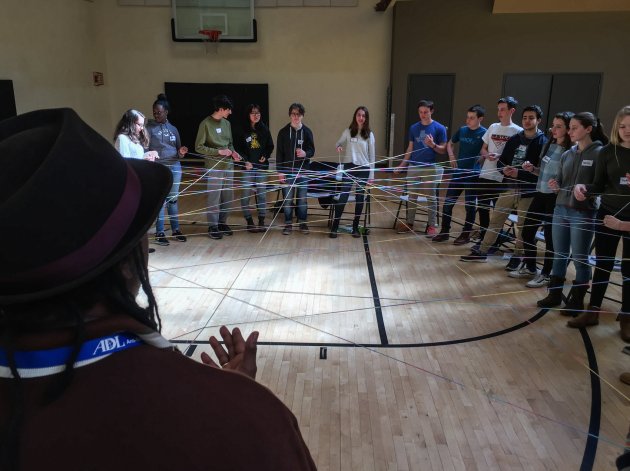
“Ok, folks! Showtime!” bellows the ADL’s New England Senior Training Consultant Rob Jones from the front of a gymnasium. His dreadlocks swinging out from under a felt fedora, Jones bounces around the circle of students, grilling them on what they’ve learned from the exercises they’ve done so far and getting them ready to be leaders instead of participants. They begin by practicing how they will introduce themselves to classmates when they run a workshop.

Rob Jones, a training consultant with the Anti-Defamation League, leads Brookline High School students in building a “web of unity.”  Tovia Smith /NPR

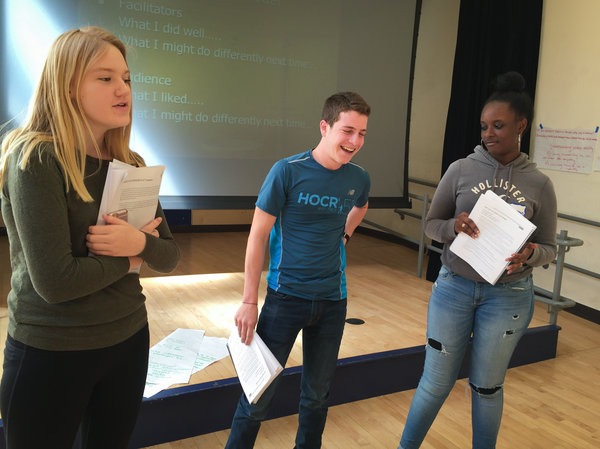
“My name is Josh Gladstone,” starts one. “I’m doing this program because I have seen many issues at the high school, and even though we attempt to have a couple of assemblies, I don’t think it’s enough.”

The students role-play and rehearse everything from ice-breakers to exercises meant to encourage empathy and bystander intervention. Jones coaches and corrects. “You don’t wanna preach,” he tells one. “You do not wanna come off as better than [them]… like you really need to help them. We’ve all laughed at jokes we shouldn’t have laughed at and made comments we shouldn’t have made. We’re all trying to learn together.”

After participating in tolerance workshops for two days, Maddie Kennedy (left), Josh Gladstone and Raven Bogues practice being presenters before they run the same workshops for their peers.  Tovia Smith /NPR

Indeed, even in their left-leaning “bubble” — as some Brookline students call it — they’ve seen an uptick in hate.

Junior Talia Vos, who moved to Brookline from Mexico, says she felt it the day after the election. She was in the hallway between classes and yelled out to a friend –- in Spanish — to save her a seat.

“A group of boys behind me, they started chanting, ‘build a wall!'” she recalls. “It’s just these new social norms of how we treat each other.”

After 30 years of doing this work, Rob Jones worries that many of the communities that need these programs the most are also in denial.

“Certain populations just won’t talk about it because they don’t get it — they don’t get it,” he says. “They’re like, ‘we don’t have any issues.’ But boy, they have a lot of bigoted behavior.”

Along with prevention, many schools these days are also quickly learning the art of “the healing response.”

In Brookline, after the hateful graffiti was found, students banded together to re-paint the table that was vandalized to “reclaim it from hate.” Other schools have called in professional facilitators to moderate a “community conversation.”

Following the KKK graffiti in Attleboro, dozens of students mobilized to counter the hate with kindness. They wrote “love notes” to each of the high school’s nearly 2000 students, staffers and teachers.

Source: How School Administrators Are Dealing With Incidents Of Hate : NPR Ed : NPR