Racisme systémique: des calculs politiques déplorables / Hearings on systemic racism in Quebec haven’t started but already nationalists are feeling victimized

Not going well (enquiries and consultations on divisive issues are hard to manage):

Les membres de la Table de concertation contre le racisme systémique ont dénoncé la politisation et l’ingérence du premier ministre dans la consultation sur le sujet, indiquant que c’est précisément cela qui est en train de faire dérailler le processus. Dans un point de presse mercredi, ils ont jugé « déplacées » les déclarations faites par Philippe Couillard au sujet de sa déconfiture à l’élection partielle, qui ouvraient la porte à l’annulation de la consultation sur la discrimination et le racisme systémique.

« Si le premier ministre aujourd’hui déclare qu’à cause de ses résultats électoraux dans Louis-Hébert il faut repenser la consultation, c’est qu’il n’a pas compris ce que ça veut dire, l’indépendance de la Commission des droits de la personne [et des droits de la jeunesse]. Ce n’est plus Philippe Couillard, le boss, c’est la Commission des droits de la personne », a insisté Émilie Nicolas, l’une des porte-parole de la Table de concertation contre le racisme systémique. « Les calculs électoraux des libéraux et la saison électorale, ça n’a strictement aucun rapport avec le mandat que s’est fait donner la Commission. »

L’exercice consultatif est trop important pour qu’il soit soumis au jeu politique et récupéré par des intérêts partisans, a indiqué pour sa part Haroun Bouazzi, président de l’Association des musulmans et des Arabes pour la laïcité au Québec. « C’est un problème de société profond qui demande du tact. »

Pour la Table de concertation, ce serait une déception si la consultation était annulée. « Mais on le serait aussi si ça se tenait tout croche. Et quand on a de l’ingérence politique dans ce qui doit être indépendant, c’est croche », a soutenu Émilie Nicolas. « Il ne faut pas d’ingérence. On veut un exercice qui soit serein et quand on se crie par la tête à l’Assemblée nationale, ce n’est pas ce que j’appelle de la sérénité. »

Conditions de réussite

Pour qu’il soit réussi, l’exercice consultatif doit se tenir à certaines conditions : la garantie de son indépendance, mais également de sa transparence. « Imaginez une seconde une consultation sur l’égalité entre les hommes et les femmes et qu’on veuille cacher les femmes victimes de sexisme », a renchéri M. Bouazzi. Il doit aussi être doté des moyens en temps et en argent, a-t-il rappelé, évoquant ainsi les critiques de l’opposition devant l’ajout de 400 000 $ portant à 900 000 $ le budget de la consultation. « Juste en pub pour la Charte des valeurs, ça a coûté 1,9 million ! »

Samira Laouni, coprésidente de la Table de concertation, déplore que certains Québécois voient dans l’exercice une manière de les accuser de racisme. « Certains médias, et je dis bien certains médias, jouent beaucoup avec les terminologies pour monter les citoyens les uns contre les autres. On a bien compris le message, nous l’entendons, le vivons sur le terrain : ce ne sont pas nos concitoyens qui sont racistes, mais les institutions », a-t-elle insisté.

Haroun Bouazzi rappelle qu’il est important de distinguer le racisme systémique, celui des institutions, de ce qui ne l’est pas, comme les actes isolés. « Une femme qui se fait cracher dessus dans la rue — malheureusement, ça existe — parce qu’elle porte un foulard, ce n’est pas un acte de racisme systémique. Mais ça le devient quand la police de Sherbrooke refuse de prendre la plainte de cette femme-là. »

Possible annulation

Mercredi matin, le premier ministre avait laissé entendre qu’il était disposé à annuler la consultation sur la discrimination systémique et le racisme et qu’il allait discuter de cette possibilité avec les membres du caucus libéral.

En après-midi, le député de Mercier, Amir Khadir, a rencontré M. Couillard et la ministre de l’Immigration, de la Diversité et de l’Inclusion, Kathleen Weil, afin d’améliorer le processus de consultation, notamment « pour être sûr que personne au Québec [ne]puisse continuer à croire que c’est le procès des Québécois ». « La rencontre a été positive et l’écoute, attentive. Nous espérons que notre échange pourra contribuer à trouver des solutions pour surmonter les appréhensions concernant cette consultation », a-t-il affirmé au Devoir, dans la foulée de sa rencontre.

Pour leur part, le Parti québécois et la Coalition avenir Québec demandent tous deux au gouvernement libéral d’en finir. « M. Couillard s’entête aujourd’hui. Il veut sauver la face. L’important, c’est qu’on agisse, qu’il n’y ait pas de procès et qu’il y ait de l’action », a lancé le chef de l’opposition officielle, Jean-François Lisée.

M. Couillard songe à revoir les modalités de la consultation. Il balaie cependant l’idée d’annoncer une série de mesures visant à enrayer la discrimination et le racisme au Québec sans avoir entendu préalablement des victimes. « Il faut laisser les gens s’exprimer aussi. On ne peut pas juste dire : “On va dicter nos solutions” », a-t-il fait valoir. Le forum public qui doit réunir plusieurs experts et acteurs du milieu pourrait donc avoir lieu comme prévu en novembre, à Montréal.

Confiance en la CDPDJ

La Commission des droits de la personne et des droits de la jeunesse a été plongée dans la tourmente après des révélations au sujet de la gestion autoritaire de sa présidente, Tamara Thermitus. Cette organisation doit-elle continuer à piloter la consultation sur la discrimination et le racisme systémique ? « On est encore dans les spéculations, et j’aimerais que la Commission réponde aux questions de journalistes et aux questions hypothétiques qui sont soulevées », s’est contentée de dire Émilie Nicolas.

Pour Nicole Filion, de la Ligue des droits et libertés, la « crise » à la Commission des droits a été instrumentalisée pour faire dérailler la consultation. « On pense que la Commission pourrait même avoir le pouvoir de décider elle-même de mener cette consultation. Je ne suis pas en train de dire que c’est ce qu’elle va faire, mais ça fait partie de ses mandats. »

Haroun Bouazzi en a profité pour réitérer l’importance de la consultation. « Lutter pour l’égalité, contre le racisme, c’est quelque chose de noble dans une société et je pense que c’est une occasion qu’on a pour montrer qu’on est capable en tant que société, en tant que nation québécoise, de mener à bien l’exercice. »

Source: Racisme systémique: des calculs politiques déplorables | Le Devoir

National Post account:

Before a single witness has been heard at Quebec’s hearings on systemic racism, before a single study has been tabled, a clear portrait of the victims is emerging.

François Legault, leader of the Coalition Avenir Québec, this week called on Premier Philippe Couillard to “end all unfair accusations against Quebecers” and cancel the commission. “Quebec doesn’t need an additional crisis on the identity issue, and especially not a crisis created by the Liberal Government,” he said.

Parti Québécois leader Jean-François Lisée said an examination of systemic racism is unnecessary and would “simply put vinegar in the wounds.” He said Couillard should “stop being so arrogant towards the will of the people” and scrap the hearings.

In a column in the Journal de Montréal last July, sociologist Mathieu Bock-Côté helped set the tone of the debate around the racism hearings — or “public self-flagellation” as he called them — scheduled to begin this month.

“We will witness an immense trial of Quebec society and, more specifically, of Quebec nationalists, who will be accused of all evils,” he wrote.

The premier’s resolve seemed to be weakening on Wednesday when he acknowledged that members of his caucus were blaming Monday’s by-election loss of a previously safe Liberal riding in Quebec City on the racism consultations. He said he would steer the process, overseen by the Quebec Human Rights Commission, “in the right direction” and assured nobody would be put on trial.

The manner in which the debate has derailed has left representatives of minority communities, armed with stacks of examples of discrimination against their members, scratching their heads. How did a debate over protecting racial minorities from discrimination get twisted into a campaign to stop labeling Quebecers as racist?

Emilie Nicolas, a board member of an umbrella group fighting systemic racism, said part of the problem is that the concept of systemic racism is poorly understood in Quebec. “It doesn’t mean that people are systematically racist,” she said.

Whereas neighbouring Ontario has been wrestling with the issue for decades, in Quebec, even the word “racism” is seen as taboo, she said.

“Any kind of gap in actual equality based on race that is a result of institutional practices is systemic racism,” Nicolas said. “It’s not about individual intentions, and it’s not about people being good or bad people.”

Source: Hearings on systemic racism in Quebec haven’t started but already nationalists are feeling victimized | National Post

Massey College under pressure to cut ties with professor after comment denounced as racist

Surprising that someone like Marrus whose extensive scholarship on the Holocaust and human rights could make such a flippant and inappropriate remark:

Massey College, an independent residential college affiliated with the University of Toronto, is under pressure from faculty and students to sever its relationship with one of the university’s professors after a comment he made was denounced as racist.

The comment was made during lunch on Tuesday by Michael Marrus, an emeritus history professor at the University of Toronto, scholar of the Holocaust, and a Senior Fellow at Massey.

Dr. Marrus was sitting with three Junior Fellows, graduate or professional students whose academic and extracurricular accomplishments have earned them a prestigious residence spot at Massey.

Hugh Segal, who leads the school and has the title of Master of Massey College, asked whether he could join the table. At that point, Dr. Marrus asked a black Junior Fellow: “You know this is your master, eh? Do you feel the lash?”

After the students left the table, Mr. Segal stayed and spoke to the professor.

“I made it clear to the Senior Fellow that the remark was completely inappropriate,” Mr. Segal said.

The three students took the issue to the dean of the college the same day and the comment was raised at a meeting of Massey’s governing board the same day. A written complaint by nine students – the three present during the lunch and additional members of the diversity committee – has been lodged with Mr. Segal, who is working with Massey’s governing board to deal with the requests made by the students.

In the wake of the comments, a petition signed by almost 200 faculty and students was sent to Massey College on Thursday asking for Dr. Marrus to end his association with the college.

“In our eyes, the very legitimacy of Massey College hinges on the effectiveness of your response to this incident,” the petition states. “We encourage you to approach this moment with the seriousness it demands, and with the courage and vision to make this an occasion for fulsome transformation.”

The petition also asks that the college issue a formal public apology, organize mandatory anti-racism training and drop the title “master” to refer to its director.

Mr. Segal said he would be open to that change.

“The term is tied to Oxbridge and the idea of master of one’s craft or art, not a master-slave reference. But we should be open to revision if it is no longer appropriate,” he said.

That demand has been made in the past. As a result, a task force has worked for several months examining whether to drop the title. It will report back in several weeks, Mr. Segal said.

He has also invited the students to meet with him.

Dr. Marrus did not respond to a request for comment. He is a Fellow of the Royal Society of Canada, the author of eight books on the Holocaust, including The Holocaust in History, Lessons of the Holocaust and co-author of Vichy France and the Jews, and a former dean of the University of Toronto’s school of graduate studies.

That history does not excuse the remark or make it less hurtful or offensive, Mr. Segal said.

“His scholarship would indicate someone who has fought his entire life for human rights. Younger Junior Fellows may not be familiar with it; it is reasonable to react how they did,” he said.​

Source: Massey College under pressure to cut ties with professor after comment denounced as racist – The Globe and Mail

Racisme systémique: la CAQ demande l’annulation de la commission

Ongoing denial among the major opposition parties:

La pression s’accentue sur le gouvernement Couillard afin qu’il abandonne l’idée d’une consultation sur la discrimination systémique et le racisme. Après le Parti québécois (PQ), c’est au tour de la Coalition avenir Québec (CAQ) d’en demander l’annulation complète.

Lundi, la porte-parole caquiste en matière d’immigration, Nathalie Roy, a fait valoir que le gouvernement rate sa cible lorsqu’il parle de racisme «systémique». «On ne croit pas que ça existe», a-t-elle affirmé lors d’un entretien téléphonique avec La Presse canadienne.

Le racisme systémique, ou racisme institutionnel, est une forme de discrimination qui s’exprime par le traitement inégalitaire d’individus racisés par une société et ses institutions.

Mme Roy a dit ajouter sa voix à celles des nombreux «analystes, leaders d’opinion, éditorialistes et chroniqueurs» au Québec qui s’opposent à une vaste consultation sur le racisme.

Le PQ avait aussi demandé, le 6 avril dernier, l’annulation des procédures dans une pétition réclamant «l’abandon immédiat du projet de consultation sur le racisme et la discrimination systémique».

Il est illusoire, selon les partis, de penser que l’on puisse tenir une telle consultation en année préélectorale, lorsque traditionnellement les esprits s’échauffent.

«Vous savez très bien que ce sont des sujets extrêmement délicats et qu’il ne faut pas faire de politique sur le dos des communautés culturelles», a affirmé Mme Roy.

«Cette consultation-là repose sur une stratégie de M. (le premier ministre Philippe) Couillard qui va exacerber les divisions et les tensions à un an des élections.»

Par ailleurs, la députée de Montarville maintient que les libéraux ont failli à leur tâche d’accroître la représentativité des membres des communautés culturelles au sein de l’administration publique.

En 2008, Yolande James, l’ex-ministre libérale de l’Immigration, avait pourtant déposé un plan d’action, intitulé «Diversité: une valeur ajoutée», qui fixait un objectif d’embauche de 25 pour cent.

Elle promettait, entre autres, d’intensifier la diffusion ciblée des offres de recrutement, l’analyse des outils de sélection en vue de s’assurer qu’ils ne comportent pas de pratiques discriminatoires, et la promotion des possibilités d’emplois dans la fonction publique.

Or, selon les informations obtenues par Mme Roy lors de l’étude des crédits, le gouvernement serait encore bien loin de sa cible, aux alentours de huit pour cent.

Annonce de la Commission des droits de la personne mardi

La Commission des droits de la personne, qui dirige la consultation, ira tout de même de l’avant et lancera ses travaux mardi, a appris La Presse canadienne.

Elle accuse du retard; la liste des organismes à but non lucratif qui sont impliqués n’est toujours pas connue, alors qu’elle devait être publiée le 1er septembre dernier.

La commission est également aux prises avec des difficultés à l’interne. La nouvelle présidente, Tamara Thermitus, serait visée par des plaintes pour abus d’autorité et mauvaise gestion.

Le lancement des travaux se fera donc sans tambour ni trompette, soit par communiqué de presse, a confirmé l’agente d’information Meissoon Azzaria.

Le PQ et la CAQ en ont également contre la décision de la Commission des droits de la personne de tenir ses premières consultations locales, auprès de personnes racisées, à huis clos.

«Le huis clos, c’est la goutte qui fait déborder le vase, a soutenu Nathalie Roy. C’est cette même commission-là, à l’intérieur de laquelle la chicane est pognée, qui va faire une consultation avec, entre autres, des témoignages à huis clos. Ça ne tient pas la route, c’est parti tout croche.»

La ministre de l’Immigration, Kathleen Weil, a pour sa part affirmé que la consultation sera à la fois publique et privée, pour permettre aux gens de s’exprimer librement.

«Notre gouvernement est déterminé à éliminer les barrières à la pleine participation des Québécois de toutes origines», a-t-elle déclaré dans un courriel, lundi.

«Le racisme et la discrimination en font partie. Nous avons le devoir d’agir et de mobiliser toute la société pour contrer ces phénomènes. C’est pourquoi nous avons confié le mandat de cette consultation à la Commission des droits de la personne et des droits de la jeunesse (CDPDJ) qui procédera d’ailleurs sous peu à l’annonce des organismes retenus pour les consultations locales», a-t-elle ajouté.

Source: Racisme systémique: la CAQ demande l’annulation de la commission | Caroline Plante | Politique québécoise

Conrad Black’s rubbish column on racism a fine example of white privilege: Paradkar

Appropriate takedown of Black’s earlier column (Conrad Black: Racism is dying, yet hateful people are still frequently accusing non-racists of it):

Many who never experience racism view it as a now shunned but once socially acceptable reality of a bygone era, kind of like smoking in the ’60s.

In line with that thinking, Black draws on history to say “most whites considered non-whites inferior, most Chinese considered non-Chinese inferior . . . I and a very large number of readers remember the murder of millions of Chinese and Cambodian and Vietnamese non-communists, and of Rwandans and Sudanese of a minority tribe or religion.”

This reduction of racism to “We all have prejudices,” springs from a half-baked understanding of the subject. It creates false equivalence between groups, just like Trump did with “all sides” at Charlottesville.

It results in ideas such as reverse racism — “racism against whites is acceptable,” Black says.

I’m not surprised when ordinary people shoot off such ideas in their emails to me. I am disappointed, however, when a rich white man with the privilege and authority to open minds instead normalizes ignorance.

All humans have prejudices and biases, of course they do. Humans discriminate. But racism isn’t just about human bias — it’s bias in the context of societal and historical power dynamics. It is also about supremacy, or the discrimination that is stitched into a socio-economic system that privileges one identity above others. In India, for instance, it benefits upper caste Hindus. In Singapore, it benefits Chinese. In Britain, it privileges men who attended private schools.

In North America and many parts of the world, thanks to colonialism, it benefits whites.

In my reading of them, serious newspapers no longer publish columns by men saying sexism is a relic of the past, or that glass ceilings are a feminist invention. Yet, such stories on racism by white people are allowed because delegitimizing progress on that front aligns with the interests of the existing racial hierarchy.

“Power concedes nothing without a demand,” said the great abolitionist Frederick Douglass in 1857. “It never did and it never will.”

I understand when working-class whites chafe at the concept of white privilege. What privilege, if you’ve just lost a job and there are mouths to feed? I suspect some views would soften if they knew white privilege just means that in their exact same circumstance, a darker-skinned person is likely to be worse off.

But when rich white people deny racism, it suggests white power is threatened. They attempt to derail advances by dictating the terms of conversation.

Increasingly this is taking the form of discussions around, “Does racism exist?” It’s in their interest to keep everyone debating on square one rather than move on to, “What are we doing about it?”

Source: Conrad Black’s rubbish column on racism a fine example of white privilege: Paradkar | Toronto Star

White people must understand that racism is real: Coren

Good commentary:

The one constant and reliable conclusion about people who argue that racism no longer exists is that they are white. And naive of course. It’s a crass statement, to be thrown in with claims such as unions have outlived their usefulness, fascism and Communism are as bad as each other, poverty a result of laziness, and the rest of the reactionary mantra. The lions of the suburbs preaching, as it were; gratingly comfortable and darkly unworldly in their invincible smugness.

The bunch of banality can usually be dismissed but lately a number of influential and even respected journalists have joined in. Sometimes they couch their arguments with a vague intelligence, often in tabloid hysteria, but the theme is repetitive: traditional values are under attack, political correctness is oppressing us, free speech is moribund, and radicals are violent and unreasonable. We’re all going to hell in a handbasket and the world has to know about it.

Most of the writers are middle-aged, as am I. In my case not only middle-aged but a white, middle-class man to boot. As such do I find some of the claims and demands of many young progressives to be shocking? Yes. But does that mean that they are wrong? No. If I can break out of my comfort zone there’s no excuse for anybody else.

Thing is, aging needn’t be synonymous with conservatism. In fact, the maxim that we become more right wing as we grow older is often the opposite of the case. Life experience, years of parenting, an increasingly safe distance from the daily economic struggle faced by younger people, the sobering reality of immortality, should all lead one to become more empathetic and reasonable.

It should also make us braver and not more fearful, but it’s fear — even hysterical fear — that seems to characterize so many of the comments from this new right collective of journalists and pundits.

Judging from what they say and write they are threatened and intimidated by the anti-Fascist movement, by Black Lives Matter, by students asking for language to be more inclusive than it used to be. Yet while these may be new movements in their specifics, there is nothing new in a fresh generation wanting a better world. When my uncle went off to Spain as a 16-year-old to fight against Franco, his parents in London were outraged. They later celebrated him as a hero.

Complacency is the last refuge of the privileged. It’s nasty in the bar or the social club but unacceptable in the pages of national newspapers. This increasingly militant wallowing in nostalgia, this reverence for a time that never was, doesn’t expand but simply destroys the debate. Yes of course such attitudes will attract fans but that says nothing — the politically blind leading the politically deaf.

It’s like the boorish parent bemoaning the music their teenagers listen to and the clothes they wear. You become figures of fun at best but at worst you’re causing harm. After one recent article denying that there was very much racism in Canada I asked a Black friend about his experience. Had he ever been stopped by the police?

He laughed. That was all. Laughed. It wasn’t a laugh of contempt but of resignation. Of course he had been stopped, several times. Is it really too much to ask those who will never be treated thus to make a small leap of empathy? Isn’t that what real journalists are supposed to do?

In the case of racism for example, it might be one thing to question some of the actions of radical groups in the Black community but quite another to refuse to understand why they were radicalized in the first place. The majority, those who enjoy power, is always frightened by anger but that does not mean that anger is not justified. As for students, socialists, and social justice campaigners, remember that liberation has to breathe. Give it some room, allow for the a few rough edges, let go and enjoy the ride.

Terms such as racism, sexism, homophobia, Islamophobia, transphobia and the rest did not develop from a vacuum and without cause. They are, alas, undeniably real. Getting old is inevitable, being young at heart, mind and soul is a choice. Do not go gently into that dark night of irrelevance.

Source: White people must understand that racism is real: Coren | Toronto Star

Rabbis ditch High Holy Days call with Trump – POLITICO

As Andrew Cohen recently argued, Trump’s Jewish advisers should stand up to him. Rabbis message should provoke reflection. As for the evangelical leaders still supporting Trump (the only council yet to have lost members or disbanded?), some signs of weakening support (Evangelicals Losing Faith in Trump After Racist Ranting):

A prominent coalition of American rabbis has decided not to hold its annual conference call with the president to mark Jewish holidays, citing Donald Trump’s remarks on the recent violence in Charlottesville, Virginia, as supporting “those who advocate anti-Semitism, racism and xenophobia.”

“We have concluded that President Trump’s statements during and after the tragic events in Charlottesville are so lacking in moral leadership and empathy for the victims of racial and religious hatred that we cannot organize such a call this year,” the groups — the Central Conference of American Rabbis, Rabbinical Assembly, Reconstructionist Rabbinical Association and Religious Action Center of Reform Judaism — said in a statement.

The coalition represents the leaders of much of the U.S. Jewish community, with the exception of Orthodox Jews, who have been much more supportive of Trump. His daughter Ivanka and her family are Orthodox Jews. The White House did not immediately respond to a request for comment on Wednesday.

The call, which is organized by the Reform rabbis group CCAR, is a standard event for presidents each year. Rabbi Steve Fox, CCAR’s executive director, said former President Barack Obama participated in each year of his administration.

“These are religious issues, not political issues. It is important that the president steps forward as a moral leader on these issues,” Fox said in an interview. “As the leader of the U.S. and the leader of the free world, we believe it is his obligation to condemn these white supremacists.”

Fox said Trump’s response to the Charlottesville unrest — among other comments, the president said there were “very fine people” amid a crowd of white supremacists and neo-Nazis protesting in defense of a Confederate statue — put the celebration of the Jewish High Holy Days at risk.

“We pray that President Trump will recognize and remedy the grave error he has made in abetting the voices of hatred,” the group said. “We pray that those who traffic in anti-Semitism, racism and xenophobia will see that there is no place for such pernicious philosophies in a civilized society.”

Trump has faced a barrage of criticism since the Charlottesville white supremacist rally that left one person dead. Trump has defended his response that “many sides” are to blame for the violence that ensued. At a campaign rally in Phoenix on Tuesday, the president accused the media of misrepresenting his response and read parts of his initial remarks, though he omitted the controversial language that seemingly placed blame on counter-protesters.

Most members on Trump’s evangelical council, meanwhile, have not distanced themselves from the president. A.R. Bernard, who once a member of the Evangelical Advisory Board, said on Friday that he resigned due to a “deepening conflict in values” between himself and the Trump administration.

Source: Rabbis ditch High Holy Days call with Trump – POLITICO

Obama’s viral tweet is wrong: Research shows babies are totally racist

The article and cited research is considerable more nuanced than the headline – babies prefer the familiar (bias) unless exposed to diversity from the beginning:

In what soon became the world’s most liked tweet, former president Barack Obama this week responded to a white supremacist march in Charlottesville, Virginia by posting a famous quote from South African leader Nelson Mandela.

“No one is born hating another person because of the color of his skin or his background or his religion,” reads the quote, which is pulled from Mandela’s 1994 autobiography, Long Walk to Freedom.

Two subsequent tweets then finish the quote, “people must learn to hate, and if they can learn to hate, they can be taught to love. For love comes more naturally to the human heart than its opposite.”

The quote is a nice sentiment, but it doesn’t quite line up with science. According to a growing body of infant research, racism is often a default setting for babies. Tolerance, not racism, is what needs to be hammered into young minds.

“Parents do not teach children to be biased,” said Kang Lee, a human development researcher at the University of Toronto.

Lee said that while a racist parent can exploit a child’s innate biases, most children will organically begin to dismiss other races soon after their birth.

Mandela was correct in that no baby is born with inherent prejudices. But at around six months, the average infant will automatically begin to distrust anything that looks and sounds different than their parents.

“Because most of us are born into monoracial environments we start to show preferences for own-race individuals, and then we start to show biases,” he said.

The baby begins to associate positive things, such as happy music, with their own race. Sad music gets associated with other races. Foreign languages and accents, meanwhile, sound scary and unfamiliar.

“If they hear English, they prefer English — they don’t like people who speak French,” said Lee.

Much of Lee’s research has focused on tracking the eye movements of young children to gauge their racial preference. A June study exposed infants to images of ethnically diverse faces, and discovered that the babies spent most of their time looking at the faces that most resembled their parents.

“Caucasian infants look longer at Caucasian faces than at other-race ones,” it read, adding “when the same Caucasian and Asian faces are shown to Asian three-month-olds … they look more at the Asian faces.”

Documented in numerous other studies around the world, it’s been called the Other Race Effect, the inability of infants to distinguish the faces of ethnicities they aren’t used to.

Spontaneous outpourings of childhood racial bigotry can sometimes emerge on the first day of preschool. In a February article in Today’s Parent, a Toronto parent expressed horror that her four-year-old son stopped playing with black children and declared his sudden dislike for NHLer P.K. Subban.

“He had been obsessed with P.K. since age two. Suddenly, he refused to wear his P.K. jersey or sleep with his P.K. doll,” said the mother, whose name was not used in the story.

Another of Lee’s tests exposed seven-month-olds to a video of a human face that would gaze at different corners of the screen, after which pleasing images of animals would appear in those corners.

Across the board, babies were more likely to trust the face’s “predictions” if it matched their own race — even if the faces were wrong.

An image showing the video presented to infants, in which pictures would appear at corners of the screen in sync with the gazes of a face.

Of course, the outcomes of these kinds of tests are much different for babies who grew up around other races.

An illuminating 2006 study out of Tel-Aviv University exposed three-month-olds to a gallery of black and white faces. Caucasian Israelis favoured white faces and African Ethiopians favoured black faces. However, Israeli Ethiopian babies — who lived in predominantly white surroundings — showed no preference for either.

“Early preferences for own-race faces may contribute to race-related biases later in life,” read the study.

Lee has been trying for 10 years to gauge the implicit biases of babies from mixed-race households, but even in Toronto, Lee’s lab has not been able to recruit enough mixed-race babies to study.

Raising a child free of racism is generally a simple matter of getting the children accustomed to other races. Lee compared it to how sushi gained a hold on the North American palate.

A combo picture shows portraits of newborn Israeli babies on October 31, 2011 at the maternity ward of the Hadassah Ein Kerem hospital in Jerusalem.

Critically, said Lee, the children must never be told that the figures they’re seeing are a different race than them.

A white child should be exposed to public figures like Barack Obama, for instance, but without parents explicitly specifying that Obama is a black man.

“If you do that, you actually increase the racial biases, even if you’re talking about positive things — this is the mistake we’ve been making,” Lee said.

In a recent study, Lee and fellow researchers tested the theory on children in a Chinese preschool.

In one test, children were asked to look at non-Chinese faces and match one of the faces with a portrait they were provided.. In another, children were asked simply to sort the non-Chinese faces by “white” and “black.”

“Individuation training significantly reduced Chinese children’s implicit racial bias against Blacks and Whites, but mere exposure did not,” the study found.

South African President Nelson Mandela takes the oath 10 May 1994 during his inauguration.

Mandela’s quote was taken from a section of his autobiography that describes his inauguration following South Africa’s first free elections after decades of apartheid. Even during his 27-year imprisonment, Mandela said that he never doubted such a day would come.

“I always knew that deep down in every heart there is mercy and generosity,” he wrote.

This sentiment is indeed finding footing in science.

At Yale University’s Infant Cognition Center — run by Saskatchewan-raised researcher Karen Wynn — tests keep showing that babies are inherently moral beings who understand the difference between right and wrong.

The only trick is getting those babies to show kindness to the babies who don’t look like them.

As Paul Bloom, a collaborator with the centre wrote in a lengthy piece for The New York Times, “our initial moral sense appears to be biased toward our own kind.”

Source: Obama’s viral tweet is wrong: Research shows babies are totally racist

Plan for hearings on ‘systemic racism’ in Quebec divides province’s political left

Good capturing range of perspectives, including blindness to the issue:

Quebec is being widely criticized for its plan to launch public consultations on systemic racism, even by those who agree visible minorities face many structural barriers in the province.

The debate has highlighted a deep divide among Quebec’s political left, with some people saying the consultations encourage an ideology of victimhood and demonize the province as inherently racist.

Some civil rights activists argue the consultations are meaningless unless the government is finally prepared to hold its institutions accountable for failing to uphold racial diversity.

Moreover, activists say they will increasingly use the court system to push through changes in society regardless of what comes out of the government’s consultations.

Michele Sirois, a political scientist and president of a women’s rights organization, believes there is no systemic racism in Quebec.

That concept, she explained in an interview, is imported from the United States, which has a history of structural racism against people of colour.

“The Americans had a slave trade,” she said. “We didn’t. Our problem is about the full integration of immigrants.”

Sirois recently penned an opinion piece in Le Devoir, a left-of-centre newspaper, and wrote that the term “systemic racism” reflects “an ideology of victimhood” and promotes the idea that only white people can be racist.

“The left is divided in Quebec,” Sirois said in the interview. “And there is an increase of people on the left who are saying, ‘stop these consultations, which will only increase racial tension in society.”‘

Quebec has asked its human rights commission to launch public consultations on systemic discrimination and racism.

Only discussion on discrimination involving race, colour or ethnic and national origin will be allowed when the hearings begin in September.

The goal, the government said, is to forge “concrete and durable” solutions in order to “fight these problems.”

The Canadian Press attempted to contact Immigration Minister Kathleen Weil, whose office is leading the consultations, but was told she would not be available to comment.

Weil said in July, when she first made the announcement, the consultations “are an occasion to mobilize all of civil society … to propose actions to eliminate the obstacles towards full participation of all Quebecers.”

Fo Niemi, executive director for the Montreal-based Centre for Research Action on Race Relations, said those on the right and the left who deny the existence of systemic racism aren’t looking hard enough.

One clear example, he said, is that Quebec’s human rights commission is so understaffed it can only render decisions many years after a complaint is lodged.

Niemi cited the case of a young man who waited seven years to be awarded $33,000 by the commission after he was racially profiled by Montreal police in 2010.

That case also highlighted the fact police are still not tracking data on racial profiling, five year after the force said it would start taking profiling complaints against its officers seriously.

“The system knows that going to the human rights commission is like going to a nameless graveyard,” Niemi said. “This is a systemic problem.”

Another example of systemic racism in Quebec society is reflected in the lack of diversity in the judiciary, he said.

Niemi pointed to a 2016 study published by the Institute for Research on Public Policy indicating that out of 500 judges in Quebec, three were visible minorities.

 He said if the percentages of visible minorities within institutions such as the public service, corporate boards of directors and the judiciary are lower than in regular society, that is a sign of systemic racism.

“It’s an indication,” Niemi said. “It’s a very important evidential element.”

Niemi said activists are increasingly going to the courts to force society to become more diverse, because nothing else seems to be working.

“It’s inevitable,” he said.

“It’s only a matter of time before some of these legal actions start to take place. Quebec is a bit slower in terms of this kind of litigation, but it’s coming and we are leading that movement for change.”

Source: Plan for hearings on ‘systemic racism’ in Quebec divides province’s political left | National Post

The mystery of high unemployment rates for black Americans – The Economist

Further to earlier posts on blind cvs and discrimination:

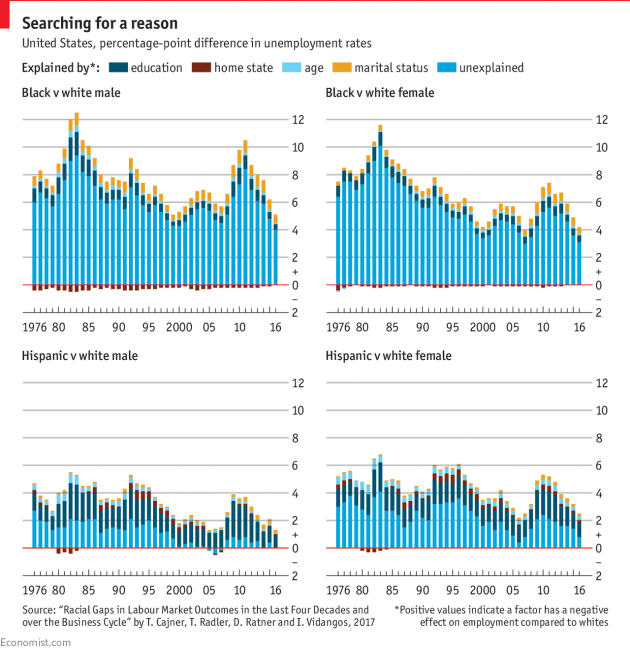
Lower levels of education cannot account for the size of the racial gap. The real cause may be discrimination

Using American census data from 1976 to 2016, the authors built a statistical model using four factors they expected to account for variations in unemployment between racial minorities and whites: education, age, marital status and the state a person lives in. Among men, these variables collectively explained around three-quarters of the difference in joblessness rates between Hispanics and whites—but only about one-fifth of the gap between blacks and whites.

The authors put forward three possible reasons for this stubborn discrepancy. First, they suggest that nominal educational attainment could be a poor measure of labour-market skills: schools vary widely in quality, and those in majority-black districts tend to underperform on standardised tests. A second potential reason is mass incarceration. Around one in three black men spend time behind bars during their lives, which severely hampers their employment prospects upon release.

The third possible explanation is outright discrimination. One study in 2004 provided strong evidence that racism among employers is at least partly to blame. The authors responded to “help wanted” advertisements in newspapers in Boston and Chicago with fake resumes. They gave names common to black Americans to some fictitious applicants, and names common to whites to the rest. Every other detail was identical. Sure enough, the candidates with stereotypically white names received 50% more job interviews.

Source: The mystery of high unemployment rates for black Americans

People Suffer at Work When They Can’t Discuss the Racial Bias They Face Outside of It

Interesting HBR-published study on the racial bias link between the outside and work environments by Sylvia Ann Hewlett, Melinda Marshall and Trudy Bourgeois:

Last month, in an unprecedented show of solidarity, 150 CEOs from the world’s leading companies banded together to advance diversity and inclusion in the workplace and, through an online platform, shared best practices for doing so. To drive home the urgency, the coalition’s website, CEOAction.com, directs visitors to research showing that diverse teams and inclusive leaders unleash innovation, eradicate groupthink, and spur market growth. But as Tim Ryan, U.S. Chair and senior partner at PwC and one of the organizers of the coalition, explains, what galvanized the group was widespread recognition that “we are living in a world of complex divisions and tensions that can have a significant impact on our work environment” — and they need to be openly addressed.

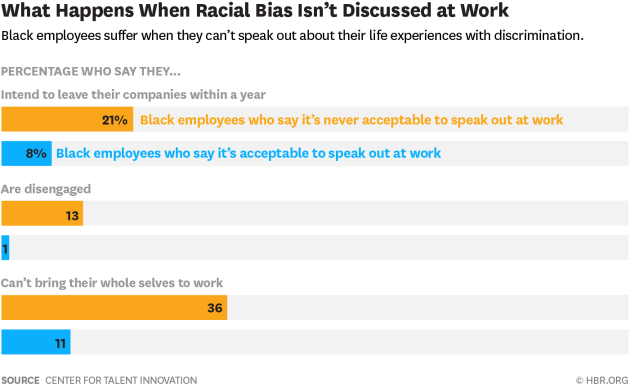
At the Center for Talent Innovation, we wanted to look into these suspicions. Do the political, racial, and social experiences that divide us outside of work undermine our contributions on the job? Our nationwide survey of 3,570 white-collar professionals(374 black, 2,258 white, 393 Asian, and 395 Hispanic) paints an unsettling landscape: For black, Asian, and Hispanic professionals, race-based discrimination is rampant outside the workplace. Black individuals are especially struggling, as fully 78% of black professionals say they’ve experienced discrimination or fear that they or their loved ones will — nearly three times as many as white professionals.

But 38% of black professionals also feel that it is never acceptable at their companies to speak out about their experiences of bias — a silence that makes them more than twice as vulnerable to feelings of isolation and alienation in the workplace. Black employees who feel muzzled are nearly three times as likely as those who don’t to have one foot out the door, and they’re 13 times as likely to be disengaged.

W170626_HEWLETT_WHATHAPPENS


The response, at most organizations, is no response. Leaders don’t inquire about coworkers’ life experiences; they stay quiet when headlines blare reports of racial violence or videos capture acts of blatant discrimination. Their silence is often born of a conviction that race, like politics, is best discussed elsewhere.

But as evidenced by the formation of the coalition and the initiatives we captured in our report, that attitude is shifting. Conscious that breaking the silence begins with their own example, captains of industry are talking about race, both internally with their employees and externally with the public. After a spate of shootings of unarmed black men last summer, Ryan initiated a series of discussion days to ensure that all employees at PwC better understood the experiences of their black colleagues. Michael Roth, CEO of Interpublic Group, issued an enterprise-wide email imploring coworkers to “connect, affirm our commitment to one another, and acknowledge the pain being felt in so many of our communities.” Bernard Tyson, CEO of Kaiser Permanente, published an essay in which, in a plea for empathy, he shared his own experiences of discrimination. And in an emotional recounting of his black friend’s experience outside the office that went viral on YouTube, AT&T chairman Randall Stephenson encouraged employees to get to know each other better.

Leaders who display this kind of courage don’t always see immediate rewards, but in the long term, our research suggests that the payoff could be extraordinary. Of those who are aware of companies responding to societal incidents of racial discrimination, robust majorities of black (77%), white (65%), Hispanic (67%), and Asian (83%) professionals say they view those companies in a more positive way. Interviews with employees at firms like Ernst & Young point to stronger bonds forged between team leaders and members as a result of guidelines disseminated to managers on how to have a trust-building conversation. Town halls at New York Life with members of the C-suite and black executives have likewise paved pathways for greater understanding across racial and political divides.

Source: People Suffer at Work When They Can’t Discuss the Racial Bias They Face Outside of It