Anti-racism campaign in B.C. school district draws backlash from parents

Prompted a needed if uncomfortable conversation regarding one’s respective advantages or disadvantages:

An anti-racism program in a rural B.C. school district has caused an uproar among some parents.

In January, administration for School District 74 — which includes Cache Creek, Ashcroft and nearby smaller communities — plastered anti-racism posters in the halls and classrooms of the elementary and high schools in the area. The posters feature administration members reflecting on racism, in their own words.

Fair enough, say critical parents. But one poster featuring the superintendent of schools, Teresa Downs, is being seen as a step too far.

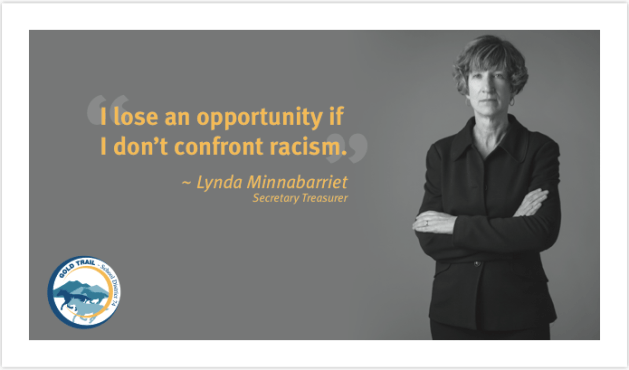
“I have unfairly benefited from the colour of my skin. White privilege is not acceptable,” reads the poster.

Downs, who has worked in education for 16 years and as superintendent for seven, says the administration was inspired by a billboard campaign in Saskatoon and felt compelled to do something similar in a school district with 60 per cent Indigenous children.

“We’re doing things to improve the sense of belonging and cultural safety for students of Indigenous ancestry,” said Downs. “So conversations on racism, privilege and prejudice are important for us to have.”

Downs says the school board understands that discussions about race and privilege can make some people uncomfortable, “but we truly believe that education and dialogue is what is really needed.”

Gil Anderson, a 37-year-old father of three, says life in the Gold Trail district has been “pretty harmonious” since he moved there from Nanaimo in 1997.

But the posters have caused unrest. Anderson says there was no notice given to parents about the posters, and he considers the wording of Downs’s is problematic.

“I teach my kids equality. I teach them tolerance. They know they’re no better being white than anybody is being a different colour,” said Anderson, who works the evening shift operating equipment for a local company. “(The poster) singles out people of a certain colour.”

Anderson isn’t the only parent to raise the issue both online and with the school board. While Downs says only four parents have voiced their concerns, the furor online has been more widespread.

A letter written by another parent to the school board obtained by Postmedia is critical of the administration’s “race-driven” policies and questions the children’s ability to grasp complicated social concepts like privilege.

“Children have innocent souls,” it reads. “I feel you have no moral ground to try to brainwash my children into thinking how you want them to.”

Downs says that concerned parents are free to speak to school administration privately, but Anderson and others believe there should be a public forum to discuss the controversial topic.

In Canadian academia, white privilege is typically defined as “the unquestioned and unearned set of advantages, entitlements, benefits and choices bestowed upon people solely because they are white. Generally white people who experience such privilege do so without being conscious of it.”

Source: Anti-racism campaign in B.C. school district draws backlash from parents

The double standard of driving while black – in Canada: Marci Ten

Speaks for itself:

Another sleepless night. I keep thinking about what happened. I keep thinking about what could have happened. What was meant to be a quiet Sunday evening last week turned into something else. That I am an award-winning journalist didn’t matter. That I co-host a national television show didn’t matter. That I have lived in the neighbourhood for 13 years didn’t matter.

But being black mattered. Maybe the hooded parka I was wearing mattered, too. I was being stopped by a police officer in my driveway outside of my house in Toronto.

I was at home. My safe place. And I was scared.

How often does this scenario play out? A lot more often than we want to admit. Canada is one of the most diverse countries in the world, but racism permeates every aspect of our society. We like to point fingers at the racial discord in the United States, but fail to acknowledge our shortcomings here at home. Our country has to get its own house in order before patting itself on the back for being a paragon of racial harmony.

The black community’s relationship with the police in this country has been well-documented and much written about: If you are a person of colour in Canada, you experience a profoundly different – and sometimes troubling – relationship with the law. When we hear about incidents involving people of colour and the police, or other enforcement agencies, they seem to mostly involve black men – my father and husband included. But this is not an experience limited to men, as I have personally come to understand.

For the third time in eight months, I was being questioned by a police officer – and I had broken no law.

I had just driven my daughter to my sister’s house for a sleepover. The streets were unusually quiet as I pulled into my driveway. A police cruiser was parked behind me – lights flashing. I got out of my car to ask him why he was there.

“Get back in your vehicle!”

“Pardon?” I asked, alarmed by his tone.

“Get back in your vehicle!”

I quickly got back into my car and shut the door. As he approached, I cracked the door open to hear what he had to say. He told me to close it, and then gestured for me to lower the window. As the window lowered, I looked up at him – at his uniform, his stance, his eyes – and wondered: “What now?” I felt a queasiness in my stomach. I felt powerless, but summoned some strength. I’m not going to break, I told myself. I will remain calm.

But I’m not calm. I’m frustrated. I’m angry. I don’t deserve this. Not now, nor the previous times I had been pulled over. “I want to let you know you’re being recorded,” he informed me. “You failed to stop at a stop sign back there. That’s dangerous, there’s a school there … lots of kids.” I told him my daughter attends that school, silently giving thanks she wasn’t with me. He asked for my ID, and I handed over my licence, registration and ownership.

As he perused them he asked me if I live here. “Yes,” I said. When he returned to his cruiser, my reporter instincts kicked in: I texted my family to let them know what was happening, so there was a definitive record of time and place. My phone started ringing – it was my sister.

I answered and quickly explained what was going on. She told me, repeatedly, to get his badge number. In the background, I heard my mom asking if I was okay. I hung up.

Next came a panicked text from my daughter asking why a police cruiser was in our driveway – apparently a friend and neighbour had seen the flashing lights and contacted her to ask what was happening. I texted back that an officer said I had rolled through a red, referring to the flashing red stop light in front of my daughter’s school. A couple seconds later, the officer returns. “I’m going to give you a warning. Be careful driving out there.”

“If I’ve done something wrong give me the ticket,” I said. “I’m prepared to pay it.”

I went on to tell him that this marked the third time in the past eight months that I had been stopped by police. Every time the initial questions had been the same: “Do you live around here? Is this your vehicle?” In every case, I wasn’t issued a ticket.

Then I asked the officer point blank: “How do I explain this to my kids? I teach them to be respectful, fair and kind, but I’m not feeling respected, served or protected right now.”

He looked at me, bid me good night and walked away.

But there is no walking away from the truth. The stop signal at my daughter’s school is half a kilometre away; why wasn’t I pulled over there? Why did he follow me home? Why, after seeing the address on my driver’s licence, did he still ask if I lived at my home?

Who you are doesn’t matter; it’s what you are. If you are black in Canada, you are subject to a different standard and, often, seemingly, different laws.

So how do we fix this? There are no easy answers, but one solution would be to start with our kids. We know that children are not born with prejudice. Racism is learned. A study by renowned Harvard psychologist and racism expert Mahzarin Banaji shows that biases can be instilled as early as 3.

What if tolerance and empathy are prioritized in the early stages of childhood? We’ve seen far too many times what happens when they’re not. Bottom line – when we do better, our kids do better. Only then can we precipitate change.

I lingered behind the wheel for a long while, too shaken to go inside. So many thoughts. I finally forced myself to get out of the car, walked to the front door and slowly turned the key.

via The double standard of driving while black – in Canada – The Globe and Mail

WARMINGTON: Anti-racism meeting turns into The Jerry Springer show

Sharp contrast to the session organized by the Riddell Centre for Political Management about a month ago in Ottawa:

It was racism industry on full display.

In one corner you had the “anti racists” who gathered together to talk about racism in Canada and new legislation to end it. In the other you had the so-called “racists.”

Needless to say this was set up to be a powderkeg.

What was billed as an “Anti-Racism Town Hall” at the Grant African Methodist Episcopal Church on Gerrard St. at Woodbine Ave. on Thursday evening turned into part socialism lecture and part The Jerry Springer Show.

Actually it was so surreal it seemed more like a Simpson’s town hall meeting, complete with characters like Mayor Quimby, Sideshow Bob, Mr. Burns and Krusty the Clown.

And yes Toronto Police 55 Division was called in.

First things first. On the stage you had the author of the M-103 motion to protect criticism of Islam and other religions MP Iqra Khalid, Minister Responsible for Anti-Racism MPP Michael Couteau, MPP Beaches-East York MPP Arthur Potts and MP Beaches-East York Nathaniel Erskine-Smith, all of whom had a similar message about the existence of racism in Canada and Ontario and the need to fix it.

There was talk about how it costs $60 million a year to “incarcerate” youth in the Jane and Finch area and how 22% of black university graduates don’t get jobs while it’s at just 10% for white “drop outs,” how “colonial Canada” supplanted the Indigenous and how government needs to make sure “every person can reach his or her full potential” by “looking for ways to eliminate systematic racism barriers.”

Well this was not sitting well with some of the proud to be rednecks in the crowd. And it boiled over when Khalid started talking about M-103 was not anti blasphemy law but more a tool to foster stronger diversity.

“You are a fraud,” yelled one guy.

“Is this going to be Sharia law,” a woman shouted.

“This is only about protecting Islam and designed to bring more Muslims over here,” said another man.

The most vocal and animated was none other than Eric Brazau who has spent nine months in jail for “promoting hatred” and at one point held up a copy of the Q’uran in protest.

The crowd grew impatient with the constant interruptions and started yelling “shut up” and “racist’s out.”

The bad behaviour was mostly from those protesting M-103 but there were some outbursts from the anti-racism crowd as well — including one man pointing out white supremacist Council of Conservative Canadians founder Paul Fromm and telling him to F… off.”

Fromm did not engage but instead quietly wrote notes in the corner of the room. However, others were fully inflamed. At one point it got so heated in the room it felt like it could explode.

“The police have been called and some people will be asked to leave,” said Erskine-Smith.

The police did come but stayed outside in their car and didn’t escort anybody out.

“It was a strange night,” said Jewish Defence League National Director Meir Weinstein, who was not impressed with the yelling at the politicians.

“I did have a question about why it is politicians accept awards from Islamic terror groups that want to kill Jews and annihilate Israel but this is not part of any conversation?” said Weinstein. “Isn’t that racism?”

It was a fair question but the grandstanding behaviour of some drowned it out. Ironically the rude shouting played right into the hands of the politicians who never lost their cool, composure or even sense of humour.

But the fact there were politicians on one side suggesting Canada is systemically racist and people on the other side acting exactly like they are indeed racist is no laughing matter.

Source: WARMINGTON: Anti-racism meeting turns into The Jerry Springer show

How to support celebrating Canada’s Black heritage and challenge racism: Tiffany Gooch

A bit of a laundry list and given resource and other constraints, some guidance in terms of relative priorities would be helpful (I always start with improved data!):

At the end of January, Prime Minister Justin Trudeau announced the official Canadian recognition of the UN Decade for People of African Descent, which runs from 2015 to 2024.

The gesture was three years late and largely overlooked by traditional media, but for some, the very act of a sitting prime minister acknowledging anti-Black racism — and making a public commitment to dealing with it — was a moment of historical significance.

The fight against anti-Black racism in Canada is not new. Generations of Black community members have been tirelessly carrying out this work across the country with insufficient support from government. It’s worth reading through the #BlackLivesCDNSyllabus developed and updated by Anthony Morgan and Huda Hassan for Canadian context.

As a next step, strategies and plans should be developed that include milestones for cross-ministerial policy collaboration with budgeted allocation, public and private partnerships, and sincere, thoughtful regional community consultations to guide the process.

There are opportunities for the private sector, unions, academic institutions, community-based organizations, and individuals to participate in seeking to understand, celebrate, and most importantly, support the advancement of the challenging work ahead.

Some key targets for these plans should include national celebrations of emancipation alongside official apologies for the enslavement of Black people in Canada and the systemic, anti-Black racism that continues to permeate Canadian institutions.

Aug. 1 should be a national holiday celebrating emancipation in Canada. Perhaps as a part of the federal recognition of the decade, the Greatest Freedom Show on Earth in Windsor, Ont., could come alive once more.

On the heels of Canada 150, we have an opportunity to band together to preserve and celebrate Black Canadian history and cultural contributions, beyond the month of February alone. There are extraordinary institutions — specifically many churches, built as sanctuaries and celebrations of Black Canadian freedom — well past observing their sesquicentennials.

Churches like Salem Chapel BME, where Harriet Tubman herself worshipped and organized to emancipate hundreds of enslaved Black families through a courageous journey to reach Canadian soil.

While we study and celebrate Black history let’s take a closer look at both the present and the future we want to create. The federal government should follow provincial leadership and gather disaggregated data, so we can see with numbers how our policies are having a disproportionately negative impact on Black Canadians.

It’s also important to remember that the African diaspora in Canada is beautifully diverse. We have different experiences, and will have different definitions of what success looks like as the Canadian acknowledgement of the decade is carried out.

We must also consider that it is real intergenerational trauma we are exploring and seeking to rectify. In the process, Black Canadians live in different stages of grief that impact how individuals contribute to this mentally and emotionally exhausting dialogue and work.

The federal government has taken an important step forward, and I hope that an equity lens can be applied in the development of policy with consideration to unique barriers faced by Black women, persons with disabilities, and members of the LGBTQ+ community.

Tangibly this means policy focus and investments in education, poverty reduction, health equity and especially mental health supports necessary for the success of Black Canadians.

This means acting on our responsibility to respond promptly to the issues facing Black communities at this very moment. This includes cannabis legalization, which should be rolled out with a proactive pardoning approach that ensures individuals with previous cannabis related convictions are not restricted from participating in the legal market.

It requires action to improve the experiences and outcomes of Black workers as they come forward with stories about the racism and micro-aggressions faced when training and working within their respective sectors. It further requires taking an honest look at public and private sector leadership positions and sponsoring a definition of diversity that goes beyond gender.

It means not turning a blind eye to the disproportionate impact of the global migrant crisis on Black families seeking refuge within our borders, and working to correct the systemic injustices, like the risk of deportation of children and youth in care that the case of Abdoul Abdi has shown us.

I challenge Canadians to aspire to global leadership, beginning by taking an honest look at our own shortcomings and contributing to the powerful role we can play as a country in creating better outcomes for people of African descent, both within and outside of our borders.

via How to support celebrating Canada’s Black heritage and challenge racism | Toronto Star

Computer Program That Calculates Prison Sentences Is Even More Racist Than Humans, Study Finds

Not surprising that computer programs and their algorithms can incorporate existing biases, as appears to be the case here:

A computer program used to calculate people’s risk of committing crimes is less accurate and more racist than random humans assigned to the same task, a new Dartmouth study finds.

Before they’re sentenced, people who commit crimes in some U.S. states are required to take a 137-question quiz. The questions, which range from queries about a person’s criminal history, to their parents’ substance use, to “do you feel discouraged at times?” are part of a software program called Correctional Offender Management Profiling for Alternative Sanctions, or COMPAS. Using a proprietary algorithm, COMPAS is meant to crunch the numbers on a person’s life, determine their risk for reoffending, and help a judge determine a sentence based on that risk assessment.

Rather than making objective decisions, COMPAS actually plays up racial biases in the criminal justice system, activists allege. And a study released last week from Dartmouth researchers found that random, untrained people on the internet could make more accurate predictions about a person’s criminal future than the expensive software could.

A privately held software, COMPAS’s algorithms are a trade secret. Its conclusions baffle some of the people it evaluates. Take Eric Loomis, a Michigan man arrested in 2013, who pled guilty to attempting to flee a police officer, and no contest to driving a vehicle without its owner’s permission.

While neither offense was violent, COMPAS assessed Loomis’s history and reported him as having “a high risk of violence, high risk of recidivism, high pretrial risk.” Loomis was sentenced to six years in prison based on the finding.

COMPAS came to its conclusion through its 137-question quiz, which asks questions about the person’s criminal history, family history, social life, and opinions. The questionnaire does not ask a person’s race. But the questions — including those about parents’ arrest history, neighborhood crime, and a person’s economic stability — appear unfavorably biased against black defendants, who are disproportionately impoverished or incarcerated in the U.S.

A 2016 ProPublica investigation analyzed the software’s results across 7,000 cases in Broward County, Florida, and found that COMPAS often overestimated a person’s risk for committing future crimes. These incorrect assessments nearly doubled among black defendants, who frequently received higher risk ratings than white defendants who had committed more serious crimes.

But COMPAS isn’t just frequently wrong, the new Dartmouth study found: random humans can do a better job, with less information.

The Dartmouth research group hired 462 participants through Mechanical Turk, a crowdsourcing platform. The participants, who had no background or training in criminal justice, were given a brief description of a real criminal’s age and sex, as well as the crime they committed and their previous criminal history. The person’s race was not given.

“Do you think this person will commit another crime within 2 years,” the researchers asked participants.

The untrained group correctly predicted whether a person would commit another crime with 68.2 percent accuracy for black defendants and 67.6 percent accuracy for white defendants. That’s slightly better than COMPAS, which reports 64.9 percent accuracy for black defendants and 65.7 percent accuracy for white defendants.

In a statement, COMPAS’s parent company Equivalent argued that the Dartmouth findings were actually good.

“Instead of being a criticism of the COMPAS assessment, [the study] actually adds to a growing number of independent studies that have confirmed that COMPAS achieves good predictability and matches the increasingly accepted AUC standard of 0.70 for well-designed risk assessment tools used in criminal justice,” Equivalent said in the statement.

What it didn’t add was that the humans who had slightly outperformed COMPAS were untrained — whereas COMPAS is a massively expensive and secretive program.

In 2015, Wisconsin signed a contract with COMPAS for $1,765,334, documents obtained by the Electronic Privacy Information Center reveal. The largest chunk of the cash — $776,475 — went to licensing and maintenance fees for the software company. By contrast, the Dartmouth researchers paid each study participant $1 for completing the task, and a $5 bonus if they answered correctly more than 65 percent of the time.

And for all that money, defendants still aren’t sure COMPAS is doing its job.

After COMPAS helped sentence him to six years in prison, Loomis attempted to overturn the ruling, claiming the ruling by algorithm violated his right to due process. The secretive nature of the software meant it could not be trusted, he claimed.

His bid failed last summer when the U.S. Supreme Court refused to take up his case, allowing the COMPAS-based sentence to remain.

Instead of throwing himself at the mercy of the court, Loomis was at the mercy of the machine.

He might have had better luck at the hands of random internet users.

Source: Computer Program That Calculates Prison Sentences Is Even More Racist Than Humans, Study Finds

Toronto Sun editorial: Learning from the hijab hoax

Unfortunately in the era of social media, immediate responses are required. However, the suggested disclaimer – “If what has been alleged is true” – is sound advice:

Since Prime Minister Justin Trudeau, Ontario Premier Kathleen Wynne and Toronto Mayor John Tory didn’t say it, we will.

The problem with Toronto’s now infamous hijab hoax is that it will make Muslims and others who are actual victims of hate crimes more afraid to come forward for fear of not being believed.

And it will make the public more cynical about the reporting of hate crimes.

We aren’t going to fault the prime minister, the premier or the mayor for assuming the initial report of an 11-year-old child describing how she had been attacked by an “Asian man” who twice tried to cut her hijab with scissors was true.

Many people believed it was true. We reported it on our front page.

But once Toronto police said, following their investigation, that no attack had occurred, it was incumbent on Trudeau, Wynne and Tory to stress the dangers of anyone falsely claiming to be the victim of a hate crime, or for that matter any crime.

Instead, they ran for cover, saying only that they were glad that no attack had occurred but that it was important to continue to be vigilant about fighting hatred and racism.

Of course it’s important to fight hatred and racism, but that’s not the lesson to be learned from what happened in this case.

The lesson in this case is that when a school board and municipal, provincial and federal politicians leap to conclusions before all the facts are known, the revelations of those facts can lead to the very thing they hoped to avoid — public cynicism about the reporting of hate crimes.

When the media wrongly identify a member of a minority group as the perpetrator of a crime, politicians are the first to condemn them.

Why then their silence when they wrongly identify a member of minority group as the victim of a crime?

The next time a crime of this nature is alleged, we suggest our political leaders say words to the effect of: “If what has been alleged is true, it’s completely unacceptable in our city (or province, or country) and we are confident the police will treat this matter seriously and investigate it thoroughly.”

Which, by the way, is exactly what happened.

Source: EDITORIAL: Learning from the hijab hoax

Douglas Todd: The misused concept of racism, refined

Doug Todd’s summary of the debates between Cornel West, Ta-Nehisis Coates and John McWhorter.

His distinction between unconscious racism (or implicit bias) vs active discrimination is overstated, as implicit bias or discrimination is not as innocuous as he presents. Just as not every action or attitude cannot be attributed to implicit bias or discrimination, neither can every case of implicit bias being dismissed.

On the other hand, looking at the issues from a narrow, one community perspective, as Holly Anderson does with the word “clan” undermines the more serious issues related to implicit bias and discrimination (much as the removal of the word ‘chief’ in Toronto District School Board job titles):

Are we starting to refine our concept of racism, arguably the most explosive word in North America today?

Three powerful African-American public intellectuals are in a high-level debate over racism. All three agree racism can be a serious problem, especially in the U.S., where black-white tensions for some still run deep.

But the eloquent authors — Cornel West, Ta-Nehisi Coates and John McWhorter — have extraordinarily different perspectives on the extent of racism. Their debate, as well as discussion in Canada, may be requiring cultural warriors on all sides to become clearer about what they mean when they use, and in many cases misuse, the term racism.

In pluralistic Canada, the anti-racism movement is not quite as aggressive as in the U.S., especially in regards to blacks, who make up only two per cent of this country’s population. Still many Canadian activists and academics try to give it top prominence.

One reason it’s important for Canadians to be clear about the meaning of racism is that cities such as Vancouver and Toronto now have among the world’s highest proportions of foreign-born residents, with ethnically hyper-diverse populations.

Discussions of housing, welfare, jobs, renting, land claims and neighbourhood enclaves sometimes touch on race and nationality. And we have to talk about these issues without fear of being silenced by trumped-up claims of racism, which has occurred over the decades.

One revealing manifestation of Canada’s anti-racism movement emerged from Simon Fraser University in 2017. Philosophy prof. Holly Andersen launched a petition to have the Scottish-rooted word “Clan” removed from the names of the university’s sports team. She argued it is potentially offensive to blacks, since they might associate it with the Ku Klux Klan.

What can a debate among America’s leading black intellectuals tell us about the value of Andersen’s petition, and, most importantly, about how to engage thorny issues that often become muddled over misunderstandings of racism?

To answer we need to know why Harvard’s Cornel West, a veteran left-wing civil rights activist, so strongly disagree with Coates, who may be the most celebrated black writer in the U.S. today.

Coates, raised in a violence-filled neighbourhood of Baltimore, is the author of many books, including last year’s We Were Eight Years in Power: An American Tragedy, which celebrates Barack Obama’s era in the White House and amounts to a concerted attack on “white supremacy.”

Coates believes racism is the U.S.’s worst catastrophe and pessimistically believes it will never change. “The problem with the police is not that they are fascist pigs, but that our country is ruled by majoritarian pigs,” Coates says.

Coates, in effect, encourages activists to dramatically broaden the definition of prejudice to include what some call unconscious racism. “Racism is not merely a simplistic hatred. It is, more often, broad sympathy toward some and broader skepticism toward others,” he says.

On Dec. 17, however, Cornel West pushed back in an opinion piece in The Guardian. It has led to a titanic dispute, an intense debate going back to disagreements between Martin Luther King and Malcolm X.

“Coates fetishizes white supremacy. He makes it almighty, magical and un-removable,” West says.

“Unfortunately, he hardly keeps track of our fight back, and never connects this ugly legacy to predatory capitalist practices, imperial policies (of war, occupation, detention, assassination) or the black elite’s refusal to confront poverty, patriarchy or transphobia.”

Coates’ “perception of white people is tribal and his conception of freedom is neo-liberal,” West said, defining “neo-liberal” as individualistic and embedded in Wall Street.

In response to the debate, Coates soon deleted his Twitter account, which had 1.25 million followers, saying, “I didn’t get in it for this.”

Which leads us to McWhorter, who writes about race and language as a professor at Columbia University and may be the most insightful of all three.

Antiracism “encourages an idea that racism in its various guises must be behind anything bad for black people,” says Columbia University Prof. John McWhorter.

“Coates is celebrated as the writer who most aptly expresses the scripture that America’s past was built on racism and that racism still permeates the national fabric,” says McWhorter.

While acknowledging racism against blacks is a grave issue, McWhorter worries Coates has become a high “priest” of what he calls the new “religion of Antiracism.” It’s not entirely bad that “Antiracism” has become a religion, says McWhorter. It’s been effective in reducing the prejudice of the 1960s, when some whites dismissed Martin Luther King as a “rabble-rouser.”

Yet in his essay, “Antiracism: Our Flawed New Religion,” McWhorter says the downside of Antiracism is that it has become an absolutistic orthodoxy that can’t be questioned, humiliates skeptics and doesn’t hold up to scrutiny.

“(Antiracism) encourages an idea that racism in its various guises must be behind anything bad for black people,” says McWhorter. “The fact is that Antiracism, as a religion, pollutes our race dialogue as much as any lack of understanding by white people of their Privilege.”

What does this grand debate in the U.S. have to do with the internationally publicized effort by SFU’s Andersen to ban the word “Clan” from sports teams?

For one, it suggests Anderson is bringing American vigilance about racism to Canada. She was raised in Montana and obtained her PhD at the University of Pittsburgh, a city where one-quarter of the population is black.

Andersen’s petition was also included in Tristin Hopper’s widely read Dec. 28 piece in The National Post, “Here are all the innocuous things that suddenly became racist in 2017,”which explored the year’s more “overblown” accusations.

Philosophy professor Holly Anderson’s petition to remove the name “Clan” from SFU’s sports teams was rejected by nine out of 10 in an online poll.

Anderson did not return messages, so I didn’t get to ask her opinion of Canadian aboriginals referring to themselves as belonging to the Raven Clan, Wolf Clan, etc. And SFU media’s relation department would only say this week that her anti-Clan petition, which the public rejected in a poll, remains “under review.”

One thing we can learn from Andersen’s petition, though, is it gained attention in part because the professor, Coates and others are increasingly popularizing the concept of unconscious racism, which has little to do with the conventional definition of racism, which focuses on active discrimination based on a sense of superiority.

Even Mahzarin Banaji, the psychology professor who invented the term, cautions that “unconscious racism” should never have quasi-legal standing and has nothing to do with real discrimination. Still, the new concept, embraced by liberals, condemns all sorts of momentary feelings that were not considered racist in the past. The concept makes it appear the problem of racism has expanded, when it is more likely contracting in North America.

Overall, though, I think West might have one of the simplest arguments against exaggerating racism. West is of the “old left,” which emphasizes economics, whereas Coates is an icon of the “cultural left,” which stresses identity politics. West (and McWhorter) think racism is a big issue, but that it’s dangerous to make it the only one.

A raft of other harms needs to be confronted that are not defined by race. West’s essay starts by naming the scourge of corporate greed, government corruption and unnecessary violence. We could add unaffordable housing, unequal access to education, et cetera. The list goes on.

Source: Douglas Todd: The misused concept of racism, refined

Stress From Racism May Be Causing African-American Babies To Die More Often : Shots – Health News : NPR

Ongoing impact from micro-agressions or other factors?

“Black babies in the United States die at just over two times the rate of white babies in the first year of their life,” says Arthur James, an OB-GYN at Wexner Medical Center at Ohio State University in Columbus. According to the most recent data from the U.S. Centers for Disease Control and Prevention, for every 1,000 live births, 4.8 white infants die in the first year of life. For black babies, that number is 11.7.

The majority of those black infants that die are born premature, says James, because black mothers like Pierce have a higher risk of going into early labor.

Scientists and doctors have spent decades trying to understand what makes African-American women so vulnerable to losing their babies. Now, there is growing consensus that racial discrimination experienced by black mothers during their lifetime makes them less likely to carry their babies to full term.

James, 65, has seen far too many black babies who didn’t survive.

It just doesn’t seem right, says James, who is also African-American. “You ask yourself the question: What is it about being black that places us at an increased risk for that kind of experience?”

A decades-long quest

Richard David, a neonatologist at the University of Illinois of Chicago, has been studying this for decades. When he first began looking into the problem in the 1980s, he says scientists thought the two main culprits were poverty and lack of education.

“We knew African-American women were more likely to be poor,” says David. “We knew that fewer of them had completed their education by the time they were bearing children.”

But David, who at the time was at the Cook County Hospital in Chicago, and his colleague James Collins at Northwestern University Medical School found that even educated, middle-class African-American women were at a higher risk of having smaller, premature babies with a lower chance of survival.

For example, David says, black and white teenage mothers growing up in poor neighborhoods both have a higher risk of having smaller, premature babies. “They both have something like a 13 percent chance of having a low birth weight baby,” he says.

But in higher-income neighborhoods where women are likely to be slightly older and more educated, “among white women, the risk of low birth weight drops dramatically to about half of that, whereas for African-American women, it only drops a little bit.”

In fact, today, a college-educated black woman like Samantha Pierce is more likely to give birth prematurely than a white woman with a high school degree.

“That’s exactly the kind of case that makes us ask the question: What else is there?” says David. “What are we missing?”

Some people suggested that the root cause may be genetics. But if genes are at play, then women from Africa would also have the same risks. So, David and his colleague, Collins, looked at the babies of immigrant women from West Africa. But as they reported in their 1997 study in The New England Journal of Medicine, those babies were more like white babies — they were bigger and more likely to be full term. So, it clearly isn’t genetics, says David.

Then, many years later, David and Collins noticed something startling. The grandchildren of African immigrant women were born smaller than their mothers had been at birth. In other words, the grandchildren were more likely than African-American babies — more likely to be premature.

This was also true of the grandchildren of black women who had emigrated from the Caribbean.

Meanwhile, the grandchildren of white European immigrant women were bigger than their mothers when they were born. David and Collins published their results in 2002 in the American Journal of Epidemiology.

“So, there was something about growing up black in the United States and then bearing a child that was associated with lower birth weight,” says David.

Growing up black and female in America

What is different about growing up black in America is discrimination, says David. “It’s hard to find any aspect of life that’s not impacted by racial discrimination,” he says. “Whether you’re talking about applying for a job, or purchasing a new car, finding housing, getting education … even given equal education, earning the same amount of money, that doesn’t happen. If you’re black, you tend to get less pay.”

As a recent poll by NPR, the Robert Wood Johnson Foundation and the Harvard T.H. Chan School of Public Health found, 92 percent of African-Americans believe that discrimination against African-Americans exists in America today. Higher education and income did not necessarily mean people experienced less discrimination, the poll found.

In 2004, David and Collins published a study in the American Journal of Public Health in which they reported the connection between a mother’s experience of racism and preterm birth. They asked women about their housing, income, health habits and discrimination. “It turned out that as a predictor of a very low birth weight outcome, these racial discrimination questions were more powerful than asking a woman whether or not she smoked cigarettes,” David says.

Other studies have shown the same results.

via Stress From Racism May Be Causing African-American Babies To Die More Often : Shots – Health News : NPR

CSIS settles multimillion-dollar lawsuit with employees who claimed workplace Islamophobia, racism and homophobia

Appears new CSIS director understood the implications and reacted quickly:

Canada’s spy service has settled a multimillion-dollar lawsuit with five intelligence officers and analysts who claimed they faced years of discrimination because they were gay, Muslim or Black.

The Canadian Security Intelligence Service posted a comment from director David Vigneault on the agency’s website Thursday afternoon, stating that the agreement had been reached with the help of a mediator.

“The settlement is in the best interest of all those concerned,” Vigneault wrote. “The complexity of the ever-evolving threat environment requires that all CSIS employees are equipped to give their best. As such, I strongly believe in leading an organization where each employee promotes a workplace which is free from harassment and conducive to the equitable treatment of all individuals.”

CSIS did not release the terms of the settlement, saying they are confidential.

Toronto lawyer John Phillips, who represented the five employees, said he could not comment on the case.

The $35-million lawsuit, launched in July, was a rare public airing of internal complaints at one of Canada’s most secretive organizations and contained detailed allegations about managers who openly espoused Islamophobic, racist and homophobic views.

Some of the most damning claims concerned emails allegedly sent by managers to Toronto intelligence officer “Alex.” (The five employees and managers are identified by pseudonyms as identifying a spy can be considered an offence under Canada’s Security of Information Act.)

“Alex,” is gay and has a Muslim partner. According to the statement of claim, one email allegedly sent in October 2015 stated: “Careful your Muslim in-laws don’t behead you in your sleep for being homo.”

Vigneault, who had only been appointed director a few weeks before the lawsuit was launched, responded quickly to the allegations.

As the Star reported in October, he invited the five employees to a lengthy meeting to hear the allegations first-hand. He also released a statement acknowledging that his agency suffers from a workplace climate of “retribution, favouritism, bullying and other problems,” which he said is “categorically unacceptable in a high-functioning, professional organization.”

via CSIS settles multimillion-dollar lawsuit with employees who claimed workplace Islamophobia, racism and homophobia | Toronto Star

The Politics of the Ostrich: On Pascal Bruckner’s “Un racisme imaginaire: La querelle de l’islamophobie et culpabilité” – Los Angeles Review of Books

Good long review and discussion of Islamophobia by Reza Zia-Ebrahimi, King’s College London, one of the more comprehensive ones I have seen.

Highly recommended for members of the Canadian Heritage committee studying Islamophobia, among others:

OVER THE PAST DECADE, the prominent French intellectual Pascal Bruckner has emerged as one of the figureheads of a sustained assault on any public discussion of Islamophobia and the consequences it may have on its victims. He has published op-eds with titles such as “L’invention de l’islamophobie” (the invention of Islamophobia) and “L’islamophobie n’existe pas!” (Islamophobia does not exist!), where he has outlined many of the ideas that the reader will find in Un racisme imaginaire. Thus, those familiar with the man’s writing will find little novelty in this book. To add perplexity to disappointment, the book also lacks focus: indeed, in addition to declaring Islamophobia imaginary, Bruckner devotes significant sections of his book to shadow-box and disparage all the usual scarecrows of the French neoconservative movement: the 1968 generation, multiculturalism, the left under all its manifestations, “political correctness,” sociologists, anthropologists, occasionally the anglo-saxons, and rather consistently — “Islam.” It would take me far more than the space I have been here granted to address all the issues he raises, and will focus on what is the central theme of Un racisme imaginaire: the existence or inexistence of Islamophobia.

Bruckner opens his book by declaring point-blank that his objective is to “delegitimize the term Islamophobia, instil doubt about it, flank it with permanent inverted commas.” He does not therefore even pretend that he is going to engage with objective data, or carry out empirical research. His first round of attack uses etymology to delegitimize the term Islamophobia, and in doing so Bruckner essentially paraphrases the French journalist Caroline Fourest, who claimed in 2003 that Islamophobia as a term was the brainchild of the Iranian 1979 Revolution. [1]According to this theory, the Iranian “mullahs” coined the term to suppress women who refused to wear the Islamic veil. The argument is put forth without a shred of evidence, and as a historian of modern Iran who is familiar with the 1979 Revolution and the discourse of its founders and ideologues, I can confidently assert here that the claim is simply a fabrication and widely acknowledged as such (even by Fourest herself who, embarrassed, edited the online version of her 2003 article accordingly). Undeterred, Bruckner continues to promote the now discredited theory, and another one, also initially made by Fourest, according to which Islamophobia re-emerged during the controversy surrounding Salman Rushdie’s book The Satanic Verses and the fatwa against his life. As with the previous claim, no evidence is to be found, no quotation is reproduced, no source is referenced. And for good reason: the claim is fallacious. It took me about 10 seconds and a simple Google search to find a 2015 article where Rushdie declares, “Today, I would be accused of Islamophobia.” Which means that back in 1989 he was not.

Although the term Islamophobia occurs in French texts as early as the 1920s (something recognized by Bruckner), its present-day use cannot be traced to the machinations of Islamists as the Islamophobia negationists would have us believe, but is rooted in a conceptual need to name forms of hostility and discrimination experienced by Muslims. The origins of the term’s present-day incarnation is thus to be found in a 1997 report called Islamophobia: A Challenge for Us All, by a UK-based think tank dedicated to the study of racism, the Runnymede Trust. This fact is widely acknowledged by the literature on Islamophobia, that Bruckner sadly ignores throughout his book, thus seriously weakening its core argument. The purpose of Bruckner’s genealogy is simply to suggest that the term Islamophobia is tainted by some original sin, its origins invariably leading to some mad, bearded fanatic. The Iranian mullah story also presents the added advantage of pitting Islamophobia against the struggle of women against the Islamic veil. Two conceptual birds are hit with the same rhetorical stone, but it remains that it is this genealogy, rather than Islamophobia itself, that is imaginary.

The second negationist argument put forth by Bruckner relates to the instrumentalization of Islamophobia, which then becomes — in his words — “a weapon of mass destruction of the intellectual debate.” Islamophobia, he claims, was maliciously coined by “fundamentalists and their Marxist allies” (or “Islamo-gauchisme” as he calls the alliance) to write off as racist anyone attempting to criticize or reform Islam. Of course, it is perfectly conceivable that if you criticize “Islam,” someone might label you an Islamophobe. Bruckner has not reinvented the wheel: Islamophobia, just like any other concept, designation, or idea, can be instrumentalized. Disappointingly, Bruckner does not come up with many examples to illustrate what he believes is a new form of blasphemy law: first, he refers to a few cases in which French Catholic groups sued film directors for blasphemy. That his first example is one from the world of catholic militancy is telling enough. His second example refers to the Organization of the Islamic Conference’s attempt — supported by many non-Muslims states — to ban the defamation of religions in international law. An attempt that — it is worth stressing — has so far miserably foundered, making one wonder why it is a relevant example in the first place. Indeed, no “legitimate criticism of Islam” has ever been “silenced” as a result of that effort. Bruckner mentions a few other cases of clashes in the polemics of Islam in Europe, but none in my view where the accusation of Islamophobia was either central to the controversy, or — indeed — succeeded in forcing anyone into silence. He is right in pointing out that the terrorists who opened fire on the staff of Charlie Hebdo in January 2015 silenced, for good, individuals that they considered to have blasphemed against Islam. Nobody disputes that murdering individuals in cold blood is criminal and shocking. But then again, why should our ability to discuss Islamophobia be undermined by the actions of murderous jihadists? Would we not let them win by doing so? By refusing to discuss Islamophobia, we make it impossible to challenge the jihadist view that Europe is fundamentally Islamophobic and that Muslims have no place there, a view that according to most serious scholarship is one of their top recruitment pitches.

I can think of a perhaps more convincing example, not of the charge of Islamophobia as a tool for censorship, but as a tool for political expediency. When Austrian authorities banned rallies in Austria in favor of President Recep Tayyip Erdoğan’s constitutional referendum in January 2017, the Turkish Foreign Ministry spokesperson called them racist and Islamophobic. No doubt, this is a case of political instrumentalization of the labels racism and Islamophobia, although I should rush to stress that the Turkish declaration had no effect whatsoever on the Austrian government, which seems to indicate that the accusation of Islamophobia is far from carrying the magical effects that Bruckner associates with it.

Provisional conclusion: Despite the paucity of Bruckner’s examples, instrumentalization is possible. That being said, Bruckner’s argument remains illogical. Ask yourself: Does the instrumentalization of a concept mean that the concept itself is inherently bankrupt? Does the phenomenon it refers to henceforth cease its tangible, objective, existence? The claim runs in the face of the most basic form of common sense. Let me illustrate my point. Many on the farther corners of the left liberally use the term “fascist” to discredit ideas or individuals that they find to be too far to the right of the political spectrum. For instance, many hard-left sympathizers in France routinely call the supporters of Marine Le Pen’s Front National party “fascists.” This is an instrumentalization of the concept of fascism designed to discredit one’s political adversaries. However, does this polemical usage mean that the concept of fascism is intrinsically flawed? Does it in itself negate the facts of history? Does it mean that Benito Mussolini was never born, and that the National Fascist Party never took power? Of course not, such flawed reasoning challenges basic rationality.

Another perhaps closer example: Few would deny that some instrumentalize anti-Semitism to silence any criticism of the state of Israel. Benjamin Netanyahu calls the BDS movement anti-Semitic. The Anti-Defamation League (ADL) calls Jimmy Carter (the US president who oversaw the Camp David Accords between Israel and Egypt) an anti-Semite because he criticizes Israeli policies. The ADL joined forces with the American Israel Public Affairs Committee (AIPAC) to push through a bill that would criminalize criticism of Israel in the United States as anti-Semitic (the legislation failed on the Congress’s floor). In all these cases, anti-Semitism is instrumentalized to pursue a political agenda: silence criticism of Israel. Yet, does this instrumentalization automatically invalidate the legitimacy of anti-Semitism as a concept, an analytical category, an objective historical phenomenon, and a lived experience for many Jews around the world? Are we to suddenly believe that Jews were never subjected to slander, hostility, discrimination, segregation, and an attempt at genocide? Of course not. But it is exactly such profoundly flawed arguments that Bruckner and his like-minded negationists put forth to have us believe that Islamophobia is imaginary. A word or a concept cannot be held hostage by those who use or abuse it.

The third argument is perhaps the most mystifying and audacious. Bruckner, again following Fourest and her fallacious Iranian genealogy of Islamophobia, claims repeatedly that Islamophobia is used by repressive Muslim states as “a tool of domestic police against Muslim reformers and liberals.” Here again, Bruckner does not provide a single example. And again for good reason: taking the claim at face value would mean that the religious police in Iran or Saudi Arabia initially had their hands tied in the back. They were incapable of repressing what they perceived as anti-Islamic deviance, because they lacked the wordthat would allow them to do so. And then one day, hallelujah, the term Islamophobia was invented and now they could freely repress religious reformers, secularizing intellectuals, and unveiled women. The reasonably critical reader is left flabbergasted by the daftness of the argument. One keeps reading, hoping that Bruckner will attempt to strengthen his case, or cover his tracks … in vain.

Islamophobia is not defined as criticism of Islamic practices in any dictionary, encyclopedia, or scholarly work on the topic. It is generally defined as hostility toward, and discrimination against, people perceived as Muslims. As such, it stands to reason that Islamophobia is a reality. The European Union and the United Nations have programs in place that attempt to quantify Islamophobia. The hostility aspect of Islamophobia manifests itself in acts of degradation or vandalism against mosques or Islamic centers and cemeteries. Hostility also manifests itself in daily acts of aggression, anything from verbal abuse to physical attack and even murder. The number of such acts is constantly increasing in spite of Bruckner’s claim (based on one single year) that the opposite is true: in my hometown of London alone, the Metropolitan Police registered 1,300 Islamophobic hate crimes in the 12 months leading to March 2017, a whopping 370 percent increase over 2013. We have also recently witnessed an unprecedented number of murderous acts: in January of this year, a gunman known for his anti-Muslim views opened fire in a Québec City mosque, killing six and injuring 19. Individuals carrying such acts are not criticizing Islamic practices, they target individuals that they perceive as Muslims for their “Muslimness” and nothing else. When in July of this year a man drove his car into a crowd leaving the Finsbury Park Mosque in London killing one, he shouted, “I want to kill all Muslims” and “This is for London Bridge,” indicating that he considered all Muslims as collectively responsible for an earlier jihadi attack.

Islamophobia can also kill people on the left, as they are seen as the natural allies of “Islam” (what Bruckner calls islamo-gauchisme). When in 2011 Anders Behring Breivik cold-bloodedly murdered 77 innocent people, mostly young members of the Norwegian Labour Party, he believed that by killing left-wing militants he was curtailing the Islamization of Europe. Like Bruckner, Breivik believes that the left and “Islam” are in bed together in an attempt to Islamize Europe. Interestingly, a flick through Breivik’s tedious manifesto 2083: A European Declaration of Independence shows that this latter’s criticism of the term Islamophobia is similar to Bruckner’s, thus revealing broader ideological affinities.

The second aspect of Islamophobia is the experience of discrimination. Some very serious studies show identifiable and quantifiable forms of discrimination against individuals with Muslim-sounding names in the practices of the state or of private entities. For instance, it has been shown by Patrick Simon that if you have a Muslim-sounding name you are at a disadvantage in the dispensation of public housing in France. [2] A compelling study by Adida, Laitin, and Valfort has shown that you are 2.5 times less likely to be shortlisted for a job if you bear a Muslim-sounding name than someone with identical qualifications but a non-Muslim-sounding name. [3] Again, theology has nothing to do with any of this; this type of discriminatory attitude proceeds from deep-seated prejudices against Muslims as a group, something that can reasonably be called Islamophobia so that the phenomenon has a name.

In light of these examples (that could be multiplied), the question is not whether Islamophobia exists, because it does beyond any doubt. Rather, the question is why are Bruckner and other negationists so keen to convince us that it does not. Why do they recoil in horror when they hear the term? I would like to offer an explanation. If one were to grossly divide the French opposition according to various forms of racism, one would end up with two camps. The first group includes the spiritual disciples of Hannah Arendt, who see totalitarianism as the main impetus behind the Holocaust, and are mainly concerned with anti-Semitism as the supreme form of racism. The second group includes the spiritual disciples of Frantz Fanon, who espouse one form or the other of anti-imperialism, and are more focused on colonial and postcolonial forms of racism, including Islamophobia. The two groups are obviously not as neatly separated as I make it appear: after all Hannah Arendt herself contended in the second volume of The Origins of Totalitarianismthat racism was made necessary by European imperialism, and that the two were part and parcel of the history of the totalitarian state. Be that as it may, one can consider Bruckner as a thinker clearly anchored within the first group, genuinely concerned about anti-Semitism, and consistently in favor of Israeli and American foreign policies, including this latter’s disastrous invasion of Iraq. He abhors third-worldism, which he scathingly (and indiscriminately) attacked in his 1983 book The Tears of the White Man. Bruckner is one of the most vehement critics of anything smacking of anti-racism, which he considers as racism (you have to admire the audacious inversion). Any acknowledgment of wrongdoing in colonial history is nothing more than “self-hatred.” Therefore, one could claim that Bruckner belongs to an exclusivist strand within the group concerned with totalitarianism, emphatically opposed to any discussion linking colonialism and racism, and rejecting out of hand any claim that postcolonial forms of racism matter or even exist. Beyond the sometimes wild exaggerations and hyperbolic language necessitated by such immoderate stances, the recurrent vocabulary of totalitarianism is an indication of Bruckner’s categories of analysis, perfectly valid otherwise, but here radically disconnected from the topic at hand: he repeatedly claims that Islamophobia is comparable to “totalitarian propaganda,” the censorship methods of the Soviet Union, and a world akin to Orwell’s dystopian novel 1984.

In a vision of the world influenced by Samuel Huntington’s The Clash of Civilizations, where a neat, clearly delimited, liberal and democratic “West” is pitted against an equally neat, delimited, but repressive and hostile “Islam,” Muslims can only be represented as oppressors, or as oppressed by other Muslims. He claims that even in Myanmar, Muslims are victimized by their own kind, a lie that is frankly detestable in light of current events. In this rigid mental straitjacket, there is no possibility of envisioning a Muslim being simply a victim, especially of a Westerner’s racism, and God forbids a French person’s racism.

It is this ideological baggage that explains the recurrent attempts to delegitimize any discussion of, or research on, Islamophobia. Not because Islamophobia does not exist — it obviously does — but because it is an inconvenient truth that challenges the rather simplistic us versus them, black versus white, ideational universe described above. Bruckner pours ridicule on Muslims who experience gratuitous antagonism or discrimination, by contending that being subjected to racism is not humiliating or traumatizing, but it is a prize, a status, a cachet, that Muslims cunningly seek. Worse, it is a usurpation of the status of the realand exclusive victims of racism: Jews. He contends that by complaining of Islamophobia, Muslims try to pass for Jews, or rather — as he scornfully puts it — “substitute Jews.” He rightly contends that Jews can be “racialized,” and that as a result anti-Semitism is a form of racism. However, he denies that racialization can be applied to Muslims. In other terms, you are born a Jew but being Muslim is voluntary. This curious contradictory claim runs in the face of a significant literature that highlights that anti-Semitism and Islamophobia are bothcharacterized by discursive dynamics that “racialize” the followers of a faith into a group with inherent psychological characteristics.

How can a thinker so genuinely touched by the plight of the victims of anti-Semitism be so insensitive to the plight of victims of Islamophobia? The answer is inescapable: for Bruckner, there is a hierarchy of racisms. Some are unacceptable, some are acceptable, a binary that reflects a hierarchy of humankind in Bruckner’s mind.

Anyone who opens Bruckner’s book hoping that he might be the long-awaited freethinker who will at long last transcend the above described divide between the opponents of anti-Semitism and colonial racisms, and make the overdue point that racism is always unacceptable, will be disappointed. Un racisme imaginaire is a collection of hackneyed attacks on the field of Islamophobia studies, and not a work concerned with objective facts. It is a cross between a long rant and an ideological pamphlet. Undoubtedly, there will be no shortage of readers happy to absolve its shortcomings and its ideological fanfare as the mostly positive reviews in the French media suggest. Yet, it remains that the book is addressed to a public that has already made up its mind on Islamophobia. For the rest of us, who expect claims to be backed up with a modicum of evidence or rational argumentation, the book is merely a primary source, a document that helps us gauge the state of the intellectual debate in the age of “fake news” and “alternative facts.”
via The Politics of the Ostrich: On Pascal Bruckner’s “Un racisme imaginaire: La querelle de l’islamophobie et culpabilité” – Los Angeles Review of Books