Rahim Mohamed: National Muslim group demands MPs denounce Israel or face wrath

We shall see the extent the relevant priority that this issue has in 2025 in relation to other issues, and what percentage of Muslim voters decline to vote or vote NDP (CPC harder pro-Israel line). Seen some analysis of the Michigan results that the absolute number of uncommitted not out of line with traditional numbers.

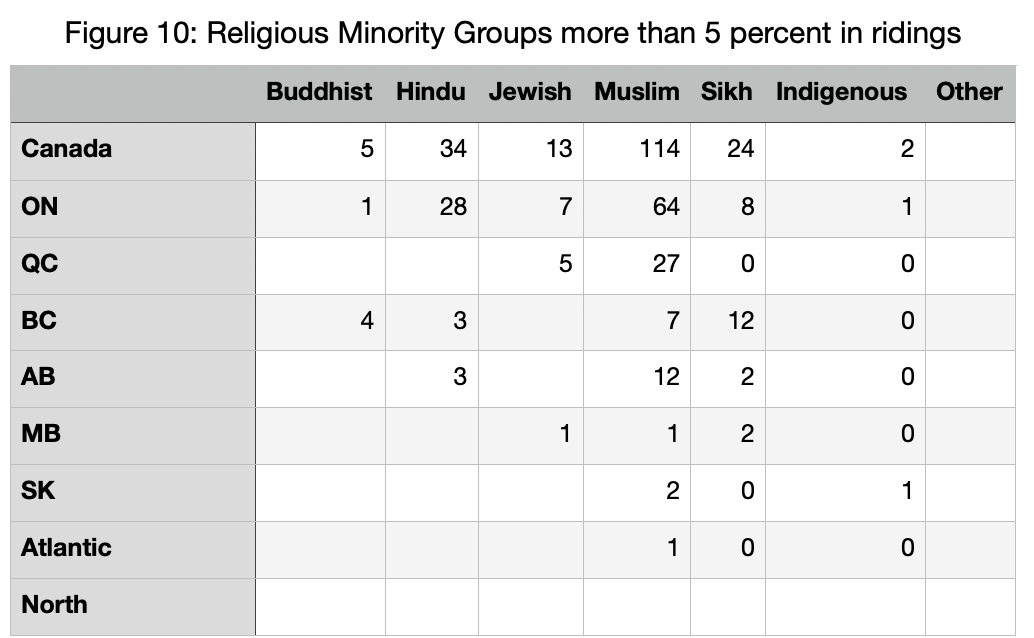
That being said, there are 114 ridings where Muslims form more than 5 percent of the electorate.

… Liberal party insiders were no doubt looking at the Michigan primary results with trepidation. The backlash among Muslim voters to the Stephen Harper government’s niqab ban for citizenship ceremonies and “barbaric cultural practices” hotline likely played a role in helping the Justin Trudeau-led Liberals secure a surprise majority in 2015. Since then, the party has made relations with the community a priority. Trudeau himself stages regular photo-ops at mosques, no doubt savouring every chance he gets to flex his sock game in a setting where shoes are prohibited.

But Trudeau, who appeared to be losing his touch with Muslim Canadians even before Oct. 7, now looks to be in freefall with the community. His multiple calls for a “sustainable ceasefire” in Gaza haven’t been enough to placate intransigent pro-Palestinian activists, who’ve even mobbed the prime minister in public settings. Trudeau has likewise found mosques to be less receptive to him than normal in recent months.

For now, Trudeau doesn’t appear to be too worried about the prospect of a Ramadan mosque ban. When asked on Thursday about the open letter, Trudeau said he’d visit any mosque that would extend him the invitation and gave no indication that he’d publicly commit to the terms enumerated in the statement. Yet Trudeau can’t be overjoyed about the prospect of having to keep his socks firmly in shoe during Islam’s holiest month, especially after seeing Biden’s humiliation in Michigan.

The results of Michigan’s just-held Democratic primary hint that the war in Gaza has triggered a rising tide among Muslim voters in the U.S. Whether electorally vulnerable members of Parliament cede to the demands of the NCCM and its affiliates or risk being shut out of mosques during a critical month for Muslim outreach could be an indication of just how strong the pull of this tide is in Canada.

Source: Rahim Mohamed: National Muslim group demands MPs denounce Israel or face wrath

Lanctôt | Une «belle victoire» pour la Loi sur la laïcité

A critical perspective:

Il s’agit, à n’en point douter, d’une grande victoire pour le gouvernement Legault dans le dossier de la Loi sur la laïcité de l’État. Jeudi, la Cour d’appel du Québec a confirmé la validité de la Loi, affirmant les conclusions de la Cour supérieure quant à l’application des dispositions de dérogation et en annulant l’exception qui avait été accordée par la Cour supérieure au système scolaire anglophone.

« La Cour vient confirmer le droit du Québec de prendre ses propres décisions, c’est vraiment une belle victoire pour la nation québécoise », déclarait le premier ministre, François Legault, en conférence de presse, quelques heures après la publication du jugement.

En 2021, le juge Marc-André Blanchard de la Cour supérieure du Québec avait déjà maintenu l’essentiel de la « loi 21 » en concluant à la validité de l’utilisation préventive de la disposition de dérogation aux droits fondamentaux garantis par les chartes canadienne et québécoise des droits et libertés.

Toutefois, le jugement formulait des commentaires inquiets quant à une utilisation aussi large de la disposition de dérogation. Le juge Blanchard notait que la loi 21 constituait le premier texte législatif dérogeant simultanément aux articles des deux chartes garantissant presque l’ensemble des droits et libertés dans la province. « Peu importe la perspective que l’on entretient face à la loi 21, notait-il, il faut souligner qu’il ne s’agit pas là d’une mince affaire. »

Sur le fond, il notait par ailleurs qu’il semblait « incontestable » que plusieurs dispositions de la loi violent non seulement les droits garantis par les chartes, mais aussi les droits découlant des instruments internationaux dont le Québec est signataire, notamment le Pacte international relatif aux droits civils et politiques, et le Pacte international relatif aux droits économiques, sociaux et culturels.

Là encore, dira-t-on, pas une mince affaire. Or, l’état du droit canadien, et c’est ce dont le gouvernement Legault et les défenseurs de la loi 21 se réjouissaient jeudi, le permet. Pour le dire vite, et reprenant l’analyse qu’ont fait tant la Cour supérieure que la Cour d’appel, en vertu de l’arrêt Ford de 1988, il suffit aux législatures des provinces d’inscrire les dérogations désirées dans la loi pour les soustraire au contrôle judiciaire.

Cet outil, quoique pertinent, est particulier au droit constitutionnel canadien : il tempère, d’une part, l’équilibre entre les provinces et le gouvernement fédéral. Il permet aussi de préserver l’autonomie de la législature face aux tribunaux.

Le Québec n’est pas la seule province à faire usage des dispositions de dérogation : le gouvernement de Doug Ford l’a fait en 2022, et plus récemment, la Saskatchewan aussi. Au Québec, en revanche, cet instrument, on le voit ces jours-ci, est chargé politiquement : déroger à cette vilaine Charte canadienne « qu’on n’a pas signée », ou encore à cette Charte québécoise qui, soi-disant, confère aux tribunaux un pouvoir démesuré, est devenu un marqueur politique clair, un appel du pied pour un certain électorat.

Ironiquement, la décision que le gouvernement Legault applaudit aujourd’hui témoigne que les tribunaux font preuve d’une grande déférence à l’égard de la législature. La décision de la Cour d’appel formule des remarques intéressantes à ce titre, en rappelant qu’il ne lui appartient pas de juger des motifs de suspendre les droits fondamentaux des citoyens ; et que le débat sur la portée des dispositions de dérogation a déjà eu lieu.

La Cour note ensuite qu’il revient aux citoyens, à la société civile, de décider si cette façon de faire du législateur lui convient. Votez en conséquence, dit-on en gros, cela n’est pas l’affaire des tribunaux.

Je crois qu’il s’agit en effet de la question fondamentale qu’il faut se poser en tant que citoyen.

Si les dispositions de dérogation agissent comme un contre-pouvoir face à Ottawa, face au contrôle judiciaire des lois en général, les droits fondamentaux, entre les mains des citoyens, constituent aussi un contre-pouvoir. On parle de préserver l’autonomie du législateur face aux tribunaux, mais qu’en est-il de protéger les citoyens face aux dérives législatives ?

L’équilibre est-il atteint ici, alors que l’on suspend la quasi-totalité des droits garantis par la Charte québécoise, pour une seule loi visant une affirmation nationale abstraite plus qu’elle ne répond à un enjeu réel ?

Dans ce dossier, on parle souvent de la nécessité de tempérer les droits individuels au profit des droits collectifs. Sauf que les droits collectifs sont toujours conditionnés par la possibilité d’exercer les droits individuels. Ces droits collectifs ne s’exercent pas dans l’abstrait, ils sont la somme des droits et des conditions d’existence que l’on garantit aux citoyens. Cela étant dit, est-on à l’aise avec l’érosion manifeste des droits des minorités religieuses provoquée ici ?

La réponse, on le comprend, est oui — en témoigne l’appui, auprès d’une certaine génération du moins, à la loi 21.

Je pense au contraire que nous nous tirons dans le pied et que nous fragilisons le tissu social en nous comportant de manière aussi ouvertement méprisante à l’égard des droits des minorités — pas juste religieuse, d’ailleurs. Construire, affirmer une identité collective « contre » quelque chose n’a jamais mené à de belles choses.

Le feuilleton de la « laïcité » (insistons sur les guillemets) a déjà laissé des cicatrices profondes dans la société québécoise, parce que ce « débat » a été mené sans égard à son effet stigmatisant sur l’ensemble des minorités. On prétend que l’affirmation du « nous » de la majorité y a gagné au change, alors au diable les dégâts collatéraux. Il me semble au contraire que les divisions n’ont jamais été aussi profondes, de toutes parts.

Aurélie Lanctôt, Chroniqueuse spécialisée dans les enjeux de justice environnementale, l’autrice est doctorante en droit à l’Université McGill.

Source: Chronique | Une «belle victoire» pour la Loi sur la laïcité

‘We Fear For Our Lives’: Foreign spies threaten Australia’s multicultural communities

The federal government has set up a counter-foreign interference taskforce, which together with ASIO and the Australian Federal Police, aims to disrupt any suspicious activity — but also inform the community about how to report it.
In his annual threat assessment, ASIO director-general Mike Burgess said more Australians are being targeted for espionage and foreign interference than ever before, revealing details of a foreign interference operation which involved a former politician.
“We have a responsibility to call it out. Australians need to know that the threat is real. The threat is now. And the threat is deeper and broader than you might think.”
In a statement to SBS, a spokesperson for the Department of Home Affairs said: “culturally and linguistically diverse (CALD) communities face unique threats and issues arising from foreign interference”, with “some foreign powers or their proxies seeking to silence, intimidate, monitor or harass members of CALD communities that they see as dissidents”.
In February 2023, Home Affairs Minister Clare O’Neil singled out Iran as an offending government when it came to foreign interference, revealing ASIO had disrupted an operation on Australian soil targeting an Australian-Iranian critic of the regime.
No, foreign interference from Iran here is not relevant. By no means, under no circumstances.

Ahmad Sadeghi, Iran’s ambassador to Australia

In an exclusive interview with SBS Persian, the Iranian ambassador to Australia, Ahmad Sadeghi, denied foreign interference is being carried out in Australia from the Iranian government.
“No, foreign interference from Iran here is not relevant. By no means, under no circumstances,” he said.
Opposition assistant foreign affairs spokesperson Claire Chandler urged the Iranian ambassador to read the results of the Senate inquiry into human rights implications of recent violence in Iran.
“I would urge them to read the submissions from the Iranian diaspora that were provided to that committee,” Chandler said.
“All I’m hearing … is that Iranians within Australia are very concerned about the monitoring, the surveillance, the harassment, and the intimidation that they are having to deal with at the hands of this regime.
“The [Australian] government needs to be clear-eyed and transparent about its interactions with embassy officials here in Australia, the government needs to list the IRGC as a terrorist organisation, we also believe the government should be utilising the full suite of sanctions it has available to it.”
In response to a question from SBS about the government’s reluctance to list the IRGC as a terrorist organisation, Prime Minister Anthony Albanese said: “We have vigilant processes, through the listing of organisations. We go through those processes appropriately, including through the national security, based upon advice.”

Threats of kidnapping: operatives targeting Iranian-Australians

Sydney-based activist Mohammad Hashemi’s cousin Majid Kazemi was executed in Iran last year, after being arrested during a Woman, Life, Freedom protest.
Before he was killed, Kazemi’s family says Iranian authorities interrogated Kazemi about his relatives’ activities in Australia.
“We know they have their spies here and we know they are watching us and monitoring us,” Hashemi told SBS News.
“They have people in many countries, they are trying to control our people, scare people … they don’t have any border for that, they will do anything.”
Mohammad Hashemi started a campaign to save his cousin, Majid Kazemi, from execution in Iran last year. Source: SBS News / /

On 29 January, The United States and the United Kingdom slapped sanctions on a network that targeted Iranian opposition activists. The US Treasury said this network was related to Iran’s Ministry of Intelligence and Security.

Hashemi’s campaign in Australia, an attempt to save his cousin, has instead landed him and his family, who are in Iran, a separate sentence of surveillance.
“They told my father, ‘We know everything about Mohammad, what he is doing in Australia, where he lives, what his job is,'” he said.
“[They said] ‘If he won’t stop, [we] have a mission to go to Australia and kidnap him and take him back to Iran.'”

Source: ‘We Fear For Our Lives’: Foreign spies threaten Australia’s multicultural communities

Axworthy et al: Canada’s plan to require visas from some Mexicans is a dangerous overreaction

Predictable reaction but not doing so would be an even more dangerous under reaction. And there is no reason why the visa requirement cannot be combined with longer term measures to reduce the root causes (no matter how sceptical I am about their chances of success):

….Before Mr. Trudeau’s government lifted it, Mexicans were deeply offended by Canada’s cumbersome visa requirement, which required visitors to endure a frustrating process operated by an inadequately staffed bureaucracy. Canadian businesses, farmers, and tourist operators also suffered heavily. But the untold damage of visa requirements may be even more significant today: more than 350,000 Mexicans visit Canada annually, and 2 million Canadians – many of them vacationers – travel to Mexico; the country has become the 10th-largest destination for Canadian investment, with some 2,000 Canadian companies now doing business there. Fortunately, it appears that the reimposed visa restrictions won’t affect those coming to Canada on study or work permits, as seasonal workers from Mexico are the linchpin of our agricultural sector, and academic exchanges between Mexican and Canadian institutions of higher learning have grown dramatically.

Still, the federal government seems to have chosen the quick and easy way out – a short-sighted decision amid growing election fever that fails to address the real roots of the problem.

Source: Canada’s plan to require visas from some Mexicans is a dangerous overreaction

Groups fighting anti-Black racism file complaint against Canadian Human Rights Commission

No surprise:

A coalition of human rights groups advocating for Black and racialized Canadians has lodged a formal complaint against the Canadian Human Rights Commission (CHRC) for discriminating against its own employees.

The coalition also outlined a number of actions Monday it wants the federal government to take to combat what it calls “systemic discrimination within its structures.”

“We’re relying on the Canadian Human Rights Commission to play a role in the fight to dismantle systemic discrimination, not to be the perpetrator in all of this,” Nicholas Marcus Thompson, executive director of the Black Class Action Secretariat (BCAS), said in Ottawa Monday.

The coalition said it has asked the Global Alliance of National Human Rights Institutions (GANHRI) to review the CHRC’s accreditation with the group.

GANHRI is an umbrella organization that coordinates policy and action between the United Nations and domestic human rights organizations.

The coalition said it wants Canada’s human rights body reviewed by GANHRI for violating international human rights law and failing to adhere to the Paris Principles.

Adopted by the UN General Assembly in 1993, the Paris Principles are a set of principles national human rights organizations have to follow to access the United Nations Human Rights Council and other bodies.

The CHRC receives and investigates complaints from federal departments and agencies, Crown corporations and private sector organizations such as banks, airlines and telecommunication companies. It decides which cases will proceed to the Canadian Human Rights Tribunal.

Racism within the CHRC

Last spring, the Canadian government’s human resources arm, the Treasury Board of Canada Secretariat (TBCS), reported that the CHRC had discriminated against its own Black and racialized employees.

The TBCS came to that conclusion after nine employees filed a policy grievance through their unions alleging that “Black and racialized employees at the CHRC face systemic anti-Black racism, sexism and systemic discrimination.”

“The organizations remain hopeful that this action will lead to significant reforms within the CHRC, ensuring it can effectively safeguard human rights and foster an inclusive society,” the coalition said in a statement released Monday.

The coalition said it does not wish to see CHRC’s funding cut but wants it to fulfil its role of combating systemic racism.

“We would like to see appropriate funding, and the government not cut funding for the [CHRC] as any type of remedy to address any shortfalls,” Thompson said.

The coalition is calling on the federal government to amend the Canadian Human Rights Act to allow complaints to go directly to the Canadian Human Rights Tribunal, rather than through the CHRC.

The coalition also wants the CHRC’s role changed so that it acts to support people making complaints before the tribunal.

The group said it wants the Employment Equity Act amended “to better reflect intersectionality and to specifically include Black and other equity-deserving groups as designated groups.”

The coalition said it also wants the federal government to appoint a Black equity commissioner to serve as an officer of Parliament with powers akin to that of the Auditor General of Canada. The commissioner would be tasked with ensuring equity across “all levels of government and the public service,” the coalition said.

The coalition said it also wants public servants found to have committed acts of discrimination to be held accountable for their actions.

Criticism of the federal action plan

Last week, President of the Treasury Board Anita Anand announced the first steps of the Liberal government’s action plan to support Black public servants.

It includes boosting the number of Black counsellors providing mental health support to public servants and their family members to 60 across the public service.

Anand also announced the launch of an executive leadership program for Black executives to improve career development services for Black public servants.

The coalition criticized the move on mental health services, saying it would have preferred for the department to work with Black public servant groups to develop the initiatives.

“Black employee networks within the federal government [as well as unions] were not consulted on that … announcement about the employee assistance program,” Thompson said. “We’re very, very concerned about that. That approach has to change.”

The coalition includes the BCAS, the Canadian Black Nurses Alliance, the Public Service Alliance of Canada, the Red Coalition, the National Union of Public and General Employees, the Federation of Black Canadians and the Black Canadians Civil Society Coalition.

Later Monday, Anand conceded that her government has “a lot of work to do in terms of building trust with public servants from the Black community.” She said she did reach out to the community before her announcement last week.

“In advance of that announcement, I and my team engaged in consultations with a number of Black public servants,” she said. “Consulting with Black public servants is at the heart of what we are doing as we come forward with supports for Black public servants.”
Source: Groups fighting anti-Black racism file complaint against Canadian Human Rights Commission

J.L. Granatstein: Leaving the old country behind

While the examples of diaspora politics and imported conflicts are valid and real, surveys such as the GSS indicate that by and large, multiculturalism is not a barrier to integration. But these conflicts do increase the challenges, as the Israel Hamas war and related increases in hate crimes demonstrate:

…What was going on? Clearly, the old country ties remained strong in immigrants to Canada. Ethnicity is a powerful force, naturally enough, but official multiculturalism encouraged ethnic communities to retain their identities. There were language schools funded by Ottawa, in addition to newspapers, community centres, and dance troupes. The money flowed because there were votes out there waiting to be harvested.

What was not going on was any effective effort by the state to turn immigrant communities into Canadians. Naomi Klein, (not someone I usually quote approvingly), wrote in 2005 after terrorist attacks in London “that the brand of multiculturalism practiced in Britain (and France, Germany, Canada …) has little to do with genuine equality,” she said. She continued:

It is instead a Faustian bargain, struck between vote-seeking politicians and self-appointed community leaders, one that keeps ethnic minorities tucked away in state-funded peripheral ghettoes while the centres of public life remain largely unaffected by seismic shifts in the national ethnic makeup.

Surely she was right, as we can readily observe when our parties scramble for ethnic votes in the suburban areas of the nation’s large cities.

Most Canadians believe immigration is important for Canada, the present difficulties notwithstanding. But polling also shows that most also believe that we must make Canadians of those who come here. It is not enough to leave them alone in the hope that they will quietly assimilate into accepting our values—peace, order and good government, civility, equality, tolerance, respect for rights—and that if they wish to join us they must understand and accept this. Canada is part of Western Civilization, not a community of communities, as Joe Clark put it, not a post-national state, as Justin Trudeau proclaimed. We are a well-established pluralist, democratic, secular nation.

To paraphrase the American writer David Rieff in the New York Times some years ago, the multicultural fantasy in Canada was that, in due course, assuming that the proper resources were committed and benevolence deployed, immigrants would eventually become liberals. As it was said, they would come to “accept” the values of their new countries. It was never clear how this vision was supposed to coexist with multiculturalism’s other main assumption, which was that group identity should be maintained. But by now that question is largely academic: the Canadian vision of multiculturalism, in all its simultaneous goodwill and self-congratulation, is no longer sustainable. And most Canadians know it. What they don’t know is what to do next.

Stephen Marche was right in saying that the old country must be left behind. It is long past time that Canadians figure out how to make this work.

Source: J.L. Granatstein: Leaving the old country behind

Et le sort des enfants de l’école juive ultraorthodoxe Belz, M. Drainville? 

On the inconsistency in application of regulations to Jewish religious schools and laicité:

Il y a trois jours, nous apprenions dans un article du Devoir que vous aviez accepté de renouveler le permis d’une école juive hassidique malgré un avis défavorable de la Commission consultative de l’enseignement privé. Après analyse du dossier, la Commission a révélé un nombre important de manquements qui perdurent depuis plusieurs années quant au respect du Régime pédagogique. 

Rien de nouveau sous le soleil. Ainsi, en 2009, cette école, qui faisait partie d’un groupe de cinq établissements qui avaient conclu une entente avec l’ex-ministre Michelle Courchesne, avait jusqu’en 2012-2013 pour se conformer aux exigences du ministre. Plus de dix ans plus tard, les lacunes persistent. Pire, les consignes relatives aux mesures sanitaires lors de la pandémie de COVID-19 n’ont jamais été observées, les mises en demeure ont été ignorées et aucune sanction n’a été prise. 

Quant aux ententes conclues avec la ministre Courchesne, autant dire qu’elles furent signées pour calmer le ministère sans intention véritable de les respecter. La Commission a d’ailleurs produit un rapport assez dévastateur à l’endroit de ces écoles, qui constatait que les manquements à la loi sont récurrents. Même les menaces de révoquer les permis sont restées lettre morte, pour la simple et bonne raison que le ministère n’y a pas donné suite. Bref, on tergiverse et, pendant toutes ces années, les enfants de ces communautés qui ont les mêmes droits que tous les enfants du Québec ne reçoivent pas l’instruction qu’ils devraient recevoir pour être en mesure de prendre en main leur destinée. C’est une honte !

En 2017, le législateur modifiait les lois sur l’enseignement privé, sur l’instruction publique et sur la protection de la jeunesse afin de se doter de moyens plus efficaces pour assurer le respect de ces lois relatives à l’ordre public. C’est d’ailleurs ce qui a amené le juge Castonguay à rejeter, en décembre 2020, la requête pour jugement déclaratoire intentée par Yochonon Lowen et Clara Wasserstein contre le Procureur général du Québec, entre autres. Ces demandeurs ont fait preuve d’un grand courage puisqu’ils ont débuté dans la vie sans avoir l’enseignement nécessaire pour s’assurer — et assurer à leurs enfants — une vie correcte. 

Les objectifs poursuivis par ces lois étaient, entre autres, d’établir des mécanismes de suivi pour mieux identifier les enfants, d’assurer un échange de dossiers avec les autres ministères pour améliorer le suivi, de donner des pouvoirs accrus aux commissions scolaires pour faire le suivi et de permettre une collaboration accrue entre le DPJ et les commissions scolaires.

Le juge Castonguay note au paragraphe 147 de son jugement : « Les articles 18.1, 18.2 et 18.3 de la Loi sur l’enseignement privé permettent au ministre de refuser le renouvellement d’un permis ou encore de le faire en posant des conditions impératives. »

 Les conditions rattachées au permis accordé dans le passé, et ce, depuis plus d’une décennie, n’ont jamais été respectées, ou si peu, seulement pour donner le change et gagner du temps. Il y a longtemps que le ministre aurait dû sévir. On ne peut plus prétendre que les lois ne lui en donnent pas le pouvoir. Malheureusement, pour faire l’économie d’une tension avec les directeurs des écoles hassidiques, le Collège rabbinique de Montréal et les autres instances qui dirigent ces communautés, le ministre préfère sacrifier sur l’autel de la soi-disant bonne entente l’avenir de ces enfants, qui sont des milliers, qui n’auront absolument pas les outils requis pour fonctionner dans la société ouverte de demain et accomplir leur destinée selon leurs aspirations. 

Le Québec a fait le choix de la laïcité afin de permettre à toutes et à tous de s’épanouir tout en respectant leur liberté de religion. Les deux éléments ne sont pas incompatibles, mais complémentaires. Les citoyens financent des écoles qui ne respectent pas les lois pourtant applicables à tout le monde sur le territoire québécois. Cela mine grandement les fondements de notre société et risque à plus ou moins long terme de créer des problèmes de cohésion sociale.

Monsieur le Ministre, vous ne respectez pas vos propres lois, comment voulez-vous qu’on vous prenne au sérieux et comment espérez-vous convaincre éventuellement les tribunaux de la justesse de ces choix ? Puis, au-delà de la question du financement des écoles qui persistent à ne pas respecter les règles, ce qui en soi est carrément injuste et discriminatoire, il y a l’avenir des enfants.

Monsieur Drainville, vous dites que c’est le sort des enfants qui vous préoccupe, prouvez-le !  

source: Et le sort des enfants de l’école juive ultraorthodoxe Belz, M. Drainville?

Idées | Il est temps de parler d’immigration autrement

Critique regarding the impact on immigrant sending societies:

Avec une couverture médiatique croissante, l’immigration se trouve au centre des préoccupations de la société canadienne et québécoise. Des débats sur son acceptabilité sociale à son effet sur le développement et l’épanouissement du Québec, le discours a évolué vers des inquiétudes quant à la capacité d’accueil et d’intégration des personnes immigrantes. L’immigration serait-elle devenue un problème ? Récemment, les défis liés au logement ont cristallisé ces préoccupations, qui alimentent les discours sur les capacités d’accueil des personnes immigrantes, les seuils et le recrutement des étudiants étrangers.

Deux facteurs principaux expliquent ce changement dans le ton du discours.

Tout d’abord, les événements survenus au chemin Roxham à partir de 2017, notamment la fermeture de ce passage frontalier le 25 mars 2023, ont marqué un tournant dans la perception de l’immigration. Cette décision visait à modifier les propos entourant l’immigration, jugée trop négative par les gouvernements aux prises avec l’arrivée irrégulière de migrants. Le gouvernement du Québec considérait le passage à Roxham comme un fardeau, une situation indésirable qui risquait de compromettre son image et d’accentuer les tensions frontalières, notamment en lien avec la capacité à accueillir les demandeurs d’asile au Québec, surtout à Montréal. 

Il était nécessaire de dissocier le Québec de cette problématique frontalière en mettant en avant sa vision de société d’immigration, fondée sur l’intégrité de son système d’immigration, la sélection des immigrants désirables et la contribution des immigrants à la croissance économique de la province. Dans les semaines suivant la fermeture du chemin Roxham, les médias ont réintroduit le concept du « bon migrant », mettant en lumière les travailleurs qualifiés capables de pallier la pénurie de main-d’oeuvre et les étudiants étrangers susceptibles de devenir résidents permanents.

Ensuite, l’immigration de travailleurs temporaires est devenue un enjeu majeur pour le développement économique de toutes les régions du Québec. Malgré une politique gouvernementale visant à limiter le nombre d’immigrants à 50 000 résidents permanents sous le mandat de François Legault, le Québec a connu une augmentation significative de l’immigration temporaire — travailleurs, étudiants étrangers et demandeurs d’asile. Cette hausse, illustrée par une augmentation de 46 % du nombre de migrants temporaires en une année, de 2022 à 2023, selon Statistique Canada, répond à une demande croissante du secteur économique en matière de recrutement. 

Cette évolution souligne l’importance de repenser le discours sur l’immigration. Dans son discours, le gouvernement provincial a toujours rappelé que l’immigration ne devait pas venir déséquilibrer certains fondements de la réalité québécoise, notamment la préservation de la langue française et la place du Québec au Canada.

Hospitalité et façon d’habiter le territoire

Comment parler d’immigration autrement ? Premièrement, en répondant au discours de la peur qui provoque une régression identitaire à un niveau mondial, comme on peut le voir relativement aux frontières, mais également dans notre quotidien. On devient méfiant. On craint la personne qui ne nous ressemble pas. On agit différemment sur le plan de notre identité en excluant l’autre. 

Deuxièmement, il est nécessaire de présenter une autre option s’inspirant de ce que le philosophe français Étienne Tassin nomme « une utopie concrète », qui ouvre la voie à une réflexion novatrice sur la manière d’être hospitalier au monde. Il y a une actualité de l’accueil aujourd’hui qui demande de nouvelles idées, de nouvelles actions concrètes. 

Dans un très bel ouvrage, l’historienne Michèle Riot-Sarcey présente trois caractéristiques d’une sensibilité utopique. D’abord, il est important de faire émerger une critique radicale de son temps et de renouer avec une écriture de l’espoir. Il me semble que cela est essentiel. Il faut remettre en question le discours dominant de l’immigration, de la réalité de l’immigration, de la manière dont le système fonctionne, ce qui veut dire articuler une pensée critique des politiques d’immigration de nos sociétés. Ensuite, il faut reconnaître les expériences concrètes et humaines et ne pas rester dans l’abstraction, dans une approche gestionnaire déconnectée de la réalité. Enfin, il faut se donner la possibilité de penser un monde de la migration autre que celui de l’État et de la souveraineté nationale.

Malheureusement, il est frappant de constater à quel point nos gouvernements préfèrent adopter un discours utilitariste du besoin d’immigrants. Par exemple, on discute sans cesse de ce qu’apporte l’immigration au développement de la société québécoise, mais pas de ce que cette émigration provoque sur les sociétés de départ. 

L’émigration s’est inscrite dans un besoin de départ pour des populations en survie économique, mais aujourd’hui, ce qui domine est une logique carrément prédatrice dans la stratégie de recrutement de main-d’oeuvre des pays du Nord à l’égard des bassins du Sud. Qu’en est-il de la justice migrante lorsque des États siphonnent les infirmières et autres professions en pénurie ? Le territoire québécois se doit d’être plus qu’un réservoir de main-d’oeuvre immigrante. Montréal ainsi que les régions ne doivent pas être qu’un simple réservoir de main-d’oeuvre immigrante.

Source: Idées | Il est temps de parler d’immigration autrement

Opinion: Recognizing immigrants’ credentials is important — but it’s just one piece of the puzzle

Of interest:

It has been an unfairly long-standing challenge for skilled immigrants to B.C. and Canada that their foreign credentials all too often go unrecognized. This has held them back from making their full contribution to our economy and building wealth.

For decades, Canada’s immigration system has selected immigrants by prioritizing those who are the most skilled. To deny so many the chance to put those skills into practice has been a waste of their talent and a missed opportunity to make our immigration system even more successful.

That’s why it has been very encouraging to recently see B.C.’s International Credentials Recognition Act that removes barriers to skilled immigrants finding work in 29 regulated professions like engineering, social work, architecture, accounting or veterinary practice.

We can, and should, build on this.

The B.C. Chamber of Commerce has remarked that the act still excludes health care and trades professionals, who are desperately needed in every B.C. community. So, while work in these sectors has been advanced through other recent legislative changes and programs, the provincial government should continue to prioritize these professions and urgently reduce the significant barriers faced by professionals in these sectors.

The province’s most recent Labour Market Outlook predicts about one million B.C. job openings from 2023 to 2033. Demographic trends mean these openings will not be filled by Canadians alone, and immigrants will be needed across the economy to address worker shortfalls and ensure continued prosperity. Removing barriers to skilled immigrants’ entry into the labour force will help make the most of the skills for which they are selected.

But what about the approximately 80 per cent of the economy that lies outside of the regulated professions? In this much larger part of the job market, employers do not formally require a specific diploma, credential or “ticket.” What they are most interested in is whether a candidate can get the job done.

In this wide group of industries and occupations like administration, small business, and many roles in tech, to name a few, hiring decisions are mainly based on a flexible combination of skills, abilities, potential, and experience. Product managers, salespeople or chefs, for example, are not regulated professions.

The province has tremendous levers to affect immigration to B.C. and respond to labour market demand through its powers under the Provincial Nominee Program and legislation that governs regulatory bodies, and should nimbly use them to make sure that not only is B.C. getting people with the skills and abilities employers need, but they are able to work immediately.

Credentials like diplomas, certificates, and degrees are often a shorthand for skills and abilities, but do not necessarily have a direct link to them. They are useful signals for busy hiring managers but are just one piece of the puzzle.

It is an unfortunate fact for skilled immigrants and for the wider B.C. economy that newcomers whose credentials are outside of what’s typically understood have their value discounted heavily, even when they have the skills employers are looking for.

Just as the B.C. government should build on the progress made with act to speed immigrants’ integration into jobs across the economy, B.C.’s employers should also consider the role they play. Are their managers, recruiters, and human resources teams equipped to recognize, hire, and develop skilled workers, no matter where they’re from? Do their processes and policies focus more on credentials than on recognizing real-life skills and abilities?

These are not academic questions. With a long-term competition for talent playing out from the international level on down, the most successful businesses (and economies) will continue to be those that can attract the best talent.

With the International Credential Recognition Act, the B.C. government has taken a clear step in the right direction. At the same time, forward-thinking employers already recognize the immense potential of skilled people no matter where they are from.

Now, it’s time to build on this progress by extending credential recognition to even more in-demand professions like health care and the skilled trades, and ensuring our provincial nominee program responds to labour market needs. It’s also time to make sure B.C. employers large and small across the entire economy have the tools and competencies to attract workers with the skills to meet and exceed their goals.

Fiona Famulak is president and CEO of the B.C. Chamber of Commerce. Patrick MacKenzie is CEO of the Immigrant Employment Council of British Columbia.

Source: Opinion: Recognizing immigrants’ credentials is important — but it’s just one piece of the puzzle

Treasury Board president announces initiatives to support Black public servants

Of note. All interesting initiatives, and future evaluation will be helpful in assessing their effectiveness.

At the macro level, Black public servants have stronger representation than many other racialized groups, hiring, promotion and separation data for the last six years shows the same pattern (the PSES, however, shows higher discrimination for Black public servants):

Treasury Board President Anita Anand announced the first initiatives of the government’s “Action Plan” for Black public servants on Wednesday, including almost $14 million in funding to three federal organizations.

The federal government committed $49.6 million to create career development programs and a mental health fund for Black public servants through its 2022 and 2023 budgets.

At a downtown news conference, Anand announced that nearly $6 million would be provided to Health Canada to introduce “Black-centric enhancements” to the Employee Assistance Program supporting more than 90 federal organizations.

A Treasury Board news release said the funding would help recruit 19 Black counsellors to provide “trauma-informed” mental health support to public servants and their families.

Another $6.9 million would go to the Canada School of Public Service to support career advancement of Black employees through an executive leadership program, with four cohorts of up to 25 Black executives to access the program over two years, beginning this summer.

The Public Service Commission would also get $1.1 million over three years to provide assessment, counselling and coaching services to Black employees.

At the media conference, Anand said the government still had work to do.

“For several years, we’ve heard from Black public servants about the need for targeted supports,” Anand said. “We haven’t done enough and we haven’t done it fast enough.

“I know that there have been challenges in our path to reconcile and that, for many of us, we see that trust in our institutions from the Black community has been broken.”

The announcement comes as the federal government continues to fight a class-action lawsuit filed by Black public service workers in 2020, alleging decades of systemic racism and discrimination.

When asked whether the government had plans to settle the lawsuit, Anand said she was aware that there was “a process in place” and that the certification hearing for the class action was expected in the coming months. She said the decision to certify the lawsuit rested in the hands of the Minister of Justice and Attorney General of Canada.

Anand acknowledged that Amnesty International Canada had recently been granted intervenor status in the case and said the government would not challenge that court decision.

“What I want to make sure we do is to bring forward supports for Black public servants so, as we look prospectively, systemic racism that is at the foundation of the Thompson class action lawsuit does not exist,” Anand said.

In a news release Wednesday afternoon, the Black Class Action Secretariat said it urged the government to settle the lawsuit. The group also raised concerns that the funding allocated to the Employee Assistance Program was insufficient, calling for the establishment of a Black Equity Branch, for the task force’s leadership to be reassessed and for the group to “meaningfully consult” with Black employee networks and labour unions.

Anand said the implementation of the Action Plan would be led by an internal task force primarily made up of Black employees.

Of the almost $50 million in funding, $24.9 million is expected to go to support mental health programs and $19.4 million is planned to go into career and leadership development projects, with $1.1 having already been spent in the 2022-23 fiscal year. The government also plans to spend $4.2 million to operate task force engagements, research and pay members for their work.

The feds are “layering on” new initiatives on top of existing efforts to support equity-seeking groups, like the Mentorship Plus Program and the Mosaic Leadership Development Program.

“Our efforts will not stop here,” Anand said, noting that the rest of the funding was with the task force to introduce new programming in subsequent months once the group determined what was working and what more needed to be done. “These are early investments which will continue to be guided by the lived experience of Black public servants.”

In 2022, a group of Black federal public servants accused the government of racism while working to develop a mental health action plan for Black workers. When asked how she could ensure a similar situation didn’t happen again, Anand said the current task force was working “very well together” and was on “a very positive track and footing” with the action plan.

The task force is set to run “check-ins” with employee networks, surveys and discussions with Black public servants to “further engage on the implementation of current and future initiatives” of the plan.

“There are continuous needs,” Anand said, adding that the 2022 Public Service Employee Survey found that 11 per cent of Black public servants had reported experiencing discrimination on the job. “We need to ensure that we’re listening to what they suggest are the reforms that should be implemented.”

Source: Treasury Board president announces initiatives to support Black public servants