Muslim woman turns to financial institutions for Islam-friendly mortgages

Hard to understand the difference between paying a “premium” and paying interest, given that the cost of money (interest) is likely reflected in the “premium.”

Westpac and Kiwibank said they did not offer a specific Sharia-friendly product and did not have any plans to do so in the near future.

ANZ spokesman Stefan Herrick said demand for Islamic loans was “very low” and the bank did not offer a specific product catering to the community.

The next step was to approach private investors and finance companies in the hope of a better response, she said.

Alternative home finance models exist around the world and have been used in New Zealand in the past.

“Currently there are no options that cater for Muslims in particular so those who find themselves desperate end up compromising their faith and values and take on the traditional mortgage available in order to achieve the dream of owning a home and providing stability to their families.”

The mother-of-two said Islam was not against buying a product like a house from a bank or financial institution in instalments with an added premium but it was not OK to accept a loan of money and pay interest.

“Interest is usury and it means to some extent the rich will keep getting richer and the poor will be poorer.”

The dental hygienist rents a house, which she lives in with her husband and two children, in the south Auckland suburb of Manukau.

Jawadi said she wanted to buy a home as it seemed a waste to pay rent and have nothing to show for it.

Jawadi and other Kiwi Muslims in similar situations could be in luck as New Zealand’s first Islam-friendly KiwiSaver provider plans to offer interest-free mortgages to Muslims.

Muslim woman turns to financial institutions for Islam-friendly mortgages | Stuff.co.nz.

Alberta’s politics have inevitably become more diverse: Hébert

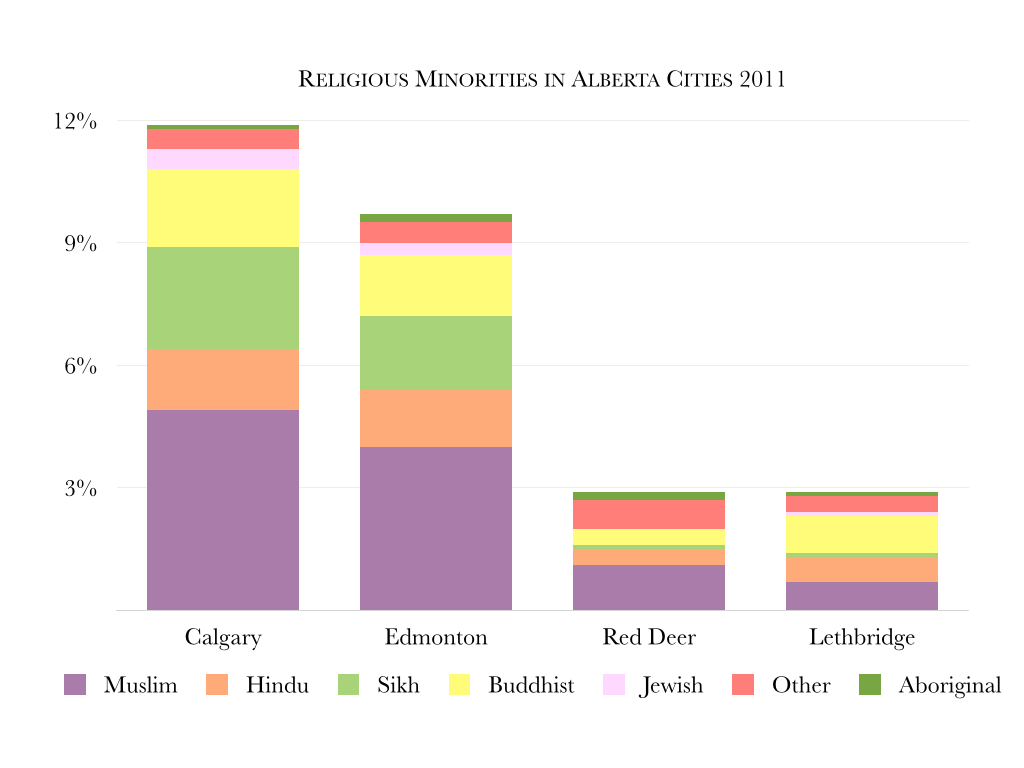
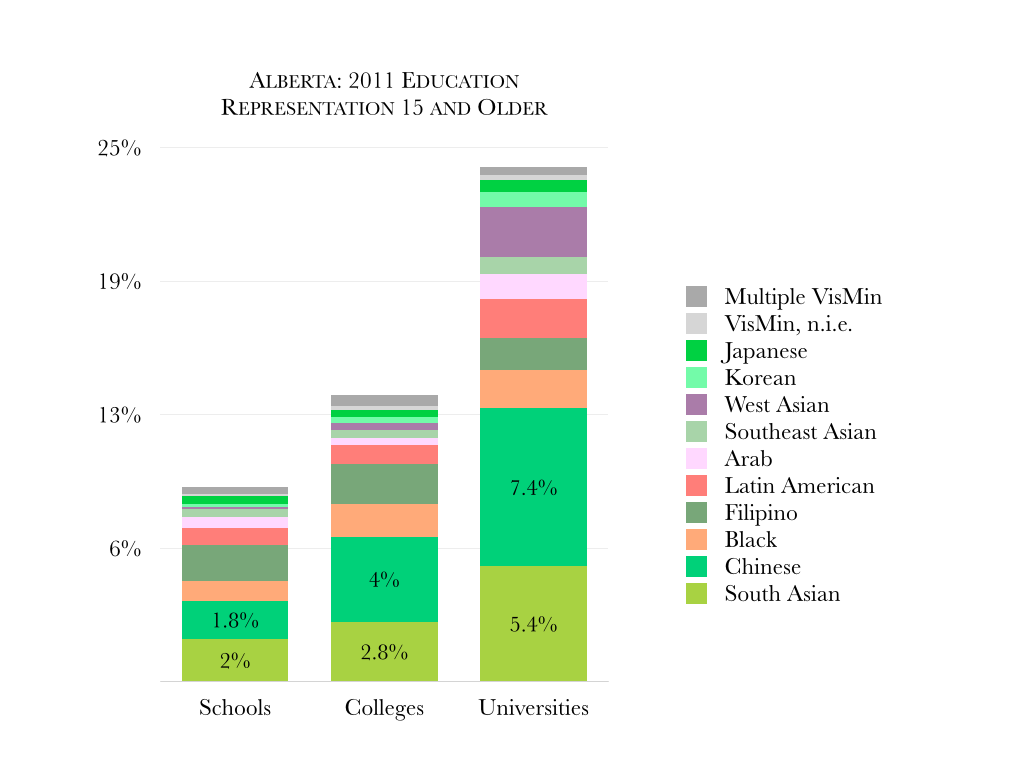
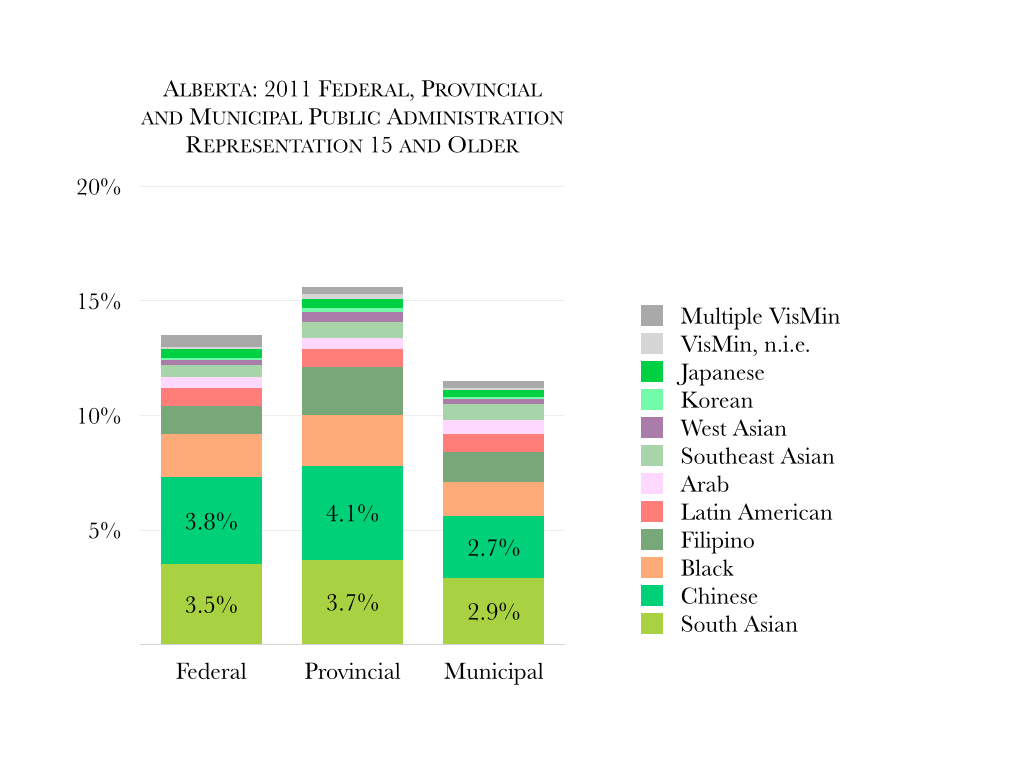
Aberta Key Slides.001 Aberta Key Slides.002 Aberta Key Slides.003 Aberta Key Slides.004 Aberta Key Slides.005

On the eve of the Alberta election, the national media finally notices that Alberta has changed.

The above charts from my forthcoming book, Multiculturalism in Canada: Evidence and Anecdote, highlight this change from a diversity angle, with Alberta having overtaken Quebec as Canada’s third most diverse province, with strong visible minority representation in healthcare, social services, universities, and provincial government public administration.

Chantal Hébert on the change:

As Alberta goes provincially on Tuesday, it will not automatically go federally. The dynamics of the two back-to-back campaigns are strikingly different.

But over the longer term it would be unwise for the federal Conservatives to bet that their virtual monopoly on Canada’s fourth largest province is immune to the tectonic shift that may see the NDP in power in Edmonton after next week.

In the big picture, it was actually only a matter of time before Alberta’s politics became more diverse.

Sooner or later, the changing demographics of the province were bound to impact on its voting patterns.

Its population has been growing faster than the Canadian average. Its median age (37) is the lowest of the four big provinces.

There is not a poll that does not show that the younger the electorate the better the NDP, the Liberals and the Greens fare versus the Conservatives.

The emergence of the NDP as the leading candidate for provincial government is the biggest crack to date in the monolithic facade of Alberta, but it is not the first one.

That was preceded in 2010 by the election in Calgary in 2010 of Naheed Nenshi, a mayoral candidate who was an outsider to the city’s power circles.

Then there was the taking of an Edmonton riding a year later by NDP MP Linda Duncan with more than 50 per cent of the vote cast and, a year after that, the rise to a close second place of Justin Trudeau’s Liberals in a 2012 Calgary byelection. (In that vote the Green Party came a respectable third with 25 per cent support.)

Even more recently the Trudeau Liberals won 35 per cent of the vote in Fort McMurray — the riding that current Wildrose Leader Brian Jean used to hold during his eight years as a Harper MP.

To predict that Alberta will increasingly take on shades other than blue is not to predict the demise of the federal Conservative party but it is to foresee an ultimately healthier federal political environment.

A more diverse Alberta voice at the national level would be a positive development both for the province and for Canada’s political life.

Alberta’s politics have inevitably become more diverse: Hébert | Toronto Star.

Hussein Hamdani says federal election politics behind his suspension

Hard not to believe Hamdani, given all the vetting he has been through and his overall track record as a member of the CCRS.

I always found him thoughtful in his contributions when I attended the CCRS, both in his appreciation of some of the factors behind radicalization as well as suggestions regarding what policies and programs could be more effective.

Consultative and advisory bodies are more useful when there is a diversity of views.

While I can understand the Government’s sensitivity towards his public support for the Liberals, it would have been more honest to list that as the reason then try to dredge up accusations from 20 years ago.

And even if true (which I doubt given the source), who among us has not something in our past that today we are uncomfortable with.

More anti-Canadian Muslim wedge politics?

Minister of Public Safety Steven Blaney suspended Hussein Hamdani from the Cross-Cultural Roundtable on National Security this week.

Blaney’s office is looking into questions raised by the French TVA network about politically charged statements it alleges Hamdani made as a university student, and allegations about radical organizations that it says Hamdani had associations with.

Blaney’s office did not explain why it was taking the action now, when it acknowledges it has known about the allegations for “some time.”

But Hamdani told CBC News he believes the decision is politically motivated, and denies all the allegations outright.

“I’ve been vetted and I’ve received various levels of security clearance over the years. So to have this come out now, to me, it clearly has political motivations that are attributed to it,” he said. All members of the roundtable are vetted by CSIS and the RCMP, he said.

“Perhaps they’re not pleased that I’m very critical of Bill C-51,” Hamdani said. “Perhaps the government is displeased that I have been supporting Justin Trudeau and the Liberals.” Bill C-51 is the Conservative government’s controversial proposed anti-terror legislation.

In a statement, a spokesperson for Blaney called the allegations against Hamdani “very concerning.”

“This individual’s membership on the Cross-Cultural Roundtable on National Security has been suspended immediately pending a review of the facts. While questions surrounding this individual’s links to radical ideology have circulated for some time, it was hoped that he could be a positive influence to promote Canadian values. It is now becoming clear this may not have been the case.”

The suspension is a blow to the reputation of a lawyer who has been a prominent Hamilton leader, considered a moderate voice on Muslim issues and whom a local business magazine named in its 40 under 40 roundup in 2012.

Cross-Cultural Roundtable chair Dr. Myrna Lashley told CBC News she was shocked by the allegations.

“That’s not the Mr. Hamdani that I know. I’ve never heard any of these things that was reported.”

Hussein Hamdani says federal election politics behind his suspension – Latest Hamilton news – CBC Hamilton.

How Canadians celebrate their identity — it’s all in the hyphen

On hyphenated identity (or, to use Lawrence Hill’s words, “who among us is not mixed up”):

John Diefenbaker, perhaps the first Canadian public figure to talk extensively about punctuation, was also passionately opposed to hyphenation.

He saw it not as a sign of disloyalty, like Wilson did, but as a manifestation of prejudice: memories of anti-German taunts during and shortly after the First World War launched the Tory prime minister on what he later called a “lifelong attack on hyphenated Canadianism.”

Diefenbaker thought two-part labels were a way of diminishing a group’s membership in the national community. To be “Ukrainian-Canadian” suggested you were less than a full citizen, in his view.

Not everyone shared this interpretation. As Peter C. Newman wrote in The Distemper of Our Times, his political history of Canada in the mid-’60s, many French-Canadians were happy with their hyphens. They saw Diefenbaker’s “One Canada” crusade as a veiled call for assimilation.

As the decade wore on, this celebration of difference spread. Hyphenation, with its way of patching together disparate things, increasingly came to be seen as an orthographic representation of the multicultural Canadian mosaic.

But the hyphen’s hold has been slippery. In the past 15 years, some academics have taken up a renewed critique of the symbol — they call it reductive, even alienating. Minelle Mahtani, a professor of human geography at the University of Toronto Scarborough, says that many of the mixed-race women she spoke to for a 2002 paper rejected hybrid identifiers like “Somali-Canadian.”

“These hyphens of multiculturalism, in effect, operate to produce spaces of distance, in which ethnicity is positioned outside Canadianness,” Mahtani wrote.

Still, for many, the hyphen remains a vital and flexible tool for representing themselves to the world.

In a recent essay for the website The Archipelago, the self-described “first-generation Canadian-Indian-Italian-American” journalist Manisha Aggarwal-Schifellite called herself “a walking hyphen.”

There is a growing crop of Canadians punctuating their identities in novel, personal ways. By 2021, at the current rate of growth, a majority of the country’s population will shade in more than one box when they’re asked about ethnicity, according to a report by the Association for Canadian Studies.

Canada’s future is likely to be hyphenated. That means more bridges, more boundary posts, more magic carpets. For better or worse, it means more knots.

via How Canadians celebrate their identity — it’s all in the hyphen | Toronto Star.

Election Watch: Debunking the “Ethnic Vote” Strategy – New Canadian Media

While generally correct, this piece by Stephen E. White, Inder S. Marwah, and Phil Triadafilopoulos understates the degree of targeting – and micro-targeting – between and within ethnic communities. The current government’s approach, taking a more explicit side in any number of diaspora politics, is but one illustration:

New Canadians are no less savvy than the rest of the Canadian electorate. While it’s true that recent immigrants don’t have many years of experience with Canadian politics and elections, research also suggests they learn rather quickly.

There’s no reason, then, to think that parties’ targeted appeals to ethnic minority communities are any more effective than the strategies used to win the support of other kinds of voters.

Where does this leave us?  We can be sure the “ethnic vote” will figure prominently in political parties’ 2015-election campaigning. While the success of their efforts can in no way be assumed, the parties will undoubtedly compete for the support of new Canadians.

There’s no evidence that ethnic outreach actually works – but the parties believe it might, and this conviction shapes both electoral strategies and policy making.

Canadian political parties’ ongoing and ever more systematic efforts to compete for the votes of new Canadians helps explain why anti-immigrant discourse is so rare in Canadian elections and why Canadian parties, regardless of their ideological stripe, support robust immigration levels and the maintenance of an official multiculturalism policy.

Put differently, Canadian “exceptionalism” in the area of immigration politics and policy may have less to do with our innate civic virtues than with the strategic calculations of our political operators.

Election Watch: Debunking the “Ethnic Vote” Strategy – New Canadian Media.

Religious Diversity in British Parliamentary Constituencies

 Concentration and Dispersion.001For those interested, an incredibly detailed mapping of British religious minorities on the eve of the British election, with the sub-text of fear of British Muslims (like so many of the Henry Jackson publications). But the mapping and level of analysis is impressive (although I find the more simple approach in the above Canadian chart provides a better overview).

Christianity is the dominant religion in Great Britain. The 2011 census names five minority religions: Buddhism; Hinduism; Judaism; Islam; and, Sikhism. Together they are followed by 4,577,799 residents, or 7.5% of the population. Of these minority religions, Islam is the largest, which is followed by 4.5% of the national population. Islam’s share of the population is at least three percentage points larger than any of the remaining minority religions: Hinduism (1.4%); Sikhism (0.7%); Judaism (0.4%); and, Buddhism (0.4%).

The prevalence and relative following of the minority religions within Great Britain’s constituencies reflects this order, with the exception of Buddhism which appears more often as the largest minority religion within many more constituencies than its overall share of the population suggests. Islam is the minority religion with the most followers in four-fifths (503, or 80.0%) of Britain’s 632 constituencies. Buddhism comprises the largest minority religion in almost one in ten constituencies (54, or 8.5%). This is followed by Hinduism in 40 constituencies (6.3%), Sikhism in 27 (4.3%), Judaism in six (1.0%), and in the remaining two constituencies the largest minority religion is equally Buddhism and Islam, with the same number of followers.

Map 2 reflects the largest minority religion within constituencies, with each minority religion represented by a different colour and shaded to reflect the size of the population share. A threshold of 0.5% has been applied as a criterion for inclusion, with the remaining 165 constituencies left blank.9 Of the 467 constituencies which met the criterion, Islam is the largest minority religion in 396 (84.8%). This is followed by Hinduism in 36 seats (7.7%), Sikhism in 25 (5.4%), Judaism in six (1.3%), and Buddhism in four (0.9%).

Islam is the dominant minority religion among Great Britain’s constituencies. In the ten constituencies with the largest minority religion share of the population, Islam is both the largest minority religion and is followed by at least one third of the population. Within these constituencies, Islam is also the largest religion as well as the largest minority religion, with the exception of Blackburn, where the Christian share (45.8%) is nine percentage points larger than the Muslim share of 36.3%.

The two constituencies with the largest Muslim share of the population are Birmingham Hodge Hill, where more than half (63,417 of 121,678, or 52.1%) of residents identify as Muslim; and Bradford West, which has a 51.3% Muslim share of the population (58,872 of 114,761). They are currently being challenged by the Respect Party and are held by the Respect Party respectively. This is followed by: Birmingham Hall Green (46.6% Muslim residents); East Ham (37.4%); Bradford East (36.9%); Blackburn (36.3%); Bethnal Green & Bow (35.4%); Birmingham Ladywood (35.2%); Ilford South (34.9%); and, Poplar and Limehouse (33.6%). Regionally, four of these ten constituencies are located in London, three in the West Midlands, two in Yorkshire and The Humber, and one in the North West.

No other minority religion makes up a third of the population in any constituency. There are, however, two constituencies where the Hindu share of the population is 32.0%: Brent North in London, where Hindus comprise 32.0%, and the Christian share is almost one percentage point (0.7%) larger; and, Leicester East in the East Midlands, where Hindus are the largest religious group, comprising 31.8%, and the Christian share is lower at 24.2%.

The largest Sikh share in Great Britain is in Ealing, Southall and Feltham & Heston, both in London, comprising 21.6% and 13.1% respectively. The largest Jewish share is in Finchley & Golders Green and Hendon, both in London, comprising 21.1% and 17.0% respectively. The largest Buddhist share is 3.1% in Aldershot, in the South East.

Religious Diversity in British Parliamentary Constituencies

Updated Citizenship Statistics: Different Numbers, Same Trend

Citizenship Take-Up 2014.001Further to my presentation at Metropolis in March and the media and other commentary the citizenship statistics generated, CIC has provided updated numbers for the full 2014 year, in contrast to the January-October numbers I used.

CIC was also able, for landing years 2005-8, separate out the take-up percentages six years after landing, to provide a more consistent measure (each additional year automatically means more citizens).

But while the number and slope of the curve have changed, the trend of a decline has not.

A longer time series for six years after landing would of course be preferable.

Again, the main reasons for the decline:

  • the processing difficulties and backlog in citizenship processing (currently being addressed so this should be a one-time occurrence, and the difference between the October and full year numbers suggests that is the case);
  • the more difficult citizenship test and higher failure rates (although 2014 January-September numbers show an increase in the overall pass rates to 90.5 percent from an average overall pass rate of 82.7 percent during 2010-13);
  • more rigorous language assessment; and,
  • anti-fraud and misrepresentation measures, including the residency questionnaire, leading to longer processing times.

Conservatives rally for communism memorial as Vietnamese Canadians mark Journey to Freedom Day

Making the politics involved even more transparent:

Canada’s minister of state for democratic reform told a crowd of Vietnamese Canadians gathered to commemorate the inaugural Journey to Freedom Day that opposition to the prominent downtown site planned for a memorial for the victims of communism was “shameful” and that the controversial monument will get built.

“It is shameful that the Liberals and the NDP have come out against building this monument at this site, and it is shameful that some in the media have done the same. This is a worthy project, it is the right thing to do, and under the strong leadership of Prime Minister Harper, we will build this monument,” Pierre Poilievre told more than 500 people at a rally on the downtown site chosen for the monument across from the Supreme Court and fronting onto Wellington Street.

Poilievre’s sentiments were echoed by Ludwik Klimkowski, board chair for Tribute to Liberty, the group fundraising to build the monument.

The monument’s prominent location has drawn criticism and opposition from the likes of Mayor Jim Watson, Ottawa architect Barry Padolsky, Shirley Greenberg, an architect who was on the jury that chose the winning design, and the Royal Architectural Institute of Canada.

Conservatives rally for communism memorial as Vietnamese Canadians mark Journey to Freedom Day | National Post.

French Muslim girl kicked out of class because her skirt was too long

Hard to see how this kind of approach and inflexibility helps integration:

A 15-year-old French Muslim girl has been banned from her classroom for wearing a long black skirt, seen as going against France’s law guaranteeing secularism.

She missed two days this month in a dispute over her skirt, French education officials said Wednesday, and the issue remains unresolved.

A popular Twitter hashtag #jeportemajupecommejeveux (I wear my skirt as I like) popped up on Wednesday after the dispute was made public in the girl’s local newspaper in Charleville-Mézières, in northeast France.

School officials say the skirt itself was not the issue. Rather, the problem was that the student had worn it specifically as a sign of her faith, contravening the 2004 law barring religious symbols in classrooms below university level.

The student, identified as Sarah, was among a group of at least five girls who arrived at the Leo Lagrange school in recent weeks with long skirts — and Islamic headscarves which they removed before entering school, the Reims Academy Services said.

The students were asked to change into “neutral clothing” before coming to class. Sarah complied, then stopped coming to class, the Academy Services said.

“It was a concerted action … with a will to put a (religious) identity on display,” Patrice Dutot, inspector of the Ardennes Academy, which oversees schools in the area, said by telephone.

French Muslim girl kicked out of class because her skirt was too long | Toronto Star.

How ethnic nationalism undercuts multiculturalism on the Korean peninsula

More on multiculturalism and diversity in the Koreas:

The ideal of creating a modern nation-state for the Korean people underpinned the founding of 
both North and South Korea. But the nation-building process also produced minorities. In South Korea, discrimination on the basis of regional origin increased under the authoritarian regimes led by Park Chung Hee and Chun Doo Hwan
 and continues in public discussions today. In North Korea, the social stratification (songbun) system divides the population into three major categories, and 51 subcategories, on the basis of how one’s grandparents participated in the emerging state’s anti-colonial communist revolution.

The most important minority group in South Korea today is ethnic Korean Chinese. Increasing numbers of 
ethnic Korean Chinese have migrated to South Korea under the diaspora (dongpo) policy, which loosened entry and residency regulations. Today, the ethnic Korean Chinese population in South Korea reaches 500,000 — 39 per cent of the total foreign nationality population. Despite sharing the same language and working in sectors where there is the most need, ethnic Korean Chinese continue to face prejudice and discrimination from broader South Korean society.

South Korea’s migration policy 
is designed to satisfy small- and medium-size businesses’ demand for cheap labour. This policy focus means the rights of migrant workers have not been protected effectively. Under the Employment Permit System, adopted in 2004, migrant workers continue to experience abuse and exploitation. They face restrictions when changing workplace and are prohibited from forming or joining labour unions. A 2014 Amnesty International report detailed abuses of migrant workers 
in the farm and fishery sectors and recommended that the government allow workers greater freedom to change workplace and enforce work condition standards across all sectors.

Marriage migrants also face problems. In rural areas, the majority of marriages — 236,000 in total — are between a Korean man and a foreign bride. Cultural differences in this male-dominated family setting can create major difficulties, and family discord and domestic violence are common. One counselling centre received 5000 requests for divorce counselling in 2014. In that same year, 69 per cent of immigrant wives suffered abuse. Seven of these women were murdered by their partners.

Civic, religious and feminist groups run shelters for immigrant women facing divorce proceedings, who risk having their residency revoked. There are 100 multicultural support centres nationwide that run incipient conflict resolution mechanisms and seek to represent the interests of immigrant wives. Jasmin Lee, a naturalised Filipino-Korean elected in 2012, is the first advocate for immigrant wives in the National Assembly. 
Lee faced racially-charged attacks, demonstrating a general insensitivity to multiculturalism in South Korea.

How ethnic nationalism undercuts multiculturalism on the Korean peninsula | East Asia Forum.