Procès pour terrorisme: «l’islamophobie» n’est pas une raison pour cacher la preuve au public

Good decision:

La Cour du Québec a réitéré le droit fondamental à un procès public jeudi et rejeté la demande de deux accusés de terrorisme, qui souhaitaient qu’une partie de la preuve amassée contre eux soit cachée au public sous prétexte qu’elle risque de compromettre leur droit à un procès équitable en alimentant « l’islamophobie » et « le climat de panique » au Québec.

La requête avait été présentée par Sabrine Djaermane et El-Madhi Jamali, deux anciens élèves du collège de Maisonneuve arrêtés il y a un an et accusés d’avoir tenté de rejoindre un groupe terroriste à l’étranger et d’avoir planifié un attentat à Montréal.

En attente de leur procès, tous deux souhaitaient empêcher la publication d’éléments de preuve résumés par les enquêteurs de la GRC dans une demande pour obtenir un mandat de perquisition.

Leur demande s’appuyait sur le témoignage d’une témoin experte, Valérie Amiraux, sociologue et titulaire de la Chaire de recherche du Canada en étude du pluralisme religieux à l’Université de Montréal. Avec l’aide de deux collègues, cette dernière a produit un rapport de 22 pages sur l’effet que pourrait avoir la divulgation de la preuve au sein de la population québécoise.

Dans son rapport, la professeure souligne que l’image publique des musulmans s’est considérablement altérée depuis le 11 septembre 2001, « notamment par l’effet du traitement médiatique des informations ». Elle ajoute qu’il existe « une antipathie généralisée vis-à-vis des musulmans au Canada » et que « l’islamophobie s’est banalisée au Québec » dans la foulée des débats sur les accommodements raisonnables et la Charte des valeurs. Le contexte s’apparente à ce que certains sociologues appellent une « hystérie politique ».

Dans ce contexte, le dévoilement de certains éléments de preuve est « problématique », conclut-elle, car « ces éléments […] sont particulièrement susceptibles d’aider à tracer des liens entre l’islamophobie, le climat de panique et le sentiment d’insécurité ».

FRONT COMMUN DES MÉDIAS

Les avocats de La Presse, Québecor et de Radio-Canada ont fait front commun pour s’opposer à cette requête au nom de la liberté d’expression et des principes établis qui veulent que la justice soit publique au Canada.

La juge Lori Renée Weitzman leur a donné raison. La magistrate a résumé l’affaire à un conflit entre deux droits fondamentaux protégés par la Charte canadienne des droits et libertés : le droit des accusés à un procès juste et équitable, et le droit à la liberté d’expression.

La juge reconnaît que la témoin experte possède une grande expertise en sociologie et traite d’enjeux réels.

«Nul besoin d’un expert en sociologie pour affirmer qu’en 2016 au Québec, la population musulmane confronte des préjugés et stéréotypes à leur égard.»

Extrait du jugement

Mais pour la cour, l’existence de ces préjugés ne justifie pas de restreindre l’accès du public aux procédures judiciaires. « Sans minimiser l’étendue de l’expertise de Mme Amiraux, la faille dans son opinion est qu’elle extrapole des données qu’elle maîtrise parfaitement en sociologie pour arriver à une conclusion portant sur le système de droit criminel canadien, sans avoir les connaissances requises dans ce domaine », poursuit la juge.

Elle rappelle que selon la Cour suprême, « la bonne administration de la justice comprend le droit prévu par l’article 11 (d) de la Charte, qui garantit un procès public, et le droit à ce que les médias aient accès au procès et rapportent ce qui s’y déroule ».

Source: Procès pour terrorisme: «l’islamophobie» n’est pas une raison pour cacher la preuve au public | Vincent Larouche | Procès

Should Canada close its doors to controversial French comic? – Erna Paris

Will be interesting to see if he is denied entry – Paris bets that entry will be denied:

Elements of these beliefs link both extremes of France’s political spectrum; however, there’s nothing new about them. Behind Dieudonné’s vile humour lies a subtext that is familiar to the French; when he targets perceived injustice, taunts scapegoats and reminds his fans of French colonial abuses, he awakens historical grievances – and in this he has famous predecessors.

Starting in the 1960s, Frantz Fanon’s wildly successful book The Wretched of the Earth exposed the psychological effects of colonialism and radicalized a generation. In the 1980s, Jacques Vergès, the Maoist lawyer for Nazi war criminal Klaus Barbie, turned his client’s trial into a focused attack on France itself – over its wartime collaboration and crimes committed during the Algerian conflict. (Mr. Vergès also subscribed to the ideology of “the new anti-Semitism,” although it didn’t yet have a name.)

Dieudonné is not in this league. Even the charges against him have mutated into petty criminality, the latest being brandishing a weapon against a bailiff who came to collect court-ordered fines. But is he dangerous? French authorities think so. As extremism grows, they worry that his racist goading will engender more violence.

Should he be barred from Canada? In today’s climate, I doubt that the French-specific new anti-Semitism would find much resonance in Quebec. On the other hand, he seems to be trying to salvage his career. According to his lawyer, the Montreal show (for which tickets are sold out) is titled In Peace. “It’s about plants and ecology,” he said.

Will Dieudonné be barred from Canada? Probably. Our anti-hate laws resemble those of France, and he has many justified criminal convictions. When he presents himself at customs next week, the border agents will make a decision about his eligibility. If I were Dieudonné, I’d get a refund on my plane ticket now.

Source: Should Canada close its doors to controversial French comic? – The Globe and Mail

‘Decrease of violent attacks against Jews, but rise in institutional antisemitism in 2015’ – Kantor Centre

Latest report from the Centre:

The number of violent attacks against Jews abroad dropped significantly in 2015 despite an increase in institutionalized anti-Semitism, an annual report released Wednesday found.

According to the Kantor Center for the Study of Contemporary European Jewry at Tel Aviv University, recorded cases of anti-Semitic violence decreased substantially throughout the world, by 46 percent. During 2015, 410 violent cases were recorded, compared to 766 in 2014. [2013 figure was 554]

“The year began and ended in a sea of blood and terror, with the massacres at the Charlie Hebdo offices and the Hyper Cacher in Paris during January and the slaughter of 130 people in Paris during November,” Dr. Moshe Kantor, president of the European Jewish Congress and the report’s sponsor, said during a press conference at Tel Aviv University.

“However, the number of violent anti-Semitic incidents worldwide decreased quite dramatically during 2015, especially after the first months of the year, in comparison to 2014,” he said.

The report attributed the drop to a “massive amount of security around Jewish institutions” in the wake of the January attacks in Paris.

It noted, however, that in “countries in Central Europe and Scandinavia where there was little increase in security, the number of incidents did not markedly decrease.”

Kantor continued that “institutional anti-Semitism” and “slander against the Jewish People as a whole” remained at the same level and perhaps higher. He highlighted the ongoing controversy seizing the British Labor party as the latest example of anti-Semitism rearing its ugly head.

“The recent events in the British Labor Party and the UK National Union of Students demonstrates that the Jews are once again targeted, this time by so-called progressive forces, when actually they uphold the most ancient and regressive of views and policies,” he said.

Source: ‘Decrease of violent attacks against Jews, but rise in institutional anti-Semitism in 2015’ – Israel News – Jerusalem Post

Diversity among federal and provincial judges

This article appeared originally in IRPP’s Perspectives:

With the federal government’s general commitment to increased diversity in appointments, and Justice Minister Jody Wilson-Raybould’s current review of the judicial appointment process, there needs to be a baseline of information about the current diversity situation in order to measure implementation of these commitments.

Overall, women, visible minorities and Indigenous people are under-represented among the over 1,000 federally appointed judges (65 are in federal courts, the balance are in provincial courts). There is a similar but less pronounced pattern of under-representation among the over 700 provincially appointed judges.

Does this matter given that judges by are expected to be objective, impartial and neutral? Their legal education, training and experience prepare them for this end. However, judges are human and, like all of us, they are influenced by their past experiences, influences and backgrounds. We know from Daniel Kahneman (author of Thinking, Fast and Slow) and others that no one is completely neutral and bias-free, even if the judicial process does represent “slow” or deliberative thinking, and thus greater objectivity, rather than “fast” or automatic thinking. Diversity of background and experience is another way to improve neutrality in decision-making.

Moreover, given the over-representation of some groups who are tried in the courts, such as Black people and Indigenous people, a judiciary in which these groups are significantly under-represented risks being viewed as illegitimate to those communities. The current debate over murdered and missing Indigenous women and police carding practices exemplify this risk.
Figure 1 highlights the extent of this under-representation: there are no visible minority or Indigenous judges in the Supreme Court and Court of Appeal, no visible minority judges in the Federal Court and no Indigenous judges in the Tax Court. In all the courts except for the Supreme Court, women are significantly under-represented.

Judicial Diversity 2016 - DRAFT.009Figure 1

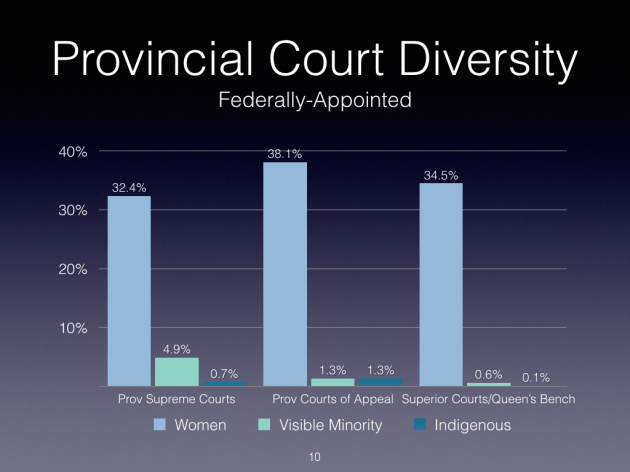
If we look at federally appointed judges to provincial courts (figure 2), the picture is slightly better in terms of both visible minority and Indigenous judges, but in both cases the representation is significantly lower than these groups’ population shares. In the superior courts/Queen’s Bench women are particularly under-represented, but they are better represented when the representation is compared with that of the federal courts.

Judicial Diversity 2016 - DRAFT.010Figure 2

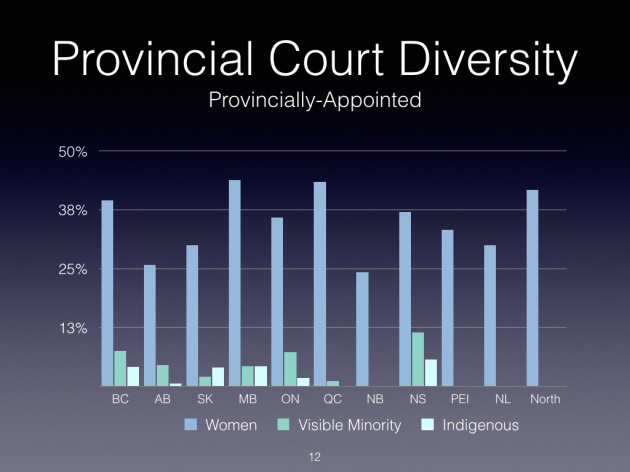
The picture for provincially nominated judges to provincial and territorial courts (figure 3) varies by province, but overall the provinces resemble each other in their under-representation of these groups. The Atlantic provinces, with the exception of Nova Scotia, have no visible minority or Indigenous judges. In the North, despite the large Indigenous population, there are no Indigenous judges. Quebec has relatively few visible minority judges and no Indigenous judges. Saskatchewan and Manitoba, despite their large Indigenous populations, have relatively few Indigenous judges.

Judicial Diversity 2016 - DRAFT.012Figure 3

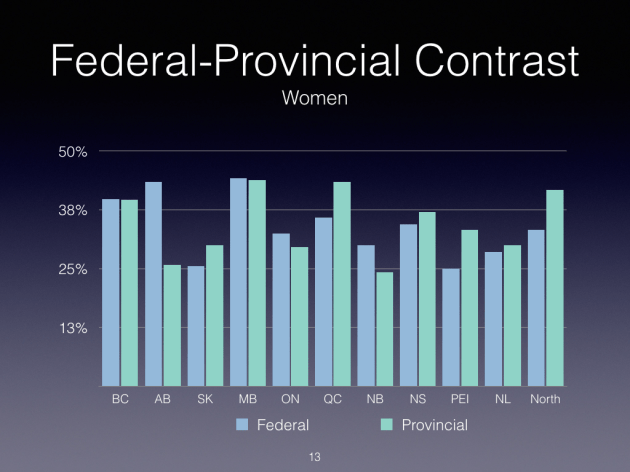
In the next series of charts federally and provincially appointed judges are compared for each under-represented group, by province, starting with women (figure 4). Here there is no overall trend: the federal and provincial appointment of women is similar in British Columbia, Manitoba, Nova Scotia, and Newfoundland and Labrador; in Saskatchewan, Quebec, Prince Edward Island and the North, provincial appointment of women is higher; and in Alberta the appointment of women is significantly lower, given the relatively large share of part-time and supernumerary appointments that are men (about a third of full-time judges are women).

Judicial Diversity 2016 - DRAFT.013Figure 4

Looking at visible minorities (figure 5), when we compare federal and provincial appointments by province, we see a trend in all provinces except Saskatchewan: provincial judicial appointments are more representative of their populations than federal nominations, although visible minorities are still significantly under-represented.

Judicial Diversity 2016 - DRAFT.014Figure 5

Lastly, with respect to Indigenous appointments (figure 6), we see the same pattern: provincial appointments are more representative of provincial populations than federal appointments in all provinces and territories, except, surprisingly, in the North, where there are no Indigenous territorial judges.

Judicial Diversity 2016 - DRAFT.015Figure 6

Looking at senior judges (chief and associate-chief justices), there are no federally appointed visible minority or Indigenous judges, and there are only a handful number of provincially appointed senior judges (figure 7).

Judicial Diversity 2016 - DRAFT.011Figure 7

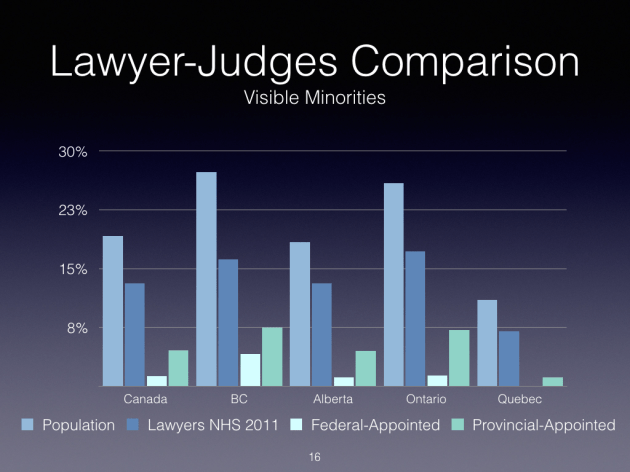
While judicial diversity is low, particularly for visible minorities and Indigenous people, the number of visible minority lawyers continues to increase. Figure 8 presents the proportions of visible minority lawyers aged 25-64 Canada-wide and in the largest provinces, which gives an idea of the size of the pool that can be drawn from. Given that visible minorities are, in general, younger than the general population, visible minority lawyers are also likely to be younger and, therefore, the percentage who would be aged 45 years old or older, the usual age people are considered for these positions, would be lower.

Judicial Diversity 2016 - DRAFT.016.pngFigure 8

As part of its review of the judicial appointment process, the Office of the Commissioner for Federal Judicial Affairs should expand the existing information on the gender of judges and include visible minorities and Indigenous people. With this information, the government could be held to account for its diversity and inclusion commitments, and it would be easier to track its progress over time.

The provinces and territories that do not already do this should do so, and they should use Ontario’s annual reports on appointments as a model, ensuring that the annual reports cover the overall diversity of the entire bench.

*A few notes on methodology. The federal government publishes statistics on gender but not on visible minority or Indigenous appointments. All provinces except Alberta and Saskatchewan indicate gender through the use of “Mr.” or “Madam” justice (the departments of justice provided the number of women judges). Gender information is thus complete.

To identify visible minority and Indigenous origin name checks, appointment announcements and, when available, photos and biographies were used. All provincial judicial councils or departments of justice were approached (only Ontario reports publicly but Saskatchewan, Quebec and Nova Scotia provided the breakdowns used). The Canadian Bar Association, national and regional branches, and law societies were approached and a number of individual lawyers also helped improve the quality of the data collected. I believe this provides a reasonable assessment of current diversity.

The taint of anti-Semitism from Europe’s left: Ian Buruma

Good piece by Buruma:

When the state of Israel was founded in 1948, the Soviet Union and leftists in general were sympathetic. For several decades, socialists of Russian and Polish extraction dominated Israeli politics. Zionism was not yet regarded as a noxious form of racism, along with apartheid in South Africa. Things began to change in the early 1970s, after the occupation of the West Bank and other Arab territories. Two intifadas later, the Israeli left finally lost its grip, and the right took over.

Israel became increasingly associated with the very things leftists had always opposed: colonialism, oppression of a minority, militarism and chauvinism. For some people, it was perhaps a relief that they could hate Jews again, this time under the guise of high-minded principles.

At the same time, and for much the same reasons, Israel became popular on the right. People who might have been fervent anti-Semites not so long ago are now great champions of Israel. They applaud the Israeli government’s tough line with the Palestinians. Israel, in a common right-wing view, is a bastion of “Judeo-

Christian civilization” in the “war against Islam.”

It is remarkable how often the old anti-Semitic tropes turn up in the rhetoric of these cheerleaders for Israel. But this time it is Muslims, not Jews, who are the target. Muslims in the West, we are repeatedly told, can never be loyal citizens. They always stick to their own kind. They will lie to people outside their faith. They are naturally treacherous, bent on world domination. Their religion is incompatible with Western values. And so forth.

The genuine threats coming from a violent revolutionary movement within the Islamic world can make such assertions seem plausible. But, in most cases, they should be recognized for what they are: tired old prejudices meant to exclude an unpopular minority from mainstream society. Islamist violence only helps to boost the politics of hatred and fear. Many Western warriors in the so-called war against Islam are nothing but modern-day anti-Dreyfusards.

None of this excuses the vile language of Mr. Livingstone and others like him. Left-wing anti-Semitism is as toxic as the right-wing variety. But the role of Israel in Western political debate shows how prejudices can shift from one group to another, while the underlying sentiments remain exactly the same.

Source: The taint of anti-Semitism from Europe’s left – The Globe and Mail

Politician’s cancelled visit causes tension in Indo-Canadian communities

I think the existing policy, implemented under the Conservatives, is preferred rather than reinforcing political attachment to countries of origin:

The planned visit of an Indian politician to Canada to campaign to non-resident Indians and its ensuing cancellation has caused tension in Indo-Canadian communities.

Amarinder Singh of the Punjab Pradesh Congress Committee had planned to visit Canada to hold rallies and events in the GTA and Vancouver, according to news reports out of India, but cancelled the visit after a complaint was made by a human rights group called Sikhs for Justice to Global Affairs Canada and the Indian High Commission in Canada.

Mr. Singh instead interacted with Indo-Canadians and non-resident Indians—known as ‘NRIs’—via Skype.

When asked about the Canadian government’s involvement in the re-routing of Mr. Singh’s North American political tour, foreign ministry spokesperson Francois Lasalle pointed to a government policy banning political campaigning by foreigners, and wrote in an email that “Global Affairs Canada has made this policy very clear to all foreign missions in Canada (including bringing it to the attention of the Indian High Commission in Ottawa) and will continue to do so.”

Canada’s government enacted a policy in September 2011 that reads “the Government of Canada will continue to refuse requests by foreign States to include Canada in their respective extraterritorial electoral constituencies. Also, the Department will not allow foreign governments to conduct election campaigns in Canada or establish foreign political parties and movements in Canada.”

Minister of Innovation, Science and Economic Development Navdeep Bains (Mississauga-Malton, Ont.) appeared to disagree with the government’s policy, saying that his constituents are engaged in international politics and that allowing politicians to visit communities is a matter of Charter rights.

“I think we have a very vibrant diaspora here in Canada that’s very engaged in domestic and international politics. I think we’re a country that supports a Charter. Freedom of expression, freedom of opinion, freedom of assembly. These are all Canadian attributes and we welcome any opportunity that politicians have when they want to come and engage with the diaspora, and I think that’s the message I heard from my constituents and that’s the message I relayed on to them,” he told The Hill Times.

Mr. Singh himself characterized the ban on his political action in much the same way, writing a letter to Mr. Trudeau on the matter. “It feels like a gag order that has left a very bad taste,” he wrote, according to a report from India Today.

Source: Politician’s cancelled visit causes tension in Indo-Canadian communities |

The black people in the Middle of Nowhere: The lost community of Amber Valley, AB

Good piece on the history of Amber Valley and its Black community:

Of course, 1909 Canada was no beacon of racial tolerance — as evidenced by the simple fact that Ottawa didn’t allow a second Amber Valley to take root.

In the era of the Chinese Head Tax and the Komogata Maru, it was clear that the government of Prime Minister Wilfrid Laurier made no bones about keeping out non-white immigrants. The only reason nobody had bothered to explicitly keep out blacks was because nobody in Ottawa could conceive of black people wanting to live in the Siberia-like climate of Alberta.

But it only took a surprise trainload of Oklahomans to spawn a nationwide flurry of petitions and letters demanding that the borders be closed to black immigration.

“This board of trade views with very serious concerns the influx of Negro settlers into Central Alberta,” read a 1911 petition by the Calgary Board of Trade.

If left unchecked, claimed the Calgarians, the tide of American blacks would have a “disastrous influence upon the welfare and development of this fair province.”

The basic objection was fear of a black Canada. The United States at the time had 10 million black citizens, and many in white America all too willing to see them disappear over the Canadian border. At the time, a Vancouver newspaper even published an interview with a Oklahoma immigration agent who was reportedly promising to “put a nigger and a team of horses on every quarter section of land I can get my hands on.”

Ottawa feared a black takeover of the plains that could overwhelm Canada’s existing 7 million population. By 1911, Canadian diplomats had effectively kiboshed any future Amber Valleys by warning would-be U.S. pioneers that “the American Negro may be barred on the ground that he could not become adapted to the rigorous northern climate.”

Tristin Hopper

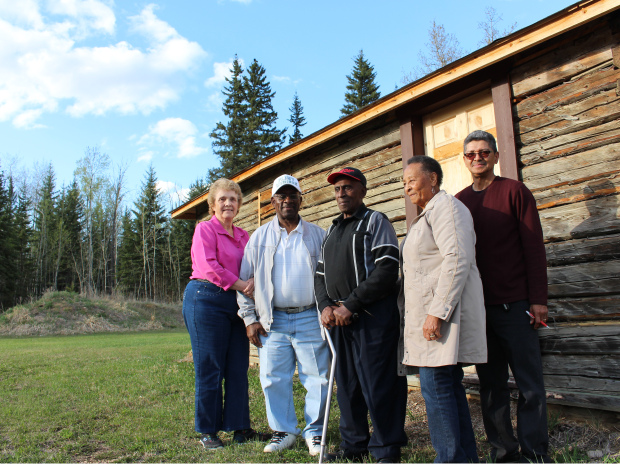
Tristin HopperThe children of Alberta’s black pioneers standing in front of the preserved Amber Valley cabin of Romeo Edwards, April 30, 2016. From left to right, Edith Edwards, brothers Elmer and Ken Edwards, Joyce Edwards and Gilbert Williams. With the exception of Edith, who grew up nearby, all four were born and raised in Amber Valley.

As with so many Western pioneer settlements, Amber Valley’s heyday was shortlived. Born-and-raised Amber Valleyans started striking out for the list of Calgary, Edmonton and Winnipeg by the 1940s, and as parents died the original homesteads were sold.

Source: The black people in the Middle of Nowhere: The lost community of Amber Valley, AB

Stop making these excuses for the lack of diversity at your company: Johnathan Nightingale, Hubba

Some practical advice on how to increase diversity in the tech industry and elsewhere:

Learn to search blindfolded

A funny thing happens when you take faces and names off of resumes and LinkedIn profiles. People who would insist that they have no bias or prejudice suddenly start evaluating candidates differently. You find candidates you somehow missed before. Unconscious bias isn’t a bleeding-heart liberal codeword, it’s a real threat to your business and your ability to find top talent. We now use the Unbias browser addon to automatically hide names and faces on LinkedIn. Try it. It really does change the quality of candidate searches, whether it ought to or not.

Cast a broader net

A job posting has one goal: to get good candidates excited enough to start a conversation. Every time a position you post reaches some great people, but they decide not to apply, your hiring program has failed. When a marketing program fails the answer is not to complain that there aren’t enough people out there; the answer is to market smarter. A job posting is no different.

Services like Textio can help you analyze your job descriptions to find obvious points for improvement, but they’re also useful for starting conversations about what you’re really looking for. A long list of bullet-point requirements feels natural, but understand that those lists implicitly select for men, who will apply when they meet a much smaller portion of them. In tech, a common pattern is for hiring managers to say “I don’t care who you are, just show me your hobby projects on Github, or your think pieces on Medium” – but a bit of reflection is all it takes to realize that screening based on free-time pursuits gets you more affluent white men than it does underemployed single moms.

Build the best team

The most pernicious theme I hear from people in hiring positions is that they don’t want to “lower the bar” – that they’d happily hire a more diverse group but not at the cost of individual candidate quality. It sounds rational but it’s wrong-headed for two reasons. First, the implication that any current diversity gap must be a result of lower quality stinks, and ignores everything we know about the barriers many groups face. But second is that it misunderstands your job as a leader.

Your job is to build the best team. You can choose a lot of strategies to get there. But if your strategy is to hire “the best candidate” for each role without regard to the team’s composition, and it’s leaving you with a weaker, less diverse team, then your strategy is failing and it needs to change.

Source: Stop making these excuses for the lack of diversity at your company – The Globe and Mail

RCMP changes application requirements, with permanent residents welcome to apply

Military, RCMP, CSIS.001RCMP employment equity reports consistently show under-representation as the above chart shows. The citizenship requirement change will make a slight difference: after 10 years, about 65 percent of visible minorities are citizens, with the percentage rising to 80 percent after 15 years:

The RCMP has changed its application requirements, with more people now eligible to apply to be a Mountie and some applicants not needing to take some of the previously mandatory tests.

Up until now, Mounties had to be Canadian citizens. But under the changes that took effect today, permanent residents who have lived in Canada for at least 10 years are eligible to apply.

The shift could only help the RCMP meet its target for 20 per cent of its ranks to be comprised of visible minorities.

Last summer, the RCMP exempted university graduates from taking the national police force’s entrance exam. Now, people with a minimum two-year college diploma may also skip the exam, which tests a person’s aptitude for police work.

There are also changes to the physical abilities requirement evaluation. Previously, prospective recruits had to complete the test at their own expense before submitting an application. Going forward, RCMP applicants won’t have to perform the test until they’ve been accepted at the RCMP’s training academy in Regina — called Depot Division — and the Mounties will cover the cost.

The RCMP says it will reimburse the $79 fee to anyone who completed the test between Jan. 1 and March 15, 2016.

These are big changes for the national police force; the RCMP Act says members of the RCMP must be citizens. The only exception is when there is no one available for appointment who meets all the criteria except citizenship.

It suggests the Mounties may not be receiving enough applications to keep up with the pace of retirements or meet the demands of its policing contracts with several provinces. That could explain a notice on the RCMP website that reads: “In order to meet organizational needs, applicants from British Columbia, Alberta, Saskatchewan or Manitoba will have the opportunity to select their home province for their first post following graduation.”

Source: RCMP changes application requirements, with permanent residents welcome to apply – Politics – CBC News

Citizenship Act bill: An overview of what the committee witnesses had to say

Versions of this post originally appeared in IRPP’s Perspectives and The Hill Times:

A Commons committee has finished hearing witnesses on the proposed changes to the Citizenship Act in Bill C-6, and is proceeding to clause-by-clause examination of the legislation. Contrasting the nature of the committee testimony with that of Bill C-24, the Strengthening Canadian Citizenship Act, some two-years ago reveals similarities and differences. A number of suggestions were broadly in line with the government’s overall agenda of diversity and inclusion, and it will be interesting if the government responds to these in amendments to the bill.

Starting with the common elements between the two sets of hearings:

  • An almost complete absence of Quebec-based witnesses and French-speaking witnesses, and thus any Quebec-specific citizenship issues that may reflect its different mix of source countries, particularly from the Maghreb, where revocation, or removal of citizenship, would likely be a particular concern;
  • An almost complete lack of statistical data with witnesses talking either in conceptual terms, anecdotal examples, or principles, without any reference to the numbers of people potentially affected by the changes. Assertions by those impacted, for better or worse, by the previous or current Bill, would benefit from the hard numbers;
  • Both sets of hearings ensured different perspectives.

However, a number of significant differences between the study of the two bills, reflecting the change in government, are also notable:

  • 18 witnesses for C-6 compared to 28 for C-24, reflecting the broader scope of C-24 and a likely tighter timeline under the current government;
  • About 40 percent of witnesses broadly supported the revocation of citizenship provision during the study of the Conservative government’s C-24, in contrast to about 25 percent during the study of C-6, reflecting the previous administration having ensured a majority of witnesses in support of the most controversial change;
  • A generally more open tone in discussion and the questioning of witnesses by all parties. The witnesses for the most part recognized that a change in government meant a needed change in tone and approach. Shimon Fogal of the Canadian Israel Jewish Advocacy exemplified this approach, going out of his way to recognize the arguments against revocation while maintaining his position in favour of it. James Bissett and Martin Collacott, both former public servants with immigration experience, did not, thus undermining their arguments as they largely repeated themselves and their tone from previous testimony.
  • Predictably, witnesses that favour an easier pathway to citizenship, while welcoming the proposed changes of C-6, focused on what they perceived as remaining gaps: procedural protections for revocation of citizenship in cases of fraud or misrepresentation; barriers to refugees and some immigrants with respect to more difficult knowledge test and language assessments;  the need for exceptions to the requirement of physical presence in Canada and not merely the possession of a legal address; and the high cost of citizenship fees ($630) and language assessments (about $200) for all applicants.

Minister McCallum did express some openness to amendments and the nature of the questions from Liberal MPs suggested the same flexibility. While the extent of this willingness is unclear, the following is my take on possible amendments, based on their broad consistency with the government’s “diversity and inclusion agenda” and the principles and philosophy behind Bill C-6:

  • Revocation for fraud or misrepresentation: C-24 removed the rights or «procedural protections » that those facing revocation faced, including recourse to the Federal Court, leaving revocation at the discretion of the Minister and delegated officials. There was broad support to ensure those protections were made comparable to those in place for revocation of permanent residency, which provides for an oral hearing. Some argued for reverting back to the former process requiring a Federal Court ruling, which was lengthy. Others argued for the Immigration Review Board (IRB) to expand its mandate to include citizenship hearings, which would require additional resources.
  • Language and knowledge testing: The government responded to public pressure by reverting to the previous age range of 18 to 54 for the testing, but did not (wisely in my opinion), allow the knowledge test to be taken with an interpreter. The revision of the study guide, Discover Canada, and the related citizenship test questions, will presumably (and should) include a complete rewrite into plain language. This would address many but not all of the issues raised by witnesses, without a further weakening of the language requirements, with language skills so important to integration.
  • Physical presence requirement: This provides a clear and common sense definition of residency. However, given the nature of a more mobile and global world, particularly for many economic immigrants, there is a strong case for some forms of defined exemptions. These exemptions could include those who work for a Canadian company abroad, or leave the country for health and compassionate grounds. Or the exemptions could revert to the previous, broader guidance provided to citizenship judges.
  • Citizenship fees: While not part of legislation, the quintupling of fees in 2014-15 and the additional cost of up-front language testing will reduce the number applying, and thus reduce the naturalization rate, a trend we are already seeing. Fees are a significant barrier for lower income immigrants and refugees. Given that a large part of Canada’s relative success as a diverse society reflects a clear pathway to citizenship, addressing the cost, through a general reduction to perhaps $300, possibly combined with a partial waiver for refugees, would help restore this pathway to citizenship and political integration.

Whether the government will consider amendments, or whether the selection of witnesses was part of a strategy to allow the government to demonstrate flexibility, will tell us both about the specific citizenship policy directions as well as their general approach to governing. Will they view Parliament only as a way to deliver on their political commitments, or will they view Parliament as a significant forum for more open policy discussions, debates and decisions?

The upcoming clause-by-clause review starting May 3rd will illustrate their approach in both the particulars of C-6 as well as the broader context.

C6_-_Citizenship_Hearings_and_Possible_Amendments.png