Todd: Do women, people of colour get fewer votes in Canada? New studies say no

Interesting US study, broadly applicable to Canada:

Given the Olympics are up and running, it’s fitting to reflect on how the image that cartoonists most often use to show that women and ethnic minorities have a disadvantage is one of the hurdles.

The illustrations recur: Of women and people of colour literally having to jump over more and higher hurdles than white people or men to reach victory in their fields, particularly politics.

Now that U.S. Vice-President Kamala Harris, whose mother was born in India and father in Jamaica, is the Democratic Party’s candidate for president, media outlets are especially filled with talk about gender and racial barriers.

But the clichéd metaphor of an unfair hurdles race is in need of an update in light of studies showing that in almost all cases and places women and people of colour compete evenly.

Last month, researchers at the University of Oxford unveiled the findings of the most extensive analysis yet performed on how people vote in view of candidates’ ethnicity and gender.

Lead by Sanne van Oosten, the team looked for the patterns in 43 different sociological experiments in the U.S., Europe and Canada of voter preference over the 10-year period ending in 2022.

The experiments typically involved presenting respondents with profiles of fictional political candidates, while randomly varying the candidates’ race or ethnicity. There were in total more than 310,000 observations of respondents’ preferences.

“Our meta-analysis concludes that, on average, voters do not discriminate against minoritized politicians,” van Oosten said. “In fact, women and Asians have a significant advantage compared to male and white candidates.”

Van Oosten, who had earlier been appalled by gender-based criticism of Hillary Clinton and the race-based undermining of Barack Obama, considers the results good news — for Harris and other candidates who are female and/or of colour.

The researcher has been surprised by the dearth of media interest, however, given that her earlier study of how the public can stereotype Muslim candidates as homophobic received international coverage.

“One journalist at a very highly esteemed newspaper even literally said to me: ‘People aren’t interested in good news’,” van Oosten said on social media.

The study by van Oosten, Liza Mügge and Daphne van der Pas doesn’t deny that there is a small minority of voters who have racist or sexist attitudes. But it does find most voters aren’t negatively impacted by a candidate being female or a person of colour. Indeed, it’s often perceived as a positive.

Here how the authors put it in their meta-analysis:

• “Voters do not assess racial/ethnic minority candidates differently than their majority (white) counterparts.”

• In regard to Asian candidates in the U.S.: “Voters assess them slightly more positively than majority (white) candidates.”

• “A meta-analysis on gender demonstrates that voters assess women candidates more positively than men candidates.”

• When voters from minority ethnic groups share the same ethnicity as the candidate, they positively “assess them 7.9 percentage points higher” than white candidates.

• Even in “patriarchal” societies, such as in Jordan, men will vote for a female candidate over a male if she shares the voter’s ethnicity.

The comprehensive Oxford study also cites the work of Anthony Kevins, of Utrecht University, who found across the U.S., Britain and Canada there is no sign that voters will refrain from marking an X on a ballot for a candidate because of their gender or ethnic background.

In Canada, Kevins found only one distinct bias: That members of the Canadian political left have, all other things being equal, “a higher likelihood of voting for the East Asian candidate.”

The University of Toronto’s Randy Besco, author of Identities And Interests: Race, Ethnicity and Affinity Voting, said in an interview that on average racial minority candidates don’t get fewer votes in Canada.

However, in one specific category, “racial minorities running for the Conservative Party do get less votes.”

The broader finding in the work of Besco and others is about significant so-called “affinity voting,” in which people elect members of their same identity group.

“Chinese and South Asians showed preference for their own ethnic group compared to a white candidate,” Besco said. And they also preferred to vote for members of other minority groups over white candidates. “But this preference was weaker than same-ethnic preference.”

Asked whether Canadians who are white also engage in affinity politics, by tending to mark their ballots for Canadians who are white, van Oosten said in an interview there is no indication white majorities in Britain and Canada make a point of voting for their ethnic in-group. But in the U.S., she said there is an inclination for some white people to do that.

In regard to Canadian voting trends around gender, Besco pointed to the work of his colleague, Semra Sevi of L’Université de Montréal, whose team wrote a paper titled, Do Women Get Less Votes? No.

Sevi et al studied the gender breakdown of over 21,000 candidates in all Canadian federal elections since 1921, when women first ran for seats in Parliament.

The researchers determined, in the 1920s, women were at a 2.5 percentage point disadvantage to men.

But in recent decades, Canadian voters have shown no anti-female bias.

What then explains the disparities on gender and ethnicity among MPs in the House of Commons?

In 2023, about 31 per cent of MPs were female, even though women make up half the Canadian population. Jerome Black and Andrew Griffith also wrote in Public Policy that MPs of colour comprised about 16 per cent of House of Commons members in 2021, while visible minorities made up about 20 per cent of all citizens.

Virtually all the researchers cited in this article maintain that such variance, in Canada and around the world, is not the result of voters being prejudiced against women or members of ethnic minorities.

It’s more about who decides to test the political waters.

The researchers strongly suggest the widespread incorrect belief that voters are prejudiced contributes to fewer minority and female candidates putting their names forward, or being supported, at the nomination stage.

As van Oosten puts it, “the demand” is definitely there for women and people of colour in office. But “the supply” often isn’t, she says, in large part because of misplaced fears about racist and sexist attitudes among the electorate.

In other words, as a society we need to stop discouraging women and people of colour from running for politics — and we can start by throwing away outdated images meant to show they have to jump over extra hurdles.

Source: Do women, people of colour get fewer votes in Canada? New studies say no
‘What is it about the make-up of our society?’ Deborah Lyons on antisemitism in Canada

Of interest:

What have the last 10 months been like in your role?

It has been intense, extremely difficult, with the many challenges that, frankly, we hear about every day. It has been disappointing, in part because I don’t feel that the rise in antisemitism is getting the attention or response from leadership across the country, at all levels, that it should be getting, and that’s been very disappointing. And it’s been quite troubling, because as much as I’ve worked in conflict zones before and difficult environments, to be here, in my own country and to experience the horrific rise, unprecedented rise, of antisemitism in Canada and the lack of a real response to it, causes me to worry about the future of our country.

It’s been, on the one hand, a very meaningful period. But, on the other hand, it’s been, in some ways, very discouraging and concerning about where are we headed. But, frankly, I wouldn’t have wanted to have missed it, because it’s important.

What would you like to see done? 

A lot more. A lot more of leaders at all levels — federal, provincial and municipal, local level — speaking up, speaking out, condemning, clearly, antisemitism. This is not a hard thing to do when you see hatred happening on the streets, in schools, at universities, in the business environment. When you see protests that maybe intended to be peaceful, but truly do get out of hand, with hateful slogans and chants and actually threatening slogans and chants. You really need leaders, community leaders, political leaders, business leaders, faith leaders, academic leaders, standing up and clearly speaking out against this surge of ugliness that seems to have taken over our country.

I would like to see a situation where the fullness of the legal system is being applied, where we have police well-trained on hate crimes, which I think we’re seeing now in some of the major centres across the country, where we’re recording well and fully the incidents that are happening and ensuring that we’re getting a strong sense of this new level of intimidation and fear that has been created in the last year. And that we are making sure that we have our educators, our teachers and our security, our police, well trained to recognize antisemitism and to respond to it.

Do you fear that there is any risk of allegations of antisemitism stifling legitimate political speech?

I’m less worried about that, and more worried about the level of hatred that is growing and where that could take us. Now, having said that, I am a huge supporter of freedom of expression, of academic freedom, freedom of speech.

One of the things we’re working on right now is the fulsome definition of antisemitism that has been developed by the International Holocaust Remembrance Alliance, that Canada has endorsed. And we’re going to be coming out with a guidebook, a handbook on explaining that definition and trying to demonstrate to people, criticize whatever you want to criticize, criticize Israel, criticize any government in the world. You want to criticize them? That’s what we want, in terms of democracy. We want freedom of expression. We want the boundaries of knowledge to be pushed. But there has to be an understanding of where that is treading into, either hateful speech or a demonstration of a particularly threatening bias.

I want to emphasize my concern about protecting freedom of expression, and, particularly, academic freedom, but, at the same time, we have to have a clear moral clarity about what we consider to be hateful speech or hateful incidents.

What does a day in your job look like?

It probably starts off around seven in the morning with a review of the latest crises or catastrophe or incidents, either from the mainstream media or from social media. It then goes through many, many meetings or calls with people across the country, because this is not an Ottawa-centric job, even though I am based out of Ottawa. So I’m travelling across the country a lot. We meet with provincial government people on a regular basis. We meet with federal ministers. So the whole (equity, diversity and inclusion) program is one that we’re looking at. We work with law enforcement on training on antisemitism for police officers across the country. We’re looking at the fullness of the legislation to make sure that it is adequate in addressing hate crimes. We’re looking at the data-collection process, so I’m often engaged with StatCan and others on, are we collecting the right data? Are we getting a good, comprehensive picture so we can have honest conversations about what is really happening there, and provide that to the political leaders?

We’re doing work on social media. (On Tuesday) we were spending some time with social media research companies to identify what is happening in terms of hate crimes throughout that platform. We’re doing work with the universities, of course, so we’re preparing right now for the return to campus in September. So I’m spending time with Universities Canada and specific universities on how they’re going to be working to ensure that the year ahead in the university environment is a more constructive and calmer one.

It does appear that Canada is one of the countries that is actually actively tackling antisemitism, openly, overtly, dramatically, intensely. We’ve seen a huge increase in antisemitism in many parts of the world. I think that we’re seen as a country that is really trying to address it; we’re not having the success I’d like to see us have, but we are at least pushing and actively struggling to try to get to a much healthier place.

Do you see any different textures to antisemitism in your travels and conversations across the country?

I guess I would say that what we’re seeing is a mix of motivations that seem to be driving antisemitism. Some of it comes from the far right, maybe, some of it, maybe, from the far left. Some of it from people who are confusing Canada’s foreign policy, and what they are expressing here in the country is an anti-Jewish hatred, which is completely, I think, all mixed up together.

One of the things, again, as somebody who’s travelled a lot internationally, is, why is Canada having this unprecedented surge in antisemitism right now? What is it about the make-up of our society? What is it about our push for diversity and inclusivity? And what is it about our demographics? What is it about our country that is seeing such a level that has actually caused other countries, to say ‘What’s going on in Canada? We wouldn’t have expected this from Canada.’

I don’t think the faith community has stepped up. I don’t think we’ve seen the non-Jewish, non-Muslim faith communities step up to say, ‘Wait a minute. This is unacceptable in Canada. We don’t endorse this level of hatred and  animosity toward one another. This is unacceptable. This is not who we are as children of God.’

Anthony Housefather, the Liberal MP, was appointed early last month as special adviser on Jewish community relations and antisemitism. Are you stepping on each other’s toes?

I’d say we’re dancing together rather than treading on each other’s toes. Anthony has a very particular role and it’s very important and it’s complementary to my role. We work very closely together, I know him very well. I work very closely, though, with all members of Parliament. Frankly, I can do with more people working actively on this file and I know how committed Anthony is. We’re in touch somewhere between daily and weekly.

Does it make your job easier or more challenging when there are different offices? There’s you, there’s Housefather, there’s Amira Elghawaby on the Islamophobia file. Under former prime minister Stephen Harper, it was the one office of religious freedom.

We talk about that from time to time. I think it was actually prescient, really forward thinking on the part of the present government to have put in place the special envoys and special representatives such as my counterpart, Amira (Elghawaby). No one knew that things were going to get this bad in Canada. It turned out to be prescient, because there is just so much specific work that we have to do, and hopefully we can get that done in spite of the fraught environment that everyone is working in right now and since October 7.

I think the configuration we have right now is actually one that we need for the time right now, because I think there’s very specific work that needs to be done to deal with Islamophobia, to deal with anti-Muslim hate. And there’s no question that there is a huge amount of work that we have to do to combat antisemitism here in Canada. And I don’t know if you would get that done with the same intensity if you were part of a larger, more general approach.

Is there anything specific you’d like to see that might lower the temperature when class returns at universities?

We want to try to see the administrations provide the students, and particularly working with the faculty, who could be playing a much larger role here, in creating safe spaces for debate, for argument, for learning from one another. For exchanging of views, that type of thing, so that the students have the opportunity to challenge the boundaries and come up with new knowledge and come up with new ways of understanding one another and communication.

And then, certainly, I would say that one of the big concerns that we’re seeing, not just at universities, but frankly in work environments generally, the whole EDI (Equity, Diversity and Inclusion) philosophy and approach often does not include antisemitism at all. In fact, it dismisses it almost. And what we found was that many students who were having issues on the campuses after October were going to and we’re told to ‘go to student services, the EDI counsellors are so good,’ and we’re not getting any real responses. And we’ve spoken to university administrations about that, and we’re hoping that we’re going to see some improvements there, where the EDI and student services offices will actually take more seriously the concerns of Jewish students who went to them to seek recourse or support or solace or whatever.

How optimistic are you about the future of your work?

We’re still in the middle of a very challenging time. I think we thought that we would have been in a better place by now. We’re not. So that’s concerning. But I think that you can feel the momentum building, more people coming on stream to be supportive, to be engaged, members of the non-Jewish population who are stepping up.

I don’t even know if I’d use the word optimist or pessimist. I would just say, I think we’re all very determined to come out of this. I’m hoping in a better place than we’ve been, not even the same as we were before, because I think this experience has taught us so much that we have no choice but to find a way to have a better Canada out of this. Because, if we don’t, that alternative is unacceptable.

Source: ‘What is it about the make-up of our society?’ Deborah Lyons on antisemitism in Canada

Kutty: Canada is putting too many Black Canadians behind bars. Here is what we can do about it

As always, the challenge is in the determining what is feasible and has an evidence-base regarding effectiveness, and ultimately in the doing and implementing. Writing a report and making recommendations is relatively easy and consultations have to include diverse views:

…Despite these strengths, the report has notable weaknesses that need to be addressed for effective and meaningful reform.

One problem is the lack of concrete action plans and timelines. Without specific implementation strategies and deadlines, the recommendations risk remaining mere aspirations. To drive real change, the government must outline clear, actionable steps and hold relevant agencies accountable for meeting these targets. Many such reports, including the 445-page Report of the Commission on Systemic Racism in the Ontario Criminal Justice System (1995), which I also wrote about, have gone into the dustbins of history without significant action. The evidence is in the numerous subsequent reports since then that also accumulated dust.

Another weakness is that while the report calls for major overhauls like pouring more resources into jobs, housing, health, and education, and eliminating mandatory minimum sentences, it does not provide robust strategies to address these underlying factors. Comprehensive socio-economic policies ensuring access to quality education, health care, housing, and employment opportunities are essential for a holistic approach to justice reform. Furthermore, the report’s recommendations for training and education of justice system professionals are not adequately detailed. Cultural competency and anti-racism training must be rigorous, ongoing, and integrated into all aspects of professional development. The report should specify the content, frequency, and evaluation methods for such training to ensure it effectively transforms attitudes and behaviours within the justice system.

While the report emphasizes the importance of community engagement, it falls short in outlining mechanisms for meaningful and sustained community involvement in the reform process.

True transformative justice requires continuous dialogue and partnership with affected communities. Establishing advisory councils, conducting regular town hall meetings, and creating platforms for community feedback are ways to ensure reforms are responsive to the needs and experiences of those most impacted by systemic racism.

It is well past the time to start dismantling systemic racism and build a criminal justice system that truly serves all members of our diverse nation.

Faisal Kutty is a lawyer and law professor. @themuslimlawyer

Source: Canada is putting too many Black Canadians behind bars. Here is what we can do about it

ICYMI – Israel Palestine: Australian multiculturalism was never a licence for ‘anything goes’

As in Canada:

Australians have been rightly proud of our largely harmonious and tolerant society, rooted in our unique model of multiculturalism.

This model is centred on celebrating cultural diversity, maintaining shared core values – such as the rule of law, mutual respect and tolerance – and a framework of laws aimed at ensuring good intercommunal relations and deterring and marginalising racial vilification, hate speech and incitement to violence.

Yet, in the past year, the notion that the different peoples and faiths that comprise modern Australia can co-exist in mutual harmony has been repeatedly challenged.

There is no denying we are experiencing an extended period of intercommunal tension, hatred, incitement and violence, which represents a direct challenge to ongoing Australian multiculturalism and our stable, cohesive democratic society.

Since Hamas’ barbaric attack against Israel on October 7 and the subsequent war, a day has seldom passed without examples of hate speech and incitement to violence and worse against Jews and non-Jews who dare express support for Israel or fail to condemn Israel for defending itself against Hamas.

These appalling incidents have included defacing war memorials and tagging Jewish day schools, synagogues and communal buildings with offensive graffiti and banners. The wider community has not been immune from these attacks either.

Protesters have glorified Hamas – a banned terrorist group – and chanted hateful slogans including: “There is only one solution, intifada revolution”.

Some Muslim leaders have seemingly supported Hamas’ massacre as legitimate resistance against Israel. One Australian Islamic scholar said there were no “innocent victims” on October 7; another Muslim cleric sermonised recently that Jews are “descendants of pigs and monkeys”; another sermonised on December 22 in Sydney that, “The most important characteristic of the Jews is that they are bloodthirsty … another is betrayal and treachery,” adding Jews are “monsters” who “love to shed blood”.

Antisemitic tropes – such as allegations that “Jewish power” works to undermine our institutions and national interests – have migrated from the fringes into the mainstream with claims from members of parliament about the supposed tentacles of the Jewish lobby and the alleged veto of Jewish politicians over the government’s Middle East policies.

Unfortunately, a vocal minority have seized on these incidents as proof that multiculturalism is not only a failed experiment but the catalyst for many of our problems.

Yes, we should be concerned, but we need to focus on the right targets.

Australian multiculturalism was never a licence for “anything goes”, that whatever your background or values – be they embedded in extremism, violence, terrorism, racism or whatever – they’ll fit into diverse Australia.

Rather, our multicultural, democratic model has succeeded only by emphasising the need to accept and practise one’s responsibilities and not just exercise one’s rights. It relies on a non-negotiable commitment to certain shared core values and responsibilities, including parliamentary democracy and the rule of law; freedom of speech and religion; the equality of the sexes; and mutual respect and tolerance.

If the values and principles embedded in your ethnicity, religious or national background violate those core multicultural, democratic values, they are unacceptable in multicultural, democratic Australia.

These are the principles underpinning the fabric of Australian multiculturalism, which so much of the current discord, hatred and antisemitism profoundly challenges and undermines.

The fundamental issue is the failure of our leaders to emphatically stress these core values and forcefully condemn behaviour breaching them, and the relative inaction of legal authorities in enforcing the law.

During the infamous October 9 anti-Israel demonstration at the Sydney Opera House, which included chants of “f— the Jews” and “Where’s the Jews?”, NSW Police failed to act against protesters.

Instead, Jews and pro-Israel supporters were told to avoid Sydney’s CBD. Law enforcement’s practice of managing conflict by shifting responsibility from would-be perpetrators to the targets of hate has been on repeat since October 7.

On November 10, when anti-Israel demonstrators descended on Melbourne’s Jewish community, the police evacuated congregants from a nearby synagogue service.

Continuing the pattern, visiting families of Israeli hostages kidnapped by Hamas were further traumatised when anti-Israel agitators took over their hotel lobby. Instead of dispersing those disturbing the peace, the police moved the Israeli guests to a nearby police station for their protection.

Police investigations into some of the sermons cited above concluded that none appeared to “meet the threshold of any criminal offence” covered by our laws against racial vilification and incitement.

Something is clearly amiss. At a time of escalating tensions, it’s crucial our leaders and law enforcement take a strong stand against hateful and threatening behaviour.

No one would argue that from time to time policies and legislation don’t need tweaking to meet today’s challenges and circumstances, and indeed reviews are under way, including on ways “for government and the community to work together to support a cohesive multicultural society” with the federal government just releasing the report of the multicultural framework review and its response.

Yet, we need more rigour and vigour in enunciating and implementing both our policy and legal frameworks to prevent further damage to Australian democracy and our multiculturalism upon which the harmony and security of our society crucially depend.

Colin Rubenstein is the executive director of the Australia/Israel & Jewish Affairs Council and was a member of the initial Council for Multicultural Australia (2000-06).

Source: Israel Palestine: Australian multiculturalism was never a licence for ‘anything goes’

Nicolas: Conservatismes dénationalisés

While I wouldn’t class J.K. Rowling the same as the “pyromanes” Elon Musk and Donald Trump, valid point on the convergence of the nationalist right wing across countries:

Il y a désormais 20 ans, l’été normalement très peu politique des gens de Québec était interrompu par une manifestation de 50 000 personnes se portant à la défense de CHOI Radio X et de son animateur vedette Jeff Fillion alors que la licence de la station était menacée par une décision du Conseil de la radiodiffusion et des télécommunications canadiennes, le CRTC. Les voitures de mon quartier étaient placardées d’autocollants où on pouvait lire : « Liberté ! Je crie ton nom partout ! »

Liberté de quoi ? Liberté, pour Jeff Fillion, d’insulter les femmes, les immigrants, les gais, les pauvres, les politiciens : bref, à peu près tout le monde. Du moins, c’était là le type de propos dits « controversés » qui avaient justifié la décision du CRTC.

En septembre 2004, une élection partielle dans mon comté, Vanier, a fait entrer à l’Assemblée nationale un nouveau député de l’Action démocratique du Québec (ADQ), Sylvain Légaré. Le chef de l’ADQ, Mario Dumont, avait vu dans la mobilisation locale une occasion politique en or et avait fait campagne en se portant à la défense de Radio X.

Cette page d’histoire locale illustre bien le contexte social et politique dans lequel a émergé ce qu’on a appelé la « crise des accommodements raisonnables ». L’été 2004 représente en quelque sorte une version bêta de l’alliance entre personnalités médiatiques populistes et politiciens populistes qui permet aux uns de normaliser leurs idées dans l’espace public et aux autres de faire des gains électoraux à court terme.

La recette testée cet été-là a été adaptée à l’échelle de la province dans les années qui ont suivi. D’un côté, des anecdotes médiatiques du type « les immigrants et les minorités exagèrent » ont trouvé leur courroie de relais à l’Assemblée nationale. De l’autre, le nouveau paradigme parlementaire a décuplé la proportion du débat public québécois qui divise la population sur la base des attitudes face à « l’identitaire ». À bien des égards, on vit toujours dans ce paradigme.

La métamorphose politique de ces années-là n’est toutefois pas unique au Québec. L’alliance entre médias de droite populiste et mouvements politiques conservateurs a aussi été cimentée par des hommes bien plus puissants, tels que Rupert Murdoch, propriétaire de la chaîne américaine Fox News comme de plusieurs médias du même acabit au Royaume-Uni et en Australie, et Vincent Bolloré, propriétaire de CNews et de plusieurs autres chaînes françaises. Ces hommes ont transformé non seulement les médias, mais aussi le champ des idées politiques acceptables et la manière de débattre dans leurs pays d’activité respectifs.

À bien des égards, la dynamique politique des années 2000, c’était le bon vieux temps. L’enfance du problème, en quelque sorte.

Ou du moins, c’est ce qui m’appert alors que je regarde comment des présupposés sur l’identité religieuse du suspect dans une affaire de meurtre servent de bougie d’allumage à une vague d’émeutes violentes portée par des mouvements d’extrême droite en Grande-Bretagne. Ou quand je vois comment la Russie, frustrée d’être exclue des Jeux olympiques, contribue à semer le doute sur l’identité de genre d’une boxeuse algérienne, Imane Khelif, de manière à faire s’entre-déchirer tout l’Internet occidental pris au piège dans ses « guerres culturelles ».

Je suis tentée de distribuer à J.K. Rowling, Elon Musk et Donald Trump les trois médailles d’une nouvelle discipline olympique : celle de l’ultrariche pyromane. Je laisse au jury le soin de terminer à qui revient l’or, l’argent et le bronze, mais de toute évidence, ces trois-là ont formé le peloton de tête cette semaine.

Je dis que les années 2000 m’apparaissent comme un temps plus doux, parce que dans l’affaire Khelif, nos populistes locaux se sont simplement fait les perroquets de nos champions internationaux ultrariches pyromanes. Depuis l’avènement des médias sociaux et la montée mondiale du populisme de droite, les dérapages qui empoisonnent nos débats d’idées sont de moins en moins désignables comme « nos » dérapages.

Du temps du code de vie d’Hérouxville, ça chauffait, certes, mais on se sentait un peu moins directement comme les pantins des milliardaires de la mondialisation en manque d’attention. On pouvait se battre contre les préjugés toxiques à armes tout de même plus égales lorsqu’on n’avait pas carrément les algorithmes de plateformes comme X contre nous.

En 2008, le rapport Bouchard-Taylor avait désigné, finalement, la « crise des accommodements raisonnables » comme une crise de perception alimentée par des anecdotes montées en épingles par certains médias d’ici. Ce que l’actualité de la semaine démontre, en quelque sorte, c’est que le carburant de nos crises de perception est plus que jamais complètement sorti des champs de compétence provinciaux.

La « bollorisation » des médias français influence directement les élites politiques et médiatiques québécoises admiratives de l’Hexagone. Les guerres culturelles de Fox News sont adaptées à la sauce canadienne par le mouvement conservateur de Pierre Poilievre. Par TikTok et YouTube, les masculinistes parlent aux jeunes de partout dans le monde. Et les propagandistes russes alimentent les complotistes occidentaux sur des plateformes où la vérification des faits a pour ainsi dire pris le bord. En fin de compte, la circulation des idées réactionnaires sur l’immigration, les minorités, les femmes et l’identité de genre s’est accélérée et internationalisée de manière phénoménale depuis 2008.

Entendons bien : les idées ont toujours circulé et circuleront toujours. Cela dit, des commissaires auraient bien du mal, en 2024, à pointer une origine précisément locale à nos « crises de perception » contemporaines sur les drag queens, les trans, les femmes trop masculines, les immigrants qui prennent trop de place, etc.

C’est là un grand paradoxe des nationalismes conservateurs contemporains. Tout en vantant la nation, ils s’appuient sur des discours qui ont de moins en moins de contenu spécifiquement national. De la France au Royaume-Uni, des États-Unis à l’Italie, de l’Espagne au Canada, les scénarios semblent de plus en plus interchangeables — et la « question de l’heure », hors de notre contrôle.

Source: Conservatismes dénationalisés

‘The trust has been broken’: accountability for racism in PCO requires resignations, says Black Class Action lead Thompson

Usual over the top rhetoric and expectations. Good that reporting is including relevant data from the PSES and EE representation data.

For Thompson to claim that PCO is not providing the numbers, these are available in Table 1 in the annual reports, albeit not disaggregated by visible minority or indigenous group or level.

Given the relatively large numbers (March 2023, 252 visible minority employees, or 22.8 percent), it should be possible to request and obtain disaggregated numbers for most groups, and for the larger groups, executives):

…The report—released on July 29 by the Coalition Against Workplace Discrimination, which obtained the document through an access to information request—said that Black, racialized, and Indigenous employees experienced “racial stereotyping, microaggressions, and verbal violence,” and a workplace culture where that behaviour is “regularly practiced and normalized, including at the executive level.” 

The report also found that PCO’s culture discouraged reporting and that “effective accountability mechanisms are currently non-existent.”

Rachel Zellars, an associate professor at St. Mary’s University, produced the report following interviews she conducted with 58 employees from November 2021 to May 2022 as part of the PCO’s “Your Voice Matters” Safe Space Initiative, and her work as the inaugural Jocelyne Bourgon Visiting Scholar for the Canada School of Public Service. 

Zellars said she conducted 13 interviews with racialized employees and eight with Black employees, the latter accounting for half of the total Black employees in the PCO at the time. 

Those employees shared experiences of their managers and supervisors using the N-word “comfortably” in their presence, and expressing surprise and ignorance when informed it was a pejorative term, as well as Islamophobic remarks and “feigned innocence” when white employees were promoted over them.

In contrast, white employees had worked at PCO for longer periods, and were clustered in higher-level positions than Black, racialized, and Indigenous employees. Those white employees also detailed experiences and career-advancing opportunities “in stark variance” to their non-white colleagues.

The Safe Space Initiative was launched following a Call to Action by former clerk Ian Shugart in January 2021. The call urged public service leaders to take action to remove systemic racism from Canada’s institutions. 

According to the 2022 Public Service Employee Survey results for the PCO, seven per cent of the 710 employees who responded said they had been the victim of on-the-job discrimination in the previous 12 months. Of the 35 respondents who identified as Black, 12 per cent said they had been the victim of discrimination. Ten per cent of the 145 racialized, non-Indigenous respondents indicated they had been the victim of discrimination, and five per cent of non-racialized, non-Indigenous employees did as well.

Of those who said they had been the victim of discrimination, 31 per cent said it had been targeted at their national or ethnic origin, followed by age-based discrimination at 30 per cent. Twenty-nine per cent said the discrimination they faced was based on their racial identity, 25 per cent said it was due to sexism, and 23 per cent said the discrimination was based on skin colour.

The vast majority of those employees who said they experienced discrimination—75 per cent—said the source had been a supervisor or manager, followed by 19 per cent who said it came from coworkers, 18 per cent who said employees from other departments, and three per cent who indicated they had been discriminated against by their subordinates.

Nearly half of the employees—47 per cent—who said they had been the victims of discrimination said they had taken no action in response due to fear of reprisals or expectations that doing so would be futile.

In an interview with The Hill Times following the Aug. 1 march, Black Class Action Secretariat CEO Nicholas Marcus Thompson questioned how the government can be trusted to implement any measures regarding the International Decade for People of African Descent, or even lead its own call to action to address anti-racism in the public service when the leadership responsible for doing so are themselves perpetrators. 

During this year’s official Government of Canada Black History Month reception on Feb. 7 at the Canadian Museum of History, Prime Minister Justin Trudeau (Papineau, Que.) announced that Canada would extend its recognition of the decade until 2028, giving Canada the “full 10 years.” Trudeau’s government officially recognized the UN General Assembly 2015 proclamation of the decade in January 2018.

Since 2019, the federal government has announced several measures and investments attributed to Canada’s recognition of the decade, including $200-million over five years for the Supporting Black Canadian Communities Initiative, $265-million over four years to the Black Entrepreneurship Program (BEP), $200-million to establish the Black-led Philanthropic Endowment Fund, and the development of Canada’s Black Justice Strategy to address anti-Black racism and systemic discrimination in the criminal justice system. The strategy “aims to help ensure that Black people have access to equal treatment before and under the law in Canada.”

Thompson noted that the PCO’s response to the report did not include an acceptance of responsibility or an apology. 

“No apology for the pain they’ve caused their employees … for the microaggressions or the use of the N-word,” Thompson said. “The first step should be an apology.”

In response to the coalition’s publication of the report, the PCO issued a similar statement to the one it sent to The Hill Times, highlighting the steps its senior management team has taken to “reinforce” its commitment to Shugart’s call to action, and pointing to the increases in representation within its workforce and executive since 2020. 

Between March 2020 and 2024, the PCO says that of its 1,200 employees, Black representation increased from 3.4 per cent (29 employees) to 5.8 per cent (66 employees). It also noted an increase from 2.7 per cent to 2.9 per cent for Indigenous employees, 16.5 per cent to 23.9 per cent for racialized employees, and an increase in women employees from 53.9 per cent to 57.8 per cent.

Within the executive, PCO says it has increased its representation in all those categories as well, but did not provide the underlying number of employees those percentages are based on, which Thompson said helps mask the reality of the situation. 

“They rely on percentages when it suits them because they could say they had a 50 per cent increase, but that could just represent one more employee if they only had two before,” Thompson explained. “We want to see representation increase, but it must be done proportionately.”

As for the steps the PCO says it has taken in its response, Thompson said many of those were performative “events,” and lack the depth required to comprehensively tackle the systemic issues identified in Zellars’ report and Shugart’s call to action. 

However, Thompson said the “trust has been broken,” and the coalition no longer believes the PCO can “fix itself.” 

“If we want to see accountability, we need resignations,” Thompson said. 

Alongside its reiteration of the long-standing calls for the creation of a Black Equity Commissioner and the settlement of the class-action lawsuit filed against the federal public service in December 2020, the coalition is also calling for the resignations of deputy clerk Natalie Drouin, who was responsible for the discrimination file since 2021, and Matthew Shea, assistant secretary to the cabinet, ministerial services and corporate affairs, and the head of PCO corporate services since 2017.

“The PCO can’t fix itself on this issue, so we need an arm’s-length commissioner to audit and direct it,” Thompson said, suggesting that one of the reasons so little action had been taken on Zellars’ report was because it had been “optional.” 

Thompson also noted that while the government has created commissioners or special envoys to tackle issues of antisemitism, Islamophobia, or anti-LGBTQ2S+ hate, there is “no such thing” to address anti-Black discrimination. 

“We’ve been needing specialized solutions to addressing anti-Black discrimination, recognizing that it’s unique from all other forms of racism and discrimination,” Thompson said, adding that the federal Anti-Racism Secretariat does not even have a mandate to investigate the public service. 

“It’s an outward-facing secretariat,” Thompson said. “It has no mandate to investigate, audit, or examine any forms of discrimination in the public service.”

Thompson said that the Black Equity Commissioner would also need structural support, including the creation of a new Department of African Canadian Studies to function similarly to Crown–Indigenous Relations and Northern Affairs Canada, and the changes to the Employment Equity Act suggested by the federal task force earlier this year.

Last December, the Employment Equity Act Review Task Force presented its findings to then-labour minister Seamus O’Regan (St. John’s South–Mount Pearl, Nfld.), recommending that Black and LGBTQ employees should be recognized as separate groups under the Employment Equity Act, instead of falling under the label of “visible minority.”

When it was implemented in 1986, the Employment Equity Act was intended to dismantle barriers to employment for minority communities. The four groups the act recognized as facing those barriers are women, Indigenous people, people living with disabilities, and visible minorities.

Speaking with reporters on Dec. 11, 2023, O’Regan said he was personally “delighted” by the recommendation, and the government has said it “broadly supports” it, according to reporting by CBC News.  

In a statement to The Hill Times, the office of current Labour Minister Steve MacKinnon (Gatineau, Que.) said his predecessor’s initial commitments are only the “first steps” in the government’s work to transform Canada’s approach to employment equity.

“We look forward to tabling government legislation that is comprehensive of the needs of marginalized communities across Canada, and knocks down the barriers that prevent people from achieving their full potential in the workplace,” the statement reads.

Consultations on the Equity Act Review Task Force report will continue until Aug. 30.

Source: ‘The trust has been broken’: accountability for racism in PCO requires resignations, says Black Class Action lead Thompson

Dave Snow: The Canadian Human Rights Tribunal will not be able to handle the deluge of cases from the Online Harms Act 

Interesting analysis of their workload and decisions:

…Exploring Human Rights Tribunal decisions

To determine how this new Bill could affect the federal human rights framework, I sought to understand how the existing framework works in practice. I conducted a content analysis of every Canadian Human Rights Tribunal decision over the last five-and-a-half years, from January 1, 2019, to June 30, 2024.

Surprisingly, I discovered that the Canadian Human Rights Tribunal issues very few decisions. Between 2019 and 2024, the tribunal only issued 63 actual decisions, along with 260 procedural “rulings” about ongoing hearings—typically involving brief motions to admit evidence, anonymize participants, or amend statements.

Moreover, nine of the 63 decisions were merely procedural in nature (mostly dismissing “abandoned” complainants) and one evaluated compliance with an ongoing settlement agreement between First Nations and the government of Canada.

This means that since 2019, the Canadian Human Rights Tribunal has only actually issued 53 decisions that involved an evaluation of a complaint alleging discrimination or harassment—fewer than 10 per year–from a low of six in 2022 to a high of 14 in 2019. By way of comparison, in 2023 alone, human rights tribunals in AlbertaB.C., and Ontario issued 126, 248, and 1,829 decisions respectively. The COVID-19 pandemic did not appear to have a serious impact on delaying tribunal decisions.

In human rights tribunals, complainants allege discrimination or harassment based on one or more “grounds.” They can claim to have faced discrimination on multiple grounds simultaneously. Across the 53 decisions, there were an average of 2.1 grounds claimed per decision.

The most frequently claimed ground was disability (in 58 percent of decisions), followed by national or ethnic origin (34 percent), race (32 percent), family status (21 percent), age (19 percent), and sex (19 percent). Interestingly, there were only two decisions where complainants alleged discrimination based on religion, only two on sexual orientation, and only one on gender identity.

For each decision, I examined whether the claimant was successful (a “win”) or unsuccessful (a “loss”). I characterized partially successful claimants as a win, as these decisions still involved a remedy that typically included some form of financial compensation.

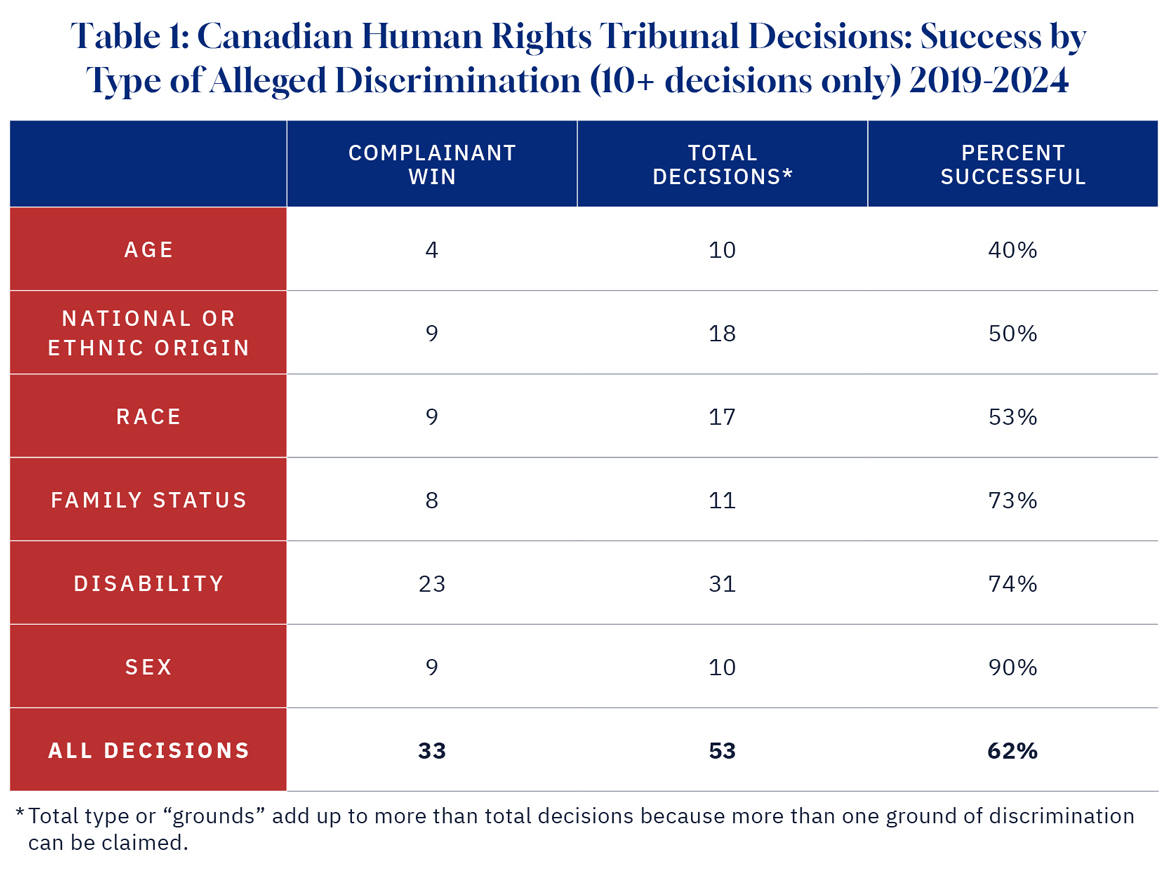
Table 1 shows an overall success rate of 62 percent. It also shows the win rate for each type or “ground” of discrimination that appeared in at least ten decisions.

Graphic credit: Janice Nelson. 

I found that complaints alleging age-based discrimination—all but one of which were based on old age —were least likely to be successful (40 percent win rate). Complaints involving discrimination based on race (53 percent) and national or ethnic origin (50 percent) also had a lower-than-average success rate.

By contrast, complainants alleging sex-based discrimination or harassment were the most successful (90 percent). Nine of the 10 complainants alleging sex-based discrimination and or harassment were women. Eight of those nine were successful.

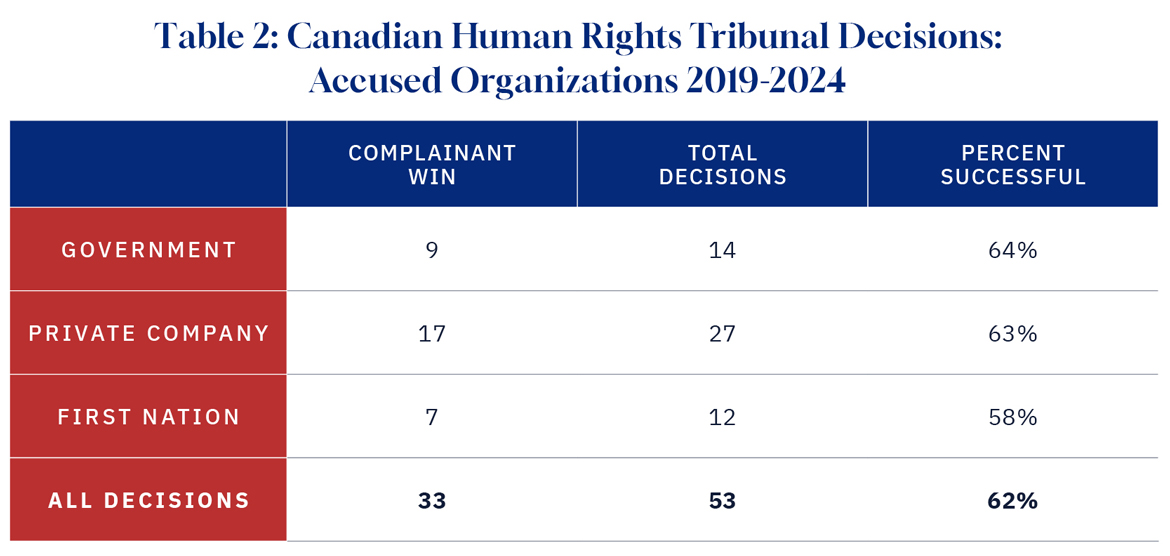
Table 2 organizes the 53 decisions according to the three types of “respondents,” or the organizations accused of harassment or discrimination: federal government entities (including federal departments, Crown corporations, the RCMP, and the City of Ottawa); private companies in federally-regulated industries (transportation, aviation, marine, rail, banking, and telecoms); and First Nations. There was minimal variation in success rates by the type of respondent, with complainants slightly less successful against First Nations (58 percent win rate) than against governments (64 percent) and private companies (63 percent).

Graphic credit: Janice Nelson. 

Given the controversy over the incoming chief of the Canadian Human Rights Commission, I also sought to explore decisions in which Jewish complainants alleged antisemitic discrimination, whether on the grounds of religion or national or ethnic origin.

What I found was that there were no such decisions. The words “Jew,” “Zion,” “Zionist,” and “antisemitic” do not appear in any of the tribunal’s 63 decisions from 2019-2024. The word “Jewish” only occurs in four procedural rulings. Three were from an identically-worded sentence in procedural rulings describing an ongoing case involving an inmate who “self-identifies as an Indigenous, Jewish, Two-Spirit transfeminine woman”. The fourth was found in an interim ruling for a Muslim inmate. He had complained that Correctional Service Canada “provided a religious diet for Jewish inmates, but not a diet for [him] that would accommodate his Muslim beliefs and his health issues.”

It is worth noting how infrequent claims of religious discrimination are. Only two of 53 decisions involved religious discrimination, and in both cases the complainants also alleged discrimination on other grounds. Both complainants were successful.

Conclusions

Federal human rights institutions are under the political microscope, and for good reason. The Canadian Human Rights Commission claims“We must all call out antisemitism” but its incoming leader (expected to take up his post this week) once posted that “Palestinians are Warsaw Ghetto Prisoners of today.” Its website proudly displays a section on “Anti-racism work” yet it has been publicly admonished for its own alleged anti-black racism.

Meanwhile, as I have demonstrated through my investigation, the Canadian Human Rights Tribunal appears unprepared to deal with the influx of complaints about online hate speech for which it will be responsible if the Online Harms Act passes.

Based on my research, I draw three main conclusions. First, the tribunal simply does not issue many decisions. It only issued 63 decisions over the last five-and-a-half years, 10 of which did not involve a formal evaluation of discrimination or harassment. The fact that the tribunal also issued 260 procedural rulings during the same period further suggests its existing hearings are often slowed down by procedural issues.

Second, the few decisions the tribunal does render are fundamentally different than what it would decide under the Online Harms Act. More than one in five decisions (12 of 53) involved truck drivers or trucking companies. The same number(12 of 53) involved allegations of discriminatory conduct by First Nations, such as when a non-Indigenous woman alleged discrimination for being fired from a First Nation-owned bowling alley (she lost). Cases of discrimination involving religion, gender identity, and sexual orientation are virtually nonexistent. The term “hate speech” occurred precisely once in a single decision over the last five-plus years. Not a single decision involved a Jewish complainant and only one involved a Muslim. This is not an organization prepared to adjudicate hateful content over the entire internet.

Third, it appears the Online Harms Act is yet another example of the Trudeau government asserting federal authority where provinces are likely better suited to govern. Because they deal with most forms of employment discrimination, provincial human rights commissions and tribunals have a far wider scope of jurisdiction than the federal tribunal does. Provincial human rights codes already deal with discriminatory speech, and the B.C. Human Rights Commission has even recently argued that the B.C. tribunal has jurisdiction over online speech as well. There is no inherent reason that the responsibility for determining online hate should be done by an entirely new and costlylayer of federal bureaucracy, particularly given the existing institutional capacity at provincial commissions and tribunals.

To be clear, I am not suggesting that provincial human rights tribunals ought to be given the sweeping powers contemplated by the Online Harms ActOthers have convincingly shown that the bill likely violatesCharter rights, and will chill “legitimate expression by the mere spectre of a complaint.” I am simply arguing that there are additional procedural reasons to be concerned about the institutional venues through which that chilling will occur.

Adjudicating online hate speech under the Online Harms Act will require deft sensitivity to competing rights claims and societal interests, a tall order for any organization. Instead, the federal government is placing its hopes in the hands of institutions that lack both the moral authority and institutional capacity to do the job.

Source: Exploring Human Rights Tribunal decisions

Trump’s Massive Deportation Plan Echoes Concentration Camp History

Good reminder:

The Republican National Convention hit rock bottom on its third day in Milwaukee, Wis., on July 17, with a sea of signs calling for “Mass Deportation Now.” If former president Donald Trump is elected for a second term, he and his advisers promise to remove from the U.S., via forced expulsions and deportation camps, as many as 20 million people—a number larger than the country’s current estimated population of undocumented residents. Put into effect, this scheme would devolve quickly into a vast 21st-century version of concentration camps, with predictably brutal results.

Concentration camps are built for the mass detention of civilians based on group identity, excluding protections normally afforded by a country’s legal system. I wrote a history of these camps that traced an arc from their 19th-century origins in Spanish-occupied Cuba through the development of death camps in Germany and their modern-day descendants around the world.

Trump’s plan to launch a massive deportation project nationwide—the first plank in the platform approved at his party’s convention—draws on the same flawed historical rationales and pseudoscience that built support for concentration camps worldwide in the 20th century. Early architects of these camps veiled their efforts in scientific terms while using terror and punishment to seize more power.

For example, Trump has claimed repeatedly that undocumented immigrants are “poisoning the blood” of the U.S. “Blood poisoning” is a medical condition; saying that foreigners are poisoning a nation’s blood is simply a slur. But perverting scientific or medical language to violate human rights and permit atrocities comes from a familiar playbook.

Justifications for brutal immigration policies have often distorted scientific goals of public health programs. Trump and his advisers have long been prone to panic-mongering over the threat of disease from immigrants. They’ve likewise twisted sociology to stoke anxiety about assimilation to justify a Muslim ban or to try to make racist comments seem less objectionable. Even simple principles of statistics get skewered as Trump lies about crime committed by immigrants.

Trump’s incendiary language echoes dangerous historical precedents. He has called his political opponents “vermin,” referred to immigrants as depravedanimals” and “rapists,” and described the U.S.–Mexico border as an “open wound.” Examples abound of similar rhetoric in Nazi propaganda about Jews.

Less well known is the fact that before World War II, the Nazis framed German Jews as aliens who needed to be forced into emigration or expelled. This was the original logic for stripping Jews of citizenship: to officially render them foreigners. (It should be noted that Trump aims to end birthright citizenship in the U.S.)

Prejudice has always been a part of concentration camps. At the dawn of the 20th century, mortality surged in British camps in southern Africa during the South African War, with children’s deaths blamed on “uncivilized” Boer mothers. Embracing pseudoscientific biology, camp administrators spent about half the money per day for food for a Black African civilian as was spent on white detainees (who themselves received insufficient rations). Bureaucracy and unforeseen crises added immeasurably to the harm. In poorly sited and badly run camps, tens of thousands of noncombatants died.

Other early camp systems included massive networks established on an emergency basis to detain immigrants or expel targeted minority groups. During the Spanish Civil War, when 475,000 refugees poured across France’s southern border in less than three weeks, many were forced into unlivable conditions in remote areas to isolate them from French society. Illness and disease followed on a massive scale.

After the start of World War II, the French government used those same camps to intern foreign Jews who had escaped Hitler’s Germany, detaining them as enemy aliens. And after France fell to the Nazis, French policemen went door-to-door in Paris in May 1941 in the service of the Vichy government to round up foreign Jews who remained at liberty. Some deported Jews were sent to barracks still holding Spanish detainees and “enemy aliens.” Camps often begin as one thing and become something else.

The relocation and detention involved in the deportation project that Trump is proposing are at least an order of magnitude greater than these debacles. The argument that a second Trump administration wouldn’t be able to launch such an operation because of a lack of personnel or legal authority should be understood as largely irrelevant because it presupposes the intention of running a precise, legal project at all.

A professional effort on this scale would be impossible. The mass deportations planned to begin in January 2025 if Trump is reelected are meant to unleash deliberate and collateral mayhem. And if history is any guide, a system of camps built to punish millions represents a threat to every American.

As for what they say they intend, Trump and his allies openly admire the results of the Eisenhower-era “Operation Wetback,” whose very name offers a slur revealing the endemic prejudice that made it possible. This limited deportation blitz led to the deaths of 88 workers in 112-degree-Fahrenheit heat. A new Trump administration would be looking to replicate that operation on a scale heretofore untried, using the largest deportation force ever seen in the U.S., according to both Trump and former director of U.S. Immigration and Customs Enforcement Tom Homan.

Trump adviser Stephen Miller has described a plan to create “vast holding facilities that would function as staging centers,” and Trump has promised to remove four percent of the current U.S. population in a deliberate plan to spur a massive disruption of the labor market. If Americans took notice of border policy during Trump’s first administration, said Homan earlier this month, “They ain’t seen shit yet.”

The “Mass Deportation Now” signs filling the audience at the Republican National Convention are a grim warning of how much worse the situation could get. Trump, his advisers, the Heritage Foundation (the extreme-right platform that has put forth Project 2025) and countless members of Congress are not only winking and nodding toward detention horrors of the past but also clearly willing to repeat history if it will let them consolidate power.

The U.S. has previously embraced concentration camps during the detention of Japanese Americans during World War II and under the family-separation policy imposed during Trump’s presidency. The broader legacy of camps on six continents offers a panoramic assortment of even more ways in which mass deportations and forced relocation can go wrong. Unleashed on anything close to the scale under discussion, the project Trump and his henchmen are proposing will be lethal to the targeted groups, catastrophic to the stability of the country and extremely difficult to undo. These camps are in no way scientific or even serious policy; they’re the equivalent of dropping a hydrogen bomb to put out a forest fire.

This is an opinion and analysis article, and the views expressed by the author or authors are not necessarily those of Scientific American.

ANDREA PITZER is author of the books One Long Night: A Global History of Concentration Camps, The Secret History of Vladimir Nabokov and, most recently, Icebound: Shipwrecked at the Edge of the World. Follow her on X (formerly Twitter) @andreapitzer.

Source: Trump’s Massive Deportation Plan Echoes Concentration Camp History

Will Canada apply its immigration policy fairly in the face of the Gaza conflict?

I find these arguments somewhat tiresome, not because they are not valid but rather because they need to also acknowledge the war crimes, genocidal aims, etc by Hamas. Equally tiresome are arguments by hardline supporters of the Israeli government not acknowledging their war crimes and tolerance of extremist settler groups:

One of the most sacrosanct foundations of democracies is that they are based on the rule of law, which mandates one set of laws enforceable on all individuals—including the government itself. The notion that the law simply does not apply to an individual, or groups of individuals, is more commonly associated with corrupt dictatorships than democracies. 

Yet, in 2024 in Canada, whether the rule of law is supreme is an open question. Canada has specific laws governing who is considered admissible to the country, proscribing Canadians from joining foreign militaries, and preventing illegal support for armed forces of another country by Canadian charities. Each one of those laws has been applied in regard to some groups, and consistently violated and disregarded with others. 

The American State Department recently issued an unexpected decision regarding Elor Azaria, a former sergeant in the Israeli Defense Forces (IDF) convicted of extrajudicially killing a Palestinian in the West Bank. The decision bars Azaria, as well as his immediate family members, from entering the United States. The statement declared, “We are designating Elor Azaria … pursuant to Section 7031(c) for his involvement in a gross violation of human rights … .” 

This decision marks a significant turning point for those implicated in war crimes in Gaza under U.S. jurisdiction, and it also raises a crucial question about the repercussions of the Gaza conflict on the enforcement of Canada’s laws. 

How will the Canada Revenue Agency (CRA) handle the Income Tax Act implications for charities that fund the IDF? The CRA recently revoked the Jewish National Fund’s charitable status for directing donations towards IDF infrastructure. This raises questions about other charities that have publicly raised funds for the IDF and illegal settlements. Similarly, how will the Royal Canadian Mounted Police address provisions of the Criminal Code and Crimes Against Humanity and War Crimes Act regarding Canadians who have joined the IDF?

Additionally, Section 34(1) of Canada’s Immigration and Refugee Protection Act (IRPA) bars entry to individuals involved in violence, terrorism, or membership in related organizations. Sections 35(1) and 35.1(1) further prohibit entry to anyone implicated in human or international rights violations, including war crimes, crimes against humanity, senior officials in governments guilty of gross human rights violations, and those under international sanctions. These provisions—mirroring the American laws that barred Azaria—were broadly designed by Parliament to safeguard national security. They granted discretionary power to Canada Border Services Agency (CBSA) officers and immigration officials, but also acknowledged the potential to inadvertently affect innocent and non-threatening individuals who are meant to be treated as exceptions. 

If applied universally, these principles could restrict figures in the vein of Nelson Mandela, or even historical members of the U.S. Democratic Party due to their support of slavery. However, in practice, the CBSA has often used these provisions selectively, particularly to unjustly target and deport refugees from Muslim countries, with decisions frequently influenced by the personal biases of individual officers. This same bias has also led to the oversight of individuals who should rightfully be captured by the law.

Despite well-documented instances of systemic violence against Muslims and other minorities by members of India’s Rashtriya Swayamsevak Sangh (RSS) and Bharatiya Janata Party (BJP), Canada has not taken a similar stance against them. The RSS, a right-wing Hindu nationalist group, and the BJP, India’s ruling party, have been linked to numerous violent acts, including riots and targeted attacks on religious minorities. From 2013 to 2023, Indian immigration to Canada increased by 326 per cent, with 18.6 per cent of recent immigrants coming from India. Yet, Canada has not pursued cases of inadmissibility against individuals from these groups, raising questions about the consistency and fairness of its immigration policies.

The ongoing Gaza conflict has led to investigations by the International Criminal Court into alleged war crimes by Israel, including the targeted killing of civilians, willful suffering, and the use of starvation as a warfare tactic—all human rights violations. Additionally, the International Court of Justice has declared that Israel’s occupation and settlement expansions in the Occupied Palestinian Territory are illegal, and that there is an imminent risk of genocide. Under Canada’s Immigration Act, involvement with groups linked to these illegal settlements or with the IDF, amidst allegations of war crimes or possible genocide, could make individuals inadmissible to Canada—a measure affecting a significant portion of Israel’s population.

Our laws must be consistently applied, holding individuals accountable for human rights violations, war crimes, genocide, and crimes against humanity, irrespective of their nationality, the geopolitical context of their actions, or the political stance of the government of the day. To ensure the proper application of the law and to enable the CBSA to effectively perform its duties, a suspension of visa exemptions for travellers from Israel is necessary.

As the U.S. has taken a step towards a consistent application of its immigration laws concerning human rights violations against Palestinians, it is crucial for Canada to critically examine its own legal enforcement, and ensure that it upholds fairness and impartiality in every instance. Our nation faces a difficult test with the Gaza crisis, challenging us to confront the systemic biases embedded within our governmental institutions. Our standing as a democratic nation founded on the rule of law demands nothing less.

Washim Ahmed is a refugee and human rights lawyer, and a co-founder of OWS Law. Taha Ghayyur is the executive director of Justice for All Canada, a non-profit human rights and advocacy organization dedicated to preventing genocide.

Source: Will Canada apply its immigration policy fairly in the face of the Gaza conflict?

In South Korea, Schools Grapple with Surge in Multicultural Student Population

Of note:

In a striking demographic shift, 350 schools across South Korea now report that students from multicultural backgrounds comprise over 30% of their total enrollment, according to a recent study.

This figure represents a 40% increase from just five years ago, highlighting the rapid changes in the country’s educational landscape.

The report, titled “Innovation Strategies for Schools in Immigrant-Dense Areas,” was released on August 2 by researchers at the Korean Educational Development Institute. It reveals that these schools with high multicultural student populations now account for 2.96% of the nation’s 11,819 primary and secondary schools, up from 2.15% in 2018.

The Ministry of Education defines “multicultural-dense schools” as those with over 100 students, where at least 30% come from multicultural backgrounds.

By this definition, 87 schools across 12 regions fall into this category, marking a staggering 278.26% increase from 23 such schools in 2018.

The concentration of multicultural students is particularly pronounced in certain areas. In Ansan, Gyeonggi Province, one elementary school reports that 97.4% of its student body comes from multicultural backgrounds.

Three other schools in Ansan and Anseong have multicultural student populations exceeding 80%.

This rapid demographic change poses unique challenges for the education system. Researchers warn that excessively high concentrations of multicultural students could negatively impact all students.

There are concerns about potential stigmatization of multicultural students and the risk of reverse discrimination against non-multicultural students if educational support becomes too focused on one group.

The study’s authors emphasize the need for comprehensive strategies to ensure quality education for all students in these diverse environments.

They recommend developing school visions and educational plans based on multicultural education policies, enhancing teachers’ expertise in multicultural education, and improving personnel policies for schools in immigrant-dense areas.

Source: In South Korea, Schools Grapple with Surge in Multicultural Student Population