While not a fan of some of Maher’s blind spots on religion and Muslims, this line captures the concept of integration (mutual partial melting) in contrast to assimilation (completely newcomer melting):
“One of the first things I said on my old show (ABC’s Politically Incorrect) is if you’re going to come to the melting pot, melt a little bit. You’ve got to melt a little,” Maher said.
Of course, the definition of what ‘melt a little’ means is where the public debates occur.
Of all the commentary written about Google’s firing of James Damore, this long read and assessment of the science and evidence appears to me the most comprehensive and convincing one given the range of studies cited.
I am also less than convinced by free speech arguments, perhaps reflecting my time in government where it was clear that any public comment should not undermine, or appear to undermine, the government. While the rules may not be so ironclad in other organizations, employees in all organizations need to be mindful of the impact of their public commentary on the overall reputation, image and policies of their employer.
James Damore, 28, questioned the company’s diversity policies and claimed that scientific data backed up his assertions. Google CEO Sundar Pichai wrote that Damore’s 3,300-word manifesto crossed the line by “advancing harmful gender stereotypes” in the workplace. Pichai noted that “To suggest a group of our colleagues have traits that make them less biologically suited to that work is offensive and not OK.”
Damore argued that many men in the company agreed with his sentiments. That’s not surprising, since the idea that women just can’t hack it in math and science has been around for a very long time. It has been argued that women’s lack of a “math gene,” their brain structures, and their inherent psychological traits put most of them out of the game.
But are they? What are the real facts? We have been researching issues of gender and STEM (science, technology engineering and math) for more than 25 years. We can say flatly that there is no evidence that women’s biology makes them incapable of performing at the highest levels in any STEM fields.
Many reputable scientific authorities have weighed in on this question, including a major paper in the journal Science debunking the idea that the brains of males and females are so different that they should be educated in single-sex classrooms. The paper was written by eight prominent neuroscientists, headed by professor Diane Halpern of Claremont McKenna College, past president of the American Psychological Association. They argue that “There is no well-designed research showing that single-sex education improves students’ academic performance, but there is evidence that sex segregation increases gender stereotyping and legitimizes institutional sexism.”
They add, “Neuroscientists have found few sex differences in children’s brains beyond the larger volume of boys’ brains and the earlier completion of girls’ brain growth, neither of which is known to relate to learning.”
Several major books have debunked the idea of important brain differences between the sexes. Lise Eliot, associate professor in the Department of Neuroscience at the Chicago Medical School, did an exhaustive review of the scientific literature on human brains from birth to adolescence. She concluded, in her book, “Pink Brain, Blue Brain,” that there is “surprisingly little solid evidence of sex differences in children’s brains.”
Rebecca Jordan-Young, a sociomedical scientist and professor at Barnard College, also rejects the notion that there are pink and blue brains, and that the differing organization of female and male brains is the key to behavior. In her book “Brain Storm: The Flaws in the Science of Sex Differences,” she says that this narrative misunderstands the complexities of biology and the dynamic nature of brain development.
And happily, the widely held belief that boys are naturally better than girls at math and science is unraveling among serious scientists. Evidence is mounting that girls are every bit as competent as boys in these areas. Psychology professor Janet Hyde of the University of Wisconsin–Madison has strong U. S. data showing no meaningful differences in math performance among more than seven million boys and girls in grades 2 through 12.
Also, several large-scale international testing programs find girls closing the gender gap in math, and in some cases outscoring the boys. Clearly, this huge improvement over a fairly short time period argues against biological explanations.
Much of the data that Damore provides in his memo is suspect, outdated or has other problems.
Damore cites the work of Simon Baron-Cohen, who argues in his widely reviewed book “The Essential Difference” that boys are biologically programmed to focus on objects, predisposing them to math and understanding systems, while girls are programmed to focus on people and feelings. The British psychologist claims that the male brain is the “systematizing brain” while the female brain is the “empathizing” brain.
This idea was based on a study of day-old babies, which found that the boys looked at mobiles longer and the girls looked at faces longer. Male brains, Baron-Cohen says, are ideally suited for leadership and power. They are hardwired for mastery of hunting and tracking, trading, achieving and maintaining power, gaining expertise, tolerating solitude, using aggression and taking on leadership roles.
The female brain, on he other hand, is specialized for making friends, mothering, gossip and “reading” a partner. Girls and women are so focused on others, he says, that they have little interest in figuring out how the world works.
But Baron-Cohen’s study had major problems. It was an “outlier” study. No one else has replicated these findings, including Baron-Cohen himself. It is so flawed as to be almost meaningless. Why?
The experiment lacked crucial controls against experimenter bias, and was badly designed. Female and male infants were propped up in a parent’s lap and shown, side by side, an active person or an inanimate object. Since newborns can’t hold their heads up independently, their visual preferences could well have been determined by the way their parents held them.
Good piece on the historical antisemitism behind the word “cosmopolitan” and “cosmopolitanism:”
President Donald Trump’s administration has announced that it wants to cut legal immigration to the United States by half and favour well-educated immigrants who speak good English. When CNN correspondent Jim Acosta, the son of a Cuban immigrant, challenged Mr. Trump’s senior policy adviser Stephen Miller by stating that the United States traditionally welcomed the world’s poor, most of whom did not speak any English, Mr. Miller accused Mr. Acosta of “cosmopolitan bias.”
One wonders whether Mr. Miller had any idea of the historical use of cosmopolitan as a derogatory term. As the descendant of poor Jews fleeing Belarus more than a century ago, he should have.
“Rootless cosmopolitan” was the code phrase used by Joseph Stalin for Jews. In the early years after the Second World War, the Soviet dictator launched a campaign against Jewish intellectuals, scientists and writers who were accused of disloyalty to the Soviet Union and bias toward the West. Not considered to be part of the native Russian people, Jews were assumed to belong to an international cabal, and hence to be inherently treacherous.
But Stalin didn’t invent this idea. In the 1930s, Fascists and Nazis also denounced Jews, as well as Marxists and Freemasons, as “cosmopolitans” or “internationalists” – people whose loyalty was suspect. It is the kind of vocabulary that emerges from nativist movements that are hostile to ethnic or religious minorities, or to financial or intellectual elites who supposedly conspire to undermine the true sons and daughters of the nation.
To pre-war fascists, the United States was often regarded as the symbol of cosmopolitan decadence. The offensive use of cosmopolitanism, then, has a profoundly anti-American provenance.
One of the oddities of the Trump administration is that several of its main representatives have revived traditionally anti-Semitic rhetoric, even though some of them, like Mr. Miller, are Jewish. The chief ideologue of ethnic nationalism in the Trump Age, Steve Bannon, is a reactionary Catholic. He has a penchant for early-20th-century French and Italian fascist thinkers, such as Charles Maurras (of the Action Française) and Julius Evola, a sinister figure who admired Heinrich Himmler and worked for the German police during the Second World War.
But to see anti-cosmopolitanism as an especially Catholic pathology would be a mistake. The first offensive use of cosmopolitanism came as part of the Protestant rebellion against the Catholic Church. Rome, to Protestant rebels at the time of the Reformation, was regarded as the centre of a global “cosmopolitan” network which oppressed national aspirations. Traces of this prejudice can still be found in some opponents of the European Union, who see the EU’s Brussels headquarters as the new Rome.
It is unlikely that Mr. Miller, who grew up in a liberal family in California, is an anti-Semite. Perhaps his early attraction to right-wing extremism was a form of rebellion, too, albeit a rebellion that soon put him in the company of toxic allies. As a student at Duke University, he became friends with Richard Spencer, who would later become a promoter of “peaceful ethnic cleansing” to preserve white civilization, whatever that may be.
One thing that unites many of Mr. Trump’s followers – as well as right-wing populists in other countries, including Israel – is a shared grievance against Muslims and the liberal urban elites who are often accused of coddling them. When Mr. Miller speaks of cosmopolitan bias, that is probably what he means.
But distrust of Muslims is only part of the story. Social elites, liberal intellectuals, and critical journalists are the enemy of those who crave power but feel looked down upon by people who appear to be more sophisticated. This is not always a matter of social class. President George W. Bush, for example, despised American reporters who spoke French.
This, too, is not a new phenomenon. The upper classes in many societies often like to distinguish themselves from the common herd by adopting the language and manners of foreigners whose cultures were thought to be superior. European aristocrats in the 18th century spoke French. Modern English nationalism started as a revolt against this kind of foppery in the name of John Bull, roast beef, and Old England.
Not all populist rebellions are inherently racist or fascist. Democracy, too, was a product of resistance to aristocratic rule. But it is hard to believe that Mr. Trump, or his ideologues, like Mr. Miller or Mr. Bannon, are interested in expanding democratic rights, even though they pretend to speak for the common – or as they like to say – “real” people. Mr. Bannon, for one, is proudly anti-liberal. He is said to have described himself as a Leninist who seeks to destroy the state.
Still, let us give Mr. Miller the benefit of the doubt. When he uses cosmopolitanism as a curse, he has no idea of the term’s antecedents. The history of fascist, Nazi, and Stalinist anti-Semitism is unknown to him. The past does not really exist. He is simply an ignorant critic of what he sees as the liberal establishment. But ignorance can be as dangerous as malice, especially when it is backed by great power.
Interesting article and study on culture and play, with interesting and relevant examples of differences between groups and related integration challenges:
Every child in the world is a master of play. Play is part of the basic developmental experiences of human lives. Children learn about culture, social norms and language through play. Precisely because of its sociocultural nature, children in different cultures engage in play differently due to differences in language, context and social norms.
Parents in different cultures also perceive play differently. Some see children’s play as part of their natural learning process — “learning through play.” In other cultures, children’s play may be seen as just a pastime and separate from learning.
When children move to another culture and context, their experiences of play can be more complex than commonly thought. Play can be an effective and natural way for immigrant children learn to socialize with children in their new country. On the other hand, differences in context, language, social norms and parental perceptions of play may create social conflicts among children in cross-cultural contexts.
The living arrangements of families influence how children play in their new land. This week, Statistics Canada released new census data on multi-generational and multi-family dwellings. From 2001 to 2016, multi-generational households rose 38 per cent. The data also points to increasing settlement patterns of multi-family dwellings in several immigrant-rich cities such as Brampton, Markham and Vaughan on the northern edges of Toronto, and other suburban communities such as Surrey, near Vancouver. These trends, even though they’re likely due to financial reasons, may help immigrant families preserve and reconstruct play environments for their children in the new land.
Four years ago, I wrote a Star column on the shocking white maleness of the boards of Toronto’s “Big 6” arts groups. Back then, all 25 board members of the Toronto Symphony Orchestra were white.
Two years ago, I wrote an update. Surely, in the most diverse city in the world, the Big 6 would diversify their boards to better reflect their donors and audiences. Many big arts groups appoint board members precisely because they have the means to help raise serious money from their communities.
Unfortunately, it seems Not in Our Back Yard. In fact, in 2015 things got worse for the Canadian Opera Company (COC), where all 36 of their board members were white. In Toronto, the visible minority had just become the majority, yet the COC couldn’t find a single person from this new majority to help guide and secure their future.
So how is the state of diversity now? Well, I described the pace of diversifying big arts boards between 2013 and 2015 as “glacial.” But glaciers are receding faster than some big arts boards are advancing on this issue. So let’s call the progress between 2015 and now “snail-like.”
First, it’s important to note that not all the big arts boards are lagging in diversity. Some are leading in it and always have. For example, TIFF’s board of directors is made up of seven white men, six men of colour, five white women and two women of colour.
The Art Gallery of Ontario (AGO) and the Royal Ontario Museum (ROM) are doing pretty well too: The ROM’s board has six white men, three men of colour, six white women and four women of colour. The AGO’s board has 21 white men, four men of colour, 15 white women and two women of colour.
Meanwhile, the National Ballet of Canada board may have more women members than men, but of the 20 women, not a single one is a woman of colour. Not one. And of the 15 men, just one is a man of colour.
The Toronto Symphony board (reduced from 27 to 13) has seven men and six women on it board. All but one is white.
Once again, the Canadian Opera Company board lags behind. In 2015, 30 of its 42 board members were men and 12 were women. All were white. Today, with a board of 35, the number of women has fallen to 11, with not one being a woman of colour. Today, just two of its 22 male board members are men of colour.
Some people will argue that the arts aren’t obliged to have their leadership reflect the makeup of the general population. I buy that argument too. But all the organizations mentioned here are in the excellence business. This means they’re also in the engaging-new-communities business.
This is why I don’t buy the argument that people from non-European cultures just aren’t interested in opera, especially since the “from” can now be several generations past.
Worse still, why could the COC not even recruit a single member to its board from a ‘white’ culture that’s bathed in opera for centuries? Not one Russian-sounding name appears on the COC board. What’s more, this year, the COC hosted the two most famous opera singers in the world for a sold-out “night to remember” concert: baritone Dmitri Hvorostovsky and soprano Anna Netrebko. Guess where they’re from?
In my previous informal reviews of arts board composition, I’ve argued that more diverse boards will help the Big 6 expand its pool of ticket-buyers and financial supporters. Given that the arts are more challenged than ever on these two fronts, I thought that just made sense.
Good commentary on the broader issues related to the tech industry culture:
The science in question, such as it is, is something better left to experts to debate. But there are nonetheless reasonable questions laypeople can ask. Among them: Even if one were to take the extreme position that genetics neatly determines behaviour, how might the ancient arrangement of nucleic acids so neatly line up with results in a field barely 50 years old – particularly since, early on when it was considered a menial task, computer programming was a field dominated by women?
More to the point, to argue that engineering or coding are simply mechanical or an abstract set of mathematics or logic misses the aim of the field. Software is made for people, to help them accomplish tasks, connect with one another, or filter through massive amounts of information in intelligent ways.
Those goals require a complex set of skills that cannot be reduced to mere coding, but require an understanding of sociology, psychology and no small amount of empathy. Putting aside the dubious assertion that we are hard-wired by gender to favour one of these skills over the other, to argue that engineering or coding should be left to those with the most abstract skill is akin to saying structural engineers should design buildings or that mechanical engineers should market cars. The creation of code and software is ultimately holistic, relying on a broad range of traits that cannot and should not be reduced to one dimension – particularly tired, gendered stereotypes.
But despite this obvious fact, the manifesto does ring true in one way: It represents the tech world’s too-common, incredibly reductive view of humanity that tries to think of humans are just like computer code itself, a complex, but predetermined series of input and output.
This view itself leads to a blind faith in a hyper-rational world dictated by metrics, competitive bro culture and faux notions of meritocracy. It’s reflected in so much in the tech world: in Facebook’s belated concerns about privacy, or their impact on political polarization; in Twitter’s arguably too-late focus on abuse and harassment, in part brought on by prioritizing resources for advertising over the standards team; or Uber’s unending troubles with sexual harassment, driver exploitation or its constant flouting of the law. In each, it was unwillingness to think about the complexity of human reaction in favour of an algorithmic or mechanistic understanding that caused the problem.
It’s a deeply naive view, one that runs roughshod over humanity when a handful of companies on the U.S. West Coast are given enormous power. In trying to create something new, they have simply repeated the past, carrying along beliefs in neutral meritocracy, the capacity of humans to power through all problems with brawn and that we are predestined to be who we are.
That is not the truth of what it means to be alive and we cannot let the tech world insist that it is. If you want a manifesto to line up behind, let it be that.
Interesting analysis of identity politics in action:
Nationality, race and ethnicity are a large part of identity for most people. Factors like this matter more for some people than others — and for some groups more than others — but a sense of group awareness or membership exists in varying degrees across all segments of American society.
Often it’s easy to see the signifiers of such group identity, in distinctive music, food or clothing, for example. But sometimes when symbols or language are co-opted, it is harder to spot. In 2015, Donald J. Trump’s “make America great again” and “build a wall” started out as simple but powerful slogans. As time went on, they became more infused with a specific meaning that symbolized the concerns and preferences of a substantial set of white Americans.
Mr. Trump’s appeals were a form of group politics or identity politics, and he continues to focus on threats to white identity as president.
Some Trump critics find his focus on whites as a group outrageous or counterproductive. But survey data suggest that many white Americans do feel threatened, and that they think there are policies that discriminate against them and should be changed.
Two examples of the president’s efforts and the underlying support for his positions illustrate these trends.
On Wednesday, he offered his support for a bill that would cut legal immigration to the United States in half, saying “this legislation demonstrates our compassion for struggling American families who deserve an immigration system that puts their needs first and that puts America first.” To achieve its goal, the plan would limit entry for some family members of American citizens and permanent residents.
In explaining how limiting the entry of relatives would put the needs of American families first, a White House policy adviser, Stephen Miller, said it was “common sense” that immigration was costing Americans jobs. He then suggested that the family members who would be denied entry under the proposal were largely low-skill workers who were taking jobs away from struggling Americans.
The claim about who, if anyone, suffers from the immigration of low-skilled workers is nuanced. Debate on the question is active. If people come to America because they have a relative living here, it does not mean by definition that they are low-skilled workers. Despite the difficulty of nailing down the effects of low-skilled immigration on American families, public opinion on the topic — at least for a particular set of Americans — may reflect the “common sense” Mr. Miller described.
In January 2016, the American National Election Study asked 875 white Americans this question: How likely is it that many whites are unable to find a job because employers are hiring minorities instead? On average, 28 percent of the white population thought it was extremely or very likely that white people could not find work because of minorities seeking those same jobs. Roughly half the white population thought it was at least moderately or slightly likely. Only 21 percent thought this was not at all likely.
Differences emerge across party lines, even among whites. Close to 20 percent of Democrats thought it was extremely likely that the prospects for white job-seekers would be threatened by the presence of minority workers, while 34 percent of Republicans (and 30 percent of independents) felt this way.
Among white Republicans and independents, an even greater divide becomes clear: White voters who preferred Mr. Trump to one of the other candidates in the Republican field were nearly twice as likely to anticipate white job loss to nonwhite workers (48 percent compared with 24 percent).
The survey also asked white people how important it was for whites to work together to change laws that are unfair to whites. On average, 38 percent said it was extremely or very important. Only a quarter thought it was not important at all — a category that presumably also encompasses people who thought no such laws existed.
These trends also help to frame President Trump’s other recent announcement that the Justice Department would be investigating college admissions procedures that might discriminate against white applicants.
The difference between white Democrats and Republicans on the importance of uniting as a group against discriminatory laws is only five percentage points, with Republicans believing it was more important than Democrats and independents.
The divide, however, among Republicans who preferred Mr. Trump in the primaries and those who chose someone else is overwhelming. Nearly 60 percent of Mr. Trump’s primary supporters thought organizing to change laws that are unfair to white people was extremely or very important. Only 15 percent thought it was not important at all to do so. Supporters of other G.O.P. candidates, on average, were about half as concerned.
The data show that race is less important to white Americans’ sense of self than to nonwhites — more white people say being white is not at all important to their identity relative to the numbers who say so in other groups. But Mr. Trump’s continued efforts to remind white Americans of their group status may increase the number of white people who think of themselves through a racial lens. It is one of the ways that his campaign and presidency may reshape public opinion and politics.
He is capitalizing both on an existing sense of threat among white voters and the opportunity to shape the way whites — because of their group membership — think of themselves.
Good capturing range of perspectives, including blindness to the issue:
Quebec is being widely criticized for its plan to launch public consultations on systemic racism, even by those who agree visible minorities face many structural barriers in the province.
The debate has highlighted a deep divide among Quebec’s political left, with some people saying the consultations encourage an ideology of victimhood and demonize the province as inherently racist.
Some civil rights activists argue the consultations are meaningless unless the government is finally prepared to hold its institutions accountable for failing to uphold racial diversity.
Moreover, activists say they will increasingly use the court system to push through changes in society regardless of what comes out of the government’s consultations.
Michele Sirois, a political scientist and president of a women’s rights organization, believes there is no systemic racism in Quebec.
That concept, she explained in an interview, is imported from the United States, which has a history of structural racism against people of colour.
“The Americans had a slave trade,” she said. “We didn’t. Our problem is about the full integration of immigrants.”
Sirois recently penned an opinion piece in Le Devoir, a left-of-centre newspaper, and wrote that the term “systemic racism” reflects “an ideology of victimhood” and promotes the idea that only white people can be racist.
“The left is divided in Quebec,” Sirois said in the interview. “And there is an increase of people on the left who are saying, ‘stop these consultations, which will only increase racial tension in society.”‘
Quebec has asked its human rights commission to launch public consultations on systemic discrimination and racism.
Only discussion on discrimination involving race, colour or ethnic and national origin will be allowed when the hearings begin in September.
The goal, the government said, is to forge “concrete and durable” solutions in order to “fight these problems.”
The Canadian Press attempted to contact Immigration Minister Kathleen Weil, whose office is leading the consultations, but was told she would not be available to comment.
Weil said in July, when she first made the announcement, the consultations “are an occasion to mobilize all of civil society … to propose actions to eliminate the obstacles towards full participation of all Quebecers.”
Fo Niemi, executive director for the Montreal-based Centre for Research Action on Race Relations, said those on the right and the left who deny the existence of systemic racism aren’t looking hard enough.
One clear example, he said, is that Quebec’s human rights commission is so understaffed it can only render decisions many years after a complaint is lodged.
Niemi cited the case of a young man who waited seven years to be awarded $33,000 by the commission after he was racially profiled by Montreal police in 2010.
That case also highlighted the fact police are still not tracking data on racial profiling, five year after the force said it would start taking profiling complaints against its officers seriously.
“The system knows that going to the human rights commission is like going to a nameless graveyard,” Niemi said. “This is a systemic problem.”
Another example of systemic racism in Quebec society is reflected in the lack of diversity in the judiciary, he said.
Niemi pointed to a 2016 study published by the Institute for Research on Public Policy indicating that out of 500 judges in Quebec, three were visible minorities.
He said if the percentages of visible minorities within institutions such as the public service, corporate boards of directors and the judiciary are lower than in regular society, that is a sign of systemic racism.
“It’s an indication,” Niemi said. “It’s a very important evidential element.”
Niemi said activists are increasingly going to the courts to force society to become more diverse, because nothing else seems to be working.
“It’s inevitable,” he said.
“It’s only a matter of time before some of these legal actions start to take place. Quebec is a bit slower in terms of this kind of litigation, but it’s coming and we are leading that movement for change.”
Interesting dynamics within the Chinese Canadian community:
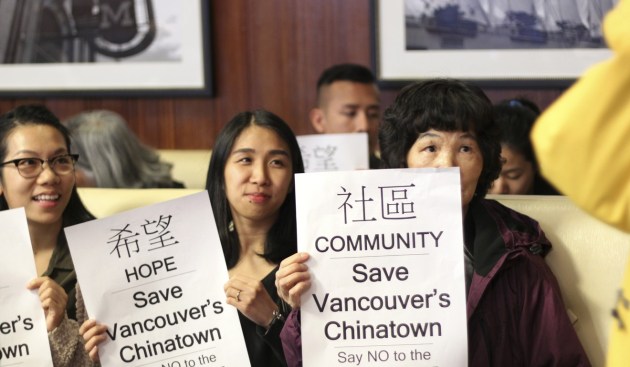
The new building at 105 Keefer Street – close to the Dr Sun Yat-sen Garden, Chinese Cultural Centre and Chinatown Memorial Square – would have been 12 storeys high, making it the tallest building in the vicinity. Although it was to have included 25 social housing units, only eight were earmarked as affordable housing subsidised by the provincial government. There were also plans for a “temporary” activity centre for elderly Chinese living in the area.
Almost 200 people – an unprecedented number – registered to speak at public hearings on the proposal. Given five minutes each, the hearings stretched to more than 26 hours over three days.
Speakers’ objections included the building’s height, the displacement of low-income senior citizens in the area through gentrification, the small number of social housing units, and the blight it would impose on Chinatown’s architectural character.
Karen Hoese, acting assistant director of planning for the city’s Vancouver Downtown Division, sat through the entire hearing. A large number of young and elderly people turned up, she says, and things got heated.
Melody Ma of community group #SaveChinatownYVR, one of the speakers, says councillors had probably not seen such large, passionate crowds, and were overwhelmed. “There were a lot of young people and people of colour [Chinese]. It was a unique situation for city hall and elected officials.” Some councillors described the young people as “a mob”, she says, which carried negative and violent connotations.
Vancouver-born councillor Kerry Jang chastised the young Chinese objectors, saying, “some of the Chinatown activists, the youth in particular, were very disappointing in their behaviour”.
“You do not represent Chinatown to me and the Chinatown I know. And don’t forget, I was there long before a lot of you. I worked down there, I did everything down there,” Jang said.
To have a healthy city strategy in Vancouver, it’s not just about art. When I looked up ‘culture’ on the City of Vancouver’s website, I could only find ‘bike culture’ and ‘horticulture’
MELODY MA
“He was saying that young people’s voices didn’t have a place at the table,” Ma says.
She was proud to see so many people with connections to Chinatown from different generations come together in solidarity to oppose the application for 105 Keefer Street.
Andy Yan, director of the city programme at Simon Fraser University and an urban planner, sat through some of the hearings, and says the speakers were a socially and economically diverse group.
“The city councillors’ response to the ‘boisterous youth’ threw them … because these young people don’t normally come to these meetings. They were articulate, diverse; a mobilised group of young people,” he says.
The campaign appeared to have been a success, when the city councillors – including Jang – voted down the rezoning application eight to three.
A few days later an open letter addressed to Mayor Gregor Robertson, signed by many who spoke at the hearings, expressed disappointment at remarks made by Jang and other councillors.
Hoese says the 105 Keefer application looked good on paper. “It met the objectives, included social housing, an activity centre and set-back upper floors,” she says. “But what’s changed over the last few years is the tension between what people want. It was difficult for councillors to make the decision, because they didn’t want to see greater division.”
She admits there have been changes in Chinatown since the application was submitted a few years ago.
For the past 20 years, Chinatown had been falling into neglect – fewer people come to shop at Chinese grocery stores because they can buy the same goods in other areas, such as Richmond, East Vancouver and Coquitlam, where later Chinese immigrants have settled. Shops and restaurants are closing because of the drop in visitors. At the same time, drug addicts in the adjacent neighbourhood of Downtown Eastside have drifted into the area and petty crime has led to security concerns among businesses and residents.
To counteract the decline, approval was given for small condo developments, while Western restaurants have opened next to Chinese grocery stores. One latest addition is Dalina, an Italian-style coffee shop that also sells gourmet food and wouldn’t look out of place in New York. But it’s questionable whether it’s right for Chinatown, which is the second largest in North America after San Francisco.
Impressive study, with disturbing (but not surprising) findings:
Students at elite colleges are even richer than experts realized, according to a new study based on millions of anonymous tax filings and tuition records.
At 38 colleges in America, including five in the Ivy League – Dartmouth, Princeton, Yale, Penn and Brown – more students came from the top 1 percent of the income scale than from the entire bottom 60 percent.
38 colleges had more students from the top 1 percent than the bottom 60 percent
These estimates are for the 1991 cohort (approximately the class of 2013). Rankings are shown for colleges with at least 200 students in this cohort, sorted here by the ratio between the two income groups.
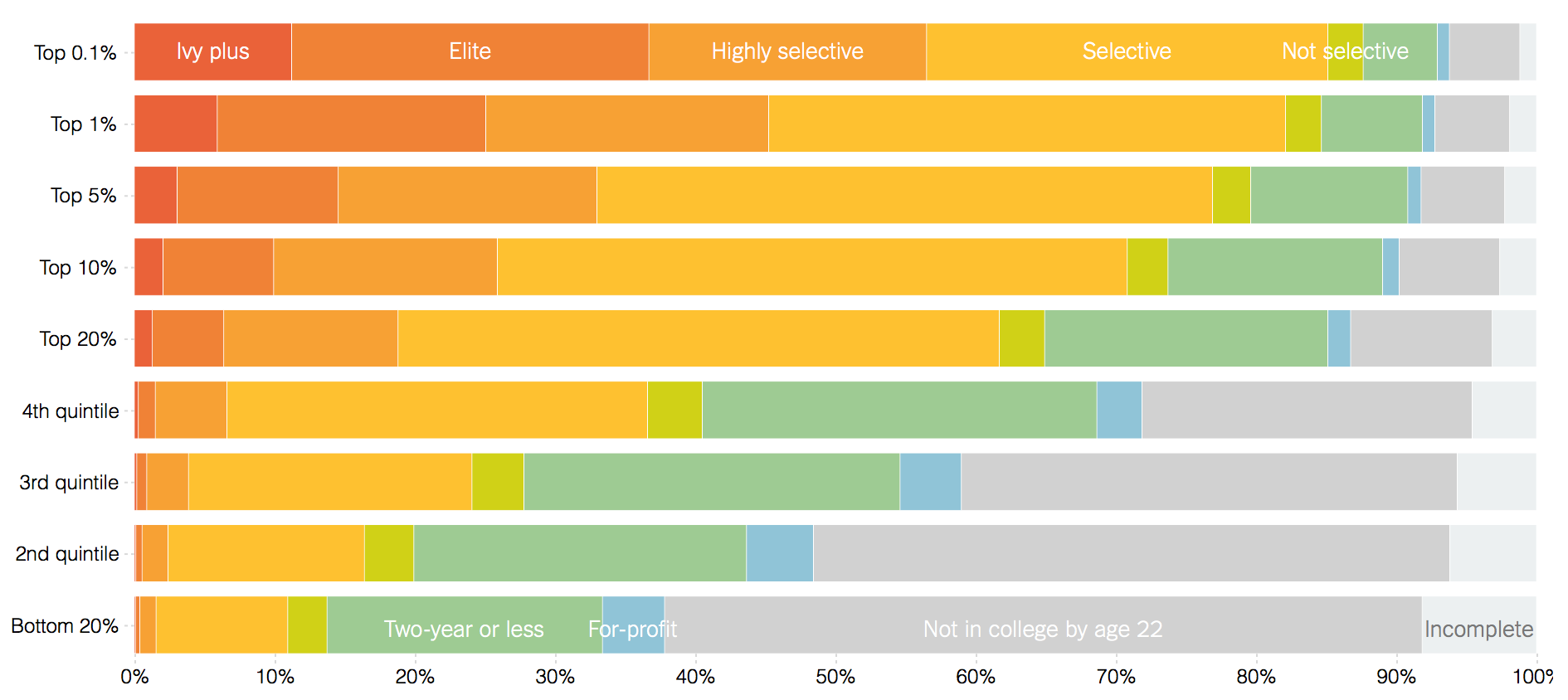
Roughly one in four of the richest students attend an elite college – universities that typically cluster toward the top of annual rankings (you can find more on our definition of “elite” at the bottom).
In contrast, less than one-half of 1 percent of children from the bottom fifth of American families attend an elite college; less than half attend any college at all.
Where today’s 25-year-olds went to college, grouped by their parents’ income
About four in 10 students from the top 0.1 percent attend an Ivy League or elite university, roughly equivalent to the share of students from poor families who attend any two- or four-year college.
Colleges often promote their role in helping poorer students rise in life, and their commitments to affordability. But some elite colleges have focused more on being affordable to low-income families than on expanding access. “Free tuition only helps if you can get in,” said Danny Yagan, an assistant professor of economics at the University of California, Berkeley, and one of the authors of the study.
The study – by Raj Chetty, John Friedman, Emmanuel Saez, Nicholas Turner and Mr. Yagan – provides the most comprehensive look at how well or how poorly colleges have built an economically diverse student body. The researchers tracked about 30 million students born between 1980 and 1991, linking anonymized tax returns to attendance records from nearly every college in the country.
We’re offering detailed information on each of more than 2,000 American colleges on separate pages. See how your college compares – by clicking any college name like Harvard, U.C.L.A., Penn State, Texas A&M or Northern Virginia Community College – or search for schools that interest you.
At elite colleges, the share of students from the bottom 40 percent has remained mostly flat for a decade. Access to top colleges has not changed much, at least when measured in quintiles. (The poor have gotten poorer over that time, and the very rich have gotten richer.)