Germany’s New Far-Right Campaign Poster Is Unsubtly Racist

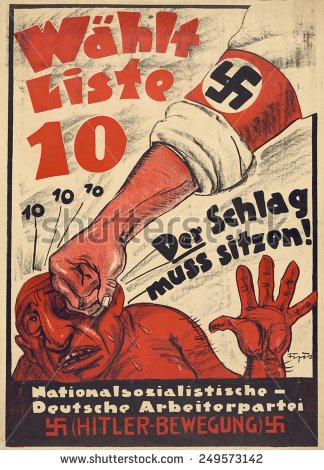
Indeed. Reminder of messaging and posters under the Nazis regarding Jews:

The far-right Alternative for Germany party released a new campaign poster last week with a slogan promising “Islam-free schools” beneath a photo of smiling white schoolchildren.

Alternative for Germany, also known as AfD, released the posters in the midst of its election campaign in the southern German state of Bavaria. Recent polls show the party is on track to win the third-largest share of the vote as it saps votes from the traditional conservative party aligned with German Chancellor Angela Merkel.

But as AfD rallies voters ahead of Bavaria’s elections next month, the party is under intense public and political scrutiny for its links to neo-Nazi organizationsand role in encouraging far-right riots in recent weeks.

AfD’s Bavarian anti-Islam posters have added to the backlash against the party. A German teachers’ associations called the posters dangerous, and an Austrian member of the European Parliament accused the party of promoting fascist rhetoric and racially segregated schools. A British hate crime monitoring group also denounced the poster, tweeting, “Welcome to the new face of fascism.”

AFD
Alternative for Germany’s new poster, vowing “Islam-free schools!” and promoting “dominant German culture.”

AfD claims that the posters are not calling for barring Muslim children from schools, Germany’s Der Spiegel reports, but are opposed to Islamic education in schools and face veils. But some Germans on social media criticized the posters for echoing Nazi-era discrimination against Jewish students, HuffPost Germany reported.

The party has a history of anti-Islamic propaganda, and during last year’s national elections it worked with a conservative American ad agency to create a controversial series of posters, including one reading “Burkas? We prefer bikinis” and another with a photo of a pregnant white woman with the tagline “New Germans? We’ll make them ourselves.”

Although AfD is often careful to distance itself from more politically toxic extremist groups and violent rhetoric, it has repeatedly provoked scandals after its officials made statements downplaying the Holocaust or siding with far-right activists. After anti-migrant riots erupted after the killing of a German man in the city of Chenmitz two weeks ago, a prominent AfD official marched with the founder of anti-Islamic extremist group PEGIDA in a demonstration against migration.

While AfD is still shut out of governing in Germany, its success has caused traditional right politicians to swing farther right in hopes of winning back voters, especially prevalent in Bavaria, where the Merkel-allied Christian Social Union is losing support and increasingly embracing anti-immigration, anti-Islamic views.

CSU leader Horst Seehofer nearly brought down the German government this year after demanding tighter border controls, and more recently he called immigration the “mother of all political problems” and said he would have joinedfar-right anti-migrant protests were he not an elected official. Bavaria’s CSU premier ordered that crucifixes be hung in all government buildings, and the party last year drafted a law banning full-face veils in public places.

Much like in several other countries where establishment parties mimic the far right, most recently Sweden, the CSU’s shift hasn’t worked, and the party is expected to lose its absolute majority government in a state where it once dominated.

Source: Germany’s New Far-Right Campaign Poster Is Unsubtly Racist

Macron Wants to Create ‘French Islam’ to Align Muslims With Secular Society

Ongoing French struggles with integration approaches. While there are obviously serious problems of Islamist extremism, France also needs to deal with failures of economic integration and ongoing discrimination:

French President Emmanuel Macron will review a new report that lays out proposals to reform Muslim society in France and create a “French Islam.”

The report’s author, Hakim El Karoui, who is the nephew of former Tunisian Prime Minister Hamed Karoui, has called for “a system with men, money and financing to combat [radicalization],” Politico reported. He proposes funding this regulatory system by taxing halal foods, while also restricting religious financing from abroad.

“There are activists on one side and nobody across to say something else. [The Islamists] have an influence that goes well beyond their number of followers,” El Karoui told Europe 1 Radio on Monday.

Speaking to BFM TV, the report’s author also warned that young French Muslims often learned about Islam via social media, where extremists often had a strong presence. He further raised concerns about preachers and mosques funded by religiously conservative foreign nations, such as Saudi Arabia.

In France, many politicians and analysts have long drawn attention to the “parallel society” arising within the country’s Muslim population. At the same time, France’s strict laws separating religion from the state prevent the government from interfering directly to oversee what is presented in mosques. Some politicians, such as far-right leader Marine Le Pen, have capitalized on a wave of terror attacks and anti-Semitic murders to urge the government to police mosques and crack down on extremist clerics.

A public call was made by several leading political figures in April to strike verses in Islam’s holy book, the Koran, that call for punishing and killing Jews, Christians and nonbelievers, The Atlantic reported. While the manifesto did not specifically say the verses should be removed from the text, many Muslims saw the open letter as an attempt to alter their sacred text, which led to significant backlash.

El Karoui also emphasized this week that only a small fraction of France’s Muslim population turned to extremism.

“There are many Muslims who are going to eat halal, women who are going to be veiled, but who are not Islamists in the sense that they do not think that the ideological political project of the Islamists is better or more important than that of the Republic,” he said, according to France 24.

Earlier this year, Macron indicated a plan to address the tensions arising in the country and to create an “Islam of France.” French Muslim leaders had also called for reforms, but efforts made by previous governments had proved unsuccessful. Under the leadership of former President Nicolas Sarkozy, France tried to create a central Islamic religious authority recognized by the state, as was done with France’s Jewish population during the time of Napoleon Bonaparte, according to Politico. But the representative council failed to maintain popular support, primarily because of significant differences among Muslims hailing from many different countries.

It remains to be seen whether or not the new report will lead to government action. Some politicians have already criticized the proposals.

Bruno Retailleau, a senator for the right-leaning Les Républicains party said that creating “an Islam of France” would “not protect the French from radical Islam,” Politico reported. He also argued that it could weaken the devoutly secular nation’s “republican pact.”

Source: Macron Wants to Create ‘French Islam’ to Align Muslims With Secular Society

Germany’s radical left is fueling anti-immigrant sentiment

Sigh….:

Sahra Wagenknecht, the leader of Germany’s far-left Die Linke party, has launched a new movement. It is called Aufstehen (literally translated, “stand up”). This in itself is not exceptional. Many other countries in Western Europe have left-wing parties of varying extremes.

Just think of the Dutch LinksGroen, the Danish Enhedslisten and Jeremy Corbyn’s Labour Party in the United Kingdom. But there is a difference between the movement proposed by Frau Wagenknecht. While the other leftist parties are composed of remnants of the 1968 generation and progressive millennials, with a healthy skepticism toward authoritarianism, Aufstehen is something altogether different. The movement is unashamedly populist — and hostile toward immigration and other liberal causes.
Not surprisingly, such views have received praise from the far-right Alternative für Deutschland.

Wagenknecht is not — as some have said — seeking to build a movement like Momentum in Britain (the left-wing grassroots movement that brought Corbyn to power) or Jean-Luc Mélenchon’s equivalent La France Insoumise.

Her ambition is to create a realignment; to found a movement that appeals to disgruntled working-class voters who feel betrayed by big business, globalism and the low wages in the gig economy.

Her message is not one founded upon hope and solidarity. It is based on an ill-disguised opposition to foreigners. Her analysis is that a message of resentment chimes with low-wage workers.

That has been seen before. It is trite to cite examples of the darker chapters of Europe’s history. Suffice it to say that both Benito Mussolini in Italy and Oswald Moseley in the UK started their respective careers on the political left with a similar message. And further afield Juan Perón, used a combination of social justice and far-right attitudes to seize power in Argentina. Germany is unlikely to go the same way. But the precedents are not to be ignored.

Wagenknecht’s analysis is not entirely unique. In Denmark, the nominally center-left Social Democrats have rebranded themselves as a party that defends the welfare state, while it has lurched to the right on immigration issues.

But unlike the Danes, Wagenknecht has fused opposition to immigration with populist economics. That is a dangerous mix.

She cannot be accused of naïveté. Like Angela Merkel, she grew up in Communist East Germany. But unlike the current Chancellor of Germany, the far-left firebrand is unapologetic about her membership of the Communist Youth Movement FDJ.

She has described the East German communist dictatorship as “the most peaceful and most philanthropic polity that the Germans created in all of their previous history.”

Just for the record, the regime killed 327 people who tried to escape.

The private lives of politicians are not usually of political importance. Wagenknecht is an exception. She is married to Oscar Lafontaine — a former social democrat finance minister — who defected from Gerhard Schröder’s coalition Socialist-Green government and later founded Die Linke, with the members of the Party of Democratic Socialism (PDS), the successor to the East German Communist Party.

Her husband — 25 years her senior and now retired from politics — always stood for a more socially inclusive form of socialism. He even wrote a book titled “The Heart Beats on the Left.”

His wife does not subscribe to softer sentiments in politics. Her decision to establish Aufstehen should be viewed with concern across the whole of Europe.

Source: Germany’s radical left is fueling anti-immigrant sentiment

Fewer people are answering a US agency’s citizenship query. That’s fueling fears for the 2020 census

Interesting given that this trend predates Trump and the increased anti-immigrant and xenophobic discourse:

A growing number of Americans are not willing to disclose their citizenship status on a government survey, according to new research. The finding adds fuel to an already fierce political debate over adding a citizenship question to the 2020 census.

State officials and civil rights groups have sued Commerce Secretary Wilbur Ross, challenging his decision earlier this year to add such a question to the decennial census. Ross’s opponents worry some groups, notably foreign-born residents, will shy away from answering the question because of the current hyperpartisan battle over U.S. immigration policy. That could undermine the accuracy of the constitutionally mandated exercise used to apportion seats in the U.S. House of Representatives and allocate $800 billion in federal funds, they say. The new data appear to bolster that argument by documenting rising nonresponse rates to the question on a related Census Bureau survey.

Citizenship is one of 72 questions on the American Community Survey (ACS), an annual sampling of 3.5 million households that in 2005 replaced the long form of the decennial census. The new study finds that the portion of respondents who did not answer the ACS citizenship question more than doubled between 2010 through 2016, from 2.7% to 6%. In contrast, the nonresponse rates for other demographic questions on the ACS—including race, sex, age, and Hispanic origin—remained constant, at less than 2%.

“This suggests an increased sensitivity to being asked about citizenship,” says Indivar Dutta-Gupta of the Center on Poverty and Inequality at Georgetown University in Washington, D.C., which released the report late last week. “The findings lend support to the conclusions of many experts, including former census directors, state officials, and the National Academy of Sciences, that a citizenship question will increase the risks for the 2020 census,” says the author, demographer William O’Hare, a veteran census data cruncher and consultant based in Baltimore, Maryland.

O’Hare found that nonresponse rates on the citizenship question also varied greatly by geography in ways that could jeopardize an accurate reapportionment. The highest rates—Arizona led at 9% and California, New York, and Colorado all exceeded 7%—are home to large numbers of immigrants. The lowest rates, below 4%, were found in Vermont, West Virginia, and Maine—states with relatively small immigrant populations.

No answer

In recent years, a growing number of respondents to the American Community Survey are not answering a question about their citizenship. Nonresponse rates to other demographic questions, however, have remained stable.
(GRAPH) D. MALAKOFF/SCIENCE; (DATA) WILLIAM P. O’HARE, GEORGETOWN UNIVERSITY CENTER ON POVERTY AND INEQUALITY

There was also variability by racial and ethnic group. Asian-Americans and Hispanics had nonresponse rates of 8.1% and 7.4%, respectively, whereas the rate for non-Hispanic whites was 5.6%. Some 8.3% of foreign-born residents ignored the question, compared with only 5.7% of those born in the United States.

The mode of response also matters. O’Hare found that nonresponse rates were highest among those who answered the ACS online, at 8%. In contrast, 6.7% of those who mailed back a paper ACS bypassed the citizenship question, and the nonresponse rate was only 3.8% for those filling out the ACS through a personal interview.

That disparity could be a double whammy for the 2020 census, O’Hare says. The internet will be an option for the first time, and Census Bureau officials hope more than 60% of U.S. residents will answer electronically. In addition, he says, the 500,000 fieldworkers hired for short-term duty on the decennial census are likely to be less capable of cajoling reluctant residents to answer any questions they have skipped than the smaller and better-trained workforce deployed for the ACS. In effect, says O’Hare, the Census Bureau “is pushing a mode of data collection and a methodology that results in higher nonresponse rates.”

In a March memo justifying his decision, Ross asserts that his staff found “limited empirical evidence” to support the argument that “adding a citizenship question would decrease response rates materially.” But a memo from John Abowd, the Census Bureau’s chief scientist, casts doubt on Ross’s assertion by detailing the negative impact of such a question on response rates. The memo was disclosed as part of the department’s response to the various law suits, and O’Hare’s analysis reinforces its message that the citizenship question represents an added burden for some respondents.

“It’s not a random sample,” Dutta-Gupta says about who is more likely to ignore the citizenship question. “The differences [in nonresponse rates] are concentrated geographically and racially. And that’s important.”

Source: Fewer people are answering a US agency’s citizenship query. That’s fueling fears for the 2020 census

Douglas Todd: Indo-Canadians in uproar over surge of foreign students

Another interesting profile by Douglas Todd of some of the tensions and debates within one of the ethnic communities:

The Indo-Canadian community is in turmoil over a recent surge in foreign students from India, whose presence is feeding community tensions amid allegations of financial exploitation, an Indian brain drain, exam cheating, mistreatment of young women, employer abuse, drug dealing and the “stealing” of South Asians’ jobs.

The number of international students from India in Canada has jumped by roughly five times in the past few years, after the federal government in 2012 bucked the trend of other Western nations and made it easier for international students to work and to go to the front of the immigration queue.

In the past it was mostly well-off Indian families who sent their children to Canada to study. But now tens of thousands of low-income Indians, including farming families, are stretching their meagre finances to get their children into the Canadian education system, job market and family immigration stream.

South Asian media outlets in Canada and India are buzzing with articles and commentary on the changes, often revolving around debate on whether the 130,000 foreign students from India, mostly from the Punjab region, are being victimized by the system or exploiting it. Canada’s South Asian population numbers more than 500,000, mostly in Metro Vancouver and Greater Toronto.

Indian education officials, especially in the Punjab, are complaining about losing students to Canada. They’re also alleging many of the foreign students are being exploited by unscrupulous immigration agents and English-language trainers in India, as well as by money-hungry colleges and universities, landlords and South Asian business owners in Canada.

Meanwhile, Indo-Canadians concentrated in Greater Toronto and Metro Vancouver have been holding public meetings to complain about how many students from India are skipping classes to work longer hours in Canada than they are permitted, leading to the Times of India running the headline: “Indo-Canadians say international students ’stealing their jobs.’”

Desi Today, an Indo-Canadian magazine, said in an editorial “There has been a simmering reaction of anger and protest by the Indo-Canadian community, especially of Surrey, against these students.

“There are YouTube videos made by Indo-Canadians displaying the behaviour of the students (and) their unhygienic lifestyle, criticizing them for their focus on earning money instead of studies. A few are leaving studies altogether to enter into illicit activities, like drug trading,” said Desi Today.

Balraj Kahlon, of Guru Nanak’s Free Kitchen, a Surrey organization that helps low-income individuals, told Postmedia News his members were discovering that “many students from India are under financial stress and there is a problem of labour exploitation, and sexual exploitation of young women.” Some Indians students are alleged to be working 16 hours a day, when their Canadian study permit allows only 20 hours a week.

The number of Indian foreign students at Surrey’s Kwantlen Polytechnic University has skyrocketed in the past couple of years, while Langara College’s cohort of Indian foreign students has catapulted 40 times in just three years. Many students from India are also attending small private colleges in Canada, which some critics dismiss as “one-room” fake diploma-and-immigration factories.

Langara College sociology instructor Gagun Chhina said Canadian institutions can’t handle the extraordinary influx of foreign students, who are flocking here because of Ottawa’s simplified process for obtaining permanent resident status. Students from India make up the second largest cohort of international students in Canada, after those from China.

Chhina said Indian foreign students are struggling to balance study with long hours on their jobs, which many need to survive in costly Vancouver and Toronto. Some are sending money home to their Indian parents, many of whom hope their sons and daughters will sponsor them to come to Canada to work temporarily or immigrate.

Indian foreign students have unfortunately become big business in both India and Canada, say the critics, and some of those enterprises are illicit.

A radio station in the Punjab, SBS, reported that English-language schools have been fined for charging students $15,000 for phoney passing marks in English tests, so they can get into Canada. Punjabi officials have ordered a crackdown on immigration consultants, some of whom take large sums and make false promises to manoeuvre young people into Canadians schools. India’s Tribune newspaper also maintains Canada’s “relaxed immigration policy” is draining tens of thousands of young people and their low-income families’ hard-earned money out of the Punjab.

Things are so strained among some South Asians in Canada that fights have broken out between domestic and foreign students in Ontario colleges.

“This is the talk of the town in the Punjabi community. The newspapers and radio shows all talk about it,” Balraj Deol, editor of the Khabarnama Punjabi Weekly, told Postmedia.

While many Indo-Canadian landlords and business owners are financially exploiting and abusing foreign students from India, Deol said the other side of the phenomenon is that Indian foreign students who break the rules by working long hours are adding to large “underground” ethnic economies in Ontario and B.C.

Said Deol: “People are angry at this poor immigration policy in Canada.”

Source: Douglas Todd: Indo-Canadians in uproar over surge of foreign students

What’s with Islamophobia in Quebec?

Good commentary by Phil Gurski, noting the impact that this kind of discourse has on security agency efforts to engage with Muslim Canadians:

“Islam should be banned like we ban pit bulls.” You read that right. This was a Twitter post by an erstwhile candidate for the Parti Québeécois in the upcoming Quebec election. Suffice it to say he is no longer on the PQ slate. But let me repeat what he wrote: “Islam should be banned like we ban pit bulls.” Wow. It is hard to say anything about that beyond disgust that someone would (a) actually think this and (b) actually Tweet it. Talk about a career killer.

Or not.

There appears to be a disturbing amount of Islamophobia in the province of Quebec. This irrational fear, despite the actual presence of Islamist extremists, a topic I will return to below, is manifest in a variety of ways, ranging from ridiculous calls to ban stoning to the killing of Muslims at worship. Somewhere in the middle, lies a gaggle of self-styled patriot groups such as La Meute who claim to be standing on guard against the dangers posed by migrants, many of whom are Muslim.

What is driving this hatred for Islam? That indeed is a very good question. Is it the changing nature of Quebec society from centuries of white francophone Catholicism to a much more multicultural polity? Is it tied to the vestiges of separatism, a desire that appears, at least as far as all the major political parties are concerned, to be all but dead? These attitudes are not limited to Quebec but when Québécois francophones hold and pronounce them they do seem to get more attention in Canadian media. This is perhaps a shortcoming of how we recognize and report what is ‘newsworthy’ in this country.

We could dismiss all of this as hateful discrimination and move on, much the same as everyone seems to have a boorish relative who says stupid things, but gets away with them because no one wants to cause a family rift by challenging them. This, of course, is not an optimal response: hatred directed at any one group should always be called out for what it is in view of what is sometimes called the ‘broken window theory’: i.e. the notion that if you ignore early signs of disorder they will only get worse. I am not drawing a direct line between Islamophobic rhetoric and the shooting at the Québec City mosque in January 2017 but it is nonetheless important to reject racism in all its forms.

Those who hold these views will often point to terrorism as justification for their fears and demands for a cap on immigration. Here they both are sadly mistaken and yet have a point. Even a cursory glance at terrorism in Canada over the past few decades demonstrates quite clearly that not only is violent extremism thankfully a rarity in our country but the single largest successful attack was actually perpetrated against Muslims, not by them—Alexandre Bissonnette’s rampage in 2017. At the same time, there was an attack in Quebec by a Muslim in 2014, this one by Martin Couture-Rouleau, a convert to Islam albeit originally a Québécois de souche. There have also been other Quebec Muslims who have left to join terrorist groups abroad and some may return one day to carry out violence back home. So yes, the fear is real even if it is minimally supported by data.

The problem remains that even if there are violently radicalized Quebec Muslims they are but a handful and outweighed by tens of thousands of others. It is simply wrong to paint all with the same brush just because a few engage in violence. Furthermore, by engaging in discriminatory practices against an entire community for the sins of a tiny part, it forces that majority to circle the wagons out of a sense of self protection. This has serious implications for any collaboration and cooperation between Quebec Muslims and those agencies tasked with investigating real threats, such as CSIS and the RCMP.

Racism is racism and has no part in Canada. Let’s not bury our heads in the sand over this.

Source: What’s with Islamophobia in Quebec?

How Well-Intentioned White Families Can Perpetuate Racism

Fascinating interview and discussion on class-based white privilege works in practice as families choose what they believe is best for their children:

When Margaret Hagerman was trying to recruit white affluent families as subjects for the research she was doing on race, one prospective interviewee told her, “I can try to connect you with my colleague at work who is black. She might be more helpful.”

Modern-day segregation in public schools

To Hagerman, that response was helpful in itself. She is a sociologist at Mississippi State University, and her new book, White Kids: Growing Up With Privilege in a Racially Divided America, summarizes the two years of research she did talking to and observing upper-middle-class white families in an unidentified midwestern city and its suburbs. To examine how white children learn about race, she followed 36 of them between the ages of 10 and 13, interviewing them as well as watching them do homework, play video games, and otherwise go about their days.

These kids and their parents display a range of beliefs about race. “Racism is not a problem,” one girl tells Hagerman, adding that it “was a problem when all those slaves were around and that, like, bus thing and the water fountain.” Meanwhile, the girl’s mother nods along. Other parents in the book have educated themselves better, but often, intentionally or unintentionally, still end up giving their kids advantages that, in the abstract, they claim to oppose. (White Kids is not, as Hagerman writes at one point, “a particularly hopeful book.”)

I recently spoke to Hagerman, and that second group kept coming up in our conversation—how, despite their intentions, progressive-minded white families can perpetuate racial inequality. She also discussed ways they can avoid doing so. The interview that follows has been edited for length and clarity.

Joe Pinsker: One reading of your book is that the way white parents talk about race with their children does matter, but that what you call the “bundled set of choices” they make about what types of people their children encounter every day might matter even more. Can you talk about that set of choices and what it determines?

Margaret Hagerman: I use the phrase bundled choices because it seemed to me that there were some pretty striking patterns that emerged with these families in terms of how they set up their children’s lives. For example, I talk in the book about how choosing a neighborhood leads to a whole bunch of other choices—about schools, about the other people in the neighborhood. Decisions about who to carpool with, decisions about which soccer team to be on—you want to be on the same one as all your friends, and all these aspects of the kid’s life are connected to the parents’ choices about where to live.

I’m trying to show in the book that kids are growing up in these social environments that their parents shape. They’re having interactions with other people in these environments, and that’s, I think, where they’re developing their own ideas about race and privilege and inequality.

Why color blindness is a counterproductive ideology

Pinsker: Some of the parents in your book may see the problems with choosing mostly white neighborhoods or schools, but the explanation they usually provide for those choices is that they just want what’s best for their children. This rationale is generally considered understandable, even honorable, but can you talk about its dark side?

Hagerman: One of the things I talk about in the book is what I call this “conundrum of privilege,” which is that these parents have a lot of resources economically as well as status as white people. They can then use those resources to set up their own child’s life in ways that give them the best education, the best health care, all the best things. And we have this collectively agreed-upon idea in our society that being a “good parent” means exactly that—providing the best opportunities you can for your own child.

But then some of these parents are also people who believe strongly in the importance of diversity and multiculturalism and who want to resist racial inequality. And these two things are sort of at odds with one another. These affluent white parents are in a position where they can set up their kids’ lives so that they’re better than other kids’ lives. So the dark side is that, ultimately, people are thinking about their own kids, and that can come at the expense of other people’s kids. When we think about parents calling up the school and demanding that their child have the best math teacher, what does that mean for the kids who don’t get the best math teacher?

Pinsker: What would it look like for a white affluent parent to make a choice not to give their children “the best”? Is it a matter of not calling the school to get the best math teacher? Or is there a more proactive thing a parent might be able to do?

Hagerman: I think part of it is how we choose to define “the best.” Some of the parents in my book, they rejected the idea that their child needed to be in all the AP classes. They valued other elements of their children’s personalities, such as their concerns about ethics or fairness or social justice. There were a handful of parents in my study who resisted having a separate track for AP students, for example, which can sometimes be a segregating force within schools.

There were also affluent parents who were very much opposed to having police officers in schools, and they were using their position of influence in the community to try to get the police officers out of there. Maybe others would be aware of their own presence at PTA meetings, making sure they’re not dominating them and making sure they’re not putting their own agenda ahead of their peers’ agendas. I’m not sure that I saw tons of behavior like that, but I certainly saw moments where some of the families were concerned more about the collective than their own kid.

White privilege, quantified

Pinsker: Some parents in the book seemed to think of diversity as something that could be let in selectively, to teach certain lessons to their kids. This came up with a lot of parents’ decisions to send their kids to public schools, which were more diverse than the private ones. Can you talk about how, for a lot of affluent white parents, diversity is something that can be toggled on and off as they please?

Hagerman: I think the best example is when these two parents decided to pull one of their children out of a public school after a racist incident there. There was a lot of turmoil, and when things basically got too challenging, they just picked their kid up and took him to a different school, a private school. And the ability to do that was not only a reflection of their economic privilege—they had the resources to suddenly, mid–school year, send their kid to an expensive private school—but also a reflection of racial privilege in that you can somehow escape racism when you want to as a white person. Certainly that’s not the case for people of color.

Pinsker: So far we’ve talked about how white parents shape their children’s views on race. But a big theme of the book is that kids themselves actively contribute to the formation of racist beliefs. How does that work?

Hagerman: One of the things I was really struck by was how frequently some of these children used the phrase That’s racist or You’re racist. They were using this word in contexts that had nothing to do with race: They were playing chess, and they would talk about what color chess pieces they wanted to have, and then one of them would say, “Oh, that’s racist”—so things that had to do with colors, but also sometimes just out of the blue, instead of saying, “That’s stupid.” These kids have taken this phrase, That’s racist, and inverted it in a way such that it’s become meaningless.

Pinsker: One question you occasionally bring up in the book is: What value does one parent’s action hold when going up against a systemic problem? And I’m not asking Does it have value?, because of course it does. But I wonder how you think about all the micro-level decisions that these parents are making in the context of the central conundrum.

Hagerman: In my book, I’m trying to highlight this tension between the broad, overarching social structures that organize all of our lives and the individual choices that people make from within these structures. So yeah, if we had equal educational opportunities, people would not be able to make choices that would confer advantages to their child over someone else’s child, right? That wouldn’t even be a possibility. Certainly, the structural level really matters.

But the best answer I can really give is that the micro level potentially could shape what goes on at the institutional or structural level. I really think—and this might sound kind of crazy—that white parents, and parents in general, need to understand that all children are worthy of their consideration. This idea that your own child is the most important thing—that’s something we could try to rethink. When affluent white parents are making these decisions about parenting, they could consider in some way at least how their decisions will affect not only their kid, but other kids. This might mean a parent votes for policies that would lead to the best possible outcome for as many kids as possible, but might be less advantageous for their own child. My overall point is that in this moment when being a good citizen conflicts with being a good parent, I think that most white parents choose to be good parents, when, sometimes at the very least, they should choose to be good citizens.

The role of parents in improving school diversity

Pinsker: I don’t doubt that you’re onto something, but, pragmatically speaking, wouldn’t that ignore a biological impulse to look after one’s own?

Hagerman: So as a sociologist, I’m much more interested in how things are socially constructed rather than biologically constructed. For example, there are lots of families who have kids who are adopted, or where parents are taking care of kids who aren’t biologically theirs—I don’t have any children, but I care very deeply about other people’s kids, and would do things to protect them. So, I hear what you’re saying, but I wonder if even the way we think about what it means to be a parent is to some extent socially constructed. We have other societies that do things differently. I think when we look across time and history and geography, we can see that the way that we’re doing it—prioritizing your own child over everyone else—is one way, but I don’t think that has to be the only way. I don’t have any grand answer, but I think people could think in bigger ways about what it means to care about one another and what it means to actually have a society that cares about kids.

Source: How well-intentioned white families can perpetuate racism

Exclusive: Right-wing sites swamp Sweden with ‘junk news’ in tight election race

Possible factor contributing to the shift in Swedish politics (scheduled before results known):

One in three news articles shared online about the upcoming Swedish election come from websites publishing deliberately misleading information, most with a right-wing focus on immigration and Islam, Oxford University researchers say.

Their study, published on Thursday, points to widespread online disinformation in the final stages of a tightly-contested campaign which could mark a lurch to the right in one of Europe’s most prominent liberal democracies.

The authors, from the Oxford Internet Institute, labeled certain websites “junk news”, based on a range of detailed criteria. Reuters found the three most popular sites they identified have employed former members of the Sweden Democrats party; one has a former MP listed among its staff.

It was not clear whether the sharing of “junk news” had affected voting intentions in Sweden, but the study helps show the impact platforms such as Twitter and Facebook have on elections, and how domestic or foreign groups can use them to exacerbate sensitive social and political issues.

Prime Minister Stefan Lofven, whose center-left Social Democrats have dominated politics since 1914 but are now unlikely to secure a ruling majority, told Reuters the spread of false or distorted information online risked shaking “the foundations of democracy” if left unchecked.

The Institute, a department of Oxford University, analyzed 275,000 tweets about the Swedish election from a 10-day period in August. It counted articles shared from websites it identified as “junk news” sources, defined as outlets which “deliberately publish misleading, deceptive or incorrect information purporting to be real news”.

“Roughly speaking, for every two professional content articles shared, one junk news article was shared. Junk news therefore constituted a significant part of the conversation around the Swedish general election,” it said.

A Twitter spokesman declined to comment on the results of the study.

Facebook, where interactions between users are harder to track, said it was working with Swedish officials to help voters spot disinformation. It has also partnered with Viralgranskaren – an arm of Sweden’s Metro newspaper – to identify, demote and counterbalance “false news” on its site.

Joakim Wallerstein, head of communications for the Sweden Democrats, said he had no knowledge of or interest in the party sympathies of media outlets. Asked to comment on his party’s relationship with the sites identified by the study, he said he had been interviewed by one of them once.

“I think it is strange that a foreign institute is trying to label various news outlets in Sweden as ‘junk news’ and release such a report in connection to an election,” he said.

“DECEPTIVE TOOLS”

Swedish security officials say there is currently no evidence of a coordinated online attempt by foreign powers to sway the Sept. 9 vote, despite repeated government warnings about the threat.

But Mikael Tofvesson, head of the counter influence team at the Swedish Civil Contingencies Agency (MSB), a government agency tasked with safeguarding the election, said the widespread sharing of false or distorted information makes countries more vulnerable to hostile influence operations.

“Incorrect and biased reporting promotes a harder, harsher tone in the debate, which makes it easier to throw in disinformation and other deceptive tools,” he said.

Lisa-Maria Neudert, a researcher from the Oxford Internet Institute’s Project on Computational Propaganda, said most of the “junk news” in Sweden supported right-wing policies, and was largely focused on issues around immigration and Islam.

The top three “junk news” sources identified by the study – right-wing websites Samhallsnytt, Nyheter Idag and Fria Tider – accounted for more than 85 percent of the “junk news” content.

Samhallsnytt received donations through the personal bank account of a Sweden Democrat member between 2011-2013 when it operated under the name Avpixlat. A former Sweden Democrat member of parliament, who also previously ran the party’s youth wing, is listed on the Samhallsnytt website as a columnist.

Samhallsnytt often publishes articles saying Sweden is under threat from Islam. In June, for example, it said a youth soccer tournament in the second-biggest city had banned pork as “haram” – or forbidden under Islamic law. The article is still online with the headline: “Islam is the new foundation of the Gothia Cup – pork proclaimed ‘haram’”.

A tournament organizer told the Dagens Nyheter newspaper that caterers had not served pork for more than 10 years for practical reasons, and there was no ban against eating or selling pork at the event.

Samhallsnytt and Fria Tider did not respond to repeated requests for comment.

Commenting before the Oxford study was published, Nyheter Idag founder Chang Frick disputed the “junk news” label and said his website followed ethical journalistic practices, citing its membership of Sweden’s self-regulated Press Council body.

“Yes, we put our editorial perspective on news, of course, like everyone else,” he said. “If you are doing a tabloid you cannot have dry, boring headlines, it should have some punch to it. But we do not lie, we do not make false accusations.”

FACT CHECKERS AND BOTS

Social media companies have come under increasing pressure to tackle disinformation on their platforms following accusations that Russia and Iran tried to meddle in domestic politics in the United States, Europe and elsewhere. Moscow and Tehran deny the allegations.A report by the Swedish Defence Research Institute last week said the number of automated Twitter accounts discussing the upcoming election almost doubled in July from the previous month. Such so-called “bot” accounts shared articles from Samhallsnytt and Fria Tider more frequently than real people, the report said, and were 40 percent more likely to express support for the Sweden Democrats.

Facebook said its work with Viralgranskaren to fact check content on its sites helped it quickly identify “false news.”

The company declined to give specific figures about the amount or sources of false news it had recorded around the Swedish election, but said any flagged content is given a lower position on its site, a practice known as “downranking” which it says cuts views by 80 percent. Users who see disputed articles are also shown other sources of verified information, it said.

In a blog post on its website, Twitter says it “should not be the arbiter of truth”.

But the MSB’s counter influence team’s head Tofvesson said there had been a “positive increase” in the work of Facebook, Twitter and other social media companies to help safeguard the election, largely via better communication and coordination with local authorities.

Source: Right-wing sites swamp Sweden with “junk news” in tight election race

Racism and anti-Semitism surged in corners of the Web after Trump’s election, analysis shows

No surprise. Provided social license to others:

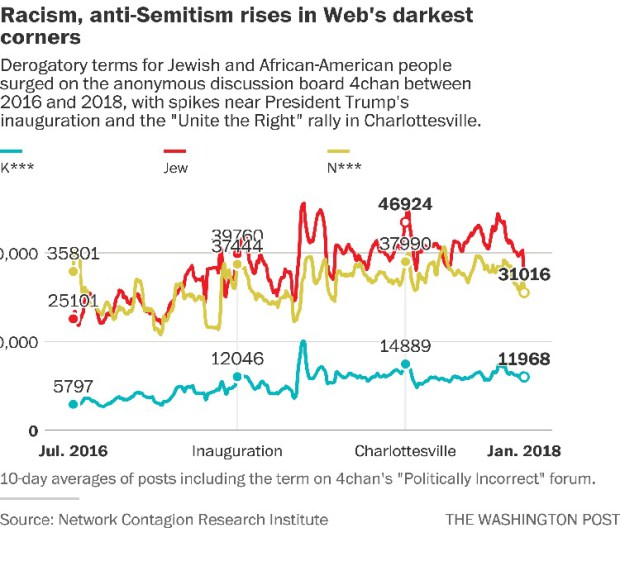
Racist and anti-Semitic content has surged on shadowy social media platforms – spiking around President Donald Trump’s Inauguration Day and the “Unite the Right Rally” in Charlottesville, Virginia – spreading hate speech and extremist views to mainstream audiences, according to an analysis published this week.

The findings, from a newly formed group of scientists named the Network Contagion Research Institute who studied hundreds of millions of social media messages, bolster a growing body of evidence about how extremist speech online can be fueled by real-world events.

The researchers found the use of the word “Jew” and a derogatory term for Jewish people nearly doubled on the “Politically Incorrect” discussion group on 4chan, an anonymous online messaging board, between July 2016 and January 2018. The use of a racial slur referring to African Americans grew by more than 30 percent in the same period.

Gab.ai, a social media site modeled on Twitter but with fewer restrictions on speech, saw even more dramatic increases since the site began operating in August 2016. The use of the term “white,” which often occurred in connection with white-supremacist themes, also surged on both platforms.

These two forums, although small relative to leading social media platforms, exerted an outsize influence on overall conversation online by transmitting hateful content to such mainstream sites as Reddit and Twitter, the researchers said. Typically this content came in the form of readily shareable “memes” that cloaked hateful ideas in crass or humorous words and imagery. (Facebook, the largest social media platform, with more than 2 billion users, is harder to study because of the closed nature of its platform and was not included in the research.)

“There may be 100 racists in your town, but in the past they would have to find each other in the real world. Now they just go online,” said one of the researchers, Jeremy Blackburn, an assistant professor of computer science at the University of Alabama at Birmingham. “These things move these radicals, these outliers in society, closer, and it gives them bigger voices as well.”
Social media has created an era of easy anonymity and instant communication between disparate groups around the world. But it has also created the conditions for outbreaks of extremist ideas.

The research, which has not yet been peer reviewed, sheds new light on how niche hate movements once relegated to dark corners of the Web can abruptly burst into the mainstream. The Charlottesville rally last year, for example, won crucial publicity through racist and neo-Nazi conversations on social media and websites such as the Daily Stormer.

“You can’t act as if the fringe will stay on the fringe, especially in the era of the Web,” said Heidi Beirich, director of the Southern Poverty Law Center’s Intelligence Project, who was not involved in the new research.

Efforts to portray the Parkland, Florida, school shooting as a hoax and its survivors as professional actors initially coalesced on fringe forums on Reddit, 4chan and 8chan, an offshoot for those who consider 4chan too restrictive, before shooting to the top of YouTube’s “Trending” list.

The QAnon conspiracy theory began circulating on the same platforms last fall before exploding into public view in August, after months of refining its central allegations, purportedly from a top-secret government agent, that President Trump is secretly battling a shadowy cabal of sex rings, death squads and deep-state elites.

The 4chan and Gab forums showed similar surges of terms referring to racial identity and white supremacy, with racially and ethnically charged terms increasing steeply on both sites after data collection began.

They also hit dramatic peaks in late January 2017, when Trump’s inauguration was celebrated by members of the “alt-right,” a movement that espouses racist, anti-Semitic and sexist views. A second, higher peak – with posts containing the terms amounting to about 10 percent of all comments on the forums – came in the days surrounding the Charlottesville alt-right rally, in August 2017, which ended in violence and the death of a counterprotester.

When asked for comment on the findings, Gab responded via its Twitter account: “Hate is a normal part of the human experience. It is a strong dislike of another. Humans are tribal. This is natural. Get over it.”

Hiroyuki Nishimura, the owner of 4chan, didn’t respond to emailed requests for comment but has in the past defended the site as a bastion of free speech.

The new research draws on a theory that such outbreaks of hate speech resemble contagious diseases that should be confronted as early as possible, before they become widespread epidemics.

“You can’t fight the disease if you don’t know what it’s made of and how it spreads,” said Joel Finkelstein, the group’s director and the research’s lead author, who recently received his doctorate in psychology from Princeton University.

The Network Contagion Research Institute formed in May as a nonprofit group. The paper on the surge in hate speech is its first, although two members of the research group, Blackburn and Savvas Zannettou, a graduate student in computer science at Cyprus University of Technology, did related work for a paper in May on how memes are created on fringe online forums. Those two and a third member of the group, Barry Bradlyn, an assistant professor of physics at the University of Illinois at Urbana-Champaign, also were co-authors on a February paper about the prevalence of hate speech on Gab.

The researchers used data analytics to show how words and images hopscotched across the online world, as different forums played distinctive roles and influenced each other.

They found, for example, that the 4chan “Politically Incorrect” board – with its high volume of posts, user anonymity and anything-goes ideology – served as the most prolific source for many of the most offensive memes that eventually spread widely across the Internet.

That board also exported anti-Semitic memes to Reddit’s “The_Donald” board, created in 2015 for supporters of Trump, and to Twitter.

Reddit spokeswoman Anna Soellner said the site implemented a new policy in October 2017 forbidding content that encourages, glorifies or calls for violence against an individual or a group of people. “We know there is more to do, and we will continue to evolve our site-wide policies, enforcement tools, and community support resources to ensure that Reddit is a welcoming place for everyone,” she said.

Taken together, some users of the various platforms worked in tandem to propel hateful and conspiratorial ideas to the attention of audiences who might not seek out such content but could have their views shaped by it.

“That is very much the stated goal of many of the meme makers who open up on openly neo-Nazi spaces on 4chan and the Daily Stormer,” said Becca Lewis, who researches online extremism for the New York think tank Data & Society and has no involvement in the new group. “They see themselves as attempting to influence mainstream culture through their memes.”

Network Contagion Research Institute researchers attempted to measure the spread and influence of memes by tracking their first appearance, where they later appeared and how they mutated while moving from platform to platform. They also sketched out what they called “neighborhoods” of memes clustered by theme or prominence.

They found that, like a mutating virus, recognizable and popular images often were co-opted and contorted into hateful memes, as anonymous users skewed the features of the originals to demean ethnic groups or popularize racial hostilities.

One meme known as the “Happy Merchant,” an offensive Jewish caricature, was used repeatedly to convey anti-Semitism. It also proved effective at reaching mainstream audiences: One comic showing the caricatures faking anti-Semitic attacks such as spray-painting swastikas onto a temple, subtitled “Makin’ Hate Crimes great again!,” spread from 4chan to Gab to Reddit, the country’s fifth-most popular website, in about two weeks in early 2017, according to the research.

The meme made at least 1,100 appearances across Reddit between mid-2016 and mid-2017, including on “The_Donald” board, the researchers found. After the meme’s posting on “The_Donald,” it routinely showed up on Twitter and other platforms tracked by the researchers, suggesting the site was unusually influential in aiding the meme’s spread.

Reddit’s “The_Donald” board had by that time implemented a policy saying racism and anti-Semitism “would not be tolerated.” Moderators for the board declined to respond.

Racial slurs on the sites grew increasingly rampant, the research found. The words “Jew” and “white,” as well as a derogatory term for Jewish people, were used in 7 percent of the roughly 100 million posts on Gab and the “Politically Incorrect” board together.

An epithet for African Americans was used in more than 2 percent of all posts. Use of the hateful term exploded in July 2016, the day after a black man killed five police officers during a mass shooting in Dallas.

The findings, researchers wrote, suggested a “worrying trend of real-world action mirroring online rhetoric” – and a possible feedback loop of online and offline hate.

“When people aggregate together” in these communities, Finkelstein said, “they end up radicalizing each other.”Even as the researchers illuminated how hateful speech and images spread, they struggled with how to combat such powerful online forces. They worry that censoring content or banning users pushes racist and anti-Semitic content to other forums.

Rather, Finkelstein and his colleagues hope that illuminating the way hate speech spreads will make it easier to challenge it – through what he calls “a digital immune system.” But it’s not entirely clear how it would form, who would deploy it or whether it would be up to the task of defusing hateful ideas.

Source: Racism and anti-Semitism surged in corners of the Web after Trump’s election, analysis shows

Danish left veering right on immigration

Another Nordic country struggling with integration:

Denmark’s right-wing government might once have expected pushback from the left-wing opposition when it introduced a controversial new integration policy.

No longer.

A recent government proposal, to be finalized by parliament in the fall, would target the country’s so-called ghetto neighborhoods with a series of sanctions and incentives. The intention is to bring immigrant communities fully into Danish society — by force if necessary.

Children living in the targeted areas would be compelled to attend day care for 25 hours a week, to ensure they learn the country’s language and values. Parents who take their kids back to their countries of origin for extended periods could face prison or deportation. Crimes committed in the neighborhoods would carry heavier sentences. Buildings would be demolished if necessary.

The last touches to the package are expected to be fully approved with a large parliamentary majority, including the enthusiastic support of the largest opposition party, the left-wing Danish Social Democrats.

“We tried to negotiate this to be, you might say more draconian,” said Mattias Tesfaye, the party’s spokesman on immigration and integration. “We think the government has been soft on this.”

Flanking on the right

Political parties across Europe are grappling with immigration policy. Concerns about new arrivals have helped propel far-right parties into government in Austria and Italy and elevated the xenophobic Alternative for Germany into its country’s largest opposition party.

The issue has posed a particular dilemma for Europe’s left-wing parties, which have suffered a wave of electoral defeats as political rivals accuse them of being responsible for untrammeled immigration. Some have shifted to an economic critique of migration due to wage competition, while others have doubled down on a defense of diversity and assistance for refugees.

The response of the Danish Social Democrats is an outlier: They have tried to outflank their competition by backing the government in a string of eye-catching bills on immigration and integration and demanding harder measures still.

Last year, the Social Democrats overhauled their party’s political agenda for only the seventh time in their 140-year history. The result, “Together for Denmark,” adopts much of the language of the anti-immigration right, including the term “parallel societies.” The policy describes these as places “where foreigners and their descendants live, isolated from the Danish community and with values that are not Danish” and calls them “unacceptable.”

In addition to throwing its support behind the ghetto plan, the party has supported the government in allowing the jewelry and valuables of asylum seekers to be seized by authorities in payment for their reception, and in banning face veils.

“Why should the social democratic position be we should leave people alone, and leave the right with the argument that we have to have a common cultural background?” asked Tesfaye, the son of a Danish woman and a refugee from Ethiopia, who serves as the party’s point person on the issue. “It should be a core issue for social democratic parties to break down these parallel societies and make sure we all belong to each other.”

The strategy may be paying off: Opinion polls indicate the party may lead a left-wing coalition into government next year.

Attacking from the left

The Social Democrats blame the perception that they are soft on immigration for recent electoral troubles. After governing Denmark for most of the 20th century, they have been out of power for all but four years since 2001.

That was the year immigration became a defining political issue, in an election that immediately followed the September 11 attacks on the United States. Voters began to abandon the left in favor of tough-on-immigration right-leaning governments, showing they were willing to compromise on the welfare state if it meant migration controls.

The right-wing populist Danish People’s Party drew voters away from the left as it lent support to governments on the condition they impose immigration freezes and cut refugee support, steadily reshaping the policies of its rivals in its own image.

In April 2017, around the same time the Social Democrats released their new party policy, Tesfaye published “Welcome, Mustafa,” a book analyzing 50 years of his party’s stance on immigration. In it, he refutes the party’s image as being pro-open borders, revealing years of debates and divisions on the issue and rehabilitating early figures who warned integration could be a problem, but who were ignored.

Tesfaye draws on the experience of his own family. When his father was granted asylum, he struggled to integrate because it was not clear what Denmark expected of him, Tesfaye recalled.

“We have to be very explicit. We have to say for example: We need you to support a secular state where there’s a religious freedom, and where the common rules of society are supported by secular arguments. We need you to make sure your children learn Danish. We need you to live not just in one place where all the refugees are,” Tesfaye said.

Reframing immigration

The Social Democrats formulate opposition to immigration as an integral left-wing position, necessary to protect the party’s traditional working-class voter base from immigrants who would compete for their jobs and send their children into their schools.

Tesfaye defends the ghetto plan, for example, as necessary to defend the welfare state, arguing that people can be asked to pay up to 53 percent in income tax for health, education and a safety net only if they feel part of a common unit with their fellow citizens.

Tesfaye also defends the measure as an investment in children’s education — a classic Social Democrat policy — and argues it should be applied across Denmark.

“With migration to Denmark it’s our own voters, and our own families, who have paid the highest price,” he said. “It’s a problem for a Social Democrat if we have areas in our country where the language is shifting to Arabic or Turkish, because it undermines the common ground [on which] the welfare state is based.”

The number of asylum seekers granted permission to reside in Denmark — though the number dwindled to 2,700 last year from a peak of 11,000 in 2015 — is still too much for the country, he said. Syrians, Iranians, Afghans and Eritrean make up the largest numbers of people seeking asylum in Denmark.

“When as a little boy I walked around in the second-biggest city of Denmark, I had a black father,” he said. “People were turning their heads because he was black. Not in a negative way, but just because it was so extraordinary that a black man was walking around in our suburb. This has changed in my lifetime.”

Since 1980, non-Western immigrants have risen from being 1 percent of the population to 8.5 percent now. “It’s been uncontrolled, we can’t control who is coming to Denmark and from where,” Tesfaye said.

His party now supports retaining border controls with Germany — an emergency measure as Denmark is within the European border-free Schengen area — until it is satisfied that the EU’s external borders are controlled. It wants to set up a processing center for refugees outside Europe where asylum seekers can apply, to stop them traveling to Denmark in advance. The number accepted should be capped, family reunifications limited, and immigrants incentivized to return to their country of origin or be deported where needed.

In the ghetto

The reality of the ghetto laws will soon hit the residents of the low-rise apartment buildings of Mjølnerparken, a leafy housing development north of Copenhagen.

“Our shared language is Danish, our common identity is Danish,” says Muhammed Aslam, chairman of the residents’ association in Mjølnerparken. “We don’t see it as a parallel society at all” | Andrew Kelly/Reuters

By the government’s analysis, Mjølnerparken is one of the most severe “ghettos” — of its 1,752 residents, 82 percent are non-Western immigrants or their descendants, and 43.5 percent are unemployed.

Muhammed Aslam, chairman of the residents’ association, sees it differently.

“About 30 different nationalities live here, of different backgrounds and cultures. Our shared language is Danish, our common identity is Danish,” he said. “We don’t see it as a parallel society at all.” 

Residents reject the label “ghetto.” Though the area has gained a certain notoriety due to some gang shootings — rare and shocking for Denmark — its pristine playgrounds and tranquility make it hard to see this as a “ghetto” by any international understanding of the term.

“I don’t agree with this form of collective punishment,” said Iliana, 53, a nurse and translator from Romania who declined to give her full name. She had lived in the country for 25 years, and was sharing a picnic with women from Denmark and Iraq in a courtyard between apartment blocks as children played nearby. “They’re punishing everyone before people have done anything wrong,” she said. 

Aslam, who moved to Denmark with his parents from Pakistan in 1969 when he was 7, said he felt the government was betraying the values of the country he grew up in.

“Given my fantastic experience growing up with such a fair democracy as Denmark I couldn’t have imagined even five years ago that we could have ended up with a law that’s so discriminatory,” said Aslam, an estranged member of the Social Democrats. “It takes away the principle of equality before the law.”

Aslam said he does not recognize the government’s image of Mjølnerparken, and urged politicians to enter into dialogue with the community about what the area really needs — apprenticeships for young people and help to find employment, he suggested.

“It has become a competition about who can be the toughest against immigration, refugees and Muslims,” he said with a sigh. “That’s going to be the basis on which the next election is won or lost.”

Source: Danish left veering right on immigration