Good and interesting data analysis with equally good data visualization:
The part of this city east of Northgate Mall looks like many of the neighborhoods that surround it, with its modest midcentury homes beneath dogwood and Douglas fir trees.
Whatever distinguishes this place is invisible from the street. But it appears that poor children who grow up here — to a greater degree than children living even a mile away — have good odds of escaping poverty over the course of their lives.
Believing this, officials in the Seattle Housing Authority are offering some families with housing vouchers extra rent money and help to find a home here: between 100th and 115th Streets, east of Meridian, west of 35th Avenue. Officials drew these lines, and boundaries around several other Seattle neighborhoods, using highly detailed research on the economic fortunes of children in nearly every neighborhood in America.
The research has shown that where children live matters deeply in whether they prosper as adults. On Monday the Census Bureau, in collaboration with researchers at Harvard and Brown, published nationwide data that will make it possible to pinpoint — down to the census tract, a level relevant to individual families — where children of all backgrounds have the best shot at getting ahead.
This work, years in the making, seeks to bring the abstract promise of big data to the real lives of children. Across the country, city officials and philanthropists who have dreamed of such a map are planning how to use it. They’re hoping it can help crack open a problem, the persistence of neighborhood disadvantage, that has been resistant to government interventions and good intentions for years.
Nationwide, the variation is striking. Children raised in poor families in some neighborhoods of Memphis went on to make just $16,000 a year in their adult households; children from families of similar means living in parts of the Minneapolis suburbs ended up making four times as much.
The local disparities, however, are the most curious, and the most compelling to policymakers. In one of the tracts just north of Seattle’s 115th Street — a place that looks similarly leafy, with access to the same middle school — poor children went on to households earning about $5,000 less per year than children raised in Northgate. They were more likely to be incarcerated and less likely to be employed.
The researchers believe much of this variation is driven by the neighborhoods themselves, not by differences in what brings people to live in them. The more years children spend in a good neighborhood, the greater the benefits they receive. And what matters, the researchers find, is a hyper-local setting: the environment within about half a mile of a child’s home.
At that scale, these patterns — a refinement of previous research at the county level — have become much less theoretical, and easier to act on.
Image
A map used by the Seattle Housing Authority identifies neighborhoods, shaded in purple, where housing officials and researchers believe that poor children have particularly good odds of rising out of poverty.CreditSeattle Housing Authority
“That’s exciting and inspiring and daunting in some ways that we’re actually talking about real families, about kids growing up in different neighborhoods based on this data,” said the Harvard economist Raj Chetty, one of the project’s researchers, along with Nathaniel Hendren at Harvard, John N. Friedman at Brown, and Maggie R. Jones and Sonya R. Porter at the Census Bureau.
The Seattle and King County housing authorities are testing whether they can leverage their voucher programs to move families to where opportunity already exists. In Charlotte, where poverty is deeper and more widespread, community leaders are hoping to nurse opportunity where it’s missing.
In other communities, the researchers envision that this mapping could help identify sites for new Head Start centers, or neighborhoods for “Opportunity Zones” created by the 2017 tax law. Children from low-opportunity neighborhoods, they suggest, could merit priority for selective high schools.
For any government program or community grant that targets a specific place, this data proposes a better way to pick those places — one based not on neighborhood poverty levels, but on whether we expect children will escape poverty as adults.
That metric is both more specific and more mysterious. Researchers still don’t understand exactly what leads some neighborhoods to nurture children, although they point to characteristics like more employed adults and two-parent families that are common among such places. Other features like school boundary lines and poverty levels often cited as indicators of good neighborhoods explain only half of the variation here.
“These things are now possible to think about in a different way than you thought about them before,” said Greg Russ, the head of the Minneapolis Public Housing Authority, which is also planning to use the data. “Is opportunity a block away? These are the kind of questions we can ask.”
The answers shown here are based on the adult earnings of 20.5 million children, captured in anonymous, individual-level census and tax data that links each child with his or her parents. That data covers nearly all children in America born between 1978 and 1983, although the map here illustrates the subset of those children raised in poorer families. The research offers a time-lapse view of what happened to them: who became a teenage mother, who went to prison, who wound up in the middle class, and who remained trapped in poverty for another generation.
Few of the children from Northgate still live in the neighborhood, but the data traces their outcomes as adults today back to the place that helped shape them…
Moving forward, we need to insist that whenever we are interrogating the admissibility of evidence in cases involving Indigenous and racialized accused or victims, that we ask the following questions:
Is there a danger that the logical connection or inference we seek the judge or jury to draw from the evidence is rooted in stereotypical assumptions?
Is there a danger that the evidence does not support the purpose for which it is being led, because it is likely connected to systemic factors such as colonialism or structural racism?
Is there a danger that the evidence will trigger stereotypical assumptions and thereby distort or taint the reasoning process?
Every day in our criminal courts, evidence is led that has the potential to corrupt the trial process because it triggers racial bias. All lawyers and judges have the ethical and moral obligation to ensure that all available steps are taken to protect our trials from this.
More good detailed analysis at the census tract level by David Hulchanski that highlights the disparities that more aggregated analysis misses.
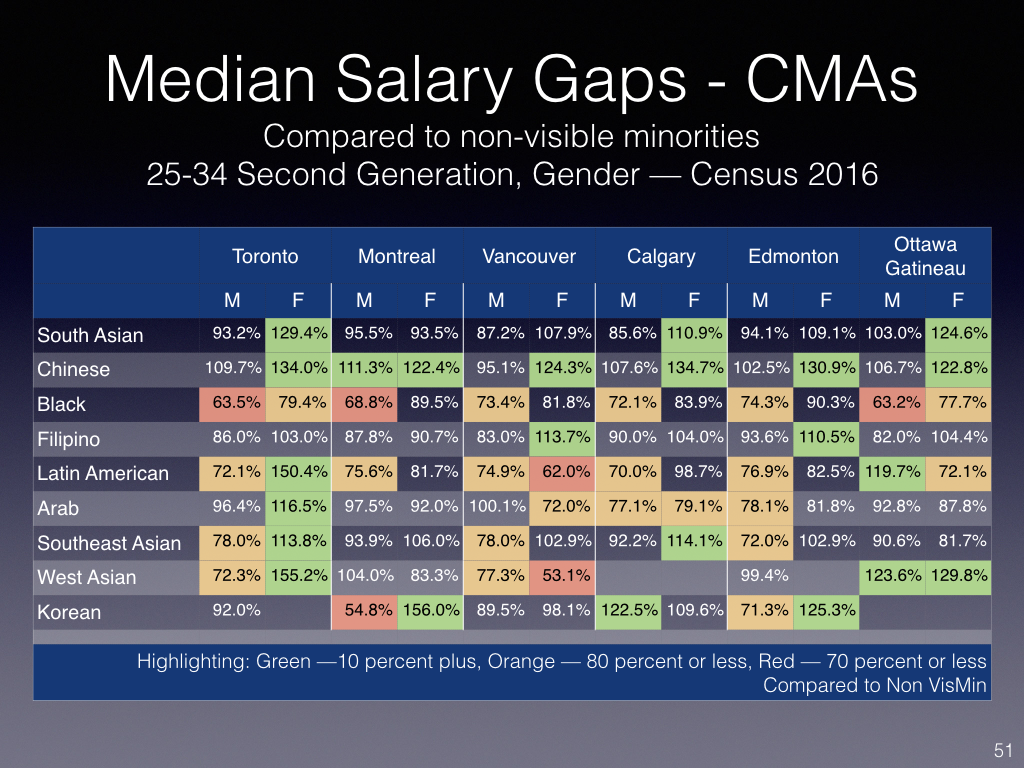
My analysis, focussing on outcomes of second generation visible minorities 25-34 years old shows largely comparable outcomes for most groups, with the exception of Blacks, Latin Americans, Arabs and West Asians. Discrimination certainly plays a part in these disparities but other factors (e.g., time in Canada, area of study etc) also play a part:
In Toronto, the colour of money is mainly white.
New demographic charts show a strikingly segregated city, with visible minorities concentrated in low-income neighbourhoods and white residents dominating affluent areas in numbers far higher than their share of the population.
The new charts come from University of Toronto Prof. David Hulchanski and his research team, known for using census data to illustrate growing income inequality in the city. Their latest effort flags the role of discrimination in that inequality, with lopsided racial breakdowns that surprised the researchers.
“It’s starker than we would expect,” Hulchanski said in an interview.
Hulchanski revealed the new charts last week in the Netherlands at a conference called “Urban poverty and segregation in a globalized world.”
Using the 2016 census, his team calculated that 48 per cent of Toronto’s census tracts are low-income neighbourhoods, where the average individual income is $32,000 before taxes.Fully 68 per cent of residents in these neighbourhoods are visible minorities while 31 per cent are white. (Whites make up 49 per cent of Toronto’s population.)
The main ethno-cultural communities in these low-income neighbourhoods are all overrepresented compared to their share of the city’s population. Black residents, for example, are 9 per cent of the population but make up 13 per cent of residents of low-income neighbourhoods.
High-income neighbourhoods are almost a reverse image. They make up 23 per cent of Toronto’s census tracts, with average individual incomes of $102,000 before tax. Fully 73 per cent of residents in these neighbourhoods are white, far higher than their share of the city’s population. The rest are visible minorities, of whom only 3 per cent are Black.
Whites are also overrepresented in middle-income neighbourhoods, where the average income is $49,000.
“Money buys choice. And people with the most choice are choosing to live in certain areas,” Hulchanski says, explaining the disproportionately high concentration of white residents in high- and middle-income communities.
Choice also partly explains the makeup of low-income neighbourhoods. Some members of ethnic groups prefer to live where their communities are most numerous, giving them easy access to the shops and cultural or religious services that facilitate integration or simply make life more enjoyable.
York University Prof. Carl James, who reviewed Hulchanski’s charts, questions how free the choice actually is for visible minorities.
“We have to think about how the system might have enabled and co-operated in making it possible for some people to access high income neighbourhoods and to stay in those neighbourhoods, or operated to keep others out of those neighbourhoods. It’s not just individual choice. Many other structural things work in relation to choice.”
Studies indicate that discriminatory barriers to good jobs and housing play a determining role.
“Discrimination is not at the same level as in the United States,” Hulchanski says, “but that doesn’t make it any better for those who face that problem here.”
The researchers split the city into high-. and low-income categories by comparing neighbourhoods that were 20 per cent above or below the Toronto Census Metropolitan Area average. Middle-income was within 20 per cent. The team then used census data to see the makeup of those communities.
Evidence of discrimination is reinforced by another chart produced by Hulchanski’s team, showing relatively high levels of education in low-income neighbourhoods. Half of all residents in those areas have a post-secondary degree: 25 per cent from a university and 25 per cent from a community college.
Hulchanski questioned why half the city has average gross incomes of only $32,000 when so many people in those low-income neighbourhoods have relatively high levels of education. “That doesn’t make sense, except for discrimination,” he said.
Another worrying sign for Hulchanski is that 57 per cent of residents in Toronto’s low-income neighbourhoods are immigrants, including established ones who arrived before 2006. Only 31 per cent of residents in high-income areas are immigrants, including 23 per cent who arrived prior to 2006.
The racial segregation of Toronto neighbourhoods is in the context of research, also from Hulchanski’s team, illustrating the growth of low- and high-income neighbourhoods in Toronto, while middle ones steadily disappear.
The polarized income trend dates back to the 1990s, caused by federal and provincial cuts in transfer payments and social assistance, along with tax cuts, rising housing costs and the disappearance of well-paid manufacturing jobs, Hulchanski says.
Government policies caused the income polarization, and only government policies can reverse it, he argues. Hulchanski warns that in Europe, where the trend is less severe, income polarization and ethnic segregation has contributed to the rise of far-right populist movements and outbreaks of violence.
“How long can this continue?” Hulchanski asks. “There is no sign of the trend reversing yet.
Knowing both Dina Porat and Yehuda Bauer from my time as Canadian delegate to IRHA, found this story particularly of interest. Agree with Bauer:
A public outcry and a media storm have raged in recent months over a joint declarationissued by the prime ministers of Poland and Israel and read by Israel’s Prime Minister Benjamin Netanyahu last June. The statement praised Polish resistance to the Nazis. It came on the heels of Poland passing a controversial law akin to Holocaust-denial that banned implicating Poles for crimes committed during the Holocaust, an offense punishable by a three-year prison sentence. When Netanyahu read the declaration, many criticized him over reaching a faustian detente with Poland.
Professor Yehuda Bauer, Israel Prize laureate and one of the world’s leading Holocaust scholars, deemed the joint statement “betrayal.”
In an interview on Israeli public radio, Bauer said that Israel had accepted the Polish narrative of the Holocaust. “The Poles have deceived us, they have us wrapped around the finger, and we agreed to this, because the State of Israel finds the economic-political-military relations with Poland more important that such a small business, the Holocaust,” he said.
Senior officials in the Netanyahu government, including Naftali Bennett, Minister of Education and Ayelet Shaked, Minister of Justice, also criticized the declaration.
The statement was drafted far from the public eye with support from a secret delegation of Netanyahu allies and former appointees, Yaakov Nagel and Yossi Ciechanover. According to reports by Israeli media, a meeting between the delegations was held at the Mossad offices. It came about in spite that this kind of historic declaration should be made after deep discussion involving experts and the public.
After the statement was made, Netanyahu revealed that “Professor Dina Porat, the chief historian of Yad Vashem was involved the drafting of the declaration.” However, Yad Vashem had already published their own unprecedented and sharp condemnation of the statement. It said the joint Israeli-Polish declaration contained “historical distortions” and was written without Yad Vashem’s involvement.
Porat would have liked to have some sections corrected, she explained in an interview with Kan radio and reported by Ynet. Yet, taken as a whole, she said “We can definitely live with it,” Porat clarified she was not paid for consulting on the declaration. “I was asked to give personal and discreet advice, I did not act as the chief historian [of Yad Vashem],” she said.
How was it possible that Porat acted behind the backs of both Yad Vashem and the Israeli public? Do political ends (such as bolstering Netanyahu’s attempt to have more embassies moved to Jerusalem) justify the means? Does that include the desecration of the memory of the Holocaust? Prima facie, Porat’s conduct was no fluke but a matter of worldview and priorities.
What is anti-Semitism? Depends on what’s in the Israeli government’s self-interest
“New anti-Semitism,” a vague term promoted by the Israeli government and its partners, regards the BDS movement and criticism of Israeli occupation policies as a form of anti-Semitism. While the Israeli right-wing often mocks the “peace industry,” it has formed its own industry under the assumption that new anti-Semitism is real and spreading. The government calls this fighting the “de-legitimization of Israel.” It is spearheaded by politicians who strive to gain personal capital, organizations on the right and extremist groups. This industry offers lucrative jobs and huge budgets.
While sporadic anti-Semitic elements in the boycott movement do occur and should not be tolerated, it makes no sense to sweepingly label this global, diverse movement as innately “anti-Semitic.” Many Jews in Israel and across the world support a full boycott of the State of Israel, or a boycott of Israeli settlements and those who profit from the occupation.
In spite of strenuous efforts by the Netanyahu government, a boycott of the State of Israel is still considered an integral part of the civil right to freedom of speech and conscience in many countries, even if the local governments oppose the boycott or do not support it. In reality, the Netanyahu government has used the fight against the “new anti-Semitism” to silence criticism of the occupation and its policies in the occupied Palestinian territories, to persecute left-wing and human rights groups, and to shrink the democratic sphere in Israel.
It comes as no surprise that the Netanyahu government’s fight against the boycott movement and the “new anti-Semitism” shifted gears in 2015, against the backdrop of the international nuclear agreement with Iran. A new existential enemy had to be found, around which the public in Israel could be rallied. To manufacture a public consensus as to the current “existential threat,” the Netanyahu government could not rely just on the fringe right wing. In this context, Porat became an important asset to the Netanyahu government by joining the campaign. For example, the Kantor Center at the Tel Aviv University, headed by Porat, publishes an annual report (of which she is the editor) on the status of anti-Semitism throughout the world. These reports pay close attention to the boycott movement and groups which campaign against Israeli policies. The reports also regard the labeling of Israel as “an apartheid state” as a manifestation of anti-Semitism. At ahearing of the Knesset’s Immigration and Absorption Committee in May 2015, Porat stated that “It’s obvious that anti-Israeliness and anti-Zionism are acquiring an increasingly anti-Semitic tone.” This means that in her view, anti-Zionism may amount to anti-Semitism.
When it comes to the “old anti-Semitism,” Porat seems more pragmatic. This was evident not just in her (professed) clandestine participation in the preparation of the joint declaration with the Polish government, but also in her approach to other regimes with a serious anti-Semitism problem. Hungarian Prime Minister Viktor Orban, has been waging a racist and anti-Semitic campaign for years, and has even expressed his personal support of Miklós Horthy, the country’s ruler during WWII who was directly responsible for the extermination of Hungary’s Jews. While the United States Holocaust Memorial Museum in Washington has condemned Orban sharply, and Elie Wiesel returned a medal he had received from the Hungarian government due to its whitewashing of the country’s Nazi past, we have not heard Porat’s criticism of this grave anti-Semitism in Orban’s party and government. In fact, the opposite is true – Orban visited Yad Vashem recently. It comes as no coincidence that Hungary is being coaxed by Netanyahu to transfer its embassy to Jerusalem.
Furthermore, we have not heard Porat’s critique as to Ukrainian legislation which, similarly to the Polish one, bans criticism of Nazi Germany’s Ukrainian henchmen during WWII. Nor have we heard her public voice regarding the integration of a neo-Nazi Militia, Azov, which uses Nazi insignia, into the national Ukrainian security forces. Once again, the converse is true: The Prime Minister of Ukraine visited Yad Vashem in May 2017, and metIsraeli Minister of Defense Avigdor Lieberman to discuss arms deals. By contrast, the Simon Wiesenthal Center has campaigned against the militia’s efforts to recruit new members, and the United States Memorial Museum has strongly condemned the Ukrainian legislation. Nor have we heard Porat’s critique as to the recent visit by Philippine President Rodrigo Duterte, who is responsible for the extrajudicial killing of thousands of suspected drug dealers and addicts. Duterte has also compared himself to Hitler and said he would gladly slaughter three million drug addicts similarly to Hitler’s slaughter of the Jews.
A dangerous stamp of approval
Porat published in Haaretz a response to an article by the Israeli writer Amos Oz, in which he claimed that Israel would not resolve its conflict with the Palestinians by using its military might, but only through negotiation, including with the Hamas terror organization. Porat criticized Oz strongly and cited an excerpt from his book “A Tale of Love and Darkness,” in which the guard from Kibbutz Hulda says: “It’s not because they are a nation of murderers that we will shoot them (if they show up to shoot us), but only for the simple reason that we too are allowed to live and for the simple reason that we too are allowed to have a country, not just they.” Porat of all people should have known that the logic of this sentence has served to justify crimes against humanity and genocide in Guatemala, Rwanda, Bosnia, South Sudan, Burma and other countries.
Accordingly, we did not hear Porat’s voice when the Chairman of the South Sudanese Parliament, Mr. Anthony Lino Makana, visited Yad Vashem in December 2017, as crimes against humanity were being committed in South Sudan by the government’s security forces and allied militias, and the UN warned that the situation could escalate to a full genocide. Nor did we hear Porat’s voice when the head of the Burmese military regimevisited Yad Vashem in September 2015, although the Burmese security forces under his command are responsible for crimes against humanity and war crimes. Porat should have noted reports by the United States Holocaust Museum, regarding the minority Muslim Rohingya population, as to grave violations of human rights taking place in the country, with a serious threat of genocide. Israel has sold weapons to the above-mentioned states, and visits to Yad Vashem have been a part of the package deal.
Porat is surely not responsible for the decades-long policies of the Israeli government and Yad Vashem. But her stamp of approval to the Netanyahu government’s foreign policy illustrates the danger of politicizing the memory of the Holocaust and the Israeli right-wing’s cynicism. It seems that the more she deals with the “new anti-Semitism” bogeyman, the less she addresses the “old anti-Semitism.” If Porat is really more concerned with support for BDS in Ireland, which has enacted a law banning settlement products, than with Hungary, whose government erects statues honoring those who assisted in the elimination of Jews, and a senior extreme right-wing figure calls for the compilation of a “Jewish list” for national security reasons – She would do wisely in letting someone more qualified assume her position at Yad Vashem. Indeed, Porat has offered her resignation, but reportedly Yad Vashem did not accept it. If she does leave her post, she will be free to advise Netanyahu as personally and publicly as she wishes.
Less contradictory than the article argues. Virtually all of the recommendations that came out of the committee examining M-103 applied to all forms of racism and discrimination (dissenting Conservative recommendations focused more on definitional questions of Islamophobia).
The additional funding for the multiculturalism program was general in application save for programming directed against racism and discrimination encountered by Black Canadians).
Just as one can criticize the policies and practices of the Israeli government without being antisemitic, one can criticize the policies and practices of the Saudi government without being anti-Muslim. In the case of the former, the IHRA definition of antisemitism provides some (imperfect) guidance that could form the basis of discussion for a comparable approach to criticizing the policies of Muslim countries, beyond basic human rights.
So while some Muslims may argue that any criticism of Saudi Arabia is anti-Muslim or Islamophobic, some Jews also argue that any criticism of Israel is antisemitic. It depends on the nature and form of the criticism:
Would jailed Saudi Arabian blogger Raif Badawi end up being accused of Islamophobia if he were released from his Riyadh prison cell and allowed to come to Canada?
Prime Minister Justin Trudeau’s government is taking contradictory symbolic stands.
In August, it provoked a diplomatic dispute with the Kingdom of Saudi Arabia by tweeting support for Badawi, who was arrested in 2012 and flogged for criticizing the country’s hardline religious leadership. Canada has even offered citizenship to the free-speech advocate, his wife, Ensaf Haidar, and their children.
But how does that jibe with the federal Liberals also pushing through Motion 103, which urges all-out war against “Islamophobia?” The Liberal politicians behind M-103 refused to respond to requests to define Islamophobia. And their deceptive gamesmanship would end up jeopardizing Badawi’s right to free expression if he were to ever to come to Canada.
Among other things Badawi has equated a host of Saudi Arabian Muslims with terrorists, which many Canadians think is an offensive and Islamophobic accusation to make.
Can Trudeau’s government have it both ways? How can it champion Badawi’s right to freely criticize Saudi Arabia’s form of Islam at the same time that Liberal MPs make a virtue of condemning anyone who disparages Islam, including the deadly rules in many theocratic Muslim countries, which legislate that people should have their heads cut off for leaving the 1.5-billion-member faith?
Ali Rizvi, Canadian-based author of The Atheist Muslim, was one of the first to point out the lack of logic from Canada’s liberal-minded politicians, which include NDP and Green MPs. “People like my good friend Raif Badawi is in jail and he has been flogged 50 times simply for blogging,” Rizvi, who has lived in Saudi Arabia, told CBC’s The Tapestry.
“It’s interesting to me that if he finally made it to Canada and joined his wife and kids here, a lot of his ideas would be considered ‘Islamophobic’ by Liberals over here because of the criticisms he makes.”
An Angus Reid poll suggests many Canadians agree with Rizvi that the Liberal government has muddied the waters of free speech when it comes to criticizing religions and religious people, something which has been going full bore in the West since the Christian Reformation 500 years ago.
Half of Canadians said it’s not necessary for federal politicians to formally condemn “Islamophobia.” And 55 per cent say the problem of anti-Muslim sentiments in this country has been overblown by politicians and the media. Presumably most Canadians feel the country’s existing anti-hate speech laws already cover extreme hostile attacks on ethnic or religious groups.
The federal Liberals have managed through all this to get themselves into a pickle over free speech.
Foreign Affairs Minister Chrystia Freeland’s August tweet calling for the release of Badawi and his sister led to Saudi Arabia retaliating. It cancelled trade deals with Canada and cut short the educations of nearly 15,000 Saudi students in Canada, even while confusion reigns about the fate of the more than 1,000 Saudi physicians in training in the country.
The trans-national furore is taking place as Badawi’s circumstances grow more dire. Even though an initial charge of apostasy, which is punished by death, was withdrawn, his health deteriorates in his small, stinking, shared cell. He has four years left in his sentence, which was to include 1,000 public lashes with a whip (he’s had 50 so far). He’s not alone in his degradation. In other Muslim-majority countries, online critics of the religion have been hacked to death, including a Bangledesh blogger who was also a friend of the Canadian author of The Atheist Muslim.
What has Badawi actually said to suffer such egregious punishment?
He has censured Muslims’ for their intolerance and argued against unequal religious attitudes towards women. He has promoted “live and let-live” secularism to replace Islamic theocracy and attacked Muslim schools that he says are filled with terrorists. And he has criticized Muslims in Arabic countries for failing to follow the lead of Europe, which has a separation of religion and state.
“States which are built on religion confine their people in the circle of faith and fear,” he writes in 1000 Lashes: Because I Say What I Think (published by Vancouver’s Greystone Books).
“We should not hide the fact that Muslims in Saudi Arabia not only disrespect the beliefs of others, but (they) charge them with infidelity, to the extent that they consider anyone who is not Muslim an infidel,” he has said.
Badawi was outraged when Muslims in New York City called for a mosque to be built near the site of the destroyed World Trade Center, where 3,000 people were murdered in the 9/11 attacks by al-Qaida terrorists, whom Badawi directly linked to Saudi Arabia.
“What increases my pain is this (Islamist) chauvinist arrogance, which claims that innocent blood, shed by barbarian, brutal minds under the slogan ‘Allahu Akbar,’ means nothing compared to the act of building an Islamic mosque whose mission will be to … spawn new terrorists.”
Badawi’s costly bid for freedom of expression in Saudi Arabia, for the right to openly denounce Islamic practices, puts him in a similar boat as the staff at France’s satiric Charlie Hebdo magazine, the Danish newspaper editors who published cartoons of Mohammed, and British-Indian novelist Salman Rushdie, whom have all suffered for finding fault with Islam.
In 1000 Lashes, Badawi defiantly chooses to follow the dictum of the late French existentialist Albert Camus, who said, “The only way to deal with an unfree world is to become so absolutely free that your very existence is an act of rebellion.”
Badawi’s courageous existence is a clear revolt against Saudi Arabia’s bullying Islamic authorities. It should also cause some censorial Canadians to squirm.
Robinson certainly has his followers on the far right media I follow, who are obsessed with him:
The online comments disparaging Muslims as “scum” didn’t appear on a shady message board or a private social media group. Instead, they were out in the open with thousands of others, elicited by a single video uploaded to YouTube and starring a self-styled free speech activist who got his start in a suburb of London.
To his critics, though, Tommy Robinson behaves like a bigoted agitator. In the video made outside a rape trial in Oxford, England, he’s seen antagonizing the accused and their families. “Twenty-nine people [including] two women are involved in this case,” Robinson said in the video. “Thirty per cent of them are called Mohamed.” The video has been seen nearly two million times since it was posted in April 2017.
“I had no idea Muslims in the U.K. were that barbaric,” one comment read.
In the replies, another user added “everywhere Islam goes, it causes trouble.”
“Why are you not killing them?” another anonymous poster asked.
The post and the comments encapsulate the uproar Robinson is known to cause and the visceral reaction he evokes from supporters. It also shows what observers see as Robinson and his allies’ gross generalization of Muslims.
“He’s tapped into a broader movement,” said Joe Mulhall, a researcher with the London-based anti-racism campaign Hope Not Hate. Robinson, 35, appeals to “a group of very angry people” upset about terrorism and highly publicized child rape cases in Britain, Mulhall said.
“He’s taking that legitimate anger and he’s changing into something that’s going to legitimize violence against the whole Muslim community and that’s extremely dangerous.”
Legal trouble
Robinson’s actions have repeatedly landed him in court — under his real name, Stephen Yaxley-Lennon. On Thursday, he appeared before a judge in London to answer to one count of contempt of court. His case was adjourned until a later date.
“People are fully aware this is a political trial and it’s a political persecution,” he told reporters outside England’s Central Criminal Court.
Robinson was greeted by a crowd of several hundred supporters who chanted his name and waved Union Jacks and the English St. George’s Cross flag. About 30 counter-protesters held up signs that read “oppose Tommy Robinson, don’t let the racists divide us.”
Several hundred supporters rallied outside London’s Central Criminal Court Thrusday, chanting Robinson’s name as he appeared on a charge of contempt. (Thomas Daigle/CBC)
Police kept the two groups separated while nearby pubs planned to remain closed in case clashes broke out.
Robinson’s contempt charge stems from a video shot outside a courthouse in Leeds in May and streamed live on Facebook. In it, Robinson was heard discussing an ongoing rape trial and seen confronting the accused.
A judge had banned reporting during the rape trial — a common practice in British courts to avoid prejudicing the jury. Robinson accepted his actions were in contempt of court and, within five hours of the incident, was sentenced to 13 months.
But his supporters saw it as an attempt to curb Robinson’s free speech. Donald Trump Jr., the U.S. president’s son, sympathetically tweeted “don’t let America follow in those footsteps.”
On a radio show in London, the president’s former chief strategist, Steve Bannon, called Robinson “a solid guy” and suggested he should be released from prison.
Between 2,000 and 3,000 supporters marched through London on July 14, chanting “Tommy, Tommy” and demanding he be freed. Videos of smaller demonstrations in support of him, from Toronto to Sydney, Australia, were posted online.
Mulhall disputes the claim the contempt charge was a way to silence Robinson. “This is a far right, anti-Muslim activist with a history of violence and criminality,” he said, adding Robinson “was sent to prison for breaking the law.” Robinson had previously been convicted of assault and fraud.
In August, the U.K.’s top judge ordered a retrial, calling the initial, swift ruling a “fundamentally flawed process.” Robinson was released on bail.
From the fringes of Brexit
The rise in Robinson’s profile has coincided with Britain’s all-consuming debate over its departure from the European Union. Pro-Brexit campaigners promised the country would have greater control over immigration. And Robinson’s base of support often overlaps with fringe elements in the Leave camp.
The populist U.K. Independence Party (UKIP), in particular, sought to portray Brexit as a way to block refugees from entering the country. And its new leader, Gerard Batten, feels Robinson should be welcomed into the party, especially now that UKIP has achieved its main goal of a successful Brexit vote.
Robinson is “somebody who has chosen to defend the weak and the helpness,” Batten told the July 14 “Free Tommy” rally in London, likening him to Ghandi and Nelson Mandela.
On a British talk show, UKIP’s former leader, Nigel Farage, called Batten’s proposal “a catastrophic mistake.” Pundits say allowing Robinson into the party would signal a move toward deeper fringe politics for UKIP and allow the ruling Conservatives to further dominate the Euroskeptic vote.
Indeed, mainstream British conservatives recoil at Robinson’s rhetoric. London’s Brexit-supporting Daily Telegraph newspaper recently labelled him an “extremist and a thug.”
‘Islamophobic, right-wing extremist group’
Robinson first became widely known under that pseudonym after founding the English Defence League (EDL) in his hometown of Luton, near London, in 2009.
The group held chaotic marches throughout England, speaking out against what it saw as creeping Sharia law and radical Islam.
But a 2016 research paper based on 50 hours of interactions with members — and published in the international journal Political Studies — found the EDL to be an “Islamophobic, right-wing extremist group.”
The study, carried out by British university researchers John Meadowcroft and Elizabeth A. Morrow, found most EDL members were white working-class men. Their motivation to join arose not only from a fear of Muslim dominance in Britain, the study said, but also the EDL’s offers of access to violence, increased self-worth and group solidarity.
The research reflects what former member Ivan Humble experienced.
“There was nobody listening to me and I found a voice in the English Defence League,” he said. Humble, 47, still sports a tattoo with the letters “EDL” on his right arm despite leaving the group in recent years.
Crossing borders
Robinson has said he objects to Islam, not its 1.8 billion adherents worldwide. But an uninitiated audience would be forgiven to believe he dislikes Muslims in general.
“I’d personally send every adult male Muslim that has come into the EU over the past 12 months back tomorrow if I could,” he posted on Twitter in 2016 before he was banned from the site.
His persona attracted the attention of Canadian commentator Ezra Levant, who described Robinson’s views as “clear and philosophical” in a 2016 video.
Levant offered Robinson an overseas platform for his opinions and videos: the Canadian alternative political commentary network, Rebel Media, which has stoked controversy with its coverage of issues such as immigration and climate change.
On The Rebel’s YouTube page, Robinson’s videos regularly racked up hundreds of thousands of views. In one such clip, Robinson sits down with an imam and tells him “we don’t have to stop extremist Islam, we don’t have to stop radical Muslims, we have to stop Islam in the U.K.”
Other international support comes from the U.S.-based Middle East Forum. The think tank says it provided tens of thousands of dollars — “about the mid-five figures” — to support Robinson’s court battle, as well as street demonstrations for his release.
“It’s not about the oxygen it’s giving to [Robinson’s] comments, it’s about his right to say it,” Gregg Roman, the organization’s chief operations officer, told CBC News in an interview in Washington, D.C.
“It’s important for an American organization to stand up for an individual talking about the threat of Islamism in his community,” he said, “because what’s going on there could also — and is also — occurring here in the United States.”
There’s been much speculation about what Robinson will do with his newfound worldwide support if he doesn’t return to prison. Bannon is reportedly considering Robinson for a role in his new European populist foundation.
Humble, the former EDL member, worries about increased divisions in society stoked by the likes of Robinson. He likens Britain to a volcano “just simmering, waiting for the eruption.”
That eruption, he says, could be triggered from something simple like “Tommy getting jailed again.”
The Canadian equivalent of the US baker refusing to bake a wedding cake for a gay couple
A United Church minister in west-end Toronto is pitted against a Christian business owner over an outdoor signboard used to spread the word of God.
In a rare complaint filed with the Ontario Human Rights Commission on Wednesday, Rev. Alexa Gilmour, minister of Windermere United Church, alleges Archer Mobile Signs refused to post a message encouraging people to “wish your Muslim neighbours a Ramadan Mubarak (Happy Ramadan)” and another that promoted the celebration of diversity during Pride Week.
“Interfaith dialogue and action is a central part of my faith and ministry,” Gilmour told the Star. “If Windermere United cannot post the messages we choose, then we cannot do the ministry we feel called by God to do.”
According to the human rights complaint, the church had rented a mobile sign from Archer Mobile Signs since 2012 and its owner, Steven Thompson, was responsible for updating the text on the sign every week.
One side of the sign generally displayed announcements about church life and events, while the other displayed a message of faith, entitled “This Week’s Spiritual Exercise,” that was authored by Gilmour as “an expression of my faith and an act of Christian ministry.” Gilmour or her staff would dictate the weekly text to Thompson by phone or email.
In the past, there had been disagreements over some of the messages on the signs, but Gilmour said the two instances flagged in the human rights complaint were the first in which he clearly defined his reasons for objecting to the minister’s choice of words.
In May, Gilmour claimed, church administrator Michelle Maldonado wrote to Thompson and requested the Ramadan message. However, Thompson only updated the announcement on the board and refused to put up the Muslim greeting.
In an email from Thompson dated May 16 that was included in Gilmour’s human rights submission, he said he found himself confused by Gilmour’s spiritual message.
“I am all for befriending Muslims in order to reach them for Christ … There is a sense in which your spiritual exercise goes beyond wishing Muslims well, to actually encouraging them in their ideology. I have no problem with wishing them well, but I would violate my own conscience before God to encourage them in their pursuit of Allah,” according Thompson’s email.
“Because I do not see any support in the scriptures to encourage anyone in a false ideology, Islam or otherwise, I must refrain from posting your spiritual exercise. For me, this would be a sin.”
Thompson did not respond to several requests from the Star for comment and waved off a reporter who approached him in person.
The church’s allegations have not been proven. As part of the human rights process, Thompson has 35 days to respond to the complaint. He has not yet filed a response.
Gilmour said she respects Thompson’s right to his opinions and did not ask him to give up his beliefs and embrace hers, but she said he has no right to censor her religious values.
“People may say it’s just a sign,” said Gilmour, “but I use the sign to post my messages of welcome and inclusion.”
Gilmour pointed out to Thompson that he had not objected to prior interfaith messages to the Jewish community (Happy Chanukah) or people of African heritage (Happy Kwanzaa).
In his email reply, Thompson explained he had concerns about his signs being vandalized and that he has the right to refuse to let customers “say what they want’ and to “limit messaging on an Archer Sign where a threat is deemed possible.”
According to Gilmour, Thompson proposed alternatives to her message such as “Wish your Muslim neighbour well,” “befriend a Muslim” or “Invite a Muslim over for dinner” to avoid the “trigger word” Ramadan.
But Gilmour refused the suggestion because “we wish to acknowledge this holy time in the Islamic calendar and believe that treating the faith traditions differently is prejudicial and possibly racist.” Thompson then reportedly said the continued sign rental was contingent on the church accepting his company’s discretion to control its messaging, and mentioned that the placement of the mobile signs at Windermere violated city bylaw.
The minister also asked Thompson if he would post the message “Celebrate God’s diverse LGBTQ2S community with Pride” in June. According to the complaint, Thompson responded: “I think you have an idea as to my view of scripture.”
In mid-June, Thompson emailed the church to say he was removing the sign on the front lawn of the church, at Windermere Ave. and Bloor St. W., in order to comply with municipal code.
City rules on mobile signs specify they cannot be on the public right of way, such as sidewalks or boulevards. Gilmour said she believed the sign was in compliance with the bylaw.
The United Church of Canada is known for championing interfaith relations and gay rights, values that Gilmour said she always stands by.
“It’s not acceptable for a service provider to limit the way I express my Christian ministry,” she said. “I’m taking this step only because many attempts to resolve this issue through dialogue or mediation have failed.”
Religious liberty has become a particularly politicized topic in recent years, and recent months were no different. In a long-awaited June decision, the Supreme Court decided in favor of a Christian baker who refused to make a custom wedding cake for a gay couple. In July, Attorney General Jeff Sessions introduced a “religious liberty task force” that critics saw as a mere cover for anti-gay discrimination. And Judge Brett Kavanaugh’s record has been scoured for evidence of what his appointment to the Supreme Court would mean for future decisions in which Christian beliefs clash with law and policy.
But when it comes to religious liberty for Americans, there’s a disturbing trend that has drawn much less attention. In recent years, state lawmakers, lawyers and influential social commentators have been making the case that Muslims are not protected by the First Amendment.
Why? Because, they argue, Islam is not a religion.
This once seemed like an absurd fringe argument. But it has gained momentum. John Bennett, a Republican state legislator in Oklahoma, said in 2014, “Islam is not even a religion; it is a political system that uses a deity to advance its agenda of global conquest.” In 2015, a former assistant United States attorney, Andrew C. McCarthy, wrote in National Review that Islam “should be understood as conveying a belief system that is not merely, or even primarily, religious.” In 2016, Michael Flynn, who the next year was briefly President Trump’s national security adviser, told an ACT for America conference in Dallas that “Islam is a political ideology” that “hides behind the notion of it being a religion.” In a January 2018 news release, Neal Tapio of South Dakota, a Republican state senator who was planning to run for the United States House of Representatives, questioned whether the First Amendment applies to Muslims.
The idea that Islam, which has over 1.6 billion adherents worldwide, is not a religion was even deployed in a 2010 legal challenge of county approval of building plans for a mosque in Murfreesboro, Tenn. The plaintiffs argued that Islam is not a religion but rather a geopolitical system bent on instituting jihadist and Shariah law in America. Because Islam is not a religion, the argument went, the mosque construction plans should not benefit from the county or federal laws that protect religious organizations. The local court ruled against the mosque, but the Tennessee appellate court overturned the ruling and the mosque prevailed.
This argument about land use is particularly distressing because not too long ago, a bipartisan coalition in Congress helped enact the federal Religious Land Use and Institutionalized Persons Act to prevent discriminatory or burdensome regulations from restricting religious exercise. In 2000, it passed both the House and the Senate by unanimous consent, as lawmakers expressed concern that minority faiths disproportionately faced zoning conflicts, and was signed into law by President Bill Clinton. It’s jarring that some would now argue that these protections do not apply to Muslims.
At the root of the push to deny that Islam is a religion is a misguided belief that Muslims are anti-American. An industry of anti-Muslim fearmongering has helped stoke and perpetuate moral panic about Islam taking over America and subverting American values.
A 2016 survey by the Pew Research Center found that almost half of all American adults believed that “at least some” American Muslims are anti-American; this number included 11 percent who think “most” or “almost all” American Muslims are anti-American. Fourteen percent thought that about half of all American Muslims are against America. A 2017 poll found that half of United States adults believed that Islam does not have a place in “mainstream American society,” and almost half (44 percent) thought there was a “natural conflict between Islam and democracy.” The fear is so real that in 2010, when the mosque opponents in Murfreesboro argued against the religious validity of Islam, the Department of Justice filed an amicus brief explaining that “under the United States Constitution and other federal laws, it is uncontroverted that Islam is a religion, and a mosque is a place of religious assembly.”
The fear is not limited to mosque cases. There have been legislative efforts in 43 states to ban the practice of Islamic religious law, or Shariah law; 24 bills were introduced in 2017 alone, according to the Haas Institute at the University of California, Berkeley. This year, Idaho introduced an anti-Shariah bill, bringing the number of measures introduced since 2010 to at least 217. Of those, 20 have been enacted.
The laws’ backers seem to see them as necessary stopgaps to protect against their imagined Muslim takeover of America. When an Idaho state representative, Eric Redman, a Republican, introduced his anti-Shariah bill in January, he said it was needed so that “foreign law” would not “defile our constitutional laws” and to “protect our state and our country.” That’s a similar sentiment to the one expressed by the conservative political activist Pamela Geller, who argued in a 2016 commentary published by Breitbart that Muslim women seeking accommodations to wear a head scarf in the workplace are part of a “Muslim effort to impose Islam on the secular marketplace.”
It’s not hard to imagine what the reaction from these corners would be if Muslims sought other exemptions, including ones routinely sought by Christians — from performing certain medical procedures, providing certain medications or, say, from baking a wedding cake for a gay couple. A June poll by Morning Consult showed that white evangelicals are more likely to support religious business owners refusing services to L.G.B.T. individuals if the business owner is a Christian, Jew or Mormon — but less so if the business owner is a Muslim.
If Islamophobes are successful in their efforts to strip American Muslims of the same protections that Christians enjoy, it’s they — not the Muslims they irrationally fear — who will be responsible for curtailing religious liberty.
Good example of positive activism and the receptivity to criticism, reflecting likely both openness as well as fears of a public backlash to the film:
This summer, Disney’s upcoming Wreck-It Ralph sequel created a good deal of buzz, thanks to a heavily teased princess sleepover scene. But while many fans went wild for the 2018 take on animated royalty, some were quick to point out that certain princesses were more noticeably “updated” than others. Princess Tiana, Disney’s first black princess, appeared to have had some work done. As The Root pointed out in August, “The newest iteration of Tiana seems to have traded in her dark skin and more African features for a seemingly more caramel hue and prototypical Pixar snub nose, complete with a mane of 3c curls.”
The internet didn’t take kindly to Disney tweaking Tiana’s appearance, underscoring that the shift toward more Eurocentric features and a lighter skin tone reinforced colorism and racist beauty standards. The racial justice organization Color of Change crystallized these sentiments in an online petition, writing that, “To re-create Princess Tiana with Eurocentric features sets a harmful precedent that Black features are considered less valuable than white features.”
“It is crucial that Princess Tiana remain the same as her original depiction,” the petition continued. “Disney must take responsibility for changing Tiana’s image and work to restore her to her original image.”
Rashad Robinson, the President of Color of Change, told The Daily Beast that the organization had been in the process of drafting an email to its over 1.4 million members when they first made contact with Disney. “We wanted to reach out to them first,” Robinson recalled. “We were very transparent on our end, by actually sharing with them the copy. We have well over a million members, and when we send out a petition like this, oftentimes news media will cover it before we even get a lot of signers, especially on an issue like this. We never had to send out that email.”
“We had that back and forth, and then on August 21 we had a phone meeting with Disney,” he explained. The group received a “verbal agreement” that changes would be made to restore Tiana to her original depiction. Next, they had a “series of text exchanges confirming the extensive changes that had been made,” and were invited to come to Burbank to walk through the alterations in person.
Color of Change’s campaigns span the government, technology, media, and culture sectors. As Robinson puts it, “We do everything from working on the written rules of policy to the unwritten rules of culture.” The Princess Tiana controversy was a natural fit for the organization, and an issue that members were extremely passionate about. “It wasn’t that I was sitting at home and saw the Wreck-It Ralph trailer,” Robinson joked. “It’s that people really reached out to us with this.”
“When Princess Tiana’s character came out, this princess who was from the Gulf Coast, from New Orleans, Louisiana, it was a character that we hadn’t seen before at that high level of a princess movie. And she represented the image that a lot of black girls could see in themselves, could see in their aunt or their cou sin or their mother. And then when the new representation was coming out, it just looked radically different, and the image of Tiana had become something that took away some of the features that made Tiana so unique in the first place for a Disney character. Doing that without a conversation felt, for us, deeply troubling.”
For Robinson, Disney’s willingness to re-draw Princess Tiana and reanimate portions of Ralph Breaks the Internet sends a strong statement—not just about Disney’s openness to critique, but about the community’s power to band together and effect real change. “I think Disney did the right thing here,” he told The Daily Beast. “Disney heard from the community, they recognized there was a problem, they sought to work with us as a racial justice organization, and they kept us informed. We wanted to let our people know that they spoke up and changes were made.”
He explained that, from the get-go, Disney “recognized that there was a problem, and they were willing to work on it… They explained various reasons for how the problem came about, but there did not seem to be any interest from them in saying that they just wanted to go forward, or hoping that we would be OK with that.” And, as Robinson pointed out, the redraw “certainly was not cheap.”
“Hollywood still has work to do,” Robinson stressed, noting that “this country had a black president before it had a black superhero.” Still, he continued, “I really want to celebrate the fact that this was not months of fighting with Disney. This was a conversation. If they didn’t make the changes, I would be here pushing hard at them for not doing that, but I think it’s important when folks do make the changes that you celebrate the fact that they were willing to listen, especially in this era when so often we are really closed off from listening, and from hearing concerns from communities that are not our own.”
Disney has been repeatedly criticized for whitewashing, from casting Johnny Depp as Tonto in 2013 to recently creating a new character just so they could cast a white person in Aladdin. The Ralph Breaks the Internet trailer actually set off multiple parallel controversies, with fans arguing that both Pocahontas and Mulan appeared to have lighter complexions and altered facial features. Asked how Disney was unable to recognize the potential pitfalls of Tiana’s redesign before unleashing it on the critical masses, Robinson replied, “I really can’t speak to it, but I’m assuming that Disney will be able to catch these in the future! I also hope that this opens up more space for black women and black folks who are animators to be in positions of power and positions of opportunity.”
On Instagram Anika Noni Rose, the voice of Tiana, shared that she also spoke with Disney about the Wreck-It Ralph alterations. “This summer new images were released where [Tiana] looked very different, with lighter skin and much sharper features,” Rose wrote. “My team and I immediately put in a call to the studio to talk about the visual changes.”
Through an in-person meeting, the actress explained, animators “explained how CGI animation did different things to the characters’ color tones in different light compared to hand drawn original characters, and I was able to express how important it is to the little girls (and let’s face it, grown women) who felt represented by her that her skin tone stay as rich as it had been, and that her nose continue to be the little round nose that [original animator Mark Henn] so beautifully rendered in the movie; the same nose on my very own face and on many other little brown faces around the world, that we so rarely get to see represented in fantasy.”
Rose concluded, “I also appreciate that this far into the process Disney had enough care and respect of all who love Princess Tiana and her legacy to spend the time and money to make the adjustments necessary.”
Informative regarding the divide between former East and West Germany and those with an immigrant background or not.
There is a theory in migration and integration studies that the more foreigners one is exposed to the less hostile one becomes to them. It is known as the Contact Hypothesis. The inverse is that the less interaction between groups the more hostility one could expect.
The recent anti-immigrant rioting in Chemnitz and Köthen, two of the cities with the lowest immigration in Germany, appears to bear this idea out in a vivid way. It was a display that shocked many Germans and has caused a somewhat separate political scandal. Above all, the hand-wringing is about how, in politically liberal Germany, such displays of outright xenophobia could be possible. This is where the Contact Hypothesis comes into it and can help us to understand what’s going on.
“I think it makes perfect sense to think (in terms of the hypothesis) because there are so few people coming from abroad or from foreign countries into Eastern Germany,” said Dr. Hans Vorländer, German political scientist and member of the Expert Council of German Foundations on Integration and Migration (SVR). “There is a kind of xenophobia, they just don’t know what these people are all about so they are not used to contact with them.”
As of the end of 2017 both Saxony and Saxony-Anhalt, the East German states that contain Chemnitz and Köthen respectively, had around 48 foreigners per thousand inhabitants. That is less than half the national figure of 128.4 and significantly lower than national leaders Berlin (246.7) and Bremen (185.1). In fact, the combined average for all the states of former East Germany (excluding Berlin as the statistics don’t discriminate between former East and West) is 47.1 while the average for the former states of West Germany is nearly three times that at just under 137.
Eastern states, however, show markedly more anti-foreigner attacks than in the west. According to the annual Status of German Unity report for 2016, which looks at the continuing divides between East and West, there were significantly more violent attacks motivated by right-wing extremism in the former East German states, with an average of 45.7 attacks per million inhabitants, compared to the 10.5 attacks per million inhabitants in former West German states.
At the same time, support for the anti-immigrant Alternative for Germany (AfD) party is strongest in East Germany, and Dresden, Saxony’s second largest city, is the home turf of the far-right anti-Islamist movement PEGIDA (Patriotic Europeans Against the Islamization of the West).
But despite all the hand-wringing about the rise of xenophobia in Germany, things long-term might not be quite as extreme as the headline numbers would lead one to think. The SVR just released their 2018 Integration Barometerwhich measures public sentiment on the integration of first- and second-generation migrants into German life. The barometer shows that despite a slight drop in their key metric on integration, from 65.4 in 2015 to 63.8 in 2017/18, people still had a positive attitude overall toward integration in the country.
Drawing conclusions from the barometer is a little tricky, as certain ethnic and cultural groups tend to push the overall number in one or another direction on certain issues. For instance, according to the barometer, 60% of those without a migration background believe Germany should continue to receive refugees, “even if it were the only EU member state to do so.” This overall number is pushed up by the overwhelmingly positive response from people of Turkish descent, while the majority of ethnic Germans were against receiving more refugees.
Despite those caveats, one thing is clear, and it brings us back to the Contact Hypothesis. From the report: “It is above all people without a migration background who have hardly any or no contact with cultural diversity who regard integration more pessimistically, especially those living in Germanyʼs eastern federal states.”
For a long time, Dr. Vorländer has been researching the far-right in Germany, and he says it’s clear there is an anti-immigrant sentiment in East Germany but it is not at the level of an existential problem for the country: “There is hostility, there is xenophobia and there is Islamophobia, to a greater extent than in West Germany. But it’s not that high, it’s a small percentage that makes the difference.”
Nonetheless, and even though studies such as the SVR integration barometer point towards the relative health of the system, it’s understandable some people want to see something done to lessen the hostility in East Germany and improve relations between migrants and “native” Germans.
Though the solution will never be simple, for researchers such as Dr. Vorländer the Contact Hypothesis provides something of a road-map: “The authorities have to support any kind of network within civil society that increases interaction between refugees, migrants and the people.” He said he’s optimistic in the long run but, as with so many problems, integration in East Germany is not one to be fixed overnight: “It takes time, you know, it takes time and it takes an awful lot of constant work, maybe it takes 20 to 30 years to find some forms of successful integration.”
And indeed such integration could be vital to the country’s future overall, and to reviving East Germany’s flagging economy. The same Status of German Unity report quoted above also suggested skilled immigration from the EU and beyond would be beneficial to East Germany, as Dr. Vorländer emphasizes: “We need migration for reasons of the job market, it’s very essential. We need labor migration, we need people coming in and it’s the only solution for the future in East Germany.”