The U.S. Commission on International Religious Freedom has released its annual report in the aftermath of attacks on mosques in New Zealand, churches in Sri Lanka and synagogues in the United States.
“It’s coming at a time when religious freedom concerns, for lots of reasons, are getting more attention across the board,” USCIRF Commissioner Johnnie Moore tells NPR.
The 2019 report identifies 16 countries that engaged in or tolerated egregious violations. China sits prominently on that list. “It takes the strongest stance against China in the history of the USCIRF,” Moore says.
In the midst of trade discussions with the United States, Chinese authorities detained as many as 2 million Uighurs, an ethnic and predominantly Muslim minority, the report says. “We believe it’s partially an intent to solidify China’s hegemony in the world,” Moore says. Concerns for the safety of Uighurs aren’t new; they were included in the first USCIRF report.
The Chinese government also raided or closed hundreds of churches, banned unauthorized religious teachings and continued a practice of surveillance of Tibetan Buddhists, the report says.
Russia continued a downward spiral of religious liberty, using the pretense of combating extremism to repress minorities. Authorities investigated 121 Jehovah’s Witnesses and imprisoned 23 members of the Christian domination, according to the commissioners. Some $90 million in church property was taken from the community.
Jarrod Lopes, spokesperson for Jehovah’s Witnesses at the New York world headquarters, tells NPR that troubles persist in Russia. “Since last April, there hasn’t been a month without a home raid — usually several each month,” he says. In February, the organization said agents stripped worshippers naked, doused them with water and shocked them with stun guns.
“As any reasonable person would imagine, it’s definitely not easy for Jehovah’s Witnesses in Russia to live each day not knowing what tomorrow will bring,” Lopes says. The group was outlawed in 2017.
Crimea, which Russia annexed from Ukraine in 2014, saw authorities kidnap, torture and imprison Tatar Muslims while Christian minorities suffered harassment, raids and looting in Russian-backed, separatist enclaves.
For the first time last year, the report says, the U.S. State Department placed Russia on a Special Watch List for governments linked to grave violations.
In Myanmar, where nearly 88% of citizens are Buddhist, religious minorities found little justice. The government and military denied there was a campaign to extinguish Rohingya Muslims through systematic rape, torture and mass killings.
False claims that spread on Facebook exacerbated hate, and two Reuters journalists were handed long prison sentences for investigating Rohingya killings. After more than 700,000 people fled Myanmar for neighboring Bangladesh, the U.S. State Department described the crackdown as ethnic cleansing and the U.S. Holocaust Memorial Museum labeled the crisis a genocide.
In northern Myanmar, fighting between the military and ethnic armed groups displaced thousands of civilians, including Christians. Security forces blocked humanitarian aid, held civilians hostage and stopped journalists from entering conflict zones to report on the crisis.
In Pakistan, extremist political parties drove hate speech, and threats of religious minorities and blasphemy laws were used to suppress Hindus, Christians, Sikhs, Ahmadis (a Muslim sect with beliefs differing from the country’s dominant Sunni version of Islam) and Shiite Muslims.
Its designation as a “country of particular concern” came even as the government granted visas for 3,500 Indian Sikhs to visit historic temples and Prime Minister Imran Khan publicly defended a Christian woman who was on death row for allegedly insulting Islam.
Among the other countries with egregious religious freedom violations were Syria, North Korea, Saudi Arabia, Sudan and Iran, where a senior official led an anti-Semitic conference and accused Jews of “manipulating the global economy and exaggerating the Holocaust.”
The report also names five entities as violators of religious freedom, including ISIS and the Taliban in Afghanistan. Yemen’s Houthi rebels are new to the list.
The report informs U.S. policy and is heard across the globe, Moore tells NPR. “Literally in the last four or five months, three prisoners of conscience that were advocated for [in the past] were released in Iran, in Pakistan and in Turkey.”
USCIRF also announced Monday that it will launch a database of victims in places with the most systematic, flagrant and sustained violations. The commission says it will start collecting data later this year.
What motivates someone to burst into a Southern California synagogue and shoot unarmed worshipers, there to recite the memorial prayer for the dead?
Depends who you ask: progressives say nationalist, racist ideology, while conservatives say hate. The difference may seem slight, but in fact, it’s why right and left talk past one another—and seem to be moving farther apart.
Progressives, and most scholars, regard the kind of anti-Semitism that motivated the Poway shooting as part of the xenophobic, ultra-nationalistic constellations of hatreds and “otherings” that also, in our day, include Islamophobia, racism, and anti-immigrant animus. Jews are the “enemy within,” facilitating the evils of immigration and multiculturalism to destroy the motherland.
This is borne out by what Poway, Pittsburgh, Christchurch, and other white terrorists all said in their manifestos and other online comments. Like thousands of others of ultra-nationalists in Europe and America, they see their white, European cultures being overrun by foreigners. And they believe that Jews are making it happen.
In the words of the Charlottesville white supremacists, “you will not replace us,” a taunt aimed at non-whites, is easily changed to “Jews will not replace us.” That is a political statement—filled with ignorance and hate, of course, but also ideology.
On the right, however, anti-Semitism is regarded as hate, not ideology.
Despite reams and reams of ideological-political writing, from the Protocols of the Elders of Zion forgery to Mein Kampf to the paranoid manifesto of the Poway shooter that allege in precise terms the ways in which Jews destroy the national homeland, conservatives insist that anti-Semitism is simply pure, irrational, timeless, and ahistorical hatred that has nothing to do with any politics whatsoever. It’s the same whether it comes from Pharaoh in Egypt, a Tsarist pogrom, or a Hamas terrorist.
“We forcefully condemn the evil of anti-Semitism and hate, which must be defeated,” President Donald Trump said in response to the Poway shooting.
This definition of anti-Semitism is extraordinarily wrong. It is at odds with what anti-Semites themselves have said since the term was popularized in 1879. It mashes together religious animus, true nationalist anti-Semitism, and resistance to right-wing Zionism. And it is particularly helpful to the very people who exacerbate it, today’s nationalists, for three reasons.
“If anti-Semitism is defined simply as anytime someone hates Jews for any reason, then it is a free-floating hatred that finds a home in Palestinian activism, fringe black nationalism, and among Muslim Americans.”
First, of course, it absolves them of any responsibility. To most rational observers, it seems obvious that when Trump spreads lies about the dangers of immigrant crime and Muslim terrorism, he stokes the fires of populist nationalism. In response to that incitement, some will merely wave a flag and don a red hat. But others will take matters into their own hands, striking back at Jews or Muslims or Mexicans.
Some, like Poway shooter John Earnest and Pittsburgh shooterRobert Bowers, may even believe that Trump himself has not gone far enough. They are extending Trump’s logic, not defying it.
Yet if anti-Semitism is merely a pathological hatred and has nothing to do with any ideology, all of this is coincidence. Why did anti-Semitic incidents rise 60 percent in the first year of Trump’s presidency? Well, anti-Semitism is an age-old hatred; no one can explain its pathology, the right says.
Once again, such a denial of causality and reality seems facially absurd, and yet, it is what the likes of Trump, Stephen Miller, Steve Bannon, and their ilk would have us believe. Moreover, since hardly any “mainstream” Republicans have spoken out about Trump’s incitement of hatred, either they believe this delusion as well, or, by refusing to speak, are implicated in the violence that Trump has incited.
Hatred of Jews goes back thousands of years, but the anti-Semitism of John Earnest is a specific, nationalist phenomenon with specific roots and specific myths.
The unmooring of anti-Semitism from ideology has a second benefit for nationalists, which is that it reinforces their own nationalism. In Israel, of course, this is most obvious: everyone hates the Jews, the thinking goes, therefore Jews must be strong and dominant. Force is all the Arabs understand, I remember being taught in Hebrew school, so we have to be stronger than they are.
But even for nationalist parties like those governing Brazil, the United States, and Hungary, anti-Semitism is a convenient reminder that violence and hatred are endemic to the human condition, and strong ethno-nationalism is the only way to fight it.
“We have no choice,” as Trump has said many times.
This is how Israeli Prime Minister Benjamin Netanyahu can find common cause with barely reconstructed anti-Semites like Hungary’s Viktor Orban. It suits Netanyahu fine for Orban to demonize George Soros and other Jews—after all, Netanyahu hates Soros, too. But more broadly, both men are also engaged in the same anti-democratic activities: attacking human rights organizations, enforcing patriotic speech, undermining the independent judiciary and, most importantly, demonizing “foreigners.”
To nationalists, the solution to anti-Semitism is not, as progressives would have it, stamping out bigotry, ultra-nationalism, and scapegoating of the “other,” but rather a strong ethno-nationalist state (Jewish or otherwise). The presence of anti-Semitism serves to reinforce this view. It simply means that we must all be even stronger and more nationalistic.
The third and final function of the uncoupling of anti-Semitism from ideology is perhaps its most important: it enables “anti-Semitism” to be a scourge of left and right alike, rather than a feature of right-wing nationalism. If anti-Semitism is defined simply as anytime someone hates Jews for any reason, then it is a free-floating hatred that finds a home in Palestinian activism, fringe black nationalism, and among Muslim Americans like Rep. Ilhan Omar.
Now, we are told, including by centrists who should know better, that an “ancient hatred” has reappeared on the right and left alike—as if it is campus BDS supporters who are shooting up synagogues and chanting “Jews will not replace us.”
Of course, there are indeed instances of anti-Semitism on the far left, including conspiracy theories involving Jews and slavery, Palestinian propaganda depicting Israelis as drinking blood, and anti-capitalist screeds that call out Jewish financiers in particular (which, of course, a Trump campaign ad also did).
But in the United States, the quality and quantity of these incidents pale in comparison by those found on the right.
Most importantly, there are no left-wing equivalents for the incitement coming from the nationalist right. There is no left-wing equivalent of Trump seeking to ban all Muslims from entering the United States. There is no left-wing equivalent of “Make America Great Again” with its harkening back to a whiter and less equal past. There is no left-wing equivalent of the lies about Mexicans bringing crime, drugs, and rape to America. A single remark that congressional support for Israel is “all about the Benjamins”—a claim applied every day to the NRA, Big Pharma, or the fossil fuel industry—is nothing compared to these violent, constant, and powerful incitements to ultra-nationalist frenzy.
To the right, the Poway shooter has more in common with Ilhan Omar than with the massacre at a Christchurch mosque.
But to the Poway shooter himself, Christchurch was his inspiration. Contrary to the false and exculpatory claims of the right, Islamophobia and anti-Semitism are arms of the same murderous monster, together with ultra-nationalism, hatred of the other, and racism.
And when you agitate one part of that monster, the whole beast rises.
The latest Focus Canada survey (I particularly like the long-time series, close to 30 years, and the consistency of questions, as a benchmark):
Canadians’ views on immigrants and refugees have held steady over the past six months despite increasing political rhetoric about asylum seekers, a new survey shows.
A poll by the Environics Institute for Survey Research, provided exclusively to The Globe and Mail, shows the question of whether immigration levels are too high continues to produce a large gap along political lines. Seventy-five per cent of Liberal supporters and 70 per cent of NDP respondents said they disagree with the notion that immigration levels are too high, compared with 44 per cent of Conservatives. On the other hand, 49 per cent of Tory respondents said they agree that immigration levels are too high, with Liberals at 20 per cent and NDP voters at 27 per cent.
The immigration debate among the federal political parties – particularly the governing Liberals and Opposition Conservatives – has intensified ahead of the election scheduled for this fall. Environics has consistently asked Canadians the same questions and found they are not any more concerned about immigration than they were six months ago. The political divide has only changed by a couple of percentage points since October, 2018, except for a 4-per-cent decrease in Conservatives who agree immigration levels are too high.
“I don’t think that anything has happened in the country that has been significant enough to shift the underlying attitudes that people have [toward immigration],” said Keith Neuman, executive director of Environics.
Canada has become a more welcoming country for immigrants and refugees over the past few decades, according to polling. Survey data dating back to the 1990s shows a decline in anti-immigration views on numerous measures, including the economic impact of immigration and support for immigration levels.
With more than 42,000 asylum seekers having entered Canada through unofficial points of entry since U.S. President Donald Trump launched his crackdown on illegal immigration two years ago, immigration has been at the forefront of political debates. The Liberal government is working with U.S. officials to revamp a border agreement on asylum seekers so Canada can turn away more refugee claimants at the land border, but the Conservatives say Ottawa must act immediately to stop them from entering the country.
The Environics poll shows 44 per cent of Canadians think immigration makes the country a better place, while 15 per cent says it makes Canada a worse place, 34 per cent believe it has made no difference and 7 per cent have no opinion. Directly comparable numbers from 2018 indicate Canadians’ views remain stable, with responses about the impact of immigration varying by only a few percentage points. Asked if immigration levels are too high, most people – 59 per cent – disagreed, compared with 58 per cent last October; the number of respondents who agreed remained steady at 35 per cent over the same period.
Mr. Neuman said polling data shows immigration is not a major concern for Canadians. Only 3 per cent of respondents said immigration and refugees are the most important problems facing Canada today, compared with the economy – the leading concern – at 22 per cent, climate change and poor government leadership at 14 per cent and health care at 8 per cent. Unemployment, taxes, education and social issues also ranked ahead of immigration.
Mr. Neuman said political parties are aware of the voter divide and will build an election platform based on it. He predicted the Liberals will appeal to their base and continue to promote immigration, while the Conservatives will strike more of a “balancing act.”
“The Conservatives have a much more challenging position because they can see that their base is much less positive [about immigration] but they do need to reach out to others who may not have voted Conservative the last time,” he said.
The Environics poll is based on phone interviews with 2,000 Canadians between April 1 and 10 and has a margin of error of plus or minus 2.2 percentage points, 19 times out of 20.
Other polling has shown a trend of increasing negativity toward immigration. An Angus Reid Institute survey from last July identified an increase in the number of people who think there should be fewer immigrants coming to Canada, up to 49 per cent in 2018 from 36 per cent in 2014. Shachi Kurl, executive director of the institute, said the finding was a notable change in public opinion.
“It was the first time … in a long time that Canadians were more likely to say that they wanted to see fewer immigrants,” Ms. Kurl said.
An EKOS Research Associates poll, conducted earlier this month, showed about 40 per cent of Canadians think there are too many visible minorities among immigrants coming to Canada. The poll surveyed 1,045 Canadians from April 3 to 11 and has a margin of error plus or minus 3 percentage points, 19 times out of 20. The change in opinion about visible minority immigrants only varied by a few percentage points in previous years, meaning that with the margin of error, it is difficult to identify an increase in Canadians’ belief that there are too many non-white immigrants coming to the country.
On-line, thus less reliable than other surveys, but nevertheless captures regional differences:
Le Québec a eu bien mauvaise presse au Canada anglais depuis le dépôt du projet de loi qui interdit le port de signes religieux à certains employés de l’État. Mais voilà qu’un sondage révèle qu’ils sont nombreux dans le reste du pays à partager l’opinion de la majorité des Québécois en faveur du projet de loi 21 du gouvernement Legault.
Le sondage Léger effectué pour La Presse canadienne a interrogé un échantillon non probabiliste de 1522 Canadiens. L’exercice s’est fait en ligne du 18 au 22 avril.
Ils seraient donc 46 % au Canada – en tenant compte des réponses des Québécois – à appuyer le projet de loi et 42 % seraient contre.
À la question « Êtes-vous en faveur ou opposé au fait de bannir le port des signes religieux visibles pour les employés du secteur public en position d’autorité (policiers, juges et enseignants du primaire et du secondaire) dans votre province ? », ils étaient 66 % au Québec à être « plutôt en faveur » ou « totalement en faveur ».
Ailleurs au Canada, ils sont toujours plus nombreux à s’opposer à l’idée mais, à part en Alberta, l’écart entre les pour et les contre n’est pas très remarquable.
Ainsi, en Ontario, 42 % appuieraient l’interdiction, 47 % s’y opposeraient. Dans les Prairies, ils seraient 41 % pour, 44 % contre. En Colombie-Britannique, le sondage a relevé 41 % en faveur de l’interdiction à comparer aux 45 % qui s’y opposeraient. Et puis dans les provinces atlantiques, ils seraient 41 % prêts à appuyer pareil projet de loi et 50 % qui n’en voudraient pas.
L’Alberta sort donc du lot avec un plus grand écart entre les pour et les contre : 34 à comparer à 53.
« Il serait faux de prétendre que tous les Québécois sont racistes parce qu’ils sont en faveur et que tous les autres sont très vertueux parce qu’ils seraient tous contre », en conclut Christian Bourque, vice-président exécutif et associé de Léger.
M. Bourque, se fiant à la couverture médiatique du projet de loi 21 s’attendait à des résultats plus « blanc et noir ». « On pense que tous les Québécois sont en faveur et on pense que tous les autres Canadiens seraient contre. Et ce n’est pas […] ce qu’on voit dans le sondage », constate-t-il.
« On est plus dans les nuances de gris », ajoute-t-il.
La différence à noter entre le Québec et les autres provinces, cependant, c’est qu’il y a une « majorité suffisante » au Québec – 66 contre 25 – qui appuie l’interdiction alors qu’ailleurs, on est beaucoup plus divisé sur la question.
Cette division se reflète aussi dans l’arène politique fédérale. Quelques élus conservateurs ont appuyé publiquement le projet de loi 21 tandis que leur chef Andrew Scheer exprime son opposition du bout des lèvres.
Chez les libéraux de Justin Trudeau, on condamne le projet de loi d’une seule voix, mais on refuse encore de dire comment on entend y répondre.
Pas si chiâleux que ça, les Québécois
Autre correction dans le sondage, ce ne sont pas les Québécois qui se plaignent le plus du gouvernement fédéral.
« La grogne est essentiellement dans les provinces atlantiques, dans les provinces des Prairies et en Alberta où de fortes majorités disent: “non, je n’obtiens pas ma juste part d’Ottawa” », note M. Bourque en analysant une autre question du sondage.
À cette question sur la « juste part », il n’y a que les Ontariens qui sont plus satisfaits d’Ottawa que les Québécois.
Ainsi, ils ont été 68 % en Alberta à répondre « non », 64 % dans les prairies, 58 % dans les provinces atlantiques, 49 % en Colombie-Britannique, 42 % au Québec et 37 % en Ontario.
« On semble vraiment être dans un cycle “western alienation” (sentiment d’aliénation présent dans l’ouest du Canada) », estime M. Bourque.
Not surprising. Focus on the economic case (and economic class of immigrants) is where support for immigration is strongest:
Big business leaders worried about Canada’s aging demographics have been urging political parties to avoid inflaming the immigration debate ahead of this fall’s federal election.
The head of the lobby group representing chief executives of Canada’s largest corporations said he’s already raised the issue with political leaders who are shifting into campaign mode for the October vote.
With signs of public concern about immigration, Business Council of Canada president and CEO Goldy Hyder said he’s promoted the economic case in favour of opening the country’s doors to more people.
“We are 10 years away from a true demographic pressure point,” Hyder said during a meeting with reporters Thursday in Ottawa. “What I’ve said to the leaders of the political parties on this issue is, ‘Please, please do all you can to resist making this election about immigration.’ That’s as bluntly as I can say it to them.”
The message from corporate Canada comes at a time when public and political debate has focused on immigration, refugees and border security, to the point it could emerge as a key election issue, tempting parties fighting hard for votes.
A poll released this month by Ekos Research Associates suggested that the share of people who think there are too many visible minorities in Canada is up “significantly,” even though overall opposition to immigration has been largely unchanged in recent years and remains lower than it was in the 1990s.
Canada has been ratcheting up its immigration numbers and it plans to welcome more. The Immigration Department set targets of bringing in nearly 331,000 newcomers this year, 341,000 in 2020 and 350,000 in 2021, according to its 2018 report to Parliament.
As the baby-boomer generation ages, experts say Canada — like other western countries — will need a steady influx of workers to fill jobs and to fund social programs, like public health care, through taxes.
Thanks to the stronger economy, Canadian companies have already been dealing with labour shortages. Healthy employment growth has tightened job markets, making it more difficult for firms to find workers.
“Every job that sits empty is a person not paying taxes … We have job shortages across the country and they’re just not at the high end,” said Hyder, who added his members are well aware that immigration has become a tricky political issue.
“We’re worried about that in the sense that the public can very easily go to a xenophobic place.”
Hyder also brought up Quebec Premier Francois Legault’s election promise last year to cut annual immigration levels in his province by 20 per cent. Legault won the election after making the vow, even though Quebec faces significant demographic challenges.
Earlier this week, the Bank of Canada noted the economic importance of immigration in its monetary policy report. Carolyn Wilkins, the central bank’s senior deputy governor, said without immigration, Canada’s labour force would cease adding workers within five years.
“The fact we’ve got people that are buying things, that are using services, that are going to stores, that need houses — well, that creates a little bit of a boost to the economy,” Wilkins told a news conference in Ottawa when asked about the subject. “Certainly, immigration is a big part of the story in terms of potential growth, which will feed itself into actual growth.”
Hyder said he’s personally part of a group called the Century Initiative, which would like to see Canada, a country of about 37 million, grow to 100 million people by 2100.
The group was co-founded by Hyder and several others, including two members of the Trudeau government’s influential economic advisory council — Dominic Barton, global managing director of consulting firm McKinsey & Co., and Mark Wiseman, a senior managing director for investment management giant BlackRock Inc. Hyder was a business consultant before joining the business council and was once a top aide to federal Progressive Conservative leader Joe Clark.
The Century Initiative wants Canada to responsibly expand its population as a way to help drive its economic potential.
“Demographics are not going to be relying on just making babies, we’re going to need immigration,” Hyder said. “We have to be able to communicate that from an economic perspective, but cognizant of the social concerns that people have.”
Dominique Anglade aimerait que le PLQ révise sa position traditionnelle
C’est fait : la ligne de fracture est apparue, clairement, au sein du caucus libéral. Deux camps se sont affrontés ouvertement : d’une part, les tenants du compromis proposé par la commission Bouchard-Taylor ; de l’autre, les partisans de la position traditionnelle du PLQ, le respect absolu des libertés fondamentales.
Le ton a monté rapidement à la « réunion de travail » qu’ont tenue les députés libéraux jeudi matin, à l’hôtel Alt de Montréal. Une série de sujets étaient à l’ordre du jour, mais la position du parti sur le projet de loi sur la laïcité, qui sera inscrit début mai au menu des travaux de l’Assemblée nationale, a monopolisé les discussions.
Pour la première fois, la probable candidate à la succession de Philippe Couillard, Dominique Anglade, a pris position sur cette question délicate – elle s’en était gardée jusqu’ici, même derrière les portes closes du caucus. Pour l’ex-ministre de l’Économie, le PLQ devrait adopter la position du compromis Bouchard-Taylor dans le débat sur la laïcité. Pas question pour autant d’approuver le projet de loi 21, qui propose d’ajouter les enseignants à la liste des employés de l’État qui n’ont pas le droit d’arborer de signes religieux.
Environ le tiers des députés – la plupart des 29 élus étaient présents – partageaient ce choix. Le ton « était respectueux, mais vigoureux, ces questions sont émotives », a confié un élu sous le couvert de l’anonymat.
Sébastien Proulx et Gaétan Barrette s’étaient déjà dits publiquement favorables à l’ouverture sur le compromis Bouchard-Taylor. La porte-parole du PLQ dans ce dossier, Hélène David, était dans le même camp, tout comme Isabelle Melançon, Saul Polo et Moncef Derraji. « Il y a un groupe qui pense que, si l’on doit terminer le débat sur le projet de loi 21, on ne peut rester sur notre position, ne pas être en conversation avec la majorité francophone du Québec », explique un élu.
Respect absolu
Dans l’autre camp, l’autre députée qui envisage de prendre part à la course à la direction du PLQ, Marwah Rizqy, est montée au créneau. Comme la majorité des députés, la députée de Saint-Laurent prône le respect absolu des libertés fondamentales – personne ne devrait être empêché d’afficher sa confession. Dans le même groupe, on retrouve Paule Robitaille, Lise Thériault, Marc Tanguay, Christine St-Pierre, Frantz Benjamin et Marise Gaudreault. Les anglophones Gregory Kelley et David Birbaum sont aussi favorables à ce que le PLQ garde la même position, tout comme Carlos Leitãao, toutefois plus ouvert à la discussion. Enrico Ciccone était absent, tout comme André Fortin.
Mmes Robitaille et St-Pierre ont confirmé être favorables à la position actuelle du PLQ dans le débat sur la laïcité, mais ont souligné que les délibérations des élus devaient rester confidentielles.
Devant le bras de fer, le chef du parti, Pierre Arcand, est resté neutre ; Filomena Rotiroti, comme présidente du caucus, n’a pas davantage pris position. À la blague, un élu libéral a comparé le caucus à « des colocs entre qui il y a une tension francophone-anglophone ».
L’un des défis du PLQ « est de rester connecté à la base francophone ; si on n’est pas capables de dialoguer avec les régions du Québec, cela ne fait pas des militants, des députés, un parti bien fort », de confier un autre élu.
Pas question pour le PLQ d’approuver le projet de loi de Simon Jolin-Barrette, mais il faut prévoir que l’opposition n’allongera pas la sauce, ne fera pas perdurer ce débat à l’Assemblée nationale.
Les libéraux souligneront que, de toute façon, le gouvernement avait annoncé qu’il allait utiliser le bâillon pour arracher de force, s’il le fallait, l’adoption de son projet de loi. Chez les députés, on convient que le PLQ n’a rien à gagner d’une longue et pénible agonie en public en adoptant une position qui n’emporte pas l’adhésion de la majorité francophone. « Le mot “filibuster” [faire de l’obstruction parlementaire] n’a même pas été prononcé », résume-t-on.
Less than a week after the attack on the Twin Towers in New York on 11 September 2001, US President George W. Bush gave a remarkable speechabout America’s “Muslim Brothers and sisters”. “These acts of violence,” he declared, “violate the fundamental tenets of the Islamic faith.” After quoting from the Quran, he continued, “The face of terror is not the true faith of Islam. That’s not what Islam is all about. Islam is peace.”
This speech is remarkable, not only for its compassion towards Muslims in the face of the attack on the US, but also because Bush was contradicting what has been, since the beginnings of Islam, the standard Western perception of this religion – namely that it is, at its core, a religion of violence.
Since its beginnings in the Arabia of the 7th century CE, the religion of Muhammad the prophet had pushed against the borders of Christendom. Within 100 years of the death of Muhammad in 632 CE, an Arabian empire extended from India and the borders of China to the south of France. Militarily, early Islam was undoubtedly successful.
Since that time, for the Christian West, regardless of the Islamic precept and practice of religious tolerance (at least as long as non-Muslims did not criticise the prophet), Islam has remained often threatening, sometimes enchanting, but ever-present. Indeed, the West created its own identity against an Islam that it saw as totally other, essentially alien, and ever likely to engulf it.
Thus, from the 8th century to the middle of the 19th, it was the virtually unanimous Western opinion that Islam was a violent religion whose success was due to the sword.
That Islam is, at its core, a violent religion is an attitude still present among some today. In the aftermath of the horrific murder of 50 Muslims in Christchurch by an Australian right wing nationalist, the conservative Australian politician Fraser Anning declared (straight out of the West’s medieval playbook), “The entire religion of Islam is simply the violent ideology of a sixth century despot masquerading as a religious leader, which justifies endless war against anyone who opposes it and calls for the murder of unbelievers and apostates.” Any violence against Muslims, he suggested, was therefore their own fault.
Anning has been roundly condemned for his statements by both sides of politics. He is clearly wildly out of step with mainstream public opinion in Australia. A change.org petition with more than 1.4 million signatures has been delivered to Senator Mehreen Faruqi, Australia’s first Muslim senator.
Clearly, blaming innocent people at prayer for their deaths at the hands of a right wing zealot crossed all the boundaries. But Anning’s view of Islam does echo an historic Western emphasis on the use of force in Islam as an explanation for its success.
This was, of course, part of an argument about the relative truth of Christianity and Islam. According to this, the success of Islam was due solely to the sword. The success of Christianity, having renounced the sword, was due to divine favour. The one was godly, the other Satanic.
This Western image of a benign, peaceful Christianity against a malevolent, violent Islam was a mythical one. With few exceptions, its proponents ignored both the violence that often went along with the spread of Christianity and the religious tolerance that often accompanied the extension of Islam. But the myth did reflect the deep-seated Western horror, always potent in the collective imagination, of being literally overrun by the fanatical hordes.
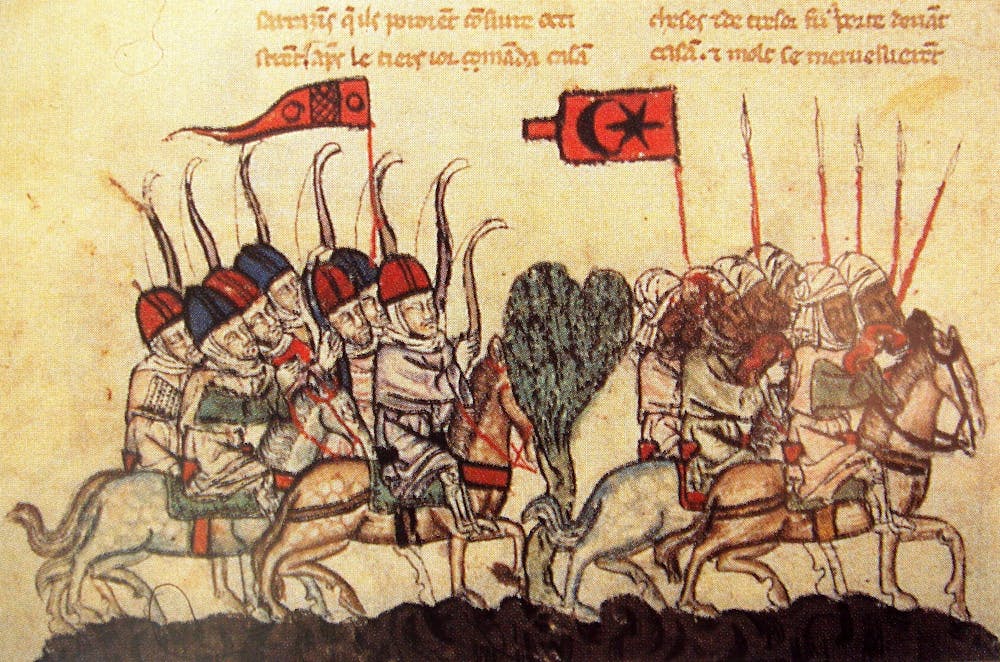
A 14th century miniature depicting Crusaders at The Battle of Wadi al-Khazandar (Battle of Homs) of 1299.Wikimedia Commons
Ripe for colonialism
In the 19th century, however, attitudes did begin to change. Muhammad was, on occasion, imagined not as the ambitious, profligate impostor of old but as a “silent great soul”, a hero who spoke “from Nature’s own heart”, as Thomas Carlyle called him. The Dublin University Magazine described him in 1873 as “one of the greatest ever sent on earth”.
Islam too now came to be seen more benevolently. The increasing cultural and global political power of the West rendered obsolete the traditional fear of being overwhelmed by Islam. The “religion of force” was now meeting a greater secular force, that of the imperial West. Islam no longer looked as threatening as it once had. The doctrine of Jihad (holy war), declared The Quarterly Review in 1877, “is not so dangerous or barbarous a one as is generally imagined”.
Islamic cultures now came to be seen as spheres of Western patronage, secular and religious. The image of a vibrant, active, progressive West against a passive, inert Islam was congenial to colonial enterprise. Ironically, the religion of aggressive action now came to be viewed as passively stagnant, decadent and degenerate, ripe for domination by an assertive West.
The inability of Western commentators in the 19th century to endorse a newly submissive Islam arose from a deep-seated Western incapacity to treat Islam on equal terms. Indeed, the greater value of the West over all those it variously characterised as backward, degenerate, or uncivilised was a central feature of most discussions of non-Western forms of life.
In short, Islam and progress were incompatible. And there was a strong tendency throughout the Victorian period to blame Islam for all the imagined ills of Oriental societies – the moral degradation of women, slavery, the physical and mental debilities of men, envy, violence and cruelty, the disquiet and misery of private life, the continual agitations, commotions, and revolutions of public life.
Contemporary times
Cut to the 21st century and a post-imperialist age, and Muslim nationalisms are again on the rise, not only in the Middle East and North Africa, but in Indonesia, India and Pakistan. The West once again feels under threat. The myth of Islam as essentially violent has re-surfaced. But, interestingly, it has done so in a different way.
On the one hand, the growth of terrorism has moved the imagined military threat of Islam from the borders of the West to its very centres – to London, Paris, New York.
On the other hand, Islam is now seen as a cultural threat as much as a military one. Even at its most benign, it is perceived as threatening Western values by virtue of the Muslims in its midst, stubbornly refusing to acquiesce to Western values. Thus the need to keep Muslims out. In December 2015, to the outrage of many Americans, then presidential candidate Donald Trump called for a ban on Muslims entering the US. Better the enemy kept outside the wall than the enemy within.
The refusal of the UK to allow Shamima Begum, the school girl who left London in 2015 to join ISIS, to return to England is the most recent example of the fear of home-grown terrorism and the enemy “within”. That she appears to endorse a violent Islam and is lacking in remorse has not helped her cause.
In addition, a new discourse has emerged of Islam as having failed to have a Reformation and an Enlightenment as did the West. Thus, for example, former Prime Minister of Australia Tony Abbott declared in December 2015 that Islam has never had its own version of the Reformation and the Enlightenment – the two events that seem to symbolise for Abbott the transition from barbarism to civilisation.
“It’s not culturally insensitive,” he declared, “to demand loyalty to Australia and respect for Western civilisation. Cultures are not all equal. We should be ready to proclaim the clear superiority of our culture to one that justifies killing people in the name of God.”
Does Islam need an Enlightenment like Europe had in the 18th century? Well yes, in the sense that European governments finally legislated freedom of religion to stop Catholics and Protestants slaughtering each other. Like Christianity in Europe in the 17th century, Islam in the 21st is as much at war with itself (especially in the conflict between Sunnis and Shiites) as it is at war with the West.
So, in the light of this history of Western attitudes to Islam, what are we to make of President Bush’s claim that Islam really is a religion of peace and that Muslim terrorists are, as a consequence, not true Muslims?
At its simplest, it is a recognition that there are vast numbers of Muslims, indeed the majority by far, both inside and outside the West, who endorse the virtues of tolerance, compassion, kindness and – simply put – just getting on with each other and with others.
It is also a recognition that multicultural and multi-religious societies thrive on unity and not divisiveness. As then Australian Prime Minister Malcolm Turnbull put it in March 2017, “What I must do, as a leader, and what all leaders should do in Australia, is emphasise our inclusivity, the fact that we are a multicultural society where all cultures, all faiths are respected and that is mutual. So, trying to demonise all Muslims is only confirming the lying, dangerous message of the terrorists.”
Many religions under one name
It is foolish to deny that there is a violent edge to Islam, as there is to Christianity and Judaism. In all these traditions, there is the tension between the idea of a God whose will is always good and a God whose will is always right.
And where God is seen as a being whose will can transcend the good (as he is in Islam, Christianity and Judaism), evil acts committed in his name can abound. Both peace and violence can equally find their justification in the Muslim, Christian and Jewish idea of God.
The willingness of the Islamic State group to accept reponsibility for the horrific bombings in Sri Lanka indicates their belief that such acts are in accord with the will of God.
That said, the question of whether Islam is essentially violent is not one that any longer makes much sense (if it ever did). The supposed fundamental oppositions between the West and Islam fail to map on to any reality.
“Islam” and “the West” are no longer helpful banners behind which any of us should enthusiastically rally. There really is no clash of civilisations here, not least because the notion of “civilisation”, Islamic or Western, really doesn’t have any purchase in a globalised world.
Moreover, we now know that it is difficult to identify the essence of any religion and futile to search for one. Any one religion is really many religions under the one name. So there are many Islams – Sunni and Shiite, but also Indonesian, Albanian, Malaysian, Moroccan, Pakistani, all culturally nuanced in quite different ways. This was evident in the many nationalities of those at prayer in the Christchurch mosques.
So too, there are many Christianities, often so different as to be hardly recognisable as parts of the same tradition – think Pentecostal snake handlers in the American south, Catholic peasants in Sicily devoted to the Virgin Mary, or cool Lutherans in Scandinavia.
The fault line in modern religion doesn’t go to a clash between civilisations or even to a clash between religions so much as to a struggle within religions and within cultures, between theologies, ethics, political ideologies, ethnicities, exclusivism and inclusivism.
It is a struggle between liberals and conservatives, fundamentalists and moderates, reason and revelation. It is a battle within theologies between a God who is thought to be knowable through nature, man and history and a God who is thought to be only knowable through the revelations contained in the inerrant pages of the Torah, the New Testament or the Quran.
It is a struggle within all religions between those who believe there are “many paths to Heaven”, endorse freedom of religion, encourage tolerance and support mutual respect against those who believe there is only “one way to Paradise” and desire to impose this on everyone else, whatever it takes.
Hard to argue against this but one wonders, with all the demands on curriculum, how educators will find time for meaningful treatment and the extent this complements or replaces existing Holocaust-based material which also had a broader perspective:
The tragic massacre of 50 Muslim worshippers in Christchurch, New Zealand, is one more horrific incident that confirms mass murder has spread to even the most peaceful of nations. Like a fire, massacres are fuelled by hate and ignorance, and are now broadcast through social media, with dozens of hate crimes reported daily around the world.
There is a chilling similarity to the underlying motives behind these global violent acts. Ignorance of “the other,” be it a racial or religious minority group, is often cited, leading to an unfounded fear of being “invaded” and overtaken by foreign cultures and values. Fear then devolves into a conviction that the foreign invader must be eliminated. This is justified by dehumanizing the community, labelling it as criminal and evil, or plotting a “white genocide.”
While we must denounce this senseless violence, we must do more than react. Ignorance and fear must be prevented through education of the next generation, before racist beliefs take root and destroy lives. As the founder of the Foundation for Genocide Education—made up of representatives from the Jewish, Rwandan, Armenian, and First Nations communities—I’m convinced that by teaching high school students about the consequences of hate, fear, and discrimination, future atrocities can be avoided. Our mission is to ensure that the study of all recognized genocides, and the steps leading to genocide, are made a permanent part of the high school curriculum across Canada.
My organization is not alone in recognizing the value of learning about genocide. In 2018, UNESCO published a policy guide on the importance of teaching genocide, specifically the Holocaust, as a means to prevent future atrocities, while helping the next generation to become responsible citizens who value human dignity. This is a step in the right direction, but the challenge remains translating theory into practice.
Shockingly, our foundation’s experience demonstrates that many Canadian students graduate high schools with little to no knowledge about past or present genocides. Some don’t even know the definition of the word.
Teachers across the country have told us that they lack the resources, time, and confidence to effectively educate their classes about this sensitive subject. Eight countries to date have made the study of genocide compulsory as part of their high school curriculums, but no Canadian province has yet done so.
How can we expect our children to recognize the dangers of intolerance and racism without proper education? How can they identify and react to online racist propaganda if they are unaware of how the media has been used historically by extremist groups to spread hate and violence?
The foundation is now partnering with Quebec’s education ministry to create a comprehensive, universal guide on teaching genocide. Once test-piloted by teachers this September, the guide will be available in every high school in Quebec by 2020. Introduced with accompanying training workshops and educational videos, it will serve to significantly build on the basic concepts of genocide already in place in the curriculum. Teachers need to be supported with the knowledge, resources, and skills required to teach about genocide and human rights, and this guide accomplishes that.
With this and next month’s commemoration days of the Armenian, Jewish, and Rwandan genocides, it’s an opportune time to reinforce the message of the devastating impact of unchecked hate. To hear the stories of survivors of the Armenian genocide, the Tutsi genocide in Rwanda, and the Holocaust, is to truly understand the chilling effects of racist propaganda that leads to dehumanization and, ultimately, genocide.
As a daughter of Holocaust survivors, I know all too well that we cannot afford to be complacent. My parents survived the Holocaust by hiding in attics and barns in Poland. My mother saw her own mother killed by machine gun in the squalid ghetto where Jews were forced to live before being deported to concentration camps such as Auschwitz. My family’s story is tragically not unique, and today’s students will undoubtedly benefit more from learning about these accounts than from the messages that are communicated by crazed white nationalist manifestos and live-streamed shooting of innocent victims.
By studying the consequences of unchecked hate, students will be equipped with the critical thinking skills to better understand racism and intolerance. We must not let another year go by without passing on this essential knowledge to our youth, the leaders of tomorrow.
The contrary view on diversity that focusses on the individual and discounts or ignores broader systemic factors at play, although there is merit to considering other aspects of diversity. Diversity of thought, of course, is the hardest one to measure and manage, including the question of limits:
If recent controversies over diversity hiring practices at Google and Microsoft are any guide, internal company message boards are the new culture war battleground.
This week, Quartz published a story about disagreements over diversity policies among Microsoft employees that were being aired on the company’s internal chatroom, Yammer. One of the posts criticized Microsoft’s diversity initiatives as “discriminatory hiring,” and suggested, “women are less suited for engineering roles.” “Many women simply aren’t cut out for the corporate rat race, so to speak, and that’s not because of ‘the patriarchy,’ it’s because men and women aren’t identical,” the employee wrote.
The plot twist? Unlike the now-infamous memo of former Google employee James Damore, these posts were written by a “female Microsoft program manager” who was ostensibly a beneficiary of such diversity initiatives.
The manager was straightforward about her concerns: “Does Microsoft have any plans to end the current policy that financially incentivizes discriminatory hiring practices? To be clear, I am referring to the fact that senior leadership is awarded more money if they discriminate against Asians and white men,” she wrote. “I have an ever-increasing file of white male Microsoft employees who have faced outright and overt discrimination because they had the misfortune of being born both white and male. This is unacceptable,” she argued.
Her questioning of Microsoft’s corporate diversity policies, coming from someone who stood to benefit from them herself, might have sparked a useful discussion about how the company defines “diversity.” Is it racial, ethnic, or religious minorities? Anyone non-male? Employees from different economic upbringings or countries other than the U.S.? It could have led to an examination of some of the costs of diversity initiatives as well as their benefits, and perhaps identified areas where such policies might be improved upon, or where they might have counterintuitive effects.
Instead, the employee, who wisely requested anonymity when speaking to the reporter, was reported to H.R. for expressing her opinion by angry employees who felt her words were themselves an assault on diversity. By allowing such opinions to be aired on a company message board, “HR isn’t trying to enforce the inclusive culture,” one employee said to Quartz. Others complained that “they weren’t aware of any action by the company in response, despite the comments being reported to Microsoft’s human resources department.”
To be sure, Quartz isn’t the most trustworthy source of reporting on gender issues in corporate America; in his article about Microsoft, reporter David Gershgorn reveals his ideological bias when he describes Damore’s memo as “pseudoscience.” (An earlier Quartz article about Damore’s lawsuit against Google had as part of its headline, “Cry Me a River.”)
Perhaps that’s why the piece makes no effort to take the Microsoft employee’s concerns seriously. Like other multicultural whistleblowers (such as Damore) Microsoft’s diversity dissenter is asking for a simple thing: evidence. As someone who manages other employees and is required to further the company’s broader diversity goals, she is asking for proof that such efforts actually benefit the company and do no harm to other employees.
But in doing so, she exposes the deep fault line between corporate diversity platitudes and corporate diversity reality. “Diversity makes us stronger” is the platitude, one everyone is expected to embrace because it makes Microsoft look like a responsible corporate citizen. The reality is a system that creates separate classes of employees based on the accident of their births, then ties executive bonuses to minority recruitment quotas, generating resentment among employees who are not included among the worthy minorities.
In other words, beyond providing a company with a warm glow of appearing “inclusive,” there’s not a lot of proof that corporate diversity programs either improve outcomes for their supposed beneficiaries nor make companies more profitable. And there’s plenty of proof that they produce bad feelings among non-minority employees.
Some research has shown that diversity policies have little impact on minorities’ sense of fair treatment, even as the policies protect the companies from lawsuits by making them appear more “inclusive.” Another study that examined longitudinal data from 700 companies concluded that there were few positive effects from corporate diversity training efforts and some negative outcomes, including a decrease in the number of black women in the companies surveyed. Other research has suggested some positive outcomes, including that a diverse workplace encourages more innovation (although the sample studied was small.)
But this is a small return given the investment of money and management time devoted to corporate diversity training. Why are companies like Microsoft still loathe to engage in stricter scrutiny of their own diversity efforts? Thinking outside the corporate box is supposed to be technology companies’ strength. As Joi Ito, the director of MIT’s Media Lab, argued in Wired,
“I believe at least some of Silicon Valley’s phenomenal success is because its culture places little value on conventional social and corporate values that prize age-based experience and conformity that dominates most of society and most institutions on the East Coast. It celebrates nerdy, awkward youth and has turned their super-human, ‘abnormal’ powers into a money-making machine that is the envy of the world.” In a parenthetical, however, Ito noted, “This new culture is wonderfully inclusive from a neurodiversity perspective but white-dude centric and problematic from a gender and race perspective.”
But it’s only “problematic” if your starting point is an abstract notion of “diversity” that values only certain identity categories (race, sex) and effectively denies equal opportunity to those groups, such as white or Asian men, who don’t meet that definition. It completely ignores other forms of diversity (such as age, experience, or education) that have just as much of an impact on an organization’s ability to thrive.
In this atmosphere, speaking up or asking questions is only acceptable if one is endorsing the status quo of corporate identity politics. Earlier in April, after some female Microsoft employees complained about sexual harassment at the company, CEO Satya Nadella promised change and said in a company-wide email, “I’m disappointed to hear about any behavior in our workplace that falls short of the diverse and inclusive culture we are striving to create . . . But I’m encouraged that people feel empowered to speak up and demand change.”
But woe to those speaking out to criticize diversity policy, as Nadella made clear: “This past year, we increased our commitment with a new core priority on inclusion for every employee. If you are not helping to create an inclusive culture, your rewards, your career trajectory, and possibly even your employment will be impacted,” Nadella wrote in his company-wide email.
And if you think being a member of an underrepresented minority will protect you if you question the policy, think again: Apple’s former diversity chief, Denise Young Smith, an African-American woman, was pushed out of her job (despite apologizing) after saying, “There can be 12 white, blue-eyed blonde men in a room and they’re going to be diverse too because they’re going to bring a different life experience and life perspective to the conversation.”
Conversation, criticism, and a free exchange of ideas clearly aren’t what corporations like Google, Apple, or Microsoft want when it comes to diversity.
Indonesia conducted its presidential election on April 17, the fourth direct presidential election since the country’s transition to democracy in 1998. The election pitted two long-term rivals against each other: incumbent President Joko Widodo (popularly known as “Jokowi”) and former Suharto-era General Prabowo Subianto. It was one of the most divisive elections in Indonesia’s 73-year old history as an independent nation. It also saw Islam being used as a tool to create divisions in the largest Muslim-majority country in the world—a political cleavage that could divide the fourth most populous country in the world for a generation or more.
Two distinct political camps have emerged from the election, largely based on different interpretations of Islamic political theology and regional identities. Jokowi, who is widely expected to win re-election according to preliminary returns, is supported by a coalition of moderate Muslims living in central and eastern Java, the most populous island in Indonesia. Many are members of Nadhlatul Ulama (NU), Indonesia’s largest Muslim organization. Jokowi also enjoys wide support among Indonesia’s substantial non-Muslim minority. Meanwhile, Prabowo is supported by conservative and hardline Muslims living primarily in the western coast of Java, as well as in the islands of Sumatera and Sulawesi.
During the eight-month campaign period, hardline Islamists within the Prabowo camp have portrayed Jokowi as a leader who lacks strong Islamic credentials and who is planning to implement policies to repress deeply religious Muslims. In return, NU members who supported Jokowi have portrayed these hardliners as religious extremists who wish to turn Indonesia into an Islamic or caliphate-based state.
Many of Prabowo’s Islamist supporters were former participants of 2016-17 Defending Islam movement (Aksi Bela Islam)—a movement to remove former Jakarta Governor Basuki Tjahaja Purnama (popularly known as “Ahok”), who was a former Jokowi ally. A Christian of Chinese descent, Ahok was accused of committing religious blasphemy after he misspoke in a campaign rally.
Up to one million Muslims participated in the rallies sponsored by the Defending Islam movement. They ranged from members of hardline groups like Islamic Defenders Front (FPI) and Islamic Community Forum (FUI) to those affiliated with Muhammadiyah—Indonesia’s second largest Islamic organization, which tends to be moderate theologically but is less inclined to support Jokowi’s policies (compared to NU). These rallies resulted in Ahok’s re-election defeat and subsequent conviction for religious blasphemy, for which he served two years in prison.
Emboldened by their success, former Defending Islam activists—now calling themselves “Alumni 212”—set their next political target: President Jokowi himself. They aligned themselves with Prabowo long before the presidential election campaign started in August 2018 by forming groups like #2019ChangePresident (#2019GantiPresiden), which staged mass rallies and protests against Jokowi between March and September 2018.
The president feared the #2019ChangePresident group so much that he ordered law enforcement officers to disband its rallies and brought criminal charges against some of the group’s leading figures, including NGO activist Ratna Sarumpaet and singer Ahmad Dhani. These resulted in a growing concern that Jokowi is responding to the challenge from hardline Islamists by using authoritarian measures.
Once the formal campaign period began, Alumni 212 aligned themselves with Islamic parties like the Prosperous Justice Party (PKS) and the National Mandate Party (PAN) to support Prabowo’s presidential bid. It formally endorsed Prabowo in September 2018, even though Prabowo reneged on his promise to pick an Islamic cleric (ulama) as his running mate. Prabowo selected billionaire Sandiaga Uno as his vice-presidential candidate instead.
Under pressure to increase his Islamic credentials, Jokowi chose Indonesia’s most senior Islamic cleric: Ma’ruf Amin, head of the Indonesian Council of Ulama (MUI), who was also NU’s supreme leader. It was done despite concerns from pro-democracy and human rights advocates regarding Amin’s track record on religious and other minorities. As long-term head of MUI’s religious edicts (fatwa) commission, Amin was thought to be responsible for the issuance of fatwas condemning Ahmadi Muslim minorities (2005) and LGBT people (2012), which resulted in increased number of communal violence and persecutions against the two groups in the last decade.
However, Amin’s selection as Jokowi’s vice-presidential nominee solidified the NU leadership’s support for Jokowi. He received endorsement from its leaders and leading clerics, who also campaigned heavily for his re-election.
Meanwhile, in addition to Alumni 212, PKS, and PAN, Prabowo also received endorsements from Indonesia’s leading popular ulama—such as Abdul Somad, Abdullah Gymnastiar, and Adi Hidayat. These ulama are active internet users to propagate their teachings and have millions of social media followers, particularly among young Muslims between the ages of 20 and 35.
The mobilization of mainstream Islamic groups like NU in Jokowi’s camp and Alumni 212 and other hardline groups in Prabowo’s camp caused this year’s presidential campaign to take an ugly turn. The hardliners painted Jokowi as a “non-devout Muslim” and an “anti-Islamic” leader who plans to impose new restrictions against Muslims’ religious freedom. Meanwhile, NU clerics have accused Prabowo of siding with radical Islamists, claiming he plans to turn Indonesia into a caliphate state.
Research by the Indonesia Program of the S. Rajaratnam School of International Studies (RSIS) in battleground provinces like Central Java, East Java, West Java, and South Sulawesi clearly shows that mobilization efforts done by hardline supporters of Prabowo were responsible for increasing Prabowo’s support among religious voters within these provinces. However, NU leaders’ portrayal these groups as radical Islamists with an extremist agenda also mobilized its followers—who mainly live in Central and East Java—to support Jokowi as well.
The polarized rhetoric used by both sides during this campaign might have contributed to the record voter turnout: estimated to be around 80 percent. It is now feared that the religiously-based polarization strategies used during the election might have long-term repercussions in Indonesian politics and society. Alumni 212 is now planning a new series of mass rallies to challenge the election results. Tough statements issued by Indonesian Armed Forces Chief Hadi Tjahjanto and National Police Chief Tito Karnavian in response to this plan indicated that Jokowi might be considering additional crackdown measures against these Islamists, in an effort to further marginalize them from Indonesia’s public sphere.
To conclude, a new axis of Islam and politics is emerging in Indonesia today. Hardline Islamists will continue to challenge Jokowi during his final five-year term as Indonesia’s president. However, if he decides to crack down against them, it might result in further deconsolidation of Indonesia’s democracy, which will be a setback in Indonesia’s trajectory as a Muslim-majority democratic nation.