Australia: Liberal politician accuses first female Muslim MP of thinking ‘her diversity is better than others’

Sigh:

A debate in the House of Representatives on the importance of multiculturalism in Australia turned sour on Thursday after Assistant Defence Minister Alex Hawke attacked Labor MP Anne Aly for thinking her diversity is “something better than other people’s diversity”.

Egyptian-born Dr Aly was the first Muslim woman to be elected to Federal Parliament after she won the West Australian seat of Cowan in 2016.

The controversial comments came after Dr Aly disputed claims by Mr Hawke that “most” of the politicians in the room were either born overseas or had a parent that was, as part of a speech on the success of multiculturalism in Australia.

“When the member opposite likes to cite her diversity as something better than other people’s diversity she ignores reality,” he said, resulting in shouts of “shame” from Labor MPs.

“The member for Cowan should reflect that people have come from all parts of the world to Australia, over many years. Just because you’re a migrant from one country doesn’t make you better than another.”

Mr Hawke, the Member for Mitchell, was responding to calls by Labor MP Andrew Giles for urgent action from politicians on the rise of racism and anti-Semitism in Australia.

Citing the attack of a heavily pregnant Muslim woman in Parramatta in November last year, he said Australia was “witnessing a creeping normalisation of hate”.

“Let me be clear: the vast majority of Australians abhor racism, but we need national leadership, setting the standard and leading by example. This has been sadly missing in this place,” Mr Giles said.

Mr Hawke defended the comments on Friday morning, accusing Labor of “feigning outrage and falsely claiming racism” in order to shut down debate.

“Labor under Anthony Albanese appears fixated on identity politics and appears constantly triggered by anything and everything,” he said in a statement to SBS News.

“Every MP has the right to engage in robust debate – certainly Labor members did in this discussion.”

Mr Hawke clarified that he was trying to make the point that Labor was misrepresenting the reality of multiculturalism in Australia, which he said is a “free, fair and tolerant place and the greatest multicultural success story in the world”.

“This constant erosion of debate threatens our freedom,” he said.

During the 2019 federal election, Ms Aly was the target of “racist” flyers which used her full Egyptian name, Azza Mahmoud Fawzi Hosseini Ali el Serougi, and accused her of proposing “blasphemy” laws to ban any criticism of Islam.

Dr Aly’s office has been contacted for comment.

Source: Liberal politician accuses first female Muslim MP of thinking ‘her diversity is better than others’

Concerns raised after facial recognition software found to have racial bias

Legitimate concerns:

In 2015, two undercover police officers in Jacksonville, Fla., bought $50 worth of crack cocaine from a man on the street. One of the cops surreptitiously snapped a cellphone photo of the man and sent it to a crime analyst, who ran the photo through facial recognition software.

The facial recognition algorithm produced several matches, and the analyst chose the first one: a mug shot of a man named Willie Allen Lynch. Lynch was convicted of selling drugs and sentenced to eight years in prison.

Civil liberties lawyers jumped on the case, flagging a litany of concerns to fight the conviction. Matches of other possible perpetrators generated by the tool were never disclosed to Lynch, hampering his ability to argue for his innocence. The use of the technology statewide had been poorly regulated and shrouded in secrecy.

But also, Willie Allen Lynch is a Black man.

Multiple studies have shown facial recognition technology makes more errors on Black faces. For mug shots in particular, researchers have found that algorithms generate the highest rates of false matches for African American, Asian and Indigenous people.

After more than two dozen police services, government agencies and private businesses across Canada recently admitted to testing the divisive facial recognition app Clearview AI, experts and advocates say it’s vital that lawmakers and politicians understand how the emerging technology could impact racialized citizens.

“Technologies have their bias as well,” said Nasma Ahmed, director of Toronto-based non-profit Digital Justice Lab, who is advocating for a pause on the use of facial recognition technology until proper oversight is established.

“If they don’t wake up, they’re just going to be on the wrong side of trying to fight this battle … because they didn’t realize how significant the threat or the danger of this technology is,” says Toronto-born Toni Morgan, managing director of the Center for Law, Innovation and Creativity at Northeastern University School of Law in Boston.

“It feels like Toronto is a little bit behind the curve in understanding the implications of what it means for law enforcement to access this technology.”

Last month, the Star revealed that officers at more than 20 police forces across Canada have used Clearview AI, a facial recognition tool that has been described as “dystopian” and “reckless” for its broad search powers. It relies on what the U.S. company has said is a database of three billion photos scraped from the web, including social media.

Almost all police forces that confirmed use of the tool said officers had accessed a free trial version without the knowledge or authorization of police leadership and have been told to stop; the RCMP is the only police service that has paid to access the technology.

Multiple forces say the tool was used by investigators within child exploitation units, but it was also used to probe lesser crimes, including in an auto theft investigation and by a Rexall employee seeking to stop shoplifters.

While a handful of American cities and states have moved to limit or outright ban police use of facial recognition technology, the response from Canadian lawmakers has been muted.

According to client data obtained by BuzzFeed News and shared exclusively with the Star, the Toronto Police Service was the most prolific user of Clearview AI in Canada. (Clearview AI has not responded to multiple requests for comment from the Star but told BuzzFeed there are “numerous inaccuracies” in the client data information, which they allege was “illegally obtained.”)

Toronto police ran more than 3,400 searches since October, according to the BuzzFeed data.

A Toronto police spokesperson has said officers were “informally testing” the technology, but said the force could not verify the Star’s data about officers’ use or “comment on it with any certainty.” Toronto police Chief Mark Saunders directed officers to stop using the tool after he became aware they were using it, and a review is underway.

But Toronto police are still using a different facial recognition tool, one made by NEC Corp. of America and purchased in 2018. The NEC facial recognition tool searches the Toronto police database of approximately 1.5 million mug shot photos.

The National Institute of Standards and Technology (NIST), a division of the U.S. Department of Commerce, has been testing the accuracy of facial recognition technology since 2002. Companies that sell the tools voluntarily submit their algorithms to be tested to NIST; government agencies sponsor the research to help inform policy.

In a report released in December that tested 189 algorithms from 99 developers, NIST found dramatic variations in accuracy across different demographic groups. For one type of matching, the team discovered the systems had error rates between 10 and 100 times higher for African American and Asian faces compared to images of white faces.

For the type of facial recognition matching most likely to be used by law enforcement, African American women had higher error rates.

“Law enforcement, they probably have one of the most difficult cases. Because if they miss someone … and that person commits a crime, they’re going to look bad. If they finger the wrong person, they’re going to look bad,” said Craig Watson, manager of the group that runs NIST’s testing program.

Clearview AI has not been tested by NIST. The company has claimed its tool is “100% accurate” in a report written by an “independent review panel.” The panel said it relied on the same methodology the American Civil Liberties Union used to assess a facial recognition algorithm sold by Amazon.

The American Civil Liberties Union slammed the report, calling the claim “misleading” and the tool “dystopian.”

Clearview AI did not respond to a request for comment about its accuracy claims.

Before purchasing the NEC facial recognition technology, Toronto police conducted a privacy impact assessment. Asked if this examined potential racial bias within the NEC’s algorithms, spokesperson Meaghan Gray said in an email the contents of the report are not public.

But she said TPS “has not experienced racial or gender bias when utilizing the NEC Facial Recognition System.”

“While not a means of undisputable positive identification like fingerprint identification, this technology provides ‘potential candidates’ as investigative leads,” she said. “Consequently, one race or gender has not been disproportionally identified nor has the TPS made any false identifications.”

The revelations about Toronto police’s use of Clearview AI have coincided with the planned installation of additional CCTV cameras in communities across the city, including in the Jane Street and Finch Avenue West area. The provincially funded additional cameras come after the Toronto police board approved increasing the number placed around the city.

The combination of facial recognition technology and additional CCTV cameras in a neighbourhood home to many racialized Torontonians is a “recipe for disaster,” said Sam Tecle, a community worker with Jane and Finch’s Success Beyond Limits youth support program.

“One technology feeds the other,” Tecle said. “Together, I don’t know how that doesn’t result in surveillance — more intensified surveillance — of Black and racialized folks.”

Tecle said the plan to install more cameras was asking for a lot of trust from a community that already has a fraught relationship with the police. That’s in large part due to the legacy of carding, he said — when police stop, question and document people not suspected of a crime, a practice that disproportionately impacts Black and brown men.

“This is just a digital form of doing the same thing,” Tecle told the Star. “If we’re misrecognized and misidentified through these facial recognition algorithms, then I’m very apprehensive about them using any kind of facial recognition software.”

Others pointed out that false positives — incorrect matches — could have particularly grave consequences in the context of police use of force: Black people are “grossly over-represented” in cases where Toronto police used force, according to a 2018 report by the Ontario Human Rights Commission.

Saunders has said residents in high-crime areas have repeatedly asked for more CCTV cameras in public spaces. At last month’s Toronto police board meeting, Mayor John Tory passed a motion requiring that police engage in a public community consultation process before installing more cameras.

Gray said many residents and business owners want increased safety measures, and this feedback alongside an analysis of crime trends led the force to identify “selected areas that are most susceptible to firearm-related offences.”

“The cameras are not used for surveillance. The cameras will be used for investigation purposes, post-reported offences or incidents, to help identify potential suspects, and if needed during major events to aid in public safety,” Gray said.

Akwasi Owusu-Bempah, an assistant professor of criminology at the University of Toronto, said when cameras are placed in neighbourhoods with high proportions of racialized people, then used in tandem with facial recognition technology, “it could be problematic, because of false positives and false negatives.”

“What this gets at is the need for continued discussion, debate, and certainly oversight,” Owusu-Bempah said.

Source: Concerns raised after facial recognition software found to have racial bias

Chinese government’s Confucius Institute holds sway on Canadian campuses, contracts indicate

Of note:

Sonia Zhao had to lie, in effect, when she left China to teach Mandarin at an Ontario university.

The contract she signed with the Beijing-run Confucius Institute indicated that Falun Gong practitioners – people like her – were barred from the job. But she kept her beliefs secret and hoped she could find more freedom in Canada. It was not to be.

She says she was trained beforehand to spin Beijing’s line if students asked about Tibet and other taboo topics, while Chinese staff at McMaster University’s branch of the institute made clear Falun Gong was poison. After a year, she quit and sought asylum here, becoming perhaps the world’s first Confucius Institute whistle-blower.

“I think they’re aiming to build a really beautiful, healthy image (of China) among those students,” Zhao said about the institute’s ultimate purpose. She believes Canada should have nothing to do with the agency. “It isn’t worth it to give up your freedom of speech or freedom even of thinking just to learn about a different language or culture.”

Her experience in 2011 did lead McMaster to end its relationship with the institute, a division of China’s education ministry that pays for Mandarin-language and cultural programs worldwide – and has long been embroiled in controversy. Advocates call the organization a generously funded cultural bridge, critics decry it as a “Trojan horse” for Chinese propaganda and influence.

But 10 other universities, colleges and boards of education across Canada still host their own Confucius outlets. And a National Post survey of the closely guarded contracts they signed found little in them that might prevent the kind of censorship and discriminatory hiring highlighted by Zhao.

Only one of seven agreements obtained by the Post includes any protection for academic freedom.

Several of the contracts indicate the local institutes must accept the agency headquarters’ assessment of “teaching quality.” One at the University of Waterloo-affiliated Renison College says any disagreements about running the institute should be referred to the Beijing headquarters, called Hanban.

Almost all bar the institutes from contravening Canadian or Chinese law, the latter routinely excoriated for its abuse of basic human rights. They also require compliance with the institute’s own constitution and bylaws. To this day, Hanban’s website says overseas teachers must have “no record of participation in Falun Gong and other illegal organizations,” a clear violation of Canadian constitutional and rights law.

Brock University in St. Catharines, Ont., even pledged to find a “prominent location” to erect a statue of Confucius to advertise the institute’s presence.

“I would say (Confucius headquarters) have absolute control,” said lawyer Clive Ansley  after reviewing some of the contracts. The former China studies professor practiced for several years in the country. “Any decision on what they call teaching quality, teaching materials, it’s all going to be made by Hanban.”

Ivy Li of the group Canadian Friends of Hong Kong said she was struck by the different roles set out in the contracts she perused at the Post’s request.

The Canadian hosts agree to provide office and classroom space and a steady supply of students, and in some cases to promote the program. Most of the contracts also say the Canadian school will provide funding, directly or in kind, at least equal to what the Chinese government contributes.

Hanban, the contracts stipulate, supplies the content – Mandarin teachers, textbooks, course software and other educational materials, which Li said come with Beijing’s particular spin.

“Even purely from a business point of view, it’s a very bad deal,” she charged. “Our universities are being used as a platform to promote (China’s) message, and that message is disinformation.”

But administrators here argue that despite what the contracts suggest, China does not actually interfere in the arrangements – arrangements they argue are an important conduit between the two nations. Meanwhile, they say, political issues never arise in the type of activities – from language training to Tai Chi – the institutes oversee.

“We have not had any pressure from China to do anything other than enhance cultural understanding,” said Lorne Parker, an assistant superintendent with the Edmonton public school division. “We are looking at our relationship with (Confucius Institute) as building a cultural bridge and not a wall. You can have more influence … by having those bridges.”

Launched in 2004, Confucius has opened 540 branches around the world. Unlike Alliance Francaise, the Goethe Institute and other cultural-outreach groups funded by some European states, it is an actual department of government and embeds itself, uniquely, inside foreign educational bodies.

The organization is hosted in Canada by two school boards – Coquitlam, B.C., and Edmonton – plus two colleges – Montreal’s Dawson and Toronto’s Seneca – and six universities – Saint Mary’s, Carleton, Waterloo, Brock, Regina and Saskatchewan.

The official stated goal is to teach Mandarin and spread the good word about Chinese culture and traditions. But even Xu Lin, Hanban’s director general, has said Confucius Institutes are “an important part of our soft power.”

“We want to expand China’s influence. This relies on our instructors, Confucius Institutes and language,” she told a conference in Beijing.

After a burst of expansion in Canada, there has been some retrenchment in recent years. Both McMaster and Quebec’s Sherbrooke University shut down their institutes amid controversy, while New Brunswick is in the process of closing the Confucius program run through one of its school districts. Toronto’s board killed the institute in 2014 just as it was about to launch. The B.C. Institute of Technology’s branch has been suspended.

But the program appears to be going strong elsewhere. To understand what the remaining hosts agreed to in exchange for Beijing’s largesse, the Post asked all for copies of the contracts they signed.

Three refused. Carleton University and Seneca College offered no reason for the denial; St. Mary’s University in Halifax said its contract is “with an external organization, and is a record that is not publicly available.” A university spokesman suggested the Post file a freedom of information request, a process that typically takes months, with no guarantee of success.

In fact, several of the Confucius contracts contain non-disclosure clauses.

Other schools said they had secured Hanban’s permission to release their agreements, or the documents had already been disclosed to local media after freedom of information applications.

All set up an arrangement between the Canadian educational facility and a partner college in China, with a director appointed from each side and a board to oversee the institute. In almost every case, Hanban agrees to supply Mandarin teachers, as many as 3,000 textbooks and other teaching material. Some mention start-up funding from Beijing of $150,000 to $250,000.

China provides about 15 teachers at a time to the Edmonton school district, though they act as “supports” in Mandarin classes that are led by the board’s own staff, said Parker.

“We received about a million dollars’ worth of books and materials from Hanban,” Bob Lajoie of the Coquitlam School District enthused to filmmaker Doris Liu in her documentary In the name of Confucius.

The nature of those books is a concern for some institute critics. Terry Russell, a senior scholar in China studies at the University of Manitoba, said institute texts he’s seen talk of Tibet being “liberated” by China and Taiwan forming part of the country.

“The perspective that is set out in the teaching materials is very much the Chinese perspective,” he said.

Most of the contracts also contain a clause that says “the institute must accept the assessment of the headquarters (Hanban) on the teaching quality.”

It suggests a degree of control by Beijing that director general Xu spelled out openly in an interview previously posted on the organization’s website.

“We haven’t lost education sovereignty,” Xu said. “It’s like the foreign universities work for us.”

Zhao said training before she left China was clear: never mention sensitive topics and if asked about them, offer Beijing’s standard line, that “Tibet is part of China and the government is treating them nicely, that Taiwan is part of China.”

When she and other Confucius teachers at McMaster watched and discussed the Hollywood movie Seven Years in Tibet – a critical look at China’s treatment of the region – their Chinese director said “if we kept talking about those things or watching those things, we need to write a report about our thinking because our minds, our thoughts are not following the Communist party.” Institute staff immediately tossed in the garbage a Falun Gong pamphlet brought in by a student, she said.

But Edmonton’s Parker said Hanban does not assess the teaching work there, and suggested the clause was included only to ensure the agency’s teachers provide good-quality instruction.

A Coquitlam spokesman said that its Confucius staff are hired locally, without the agency’s input, and Hanban has never visited the district to perform assessments.

Institute administrators in Canada also deny having to abide by any aspect of Chinese law or Hanban rules, despite what the contracts say.

“I’m not aware of any of those restrictions,” Parker said when asked about the Falun Gong teacher ban.

But if some Canadian Confucius partners dismiss any suggestion of undue influence from China, and their contracts erect limited firewalls against potential Beijing meddling, there is at least one exception.

When the University of Saskatchewan renewed its agreement with Hanban in 2016, it managed to include a provision that said the institute’s activities “will respect academic freedom and transparency, as well as University of Saskatchewan institutional values, priorities and policies.”

Without that caveat, the contract would not have been extended, Karen Chad, the university’s vice-president research, said in a statement.

But critics of the Confucius Institute question whether it will have much impact. To achieve its goals, they say, the institute has never needed to overtly propagate Chinese propaganda. It has taught Mandarin and presented Chinese culture in a way that simply avoids mention of religious persecution, censorship and other topics unflattering to the Communist regime.

“The Canadians get duped as they most often do when they deal with the government of China. They get duped into thinking these things are just cultural institutions and ‘Hey it’s a good idea to have a lot of Canadians learning Mandarin,’ ” said Ansley. “That’s not the Chinese goal at all … The goal is soft power, to promote a favourable image of China in the minds of Canadians.”
Source: Chinese government’s Confucius Institute holds sway on Canadian campuses, contracts indicate

Why celebrating women’s rights without an intersectional lens is meaningless

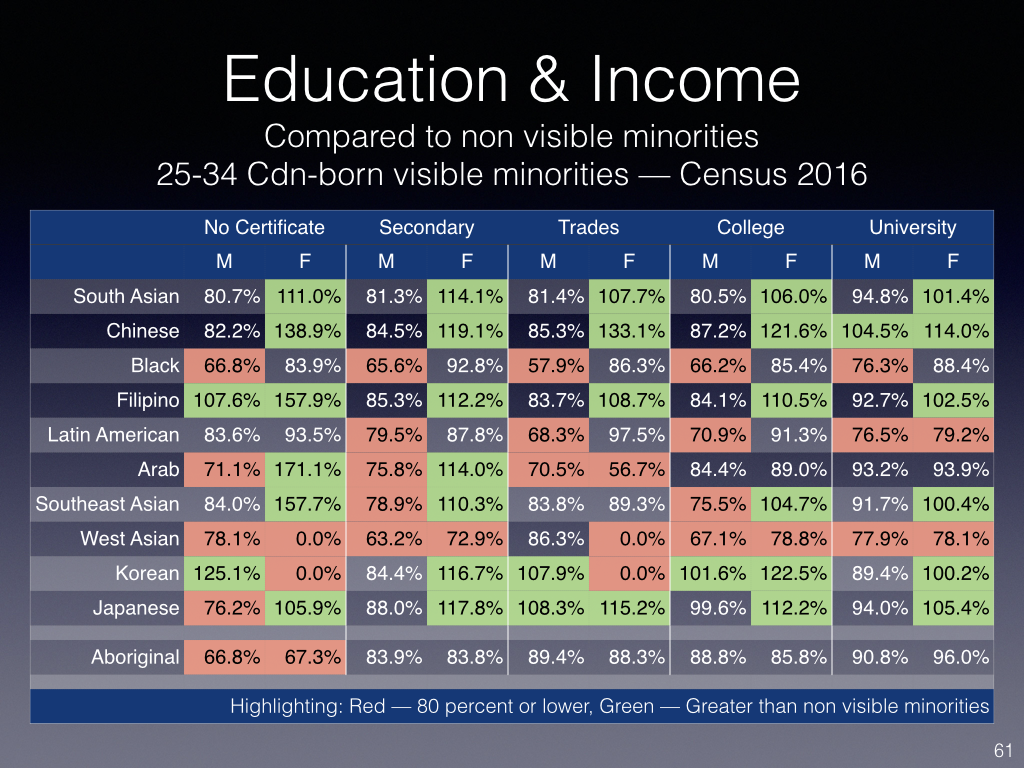
I wouldn’t go as far as meaningless, and I find intersectionality is too jargony to my taste but of course, one should not celebrate or discuss any group, whether men, women, specific religious or ethnic groups, without consideration and acknowledgement of that diversity.

Ironically, when I analyse economic outcomes of visible minorities compared to not visible minorities, the gaps are larger between visible minority men and not visible minority men than is the case for women as the example looking at second generation 25-34 year olds below illustrates (similar pattern for first generation):

Not that many years ago, four to be precise, a senior journalist was sincerely trying to explain how his newsroom was attempting to diversify its staff.

Job applicants could check one of four boxes, he said. Gender, race, disability and sexual orientation. What box would I check, I wondered out loud.

“Race,” he said. And just like that, he erased major parts of my identity, rendering everything beyond my brown skin invisible.

This was about 25 years after civil rights advocate and scholar Kimberlé Crenshaw coined the term intersectionality to describe how people’s identities interact with power to create new forms of discrimination (specifically around Black women) when they overlap, and a few years after it had become a mainstream buzzword.

March 8 was International Women’s Day, a day that sprung from the women’s labour movement and began to be celebrated in many countries since the United Nations’ adoption of it in 1975. It gained a higher profile in recent years following important movements such as #MeToo.

But every day is every woman’s day. Celebrating the fierceness of the suffragettes who helped women win the right to vote doesn’t mean we forget that it was white women who won that right for themselves in Canada, Asians came decades later and that First Nations men and women didn’t have the right to vote until 1960.

If second-wave feminism looked at expanding rights beyond voting, I don’t know how we can celebrate representation in boardrooms and courtrooms without acknowledging that “diversity” initiatives have allowed white patriarchy to bend just enough to accommodate white women.

I don’t know how we can celebrate a narrowing gender wage gap without acknowledging that jobs traditionally done by women, often racialized women — health-care workers, daycare workers, nannies — are undervalued and underpaid. If full-time working women earned on average 75 cents to every dollar earned by a man, racialized and Indigenous full-time working women earned approximately 65 cents.

Women can use their own bodies however they choose, but I don’t know how we can celebrate Femen-type feminists and their topless protests without acknowledging that feminism is often reduced to sexual liberation or that sexual liberation is often reduced to the acreage of skin women expose.

For that matter, I don’t know how we think we’ve got anything close to liberation when women in the richest corporations are most valued when they show up to work looking thin, wearing tight clothes, tall heels and warpaint on their faces. And yeah, not in overly bright colours (too loud), not in overly short skirts (too slutty) or overly long ones (too daggy). Hair is ideally straight with a few waves permitted to flounce up at the bottom. While we’re at it, slow down those promotions if you must keep your hair grey, keep a ’fro or dreadlock or twist it, and heaven forbid you go home every time your kids are sick.

In other words, I don’t know how any reflection on the fight for women’s rights can be authentic unless it is intersectional. By that I don’t mean that we just include the voices of women who continue to be oppressed by identities of race, culture, caste, sexuality and disability.

To hell with “inclusion” and the paternalism inherent in it.

Inclusion is inviting a Black woman at a rally to speak about her experiences in a let’s-expand-our-minds sort of way. In this scenario, her experience — seen as a deviation from the norm rather than central to it — is still in service of non-Black women.

This kind of “inclusion” then allows organizations like the Toronto Public Library to claim diversity of thought and platform voices of those who reject trans women from the fold of womanhood.

On the other hand, true intersectional feminism means radically changing societal structures to put the most marginalized at the centre, making their concerns the first priority.

In this scenario, a discussion around sexual safety would yield not to more policing but less. In her book Invisible No More, Andrea Ritchie outlines how for white women, the concern around sexual assault and domestic violence is around police non-response. For women of colour, that police response is the problem, with too many experiences of officers responding to domestic violence calls sexually assaulting or otherwise violating the person who called for help.

The cases of the Missing and Murdered Indigenous Women and Girlsare not a sideshow from “mainstream” women’s issues, but central to it.

Prioritize those voices and support structures around sexual assault might start to look more like transformative education for all genders at schools and highly trained, legally empowered social workers might be brought to the front line.

On reproductive rights, if issues such as the forced sterilization of Indigenous women or the dignity of the poorest women were at the centre, the discussion would go beyond condoms and abortion rights. It would lead to a revolutionary battle to keep governments away from our bodies, a fight for free services including legal and medical support, among other solutions.

Trevor Phillips suspended from Labour over Islamophobia allegations

Never been a fan of some of the statements of Phillips, including the examples cited in the article. But expulsion only draws further attention to some of the weaknesses of Labour:

The former UK equality watchdog chief, Trevor Phillips, has been suspended from the Labour Party over allegations of Islamophobia.

The Times newspaper reported the anti-racism campaigner is being investigated over past comments dating back years.

Mr Phillips, ex-chairman of the Equality and Human Rights Commission, said Labour was in danger of collapsing into a “brutish, authoritarian cult”.

Labour said it takes complaints about Islamophobia “extremely seriously”.

A spokeswoman added: “[The complaints] are fully investigated in line with our rules and procedures, and any appropriate disciplinary action is taken.”

Mr Phillips was among 24 public figures who wrote to the Guardian last year declaring their refusal to vote for Labour because of its association with anti-Semitism.

He could be expelled from the party for alleged prejudice against Muslims.

Mr Phillips has been suspended pending investigation over remarks, including expressing concerns about Pakistani Muslim men sexually abusing children in northern British towns, according to the Times.

It says the complaint also covers his comments about the failure of some Muslims to wear poppies for Remembrance Sunday and the sympathy shown by some in an opinion poll towards the “motives” of the Charlie Hebdo attackers.

The paper said many of his statements are years-old but that Labour’s general secretary Jennie Formby suspended him as a matter of urgency to “protect the party’s reputation”.

‘A kind of racism’

Speaking to BBC Radio 4’s Today programme, Mr Phillips stood by his previous assertions that Muslims were “different”, adding: “Well, actually, that’s true. The point is Muslims are different and in many ways I think that is admirable.”

But he criticised the party for taking offence, saying: “I am kind of surprised that what is and always has been an open and democratic party decides that its members cannot have healthy debate about how we address differences of values and outlooks.”

Mr Phillips went on to describe the decision by Labour to adopt the definition of Islamophobia agreed by an all-party parliamentary group on British Muslims as “nonsense”, as Muslims were “not a race”.

He added: “My objection is very simple. That definition said…that Islamophobia is rooted in a kind of racism – expressions of hostility towards Muslimness.

“First of all, Muslims are not a race. My personal hero was Muhammad Ali, before that Malcolm X.

“They became Muslims largely because it is a pan-racial faith. This is not a racial grouping, so describing hostility to them as racial is nonsense.”

Mr Phillips was the founding chair of the EHRC, which is currently investigating anti-Semitism in the Labour Party, when it launched in 2006.

He has previously made documentaries about race and multiculturalism, and now chairs Index on Censorship – a group that campaigns for freedom of expression.

Asked if he would change his language as a result of the suspension, Mr Phillips pointed to this new role, adding: “Frankly, it would be a bit odd if I suddenly decided because I had been kicked out of the club, I couldn’t express my beliefs.”

Source: Trevor Phillips suspended from Labour over Islamophobia allegations

ICYMI: A Quebec ban on religious symbols upends lives and careers

Raises visibility of Quebec not in a good way:

A Muslim lawyer who wears a head scarf has put aside her aspiration to become a public prosecutor.

A Sikh teacher with a turban moved about 2,800 miles from Quebec to Vancouver, calling herself a “refugee in her own country.”

And an Orthodox Jewish teacher who wears a head kerchief is worried that she could be blocked from a promotion.

Since the Quebec government in June banned schoolteachers, police officers, prosecutors and other public sector employees from wearing religious symbols while at work, people like these three women have been grappling with the consequences.

François Legault, the right-leaning Quebec premier, says the law — which applies to Muslim head scarves, Sikh turbans, Jewish skullcaps, Catholic crosses and other religious symbols — upholds the separation between religion and state, and maintains the neutrality of public sector workers. The government has stressed that the vast majority of Quebecers support the ban.

“I would not feel comfortable being faced with a judge or lawyer in court wearing a head scarf here, because I would worry about their neutrality,” said Radhia Ben Amor, a research coordinator at the University of Montreal, who is Muslim and said she moved from Tunisia to live in a more secular country.

But the law has prompted vocal protests and legal challenges, as well as condemnation by Prime Minister Justin Trudeau.

Critics say it flouts freedom of religion, breaches constitutional protections and excludes minorities who choose to wear symbols of faith from vital professions. They also say implementing the law will be fraught because it can be hard to discern a religious symbolfrom a fashion accessory or nonreligious garb.

The English Montreal School Board said the law was forcing it to turn away qualified teachers. It said at least one teacher had removed her head scarf while at work to keep her job.

The Coalition Inclusion Québec — a group that includes Roman Catholics, Jews, Sikhs and Muslims — is challenging the law in court, along with three teachers, including two Muslims and a Roman Catholic.

Perri Ravon, a lawyer who has worked on two of the lawsuits against the ban, said that at least for now, “the law is disproportionately affecting Muslim women because the hijab is an outwardly visible religious symbol.” She noted that a Catholic cross was less conspicuous since it could be concealed in a blouse or a shirt while at work.

Nonetheless, the Catholic teacher named in one of the suits, Andréa Lauzon, who wears a visible cross and medallion of the Virgin Mary, said in court papers that her faith and identity were inextricably bound, and that her constitutional right to freedom of religion was being breached.

The ban has its roots in Quebec’s historic evolution into an abidingly secular society with a visceral distrust of religion, stemming from the so-called Quiet Revolution in the 1960s, when Quebecers revolted against dominance of the Roman Catholic Church.

Jean Duhaime, emeritus professor of religion at the University of Montreal, said that even before the recent law, the wearing of crosses in the public sector was stigmatized and discouraged in Quebec society.

He said Catholic opponents to the ban were in solidarity with other religious groups, adding that many proponents of the law saw Muslims wearing head scarves as “the phantom of religion reappearing in Quebec while viewing the hijab as an instrument of patriarchal domination.”

Here are four women whose lives and careers have been affected by the ban (see article).

International Women’s Day: With Shoes And Stones, Islamists Disrupt Pakistan Rally

Sigh….

Demonstrators belonging to Islamist groups attacked an International Women’s Day rally in the Pakistani capital Islamabad on Sunday, hurling rocks, chunks of mud and even their shoes. The demonstrators, who were at a rival rally held by hardline Islamist organizations, were particularly enraged by one slogan the women’s day rally adopted: “mera jism, mera marzi” – “my body, my choice.”

Riot police set up large cloth barricades to dive the rival rallies, which flanked either side of a main road. But the police were also there to protect the women’s day protesters, after the hardline men and women threatened violence.

As the protest was winding down, dozens of men tried to push through the barricade, including a man who held a little girl aloft on his shoulders. According to a video uploaded to Twitter by a BBC reporter, police used batons to push them back. Still, for the next few minutes, they hurled projectiles that scattered the women’s day protesters, as journalists huddled behind concrete road dividers.

The hardline groups, their surrogates and conservative talking heads, took to the airwaves preceding the rally to condemn Pakistani feminists, accusing them of encouraging anti-Islamic vulgarity by raising a slogan that hinted that a woman had the right to do as she pleased.

The tensions even boiled over on a live talk show, where a screen writer swore at a prominent Pakistani liberal after she interrupted him by chanting the slogan. “Nobody would even spit on your body,” he shouted in a clip widely shared on social media.

Conservative lawyers petitioned the courts in Pakistan’s three cities to try ban the women’s marches. One prominent Islamist opposition leader, known as Maulana Fazl-ur-Rehman, threatened protesters on Feb. 29, warning them not to chant “my body, my choice.” “God willing, we will also come out into the streets, and we will destroy you,” he warned. And a senior teacher at Jamiat Hafsa, a hardline women’s seminary in the Pakistani capital, told NPR her students would halt the march by organizing a rival “modesty march.”

“This is a march to stop that march,” said the woman, who uses the name Bint Azwa (the women at the seminary often use first names or fake names to avoid being identified by security institutions that monitor their activities). “We are not going to let those women march the streets of our country, our neighborhood, with those vulgar chants.”

The violence underscored how hardline Islamist groups played upon conservative outrage over the slogan “my body, my choice,” to assert their presence in the Pakistani capital – and demonstrate their muscle.

The opposition leader Maulana Fazl-ur-Rehman has struggled to find a toehold in Pakistan’s freewheeling politics since his party was forced into opposition. The hardline Jamiat Hafsa was violently shut down in 2007, after a standoff that killed more than 100 people. The women returned to the seminary only this February, and have dared security forces to remove them again.

On Sunday, dozens of the seminary women turned up at the counter-rally, clad in long black robes, headscarves and face veils, segregated from dozens of men who stood in a nearby park. They stood in military-style rows, their fearsome appearance only jarred by blue, green and pink bows pinned to their shoulders, to identify which bus they should return on, explained one 25-year-old, who only gave her first name, Rubina.

“We don’t want women to make choices for their bodies. The choice rests with God,” she said. Nodding toward the women’s day march, she described the women there as “naked.” “These people don’t even wear dupatas,” she exclaimed, referring to the shawl that Pakistani women traditionally drape across their chests to signify modesty.

On the other side, at the women’s march, hundreds of men, women and transgender Pakistanis clustered. Some waved the red flag of a leftist party. Others held up signs, including “my body, my choice,” but they denounced so-called “honor” killings, where men murder their female relatives for bringing alleged shame onto the family. Some demanded to know the fate of female political activists who mysteriously disappeared.

“Pakistan is getting more and more divided over time,” said Ambreen Gilani, a 41-year-old development consultant, gesturing to the Islamists across the road. The opposition to the women’s march helped motivate another protester to turn up, Sukaina Kazmi, a chemical engineer. She gestured to her Muslim headscarf, “Our religion does not teach us any of the things they are standing up against, our religion actually does fight for women’s rights,” she said.

As the protesters regrouped and walked away from the dozens of men trying to assault them, one organizer, Anam Rathor, said the violence underscored why they were demonstrating. “This proves our point, and this movement is growing. And now we will have more people. The reason why they are throwing stones is because they are afraid of us and that makes us happy.”

Source: International Women’s Day: With Shoes And Stones, Islamists Disrupt Pakistan Rally

End of Quebec course on religion and ethics seen as win for nationalists

Good overview of the various perspectives. But always felt that course was useful effort to increase understanding:

Since 2008, elementary and high school students in Quebec have taken a mandatory course aimed at cultivating respect and tolerance for people of different cultures and faiths.

But after years of relentless criticism from Quebec nationalists and committed secularists who say the ethics and religious culture course is peddling a multiculturalist view to impressionable young Quebecers, the provincial government is abolishing the course.

In a statement announcing the move, Education Minister Jean-Francois Roberge said it was a response to “abundant criticism from experts and education stakeholders.” An aide to Roberge said too much time was being taken up by a section of the course devoted to religions.

It is striking that a course aimed, in the words of the Education Department’s teaching guides, at fostering “the recognition of others and the pursuit of the common good” has proven so divisive.

But critics have long described the course as a type of mental virus, contaminating a generation of young people by making them amenable to Canadian multiculturalism and other pluralist ideas. Education Minister Jean-Francois Roberge says a new class will be taught instead by fall 2022.

Nadia El-Mabrouk, professor at Universite de Montreal’s computer science department, has been one of the most outspoken critics of the course, which she says defines citizens by their religion.

She suggested in a recent interview the course is partly responsible for the fact that, according to polls, young Quebecers are less likely to support Bill 21, the legislation adopted last June that bans some public sector workers, including teachers and police officers, from wearing religious symbols on the job.

And she’s not alone in that belief.

Jean-Francois Lisee, who lost the 2018 election as leader of the Parti Quebecois, wrote in January that it’s “difficult not to see a cause-and-effect connection” in the fact that young Quebecers who have taken the course “are the least favourable to prohibiting religious signs.”

For Sabrina Jafralie, who teaches the program at a Montreal high school, the decision to abolish the course is another sign of the growing influence of Quebec nationalists on the Coalition Avenir Quebec government.

The curriculum, she said, explains to students that Quebec is filled with people who have different driving forces. It doesn’t teach young people to be religious, she said, it simply explains why other people may be.

“But what the government is trying to do,” Jafralie said, “is in fact replace the ability to investigate and explore religiosity, with their own new religion — which is secularism.”

The course was introduced in 2008 under the Liberal government of the day to replace long-standing classes on Catholic and Protestant moral and religious instruction. Jafralie, who was one of the first teachers trained to teach the new course, says the content comes from a secular perspective.

The course exposes students to religions from around the world, and according to the teaching guides, “attention is also given to the influence of Judaism and Native spirituality on this heritage, as well as other religions that today contribute to Quebec culture.”

But for El-Mabrouk, that is precisely the problem.

The course teaches young people to “recognize, observe, to accept and to tolerate the way people practise (religion),” she said.

The issue, she continued, is that the material puts religious practices on an even footing, whether or not they run contrary to such Quebec values as the equality of men and women.

“The course is based on a vision of living together that is tied to Canadian multiculturalism … but we have changed orientation,” El-Mabrouk said, pointing to the adoption of Bill 21 as evidence.

Francis Bouchard, spokesman for the education minister, said the government recognizes that students should have an appreciation of the major religions to better understand the driving forces of the world.

But in the current program, he explained in an email, religion “took up too much space.” He said the goal of the new course isn’t to remove the religious component completely but to “rebalance” the content with “other concepts to prepare young people for Quebec society.”

Those could include themes about environmentalism, digital literacy and democratic participation, he said.

Roberge launched three days of consultations in February to collect ideas from education stakeholders for the new course’s content. The consultations sparked a scandal after one of the experts invited, McGill University law professor Daniel Weinstock, was blocked from speaking following the publication of an inaccurate newspaper column.

Richard Martineau wrote in the Journal de Montreal that the ethics and religious culture course “shoves the multiculturalist credo down the throats of children.” He then falsely stated that Weinstock — whom he called a “dyed-in-the-wool multiculturalist” — had previously advocated the symbolic circumcision of young girls.

Weinstock’s invitation was swiftly withdrawn by the minister, which led to an uproar among academics and an eventual apology from Roberge after Weinstock threatened legal action.

El-Mabrouk maintains the course should be done away with entirely. Teaching about religion in school is fine — but not in a class that is tied to ethics, she said. Religious material belongs in classes about politics, science or geography, she said, and it should be limited to older students who have the “intellectual tools” to digest the content.

“What is the best way for children to learn to live in a society, to live with one another?” she asked. “It’s having more time for sports, cultural activities, to talk together. It’s in real life situations that children learn to be together.”

But Jafralie says the content of the course reflects the realities of Quebec society, and changing it is a denial of the facts on the ground.

“There seems to be this desire to eradicate this (reality) or shape young people’s values to be more ‘Quebecois’ — and what ‘Quebecois’ is, is defined by (the government).”

Source: End of Quebec course on religion and ethics seen as win for nationalists

‘Feminism is not for Indonesia’: Conservative Muslims’ recipe for women’s empowerment – The Jakarta Post

Always interesting to follow Indonesian debates:

Maimon Herawati is an accomplished woman who believes in equal opportunity for women. She finished her Master’s degree at Abertay University in the United Kingdom in 2003, securing tenure as a lecturer of mass communication science in West Java’s Padjadjaran University and then juggling her family life with her social and political activities.

She has participated in various activities in her community, including a “Free Palestine” movement.

Maimon is one of many empowered women who has been politically active but has worked against the feminist movement in Indonesia, including by protesting against a bill that is intended to eradicate sexual violence. Such women have been in a cultural clash against Indonesian feminists on several other issues, like the Pornography Law and, most recently, the family resilience bill.

The two warring groups both have highly educated women as members who express their opinions with confidence, are politically active and have made achievements in their lives. However, at some point, these empowered women who fight for women’s empowerment have parted ways.

Antifeminist groups claim the sexual violence bill is “pro-adultery” since it only criminalizes nonconsensual sex. They said the bill should instead prohibit all extramarital sex, consensual or not.

Objections by the antifeminist group have halted deliberations over the bill, triggering protests from women’s rights activists. The bill’s supporters said they believe that since it defines more types of sexual violence than the prevailing Criminal Code, it would end impunity for sexual violence perpetrators and provide more help to survivors.

Neng Dara Afifah, the author of Muslimah Feminis: Penjelajahan Multi Identitas(Muslim Feminists: Multi-Identity Exploration), said the antifeminist movement had become counterproductive to gender mainstreaming efforts.

“What they are doing is a form of betrayal of feminism, which has allowed them to access the public sphere and eventually express their ideas,” said the Syarif Hidayatullah Islamic State University lecturer.

Maimon disagreed. She said she could be active politically because Islam allowed women to be so. Islam, she said, introduced gender equality some 14 centuries ago, long before feminism did.

Islam, which emerged from Arabian society during the so-called Age of Ignorance, had elevated women’s dignity from being considered merely as property to having the right to inherit and secure their own property, Maimon said. She said she refused to be associated with feminism because “the idea came from the Western world, which is antithetical to Islamic values”.

Maimon said that one of the basic principles of feminism that collides with Islamic principles is the notion of “my body is mine”, meaning women possess full authority over their own bodies, no one else has the right to control them and they can wear whatever they want over their bodies in public. However, in Islam it does not work that way, Maimon explained.

“My body is not mine. It’s a mandate from God, so I cannot just do what I please on my body,” she said.

Another prominent figure among conservative Muslims is Euis Sunarti, a professor of family studies at the Bogor Agricultural Institute. Euis said feminism was problematic for Indonesia because its “liberal” values conflicted with the values of Islam, which were adopted by a majority of Indonesian citizens.

Feminism, she claimed, does not recognize the “division of roles” between men and women, husbands and wives. If a husband works and earns a certain amount of money, the wife should also do the same to achieve the goal of equality, Euis said.

“In fact, it does not have to be that way. If a married couple is committed to building a family and have children, then who should focus more on raising the kids?” Euis asked. She suggested mothers as the ones giving birth should take more responsibility in child-rearing but added that that did not mean mothers could not “actualize” themselves by participating in public affairs.

Women’s rights activist Nursyahbani Katjasungkana clarified that feminism did not put money or power above all, but instead “fights for equal rights between men and women, inside and outside their homes”.

Instead of applying gender stereotypes to domestic roles, Nursyahbani said, feminism actually promoted “cooperation within households” by which both parties were encouraged to play active roles in taking care of domestic affairs, “unlike the rigid role of husbands and wives as stipulated in the 1974 Marriage Law”.

Article 31 of the law regulates that “husbands are the heads of the households and wives are homemakers”. Article 34 further states that husbands are obliged to fulfill the family’s needs, while the responsibility of wives is to properly manage domestic affairs.

“We want to eliminate the rigid legal norms because they’re inconsistent with the social reality, where many women actually act as breadwinners in their respective families,” said the founder of the Indonesian Women’s Coalition and the Legal Aid Foundation of Indonesian Women Association for Justice.

Source: ‘Feminism is not for Indonesia’: Conservative Muslims’ recipe for women’s empowerment – The Jakarta Post

Khan: To unearth the ‘hidden figures’ of Islam, sexism against Muslim women must end

Another interesting piece by Khan to change narratives:

On Feb. 24, Katherine Johnson – the esteemed mathematician who was part of an exclusive group of scientists at NASA’s Flight Research Division, where she used her mind, a slide rule and pencil to calculate flight paths for the Apollo 11 moon mission in 1969 – passed away at the age of 101. And if you know her story – as well as that of her NASA cohort of brilliant African-American female mathematicians – it may be because of the 2016 film Hidden Figures, based on the book by Margot Lee Shetterly.

That film was a revelation to much of the American public. It shattered many stereotypes and showcased the intellectual talents and resilience of women who wouldn’t let institutionalized racism and segregation get in the way of achieving excellence.

Those themes are universal, though. Groundbreaking accomplishments by women have always occurred. We just need to dig deep enough in history to find these gems. And Muslim women are just starting to get their similar due.

Thanks to the painstaking research of Islamic scholar Mohammad Akram Nadwi, the dean of Cambridge Islamic College, the stories of accomplished Muslim female scholars, jurists and judges have been unearthed. Over the past 20 years, Mr. Nadwi’s research of biographical dictionaries, classical texts, madrasa chronicles and letters has led to a listing of about 10,000 Muslim women who have contributed toward various fields of Islamic knowledge over a period of 10 centuries.

Not only is the sheer number impressive, but so is the manner in which these women operated: Many were encouraged by their fathers at an early age to acquire knowledge, and many travelled to seek deeper understanding of Islamic sciences. They sat in study circles – with men – at the renowned centres of learning, debating and questioning alongside their male counterparts. And they taught their own study circles to men and women alike. Some were so revered that students came from near and far to absorb their wisdom. They approved certifications of learning and provided fatwas (non-binding religious opinions); as judges, they delivered important rulings.

A few notable examples include Aisha, the youngest wife of Prophet Mohammed, who was known for her expertise in the Koran, Arabic literature, history, general medicine and juridical matters in Islam. She was a primary source of authentic hadith, or traditions of the Prophet, which form part of the foundation of Sunni Islam. Umm al-Darda was a 7th-century scholar who taught students in the mosques of Damascus and Jerusalem, including the caliph Abd al-Malik ibn Marwan. She was considered among the best traditionalists of her time. “I’ve tried to worship Allah in every way,” she wrote, “but I’ve never found a better one than sitting around debating with other scholars.” And one of the greatest was the 8th-century scholar Fatima al-Batayahiyyah, who taught in Damascus. During the Hajj, leading male scholars flocked to her lectures. She later moved to Medina, where she taught students in the revered mosque of the Prophet. When she tired, she rested her head on the grave of Mohammed. Fatimah bint Mohammed al Samarqandi, a 12th-century jurist, advised her more famous husband, ‘Ala’ al-Din al-Kasani, on how to issue his fatwas; she was also a mentor to Salahuddin.

These are but a few of the thousand luminaries found by Mr. Nadwi, a classically trained Islamic scholar. Initially, he thought he would find 20 or 30 women; his compilation now fills 40 volumes. While a 400-page preface (Al-Muhaddithat: The Women Scholars in Islam) has been published, the remainder sits on a hard drive, waiting for a publisher. Given the far-reaching importance of Mr. Nadwi’s work, surely a Muslim country or UNESCO can help disseminate it.

This research provides a stark contrast to contemporary practice in parts of the Muslim world. Some mosques, including ones here in Canada, forbid women. Rarely do Muslim women give lectures to their own communities. And the idea of women being intellectually on par with (or superior to) men is laughable in many quarters. Muslim women have a long way to go to reclaim their rightful place. Even his groundbreaking research will not change much, laments Mr. Nadwi, until Muslim men have respect for women – respect that starts in the home. He’s seen too much family violence in Britain, India and Pakistan. He’s highly critical of those who discourage or deny women from pursuing education, comparing it to the pre-Islamic practice of burying baby girls alive.

Muslims have just begun to discover our own “hidden figures” and there are many more yet to find. If we fail to deal with the present-day sexism that has eroded the egalitarian nature of our own historical communities, this excavation becomes all the more difficult.

Source: To unearth the ‘hidden figures’ of Islam, sexism against Muslim women must end: Sheema Khan