Britain offers millions of Hongkongers path to citizenship

The historic change to the rights of Hongkongers born during the colonial era was announced hours after China officially imposed a sweeping national security law on Hong Kong.

“The enactment and imposition of this national security law constitutes a clear and serious breach of the Sino British Joint Declaration,” Johnson told Parliament.

Raab added: “There will be no quotas on numbers.”

“This is a special, bespoke set of arrangements developed for the unique circumstances we face and in light of our historic commitment to the people of Hong Kong,” Raab said.

Crucially, the two did not repeat previous references to “extendable periods of 12 months” during the five-year period.

Whether that means BN(O) holders will be relieved of the need for annual renewals, as previously suggested, remains to be seen in detailed proposals to be outlined by Home Secretary Priti Patel.

The Foreign Office said the new policy would be implemented in the coming months, with the exact date and further details to be announced in due course.

It added: “In the meantime, we will ensure BN(O) citizens who wish to come to the UK will be able to do so, subject to standard immigration checks.”

Also on Wednesday, China’s ambassador to the UK was summoned to the Foreign Office over the imposition of the security law.

Liu Xiaoming was called to a meeting with the Foreign Office’s permanent undersecretary, Simon McDonald, on the same day as hundreds of people defying a protest ban in Hong Kong were arrested, some under the new law.

McDonald made clear the Britain’s “deep concern” over the new law, reiterating that it breached the Sino-British Joint Declaration that was signed in 1984 and gave Hong Kong nearly full autonomy for 50 years after Britain handed the territory back to China in 1997.

It was only the second time a Chinese ambassador has been called to the Foreign Office about Hong Kong since 1984.

Liu did not comment about the meeting in his tweet that said: “#NationalSecurityLaw will bring the order&stability to the HKSAR and get its economy back on track. We have every confidence in the better&brighter future of #HongKong!”

He also did not mention if he raised any objection to Britain’s change to the BN(O) policy.

As of February, there were 349,881 holders of BN(O) passports and the British government estimates that around 2.5 million people who used to hold the passports are eligible to apply for them.

The policy change was announced on the first full day of the law, with Hong Kong police using it against those who waved flags they considered secessionist.

“It’s heartbreaking to see the scenes in Hong Kong just hours after the enactment of this national security legislation,” Raab said.

“We are counselling the Hong Kong authorities and Beijing to step back, but it’s clear having enacted this legislation that they wish to proceed.”

The Sino-British Joint Declaration, signed in 1984 by prime minister Margaret Thatcher and premier Zhao Ziyang, laid out the terms of the handover after a century and a half of British colonial rule.

It also guarantees the city’s rights and freedoms under the “one country, two systems” formula.

China previously said Britain’s move to change the status of BN(O)s would breach the Joint Declaration – even though Beijing has repeatedly described it as a historical document that no longer has any practical significance.

“All Chinese compatriots residing in Hong Kong are Chinese nationals, whether or not they are holders of the British Dependent Territories Citizens passport or the British National (Overseas) passport,” foreign ministry spokesman Zhao Lijian in May.

But Johnson said the new plan honoured Britain’s commitments.

“We made clear … if China continued down this path, we would introduce a new route for those with [BN(O)] status to enter the UK, granting them limited leave to remain, with the ability to live and work in the UK, and thereafter to apply for citizenship” Johnson said. “And this is precisely what we will do now.”

What is a BN(O) passport and who in Hong Kong is eligible?

Their dependents, including spouses and children under 18, will also be allowed to go with them. It remains to be clarified what rights to work or study in Britain they have.

The Foreign Office spent the night going over the legal text released by Beijing – which was only available in Chinese – before Raab attended the parliamentary session.

The foreign secretary outlined four areas in which Britain believed the Joint Declaration had been breached.

The imposition of the legislation by Beijing, he said, was “in direct conflict” with Article 23 of Hong Kong’s Basic Law, which affirms that Hong Kong should bring forward its own national security legislation.

The new law also “contains a slew of measures that directly threaten the freedoms and rights protected” by the 1984 declaration, he said, citing the “potentially wide-ranging ability of the mainland authorities to take jurisdiction over certain cases, without any independent oversight, and to try those cases in the [mainland] Chinese courts”.

The power of the Hong Kong chief executive, rather than the chief justice, to appoint judges to hear national security cases “clearly risks undermining the independence of Hong Kong’s judiciary”, Raab said.

Finally, he said, it was “particularly worrying” that the Chinese government was going to set up a new office for safeguarding national security in Hong Kong “run by and reporting to the mainland authorities”.

Source: Britain offers millions of Hongkongers path to citizenship
Belgian King Conveys ‘Deepest Regrets’ For Brutal Colonial Past In Congo

Long overdue:

The policies of Belgian King Leopold II left millions of people dead more than a century ago in the region that is now the Democratic Republic of the Congo. Now, in a first for the Belgian monarchy, King Philippe has expressed his “deepest regrets” for a colonization campaign that remains notorious for its brutality.

“Our history is made of common achievements but also of painful episodes,” Philippe wrote in a letter to Congolese President Félix Tshisekedi that was published Tuesday in Belgian media. The note commemorated the 60th anniversary of the Central African state gaining its independence from Belgium.

Philippe acknowledged “acts of violence and cruelty” under the colonial administration spearheaded by his ancestor.

The decades straddling the turn of the 20th century saw vast swaths of the region’s population die of disease, famine or violence under Leopold’s rule. He plundered rubber, ivory and other raw materials.

In Philippe’s letter, which did not explicitly name Leopold, he wrote that the regime’s violent practices sowed “suffering and humiliation” among the people of Congo.

“I would like to express my deepest regrets for those wounds of the past,” the king added, “the pain of which is today revived by the discrimination that is still all too present in our societies. I will continue to fight all forms of racism.”

Tshisekedi did not offer an immediate public response to the letter on what has been a relatively subdued holiday for the country as it battles the coronavirus.

The country’s colonial past has been thrust into headlines in recent weeks with protests seething worldwide over racial injustice.

Catalyzed by a string of police killings of Black people in the U.S., protests have erupted beyond American borders as well. Across the Atlantic — in the U.K. and Belgium, in particular — statues with racist, colonial legacies have been vandalized and have seen widespread calls for removal.

And statues of King Leopold II have attracted particular vitriol.

The long-reigning monarch claimed the region as his own private property, calling it — unironically — the Congo Free State. Shortly before his death, he was forced to cede the territory to the Belgian state, which maintained formal ownership of the colony until 1960.

Leopold, his successors and the Belgian government drew riches from a system that featured the widespread abduction, mutilation and forced labor of natives.

Several statues of Leopold across Belgium have been the targets of arson and dashes of paint recently, and at least one has been removed by authorities. A petition demanding that Brussels, the Belgian capital, remove all of its Leopold statues has also garnered tens of thousands of signatures.

Meanwhile, a commission approved earlier this month in the Belgian parliament has pledged to investigate and more broadly acknowledge the country’s colonial past. It’s an effort that Belgian Prime Minister Sophie Wilmès heralded in a speech Tuesday marking Congo’s independence day.

“The point is not to rewrite history, but to better understand it,” she said in Ixelles, where she dedicated a commemorative plaque for the Belgian city’s Congolese residents. “After all, we cannot start a new chapter without knowing all the previous ones. This is necessary to build the future.”

Source: Belgian King Conveys ‘Deepest Regrets’ For Brutal Colonial Past In Congo

US: Trying to Correct Banking’s Racial Imbalance

Of note. Anyone have comparable Canadian data?

Wole Coaxum was a managing director at JPMorgan Chase in business banking when a police officer fatally shot the unarmed Michael Brown in Ferguson, Mo., in 2014.

The killing caused Mr. Coaxum to rethink his career goals.

“Everyone needs the opportunity to effectively participate fully in the economy, and I wanted to be part of the conversation,” he said. “The issues, including the lack of access to banking and financial tools, were hiding in plain sight. But for a community to have a social justice plan without an economic plan is like one hand clapping.”

Within the year Mr. Coaxum left JPMorgan to create Mobility Capital Finance, known as MoCaFi, a start-up focused on providing free or less expensive financial services to those with low-to-moderate incomes, “people like home health care workers, bus drivers and municipal employees,” he said, who frequently were underserved, discriminated against or shut out from traditional banks.

Now, the deaths of George Floyd, Rayshard Brooks and Breonna Taylor, coupled with the racial disparity in Covid-19 outcomes, have magnified the deep fault lines nationwide. Additionally, black-owned businesses have been more affected by the economic fallout from the pandemic. The confluence of these crises have laid bare another underlying issue: income inequality and a resulting loss of access to the financial system among communities of color.

At the time Mr. Coaxum left traditional banking to become an entrepreneur, close to 30 percent of households in the United States had no bank accounts or, even if they had them, still resorted to significantly more expensive alternative systems like check cashing centers or payday loan businesses.

While those numbers have improved incrementally since then — as of 2017, roughly 25 percent of U.S. households had limited or no access to the traditional financial system, a racial divide remains. Most of those who are the so-called un-or-under-banked live either in communities of color or rural areas. Close to 17 percent of black households and 14 percent of Hispanic families lack basic financial services, compared with 3 percent of white households in 2017, the last year for which statistics are available from the F.D.I.C.

The loss of access means that “black and Hispanic people are spending 50 to 100 percent more per month for basic banking services, which, over a lifetime, can cost $40,000 in fees,” Mr. Coaxum said.

While the technology sector has been criticized for its lack of diversity, Mr. Coaxum and a handful of other founders are hoping that fintech — the frequently used term for financial technology — can lead to successful business models that can help correct the imbalance in the financial system.

Marla Blow had worked in start-ups and financial institutions after graduating from the Stanford Graduate School of Business. But it was through her experiences at the Treasury Department and the Consumer Financial Protection Bureau that she thought about focusing on those without access to banks and credit cards.

“Financial services companies have a long history of redlining and declining to serve communities of color,” she said.

While the economy recovered from the financial crisis, she said, the subprime market — often the only credit available to households with low-to-moderate income — lagged behind.

As a result, she started FS Card, a company that provided the Build credit card with a $500 spending limit, offering a lower-cost alternative to a payday loan. To get this done, FS partnered with Republic Bank to gain access to the credit-card system. She had traction: At the time she sold the company to Continental Financein late 2018, FS Card had issued more than 100,000 cards and extended $50 million in credit, she said.

Ms. Blow joined Mastercard as the senior vice president for social impact, North America, at the company’s Center for Inclusive Growth last October, where she focuses on closing economic disparities.

Mr. Coaxum and Ms. Blow were also aware of another problem facing people with low-to-moderate income: the inability to get personal or small business loans. Traditionally, banks use three credit rating bureaus — Equifax, Experian and TransUnion, which rely on indicators like checking-account performance and mortgage payments, among others, to compute the important FICO scores.

But that often leads to a dilemma for those who have had overdrafts or pay rent. These people may have very low scores, or sometimes none at all. About 20 percent of consumers have insufficient credit history to secure loans from traditional means.

James Gutierrez, the chief executive and co-founder of Aura Financial and the grandson of immigrants, was driven by this imbalance, which, he said, left “customers with only two options — payday loans or auto title loans.” His first company, Progreso Financiero, opened in 2005 before smartphones became widespread.

It offered loans through supermarkets and storefronts. Both companies, Mr. Gutierrez said, took a risk on people who were “sometimes invisible but make the economy go round. And they paid us back.”

After he left in 2012, he began Aura, which offered loans to people often unbanked and underbanked, but this time through smartphones and in locations like supermarkets. To determine credit risk — and the interest rate for the loans — Aura “uses proprietary data, in addition to credit bureau data, that include income and expenses, bank account information” and whether the borrower gives money to relatives in other countries, he said.

Progreso was renamed Oportun after Mr. Gutierrez left. Under the current chief executive, Raul Vazquez, Oportun has an “omnichannel approach” of mobile, branded storefronts and grocery store availability and is now publicly traded on Nasdaq. Mr. Vazquez, the son of Mexican immigrants, said Oportun was not only providing financing, but was also trying to provide “relationship banking services” to customers who often worked multiple jobs with little time to spare.

All the founders emphasize that while they focus on low-to-moderate-income households, they are for-profit companies that can succeed as they scale.

MoCaFi, for example, which offers Mastercard debit cards, relies on the fees merchants pay credit-card processors for revenue. MoCaFi recently announced that it would expand significantly this summer by offering free deposit accounts at 55,000 A.T.M.s in five countries, 40,000 of which will be in the United States, in stores like CVS and Rite Aid, Mr. Coaxum said.At those A.T.M.s, customers can deposit checks or cash into their accounts and, as a result, avoid checking-cashing businesses.

For companies like Oportun and Aura that focus on lending, the revenue source is from the interest rates on loans that often hover around 36 percent (when including origination fees, the annual percentage rate, or APR, can exceed 50 percent). While that seems high when compared to bank loans or even credit-card financing, it is far lower than the effective rates for small payday loans — those that offer money to be repaid with the next paycheck — which can exceed 400 percent.

Mr. Vazquez said that the higher rates applied to first-time loans from borrowers with no credit history; he estimated that half of Oportun’s customers lacked credit scores. If they repay on time, a second loan might be offered at a lower rate, and ultimately, the borrower could establish a credit rating that would enable even better rates.

Leonard Chanin, the deputy to the chairman of the F.D.I.C., said that those short-term rates should be viewed as just that. An annual interest rate of 36 percent on a $100 loan could amount to about $3 if repaid in a month, he said, while in comparison a bank could charge a flat fee of $30 for an overdrawn $100 check.

He said that if online lenders and banks were prohibited from charging those interest rates, then lending could dry up, leaving some borrowers with no recourse apart from payday or auto-title loans.

While these companies are expanding, there is room for more, said Linda Lacewell, superintendent of New York State Department of Financial Services.

“Many are not participating in the financial system the way middle class and rich understand,” she said. “We want to help generate the opportunity to participate in a way that is efficient, but not discriminatory.”

Source: Trying to Correct Banking’s Racial ImbalanceEntrepreneurs are working on new business models to address income inequality and a resulting lack of access to the financial system for communities of color.By Ellen Rosen

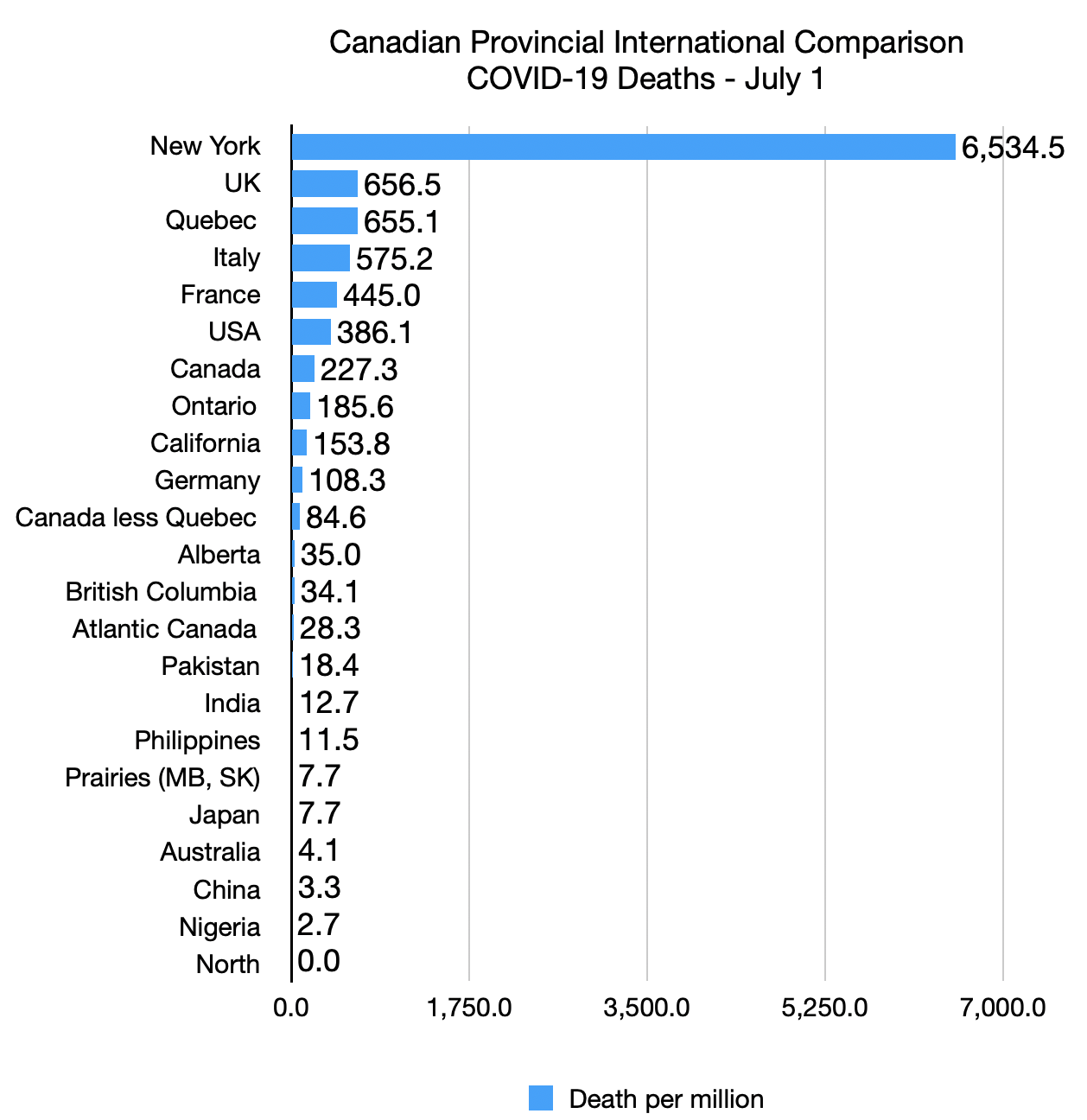
#COVID-19: Comparing provinces with other countries 1 July Update – Adding major immigration source countries

While the data from major source countries reflects large undercounting compared to G7 countries, nevertheless of interest given that perceptions of relative rates of COVID-19 infections and deaths may affect interest in immigrating to Canada:


Open Letter to Directors, Executive Senator Omidvar: Directors, and CEOs of Canadian Charities and Non-Profits

A pointed reminder that charities and non-profits have work to do to improve their board diversity by Senator Omidvar, starting with better data and voluntary disclosure. Any initiative by the big players should report on the four employment equity groups and ideally be synchronized on a fiscal or calendar year basis to facilitate comparisons:

Dear colleagues,

First, let me thank you for the work that you, your staff, and volunteers have done to keep Canadians safe during the pandemic.  Your heroic efforts have not gone unnoticed or unappreciated. I also know that Canadians will rely on you to help them stride slowly, yet confidently, into the recovery stage of this crisis.

But our country also needs to wake up to another crisis. The scourge of racism holds back prospects for security, safety, and opportunity for all its victims. But it has a particularly malignant effect on Black Canadians and Indigenous Peoples in Canada. Canadians recognize this; they have taken to the streets with vociferous demands to address it. Governments, corporations, the media, and other institutions are all taking a hard look at themselves to ask the question: what have we done to recognize and address all kinds of racism?

But what about charities and non-profits?

In June 2019, the Senate Charities Committee tabled its final report. Buried in the 42 recommendations is one that deserves re-examination given the context of the day. In the report we took note of the size, scope, and influence of the sector. We noted that it touches all aspects of our lives, from religion to sports, from seniors to young people. It also wields sizeable heft in other aspects: it contributes 8% to the GDP and employs close to two million Canadians. But what about its diversity?

Sadly, the absence of data gets in the way of answering these questions with any real reliability.  An e-consultation conducted in connection to the Senate study, although not statistically significant, found that more than half of the organizations which responded to the survey did not collect data on diversity of employees or directors.

Further, studies by academic institutions like the Diversity Institute at Ryerson University paint a picture of a sector that may talk the talk but appears to be unwilling to walk the walk. The evidence that is available is not encouraging. Racialized minorities made up 54% of the Greater Toronto Area’s total population in 2017. However, their representation in leadership roles in the voluntary sector falls short. Only 38% of boards analyzed had at least 20% racialized minority leaders, and 19% had none. Equally notable, 38% of senior management teams had at least 20% racialized minority representation, while 52% had none.

The Senate recommended a reasonable start to get data on diversity in the charitable sector. It recommended that the CRA include questions on both the T1044 and the T3010 forms on diversity representation on boards of directors as per the existing employment equity definitions.

In this way, the data could be aggregated to present a picture of diversity in the sector on an annual basis. Based on clear evidence, the country and the sector could see if progress is being made, how and where.

Since the Senate tabled the report, events have overtaken it. Parliament has not met on a regular basis and the Senate Charities report has not yet been debated or approved. However, the need to ensure that leaders reflect the diversity of our country’s population has heightened. The sector does not have the time to wait for the report’s recommendations to be implemented. It must take action now. That action is now in the hands of its leaders.

Each charity or non-profit can undertake such a review voluntarily on an annual basis. More importantly, large sector membership-based organizations, like Imagine Canada, Community Foundations of Canada, the Ontario Nonprofit Network, and the Philanthropic Foundations of Canada can request that their members disclose this data on a voluntary basis. Given that the membership of these organizations is large, it would create a significant evidence base from which to draw conclusions. Collected annually, it would give impetus to provide a national picture of diversity in the sector. Because the sector would be in the driver’s seat, it could choose to disaggregate the data to further understand issues of race and intersectionality. Most importantly, evidence could lead to action: the opportunity to compare successes and challenges and share best practices. All without legislation.

The sector could go one step further. It could make disclosure of such information a criterion for all members, thus making it mandatory within their associations. This would send a powerful signal of leadership to the rest of Canada.

Charities and non-profits are often frustrated and hamstrung by the federal government in their efforts to achieve their missions. The sector has urged the government to take it more seriously, as it should. Yet, here is an opportunity to state exactly how serious the charitable sector is on a matter of national urgency. It is time for the sector to lead, to show the way for others, so that others may follow.

I am calling on the sector to take up this call and be a leader and a champion for diversity and inclusion. In the fight against racism, this is not the only step. But it is the first that will bring evidence-based reflections and changes.

I have often been asked if the sector is ready for this change. My observations to date are summed up as follows: the sector’s spirit is willing, but its flesh is weak.

I sincerely hope that you will prove me wrong.

Sincerely,

The Honourable Ratna Omidvar, C.M., O.Ont.

Independent Senator for Ontario

Senate of Canada

Source: https://thephilanthropist.ca/2020/06/open-letter-to-directors-executive-directors-and-ceos-of-canadian-charities-and-non-profits/

@Shree Paradkar Dear brown people: I’m about to wash some dirty linen in public. Consider this an overdue act of tough love

A good reminder that racism occurs among visible minorities too:

A South Asian man wrote me an email recently about my columns on the Peel District School Board. “I have not seen you focus as much on the South Asian students in that board as you have been on the Black students,” he wrote. He grew up in Peel, where he said South Asians faced “bigotry at the hands of white teachers and students and hostility at the hands of Black students.”

Most of the South Asian students he grew up with worked hard, persevered and are very successful, despite their working-class roots, he wrote.

“However, as was the case when we were growing up, the Black community and students are basically monopolizing the public’s and school board’s attention and resources.” He dived into predictable comments about Black family structures being to blame, “though external obstacles no doubt continue to exist as they do for all minority communities.”

The letter, sent in late April, expressed commonly held views among South Asians: the myth of the “model minority” — or the false perception of universal success among brown people; an ahistorical view of anti-Black racism; and racist ideas about Black “family structures.”

And we’re surprised Black people don’t trust us?

Dear brown people: a warning. I’m about to wash some dirty linen in public. Consider this an overdue act of tough love.

Two years ago when I called out various forms of discrimination within South Asian communities in a keynote for the Council of Agencies Serving South Asians (CASSA), I was a minority voice within a minority; while many in the audience were supportive, we all knew there simply wasn’t a widespread movement to hold the anti-Blackness within to account.

That is changing.

In the wake of Minneapolis cop Derek Chauvin’s callous disregard for George Floyd’s life and several botched — racist — police interventions against Black and Indigenous people in Canada, the reckoning of anti-Blackness steeped in the very pores of our existence has become urgent.

In recent days, Hasan Minhaj called out fellow brown people in a 12-minute special on his Netflix show “Patriot Act.” CASSA hosted a series of panels on anti-hate conversations including one on racism within racialized communities. (Full disclosure: I was on that panel.) The U.K.’s Burnt Roti magazine hosted a discussion named Dismantling Anti-Blackness in South Asian communities.

On June 19, three education experts — York University assistant professor Vidya Shah, former Toronto school board education superintendent Jeewan Chanicka and Herveen Singh, an assistant professor at Dubai’s Zayed University — spoke in a brutally frank session titled “Brown Complicity in White Supremacy.”

While anti-Blackness is also rampant among Hispanics, East Asians, Middle Eastern people and any people who are neither white nor Black, “brown” here refers to people of South Asian ancestry and their diasporic communities.

In the artificial racial hierarchy created by Europeans who placed themselves at the top and enslaved Africans at the bottom, brown folks reside in the uneasy middle.

“We shift towards Blackness when it’s cool, when it demonstrates some sort of street cred or street smarts and then we shift right back to whiteness when we need to maintain access or mobility within the system,” Shah told the panel. “We’re chameleons.”

At least a couple of factors make us ripe for this role in the grey zone. One, as architects/participants of a caste system that in practice transcends religion, we inherently understand hierarchies. Two, our own vitriolic colourism — further cemented by waves of colonization — means we’d rather kiss the ring of whiteness than be associated with Blackness.

This has turned us into white supremacists in brown skin, useful tools in the project of whiteness. Our presence enables white people to look like multicultural progressives — some of us are the checkbox diversity hires that help them avoid addressing anti-Blackness. Our success is then used to absolve whiteness: look, Black people are told, if these people can succeed, why can’t you?

In constantly aspiring to whiteness we make ourselves more palatable to a system that does not wish to dismantle the status quo, Singh told the panel. This makes us easier to hire and be promoted through the ranks than a Black person. “In this way we become honorary whites, meaning that we are accepted in white spaces by white people upon the condition that we continue to be passive, compliant and constantly striving for whiteness.”

That compliance requires us to not talk too loudly, especially on matters of racial equity.

Brown people, we love to pat ourselves on the back for our “success” — look at our high household incomes, look at our high-achieving kids, look how far we’ve come and how quickly. So hardworking.

But we forget to see whose activism even made it possible for us to arrive here. Whom we’re stampeding on in our rush for success. Whose activism has the effect of making us appear compliant — and therefore palatable. And whose scholarship, despite it all, saves us.

“I want brown folks to remember we’re not just ascending on the backs of Black people, we have our feet on their necks as well,” Chanicka told the panel.

The fight for civil rights opened up North America to non-white immigrants in the 1960s. But immigrants were required to be highly educated people and in perfect health. These requirements a) filtered out those marginalized in their home countries and b) set those early migrants up for success even if they faced racism in the job market upon entry.

Some were able to fall back on their education and prior experience to became entrepreneurs while others sacrificed professional fulfilment for their children’s prospects. Fit in, they told their kids. Behave, study, fit in. Why would we not? Disrupt and we could end up at the bottom of the heap.

This, however, is a deal with the devil. Many of us gave up language, cultural practices, even names — anglicizing them or reducing them to monosyllabic ones.

“In this process of emptying ourselves of our core brown assets we’re filled with tremendous anxiety and insecurity,” said Singh. “And it is due to this insecurity that we lack the integrity to dismantle anti-Blackness within ourselves.”

However, no matter how much we strive for whiteness, we never can be white. It doesn’t matter how we sound, how we dress, how light-skinned we think we are, how much class privilege we enjoy to buffer racism, how many personal relationships we have that transcend race. Collectively, we are marked The Other.

When we’re rushing up the ladder we may not care that we’re crushing Black fingers on every rung. It’s when we or our children invariably hit glass ceilings — because racism against brown people is very real — that we begin to search for answers.

The shallowest of those questions is, “Why is everything just about anti-Black racism? What about us?” Chanicka calls this a way to silence the conversation. “It keeps dividing us as opposed to the understanding that racism is built on anti-Blackness. You cannot solve racism without addressing anti-Blackness.”

An awakening of our critical consciousness comes from the deep well of Black knowledge and activism — there is no equivalent South Asian activism to turn to here although there is growing Dalit (formerly called “untouchables”) scholarship; Anti-Black racism has centuries of intergenerational roots in Canada, running parallel and at times intersecting with anti-Indigeneity.

There is yet another steep cost for brown folks in the white man’s game. When we look down upon dark skin, view it as inferior, we implicitly accept our inferiority to whiteness. That’s the most cruel cut we could inflict on ourselves.

It makes anti-Blackness among brown folks the ultimate act of self-hate, one that all the Fair & Lovely cream in the world cannot erase.

China forces birth control on Muslim Uighurs to suppress population

The news regarding Chinese government repression keeps on getting worse and worse:

The Chinese government is taking draconian measures to slash birth rates among Uighurs and other minorities as part of a sweeping campaign to curb its Muslim population, even as it encourages some of the country’s Han majority to have more children.

While individual women have spoken out before about forced birth control, the practice is far more widespread and systematic than previously known, according to an AP investigation based on government statistics, state documents and interviews with 30 ex-detainees, family members and a former detention camp instructor. The campaign over the past four years in the far west region of Xinjiang is leading to what some experts are calling a form of “demographic genocide.”

The state regularly subjects minority women to pregnancy checks, and forces intrauterine devices, sterilization and even abortion on hundreds of thousands, the interviews and data show. Even while the use of IUDs and sterilization has fallen nationwide, it is rising sharply in Xinjiang.

The population control measures are backed by mass detention both as a threat and as a punishment for failure to comply. Having too many children is a major reason people are sent to detention camps, the AP found, with the parents of three or more ripped away from their families unless they can pay huge fines.

After Gulnar Omirzakh, a Chinese-born Kazakh, had her third child, the government ordered her to get an IUD inserted. Two years later, in January 2018, four officials in military camouflage came knocking at her door anyway. They gave Omirzakh, the penniless wife of a detained vegetable trader, three days to pay a $2,685 US fine for having more than two children.

If she didn’t, they warned, she would join her husband and a million other ethnic minorities locked up in internment camps — often for having too many children.

“To prevent people from having children is wrong,” said Omirzakh, who went deep in debt to scrape together the money and later fled to Kazakhstan. “They want to destroy us as a people.”

Birth rates in the mostly Uighur regions of Hotan and Kashgar plunged by more than 60 per cent from 2015 to 2018, the latest year available in government statistics. The hundreds of millions of dollars the government pours into birth control have transformed Xinjiang from one of China’s fastest-growing regions into one of its slowest in just a few years, according to new research obtained by The Associated Press in advance of publication by China scholar Adrian Zenz.

“This is part of a wider control campaign to subjugate the Uighurs,” said Zenz, an independent contractor with the nonprofit Victims of Communism Memorial Foundation in Washington, D.C.

The Chinese Foreign Ministry and the Xinjiang government did not respond to multiple requests for comment. However, Beijing has said in the past that the new measures are merely meant to be fair, allowing both Han Chinese and ethnic minorities the same number of children.

Under China’s now-abandoned ‘one child’ policy, the authorities had long encouraged, sometimes forced, contraceptives, sterilizations and abortions on Han Chinese. But minorities were allowed two children — three if they came from the countryside.

That changed under President Xi Jinping, China’s most authoritarian leader in decades. Soon after he came to power, the government revised birth regulations so Xinjiang’s Han Chinese could have two or three children, just like minorities.

While equal on paper, in practice Han Chinese are largely spared the abortions, sterilizations, IUD insertions and detentions for having too many children that are forced on Xinjiang’s other ethnicities, interviews and data show. Some rural Muslims, like Omirzakh, were punished even for having the three children allowed by the law.

Forced birth control

Fifteen Uighurs and Kazakhs told the AP they knew people interned or jailed for having too many children. Many received years, even decades in prison.

Once in the detention camps, women are subjected to forced IUDs and what appear to be pregnancy prevention shots, interviews and data show.

One former detainee, Tursunay Ziyawudun, said she was injected until she stopped having her period and kicked repeatedly in the lower stomach during interrogations. She now can’t have children and often doubles over in pain, bleeding from her womb, she said. Ziyawudun said women at her camp were made to undergo gynecology exams and get IUDs, and their “teacher” told them they would face abortions if found pregnant.

In 2014, just over 200,000 IUDs were inserted in Xinjiang. By 2018, that jumped more than 60 percent to nearly 330,000 IUDs. At the same time, IUD use fell sharply elsewhere in China, as many women began getting the devices removed.

Chinese health statistics also show a sterilization boom in Xinjiang.

Budget documents obtained by Zenz show that starting in 2016, the Xinjiang government began pumping tens of millions of dollars into a birth control surgery program. Even while sterilization rates plummeted in the rest of the country, they surged seven-fold in Xinjiang from 2016 to 2018, to more than 60,000 procedures.

Zumret Dawut, a Uighur mother of three, said after her release from a camp in 2018, authorities forced her to get sterilized. If she didn’t, they told her she’d be sent back to the camp.

“I was so angry,” she said. “I wanted another son.”

Ethnically targeted

The birth control campaign is fuelled by government worries that high birth rates among Muslims leads to poverty and extremism in Xinjiang, an arid, landlocked region that has struggled in recent years with knifings and bombings blamed on Islamic terrorists. Though the program adopts tactics from China’s ‘one child’ policy, the campaign unfolding in Xinjiang differs in that it is ethnically targeted.

“The intention may not be to fully eliminate the Uighur population, but it will sharply diminish their vitality, making them easier to assimilate,” said Darren Byler, an expert on Uighurs at the University of Colorado.

Some experts take it a step further.

“It’s genocide, full stop,” said Uighur expert Joanne Smith Finley, who works at Newcastle University in the U.K. “It’s not immediate, shocking, mass-killing on the spot type genocide, but it’s slow, painful, creeping genocide.”

Source: China forces birth control on Muslim Uighurs to suppress population

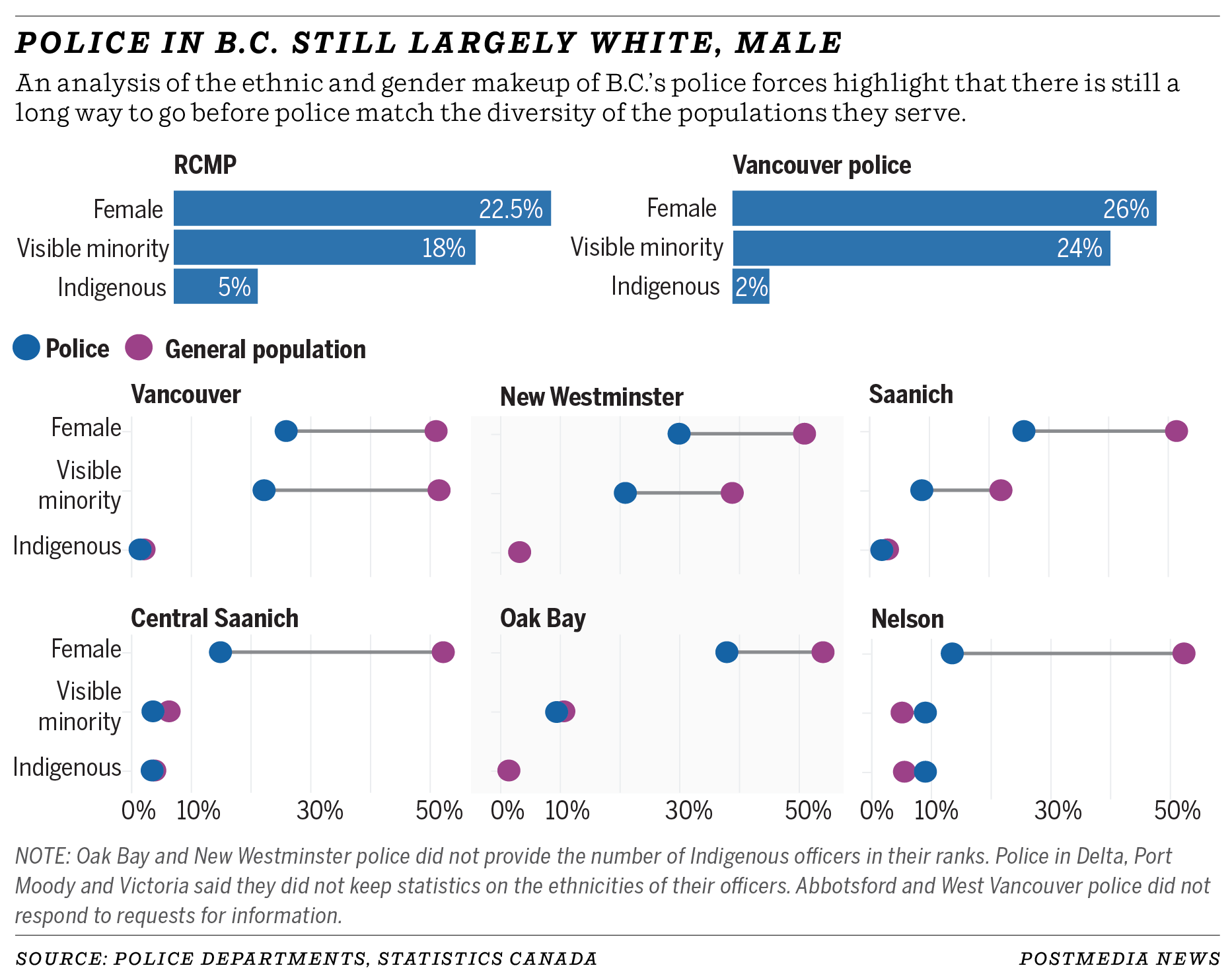
How diverse is your police force? After anti-racism protests, we analyze the makeup of B.C.’s policing

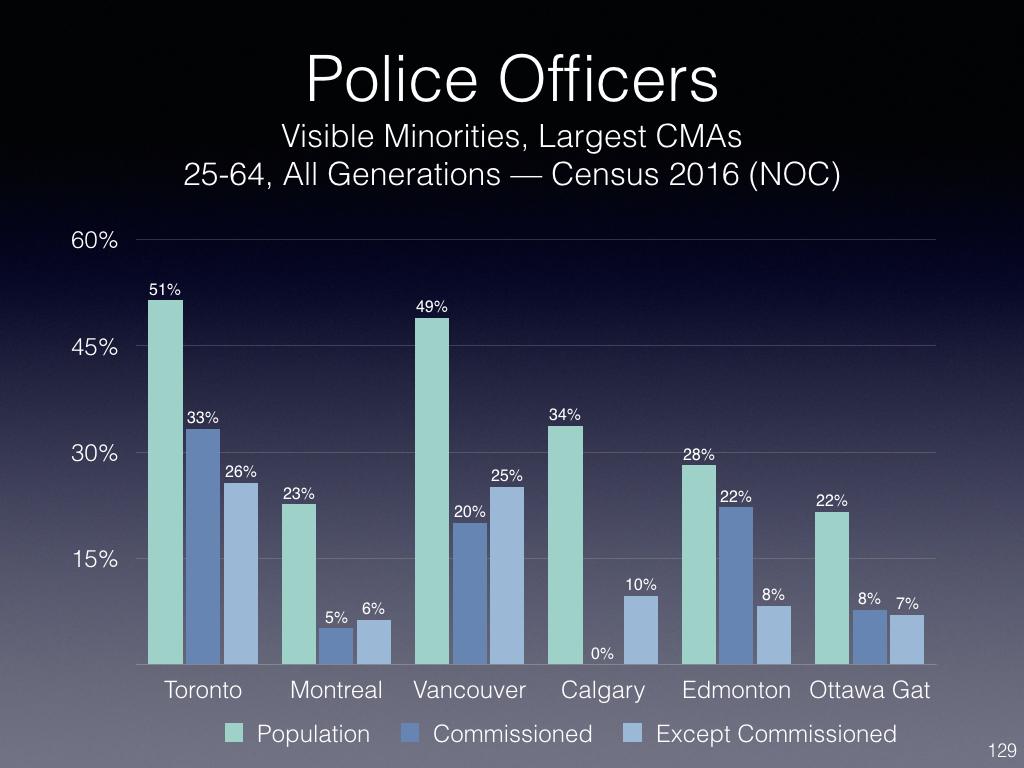
Above chart shows diversity data based upon the 2016 Census.

Good look at the diversity of British Columbia police forces:

As a growing number of protests in the U.S. and Canada call for reimagining how police are funded and structured, we wondered how closely B.C.’s various departments reflect the demographics of the people they serve.

We asked B.C.’s 12 municipal police agencies and the RCMP, which has jurisdiction in the rest of the province, how many of their officers identify as visible minorities and how many are women.

The significance of these numbers varies widely depending on who you ask.“Overall, I’d say it’s good to have these kinds of statistics. However, even if we made a lot of progress in terms of having RCMP and local city forces more reflective of the general population in B.C. in terms of proportions of visible minorities, I’m not sure how much actual change we could expect,” said Samir Gandesha, director of the institute for humanities at Simon Fraser University.

There needs to be a cultural shift within law enforcement, Gandesha argued, that addresses “deep-seated” inequities around racism and sexism. “Talking about the demographics, I think, is a great place to start, but there are some much harder questions.”

Protesters demanding a different type of policing have marched on local streets since the May 25 death of George Floyd in Minneapolis, after a white officer knelt on the Black man’s neck for nearly nine minutes. Many local activists want the police to be “defunded,” a concept that would allocate some — or all — of hefty law-enforcement budgets to social workers or psychologists better equipped to respond to mental health calls.

For Sgt.-Maj. Sebastien Lavoie, a Black Mountie based in Surrey, the statistics mean the RCMP needs to find new, innovative ways to hire qualified officers from varied backgrounds, especially from communities in which recruitment has been challenging. The video of Floyd’s agonizing death was sickening to Lavoie, but he believes the vast majority of police officers are good people, and says sensitivity and cultural training of new recruits is “a million light years” ahead of when he went through the process 20 years ago.

“We do want to represent the society as best we can in terms of demographics,” said Lavoie, whose job is to advise rank-and-file members about decisions made by management, while also bringing officers’ concerns to the higher-ups.“So the challenge is how do we get the good candidates from those demographics coming to us? We want to get the quality and the equality. … For me the biggest focus has to be to reach out to the communities and bridge the gap and actually have people interested in policing in those communities.”

‘Not an overnight fix’

The RCMP polices large areas of the province, including parts of Metro Vancouver and most of rural B.C. It employs nearly three-quarters of B.C.’s 9,500 police. The RCMP says 18 per cent of its officers are visible minorities and another five per cent are Indigenous persons.

Those statistics come close to reflecting the demographics of a rural city like Prince George, where 24 per cent of the population identifies as one of those two groups, the census says, or in Kelowna, where the two groups comprise just 16 per cent of the population. But the statistics are out of whack for diverse cities such as Richmond, where visible minorities and Indigenous peoples represent 77 per cent of residents, or in Surrey, where they represent 61 per cent.
The Vancouver Police Department employs the second largest number of officers in B.C., and says 26 per cent of its 1,340 officers are visible minorities or Indigenous, which is one of the highest percentages in the province. However, the 2016 Census found twice that amount — 54 per cent — of Vancouver’s population identified as one of those two groups.

Vancouver police Chief Adam Palmer agreed it is important for his department to reflect the community, and suggested it is “on the path” towards that, but cautioned “it’s not an overnight fix.” He said each recruiting class today is far more diverse than the officers who are retiring, that his officers speak a combined 50 languages, and that a quarter of the force is female.“I think a lot of people would think that, ‘Oh, policing in Vancouver, it’s a bunch of six-foot-tall, 200-pound white guys running around,’ when that’s not the case,” Palmer said.

He added, though, that hiring cannot be focused on demographics alone. “Diversity is important, but it’s also important to get the right person, the right temperament and background and just the right personality and mindset to be a police officer.”

Palmer, who is also president of the Canadian Association of Chiefs of Police, denied this week there is systematic racing in Canadian policing. His department, though, is falling under increasing scrutiny.Vancouver Mayor Kennedy Stewart asked the province for a “comprehensive review” of policing in B.C., including investigating the “systemic racism and disproportionate violence” faced by Black and Indigenous peoples. Stewart, who chairs the police board, has also said he wants Vancouver police to end the practice of street checks, when people are randomly stopped and their identification often recorded, because the checks have disproportionately targeted Indigenous and Black people in his city.

On Thursday, the B.C. Civil Liberties Association, the B.C. Union of Indian Chiefs and the Hogan’s Alley Society echoed calls for street checks to end, after alleging racist and other inappropriate behaviour by two Vancouver police officers.And Vancouver Coun. Pete Fry has introduced a motion asking council to support a “community-based crisis management strategy” that would send mental-health experts, rather than police, to help people in crisis.

Also this week, trustees with the Vancouver and Victoria school boards voted unanimously to review the use of police liaison officers, who often work with at-risk youth and sometimes coach sports teams.

‘Change in a radical way’

Meenakshi Mannoe, criminalization and policing campaigner with Pivot Legal Society, co-wrote a letter last week to B.C.’s attorney general and the RCMP’s B.C. commander, calling for immediate action to address issues such as the disproportionate policing of some groups and low-income communities.

Mannoe does not, though, believe the answer is hiring more Indigenous or visible-minority officers, but rather a defunding of law-enforcement budgets, with the money routed to areas that can “prevent a crisis,” such as housing, medical care, a safe drug supply, peer counselling and cultural programs.

“We are in a moment where people are really talking about change within the police in a radical way,” said Mannoe, a trained social worker.“If we address inequalities at their core, we wouldn’t need to over-police communities like the Downtown Eastside or communities with people who experience homelessness or use drugs.”

She rejects the argument that policing in B.C. is not as racist as south of the border and therefore doesn’t need a major rethink, pointing to several local police incidents involving visible minorities. In 2014, Tony Du, a schizophrenic man waving a piece of wood, was shot dead in a Vancouver intersection. And last December, police handcuffed an Indigenous man, Maxwell Johnson, and his 12-year-old granddaughter outside a Vancouver bank after tellers questioned the pair’s identification.

These high-profile incidents are not just happening in Vancouver, of course. This week, University of B.C. Okanagan nursing student Mona Wang sued the RCMP, alleging a Kelowna officer dragged her out of her apartment, kicked her in the stomach and shouted phrases like “stupid idiot” during a wellness check.

B.C.’s policing rules outdated: Minister

The province has not yet responded to Mannoe’s letter. But earlier this month, Public Safety Minister Mike Farnworth promised to set up an all-party committee to modernize B.C.’s 45-year-old Police Act, “with a specific focus on systemic racism.” He added the “outdated” act is “out of step with our government’s approach” on issues including harm reduction and mental health.

Policing in B.C. is a patchwork quilt, with the RCMP taking up most of the fabric. Eleven municipal departments oversee 12 cities and communities, while the Transit Police patrols the SkyTrain, bus routes, the SeaBus and the West Coast Express.

After the two largest agencies, the RCMP and Vancouver, here is how the rest of the departments report on the combined percentage of visible minority and Indigenous officers they employ, based on statistics they supplied to Postmedia:

Transit Police: 31 per cent of officers are visible minorities or Indigenous, the highest percentage in B.C. It provided the most detailed breakdown of its officers’ ethnicities, which included three Indigenous and two Black officers.

New Westminster: 21 per cent of officers in a city where 42 per cent of the population identifies as visible minority or Indigenous. The agency is trying to recruit more diverse applicants through social media, community liaison officers, and lower application expenses for underprivileged people, said Sgt. Jeff Scott.Saanich: 11 per cent of officers compared to 25 per cent of the general population that is a visible minority or Indigenous. It provided detailed five-year data, which showed a slight improvement over 2016, when nine per cent of officers belonged to those two groups.

Central Saanich: It has one visible minority and one Indigenous officer, representing seven per cent of its 27-member department, numbers that have stayed roughly the same for a decade in a small community where 10 per cent of the population identifies as one of those two groups. “We are consulting with the Greater Victoria diversity committee to identify ways to reach a greater, more diverse audience” when the department is ready to hire new officers, said Sgt. Paul Brailey.

Nelson: It has two Indigenous officers but no visible-minority officers, representing nine per cent of its 22-officer department. Chief Paul Burkart noted his community is unique in B.C., because the census says its overall population of visible minorities and Indigenous people is only 11 per cent of the total.

Oak Bay: Like Nelson, nine per cent (two) of its 22 officers identify as visible minorities, compared to 12 per cent of the general population. It is seeking ways to find more diverse officers, but only hires from other departments, which limits its pool of potential candidates, said spokesperson Lindsay Anderson.

Victoria, the second largest department after Vancouver, and smaller Port Moody do not keep ethnicity statistics and did not explain why they don’t. Neither does Delta, but it “believes there may be value in collecting this data,” so in 2018 started asking recruits to volunteer this information. Since then, half of its new employees have identified as visible minorities, said Delta spokesperson Cris Leykauf.Abbotsford did not respond to requests for the data, and West Vancouver did not provide it by deadline.

To find more ethnically diverse officers, the VPD held information sessions for LGBTQ2S+ candidates, and attended events like Hoobiyee, National Indigenous People’s Day, the Chinese New Year Parade and Vaisakhi, said Simi Heer, public affairs director. The RCMP attends career fairs and cultural events, and has also launched a pilot program to help Inuit people navigate the recruitment process, said Staff Sgt. Janelle Shoihet.

‘This is the worst I’ve ever seen it’

The fallout from Floyd’s “heartbreaking” death and the public’s animosity toward police hit local Mounties harder than any other similar case that has been in the news, said the RCMP’s Lavoie.

“This is the worst I’ve ever seen it. We have seen family members turn on each other, spouses turn on their spouse,” he said. “This is one of the most emotional topics that I’ve seen in my 20 years. It’s been really bad.”

He believes the RCMP does good work and is trying to make up for past errors with modern-day efforts to change. For example, before officers respond to a major situation involving Indigenous people, such as the Wet’suwet’en pipeline protests, Lavoie says he reminds them of the Mounties’ role in seizing children to force them into residential schools and that officers need to be sensitive about this history.

“We need to own exactly what we have done, and I think we are doing a much better job of this than ever before. And that is critical,” he said.Lavoie added he has not felt racism directed at him by anyone in the RCMP, noting he was promoted while on the emergency response team and into his position today with no consideration of the colour of his skin.

Gandesha, the SFU prof, argued that hiring more racialized, or ethnically diverse, people or even having them in positions of power is not a quick fix on its own, unless everyone in the organization believes in change. For example, Minneapolis has a Black police chief, but that didn’t stop a white officer from kneeling on Floyd’s neck until he died.

He notes police budgets have risen as crime has fallen in Canada, and believes there should be a rebalance that results in more investment in social services. Then when someone is in distress, as happened west of Toronto on the weekend when Ejaz Choudry, who had schizophrenia, was shot dead by Peel police, social workers or psychologists would ideally respond to the call, not armed officers, Gandesha said.

‘It raises an eyebrow’

Another statistic we requested from B.C.’s police departments was the number of female officers they employed. That ranged widely, including 30 per cent in New Westminster, 26 per cent in the VPD, 23 per cent within the RCMP, and 15 per cent in Port Moody.

“It raises an eyebrow” that, in 2020, women are not closer to representing half of the police officers in the province, said Genevieve Fuji Johnson, an SFU political science professor who just published a study on the “whiteness” of the upper echelons of Canadian universities.She wonders about the retention rate of women in policing careers, if they perhaps leave prematurely if they don’t feel valued. Earlier this year, for example, an estimated 2,000 former female employees of the RCMP won final court approval to proceed with a multimillion-dollar class-action lawsuit against the force over gender-based abuse and discrimination.

Another question to ask these departments, she said, is whether women and visible minorities have a proportional number of high-ranking jobs or if they mainly fill the lower ranks.“Our police departments, and the RCMP, you want them to look, to the extent that’s possible, like the people they are serving. So you want that representation for a whole range of reasons,” said Fuji Johnson, who is not sure that substantive change will happen soon.

“Right now there are tons of demonstrations going on and people are making noise and I think that is super important. But is anything going to change? I don’t know.”

In a letter posted on the Stl’atl’imx website this month to the people of the St’at’imc Nation, near Lillooet, Doss-Cody wrote that many police agencies have promised to check past behaviour and build a better relationship with the people they serve.

“I wish them all of the best, but like you, I can only believe that this change can come about if there is a serious effort to deal with the systemic racism that has existed that has led to much strife with our people, including our interaction with police,” the police chief wrote.

Source: How diverse is your police force? After anti-racism protests, we analyze the makeup of B.C.’s policing

Do Canada’s most powerful federal posts reflect the country’s diversity?

My latest, with Jerome Black, examining which benchmark should we use regarding visible minority representation in political institutions: overall population or citizenship-based population:

The inclusion of Canadians from visible minority groups in the country’s major political and socio-economic institutions is an important indicator of the success that Canada can claim as a multicultural nation, and ultimately a measure of the nature and distribution of power and influence within the country. But how to properly assess the level of inclusion for particular groups?

Where data exist, this is a straightforward task. To contextualize whether genuine integration and inclusion have occurred requires identifying the percentage of the overall Canadian population that the visible minority group occupies, and comparing that number to the group’s representation in a particular sector. A small or non-existent gap between the two percentages would suggest a more positive interpretation about the incorporation of visible minorities while a larger deficit would imply the opposite. Still, the analysis can be done using different population benchmarks. (Note that the term visible minority is used here to match the language used by Statistics Canada in the collection of census and other data.)

We wanted to take a close look at the overall percentage of visible minority candidates and MPs over the last three general elections; and the percentages per visible minority group. We also wanted to see what percentage of appointed officials (senators, judges, Governor in Council (GiC) appointees and public servants) were from visible minority groups.

There are two benchmarks used here – one is using the overall population, and the other is using the portion of the population that are citizens. The latter’s importance stems from the requirement that the candidates of political parties hold citizenship.  Similarly, the requirements for most political appointments and public service hiring are citizenship-based. While GiC appointment requirements vary by organization, given residency, knowledge and experience requirements for full-time positions, citizenship would appear to be the default criterion…

Continue Reading: Do Canada’s most powerful federal posts reflect the country’s diversity?

The UK social media platform where neo-Nazis can view terror atrocities

Of interest:

A UK-registered technology company with British directors is behind a global platform used by neo-Nazis to upload footage of racist killings.

BitChute, which was used in the dissemination of far-right propaganda during the protests in London and elsewhere this month, has hosted films of terror attacks and thousands of antisemitic videos which have been viewed over three million times.

The platform has also hosted several videos from the proscribed far-right terrorist group National Action, now taken down.

Concerns about BitChute have been flagged in a new report, Hate Fuel: The hidden online world fuelling far right terror, produced by the Community Security Trust (CST), a charity set up to combat antisemitism.

In response to the report, the company, based in Newbury, Berkshire, said in a tweet that it blocks “any such videos, including incitement to violence”.

But the platform was still showing the full footage of the 2019 Christchurch mosque shootings and an attack on a German synagogue until the Observerbrought the videos to its attention.

The far-right activist Tommy Robinson has a channel on BitChute with more than 25,000 subscribers.

When far-right protesters recently descended on London and several other cities, BitChute’s comment facility carried numerous racist postings on Robinson’s channel, many of them making derogatory claims about George Floyd, whose death after being restrained by police in the US city of Minneapolis has sparked worldwide protests.

“Extremists know that they can post anything on BitChute and it won’t be removed by the platform unless they are forced to do so,” said Dave Rich, director of policy at the CST. “Some of the terrorist videos we found on BitChute had been on the site for over a year and had been watched tens of thousands of times.”

He added: “It’s no surprise, therefore, that the website is a cesspit of vile racist, antisemitic neo-Nazi videos and comments. This is why there need to be legal consequences for website hosts who refuse to take responsibility for moderating and blocking this content themselves.”

BitChute is one of several platforms alarming those who monitor the far right.

Another, Gab, created in 2016, has a dedicated network of British users called “Britfam” that has 4,000 members and which far-right extremists use to circulate racism, antisemitism and Holocaust denial.

Last week the chief executive of Gab, Andrew Torba, sent an email to users attacking what he alleged was the “anti-white, anti-Trump and anti-conservative bias” on more mainstream social media platforms.

Source: The UK social media platform where neo-Nazis can view terror atrocities