ICYMI: Black Children Are More Likely to Die After Surgery Than White Peers, Study Shows

Yet another study showing racial disparities in healthcare:

Black children are more than three times as likely to die within a month of surgery as white children, according to a study published in the journal Pediatrics on Monday.

Disparities in surgical outcomes between Black and white patients have been well established, with researchers attributing some of the difference to higher rates of chronic conditions among Black people. But this study, which looked at data on 172,549 children, highlights the racial disparities in health outcomes even when comparing healthy children.

Researchers found that Black children were 3.4 times as likely to die within a month after surgery and were 1.2 times as likely to develop postoperative complications. The authors performed a retrospective study based on data on children who underwent surgery from 2012 through 2017.

Olubukola Nafiu, the lead author of the study and a pediatric anesthesiologist at Nationwide Children’s Hospital in Columbus, Ohio, said the authors were not surprised to find that healthy children, across the board, had extremely low rates of mortality and rates of complications after surgery. But what surprised them was the magnitude of the difference in mortality and complication rates by race.

“The hypothesis we had when we started was that if you studied a relatively healthy cohort of patients, there shouldn’t be any difference in outcomes,” Dr. Nafiu said.

The authors, in their paper, acknowledged limitations of the study: They did not explore the site of care where patients received their treatments or the insurance status of patients, which can be used as a proxy for socioeconomic status. This meant they could not account for differences in the quality of care that patients received or the economic backgrounds of the patients.

Another limitation was that because mortality and postoperative complications are so uncommon among healthy children, it is possible that most of the cases came from a few hospitals, Dr. Nafiu said.

But while Black people are more likely to receive care in low-performing hospitals, that may not be the main factor driving the gap this study found, Dr. Nafiu said. The hospitals examined in the study were all part of the National Surgical Quality Improvement Program, a voluntary program, meaning they had the resources to be part of the program and the belief that quality improvement is important.

Adil Haider, dean of the medical college at Aga Khan University, who was not involved with the study, said that it told a key piece of the story about racial disparities in surgical outcomes, but that there were still many questions about what drives disparities.

ICYMI: Professor Criticizes Book, ‘White Fragility,’ As Dehumanizing To Black People

Valid criticism regarding over simplification and categorization:

Robin DiAngelo’s book White Fragility, published in 2018, has shot up bestseller lists after protests over the death of George Floyd reignited discussions about racism in America.

DiAngelo is white and regards racism as “the foundation of the society we are in.” She says white people become defensive and exhibit “fragility” when challenged on their underlying and, often unconscious, racism.

White people will never be rid of their biases, DiAngelo has told NPR, saying their necessary work “will be lifelong: really thinking deeply about what it means to be white, how your race shapes your life.”

But as DiAngelo’s corporate lecture requests and book sales have grown, so too has criticism of her work.

The Washington Post‘s Carlos Lozada said the book employs “circular logic.” Lozada writes that White Fragility views people of color as “almost entirely powerless, and the few with influence do not wield it in the service of racial justice.”

Columbia University professor and linguist John McWhorter, who is Black, echoes that criticism, writing in The Atlantic that the book “openly infantilized Black people” and “simply dehumanized us.”

He argues that for “DiAngelo, the whole point is the suffering” of white people, who are “taught that pretty much anything they say or think is racist and thus antithetical to the good.”

McWhorter spoke with Morning Edition‘s Steve Inskeep about his criticism of the book and what he thinks is needed to change racist institutions.

Here are excerpts of the interview:

What are some examples of the way that she talks in the book and also talks in her seminars that you think miss the mark?

Well, I understand where she’s coming from. I don’t think she’s a hustler. I know that she’s sincere. But my question is, is it necessary for every good white person to walk around feeling uncomfortable about themselves as abstractly complicit in a racist system before we see political change?

And so a white person is supposed to learn that there are all sorts of things that they can’t say. You can’t say, “I marched in the civil rights movement,” because that would make you too comfortable. You can’t say, “I don’t see race,” because you almost certainly do. You can’t say, “it’s about class,” because it’s about race.

And she’s got about 25 proscriptions that make it so that any good white person is essentially muzzled. You just have to be quiet.

If you think about human history, there have been great and wrenching changes not only in this country, but in a great many others, but especially in this one, — say, a few things that happened about 50 years ago — without there needing to be this rather Orwellian indoctrination program. So the question is, why do we need this now?

She’s trying to, you argue, fix white people’s souls when in reality the place that people should look is at institutions. What are the rules for police? What are the rules for fair housing? That sort of thing.

You have said exactly what I believe. I think that what Robin DiAngelo is doing is well-intentioned, but I think ultimately, it’s idle. Ultimately, the result of what she would create is a certain educated class of white person feeling better about themselves. And frankly, that’s antithetical to her goal, because no matter how she wants it to go, people are going to think that they’ve done some kind of work. It’s going to be hard to get people to truly feel as endlessly culpable as she’s seeking.

And in the meantime, what’s the connection between that and forging change? You can say that all of this is a prelude to changing structures. But the question will always be, why don’t you just go out and change the structures? And why do you think that you couldn’t until doing this?

You say this book that is dedicated to eliminating racism in white people is racist. Why do you say it’s racist?

It is racist, and I don’t mean that Robin DiAngelo is a racist. I’m not calling her that. But I’m saying that if you write a book that teaches that Black people’s feelings must be stepped around to an exquisitely sensitive degree that hasn’t been required of any human beings, you’re condescending to Black people. In supposing that Black people have no resilience, you are saying that Black people are unusually weak. You’re saying that we are lesser. You’re saying that we, because of the circumstances of American social history, cannot be treated as adults. And in the technical sense, that’s discriminatory.

I also want people to know that you’re a linguist. And here we are using this word racist. What is a proper definition of racist?

Well, racism is a very confusing word these days. But when I say that White Fragility is a racist book, what I mean is it does not allow Black people to be full human beings, because full human beings deal with the imperfections of life.

This is important: by the imperfections of life, I do not mean somebody stepping on your neck until you’re dead. I’m not talking about actual abuse. I’m talking about the more abstract sorts of things that we’re familiar with, especially over the past several decades as part of our racial landscape, where I think that the solutions are going to be more subtle than the kind of mental and spiritual straitjacketing that DiAngelo seems to think are necessary. It’s an interesting proposal, but it’s by no means as self-evidently wise as she implies, and that many people tragically seem to be agreeing with her about.

Source: Professor Criticizes Book, ‘White Fragility,’ As Dehumanizing To Black People

Pakistan: Ancient statue of Buddha destroyed as un-Islamic

Sigh:

Last Friday, an ancient statue of Buddha was vandalised in Takht Bahi, Mardan district (Khyber Pakhtunkhwa).

The statue was destroyed as “un-Islamic” by the workers who found it (pictured) whilst digging to lay the foundations of a house.

The ancient artefact belongs to the historic Gandhara civilisation which encompassed the region of modern-day north-western Pakistan, more or less Peshawar valley and the lower valleys of the Kabul and Swat rivers.

Gandhara is the old name for the Pakistani province of Khyber Pakhtunkhwa. It is highly revered by Buddhists and is deemed an important regional site of Buddhist civilisation.

On Saturday, videos of the destruction went viral on social media. They show a man breaking the statue with a big hammer, with other men expressing their approval and some taping the whole thing.

Pakistani media have reported that four people involved in the incident were arrested.

In 2017, two rare and ancient Buddha statues were found in Bhamala, an archaeological site in Hariput district. The largest statue ever found on the site depicts Buddha’s death whilst the second statue was a Buddha with a double halo.

According to Abdus Samad Khan, head of the province’s archaeology department, the vandalised Buddha statue was 1,700 years old; the broken pieces were recovered to assess their archaeological value.

Following the incident, various news channels and social media discussed the protection of others’ beliefs in the country.

Whilst the Pakistani constitution respects all religions and all faiths are sacred for their followers, many activists and leaders have come out against the destruction of the statue of Buddha. For Samad Khan, it was a “crime” and showed “disrespect for religion”.

Later, police arrested a local contractor and five other people suspected of breaking antiquity regulations.

Two rare and ancient Buddha statues were unearthed in Hariput district in 2017, noted Mansha Noor, executive secretary of Caritas Pakistan in Karachi,

“Breaking this ancient statue of lord Buddha shows ignorance of history and a lack of education,” Mansha said. “Our country is filled with minerals and hidden history. We need to educate our nation about other owners of this land.”

In ancient times, Gandhara was a trading and cultural crossroads linking India, Central Asia and the Middle East.

Source: PAKISTAN Ancient statue of Buddha destroyed as un-Islamic

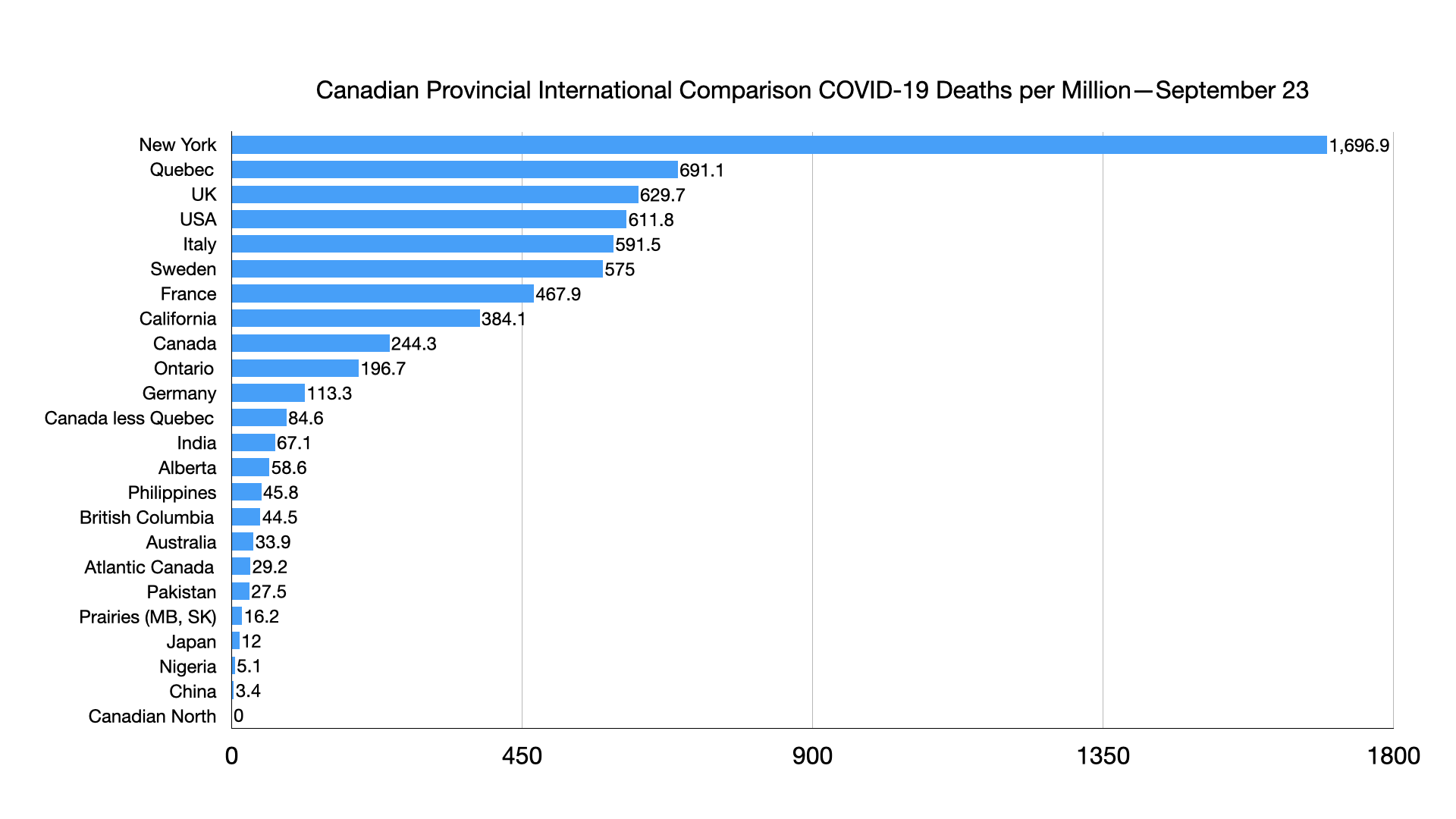
#COVID-19: Comparing provinces with other countries 22 July Update

The latest weekly stats showing no major changes from last week in terms of relative ranking, although the USA can be expected to surpass the harder hit European countries in deaths per million over the next few weeks given current trends. The recent spike in infections in British Columbia, Alberta and Quebec continues to become more apparent (but not, fortunately to date, in the death statistics).California edged over Ontario this week:

Why are there still so few Black lawyers on Bay Street?

Good detailed analysis in the Globe (see article for graphics):

Just about every Black lawyer on Bay Street has a tale to tell about the racism – whether overt or covert – they’ve experienced throughout their career: drawing scathing rebukes for minor errors that white colleagues don’t seem to face; being mistaken for an assistant rather than a litigator; enduring comments about their hair and clothing, or blatant accusations of tokenism; being ignored in a circle of white colleagues, and left out of after-work drinks and client meetings.

For years, the country’s biggest law firms have been proudly posting messages of diversity and inclusion on their websites. Yet, with organizations on both sides of the border now at an inflection point when it comes to race, Bay Street is still overwhelmingly white.

According to the Law Society of Ontario (LSO) – the largest self-governing legal body in the country, with more than 55,000 lawyers and 9,000 paralegals as members – 19.3 per cent of the province’s lawyers in 2016 identified as racialized, a full 10 points lower than the population at large. A mere 3.2 per cent were Black, compared with 4.7 per cent of Ontario’s population.

As for the situation at the country’s largest law firms, comprehensive data either doesn’t exist or hasn’t been made public. To help fill in the gaps, The Globe and Mail sent questions about racial diversity to 20 of them (including Bay Street’s hallowed Seven Sisters: Blakes, Davies, Goodmans, McCarthy Tétrault, Osler, Stikeman Elliott and Torys).

While more than half provided information on racial diversity within their ranks, only five firms broke out data on Black lawyers in particular; two others confirmed the number of Black partners. (Many respondents cited the need to protect privacy and data collection policies that prohibit the disclosure of numbers so small the people behind them could be identifiable.)

Six firms – Osler, Bennett Jones, Davies, McMillan, Blaney McMurtry and Fogler Rubinoff – said they either didn’t collect the information or would not share it publicly; WeirFoulds declined to answer any questions for this story.

The Globe also conducted a visual analysis of photos and biographies posted on the websites of 16 of Toronto’s largest firms to estimate the number of Black partners represented. The result: roughly 35 out of around 4,000 partners. This is an imperfect estimate, of course, because it can’t account for how people self-identify. Still, many law students and junior lawyers perform a similar exercise, scanning through the photos on firm websites in search of others who look like themselves.

McCarthy Tétrault was one of the five firms that was most candid in its responses (along with Fasken, Goodmans, Dentons and Aird & Berlis), admitting that just 2 per cent of roughly 700 lawyers, including partners, and articling students at the firm are Black. (Dentons reported a similar figure.)

McCarthy’s CEO, Dave Leonard, says he’s not proud of its diversity numbers, but decided to share relatively detailed information anyway. “Transparency,” he says, “is part of how we’re going to solve this.”

“I stand up often and talk to our people about my white privilege and that too much of our partnership looks like me,” Mr. Leonard adds.And I do recognize that I’m here because of hard work and intelligence and all the rest of it. But I’m also here because of my role and my place in society, and where I grew up and how I grew up and the colour of my skin and my gender.”

Hadiya Roderique chronicled five years of microaggressions in her essay “Black on Bay Street,” published in The Globe in November, 2017. Ms. Roderique had been hired as an employment lawyer at Fasken straight out of law school, where interviewers were wowed by her top grades and litany of extracurriculars. But she ultimately struggled to fit into the “upper-class white world” that dominates the corporate realm. “Big law could not accommodate the person and the colour I was,” wrote Ms. Roderique, who went on to do her PhD in organizational behaviour at the Rotman School of Management.

Ms. Roderique’s essay went off like a bomb inside the country’s biggest law firms. Linc Rogers, a partner at Blakes who is Black, remembers feeling there was a new kind of willingness to talk about how Bay Street could accommodate people from different backgrounds.

“Her thesis was there is a narrow corporate culture on Bay Street, and to succeed, you have to mold yourself to it,” he says. “She said out loud what a lot of people were saying in quiet conversations, and she said it with thunder. Everybody read it. Everybody talks about it.”

For this story, The Globe spoke with dozens of Black lawyers and those from other diverse backgrounds about their experiences at Bay Street firms. Some commented on the record; others asked to remain anonymous, concerned that even mildly critical remarks could impede their careers in what is still a relatively small community dominated by a handful of powerful players.

“I think systemic discrimination is unfortunately baked into the system,” says Vivene Salmon, president of the Canadian Bar Association. “I think you have to fight pretty hard to defy the odds.”

DIVERSITY SURVEY

The Globe asked the 20 largest law firms in Toronto (most of which have offices around the country as well) questions about the diversity of their Canadian workforce. The following firms responded and most provided data from their most recent internal survey based on employee self-identification.

The world of Bay Street law is small. All together, according to trade publication Lexpert, the 20 largest corporate firms in Toronto collectively employ about 8,500 lawyers across the country, almost half of them in Toronto itself. For two decades, these organizations have been promoting the idea of diversity and inclusion, but their efforts have focused primarily on gender, often with the goal of reaching partnerships comprised of at least 30 per cent women.

While progress has come slowly on that front, Bay Street has generally not put the same emphasis on recruiting, retaining and promoting lawyers who are Black, Indigenous and people of colour (BIPOC) – or, for that matter, those with disabilities or members of the LGBTQ+ community. Even without published information on Black leaders at Canadian law firms, it’s evident the numbers are miniscule.

“We don’t collect data on this stuff, but if you poke around the firm websites, it becomes pretty clear the representation of Black people on Bay Street isn’t anywhere near what Toronto actually looks like,” says Marlon Hylton, who was a partner at Cassels before recently starting his own data, information and innovation law firm and affiliated tech company, INNOV-8 Data Counsel.

In 2010, the Canadian Association of Black Lawyers held an event to honour 17 Black partners known to work at major Bay Street firms. A decade later, that figure appears to have roughly doubled – but still represents less than 1 per cent of partners at top firms.

Beyond Bay Street, there were just 63 Black lawyers in Ontario who were partners at law firms of all sizes in 2016, according to the LSO. That’s just 6 per cent of Black lawyers overall; meanwhile, 18 per cent of white lawyers (about 4,800) were partners.

Black lawyers also tend to work as sole practitioners at a far higher rate than their white counterparts. In 2016, the LSO lists 31 per cent of Black lawyers in the province as sole practitioners, compared with 19 per cent of white ones. That suggests at least some don’t find a career path for themselves in Big Law and opt instead to set up shop on their own.

Data on the number of Black law students is also uneven – only a handful of Canada’s 20-plus law schools share demographic information. What information is available shows members of the Black community account for about 1 per cent of law students at both the University of Toronto and Queen’s University; York University’s Osgoode Hall is more representative, at about 8 per cent. Part of the problem is cost: Law students graduate with an average debt load of $83,000 in Ontario – particularly damaging for low-income and BIPOC students without the benefit of generational wealth.

Marie Kiluu-Ngila was one of just five Black students in her law class at U of T, spurring her to co-found Black Future Lawyers, a program to support and encourage Black students going into law. When CBC interviewed Ms. Kiluu-Ngila about the initiative in January, the firm where she was articling, Cassels, featured the clip on its website. In late spring, however, she learned she was one of two students out of 15 who wouldn’t be hired back. Despite several requests, she says she never received a clear answer why.

“It was very confusing – to hear that you’re so great, you have stellar performance reviews, to be told you’re an excellent student,” says Ms. Kiluu-Ngila, who is now looking for work in consulting, or with a government or financial institution. “It didn’t really add up.”

The hiring process is just the first hurdle Black law grads face, where a foreign-sounding name might scuttle your chances of getting an interview in the first place and an ineffable quality called “fit” dictates who gets hired and who doesn’t.

Since most students’ résumés look roughly the same, who gets an interview is based largely on grades. But even top marks might not be enough to overcome bias in favour of white-sounding names. One Black lawyer who now works in Ottawa told The Globe he applied widely to large Toronto firms with employment and labour practices. He had straight A’s in all the relevant courses, but never even got an interview – leading him to suspect it was related to his African last name. In fact, a 2016 study by Sonia Kang at the University of Toronto showed Black students who “whiten” their résumés get callbacks at a rate 2.5 times higher than ones who don’t.

Once past the résumé-screening process, further barriers include looking the part during speed-dating-style interviews and navigating awkward cocktail parties with talk about international travel, cottages and ski clubs.

Shaneka Shaw Taylor, now a partner at Boghosian + Allen, recalls the high anxiety she felt during in-firm interviews. “At various interviews, I felt excluded or not understood, in the sense that I just couldn’t resonate with some of the conversations, some of the questions, some of the experiences. And it wasn’t coming from a place of the interviewer meaning to do anything wrong – sometimes you can only speak to what you’ve experienced.”

Several lawyers who spoke with The Globe expressed concern that nepotism is also still common, with children, nieces and nephews of partners (or friends of partners at other firms) often flagged for interviews.

“One of the things that helps people get Bay Street jobs is connections and legacy,” says Hermie Abraham, who articled at Cassels before starting her own employment law practice. “If you do see Black students landing jobs at those firms, you know they’re outstanding.”

Even once you’re in, it can be a struggle to stick around and to attain the same level of pay as your peers (for in-house counsel, for instance, white lawyers make an average of $12,000 more than their BIPOC counterparts). “I’m not going to tell any Black lawyer at a major firm that being Black doesn’t matter,” says Raphael Tachie, a senior in-house lawyer at TD Bank. “I think it does.”

Mr. Tachie joined Blakes as a summer student in 2008 in part because there were five Black lawyers at the firm – “the most I’d ever seen.” But although Blakes made a concerted effort to recruit Black students, he later found many of them didn’t stay. (He left after articling because he was only offered a non-permanent position.) He now passes on the same advice to Black law students that a mentor once gave him: “Go into job interviews as if being Black doesn’t matter, but leave the room knowing it does.” That means turning on the charm to get the job, he says, then working harder than anyone else to keep it.

But even getting the chance to do that can be difficult. To climb the ranks, lawyers need to build a book of business, which means getting good work on important files, along with crucial client face-time. All that is doled out by partners, who for decades have tended to mentor and assign work to people they like – people who remind them of themselves.

“It might not be anything particularly malevolent on someone’s part, but it’s just that you’ve made a connection with the person in the next office,” says Blakes’ Mr. Rogers. “Maybe they went to the same school, vacation at the same spot, like the same sport. You have a connection, and you give them work. Those attributes are often tied to race and gender.”

When the CBA’s Ms. Salmon was a junior lawyer on Bay Street, she recalls working weekends and long hours on legal research, and then having to beg the partners to let her attend client meetings. “If you were a white guy, you wouldn’t have to beg,” she says. “The senior partner on the file would say, ‘Oh it would be good for your learning – why don’t you come along?’ ”

The culture is changing, some lawyers say, but invitation-only meals and tickets to major-league events remain a big part of business development and career advancement, and Black lawyers are often left out. Black women face a double bind because of their race and gender, says Jenelle Ambrose, in-house counsel with Grant Thornton and secretary of the Black Female Lawyers Network.

“There’s a discomfort in interrogating not just the things that you are doing, but the things that you aren’t,” Ms. Ambrose says. “Like not including people – why is it that someone isn’t really a fit? Why is it that someone is invited to golf or after-work drinks, and someone else isn’t?”

Then there are the consistent microaggressions that leave many BIPOC lawyers confused and thinking, “I’m pretty sure that’s racism,” says Mr. Hylton, who worked at McCarthy Tétrault before he was a partner at Cassels. Many of the lawyers who talked to The Globe had stories of being praised for being articulate – as though it were completely unexpected – or being told by a colleague, “I don’t see race.” Both women and men spoke of receiving comments on their hair, and one man wondered if letting his curls grow in might affect his job prospects.

“You walk around with this sense of a question about whether or not they think you belong,” Mr. Hylton says. “You know you’re just as smart, you do good work, but you still have that feeling of needing to do that much more than everyone else.”

On one occasion, Ms. Salmon attended a meeting with a group of white men when a lawyer on the opposite side of the file told her to serve coffee. “I essentially wasn’t invited to sit at the table, but I was told to get coffee for everybody else. That just shows you the effect of race and gender. It shows you you’re not considered equal.”

Lori Anne Thomas, president of the Canadian Association of Black Lawyers, has been in plenty of similar situations throughout her 12 years of legal practice. “These things come about in your day-to-day experiences, and you’re faced with a decision tree of how do you act, how do you respond? Am I the educator today, or am I the stern corrector? Or do I ignore it? And then, how do I do my job?” Ms. Thomas says. She owns her own criminal defence firm, which she says gives her the freedom to wear her hair dyed blonde and cropped short. But she often hears from CABL members about the pressures they face to look a certain way at corporate law firms: “What do I wear today? How do I minimize my Blackness to assimilate and accommodate? Do I wear the colourful tie that brings out my African heritage, or will that be perceived as ‘too Black?’ ”

In the wake of the police killing of George Floyd in Minneapolis, many Bay Street firms began to reevaluate their efforts on diversity and inclusion. At Stikeman Elliott, chairman Marc Barbeau sent a firm-wide email, acknowledging, “We’re by no means perfect.” Although it didn’t share overall numbers, the firm says it has made progress on hiring junior lawyers from diverse backgrounds, but admits it hasn’t done as well on retention and promotion. Stikeman’s leaders have been going through an “uncomfortable process,” says Mr. Barbeau, as they question why they came up short, “despite all our good intentions, our desire to be fair, to be equitable and to advance these things.”

Over at Gowlings, chief executive Peter Lukasiewicz says that when it comes to ensuring lawyers from diverse backgrounds make it to partner, “honestly, until recently, firms simply weren’t addressing that. … We know what some of the issues are and are addressing them.”

Last week, Norton Rose, Stikeman Elliott, Bennett Jones and corporate finance firm Wildeboer Dellelce signed on to a pledge associated with the BlackNorth Initiative, a new program to improve Black representation in boardrooms. The firms have committed to attaining seven goals, including hiring at least 5 per cent of their student work force from the Black community and employing Black or visible-minority leaders in 3.5 per cent of senior roles by 2025.

Yet, recent events have shown many in powerful positions have yet to confront the widespread and insidious barriers facing lawyers from diverse backgrounds. Stockwell Day resigned his position as a strategic adviser to McMillan in June after questioning the existence of systemic racism during a TV appearance. Both the firm and the business community overall were quick to censure Mr. Day for his remarks, which he made at the height of protests over Mr. Floyd’s death.

Mr. Day’s opinions were hardly unique in the world of Big Law, however. Months earlier, a co-ordinated group of benchers was elected to the board of the Law Society of Ontario after campaigning on a promise to overturn a statement of principles (SOP) that would have had lawyers and paralegals pledge to promote equality, diversity and inclusion. The SOP was scrapped in September, leaving many BIPOC lawyers feeling betrayed.

“It’s disheartening,” says Atrisha Lewis, a litigation lawyer at McCarthy Tétrault who was also elected as a bencher last year. “On the one hand, you see now a greater kind of attention and rhetoric focused on race. But at the same time, with all of this happening, you have this slate who very much campaigned on denying that systemic racism exists.”

In interviews with leaders from six firms – Stikeman Elliott , McCarthy, Cassels, McMillan, Gowlings and Blaney McMurtry – as well as lengthy written responses from others, Canada’s biggest law firms generally express a commitment to do better on representation and regret over their failures to date.

“We are aware that all of the large Canadian firms are dedicated to anti-racism and diversity in the legal profession, and are taking steps to address inclusion and retention of Black lawyers and partners,” Angie Andich, director of communications at Dentons, said in an e-mail last week. “We have been in touch with each other, nearly weekly, to address this issue.”

The research is clear on how to improve outcomes for lawyers from diverse backgrounds, says Ms. Roderique, who is now an equity, diversity and inclusion researcher and consultant. For starters, she’d like to see firms eliminate the “mystery” of the interview process and end subjective elements like cocktail parties and dinners, since they can penalize BIPOC candidates, some of whom may have never attended such an event. Firms should also take steps to make recruiting and retention more objective, she says, by removing names from résumés, using standardized interview questions and controlling the distribution of work. “It’s not rocket science,” she says. “They just have to actually follow through and do these things.”

To address the pipeline issue, many firms are involved with diverse student groups (14 of the firms surveyed sponsor the Black Law Students’ Association of Canada, for example), and several donate money to scholarships aimed at BIPOC students. McCarthy Tétrault said it plans to run a pilot project offering summer jobs to first-year law students, with an emphasis on recruiting from equity-seeking groups.

Most firms have also conducted at least some training around unconscious bias – usually for firm leaders and those involved in hiring – and some have rolled it out firm-wide or plan to (including Cassels, McCarthy, Gowlings and Davies). On the hiring front, McMillan, Gowlings and Fasken have begun using standardized interview questions. Lenczner Slaght, a litigation-focused boutique, was the first Canadian firm to implement anonymized résumé review, in 2018. Shara Roy, a partner and co-head of the firm’s student program, says the evidence so far is anecdotal, but in the first year, they hired 11 students, nine of whom were women and six of whom self-identified as racialized. Last year, the firm hired eight female students, three of whom were racialized. So far, none of the largest Bay Street firms said they have taken steps to make résumé review anonymous.

When it comes to advancement, almost all firms have some sort of formalized mentorship program, but many lawyers also spoke about the importance of getting good work. Most firms have controls in place to distribute work to junior lawyers, but some – including Blakes, McCarthy Tétrault, Osler and Fasken – have gone further, formalizing work-allocation processes in large practice groups or across the firm, taking subjective assigning decisions out of partners’ hands. Other firms say they’re considering similar initiatives.

Banks, pension funds and other big corporate clients are also ramping up demands on external legal providers to field diverse teams. American companies have been more aggressive on this front, says Kristin Taylor, deputy managing partner at Cassels, adding that large Canadian companies have started to require more detailed data from law firms on the issue. “Relying on clients to force us to do it is obviously a wrong-headed approach,” she says, “but with the support of clients for what we’re doing, it’s an easier sell within law firms to get out of their comfort zone and really focus on this.”

Committing to diversity and inclusion can help woo the next generation, as well as boost the bottom line, says Nikki Gershbain, chief inclusion officer at McCarthy Tétrault (a unique role among Canadian firms – she reports directly to the CEO and is a member of the management team). “All the research shows that organizations that are inclusive are more productive, innovative and profitable, and the people who work for such organizations have higher morale, they’re more productive, and they’re more likely to stay with the organization.”

Sandra Aigbinode Lange worked as a Crown lawyer before joining McCarthy’s Calgary office in 2017, a move she credits in part to its inclusion programs. She says the firm’s formal work allocation program has led to some some high-profile assignments, including the chance to argue a case at the Supreme Court of Canada. Although Ms. Lange notes she sees no Black judges in Calgary and only a tiny handful of Black partners at large firms, she still sees the possibility of partnership in her future.

“I carry this weight of my Blackness, and specifically my Nigerian heritage, on my shoulders, because so many people have invested in me, and so many believe in me,” Ms. Lange says. And although she sees no examples to follow, “I just feel I’ve got to do it. To show this province, this country, this world that a Black woman like me is smart, capable and just as right for the job.”

Multiracial Congregations May Not Bridge Racial Divide

Interesting study and findings:

Twenty years ago, a sociologist at Rice University, Michael Emerson, directed a study of efforts by white evangelical Christians to address racial inequality. His provocative conclusion, summarized in his book Divided By Faith, co-authored with Christian Smith, was that evangelicals “likely do more to perpetuate the racial divide than to tear it down,” largely because they tended to worship in racially segregated congregations and viewed racial prejudice as an individual, not a societal, problem.

The book, published in 2000, captured wide attention in evangelical circles and was featured on the cover of the magazine Christianity Today.

Emerson then proposed an answer to the problem he had highlighted: If Christians of different racial backgrounds began worshipping together, he suggested, racial reconciliation could follow. In a 2004 book, United By Faith, a sequel to his earlier book, Emerson and a team of collaborators called for a new church movement.

“The 21st century,” they argued, “must be the century of multiracial congregations.”

Emerson, who is white, became personally committed to the cause, moving his own family into a mostly African-American congregation. He soon became a godfather of sorts for the multiracial church movement, consulting with congregations around the country on how to promote diversity in worship. The key, Emerson argued, was to do it with deliberate purpose.

“You put it into your mission statement,” he said in a 2019 interview with NPR. “You think about who is up on the platform during worship and who is put into leadership and the ministry. You think about the artwork and the books you’re using and the music you’re playing. Does it reflect all people or only one culture?”

For many, the multiracial church movement appeared to be a good idea, attracting both whites and people of color.

In Columbus, Ohio, Korie Little Edwards, who was attending a Black church, was one of those intrigued by the promise of more diversity in her worship experience.

“I bumped into someone who said, ‘Hey, I go to this multiracial church, and it’s down here in the city. Why don’t you check it out?'” Little Edwards told NPR. “And I thought, ‘Yeah, well, why not?'”

Little Edwards teaches sociology at the Ohio State University, but at the time her interest in the church was personal.

“I had this idea that, ‘Yeah, this would be really great,'” she said. “I thought, ‘This will be a place governed by Christian ideals, a place where people can come and connect with one another and support one another.’ I was thinking that multiracial churches could be an answer to racial inequality.”

In the years that followed, Little Edward’s interest in the multiracial church movement became professional. As a sociologist of religion, she wanted to see whether diverse churches could help break down racism, and she began visiting congregations and interviewing members and church leaders with a team of research assistants, identifying the strategies they followed and the problems they encountered.

A church transformed

In Fort Worth, Texas, a white Southern Baptist pastor named Randal Lyle heard about Michael Emerson and his multiracial church movement and resolved to diversify his own nearly all white church, Meadowridge Baptist. The obstacles were quickly apparent.

Lyle’s youth minister organized a basketball league for African American youth from the neighborhood. When he learned some were devout Christians, he invited them to visit Meadowridge, Lyle says, only to be rebuffed.

“A young man told him, ‘I’m not going there. That’s a white church,'” Lyle says. He and his staff took the comment to heart.

“Our church was probably like most,” he told NPR. “We’d say we would welcome anybody who wants to come here, but what we meant was, as long as they do things exactly how we do them.”

After reviewing Michael Emerson’s books and videos on the subject, Lyle realized big changes at his church would be needed. He changed the sign out front to say, “All Races United In Christ.” The staff bought new toys for the children’s room, making sure they reflected racial diversity. They changed the artwork in the church, and Lyle organized a choir.

“When I first came here, I said, ‘We’re not going to do choir,'” Lyle said. “But then we began to think, ‘This community is primarily African American and Anglo. Choirs are huge in an African American church.’ So we realized we need to have a choir.”

The effort proved largely successful. The membership at Meadowridge Baptist is now about one-third African American, and the number of Latino members is growing.

“I needed a different experience,” says Myrtle Lee, 73, who left the Black church she had been attending and joined Meadowridge with her two sisters. “I wanted to worship with everybody that I worked with. I work with not just Black people. I wanted to go to church with those same people.”

One of her sisters, Cecilia Rhodes, says it took a while to get accustomed to worshiping in a predominantly white church.

“Sometimes, there was stares,” she says. “People looking at you kind of strangely. And then I just made it my mission to hug. So I started hugging people.”

Curtis Hudson, who is African American, joined Meadowridge with his wife Andrea, who is white, shortly after they moved to the Fort Worth area.

“We were looking for a church, and what we found were either all white or all Black,” Hudson says. “And then Andrea did a Google search for ‘mullticultural churches,’ and this church came up. So we said, ‘Let’s check it out.'”

Meadowridge remains today one of the few intentionally multicultural churches in the Dallas-Fort Worth area.

“I’d love to say it’s not rare,” says Myrtle Lee. “I’d love to say that. But I think it is.”

A one-way movement

The number of multiracial churches has actually been growing in the United States. A recently completed survey of congregations by Michael Emerson, now at the University of Illinois at Chicago, and Kevin Dougherty of Baylor University found that the share of churches defined as “multiracial,” with at least one out of five members from a minority background, grew from six percent in 1998 to 16 percent in 2019.

During that time, however, those multiracial churches did not themselves become significantly more diverse. The African American membership share in these churches grew only slightly, from 16 to 21 percent and actually declined between 2012 and 2019. The white membership share in multiracial churches from 1998 to 2019 remained nearly unchanged at about 50 percent.

“Integrated churches are tough things,” says Keith Moore, a Black pastor in Montgomery, Ala., who works closely with local white pastors. “When you see both African Americans and Caucasian Americans [in a church], it’s more than likely to have a Caucasian pastor,” he says. “I think it’s sometimes more difficult for whites to look at a black pastor and see him as their authority. That’s a tough call for many.”

As a result, Moore says, African Americans ready to worship in a multiracial church are often forced to accept white leadership and a different worship style.

“You have to abandon some of your ethnic culture and become more palatable to the majority white culture,” Moore says, “give up some of the old traditional African American experience to fit in. So there is a sacrifice.”

Moore’s impressions, in fact, are supported by the research of Emerson and Dougherty.

“All the growth [in multiracial churches] has been people of color moving into white churches,” Emerson says. “We have seen zero change in the percentage of whites moving into churches of color.” Once a multi-racial church becomes less than 50 percent white, Emerson says, the whites leave. Such findings have left Emerson discouraged.

“For the leaders of color who were trying to create the multiracial church movement,” Emerson says, “they’re basically saying, ‘It doesn’t work. The white brothers and sisters just won’t give up their privilege. And so we’ve been defeated, in a sense.'”

The continuing power of race

In Columbus, Ohio, Korie Little Edwards found a similar pattern in her own research. After her personal interest led her to join a multiracial church, her subsequent study left her skeptical that such churches were making the difference in promoting equality that she had hoped to see.

“I came to a point where I realized that, you know, these multiracial churches, just because they’re multiracial, doesn’t mean they have somehow escaped white supremacy,” she says. “Being diverse doesn’t mean that white people are not going to still be in charge and run things.”

In her book The Elusive Dream: The Power of Race in Interracial Churches, Little Edwards argued that people of color often lose out.

“The pain people experience is not feeling like they’re accepted for who they are,” she told NPR, “not being able to be themselves, not being able to worship how they want to worship, feeling like you have to fall in line with what white people expect you to do.”

In their own churches, Little Edwards says, African Americans often dress formally and expect worship services to last about two hours on average. When they join diverse churches, they generally find the white members insisting on shorter services and favoring more casual dress.

Beyond style differences, Little Edwards says, Black people in a multiracial congregation may be reluctant to push for a leadership role and feel pressure instead to settle for a visible or symbolic position, as a greeter or usher or musician.

“What’s at work here is the power of whiteness,” she says. “And what whiteness says is that people who are white are understood to be dominant and understood to be in charge.”

Little Edwards herself continues to attend a multiracial church, but that feature is not what binds her to the congregation, and her view of the value of integrated churches has shifted somewhat.

“I would argue that the goal shouldn’t be diversity,” she says. “Rather, all churches are called to be places of justice, uplifting the oppressed. That is what the Christian faith is. All churches, regardless of their racial and ethnic composition, should be like that. And then you can move toward integration.”

Source: Multiracial Congregations May Not Bridge Racial Divide

Officials: Pentagon eyes new way to bar Confederate flag

Clever move:

Defence leaders, who for weeks have been tied in knots over the incendiary issue of banning the Confederate flag, are weighing a new policy that would bar its display at department facilities without actually mentioning its name, several U.S. officials said Thursday.

No final decisions have been made, but officials said the new plan presents a creative way to ban the Confederate flag in a manner that may not raise the ire of President Donald Trump, who has defended people’s rights to display it. The officials spoke on condition of anonymity to discuss ongoing internal deliberations.

Secretary Mark Esper discussed the new plan with senior leaders this week, triggering some bewilderment over the lack of an appetite for a straight-forward ban on divisive symbols. The Marine Corp has already banned the Confederate flag saying it can inflame division and weaken unit cohesion. Military commands in South Korea and Japan quickly followed suit and the other three military services were all moving to do the same when they were stopped by Esper, who wanted a more uniform, consistent policy across the whole department.

An early version of the Department plan banned display of the Confederate flag, saying the prohibition would preserve “the morale of our personnel, good order and discipline within the military ranks and unit cohesion.”

That policy was never finalized, and a new version floating around the Pentagon this week takes a different tack, simply listing the types of flags that may be displayed at military installations. The Confederate flag is not among them – thus barring its display without singling it out in a “ban.”

Acceptable flags would include the U.S. and state banners and the widely displayed POW/MIA flag. Official military division and unit flags are also likely to be allowed.

The move is an attempt at finding compromise, as Esper tries to enact a ban that passes legal muster, gives military leaders what they want, but doesn’t infuriate the commander in chief. That delicate balance has proven difficult and officials said Thursday there was no guarantee that this latest version would make the final cut.

An apparent sticking point is whether the military services will be allowed to develop their own more stringent policies on what they consider to be divisive symbols, and whether the policy will state that or leave it unsaid.

Army Secretary Ryan McCarthy told reporters on Thursday that he is still working on a policy that would remove all divisive symbols from Army installations.

He specifically didn’t mention the flag, but said, “we would have any divisive symbols on a no-fly list.”

Confederate flags, monuments and military base names have become a national flashpoint in the weeks since the death of George Floyd. Protesters decrying racism have targeted Confederate monuments in multiple cities. Some state officials are considering taking them down, but they face vehement opposition in some areas.

Trump has flatly rejected any notion of changing base names, and has defended the flying of the Confederate flag, saying it’s a freedom of speech issue.

Source: Officials: Pentagon eyes new way to bar Confederate flag

Ottawa adding new census questions on gender, Indigenous people, linguistic and ethnic minorities

Not surprising. The 2021 Census will also include religion (done every 10 years):

The 2021 census will for the first time count transgender Canadians and include questions designed to get better data on Indigenous communities, linguistic minorities and ethnic groups.

According to federal officials, the new census questionnaires will address long-standing requests from groups who said the previous census questionnaire did not count everyone in their communities or that the numbers were imprecise.

In particular, the changes will affect the way Statistics Canada counts members of Indigenous communities, ethnic communities such as Jews, transgender Canadians and members of anglophone and francophone minorities. In the case of linguistic minorities, the new short-form and long-form census questionnaires are designed to improve their access to public schools, as guaranteed under the Charter of Rights and Freedoms.

The Globe and Mail is not identifying the federal officials because they were not authorized to speak about the matter before the new questionnaires are made public in the Canada Gazette on Friday afternoon.

While the 2016 census asked people to list their sex as male or female, the officials said the 2021 census will ask a question about the respondent’s sex at birth and another question about the person’s current gender, marking the first time the census has counted transgender Canadians.

It will also aim to provide more data on Indigenous groups, who will no longer be referred to in the document as Aboriginal. For example, the new questions will help identify the beneficiaries of Inuit land-claims agreements and determine the number of members of the Métis Nation.

Officials said the government will also address criticism from Jewish groups who said a change to the question about ethnic identity in the 2016 census left them drastically underrepresented. With the omission of “Jewish” as one of the listed examples of ethnic ancestry, the official count of Canada’s Jewish population fell from about 309,000 in 2011 to little more than 143,000 in 2016. As a result, the government will add a significant number of examples of ethnic origin to the 2021 census, which will once again include “Jewish” as a possible answer.

After coming to power in 2015, the Trudeau government made it mandatory for recipients of the long-form census to fill out the questionnaire, reversing a decision by the Harper government.

A new law adopted in 2017 gave Statistics Canada more independence, but the power to determine census questions remains in the hands of the government, with Innovation Minister Navdeep Bains acting as the lead minister on the file.

Federal officials said cabinet recently approved changes to both the short-form census questionnaire, which goes to 80 per cent of households, and the more detailed long-form questionnaire, which goes to the remaining 20 per cent. Statistics Canada had set this month as the deadline for the final versions to be approved in order to be ready for next year’s census.

Both will include new questions about education history as part of an effort to determine precisely how many Canadian children are eligible to go to an English-language school in Quebec or a French-language school in the rest of the country.

The proponents of the census changes have argued that provinces and school boards currently lack the necessary data to plan the construction of new schools, leading to a shortage of spaces in many parts of the country. They say the new questions will help them obtain an exact count of Canadians known as “rights-holders,” who have the right to send their children to either French- or English-language public schools.

By making all Canadians answer questions about language skills and schooling history, Ottawa will be providing linguistic minorities with another victory on the education front. Last month, the Supreme Court of Canada ruled that, even when their numbers are relatively small, linguistic minorities have a right to their own high-quality schools.

Source: Ottawa adding new census questions on gender, Indigenous people, linguistic and ethnic minorities

Graffiti on monument commemorating Nazi SS division being investigated as a hate crime by police

How is the original monument not considered a symbol reflecting hate, if not a hate crime in itself. That being said, a petition or activism to remove the monument is the appropriate response, not anonymous spray painting:

An incident involving graffiti spray painted on a monument to those who fought in Adolf Hitler’s SS is being investigated as a hate crime by an Ontario police force.

Someone painted “Nazi war monument” on a stone cenotaph commemorating those who served with the 14th SS Division. The monument is located in Oakville in the St. Volodymyr Ukrainian Cemetery.

In response to questions from this newspaper, Const. Steve Elms, spokesman for Halton-Regional Police, cited a section of the Criminal Code that noted those communicating statements in any public place inciting hatred against any identifiable group could face imprisonment not exceeding two years. “This incident occurred to a monument and the graffiti appeared to target an identifiable group,” he explained in an email to questions about how a hate crime could be perpetrated against members of the SS.The 14th SS Division, also known as the Galizien Division, was formed in 1943 when Nazi Germany needed to shore up its forces as allied troops, including those from the U.S., Canada, Britain and Russia, started to gain the upper hand and turn the tide of the war. In May 1944, SS leader Heinrich Himmler addressed the division with a speech that was greeted by cheers.  “Your homeland has become more beautiful since you have lost – on our initiative, I must say – the residents who were so often a dirty blemish on Galicia’s good name – namely the Jews,” Himmler said. “I know that if I ordered you to liquidate the Poles, I would be giving you permission to do what you are eager to do anyway.”

SS leader Heinrich Himmler greets members of the 14th SS Division during the Second World War. Police say graffiti left on an Oakville monument to the SS division is being investigated as a hate-motivated crime. (Photo courtesy US Holocaust Memorial Museum)
SS leader Heinrich Himmler greets members of the 14th SS Division during the Second World War. Police say graffiti left on an Oakville monument to the SS division is being investigated as a hate-motivated crime. (Photo courtesy US Holocaust Memorial Museum) /jpg

There are allegations members of the 14th SS Division took part in killing hundreds of Polish civilians in 1944 in the village of Huta Pieniacka. Some Ukrainians dispute that the SS division took part in the killings or they argue that only small elements from the unit – and under Nazi command – were involved. Others argue the SS members were heroes who fought against the Russians.

In 2017, a Polish judge issued an arrest warrant for then 98-year old Michael Karkoc, a 14th SS Division deputy company commander for war crimes. Karkoc, living in the U.S., died before he could be tried in court. He had been accused of coordinating the massacre of 44 civilians, including women and children, in the Polish village of Chłaniów in 1944.

Bernie Farber of the Canadian Anti-Hate Network said there is a need for Halton Regional Police to better educate themselves on what constitutes a hate-motivated crime. “Yes, it’s destruction of property for sure,” Farber said of the graffiti on the monument. “But a hate crime? Far from it.”

The monument to the 14th SS Division was also in the headlines in 2017 when the Russian Embassy in Ottawa posted images on its Twitter account pointing out the “Nazi monuments” in Canada.

Source: Graffiti on monument commemorating Nazi SS division being investigated as a hate crime by police

‘Invasion’ of ancient Egypt may have actually been immigrant uprising

Interesting and impressive work:

Ancient Egypt’s first “foreign” takeover may actually have been an inside job. About 3600 years ago, the pharaohs briefly lost control of northern Egypt to the Hyksos, rulers who looked and behaved like people from an area stretching from present-day Syria in the north to Israel in the south. The traditional explanation is that the Hyksos were an invading force. But a fresh analysis of skeletons from the ancient Hyksos capital suggests an alternative: The Hyksos were Egyptian-born members of an immigrant community that rose up and grabbed power.

The pharaohs ruled Egypt from about 3100 B.C.E. to 30 B.C.E., but they weren’t always in complete command of their territory. One period of vulnerability began around 1800 B.C.E., with a succession of ineffectual pharaohs who struggled to maintain order. The Hyksos took advantage of the power vacuum by seizing control of northern Egypt, according to ancient texts, leaving the pharaohs in charge of only a tiny strip of land to the south.

Archaeologists know the Hyksos were unlike typical Egyptians: They had names like those of people from the neighboring region of southwest Asia. Ancient artwork depicts them wearing long, multicolored clothes, unlike normal Egyptian white attire. But exactly who they were has been unclear.

Source: ‘Invasion’ of ancient Egypt may have actually been immigrant uprising