Alberta’s worst COVID-19 rates are in racialized communities, data show

As happens in most cities, given the poorer socio-economic conditions and housing, along with the fact that many are front-line workers who cannot work remotely:

The worst rates of COVID-19 infection in Alberta’s two largest cities are in areas with higher proportions of racialized people, including the northeastern corner of Calgary, where the per-capita number of cases is more than twice the provincial average.

The province has yet to publish detailed statistics on the relationship between race and COVID-19 infections, despite promising to track and release that type of information months ago. But Statistics Canada data show a relationship between high rates of COVID-19 infections and the proportion of people who identify as visible minorities. In northeastern Calgary, for example, 80 per cent of people were recorded in the census as non-white.

Premier Jason Kenney has singled out large multigenerational households and social gatherings among South Asian people. He was criticized for telling a local radio station on the weekend that a sharp increase in infections in northeast Calgary should be a “wake-up call” to follow public-health advice.

Arjumand Siddiqi, who holds the Canada Research Chair in population health equity and teaches at the University of Toronto, said data from places such as Toronto, Montreal and some American cities all point to the same conclusion: People of colour are more likely to get sick from COVID-19 because of their socio-economic status, not culture.

”This pattern of racialized people having the worst health outcomes relative to whites is something we see for almost every health outcome I can think of,” Dr. Siddiqi said.

“What we think is probably the primary driver of racial inequalities in COVID is who is doing essential-service work. That’s the trigger, because with COVID, you have to be outside to be exposed.”

Alberta has not reported neighbourhood-level data for COVID-19 infections, but divides each of the two major cities into more than a dozen health areas.

Calgary’s upper northeast area has by far the highest rates – for both active cases and the total number of infections since the pandemic began – in either city. It also has the highest proportion of people who identify as visible minorities, as well as the largest household size, the largest percentage of people who do not speak English and the largest number of recent immigrants.

The second highest-rates in the city are Calgary’s lower northeast, which also has the second highest proportion of visible minorities, at 56.2 per cent.

In Edmonton, the highest infection rates are also largely in areas with higher-than-average proportions of people who identify as visible minorities, although the relationship is not as stark.

For example, the Castle Downs and Northgate areas both have the highest rates of infections since the pandemic began and both have higher proportions of racialized people than the rest of the city. Mill Woods South and East has the second-highest proportion of people who identified as a visible minority and the area currently has the fourth-highest rate of active infections in the city.

Dr. Siddiqi said the theory that those higher rates are primarily linked to culture or social gatherings is misguided and not supported by the data.

“This is not a matter of individual choice and decision making,” she said. “People have to go to work.”

Mr. Kenney appeared on RedFM for an interview in which he talked about COVID-19 among South Asian people in northeastern Calgary. He referred to “a tradition to have big family gatherings” as he explained the outbreak in the area.

The Premier has since said he was not attempting to cast blame and that he recognizes the risks faced by South Asian and other racialized people, including taking on higher-risk front-line jobs.

“It is not a phenomenon unique to Alberta,” Mr. Kenney said on Wednesday.

“I think it’s most obviously connected to the issue of socio-economic status. Many newcomers, when they start their lives in Canada … they are typically starting out at lower levels of incomes and that often creates greater vulnerability to situations like this.”

He said the province is responding by increasing support for people who need to isolate, including by offering them a place to stay outside the home, and is also looking at how to help overcome issues such as language barriers and transportation.

Deena Hinshaw, Alberta’s Chief Medical Officer of Health, said her office has been collecting data on race and COVID-19 infections and is looking into how best to release it.

Aimée Bouka, a Calgary doctor who has written about the relationship between race and COVID-19, said the province appears to have very little data about how racialized people are getting sick. She pointed out the province’s contact-tracing system has fallen apart, making it impossible to know what is happening during the recent spike in cases.

”It’s even more shocking and surprising to have it brought up publicly with such a level of confidence,” she said.

“How come none of us can actually see this? Where is the data that really links what he says is cultural behaviours to the actual spread of COVID-19?”

Dr. Bouka said narrowing in on cultural factors ignores a growing body of evidence that working and living conditions are driving infections in racialized populations. She also points out there have been many examples – across cultures and racial backgrounds – of people flouting the rules by holding parties or other events.

Jay Chowdhury, who lives in northeastern Calgary, became infected with COVID-19 at a prayer meeting in early March, before the lockdowns and restrictions that swept the country in the spring. He was in a medically induced coma for more than three weeks and is still recovering.

Mr. Chowdhury agreed that many in the area are in jobs that place them at higher risk.

“The people living in [northeastern Calgary] are people working at the airport, working at the hospital, working at McDonald’s,” he said.

“These are people who don’t have a job where they can work from home. … They are hard hit because they have to be physically present.”

Still, he said he has heard of instances of people flouting the guidance around social events, which he attributed to a “meet and greet” culture. He said it appears that South Asian people he knows in the area are getting more serious about following the new restrictions, including a recent ban on all gatherings.

Amanpreet Singh Gill, president of the Dashmesh Culture Centre, a large Sikh Gurdwara in northeastern Calgary, said people who attend his Gurdwara have been diligent about following public-health advice. Many weddings have been cancelled or changed to respect limits on gatherings and recent Diwali celebrations were significantly scaled back.

George Chahal, who represents the area on city council, said he viewed the Premier’s comments on the weekend as targeting the South Asian population. Mr. Chahal said work and housing appeared to be the primary factors, adding people in the area are taking the pandemic seriously.

“There is a lot of fear out there,” he said. “People are worried about their families.”

Source: https://www.theglobeandmail.com/canada/alberta/article-albertas-worst-covid-19-rates-are-in-racialized-communities-data/

Gary Mason on Premier Kenney’s singling out of the South Asian community and his avoidance of recognizing the impact of socio-economic factors (although cultural factors also play a role):

If there’s one community that has been singled out for its role in the spread of COVID-19 in this country, it is the South Asian.

Alberta Premier Jason Kenney stirred controversy last week when he delivered what he called a “wake-up call” to South Asians in his province. In an interview with South Asian radio station RED 106.7 FM, he said there had been a much higher rate of the virus among this particular group, and linked the phenomenon to “big family gatherings” and “social functions” in their homes.

Likewise, South Asians have been the focus of attention in the B.C. city of Surrey, where they are the dominant minority and where there has been a disproportionately higher number of cases of the virus than elsewhere in Metro Vancouver.

The same applies to the Ontario region of Peel, where South Asians make up 31.6 per cent of the population, but have accounted for 45 per cent of COVID-19 cases.

So what gives? Are South Asians flagrantly disregarding government orders to help prevent the spread of the virus? Are they putting culture ahead of public-health security? Or does something else explain the numbers?

While there have assuredly been members of the South Asian community who have flouted public-health edicts, there’s no evidence that their numbers are significantly greater, percentage wise, than those in the broader population who have done the same.

Yes, weddings, spiritual holidays, music nights and celebrations of life are often enormous, sacred happenings in South Asian culture. Over the summer, for instance, B.C. Provincial Health Officer Dr. Bonnie Henry said some of these events had helped accelerate the spread of the virus in Surrey, and she called for restraint.

The message seemed to have been heard: Last month, despite broad concern about the public-health consequences of the major five-day Indian festival of Diwali, there were no reported instances of a dramatic surge in the virus in those areas with high populations of South Asians.

The more likely cause of higher-than-normal rates of COVID-19 among South Asians is their socioeconomic status. Many occupy low-paying, public-facing jobs that are essential to the economy, from truck drivers and hospital workers to cleaners and aides in long-term care homes. They rely on public transit to get to and from work. And when they do get home, it’s often to a house that includes multiple generations of a family. There can be 10 or more people sleeping under the same roof, sometimes because of tradition, and sometimes out of financial necessity.

The fact that South Asians are disproportionately suffering the consequences of the disease is also the result of another ugly reality: Racialized people in this country have worse health outcomes than white Canadians. They often have higher rates of the kind of underlying conditions that the virus preys on: heart disease, diabetes and obesity among them.

And many new immigrants, from South Asia or elsewhere, don’t speak English. Public-health information related to COVID-19 has often only been made available in English and French, and not in languages such as Punjabi or Hindi. That can come at a cost.

While Mr. Kenney later acknowledged that some of the occupations held by South Asians put them more directly in the path of the virus, the scolding tone of his warning to the community did not sit well with many. It just helps perpetuate a false narrative: that an irresponsible minority is to blame for the whole province’s high COVID-19 numbers.

There is also the rank hypocrisy of it all. This is the same Premier who effectively gave a pass to hundreds of mostly white anti-mask protesters in Calgary, but has now deemed gatherings in the homes of South Asians to be the real problem.

The fact that the death rate from the virus is 25 per cent higher in neighbourhoods with large South Asian communities should concern us all – our politicians and public-health officials in particular. But the response shouldn’t be condemnation. It should be investigating what the root causes behind the numbers are, and what can be done about it.

What can we do, for instance, about low-paid workers who might feel sick but go to work anyway because they won’t otherwise have money to pay their rent? What can be done about the dismal state of our overwhelmed contact-tracing systems, which are failing those whose jobs put them most at risk of contact?

Source: https://www.theglobeandmail.com/opinion/article-scapegoating-south-asian-canadians-for-high-covid-19-numbers-is-just/

Lastly, second year medical student Sharan Aulakh takes a similar tack:

COVID-19 cases soar in Alberta, with the province now accounting for nearly 25 per cent of all active cases in Canada, Premier Jason Kenney appeared on a popular South Asian radio station in Calgary, calling for the South Asian community to do more to bring down surging infection rates.

According to Kenney, the South Asian community is responsible for the rapid rise in COVID-19 cases in Alberta, zeroing in on northeast Calgary, an area with a significant South Asian population, for having a particularly high number of COVID-19 cases. While Kenney tried to assure listeners that he doesn’t mean to blame or target any particular individual or community, his message misses the mark.

While the community is diverse, a large proportion of Albertans of South Asian descent are employed in essential frontline services and do not have the privilege of being able to work from home. They are grocery-store workers, transit operators, and truck drivers; they are the nurses, health-care aides, and support staff in clinics, hospitals, and long-term care homes. Along with an increased risk of exposure to COVID-19, many have limited employment benefits and access to compensated sick leave. South Asians are also more likely to live in multigenerational housing. Often, this is a result of financial constraints that are more likely to be faced by recent immigrants. Many within the South Asian community are on the front lines of the COVID-19 pandemic response. For the premier to selectively call out and chastise the South Asian community for seemingly shirking their responsibility in this pandemic betrays a fundamental misunderstanding of the different structural factors that shape how COVID-19 disproportionately impacts certain communities. It further perpetuates unfair and harmful narratives of the community.

In reality, the reason for the rise in COVID-19 rates in Alberta over the past month has been the Kenney government’s relative inaction in the face of a worsening pandemic. Kenney’s refusal to implement appropriate public health restrictions is the reason for the rapid spread of the virus, not South Asian culture.

Alberta is currently the only jurisdiction in Canada that has not introduced a provincewide mask mandate. Even in the face of a broken contact tracing system, Kenney refuses to adopt the federal contact tracing app, citing the monstrous challenge of deleting the provincial app and downloading a different one. When Alberta physicians called for a two-week “circuit breaker” lockdown to limit the strain of the virus on the health-care system, Kenney responded with the closure of group yoga and spin classes.

Over the weekend, hundreds of maskless Albertans took to the streets to participate in anti-mask demonstrations in Edmonton, Calgary, and Red Deer. Even though current provincial regulations limit outdoor gatherings to 10 people, Calgary police officers watched from a distance. While Kenney delivered a reprimanding “wake-up call” to South Asians, threatening the community with policing and monetary fines, he refused to condemn these anti-mask rallies. It is clear that for Kenney, the right to protest trumps Albertans’ right to safety and health.

Rather than scapegoat a community that has done much to combat the COVID-19 pandemic — from staffing hospitals to cleaning schools to driving buses — the provincial government would far better serve Albertans by prioritizing a pandemic response based on public health, not on ideology. While efforts to combat the virus are our collective responsibility, it starts at the top.

Sharan Aulakh is a second-year medical student at the University of Alberta with a background in public health.

Source: Kenney should blame his inaction for COVID surge, not South Asian community

Canada’s fiscal update may be feminist in its approach, but it’s not so intersectional

A bit of a tortured piece as the authors struggle between finding fault and faint praise. The government has made significant investments in anti-racism initiatives (even if more could be done) but these are targeted initiatives. The various benefit programs have been relatively generous in terms of their coverage, with the main inequalities being between front-line service workers (disproportionately women and visible minorities) and those being able to work remotely. And most of these are residence-based, not on being a citizen or permanent resident, contrary to their assertions:

On Monday, Canada’s first female Finance Minister delivered the fall economic statement (FES), and appropriately, she declared that Canada’s pandemic recovery “must be feminist and intersectional.” But while Chrystia Freeland’s proposed mini-budget arguably meets the former aspiration, it does not seem to meet the latter.

The FES provides a modest increase in child-care investments, additional dollars for the child-care work force, and a promise to make these increases permanent. The Liberal government deserves praise for making child care a priority for economic recovery.

But a feminist budget must also be anti-racist, or else the government would end up privileging a certain segment of the population while leaving groups that already experience pre-existing structural inequities in worse shape.

The government gave an encouraging nod to supporting anti-racism initiatives with $50-million over two years to expand the anti-racism action program and multiculturalism program. It also allocated funding to expand the anti-racism secretariat, restated a previously announced pilot program to build opportunities for Black-owned businesses, and promised to review the Employment Equity Act as it is applied to the federal public sector.

However, it lacks an overall anti-racist framework for budgeting, or targeted investments for communities of colour. The FES does not state how the government plans to redress long-standing racial gaps in the labour market, which have significantly widened during the pandemic.

Statistics Canada’s most recent labour-force survey confirms that Canadians in Arabic, Black, Chinese and South Asian communities experienced much higher unemployment rates and much higher increases in unemployment rates over the past year compared with white Canadians. The government promised to create more jobs through massive infrastructure investments, but it did not guarantee these jobs will be made equitably accessible to those under-represented in the labour market due to structural racism and other forms of discrimination.

It’s also worth noting that the government earmarked $238.5-million to be spent on body cameras for RCMP officers to “respond to concerns about policing from racialized communities.” That money could have been used to strengthen programs for racialized youth, or more directly combat systemic racism within Canada’s national police force.

The government rightly decided to boost the Canada Child Benefit (CCB) for low-income families, but has again failed to repeal the discriminatory provision under the Income Tax Act that links CCB eligibility to immigration status. Low-income racialized women with precarious status who dutifully file income tax still cannot access the CCB, even for their Canadian-born children.

They are the same mothers, along with others, who are denied access to almost all COVID-19 emergency benefits, including the CRB and CERB, because they lack permanent status in Canada – despite disproportionately being the ones who put their and their families’ lives at risk by doing essential work.

The FES promises long-overdue investment in long-term care to improve their infection control, but does nothing to enhance the sorely needed culturally appropriate long-term care facilities for racialized seniors.

The pandemic has amplified major racial inequalities in employment, health care, access to senior care, housing, justice and education.

While the government works on a “feminist and intersectional” pandemic recovery plan, we must also reimagine what a society founded on justice, equity and dignity should look like.

Let’s not revert to the common refrain of austerity and deficit fighting that will only benefit the privileged few at the expense of everyone else. We have here a once-in-a-lifetime opportunity to make government spending count.

The government can start by making anti-racism more than just the “plus sign” of its gender-based analysis and elevating it to equal footing with its stated feminist agenda. Specifically, it should create a national action plan against racism, with concrete strategies, actionable goals, measurable targets, timetables and necessary resource allocation to address all forms of racism including anti-Indigenous, anti-Black and anti-Asian racism, as well as Islamophobia.

The government claims to want to proceed with a recovery for all. Strengthening employment equity for the federal public sector, attaching employment equity measures to all federal investment and recovery programs through mandated Community Benefits Agreements (which would give racialized and other under-represented groups equitable access to any new jobs created and equal benefit from all investment), and eliminating immigration status as a gateway requirement to accessing federal benefits would be the place to start.

Avvy Go is the clinic director at the Chinese & Southeast Asian Legal Clinic. Debbie Douglas is the executive director of Ontario Council of Agencies Serving Immigrants. Shalini Konanur is the executive director of South Asian Legal Clinic of Ontario.

Source: https://www.theglobeandmail.com/opinion/article-canadas-fiscal-update-may-be-feminist-in-its-approach-but-its-not/

UK: How anti-Semitic and how Islamophobic are local politicians?

Interesting and revealing analysis. Suspect similar patterns between urban and rural areas in most countries:

In October 2020, the UK’s human rights watchdog found Labour to be ‘responsible for unlawful acts of harassment and discrimination’. Last year, the Muslim Council of Britain called for an enquiry into Islamophobia in the Conservative Party. Other critics have accused the latter of failing to tackle Islamophobia. The 2017 British Social Attitudes Survey showed that 33% of those who identify with the Conservative Party would describe themselves as somewhat racist, compared with 18% of those who identify with the Labour Party.

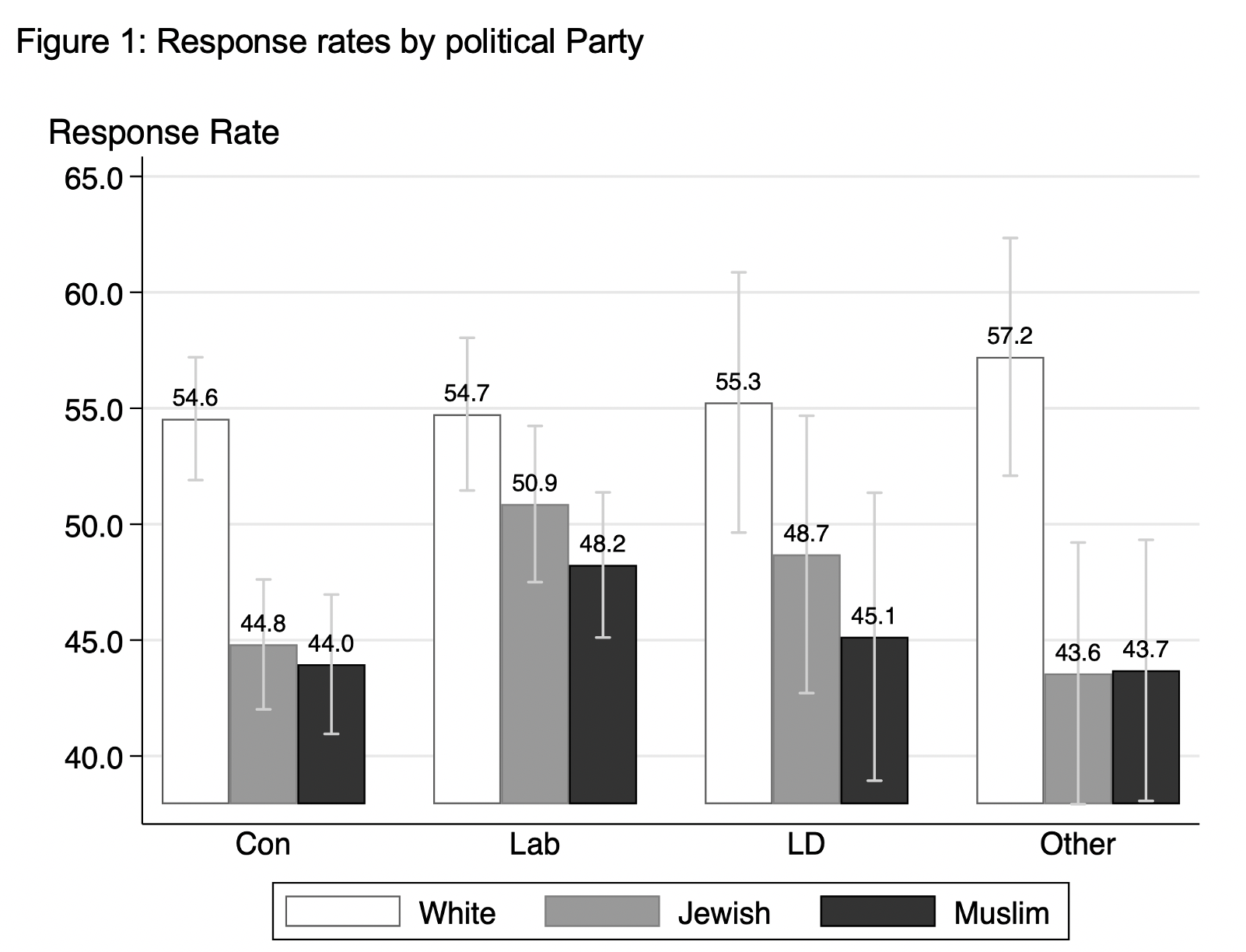
We set out to gather some evidence on the extent of bias by local politicians against their constituents, using a correspondence experiment. We sent ten thousand emails to councillors with a quick question, and randomised whether they came from a stereotypically Christian name (Harry or Sarah White), Jewish name (Levi or Shoshana Goldstein), or Muslim name (Mohammad or Zara Hussain). We kept the email short in order to minimise the burden placed on our busy objects of study.

Response rates were six to seven percentage points lower to the Muslim and Jewish names – a clear evidence of bias. We don’t however see more bias against Jewish names by Labour councillors. Neither do we see more bias against Muslim names by Conservative councillors. Such discrimination in the provision of services based on race or religion is against UK law.  This form of discrimination by councillors may have substantive impacts for constituents. For example councillors set policy on access to the limited supply of social housing, policies which have been documented to disadvantage ethnic minorities.

Note: Response rates are estimated after removing council fixed effects, and standardising residuals to a response rate equal to the sample average of 55 percent for whites. Bars represent 95 percent confidence intervals.

In total we received 5,093 responses to 9,994 queries sent, for a 51% response rate. This is almost identical to the response rate found by a survey of real requests to councillors, in which 51% received a response within two weeks. Amongst those who responded to our queries, the median time to response was 12 hours, and the median length of responses was 228 words.

Compared to the male Christian name (Harry White), response rates to Jewish names are 5-6% points lower, and 6-9% points lower to Muslim names. Response rates are marginally higher to the female Christian name (Sarah) than to the male Christian name (Harry). Response rates are also higher to Zara Hussain than to Mohammad Hussain.

Name or Religion?

We randomise each councillor to receive one of two email scripts. The first email script makes a simple request in line with basic councillor responsibilities – ‘I have a question about local services and was wondering if you could tell me when your surgery is held?’. The second request explicitly indicates the religion of the emailer – ‘I’m  interested in organising a sponsored  walk in the local area to raise money for [Christian Aid/Islamic Relief/Global Jewish Relief]. Could you advise me if I need to get some kind of permit?’.

The two email scripts can be seen as different levels of intensity of the treatment. The response rate for white names to the first email was 61%, and 45% to the second email. Bias in response rates is similar across the two types of emails. This suggests that the discrimination occurs based on the name of the sender alone. Due to the high volume and low cognitive effort of checking emails, by not replying, councillors may be acting unconsciously when exposed to non-Christian/minority group names. Alternatively, councillors may simply be consciously discriminating against minority constituents, irrespective of their degree of self-identity. Because the identity of the sender is present in the email address itself, councillors might choose to not even open the emails from names associated with minority groups.

What explains the bias?

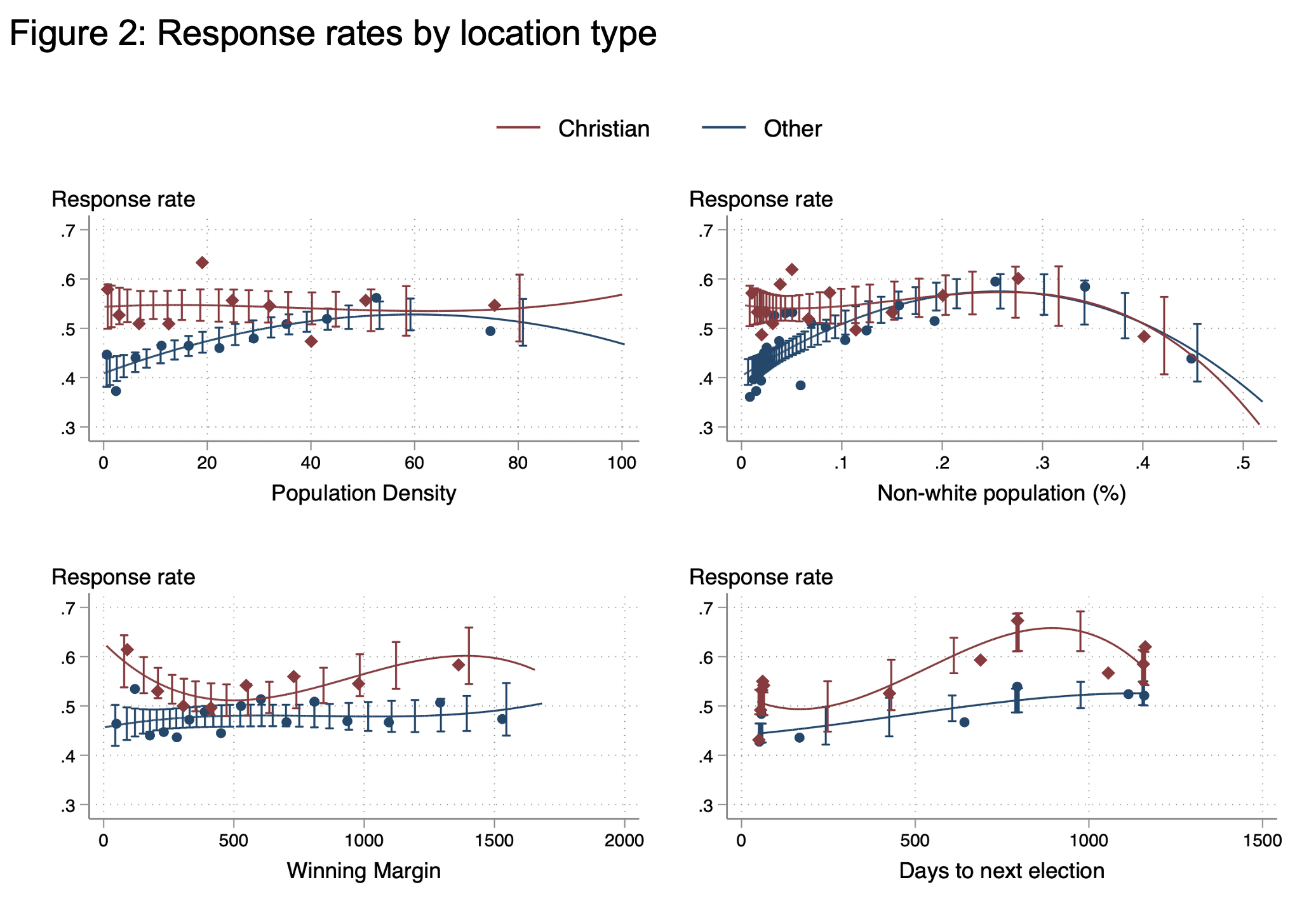
Bias in response rates is largest against Jewish and Muslim names in the least densely populated rural locations, with small non-white populations (Figure 2). One reason for this could be that councillors in white areas are more likely to be white themselves. On average we see much lower bias by councillors with names estimated to be Jewish or Muslim (though these estimates are imprecise due to the small number of such councillors). There may also be other differences in the selection of candidates with different levels of unobserved racial and religious bias in rural and urban areas. Alternatively, councillors may respond to political incentives and be less likely to respond to minorities in locations where minority groups are a small proportion of the electorate.

We test responses to electoral incentives directly by showing the relationship between response rates and two measures of competition – the margin of victory at the last election and the number of days until the next election. We see now less bias in close elections. Finally, lower bias could be attributed to the degree of ‘contact’ councillors have with different minority groups. Councillors in more diverse urban locations may show less discrimination through an erosion of prejudice as described by the contact hypothesis, though we are unable to test this hypothesis directly.

Note: The top-left figure shows a binned scatterplot of response rates against population density, by whether the sender name was Christian or non-Christian. The top-right figure shows response rates against the non-white population share. The bottom-left shows the response rate against the winning margin of the elected councillor at the last election. The bottom-right shows the response rate by the number of days until the next election. Fitted lines are polynomial regressions of order three, with bars showing 95 percent confidence intervals. Population density and non-white population shares are calculated at the ward (sub-council) level from 2011 census data. On average there are three councillors in each ward. Population density is expressed as residents per hectare.

Conclusion

We find evidence for bias from local politicians in response to requests for basic information from ‘Jewish’ or ‘Muslim’ constituents. Despite the media narrative of anti-Semitism in the Labour party and Islamophobia in the Conservative party, our results suggest that both parties are equally discriminatory to both minority groups. This discrimination seems to occur based on names alone, and is unchanged by the explicit identification of religious identity. These effects are largest in rural areas (with low population density) and with small non-white populations. Councillors in such areas may have fewer opportunities for positive interactions with minority groups.

This work demonstrates that even access to basic services are susceptible to forms of discrimination, and that minority group members may struggle to be heard through this process. Reducing councilor bias could be attempted through training designed to reduce implicit prejudice. The leader of the Labour Party has announced the party’s commitment to undergoing this type of training, though more research is needed into the effectiveness of such training. Future studies may benefit from further investigating the process through which politicians engage with their community, and identify ways in which to reduce these biases.

Lee Crawfurd and Ukasha Ramli measure the responsiveness of elected local representatives to requests from putative constituents from minority religious groups. They find that response rates are six to seven percentage points lower to stereotypically Muslim or Jewish names, with Labour and Conservative councillors both showing equal bias towards the two. Their results suggest that the bias may be implicit and that it is lower in more dense and diverse locations.

Source: How anti-Semitic and how Islamophobic are local politicians?

David Feldman: The UK government should not impose a faulty definition of antisemitism on universities

On the risks of universities applying the IHRA definition of antisemitism:

We all know how the path to hell is paved. But it is a warning worth repeating for Gavin Williamson. The secretary of state for education intends to rid universities in England of antisemitism, but his intervention not only threatens to provoke strife and confusion – it also places academic freedom and free speech on campus at risk.

In October, Williamson wrote to all university vice-chancellors “requesting” they adopt a particular definition of antisemitism: the “working definition” promulgated by the International Holocaust Remembrance Alliance (IHRA) in 2016. Williamson is not the first ministerto write to universities on this matter, but he has been more forceful than his predecessors. His letter demands action by Christmas, and threatens swingeing measures against refusenik institutions that later suffer antisemitic incidents. He threatens to remove funding and the power to award degrees from universities that do not share his faith in the efficacy of the IHRA working definition.

This is misguided, for a number of reasons. First, it misconceives the task universities face. As shown in a report released last week by Universities UK – Tackling Racial Harassment in Higher Education – structural racism in universities is profound, and racial harassment on campus is widespread. These are problems that universities must address. The imposed adoption of the IHRA working definition will not meet this challenge. It will, however, privilege one group over others by giving them additional protections, and in doing so will divide minorities against each other. For this reason alone, Williamson should pause and consider how best to protect students and university staff from racism broadly as well as from antisemitism.

How Did Hasidic Jewry Become a Stronghold of Trumpism?

Of interest:

Is American Hasidism in crisis? After successfully rebuilding its institutions after the war, Hasidism in America has flourished. And yet, its response to COVID and its newfound reactionary political populism, leads us to ask the question: is something changing in contemporary Hasidism that’s worth examining more closely?

Much has been written lately about the politicization of the Hasidic world in America, particularly its full-throttled support of Donald Trump. In fact, Hasidic voting patterns now closely resemble those of evangelical Christians. Scholars and pundits have weighed in on this surprising political activism in a community that usually keeps a low profile and focuses on its internal needs. And this activism has become even more visible as Hasidic communities have flouted health guidelines in the COVD crisis and made a public health issue into a political one. While the fact of these phenomena have been well documented, what are some of the underlying conditions that have contributed to a kind of “perfect storm” of populist reactionary Hasidic activism?

Part of what we’re witnessing in this new Hasidic populism is another stage of Hasidic Americanization in the wake of the loss of the last vestiges of European authority. The great Hasidic figures from Eastern Europe commanded intense devotion and respect from their communities, representing an authentic world destroyed in the Holocaust. Others emerged to take their place but it’s arguable that the weight of authority of these masters was not replicated in their American or Israeli born successors.

This isn’t to argue that these new rebbes haven’t commanded respect; they certainly have. It’s simply to point out that the force of their authority is diminished in comparison to those who arrived in America from prewar Europe. Eastern Europe was the fertile ground of Hasidic aristocracy. America, Mandate Palestine, and Israel, stood in its shadow. The loss of first-hand exposure to those halcyon years diminished Hasidism’s luster and authenticity. It continues, albeit in a different register.

If this is true, it’s worth considering how it contributes to a rise of the Hasidic populism that’s taken to the streets to express disdain for the government and its health mandates. It’s a complicated situation and is certainly the result of many factors. In one sense, this is a classic example of a popular revolution when individuals without much authority somehow evoke a rebellion against authority (think of Castro and Che in Cuba), be it religious or civil, by touching the nerve of a rapidly growing community in crisis coupled with a weakened stature of leadership.

The transformation of COVID from a health crisis to a political movement in the Hasidic world is a phenomenon that merits deeper study. When and why did this happen? Why and how did street protests against mask mandates and synagogue and park closings turn into Trump rallies in Hasidic Brooklyn? It’s true that Trump espouses conservative values that many Hasidim identify with, but so did Ronald Reagan and he didn’t enjoy such passionate support. And Reagan arguably did more for Hasidim than Trump ever did when, in 1984, he granted them “disadvantaged minority status” enabling them to apply for federal funding for businesses.

Whether, in fact, this speaks to a significant shift in Hasidism’s politicization or not remains to be seen. What I’m pointing to here is the rise of a populist mind-set where a rabble-rousing radio talk show host and Hasidic outsider like Heshy Tischler, who has no authoritative role in the community whatsoever, can attract the attention of young Hasidic boys and compel them to take to the streets.

One could view this as a positive manifestation of the growing autonomy of these communities and their increased involvement in public political life. And yet, as I will suggest below, an unreconstructed Hasidism will invariably—and, given theological considerations, understandably—be attracted to a reactionary political agenda and autocratic leadership.

The Americanization of Hasidism 

Hasidism rose from the depths of Jewish traditional society in Eastern Europe during a tumultuous time. The Napoleonic Wars were changing the map of Europe, autocratic rule was slowly transforming into early stages of tolerance and later democracy. Emancipation may still have been decades away, but encroaching modernity from the West was making inroads into the traditional Jewish world, attracting some of its most talented youth.

In some way, Hasidism was both a rebellion against the internal autocracy of the rabbinic elite and the modernizing mind-set of the enlightenment (haskala). It made a play for both power and piety in a very unstable period. Among the challenges of a nascent Hasidic world was one of political alliances; in one case between Napoleon and the freedoms he promised, and in the other, Czar Alexander I and an autocracy that allowed Jewish enclaves to continue their traditional lives.

Similar debates made their way westward questioning whether emancipation was good for the Jews; that is, whether the modernization that accompanied the promise of freedom ultimately threatened the Jewish tradition. As told by Chaim Heilman in his Beit Rebbe, Shnuer Zalman of Liady offered a cogent assessment of the wager: if Napoleon wins, Jews will be materially successful but will suffer spiritually, and if Alexander wins, Jews will be materially impoverished but will spiritually flourish. Throughout its history, Hasidism has lived in the balance of that wager. It arguably filters through Hasidism’s entire negotiation with modernity. Perhaps until now.

America presented another way to understand this bargain. What we may be witnessing today is another layer of the complex process of the Americanization of Hasidism. The first stage may have been propagated by Eastern European Hasidic immigrants, many of whom were survivors of the Holocaust, in their initial reconstruction of Hasidic dynasties in America. Schneerson’s (Lubavitch) advocacy of a moment of silence in public school (supporting Jerry Falwell), his campaign to erect Hanukkah Menorahs in public squares, and his Noahide Law campaign to gentiles, all illustrate his deep belief in America.

And Teitelbaum’s attempt to secure public funding for special education in the yeshivot in the Satmar enclave, Kiryas Joel, speaks to the extent he too understood America as holding potential for his own religious vision. The Satmar enclave of Kiryas Joel isn’t a replica of something that existed in prewar Europe. It was, as David Myers and Naomi Stolzenberg write in their upcoming book, Teitelbaum’s American fantasy; an American shtetl.

In the street protests and general political activism in present day Hasidism we may be witnessing yet another iteration of Hasidism’s developing Americanism. While Hasidim have always supported political candidates and voted in relatively high numbers, most of the advocacy was primarily transactional; they supported candidates they thought could maximize their resources. In 2020, impromptu pro-Trump rallies in Flatbush and Boro Park, a pair of Brooklyn neighborhoods with high numbers of Orthodox Jews, illustrates a new kind of political populism seldom seen in communities that often prefer to stay out of the spotlight.

The question as to why Hasidim overwhelmingly supported an immoral, autocratic, and reactionary candidate with such verve and vigor is multivalent. One reading may have to do with a lopsided equation of integration. That is, on the one hand Hasidim are becoming politicized as a result of their developing Americanism, which values public political expression. At the same time, however, they haven’t revised their general worldview, which was built on earlier political realities, a theology and religious ideology founded on chosenness, and historic feelings of exclusion and resentment.

The “us vs. them” mentality that grew over time and the theology that informed traditional Jewish teaching in large part followed suit. In many ways the binary of “friend vs. enemy” plays into the Trump vision of America. Traditional Jews, like the Ultra-Orthodox Hasidim, have historically been attracted to strong autocratic leaders who shared their binary view of the world. In this sense, their support of Trump is predictable

The challenge of emancipation, or the “liberal social contract” with the Jews in Europe, required Jews to revise those ideological principles to become fully a part of larger society. Non-Orthodox Judaisms, Jewish secularisms, and to some extent Neo- and Modern Orthodoxy engaged this challenge in different ways. But American democracy demanded an even stronger revision.

American rabbi Mordecai Kaplan argued that chosenness simply could not survive American democracy intact. One cannot easily be full members of a democratic society and maintain a theologically exceptionalist status. He was right, until he was wrong. By the 1950s, sociologists talked of the “death of Orthodoxy” in America while Hasidism was just beginning to rebuild in this new land of tolerance—what Rabbi Schneerson called a “medina shel hesed” (a land of kindness). Whether and how Orthodoxy could bear the weight of American integrationism was an open question.

What the sociologists of the 1950s could not have predicted was the rise of the counter-culture that would re-frame America’s conformism into a multitude of expressions of difference, pluralism, and later, multiculturalism. This would not only save Orthodoxy but enable Hasidism to enter the public square with minimal ideological and theological revisions. Schneerson saw this in the 1960s more than any other American Jewish religious leader and his movement flourished, riding the wave of multiculturalism. One of the byproducts of the multicultural turn was the ability of more traditional Jewish communities, Hasidim among them, to maintain strict observance and retain their ideological and theological commitments while increasingly becoming a part of American society. By the 1960s, acculturation was no longer a prerequisite for integration. Hasidim entered the public square without having to pay much of a theological or ideological price. The “liberal social contract” no longer carried the weight it once did.

The problem, however, is that Hasidim entered the public square with their old-world chauvinistic and xenophobic inclinations intact and residual fears of the left stemming from the days when the left meant socialism in Europe and when Russia used communism as a tool to attack and demolish religion. Given Jews’ complicated relationship with race, and African Americans in particular, this fear easily transformed into a belief that the progressive left, in part in the BLM movement, was inherently anti-religious, and antisemitic. Interestingly, the antisemitism of the right seemed less threatening, perhaps more familiar, than the antisemitism of the left. Trump subtly exonerating the marchers at Charlottesville seemed less problematic than Linda Sarsour’s anti-Zionism. Even though they weren’t Zionists, “Jews will not replace us” seemed less threatening to the Hasidim than “Israel is a colonialist state.”

Another paradoxical twist in this story is that the antisemitism of the left today in America is largely targeting Zionism, which the Hasidim largely don’t support either, albeit for very different reasons. Thus, what’s emerged is a kind of Hasidic anti-Zionist pro-Israelism; tacit support for Israel as an act of tribal fidelity rather than any form of Zionism. Ask a Hasidic Jew touting Trump’s moving the US Embassy to Jerusalem whether he is a “Zionist” and he will think you’re crazy. Anti-Zionism has been part of the very fabric of Hasidic Judaism for a long time, even now in muted form. But somehow without abandoning that, they found a way to support Israel and deem left-wing anti-Zionism a form of antisemitism, while their form of anti-Zionism is protecting Judaism.

The Trumpization of Hasidic Jewry should not be surprising and it can be thought of as the byproduct of multiculturalism’s enabling. When Hasidic groups can enter the public square without compromising their theological and ideological commitments—that is, without a “liberal social contract”—they can easily be attracted to right-wing reactionary movements. They will support the Czar over Napoleon.

In earlier times, as Shneur Zalman of Liady suggested, they had to compromise their material wealth for the sake of spiritual survival. In America that’s no longer necessary. They can have both and in addition they can partner with a segment of the majority (white evangelicals) that has ostensibly found its own tacit acceptance of the Jews through its own version of Zionism. Just as Hasidim can be anti-Zionist and pro-Israel, evangelicals can be antisemitic and pro-Israel. It’s not very provocative to say that when Hasidic ideology, founded on the kabbalistic tradition, becomes politicized, it can easily support a kind of autocracy—as long as they are the beneficiaries.

On this reading, the origin of Hasidic Trumpism may be Schneerson himself. It was Schneerson who believed Hasidic Jews could enter the public square without sacrificing any of their ideological positions. He couldn’t have predicted Trump but he enabled the Hasidic support of a candidate not merely as Jews, but as “Americans,” while holding onto views that reflect a Jewish experience of the old world.

Schneerson’s success is undeniable, but we may be seeing the dark side of that success in Hasidic Trumpism. Chabad has been adept at presenting its Jewish vision in the form of a sweetened Judaism to non-religious Jews and to the world more generally. But the support of a political figure who expresses a different form of chauvinism is telling in regards to how the deep-seated ideological core of Chabad, and Hasidism more generally, remains operational.

Source: How Did Hasidic Jewry Become a Stronghold of Trumpism?

Genghis Khan’s memory is erased from view as China cracks down on Mongolian culture

Yet one more example of Chinese government repression of ethnic minorities:

One of history’s most influential figures has been drawn into a Chinese government campaign to impose ethnic conformity on people of Mongolian descent.

Genghis Khan, the 12th-century conqueror, has long been both an icon of the Mongolian people and a rallying figure for nationalists. Now he is becoming a symbol of Beijing’s new effort to put pressure on its Mongolian population, as authorities across the country are demanding greater adherence to a centrally defined notion of what it means to be Chinese.

Under President Xi Jinping, the Communist Party of China has made it harder for ethnic minorities to maintain unique languages, identities and belief systems – a policy that also includes a push to expunge foreign influences from religion, philosophy and schools. Genghis Khan’s standing among Mongolians has long made him a source of disquiet for the Chinese government. “Genghis Khan is a god in Mongolians’ minds,” said Ulzidelger Jagchid, an ethnic Mongolian from China who is now an activist living abroad. “The government fears that Mongolians, with this belief in a god, will come together and unite.” Beijing, he said, “wants to lower the position of Genghis Khan in Mongolians’ world.”Zoom/Pan

In Hulunbuir, a small administrative centre of China’s Inner Mongolia region, in the midst of sprawling grasslands, plaques describing the warrior’s exploits have been removed and defaced in the area around an oboo, a sacred site built around a stone from his birthplace. One rock formerly held a tablet with a quote from Anandyn Amar, a former Mongolian prime minister and independence advocate who called Genghis Khan a leader who had made the Mongolian people “famous across the Four Seas.” A series of other plaques, displayed until recently below a lengthy stone frieze depicting his birth and exploits, have disappeared; only their dark outlines remain on the concrete below.

It is not clear who is responsible or whether their removal was an instance of historical negationism or an act of protest against the government. Some plaques still on display show signs of having been painted over and subsequently cleaned. The propaganda office in Hulunbuir did not respond to a faxed Globe and Mail request for comment.

But the alteration and vandalism of a site devoted to Genghis Khan inside China comes after local authorities banned unilingual, Mongolian instruction in schools, supplanting it with bilingual – Mandarin and Mongolian – education that, people in Hulunbuir say, has dramatically reduced the classroom time devoted to a language that is still used in many homes. About 6.5 million ethnic Mongolians live in China today. Similar education policies have been used to enforce conformity in other areas of China with large culturally distinct minorities, including Tibet and Xinjiang.

The bilingual education policy prompted a rare series of public protests across Inner Mongolia this fall, with parents and students boycotting classes for more than a week in Hulunbuir. Authorities responded with arrests and firings. A number of Communist Party members were ordered to attend “the Party school for education and training.” When some refused, they were expelled from the Party.

It has been followed by other signs of a deepening crackdown on Mongolian culture.

Last month, the Château des ducs de Bretagne history museum in France postponed an exhibit about Genghis Khan and his empire that had been planned in partnership with the Inner Mongolia Museum in China. Before the exhibit could open, the French museum said, the Chinese Bureau of Cultural Heritage demanded changes, including the removal of the words “Genghis Khan,” “Empire” and “Mongol.” The bureau instead proposed its own plan for the exhibit, which sought “the complete disappearance of Mongol history and culture in favour of a new official narrative,” the museum said.

Schools in Inner Mongolia have continued to display Mongolian script, according to pictures seen by The Globe. But activists say images of Genghis Khan have been removed, although The Globe was sent a photo of a portrait that remains in one school in the region.

Communist China has gone to war with Genghis Khan before.

During the bloody tumult of the Cultural Revolution, worship of the Mongol emperor was outlawed and some of his relics destroyed. Mao Zedong mocked him as a short-lived ruler who knew “no more than hunting eagles.” Subsequent Chinese policies have actually sought to recast and embrace him as a Chinese leader.

But for ethnic Mongolians, Genghis Khan remains very important, said a Mongolian woman in Hulunbuir, adding that all Mongolian families have an image of him in their homes.

The Globe is not identifying Mongolians in Hulunbuir because those who criticize government policy in China face serious reprisals.

At least two museums in the region with Genghis Khan and Mongolian culture exhibits are currently not open to visitors. In Manzhouli, the Zhalainuo’er Museum says it is doing renovations in response to a forest fire that took place Oct. 1 near a city almost 1,400 kilometres away. In Ordos, the display halls at the Mausoleum of Genghis Khan are also closed. A worker said infrastructure upgrades are under way. Outdoor areas with religious significance remain open.

Another museum dedicated to “The Secret History of the Mongols,” which state media called the only museum of its kind when it opened last year, says it only accepts pre-screened visitors.

In Hulunbuir, classes have resumed. An apparently new police station now sits outside the gate of a local middle school. Large characters on an electronic sign inside proclaim: “10,000 people of one mind, unity is strength.”

But resentment simmers.

One young Mongolian man in Hulunbuir said – in flawless Chinese – that when he was a student, classes were conducted entirely in Mongolian and that Mandarin was a minor subject. Many families still sought Mandarin lessons for their children because the language offered better employment prospects.

Now, however, there is no way to resist a government intent on enforcing a single vision of what it means to be Chinese, the young man said.

But what can’t be taught in school can be taught at home, he said, vowing to raise his future children with a knowledge of their ancestral tongue.

“Maintaining the Mongolian language to me is a must. It’s a symbol of our people,” he said.

Genghis Khan, meanwhile, remains a spiritual ballast, he said.

Source: https://www.theglobeandmail.com/world/article-genghis-khans-memory-is-erased-from-view-as-china-cracks-down-on/?utm_medium=email&utm_source=Morning%20Update&utm_content=2020-12-2_6&utm_term=Morning%20Update:%20Trudeau%20open%20to%20more%20health%20care%20funding%20as%20premiers%20criticize%20fiscal%20update&utm_campaign=newsletter&cu_id=%2BTx9qGuxCF9REU6kNldjGJtpVUGIVB3Y

#COVID-19: Comparing provinces with other countries 2 December Update

Main news continues to be with respect ongoing sharp spike in infections along with death rate increases:
 
Weekly:
 
Infections per million: Alberta ahead of Germany, Japan ahead of Australia
 
Deaths per million: British Columbia ahead of Philippines, Canadian North ahead of Japan
 
COVID Comparison Chart.002COVID Comparison Chart.003
 

Groundbreaking investigation shows ‘pervasive racism’ against Indigenous people in B.C. health-care system

Of note:

Racism against Indigenous people is pervasive in British Columbia’s health-care system, concludes an investigation that is being touted as the first complete review of racism in a Canadian medical system.

It’s racism that is hurting the health of Indigenous people and leaving them more harshly affected by health crises in the province, including the opioid crisis and the COVID-19 pandemic, finds the newly released report.

“What it looks like are abusive interactions at the point of care; verbal and physical abuse; denial of service,” Mary Ellen Turpel-Lafond, a well-known Indigenous lawyer and former B.C. advocate for children and youth, who led the investigation at the request of the provincial government, said Monday.

“We have a major problem with Indigenous-specific racism and prejudice in B.C. health care.”

Turpel-Lafond said her team’s recommendations could provide a blueprint for the rest of the country for rooting out racism and discrimination.

The B.C. probe was initiated in June, after B.C. Health Minister Adrian Dix said he found out about allegations that health-care workers in an emergency room had played a game in which they guessed the blood-alcohol level of largely Indigenous patients before they received treatment.

Métis Nation British Columbia told CBC that health-care staff called the game “The Price Is Right.”

Turpel-Lafond said the investigation did not find evidence of an organized “Price is Right” game, but that it unearthed an even more insidious picture of a system rife with racism and prejudice, that is making the B.C. health-care system an unsafe place for Indigenous people to seek care.

The report, called In Plain Sight, is based on input from 9,000 people, including Indigenous people and health-care workers.

Turpel-Lafond said a second report, a data-analysis of Indigenous-specific health outcomes, will be released in the next month.

The report’s 24 recommendations deal with implementing systems and cultural expectations to root our implicit and explicit racism in B.C.’s health-care system, including the creation of a B.C. Indigenous officer of health and an associate deputy minister of Indigenous health at the provincial government.

Dix on Monday offered an “unequivocal” apology for the findings of racism in the report, and vowed to implement recommendations immediately, including by introducing new Indigenous health liaisons in each of the province’s health authorities.

Indigenous leaders were quick to express their support for the recommendations, saying they were especially urgent in view of the ongoing pandemic.

“There is no time to wait; the current COVID-19 pandemic necessitates constant engagement by First Nations with the health care system, and we categorically demand a safe health care system for our people at this time and going forward,” reads a portion of a statement by the First Nations Leadership Council.

The treatment of a Quebec woman in hospital earlier this year also served to highlight the barriers Indigenous people face to getting care.

Joyce Echaquan, an Atikamekw mother of seven, died soon after she filmed herself from her hospital bed in late September while she was in clear distress and pleading for help. Toward the end of the video, which was streamed live, two female hospital staff enter her room and are heard making degrading comments, including calling her stupid and saying she’d be better off dead.

The video has created widespread indignation, several inquiries and a lawsuit from Echaquan’s family against the hospital where she died in Joliette, Que.

Source: Groundbreaking investigation shows ‘pervasive racism’ against Indigenous people in B.C. health-care system

‘Institutionally racist’: NZ security agencies were Islamophobic and ignored right-wing threat – Muslim group

Of note. Valid and necessary of course to await the inquiry’s final report:

New Zealand’s security agencies were “institutionally racist and Islamophobic” and ignored the rising threat of right-wing extremism because it was instead focused on Muslim terrorism, a Kiwi Islamic organisation says.

The Federation of the Islamic Associations of New Zealand (FIANZ) yesterday publicly released its submission to the Royal Commission of Inquiry into the March 15 terror attacks.

It investigated how the New Zealand Intelligence Community [NZIC] didn’t foresee the threat of right-wing extremism despite rising attacks overseas and the Muslim community here feeling increasingly unsafe.

“We asked for help. We knew we were vulnerable to such an attack. We did not know who, when, what, where or how. But we knew,” the report said.

A team of researchers pored over a decade of media reports, speeches in Parliament, public addresses, online forums among other sources to establish how the threat had been ignored.

It concluded security organisations were institutionally racist, Islamophobic, incorrect and misled the public.

“We are not trying to generate any hate, we are just trying to give the facts as we see them. The problem is much deeper than that,” said Abdur Razzaq Khan, who chaired the federation’s submission to the Royal Commission.

The federation said Muslim communities were left “defenceless” because of “systemic failures” of diversity at the security organisations which failed to properly engage with Muslim communities.

The report pointed to numerous examples of the director-general of security Rebecca Kitteridge wrongly framed terrorism as a “Muslim issue” rather than seeing the community as potential victims.

Their submission included a speech from Kitteridge in 2016 at Victoria University where she said New Zealanders “can walk the streets free from fear” of events like Paris, Brussels, Ottawa, London and Sydney which were all perpetrated by Islamic radicals.

She did not mention the events of Oslo, Quebec, Pittsburg or Macerata which were orchestrated by right-wing extremists.

It was not until mid-2018 that agencies began assessing the threat of right-wing extremists, the report said.

But Khan said they did not blame any individual for the “failings”, or say that the NZIC was staffed by white supremacists or individuals with anti-Muslim bias.

“This is not the fault of any individual – this is the culture of Islamophobia.”

The NZSIS was extremely capable and if they had focused on finding right-wing extremism, they would have found the Christchurch terrorist.

“This rat would have easily been identified if they were looking – but they weren’t looking.

“They are very good, they searched out those Muslims who were searching out objectionable material and they prosecuted.”

The federation also found the Christchurch mosque attacks terrorist would never have been able to obtain a firearm if proper procedures were followed because two of his referees did not meet police criteria.

In order to avoid a terror attack happening again, the federation recommended criminalising hate crimes, denying right-wing extremism, establishing a Ministry of Super Diversity, improving how media portray Muslims, and better training for the police and security agencies.

The New Zealand Intelligence Community said it could not respond to specific claims until the Royal Commission’s report was released on December 8. The 800-page report has been presented to the Government.

Prime Minister Jacinda Ardern said she wanted the public to see the report before “launching into the discussion” on whether New Zealand’s security agencies had failed.

Source: ‘Institutionally racist’: NZ security agencies were Islamophobic and ignored right-wing threat – Muslim group

BlackNorth Initiative calls for ‘too white’ Order of Canada to ‘reflect the deep cultural mosaic of our country’

While the overall point of under-representation of visible minorities and Black Canadians in particular is factually correct, Wes Hall does not appear to understand how the Order selection process works. It is based upon nominations, which are reviewed by the selection committee which makes the recommendations, for the formal approval of the Governor General.

Rather than calling on the Governor General, the correct and more effective approach is to ensure more nominations of visible minority and other under-represented groups.

Proposing the nomination of dead Canadians is a non-starter as this would have to be open to all and most award programs are for the living, not the deceased, the most prominent being the Nobels.

Recognition of Viola Desmond on the $10 bill is both more significant and more appropriate.

In doing the background research for the chart above (and associated deck https://multiculturalmeanderings.com/wp-content/uploads/2020/12/order-of-canada-2013-20-diversity-1.pdf ), the Governor General’s office provided with earlier gender data that showed that the selection committee made an effort to improve women’s representation: while only 26.9 percent of nominations were women, 32.6 percent of appointments were women (2010-14 data):

The BlackNorth Initiative has spoken out about the racial gap in home ownership among Black people, the lack of Black people in boardrooms — and now it has turned its attention to one of the country’s highest civilian honours: The Order of Canada.

In a letter to Julie Payette, Canada’s Governor General, whose office hands out the awards, the initiative points out that only one Black Canadian was included out of the 114 recipients in 2020.

“If the Order of Canada is truly meant to reflect our country, then why do we not honour, dignify and celebrate the contributions of countless Black Canadian leaders who have pre-eminence, national and international service, and achievement?” asks the letter, signed by the initiative’s founder and chairman Wes Hall.

“The problem is that the vast majority of those 7,000 people who have received the Order are white and do not reflect the deep cultural mosaic of our country, especially Blacks.” 

Hall is also the executive chairman and founder of Kingsdale Advisors, which advises many of Canada’s large publicly traded companies. Hall says his experience working as a Black man in Canada led to many business leaders reaching out to him, resulting in the BlackNorth Initiative.

“I’m curious to see the reaction to this letter,” he said in an interview with the Star. “Our job is to keep shedding light on the systemic racism in our society, and hope they change their process.” 

The letter makes a number of recommendations, including the investiture of five Black Canadian leaders: businessman Michael Lee-Chin; athlete and Olympic gold-medallist Donovan Bailey; lawyer Robert Sutherland (born in Jamaica in 1830, died in Toronto in 1878); businesswoman and activist Viola Irene Desmond, who died in 1965; and social worker and Canada’s first Black MLA, Rosemary Brown, who died in 2003. The latter three have died, and the Order of Canada isn’t awarded to people posthumously — they’re given to living people. 

Hall says this was deliberate. He points out that the only 2020 Black recipient, B. Denham Jolly — who was awarded for his contribution to the promotion of equality and opportunity within the Greater Toronto Area — is already 85.

“I could die tomorrow, and no one would know about my accomplishment to society,” said Hall. 

He points out in the letter to Payette that, since 2013, only 4.8 per cent of the Order of Canada appointments are made up of visible minorities, “well below the 30 per cent of the population who identified as visible minority.”

“71.4 per cent of appointees in 2019 were men. The low number of women among the 2019 appointees — just 28.6 per cent of the total — and the low number of visible minorities — just 5.4 per cent — show the Order of Canada falling short of representing Canada’s diverse population,” the letter reads. 

Accusing the Order of Canada of forgetting countless Black Canadians, the letter urges Payette to do the “right thing.” 

“This chronic lack of recognition of Black Canadians must end. The time is now to set a path forward to equality, equity and justice for Black Canadians.”

Source: https://www.thestar.com/news/canada/2020/12/01/blacknorth-initiative-calls-for-too-white-order-of-canada-to-reflect-the-deep-cultural-mosaic-of-our-country.html