Ironic Bonokoski article given that much of Sun/Postmedia commentary reinforces the belief that mainstream media has a left-wing bias (of which, of course, Postmedia is part):
The non-partisan think tank the Macdonald-Laurier Institute (MLI) has launched an essay-writing contest for students, claiming the “dominant mainstream media narrative seems to offer a single, simplistic, politically biased view to represent all people of colour on the most important political and cultural issues.”
It cited no example of that bias.
The contest rules don’t implicitly say that ‘white people need not apply’ but it is certainly inferred that white students would not have the world or personal experience to address the issues.
“A diversity of opinions from individuals with different backgrounds represents a strong measure of a successful democracy,” said MLI Senior Fellow Jamil Jivani.
“Young Canadians deserve to be heard, especially those whose opinions are often left out of public debate.”
This essay competition, says MLI, is part of the institute’s Speak for Ourselves project, which “seeks to amplify the views of people of colour whose dissent from mainstream narratives might leave them without a platform for expressing their opinions.”
The contest winner — with essays limited to 750 to 1,000 words and open to students 25 and younger — will receive a $1,500 prize and have their essay published in MLI’s Inside Policy magazine.
According to MLI Munk Senior Fellow Shuvaloy Majumdar, “Supporting true diversity and inclusion is much more important than succumbing to the narrow ‘culture war’ debate being perpetuated in much of society.”
As Jivani notes, successful submissions will be those that provide “a unique and compelling argument or commentary on issues of race, racism, and diversity — the kind of argument you might not read in the opinion sections of Canada’s major papers or in a university classroom.”
The deadline for submissions is midnight Nov. 29.
The World Economic Forum recently put out a paper on the need of the media and entertainment industries to expand diversification, stating that it opens the door to increased profits.
“Diversity, equity and inclusion (DE&I) has recently become one of the most trending topics in the media and entertainment industry,” said the forum.
“But embracing diversity isn’t only about doing the right thing.
“Analysis shows that ethics and profits are two sides of the same coin. There’s financial logic to making sure that content — and those who create it — are authentically and inclusively representative of today’s society.
“For example, movies that lack authentic and inclusive representation underperform by around 20% of their budget at the opening weekend box office.
“In advertising, 64% of consumers in a Google survey said that they had considered buying or had made a purchase after seeing an ad that they considered diverse or inclusive.
“Similarly, other sectors have sizable untapped opportunities from increased diversity and inclusion.
“However, true diversity includes diversity of thought and, in this respect, minority communities are as diverse as any other communities in our country,” says the Macdonald-Laurier Institute.
“This essay competition is an opportunity for students across Canada to challenge the dominant mainstream narrative on race and racism in Canada.
“Reflecting from a place of personal experience is encouraged and, in doing so, a successful essay will exemplify true diversity — the diversity of thought — in our country,” it offers.
“This is to say, the winning essay will be one that provides a unique and compelling argument or commentary on issues of race, racism, and diversity — the kind of argument you might not read in the opinion sections of Canada’s major papers or in a university classroom.”
After trying to moderate her image for months, far-right leader Marine Le Pen went back to basics by casting a national conversation about immigration as a battle for the soul of France and renewing a pledge to hold a referendum on the issue if she defeats Emmanuel Macron next year.
“The April 2022 election will be about our civilization,” Le Pen said during a press conference on Tuesday. “Will France remain France, or be brushed aside by the uncontrolled torrent of massive migration flows that will wipe out our culture, our values, our way of life.”
Le Pen said she’d consult the French about changing the constitution to “drastically” reduce immigration. She pledged to introduce a law that will prevail over international treaties and allow her to breach European Union legislation if a majority of citizens backs the idea.
“What we are offering is a ready-for-use solution,” she said.
Several presidential hopefuls on the traditional right are seeking tougher rules on who is allowed to live in the country, including Michel Barnier and Xavier Bertrand.
And though Macron ran as a centrist in 2017, he has since become more conservative and his government has also talked about the need to control immigration. On Tuesday, it said it will reduce the number of visas granted to Algerians, Moroccans and Tunisians to protest their countries’ refusal to facilitate the return of nationals in “an irregular situation” in France.
But Le Pen’s harsher tone may be more the result of the threat posed by ultra-right media personality Eric Zemmour, who has been publicly toying with a run. He has previously demanded a referendum to overhaul immigration law as well as a short-term moratorium on entries. He links immigration to terrorism.
Le Pen is placing second in surveys of voting intentions, after Macron, though polls show support for Zemmour rising and cutting into her voter base. If Zemmour joins the crowded contest, he’d likely increase the chances Le Pen would be knocked out of the second round and throw the race wide open.
During the press conference, Le Pen said she wants to make it illegal for people from different countries to live in closed communities as a way of preserving their traditions and ban undocumented people from regularizing their situation. The Schengen accord, which allows free circulation for people in Europe, would need to be renegotiated, she said.
Good reminder of the importance of considering socio-economic factors along with racism, bias and discrimination:
“He thinks there’s no systemic racism.” No, it’s just that I think we overstate its role in American society today. “But what about redlining? What about the cops? Can he really …?” Yes, he can — because things like that just aren’t as simple as we are taught to suppose. One recent study of redlining is Exhibit A. First, some background: Redlining was a policy in which certain neighborhoods — coded in red on maps — were considered too risky for mortgage lending. In a great many American cities, Black people were essentially corralled into these red zones, unable to build equity in better housing found elsewhere. Redlining is now widely seen as a major justification for reparations for Black Americans, especially in light of Ta-Nehisi Coates’s famous Atlantic article, “The Case for Reparations.” In Evanston, a suburb of Chicago, the City Council in March approved a plan to pay out $25,000 grants for home repairs, down payments or mortgage payments to Black people who suffered housing discrimination or whose family lived in the city during the years of active redlining. However, as with so many matters of race, the redlining story is more complicated than many know. For one thing, there’s the matter of how many white people owned homes and lived in the redlined areas. An interesting National Bureau of Economic Research working paper by the economist Price V. Fishback and co-authors matched households in the 1930 and 1940 censuses to their locations in neighborhoods in “residential security” maps of 10 major Northern cities produced by a New Deal mortgage entity, the Home Owners’ Loan Corporation. The researchers found that white people accounted for 82 percent of individuals living in the lowest-rated areas. White people also owned 92 percent of the homes in these areas. The Home Owners’ Loan Corporation made a higher share of its loans to Black people than the other lenders at the time (a better-known New Deal agency, the Federal Housing Administration, insured a substantially smaller share of Black mortgages). I know where you may think I’m going. One approach to this data is to say that redlining was about class, not race, and treat it as a refutation of arguments such as Ta-Nehisi Coates’s. But not so fast. Black people were still represented disproportionately in the lowest-rated neighborhoods: More than 97 percent of Black people — in other words, almost all of them — rented or owned homes in redlined neighborhoods in the 10 cities surveyed. One reason for that was almost all Black people were poor, a disproportion due certainly to manifestations of other forms of racism at the time and historically. And this disproportionate representation in redlined communities helped keep them poor. Plus, there is plenty of anecdotal and fragmentary evidence that people working on the ground for the F.H.A. and the Home Owners’ Loan Corporation had not only classist but also racial biases. And of course within neighborhoods, homeowners themselves openly barred Black people from becoming neighbors via the racially restrictive covenants memorably depicted in Lorraine Hansberry’s “A Raisin in the Sun” (I recommend Charles Shields’s forthcoming Hansberry biography).
However, the Redlining 101 story — that cigar-chomping bigots in suspenders drew lines around where Black people happened to live while giving loans to poor whites — doesn’t fully hold up. I am not arguing that systemic racism isn’t real overall, but rather I am scrutinizing one commonly addressed case of it to show that the facts are more complex than they seem. Namely, large numbers of poor whites — recall from above, some four-fifths of the people living in redlined neighborhoods in the cities surveyed by the study I cited — dwarfed the numbers of Black people and were stuck in the redlined neighborhoods too, getting old and having to move in with their grown kids elsewhere as the neighborhoods fell apart. We just don’t hear that part of the story. Nor do we tend to hear that the cops kill vastly more white than Black people. Or, if we do, the issue of disproportion comes up, just as it must on redlining. But then comes poverty — leaving us again with a more complicated picture than many seem to find convenient. In 2020, a plurality of the more than 1,000 people shot and killed by the police, according to data compiled by The Washington Post, were white (459); Black people were about a quarter. That is typical year after year. From these statistics some people might wonder why we consider killings by cops a Black problem. But not so fast. Black Americans account for about 13 percent of the country’s population, but they are more than two times as likely as white Americans to be fatally shot by police officers. This must be attended to, even if it isn’t that Black men are all, or even most, of those killed. The disproportion is typically taken to suggest that racism leads cops to value our lives less. So: Just as racism was why most Black people lived in redlined, even if mostly white, neighborhoods, racism is why Black people are killed by cops disproportionately, even if they kill more white people numerically. Right? Yet poverty is germane in the police-killing case as well. Black Americans are two and a half times as likely as white Americans to be killed by cops, and also more than twice as likely to be poor. And crucially, as a report on policing, poverty and racial inequity in Tulsa makes clear, policing is concentrated in poorer neighborhoods, which are more frequently communities of color and which receive more frequent calls for service. And the horrors of modern “war on crime”-style policing are focused on poverty.
Just as racism certainly operated within the housing loan system, racial bias certainly operates within policing. Solid evidence shows racial bias in who gets pulled over (Black people are less likely to be pulled over after dark, when the driver’s race is harder for officers to discern), searched (the bar for searching Black drivers is lower than that for searching white drivers) and verbally abused.
Yet data also suggests that when it comes to police shootings, with all factors taken into account, such as whether the suspect was armed and whether the officers had just cause to fear for their lives, cops kill white people in greater numbers than Black people, but they kill Black people to a disproportionately far greater degree. White cops may not like Black people much in many cases — and they show it — but when it comes to ending Black lives, just maybe we can open up to the possibility that they hold back on resorting to shooting just as much as they do with white men? That was the finding of the Harvard economist Roland Fryer, who in 2016 found that while Blacks were more likely to experience some form of force in their interactions with the police after they were stopped, there was no racial bias when it came to officer-involved shootings. Overall, the Cops and Black People 101 story — that police officers casually mow down Black men while letting white men pass with a summons or a slap on the hand — doesn’t hold up. Many more white men than Black men die at the hands of cops. We just don’t hear that part of the story very much. So on that gloomy old map you see illustrating articles about housing bias, most people living within the redlined perimeter were likely white, according to the National Bureau of Economic Research study, but we don’t hear that part of the story either. None of that means that racism hasn’t existed or doesn’t exist. But it also suggests that socioeconomic factors matter as well, and a lot. This is a point made by the historian Touré Reed, who wrote an important book to this effect; his father, the political scientist Adolph Reed Jr., is of similar mind, as is the historian Barbara Fields — all three want us to think more about class than “antiracism.” In a nutshell, one of my takeaways from redlining and shootings by the police is that alleviating Black poverty makes Black people less susceptible to ills that disproportionately befall those who are poor — ills in which racism surely plays a part, but my interest is in the fact that being poor makes you encounter these things so much more. Some will still prefer to focus their battle on racism, but no one is going to tell me that focusing more on poverty is anti-Black or disloyal.
The conservative cancel culture panic over “critical race theory” in schools is continuing to spread. But while some school districts are correctly pointing out that CRT is not taught in their system, anti-CRT forces have expanded their objections so broadly that defining the controversial academic disciplinehardly matters any more.
Tennessee is one of several states that has laws banning CRT from schools, and a chapter of Moms for Liberty, led by Robin Steenman (whose child attends private school) has been reporting the schools of Williamson County for violating the gag rule. But the spreadsheet of objections seems to fall far outside the issues of historic and systemic racism in the US. Objections include books about poisonous lizards, Johnny Appleseed, Greek and Roman mythology, and owls. One respondent objects to a book about Galileo because there is no “HERO of the church” to contrast with their persecution of the astronomer. This group has also objected to a book about Ruby Bridges because it offered no “redemption” for the protestors who screamed at a child trying to go to school.
But the anti-CRT movement is increasingly broadening to attack anything that conservative parents don’t like in schools. The theory is that while CRT may not be explicitly taught in schools, it has seeped in. Florida Citizens Alliance talks about “the many tentacles” of CRT, including words like “equity” and “diversity.” Textbooks including “culturally sensitive teaching” are widely considered CRT red flags by anti-CRT groups. Parents Defending Education offers a blanket condemnation of all “woke” policies.Nevada Family Alliance worries that schools are indoctrinating students to “lead the effort to accomplish ‘social justice.’’ State-level efforts to solicit complaints in Idaho and North Carolinaturned up complaints about LGBTQ issues and students being forced to watch CNN. Christian Post complains about the “religious adherents to the new cult of Diversity, Inclusion, and Equity.”
Wisconsin’s Assembly has joined the list of state bodies passing gag laws forbidding certain sorts of speech, and the list of forbidden ideas is grown far beyond the boundaries of actual critical race theory. Bill co-author Chuck Wichgers testified that
“the bill would ban the teaching of concepts including “Social Emotional Learning,” “Diversity, Equity and Inclusion,” culturally responsive teaching, anti-racism, conscious and unconscious bias, culturally responsive practices, diversity training, equity, microaggressions, multiculturalism, patriarchy, restorative justice, social justice, systemic racism, white privilege, white supremacy and “woke,” among others.”
In addition, Wichgers testified to a list of additional terms and concepts that would be prohibited under the bill. The canceled concept list is almost 90 items long and includes anti-racism, centering or de-centering, critical pedagogy, equity, implicit bias, normativity, patriarchy, racial prejudice, systems of power and oppression, and woke.
Under the bill, school districts and charter schools would lose 10% of their state funding for violating the ban through either classroom instruction or professional development. This, even though no school in Wisconsin is known to be teaching critical race theory. Should this bill pass the Senate and survive a likely veto from the governor, future Wisconsin teachers will need an entire course just to learn what they are forbidden to teach about in their classroom.
Back in March, Christopher Rufo, a conservative activist who was at the fore of the anti-CRT movement, tweeted “The goal is to have the public read something crazy in the newspaper and immediately think ‘critical race theory.’ We have decodified the term and will recodify it to annex the entire range of cultural constructions that are unpopular with Americans.” That promise has apparently been fulfilled, as anti-CRT activists and legislators have redefined the term so broadly as to be nearly meaningless.
Hakan Demir smiled broadly as he stood in front of Germany’s majestic parliament building Tuesday, his first official day of work as a national lawmaker.
“My grandfather would have been mighty proud of me, and my parents are proud as well,” Demir, 36, said, taking a moment to remember his family’s roots in Turkey, from where his grandfather came in the early 1970s as an untrained “guest worker” to help build roads and houses in Germany.
The chamber now includes at least three people of African descent — up from one in the previous parliament. After years of stagnation, the number of female lawmakers also has gone up again, including two transgender women.
Among the newly elected immigrants is Awet Tesfaiesus, 47, the first Black woman to serve in parliament. Tesfaiesus, who fled from Eritrea with her family as a 4 year old, is a member of the Greens who was elected to represent the Werra-Meissner constituency in central Germany.
Other new Social Democratic lawmakers are Armand Zorn, 33, who was born in Cameroon and came to Germany at age 12, and Reem Alabali-Radovan, 31, the daughter of Iraqi migrants.
New parliament member Serap Guler, 41, of outgoing Chancellor Angela Merkel’s center-right Christian Democratic Union, is the German-born daughter of Turkish immigrants. She has served in recent years as deputy minister for integration in North Rhine-Westphalia state.
West Germany started recruiting “guest workers” from Turkey, Italy, Greece and later Morocco more than 60 years ago, to help the country advance economically. The workers were employed in construction, coal mining, steel production and the auto industry.
Many who initially came as temporary workers decided to stay and bring their families, giving Berlin and other cities in western and southwestern Germany large immigrant communities.
“My grandfather came to Germany because his family was simply so poor. He always told me how as a child he couldn’t even afford to buy shoes,” said Demir, who 50 years later was elected to represent Berlin’s Neukoelln district, one of the country’s most diverse immigrant neighborhoods.
Nowadays, there are about 21.3 million people with immigrant backgrounds in Germany, or about 26% of the population of 83 million.
More than 500 candidates with immigrant roots ran for parliament this year. While it is not yet clear how many were elected, the number is expected to be higher than in all previous parliaments.
The outgoing parliament had 8.2%, or 58 of 709 lawmakers with immigrant roots, while the 2013-17 parliament had only 5.9%, or 37 out of 631 lawmakers, according to Mediendienst Integration, an organization tracking migrant issues in Germany. Election rules mean that the number of lawmakers serving in Bundestag can change; the new one has 735 seats.
The growing diversity in German politics reflects demands from society for a more accurate representation of everyone, University of Trier political scientist Uwe Jun said.
“There is more openness now, and the idea that diverse groups should be found in politics and be directly represented,” Jun told The Associated Press. “This will change politics.”
While the election gave the Bundestag more female lawmakers, women are still a long way from reaching parity in the national legislature. More than a third, or 34.7%, of the new lawmakers are women compared to 31.4% in the outgoing parliament, according to German news agency dpa. In the 2013-17 parliament, 37.3% of lawmakers were women.
The two transgender women elected are both from the Green party: Tessa Ganserer, 44, a forester from Nuremberg in Bavaria, and Nyke Slawik, 27, who grew up in and represents the western city of Leverkusen and whose father emigrated from Poland.
“It all feels so new. I think I’ll only realize later today that I am now truly part of this Bundestag. And I’m so looking forward to it,” Demir said.
Some of the more interesting and revealing findings for me:
Recent immigrants have more favourable views than longer term immigrants;
Children of visible minorities have less favourable views than than their parents;
Visible minorities have more pride in Canada’s treatment of all groups in society than non visible minorities, with differences between groups;
Visible minorities have more pride in how democracy works in Canada;
Indigenous peoples have the least pride in how Canada treats all groups and how democracy works; and,
Young people have less pride in how Canada treats all groups and how democracy works.
In one sense, this represents integration, as the initial reactions change with the lived experience and immigrants over time, along with their children, move closer to the non-immigrant, no-visible minority population:
“Today’s Daily article presents a snapshot of results from the General Social Survey – Social Identity (GSS SI). This first release focuses on the pride that Canadians feel for selected Canadian achievements and how it is similar or different across diverse population groups. The survey asked respondents about their pride in 13 different Canadian achievements. For this analysis, three Canadian achievements were chosen because of their relevance to the COVID-19 pandemic. These are pride in Canada’s health care system, pride in the way democracy works in Canada and pride in Canada’s treatment of all groups in society.
As part of the data pillar of Canada’s Anti-Racism Strategy, Canadian Heritage sponsored an oversample of six population groups designated as visible minorities for the latest cycle of the GSS SI. This oversample will allow data users to further disaggregate data to better represent the unique experiences of different groups of Canadians.
Canadians are most proud of Canada’s health care system
At a time when Canada’s front-line workers were treating COVID-19 patients in clinics, emergency rooms and hospitals, Canadians were most proud of their health care system. The highest share (74%) of respondents who said that they were very proud or proud of an achievement reported feeling proud of Canada’s health care system. People who belong to population groups designated as visible minorities were especially proud, with 82% reporting feeling proud of Canada’s health care system, compared with 71% of non–visible minorities. Among the different visible minority groups, Filipino (96%) and South Asian (87%) respondents were the most likely to report being very proud or proud of Canada’s health care system.
Almost half of Canadians report feeling proud of Canada’s treatment of all groups in society
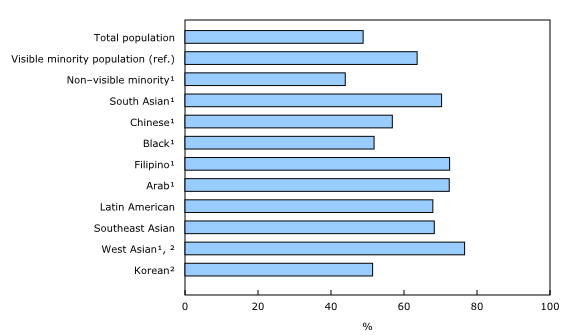
COVID-19 shone a light on the systemic inequities that many people in Canadian society experience—the health, social and economic impacts of the pandemic were not experienced equally by all Canadians. In addition, movements such as Black Lives Matter brought greater attention to the systemic inequities and racism faced by Black Canadians and other population groups designated as visible minorities. Against this backdrop, 49% of the population expressed pride in Canada’s treatment of all groups in society. However, there were differences among Canadians who belong to population groups designated as visible minorities; 64% of respondents who belong to population groups designated as visible minorities felt pride in Canada’s treatment of all groups in society, compared with 44% of individuals not in a visible minority group. Canadian-born respondents who belong to population groups designated as visible minorities were less likely than respondents in groups designated as visible minorities who immigrated to Canada to report pride in Canada’s treatment of all groups in society (45% compared with 68%).
It is important to note that there are differences between population groups designated as visible minorities. A lower proportion of Black (52%) and Chinese (57%) respondents expressed pride in Canada’s treatment of all groups in society. This contrasts with West Asian (77%), Filipino (73%), Arab (72%) and South Asian (70%) respondents, who were more likely to report pride in Canada’s treatment of all groups in society. This could be partly attributable to experiences with discrimination, which were particularly high for some population groups designated as visible minorities during the pandemic. For example, crowdsourcing data collected in August 2020 by Statistics Canada indicated that Korean (64%), Chinese (60%) and Black (55%) participants were more likely to report experiencing discrimination or being treated unfairly during the pandemic (see the publication “Experiences of discrimination during the COVID-19 pandemic“).
Chart 1 Pride in Canada’s treatment of all groups in society among population groups designated as visible minorities, Canada, 2020
Men were more likely than women to report feeling pride in Canada’s treatment of all groups in society—52% of men compared with 46% of women. Pride in Canada’s treatment of all groups in society is the achievement with the biggest gender difference, with only minor differences between men and women for the other Canadian achievements included in the survey.
Canadians are generally proud of the way democracy works in Canada, and this is especially the case for many people who belong to population groups designated as visible minorities
Almost 7 in 10 Canadians (68%) said that they felt pride in the way democracy works in Canada. This increased to close to 8 in 10 (79%) for respondents who belong to population groups designated as visible minorities, compared with 64% of those who did not belong to a visible minority group. Some visible minority groups had a high proportion of respondents reporting pride in the way democracy works in Canada, with 80% or more of West Asian, Filipino, Latin American and South Asian respondents reporting pride in this Canadian achievement.
Canadian-born respondents who belong to population groups designated as visible minorities were less likely to report pride in the way democracy works in Canada, with 65% reporting pride in this achievement, compared with 82% of respondents in groups designated as visible minorities who immigrated to Canada. Similar to Canadian-born respondents belonging to groups designated as visible minorities, 62% of Canadian-born respondents not belonging to a visible minority group were proud of the way democracy works in Canada.
Immigrants who arrived to Canada within the past five years are more likely to feel pride in how Canada treats all groups in society
Immigrant respondents (63%) were more likely than Canadian-born respondents (43%) to be proud of Canada’s treatment of all groups in society. For immigrants, pride in how Canada treats all groups in society is connected to the time since their arrival in Canada; the longer they have been in Canada, the lower their pride in how Canada treats all groups in society. Nearly 8 in 10 immigrants who arrived in Canada 5 years ago or less (78%) expressed pride in this achievement, compared with 65% of immigrants who arrived 6 to 10 years ago and 60% of immigrants who arrived more than 10 years ago. However, regardless of the time since their arrival to Canada, the immigrant population was more likely than the non-immigrant population to report pride.
The different levels of pride between immigrant respondents and Canadian-born respondents were observed not only for how Canada treats all groups in society but also for the health care system (79% versus 72%) and the way democracy works in Canada (81% versus 62%).
Indigenous respondents also report feeling the most pride in Canada’s health care system but are less likely to report pride in how Canada treats all groups in society and the way democracy works in Canada
As with non-Indigenous respondents, Indigenous people also reported feeling the most pride in Canada’s health care system. Among the Indigenous population living off reserve, 67% were proud of Canada’s health care system. This was the case for 63% of First Nations people living off reserve and 69% of Métis. This compares with 72% of non–visible minority, non-Indigenous respondents. Because of the small number of Inuit respondents, estimates for Inuit are not available. It is important to note that the GSS SI did not collect information for people living on reserve. Thus, the information for Indigenous people reflects only the answers of respondents who live off reserve, which may be different from those of people who live on reserve.
Close to one-third (31%) of Indigenous people living off reserve reported feeling pride in how Canada treats all groups in society, compared with 43% of non–visible minority, non-Indigenous Canadians. Indigenous people were also less likely to report feeling pride in how democracy works in Canada. Overall, just over half (52%) of Indigenous people living off reserve felt proud of the way democracy works (46% of First Nations people and 56% of Métis), compared with 63% of non–visible minority, non-Indigenous Canadians.
These results partly reflect the historical and ongoing impacts of colonization, as well as the long-standing historical inequities experienced by Indigenous people in Canada, including social, democratic and economic inequities. As well, other achievements not listed in the survey may be more relevant to Indigenous respondents.
A slightly lower percentage of persons with disabilities report pride in Canada’s health care system
Persons with disabilities were most proud of Canada’s health care system (72%), lower than what was reported by persons without disabilities (76%). This could be attributable to barriers that persons with disabilities experience trying to access health care services. For example, slightly over three-quarters (77%) of crowdsourcing participants with long-term conditions or disabilities reported that they required a health care service but were unable to access it because of the COVID-19 pandemic (see the publication The changes in health and well-being of Canadians with long-term conditions or disabilities since the start of the COVID-19 pandemic). Results are based on participants in the 2020 crowdsourcing initiative Impacts of COVID-19 on Canadians – Living with Long-term Conditions and Disabilities (Impacts of COVID-19 on Canadians: Data Collection Series).
Persons with disabilities were also less likely than persons without disabilities to report pride in the way democracy works in Canada (64% compared with 71%). Regarding pride in the treatment of all groups in society, persons with disabilities were less likely than persons without disabilities to express pride in this achievement (43% compared with 53%). Many persons with disabilities have experienced barriers in society, including in the workplace, or have experienced discrimination. For example, almost half (48%) of participants with disabilities in the 2020 crowdsourcing initiative Impacts of COVID-19 on Canadians – Living with Long-term Conditions and Disabilities reported that they were discriminated against during the COVID-19 pandemic, compared with 25% of those without disabilities (see the publication The changes in health and well-being of Canadians with long-term conditions or disabilities since the start of the COVID-19 pandemic).
Younger Canadians are less likely to be proud of Canada’s treatment of all groups in society and the way democracy works
While similar proportions of Canadians of all ages were proud of the health care system, Canadians aged 15 to 34 were less likely than those aged 35 and older to report pride in the way democracy works in Canada and pride in Canada’s treatment of all groups in society. While 62% of Canadians aged 15 to 34 reported pride in the way democracy works, 70% of those aged 35 and older reported feeling proud. Canadians aged 15 to 34 were also less likely than older Canadians to be proud of the way all groups in society are treated, with 43% of 15- to 34-year-olds saying they were proud of this, compared with 53% of people aged 35 to 54 and 50% of people aged 55 and older. “
After its return to power in Afghanistan, the Taliban are again imposing their religious ideology, with restrictions on women’s rights and other repressive measures. They are presenting to the world an image of Islam that is intolerant and at odds with social changes.
Islam, however, has multiple interpretations. A humanitarian interpretation, focusing on “rahmah,” loosely translated as love and compassion, has been emphasized by a group I have studied – Nahdlatul Ulama, which literally means “Reawakening of the Islamic Scholars.”
Nahdlatul Ulama, or NU, was founded in 1926 in reaction to the Saudi conquest of Mecca and Medina with their rigid understanding of Islam. It follows mainstream Sunni Islam, while embracing Islamic spirituality and accepting Indonesia’s cultural traditions.
Functioning in Indonesia, the country with the largest Muslim population, Nahdlatul Ulama is the world’s biggest Islamic organization with about 90 million members and followers. In terms of membership, the organization hugely outstrips that of the Taliban – yet this face of Islam has not been sufficiently recognized on the international stage.
In 2014, NU responded to the rise of the Islamic State group and its radical ideology by initiating an Islamic reform. Since then, it has elaborated on this reform that it calls “Humanitarian Islam.”
Humanitarian Islam
During the past seven years, NU’s general secretary, Yahya Cholil Staquf, has organized several meetings of the organization’s Islamic scholars with a reformist agenda. They made public declarations for reforming Islamic thought on controversial issues, including political leadership, equal citizenship and relations with non-Muslims.
The Nahdlatul Ulama declarations include crucial decisions that differentiate “Humanitarian Islam” from other interpretations. First of all, they reject the notion of a global caliphate, or a political leadership that would unite all Muslims. The concept of a caliphate has been accepted by both mainstream Islamic scholars, such as those in Al-Azhar – Egypt’s world-renowned Islamic institution – and radical groups, such as the Islamic State group and al-Qaeda.
Moreover, the NU declarations emphasize the legitimacy of modern states’ constitutional and legal systems, and thus reject the idea that it is a religious obligation to establish a state based on Islamic law.
Additionally, these declarations stress the importance of equal citizenship by refusing to make a distinction between Muslims and non-Muslims as legal categories.
They call for a deeper cooperation among Muslims, Christians and followers of other religions to promote world peace.
Nahdlatul Ulama has taken practical steps for realizing these aims. For example, it has established a working relationship with the World Evangelical Alliance, which claims to represent 600 million Protestants, to promote intercultural solidarity and respect.
These NU declarations may sound insufficient from a Western liberal point of view, since they do not touch upon some issues such as LGBTQ rights. To better understand the importance of NU’s perspective and its limits requires an examination of the Indonesian context.
Indonesia’s tolerant Islam
My research on 50 Muslim-majority countries finds that Indonesia is notable because it is one of the few democracies among them.
Indonesia’s foundational credo, Pancasila, means “five principles” and basically refers to the belief in God, humanitarianism, Indonesia’s national unity, democracy and social justice.
About 88% of Indonesia’s population of 270 million are Muslim. Both Nahdlatul Ulama and Muhammadiyah, the country’s second-biggest Islamic organization, have been respectful of these principles. Like NU, Muhammadiyah also has tens of millions of followers, and these two organizations often cooperate against radical Islamist groups.
Robert Hefner, a leading expert on Indonesia, documents in his 2000 book “Civil Islam” how NU and Muhammadiyah made important contributions to the country’s democratization in the late 1990s. During this process, the leader of NU, Abdurrahman Wahid, became Indonesia’s first democratically elected president in 1999.
Wahid, who died in 2009, left a religious legacy, too. During my conversations, senior NU members repeatedly referred to Wahid’s reformist ideas as the main source of inspiration for Humanitarian Islam.
Indonesia’s intolerant Islam
Not all Islamic theories and practices in Indonesia are tolerant toward diversity. The country’s Aceh province has enforced certain rules of Islamic criminal law, including the punishment of caning for those who sell or drink alcohol.
Another example of religious and political intolerance is the country’s blasphemy law, which resulted in the 20-month imprisonment of the capital city Jakarta’s Chinese Christian governor, Basuki Purnama in 2017-2018, for a statement about a verse in the Quran.
In short, there is a tug-of-war between tolerant and intolerant interpretations of Islam in Indonesia. Even within NU, there exist disagreements between conservatives and reformists.
Nonetheless, Nahdlatul Ulama reformists are becoming more influential. One example is the current minister of religious affairs, Yaqut Cholil Qoumas, a leading NU member and the younger brother of NU’s reformist general secretary. He was one of the three ministers who signed the joint decree banning the imposition of headscarves on students in February.
NU’s Humanitarian Islam movement might be crucial to promote tolerance among Indonesia’s Islamic majority. But can it have an effect beyond Indonesia?
This reform movement’s reception in the Middle East, the historical center of Islam, is important if it is to have a global impact. Humanitarian Islam has been mostly ignored by scholars and governments of Middle Eastern countries, who generally see it as a competitor of their own attempts to influence the Muslim world. As a nongovernmental initiative, Humanitarian Islam is different from Middle Eastern efforts to shape the Muslim world, which are mostly government-led schemes.
In order to reach a Middle Eastern audience, the Humanitarian Islam movement is launching an Arabic-language version of its English website. Whether this Indonesian initiative can have an impact in the Middle East and become a truly global movement for Islamic reform remains to be seen.
A former Conservative MP who lost his seat in the recent election thinks the party could have done a better job speaking directly to Chinese Canadians.
Kenny Chiu was defeated in Steveston-Richmond East, a British Columbia riding with many residents of Chinese descent.
The party also saw the losses of longtime Conservative MP Alice Wong in Richmond Centre and Bob Saroya in Markham-Unionville, both home to many voters with Chinese roots. Neither responded to requests for comment from The Canadian Press.
The defeats have the Conservatives wondering what happened, and what connection the losses might have to the party’s stance and messaging on China.
Conservative Leader Erin O’Toole has been an outspoken critic of China’s human rights abuses, calling on the Liberal government to adopt a tougher approach with the authoritarian regime.
Chiu says there’s no single reason for his loss, but points to online WeChat posts he says contained false information about the Conservatives and allegations a private member’s bill he tabled would discriminate against Chinese Canadians.
“Hindsight is always 20/20. I think there could be more proactive communication directly addressing Canadians of Chinese descent that we could have done,” Chiu said in an interview.
The party could have bought more targeted advertisements, he said, adding it’s clear the communication efforts weren’t enough to counter what he considers misinformation.
Improving how Conservatives speak to constituents is one of the issues Chiu said he had hoped to raise heading into the next session of Parliament. Another was how to reassure people that their criticism of the potential influence of the Chinese Communist Party doesn’t mean they are attacking China, a country with a rich and storied history, or its people.
O’Toole hasn’t addressed the issue specifically, but expressed general disappointment in last week’s election results, promising that what went wrong will be examined in a postelection review. Details have yet to be provided on its parameters or who will lead it.
Besides failing to grow the party in key areas like the Greater Toronto Area and Metro Vancouver, home to many immigrants and new Canadians, the Conservatives have five fewer elected people of colour because of defeats in and around these two cities, as well as in Calgary.
That comes as a hit to O’Toole’s pledge to grow the party, and make it a place where more Canadians and people of all backgrounds call home.
During the campaign he tried courting voters by telling them Conservatives were no longer their dad’s or grandfather’s party, despite having a predominantly white caucus.
For Tenzin Khangsar, who worked for Jason Kenney when the Alberta premier served as immigration minister under former Conservative prime minister Stephen Harper, success in making inroads with newcomer communities came down to having an authentic presence there before any election was called.
Under Harper, Kenney prioritized aggressive outreach with diaspora communities, noting that Canada’s demographics had changed.
Kenney was a key supporter of O’Toole’s when he ran to win the party’s leadership in 2020, with O’Toole crediting his former colleague for having helped grow the party when he served in Harper’s cabinet.
More recently, Conservative MPs including Alberta’s Tim Uppal have apologized for not speaking out when he was in Harper’s government against its efforts to ban face coverings during citizenship ceremonies and its 2015 election promise to set up a so-called “barbaric cultural practices” hotline.
In 2015, Caroline Dorn resigned in protest from her role as student president of Muhlenberg Hillel, the Jewish organization at Muhlenberg College. After her Hillel’s rabbi prevented the Muhlenberg Hillel from hosting civil rights activists who support the Boycott, Divest, and Sanction movement against Israel, Dorn explained her resignation in an op-ed for the college’s newspaper: “I can’t be a representative of Hillel International, an organization that I feel is limiting free speech on our campus and prohibiting academic integrity.”
These past few months have seen an increase in conflict between Israelis and Palestinians, sparked by the threat of evictions in Sheikh Jarrah, and with the increased conflict comes increased international attention. As students and experts alike rush to share infographics and articles expressing countless viewpoints, the question of dialogue versus ostracism is more important than ever.
History of Hillel and BDS
One arena ripe with conflicting viewpoints is the Hillel community, the international organization for Jews on campus. Hillel International was founded in 1923 to, in the broadest terms, oversee, support, and coordinate communities for Jewish students on university campuses called “Hillels” (as an example, you may have heard of Harvard Hillel, which fits under the umbrella of Hillel International). While Hillel was not founded as a political organization — indeed, at the time of its founding, the State of Israel did not even exist — it has become increasingly right-wing regarding Israel in the past 30 years, especially following the Second Intifada from 2000 to 2005.
At the end of the Second Intifada, the Boycott, Divestment, Sanctions Movement was founded as Palestinian civil society organizations called for boycotts as a form of nonviolent resistance against what they saw as Israel’s occupation of Palestinian land. The movement quickly spread across American and international university campuses, but not without controversy.
The BDS movement claims its actions are necessary since “Israel maintains its system of settler colonialism, apartheid and occupation over the Palestinian people because of the support that it receives from world governments and corporations.” They encourage international pressure against Israel in order to end Israeli occupation, recognize Palestinian rights to full equality, and grant Palestinian refugees the right to return to their homes.
Those opposed to BDS claim that it is founded in anti-Semitism, as it both singles out Israel among a host of countries committing human rights violations and is rooted in the anti-Semitic belief that Jews do not have a right to self-determination. As Rabbi Jonah Steinberg, Executive Director of Harvard Hillel, puts it, “BDS is about singular alienation and ostracism of Israel among all countries in the global family of nations, and it is about severing all connections with Israel, not just financial relationships, but scholarly and academic interactions, all cultural intercourse, and really all possibility of getting to know Israel at all.”
When BDS and Hillel Clash
There are an increasing number of Jewish people in support of the BDS movement, especially college students, which makes the intersection of Hillel and BDS extremely contentious. Such was the context of Caroline Dorn’s resignation, who, in her op-ed, references a policy called the “Standards of Partnership,” implemented by Hillel International in 2010, which marked a shift in their Israel mission: from encouraging “Israel engagement and education” to “Israel engagement, education, and advocacy” (emphasis added).
The Standards of Partnership prohibit any Hillel from partnering with, housing, or hosting organizations, groups, or speakers that deny Israel’s right to exist, delegitimize or apply a double standard to Israel, support BDS, or disrupt campus events with an “attitude of incivility.”
While Hillel’s are encouraged to “review these standards and create their own Israel guidelines that are consistent with this document and reflect the local environment,” this policy has created a substantial divide in the American Jewish campus community as students and Hillel professionals alike grapple with how to engage with Israel in productive ways while abiding by Hillel International’s mission.
Different universities have taken different approaches to this challenge. Swarthmore Kehilah, formerly known as Swarthmore Hillel, chose to break with Hillel International over the Standards of Partnership. After attempting to host a panel discussion of civil rights activists about the connections between civil rights work in the 1960s American South and the Israel-Palestine conflict, Hillel International sent them a letter threatening legal action if they held the event.
Swarthmore Hillel thus declared itself an “Open Hillel,” writing in an op-ed, “All are welcome to walk through our doors and speak with our name and under our roof, be they Zionist, anti-Zionist, post-Zionist, or non-Zionist.” Hillel International, bound by the Standards of Partnership, refused to allow this, and the year-long controversy ended with Swarthmore Hillel disaffiliating with Hillel International, changing their name, and changing their mission, which now includes no reference to Israel.
Harvard Hillel has taken a different approach. “Harvard Hillel, as an institution, is committed to the deepest and most circumspect possible exploration of Israel,” says Rabbi Steinberg. “But, our role is vigorously to provide alternatives to the BDS-aim of simplistically demonizing, ostracizing, and alienating Israel.”
Bound by the Standards of Partnership but invested in productive dialogue, Harvard Hillel has sought to find creative ways to strike this balance. In 2014, former Israeli Speaker of the Knesset Avraham Burg was invited to Harvard by the university’s Palestine Solidarity Committee, which in turn asked to host the event at Harvard Hillel. Harvard Hillel had to refuse but hosted Burg for dinner that night, and PSC members attended as “individuals” (Burg strongly denounced BDS as “a tool of violence” at that dinner). Then, the PSC hosted Burg in Quincy House, and Harvard Hillel students attended, again as “individuals.” This compromise allowed interested students from a diversity of backgrounds to attend the event without complicating Harvard Hillel’s commitment to the Standards of Partnership.
Open Hillel, Open Community — A Move Away from the Standards of Partnership
A year before the invitation of Avraham Burg, a similar controversy surrounding the Standards of Partnership led to the founding of the Open Hillel movement, now called Judaism on Our Own Terms. In 2013, the Progressive Jewish Alliance, an independent Harvard student group affiliated with Harvard Hillel, met with Rabbi Jonah to discuss hosting an event similar to Swarthmore’s with pro-BDS activists, but found they could not host it at Hillel due to the Standards of Partnership.
“I’d been heavily involved with Harvard Hillel for 4 years and didn’t know the Standards of Partnership existed until we walked straight into it,” said Emily Unger ’13, the former president of the PJA and co-founder of Open Hillel. “I and other PJA members were horrified that this actually meant that Hillel couldn’t cosponsor event with essentially any Palestinian organization on any campus.”
Unger and her peers realized their horror was not unique — Jewish students across the country were grappling with how to handle increasing Jewish support for BDS, and what that meant for their Hillel communities. They decided to launch a petition calling on Hillel International to end the Standards of Partnership, which was signed by over 900 students. When Hillel International did not give in, Unger and friends began networking with Hillel’s across the county, helping them to disaffiliate with Hillel International in protest. Soon, they discovered a demographic in need of a community.
“As a queer, Jewish person, the Palestinian experience of oppression and dispossession of land resonates with me,” Unger said. “We found that the Standards of Partnership disproportionally affects queer Jews and Jews of color with ties to organizations that see BDS as a core issue.” Wanting to create a Jewish space where students do not need to “check a part of their identity at the door,” Unger and others morphed Open Hillel into Judaism on Our Own Terms, an open Jewish community organization engaged in collaboration across oppressed groups. As independent organizations with branches across the country, JOOOT affiliates can create whatever community best fits their needs, collaborating — unbeholden to donors or international policies — in whatever way they see fit.
When asked if she saw any advantages to the Standards of Partnership, Unger came up empty, saying that there is “nothing to be gained by making those conversations [between Hillel and pro-BDS organizations] impossible.” She sees the policy as “created from a place of fear and a desire to maintain power,” power of both long-term donors, who are typically more conservative, and the power of Israel over Palestinians. “BDS is a non-violent form of protest that is mainstream in Palestinian organizations,” Unger continued. “By banning partnering with pro-BDS organizations, it makes it impossible to have any communication of any kind with Palestinian organizations. And, cosponsoring events is the bread and butter of campus collaboration — it’s how organizations build relationships — so it is quite striking to have a ban on co-sponsorship.”
There may well be places of agreement between Hillel and the PSC — for example, they likely see eye to eye that humanitarian aid is needed in Gaza — but the Standards of Partnership would prevent Hillel from co-hosting an event with the PSC around those shared interests due to the PSC’s support of BDS.
In addition, the Standards of Partnership has the potential to taint Hillel’s name, as campus groups in support of BDS may legitimately say that they wanted to host an event about a progressive cause, but “Hillel refused to partner with us because we stand for human rights!” That is, Hillel would decline to partner not out of a lack of empathy for human rights — Hillel is of course in favor of those — but due to the organization’s support for BDS. This nuance can be easily lost, especially in today’s political environment.
Unclear Territories — The Nuance Behind the Issue
The relationship between Rebecca Araten, past president of the Harvard Hillel Steering Committee, and the Standards of Partnership, is a bit more complex. “I understand Hillel not wanting to sponsor an event under their name that will be a pro-BDS event — that is a message they wouldn’t want to endorse,” she said. “But, there is a difference between active encouragement and conversation.” She added that it is important that collaborations between Hillel and pro-Palestinian organizations happen, “because this is how peace works.”
Araten acknowledges that there is “strength” in having connections with Hillel International, both in terms of organizational networking and financial support. However, she urged students “not to get bogged down” in institutional bureaucracy and “interact on a human level instead.” As an example, Araten suggested that Hillel-affiliated students bothered by the Standards of Partnership make individual efforts to connect with pro-BDS organizations or individuals.
Araten also points to the diversity of viewpoints found among Hillel students, and emphasizes that Hillel programming tries to incorporate many views on the topic of Israel. “It seems like a natural extension to engage with views that are more critical [of Israel] with the aim to come to more understanding and collaboration on shared ideals,” she said.
However, both Araten and Unger agree that crossing the line from legitimate criticism of Israel into anti-Semitism cannot be tolerated. “Being able to criticize the state of Israel and its actions is important, but sometimes that criticism leads to demonization, like singling out Israel for things not unique to Israel. To me, that echoes historic anti-Semitic tropes of Jews being world’s biggest issue,” said Araten. Unger concurred, pointing out that “PSC views the conflation of anti-Zionism and anti-Semitism to be an inappropriate and counter-productive framing of the situation.” Unger also noted that BDS is not inherently anti-Semitic, but admitted that it can be a “fodder” for anti-Semitism. However, she sees the increased dialogue as the solution to this conflation, not distance.
Still, the Standards of Partnership does encourage Hillel’s to create their own guidelines around Israel engagement, and in attempting to promote dialogue, Rabbi Steinberg tries to thread the needle between the Standards of Partnership and dialogue as much as possible. “The truth is that Harvard Hillel has never much invoked the Hillel International Standards of Partnership, not because we take issue with them but because we have long since arrived at our own articulation and approach, with the same outcome in practice where BDS is concerned,” he notes.
But he remains in favor of the Standards of Partnership because of what BDS is to him: “BDS is about singular alienation and ostracism of Israel among all countries in the global family of nations, and it is about severing all connections with Israel, not just financial relationships, but scholarly and academic interactions, all cultural intercourse, and really all possibility of getting to know Israel at all,” he says. Rabbi Steinberg also emphasizes “the ‘horrible anti-Semitism’ decried by the United Nations High Commissioner for Human Rights as having been manifest at the 2001 UN Conference Against Racism where the BDS movement took shape.” For these reasons, Rabbi Steinberg sees the benefit of the Standards of Partnership, while also committing himself to fostering dialogue about Israel within Hillel.
Rabbi Steinberg sees another benefit to the Standards of Partnership: the facilitation of students’ exploration of their relationship to Israel, whether positive or negative. He explains that Hillel’s commitment to Israel “is far past being political,” explaining that “Israel is a hugely generative crucible of Jewish thought and culture, home to nearly seven million Jews — almost half of all Jewish people alive in the world today — so connection with Israel is a fact of kinship and of global Jewish community.” He therefore emphasizes that “to come of age Jewishly without acknowledging and exploring the phenomenon of Israel as having something to do with one’s own self is, forgive me, not mature.”
BDS as a Mainstream Progressive Issue
It is the case that Hillel does not represent the subsection of the Jewish population that supports BDS, and therefore can be an alienating place, especially for progressive activist Jews. With the Standards of Partnership forbidding events as seemingly innocuous as a joint Hillel-PSC event to raise money for humanitarian aid in Gaza, there is concern about the potential for collateral damage from the Standards of Partnership as BDS becomes more mainstream.
“There is a clear trend globally, domestically, and especially on college campuses calling for the recognition of Palestinian rights and liberties as the situation continues to devolve into apartheid,” said the Harvard PSC Board in an anonymously written statement to the Harvard Political Review. “Hillel’s decision to disengage from any group who supports divestment as a way forward prevents the college community from engaging in an honest and open conversation about the human rights violations occurring [in Israel/Palestine],” they added.
Not only does the Standards of Partnership prevent Hillel from formally engaging with the PSC, it may prevent Hillel from co-hosting events with other progressive groups on campus. “Palestine is a rising issue on the American progressive agenda as evidenced by growing support from individuals like Alexandria Ocasio-Cortez, Elizabeth Warren, Bernie Sanders, and many more,” said the PSC Board. There is a growing concern among progressive Jews that the Standards of Partnership will eventually isolate Hillel from most, if not all, progressive groups on campus, if they adopt BDS as one of their missions.
Expressing her concern about Hillel’s ability to be inclusive and hold the Standards of Partnership, Unger said, “Being queer is such a defamiliarizing experience that it makes it easier to see through norms in organizations.” “The Standards of Partnership don’t only harm communication between Jewish and Palestinian groups, but also between Hillel and other organizations surrounding any oppressed identity,” she added.
However, to the point that the Standards of Partnership inhibit productive speech on campus, Rabbi Steinberg disagrees, pointing to the importance of a plethora of diverse, mission-driven organizations: “A robust environment of ideas is populated not just by individuals but also by associations and institutions committed to various missions and visions. The fact that there is a Harvard Hillel committed by mission, as a part of a global Jewish community, to an active relationship with Israel and with our kin there is at least as valid as there being a Palestinian advocacy group at Harvard,” he says.
Beyond the question of validity, without missions, no one would have anything to stand behind, and campus dialogue would arguably grind to a halt. What fuels robust discussion is disagreement, and Rabbi Jonah argues that, if all organizations dropped their missions in favor of complete openness, that would lead to a rapid decrease in dialogue. Araten agrees with the importance of missions and of dialogue, saying “Hillel should strive to get as close to the line [drawn by the Standards of Partnership] as possible in terms of conversations with people who support BDS, but the challenge is not knowing when partnership will veer in a direction that is antithetical to Hillel’s mission.”
The point about missions and speech on campus brings into focus a broader question of mission-oriented clubs on campus. On the one hand, it stands to reason that clubs should be permitted to have and stand by specific missions, even at the exclusion of others. On the other hand, one can imagine a world in which the missions of each club are so exclusive that there leaves no room for collaboration or even communication. A third possibility is that clubs are so inclusive that they no longer stand for anything, or cannot allocate any resources for fear of going against a facet of the club.
To be honest, I am not sure what the solution is here. As a Jewish student, while I understand the perspective around missions given by Rabbi Jonah, and by extension, Hillel International, I feel uncomfortable about the Standards of Partnership. I would prefer Hillel to be open to hosting events with anyone in the name of mutual understanding, even if Hillel vehemently disagrees with the other organization’s position.
However, I do believe that every organization is entitled to a mission and to stand by it. Perhaps the answer is that missions should not prevent official dialogue —or that engagement policies can forbid monetary support but must not interfere with conversations —but I am wary of the idea of regulating which missions are acceptable and which are not. That solution feels like a slippery slope.
The bottom line is that missions should not get in the way of dialogue between people. Perhaps that dialogue is not endorsed by a club, but that should not stop us from seeking out opportunities as individuals to truly understand others, even if they hold perspectives antithetical to ours. If there are clubs whose missions we disagree with, we should be inspired to speak up, or start our own organizations. At the end of the day, the decision behind who gets to talk and how is just one big balancing game — and the scale should never fully tip to one side.
Good rebuttal to the unfair criticism and cravenness of Canadian federal leaders:
The question to Bloc Québécois Leader Yves-François Blanchet created a controversy in Quebec, taking on a narrative and a legend of its own. It led the National Assembly to censure me, cartoonists to ridicule me and party leaders to demand an apology.
So here was the question: “You deny that Quebec has problems with racism. Yet you defend legislation such as Bills 96 and 21, which marginalize religious minorities, anglophones, and allophones. For those outside the province, please help them understand why your party also supports these discriminatory laws.”
To those asking me to take it all back: I stand by the question. Unequivocally.
I stand by it because the question gave Mr. Blanchet the opportunity to talk to people outside Quebec, about secularism, about laïcité. He could have shared the Quebec perspective with the rest of Canada. He chose not to.
I stand by it because the Quebec government has or signalled it will override the Charter of Rights and Freedoms to protect Bills 21 and 96 from legal challenges over discrimination. And because the National Assembly included provisions in Bill 21 and 96 to override the Quebec Charter of Human Rights and Freedoms, leaving many Quebeckers feeling vulnerable and as Quebec Superior Court Justice Marc-André Blanchard put it in regard to Bill 21, dehumanized.
I stand by it because what does it say about the state of our democracy that a question is deemed unaskable? Who gets to decide which issues are appropriate to discuss during a federal election campaign? What does it really say about the convictions of our political leaders when they choose to make me a target to divert from their own position on a critical issue of personal freedom?
What does it say about journalism when seasoned reporters and political commentators were shocked that I dared to “go there?” Is the state of our federation so weak that we cannot even raise questions about it?
Alexander Tytler, the 17th-century Scottish philosopher, wrote democracy lasts only about 200 years. A quote commonly attributed to him says that part of the cycle moves from courage to liberty, then to abundance, to selfishness, to complacency, then apathy, and eventually back to bondage. I hope we are not on the downslope of this cycle.
During my silence – appropriate during the election campaign – people encouraged me to educate myself about Quebec. I don’t live there, but I have spent time in places like the Saguenay-Lac Saint Jean and La Malbaie. Operating entirely in French, I experienced a lasting immersion in Québécois pride and history, and in Quebeckers’ outlook on secularism, survival and the strong desire to maintain culture and language. Learning is never finished.
I have heard and listened to what people have said about the question, and the hurt it caused in Quebec. Could it have been phrased differently? Yes. Do I ultimately believe a change in wording would have prevented Mr. Blanchet, Quebec Premier François Legault, and party leaders Justin Trudeau, Erin O’Toole and Jagmeet Singh from exploiting it all for their own purposes? No.
Becoming the story was not a life goal. Yet what happened was just craven politics. What else would Mr. Blanchet have done in the midst of a sagging campaign? Politically, it made sense that Mr. O’Toole, Mr. Trudeau, and Mr. Singh piled on in order to protect their Quebec campaigns rather than stand on principle.
Other things were a little harder to take. Columnists wrote that I was “aggressive,” or “shrill,” likening my tone to that of a “mom,” using “chains” to keep order. The only square they didn’t blot on that particular bingo card appears to be “nasty woman.”
But this isn’t about them. It’s about Canadians. I did the debate as a public service, not to earn gold stars. Some people didn’t like it or didn’t like my style. That’s okay. Polling from our own organization found that 53 per cent of older men found the debate engaging, I’ll take that split. It is notable that number rose to 65 per cent among women 18 to 34. Past, meet the future.
For all the disagreement, and there has been a lot, I’ve had thousands of messages of appreciation from across the country, including Quebec. Notes of thanks for not taking the leaders talking points at face value. People who wrote saying they don’t usually watch the whole debate, but did that night with their children. Teenagers who talked about the debate in class and concluded I was “badass.” Women thanking me for being prepared, fierce, professional and strong.
On the way out of Ottawa, I stopped in Toronto, where I was met at the hotel door by a bellman.
“I think I saw you the other night.” Here we go, I thought to myself.
“And what did you think?”
“It was great!” I could tell he had more to say. He was holding back.
“Look, it’s okay. I can take it.”
“I just want to tell you … I just … I’m really glad you asked that question.”