Lederman: What the Israeli flag debacle at Auschwitz really says about this moment

Good observation:

…Mr. Bartyzel did not answer my question about whether this has happened before. Have unauthorized Israeli flags entered the site previously by people marching in? Has anyone been forced to return their flags to their vehicles and then enter without them? Has such an order been given before Israel became the global pariah it is now? If so, I missed the global outrage.

Today, the Jewish community is on high alert, frightened that antisemitism is lurking around every corner. Here in Canada, B’nai Brith reports that antisemitism has reached “perilous, record-setting heights.” The same thing is happening in the U.S.the U.K.around the world

In the midst of this, it is easy for Jews to assume antisemitic intent. While this is often true, it is not always the case. We need to be thoughtful in each circumstance. 

That said, if there is a spot where the consequences of antisemitism can be felt viscerally, it is at Auschwitz-Birkenau, where the absolute worst happened.

I visited the site in 1998 during the March of the Living, with family members including my mother, who survived Birkenau. It was a difficult day for her, but she drew comfort from not just her own descendants, but from seeing so many young Jews from around the world – and the sea of Israeli flags. They were a symbol of what rose from all she had lost: her parents, her little brother, her home, every single possession, her freedom, her youth, her education, her health, her life as she had known it.

Nobody should have to experience such staggering losses. Nobody.

Source: What the Israeli flag debacle at Auschwitz really says about this moment

Yakabuski: Montreal Pride finally stands up to the pro-Palestinian bullies 

Of note:

…The statement did not name any banned groups, but Ga’ava and the Centre for Israel and Jewish Affairs (CIJA) revealed that they had been suddenly disinvited from the event. In a Facebook post, Ga’ava said the explanation given by Fierté Montréal for its exclusion was related to Ga’ava’s description of certain groups that had previously demanded the organization’s banishment from the parade. Ga’ava’s and CIJA officials had said the groups were “pro-terror” and “pro-Hamas” in a Jewish newspaper article. Ga’ava president Carlos Godoy denied those terms constituted hate speech.

On Tuesday, Fierté Montréal reversed itself and lifted the ban on Ga’ava and the CIJA. It apologized to the Jewish community, and particularly Jewish members of Quebec’s LGBTQ community, who felt it had sought to exclude them. What exactly transpired remains unclear, but it is a safe bet that government and corporate sponsors – which account for about 80 per cent of Fierté Montréal’s budget – had something to do with the move. The chairman of Fierté Montréal’s board of directors also resigned on Monday. 

Fierté Montréal’s reversal angered the pro-Palestinian groups that had called for Ga’ava’s exclusion. But it was the correct move. There are legitimate grievances to be aired about the Israeli army’s increasingly disgraceful conduct in Gaza. Yet, attacking Ga’ava appears to have more to do with the role such groups play in underscoring Israel’s protection of LGBTQ rights, in contrast to the oppression LGBTQ persons face in most Arab jurisdictions. That is not a contrast pro-Palestinian activists want to emphasize, perhaps because it exposes their own cognitive dissonance, if not hypocrisy.

These pro-Palestinian LGBTQ activists accuse Israel of “pinkwashing,” or playing up gay rights in Israel to distract attention from its treatment of Palestinians in Gaza and the West Bank. But what they are really seeking to do is to silence anyone who suggests otherwise.

Source: Montreal Pride finally stands up to the pro-Palestinian bullies

Khan: We shouldn’t turn a blind eye to assaults on Muslim women 

Agree:

…The scourge of hate is corrosive. It cannot be effectively addressed in a siloed fashion, where each affected group stands alone. Here’s an idea: next time when there’s a hateful incident against one group, let’s have a few representatives of all affected groups stand together to condemn the hate. There are fundamental disagreements between affected groups, but all agree that no member of our Canadian family should be subject to intimidation, threats or violence.

Source: We shouldn’t turn a blind eye to assaults on Muslim women

Décision rendue fin juillet | Une première peine adaptée aux criminels racisés au Québec

Of note:

Dans une décision récente rendue fin juillet au palais de justice de Longueuil, la juge Magali Lepage a condamné l’accusé Frank Paris à 24 mois de prison dans une affaire de trafic de cannabis et de haschich. Ce dernier avait déjà plaidé coupable. Jusqu’ici, rien d’inhabituel.

Or, pour déterminer sa peine, la juge a considéré la jurisprudence, une analyse de la preuve, une balance des facteurs aggravants et atténuants… mais aussi une évaluation de l’impact de l’origine ethnique ou culturelle (EIOEC), une analyse particulière qui se penche sur le parcours personnel d’un criminel à travers la loupe des barrières systémiques auxquelles il a pu faire face.

Après la lecture de l’évaluation, la juge a décidé d’accepter la suggestion de la défense, presque un an plus courte que celle de la poursuite.

Il s’agit d’une première au Québec. Aucun juge québécois n’avait considéré une EIOEC dans la détermination d’une peine jusqu’au 28 juillet dernier. La décision risque donc de faire jurisprudence dans le contexte québécois. De telles procédures existent depuis 2014, ailleurs au Canada.

Qu’est-ce qu’une EIOEC ?

Une EIOEC est un rapport présentenciel d’experts qui est utilisé pour déterminer la peine d’une personne racisée – mais qui est surtout utilisé pour les personnes noires. Elle est donc déposée après qu’un accusé est reconnu coupable, mais avant que la peine soit déterminée.

Le rapport fait un examen exhaustif du parcours de l’accusé, avec une insistance sur les « réalités propres » aux personnes racisées, à la « discrimination systémique » qu’elles ont vécue et aux défis spécifiques auxquels elles sont plus exposées (plus bas taux de diplomation, plus grande proportion de familles monoparentales et de père absent, plus grand risque de vivre dans des quartiers défavorisés et criminalisés, etc.).

On considère que ces facteurs, plus présents chez les Noirs, mènent plus facilement à la criminalité.

Comme l’explique MValérie Black St-Laurent, avocate et directrice des opérations chez Jurigo, « l’objectif d’une EIOEC, c’est vraiment d’informer la Cour pour contextualiser le parcours de la personne qui se trouve devant elle et pour qu’elle puisse rendre une peine qui est juste » et individualisée, comme le prévoit le Code criminel.

« C’est individualisé, mais il reste que les statistiques montrent que tout le groupe des personnes noires est victime de discrimination », renchérit Karine Millaire, professeure adjointe à la faculté de droit de l’Université de Montréal.

« Il faut tenir compte du fait qu’il y a une surincarcération des personnes noires qui est issue du fait que notre système est aussi discriminatoire », dit-elle….

Source: Décision rendue fin juillet | Une première peine adaptée aux criminels racisés au Québec

In a recent decision delivered at the end of July at the Longueuil courthouse, Judge Magali Lepage sentenced the accused Frank Paris to 24 months in prison in a cannabis and hashish trafficking case. The latter had already pleaded guilty. So far, nothing unusual.

However, to determine her sentence, the judge considered the case law, an analysis of the evidence, a balance of aggravating and mitigating factors… but also an assessment of the impact of ethnic or cultural origin (EIOEC), a particular analysis that looks at the personal journey of a criminal through the magnifying glass of the systemic barriers he was able to face.

After reading the evaluation, the judge decided to accept the suggestion of the defense, almost a year shorter than that of the prosecution.

This is a first in Quebec. No Quebec judge had considered an EIOEC in determining a sentence until July 28. The decision is therefore likely to become jurisprudence in the Quebec context. Such procedures have existed since 2014, elsewhere in Canada.

What is an EIOEC?

An EIOEC is a face-to-face expert report that is used to determine the sentence of a racialized person – but is mainly used for black people. It is therefore filed after an accused is found guilty, but before the sentence is determined.

The report makes an exhaustive examination of the accused’s career, with an emphasis on the “realities specific” of racialized people, the “systemic discrimination” they have experienced and the specific challenges to which they are more exposed (lower graduation rates, greater proportion of single-parent families and absent fathers, higher risk of living in disadvantaged and criminalized neighborhoods, etc.).

These factors, more present among blacks, are considered to lead more easily to crime.

As explained by Valérie Black St-Laurent, lawyer and director of operations at Jurigo, “the objective of an EIOEC is really to inform the Court to contextualize the journey of the person who is in front of it and so that he can render a sentence that is fair” and individualized, as provided for by the Criminal Code.

“It’s individualized, but the statistics still show that the entire group of black people is a victim of discrimination,” adds Karine Millaire, assistant professor at the Faculty of Law at the University of Montreal.

“We must take into account the fact that there is an over-imprisonment of black people that results from the fact that our system is also discriminatory,” she says….

Patrick Lagacé’s biting critique of the EIOEC reasoning the judgement relied on:

La suite du paragraphe est hallucinante de déresponsabilisation : « Bien que M. Paris ait cru qu’il servait sa communauté d’une façon positive en donnant une tribune aux artistes et l’accès à l’internet, il y vendait aussi des substances illicites. En rétrospective, M. Paris croit qu’il aurait dû cesser de vendre de la cocaïne à cette époque… »

Et c’est comme ça sur 44 pages, cette « évaluation de l’incidence de l’origine ethnique et culturelle », j’en passe et des meilleures : tout est la faute de la société, rien n’a jamais été, rien n’est et ne sera jamais la faute de Frank Paris.

S’il commet des crimes, si la récidive lui tombe dessus à répétition, c’est parce qu’il est noir dans une société anti-black. Et handicapé, mais ça me prendrait une autre chronique pour vous expliquer cette intersectionnalité fascinante qui pousse aussi M. Paris à la criminalité.

Bref, je ne sais pas si les « évaluations de l’incidence de l’origine ethnique et culturelle » nées en Nouvelle-Écosse sont toujours de la bullshit, mais celle de M. Frank Paris, la première utilisée par une juge au Québec, m’apparaît comme ça et juste ça : de la bullshitpur jus.

Source: Un rapport vaguement ésotérique

The rest of the paragraph is hallucinating with deresponsibility: “Although Mr. Paris believed that he served his community in a positive way by giving a forum to artists and access to the Internet, he also sold illicit substances there. In retrospect, Mr. Paris believes that he should have stopped selling cocaine at that time…”
And that’s how it is on 44 pages, this “assessment of the impact of ethnic and cultural origin”, I pass and the best: everything is the fault of society, nothing has ever been, nothing is and will never be the fault of Frank Paris.
If he commits crimes, if recidivism falls on him repeatedly, it is because he is black in an anti-black society. And disabled, but it would take me another column to explain this fascinating intersectionality that also pushes Mr. Paris to crime.
In short, I don’t know if the “evaluations of the incidence of ethnic and cultural origin” born in Nova Scotia are still bullshit, but that of Mr. Frank Paris, the first used by a judge in Quebec, appears to me like this and just that: bullshitpur jus.


Air Canada says she was being ‘loud, demanding and unruly.’ She says she was being stereotyped. Here’s what the human rights tribunal heard

Will be interesting to see how the Tribunal rules. Incident dates from 2018 and don’t know whether the delay is normal for the Tribunal. As a business class passenger, she would have access to shorter check-in and boarding lines. As an DEI academic and activist, Francis would likely be more aware and sensitive to perceived discrimination and stereotypes:

It’s not an uncommon scene at any busy airport: A passenger needs help and approaches an airline agent who may come across as rude.

But what happened to a Jamaican Canadian at Vancouver International Airport on March 1, 2018 — as described last week over a five-day hearing at the Canadian Human Rights Tribunal — has highlighted the stark contrast in how a Black woman and airline staff viewed their encounter seven years ago.

The case of alleged discrimination for “Flying while Black” will test how far the Canadian Human Rights Act can go in awarding damages to air travellers for discrimination. Claims against carriers are governed by the Montreal Convention, an international pact that’s a standard liability regime for death and injury, damage or loss of baggage and flight delay only.

Business-class passenger June Francis had had her knees replaced six months before a trip to Toronto. She approached an Air Canada check-in agent for help amid an exceptionally long lineup, the tribunal heard.

She testified that the agent cut her off before she could request an accommodation, yelled at her and told her to “get in line.” Unsuccessful in getting the agent’s name or identification number, she took photos of the agent with her cellphone for identification so she could complain to Air Canada.

Francis, who is five-foot-10, was described as “loud,” “demanding” and “unruly,” the tribunal heard from Air Canada. A supervisor and security guard were dispatched and demanded that Francis delete the photos, or else she would be refused boarding.

Francis testified that the supervisor said to her, “I can see why you are a problem. You do not take directions. I can see why you were treated that way.” 

“It was a very demeaning comment,” Francis said. “It suggested that I needed directions from people to know how to behave.”

The now 70-year-old woman — a Simon Fraser University business professor and a King Charles III Coronation Medal recipient for her anti-racism work — said she felt afraid when she saw the airport security guard.

“I was shaken,” she testified. “I had done nothing wrong. I am a Black woman … I know what has happened from my community when law enforcement arrives.”

On the witness stand, the agent, later identified as Betty Liao, described Francis as rude and aggressive, but denied yelling at her to get in line or that the complainant ever mentioned her physical needs. She also testified she did not remember if Francis asked for her name or identification number to file a complaint, or if she refused. 

Liao did remember telling Francis to stop taking photos of her, and told the tribunal she felt unsafe. “This is too intimidating,” testified Liao, who is five feet tall. “And I have no right to say no?”

In laying out the complaint at the hearing, Francis’s lawyer Sujit Choudhry said this is the first case of flying while Black to reach a full hearing before the tribunal.

“Professor Francis, a grandmother, (then) 62-year-old, recovering from a knee surgery, posed no threat,” he told the tribunal….

Source: Air Canada says she was being ‘loud, demanding and unruly.’ She says she was being stereotyped. Here’s what the human rights tribunal heard


ICYMI – Urback: Did we really have to make this D-list MAGA singer famous in Canada?

Yep:

…But perhaps most irritating of all is that this totally unnecessary controversy has made a MAGA martyr of Sean Feucht: a man who was, and should’ve continued to be, mostly anonymous – a D-list celebrity, if that, in Canada. It is irritating that many of us now know how to pronounce his name; irritating that he has accidentally stumbled upon the type of mainstream attention his brand of worship rock could have never organically drawn; irritating that there will be more eyes on his Pride month posts about the “agenda seeking to destroy our culture and pervert our children.” And irritating that those who value and understand the rights protected by our Charter – of free speech, and free assembly, and freedom from discrimination – have to defend this guy’s rights, even if they loathe what he’s saying. 

Had licensing officials politely shut down the minority of protesters who knew of Mr. Feucht’s existence and objected to his performances, the majority of us could have continued to exist in blissful ignorance, and Mr. Feucht would’ve soon returned to his long list of other grievances. Instead, they’ve set a terrible new precedent for access to public spaces, while inadvertently forcing the rest of us to give him what he clearly desires most: attention.

Source: Did we really have to make this D-list MAGA singer famous in Canada?

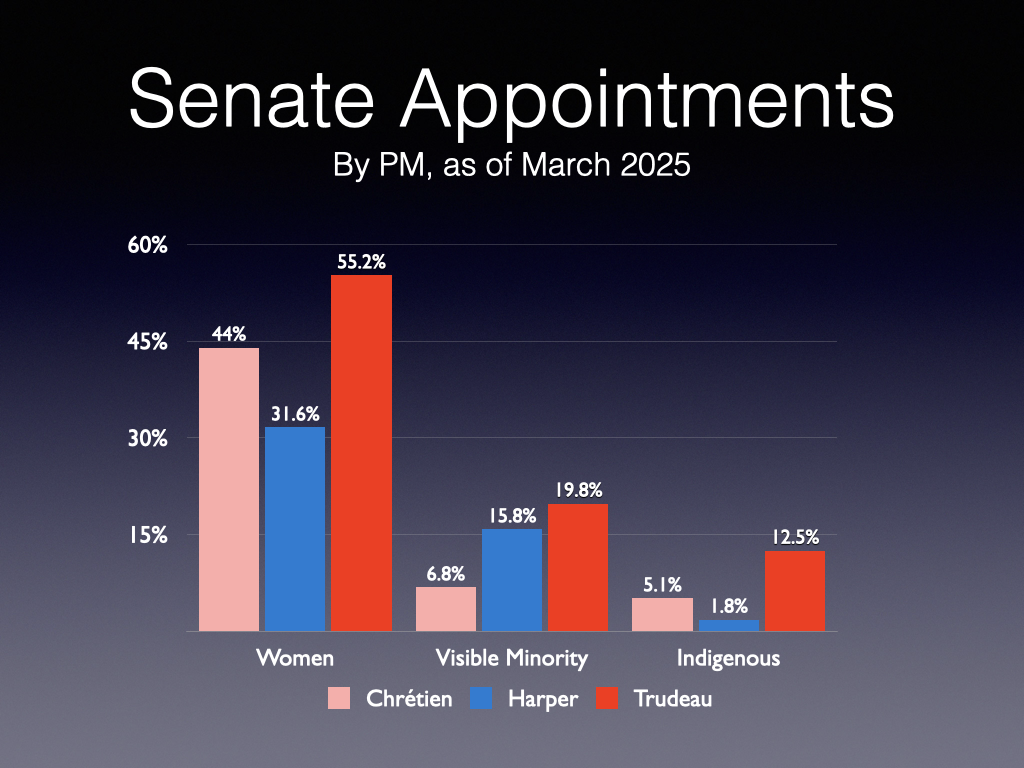
ICYMI: Trudeau radically overhauled the Senate — will Carney keep his reforms?

We shall see. Chart below contrasts Chrétien, Harper and Trudeau appointments:

…In an interview with CBC Radio’s The House, House leader Steve MacKinnon signalled there may indeed be more changes coming.

“I think the Senate is very much a work in progress,” he said.

“We continue to work constructively with the Senate in its current configuration and as it may evolve. I know many senators, the various groups in the Senate and others continue to offer some constructive thoughts on that.”

Asked if Carney will appoint Liberals, MacKinnon said the prime minister will name senators who are “attuned to the vagaries of public opinion, attuned to the wishes of Canadians and attuned to the agenda of the government as is reflected in the election results.”

Carney is interested in senators who “are broadly understanding of what the government’s trying to achieve,” MacKinnon said.

As to whether he’s heard about efforts to revive a Senate Liberal caucus, MacKinnon said: “I haven’t been part of any of those discussions.”

Alberta Sen. Paula Simons is a member of the Independent Senators Group, the largest in the chamber and one mostly composed of Trudeau appointees (she is one of them, appointed in 2018).

Simons said she knows the Conservatives would scrap Trudeau’s reforms at the first opportunity. What concerns her more are those Liberals who are also against the changes.

“There’s a fair bit of rumbling about standing up a Liberal caucus again. And I am unalterably opposed to that,” she said.

When the last Liberal caucus was disbanded, some of its members regrouped as the Progressive Senate Group, which now includes senators who were never Liberals.

“To unscramble that omelette, whether you’re a Liberal or a Conservative, I think would be a betrayal of everything that we’ve accomplished over the last decade,” Simons said.

“I think the Senate’s reputation has improved greatly as a result of these changes. I think the way we are able to improve legislation has also increased tenfold. It would be foolish and wasteful to reverse that.”

Still, she said there’s been pushback from some Trudeau appointees.

Senate debates are now longer, committee hearings feature more witnesses and there’s more amendments to legislation than ever before, she said.

Not to mention Independent senators can’t be whipped to vote a certain way. All of that makes the legislative process more difficult to navigate.

“Partisan Liberals don’t like the new independent Senate because they can’t control it as easily,” she said.

Marc Gold, Trudeau’s last government representative in the Senate who briefly served under Carney before retiring, said his advice to the new prime minister is to keep the Senate the way it is.

“The evolution of the Senate to a less partisan, complementary institution is a good thing. I think it’s a success, and I certainly hope that it continues,” Gold said….

Source: Trudeau radically overhauled the Senate — will Carney keep his reforms?

Lederman: There is an abundance of shame – and rightly so – over the calamity in Gaza

Indeed:

…As more than 170 former Canadian diplomats, including former ambassador to Israel Jon Allen, wrote in an open letter this week: “If Israel continues on this path, it will lose its standing with the world community, placing the security and the future of the Israeli people in jeopardy.”

This isn’t the most important reason to speak out about the suffering of so many people, of course. That would be the killings, the starvation, the inhumanity.

“Food and health are basic rights,” Dorit Nitzan, director of the School of Public Health at Ben-Gurion University of the Negev, told Haaretz. “When we turned them into a bargaining chip, we harmed ourselves, not just our values and morals.” 

Former Israeli prime minister Ehud Barak has issued an “emergency call” for “massive nonviolent civil disobedience” to bring a total shutdown of Israel until there is a change in government. “The Israel of the Declaration of Independence and the Zionist vision is collapsing,” he wrote.

The Union for Reform Judaism also issued a statement this week: “Blocking food, water, medicine, and power—especially for children – is indefensible. Let us not allow our grief to harden into indifference, nor our love for Israel to blind us to the cries of the vulnerable. Let us rise to the moral challenge of this moment.”

Yes. Let us. The moral tragedy of this moment is abundantly clear. 

Source: There is an abundance of shame – and rightly so – over the calamity in Gaza

Rempel Garner: Without national identity, integration is impossible and collapse is inevitable.

Always worth reading the Conservative take on immigration policy even when overly partisan and exaggerated in places. Some of her critiques have some merit but are weakened by being overstated. And to ignore broader trends on belonging and pinning everything on the Trudeau government is shallow at best:

…For example, on immigration, the Trudeau Liberals narrowed the age range for mandatory language and knowledge requirements in citizenship applications from 14-64 to 18-54, thus diminishing shared language’s role in Canadian identity for newcomers. They eliminated the in-person citizenship oath requirement. They sought to erase references to practices like female genital mutilation as abhorrent in the citizenship study guide, and in so doing, arguably normalized their importation into Canada. They turned a blind eye to judicial rulings allowing immigration status to factor into sentencing violent criminals, valuing the process of entry into the country over the responsibility associated with citizenship. They allowed Canada’s compassionate asylum system to be abused into a mockery.

The Trudeau Liberals also normalized the practice of the importation of conflicts from newcomer’s countries of origin, rather than primarily encouraging the shedding of these quarrels in favour of a pluralistic, unified Canadian identity rooted in Western democratic values. This phenomenon is best exemplified via the Trudeau government’s tolerance of diasporic lobby groups’ influence in elections and Canadian institutions, while simultaneously turning a blind eye to groups who sought to plant international conflicts and even terrorist principles in Canadian soil. And despite clear evidence of rising foreign interference in elections, the Liberals have yet to implement a foreign agent registry.

The Trudeau Liberals also prioritized cultural and ethnic differences over a shared ethos of equality in hiring and storytelling. For example, they embedded divisive, quasi-racist hiring policies into federal funding for educational institutions. They allowed Canada’s publicly funded national broadcaster to consider abandoning objectivity for racialized narratives, and now allocate news funding based on whether or not outlets sufficiently highlight ethnic, religious, and other group differences.

And rather than enlisting newcomers to help strengthen a cohesive Canadian national identity, such as by constructively addressing the nation’s historic injustices while simultaneously celebrating its positive achievements, the Trudeau Liberals actively erased symbols of shared historic Canadian identity from public view. They redesigned the Canadian passport to replace images of Canadian national heroes like Terry Fox with inert objects like a wheelbarrow. They supported activities that established the Canadian flag as a symbol of shame as opposed to a representation of patriotism. They worked to erase Canada’s founders from places of prominence.

Thus, Canada’s political left has profoundly succeeded in transforming Canada into a post-national no-nation, free from the trappings of a cohesive national identity.

For those who might argue that this is a good thing, they are very wrong. 

What Justin Trudeau overlooked in his Liberal government’s zealous pursuit of post-nationalism is that his father’s multicultural vision could only thrive under robust Western democratic institutions. Without a government prioritizing above all else, especially over partisan ideology, the safeguarding of principles like freedom of speech, secularism, and equality of opportunity, multiculturalism will inevitably destroy a peaceful, democratic pluralism.

The proof is in the pudding. Today in Canada, after decades of post-national, national identity-destroying policies, less than half of Canadian youth say they would fight for the country. This marks a startling shift from generations ago, when Canadians fought for what seemed to be immutable freedoms in the Great Wars. Diasporic conflicts now erupt on Canadian streetshate crimes against ethnic and religious groups have surged, and the once-strong Canadian consensus on immigration is solidly broken.

If Canadians want to reverse the pluralism-destroying course post-nationalism has set us on, everyone, regardless of political stripe, must acknowledge that post-nationalism has eroded Canada’s national identity to point of non-existence. That state of affairs is likely the biggest threat to Canada’s sovereignty today.

History proves this conclusion correct. For a civilization to survive the test of history it needs some sort of cohesive shared identity. Without it, collapse occurs. There’s even examples to be found within Canada’s own evolution in the 20th century. In the early 1900s a Canadian national identity had taken root in spite of high levels of immigration. Forged in the crucibles of battlefields like Vimy Ridge, peoples of many backgrounds fought together as Canadians, united by shared values of democracy, rule of law, bilingualism, and loyalty to the Crown. To be Canadian then was to embrace English or French as a primary language, respect parliamentary institutions, and demonstrate civic duty through collective efforts in war and nation-building. 

Fast forward to today. Our domestic efforts fail to build critical national infrastructure and have allowed our military to atrophy to the point of near non-functionalityOur foreign policy rewards the tactics of terrorist organizations and abandons Western allies in times of crisis. Logic dictates that if the Liberal government continues eroding the Western democratic values that once, but arguably no longer, underpin Canada’s rapidly disappearing pluralistic national identity (freedom of speechfreedom of worship, and equality in the rule of law’s application), then collapse is what should be expected of Canada’s once-vaunted pluralism.

Those looking for remedy from new Liberal Prime Minister Mark Carney will likely be sorely disappointed. Long an adherent to the World Economic Forum’s globalist brand of post-nationalism, the best definition of Canada’s national identity he has mustered is that we’re not the United States. His new “Minister of National Identity” Stephen Guilbeault managed an arguably worse response, offering pithiness like “I won’t stand here and pretend that I can tell you what Canadian identity is or should be,” while arguing there is “no one way to be Canadian.” That neither could define Canadian identity as rooted in shared respect for things like the rule of Western-based law, freedom of speech, freedom to worship, and equality of opportunity is telling.

The reality for Mr. Carney is that his government must reverse the many changes Mr. Trudeau made under his aggressive post-national doctrine to order to rebuild Canada’s national identity, prevent pluralism’s collapse, and retain our sovereignty.

If he fails, the effect will be the same as if he were to tip over Cardiff’s speakers in the National Gallery: a shameful and purposeful squandering of an intricate, delicate masterpiece.

Source: Without national identity, integration is impossible and collapse is inevitable.

Éditorial | Qui doit fixer les limites de la liberté d’expression?

Sensible approach rather than simply cancelling:

…Il n’y a pas de place pour le discours haineux dans le début public. Quiconque incite à la haine contre un groupe identifiable est passible d’accusations criminelles. Il existe une exception — et non la moindre — protégeant de poursuites une personne qui a exprimé de bonne foi une opinion sur un sujet religieux ou en se fondant sur un texte religieux auquel il croit. Cette exemption a suscité de vives critiques du chef du Bloc québécois, Yves-François Blanchet, qui n’a pas été en mesure de convaincre Ottawa d’agir pour refermer cette « brèche complaisante ».

Le cadre juridique canadien résiste à la tentation de faire une hiérarchie des droits constitutionnels ; ils sont plutôt en concurrence permanente les uns par rapport aux autres. En matière de liberté d’expression, les tribunaux ont reconnu à maintes reprises que ce droit englobait les idées impopulaires ou offensantes, et les propos qui choquent ou qui dérangent. La barre est très haute pour entrer dans la catégorie du discours haineux.

Peut-être que Sean Feucht a dépassé les limites. Si c’est le cas, il faudra agir aussi contre les rappeurs et les influenceurs masculinistes qui véhiculent les pires clichés misogynes. Il faudra sans doute inspecter les églises, les mosquées et les synagogues pour y débusquer les prêcheurs outranciers qui pourraient cracher contre le vent de la modernité. Il nous faudra une police de la pensée, bien rodée et bien financée, car l’ouvrage ne manquera pas.

Il y avait une autre façon de gérer le dossier de Sean Feucht, en utilisant les outils en place : porter plainte à la police, faire une enquête en bonne et due forme, s’en remettre à la norme du contrôle judiciaire pour séparer ce qui relève de la liberté d’expression et du discours haineux. En se faisant à la fois juges et parties de la situation, les autorités municipales et policières ont foulé ces principes d’une façon dérangeante, qui a plus à voir avec la culture de l’annulation qu’avec la protection des libertés civiles.

Source: Éditorial | Qui doit fixer les limites de la liberté d’expression?

… There is no place for hate speech in the public opening. Anyone who incites hatred against an identifiable group is liable to criminal charges. There is an exception – and not the least – protecting from prosecution a person who has expressed a good faith opinion on a religious subject or based on a religious text in which he believes. This exemption was strongly criticized by the leader of the Bloc Québécois, Yves-François Blanchet, who was unable to convince Ottawa to take action to close this “complacent breach”.

The Canadian legal framework resists the temptation to make a hierarchy of constitutional rights; rather, they are in permanent competition with each other. In terms of freedom of expression, the courts have repeatedly recognized that this right encompasses unpopular or offensive ideas, and remarks that shock or disturb. The bar is very high to enter the category of hate speech.

Maybe Sean Feucht has crossed the line. If this is the case, it will also be necessary to act against rappers and masculinist influencers who convey the worst misogynistic clichés. It will probably be necessary to inspect churches, mosques and synagogues to flush out the outrageous preachers who could spit against the wind of modernity. We will need a police of thought, well-honed and well-funded, because the work will not be lacking.

There was another way to manage Sean Feucht’s case, using the tools in place: file a complaint with the police, make a proper investigation, rely on the norm of judicial control to separate what is freedom of expression and hate speech. By making themselves both judges and parties to the situation, the municipal and police authorities have trampled on these principles in a disturbing way, which has more to do with the culture of annulment than with the protection of civil liberties.