McWhorter: Every Day, We’re Told to Use New Lingo. What Does That Really Accomplish?

Indeed. Changing terminology and labels is often an easy way out of confronting the harder substantive issues and disparities. Fairly or not, I tend to discount those who focus more on terminology than substance:

The left these days gets a bad rap for policing language. It can be irritating to feel like you have to watch how you say things or keep up with the latest lingo when the old lingo still seems perfectly fine. This is especially the case with counterintuitive ideas such as referring not to “pregnant women” but to “people who are pregnant” — a phrase now used on Planned Parenthood’s website — or the even less intuitive “birthing people,” which we’re asked to embrace as inclusive, and therefore progressive, despite that both reduce women to being biological vessels.

I’m certainly not arguing for intolerance toward those who can become pregnant but don’t identify as women. I’m saying that even if we’re not being forced to use the new terms, the way they’re introduced, almost as if by fiat, can make it seem as if sticking with the old ones is a kind of thought crime. But it isn’t that those on the left have some weird, childish yen for control. Rather, they seem to be operating under an attractive but shaky idea that language channels thought: Change how people say things and you change how they think about things and then the world changes.

That’s not how it works, though. Good intentions frequently don’t translate into efficacy. So, the question is, how much does changing terminology really accomplish?

In the late 1980s, the Rev. Jesse Jackson said the term “African American” had more “cultural integrity,” and “Black” was, therefore, out of date. But I’d be hard-pressed to say that the Black community today has a greater measure of cultural integrity or is any prouder than it was then. And though a recent poll showed that a majority of Black Americans see being Black as central to their identity, the younger they are, the less central it is — suggesting less significance, as time goes on, about what we call ourselves.

I think also of Nina Simone’s musicalization of Lorraine Hansberry’s phrase “To be young, gifted and Black.” Watch Simone perform this song in Questlove’s Oscar-winning documentary, “Summer of Soul,” with her vocal emphasis, full of conviction, on the word “Black.” Singing “African American” wouldn’t — couldn’t — ring with the same richness. Black America added meaning to and wrested pride out of a word that was supposed to have negative connotations by thinking of ourselves as beautiful and determined. I’m not sure “African American,” just as a term, has furthered that at all: “To be young, gifted and African American”?

Remember, too, the “euphemism treadmill” described by the Harvard University psychology professor Steven Pinker, who explained in a 1994 Times Opinion essay: “People invent new ‘polite’ words to refer to emotionally laden or distasteful things, but the euphemism becomes tainted by association and the new one that must be found acquires its own negative connotations.” For example, the pathway from “crippled” to “handicapped” to “disabled” to “differently abled.” New words ultimately don’t leave freighted ideas behind; they merely take them on.

Consider the phrase “urban renewal.” Starting in the 1930s, there were initiatives in American cities to raze working-class, often Black neighborhoods. They would eventually be replaced with various civic projects, such as new highway construction. One term for this, embraced by city planning éminences grises such as Robert Moses in New York City, was “slum clearance.”

As the years passed, the downsides of this destruction of modest but cohesive communities became more apparent, and the term “slum clearance” was gradually supplanted by the term “urban renewal,” starting in the 1950s. But calling it urban renewal didn’t persuade a range of writers, thinkers and displaced residents to celebrate this destructive dislocation. Other than by, perhaps, some city planners, urban renewal was increasingly perceived as a glum business — the same business — as slum clearance. James Baldwin memorably coined it with the more reality-based term, “Negro removal.”

Even when factoring in Pinker’s treadmill, I understand the impulse to refer to “enslaved people” rather than “slaves” — not all new terminology is pointless. Describing someone as a “slave” can be taken as indicating that servitude is an inherent trait rather than an imposed condition. But I suspect that after a while, the term “enslaved person” will continue its lexical drift and we’ll need a new term. Why? Because of what happened to “homeless person,” which began as an enlightened replacement for terms such as “bum” and “bag lady,” but is now itself being slowly replaced by referring to someone who is “unhoused.”

It is, then, reasonable to surmise that terms such as “pregnant people,” while pleasing a certain contingent, will not deter most people from continuing to perceive the world according to an old-fashioned gender binary. Basic perception will remain that most pregnant people are cisgender women, such that it will still feel natural to think of being pregnant as something women experience, and it will feel forced to use gender-neutral language, even as we acknowledge that there are people who identify as men or nonbinary who can become pregnant.

As I’ve discussed before in this newsletter, research has shown that language can influence thought, but sometimes only slightly. And what pops up in a psychological experiment may not track with real-life behavior: The Implicit Association Test, more than two decades old, has often been used to demonstrate how implicit bias is supposed to work — how negative associations with terms such as “Black” may correlate with people exhibiting prejudice or bigotry. But a more recent analysis argues that there is no evidence that quietly associating negative terms with Black people rather than white people in such tests correlates with racist behavior.

Today’s predilection for newspeak neglects all of this. Frankly, I think it is partly because generating new labels offers instant gratification, especially with the internet handy. It’s easier to introduce new terms than to change the way different groups referred to by those terms are really perceived. In that way, never-ending calls to change the way people talk and write is less an advance than a cop-out.

Terminology will, of course, evolve over time for various reasons. But broadly speaking, thought leaders and activists of past eras put their emphasis on what people did and said — not on ever-finer gradations of how they might have said it.

Far better to teach people what you think they should think about something, and why, instead of classifying the way they express themselves about it as a form of disrespect or backwardness. After a while, if you teach well, they won’t be saying what you don’t want them to say. Mind you, you may not be around to see the fruits of the endeavor — a frustrating aspect of change is that it tends to happen slowly. But “Change words!” is no watchcry for a serious progressivism.

Source: Every Day, We’re Told to Use New Lingo. What Does That Really Accomplish?

Debating difference and diversity: combining multiculturalist and interculturalist approaches to integration

Much of these debates and discussions are more semantics than substantive, as the devil is in the details regarding the specific practices and policies of integration, social cohesion, multiculturalism and interculturalism:

In the UK, as elsewhere in Western Europe, issues of integration and social cohesion in relation to ethno-cultural minorities are never far from the headlines or policy concerns in one form or another. In the last year, events such as the Black Lives Matters protests, COVID-19, the Euros, and the upcoming Queen’s Platinum Jubilee, have all prompted reflection on integration. In 2019 the government published a new indicators of integration framework and the term has again been the central concern of a recent report by a prominent think tank, which notes that integration is ‘one of the slipperiest concepts in the political lexicon’.

One of the central issues to thinking about integration is what is to be done about ethno-cultural difference? Is it a problem to be overcome, a barrier to integration? Is it something positive, to be embraced and celebrated? Should it be overlooked in favour of what we all, as individuals, have in common, or should it be the ground we build a more equitable sense of belonging from?

The term integration can be not just slippery but the site of antagonistic and at times heated debate. These two properties of antagonism and slipperiness are well exemplified in debates between two alternative camps on how to manage and think about integration and ethno-cultural diversity: multiculturalism and interculturalism. Whereas the former emphasises respect for difference and hyphenated identities, the latter emphasises contact, mixing and what is shared or common against difference.

The two have frequently butted heads in academic debates, with multiculturalism under fire from interculturalists as in need of replacement, something reflected in political and policy discourse. For instance, the government’s 2018 Integrated Communities Strategy stated that ‘multiculturalism has too often encouraged communities to live separate lives – reinforcing distinct cultural identities to the detriment of efforts to draw attention to what we have in common – and is defunct’. Multiculturalists have responded by pointing out how these arguments misrepresent or caricature multiculturalism.   

In a new research project, PLURISPACE, we ask if this antagonism must necessarily be the case. We’ve found that integration as it exists in government policy as well as policy advocacy from civil society organisations more often combines these two opponents in various ways, and this is where the slipperiness comes in. Peeling back from political rhetoric and academic theory debates, what might we learn from the slipperiness?

While policies that are consistent with an intercultural position have become central, through increased emphasis on contact and mixing, as well in discourse around fundamental British values, the term itself is found nowhere in policy documents or parliamentary debates themselves (unlike, for example, in Spain or at the EU level). Moreover, these interculturalism gains have not been to the detriment of multicultural policies, which have also shown an increase over the last few decades. This begins to point to types of complementarity between different approaches, which forms the focus of the PLURISPACE project. But what different forms does such complementarity take in practice?

From an analysis of documents produced by prominent civil society organisations, supplemented by interviews, we can point to three main types of complementary form in which multiculturalism and interculturalism are combined in the UK, reflected in alternative emphases on the idea of integration. The first two represent what we might call a principled multiculturalism, complemented or qualified by interculturalism to different extents.

The first variation is broadly multiculturalist in emphasis. It wants to preserve the importance of difference between ethnic, cultural, and faith communities whilst developing a sense of multicultural nationhood that can include these differences. Integration is thought about as relations between communities and across difference, but which adds to this the need for contact and mixing between people of different ethnicities and faiths and a simultaneous emphasis on what is held in common if it is to be successful. Here, integration is very much a ‘two-way street’.

The second variation represents a more equal mixing of multiculturalism and interculturalism. It is more cautious of stronger statements about group rights but with a significant feature; its underlying premises can be said to be more multiculturalist than interculturalist. That is, underpinning interculturalist features is a stronger sense of the need to recognise and respect difference as a fundamental way in which equality is thought about. As one report puts it: ‘If integration is not about everybody, it is not integration‘. Interculturalist emphases from this position are important, but bound to fail if not substantively underpinned by thicker multiculturalist sensibilities and policies when it comes to identifying and addressing discrimination and positive recognition.

Across these two positions features of interculturalism are seen as extremely important but also as inadequate and ineffective if not underpinned by more substantive approaches to equality consistent with multiculturalism.

A third position is one we might call critical interculturalism. This adopts a broadly interculturalist stance, but is qualified in significant ways (and ways that some interculturalists would reject) by multicultural emphases. It emphasises contact and mixing, and is oriented foremost around individual rights and the centrality of ascribing to fundamental British values, and of minority integration into these values. It stresses general laws and policies that apply to everybody, rather than differentiated policies and stronger forms of group recognition. Yet, different expressions of this broad position also emphasise the national level as significant in setting the tone for equality and integration; some emphasise that group targeted policies might be necessary in order to address patterns of discrimination and disparities in policy areas such as employment, education and so on, even if they are not necessarily ideally desirable and one day might not be necessary. We might see this as a kind of stop gap multiculturalism.

Overall, these different forms of complementarity are suggestive of the important contestations and differences there are when it comes to questions of what integration should mean and look like. But what they also show is that out of the shadows of academic debates and political rhetoric, syntheses and hybrids are occurring on the ground, and this has lessons for theory and politics alike. It also shows that behind the rhetoric, multiculturalism is not only alive but a multicultural sensibility is a significant feature of how we should think about equality and belonging.

Thomas Sealy (@SealyThomas) is Lecturer in Ethnicity and Race in the School of Sociology, Politics and International Studies at the University of Bristol.

Source: Debating difference and diversity: combining multiculturalist and interculturalist approaches to integration

Australia: How did Labor get it so wrong in Fowler?

One of the more interesting vignettes in Australia’s election, when parachuting a “white” candidate backfired spectacularly:

“Dai! Dai!” they cry from across the street, followed by a burst of Vietnamese.

As their new federal member walks through the Cabramatta mall in a pink suit, people run across to shake her hand and hug her. In Gough Whitlam Place, Dai Le is mobbed by fans and poses for photos.

After a lacklustre election, the electorate feels, well, alive.

There’s shock and amazement that a once seven-year-old girl who fled Vietnam by boat will be heading off to Canberra to represent them. Who would have thought?

“We are the little people,” one man said. “But this time we raised our voice.”

“Kristina Keneally sucks!” a tradesman in fluro added.

It’s all a wild dream, according to Ms Le, who spoke to 7.30 a day after Labor’s parachute candidate Kristina Keneally conceded defeat.

On Saturday night, as the results trickled in from booths across Fowler in Sydney’s south-west, the veteran local councillor’s pleasant surprise turned to shock and disbelief.

The very safe Labor seat of Fowler hadn’t changed hands since its creation in 1984, and it had been held by retiring incumbent Chris Hayes on a margin of 14 per cent. Ms Le won narrowly but enjoyed a 16 per cent swing towards her. A political miracle.

“I sat there in my lounge room and I literally looked back at that time when I was on a boat in the middle of the ocean with my mum and two younger sisters and I remember how fearful that moment was for me because we thought we were going to die,” she said.

If the 2022 election was about flipping the bird to the major parties, then the result in Fowler speaks volumes.

Questions over Labor’s multicultural legacy

Gough Whitlam is known as the father of multiculturalism and used to live in Cabramatta. There’s a monument to his legacy in the heart of the mall. It sits in front of a cafe where old men gather around tables to play traditional games.

So how did Labor, the purported party of multiculturalism and the working class — the people of Fowler are both — get it so wrong?

Some blame Labor’s Sussex Street headquarters, but Prime Minister Anthony Albanese played his part by backing Kristina Keneally over young lawyer Tu Le.

Ms Keneally would have lost her Senate spot had she stayed there, and needed a safe Labor seat to return to parliament.

Mr Albanese described Ms Keneally — a white American-born woman from the northern beaches, who did not grow up in south-west Sydney — as a great migrant success story.

Ms Keneally was unavailable for an interview.

“Fowler shows that people will see through cynical ploys,” Per Capita research fellow and Labor member Osmond Chiu told 7.30.

“They don’t want to be taken for granted, and when they feel like you’re taking them for granted they’re more than willing to punish you.”

The Keneally decision sparked an outcry among some Labor MPs at the time, but the increase in cultural diversity among Labor ranks in this parliament is likely to neutralise the anger.

Either way, the end result is the first Vietnamese Australian to enter federal parliament, just not on the Labor side.

‘I’m not a teal’, Dai Le declares

If blue seats turned teal this election, then Dai Le’s Fowler turned from red to pink. The politics are slightly the same, the shade is a little different.

The disparity between Fowler and the wealthy teal electorates in Sydney and Melbourne is stark.

In Fowler, most voters are labourers and tradespeople, clerical and administrative workers, machinery operators and drivers, and community service workers.

According to the 2016 Census, 60 per cent were born overseas while more than 80 per cent have parents born overseas. Vietnamese is the top ancestry.

The rise of the independents in Australia is as uneven as our country.

Dai Le is quick to say she’s not a teal even though she’s happy to sit down and “have a cup of tea” with them.

How she votes in the parliament remains to be seen.

When 7.30 asked her how she would vote on climate change, Ms Le seemed to echo Scott Morrison who told 7.30 last week that some parts of the country were more insulated to such issues.

“The teal independents are very much affluent,” Ms Le said. “They have other things they can worry about. Whereas my electorate, we actually have to worry about food on the table.

“The climate change issue, the federal ICAC issue, I mean it is important to us, but for me it’s our health system.

“For me, the priority would be how to make sure there is affordable and cheap electricity prices.”

As she embarks on a life in the Canberra bubble, Ms Le is promising to be her same, genuine self, and on the streets of Fowler, voters are proud that one of their own will be in parliament.

“Menzies, years ago, talked about the forgotten people,” said Than Nguyen, a former Vietnamese community leader.

“We are the real forgotten people.”

Politicians be warned. If you forget the voters, they’ll remember.

Source: How did Labor get it so wrong in Fowler?

Soutphommasane: We’re about to have Australia’s most diverse parliament yet – but there’s still a long way to go

Still less than 10 percent (Canada is just under 16 percent):

The message from Saturday’s election result was clear: Australians want a political reset. And not just about issues such as government integrity and climate change.

While much attention has been directed at the teal wave of independents, another change is taking place to the composition of parliament.

This Australian parliament is shaping to be the most diverse yet in its ethnic and cultural background. Capital Hill is about to see a substantial injection of colour.

A fitting result

Newly elected members Sally Sitou, Michelle Ananda-Rajah, Sam Lim, Zaneta Mascarenhas, Cassandra Fernando and Dai Le will bolster the non-European representation of the House of Representatives.

The Indigenous ranks of parliament are also set to swell, with the additions of Marion Scrymgour and Gordon Reid in the House, and Jacinta Price in the Senate.

In many ways, it is a fitting result to an election that had its share of controversies about representation.

Labor caused consternation when it parachuted former Senator (and ex-NSW Premier) Kristina Keneally into its then safe southwest Sydney electorate of Fowler, cruelling the prospects of local Vietnamese-Australian lawyer Tu Le.

A second captain’s pick from Anthony Albanese, millionaire former political adviser Andrew Charlton, ran in the western Sydney seat of Parramatta, to the chagrin of local aspirants from multicultural backgrounds.

Such picks left many asking, with good reason: if worthy candidates from non-European backgrounds can’t get preselected in multicultural electorates like Fowler and Parramatta, how can we get more diversity into parliament?

It’s a question that lingers, notwithstanding what this election has delivered.

Still a long way to go

If it feels like a surge of diversity will flow through the parliament, it’s only because there was so little to begin with.

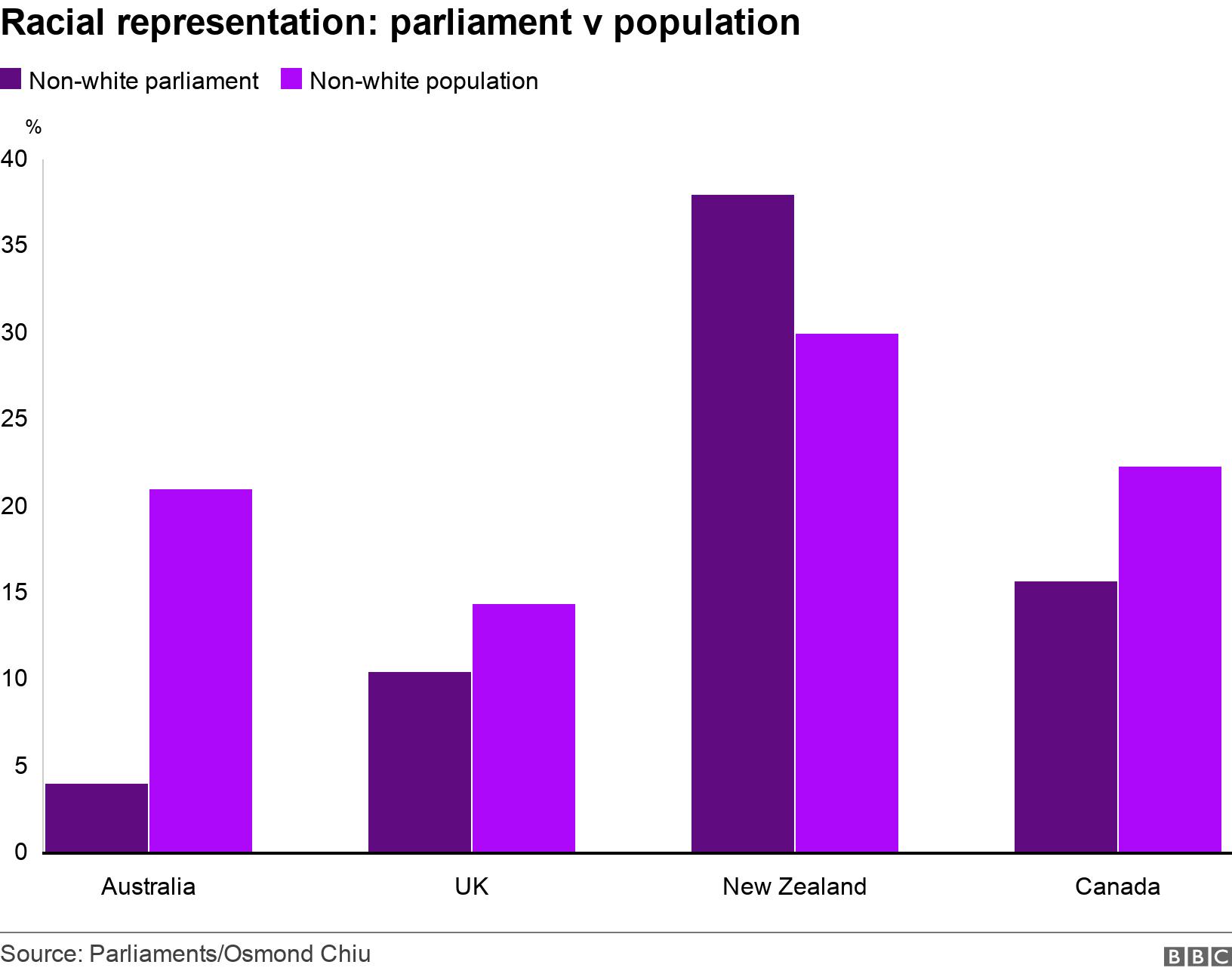
While those from a non-European background make up an estimated 21% of the Australian population, they made up just a tiny fraction of the 46th parliament.

The 47th parliament could feature up to 13 parliamentarians with a non-European, non-Indigenous background, along with nine or ten (depending on final results) parliamentarians of Indigenous background.

That may sound like a strong result – it’s certainly an improvement, and better than how many other major institutions in Australian society perform – but we should put it in perspective.

It would still mean just a tiny fraction of the parliament (no more than 10%) having a non-European or Indigenous background – far less than what you’d see if the parliament actually reflected our society accurately. Australia lags significantly behind the US, UK and Canada and New Zealand.

It’s not all about numbers, of course. We can’t judge the calibre of our parliament solely on whether it’s proportionately representative.

Yet when sections of society can’t see themselves within our public institutions, it is a problem. The very legitimacy, and quality, of those institutions can suffer

A new phase?

For a long time, calls for greater multicultural diversity in politics have been typically greeted with indifference. It wasn’t an urgent problem. Gender diversity was a higher priority. Political parties didn’t feel the pressure from those supposedly excluded from the system.

That now has changed. Labor has been brutally punished for its Fowler move. A swing of more than 16% saw the seat fall to independent (and former Liberal) Dai Le.

Clearly, being from a non-European background isn’t the electoral handicap political parties have sometimes feared.

Something generational is at play. Australia may once have comfortably accepted that newer arrivals were expected to play the role of the grateful supplicant in their “host society”.

But the children and grandchildren of yesterday’s migrants don’t see themselves as guests in their own country. They aren’t happy refugees or cheerful migrants who are content to know their place. They’re taking their lead less from the Anh Dos of the world and more from the AOCs (Democrat politician Alexandria Ocasio-Cortez) of US politics.

Demands about access and equity for non-English speaking background people have been replaced with calls for the equal treatment of “people of colour” and for attention to “intersectionality”.

We could be seeing a new phase in the evolution of Australia’s multicultural project.

While a triumph in many respects, Australian multiculturalism has to date fallen short on several counts. A celebration of cultural diversity has never been accompanied by a sharing of Anglo-Celtic institutional power. Or, for that matter, by a full reckoning with racial inequality and injustice.

That’s why it will be interesting to observe this new parliament. The very presence of this new ethnic and cultural diversity will, in subtle and not so subtle ways, be felt in Canberra and beyond.

Critical mass matters. It is hard, for example, to imagine a more diverse parliament trying to wind back racial hatred laws (as parliament has done on more than one occasion with respect to the Racial Discrimination Act).

Or to imagine a diverse parliament indulging other periodic bouts of race politics (think of the scaremongering over African gangs in Melbourne or the McCarthyist targeting of Chinese-Australians).

All such excesses become much harder when the people debating such matters have skin in the game.

So don’t mistake the wave of multicultural politicians for being a mere symbolic adornment in Canberra – like the political equivalent of having exotic foods and festivals.

It may feel like a subplot for now, but this could end up being just be as significant as the teal revolution.

Source: We’re about to have Australia’s most diverse parliament yet – but there’s still a long way to go

Pap Ndiaye on BLM and the antiracist movement in France

Good background on France’s new education minister and the debates over racism and “wokeism”.

Arun's avatarArun with a View

I’ve been in Berlin for the past week and generally away from the laptop, thus the absence of AWAV’s take on Emmanuel Macron’s appointment of Élisabeth Borne to Matignon and the subsequent announcement of her government—all the picks being Macron’s, of course. The most noteworthy, indeed astonishing, one—I let out a loud “wow!” when I learned of it—was that of Pap Ndiaye as Minister of Education, which is a pretty important ministry in the French government—the minister having a million or so (heavily unionized) fonctionnaires under her/his tutelary authority, plus responsibility for some 13 million schoolchildren and students. Pap Ndiaye is well known to all those of a social scientific/humanities academic and/or left-wing bent, as a brilliant academic specialist of race in France, but also in the United States, and as director since March 2021 of the Museum of the History of Immigration (for which he was profiled in The…

View original post 689 more words

Historic levels of hate crimes are a threat to U.S. democracy, Lipstadt says

Of note:

The historic levels of hate crimes in the U.S. were devastatingly illustrated with a racist mass shooting last weekend at a supermarket that took 10 lives in a mostly Black neighborhood in Buffalo, N.Y. At the forefront of a global fight against hatred and racism is a special U.S. envoy, Ambassador Deborah Lipstadt. Her mandate at the State Department is to monitor and combat antisemitism.

DEBORAH LIPSTADT: But anti-Semitism morphs into other hatred.

FADEL: And when she and I spoke, we discussed how ugly prejudices in one community can feed and grow hate in another.

LIPSTADT: The rising threat of anti-Semitism, the rising threat of racism, the rising degree of conspiratorial thinking, it’s not just a threat to the welfare of specific groups in this country – we saw it against the African American community in a tragic, tragic way this past week – but it’s a national security threat. It’s a threat to our communal welfare. And the need is immediate. And the need is great.

FADEL: Since the attack in Buffalo, we’ve been hearing a lot about this racist conspiracy, the replacement theory. And when I hear that, I think back to Charlottesville, nearly five years ago, when we watched neo-Nazis and white supremacists march with torches and chant, Jews will not replace us. Can you just explain this debunked and racist conspiracy and its danger?

LIPSTADT: Sure. There is a belief amongst people such as the killer in Buffalo and too many others like him. And what they argue is that there is a concerted effort, a plan, a scheme to replace, to destroy white Christian culture, to turn white Christians into a minority by flooding their countries with either people from Africa, Muslims – in this country, people from, quote-unquote, “south of the border” – and to render white Christians a minority. But there’s something else that motivates them or that is part of that theory. They look upon people of color as inferior to white Christians. There has to be someone behind them making this happen. They are the puppets. But who is the puppeteer? And some of them will immediately say, it is the Jew, because in their eyes, Jews are not white. Or they will look for someone whom they believe has the financial resources, the malicious smarts, the ability to be – though small in number, to do this thing, to make this thing happen and to do it secretly. And they will come upon the Jews.

FADEL: And this idea, this conspiracy that has no truth to it, it’s not fringe anymore. It doesn’t feel fringe anymore.

LIPSTADT: You’re absolutely correct. There is an increasing percentage of the American population who believe this is really happening and who think that America’s identity is under threat. And whether they read it online, whether they hear it in the media, whether they hear it from certain politicians – but they believe it. This young man who committed this horrendous, horrendous act in Buffalo, he was radicalized online. Now, maybe in his home, you know, he heard certain things that made him amenable to these ideas. But it’s out there. And people have to recognize that it’s this panoply of hatreds that constitute this threat to our democracy and threat to our country and to national security and foreign countries as well.

FADEL: Your mandate is global, and we’re talking about the danger here in the U.S. But when you look at the world, how prevalent is this right now in 2022?

LIPSTADT: It’s extremely prevalent. And my mandate, of course, is global. I’m based in the State Department. But it becomes increasingly difficult to draw a strict dividing line. Or take Buffalo – the killer in Buffalo, the murderer in Buffalo, looked at, as a model, the Christchurch shooter who murdered people in the mosques. He plagiarized what he had written. He also said he had been inspired by the shooter in Halle, Germany, who, two years ago, on Yom Kippur – the Day of Atonement, the holiest day of the Jewish year – tried to attack a synagogue in which there were 70 or 80 worshippers. And but for a lock on the door, we would have had the largest massacre of Jews on German soil since the Holocaust. So it is a global threat, including in our own country.

FADEL: But I guess I struggle with – how do you combat an idea, whether true or not? – because you can’t imprison an idea out of existence. You can’t kill an idea out of existence. I mean, what do you do practically?

LIPSTADT: I’m a teacher. And I hope I can reach people. I’m not going to be able to change the minds of people who would pick up a gun, put themselves in full body armor and go to a supermarket on a weekend afternoon, where people are buying groceries and buying snacks to watch their nighttime movies or taking their kids for ice cream, and murder them. Those people I can’t reach. But I want to reach the people who don’t really understand this threat, the nature, the danger of these ideas and get them to understand and get them to understand something else as well. And this comes from my years of study and teaching and research about the Holocaust. The Nazis in Germany didn’t come into office in January, 1933, with a plan to murder Jews and saying, OK, we’re going to have gas chambers. Maybe some of them had that in the back of their mind, but that wasn’t what they were planning. They tested. They started first by burning books in May. Then they threw Jews out of civil service positions. And then, in 1935, they deprived them of their citizenship. And slowly but surely, in 1938, they had a nationwide destruction of Jewish property and killing of Jews. And they tested how far they can go. When can we be stopped? So you can’t wait until a Buffalo to try to stop it. You’ve got to stop it before.

FADEL: Ambassador Deborah Lipstadt is the special envoy to monitor and combat antisemitism. Thank you so much for your time.

Source: Historic levels of hate crimes are a threat to U.S. democracy, Lipstadt says

B.C. commits $100 million to Japanese Canadians in recognition of incarcerations

Of note:
B.C. is giving $100 million in funding to address the historical wrongs it caused when it helped to incarcerate thousands of Japanese Canadians during the Second World War.

The announcement comes on the 80th anniversary of the first arrivals of Japanese Canadians to the Greenwood, Kaslo, New Denver, Slocan City and Sandon camps in 1942.

Premier John Horgan says funds will go toward providing updated health programs for survivors, the creation and restoration of heritage sites and updating the provincial curriculum to include what he calls a “terrible chapter” in B.C.’s history.

Horgan says the recognition is “long overdue” and the funding symbolizes “turning a page” in how Japanese Canadians have been treated by past governments.

The province says in a statement that this builds on a 2012 apology by the B.C. legislature and responds to a redress proposal advanced in 2021 by the National Association of Japanese Canadians.

B.C. also gave $2 million to the Nikkei Seniors Health Care and Housing Society last May as a first step toward fulfilling a promise to recognize the incarceration of almost 22,000 people.

“This endowment will not change the past, but it will ensure that generations that are with us still, and those that come after, will have the opportunity to see something positive coming out of what was clearly a very, very dark period in our collective histories,” Horgan said at a Saturday news conference.

Source: B.C. commits $100 million to Japanese Canadians in recognition of incarcerations

Australia election: Why is Australia’s parliament so white?

More on the lack of diversity among Australian politiciants:

Australia is one of the most multicultural nations in the world, but it’s a different story in the country’s politics, where 96% of federal lawmakers are white.

With this year’s election, political parties did have a window to slightly improve this. But they chose not to in most cases, critics say.

Tu Le grew up the child of Vietnamese refugees in Fowler, a south-west Sydney electorate far from the city’s beaches, and one of the poorest urban areas in the country.

The 30-year-old works as a community lawyer for refugees and migrants newly arrived to the area.

Last year, she was pre-selected by the Labor Party to run in the nation’s most multicultural seat. But then party bosses side-lined her for a white woman.

It would take Kristina Kenneally four hours on public transport – ferry, train, bus, and another bus – to get to Fowler from her home in Sydney’s Northern Beaches, where she lived on an island.

Furious locals questioned what ties she had to the area, but as one of Labor’s most prominent politicians, she was granted the traditionally Labor-voting seat.

Ms Le only learned she’d been replaced on the night newspapers went to print with the story.

“I was conveniently left off the invitation to the party meeting the next day,” she told the BBC.

Despite backlash – including a Facebook group where locals campaigned to stop Ms Kenneally’s appointment – Labor pushed through the deal.

“If this scenario had played out in Britain or the United States, it would not be acceptable,” says Dr Tim Soutphomassane, director of the Sydney Policy Lab and Australia’s former Race Discrimination Commissioner.

“But in Australia, there is a sense that you can still maintain the status quo with very limited social and political consequences.”

An insiders’ game

At least one in five Australians have a non-European background and speak a language at home other than English, according to the last census in 2016.

Some 49% of the population was born or has a parent who was born overseas. In the past 20 years, migrants from Australia’s Asian neighbours have eclipsed those from the UK.

But the parliament looks almost as white as it did in the days of the “White Australia” policy – when from 1901 to the 1970s, the nation banned non-white immigrants.

“We simply do not see our multicultural character represented in anything remotely close to proportionate form in our political institutions,” says Dr Soutphomassane.

Compared to other Western multicultural democracies, Australia also lags far behind.

The numbers below include Indigenous Australians, who did not gain suffrage until the 1960s, and only saw their first lower house MP elected in 2010. Non-white candidates often acknowledge that any progress was first made by Aboriginal Australians.

Racial representation: parliament v population. .  .

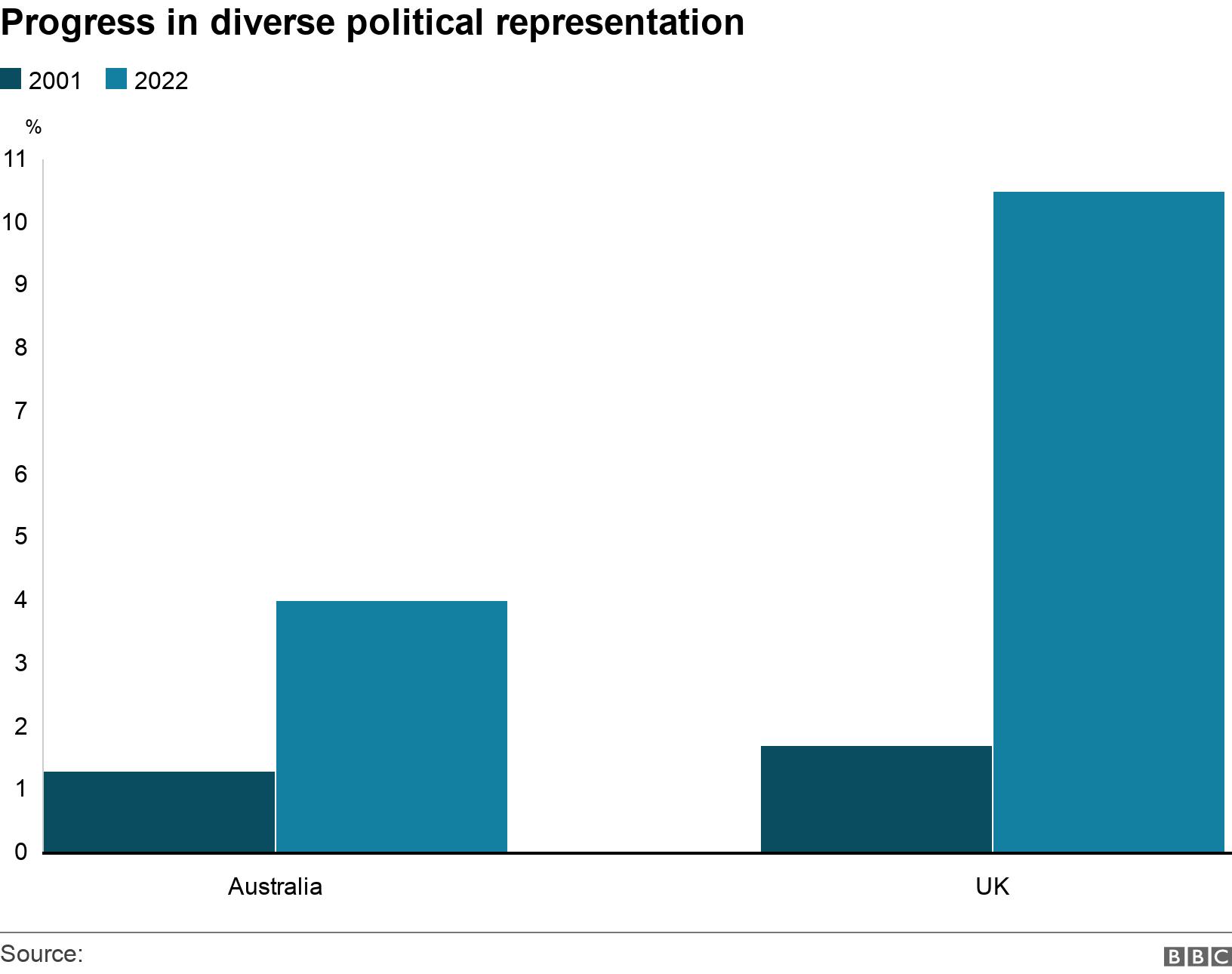
Two decades ago, Australia and the UK had comparably low representation. But UK political parties – responding to campaigns from diverse members – pledged to act on the problem.

“The British Conservative Party is currently light years ahead of either of the major Australian political parties when it comes to race and representation,” says Dr Soutphomassane.

Progress in diverse political representation. .  .

So why hasn’t Australia changed?

Observers say Australia’s political system is more closed-door than other democracies. Nearly all candidates chosen by the major parties tend to be members who’ve risen through the ranks. Often they’ve worked as staffers to existing MPs.

Ms Le said she’d have no way into the political class if she hadn’t been sponsored by Fowler’s retiring MP – a white, older male.

Labor has taken small structural steps recently – passing commitments in a state caucus last year, and selecting two Chinese-Australian candidates for winnable seats in Sydney.

But it was “one step forward and two steps back”, says party member and activist Osmond Chiu, when just weeks after the backlash to Ms Le’s case, Labor “parachuted in” another white candidate to a multicultural heartland.

Andrew Charlton, a former adviser to ex-PM Kevin Rudd, lived in a harbour mansion in Sydney’s east where he ran a consultancy.

His selection scuppered the anticipated races of at least three diverse candidates from the area which has large Indian and Chinese diasporas.

Source: Australia election: Why is Australia’s parliament so white?

McWhorter: ‘Racism’ Has Too Many Definitions. We Need Another Term.

Interesting distinction, between the individual and the systemic, and questions regarding the nexus between the two:

Since Saturday, the mass shooting in Buffalo has rarely left my mind. Ten innocent people killed at a supermarket in a predominantly Black neighborhood. Out of 13 people shot, 11 were Black. According to law enforcement, the man accused of shooting them, Payton Gendron, was motivated by racist hate. Erie County Sheriff John Garcia didn’t equivocate when he said, within hours, that it was a “straight up racially motivated hate crime.” Nor did Mayor Byron Brown when he said on Sunday that “this individual came here with the expressed purpose of taking as many Black lives as he possibly could.” It’s impossible not to be reminded of the 2015 massacre at Emanuel A.M.E. Church in Charleston, S.C., and, sorrowfully, we have no reason to think something like that won’t happen again.

Clearly, racism is not over in the United States.

I have reason to suppose, however, that there are more than a few who think that I am not aware of this. A heterodox thinker on race, as I and others are sometimes called, is often accused of thinking, “There’s no racism.” Or as more temperately inclined folks sometimes say to me, we underplay racism and seem not to understand that it’s still out there. As such, I as well as similarly minded Black thinkers such as Glenn Loury, Coleman Hughes, Wilfred Reilly, Orlando Patterson and Thomas Chatterton Williams are dealing in an alternate reality.

Much of this kind of impression is due to our questioning of how sweeping the use of the word “racism” has become, and I’d like to clarify, at a juncture like this, why I take issue with most strains of what is today called antiracism, despite the reality of racist violence.

The key difference is between outright bigotry and the more abstract operations of what we call “systemic racism.” Yes, there is a synergy between the two. But as the difficulty in our conversations about racism attests, there is a wide gulf between personal prejudice (Racism 1.0) and the societal and sociohistorical operations that render Black physicists, for example, rare relative to Black people’s proportion of the population — Racism 2.0, sometimes even termed “white supremacy.” In an alternate universe, those two things might not go under the same name.

On Racism 1.0, the lamentable thing is that I see no reason it will ever completely vanish, at least not in our lifetimes. Studies haverevealed that a degree of fear and distrust of “the other” exists in our species, for better or worse. Call it conservative of me, but I see little point in hoping that human nature will entirely change. Educated Westerners, especially, have already acquired a more robust habit of self-monitoring for racism than perhaps any humans in history. In our country, this habit noticeably gained traction in the 1960s. Some argue that white Americans need to go further, plumbing more deeply for subtle racist assumptions in their hearts. I understand the desire for it but wonder just how realistic that expectation is at this point.

I assume, with regret, that there will always be racists among us. As long as our gun laws make it easy to obtain assault-style weapons, there will be people, some mentally imbalanced and some just plain evil, who decide to commit mass shootings. There is no reason the hatred in people like this will mysteriously step around racism; the question would be why such people would not often be motivated by it. We live with this horror.

However, there isn’t enough of a nexus between this grim reality and disparities between Black people and white people — in, for example, wealth and educational opportunity — to gracefully put both under the general heading of “racism.” That is, we increasingly apply the term in reference both to violent hate crimes and to the fact that, for example, in the aggregate, Black students don’t perform as well on standardized tests as some of their counterparts. But while we tend to use the term “racism” for both things, it isn’t readily obvious to most how both prejudice and a differential in performance are versions of the same thing, referred to with one word. One of the thorniest aspects of today’s race debate is that we have come to apply that word to a spread of phenomena so vast as to potentially confuse even the best-intended of people.

As such, to be aware of a case like the Buffalo tragedy cannot be taken as making inevitable one’s support for antiracist initiatives such as reparations for slavery or taking funds away from the police in a given city. There may be arguments for such proposals, but the existence of outright bigotry and racist violence is not one of them.

Thus, I am chilled to my socks by what happened in Buffalo while also opposed to the ideology that challenges mainstream standards as “white,” sanctions the censure and dismissal of those who fail to adhere to fashionable tenets of antiracist doctrine, and condescends to Black people by encouraging exaggerated claims of injury. My position comes in full awareness that there remain people in our society who deeply despise Black people and Blackness.

There will always be those who see cases like this one, shake their heads and dismiss someone who sees things as I do with the thought: “And he thinks racism is over — yeah, right.” I can’t fix that, but I suspect I can get a little further with those who think heterodox Black thinkers are reasonable but still underplay the effects of racism. I don’t think we do. I am respectful toward, but skeptical of, potential arguments holding, for example, that acknowledging Racism 1.0 requires accepting the precepts of Racism 2.0. But I hope this newsletter shows, in line with the theme of a recent one I wrote, that my leeriness about how well that kind of argument could hold up is based on neither ignorance nor malevolence, but opinion.

Source: ‘Racism’ Has Too Many Definitions. We Need Another Term.

Le Québec «bashing» ou la tolérance à deux vitesses

Sigh. Not to mention the inverse, Canada bashing on the part of some intellectuals…

Le Canada se drape de tolérance envers les minorités — tout en assumant des épisodes de Québec bashing, devenus chroniques dans l’histoire des deux solitudes. Ce paradoxe, commun au monde anglo-saxon, remonte à l’origine même du libéralisme britannique, estime Patrick Moreau, professeur au collège Ahuntsic qui participait, mercredi, à un colloque consacré à « la condescendance francophobe en contexte canadien ».

« Les sociétés anglo-saxonnes en général — et la société canadienne en particulier — se présentent toujours comme très libérales, très à cheval sur les droits individuels et la tolérance, explique M. Moreau, qui collabore par ailleurs à la section Idées du Devoir. En même temps, elles ont souvent, à travers l’histoire, connu des accès d’intolérance. »

Pour le professeur, invité à prendre la parole au congrès de l’Acfas mercredi, « le ver est dans le fruit » depuis la naissance de la tolérance religieuse proclamée au XVIIe siècle par le pouvoir anglican. « L’Angleterre autorisait toutes les sectes protestantes, ce qui était exceptionnel en Europe, à l’époque. En revanche, cette tolérance excluait les catholiques et les athées. Nous sommes tolérants, mais pas à l’égard de toutes et de tous. »

Ce même réflexe s’applique encore aujourd’hui envers le Québec, maintient le professeur Moreau. Le Canada anglais prétend accueillir et célébrer les différences. Sauf certaines, souvent québécoises.

« Dès qu’on nous montre la diversité canadienne, il faut qu’on nous montre une femme voilée, un turban, etc., poursuit le chercheur, en entrevue au Devoir. Comme si la seule différence admissible était en réalité superficielle. Si les Québécois se contentaient d’être une minorité parmi d’autres, arborant la ceinture fléchée lors de la Saint-Jean, le Canada s’en réjouirait et les tolérerait comme il tolère n’importe quel costume de n’importe quelle minorité ethnique ou religieuse. »

Or, le Québec dérange au point de devenir intolérable, soutient M. Moreau, parce que la différence qu’il revendique réfute la suprématie du modèle anglo-saxon.

« Ce qui est inacceptable aux yeux du Canada anglais, c’est cette volonté du Québec de faire société en français et selon des termes politiques qui ne sont pas ceux de la philosophie politique anglo-saxonne. Autrement dit, de revendiquer des droits linguistiques collectifs. […] La laïcité, c’est un peu la même chose, poursuit le professeur Moreau. On refuse, au Canada anglais, de voir la laïcité comme un modèle légitime de gestion de la diversité. On veut à tout prix y voir l’expression d’une intolérance ethnique à l’égard des autres minorités religieuses. »

Un Québec bashing progressiste

Cette discrimination à l’égard des francophones, M. Moreau note qu’elle a évolué au tournant du XXIe siècle. « La francophobie canadienne était, jusque dans les années 2000, plutôt conservatrice. C’était vraiment une francophobie coloniale issue d’un sentiment de supériorité très britannique et protestant à l’égard de Canadiens français, jugés arriérés, et catholiques, en plus. »

Plus récemment, avance le chercheur, « nous sommes passés à un Québec bashing progressiste, c’est-à-dire que nous allons reprocher au Québec d’être intolérant à l’égard des minorités, de créer une discrimination à l’égard des minorités, donc finalement de refuser les normes du multiculturalisme trudeauiste actuel. »

La saga entourant l’Université d’Ottawa et l’usage du mot en « n » dans une salle de cours a jeté une lumière crue sur le paradoxe de la tolérance canadienne envers ses minorités, insiste le professeur de littérature au collège Ahuntsic. « Il y a eu un glissement que je trouve personnellement assez épatant de la part de gens qui se prétendent fondamentalement antiracistes, mais qui vont insulter des professeurs en les traitant de fucking frogs. Bref, en utilisant un vocabulaire qui est très clairement raciste. »

À son avis, le Québec bashing a encore de beaux jours devant lui. Tant mieux, souligne-t-il, puisque sa disparition voudrait dire la fin d’un Québec qui revendique son droit à faire société autrement.

« Le jour où le Québec bashing va disparaître, ce ne sera pas vraiment une bonne nouvelle pour le Québec, avance M. Moreau. Ça voudra dire, je pense, que le Québec aura renoncé à faire société d’une façon différente du Canada. Autrement dit, il aura adopté le modèle dominant du libéralisme canadien. À ce moment-là, il sera devenu acceptable », conclut le professeur.

Source: Le Québec «bashing» ou la tolérance à deux vitesses