Khan: I thought the Charter protected Canadians’ fundamental rights, but I was wrong

Another good column by Sheema Khan:

Like you, there have been many times I have felt proud to be Canadian. For example, our government’s principled refusal to join the immoral invasion of Iraq. Attending citizenship ceremonies, where new Canadians remind us of the deeper meaning of citizenship. Being told by one of my Harvard professors that Canadian students were the best prepared – a testament to our excellent public education system. And of course, the 1995 Unity Rally in Montreal, on the eve of the Quebec referendum, where Canadians joined hands peacefully to express our heartfelt love for Canada and Quebec.

The contentment has been punctuated by instances of profound doubt, when I wonder what we really stand for. For example, the longstanding Canadian project to inflict cultural genocide on Indigenous communities. Just read the summary of the Truth and Reconciliation Commission’s report to get a shocking glimpse into the depravity of our country’s official policy: Last year’s gut-wrenching announcements about the unmarked graves of Indigenous children on the grounds of former residential schools. And let’s not forget the complicity on the part of government agencies in the rendition of Maher Arar to torture in Syria.

Post 9/11, our courts served as a check on government overreach on basic civil liberties. I grew to love our Constitution, which replaced hockey as a central feature of my Canadian identity.

I am not a historian. Nor am I a lawyer. I am, simply, a Canadian citizen who cherishes our Charter of Rights and Freedoms as a safeguard for fundamental rights and freedoms.

Imagine, then, the gut-punch upon discovering that the highest law of the land – to which new citizens pledge allegiance – makes no such guarantees of fundamental rights and freedoms whatsoever. All owing to the notwithstanding clause, which is enshrined in the Charter.

For years, I saw the “notwithstanding clause” as a polysyllabic legal term, bandied about by constitutional experts. I didn’t know what it meant. Mainstream media clarified it as a right, given to provincial and federal governments, to suspend Sections 2 and 7 to 15 of the Charter. All of this still seemed abstract. Until it wasn’t, after reading those sections.

In a nutshell, the Charter grants governments the right to suspend basic individual freedoms that we all take for granted. Namely, freedom of conscience, religion, thought, belief, opinion and expression, as well as freedom of the press, peaceful assembly and freedom of association. We aren’t talking about emergency measures, nor reasonable limits that are justified in a democracy. No, we are talking about a constitution that makes it perfectly legal to suspend basic human rights, as a matter of governance.

It does not stop there.

A number of basic legal rights can be suspended. These include the right to life, liberty and security (barring some exceptions, such as the prison system); requirement of warrants for search and seizure; the right to be informed why one is being detained; the right to a lawyer upon arrest; the right against unlawful imprisonment; presumption of innocence until proven guilty; and the right not to be subjected to cruel and unusual punishment. The clause allows suspension of the right of every individual to be equal before, and under the law; and suspends the right to equal protection of the law without discrimination based on race, ethnicity, colour, religion, sex, age or disability.

This needs to be spelled out: our Charter makes it perfectly legal to gut basic rights. There is no need for a coup, no need to politicize selection of judges, no need to gerrymander, no need to use a loophole. The potential for abuse is encoded into law. There is no other constitutional democracy that allows for the gutting of basic rights as a matter of governance.

Much has been written about the history of how the notwithstanding clause came to be: a compromise between federal and provincial powers; a balance between elected representatives and unelected judges. Yet, this does not explain how basic human rights were used as a bargaining chip, rendering our Charter of Rights and Freedoms hollow.

When it was introduced, the thought was that it would be rarely used. Some termed it the “nuclear button.” For decades, that was the case. However, within the past three years, it has been used twice by Quebec and once by Ontario. Quebec Bills 21 and 96 unequivocally suspend individual and legal rights of minorities. Conservative Party leadership candidates Jean Charest, Pierre Poilievre and Patrick Brown have promised to strike down the recent Supreme Court decision on sentencing, using the clause.

It’s time for each Canadian to engage in a conversation about who we are as a country, given that our Charter allows for cancellation of basic civil liberties.

Source: I thought the Charter protected Canadians’ fundamental rights, but I was wrong

Parkin, Triandafyllidou, Aytac: Newcomers to Canada are supportive of Indigenous Peoples and reconciliation

Particularly relevant on National Indigenous Peoples Day and current high levels of immigration:

Public education about Canada’s treatment of Indigenous Peoples is an important component of the process of reconciliation.

Knowing the history can better help citizens understand current challenges and equip them with the tools to work respectfully with Indigenous Peoples to build a better future, in keeping with the section on “education for reconciliation” in the Truth and Reconciliation Commission’s final report

Much of this public education occurs in schools, through the media and even via discussions among friends and within families. But new immigrants to Canada might miss some of this socialization (depending on their age of arrival) because they’ll have less exposure to Canadian schools and media in their formative years. 

This could affect their attitudes to Indigenous Peoples and support for the process of reconciliation itself. Given that one in five Canadians was born abroad, this would pose a significant political risk. 

Alternatively, it’s possible that, despite less exposure to Canadian schools and media, immigrants might be more supportive of Indigenous Peoples because they could be more aware of the legacies of colonialism worldwide, more open to learn about their new country or more conscious of their responsibility as newcomers to learn Canadian history.

Supportive of Indigenous Peoples

The question of how immigrants perceive Indigenous Peoples in Canada, and vice versa, is therefore relevant but rarely explored. 

But data from the Confederation of Tomorrow 2021 survey, conducted by the Environics Institute and including sufficiently large samples of both immigrants and Indigenous Peoples, allows us to examine these issues.

Specifically, we can explore perceptions of immigrants towards Indigenous Peoples and reconciliation, and look at responses to three questions: 

  1. How familiar do you feel you are with the history of Indian Residential Schools in Canada?
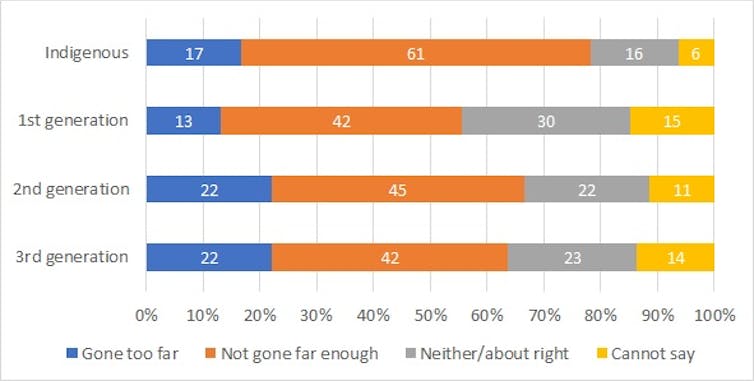
  2. In your opinion, have governments in Canada gone too far or have they not gone far enough in trying to advance reconciliation with Indigenous peoples?
  3. Do you believe that individual Canadians do, or do not, have a role to play in efforts to bring about reconciliation between Indigenous and non-Indigenous people? 

The survey results generally show that, despite less familiarity or certainty about these issues among new immigrants compared to those born in Canada, they are more likely to support Indigenous Peoples.

Gap in knowledge

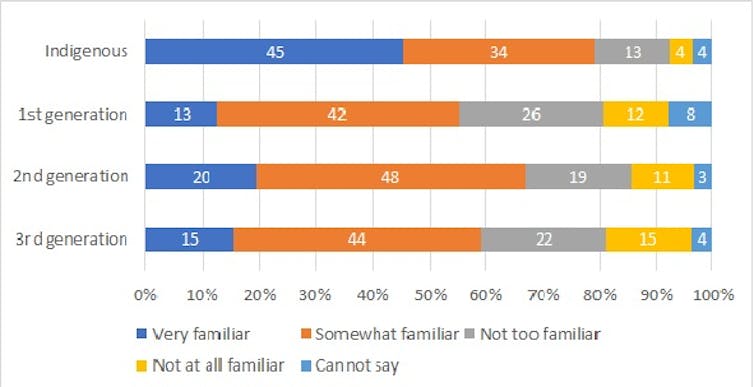
The survey shows a big gap between how familiar Indigenous Peoples and non-Indigenous people — both immigrants to Canada and non-immigrants — are with the history of Indian Residential schools.

The findings suggest first-generation immigrants are less likely than non-Indigenous Canadians to say they’re “very familiar” with this history, and are more likely to express no opinion.

These results indicate that first-generation immigrants don’t know as much as other Canadians about the history of Indian Schools in Canada. It is notable, however, that second-generation Canadians are more likely than third-generation Canadians to feel “very familiar” with the history of Indian Residential Schools.

A graph shows how familiar immigrants to Canada feel they are with the history of Indian Residential Schools in Canada compared to Indigenous Peoples.
A graph shows how familiar newcomers to Canada feel they are with the history of Indian Residential Schools in Canada compared to Indigenous Peoples. Author provided, Author provided

This lesser familiarity among first-generation immigrants, however, does not translate into lower support for efforts to advance reconciliation. 

Government response

This support is evident when they were asked about whether governments have gone too far, or not far enough, to advance reconciliation. 

The most striking difference — not surprisingly — is that Indigenous Peoples are much more likely than non-Indigenous Canadians to say that governments have failed to go far enough to advance reconciliation. 

But first-generation immigrants are just as likely to hold this view than second- or third-generation Canadians. First-generation immigrants are also less likely to say that governments have gone too far in their efforts to promote reconciliation — a result that’s significant when controlling for education (which is an important step since first-generation immigrants are more likely to be university-educated than the rest of the population). 

First-generation immigrants are also less likely to take a definitive position either way, and are more likely to say “neither” or “cannot say.”

A graph shows whether Canadians believe governments have gone far enough in trying to advance reconciliation with Indigenous Peoples.
A graph shows whether Canadians believe governments have gone far enough in trying to advance reconciliation with Indigenous Peoples. Author provided, Author provided

The role of Canadians

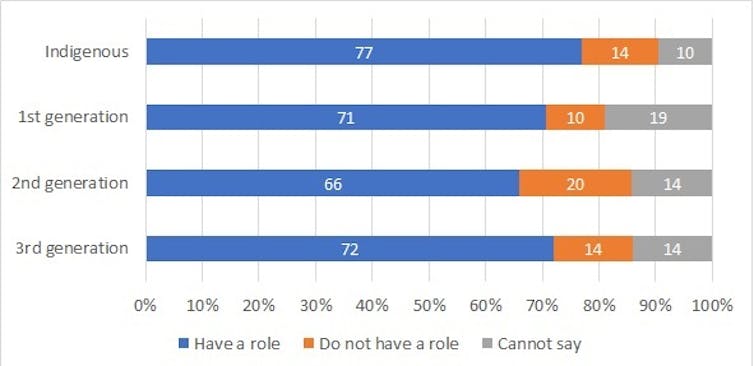
Similarly, Indigenous Peoples are unsurprisingly the most likely to say that individual Canadians have a role to play in reconciliation. 

But first-generation immigrants are just as likely as second- or third-generation Canadians to hold this view (although first-generation immigrants are also more likely to have no opinion on this question). 

A graph shows whether individual Canadians have a role to play to bring about reconciliation between Indigenous and non-Indigenous Peoples.
A graph shows whether individual Canadians have a role to play to bring about reconciliation between Indigenous and non-Indigenous Peoples. Author provided, Author provided

These results are encouraging because they suggest that even if immigrants aren’t socialized in Canada at a young age, that’s not an obstacle to building understanding and support for reconciliation. 

Indigenous support for immigration

Interestingly, the survey also allows us to explore the other side of the relationship between immigrants and Indigenous Peoples in Canada, namely support among Indigenous Peoples for immigration. 

This is a potentially contentious issue. On the one hand, diverse sources of immigration in the post-Second World War period have already disrupted the narrative of Canada as a nation of two founding peoples (British and French). That in turn suggests a view of Canada that is not only multicultural but multi-national, and inclusive of Indigenous Peoples and nations. 

In this sense, the interests of immigrants and Indigenous Peoples could be aligned. But at the same time, the ongoing arrival of newcomers can be seen as a continuation of the settler/colonization process. 

Thoughts on immigration

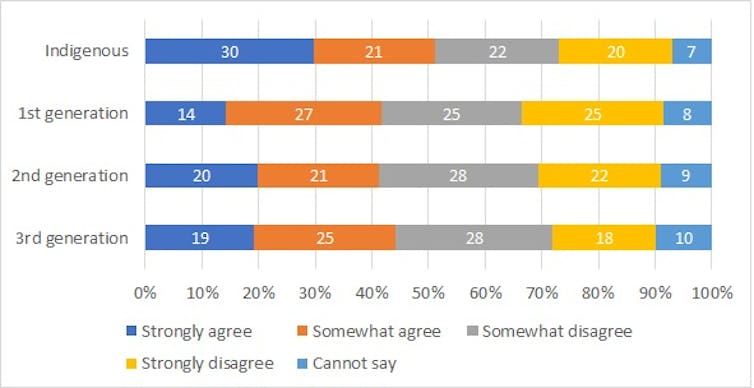
We can explore this issue by referring to a question in the survey asking Canadians whether they agree or disagree that “overall, there is too much immigration to Canada.” 

The results show that there are significant differences in attitudes about immigration between the general population and Indigenous Peoples. Thirty per cent of Indigenous peoples “strongly agree” with the statement, the highest proportion among all groups. 

A graph shows whether Canadians and Indigenous people believe there is too much immigration to Canada.
A graph shows whether Canadians and Indigenous people believe there is too much immigration to Canada.Author provided, Author provided

However, this general difference about immigration levels is driven in large part by the difference in views between Indigenous Peoples and first-generation immigrants. While Indigenous Peoples, compared to first-generation immigrants, are more likely to strongly agree than strongly disagree that there is too much immigration to Canada, there are no statistically significant differences between Indigenous Peoples and second- or third-generation Canadians.

This suggests that the key factor influencing attitudes towards immigration might not be Indigenous identity, but being born in Canada.

Nonetheless, this finding is important because it’s a reminder to proponents of more immigration that they should be open to and engage with Indigenous Peoples’ perspectives on this issue. Immigration, as a policy objective, should be pursued with an eye on how it might be perceived by those who were displaced by the earlier arrival of settlers.

Source: Newcomers to Canada are supportive of Indigenous Peoples and reconciliation

Jussim: The Problem with Research on Microaggressions

Interesting discussion of microaggressions as racial insults or just being treated badly (equitably so):

If one were to read much of the psychological literature on microaggressionsuncritically, one would come away with the conclusion that they are a serious problem. If so, it is very hard to discern this from the vast literature on microaggressions.

A microaggression is often defined as some sort of subtle racial insult, often one that’s plausibly deniable as not racist. But this definition is complicated by the fact that people are treated badly all the time.

The day I wrote this, I had to wait for a ridiculous amount of time to pay $13 for a small, desiccated hamburger at an airport. Interestingly, this is exactly the type of incident that Sue et al (2007, p. 275) highlighted as a possible example of a microaggression: “When a Latino couple is given poor service at a restaurant…” Similarly, Nadal (2011) used this item to assess people’s experiences with microaggressions: “I received substandard service in stores compared to customers of other racial groups.”

As per Nadal (2011), if I believed customers of other races were given better service, I should consider this a microaggression. In this case, I am pretty sure my long wait for a bad burger was not a microaggression. And I am pretty sure it would not have been a microaggression if the burger shop provided the same overpriced, undersized, desiccated burger to a person of color (POC), notwithstanding Sue et al’s or Nadal’s analyses.

When Is Bad Treatment a Microaggression?

What makes some sort of bad treatment a microaggression versus just another form of people treating each other badly sometimes? Racism (or some other form of bigotry). The treatment needs to be motivated by, express, and reinforce racism or some other form of social bias. Long waits for bad burgers could be a microaggression—if, say, the burger joint made POC wait longer to order. But if everyone has a long wait for bad overpriced burgers, there is no racism involved, so no microaggression.

But how can one tell whether any particular insult or mean-spirited act or statement is a microaggression or just a person acting badly that has nothing to do with race (or any other identity)? One definition of microaggressions (Sue et al., 2007) is “brief and commonplace daily verbal, behavioral, or environmental indignities, whether intentional or unintentional, that communicate hostile, derogatory, or negative racial slights and insults toward people of color.” Did they literally mean “daily,” or is it just a figure of speech? Sue et al. (2008, p. 278) clarify: minorities don’t “just occasionally experience racial microaggressions.” Rather, “they are a constant, continuing, and cumulative experience” in their lives. They are, per this definition, disturbingly common racial slights.

Another more recent definition is that these are “deniable acts of racism that reinforce pathological stereotypes and inequitable social norms” (Williams, 2020). This is quite a scientific statement. They are racist but deniable as not racist. They have clear causal effects—reinforcing pathological stereotypes and inequitable social norms. This would seem to require researchers to do the following:

  1. Establish that an insult/slight is motivated by racism.
  2. Identify stereotypes that the insult/slight reinforces.
  3. Empirically establish the “pathology” of the stereotype.
  4. Show that the microaggression actually strengthens those particular pathological stereotypes.
  5. Identify relevant inequitable social norms.
  6. Show that the microaggression reinforces those norms.

Given that all of this is in Williams’s definition of microaggressions, to take this seriously scientifically, one would expect all of this to be empirically established for a particular slight before it would be labeled a microaggression.

Instead, I argue that the reverse occurs—some act is labeled a “microaggression” by one or more scholars, then all of the ills attributed to microaggressions are presumed rather than demonstrated. Then the act is heralded as scientific evidence of a microaggression.

The academic legerdemain by which the ills of microaggressions have been implicitly imported or declared by fiat rather than actually empirically demonstrated has been explored in each of the following articles (titles shown; all fully referenced at the end):

  • “Macrononsense in Multiculturalism”
  • “Microaggressions: Strong Claims and Inadequate Evidence”
  • “Microaggressions, Questionable Science, and Free Speech”

For example, Lilienfeld (2017) concluded that there is insufficient evidence to support any of these major claims by microaggression advocates:

  1. They are operationalized with sufficient clarity and consensus to afford rigorous scientific investigation.
  2. They are interpreted negatively by most or all minority group members.
  3. They reflect implicitly prejudicial and implicitly aggressive motives.
  4. They can be validly assessed using only respondents’ subjective reports.
  5. They exert an adverse impact on recipients’ mental health.

The “Best” Studies

Some of the “best” studies often held up by microaggression advocates as establishing the validity of these main claims fail to do so. For example, in defending the microaggression concept in light of Lilienfeld’s critique, Williams (2020, p. 12) invoked a study by Kanter et al. (2017): it provides “important empirical support for something that diversity researchers knew all along—microaggressive acts are rooted in racist beliefs…” This was a small-scale study, including only 33 Black and 118 white students, all from a single university. These numbers are so small and so unrepresentative of any population that the entire study should be viewed as little more than question-raising, regardless of other limitations, of which there are many, as we elucidated in Cantu and Jussim (2022).

Williams (2020, p. 13) also extolled “Another important measure of microaggression frequency—the Racial and Ethnic Microaggressions Scale (Nadal, 2011), which was validated with a large sample of African Americans, Hispanic Americans, Asian Americans, and multiracial participants.” Whether anyone should take Nadal’s scale seriously, given its numerous limitations, is, however, another issue. For example, consider the item “someone avoided walking near me on the street because of my race.” This would require mindreading. Even since Bem’s ESP article helped trigger the replication crisis, mindreading has been widely recognized as impossible.

However, I argue that one does not need to criticize the methods to understand how damaging Nadal’s study was for claims extolling the frequency with which POC experience microaggressions. Respondents were provided with supposed examples of microaggressions and were then asked how frequently they had experienced such discrimination in the prior six months. For a vast majority of the items, most respondents reported that they either had not experienced the microaggression in the past six months at all or, if they had, did so one to three times. In light of this result, I would argue that it’s difficult to characterize microaggressions as constituting a major social ailment. And that comes from taking his results at face value, which in itself may not be warranted.

Perhaps because we (Cantu and Jussim, 2022) highlighted the strange state of affairs whereby an article extolled as testifying to the importance of microaggressions actually found just the opposite, Williams recently highlighted a study (Anderson et al., 2022) as demonstrating that microaggressions are experienced very frequently by medical students. That is indeed what the authors claimed to have found: “Our first major finding was that medical students frequently experience microaggressions.” (p. 303).

Unfortunately, the authors’ claims notwithstanding, they did not assess “microaggressions.” They assessed variations on “How often do you think has someone been mean to you?” Here are just two items:

People trivialize my ideas in classroom discussions.

I am made to feel unwelcome in a group.

There is nothing about race or racism here (or in their other questions). These types of experiences have probably happened to everyone. To be sure, though, I have no doubt that people are subject to subtle insults, and that sometimes these are racially motivated. But if one wishes to know “how often?” one cannot possibly obtain much of an answer from even the supposedly best published psychological science on the topic.

Thus, it’s possible for peer-reviewed social science to create myths (much as I argue it has about stereotype threat and implicit bias) about the power of problems that it has not actually established to exist to any substantial degree.

Source: The Problem with Research on Microaggressions

‘There is systemic discrimination in our policing’: New Toronto police data confirms officers use more force against Black people

Significant. However, most activists remain sceptical, at least the ones I heard on CBC:

The hard data proves what has long been known and felt by members of the city’s Black communities.

Toronto police officers use more force against Black people, more often, with no clear explanation why. Except for race.

That is a key takeaway from a landmark new report containing never-before-seen data on officer use of force and strip searches — statistics that, for the first time, were collected and released by the Toronto Police Service itself.

The race-based statistics are so stark that Chief James Ramer offered an apology to the city’s Black community, coinciding with the release of a 119-slide presentation on the force’s findings.

“I am sorry and I apologize unreservedly,” Ramer said Wednesday morning.

“Our own analysis of our data from 2020 discloses that there is systemic discrimination in our policing,” Ramer said. “That is, there is a disproportionate impact experienced by racialized people, particularly those of Black communities.”

Meanwhile, police this weekend warned officers to brace for a “challenging” public reaction that will “lead some people to question the hard work you do every day.” 

Among the major findings: In 2020, Toronto officers used force on Black people about four times more often than their share of the population — and Black Torontonians were five times more likely to have force used against them than white ones. 

And in those cases when force was used, an officer was more than twice as likely to draw a firearm on a Black person they thought was unarmed than a white person they thought was unarmed. 

The statistics show overrepresentation in other racialized communities, too. If you are Indigenous, you were more likely to be subjected to a strip search, a highly invasive police practice; and members of the Latino, Middle Eastern and Southeast Asian communities were also more likely to have force used against them.

The sobering data released Wednesday aligns with past external reports that have found Black people are overrepresented in police use of forcein this city. 

But the new data uses internal police records to go a step further, evaluating racial disparities in police use of force not only against the city’s population but within the pool of people interacting with police — those who were arrested, considered suspects, ticketed for provincial offences and more.

“This allows us to compare outcomes against the population that actually had contact with police,” a Toronto police statement said, adding it allows police to “focus our efforts on the actions that we can control.”

In other words: If officers were simply responding to higher rates of crime in any one group, this method should make the racial disparity disappear.

Even here, Black people were overrepresented, found to be 1.6 times more likely to be subjected to force compared to their percentage of total police interactions in 2020. Latino people were overrepresented by 1.5 times and Middle Eastern people were overrepresented by 1.2 times.

And Black people were already more than twice as likely to be the subject of this baseline police enforcement. Although they represented approximately 10 per cent of the city’s population in 2020, they accounted for 22 per cent of what police called “enforcement actions,” including arrests, tickets and other stops.

The police report has been independently peer-reviewed, Ramer said. 

He added: “This is some of the most important work we have ever done.”

Where the data is coming from

The race-based data released Wednesday details the use of force and strip searches conducted by Toronto police in 2020.

The use of force data is taken from Ontario’s “use of force reports” — documents required to be filled out whenever an officer uses physical force requiring medical attention, deploys a TASER, or draws or points their firearm. In 2019, Ontario’s provincial government required all police services to begin recording the officer’s perception of the race of the person they used force against.

Toronto police then cross-referenced these reports with internal “occurrence” reports — allowing them to conduct a deeper analysis, including of the type of call and the location of the incident.

In total in 2020, Toronto police said there were 949 use of force incidents involving 1,224 members of the public. Of those, 39 per cent were perceived as Black, while 36 per cent were perceived as white. (In 2020, 46 per cent of Toronto’s population was white.)

In 2020, Toronto police also began recording officer perception of race for strip searches — an invasive procedure conducted on people who are arrested. For years, Toronto police and other services were not capturing race-based data on strip searches, something critics said was long overdue.

The data analysis independently reviewed “leading experts” in race data collection with a human rights lens, Toronto police said. Since it began collecting race-based data, Toronto police has been consulting with a community advisory committee that includes members of Black, Indigenous and racialized communities.

Use of force — from low to high

Police use of force reports capture a range of interactions. Lower level force includes the use of aerosol spray, a baton, a police dog or a strike with a hand. Less lethal force is the use of a Taser or bean bag gun, and higher levels of force include when a firearm is pointed or discharged.

Of the 949 use of force incidents in 2020, a firearm was pointed at someone 371 times. The gun was fired four times, twice killing someone.

When officers use force, Toronto police were more likely to point a firearm toward a Black person compared to a white person.

Even in situations where police believed the subject was armed, a Black person was 1.5 times more likely to have a gun pulled on them than a white person in the same scenario.

The difference increased even when police didn’t think the subject had a weapon. In that scenario, a Black person was more than twice as likely as a white person to have a police officer pull out their gun and point it at them.

Black, South Asian and East/Southeast Asian people were more likely to experience higher uses of force compared to white people when it came to “less than lethal force,” such as a bean bag gun.

Locations

https://misc.thestar.com/interactivegraphic/2022/06-june/15-use-of-force-rate-map/index-doubled.html

Toronto police also examined police officer use of force rates in police divisions across the city. The results showed that, overall, incidents involving white people had lower use of force rates while those involving Black people had higher use of force rates. 

The differences appear to be stark in some mid-Toronto police divisions, including downtown’s 51 and 52 Divisions. 

In those areas, officers used force on a white person in .5 to .75 per cent of all enforcement interactions (such as arrests). But when the person was Black, force was used in more than 1.75 per cent of these same interactions — numbers that show these divisions used force against Black people around two to four times more frequently.

The differences, Toronto police said, are “not explained” by the demographic makeup of the local population. 

In other divisions there is a much lower racial disparity, or none at all, according to the data. In Scarborough’s 42 Division and midtown’s 53 Division, for example, the data shows no difference in use of force between white and Black people.

Calls for service and types of offences 

In calls for service that were classified as violent, Black people were 1.2 times more likely and Indigenous people were 1.4 times more likely to be on the receiving end of officer use of force, according to the data.

With calls regarding a person in crisis, Black people were nearly two times more likely to be subjected to force, while Indigenous people were 1.4 times.

Black people were found to be more likely to be subjected to police officer use of force in incidents involving assaults, mental health calls, fraud, mischief and robbery. 

Strip searches

In 2020, more than 22 per cent of all arrests — more than one in five — resulted in a strip search by Toronto police (7,114 strip searches in total, from 31,979 arrests). 

Of those, 31 per cent of those strip searched were perceived as Black, roughly three times their share of the population and higher than their 27-per-cent share of total arrests.

Indigenous people showed the highest overrepresentation in strip searches. They were overrepresented by 1.3 times compared to their presence in all Toronto police arrests. They accounted for just three per cent of the total arrests but represented to 4 per cent of all strip searches. 

The data was collected the same year Toronto police made a significant policy change to strip searches in response to a scathing report by Ontario’s police complaints watchdog that found the force conducted “far too many” strip searches. Before, more than 27 per cent of arrests resulted in a strip search; following the changes, which included having a supervisor sign off on all strip searches, that number dropped to 4.9 per cent of arrests.

Data from 2021 shows a marked decline in the number of strip searches, though arrests involving white and Black people were still more likely to result in a strip search, compared to the average. 

Source: ‘There is systemic discrimination in our policing’: New Toronto police data confirms officers use more force against Black people

And a somewhat contrary view regarding the need to include the context of crime rates in communities:

The problem with the Toronto Police report released Wednesday concluding that Blacks, Indigenous people and other racial minorities are disproportionately targeted by police when it comes to use-of-force incidents and body searches, is that it looks at only half the issue. It concludes the reason for this is systemic racism within the police force, for which Police Chief James Ramer publicly apologized and pledged to do better going forward, noting the study recommends 38 “action items” police will implement along with dozens of recommendations in other studies.

But what the report excludes are the crime rates in the various communities with which the police interact.

Logically that’s part of the equation because if they are higher in some communities than others, that will impact the frequency and type of their interactions with police.

However, it has been illegal for police forces in Ontario to gather or reveal this data for decades.

That was the result of a controversy that erupted in 1989 when then Toronto police superintendent Julian Fantino released statistics suggesting Blacks in one Toronto community were disproportionately involved in crime.

Fantino said he did it to counter allegations police were racist.But politicians, criminologists and civil rights groups responded that releasing the data without the context that the Black community was over-policed, was unscientific and would feed into racism.

As a result, race-based police statistics today are used solely to search for systemic bias within policing.

Scot Wortley of the University of Toronto and Maria Jung of Toronto Metropolitan University in a 2020 report for the Ontario Human Rights Commission which concluded Blacks were disproportionately arrested and charged by Toronto police compared to whites, cited both theories to explain why this happens.

One is the “Bias Thesis” which argues, “Black people are over-represented in police statistics because they are subject to biased or discriminatory treatment by the police and the broader criminal justice system. “Rates of Black offending stem from the negative consequences of centuries of colonialism, slavery and racial oppression … The impact of intergenerational trauma and contemporary social disadvantage, in turn, results in higher rates of Black offending.”

An alternative explanation, the “Higher Rate of Offending Thesis” argues “Black people engage in criminal activity at a higher level than other racial groups and this fact is accurately reflected in official crime statistics … when such factors as the criminal history of individuals and the seriousness of their offences are considered, there’s no evidence disparities in arrest rates are the result of police racism.”

The authors of the OHRC study cited “growing evidence (that) suggests that both explanations have merit … (that) the over-representation of Black people in arrest statistics may be caused both by higher rates of offending and racial bias within the criminal justice system.”

That is, police disproportionately arrest and charge Blacks (for example) because while the vast majority of Blacks are law-abiding, a minority are disproportionately involved in criminal activity and the reason is often due to the adverse social and economic conditions faced by Blacks because of systemic racism, not just in the police force, but in society in general.The problem is that by continuously ignoring the issue of crime rates within the communities with which the police interact, we are no longer looking honestly or completely at all aspects of the issue.

This will inevitably contribute to public skepticism among many about the findings of this latest report by Toronto Police identifying systemic racism in the force.
Source: GOLDSTEIN: Here’s why we no longer talk honestly about police race-based data

Harder: Three years on, Quebec’s law on religious symbols hampers our ability to defend global human rights

Of note:

Shortly after I retired as deputy minister of foreign affairs, a senior Canadian diplomat told me of a spat he overheard between a French reporter and an Iranian official on the issue of religious face-coverings.

The Iranian official was condemning a French law prohibiting Muslim women from wearing the niqab in public when the reporter shot back that Iran’s restrictive dress codes for women amounted to much the same thing.

“Yes,” the Iranian official agreed. “The difference is that we have never promised anyone liberté, égalité, or fraternité.”

The hypocrisy alleged by the Iranian came back to me recently in advance of Thursday’s third anniversary of Quebec’s law on laïcité, Bill 21, which prohibits Quebec public servants such as teachers from wearing religious symbols while performing their duties.

The enactment of the law unsettled many Canadians in 2019, not least because Quebec overrode the protection of the Charter of Rights and Freedoms through use of the notwithstanding clause. But the law has also had a knock-on effect by undercutting Canada’s international standing as a defender of pluralism — an obstacle which gets worse the longer the law is in place.

In a world where civil liberties become ever more restricted, the global community needs every credible proponent and protector of pluralism that there is, and Canada should be at the top of that list. But we degrade our position when we tolerate within our borders two classes of citizens: those who enjoy the full liberty to express their religion in their dress, and those who do not.

Consider the position of Canadian diplomats who might want to press Russia for its arrest of demonstrators protesting the invasion of Ukraine, or protest the crackdown on freedom of expression in Hong Kong or censure the treatment of Uyghurs in China? Will we have maximum credibility when we speak?

Not unless we clean up our own house.

One place to start is to guard against becoming so accustomed to measures such as the Quebec law that we no longer speak out against them. That means making our voices heard not only on anniversaries, but regularly and in as many forums as are available to us.

A compromise of any civil liberty becomes more offensive the longer it remains place. At all costs, we must refuse to become desensitized to rights’ violations simply because they have been with us for an extended period of time.

Second, our leaders must stop shying away from criticizing the actions of other jurisdictions in the hope that staying silent will lead to acquiescence when and if they decide to abridge rights in their home jurisdiction.

Provincial premiers muse far too often these days about using the notwithstanding clause, a habit that will over time erode Canadians’ resistance to its use. Since the day three years ago when Quebec invoked the clause on religious symbols, Ontario has done the same on third-party advertising laws. Quebec also invoked it pre-emptively in the passage of Bill 96 recently, the bill designed to reform the Charter of the French Language.

To be sure, the law on the wearing of religious symbols is not the only example where Canada has fallen short on the protection of rights, and our opponents will remind us of those historic deficiencies when we try to shine a light on wrongdoing outside our nation. Witness the treatment of Indigenous Canadians in residential schools, which has already been the subject of a request by China and its allies for an independent investigation.

We can’t change the past. What we must do now is take every effort possible to clean up our act in the present. If we don’t, we will end up with a patchwork quilt in our own country, without a leg to stand on when advocating for equality in other parts of the globe.

In failing to get tough with ourselves, we will do a disservice to those millions of people fighting the good fight against authoritarian regimes in their own countries.

Peter Harder is a former deputy minister of Foreign Affairs and former government representative in the Senate.

Source: Harder: Three years on, Quebec’s law on religious symbols hampers our ability to defend global human rights

Australia: Multicultural groups welcome federal government’s move to collect ethnicity data

Another long overdue step:

The federal government has announced it will begin collecting ethnicity data as part of measuring diversity in Australia, a move long called for by experts and multicultural community groups.

Key points:

  • Comparable countries like the US, Canada and New Zealand collect data about ethnicity to measure diversity
  • Experts say failure to understand the make up of multicultural Australia hindered COVID-19 responses
  • The federal government aims to collect ethnicity data at the next census

Country of birth and language spoken at home have historically been the main diversity indicators used by Australian government agencies.

But experts say this does not adequately capture the diversity of the community — not least because many Australians from diverse backgrounds are born in Australia and speak English.

“Australia does not effectively measure our diversity,” Andrew Giles, the new Minister for Immigration, Citizenship, Migrant Services and Multicultural Affairs, told a conference in Melbourne.

He said Australia’s failure to collect data on ethnicity or race — unlike the US, Canada and New Zealand — was a “fundamental barrier to understanding the issues that face multicultural Australians”.

“I looked at the sort of countries that we often compare ourselves to … and we weren’t compiling data that enables us to understand the representation of different population groups,” Mr Giles told the ABC at the Federation of Ethnic Communities Councils of Australia (FECCA) conference.

“This became a much bigger issue, of course, during the pandemic, where we saw really uneven health impacts, particularly in the vaccination rollout.”

Last year, the ABC reported that while the federal government had committed to sourcing ethnicity data during COVID-19 testing and vaccination, Victoria was the only state collecting data on ethnicity.

This was despite indications that culturally and linguistically diverse communities were being harder-hit by coronavirus outbreaks, such as those in Western Sydney and public housing towers in Melbourne.

“The pandemic showed us some pretty hard truths about our society,” Mr Giles said.

“The truth someone born in the Middle East was 10 times as likely to have died during the pandemic, than someone born in Australia, is unacceptable.”

Australian Bureau of Statistics (ABS) data to January 2021 showed that Australian residents born in the Middle East and North Africa were over 10  times more likely to die of coronavirus than people born in Australia.

Those born in South-East Asia and southern and central Asia, meanwhile, were around twice as likely to die of COVID.

“That is the most extreme example of many about our failures to ensure that everyone was counted, and everyone was supported, through a difficult time. I don’t want that to happen again,” Mr Giles said.

A culturally and linguistically diverse data collection working group with representatives from peak multicultural bodies, along with data collection and demography experts, would be established to develop national standards for diversity data collection, Mr Giles said.

The pandemic showed there was a “gaping hole” in the data collected about the Australian population, according to FECCA chief executive Mohammad al-Khafaji.

“COVID has provided that opportunity for us to actually look seriously at the systemic barriers for us to address this issue,” he said.

Mr al-Khafaji welcomed Mr Giles’s announcement, saying he was pleased the new government recognised it as a priority.

“We’ve been calling for this for the past few years, and we’re glad that that call has been answered,” he said.

“If you’re not counted, you don’t know that you exist, and the programs and the policies won’t reflect the diversity of Australia today.”

Ahead of the 2021 census, people from Asian and Pacific Islands ethnic minority backgrounds told the ABC the Australian Bureau of Statistics was not accurately capturing their ancestry.

Mr Giles said he wanted the changes to inform the next census in 2026.

“The data set we have about this is imprecise, because place of birth doesn’t really tell us the full story about who someone is, how they identify, and that’s why we do need to get better data,” he said.

Race Commissioner wants more data on racism

Australia’s Racial Discrimination Commissioner, Chin Tan, also welcomed Mr Giles’s announcement of the shift towards collecting more detailed data on diversity, calling it a “positive move”.

“We are now looking at focusing on an area that we should have taken care of a long time ago,” Mr Tan said.

“For me it’s a positive move to get more information that will support multicultural communities and support Australia in advancing multiculturalism.”

He told the ABC the Australian Human Rights Commission wanted to see greater data collection on race issues and racism.

“While we applaud and will support initiatives toward multicultural data collection, we are also looking at data collection that will capture race and race issues in this country as well,” Mr Tan said.

He said Australia was still “lagging far behind” other countries in terms of multicultural policies and programs.

“Our multicultural future needs to be enhanced, and needs to be strengthened, and reinforced,” Mr Tan said.

“We need to have policies and programs, and funding obviously, to support that.”

Source: Multicultural groups welcome federal government’s move to collect ethnicity data

Biden officials may change how the U.S. defines racial and ethnic groups by 2024

Long overdue:

The Biden administration is taking steps that could change how the U.S. census and federal surveys produce racial and ethnic data that is used for redrawing voting districts, enforcing civil rights protections, policymaking and research.

The multiyear process is likely to carry out long-awaited data policy changes that will particularly affect how Latinos and people of Middle Eastern or North African descent are counted in statistics around the country.

In a blog post released Wednesday, Karin Orvis, U.S. chief statistician within the White House Office of Management and Budget, said the federal agency is starting a new formal review of the government’s standards for statistics about race and ethnicity to help ensure they “better reflect the diversity of the American people.”

The goal, Orvis added, is “completing the revision no later than Summer 2024,” which would be months ahead of the next presidential election and in time for any changes to be incorporated into 2030 census plans.

“I understand the importance of moving quickly and with purpose. It is also important that we get this right,” Orvis said in the post, noting that the process will include gathering input from federal agencies and members of the public.

A little-known part of the federal government, OMB is in charge of determining how the Census Bureau and all other agencies can ask about a person’s racial and ethnic identities, as well as defining the checkboxes found on surveys.

First set in 1977, OMB’s standards for racial and ethnic data were last revised in 1997 and have influenced how surveys across the U.S. generate demographic statistics.

A major overhaul was expected ahead of the 2020 census. But those efforts stalled during former President Donald Trump’s administration despite years of research by the bureausuggesting that certain changes to the standards could improve the accuracy of statistics about Latinos and people with origins in the Middle East or North Africa.

Other proposals included no longer officially allowing the term “Negro” to be used to describe the “Black” category on federal surveys and taking out “Far East” from the standards as a description of a geographic region of origin for people of Asian descent.

Orvis noted that the new review will make use of past research, as well as the work of an earlier working group of career civil servants who were reviewing proposals to allow forms to ask about a person’s Hispanic origins and race in a combined question and to include a checkbox for “Middle Eastern or North African.”

Many Democrats in Congress have been calling for OMB to add a separate category for people of Middle Eastern or North African descent, whom the current standards classify as “White.”

“Federal demographic data does not reflect the realities of MENA individuals and community-based organizations, which makes it increasingly difficult for advocates, researchers, agency officials, and policymakers to communicate, understand, and address community needs,” wrote a group of Democratic members of the House Oversight and Reform Committee led by Rep. Carolyn Maloney of New York, the committee’s chair, and Rep. Rashida Tlaib of Michigan in a letter this week to the head of OMB.

The Biden administration has previously signaled that adding such a category would be a priority. Movement at OMB, however, has been slowed by the delayed confirmation of a new agency director and the hiring of a new chief statistician.

Asked by NPR why OMB decided to start a new review of its standards on racial and ethnic data instead of continuing its earlier review, OMB’s press office did not answer directly and referred instead to Orvis’ blog post.

Source: Biden officials may change how the U.S. defines racial and ethnic groups by 2024

‘Conservatives are losing traction in ethnic communities:’ Will their leadership race make it even worse?

Likely premature call.

As we know, voters in the 905 have flipped between Conservatives and Liberals, and Doug Ford won most of these ridings in 2018 and 2022.

And during the recent leadership debates, there was remarkable consensus in favour of immigration and no opposition to the current government’s ongoing increase in immigration levels:

Cyma Musarat still remembers being accused of having lost her mind when she ran for the federal Conservatives in 2019.

As a Muslim woman, she was asked time and time again how she could cast her lot with a party that promoted policies condemned as racist.

In her riding of Pickering-Uxbridge, it was a particularly sensitive topic — during the 2015 election campaign, the Tories held an event in a pocket of the riding where they promised a so-called “barbaric cultural practices” tip line for people to report on their neighbours.

The tip line proposal and support for a ban on face coverings during citizenship ceremonies were seen as key contributors to the party’s defeat in the election.

And not just that year.

The policies effectively bombed the bridges the party had built with ethnic communities, and the issues surfaced in the 2019 and 2021 campaigns as the Tories failed to make the gains in urban centres.

What it will take for the Tories to win the next election is the question at the heart of the party’s current leadership race.

But how ethnic communities factor into the equation is a point of contention, and an issue not being debated enough, some say.

So far, the race has not seen debate over social issues like systemic racism or inequality, or even how the party can and must embrace equity and inclusion internally, said long time political activist Sukhi Sandu, who backed the Tories in the last federal campaign.

“The Conservatives are losing traction in ethnic communities, and they seem not to understand the issues that pertain to those racialized groups,” Sandu said in an interview from Boston, where he’s working towards a master’s degree in diversity, equity and inclusion.

Musarat believes the party must first acknowledge these issues exist, then move beyond a process of just checking off boxes.

For her, that’s why Brampton Mayor Patrick Brown’s leadership bid is so appealing.

“He openly says that Islamophobia exists,” she said. “That’s where the journey starts. That’s where the change will start: acknowledge the problem. Once you’ve acknowledged it, and then you find a solution to fix it.”

Brown built his leadership bid on his outspoken opposition to Quebec’s Bill 21, which bans people in positions of public authority in that province from wearing religious symbols, like turbans or hijabs, at their workplaces.

He went on to promise a multi-faith, multicultural coalition that would restore trust between the Tories and ethnic communities.

While signing up what his campaign says are 150,000 new party members, Brown has made specific promises to different ethnic groups.

In turn, he has been accused of playing diaspora politics — an accusation his backers say is proof most candidates aren’t willing to do the hard work of sitting down with voters to listen to their specific concerns and address them.

“People have this misconception that someone stands up at the front door on stage and says, ‘We’re all gonna support Patrick,’ and, you know, 50,000 people sign up for the man,” said Jaskaran Sandu, a volunteer on the Brown campaign.

“That’s not how it works. It’s painstaking, person-to-person relationship building that only works if there is sincerity and a track record.”

Brown has also been unsparing in his attacks on rival Pierre Poilievre, challenging the Conservative MP for remaining silent when the Tory government introduced the niqab ban and proposed the tip line.

Poilievre’s campaign co-chair Tim Uppal has apologized for not personally pushing back against those policies when he was an MP — and minister of state of multiculturalism.

Uppal said he had no concerns that the candidates’ positions on tackling racism aren’t getting a broad airing on the campaign trail. An issue like that only gets debated if there’s a flashpoint which prompts it, he said.

He said while Brown is recruiting in diverse communities, so too is Poilievre, citing a recent speech to a packed mosque, among others.

“What I’ve talked to people a lot about is that they’re being included because of issues that are important to them, which is taxes and other issues that affect all Canadians,” he said.

Leslyn Lewis, a Black woman making her second run for the Conservative leadership, did not respond to questions from the Star about how she views the future of the party’s relationship with ethnic communities.

Vonny Sweetland is working on Jean Charest’s leadership bid, a decision based on the depth of the former Quebec premier’s experience — and his willingness to bring people like Sweetland onto his team.

The leader sets the tone, said Sweetland, who is Black, and Charest’s is inclusive and progressive.

But both Sweetland and Sandhu said they have concerns about what will happen to the party if the populist elements that appear to be playing a major role in this race ultimately triumph.

Sandhu pointed to the tension between members recruited with a promise the Conservatives will embrace diversity and those brought in over concerns about global institutions like the World Economic Forum, around which conspiracy theories with racist undertones persist.

“Why do you expect us to be involved or continue if that’s the type of rhetoric that’s going to be included back into the party?” he said of those recruited by Brown.

“That doesn’t actually solve the issue — it goes back to the basis of the problem, which is that the Conservative party is not ready to look in the mirror and evolve and realize why it falls short in places like the 905.”

Sweetland said while he’s planning to give the new leader is some runaway, whoever it is, there is anxiety among other Black conservatives.

“I’ve seen, people, particularly people of colour, feel that this is not only a leadership race — and I’m sure you’ve heard this quote, it’s not mine, but I agree with it — that this is the battle for the soul of our party,” he said.

“And many people of colour feel that way.”

Source: ‘Conservatives are losing traction in ethnic communities:’ Will their leadership race make it even worse?

Millions believe in conspiracy theories in Canada

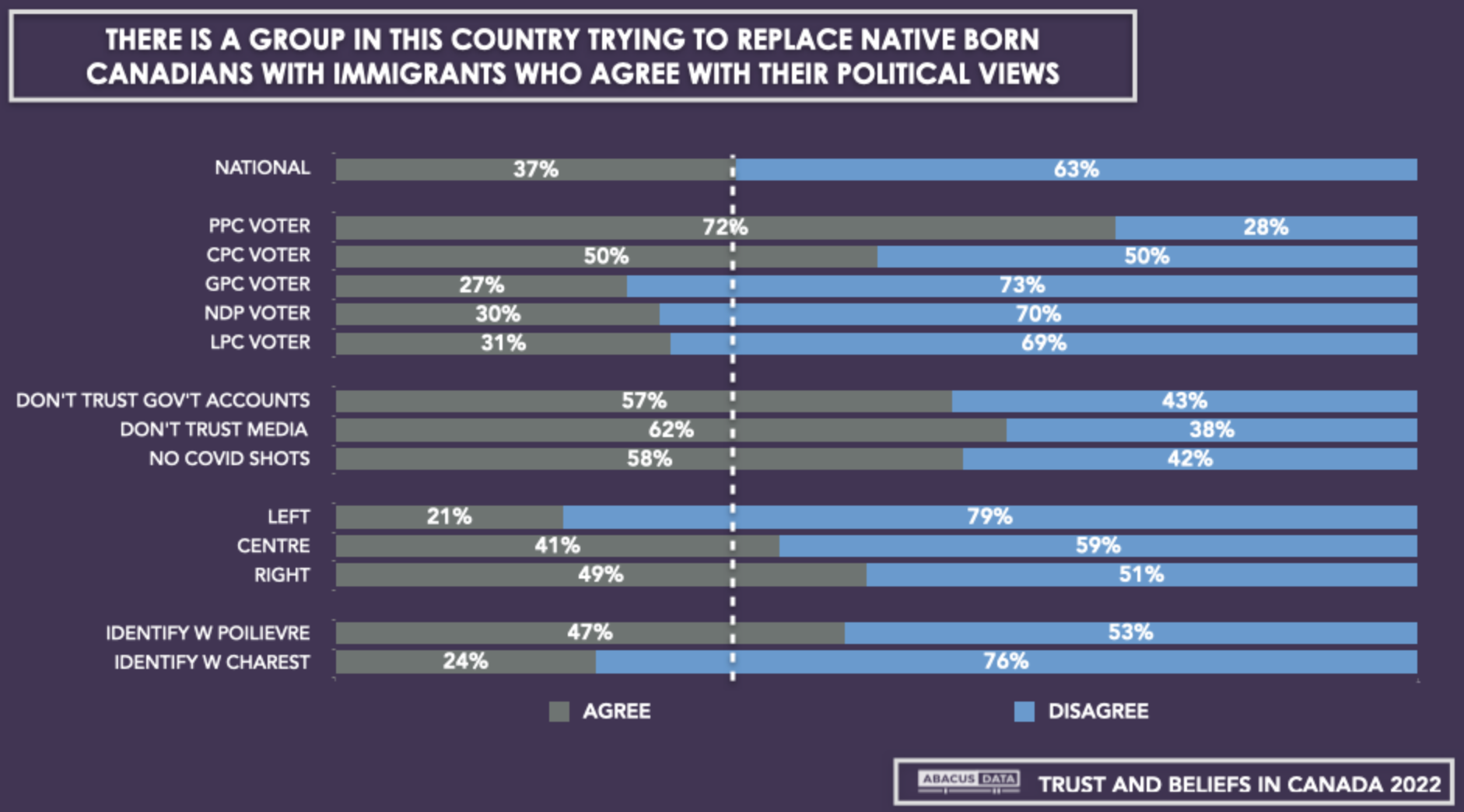
Interesting public opinion research and worrisome. The “great replacement” slide below is the one that most attracted my attention. It does track, to a certain extent, the Focus Canada question, “Too many immigrants do not adapt Canadian values,” 48 percent Fall 2021:

We recently completed nationwide surveying among 1500 Canadians.  The focus was on the levels of trust people have in institutional sources of information, and belief in conspiracy theories.  This is the second in a series called “Trust & Facts: What Canadians Believe”

• 44% (the equivalent of 13 million adults) believe “big events like wars, recessions and the outcomes of elections are controlled by small groups of people working in secret against us”. Almost as many agree “much of our lives are being controlled by plots hatched in secret places

• 37% (or 11 million) think “there is a group of people in this country who are trying to replace native born Canadians with immigrants who agree with their political views. This is an articulation of what is commonly referred to as replacement theory.

• 20% believe it is definitely or probably true that “the World Economic Forum is a group of global elites with a secretive strategy to impose their ideas on the world.” Another 37% think it is possibly true or aren’t sure either way.

• 13% think it is definitely or probably true that Microsoft founder Bill Gates is using microchips to track people and affect human behaviour. Another 21% say it’s possible, or aren’t really sure.

A deeper dive into demographic and other variables that correlate with these beliefs revealed:

• Belief in these theories is higher among supporters of the People’s Party, those who self-identify on the right of the spectrum, those who have not received any COVID-19 shots, and those who think media and official government accounts of events can’t be trusted. Those who feel Pierre Poilievre is the Conservative leadership candidate closest to their values and ideas are more likely to believe these theories when compared to those who feel more aligned with Jean Charest.


THE UPSHOT

Canadians who want to believe that Canadian society is relatively unaffected by conspiracy thinking will find little comfort in these results. Millions believe that our lives are controlled by secret plots to undermine our interests.

That such beliefs correlate strongly with the instinct to mistrust what media report and what governments say –is a challenge that threatens all institutions that depend on an informed body politic and is like a poison affecting our civil discourse. Only recently we’ve witnessed how a massive demand for the protection offered by Covid 19 vaccines fostered a strenuous effort by those who disbelieve government and media to deny the value of those same vaccines.

This question of whether people can and should trust in institutional voices and known facts is the central theme running through the current leadership dynamic within the Conservative Party leadership race. The data make it clear that to compete for votes from the People’s Party base, Conservatives could choose to embrace conspiracy thinking, but in so doing would alienate a good portion of others, and create hesitancy among half their current voter coalition.

Perhaps the most disconcerting thing in these numbers is the fact that mistrust of institutional accounts isn’t simply neutral skepticism – it is often accompanied by a willingness to believe dangerous contrarian theories. This threatens to undermine the ability of political parties, businesses, civil society groups, and governments to help build consensus and make progress together.

Source: Millions believe in conspiracy theories in Canada

Tolley: Women and racialized political candidates are being set up to fail

I’m less pessimistic than Tolley given overall progress election to election, albeit slower than desired. And gender equity may be more of a factor in winnable ridings as visible minority and Indigenous candidates are largely, but not universally, as a function of riding demographics:

Recent elections have resulted in more women, racialized and Indigenous people holding political office in Canada. That’s good news, but we’ve got a long way to go. Elected institutions still do not reflect the demographics of the populations they claim to represent. These representational gaps are a clear indicator of democratic inequality.

It’s not that there is a shortage of qualified candidates from diverse backgrounds. It’s that the major parties still tend to privilege candidates who are white, male and middle-aged. Parties have many of the tools they need to address electoral under-representation, but rather than being a gateway into politics, parties are frequently the gatekeepers. It’s time this changed.

Political parties are the central pressure point in any effort to address electoral under-representation. The problem isn’t really voter bias: Canadians tend to base their voting on party and leader preference, and this inclinationtends to override all but the strongest prejudices against local candidates. There also isn’t a shortage of qualified candidates, but parties frequently underestimate the electoral potential of those who don’t fit the mould.

If all parties nominated a more diverse slate of candidates in winnable districts, elected institutions would be more representative.

In the lead-up to Ontario’s most recent election, commentators pointed to the high number of women and racialized candidates, including many with immigrant and minority backgrounds. But when the votes were counted, the legislature’s gender composition remained stalled at just 39-per-cent women.

What happened?

We need to look beyond aggregate candidate “diversity” numbers. It’s not just who gets nominated, but also where they run. Realizing it is electorally advantageous, some parties have attempted to recruit more women and racialized candidates, but women especially continue to be disproportionately nominated in ridings the party has no hope of winning. This isn’t inclusion.

And although there has been some progress in the right direction, it’s not enough – and it hasn’t been across all parties at all levels of government.

For example, prior to the Ontario election, the Liberals set aside 22 ridings and designated them women-only nomination contests. In the end, the party’s dismal electoral fortunes meant they only eked out a victory in one of those designated ridings, but polling indicates this was more a rejection of the party and its leader than the individual candidates.

If all parties committed to nominating more women in winnable ridings, the demographics of our elected institutions would shift.

International evidence confirms the key role that parties can play.

In 2005, Britain’s Labour Party introduced legislation that permits parties to use all-women short lists to achieve gender equality in Parliament. In the 2019 election, 51 per cent of the party’s elected MPs were women. There is noevidence voters punished Labour for using a positive discrimination measure, and the selected women were every bit as qualified as other candidates, often even more so.

There is a straight line between more equitable nomination practices and increased gender representation. Political parties that are serious about democratic equality should take note.

But parties need to think about diversity beyond gender.

In Canada, the primary beneficiaries of most diversification efforts are white women. Federally, my own research shows that racialized candidates come forward for party nomination in numbers that exceed their share of the population, but parties still show a preference for white candidates, even in some of the country’s most diverse ridings. And even when they nominate more diverse slates, parties nonetheless funnel more money to prototypical white, male candidates.

Without financial and organizational support, candidates are being set up to fail.

Politics is increasingly seen as inhospitable. Electoral engagement is at an all-time low. If parties wait to see which candidates knock on their door and want to run, chances are it will be one of the usual suspects. The time to think about candidate recruitment and organizing is now – not just at election time or the few frantic months that precede it.

Enough hand-wringing. Parties need to recognize their role and commit to action. To open the gates, they must pro-actively identify, recruit and support a more representative slate of candidates with money and organizational capacity in ridings where they can actually win.

Source: Women and racialized political candidates are being set up to fail