Rioux | Les dix ans du Bataclan

More war of civilization commentary but correct that it is internal, not just external:

…Dix ans plus tard, l’idéologie qui a inspiré les assassins du Bataclan n’a cessé de progresser. Tout cela à la faveur d’une naïveté coupable, mais aussi, et c’est nouveau, d’intérêts politiques bien sentis. Certains partis étant prêts, pour rameuter une nouvelle clientèle, à faire l’impasse sur quelques vérités dérangeantes.

Aujourd’hui, constatent les meilleurs analystes, l’islamisme n’est plus un courant venu de l’étranger, comme plusieurs de ces assassins du 13 novembre arrivés par bateau de Syrie pour se mêler aux migrants qui débarquaient sur les côtes grecques. Il est devenu endogène et fleurit dans les banlieues de toutes les grandes villes d’Europe. Nos pays ont beau avoir délocalisé usines et capitaux, ils sont dorénavant capables de produire des djihadistes maison 100 % pure laine. Ce qui faisait dire à un spécialiste des stratégies militaires comme David Betz, du King’s College de Londres, que, face à l’effritement des consensus sociaux et de la confiance envers l’État, les conflits à venir ont de plus en plus de chances de ne pas être des guerres traditionnelles entre pays, mais des guerres civiles.

« Tout le drame, c’est que l’ennemi est devenu endogène et que nous n’avons plus la même capacité à le reconnaître », nous confiait l’ancien président de la commission parlementaire sur les attentats du 13 novembre, Georges Fenech.

Souhaitons que ces commémorations, par ailleurs nécessaires, ne servent pas à blanchir la conscience de ceux qui ont fermé les yeux et n’ont rien vu venir. Il ne faudrait pas que les victimes du Bataclan soient mortes en vain.

Source: Chronique | Les dix ans du Bataclan

… Ten years later, the ideology that inspired the Bataclan’s assassins continued to progress. All this thanks to guilty naivety, but also, and this is new, of well-felt political interests. Some parties are ready, to attract a new clientele, to ignore some disturbing truths.

Today, the best analysts note, Islamism is no longer a current from abroad, like many of these murderers of November 13 who arrived by boat from Syria to mingle with the migrants who landed on the Greek coasts. It has become endogenous and blooms in the suburbs of all major cities in Europe. Our countries may have relocated factories and capital, but they are now capable of producing 100% pure wool homemade jihadists. This made a military strategy specialist like David Betz of King’s College London say that, in the face of the crumbling of social consensus and confidence in the state, future conflicts are increasingly likely to be not traditional wars between countries, but civil wars.

“The whole drama is that the enemy has become endogenous and that we no longer have the same ability to recognize him,” told us the former president of the parliamentary committee on the November 13 attacks, Georges Fenech.

Let us hope that these commemorations, which are also necessary, do not serve to whitewash the conscience of those who closed their eyes and saw nothing coming. The victims of the Bataclan should not have died in vain.

McWhorter: ‘The Zorg’ tells a story we all must hear

Another good column, again a reminder that simplistic Manichean dichotomies don’t reflect historical realities and complexities:

…As the African American studies professor Henry Louis Gates Jr. has written and I have experienced, people are often uncomfortable learning that Africans sold one another into this living hell. A common objection is that Africans had no way of knowing what conditions their captives would encounter. But they saw those captives being marched all but to death, sold like animals and penned into a slave castle hold. Black African slave traders had more than enough information to understand the fundamental immorality of the undertaking. If whites had seen even only what the Africans saw, we would not hesitate to judge them as unforgivably complicit in sin.

One lesson of “The Zorg” is that history and people are complex. The recently fashionable view of American (or Western) history as just one extended hit job, with whiteness always the oppressor and people of color always the subaltern, is ultimately a childish temptation, excusing us from engaging detail and nuance. Humans of all shades have quite often been awful to one another. Our job is to work against that tendency, not to pretend it doesn’t exist. And to celebrate those who overcome it, whatever their race. Abolitionism — a Western, Anglophone achievement, which Kara recounts in a final chapter — was a keystone example of that effort, and “The Zorg” is invaluable instruction in what made it so important….

Source: ‘The Zorg’ tells a story we all must hear

Parkin: Spot the backlash [DEI]

More interesting analysis that bucks some of the commentary:

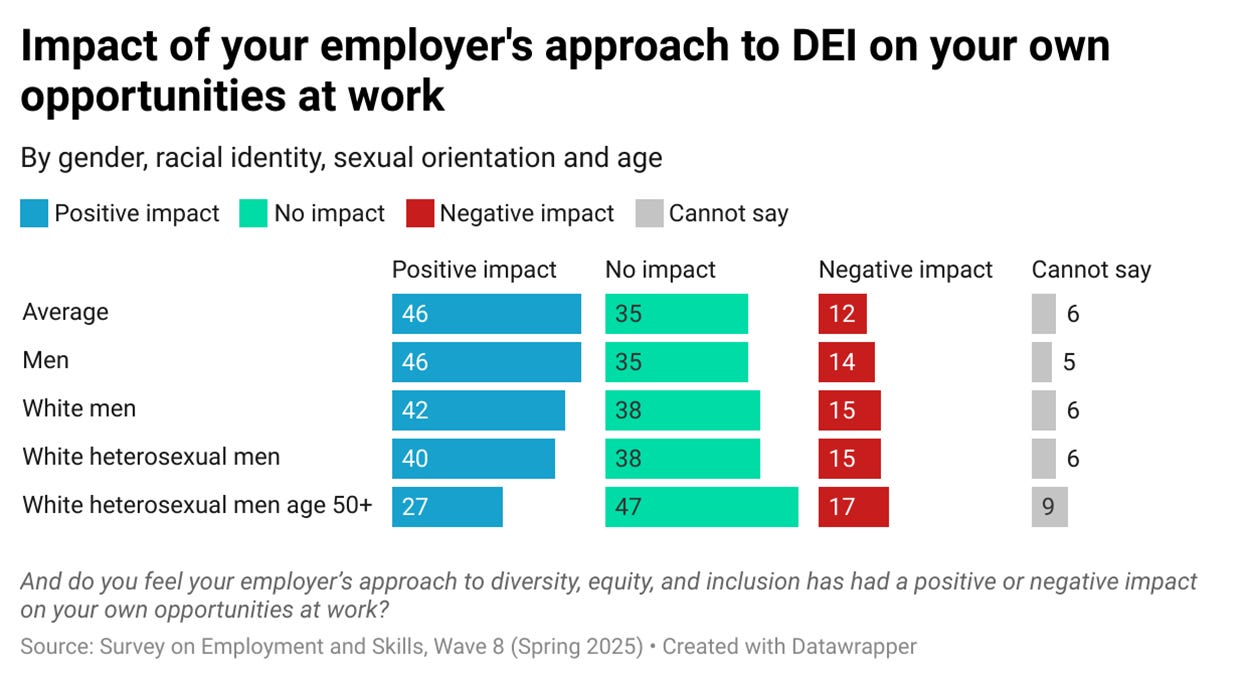
…But maybe we’re not looking closely enough. Thanks to the support of our survey partners at the Diversity Institute and the Future Skills Centre, the survey sample allows us to narrow the focus. Follow along in the chart below, which starts with the responses for employed adults in general, but then zeroes in on gender, racial identity, sexual orientation and age.2

Can you see the backlash taking shape? No, me neither.

Certainly, opinions are influenced by age. Older people are less likely to say that they’ve been positively affected by DEI policies (this holds true for older people in general, not just older white men). But opinions mostly shift to the neutral position (no impact). The proportion of white, heterosexual men age 50 and older who say their own opportunities have suffered as a result of DEI is only five percentage points higher than the average.

Source: Spot the backlash

Japanese immigrants fought for Canada during WW I while denied the right to vote 

Part of our less proud history:

For the first time the faces of Japanese Canadian veterans who fought in the First World War are on display on the streets of Vancouver after a century largely unrecognized.

A community historian spent more than 15 years digging through archives, tracking down descendants and uncovering heroic acts to bring this group of forgotten soldiers’ stories to life and push for the recognition she says they deserve.

“These were young men who gave their whole lives and no one remembers them,” Debbie Jiang told CBC News.

“I feel like I’m bringing back to life that person and their names that would otherwise be unknown.”

Jiang calls it a “travesty” that a dark chapter in Canadian history overshadowed their service and kept their stories hidden not only from the public, but in many cases their families, too. 

During the Second World War, Canada labelled all Japanese Canadians including veterans “enemy aliens” and forced thousands in B.C. into internment camps, seized their property and sold their belongings. 

Kelly Shibata says it wasn’t until he spoke to Jiang that he started learning more details about his grandfather’s remarkable military career. 

“That is the mystery of all of it — we had virtually no information about his time in the military,” Shibata said. 

His grandfather, retired private Otoji Kamachi, was part of a distinct group of Japanese Canadian soldiers who enlisted during the First World War in Canada’s military…

Source: Japanese immigrants fought for Canada during WW I while denied the right to vote

Jamie Sarkonak: Carney’s budget is more subtle on wokeness, but the agenda is still strong

Noting the change but discounting the extent:

Tuesday’s budget wasn’t like those of the high Trudeau years, encrusted with identity politics at every turn. But the spirit of the old regime lives on under Prime Minister Mark Carney, who has opted for a deficit of $78.3 billion along with the continuation of social justice programs and diversity mandates.

This year, one-time “investments” are numerous. The federal anti-racism secretariat — the entity that spurred a government-wide clampdown on forced diversity and hiring quotas in Ottawa in 2021, in response to the Black Lives Matter movement — is getting $2 million in 2025-26, and nothing else after that. The Canadian Heritage program for DEI in sport is getting $8 million in 2025-26, and, again, nothing afterwards.

Even better, the Liberals are spending $28 million over the next two years on Canadian Heritage’s Digital Citizen Initiative, which has been around for years now. It could arguably be called a propaganda program, as it essentially involves funding government-aligned influencers to dispel “disinformation” and researchers to track “anti-Liberal” media, among other things. This budget claims that the funding tap will shut off in 2027 … but we’ll see about that.

The National Film Board, which restricts non-Indigenous individuals from using archive footage for commercial purposes, is getting a $4 million bonus next year. Federal museums, which have been slammed with diversity mandates in the Liberal era, will get $12 million.

Identity-based business funding is back, as well. The federal women’s entrepreneurship program is supposed to get $39 million next year, with nothing to come after. Black entrepreneurs, meanwhile, were told in September that they were getting another $189 million over the next five years for race-based business funding (this wasn’t written into the budget documents, however).

How many of these programs will actually end in a year or two, it’s hard to say. It’s easy for the government change its mind next budget season — better, even, because doing this helps keep the projected deficit lower….

Perhaps most disappointing of all is the continued existence of Women and Gender Equality Canada, which will be getting $500 million over the years 2026 to 2030. The department exists to funnel government money to Liberal-aligned social justice organizations and create new crises relating to menstruation, among other things, and really doesn’t have a point in an age where gender equality has largely been achieved.

Regardless of any spending cuts, the core philosophy of the Liberal government has remained the same since 2015: spend on the mosaic model of culture; prioritize supports on the basis of identity and privilege. Under Carney, it’s no different.

Source: Jamie Sarkonak: Carney’s budget is more subtle on wokeness, but the agenda is still strong

Jamie Sarkonak: Liberal diversity mandates must end if we’re to solve the judge shortage

Not sure if there is real evidence for the assertion “focus on diversity necessarily comes at the expense of excellence” and citing one example rather than a broader sample does not cut it. The shortages assertion may or may not be true, as the government has a record in many areas of not meeting targets and levels:

…This tends to involve standard-bending because the pool of bench-eligible senior lawyers is going to be more white and more male than the country as a whole. The senior tiers of any profession reflect the demographics of students in professional schools 40 years ago, not today. While excellent candidates can be found from all walks of life, the Liberal focus on diversity necessarily comes at the expense of excellence. And because the Liberals are obsessed with maintaining an acceptable ratio of white male to “diverse” appointees, we can infer that they’d rather leave some seats empty until a correct number of diverse judges can be put forward at the same time. Shortages ensue….

Source: Jamie Sarkonak: Liberal diversity mandates must end if we’re to solve the judge shortage

CBC hired 84 percent racialized, Indigenous, or disabled while having job vacancies for top talent: Internal report

Telling that the commentary only mentions the overall diversity numbers for context at the bottom of the article, highlighting the representation gaps that CBC like other organizations are trying to address:

The CBC far exceeded its “equity representation” target in the last fiscal year, with 84.1 percent of new hires being “Indigenous Peoples, persons with disabilities, and racialized people,” according to the public broadcaster’s new corporate report. In the “reflecting contemporary Canada” subsection, the report shows the CBC had aimed for 65 percent of new hires to fall within the three groups, but surpassed it by 19 percentage points.

Some employment lawyers believe the CBC’s fixation on race and disabilities in its hiring process is limiting the broadcaster from accurately reflecting the Canadian population, and could fall into hiring discrimination.

“Moving away from merit-based hiring is a disaster no matter what the makeup of your organization is,” said Puneet Tiwari, a Toronto-based employment lawyer. “If an employer wants a more diverse workplace, it should be an equal opportunity employer, but still hire based on merit. As an Indo-Canadian whose grandparents came here in the 60s, I’ve seen more representation across all media outlets.”

CBC hiring doesn’t appear to reflect the overall ethnic demographics of the country. Canada’s most recent census data from 2021 showed that approximately 4.9 percent of Canadians were Indigenous, 26.5 were visible minorities (with 67.4 percent being white), and 27 percent had disabilities. The country’s demographics and population has dramatically changed in the last four years through immigration, however, increasing from 38.1 million in 2021 to 41.7 million in 2025.

…Out of CBC’s total workforce as of June 2025, employees self-identifying as Indigenous were 2.1 percent, 11.3 percent were persons with disabilities, and 20.7 were visible minorities….

Source: CBC hired 84 percent racialized, Indigenous, or disabled while having job vacancies for top talent: Internal report

McWhorter: Those flubs of Mamdani’s name aren’t necessarily what they sound like

Always interesting:

…I once heard two colleagues grumbling about the ways that people mispronounced their names. One of those colleagues was Italian; the other was a Black Muslim. They took it as an unquestionable sign of disrespect. I thought they could have eased up a little, given that they themselves surely had occasion to screw up unfamiliar names. It’s quite difficult not to.

If Mamdani is elected mayor, mispronunciations of his name will diminish, and soon sound very dated. Repetition and practice will assure that his name gets more respect than Kosciuszko’s. But in the here and now, it’s worth not leaping to conclusions about why someone might jumble the sounds. Between the human mouth, the power of habit and the vagaries of spelling, “Zor-han Mandami” is an inevitable first step toward, as Mamdani put it, getting it right.

Source: Those flubs of Mamdani’s name aren’t necessarily what they sound like

Most Canadian workers support equity efforts despite some backlash: report

Of note. Not clear from the article if any significant variations by types and sectors of employment:

A majority of Canadian workers say they view equity, diversity and inclusion favourably, according to a new report, even in the face of some backlash. 

The report from the Future Skills Centre and researchers at the Diversity Institute at Toronto Metropolitan University found that 54 per cent of Canadian workers view EDI favourably, while 27 per cent were neutral, and 16 per cent viewed it negatively. The survey was conducted by Environics Institute.

Workplace EDI initiatives in Canada and the U.S. have faced “intensifying scrutiny and backlash” amid policy shifts in the U.S., which have had spillover effects in Canada, the report said.

“Most Canadians do not view it (EDI) as a matter of political correctness or wokeness. They view it as an important foundation of Canadian values and culture,” said Wendy Cukier, one of the report’s authors and a professor of entrepreneurship and innovation at Toronto Metropolitan University.

“Increasingly, we’re seeing evidence that most businesses and non-profits and government organizations recognize that it’s fundamental to their success, particularly in times of disruptions.”  

In January, U.S. President Donald Trump signed an executive order putting a stop to diversity, equity and inclusion programs across the U.S. government.

Some companies have scaled back equity-related efforts as well, the report said, highlighting moves by Meta, Amazon and Target in the U.S. In Canada, the authors highlighted changes Shopify Inc. made by disbanding its dedicated diversity team and law firm McCarthy Tétrault pausing a specialized hiring program for Black and Indigenous law students. …

Source: Most Canadian workers support equity efforts despite some backlash: report

StatsCan Study: Portrait of the Arab populations in Canada

Another useful demographic portrait from StatsCan:

The Arab populations in Canada are growing

Arab populations in Canada more than tripled from 2001 to 2021 because of immigration and the growth of the Canadian-born Arab population. In 2021, Arab populations reached 795,665 people and made up 2.2% of the total population of Canada. According to the latest demographic projections, Arab populations in Canada could number 1.4 million to 1.9 million people by 2041, constituting 3.1% to 3.6% of the population of Canada.

Arabs in Canada have many different places of birth, with Canada being the most common

Based on 2021 data, about 3 in 10 Arabs were born in Canada (30.3%). The next most common places of birth included Lebanon (10.3%), Syria (10.0%), Iraq (7.0%) and the Arabian Peninsula (6.8%) in Southwest Asia and Morocco (9.4%), Egypt (7.4%) and Algeria (6.4%) in Northern Africa. The proportion of Arabs in Canada who were born in Lebanon declined from 1 in 5 in 2001 to 1 in 10 in 2021, as immigration from other places of birth increased. The peak of Arab immigration from Lebanon was in the late 1980s and early 1990s. 

Just over half of Arabs who immigrated to Canada from 1980 to 2021 are economic immigrants

In 2021, just over half (51.3%) of Arabs in Canada who had immigrated from 1980 to 2021 were economic immigrants (selected for their ability to contribute to Canada’s economy), while close to 2 in 10 (18.4%) were sponsored by family members and 3 in 10 (29.5%) were refugees. More than 70% of Arab immigrants born in Egypt, Algeria or Morocco were economic immigrants. Most Arab immigrants born in Lebanon were either economic immigrants (52.1%) or sponsored by family members (32.2%). Refugees made up the majority of Arab immigrants born in Syria (78.3%) or Iraq (67.6%)….

Source: Study: Portrait of the Arab populations in Canada