Anti-Semitism Comparative Statistics

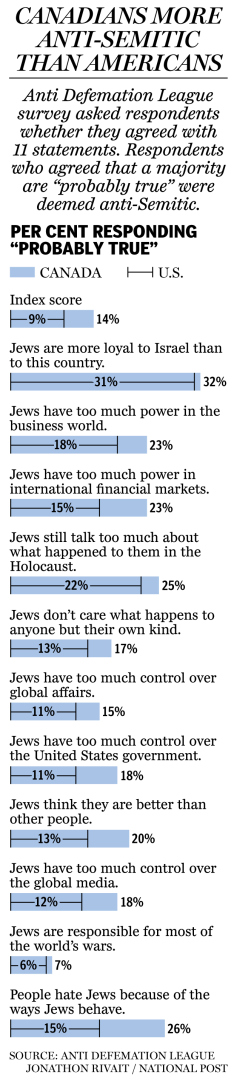
Some good comparative stats on antisemitism by country:

On balance, it appears to me that more of these countries show declines than show increases. But that’s subject to statistical argument, and it doesn’t change the fact that the trends in Europe aren’t as clear as the trend in the U.S. As the Ukraine and U.N. cases illustrate, anti-Semitism is sometimes hyped or manufactured for political advantage. And in the U.S., the Kansas shooting is an outlier. But in some countries, the rate of anti-Semitic incidents is holding steady or even increasing. Each country is different.

The Canadian stats come from B’nai Brith.

Anti-Semitism in Europe: statistics from France, Germany, the U.K., and other countries.

The Sources of Egyptian Anti-Semitism

Long detailed piece on ongoing antisemitism in Egypt and how deeply entrenched it is:

When confronted with anti-Semitism in their country, Egyptians typically dismiss the charge out of hand. “We cannot be anti-Semites, for we are Semites ourselves,” is the favorite line. Western observers, incapable of echoing such nonsense, have tended to dismiss concern with the widespread appeal of anti-Semitism in Egypt and beyond. “It’s just a stupid knee-jerk reaction to the Arab-Israeli conflict”, is a sentiment held by many. Egyptians are not really anti-Semites, not like the Europeans anyway; they are just anti Israeli and cannot make the differentiation between Israel and the Jews. Given that, after the persecution by Nasser, there are very few Jews in the country anyway, this bigotry has no practical ramifications and should not concern us. Egypt will uphold its peace treaty with Israel, and the country’s decision-makers, while sometimes using anti-Semitism as a tool, are too sane to fall for such nonsense.

Such attitudes are not only wrong; they are dangerous. As I’ve shown, decision-makers in Egypt are not themselves immune to anti-Semitism but in fact are among its most committed believers. In the top ranks of the Egyptian army, in its intelligence community, and in the ranks of state servants, the nearly universal belief of the existence of a Jewish conspiracy against the homeland is dangerous and affects perception of reality and hence policy. To be unable to see the world as it is, to be incapable of understanding the causes of events, is a dangerous condition, and one that can lead to disastrous consequences.

Anti-Semitism in Egypt is not merely a form of bigotry. It forms the basis on which its adherents interpret and understand the world. As such, at the forefront of those concerned by its widespread adaptation by the country’s leaders and intellectuals should be Egyptians themselves—at least those who care enough about the country’s future and wish it well. As Walter Russell Mead has argued: “Rabid anti-Semitism coupled with an addiction to implausible conspiracy theories is a very strong predictor of national doom.”

Anti-Semitism is one of the pillars of socio-political life in Egypt. A country consumed with such madness cannot become a flourishing liberal democracy. Egypt should not be doomed to such a condition. Those who seek a better future for their country must begin by combating the vicious monster head on, before it consumes them.

The Sources of Egyptian Anti-Semitism – The American Interest.

Is criticism of Israel anti-Semitic? | My take

One of my recommendations on the approach to antisemitism from my piece in the CJN:

Secondly, we must strengthen messaging on the commonalities between anti-Semitism and other forms of hatred and intolerance. Some of the pioneering work by Jewish communities is being lost in the focus on anti-Semitism. More express links among all forms of hatred, racism and discrimination can help combat anti-Semitism through engagement of a broader range of communities. The activities of the Holocaust centres in Canada in educating our increasingly diverse population are good examples. Perceived exclusive government focus on anti-Semitism may undermine understanding and support among other communities.

Is criticism of Israel anti-Semitic? | The Canadian Jewish News.

International Holocaust Remembrance Alliance (IHRA) – Now that Canada no longer chairs …

Further to my earlier post, International Holocaust Remembrance Alliance Ends: Andrew Bennett New Canadian Head of Delegation, a further update on the declining importance of IHRA now that the Canadian chairmanship has come and gone. Canada will no longer financially support attendance of Canadian Holocaust experts, leaving representation more at the symbolic rather than substantive level. I always found the strength of IHRA was the extensive involvement of experts, less so the governmental level (of which I was part).

Likely a combination of the bureaucratic (viewed as minor “all things Jewish” file rather than from a broader policy perspective) and the governmental (experts and expertise have more nuanced messaging than the political level, and focus on antisemitism and Israel mean ongoing community support).

Unfortunate, as the value of IHRA and Holocaust awareness and education is important for all Canadians, particularly in as diverse a society as Canada, and for the universal lessons it brings.

CORRECTION: Subsequently, this decision to no longer fund expert attendance was reversed given stakeholder pressure but still surprising that it happened in the first place.

International Holocaust Remembrance Alliance Ends: Andrew Bennett New Canadian Head of Delegation

Interesting choice of new head of Canadian delegation to the International Holocaust Remembrance Alliance: Andrew Bennett, Canada’s Ambassador for Religious Freedom.

Responsibility for multiculturalism-related files now spans three Ministers:  Baird of DFATD, Alexander of CIC, and Kenney, who has overall political responsibility. Holocaust awareness and remembrance is about more than religious freedom. Countries like the US and UK separate religious freedom and Holocaust/antisemitism responsibilities. Represents a further dilution of the multiculturalism policy role of CIC, whether driven by the political or bureaucratic levels, and whether or not it represents distrust of officials.

News Release — Canadian Chair Year of the International Holocaust Remembrance Alliance Ends: Holocaust Awareness and the Fight Against Anti-Semitism Continue.

Godwin’s Law

An old post, but continues unfortunately to be relevant, by Bernie Farber on the abuse of Hitler comparisons (Godwin’s Law):

http://m.huffpost.com/ca/entry/1875579

A. Alan Borovoy: Going to court with Ernst Zündel

An excerpt from Alan Borovoy’s book, recounting his experience on some of the more thorny free speech issues when he was head of the Canadian Civil Liberties Association (CCLA):

In 1990, a few years later, the Supreme Court of Canada ruled on the Keegstra case, and upheld the constitutionality of Canada’s anti-hate law by a narrow margin. When the press asked me for a comment, I noted that, by the time the case reached the Supreme Court, Keegstra had been removed from the classroom, disqualified from the teaching profession, and ousted as mayor of Eckville, Alberta. By then, he was working as a garage mechanic. And so, in addition to the free-speech-chilling implications of the Court’s Keegstra decision, it was gratuitous given all that already had happened.

“In my view,” I said, “he should have been allowed to wallow in the obscurity he so richly deserves.”

A. Alan Borovoy: Going to court with Ernst Zündel | National Post.

Abe Foxman Looks Back at Changing — and Declining — Face of Anti-Semitism, Emily Hauser on BDS

Abe Foxman of the ADL reminds of the commonalities between antisemitism and other forms of prejudice and intolerance:

“There’s a lot of extremism in this country,” Foxman said. “We still have prejudice – against Hispanics, African-Americans, gays and lesbians, Mormons, Asians. The battle for a civil, respectful, tolerant society continues. We haven’t won that battle. We have not found an antidote, a vaccine. Until we find that vaccine, it’s going to be with us.”

Abe Foxman Looks Back at Changing — and Declining — Face of Anti-Semitism – Forward.com.

Emily Hauser notes the ironic synergy between the Israel PM Netanyahu,  some of the leaders of major Jewish organizations and the BDS campaign:

American Jews like Hoenlein and Israeli politicians like Netanyahu want to scare you, me, and the whole world off from even considering the possibility that the Israeli government is as human as any other and thus as worthy of examination as any other, because they want the occupation and settlement project to continue.

They are in fact served by BDS, because not unlike Hoenlein and Netanyahu, et al, the BDS movement blurs the lines between the democratic state of Israel that exists legally and legitimately within its recognized international borders and the military dictatorship that is the occupation; Hoenlein and Netanyahu (et al) are further served by BDS because every single day that we Jews get all wound up about BDS is another day in which the Israeli government can deepen its hold on Palestinian land.

BDS Is Not Anti-Semitism

Global Anti-Semitism and the Erosion of Shame | Abraham H. Foxman

Abe Foxman, of the Anti-Defamation League, on antisemitism, taking a broad interpretation. His point on the erosion of shame is valid, but is not limited to antisemitism as it widespread in the political, corporate, entertainment and other worlds. On Israel, he, like many commentators, do not distinguish between criticism of Israel per se and Israeli policies and practices in the occupied territories :

Anti-Semitism has characteristics like other forms of bigotry in terms of stereotyping, alienation from the other, and discrimination.

But what makes it different, and which goes a long way to explain anomalous things about anti-Semitism — how long it has lasted, how it pops up in different places, the concept of anti-Semitism without Jews, the contradictory accusations against Jews, etc. — is the core of the anti-Semitic idea: that Jews are not what they seem to be. The real Jew, according to the anti-Semite, is a hidden conspiratorialist, all-powerful and evil….

But other factors play a role and are increasingly worrisome. There is the erosion of shame about anti-Semitism as the Holocaust becomes more remote in time and as survivors pass away. The too-easy analogizing of every bad thing that happens today to the Holocaust, which the Anti-Defamation League condemns whenever it surfaces, is just one manifestation of the loss of impact on attitudes that the Holocaust formerly had.

Pictures of Auschwitz after the war did not lead to the disappearance of anti-Semitism. They did, however, constrain manifestations of Jew hatred. That loss of embarrassment over time reduces those constraints.

Additionally, the ongoing critique of the state of Israel is a powerful corrosive factor. Not every criticism of Israel is illegitimate, and surely not anti-Semitic. But when condemnations of the Jewish state are so clearly biased, when Israel is singled out for punitive treatment, even when some of those engaging in these activities may not be motivated by anti-Semitism, it opens up the Pandora’s Box of Jew hatred and makes it much more acceptable. We see this in the boycott and delegitimization movements against Israel, which lead to anti-Jewish activities, like isolating Jewish students on campus.

Global Anti-Semitism and the Erosion of Shame | Abraham H. Foxman.

Can Virtual “Racism” Evoke Empathy? | There’s an App for That

Interesting concept, poor execution.

The app creators seemingly hope to reach people who discriminate against others, and to encourage these users to change their ways — after virtually experiencing “racism.” This limits their target audience to conscientious racists. And if there are such self-aware racists, are they really so oblivious to what needs to change?

Perhaps this app could better achieve its goals if it chose a name that didn’t perpetrate misconceptions and stereotypes, and if it marketed itself as a resource for multicultural education programs, practical diversity trainings or even sensitivity workshops.

Imagine if the app were renamed to reflect reality: Being Different Is Normal — But It Ain’t Easy.

Can Virtual “Racism” Evoke Empathy? | Re/code.