The worst time for Jews to abandon Europe – Avraham Burg

Avraham Burg on European Jews:

In a generation in which we Israelis have forgotten how to be sensitive and empathetic to minorities, to those who are different, to the persecuted, and many American Jews are swallowed up in their comfort zones of white society and are abandoning their partnership with the “others,” in America, the “United States of Europe” is presenting a new model of identity – a union between those who are different, and the “other.” It’s a model no different from the American one which seeks to assimilate all into a monochromatic American democracy.

Further, Europe is the current meeting point between Islam and the West. Some of that encounter involves clashes, and some involves learning. The Christian continent is learning to make space for other, rich and varied identities. My friends, Ziya from Bangladesh, Shaida whose family is from Turkey and Rob from Jamaica, are impressive Europeans, and Europe is better off with them. Just like Shaul from Venice, Yoop from Amsterdam and Brian from London – there is no dissonance between their Jewish heritage and their European identity. The discourse between white, Christian Europe and those who are different is fascinating. More important is the dialogue between Western Europe and the Muslim forces in its midst.

The Muslim world and some of its members are embarking on a long journey toward the Western values of freedom, equality and brotherhood. The institutionalization of Western Islam in the heart of Europe – that which is absorbing values of democracy while remaining true to Muslim tradition – is where the strategic potential exists for bridging the gaps peacefully in the generations to come. It’s not happening in the Middle East or North America, but only in Europe. That is where the vanguard of humanity and humaneness is to be found. There has never been a worse time for Jews to abandon Europe.

The challenge facing the West and Europe is no longer military or economic, but rather an intellectual challenge of values. The philosopher Hans-George Gadamer said that he regards abundance of diversity as the most precious treasure which Europe managed to save from the conflagrations of the past, to offer to the world today.

“To live with Another, live as Another for Another, is the fundamental task of man – both on the highest and the lowest level …therein perhaps dwells that specific advantage of Europe, which could and had to learn the art of living with others,” Gadamer is quoted in Zygmunt Bauman’s book “Culture in a Liquid Modern World.”

A fight for the future of the West without the Jews of Europe would be almost tragic, and must be avoided at all costs.

The worst time for Jews to abandon Europe – Opinion – Israel News | Haaretz.

Why does the left downplay antisemitism? All forms of racism should be abhorred | Dean Sherr

Fair commentary, and some good parallels between antisemitism, Islamophobia and other forms of racism and prejudice:

But Jews should not be required to parade our suffering, historical or contemporary, in a competition for attention with other forms of racism. Nor should we be expected to tolerate the constant appearance of antisemitic language and imagery at prominent anti-Israel rallies, which does seem to show that the use of antisemitic symbols and language in the west is seen as less threatening, or perhaps “understandable”, when connected with Israel.

….Her [Miriam Gargoyles’]  solution was for Australians to see that “not all Jews behave in the way Israelis are doing” – suggesting all the Jew has to do is denounce Israel loudly enough, or perhaps wear a sign, that indicates that we aren’t all “evil” like Israelis are, to avoid being victimised.

Ironically, it sounds remarkably like a demand so often made of Muslims. As Australian prime minister Tony Abbott said a week earlier, “I wish more Muslim leaders would say [they are a religion of peace] more often and mean it.” Abbott’s comments were widely denounced by the left and rightfully so, but Margolyes’ comments were not objected to, they were applauded by many in the audience and online.

It is surely obvious that mitigating bigotry or racism with victim-blaming is wrong regardless of the victim’s ethnic or religious background. Yet it persists in some left-wing circles that Jews are the exception to this rule – our communal connection to Israel makes us somehow more legitimate targets, unless we denounce the Jewish state.

The problem with this notion is twofold – firstly, because Jews do not wear signs declaring our position on Israel. A proud Zionist Jew can just as easily be targeted at a kosher supermarket as an anti-Zionist one. More than that though, why should we have a duty to detach ourselves from a vital aspect of our cultural identity to avoid victimisation?

The reality is that we are human beings with complex identities, defined by a wide range of societal, communal and ethnic influences. Must we carry the burden of answering for all of Israel’s actions because we were born Jewish? And are we so unlike other ethnic cultures that care for the safety and security of our relatives abroad, that we can be painted as immoral for not abstracting ourselves from their threatened existence?

In a political climate where fear is a weapon as much as a state of mind, where innocence isn’t automatically assumed, and where wars and foreign affairs can fuel prejudice at home, it is natural that many take great steps to defend embattled Muslim communities from the risk of dangerous incitement. In doing so, they recognise that Muslims deserve to have their rights – freedom of association, of safety, of speech – protected, if necessary by the state.

They also recognise that self-determination of cultural and national identity is not something we can impose on other people. Those rights and understandings must be equally extended to Jews without the expectation that we must first denounce Israel, fight it, answer for it, or be ashamed by it.

… When progressives downplay or diminish the threat of antisemitism in the diaspora because of Israel – or, worse, fuel it – they do not extend to us those equal rights they purport to stand for. Progressives do more than dishonouring their values in this case, they diminish the unique history of Jews in Australian (and western) society, failing to acknowledge and defend us as equal, regardless of our relationship with or opinions about Israel.

The left must act to repair its straining relationship with Jews and once again take up opposition to antisemitism as its cause. Antisemitism is, like all forms of racism, to be abhorred and condemned unequivocally, not reduced and marginalised by games of comparison and mitigation. It is not a partisan issue and it cannot be up to the right to own the unqualified outrage it deservedly generates. The left, and the values it holds, are far too proud and dear to our hearts for that.

Why does the left downplay antisemitism? All forms of racism should be abhorred | Dean Sherr | Comment is free | The Guardian.

How can we help Jews stay in Europe despite anti-Semitism: Jeffrey Goldberg’s Atlantic article doesn’t answer that question.

Interesting take by William Salatan on antisemitism in Europe:

I don’t mean to suggest that Muslims don’t understand anti-Semitism. They do. But the anti-Semitism they’re familiar with is the anti-Semitism of resentment, not the anti-Semitism of genocidal success. Goldberg describes a French Jew whose parents fled Tunisia in 1967, “driven out by anti-Jewish rioters who were putatively distressed by Israel’s victory in the Six-Day War.” The key word in that sentence is victory. If Israel had lost—if the Jews of Palestine had been annihilated—Muslims in the Middle East and North Africa might understand anti-Semitism the way Europeans do. Anti-Semitism isn’t about a chant or a salute. It’s about piles of corpses.

Nor do I mean to exonerate the majority of Europeans who are neither Muslim nor Jewish. They’ve played their part in the intimidation of Jews by not playing their part in stopping it. Goldberg credits leaders of Germany, France, and Britain for denouncing anti-Semitism. But he points out that “the general publics of these countries do not seem nearly as engaged in the issue as their leaders. The Berlin rally last fall against anti-Semitism that featured Angela Merkel drew a paltry 5,000 people, most of whom were Jews.” And the silence of the majority leaves Jews feeling isolated. “Everyone is saying ‘Je suis Charlie’ today,” a Jewish student in Paris tells Goldberg, alluding to outrage over the murder of cartoonists at Charlie Hebdo. “But this has been happening to the Jews for years and no one cares.” Another student, using the French term for “Jewish,” suggests: “It would be nice if someone would say ‘Je suis Juif.’ ”

Why don’t non-Muslim Europeans care more about the new anti-Semitism? One reason is that they aren’t Jews. But another reason is that they aren’t Muslims. They’re neither the victims nor the perpetrators. They feel neither the threat nor the responsibility.

…If I were a Jew in Europe, I don’t think I’d leave. Growing up in Texas, I had many encounters—slurs, threats, occasional minor violence—similar to those described by Goldberg as anti-Semitic. They were anti-Semitic. I just had to deal with them. One thing that helped me get through it was the belief that my tormentors represented an ignorant, dying past. The best way to help today’s European Jews is to give them the same confidence, by working on the ignorance at the heart of Muslim anti-Semitism. To do that, you have to focus on the ignorance, not the Islam.

How can we help Jews stay in Europe despite anti-Semitism: Jeffrey Goldberg’s Atlantic article doesn’t answer that question..

ICYMI: Antisemitism — The Facts and the Hope | John Gerzema

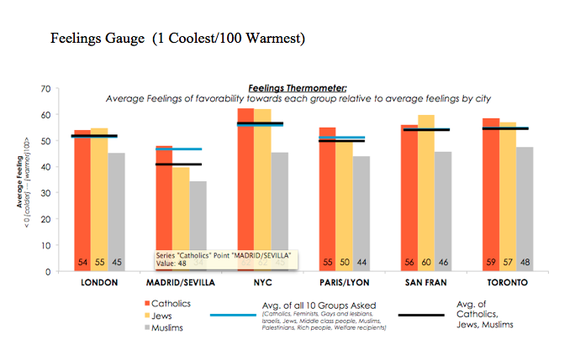
Comparative Religious Attitudes CitiesInteresting comparative study across religions and cities, with strong conclusion of how best to proceed:

The data shows that anti-Semitism, at least in the countries surveyed, is stubborn, deep-seated and chronic. It is worse than anti-Catholic bigotry but not quite as widespread as anti-Muslim feelings. Yet here’s a critical distinction: within nations, people act-out against Jews more often than they do against Catholics and Muslims. Some of this behavior seems linked to events involving Israel. However, it would be wrong to suggest a causal link between expressions of anti-Semitism and Israeli policy. Last Fall’s conflict in Gaza, for instance, may have “unleashed” anti-Semitism, acting as a false catalyst, but the feelings against Jews exist independent of the Middle East. After all, if someone predisposed to hate Jews cites Israeli policy to justify their anti-Semitism, he or she is still an anti-Semite.

Yet not all our findings were bleak. As part of our study we tried to determine whether people were affected by media mentions of Israel. When we asked our survey respondents last August to read an unbiased report on the ongoing events in Israel and Gaza we saw expressions of anti-Jewish feelings decline. People who told us they were “somewhat open” to new information moved from a 14 percent to 25 percent likelihood of sympathizing with Israel. Those that were “very open” moved from 35 percent to 42 percent likelihood of sympathizing with Israel. We saw related reductions in the number of people who said they had negative thoughts about Jews in general.

So the data offers hope that hearts and minds can be affected by honest, reliable, unadulterated information. We can inform instead of inflame. We can teach instead of just talk. We can exercise our freedom of speech and freedom of the press as a means to contest cultural boundaries. The alternative is watching bigotry of all kinds — against Muslim or Jew, Catholic and, sadly, a long list of other groups — dominate the discussions around the world. The evidence is there that we can create change and counteract the hate that occurred last week and continues to be so pervasive and pernicious. It is up to all of us to engage, enlighten and educate.

Anti-Semitism — The Facts and the Hope | John Gerzema.

The True History Behind Downton Abbey’s Antisemitism Storyline | TIME

For Downton Abbey founds, the story behind the mini-theme of antisemitism and tolerance:

Lady Rose MacClare and Atticus Aldridge come from similar socioeconomic backgrounds but different religions—though they’ve changed their name and acquired a noble title, the Aldridges are Jewish—and neither family is thrilled about the engagement. In typical Downton fashion, when it comes to love there is, as the Dowager Countess puts it, always something: Despite the fact that Rose’s aunt Lady Grantham’s father was also Jewish, the match is still not fully accepted within the household. The show has a solid track record of incorporating real-life historical moments; the Aldridge family’s struggle to be accepted mirrors the experience that a wealthy Jewish-British family might have faced in the real 1920s, and the real Rothschild family gets a shout-out during the episode.

But, in this case, the true story behind the fiction doesn’t actually go back quite so far in time. Rather, for Julian Fellowes, the creator and sole writer of the Emmy-award winning show, the plot line is a familiar one.

“In my own youth I went out with a girl for some time from a very prominent, grand Jewish family,” Fellowes tells TIME. “And it was one of my only times when I have been considered ineligible and not a sort of desirable party.”

In the latest episode both families protest the wedding, with Atticus’s father Lord Sinderby calling Rose a shiksa—a derogatory Yiddish term meaning gentile woman—and Rose’s mother staging a scene that makes it look as though Atticus is cheating. Fellowes explains that he had wanted the show to have a romantic storyline in which the disapproval went both ways. The timing of this story airing in the U.S. amid a rise of anti-Semitism in Europe is simply coincidental.

… Still, though the story was not planned in response to current events, Fellowes acknowledges that the issues raised by this particular Downton wedding aren’t a matter of history only. “The situation is not as simple as one had hoped and these emotions are still rampant,” he says. “All of this stuff is pretty fundamental and we are still looking for solutions to a lot of it. I think, at least I hope, it’s useful and helpful to be reminded that these divisions have had to be addressed and resolved since the beginning of history.”

Likewise, the characters’ fears of assimilation and anti-Semitism are worthy of empathy in any time period. “When [Lord Sinderby] explains why he doesn’t want to have non-Jewish grandchildren, you do—or I hope you do—slightly understand his point of view and you slightly sympathize,” Fellowes says.

The True History Behind Downton Abbey’s Anti-Semitism Storyline | TIME.

Jewish groups criticise German panel on antiSemitism

Does seem a bit odd – but it also depends on the experts selected:

Jewish groups have strongly criticised the German government for creating a commission to tackle anti-Semitism that does not include a single Jew.

A spokesman for the Moses Mendelssohn Centre for European-Jewish Studies in Germany said it was a “scandal”.

The centre announced on Tuesday that it was creating a rival panel of experts.

Germany’s interior ministry set up the independent commission to fight anti-Semitism and support Jewish life.

A spokeswoman for the ministry told The Associated Press news agency that the question of religious affiliation was not part of the panel’s selection process.

Anetta Kahane from the Amadeu Antonio Foundation criticised the decision. “Nobody would even think of creating a conference on hatred of Islam without Muslims or a round table on the discrimination of women without women,” she said.

The Moses Mendelssohn Centre announced that it, along with two other leading Jewish groups, would be creating an alternative commission.

Spokesman Julius Schoeps said that they would include both Jewish and non-Jewish experts on the panel.

The group of eight experts appointed by Germany’s interior ministry are due to submit a report to parliament within two years that will be the basis for a discussion on how to tackle anti-Semitism.

BBC News – Jewish groups criticise German panel on anti-Semitism.

FAST launches high school anti-racism curriculum

Good cross-linkages between antisemitism, Holocaust awareness, and all forms of racism, bigotry and hate:

Voices into Action, an interactive site developed in accordance with provincial curriculum standards by a team of teachers, curriculum experts, graduate students, university professors, and consultants, contains five units that focus on issues related to human rights, genocide, prejudice and discrimination.

“It’s divided into five units and the Holocaust is a major feature throughout. It is at least a third of the content,” Miller said.

Although the program addresses racism, bigotry and hate in all forms, there is a special emphasis on anti-Semitism and the Holocaust.

The founders of FAST, Elizabeth Comper, and her husband Tony, a retired Bank of Montreal CEO, were inspired to create the organization after a series of anti-Semitic attacks in Toronto and Montreal, including the 2004 firebombing of Montreal’s United Talmud Torah Jewish day school.

“It was important to address other human rights issues, to put them on a scale, to understand that the Holocaust was as far as you could go with hatred,” Miller said.

“The Holocaust is the first chapter of units 1, 2, 3 and 4, and unit 5 is entirely about the Holocaust and it ends with a conclusion on contemporary anti-Semitism.”

Miller added that most important is the fact that the high school program is curriculum-based and completely free of charge.

FAST launches high school anti-racism curriculum | The Canadian Jewish News.

Rock concert, rallies overwhelm Germany’s anti-Islam group | Merkel Comments

Merkel is remarkably consistent in her language against all forms of antisemitism and all forms of racism. Canadian politicians, in their legitimate attention to antisemitism, have largely forgotten the broader anti-racism message:

Earlier on Monday, on the eve of Tuesday’s 70th anniversary of the liberation of the Nazi death camp at Auschwitz, Chancellor Angela Merkel said Germans had an everlasting responsibility to fight anti-Semitism and all forms of racism.

In what appeared to be an indirect reference to PEGIDA, Merkel told a memorial for the victims of Auschwitz: “We’ve got to fight anti-Semitism and all racism from the outset.”

“We’ve got to constantly be on guard to protect our freedom, democracy and rule of law,” she said. “We’ve got to expose those who promote prejudices and conjure up bogeymen, the old ones as well as the new.”

Merkel said it was a disgrace that some Jews or those expressing support for Israel had been threatened or attacked in Germany, which was responsible for the Holocaust, and that protecting the growing Jewish community was a national duty.

Rock concert, rallies overwhelm Germany’s anti-Islam group | Reuters.

Jewish life in Europe is about much more than anti-Semitism

Different angle on the antisemitism in Europe and the vibrancy of Jewish life in Europe:

But very little has been reported about what constitutes French Jewish life beyond all of that: synagogues, cultural events, kosher restaurants and new initiatives such as the opening of a Moishe House in the center of Paris last summer. Moishe House is an organization which subsidizes housing all over the world for Jewish young professionals, who then open the doors of their apartments to create “a hub of Jewish life for their peers and community members,” according to their website.

Do not misunderstand what I’m saying: anti-Semitism is a plague, in France and in many other European countries. It is even more so because in Europe Jews are often living in the very same places where their ancestors were persecuted and massacred 70 years ago, and multiple times before that. But it is not the extent of European Jewish life, in the very same way living in Israel is not all about the geopolitical tensions.

To be fair, speaking about European Jews as a single community is not exactly accurate. European countries are very diverse, and the same is true of their Jewish communities. France hosts the biggest one, with about half a million Jews, followed by the United Kingdom (300,000) and Germany (100,000). Every country, and sometimes even every city, neighborhood and congregation has a different story, and the examples of vibrant and meaningful Jewish life are countless.

…European Jewish life involves studying, celebrating Jewish holidays, going to shul, attending cultural events, gathering for both happy and sad occasions.

It may be less interesting to report than issues related to anti-Semitism, to people making aliya, to politics. However Israelis and American Jews should not forget it.

Nor should European Jews themselves. That would be terrorists and anti-Semites’ greatest victory.

Jewish life in Europe is about much more than anti-Semitism – Opinion – Jerusalem Post.

EU Parliament’s Israel-relations czar defends removed anti-Semitism definition

More debate on whether or not the definition of antisemitism should include criticism of Israel or not (see What is anti-Semitism? EU racism agency unable to define term):

“However, I think the definition represented a landmark in combating anti-Semitism that should pave the road to effective institutional responsibility” in the fight against all forms of discrimination and intolerance, said [Fulvio] Martusciello [of the Group of the European People’s Party], who assumed the chairmanship of the delegation in October.

Set up in 1979, the delegation is among the European Parliament’s oldest and is responsible for maintaining and developing parliamentarian ties between the Knesset in Jerusalem and its counterpart within the European Union.

Blanca Tapia of the EU’s Fundamental Rights Agency said the definition of anti-Semitism was removed last year “together with other non-official documents,” and that her organization had in fact never viewed the document as a valid definition. She said her organization was unaware of any other official definition of the phenomenon and that it was not able to define it.

EU Parliament’s Israel-relations czar defends removed anti-Semitism definition | The Times of Israel.