Mid-East: The knowledge constituency versus the ignorance lobby

Good piece by Hussein Ibish on the resignation of Prof. Dajani over his leading a visit to Auschwitz:

Even if none of that’s true, knowledge is, nonetheless, power. The constituency for keeping Palestinian students ignorant of certain facts, presumably because they present the truth about Jewish suffering in Europe during the 20th century and that this complicates the understanding of Jewish Israelis simply as oppressors in the occupied Palestinian territories, is a perfect example of the “stupidity lobby.”

And it’s not just restricted to Palestinians and their relationship to Jewish history and the Holocaust. There is a broader conflict throughout Arab culture between those who want to embrace the world, in all its complexity and challenges, versus those who want to crawl inside a warm cocoon of insularity. Relying on nostalgic fantasies about former periods of greatness, the broad Arab ignorance constituency is very powerful.

It includes not only Islamists and other religious dogmatists, including apolitical clerics, but also strident nationalists, leftists, fascists, and chauvinists of every possible variety. Among all of these groupings, as well as the important open-minded and globally-conscious constituencies that are most in favor of engaging the world, there are people who push back against insularity. But for the past century at least, the majority trend in the Arab world has been to try, insofar as possible, to shut out knowledge of and engagement with outsiders, except for commercial purposes.

Many Arabs seem to be suspicious of and hostile towards real knowledge of others as opposed to myths and stereotypes, of course, and even more engagement with them. Too many of us just don’t want to hear it. Those, like Prof. Dajani, who try to break through this curtain of insularity are frequently punished, or at least criticized, for their embrace of broader realities, some of which are uncomfortable and destabilize reassuring mythologies.

Prof. Dajani says he doesn’t regret the turn of events. Why should he? He’s done something noble and constructive, and he will continue to do so without the support of his former university, through many other venues such as his Wasatia movement. But he, and all those like him throughout the region who want to smash the shackles of decades of carefully cultivated ignorance and embrace history and reality in all its troublesome complexity, are pointing the way.

The whole Arab world is at a turning point. If it continues to allow the stupidity and ignorance lobby, in all its myriad forms, to insist on cultural insularity, chauvinism, and deafness to the outside world, it will remain utterly stuck and unable to successfully join and compete in a globalizing world. But if the intelligence and knowledge constituency, as embodied by Prof. Dajani and so many other important leading Arabs, succeed in turning their societies away from decades of enforced parochialism, they will be among the most important groups in building a better future for the Middle East.

The saga of Prof. Dajani, and the whole battle between the Arab ignorance versus knowledge constituencies, is far from over. My money is on the intelligence community ultimately defeating the stupidity brigade, but its going to be an uphill struggle.

The knowledge constituency versus the ignorance lobby.

Panelists decry Muslim anti-semitism | The Canadian Jewish News

Panel discussion organized by the Friends of Simon Wiesenthal Center for Holocaust Studies’ (FSWC) at the inaugural Leadership Policy Conference on Anti-Semitism., with Raheel Raza, Tarek Fatah and Tahir Gora:

The three Muslim panelists spoke out vehemently against what they characterized as a pervasive anti-Semitism found in Canada and across the Muslim world and which, stoked by Islamic extremism, often forms the underpinning of anti-Israel rhetoric, Israeli Apartheid Week and the boycott, divestment and sanctions BDS movement.

Raza, who is also president of the Council for Muslims Facing Tomorrow, a group working to “reclaim Islam” and oppose extremism and violence in the name of religion, said it’s important for the Jewish community to ask itself, “Who are our real friends?”

She warned against “seemingly innocuous” displays of anti-Semitism, such as those that she said sometimes emerge under the pretext of interfaith dialogue.

“Some aspects of anti-Semitism you see flat out, like Israeli Apartheid Week. But then there are those subtle forms that come under the umbrella of interfaith dialogue – the whole term interfaith dialogue has been hijacked by [extremist] Islamists.

”She said hatred of Jews is often embedded in early Islamic education, and that Jews cannot afford to “stand by silently anymore” regarding things like anti-Israel activities on university campuses.

“If anti-Jewish sentiment is taught early in mosques, then is there any wonder you have Israeli Apartheid Week and BDS campaigns in places of education?”

Having been involved in more than a few discussions on antisemitism, and having my own take (see Is criticism of Israel anti-Semitic?), these sessions could be strengthened by a broader cross-section of  panelists, not just three who agree with each other.

Pardon the phrase, but it is preaching to the converted; the challenge is to engage with those with whom one disagrees with.

Suspect the organizers were less pleased with Tarek’s other remark:

Fatah also asserted that without a two-state solution and the creation of a Palestinian state, Israel’s and the Jewish Diaspora’s problems won’t cease.

“Palestine has to be a state and Israel has to get out of the West Bank… there is no choice. And this is the Israeli consensus. It’s only in North America where Jewish organizations question the two-state solution… A lot of time in the Jewish Diaspora is being wasted on unnecessary arguments that have no outcomes.”

Panelists decry Muslim anti-semitism | The Canadian Jewish News.

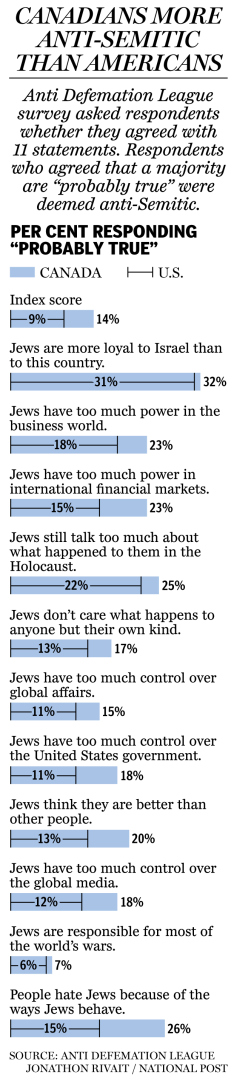
Canadians more likely to be anti-Semitic than Americans, ADL, and commentary

NP_antisemitism_c_jrFrom the recent ADL worldwide study on antisemitism, the Canadian data showing Canada slightly worse that the US but comparatively better than most other countries:

I’m a little bit surprised that the figures aren’t greater in the United States but I’m not surprised at the 14% in Canada,” said Frank Dimant, chief executive officer of B’nai Brith Canada. “We have always surmised that it is in that range — that range of ‘hardcore.’”

….

“We’re talking about 4.8 million people. That’s a lot of people who harbour this kind of hatred in their hearts.”

….

“Once, we had certain pre-conceived notions as to the stereotypic image of an anti-Semite as an illiterate boor. Today, that is simply not the case,” he said.

“We see the penetration of this disease of anti-Semitism in many new components of society… much of it is in the guise of anti-Israel.

“The coalition of hate is widespread so it ranges from academics to neo-Nazis to Islamic jihadists to radical feminists to trade unionists.”Shimon Koffler Fogel, head of the Centre for Israel & Jewish Affairs (CJIA), said the survey should provide the catalyst for a national discussion.

“For us, the real take-away is that issues like anti-Semitism and racism in general have not diminished to the point where as a society we can say we don’t have to address these concerns,” he said.

Canadians more likely to be anti-Semitic than Americans, poll finds | National Post.

And the two contrasting takes on the worldwide results, starting with Commentary on the right:

Anti-Semitism has survived the death of European theocracies, Nazism, and Communism and metastasized into a belief system embraced by Muslims and Arabs, and remains a deadly force. Though some might claim that the existence of Israel and allegations about its behavior has become the single greatest motivating factor for anti-Semitism (judging by the survey, the Palestinians are the most anti-Semitic people on Earth), that assertion must be placed up against the fact that the attitudes that indicate hostility to Jews long predate the birth of the Jewish state or its coming into possession of the West Bank in 1967. Seen in that perspective, it’s clear that Israel is just the latest, albeit a vicious, excuse for Jew hatred. If not all those who hate Israel also embrace the full roster of anti-Semitic stereotypes, their willingness to embrace the war against the Jewish state demonstrates the way Jews remain the planet’s boogeyman and the objects of unthinking bias and potential violence.

Many Jews will look at these numbers and, no doubt, wonder how they can change the minds of the haters or adopt behaviors that will undercut the stereotypes. But whatever else it tells us, the survey is a reminder that anti-Semitism is about the minds of the anti-Semites and their desire to seek out a small group for hostility, not what the Jews do. Those who will seek to blame Israel or Jewish power for these numbers are deceiving both themselves and others. Anti-Semitism is an ancient belief system that can adapt itself to any set of circumstances or locale.

Israel and the Reality of Anti-Semitism

From Haaretz on the left:

4. Iran, on the other hand, not only emerges unscathed from the survey but actually stands out for the positive. It has the lowest “Anti-Semitic Index” (56%) of all Middle East countries. It is a finding sure to confound hasbara people and one that can be attributed, among other things, to the relative sophistication of the Iranian people, to the continued existence of the local Jewish community – unlike in most Arab countries – and to the Iranian leadership’s ongoing protection, for its own reasons, of Iranian Jews.

5. In fact, the ADL poll more or less upsets the apple cart altogether in disestablishing the causal connection between anti-Jewish and what are widely perceived as anti-Israeli sentiments. Sweden – Sweden, for God’s sake – a hotbed of anti-Israeli agitation that is routinely labeled as anti-Semitic is the LEAST anti-Semitic country in Western Europe, according to this survey, along with its Nordic neighbors – Iceland, Finland, Norway and Denmark.

On the other hand, Eastern European countries such as Poland, Bulgaria and Ukraine, whose governments are rock solid supporters of Israel, harbor large segments of anti-Semitic feelings. The outliers are the Czechs, god bless them, who have always felt themselves more Western than Eastern European anyway. And what can you say about South Korea, a country with excellent diplomatic and commercial ties to Israel whose population – 53%, by ADL’s standards – has very questionable views of Jews.

….

7. The worst anti-Semitism, by ADL’s definition, was measured in the Middle East and North Africa, from the West Bank and Gaza (93%) and Iraq (92%) to Saudi Arabia (74%) Turkey (69%) and Iran (56%). No surprise there, really, given that in most Middle Eastern countries the media freely engages in anti-Jewish agitation, with governments either sitting idly by or actively taking part.

Nonetheless, it is an open question whether anti-Jewish sentiment in a region in which a. there are hardly any Jews and b. sees itself at war with the Jewish state and/or as the usurpers and oppressors of the Palestinians should really be included in the same rankings as all the rest, or whether Muslim anti-Semitism isn’t a category all to itself.

Ten comments on ADL’s global survey of anti-Semitism (It’s not all bad)

Of course, while dispiriting, in most developed countries Jews are more favourably viewed than other minorities such as Sikhs and Muslims (see as an What Europe Thinks of Jews, Muslims and Roma – Pew).

The link to the ADL study:


ADL Global 100
Looking at Anti-Semitism and Anti-Zionism From a Literary Perspective

Interesting essay by Nora Gold on why she wrote her novel, Fields of Exile, on the issue of anti-Israel sentiment on campus:

I spent years writing a novel on this topic because I was so distressed about the anti-Israelism around me that I really couldn’t write about anything else. It was like having a fish hook in my stomach.

I was pained not only by the most obvious manifestations of anti-Israelism, like Israel Apartheid Week – during which, year after year, I witnessed the emotional and psychological damage wreaked on Jewish students and professors – but also the increasing normalization of Israel-bashing in classes, in faculty meetings, and at conferences. I was appalled that in certain disciplines it was almost de rigueur to trash Israel.‎

Looking at Anti-Semitism and Anti-Zionism From a Literary Perspective | Jewish & Israel News Algemeiner.com.

No real increase in Ukraine anti-Semitism, OSCE Rep

Of note:

Rabbi Andrew Baker, who is the Personal Representative of the Chairperson-in-Office on Combating Anti-Semitism at the Organization for Security and Co-operation in Europe, or OSCE, made the statement Tuesday after visiting Ukraine this week.

“There have been several incidents in the last few months including violent attacks which are rare in Ukraine,” Baker told JTA in an email. “By all accounts hate crime incidents in Ukraine are under reported. But apart from these recent events, which many believe were not ‘home grown,’ there does not appear to be any real increase over recent years.”

No real increase in Ukraine anti-Semitism, researcher says | The Times of Israel.

Anti-Semitism Comparative Statistics

Some good comparative stats on antisemitism by country:

On balance, it appears to me that more of these countries show declines than show increases. But that’s subject to statistical argument, and it doesn’t change the fact that the trends in Europe aren’t as clear as the trend in the U.S. As the Ukraine and U.N. cases illustrate, anti-Semitism is sometimes hyped or manufactured for political advantage. And in the U.S., the Kansas shooting is an outlier. But in some countries, the rate of anti-Semitic incidents is holding steady or even increasing. Each country is different.

The Canadian stats come from B’nai Brith.

Anti-Semitism in Europe: statistics from France, Germany, the U.K., and other countries.

The Sources of Egyptian Anti-Semitism

Long detailed piece on ongoing antisemitism in Egypt and how deeply entrenched it is:

When confronted with anti-Semitism in their country, Egyptians typically dismiss the charge out of hand. “We cannot be anti-Semites, for we are Semites ourselves,” is the favorite line. Western observers, incapable of echoing such nonsense, have tended to dismiss concern with the widespread appeal of anti-Semitism in Egypt and beyond. “It’s just a stupid knee-jerk reaction to the Arab-Israeli conflict”, is a sentiment held by many. Egyptians are not really anti-Semites, not like the Europeans anyway; they are just anti Israeli and cannot make the differentiation between Israel and the Jews. Given that, after the persecution by Nasser, there are very few Jews in the country anyway, this bigotry has no practical ramifications and should not concern us. Egypt will uphold its peace treaty with Israel, and the country’s decision-makers, while sometimes using anti-Semitism as a tool, are too sane to fall for such nonsense.

Such attitudes are not only wrong; they are dangerous. As I’ve shown, decision-makers in Egypt are not themselves immune to anti-Semitism but in fact are among its most committed believers. In the top ranks of the Egyptian army, in its intelligence community, and in the ranks of state servants, the nearly universal belief of the existence of a Jewish conspiracy against the homeland is dangerous and affects perception of reality and hence policy. To be unable to see the world as it is, to be incapable of understanding the causes of events, is a dangerous condition, and one that can lead to disastrous consequences.

Anti-Semitism in Egypt is not merely a form of bigotry. It forms the basis on which its adherents interpret and understand the world. As such, at the forefront of those concerned by its widespread adaptation by the country’s leaders and intellectuals should be Egyptians themselves—at least those who care enough about the country’s future and wish it well. As Walter Russell Mead has argued: “Rabid anti-Semitism coupled with an addiction to implausible conspiracy theories is a very strong predictor of national doom.”

Anti-Semitism is one of the pillars of socio-political life in Egypt. A country consumed with such madness cannot become a flourishing liberal democracy. Egypt should not be doomed to such a condition. Those who seek a better future for their country must begin by combating the vicious monster head on, before it consumes them.

The Sources of Egyptian Anti-Semitism – The American Interest.

Is criticism of Israel anti-Semitic? | My take

One of my recommendations on the approach to antisemitism from my piece in the CJN:

Secondly, we must strengthen messaging on the commonalities between anti-Semitism and other forms of hatred and intolerance. Some of the pioneering work by Jewish communities is being lost in the focus on anti-Semitism. More express links among all forms of hatred, racism and discrimination can help combat anti-Semitism through engagement of a broader range of communities. The activities of the Holocaust centres in Canada in educating our increasingly diverse population are good examples. Perceived exclusive government focus on anti-Semitism may undermine understanding and support among other communities.

Is criticism of Israel anti-Semitic? | The Canadian Jewish News.

International Holocaust Remembrance Alliance (IHRA) – Now that Canada no longer chairs …

Further to my earlier post, International Holocaust Remembrance Alliance Ends: Andrew Bennett New Canadian Head of Delegation, a further update on the declining importance of IHRA now that the Canadian chairmanship has come and gone. Canada will no longer financially support attendance of Canadian Holocaust experts, leaving representation more at the symbolic rather than substantive level. I always found the strength of IHRA was the extensive involvement of experts, less so the governmental level (of which I was part).

Likely a combination of the bureaucratic (viewed as minor “all things Jewish” file rather than from a broader policy perspective) and the governmental (experts and expertise have more nuanced messaging than the political level, and focus on antisemitism and Israel mean ongoing community support).

Unfortunate, as the value of IHRA and Holocaust awareness and education is important for all Canadians, particularly in as diverse a society as Canada, and for the universal lessons it brings.

CORRECTION: Subsequently, this decision to no longer fund expert attendance was reversed given stakeholder pressure but still surprising that it happened in the first place.

International Holocaust Remembrance Alliance Ends: Andrew Bennett New Canadian Head of Delegation

Interesting choice of new head of Canadian delegation to the International Holocaust Remembrance Alliance: Andrew Bennett, Canada’s Ambassador for Religious Freedom.

Responsibility for multiculturalism-related files now spans three Ministers:  Baird of DFATD, Alexander of CIC, and Kenney, who has overall political responsibility. Holocaust awareness and remembrance is about more than religious freedom. Countries like the US and UK separate religious freedom and Holocaust/antisemitism responsibilities. Represents a further dilution of the multiculturalism policy role of CIC, whether driven by the political or bureaucratic levels, and whether or not it represents distrust of officials.

News Release — Canadian Chair Year of the International Holocaust Remembrance Alliance Ends: Holocaust Awareness and the Fight Against Anti-Semitism Continue.