‘Decrease of violent attacks against Jews, but rise in institutional antisemitism in 2015’ – Kantor Centre

Latest report from the Centre:

The number of violent attacks against Jews abroad dropped significantly in 2015 despite an increase in institutionalized anti-Semitism, an annual report released Wednesday found.

According to the Kantor Center for the Study of Contemporary European Jewry at Tel Aviv University, recorded cases of anti-Semitic violence decreased substantially throughout the world, by 46 percent. During 2015, 410 violent cases were recorded, compared to 766 in 2014. [2013 figure was 554]

“The year began and ended in a sea of blood and terror, with the massacres at the Charlie Hebdo offices and the Hyper Cacher in Paris during January and the slaughter of 130 people in Paris during November,” Dr. Moshe Kantor, president of the European Jewish Congress and the report’s sponsor, said during a press conference at Tel Aviv University.

“However, the number of violent anti-Semitic incidents worldwide decreased quite dramatically during 2015, especially after the first months of the year, in comparison to 2014,” he said.

The report attributed the drop to a “massive amount of security around Jewish institutions” in the wake of the January attacks in Paris.

It noted, however, that in “countries in Central Europe and Scandinavia where there was little increase in security, the number of incidents did not markedly decrease.”

Kantor continued that “institutional anti-Semitism” and “slander against the Jewish People as a whole” remained at the same level and perhaps higher. He highlighted the ongoing controversy seizing the British Labor party as the latest example of anti-Semitism rearing its ugly head.

“The recent events in the British Labor Party and the UK National Union of Students demonstrates that the Jews are once again targeted, this time by so-called progressive forces, when actually they uphold the most ancient and regressive of views and policies,” he said.

Source: ‘Decrease of violent attacks against Jews, but rise in institutional anti-Semitism in 2015’ – Israel News – Jerusalem Post

The taint of anti-Semitism from Europe’s left: Ian Buruma

Good piece by Buruma:

When the state of Israel was founded in 1948, the Soviet Union and leftists in general were sympathetic. For several decades, socialists of Russian and Polish extraction dominated Israeli politics. Zionism was not yet regarded as a noxious form of racism, along with apartheid in South Africa. Things began to change in the early 1970s, after the occupation of the West Bank and other Arab territories. Two intifadas later, the Israeli left finally lost its grip, and the right took over.

Israel became increasingly associated with the very things leftists had always opposed: colonialism, oppression of a minority, militarism and chauvinism. For some people, it was perhaps a relief that they could hate Jews again, this time under the guise of high-minded principles.

At the same time, and for much the same reasons, Israel became popular on the right. People who might have been fervent anti-Semites not so long ago are now great champions of Israel. They applaud the Israeli government’s tough line with the Palestinians. Israel, in a common right-wing view, is a bastion of “Judeo-

Christian civilization” in the “war against Islam.”

It is remarkable how often the old anti-Semitic tropes turn up in the rhetoric of these cheerleaders for Israel. But this time it is Muslims, not Jews, who are the target. Muslims in the West, we are repeatedly told, can never be loyal citizens. They always stick to their own kind. They will lie to people outside their faith. They are naturally treacherous, bent on world domination. Their religion is incompatible with Western values. And so forth.

The genuine threats coming from a violent revolutionary movement within the Islamic world can make such assertions seem plausible. But, in most cases, they should be recognized for what they are: tired old prejudices meant to exclude an unpopular minority from mainstream society. Islamist violence only helps to boost the politics of hatred and fear. Many Western warriors in the so-called war against Islam are nothing but modern-day anti-Dreyfusards.

None of this excuses the vile language of Mr. Livingstone and others like him. Left-wing anti-Semitism is as toxic as the right-wing variety. But the role of Israel in Western political debate shows how prejudices can shift from one group to another, while the underlying sentiments remain exactly the same.

Source: The taint of anti-Semitism from Europe’s left – The Globe and Mail

Jonathan Kay: Don’t blame the media for Islamophobia | National Post

Jon Kay’s balanced assessment in response to Haroon Siddiqui’s column (Canada’s news media are contributing to mistrust of Muslims | Toronto Star), including his dismissal of B’nai Brith’s annual antisemitism report (I always find the police reported hate crimes to be more objective, although imperfect and likely understated).

However, Elke Winter has done some interesting parliamentary and media analysis related to citizenship revocation in cases of terror or treason, presented at Metropolis 2016, that showed that despite balanced coverage, the net effect of the examples used, understandably largely Muslim, did contribute to distrust of Canadian Muslims:

Jews and Muslims have more in common than most people think. And not just on the superficial level of pork avoidance, a love of shawarma and (male) circumcision. In Canada, both the Jewish and Muslim communities are periodically riled up with claims that they are being victimized by epidemics of acute anti-Semitism and Islamophobia. These claims are baseless in both cases.

I flipped a coin. Let’s start with the Jews.

Every year, B’nai Brith Canada releases its Audit of Anti-Semitic Incidents. And every year, B’nai Brith assures us that its numbers prove that Jews are besieged by a “rising tide of anti-Semitism.”

“All one needs to do is look to the comment section of any major news site on a story examining the Israel-Hamas conflict,” declared B’Nai Brith CEO Michael Mostyn when the most recent report was published. “Almost without exception, legitimate debate and dialogue devolves to accusations of the murder of children, Zionist plots and the use of anti-Semitic language blaming the ‘Jews.’ ”

But when you examine B’nai Brith’s catalogue of supposedly horrifying anti-Semitic episodes, what you find is a menagerie of demented Internet crackpots and teenage graffiti artists spray-painting backward swastikas on fences. There is no “rising tide of anti-Semitism” in Canada. It only feels that way because whenever some loon in a strip-mall mosque does express a hate-on for Jews, the incident becomes a sensation on social media.

In other cases, the examples of anti-Semitism are padded out with hateful statements that aren’t really about Jews at all — but quite specifically about the Israeli government. The idea that criticizing Israel automatically qualifies as a form of disguised anti-Semitism has become a lazy debating trick.

Based on the scattered anecdotal reports I hear, I’d say that Islamophobia is somewhat more common in Canadian society than anti-Semitism. You rarely hear of some kid named Avi or Mordechai getting mistakenly put on a no-fly list, for instance. And this month, well-heeled spectators came out to a debate in downtown Toronto where the star performer promoted the thesis that Muslim refugees just can’t be trusted not to rape our Judeo-Christian babies. That’s bad. As was last week’s debunked and retracted Halifax newspaper story about little Muslim children plotting global Islamic conquest from the merry-go-round.

Nevertheless, hate-speech watchdogs take things too far when they suggest that the mainstream media are somehow cheerleading Canada’s fringe Muslim-haters.

This month, former Toronto Star columnist and editorial-page editor Haroon Siddiqui told an audience at the city’s Aga Khan Museum that — according to the Star’s summary — “the media have contributed to widespread Islamophobia by conflating Muslim terrorists with all Muslims.”

In his speech, excerpted in the Star, Siddiqui declared: “The biggest culprits have been the National Post and the Postmedia group of newspapers across the country, which now include the Sun chain. Hardly a week goes by without these publications finding something or other wrong with Muslims and Islam. These publications are forever looking for terrorists under every Canadian minaret. They are hunting for any imam or any Muslim who might make some outrageous statement that can be splashed as proof of rampant Muslim militancy or malevolence.”

Siddiqui and I have appeared on media panels together. I like the guy, and have found him to be quite moderate on most issues. But what he’s written here is unfair.

Yes, the media are fascinated with terrorism — because our readers are fascinated by terrorism. Just as they are fascinated with all forms of horrifying violence — including the kind caused by street gangs, natural disasters and Karla Homolka. It’s human nature. We pay attention when things go bang and boom and all bloody-like.

We also pay attention to questions of motive. And since Islamist terrorists from Islamic state of Iraq and the Levant, Boko Haram, al-Shabab and al-Qaida insistently, repeatedly and explicitly tell us that they are committing their slaughter in the name of Islam, we report that, too. When terrorists in the Middle East, Africa and South Asia stop praising Allah as they self-detonate — or, better yet, stop self-detonating altogether — we media types will be the first to report on that phenomenon, as well.

Moreover, it would be nice if Siddiqui might acknowledge that in the last two years, not one but two Canadian governments — Stephen Harper’s Tories and Pauline Marois’ Parti Québécois — have been booted out of office in large part because media commentators were disgusted by their Islamophobic fearmongering on the niqab issue. I myself was working at the National Post during the 2014 Quebec election campaign, and personally authored several articles denouncing the xenophobic messaging from PQ hardliners. In both cases, it wasn’t media Islamophobia that held sway at the polls, it was media anti-Islamophobia.

Canadians should be proud that they live in a tolerant country where both anti-Semitism and Islamophobia are marginalized and discredited sentiments. Haroon Siddiqui is correct to advocate vigilance against these forms of hatred, but he greatly exaggerates the scope of the problem.

Source: Jonathan Kay: Don’t blame the media for Islamophobia | National Post

High-school students need to learn more about Holocaust to dissuade teens from joining ISIL, group says

One effort to improve awareness:

“It’s very topical: we’re talking about 17-year-olds and 16-year-olds being lured into ISIS,” said Berger. “The question is, if these students were educated about genocide, that would certainly help to a large degree.”

Kyle Matthews of the Montreal Institute for Genocide and Human Rights Studies is supporting Berger’s initiative.

“It struck me that we’re not teaching our youth enough about genocide when we have Canadian and Quebec youth leaving to commit genocide overseas,” said Matthews.

“Something is missing in our core education when not just a couple of a bad apples but a significant number are embracing an ideology that encourages slaughter (and) extinction.”

Matthews says it is important to preserve the memory of such massacres: there are no survivors left of the Armenian genocide and Holocaust survivors are elderly and dying.

Genocide education is sporadically available around the country. The Toronto District School Board has offered a course since 2007 that investigates examples of genocide in the 20th and 21st centuries, including Armenia, the Holocaust and Rwanda.

Berger, a filmmaker and university lecturer, carries on her mother’s message in her own school presentations on the Holocaust — one in which Kazimirski still figures prominently through a posthumous video testimonial about the harrowing experiences she endured.

In her school visits, Berger learned that teachers are afraid to teach it and don’t have the tools.

“An ethics teacher came up and told me that kids are graduating from Grade 11 without knowing what the word genocide means,” Berger recounted.

About 18 months ago, she founded The Foundation for the Compulsory Study of Genocide in Schools. In Quebec, Berger is lobbying for changes to a textbook for a course called “Contemporary World” to include a full chapter on genocide instead of the current few paragraphs. She also wants help for teachers.

Berger says a meeting with Education Minister Sebastien Proulx is scheduled for early May and that a previous petition as well as meetings with provincial legislators and teachers’ unions have been positive.

David Birnbaum, the legislative assistant to Proulx, has helped Berger navigate Quebec bureaucracy and bring the matter to the attention of the national assembly.

Birnbaum said academic studies suggest a relatively high level of ignorance about the Holocaust and genocide in general, but adds the matter is tackled in the current Quebec curriculum.

“There are a range of places … where the Holocaust and the concept of genocide are mentioned and it’s always a challenge to make changes to the program,” Birnbaum said.

“But my own priority is to make sure that Heidi Berger gets to make her case as clearly and directly as she can.”

Quebec title: Une Québécoise réclame une formation sur le génocide dans les écoles

Source: High-school students need to learn more about Holocaust to dissuade teens from joining ISIL, group says | National Post

Has Labour under Corbyn really gone soft on antisemitism? | Tony Klug 

One of the more thoughtful and balanced commentary on the UK Labour antisemitism issue:

For Britons on all sides, it means reflecting on the critical role Britain and Europe played in instigating the conflict in the first place. The tragic historical Arab-Jewish clash was the product of generations of virulent European antisemitism at home and rampant imperialism abroad. It was white Europe’s innate sense of superiority and its routine oppression that fostered Jewish nationalism, Arab nationalism and Palestinian nationalism. Europe’s present-day assumption of the moral high ground over a conflict it helped to shape is breathtakingly audacious. Those on the British left today who disdainfully dismiss Israel as merely a colonial-settler state conveniently forget that Jews were not sent to Palestine as agents of imperial Europe, but were fleeing the continent for their lives.

For its victims, the systematic annihilation of two-thirds of European Jews was not just a shocking historical statistic. A cataclysm of that magnitude has inevitably left an indelible mark on the psyche of a people made to feel not just powerless, but also utterly degraded and worthless. Probably most Jews, including strong critics of successive Israeli governments, hold on to Israel as the phoenix that arose from the ashes. Many lament that the Jewish state did not come into existence 10 years earlier, for that might have saved up to 6 million Jewish lives.

It is these sentiments that are generally uppermost in the minds of Jews who passionately parade their support for Israel. Their myopia regarding the increasingly desperate Palestinian plight is shadowed by the insensitivity of others who dismiss them as simply bigots or oppressors. This is felt particularly keenly when their accusers seem much less exercised by the gross human rights abuses of a host of despotic regimes or the brutal antics of armed militant groups, and in some cases even make excuses for them.

Historically, Jews and Arabs have mostly had cordial relations. The Jewish and Muslim belief systems and customs have much in common. The contemporary conflict has severely undermined these ties and has fostered in their place the parallel phenomena of anti-Jewish sentiment in the Arab and Muslim worlds and anti-Muslim and anti-Arab sentiment in the Jewish world. Ultimately, only a resolution of the conflict will settle these matters. Here, Europe could be appropriately and energetically engaged. Meanwhile, it should not be forgotten that Israeli Jews and Palestinian Arabs are fated to live alongside each other one way or another. Thus they both have an intrinsic interest in spurning the sometimes dubious support of fair-weather third parties whose antipathy to one side or the other can be so odious that it could poison relations indefinitely.

By promptly excluding Downing and Kirby, and investigating recent allegations of endemic antisemitism in the Oxford University Labour Club, the Labour party is showing itself to be alert to this insidious menace. But these steps might be tinkering at the edges. Without prejudging them, a comprehensive open inquiry into antisemitism on the British left, including the Labour party, would help clarify the underlying issues and draw out the important distinctions. As proudly proclaimed opponents of racist bigotry in all its forms, Jeremy Corbyn and the party he leads could provide an important service to the fabric of community relations by taking on this challenge.

Source: Has Labour under Corbyn really gone soft on antisemitism? | Tony Klug | Opinion | The Guardian

Refugees and anti-Semitism: is it a problem? | Germany

More about antisemitism and refugees in Germany:

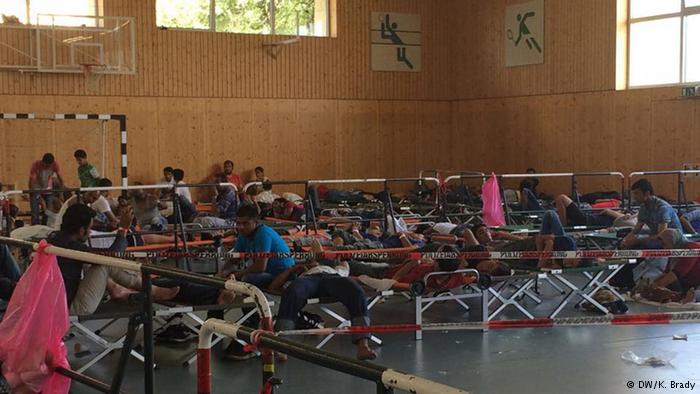
First, there were the images on TV of desperate, scared people climbing out of tiny boats and marching slowly along motorways and through woods. Then, not long after, the refugee crisis arrived on Shaked Spier’s doorstep in Berlin: overcrowded gyms, people waiting for weeks to be registered, overwhelmed officials.

“I knew immediately: If refugees are now in the country that my grandparents had to flee, and if they need help and protection, then I have to do my part,” Spier said. For him, there was absolutely no doubt. Since then, Spier, a Jew whose grandparents once fled the Nazis, has been volunteering at a refugee shelter in Friedrichshain, a hip district of Berlin filled with bars and cafes. Spier, 30, is a well-spoken man who works as a project manager at an IT company, and gives long, reflective answers when asked questions. At the refugee shelter, he helps to serve meals, plays with the kids and talks to the parents about the trauma they’ve experienced.

He is one of many Jews who’ve been helping refugees by donating clothes, working in shelters, or taking refugees into their homes. Spier says he hasn’t had any negative experiences. He says his identity, background and sexual orientation – Spier is openly gay – have never played a big role in his encounters with refugees. If someone notices the Hebrew tattoo on his arm or his accent, the reaction is typically one of, “Oh, you’re from Israel? Cool, I’m from Afghanistan.” He laughs.

Deutschland Rosenheim Grenze Österreich Turnhalle Lager Asylbewerber More than 1 million refugees came to Germany in 2015

No research to support the claims

But then he grows serious. It makes him angry, he says, when other people accuse refugees of being anti-Semites or harboring hate towards Israel simply because they come from countries whose governments espouse such sentiments. The head of Germany’s Central Council of Jews, Josef Schuster, has frequently spoken about the danger of importing anti-Semitism along with refugees. In a recent newspaper interview, he said that “a considerable proportion of Arabs have grown up with anti-Jewish, anti-Israeli stereotypes. These people cannot simply leave their prejudice behind at the border.”

Spier says he has experienced no hostility while working with refugees

Dervis Hizarci, a history and political science teacher in Berlin, also finds such generalizations problematic. There is no research on the extent to which refugees may be bringing anti-Semitism with them to Germany, he said. Hizarci is the head of KIGA, an initiative against anti-Semitism based in the Berlin neighborhood of Kreuzberg. The initiative has launched a project about anti-Semitism among refugees; he expects to have the initial results by the end of the year. Until then, Hizarci says people shouldn’t make generalizations about the issue, as that would only stir up anti-Islam and anti-foreigner sentiment. However, he points to research showing that between 15 and 20 percent of the German population harbor latently anti-Semitic views. “Of course there are Muslims among these people, even in the second and third generation, but they’re by far not all Muslims!”

Hizarci doesn’t deny that young German Muslims are susceptible to anti-Semitic views, fueled by the horrors of the Middle East conflict they see on their smartphones and televisions. Hizarci and his colleagues give workshops and lead debates about anti-Semitism, but also about hatred of Islam. He says his work requires a lot of time and resources. “Just like when it comes to fighting homophobia or right-wing extremism, you can’t change such views with a single workshop; it doesn’t happen overnight.” After the Easter holidays, the initiative wants to start a model project that, among other things, will offer welcome workshops on the topic.

Mosques are overwhelmed

But often, it’s individual people engaged in such efforts to promote tolerance: German mosques are often overwhelmed with the problem, in part because they are led by volunteers who also have to commit their time and energy to other problems facing members of their community, such as exclusion, anti-Islam sentiment and joblessness. There are barely any resources left for confronting the problem of anti-Semitism, said an insider who asked to remain anonymous due to the contentious nature of the topic. The source added that many young Muslims are not an integrative part of the mosque community: “When that’s the case, there’s no way to reach them.”

Source: Refugees and anti-Semitism: is it a problem? | Germany | DW.COM | 12.03.2016

Helmut Oberlander, Ex-Nazi Death Squad Member, Still Keeping His Canadian Citizenship

This case drags on and on, legal ragging the puck (as is his right):

The federal government has hit another roadblock in its decades-long effort to strip Canadian citizenship from a now 92-year-old man who was once a member of a brutal Nazi death squad.

In its decision, the Federal Court of Appeal set aside a ruling against Helmut Oberlander and ordered the government to take another look at the case.

Oberlander, an ethnic German born in Ukraine, has argued he had no choice when German forces conscripted him at age 17 in 1941 to serve as an interpreter in Einsatzkommando 10a. The unit was part of a force responsible for killing more than two million people. Most were civilians, and most were Jewish.

“The appellant was entitled to a determination of the extent to which he made a significant and knowing contribution to the crime or criminal purpose of the Ek 10a,” the Federal Court of Appeal said in its recent decision.

“Only then could a reasonable determination be made as to whether whatever harm he faced was more serious than the harm inflicted on others through his complicity.”

In making its decision, the court noted the Supreme Court in 2013 ruled that individuals cannot be held liable for a group’s crimes only because they associated with the group or passively acquiesced to its criminal purpose.

Source: Helmut Oberlander, Ex-Nazi Death Squad Member, Still Keeping His Canadian Citizenship

Antisemitism: Latest figures from UK and France

Latest data from UK and France:

The number of antisemitic incidents in Britain fell by more than a fifth last year — but 2015 was still the third worst year on record.

Figures published by the Community Security Trust revealed there were 924 incidents of Jew hatred last year.

It represented a drop of 22 per cent compared to 2014, when, following the Gaza conflict, there was a significant spike resulting in 1,179 reported cases.

cst_incidents
Home Secretary Theresa May said there were “still too many cases” of antisemitism in Britain in 2015. CST chief executive David Delew warned that the latest figures were worse than had been expected.

Incidents included two telephoned bomb threats to Jewish schools in London and Manchester, Jewish schoolboys being spat at while visiting a friend at a Manchester hospital, a cyclist throwing a stone at a Jewish man, a swastika being daubed on a Jewish home in Bournemouth, and similar graffiti at a Liverpool cemetery.

CST said there had been no major trigger incident last year, but January and February 2015 saw the most reports of antisemitism following the murders at the Hyper Cacher supermarket in Paris and the attack on a synagogue in Copenhagen.

The charity, which has charted antisemitism in Britain since 1984, said it was unclear whether better reporting mechanisms or a genuine rise in Jew hatred played a bigger role in the total number, which ranked 2015 behind only 2014 and 2009 for total incidents.

Source: CST figures reveal 2015 was third worst year for antisemitism | The Jewish Chronicle

From France:

A total of 59 per cent of French people think members of the Jewish community are at least partially responsible for anti-Semitism, a survey conducted by the Fondation de Judaisme Français and Ipsos has suggested.

The foundation surveyed 1,005 people who “constituted a sample representative of the French population” online over nine days.

Respondents were asked whether they thought Jews held part of the responsibility for anti-Semitism in France.
​Jews leave France at record rate as Isis-inspired anti-Semitism rises
German Jews ‘no longer safe due to rising anti-Semitism’
Video showing Jews and Arabs kissing disappears from Facebook
Of the 59 per cent that answered yes, three per cent thought they had ‘a very important part’ and 14 per cent said they had a ‘significant’ part.

Over half of respondents said Jewish people had a lot of power and were richer than the average French person.

A total of 13 per cent of respondents thought there were too many Jewish people in France, despite the Jewish community only making up one per cent of the population.

Reported anti-Semitic crimes in France have more than doubled between 2014 and 2015 according to a report by Human Rights First, who stated that the crimes were becoming “increasingly violent”.

Approximately 8,000 French Jews migrated to Israel last year, making France the highest source of immigrants to Israel, and many more have migrated to the UK and Canada.

Board of Deputies of British Jews Senior Vice President Richard Verber said: “it is troubling to consider that more than one in 10 French people believe there are ‘too many Jews’ in the country.

“The sad reality today is that visibly-Jewish French citizens are subject to a range of disturbing reactions, from latent anti-Semitism to acts of extreme violence – a number of which have resulted in deaths. For many, this has led to a decision that Jewish life is no longer viable in the country.

http://www.independent.co.uk/news/world/europe/6-in-10-french-people-think-jews-are-responsible-for-anti-semitism-survey-finds-a6848911.html

The York mural controversy: when art and politics collide – Yakabuski

Yakabuski on the YorkU mural controversy:

It is entirely legitimate to criticize Israel’s defiant construction of Jewish settlements in the West Bank, which UN Secretary-General Ban Ki-moonagain this week called “an affront to the Palestinian people and the international community.” But there is nothing uncomplicated about the Israeli-Palestinian conflict, yet the terms “apartheid,” “racism” and “war crimes” steamroll over its discussion on campus.

The settlements are an obstacle to peace and the creation of a Palestinian state. They call into question Israeli Prime Minister Benjamin Netanyahu’s commitment to a two-state solution. But the settlements are not the cause of the conflict. And, as the U.S. ambassador to the UN, Samantha Power, reminded the Security Council this week, “settlement activity can never in itself be an excuse for violence.”

Only the mural’s artist, Ahmad Al Abid, knows what he intended to convey in his painting. Personally, I see Palestinian frustration and impotence more than the “purely anti-Semitic hate propaganda” Mr. Bronfman sees. But since he’s far from alone in his view, York should seize on this controversy to do what universities are supposed to do: open minds.

“The response of college officials can make a difference,” Prof. Saxe [Brandeis University Jewish Studies professor whose survey of 3,000 Jewish students revealed hostility towards Jews] explained “Each incident should be seen as an opportunity to educate students, not merely referee a dispute.”

Source: The York mural controversy: when art and politics collide – The Globe and Mail

Israel, Antisemitism and Terrorism: Gurski

Phil Gurski on Israel and the tendency to label any criticism as antisemitism (the former heads of Shin Bet, the interior intelligence agency, make similar points regarding the continued occupation in the documentary, The Gatekeepers):

There is no question that Israel faces significant security challenges in its dangerous neighbourhood (although I would stop short of calling those threats existential for the simple reason that Israel’s humongous technological superiority, not to mention its undisclosed nuclear arsenal, makes it more than a match for any state stupid enough to attack it) .  And Israel is, and should be, an ally of this country.  It is a vibrant, albeit unwieldy, democracy that serves as an all too rare example for the region.

On the other hand, it has been increasing settlement activity in the Occupied Territories for decades, a clear and flagrant violation of international law. It is beholden to fanatic religious zealots who are no different than the religious extremists we find elsewhere in the region. It has cracked down on freedom of association, but only for groups that are critical of the Israeli government.  All in all, some of what it does can be seen as kindling for the extremist fire.  No, terrorism does not spring solely from Israeli policies, but some of those policies are counterproductive.

Israel likes to complain that the world holds it up to a higher standard than that of its neighbours and that there are much more egregious actors who are a lot worse.  True, but as a democracy, and one that gets gazillions in subsidies from its main ally, the US, it has to put on its big boy pants and accept criticism. Without pouting and calling those that disagree with it Jew haters.

Israel has to acknowledge that its policies in the West Bank are inimical to its long term security and stop kowtowing to fundamentalist religious kooks.  We will work beside Israel to keep it safe and prosperous.  In exchange it has to accept sometimes harsh words.  Friends tell friends when they err.  Canada is Israel’s friend.  It’s time for the latter to listen.  Because it will hear more honest talk from Canada under the Trudeau government than it did under the previous one.

Source: Borealis Threat & Risk Consulting