Adrian Karatnycky: Ukraine, anti-Semitism, racism, and the far right

Interesting analysis and commentary placing the legitimate fears regarding the rise of the far right and antisemitism in Ukraine in context. Look forward to comments from others who know Ukraine better than me:

October 14 saw the latest in a string of annual mass marches by the far right in Ukraine. As many as 10,000 people participated, mainly young men, chanting fiercely. A nighttime torchlight parade with signs proclaiming “We’ll return Ukraine to Ukrainians,” contained echoes of Nazi-style symbolism.

Lax law enforcement and indifference by the security services to the operations of the far right is being noticed by extremists from abroad who are flocking to Ukraine. German media reported the presence of the German extreme right (JN-NPD, Dritte Weg) at the rally. According to Ukrainian political analyst Anton Shekhovtsov, far-right Norwegians, Swedes, and Italians were supposed to be there too. And on October 15, they all gathered in Kyiv for the Paneuropa conference organized by the Ukrainian neo-Nazi National Corps party. “Kyiv,” says Shekhovtsov, “has now become one of the major centers of European far-right activities.”

Such activism, naturally, unnerves liberals as well as Jews, and national minorities. And they often result in alarmist headlines in Western and Israeli newspapers.

Coming in a year in which the white supremacist C14 group engaged in savage beatings at a Roma encampment near Kyiv, one could draw the conclusion that the far right is on the rise in Ukraine.

But such a reading would be mistaken. Far-right sentiments exist in Ukraine, but these ultranationalist groupings attract little public support. As the March 2018 presidential election approaches, recent polls show that the combined vote of far-right presidential candidates amounts to around 4 percent. A similarly paltry level of support is to be found for the far-right Svoboda and National Corps parties. Compared to the support of far-right parties such as the AfD in Germany (12.6 percent support), Marine Le Pen’s Rally for the Nation (13 percent) and Italy’s Northern League (17.4 percent), Ukraine’s public has little sympathy for the far right.

Nor can these fringe Ukrainian parties be labeled pro-Nazi, though their leaders initially were drawn to proto-fascist ideas.Ukraine is a country on whose territory two million Jews died in the Holocaust. It is also a country in which five million non-Jewish Ukrainians perished in combat as a result of Nazi occupation. Virtually every family has the memory of Nazi brutality etched into its memory. Ukraine’s nationalists of the 1930s and 1940s, who advanced anti-Semitic and proto-fascist ideas, were also eventually hunted down for extermination by the Nazi regime.

To be sure, casual anti-Semitism and Jewish stereotypes persist in everyday life. And anti-Semitic graffiti appears with regularity near Jewish synagogues, cemeteries, and cultural institutions. Even still, this regrettable phenomenon is widespread in most advanced industrial democracies.

At the same time, in the last two years there has been not a single recorded violent attack against a Jewish person. The last such attack occurred on October 7, 2016, against a Hasidic rabbi visiting the city of Zhytomyr.

Between 2016 and 2017, acts of vandalism against Jewish targets increased from 19 to 24, but were still far below those reported in many European countries. While an Israeli government report issued in January 2018 alleged a doubling of anti-Semitic incidents in Ukraine, it failed to provide detailed answers about its methodology or sources.

Unlike two decades ago, when Silski Visti, an anti-Semitic newspaper reached millions of readers, today there is no mass circulation periodical spilling out anti-Semitic bile.

Moreover, in comparison with its Central and East European neighbors, Ukraine remains a remarkably tolerant society, even as it faces Russian occupation in part of its territory. A 2016 Pew Research Center poll found that among South, Central, and East European countries, Ukraine had the highest level of acceptance of Jews as fellow citizens, with only 5 percent of the public disagreeing.

The leadership role of Jews in the country’s economic and political life is rarely a topic of public discourse and is accepted as normal.

The country has a Jewish Prime Minister, Volodymyr Groisman.The president’s chief of staff is Jewish, as was his last chief of staff, Borys Lozhkin, who now heads the Ukrainian Jewish Confederation and is a vice president of the World Jewish Congress.

According to the Ukrainian Jewish Confederation, more than thirty of 427 members of parliament are Jewish. And the Committee on Interparliamentary Relations with Israel is the largest of all such groupings in the Ukrainian Rada, numbering nearly 140 deputies, a third of the legislature.

Ukraine’s religious leaders have regular access to key government leaders. And Ukrainian government and state leaders routinely take part in commemorative ceremonies of remembrance of the Holocaust.

All this is not to say that there are serious problems.

Ukraine’s memory politics reflect too much heroization of a complex past and not enough acknowledgment of such issues as indigenous anti-Semitism and collaboration with the Nazi occupation. More, too, needs to be done in restoring the killing fields in which Jews were murdered in the Holocaust.

More ominously, Ukraine’s far-right, para-military formations and their penchant for vigilantism remain a problem that must be more vigorously countered by the state and their sources of funding investigated thoroughly.

Anti-Semitic vandalism needs to be rooted out and hate speech handled in accordance with Ukrainian law. Government reactions to acts or expressions of anti-Semitism remain far too slow. And incidents of violence against Roma by members of far-right groups such as C14 must be swiftly prosecuted.​

However, Western and Israeli governments, media, and NGOs should be sensitive to Russia’s hybrid warfare and disinformation around the topic of anti-Semitism and the far-right in Ukraine. Russia’s deployment of actors who wittingly or unwittingly are encouraged to engage in hate speech, incite anti-minority tensions, commit vandalism, and employ violence is another phenomenon that must be better understood. In a poor country, it is easy to buy or win the allegiance of alienated youth and enlist them in fringe politics either by far-right operatives or Russian agents.

Ukraine’s far right may not be a rising force. But in a poor country facing external aggression, it is a force that cannot be ignored.

Adrian Karatnycky is a senior fellow with the Atlantic Council, and co-director and board member of the Ukrainian Jewish Encounter.

Source: Adrian Karatnycky: Ukraine, anti-Semitism, racism, and the far right

There’s Been a George Soros for Every Era of Anti-Semitic Panic

Good long read and historical reminder:

It’s been largely forgotten, but when Russian military intelligence created online cutouts in 2016 to manipulate the American electorate, the Democratic Party wasn’t its only target.

The most prominent of those fake digital identities was Guccifer 2.0, which took credit for hacking the Democratic National Committee and then provided the pilfered information to WikiLeaks. The other was called DCLeaks. On Aug. 29, 2016, two months after the DNC hack became public, DCLeaks’ now-banned Twitter account told its followers to check out another of its projects: “Find Soros files on soros.dcleaks.com.”

Visitors to the now-shuttered site could find purported documents from the billionaire philanthropist’s Open Society Foundations, which promote liberal values and democratization. They had file names like “public health program access to medicine” and “youth exchange my city real world.” But before those curious about the leaks got there, the Russians wanted to put George Soros in a particular context.

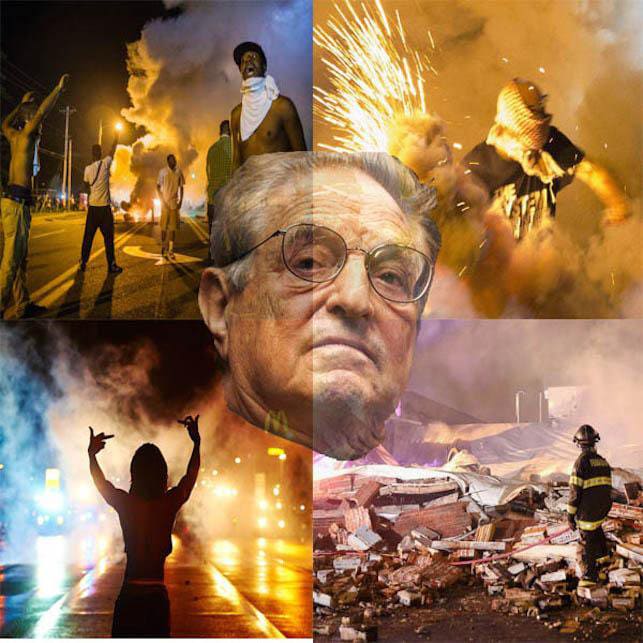
The homepage displayed a photo illustration of a smug-looking Soros in the midst of four scenes of street chaos whose apparent perpetrators were conspicuously nonwhite. They were taken from the Ferguson, Missouri, protests in 2014, the birthplace—to the consternation of many white Americans whom the Kremlin sought to cultivate—of the contemporary civil rights movement. In both the image and the accompanying text, the Russians portrayed Soros as the puppet master.

“Soros is named as the architect and sponsor of almost every revolution and coup around the world for the last 25 years. Thanks to him and his puppets USA is thought to be a vampire, not a lighthouse of freedom and democracy,” the website proclaimed. The “oligarch” who sired the U.S. vampire, and whose “slaves spill blood of millions and millions people just to make him even more rich” [sic], had a particular background the Russians highlighted in the very first sentence: Soros is “of Hungarian-Jewish ancestry and holds dual citizenship.”

More than two years later, the president of the United States gave a similar portrayal of Soros, though Trump left Soros’s background unsaid. Soros, Trump said on Friday, Oct. 5, had paid for “professionally made identical signs” in the hands of women objecting to Brett Kavanaugh’s Supreme Court justiceship. On Tuesday, he followed up by implying that Soros had stiffed these hired “screamers.” In Trump-like fashion, his accusations were a form of mirror-imaging, as Trump himself had paid for people to support his presidential announcement and denied them payment for months, and he appears to have misunderstood a Fox News guest who spoke sarcastically about Soros paying the protesters.

But it was not Trump’s first time making sinister allegations about Soros. He did so in the final advertisement from his campaign, run at the time by the blood-and-soil nationalist Steve Bannon. Its message was reminiscent of the darker periods of European history: the virtuous future of the forgotten, salt-of-the-earth people has been stolen by a predatory elite. As a shot of the Capitol Dome faded into a Wall Street sign, Trump narrated a message to “those who control the levers of power in Washington” right as the camera showed an image of Soros, giving way to a shot of then-Federal Reserve chairwoman Janet Yellen, who is also Jewish, as Trump continued speaking about “global special interests.” This followed months of the so-called alt-right transforming “globalism” into an anti-Semitic euphemism, and preceded Trump stocking his cabinet with ultra-rich financiers, Jew and gentile alike.

In the 1980s and 1990s, George Soros was hailed as an anti-communist and post-communist hero. His philanthropy helped smooth democratic transitions from the Soviet orbit in central and Eastern Europe. Alongside that track record was a different one: Soros was a ruthless currency speculator who benefited from, among other things, the 1992 British financial disaster and who once blithely dismissed second thoughts over the world-moving power of his investments, saying, “I am engaged in an amoral activity that is not meant to have anything to do with guilt.” In a 60 Minutes interview from 1998—one that Glenn Beck would famously butcher to paint Soros, who as a boy lived through Nazi occupation, as a Nazi collaborator—Jim Grant of Grant’s Interest Rate Observer, remarked that Soros was “Donald Trump without the humility.”

The current portraiture of Soros, now ascendant if not dominant online, isn’t interested in that sort of complexity. For the far right, from Russia to central Europe and increasingly, America, Soros is the latest Jewish manipulator whose extreme wealth finances puppet groups and publications to drain the prosperity of the Herrenvolk. This cannot be dismissed as the preoccupation of ignorable fools on the internet, nor as the equivalent of liberal criticism of the Koch Brothers. Instead, the attack on Soros follows classic anti-Semitic templates, grimly recurrent throughout western history, and some of the most powerful geopolitical figures in the world are pushing it. It’s fueled by Soros’s political activism against a revanchist right eager to view the world in zero-sum racial terms that is on the march across Europe, America and beyond.

“The attack on Soros follows classic anti-Semitic templates, grimly recurrent throughout western history, and some of the most powerful geopolitical figures in the world are pushing it.”

Other Jewish bogeymen may haunt the fever dreams of the vicious, but the scale and intensity of the attacks on Soros are unrivalled. They reveal what the global nationalist right believes is at stake in this present moment. We may one day look back on this era as the Soros Age of anti-Semitism.

“It’s important to distinguish between intent and effect. Of course a person who shares a conspiracy theory about George Soros may not intend to promulgate anti-Semitism, and of course not every Soros conspiracy theory is anti-Semitic. But the image of the rich, powerful Jew who manipulates social and political movements around the world for his own agenda is an ancient anti-Semitic trope,” said Aryeh Tuchman, the associate director of the Anti-Defamation League’s Center on Extremism.

“Because Soros’s Jewish identity is so well known, we are concerned that conspiracy theories about George Soros may have the effect of reinforcing this trope and spreading it throughout the broader population,” Tuchman added. “This is especially true when other anti-Semitic tropes are woven in, such as claims that Soros controls the media or the banks, or when he is described using terms that harken back to medieval claims that Jews are evil, demonic, or agents of the Antichrist.”

There will always be this sort of tentacular George Soros figure. There have been many before. One was said to have profited off the bloodshed at Waterloo.

Thirty years after the pivotal battle capping the end of the Napoleonic Wars, a pamphlet circulated across Europe claiming that Nathan Rothschild, a London banker and scion of the Jewish mega-financier family, sped from the battlefield to parlay his insider knowledge of the French defeat into a windfall on the London stock exchange. “This family,” charged an author writing under the nom de plume “Satan,” “is our evil genius.”

It was the fake news of its era. Nathan Rothschild was never at Waterloo. He died five years before the pamphlet’s publication in 1841, leaving him unable to rebut it. But the lie, after a series of adjustments to explain away its baseline factual mistakes, would reach escape velocity. One subsequent version, according to Brian Cathcart of Kingston University London, claimed Rothschild “deliberately provoked a collapse in stock market confidence by encouraging rumors that Wellington had been defeated.”

The form of conspiracy theories follows their function. Here was a Jewish family whose fortune was said to derive from exploiting European carnage. As Jews, they were considered a foreign presence on the continent, one that had taken advantage of their adopted countries’ naive openness to establish a shadowy power that could determine the fate of nations. Accordingly, European publics would not have to look to their distant autocratic governments for their political disenfranchisement, nor would they have to look to a confusing system of capitalist finance to explain obscene discrepancies in wealth. In place of a systemic critique was a Jewish face. More recently, you can find Rothschild references in the QAnon conspiracy theory, alongside, of course, Soros.

A recurrent theme of 19th-century anti-Semitism is that it finds substantial currency at moments when old regimes appear exhausted and fear about revolutionary dislocation intensifies. A tutor to Russia’s final two tsars demonstrated the utility of using Jews as an omnibus explanation for the anxieties of his age. Jews in Russia endured repression of their civil and economic rights—but they only appeared powerless.

“Yids,” wrote Konstantin Pobyedonostsev in August 1879, have “invaded everything, but the spirit of the times works in their favor. They are at the root of the Social Democratic movement and tsaricide. They control the press and the stock market. They reduce the masses to financial slavery. They formulate the principles of contemporary science, which tends to disassociate itself from Christianity. And in spite of that, every time their name is mentioned, a chorus of voices is raised in favor of the Jews, supposedly in the name of civilization and tolerance, that is to say, indifference to faith. And nobody dares say that here the Jews control everything.” Like many before and since, Pobyedonostsev did not pause to reconcile his claimed Jewish interest in exploitative capitalism with his claimed Jewish interest in the socialism designed to destroy it, but a man like George Soros offers Pobyedonostsev’s descendants a way to square the circle.

After Rothschild, there was Max Warburg. Warburg, another Jewish banker, was a member of the Hamburg parliament and said to have an open line to Kaiser Wilhelm II. Once Pobyednostsev’s fears came true in 1917, a forgery about Warburg appeared in Petrograd claiming that he and a “Rhenish-Westphalian syndicate” were financing the Bolsheviks, through the Jewish Trotsky.

A Russian journalist, Eugene Semyonov, provided the forgery to an American diplomat, Edgar Sisson. It had currency for the Creel Committee, an official U.S. government propaganda organ promoting participation in World War I, since it portrayed the Russian Revolution as a German plot financed by Jews. In September 1918, the committee published it under the title The German-Bolshevik Conspiracy. Leon Poliakov writes in the fourth volume of his History of Anti-Semitism that it was the first time that an anti-Semitic forgery was published by a government that was neither tsarist nor otherwise committed to anti-Semitism as a matter of policy. (Warburg himself, 20 years later, would immigrate to New York to flee the Nazis.)

According to Poliakov, the years between the world wars were a boom time for anti-Semitic forgeries in the United States. There was the fake George Washington missive, warning that the Jews, not the British Army, were the principal danger. And there was a fake Ben Franklin prophesy, forecasting Jewish world domination by 1950 or so.  Detectives hired by the anti-Semitic industrialist Henry Ford traveled to Mongolia, of all places, in pursuit of an authentic Hebrew copy of the invented Protocols of the Elders of Zion. Another went “looking for the secret channel through which [Supreme Court Justice and Jew] Louis Brandeis gave his orders to the White House.”

Foreshadowing the present day, the upswing of American anti-Semitism came at the intersection of an immigration panic, an ascendant nativist movement, and fears about foreign-borne internal subversion. As the Bolshevik Revolution spread, so did a cottage industry of paranoiacs connecting it to mainstream American Jewry, just as a later generation of Islamophobes would do to American Islam after 9/11. In 1919, a Methodist minister recently driven from Russia, the Rev. George A. Simons, testified to a Senate subcommittee about the Jewishness of Bolshevism.

Simons, speaking through barely concealed euphemism, told the Senate that he had encountered “hundreds of agitators” in the former St. Petersburg who had come from “the East Side of New York,” meaning the Jewish slum. The typical sentiment of Russians to describe the post-revolutionary arrangement, Simons related, was that “it is not a Russian government, it is a Hebrew government.” But, Simons assured the Senate, he was no bigot: “I am not in sympathy with anti-Semitism. I never was and never will be. I hate pogroms of any type. But I am firmly convinced that this business is Jewish.”

Vladimir Putin and the global nationalist right have particular motivations to vilify Soros, though deploying anti-Semitism to do it is entirely their choice.

Soros was deeply involved in post-Soviet economic efforts in Russia in the 1990s, corresponding with the nadir of Russian power that Vladimir Putin considers a national humiliation demanding redress. And though he’s denied doing any such thing, Russians have long speculated that Soros profited off a Russian economic downturn in 1998, a year during which he boasted of being Russia’s largest single investor. (His Quantum Fund claims to have lost $2 billion from the episode.) Prophetically, Soros warned Charlie Rose in 1995 of revanchist eastern-European authoritarianism born of an alliance between nationalist politicians and business interests: “Russia is very much up for grabs. It’s very much a struggle which way it’s going to go.”

Soros’s solution to all of this is liberalism. He took his inspiration from the anti-totalitarian philosopher Karl Popper, best known for The Open Society and Its Enemies, and used Popper’s work to develop a critique of the rapacious capitalism Soros himself practiced as a threat to that open society—conveniently, after he had made his billions. Soros’s Open Society Foundations, which operate in over 140 countries, provide assistance and financing to civil-society institutions that promote transparency, the rule of law, higher education, refugee aid, the rights of marginalized peoples, and democratic accountability.

Accordingly, recipients of Soros’s philanthropy include groups such as NARAL, Planned Parenthood and the ACLU that in their various ways oppose the agendas of the American right. In 2003, Soros pledged what would for anyone other than him count as a fortune in a failed attempt to prevent George W. Bush’s re-election, fanning the flames of his enemies’ ire. Then, in October 2017, the elderly Soros transferred a gargantuan $18 billion to the foundation, making it the U.S.’ second largest philanthropic organization.

But it’s one thing to be a wealthy donor, even an unfathomably wealthy one: American politics, to its cross-ideological abasement, relies upon them, and scrutiny of them is vital for the very open societies Soros promotes. It’s quite another for such an unfathomably wealthy donor to stand as a singular, nefarious explanation for all manner of global political phenomena. A recent ADL study about anti-Semitism on Twitter took particular note of the frequency and virulence of invocations of Soros for “undermin[ing] western civilization, or following a long-standing pattern of Jewish behavior.” The ADL even found far-right warnings that Soros had engineered the lethal white-supremacist march on Charlottesville as a false-flag operation.

After the teenage survivors of the Parkland high school massacre began their demonstrations for gun control, some let the mask slip. One now-suspended “alt-right” account tweeted that it was “@georgesoros at work.” Softer versions of that sentiment are ubiquitous online. One more humorous version came after someone posted a picture of a bald Britney Spears attacking a car during her 2007 meltdown to joke that it was Parkland’s Emma Gonzalez – prompting an apparently elderly woman to tweet that “these children of Satan… are funded by Soros.” At an “alt-right” gathering in New York convened by Pizzagate conspiracy theorist Mike Cernovich, drunken panelists referred to Soros as the “head of the snake.”

Larger players in the “alt-right” firmament, echoing their 19th- and 20th-century antecedents, find the malevolent handiwork of Soros everywhere. WikiLeaks, on Twitter, sought to discredit 2016-era reporting in the Panama Papers concerning Vladimir Putin by portraying it as Soros-funded. Bannon’s former home for distorted news, Breitbart, ran a cottage industry connecting far-right targets to Soros, no matter how innocuous the connection. In a typical piece, H.R. McMaster’s consultancy at the International Institute for Strategic Studies – a minor thing, considering it overlapped with McMaster’s Army career – became “Soros-funded” through a IISS affiliation with the nuclear-nonproliferation Ploughshares Fund. Google and Facebook were hit with similar Breitbart smears-by-association through their sins of using credible organizations like the Poynter Institution, which take Open Society money, to reduce the onslaught of fake news. InfoWars similarly highlights Soros money taken by its critics to paint itself as unfairly persecuted.

In keeping with the broader trajectory of the extreme right, the paranoid conception of Soros has moved closer to the corridors of power. In December, the GOP nominee for Senate in Alabama, Roy Moore, castigated Soros in terms redolent with anti-Semitism. Soros’s agenda was “sexual” in nature, said a man accused of child predation, and it’s “not our American culture.” Soros, Moore told a radio host, “comes from another world that I don’t identify with. … No matter how much money he’s got, he’s still going to the same place that people who don’t recognize God and morality and accept his salvation are going.”

“Soros’s agenda was ‘sexual’ in nature, said Roy Moore, a man accused of child predation. Soros ‘comes from another world that I don’t identify with. … No matter how much money he’s got, he’s still going to the same place that people who don’t recognize God and morality and accept his salvation are going.’”

That same month, Erik Prince, brother of Trump’s education secretary and mercenary CEO, encouraged a GQ reporter to investigate the Clintons’ sartorial choices of purple shirts and ties. “Purple Revolution lore,” the wealthy Prince told GQ. “I think it’s a Soros thing.” (There is no such thing as the Purple Revolution.) A Prince associate and former CIA official, the Intercept reported last year, told would-be donors that McMaster used a burner phone to route the fruits of deep-state surveillance on Bannon and the Trump family to “a facility in Cyprus owned by George Soros.”

More recently, after the Kavanaugh confirmation fight, Senator Chuck Grassley stopped just short of validating the accusation that Soros had paid for those protesting Kavanaugh. “I believe it fits in his attack mode that he has, and how he uses his billions and billions of resources,” said the chairman of the Senate judiciary committee. Even Rudy Giuliani on Saturday retweeted someone who called Soros the “anti-Christ.” The “evil genius” that “Satan” concocted in 1841 had found its 2018 incarnation.

Nowhere has the attack on Soros been more geopolitically potent, or as clarifying, as in his native Hungary.

The Hungarian strongman prime minister Viktor Orban, for months ahead of his April reelection, united anti-Semitism and Islamophobia to portray Soros as the string-puller behind a transformational Islamic invasion of Syrian migrants. Whereas some Soros opponents mumble through their anti-Semitism, Orban roars it. Soros is out to deal “a final blow to Christian culture,” Orban charged in November. “It’s Soros’s plan for America, too. PM Orban’s view is deeply well informed & reasoned,” the racist Iowa Republican Congressman Steve King said in December while quote-tweeting an account that used the Soros photo illustration from the DCLeaks page.

In a March pre-election speech, Orban put Soros and immigration in existential terms for Hungary. He pledged to expel Soros as the Hungarians did previous remote tyrannies from the Ottomans to the Hapsburgs to the Soviets. And he applied anti-Semitic tropes not seen from a European leader since Hitler.

“We are fighting an enemy that is different from us,” Orban said, per a New York Times translation. “Not open, but hiding; not straightforward but crafty; not honest but base; not national but international; does not believe in working but speculates with money; does not have its own homeland but feels it owns the whole world.” Even a previously sympathetic writer, National Review’s Michael Brendan Dougherty, said the speech read like “a checklist drawn from the Protocols of the Elders of Zion.”

Perhaps it’s worth noting that Orban himself received a Soros-funded scholarship to Oxford. But it was not the only irony in this ugly episode. To its discredit, the Israeli government of Benjamin Netanyahu wilfully averted its eyes from Orban’s anti-Semitism. Billboards in Hungary last year promoted Orban’s anti-immigrant agenda by using a photo of a smiling Soros to warn Hungarians against letting him get “the last laugh.” Yossi Amrani, the Israeli ambassador, posted on Facebook that the campaign sowed “sad memories”—an apparent allusion to Hungary’s complicity in genocidal anti-Semitism—and “hatred and fear.”

Yet the Israeli foreign ministry undercut its own diplomat. It insistedit had no intent to “delegitimize criticism of George Soros, who continuously undermines Israel’s democratically elected governments by funding organizations that defame the Jewish state and seek to deny it the right to defend itself.” That followed on Israel opting to accept official assurances against anti-Semitism after Orban called Miklós Horthy—Hitler’s Hungarian ally whose expulsions of Hungarian Jewry led to the slaughter of half a million people in the Holocaust—an “exceptional statesman.”

An Israeli journalist, Mairav Zonszein, contextualized the toleration of anti-Semitism within Netanyahu’s broader alignment with right-wing nationalist governments “if it will bolster the Greater Israel movement.” This appears to be an allusion to Soros’s funding of Israeli groups such as B’tselem and Breaking The Silence, which challenge the brutal Israeli treatment of Palestinians, an internal criticism that Netanyahu and his allies cannot abide. Netanyahu, who postures as the protector of diaspora Jewry when it suits him, had tacitly collaborated with an anti-Semite to turn a Hungarian-born Jew into a metaphorically stateless person.

This spring, Orban’s government criminalized the assistance of asylum seekers and undocumented immigrants through what it called the “Stop Soros” laws. Ahead of its passage, the Open Society Foundations announced that it would cease operations in Budapest and transfer its local staff to Germany. In July, Netanyahu hosted Orban in Jerusalem and declared him a “true friend of Israel.”

Calculations like Netanyahu’s underscore the ascendancy and the purpose of the global far right. From Russia to America and beyond, the open society is on its back foot against an assault not seen since the 1930s. The assaulters are far from finished. Whereas the previous generation of European nationalists wanted to marginalize the European Union, the current one seeks to take it over. Orban and his Italian ally, Interior Minister Matteo Salvini, are crusading on an anti-immigration platform ahead of spring’s European Parliamentary elections. They’re joined, on the outside, by Steve Bannon, who dreams of a pan-European nationalist bloc and styles himself, as he told The Daily Beast’s Nico Hines, a counterweight to the version of George Soros so thoroughly cultivated for the reactionary European, Russian and American imagination.

Soros would not talk for this article. But the Open Society Foundations’ communications director, Laura Silber, called the attacks on him “a tribute,” as his philanthropy “strikes at the interests of autocrats, oligarchs and corrupt politicians” and supports human dignity.

“The voices that are loudest in speaking out against George Soros are those that are authoritarian, seeking to galvanize their bases and consolidate power, ignoring or silencing the most vulnerable,” Silber told The Daily Beast. “They’re doing it by circulating recurrent tropes. The billboards that the Hungarian government put up were eerily similar to World War II propaganda, and it’s telling that they were defaced with swastikas and hateful epithets.”

“The voices that are loudest in speaking out against George Soros are those that are authoritarian, seeking to galvanize their bases and consolidate power, ignoring or silencing the most vulnerable.”
— Laura Silber

The U.S. has been better to and for Jews than any other diaspora nation in history. It’s for that reason that many American Jews, particularly those whose white skin affords them access to the highest levels of the American Dream, often diminish the dangers posed by a mass movement comfortable, wittingly or not, with creating a Jewish scapegoat for its political frustrations. There is also a powerful Jewish collective instinct to avoid calling attention to empowered anti-Semitism for fear of provoking it to violence.

Nearly a century ago, as anti-Semitic propaganda backed by powerful white Americans like Henry Ford proliferated, an American Jewish lawyer and civil-rights leader urged his fellow Jews to confront it. “Events have shown that the policy of silence was a mistake. Not only do Ford’s articles appear every week with undiminished virulence, but worse, the Protocols is distributed in every club, placed in every newspaper,” wrote Louis Marshall in 1921. “It has been received by every member of Congress and put in the hands of thousands of personalities. It is the topic of conversation in every living room and in every social sphere.”

Eighteen years later, 20,000 Nazi supporters filled Madison Square Garden to preach their vision of an American Reich. It would not be long, across the Atlantic, before much worse unfolded.

“I’m concerned that the prevalence of conspiracy theories about Soros which paint him as a larger than life, powerful figure has the effect of shrinking that public space where anti-Semitism is not acceptable,” said the ADL’s Tuchman. “If you have fully embraced the notion that there is a powerful Jewish figure manipulating social and political movements around the world to promote his agenda, you’re inching toward the edges of that space where anti-Semitism is acceptable. Soros is a liminal figure in that way.”
Source: There’s Been a George Soros for Every Era of Anti-Semitic Panic

Dina Porat, Netanyahu’s secret agent in his war on the ‘new anti-Semitism’

Knowing both Dina Porat and Yehuda Bauer from my time as Canadian delegate to IRHA, found this story particularly of interest. Agree with Bauer:

A public outcry and a media storm have raged in recent months over a joint declarationissued by the prime ministers of Poland and Israel and read by Israel’s Prime Minister Benjamin Netanyahu last June. The statement praised Polish resistance to the Nazis. It came on the heels of Poland passing a controversial law akin to Holocaust-denial that banned implicating Poles for crimes committed during the Holocaust, an offense punishable by a three-year prison sentence. When Netanyahu read the declaration, many criticized him over reaching a faustian detente with Poland.

Professor Yehuda Bauer, Israel Prize laureate and one of the world’s leading Holocaust scholars, deemed the joint statement “betrayal.”

In an interview on Israeli public radio, Bauer said that Israel had accepted the Polish narrative of the Holocaust. “The Poles have deceived us, they have us wrapped around the finger, and we agreed to this, because the State of Israel finds the economic-political-military relations with Poland more important that such a small business, the Holocaust,” he said.

Senior officials in the Netanyahu government, including Naftali Bennett, Minister of Education and Ayelet Shaked, Minister of Justice, also criticized the declaration.

The statement was drafted far from the public eye with support from a secret delegation of Netanyahu allies and former appointees, Yaakov Nagel and Yossi Ciechanover. According to reports by Israeli media, a meeting between the delegations was held at the Mossad offices. It came about in spite that this kind of historic declaration should be made after deep discussion involving experts and the public.

After the statement was made, Netanyahu revealed that “Professor Dina Porat, the chief historian of Yad Vashem was involved the drafting of the declaration.” However, Yad Vashem had already published their own unprecedented and sharp condemnation of the statement. It said the joint Israeli-Polish declaration contained “historical distortions” and was written without Yad Vashem’s involvement.

Porat would have liked to have some sections corrected, she explained in an interview with Kan radio and reported by Ynet. Yet, taken as a whole, she said “We can definitely live with it,” Porat clarified she was not paid for consulting on the declaration. “I was asked to give personal and discreet advice, I did not act as the chief historian [of Yad Vashem],” she said.

How was it possible that Porat acted behind the backs of both Yad Vashem and the Israeli public? Do political ends (such as bolstering Netanyahu’s attempt to have more embassies moved to Jerusalem) justify the means? Does that include the desecration of the memory of the Holocaust? Prima facie, Porat’s conduct was no fluke but a matter of worldview and priorities.

What is anti-Semitism? Depends on what’s in the Israeli government’s self-interest

“New anti-Semitism,” a vague term promoted by the Israeli government and its partners, regards the BDS movement and criticism of Israeli occupation policies as a form of anti-Semitism. While the Israeli right-wing often mocks the “peace industry,” it has formed its own industry under the assumption that new anti-Semitism is real and spreading. The government calls this fighting the “de-legitimization of Israel.” It is spearheaded by politicians who strive to gain personal capital, organizations on the right and extremist groups. This industry offers lucrative jobs and huge budgets.

While sporadic anti-Semitic elements in the boycott movement do occur and should not be tolerated, it makes no sense to sweepingly label this global, diverse movement as innately “anti-Semitic.” Many Jews in Israel and across the world support a full boycott of the State of Israel, or a boycott of Israeli settlements and those who profit from the occupation.

In spite of strenuous efforts by the Netanyahu government, a boycott of the State of Israel is still considered an integral part of the civil right to freedom of speech and conscience in many countries, even if the local governments oppose the boycott or do not support it. In reality, the Netanyahu government has used the fight against the “new anti-Semitism” to silence criticism of the occupation and its policies in the occupied Palestinian territories, to persecute left-wing and human rights groups, and to shrink the democratic sphere in Israel.

It comes as no surprise that the Netanyahu government’s fight against the boycott movement and the “new anti-Semitism” shifted gears in 2015, against the backdrop of the international nuclear agreement with Iran. A new existential enemy had to be found, around which the public in Israel could be rallied. To manufacture a public consensus as to the current “existential threat,” the Netanyahu government could not rely just on the fringe right wing. In this context, Porat became an important asset to the Netanyahu government by joining the campaign. For example, the Kantor Center at the Tel Aviv University, headed by Porat, publishes an annual report (of which she is the editor) on the status of anti-Semitism throughout the world. These reports pay close attention to the boycott movement and groups which campaign against Israeli policies. The reports also regard the labeling of Israel as “an apartheid state” as a manifestation of anti-Semitism. At ahearing of the Knesset’s Immigration and Absorption Committee in May 2015, Porat stated that “It’s obvious that anti-Israeliness and anti-Zionism are acquiring an increasingly anti-Semitic tone.” This means that in her view, anti-Zionism may amount to anti-Semitism.

When it comes to the “old anti-Semitism,” Porat seems more pragmatic. This was evident not just in her (professed) clandestine participation in the preparation of the joint declaration with the Polish government, but also in her approach to other regimes with a serious anti-Semitism problem. Hungarian Prime Minister Viktor Orban, has been waging a racist and anti-Semitic campaign for years, and has even expressed his personal support of Miklós Horthy, the country’s ruler during WWII who was directly responsible for the extermination of Hungary’s Jews. While the United States Holocaust Memorial Museum in Washington has condemned Orban sharply, and Elie Wiesel returned a medal he had received from the Hungarian government due to its whitewashing of the country’s Nazi past, we have not heard Porat’s criticism of this grave anti-Semitism in Orban’s party and government. In fact, the opposite is true – Orban visited Yad Vashem recently. It comes as no coincidence that Hungary is being coaxed by Netanyahu to transfer its embassy to Jerusalem.

Furthermore, we have not heard Porat’s critique as to Ukrainian legislation which, similarly to the Polish one, bans criticism of Nazi Germany’s Ukrainian henchmen during WWII. Nor have we heard her public voice regarding the integration of a neo-Nazi Militia, Azov, which uses Nazi insignia, into the national Ukrainian security forces. Once again, the converse is true: The Prime Minister of Ukraine visited Yad Vashem in May 2017, and metIsraeli Minister of Defense Avigdor Lieberman to discuss arms deals. By contrast, the Simon Wiesenthal Center has campaigned against the militia’s efforts to recruit new members, and the United States Memorial Museum has strongly condemned the Ukrainian legislation. Nor have we heard Porat’s critique as to the recent visit by Philippine President Rodrigo Duterte, who is responsible for the extrajudicial killing of thousands of suspected drug dealers and addicts. Duterte has also compared himself to Hitler and said he would gladly slaughter three million drug addicts similarly to Hitler’s slaughter of the Jews.

A dangerous stamp of approval

Porat published in Haaretz a response to an article by the Israeli writer Amos Oz, in which he claimed that Israel would not resolve its conflict with the Palestinians by using its military might, but only through negotiation, including with the Hamas terror organization. Porat criticized Oz strongly and cited an excerpt from his book “A Tale of Love and Darkness,” in which the guard from Kibbutz Hulda  says: “It’s not because they are a nation of murderers that we will shoot them (if they show up to shoot us), but only for the simple reason that we too are allowed to live and for the simple reason that we too are allowed to have a country, not just they.” Porat of all people should have known that the logic of this sentence has served to justify crimes against humanity and genocide in Guatemala, Rwanda, Bosnia, South Sudan, Burma and other countries.

Accordingly, we did not hear Porat’s voice when the Chairman of the South Sudanese Parliament, Mr. Anthony Lino Makana, visited Yad Vashem in December 2017, as crimes against humanity were being committed in South Sudan by the government’s security forces and allied militias, and the UN warned that the situation could escalate to a full genocide. Nor did we hear Porat’s voice when the head of the Burmese military regimevisited Yad Vashem in September 2015, although the Burmese security forces under his command are responsible for crimes against humanity and war crimes. Porat should have noted reports by the United States Holocaust Museum, regarding the minority Muslim Rohingya population, as to grave violations of human rights taking place in the country, with a serious threat of genocide. Israel has sold weapons to the above-mentioned states, and visits to Yad Vashem have been a part of the package deal.

Porat is surely not responsible for the decades-long policies of the Israeli government and Yad Vashem. But her stamp of approval to the Netanyahu government’s foreign policy illustrates the danger of politicizing the memory of the Holocaust and the Israeli right-wing’s cynicism. It seems that the more she deals with the “new anti-Semitism” bogeyman, the less she addresses the “old anti-Semitism.” If Porat is really more concerned with support for BDS in Ireland, which has enacted a law banning settlement products, than with Hungary, whose government erects statues honoring those who assisted in the elimination of Jews, and a senior extreme right-wing figure calls for the compilation of a “Jewish list” for national security reasons – She would do wisely in letting someone more qualified assume her position at Yad Vashem. Indeed, Porat has offered her resignation, but reportedly Yad Vashem did not accept it. If she does leave her post, she will be free to advise Netanyahu as personally and publicly as she wishes.

Source: Dina Porat, Netanyahu’s secret agent in his war on the ‘new anti-Semitism’

Douglas Todd: Would Saudi Arabia’s jailed blogger be accused of ‘Islamophobia’ in Canada?

Less contradictory than the article argues. Virtually all of the recommendations that came out of the committee examining M-103 applied to all forms of racism and discrimination (dissenting Conservative recommendations focused more on definitional questions of Islamophobia).

The additional funding for the multiculturalism program was general in application save for programming directed against racism and discrimination encountered by Black Canadians).

Just as one can criticize the policies and practices of the Israeli government without being antisemitic, one can criticize the policies and practices of the Saudi government without being anti-Muslim. In the case of the former, the IHRA definition of antisemitism provides some (imperfect) guidance that could form the basis of discussion for a comparable approach to criticizing the policies of Muslim countries, beyond basic human rights.

So while some Muslims may argue that any criticism of Saudi Arabia is anti-Muslim or Islamophobic, some Jews also argue that any criticism of Israel is antisemitic. It depends on the nature and form of the criticism:

Would jailed Saudi Arabian blogger Raif Badawi end up being accused of Islamophobia if he were released from his Riyadh prison cell and allowed to come to Canada?

Prime Minister Justin Trudeau’s government is taking contradictory symbolic stands.

In August, it provoked a diplomatic dispute with the Kingdom of Saudi Arabia by tweeting support for Badawi, who was arrested in 2012 and flogged for criticizing the country’s hardline religious leadership. Canada has even offered citizenship to the free-speech advocate, his wife, Ensaf Haidar, and their children.

But how does that jibe with the federal Liberals also pushing through Motion 103, which urges all-out war against “Islamophobia?” The Liberal politicians behind M-103 refused to respond to requests to define Islamophobia. And their deceptive gamesmanship would end up jeopardizing Badawi’s right to free expression if he were to ever to come to Canada.

Among other things Badawi has equated a host of Saudi Arabian Muslims with terrorists, which many Canadians think is an offensive and Islamophobic accusation to make.

Can Trudeau’s government have it both ways? How can it champion Badawi’s right to freely criticize Saudi Arabia’s form of Islam at the same time that Liberal MPs make a virtue of condemning anyone who disparages Islam, including the deadly rules in many theocratic Muslim countries, which legislate that people should have their heads cut off for leaving the 1.5-billion-member faith?

Ali Rizvi, Canadian-based author of The Atheist Muslim, was one of the first to point out the lack of logic from Canada’s liberal-minded politicians, which include NDP and Green MPs. “People like my good friend Raif Badawi is in jail and he has been flogged 50 times simply for blogging,” Rizvi, who has lived in Saudi Arabia, told CBC’s The Tapestry.

“It’s interesting to me that if he finally made it to Canada and joined his wife and kids here, a lot of his ideas would be considered ‘Islamophobic’ by Liberals over here because of the criticisms he makes.”

An Angus Reid poll suggests many Canadians agree with Rizvi that the Liberal government has muddied the waters of free speech when it comes to criticizing religions and religious people, something which has been going full bore in the West since the Christian Reformation 500 years ago.

Half of Canadians said it’s not necessary for federal politicians to formally condemn “Islamophobia.” And 55 per cent say the problem of anti-Muslim sentiments in this country has been overblown by politicians and the media. Presumably most Canadians feel the country’s existing anti-hate speech laws already cover extreme hostile attacks on ethnic or religious groups.

The federal Liberals have managed through all this to get themselves into a pickle over free speech.

Foreign Affairs Minister Chrystia Freeland’s August tweet calling for the release of Badawi and his sister led to Saudi Arabia retaliating. It cancelled trade deals with Canada and cut short the educations of nearly 15,000 Saudi students in Canada, even while confusion reigns about the fate of the more than 1,000 Saudi physicians in training in the country.

The trans-national furore is taking place as Badawi’s circumstances grow more dire. Even though an initial charge of apostasy, which is punished by death, was withdrawn, his health deteriorates in his small, stinking, shared cell. He has four years left in his sentence, which was to include 1,000 public lashes with a whip (he’s had 50 so far). He’s not alone in his degradation. In other Muslim-majority countries, online critics of the religion have been hacked to death, including a Bangledesh blogger who was also a friend of the Canadian author of The Atheist Muslim.

What has Badawi actually said to suffer such egregious punishment?

He has censured Muslims’ for their intolerance and argued against unequal religious attitudes towards women. He has promoted “live and let-live” secularism to replace Islamic theocracy and attacked Muslim schools that he says are filled with terrorists. And he has criticized Muslims in Arabic countries for failing to follow the lead of Europe, which has a separation of religion and state.

“States which are built on religion confine their people in the circle of faith and fear,” he writes in 1000 Lashes: Because I Say What I Think (published by Vancouver’s Greystone Books).

“We should not hide the fact that Muslims in Saudi Arabia not only disrespect the beliefs of others, but (they) charge them with infidelity, to the extent that they consider anyone who is not Muslim an infidel,” he has said.

Badawi was outraged when Muslims in New York City called for a mosque to be built near the site of the destroyed World Trade Center, where 3,000 people were murdered in the 9/11 attacks by al-Qaida terrorists, whom Badawi directly linked to Saudi Arabia.

“What increases my pain is this (Islamist) chauvinist arrogance, which claims that innocent blood, shed by barbarian, brutal minds under the slogan ‘Allahu Akbar,’ means nothing compared to the act of building an Islamic mosque whose mission will be to … spawn new terrorists.”

Badawi’s costly bid for freedom of expression in Saudi Arabia, for the right to openly denounce Islamic practices, puts him in a similar boat as the staff at France’s satiric Charlie Hebdo magazine, the Danish newspaper editors who published cartoons of Mohammed, and British-Indian novelist Salman Rushdie, whom have all suffered for finding fault with Islam.

In 1000 Lashes, Badawi defiantly chooses to follow the dictum of the late French existentialist Albert Camus, who said, “The only way to deal with an unfree world is to become so absolutely free that your very existence is an act of rebellion.”

Badawi’s courageous existence is a clear revolt against Saudi Arabia’s bullying Islamic authorities. It should also cause some censorial Canadians to squirm.

Source: Douglas Todd: Would Saudi Arabia’s jailed blogger be accused of ‘Islamophobia’ in Canada?

If you want a fair definition of Zionism, it’s best to ask a Palestinian

Interesting and provocative column on the IHRA definition of antisemitism and its use:

There are lots of good reasons to think the International Holocaust Remembrance Alliance’s (IHRA) definition of anti-Semitism, now adopted “in full” by Labour’s national committee and by Labour MPs, is, well, a bit rubbish.

  • The actual definition of anti-Semitism is not up to much
  • The illustrations are a legal mess
  • It appears to be having no impact on anti-Semitism in the (few) countries which have endorsed it
  • And it’s already being used to prevent open debate on university campuses

A recent article by Tony Lerman gathers together all of these points and more.

It was short-term political expediency which drove this week’s decision-making, necessitated by an ongoing high-stakes campaign of vilification that takes no prisoners.

The Liberal Democrat Party has also fallen into line, no doubt realising that attempting to conduct a rational discussion over the merits of the IHRA burns up too much political capital. And now we read that the Church of England wants to adopt it too. The sanctification of this document is going ecumenical.

But there’s a further problem which should be reason enough to dump the whole IHRA definition, and its illustrations, in the rubbish bin. And it goes beyond the need to guarantee freedom of speech.

The truth of the matter is, the Jewish community can no longer define “Zionism,” or indeed “anti-Semitism,” without the help of Palestinians.

The right to define

I know what some people will be thinking.

Surely, it’s for the Jewish community, through its leadership, to determine what anti-Semitism is? What Zionism is? Surely, an oppressed people should have the right to define the nature of the oppression perpetrated against them? Hence the insistence that the Labour Party adopt, in full and without amendments or caveats, the IHRA definition and illustrations.

That’s what the Board of Deputies of British Jews has asked for. So surely, that’s what it should get?

It’s become a politically difficult task, if not impossible, to challenge this assertion of the right to define what’s perceived as exclusively Jewish experience and terminology, especially at a time when identity politics rules our daily discourse.

The President of the Board of Deputies, Marie van der Zyl, provided a good example of the accepted parameters of the debate in her statement welcoming the National Executive Committee’s (NEC) decision.

“It is very long overdue and regrettable that Labour has wasted a whole summer trying to dictate to Jews what constitutes offense against us.”

Similarly, the NEC’s addition of a one-sentence free speech caveat was characterized by Simon Johnson, CEO of the Jewish Leadership Council, as driving “a coach and horses” through the anti-Semitism definition:

“It is clearly more important to the Labour leader to protect the free speech of those who hate Israel than it is to protect the Jewish community from the real threats that it faces.”

Devoid of context

But this is a perspective devoid of historical context. It just doesn’t work for the situation in which we as a Jewish community now find ourselves, and which our leaders have done so much to create.

If defining “anti-Semitism” has become, to a considerable extent, what can and can’t be said about Israel and Zionism, then how can it be a question which only (some) Jews get to answer?

And if this is really all about the right to define your own oppression, then why does this rule not apply to the Palestinians?

It’s a bit like trying to define “British colonialism” by only asking the opinion of a 19th-century British diplomat. Or praising “American freedom and values” without acknowledging the experience of Native Americans or African Americans. It makes no sense because you only get half the story, half the lived experience (at most). The language and the ideas in question have more than one owner.

Inextricably linked

For more than 100 years, the history of the Palestinians and the Jews has been inextricably linked. Neither of us can understand our past or present condition without reference to the other. Neither people’s story is complete without the other.

Of course, our interlinked relationship is not one of equality. Our story is shared but the consequences of our entanglement are vastly different.

One side has rights and national self-determination. The other side is denied those same things in the name of Jewish security and Jewish national sovereignty. In short, one side has been empowered by dispossessing the other.

The Palestinians have even become caught up in the telling of the Holocaust. Successive generations of young Jews have been taught to see Israel, as it’s currently constituted, as the only rational response to our 20th-century catastrophe. The Palestinians are seen as attempting to thwart that response.

It’s this entanglement of narratives and the need to defend Israel’s legitimacy that have led to the muddle, the confusion and the deliberate politicization of “anti-Semitism” as a concept. And, by contrast, it’s led to the spiritualization of “Zionism” so it has become not a political project but an expression of Jewish faith.All of this has forfeited our right to independently define our oppression without consulting the victims of our new faith in Jewish nationalism. The meaning of “anti-Semitism” and “Zionism” is no longer ours to determine alone. These words, and most importantly the experiences they bring with them, now belong to the Palestinian people too.

To get beyond this, we as a Jewish community, need to confront Zionism’s past and present. We need to rethink Jewish security in a post-Holocaust world. We need to build broad coalitions to tackle all forms of discrimination. That must include antisemitism from the left, and more often the right, which uses anti-Jewish myths and prejudices to promote hatred of Jews for being Jews. And that includes those who use anti-Jewish tropes to critique Israel.

Above all the though, if we want to be serious, rather than tribal, about a fair definition of Zionism, we need to ask the Palestinian people what they think and believe and feel about it. And if they tell us “Zionism is a racist endeavor” we’d better pay attention.

Reflection and repentance

The Jewish High Holidays are coming up. They are a time for reflection and repentance as an individual Jew and as part of a Jewish community. I doubt we’ll see much sign of reflection or repentance on the question of Israel/Palestine. The denial is too deep. The fear of “the other” is too great. The emotional layers of self-preservation are too many.

Not all Jews can or should be held responsible for what’s done in the name of Zionism or the actions of the State of Israel. That’s anti-Semitism. But all Jews ought to feel obligated to speak out against the discrimination, ill-treatment, and racism carried out in the name of protecting Israel. To me, that’s Judaism. And if you don’t see the discrimination, ill-treatment and racism – then read more books, listen to more Palestinian voices, open your heart.

But whether we choose to face into it or not, our relationship with the Palestinian people will remain the single most important issue facing Jews and Judaism in the 21st century.

To my Jewish readers, Shana Tova! A good New Year! May our names be written in a Book of Life that is filled with love and justice for all who call the Holy Land home.

Postscript

Ten questions to the President of the Board of Deputies

For those not following me on Facebook or Twitter, I’ve been asked to reproduce the ten questions I put earlier this week to Marie van der Zyl, the President of the Board of Deputies of British Jews. No response forthcoming so far.

In a critical week for Labour and the Jewish community in Britian, here’s my ten questions to the president of the Board of Deputies, Marie van der Zyl.

1. Why are you ignoring the Jewish academic experts, notably: David Feldman, Director of the Pears Institute for the Study of Antisemitism; Dr. Brian Klug of Oxford University; and Tony Lerman, the former Director of the Institute for Jewish Policy Research, who have all made critical studies of the IHRA document and found it inadequate and unhelpful in numerous ways?

2. Why are you ignoring the concerns expressed by the original drafter of the IHRA definition and its illustrations, Kenneth Stern, who has said the document is already being used around the world to chill free speech?

3. Why are you ignoring the legal opinions of the document provided by Sir Stephen Sedley, Hugh Tomlinson QC and Geoffrey Robertson QC, who have drawn out its failings in detail?

4. Why do you defend Jewish rights to determine antisemitism but support a document which will deny the Palestinian people their right to define their experience of racism caused by Zionism?

5. Can you explain why you think that Israel’s 51-year occupation of the West Bank does not meet the international definition of Apartheid?

6. Will you acknowledge the findings of the 2016 Home Affairs Select Committee report on antisemitism which noted that “there exists no reliable, empirical evidence to support the notion that there is a higher prevalence of antisemitic attitudes within the Labour Party than any other political party”?

7. Are you able to provide evidence that antisemitism is “rife” among the Labour Party’s half a million members?

8. Can you explain why the Board chose to pursue its campaign against the Labour Party only after Jeremy Corbyn became its leader and despite a YouGov survey indicating a fall in anti-Semitism among Labour voters since 2015?

9. Are you at all concerned that the Board’s campaign against Jeremy Corbyn is creating an environment of fear within the Jewish community in Britain which is unjustified and disproportionate?

10. Having stated your commitment “to being a leader for the entire community,” when do you plan to meet formally with Independent Jewish Voices, Jews for Justice for Palestinians, Jewdas, Jewish Voice for Labour, or Na’amod – British Jews Against Occupation?

Source: If you want a fair definition of Zionism, it’s best to ask a Palestinian

The left must restore the ties between antisemitism and other racism

Good thoughtful commentary on the need to recognize the linkages between antisemitism and other forms of racism and discrimination:

Jewish new year is a time for reflection, and the subject of Labour and antisemitism inevitably featured on the list of things to think about this year. Indeed, it was hard to avoid, for on the eve of Rosh Hashanah, the Labour MP Chuka Umunna proclaimed his party to be “institutionally racist” over antisemitism. Folded into this row is a painful aspect of the story: that elements of the left, for whom fighting racism is a deeply held principle, might overlook, underplay or even reproduce this ancient race-hate against Jewish people.

The issue has coalesced around the Labour leader, Jeremy Corbyn, and his supporters. But in truth, it is nothing new. Published in the early 1980s, Jewish socialist Steve Cohen’s book That’s Funny, You Don’t Look Antisemitic, still resonates today. He wrote: “It is intolerable that the socialist movement has never been prepared to look at its antisemitism in a self-critical way.”

Leftwing antisemitism can arise from common misconceptions, such as coding all Jewish people (including those, like me, from an Arab-Jewish background) as white – in both political and status terms. Racism as an imagined white superiority over people of colour underpins current discrimination and appalling historical injustices such as colonialism and slavery, which continue to cause terrible harm today. By contrast, a core antisemitic trope is the Jewish conspiracy of a shadowy all-powerful group controlling the world, or at least the media – based on an imagined superior status of Jews. Perceptions of Jewish people as “white” can also mask their persecution as a racialised minority. Jews were long hated as the “other”, the Orientals of Europe, in language of a type deployed to demonise Arab and Muslim populations today.

Meanwhile, the Israeli-Palestinian conflict has driven a wedge between battles against racism and antisemitism. The Oxford philosopher Brian Klug locates the genesis of this divide in a 1975 UN general assembly resolution asserting that Zionism, alongside colonialism and foreign occupation “is a form of racism and racial discrimination”. This, Klug argues, “erased the origins of Zionism in the Jewish historical experience of exclusion, expulsion and racial discrimination”. Eventually dropped, the resolution, he says, had a lasting effect on the left – diminishing the idea that, as well as being experienced as colonial racial discrimination by Palestinians, Zionism was also a national movement born of oppression and trauma. Cohen sums up this duality by describing Zionism as both racist and anti-racist – the latter because it was an answer to the murderous anti-Jewish racism of Europe.

For the left, this division deepened in 2001, when a world conference against racism in Durban, South Africa issued a statement that Zionism equals racism. Again Jewish nationalism arising from a need to escape race hate was defined solely and purely as a perpetrator of race hate. It’s not surprising that criticism of Israel grew more urgent and damning during this period. It was marked by the breakdown of the Oslo peace process and Palestinian uprising in 2000, Israel’s military reoccupation of the West Bank and building of a separation wall, its siege of Gaza and subsequent deadly assaults on the strip in 2008 and 2014, as well as war with Lebanon in 2006, demolitions of Palestinian homes and expansion of illegal Jewish settlements. But around this time, mention of Jewish self-determination came to be met with suspicion. It was seen as an attempt to quash the historical facts of the devastation and dispossession caused by Israel’s creation for Palestinians, or as deflection from Israel’s military aggression, or a way of engineering equivalence between two sides in a starkly asymmetric conflict.

More recently, divisions are compounded by political invocations of “Judeo-Christian values”. Commonly but by no means exclusively used by the far right as a way of excluding Islam, this Judeo-Christian tradition is a surprise to those who recall that the deadly depictions of Jewish people as responsible for killing Christ or drinking the blood of babies came out of Christian Europe. Or that Jews and Muslims enjoyed the centuries-long creative coexistence of a Golden Age in Spain – until Christian armies rolled up and expelled both communities in 1492. Or that Jews living in Arab and Muslim lands did not suffer the regular pogroms and persecutions inflicted upon their co-religionists in Christian Europe during the same period. If there is a historic sharing of values, it is a Muslim-Jewish one – although this currently has no perceived use politically. But the promotion of this mythical Judeo-Christian love-in has reinforced a perception of where Jewish people fit geopolitically: with the imperialist, crusading west and not among the persecuted and suppressed.

All of which feeds the blind spot we see now amid the left. It can appear obliquely, in suggestions that Jewish people have been granted unique protections from discrimination, or in the denial of material consequences to antisemitism so that, unlike other racism, it is only about offensive words. This misses the fact that language is frightening precisely because it is integral to the architecture of antisemitism, which can and has culminated in violence, exclusion and ultimately genocide. Race- or faith-based prejudice is ever-present across society, which is why such animosities can be so readily roused by ideologues.

A new alliance of black, Asian, Muslim and Jewish people, of which I am a member, advocates a different approach, asking that organisations not only tackle antisemitism but also link it to work on tackling other racism. It’s vital that the left reconnects these divided struggles, building solidarity and mutualism at a time when communities are being prised apart by global politics. Antisemitism within the left did not start with Labour’s current leader. He could, however, now help to end it.

Source: The left must restore the ties between antisemitism and other racism

Racism and anti-Semitism surged in corners of the Web after Trump’s election, analysis shows

No surprise. Provided social license to others:

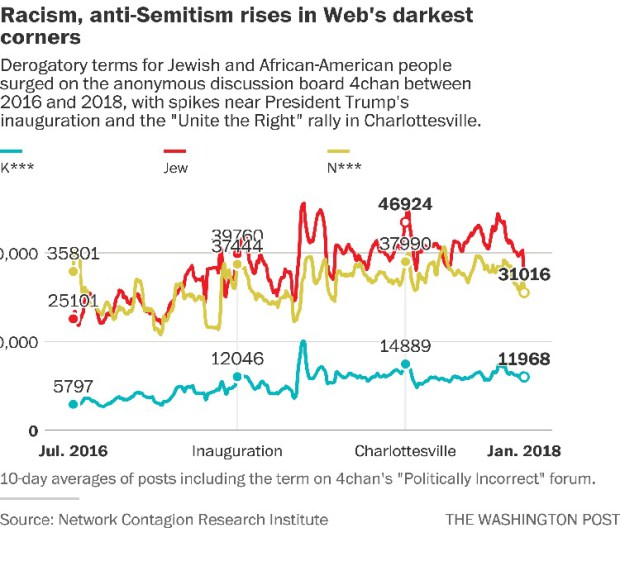
Racist and anti-Semitic content has surged on shadowy social media platforms – spiking around President Donald Trump’s Inauguration Day and the “Unite the Right Rally” in Charlottesville, Virginia – spreading hate speech and extremist views to mainstream audiences, according to an analysis published this week.

The findings, from a newly formed group of scientists named the Network Contagion Research Institute who studied hundreds of millions of social media messages, bolster a growing body of evidence about how extremist speech online can be fueled by real-world events.

The researchers found the use of the word “Jew” and a derogatory term for Jewish people nearly doubled on the “Politically Incorrect” discussion group on 4chan, an anonymous online messaging board, between July 2016 and January 2018. The use of a racial slur referring to African Americans grew by more than 30 percent in the same period.

Gab.ai, a social media site modeled on Twitter but with fewer restrictions on speech, saw even more dramatic increases since the site began operating in August 2016. The use of the term “white,” which often occurred in connection with white-supremacist themes, also surged on both platforms.

These two forums, although small relative to leading social media platforms, exerted an outsize influence on overall conversation online by transmitting hateful content to such mainstream sites as Reddit and Twitter, the researchers said. Typically this content came in the form of readily shareable “memes” that cloaked hateful ideas in crass or humorous words and imagery. (Facebook, the largest social media platform, with more than 2 billion users, is harder to study because of the closed nature of its platform and was not included in the research.)

“There may be 100 racists in your town, but in the past they would have to find each other in the real world. Now they just go online,” said one of the researchers, Jeremy Blackburn, an assistant professor of computer science at the University of Alabama at Birmingham. “These things move these radicals, these outliers in society, closer, and it gives them bigger voices as well.”

Social media has created an era of easy anonymity and instant communication between disparate groups around the world. But it has also created the conditions for outbreaks of extremist ideas.

The research, which has not yet been peer reviewed, sheds new light on how niche hate movements once relegated to dark corners of the Web can abruptly burst into the mainstream. The Charlottesville rally last year, for example, won crucial publicity through racist and neo-Nazi conversations on social media and websites such as the Daily Stormer.

“You can’t act as if the fringe will stay on the fringe, especially in the era of the Web,” said Heidi Beirich, director of the Southern Poverty Law Center’s Intelligence Project, who was not involved in the new research.

Efforts to portray the Parkland, Florida, school shooting as a hoax and its survivors as professional actors initially coalesced on fringe forums on Reddit, 4chan and 8chan, an offshoot for those who consider 4chan too restrictive, before shooting to the top of YouTube’s “Trending” list.

The QAnon conspiracy theory began circulating on the same platforms last fall before exploding into public view in August, after months of refining its central allegations, purportedly from a top-secret government agent, that President Trump is secretly battling a shadowy cabal of sex rings, death squads and deep-state elites.

The 4chan and Gab forums showed similar surges of terms referring to racial identity and white supremacy, with racially and ethnically charged terms increasing steeply on both sites after data collection began.

They also hit dramatic peaks in late January 2017, when Trump’s inauguration was celebrated by members of the “alt-right,” a movement that espouses racist, anti-Semitic and sexist views. A second, higher peak – with posts containing the terms amounting to about 10 percent of all comments on the forums – came in the days surrounding the Charlottesville alt-right rally, in August 2017, which ended in violence and the death of a counterprotester.

When asked for comment on the findings, Gab responded via its Twitter account: “Hate is a normal part of the human experience. It is a strong dislike of another. Humans are tribal. This is natural. Get over it.”

Hiroyuki Nishimura, the owner of 4chan, didn’t respond to emailed requests for comment but has in the past defended the site as a bastion of free speech.

The new research draws on a theory that such outbreaks of hate speech resemble contagious diseases that should be confronted as early as possible, before they become widespread epidemics.

“You can’t fight the disease if you don’t know what it’s made of and how it spreads,” said Joel Finkelstein, the group’s director and the research’s lead author, who recently received his doctorate in psychology from Princeton University.

The Network Contagion Research Institute formed in May as a nonprofit group. The paper on the surge in hate speech is its first, although two members of the research group, Blackburn and Savvas Zannettou, a graduate student in computer science at Cyprus University of Technology, did related work for a paper in May on how memes are created on fringe online forums. Those two and a third member of the group, Barry Bradlyn, an assistant professor of physics at the University of Illinois at Urbana-Champaign, also were co-authors on a February paper about the prevalence of hate speech on Gab.

The researchers used data analytics to show how words and images hopscotched across the online world, as different forums played distinctive roles and influenced each other.

They found, for example, that the 4chan “Politically Incorrect” board – with its high volume of posts, user anonymity and anything-goes ideology – served as the most prolific source for many of the most offensive memes that eventually spread widely across the Internet.

That board also exported anti-Semitic memes to Reddit’s “The_Donald” board, created in 2015 for supporters of Trump, and to Twitter.

Reddit spokeswoman Anna Soellner said the site implemented a new policy in October 2017 forbidding content that encourages, glorifies or calls for violence against an individual or a group of people. “We know there is more to do, and we will continue to evolve our site-wide policies, enforcement tools, and community support resources to ensure that Reddit is a welcoming place for everyone,” she said.

Taken together, some users of the various platforms worked in tandem to propel hateful and conspiratorial ideas to the attention of audiences who might not seek out such content but could have their views shaped by it.

“That is very much the stated goal of many of the meme makers who open up on openly neo-Nazi spaces on 4chan and the Daily Stormer,” said Becca Lewis, who researches online extremism for the New York think tank Data & Society and has no involvement in the new group. “They see themselves as attempting to influence mainstream culture through their memes.”

Network Contagion Research Institute researchers attempted to measure the spread and influence of memes by tracking their first appearance, where they later appeared and how they mutated while moving from platform to platform. They also sketched out what they called “neighborhoods” of memes clustered by theme or prominence.

They found that, like a mutating virus, recognizable and popular images often were co-opted and contorted into hateful memes, as anonymous users skewed the features of the originals to demean ethnic groups or popularize racial hostilities.

One meme known as the “Happy Merchant,” an offensive Jewish caricature, was used repeatedly to convey anti-Semitism. It also proved effective at reaching mainstream audiences: One comic showing the caricatures faking anti-Semitic attacks such as spray-painting swastikas onto a temple, subtitled “Makin’ Hate Crimes great again!,” spread from 4chan to Gab to Reddit, the country’s fifth-most popular website, in about two weeks in early 2017, according to the research.

The meme made at least 1,100 appearances across Reddit between mid-2016 and mid-2017, including on “The_Donald” board, the researchers found. After the meme’s posting on “The_Donald,” it routinely showed up on Twitter and other platforms tracked by the researchers, suggesting the site was unusually influential in aiding the meme’s spread.

Reddit’s “The_Donald” board had by that time implemented a policy saying racism and anti-Semitism “would not be tolerated.” Moderators for the board declined to respond.

Racial slurs on the sites grew increasingly rampant, the research found. The words “Jew” and “white,” as well as a derogatory term for Jewish people, were used in 7 percent of the roughly 100 million posts on Gab and the “Politically Incorrect” board together.

An epithet for African Americans was used in more than 2 percent of all posts. Use of the hateful term exploded in July 2016, the day after a black man killed five police officers during a mass shooting in Dallas.

The findings, researchers wrote, suggested a “worrying trend of real-world action mirroring online rhetoric” – and a possible feedback loop of online and offline hate.

“When people aggregate together” in these communities, Finkelstein said, “they end up radicalizing each other.”Even as the researchers illuminated how hateful speech and images spread, they struggled with how to combat such powerful online forces. They worry that censoring content or banning users pushes racist and anti-Semitic content to other forums.

Rather, Finkelstein and his colleagues hope that illuminating the way hate speech spreads will make it easier to challenge it – through what he calls “a digital immune system.” But it’s not entirely clear how it would form, who would deploy it or whether it would be up to the task of defusing hateful ideas.

Source: Racism and anti-Semitism surged in corners of the Web after Trump’s election, analysis shows

HARPER: Corbyn’s antisemitism is a threat to all of us

Consistent with the Harper government’s position and focus on antisemitism (and, IMO, relative neglect of other forms of xenophobia and discrimination):

The rise in antisemitism across Europe should be alarming to all of us, and not just for moral reasons. History shows that the mindset which embraces antisemitism rarely restricts its hatred to the Jewish minority.

Today’s threats against Europe’s Jewish populations are both different and more diverse than those in the past. Far-right extremism is still with us, but now represents only one slice of the problem. Radical, jihadist Islam is now the much larger threat. However, the far-left has also become a substantial source of antisemitism.

Today’s hard-left exhibits a particularly pernicious form of antisemitism – one couched in anti-racism rhetoric to make it socially acceptable in polite company. It is not the Jews, they claim, who are uniquely evil among the nations. It just happens to be Israel, the Jewish state, that is the source of such malevolence.

And so we arrive at the sorry phenomenon that is Britain’s Leader of the Opposition Jeremy Corbyn – a man who lays wreaths at the graves of anti-Semitic terrorists, and then thinly papers over his actions with nonsensical hair-splitting. Mr Corbyn’s comfort in the company of anti-Semites and other extremists whom he calls “friends” speaks for itself. While he claims to embrace such individuals in the name of “peace,” it is a peace that only ever involves the enemies of the West generally and of the Jewish people specifically.

From the highest levels to the foot soldiers of Corbyn’s Momentum, not a day goes by without another vile display of antisemitism, darkly hinting about an omnipresent Jewish cabal, controlling the media and conspiring for their comrade-leader’s downfall. In the meantime, Mr Corbyn cannot even pretend to take the issue of antisemitism seriously, all the while claiming to be “a life-long anti-racist.”

The naked reality underlying Labour’s refusal to accept the full International Holocaust Remembrance Alliance (IHRA) definition of antisemitism is that Mr Corbyn and his allies have no intention of stopping their overt attacks on the Jewish state. Perhaps the growing political pressure will force them to do so, but either way their views are now plainly evident.

It is the far-left’s obsession with Israel that concerns us most specifically. Our organization is premised on a simple demand: A fair debate about that country, on the same terms which we extend to debates on all other countries. Today’s antisemitism all too often manifests itself in the singling out of Israel, depicted as a uniquely horrific place, responsible for all the ills of the Middle East, if not the world.

A fair examination would show that nothing could be further from the truth. Israel grapples with some of the most acute challenges the West faces in defending ourselves against jihadist aggression while maintaining modern, open societies. Israel carries this burden admirably, sustained by a democratic polity and a civil judiciary that, in some instances, surpass our own practices. It does this despite having been repeatedly tested under fire in ways our own citizens would simply not tolerate.

It is time to strip away all the rhetoric and rationalizations. Mr. Corbyn and his allies hate Israel uniquely and obsessively. Under his leadership, Israel – and thus any Jew daring to identify with it – will face relentless slander. He, and those who share such malignant views, must be exposed and opposed at every opportunity.

Source: https://torontosun.com/opinion/columnists/harper-corbyns-anti-semitism-is-a-threat-to-all-of-us

Stop comparing Labour anti-semitism with Tory Islamophobia—there is no hierarchy of race hate

Rachel Shabi on hate is hate:

A few months ago, Muslim leaders placed full-page ads in two broadsheets, the Telegraph and the Times, condemning antisemitism. The ads, stating that British Jews did not stand alone in the fight against antisemitism, came as the Labour party’s handling of the issue within its own ranks was dominating the national news (much as it is today).

After months of media-relayed accusation and denial over the issue—during which British Jews often felt like unwilling pawns in a political game—these ads were a welcome message of solidarity. They were also an echo of previous acts of collectivism, such as when Muslim and Jewish organisations jointly complained to the Independent Press Standards Organisation (Ipso) last year over a column in the Sun that referred to a “Muslim problem”.

This phrase, they noted, “harked back to the Nazi use of the phrase ‘The Jewish Problem’ in the last century, to which the Nazis responded with ‘The Final Solution’—the Holocaust.”

Such cross-faith unity shouldn’t be hard to comprehend. Racialised minorities know all too well that race-hate is a shape-shifter, attacking and scapegoating different groups interchangeably depending on the social standards of the day.

In 2011 the Conservative Baroness Sayeeda Warsi said that Islamophobia had “passed the dinner table test” of social acceptability in the UK. By that time, European far-right parties had, in attempts to rehabilitate and go mainstream, dropped the overt antisemitism and taken instead to hating Muslims and migrants.

Sometimes, though, antisemitism is too hard a habit to even pretend to break. Hungarian far-right prime minister Victor Orban’s attacks on philanthropist George Soros depict him not just as a “billionaire speculator” but as one who is trying to “Muslimise Europe.”

Such hateful scaremongering casts Muslims and Jews as united in a secret mission to destroy Christian Europe, by which, presumably, Easter eggs and Christmas trees will be banned, but bagels and falafel are fine (not together, though. Obviously.)

Earlier this month, Baroness Warsi reiterated her call to the UK Conservative party, of which she is former co-chair, to tackle the Islamophobia within its own ranks. In this, she is echoed by the Muslim Council of Great Britain and other Muslim groups.

There are ample examples to warrant the concern and calls for an inquiry—Warsi describes the scale of the problem as “more than weekly incidents.” Just for starters, there’s the anti-Muslim post retweeted by Tory MP Bob Blackman, and the Conservative councillor Mike Payne, who shared an article that called Muslims “parasites.”

Going further back, there is the anti-Muslim London mayoral campaign run in 2016 by Conservative Zac Goldsmith standing against Labour’s Sadiq Khan. More recently, conservative MP Michael Fabricant had to apologise for reposting an appalling image involving Khan and an inflatable pig.

The baroness also signposted a corollary problem: that the Conservative party cannot call out antisemitism within Labour if it then ignores its own Islamophobia. Bluntly, that would reek of hypocrisy.

But in some ways, the consequences go deeper. Asking that different prejudices be taken equally seriously is not an attempt to equate the two. They are different; there are specifics—among them, of course, the systematically murderous history and distinct perniciousness of antisemitism.

The trouble is that, with the Tories ignoring Islamophobia and Labour trying to deal with antisemitism (badly, but at least the party isn’t denying it), an impression may be transmitted of a sort of hierarchy of race hate.

Already toxic, this is made more damaging still because the idea of Jewish people seeking special treatment is itself an anti-semitic trope. And it means a grim competitiveness has emerged, whereby denials of a prejudice problem in one party are packaged with claims the other party is worse.

This harmful asymmetry is maintained by Labour evidently taking its own racism more seriously, which is one reason there are people inside the party pushing it to tackle antisemitism, which then creates media attention over the issue—in a way that does not happen to the same degree over Islamophobia. (Yes, antisemitism is also sometimes weaponised to attack the Labour leader, but let it go for once. This is not the point we’re exploring here.)

Meanwhile, we have an overarching climate in which Islamophobia, as Baroness Warsi noted, is more socially acceptable—to the extent that it is routinely on display within our national press. Worse, it is sometimes denied as being a prejudice at all, even while hate crimes committed against Muslims spiral and police launch an investigation into “punish a Muslim” letters, promising rewards for violence against Muslims and sent out in UK cities. Indeed, much of the work of the far-right has been to conflate manufactured fear of Muslims with fear of migrants, so that hostility to the latter is a proxy for hostility to the former.

At a time of far-right resurgence globally, when we are witnessing the most appalling racism and bigotry go mainstream, it’s more urgent than ever to fight back against hatred of Jews and Muslims alike.

This isn’t just a matter of how our political parties handle prejudice within their own ranks. It is about the poisonous, rupturing effect on our society and our communities when they fail to tackle such hatreds consistently, clearly—and with equal commitment.

Source: Stop comparing Labour anti-semitism with Tory Islamophobia—there is no hierarchy of race hate

Germany’s Jewish community issues appeal for anti-Semitism funding oath

Echoes of the Canada Summer Jobs attestation:

  • “Both the job* and my organization’s core mandate* respect individual human rights in Canada, including the values underlying the Canadian Charter of Rights and Freedoms as well as other rights. These include reproductive rights and the right to be free from discrimination on the basis of sex, religion, race, national or ethnic origin, colour, mental or physical disability or sexual orientation, or gender identity or expression;”

Curious to see if the ewish Forum for Democracy and Against Anti-Semitism (JFDA) proposal generates similar opposition within Germany:

Just last week, a man wearing the Star of David was beaten down and kicked right in the center of Berlin. Some weeks earlier, a similar incident in Germany’s capital caused public outrage and sparked a nationwide debate on anti-Semitism when a 19-year-old Syrian attacked and Arab Israeli and his companion with a belt in broad daylight. Both victims wore kippahs (traditional Jewish head coverings) in what was an allegedly anti-Semitic attack.

Call for an oath

Enough is enough, according to more than 30 Jewish organizations and communities, who have now issued an appeal to the German government. In a declaration published on Monday, Germany’s Jewish Forum for Democracy and Against Anti-Semitism (JFDA) called on the authorities to crack down harder against anti-Semitic agitation and attacks. The organization is demanding that in the future, public funding for civil and religious groups should be granted only if those groups have publicly distanced themselves from all forms of anti-Semitism — a kind of pro-democracy oath.

The authors of the declaration stressed that this applies to Muslim organizations as well. Lala Süsskind, chairperson of the JFDA, warned against playing down anti-Semitism among Muslims out of misconceived concern. “Of course, anti-Semitism also exists on the Muslim side,” she told DW. Denying that does not prevent the exploitation of Muslim anti-Semitism by the enemies of Islam, but it is detrimental to combating anti-Semitism effectively and makes a mockery of the victims, Süsskind said. The German government should, therefore, examine very carefully which organizations benefited from public funding, she explained, and whether said organizations were, in effect, adhering to Germany’s Basic Law, or constitution.

As an example, the JDFA cited the controversial debate surrounding the Berlin Institute for Islamic Theology, which is scheduled to open its doors in 2022 as an affiliate of the city’s Humboldt University. It remains a controversial issue to this day how much control should be given to the three representatives of traditional conservative Islamic associations on the institute’s advisory board. They include the Central Council of Muslims in Germany, the Islamic Federation and the Islamic Community of Shiite Parishes. These associations are among those which, according to the Jewish organizations’ representatives, should make some kind of public commitment to democracy.

Even Jewish students in Berlin have been subjected to anti-Semitic harassment

‘Committed to this fight’

The president of the Central Council of Muslims in Germany, Aiman Mazyek, does not think of himself as a direct addressee of the Jewish organizations’ initiative. “I take note of the appeal, and I believe it’s correct and important to highlight painful issues, to make every necessary effort to fight anti-Semitism, and that we remain committed to this fight with all the social power that’s available to us,” he told DW, adding that was all he could say about the matter.

Mazyek says his organization is committed to fighting anti-Semitism

After the interview, Mazyek sent DW a newspaper article detailing how he — as president of the Central Council of Muslims — visited the former Buchenwald concentration camp with a group of Syrian refugees in April. Mazyek’s message, which he wants to be understood by DW and by the public, is that his organization is actively campaigning for reconciliation between Muslims and Jews in Germany. He, therefore, said he doesn’t care to comment on appeals, pro-democracy oaths or any other such demands.

Süsskind said she found that response regrettable, and that it reminds her of previous dialogue between Jewish and Islamic organizations on the thorny issue of anti-Semitism. “There are few Muslim associations to which you can speak openly,” she claimed. What’s more, Süsskind added, the appeal was to be explicitly understood as an invitation to all religious groups, political parties and social associations — after all, not only Jewish life in Germany was at stake. “If people are not ready to stand up for their democracy, it goes down the drain,” she said.

An anti-Semitic attack in April prompted a show of solidarity from Berlin’s Jewish community

More financial support

The German government has not yet responded to the appeal issued by the country’s Jewish community. Interior Minister Horst Seehofer had already announced on July 6 that the government plans to extend financial support for the Central Council of Jews in Germany. The annual subsidy will rise from €10 million ($11.75 million) to €13 million, both sides confirmed. The reason behind this was, according to Seehofer, the growing threat to Jewish life in Germany. “Those who threaten our Jewish citizens threaten us all,” he said.

Read more: Anti-Semitism in German schools to be tackled with anti-bullying commissioners

Süsskind stressed that the social climate has changed considerably with respect to Jews. She said she frequently receives hate mail, including one message that read: “In goes the knife, out goes the knife, the Jew’s dead.” When she tried to report the authors of those hate messages to the authorities, she was repeatedly informed that they were protected under freedom of speech legislation. In response, Süsskind asked: “Is that really possible?”

Source: Germany’s Jewish community issues appeal for anti-Semitism funding oath