David Pugliese: Nazi whitewash gathers momentum as memory of the Holocaust fades

Good article by Pugliese:

With the horrors of the Holocaust a distant memory, and many Canadians no longer aware of the crimes that took place in the name of the Third Reich, an opening has emerged for those who want to rewrite the history of Adolf Hitler’s regime and those who served it.

A movement is afoot to claim that the Nazi collaborators and the SS units made up of Ukrainians, Latvians and other eastern Europeans, were actually nationalistic heroes and in no way associated with the Nazis. I have written a number of articles exposing the role of these collaborators in the Holocaust and their complicity in murdering tens of thousands of Jewish men, women and children.

I have received emails from Ukrainians and Latvians who claim the Holocaust never took place. Others write that while Jews were indeed killed, they deserved the death and destruction the Nazis brought down on their communities.

And then there are others who claim that journalists who write articles about the Ukrainian and Latvian SS units – and the parades that are held in those nations to this day honouring these Nazi collaborators – are “pro-Russian” or somehow spouting Kremlin propaganda.

I’ve had the distinction of being singled out as such in a recent report on Russian disinformation by the Macdonald-Laurier Institute of Ottawa, a right-wing think-tank.

The report’s author, Marcus Kolga, claims my articles about the role of Ukrainians and Latvians in the Holocaust and their service in SS units has parroted the Kremlin’s narrative and has “been critical of Canada’s support for states targeted by Kremlin aggression.”

For starters, the articles I have written about Ukrainian and Latvian Nazis who butchered Jews don’t even mention Canada’s support for those two countries, let criticize that support.

My articles are about those who would deny that Ukrainians, Latvians, and others from eastern Europe eagerly participated in the Holocaust and supported Adolf Hitler. The articles also expose those who would declare these Nazi collaborators as some kind of heroes.

To be sure, the Ukrainian and Latvian governments were not happy about my articles, considering they exposed their nations’ dark past in supporting the wholesale slaughter of Jews.

And the Macdonald-Laurier Institute has received funding from the Latvian Ministry of Defence. In addition, the Embassy of Latvia in Canada has also provided sponsorship for the institute.

What is going on in Latvia and the Ukrainian and other east European nations is a Nazi whitewash designed to rehabilitate those from these countries who took part in some of the most heinous crimes in history.

Here’s how it works.

Ukrainian and Latvian militia and police units were among the most brutal in helping the Nazis hunt down and murder Jewish men, women and children.

They were good at killing defenceless people. So good, that the Holocaust Chronicle, published in 2003 and written by 7 top scholars in the field of Holocaust studies, noted that Ukrainians were also sent to help kill Jews during the Warsaw Ghetto uprising in April 1943. The Chronicle published a photo of two of Ukrainian SS members standing over the bodies of Jews murdered during that uprising. See the photo below:

SS General Jurgen Stroop, later executed as a war criminal, was very pleased with the Ukrainian, Latvian and Lithuanian volunteers who helped him and his men murder and hunt down 56,000 Jews. In his diary Stroop wrote that these killers were not only “nationalists and anti-Semites” but among his best troops. They were “wild at heart and with a tendency towards base things. But nevertheless obedient,” Stroop gushed about his Ukrainian, Latvian and Lithuanian killers.

The Ukrainian militias who murdered Jews in the ghetto and elsewhere went on to serve in a new SS unit created by the Nazis, the 14th SS Galizien Division. Stroop was brought on as an advisor to the newly created division.

A similar development happened in Latvia. The members of Latvia’s Arajs Kommando, who had killed an estimated 26,000 Jews for the Nazis, went on to serve in the Latvian SS legion.

These SS units were sent to fight the Russians as they closed in on the Third Reich.

Decades later the whitewash began. The Ukrainians and Latvians who fought for the SS – as the whitewash explains – weren’t really Nazis. They instead were nationalists fighting for their own country against the Russians. And of course none of them committed any type of crime, or so the whitewash explains, carefully ignoring the previous role of the individual members in these SS units in the mass murder of tens of thousands of Jews.

Last year, Karlis Eihenbaums, Latvia’s Ambassador to Canada, launched an attack on Canadian journalist Scott Taylor who wrote about the Latvian Legion (15th Waffen Grenadier Division of the SS (1st Latvian) et al) and Latvian killers like war criminal Herberts Cukurs as well as the members of the Arajs Kommando. Like the Macdonald-Laurier Institute, Eihenbaums suggested such articles were “fake news” and “disinformation.” And like the Macdonald-Laurier Institute, Eihenbaums tried to smear the journalist by suggesting he was under the “influence” of the Russian government. Eihenbaums also targeted my articles.

As I have written before, the eager participation of some Latvians in the Holocaust is not “fake news.” It is a well-documented historical fact that many of the killers from the Arajs Kommando went to the Latvian Legion. These Latvians, Ukrainians, Estonians and others from eastern Europe nations served Hitler and his war aims. No number of claims of “fake news” can change that fact.

These days there are parades in Latvia and Ukraine to honour these SS units who fought under the Swastika. These parades and memorials, which have attracted the support of Neo-Nazis and other fascist groups, have long been controversial and questioned by many throughout Europe. See the photo below and note the white pride shirt on the young Ukrainian with the Ukrainian SS veteran.

For instance, the controversy over the Latvian Legion and the annual parade held in Riga (each March) to celebrate these Nazi collaborators is well known and has been going on for two decades, long before the term “fake news” was even coined. In 1998 the parade caused a storm of protests around the world, particularly in Israel, where Holocaust survivors couldn’t understand Latvia’s desire to celebrate such ruthless killers. German Chancellor Helmut Kohl and French President Jacques Chirac were among those that year to protest the Latvian parade. The Times of Israel reported on last year’s Latvian SS parade in Riga, which took place mid-March.

So much for “fake news.” Did Helmut Kohl and Jacques Chirac spread Russian “disinformation” when they denounced the SS parade in Latvia? Of course not.

This whole issue isn’t about “fake news” or Russian “disinformation.” It is about individuals and nations trying to whitewash their Nazi collaboration and rewrite history, while attacking journalists and other organizations who don’t want to let that happen.

While the Macdonald-Laurier report carefully ignores the crimes of Ukrainians and Latvians who supported Hitler’s Third Reich and butchered Jewish men, women and children by the thousands, there are those in the U.S. Congress and Jewish community speaking out against the Nazi whitewash.

In late April 2018 more than 50 members of the U.S. Congress condemned the government of Ukraine’s ongoing efforts to glorify “Nazi collaborators.”

The letter, signed by both Republicans and Democrats, outlined concerns about ongoing ceremonies to glorify leaders of the Ukrainian Insurgent Army as well as 14th SS Galizien Division (aka 1stGalician/Galizien or the 1st Ukrainian Division). “It’s particularly troubling that much of the Nazi glorification in Ukraine is government-supported,” noted the letter to U.S. Deputy Secretary of State John Sullivan. The letter was initiated by Democratic Reps. Ro Khanna of California and David Cicilline of Rhode Island.

In the summer of 2018 B’nai Brith Canada’s chief executive officer Michael Mostyn called on Prime Minister Justin Trudeau to use his trip to Latvia that year to push back against that country’s glorification of Nazi collaborators as well as attempts to deny the nation’s role in the Holocaust.

Mostyn called on the Canadian government to speak out more forcefully to denounce parades in Latvia and other eastern European nations that honour units who fought with the Nazis during the Second World War.

“We must challenge all those who distort the historical record on governments, military units or organizations that fought with, supported or sympathized with the Nazis during World War II,” Mostyn wrote to Trudeau. “This includes government leaders who acquiesce in, or fail to condemn, a process of Nazi glorification that amounts to Holocaust distortion.”

“Those who glorify the record of such organizations or units cannot dismiss criticism as ‘fake news’ “,added Mostyn. “The fact is that some organizations and their leaders, now glorified for their fight against the Soviet army, were also involved in atrocities against Jewish civilians or embraced ideologies that were deeply anti-Semitic and perpetuated social hostility towards their Jewish populations. This is why B’nai Brith rejects any efforts to constrain historians and the media from researching what happened and publicly explaining it in an objective manner.”

These are words that those at the Macdonald-Laurier Institute should pay attention to.

Mostyn letter is here:

https://www.bnaibrith.ca/canada_must_counter_the_glorification_of_nazis_in_european_nato_countries

Source: Nazi whitewash gathers momentum as memory of the Holocaust fades

Kenan Malik: Antisemites use the language of anti-Zionism. The two are distinct

Important to note the distinctions and consequent implications:

Anti-Zionism is antisemitism. So claimed France’s President Emmanuel Macron in a speech last week in which he promised to change policing regulations to criminalise anti-Zionism.

The condemnation of anti-Zionism as antisemitism has a long history, but in recent years has become increasingly accepted by mainstream politicians and organisations. This shift in perspective has taken place against the background of rising antisemitism, from physical attacks to racist tweets, fuelled by both the resurgence of the far-right and the growth of antisemitism on the left. Particularly in sections of the left, anti-Zionism has more and more appropriated, often unrecognised, antisemitic tropes.

All this is undeniably true. Yet, it remains important to resist the equation of anti-Zionism and antisemitism.

Critics of anti-Zionism observe that Zionism simply expresses the right of Jewish people to self-determination. Just as other peoples, from Armenians to Zimbabweans, have the right to self-determination, so do Jews. To deny that is antisemitic because it is to deny Jews the rights accorded to others. However, the issue is more complex. When Scots voted in their independence referendum in 2016, all residents of Scotland who were over 16, and were British, EU or Commonwealth citizens, had the right to vote. The right to self-determination did not extend to all those of Scottish ancestry living outside Scotland.

The Zionist notion of “self-determination”, on the other hand, embodies the idea that Jews anywhere in the world “self-determine” and that such self-determination relates to a state in which the vast majority of Jews do not and will not live.

Zionism is a form of ethnic, as opposed to civic, nationalism. The distinction between the two is fiercely contested, and often blurred. Many modern states fuse elements of both in nationality and immigration laws. Nevertheless, the distinction between civic and ethnic nationalism is important because they embody contrasting conceptions of national belonging, citizenship, equality and rights.

Israel itself combines aspects of civic and ethnic nationalism. As the late historian Tony Judt put it in an essay for the New York Review of Books, Israel is both a democracy in which non-Jews can be citizens and “a state in which Jews and the Jewish religion have exclusive privileges from which non-Jewish citizens are forever excluded” and from which Palestinians grievously suffer. Judt faced great opprobrium for that essay, with many reviling him as “antisemitic” or a “self-hating Jew”.

To oppose Zionism but not other forms of ethnic nationalism would indeed be antisemitic. But to oppose Zionism because one opposes ethnic nationalism is a legitimate view.

Judt, who in early life was a Zionist, came eventually to accept that the only lasting solution would be a single, secular state in which both Jews and Palestinians were treated equally. For anti-Zionists like Judt, “self-determination” in that piece of contested land that is Israel/Palestine should adhere to principles of civic, not ethnic, nationalism; that is, be the self-determination of the people, and only the people, who live there, whether Jews or Palestinians.

This kind of anti-Zionism is very different from that which calls for the “destruction of the state of Israel”, usually (a not very veiled) code for the destruction of Jews. The latter is a form of anti-Zionism that refuses to acknowledge the presence of more than 6 million Jews in Israel/Palestine, whose rights, needs and aspirations are as central as those of Palestinians to any discussion of the region’s future.

There are, in other words, many forms of anti-Zionism, some progressive, some antisemitic. What has shifted is that leftwing ideas of anti-Zionism have become increasingly colonised by antisemitic forms. The reasons are complex, ranging from evolving notions of “anti-imperialism” to the mainstreaming of conspiracy theories.

One key development that has helped foster the shift is the growth of the politics of identity and of the tendency to see “good” and “bad” in terms of the group to which someone belongs and the privileges that they are supposed to possess.

Identity politics has led many to target Jews for being Jews, especially as they are seen as belonging to a group with many privileges to check, and to hold all Jews responsible for the actions of the state of Israel. Many who support the Palestinian cause, including many within the Labour party, seem genuinely unable to distinguish between criticising Israel and sowing hatred against a people.

The elision of anti-Zionism and antisemitism is a feature, then, of both sides of the debate. On the one side, it helps to legitimise antisemitism, on the other to close down debates about Israel and to criminalise genuine struggles for Palestinian rights. We should reject both.

Source: Antisemites use the language of anti-Zionism. The two are distinct

France declares anti-Zionism a form of antisemitism in crackdown on racism against Jewish people

The challenge, as always, lies in the interpretation of how “criticism of Israel similar to that levelled against any other country” is assessed and related definitions, particularly on human rights related issues as well as issues particular to Israel itself and its occupation of the West Bank.

But as a working definition, it is particularly sound in the examples of contemporary antisemitism:

Emmanuel Macron has declared anti-Zionism a form of antisemitism as he ramps up France’s crackdown on racism against Jewish people.

Speaking at the 34th annual dinner of the Representative Council of Jewish Institutions of France, Mr Macron said a surge in antisemitic attacks in his country had not been seen since World War Two.

He promised a new law to tackle hate speech on the internet and said France would adopt the definition of antisemitism set by the International Holocaust Remembrance Alliance (IHRA).

The IHRA definition does not use the phrase “anti-Zionism” but does say denying the Jewish people their right to self-determination “e.g., by claiming that the existence of a State of Israel is a racist endeavour,” is antisemitic.

Some critics of Israel, its occupation of territory internationally recognised as Palestinian, and its isolation of the Gaza Strip, say they risk being unfairly branded antisemitic, although the IHRA definition says: “criticism of Israel similar to that levelled against any other country” is not.

Mr Macron’s words were well received from the World Jewish Congress which said: “This is just the beginning of a long road ahead. Adopting this definition of anti-Semitism must be followed by concrete steps to encode into law and ensure that this is enforced.”

The IHRA definition is not legally binding but does serve as an international guideline.

Germany and Britain adopted the definition in texts in 2016, though the European Union adopted a softer tone, calling the IHRA definition a “guidance tool” amid concern from some member states that it could make criticism of Israeli policy, particularly with regards to Palestinians, difficult.

Mr Macron said France would not change its laws relating to antisemitism and that recognising the IHRA’s definition must not be seen as a means of preventing people from criticising the Israeli government.

Source: France declares anti-Zionism a form of antisemitism in crackdown on racism against Jewish people

7 UK Parliamentarians, In Protest Of Jeremy Corbyn, Leave Labour Party

The ongoing saga of Labour not being able to address antisemitism, as the Conservatives flail on Brexit. Sad:

Seven members of Britain’s Parliament quit the main opposition Labour Party on Monday, accusing its leader, Jeremy Corbyn, of letting anti-Semitism flourish and failing to support a plan to hold another referendum on Brexit.

“This has been a very difficult, painful but necessary decision,” Luciana Berger, one of the seven legislators who have resigned, told reporters at a press conference Monday.

“I am sickened that Labour is now perceived by many as a racist, anti-Semitic party,” said parliamentarian Mike Gapes, adding that “prominent anti-Semites” were readmitted to the party.

The party’s leader has long faced accusations of either being an anti-Semite or tolerating anti-Semitism. Berger said the party has failed to address a strain of anti-Semitism within its ranks and has become “institutionally anti-Semitic.”

Gapes also accuses the party’s leadership of being “complicit in facilitating Brexit.” The former Labour members have said the United Kingdom’s imminent withdrawal from the European Union will trigger economic, political and social distress in the country.

“We’ve taken the first step in leaving the old tribal politics behind and we invite others who share our political values to do so too,” said Chuka Umunna, another of the politicians ditching Labour. “We invite you to leave your parties and help us forge a new consensus on a way forward for Britain.”

The seven lawmakers will remain in Parliament as the new, more centrist “Independent Group.” They support a Final Say referendum — a second poll after citizens voted for Brexit in 2016 — which they say should take place days before the withdrawal from the E.U.

In a statement, the group said the Labour Party has abandoned its progressive values and now pursues policies that could weaken national security and destabilize the British economy for ideological objectives.

“For a Party that once committed to pursue a spirit of solidarity, tolerance and respect, it has changed beyond recognition,” the group said. “Today, visceral hatreds of other people, views and opinions are commonplace in and around the Labour Party.”

In response, Corbyn said he was dismayed the members of Parliament are leaving the party. “I am disappointed that these MPs have felt unable to continue to work together for the Labour policies that inspired millions at the last election and saw us increase our vote by the largest share since 1945.”

He added, “The Tories are bungling Brexit while Labour has set out a unifying and credible alternative plan.”

Other prominent Labour members also expressed their dismay.

London Mayor Sadiq Khan called it a “desperately sad day,” despite agreeing that the public should be allowed to relitigate Brexit and that anti-Semitism needed to be addressed within the party.

Khan and other members of the party worry that the split will lead to a Conservative government.

“We shouldn’t splinter in this way,” Shadow Chancellor John McDonnell told the BBC. “It is better to remain in the party, fight your corner.”

But Conservatives used the announcement as a chance to denounce the Labour Party and Corbyn himself.

Conservative Party Chairman Brandon Lewis accused Labour of becoming “the Jeremy Corbyn party.” He said, “We must never let him do to our country what he is doing to the Labour Party today.”

Nigel Farage, who helped lead the country’s Brexit campaign, also weighed in on Twitter, saying, “This moment may not look very exciting but it is the beginning of something bigger in British politics #realignment.”

Source: 7 UK Parliamentarians, In Protest Of Jeremy Corbyn, Leave Labour Party

What would it have looked like if the Holocaust had come to Canada?

An interesting mix of historical fact and reasoned hypotheses of what could have happened:

There were only 52 Jews in Trois-Rivieres, Que. during the Second World War, but Nazi Germany knew.

This week, Library and Archives Canada unveiled its newest acquisition: A 137-page book once owned by Adolf Hitler that seems to represent the first outlines of a Nazi plan to bring the Holocaust to Canada. “It undoubtedly breaks the myth viewed by many at the time that the Holocaust and WWII were only Europe’s problems,” said Mina Cohn, director of the Centre for Holocaust Education and Scholarship at Carleton University.

Canadian troops participated in the liberation of Nazi concentration camps, including Bergen-Belsen. Canada also became a postwar haven for tens of thousands of Holocaust survivors. But Canada of the early 1940s was also a viciously antisemitic country with one of the world’s worst records of admitting Jewish refugees.

Below, some chilling details of what the Nazis intended to do with Canadian Jewry — and how willing Canada might have been to stop them.

The Nazis were apparently planning something for North America’s Jews
“I don’t think it’s a crazy claim to say that governments and militaries, especially during wartime, don’t do research for no reason,” said Michael Kent, the Library and Archives Canada librarian who acquired the German book. Entitled Statistics, Media, and Organizations of Jewry in the United States and Canada, the book includes a detailed accounting of Jewish newspapers and organizations in Canada, as well as a census of Canada’s Jewish population and where they could be found. Cities as small as Moose Jaw, Sask., for instance, are noted to have 96 “Juden.” The book, which appears to have been commissioned for senior Nazi leadership, is similar to other censuses that Nazi authorities used to organize the deportation and murder of Jews in occupied countries. Prior to the planned invasion of Great Britain, for instance, the SS prepared a lengthy “arrest list” of British citizens, including prominent Jews such as Sigmund Freud. Of course, a Nazi conquest of Canada would have been virtually impossible. If Nazi German forces couldn’t mount an invasion across the English Channel, it’s much more unlikely they could handle one across 4,000 kilometres of ocean. Nevertheless, the book was commissioned right around the time when Germany was dispatching saboteurs to North America, and when Nazi planners were investigating the possibility of an “Amerikabomber”; an extremely long-range bomber that could lay waste to cities such as New York.

The book was likely looted by a U.S. soldier after the Allied liberation of Berchtesgaden, site of Hitler’s mountain hideout.

France, Norway and even occupied British territories all willingly participated in the Holocaust
In occupied Norway, it was Norwegian police who organized the deportation of 772 Jews and the seizure of their property. The collaborationist Vichy regime in France started cracking down on its Jewish population even without orders from Berlin. When French Jews started being shipped to Auschwitz, the French national railway took the contract to deport them east. Even in the British Channel Islands, occupied by the Germans during the war, local authorities handed over information on Jewish residents without protest. Although none of these places would have perpetrated a genocide on their own, their collaborationist governments ultimately proved remarkably willing to comply with German demands. “Why would Canada of that time be any different from all the other western civilized counties in Europe?” said Mina Cohn. Hilary Earl, a Holocaust researcher at Nipissing University, is more skeptical. Denmark rescued almost its entire Jewish population. Fascist countries such as Spain and Italy sheltered Jews. The Netherlands strongly resisted the Holocaust, but still wound up losing a higher percentage of their Jewish population than almost anyone else. “It is impossible to know for certain what would have happened and who would have pushed back,” Earl said. “Antisemitism does not automatically beget genocide, it facilitates it for certain, but it isn’t the only factor.”

Canada was much more antisemitic than we know it now 
McGill University had quotas to limit Jewish enrollment. Toronto Island and other Ontario vacation spots brazenly featured “gentiles only” signs. Alberta premier William Aberhart openly blamed Jews for the Great Depression. Newspaper editorials in mainstream publications such a Le Devoir called Europe’s Jewish population “a very serious problem.” Prime Minister Mackenzie King was deeply antisemitic, objecting to the introduction of “foreign strains of blood” and even believing that the United States was too much in the thrall of “Jews and Jewish influence.” “The vast majority of Canadians have no lived memory of a Canada in which antisemitism was widely and legally tolerated,” wrote the authors of the groundbreaking 1983 book None is Too Many. The meticulously researched book framed Canada as having the worst record among Western democracies for accepting Jewish refugees during the Holocaust. Only 5,000 Jews were admitted to Canada from 1933 to 1945, compared to 200,000 accepted by the United States and 70,000 by the U.K. Still, while Canada did not like Jews, this was far from the preconditions for participation in a genocide. “Antisemitism to a degree was universally present in the 1940s but cooperation in the Holocaust was not,” Tomaz Jardim, a Ryerson University Holocaust scholar told the National Post by email.

Canada already had a fair bit of experience with rounding up ethnic groups
During the First World War, the federal government interned 8,000 Ukrainian-Canadians and forced others to carry special identity papers. During the Second World War, more than 31,000 Italian-Canadians were forced to register as enemy aliens. West Coast authorities also forcefully rounded up Japanese-Canadians into transit centres, seized their property and then deported them to remote internment camps. Internees at the time even complained that they were being given the “same treatment the Nazi’s gave the Jews.” A French gendarme rounding up Parisian Jews for the gas chambers might have been able to take comfort in the Nazi fiction that they were simply being sent to agricultural colonies in the east. Similarly, Canadian police in the 1940s carried out mass deportation orders without full knowledge of where detainees were going. “I would hope that Canada would have proven itself to be another Denmark and resisted persecution of its Jewish population at all costs, even under extreme duress, but given the internment of Japanese-Canadians and the anti-Semitic sentiment that was widely accepted within mainstream Canadian life at the time, one can imagine a Canada engaging in anti-Jewish activity that would fill us with horror and regret today,” said Rebecca Margolis, president of the Association for Canadian Jewish Studies.

Japanese-Canadians being deported into the B.C. interior via open truck.

There were already Jews behind barbed wire on Canadian soil
During the Second World War, 2,300 Jewish men of German and Austrian origin lived in internment camps in Quebec and the Maritimes. They had come to Canada as refugees from Nazi oppression, but were detained as “enemy aliens” due to their country of origin. Had Canada fallen to Nazi occupation, these camps could have functioned as the first hubs of Canadian Final Solution. This precise scenario is what happened to the Netherlands. Shortly after the Nazi invasion of Poland, the Dutch set up Westerbork, an internment camp for the more than 400 Jewish refugees who had entered the Netherlands illegally across the German border. After Germany conquered the Netherlands in 1940, Westerbork was converted into a transit camp and its internees transferred to killing centres in occupied Poland.

Killings probably would have been carried out on Canadian soil
The Nazis prioritized efficiency above all else when it came to genocide. Initially, Jews were murdered in mass shootings conducted in open areas by German military units. Later, to assuage the psychological burden of soldiers killing hundreds of civilians per day, Nazi military scientists experimented with mobile killing vans that would asphyxiate victims with carbon monoxide. By war’s end, Nazi authorities had settled on the method of deporting Jews to centralized killing centres. The expense of moving Canadian Jews to occupied Eastern Europe would likely have been prohibitive, so German genocide planners would likely have settled on a made-in-Canada solution. “Parts of remote areas could have been turned into enormous camps where people could have been starved and left to die of the cold,” said David MacDonald, a researcher in genocide studies at the University of Guelph. At the time, the Soviet Union’s gulag system had already proven the utility of using remote northern areas to make thousands of people disappear. And Canada’s own experience of Indian Residential Schools showed that it was indeed possible for early 20th century Canadians to dig the occasional child mass grave without anybody asking all that many questions.

Source: What would it have looked like if the Holocaust had come to Canada?

A Toronto conference on racism will feature both anti-Islam speakers and Jewish groups

Strange bedfellows:

An upcoming Toronto conference is going to feature anti-Islam speakers, anti-hate advocates and some of the most recognizable Jewish organizations in Canada.

The “national teach-in” on hate and racism is organized by a group called Canadians for the Rule of Law, which argues on its website that “‘political correctness’ is distorting valid criticism” and “‘Libel chill’ is preventing the sharing of ugly facts.” The teach-in seeks to expose those who perpetuate these problems to the detriment of Canadian democracy.

To that effect, the March 17 conference will scrutinize “(A) the radical left; (B) radical Islamists; and (C) the radical right,” in that order of priority. The teach-in was supposed to take place at an important synagogue in Toronto until it pulled out last week over security concerns.

B’nai Brith Canada, one of the country’s most prominent Jewish advocacy groups, has agreed to their CEO Michael Mostyn moderating one of the panel sessions, while Robert Walker, the head of Hasbara Fellowships Canada, a pro-Israel group that works primarily on campuses, is also speaking at the event next March.

Though the conference features a number of well-known, mainstream anti-hate advocates such as Donald Carr, who sits on the board of CFTRL, David Matas and Anita Bromberg, a significant number of organizers and featured speakers are active in Canada’s anti-Muslim or alt-right circles.

Perhaps most notable among these are Charles McVety, president of Canada Christian College, and Christine Douglass-Williams, who was fired from the Canadian Race Relations Foundation board for being an active writer to Jihad Watch, a leading Islamophobic platform. McVety had a national TV show pulled off the air in 2010 for his remarks against the LGBTQ community. His college hosted a Rebel Media event in Feb 2017, emceed by prominent far-right propagandist Faith Goldy. He also hosted the popular anti-Islam activist and then Dutch Parliamentarian Geert Wilders in 2011. At the time, McVety described the spread of Islam in Canada as a “demographic jihad.” “Islam is not just a religion, it’s a political and cultural system as well and we know that Christians, Jews and Hindus don’t have the same mandate for a hostile takeover,” he said in 2011.

“No reason whatsoever not to engage in a public discussion.”

John Carpay, who heads up Justice Centre for Constitutional Freedoms, will also be at the conference. He spoke at a Rebel Media event in Calgary last month about the threat of totalitarianism in Canada partly by comparing the Nazi swastika to the “rainbow flag,” a comment he later said was “unintentionally” made. Rebel also fundraised on behalf of Carpay’s centre and some of its initiatives.

B’nai Brith Canada’s media liaison Marty York qualified his organization’s overall involvement when asked whether the decision to send its CEO to participate was made with the consideration that it features such a prominent anti-Muslim presence.

“Mr. Mostyn is moderating one single session on hate speech, which is something he does regularly,” York told VICE News. “He found out who the panelists are going to be and he was comfortable with their identities. Whoever else is involved during the day in other sessions, I’m not even sure if he even knows.”

He said Mr. Mostyn saw “no reason whatsoever not to engage in a public discussion” on hate speech in his one session.

“So there seems to be a smear by association campaign going on, and if that’s the case it’s very unfortunate.”

He added that B’nai Brith Canada “supports the rule of law” in Canada and thus “has no qualms at all about” Mostyn’s participation, regardless of who else is involved throughout the day-long conference.

David Matas, a noted human rights specialist and Senior Honorary Counsel for B’nai Brith, says he’s troubled by the anti-Muslim presence in the planned conference, but didn’t know until friends and colleagues emailed him their concerns.

“This all sort of just popped up and I have to go through all of it and make a decision collectively with my colleagues,” he says. “I admit that from what I’ve seen, there are obviously concerns that we need to discuss and I may end up not participating, but we have to look at all the information first.”

Robert Walker, executive director of Hasbara Fellowships Canada, cited addressing “anti-Semitism” and “anti-Zionism” as the main reasons for his involvement in the conference, preferring to offer no comment on the anti-Muslim participants.

“There are obviously concerns that we need to discuss.”

Hasbara is an initiative run out of Aish Hatorah, a major international network of Jewish educational centres and synagogues.

“Contemporary anti-Semitism often masquerades behind different masks, such as anti-Zionism, which is denying the Jewish people’s right to self-determination in their historic homeland,” he told VICE News. “I do not and cannot speak for other panelists or speakers.”

Among the conference’s main topics is “Actions Against BDS,” or the international Boycott, Divestment and Sanctions movement against the state of Israel.

The conference was originally supposed to take place at the prominent Beth Tikvah synagogue in North York. But in an email to VICE News, Rabbi Jarrod Grover of the synagogue noted that it has pulled out of the arrangement, leaving CFTRL without a host.

Grover stated that the decision to pull out was based primarily on security concerns for participants and to avoid a “media circus” — not over any ideological concerns.

“I defend the right of CFTRL and their speakers to say what they want to say within the limits of Canadian law.”

“We like dialogue and free speech, but we are a religious, not a political organization,” he wrote. “I defend the right of CFTRL and their speakers to say what they want to say within the limits of Canadian law, despite the fact that I obviously have different beliefs than many speakers at this conference.”

According to the Canadian Jewish News, the decision to pull out came after Karen Mock, president of the progressive Jewish group JSpace Canada, reached out to Rabbi Grover to discuss “potential damage control” over media interest in the event due to “the Islamophobia and bigotry associated with some of these groups and individuals.”

A response for a media request to CFTRL’s general inbox was replied by board member David Nitkin, who rejected the request on the basis that VICE News is an “alt-left” publication. Carr did not respond to requests for comment. He told the Canadian Jewish News that the event will go on, and “we reject any attempt by those who wish to stifle free speech.”

Nitkin is also a leading organizer and board member of the anti-Islam group, Canadian Citizens for Charter Rights and Freedoms (C3RF), which indicates in its mission statement that “Islamophobia” is a concept invented by the Muslim Brotherhood and its allies to infiltrate Canada and implement Shariah law. It is listed as a “community supporter” of the conference, along with ACT! Canada, which is a prominent anti-Islam group.

Source: A Toronto conference on racism will feature both anti-Islam speakers and Jewish groups

Steven Spielberg on Storytelling’s Power to Fight Hate

Good long read and interview with Spielberg:

Pinchas, how old are you?” Steven Spielberg asked the wall screen, a life-size video image of an elderly man in a cardigan, who blinked and answered without missing a beat.

“I was born in 1932, so you can make your own arithmetic,” responded Pinchas, in a Polish accent.

“He asked me to do the math!” Mr. Spielberg laughed. “How did you survive when so many did not?”

“How did I survive?” the screen responded. “I survived, I believe, because provenance watched over me.”

The chat went on for five minutes, and while the artificial intelligence looked eerily reminiscent of Mr. Spielberg’s earlier films, the goal wasn’t entertainment — it was education. On the sound-sensitive screen was an interactive biography of Pinchas Gutter, a Polish Holocaust survivor and part of a tour the director was leading through the redesigned headquarters for the U.S.C. Shoah Foundation, the organization he founded in 1994 to collect testimony from Holocaust survivors. Now Mr. Spielberg has expanded the foundation’s footprint on the University of Southern California campus, along with its mission and public focus: to fight hate, which he says has become commonplace globally.

“The presence of hate has become taken for granted,” Mr. Spielberg said. “We are not doing enough to counter it.”

The prerecorded video conversation is part of a series using playback technology that invites visitors to converse with 16 survivors of genocide, based on specific word patterns and more than 2,000 questions that vary from views on God to personal history. Earlier this month, the testimony of Pinchas was displayed at the United Nationson the 70th anniversary of the adoption of genocide laws, a storytelling tool to raise awareness.

While the foundation continues to archive stories from victims of anti-Semitism, and advocate on their behalf, it is also collecting what Mr. Spielberg calls “living testimony” from modern genocide victims. “The Holocaust cannot stand alone,” he said with conviction. “We decided to send our videographers into Rwanda to get testimony. From there we went to Cambodia, Armenia — we’re doing a critical study in the Central African Republic, Guatemala, the Nanjing massacre. Most recently, we’re doing testimony on the anti-Rohingya violence in Myanmar and the current anti-Semitic violence in Europe. We’re expanding our scope to counter many forms of hate.”

The 10,000-square-foot space — which opened to the public last month — is a far cry from the organization’s beginnings following “Schindler’s List,” in 1993. Mr. Spielberg sent an army of videographers around the globe to record Holocaust survivors’ stories. Betamax tapes of the interviews were stored at his Amblin Entertainment offices on the Universal Studios lot, and then at a storage company before the foundation’s move to U.S.C.’s Leavey Library in 2006. (There are a little over 51,000 recordings of Holocaust survivors in the visual history archive, a staggering 115,000 hours.)

Today the group has 82 employees and an annual budget of about $15 million, which includes $3 million from the university. It also has received millions in donations. Its new home — part office, part media lab — is packed with video testimonies from 65 countries in 43 languages, along with survivor-inspired artwork (a hanging steel sculpture by the British artist Nicola Anthony incorporates phrases from filmed testimony.) Visitors can tour the offices Monday through Friday, between 10 a.m. and 2 p.m.

“Everyone thinks the Shoah Foundation is about archiving the past but it’s about understanding empathy and using testimony to shine a light,” Stephen D. Smith, its executive director, said.

Reflecting its founder’s legacy, the organization has produced multiple films, including the recent documentary “The Girl and the Picture,” about 88-year-old Xia Shuqin, who witnessed the murder of her family in the Nanjing Massacre in 1937. It was directed by Vanessa Roth, whose mother was an interviewer for the foundation in the early 1990s. “The Last Goodbye,” a virtual reality memorial screening at Holocaust museums in Florida, New York, Illinois and California, takes audiences into the Majdanek concentration camp in German-occupied Poland, with Pinchas Gutter as guide, using thousands of photos and 3-D video to explore a railway car, gas chamber and barracks. David Korins, the scenic designer of the musical “Hamilton,” is now the foundation’s director of museum experiences, with the goal of getting the collection of archival footage into more museums.

Rising anti-Semitism is providing fresh impetus for the foundation’s relaunched efforts. “Not only are people willing to forget about the Holocaust, they’re willing to deny it,” said Aaron Breitbart, a senior researcher at the Simon Wiesenthal Center, the human rights organization that has worked with the foundation since the 1990s. “The Shoah Foundation has made a great contribution in that battle for memory.”

The relaunch coincides with the theatrical rerelease of “Schindler’s List.” In her 1993 review of the film for The Times, Janet Maslin wrote: “Rising brilliantly to the challenge of this material and displaying an electrifying creative intelligence, Mr. Spielberg has made sure that neither he nor the Holocaust will ever be thought of in the same way again.”

The film ran in about 1,000 theaters in mid-December and was screened free for students nationwide. Although it was digitally remastered in 4K resolution, Mr. Spielberg said, “I didn’t touch a frame.” The original version of the film is currently available on Netflix.

A quarter century on, it remains a complex depiction of Nazi horrors.

“We were surprised that somebody even attempted to make a film about it,” said Renee Firestone, 94, whose story is told at the foundation.

Despite the expansion, some challenges remain, Mr. Smith said. Most testimonies are unavailable online, which means they can only be seenat the foundation or the 146 partner libraries and universities (links are free for families of those interviewed). There are no transcripts of the recordings yet, but the foundation is spending $10 million building a free online platform for researchers, schools and the general public starting in late 2019, Mr. Smith said.

Days before Mr. Spielberg’s 72nd birthday, wearing a suede jacket and 1860s-style boots from his 2012 opus, “Lincoln,” the director munched a granola bar at the foundation’s headquarters. The color of his beard is now saltier, he has a few more inches around the middle, but his gray-green eyes still shine boyishly when he’s discussing his foundation and his seminal film. These are edited excerpts from that conversation.

Why expand the mission of the Shoah Foundation?

I think there’s a measurable uptick in anti-Semitism, and certainly an uptick in xenophobia. The racial divide is bigger than I would ever imagine it could be in this modern era. People are voicing hate more now because there’s so many more outlets that give voice to reasonable and unreasonable opinions and demands. People in the highest places are allowing others who would never express their hatred to publicly express it. And that’s been a big change. There’s all kinds of efforts to take the truth and subvert it to twisted ideology. We saw it happen in Europe first, in France, then Poland again — I never thought it would come back home to us like it has existed over the last two years.

Many groups are clamoring that they have it harder than others — how do we overcome that?

We can commiserate with each other about suffering and pain, but we should never compete that way. Being marginalized, being discriminated against, having racist and anti-Semitic slurs hurled is something that unites [all people]. Everything against black society is also against the Jewish community. Everything against the gay and lesbian, LGBTQ community is against black and Jewish communities. Hate is hate and the spillover makes us all responsible for watching each others’ backs and standing up for each other. None of us could ever be bystanders again.

How can Hollywood combat this?

Look how many movies are now telling the stories of women. There’s a huge shift that is gender-centric, and we saw it happen at the beginning of the Harvey Weinstein downfall. Storytelling is fundamentally human. But the art of listening is what I’m hoping the Shoah Foundation is able to inspire.

[In 2018, Amblin Television, a division of Amblin Partners, Mr. Spielberg’s production company, was one of three parties to a $9.5 million settlement agreement with an actress on the CBS show “Bull” who was dropped after she confronted its star about inappropriate comments. A representative for Amblin declined to comment, directing inquiries to CBS, “the sole owner of the show.”]

You are rereleasing “Schindler’s List” after 25 years. Do you believe it can still make an impact?

At the Tribeca Film Festival, I experienced my first audience in 25 years watching “Schindler’s List.” It was a full house, and the reaction — I turned to Kate [Capshaw, his wife] and said “Oh my God, they’re still listening.” With this renewed cycle of hate, and initiatives at the Shoah Foundation, I thought it could open up a conversation that genocide can happen anywhere when an ordinary society goes wrong. Charlottesville and the aftermath made a huge impact on wanting to reissue the film.

If you made the film today, what are the things you would have changed?

No. There’s nothing I would have changed, absolutely nothing. I stand by the film as it has stood its own test of time.

What sticks with you 25 years later about filming in Poland, where the carnage happened?

In four months’ filming in Krakow, the hair on the back of my neck never went down. It was really hard every morning to simply get out of the car and walk to the set. I wanted to use the locations where Schindler stayed in Krakow, including the Jewish Ghetto, even shooting very close to the Płaszów forced labor camp. We shot just outside Auschwitz, building a barracks and backing the train into Auschwitz proper, so when the train exits Auschwitz, it appeared in the film as if it’s entering the death camp. That was one of the coldest nights I ever experienced. That mournful silence within the company of actors — you could hear a pin drop.

The foundation decided to include modern testimonies about genocide when it already has over 51,000 testimonies on record about anti-Semitism. My grandparents were filmed by the foundation in 1996; is video the best teacher?

Look, we’re all storytellers. There’s no one alive who isn’t a storyteller, even if they don’t think they are. Every day is a story. Maya Angelou said: “History, despite its wrenching pain, cannot be unlived, but if faced with courage, need not be lived again.”

What are your earliest memories of being different?

My grandmother taught English to Hungarian Holocaust survivors in Cincinnati. I was 2 or 3, and I would sit with them around the table. That’s where I learned my numbers — on the arm of an Auschwitz survivor who showed me the numbers of his forearm. That was my “Sesame Street.” That’s how I first learned to count.

What more can we do? What do you plan to do?

Teachers and parents who need to take responsibility for the acceptance of hatred in the fabric of society. I’m working with the Discovery Channel and the Academy Award-winning filmmaker Alex Gibney on a six-hour study called “Why We Hate.” I’m not planning any more dramatization on the Holocaust itself. I’m putting all my attention on the documentary format.

Hungary backs $1.7 million to combat anti-Semitism in Europe

Hard to take seriously given their campaign against Soros and the overall xenophobic tenor of the government:

The Hungarian government says it will spend 1.5 million euros ($1.7 million) a year to support programs countering anti-Semitism in Europe.

Government spokesman Zoltan Kovacs said Thursday that funds have been earmarked for a Hungarian Jewish civic group — the Europe Action and Protection League. It will have an office in Brussels and operate a hotline to report anti-Semitic incidents.

Other activities of the group will include evaluating local justice systems within the EU, advising on unified legislation to effectively combat anti-Semitism and a comprehensive analysis of state curricula and educational materials used in EU states.

Hungary’s government has been criticized for campaigns against billionaire George Soros which were seen as having anti-Semitic overtones and for views which seemingly diminished Hungarians’ involvement in the Holocaust.

Deborah Lipstadt wrote a new book on anti-Semitism. Then Pittsburgh happened

Good long and thoughtful interview, particularly on the enablers and the need to think outside one’s bubble:

The advance copies of Deborah Lipstadt’s new book, “Antisemitism Here and Now,” display a cover photo of a white supremacist carrying a tiki torch.

But that iconic image of the August 2017 white power rally in Charlottesville, Virginia, could now be replaced by another one: Police tape cordoning off the Tree of Life Congregation in Pittsburgh. Or perhaps the row of cut-out stars displaying the names of that massacre’s 11 victims.

“Antisemitism,” written earlier this year and due out in February, offers a concise and comprehensive overview of the various forms of Jew-hatred that have reappeared or intensified during the past few years. And before Pittsburgh, there already was plenty to write about: anti-Semitic attacks in Europe; the “alt-right” in the US; the persistence of Holocaust revisionism and denial; whether and when criticism of Israel qualifies as anti-Semitic; and of course Charlottesville.

Then the shooting happened. For Lipstadt, the renowned Holocaust historian and Emory University professor, the tragedy in Pittsburgh was both a surprise and a reaffirmation of her warnings.

Lipstadt, 71, spoke with JTA in New York City this week about what the Pittsburgh shooting means for American Jews and how Jews should fight anti-Semitism. The interview has been edited for length and clarity.

JTA: What are your thoughts about the book following Pittsburgh?

Lipstadt: I wasn’t surprised by Pittsburgh, but I was shocked. I wasn’t surprised because I kept saying something’s going to happen in our country, and had been happening.

It would be easy to say everything changes after Pittsburgh, and I do think everything changed for Jews, for synagogues. Any synagogue board that in the past 10 days hasn’t met to discuss security operations is crazy. That’s the new normal.

We had one incident, a horrible incident — it doesn’t characterize our whole country — but it is disturbing. I tell the story, the one I end the book with, of walking into shul with a little friend who’s now 6 1/2, and her mother said, “Say thank you to the police officer for keeping us safe.”

She’s going to figure it out soon enough. She’ll look across the street at the church dead opposite our shul and there are no police officers there. How do you recognize a shul now if you don’t know exactly what the number is or what the cross street is? Look for the police officers. Kids recognize that.

There will be kids who say what do I want to go to Hillel for? There will be parents who will say, you know what? Why should I take my kid to a place where there’s danger?

In your book, you focus largely on people who enable or minimize anti-Semitism, as opposed to hardcore anti-Semites themselves. Why is that?

It’s “farfaln” [Yiddish, roughly, for “a lost cause”] to try to change those people. I could write about David Duke from here until the cows come. I’m not going to change David Duke’s mind. We all know David Duke is a lowlife of the first order, but it’s the people who might be influenced by David Duke who I want to reach.

Farrakhan, he’s a disgusting excuse for a human being. But it’s the people around him, Linda Sarsour, [Women’s March co-chair] Tamika Mallory, who have the voice of the press, who are listened to. They’re enablers. The enablers are much more dangerous to me than the people we recognize.

On some level, it’s the non-Hitlerian kind of anti-Semite, the one who doesn’t quite present as an anti-Semite, who’s much more dangerous because that’s the person who’s going to have access to the public.

How do you view Linda Sarsour’s activism and fundraising on behalf of Jewish causes, and her collaborations with progressive Jewish groups?

There are lots of people who proclaim they’re against anti-Semitism — “Pittsburgh? Terrible!” Linda Sarsour, you know. At the same time, on the other side of her mouth, she’s talking about don’t humanize Israel and when you wear a Jewish star it makes me feel unsafe. She’s talking out of two sides of her mouth.

[At an event in September, after criticizing Israel, Sarsour said, “If you’re on the side of the oppressor, or you’re defending the oppressor, or you’re actually trying to humanize the oppressor, then that’s a problem…” In 2017, speaking at a march protesting racism, Sarsour said, “I’m going to be honest, there are instances of things that happened to me at this space that made me feel unsafe.” Some people took that as a reference to Zionist signs.]

I don’t trust people like that. One of the reasons I’m particularly not trusting of someone like that is that there are so many Jews on the left who come so cheap. They wrote me, “Look, Linda Sarsour criticized Pittsburgh, look, she’s helped to rebuild a cemetery,” etc. Give me a break. Anyone who’s not going to criticize what happened in Pittsburgh … someone gets credit? OK, so she’s raising money to help rebuild a cemetery, that’s very nice. But at the same time she’s making awful statements about Jews. Not just about Zionists but about Jews.

Farrakhan, he called Jews termites, and Linda Sarsour and Tamika Mallory and leaders of the Women’s March are embracing him and praising him. He called us termites. How much more do you need?

On the right, is a person with 50 Twitter followers who sends a meme something we really need to be concerned about?

If it were one person with 50 followers I’d say let’s get a life. But it’s not one person with 50 followers. It’s 500 people with 50 followers and one of them with a thousand and another, like a Richard Spencer, who figures out how to take those 50 and 50 and 50 and turn them into something more acceptable and more mainstream.

It’s a ripple effect. The internet can be a weapon or it can be a great tool for connecting people. Given that we now have the internet, given that these right-wingers have learned how to use it, they have a tool they didn’t have before.

The thing that really galvanized it was, of course, having a president who — I don’t know if Donald Trump is an anti-Semite, I doubt that he’s an anti-Semite. But that’s the wrong question to ask. The question to ask is, does he enable anti-Semites?

[Lipstadt then refers to anti-Semitic abuse from Trump supporters directed toward reporter Julia Ioffe, who wrote a critical profile of Melania Trump in 2016.]

That would have been the moment for him to look straight into the camera and say, “Listen, this is not how I want to win the presidency. This is not what America is about.” Instead he said “I have no message for them.” [Trump told CNN, “I don’t have a message to the fans.”]

You have a president who glorifies violence. You have this violence, this glorification of violence. You put it together with white nationalism, white supremacy. At the heart of that white nationalism is a deep-seated anti-Semitism.

You criticize activists who lead the Boycott, Divestment and Sanctions movement, or BDS, against Israel. But could you explain why you also have harsh words for Israeli Prime Minister Netanyahu, who they oppose?

Bibi has done a number of things. First of all, his welcoming and embrace of [Hungarian prime minister] Viktor Orban, who has been pushing this Soros imagery [billboards criticizing the liberal Jewish philanthropist George Soros] and cracking down on the Jewish community of Budapest in a horrible, horrible way.

No. 2, what happened with the critics of BDS and that policy of keeping them out [of Israel]. Not only is it antithetical to Israel being a democracy, but it steals us of our best argument against BDS. BDS says “shut down the conversation, don’t bring anybody who might disagree with you,” and we say “no, open up the conversation.”

Most of all, the Polish law [criminalizing blaming Poles for collaborating with the Holocaust]. When the Polish law came out, Israel was appalled and was absolutely critical of Poland for this law. But then they announced with great fanfare, with Bibi at the table, we’ve worked things out with Poland, and Poland is changing the law so that it’s not as offensive.

What they had done is essentially changed the punishment from criminal to civil, but at the same time taken away protections for professors and artists.

This bending to Poland on this law was realpolitik. Bibi did it because he wants Orban in Hungary and whoever’s leading the Polish government at the moment, and Austria, to be his friends. Now you can say that’s realpolitik, but don’t do that and then claim Israel is the primary spokesperson and the address for fighting world anti-Semitism when you have coddled an anti-Semite like Orban, when you have made room for a soft-core Holocaust denial law like the Polish law. When you’re talking about anti-Semitism, there’s a red line.

You criticize people on both left and right, anti-Israel activists and the Israeli prime minister. Do you feel like you’re fighting a losing battle trying to carve out space in the middle?

I call it as I see it. If I thought it was a losing battle I probably wouldn’t do it.

I think there are a lot of Jews who feel like I do. I think there are a lot of Jews who will read half the book and remember half the book, who will be appalled when I’m putting down the right and love it when I’m putting down the left and be appalled when I’m putting down the left and love it when I’m putting down the [right].

I’m not out to win a popularity contest. I hope I’m not a voice crying out into the dark. I didn’t write the book to convince people who already know what they think. If the book makes people a little bit uncomfortable, and makes them reassess where they are and what they’re doing and where they see things, that’s good, too.

So what should we do to fight anti-Semitism?

I compare anti-Semitism to herpes. For most of the time we’ve had herpes, it couldn’t be cured. And if you were suddenly under stress, boom, up would come a herpes infection. Anti-Semitism is like herpes. When a society is under stress, it appears.

I would say the following things: They won’t cure it, but at least it might help alleviate it.

Don’t see anti-Semitism only on the other side of the political transom from which you are located. All these Jews on the left who suddenly, when Trump was running, saw anti-Semitism on the right and began to get all upset about that. And they weren’t wrong. But they had a patch on.

All those people on the right who are now saying Pittsburgh was a one-off, but we really should be worried about BDS. Of course we should be worried about BDS, but if you’re on the right you can have a conversation with those people. If you’re on the left you can try to have a conversation with those people.

If you’re only seeing it on the opposite side of the transom, you’re instrumentalizing this for political purposes.

I call for civil society. It used to be we could take our lead from government and leadership. We can’t. So it becomes incumbent on civil society to take a role.

A healthy democratic society cannot tolerate anti-Semitism and racism. If that is festering in its midst, it says something is unhealthy about the society. It’s not just Jews for whom this is dangerous. This should terrify you. Because if this is happening to Jews, it may start with the Jews but it doesn’t end with the Jews.

Source: Deborah Lipstadt wrote a new book on anti-Semitism. Then Pittsburgh happened

Amazon’s Algorithm Has an Anti-Semitism Problem

As we are also seeing in the ongoing Facebook scandals, tech hasn’t managed to include ethical and moral considerations in its business models and algorithms:

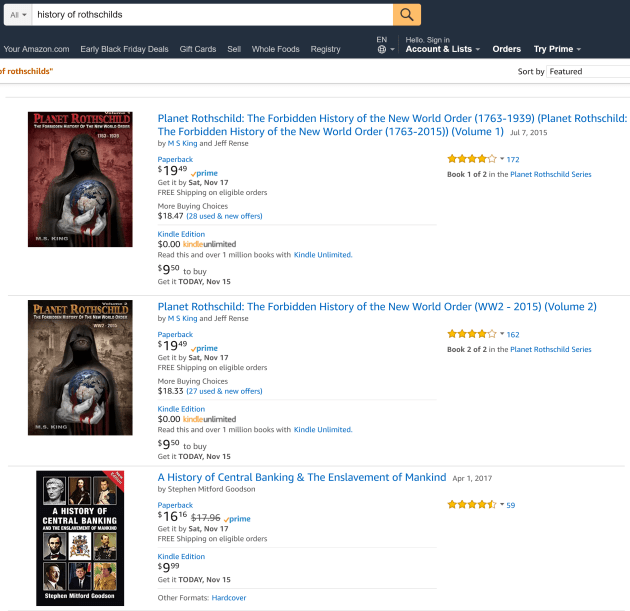
In the wake of the Pittsburgh massacre, I invited my followers on Twitter to send me their inquiries about anti-Semitism. The response was overwhelming, and ran the gamut from questions about specific aspects of the prejudice to requests for advice on how to help fight it. One reader asked for more information about the Rothschild family, the Jewish banking dynasty that is a favorite bogeyman of anti-Semites and is typically used as a stand-in for the Jewish conspiracy that purportedly controls world affairs. He explained that some in his circle of friends regularly make bigoted remarks about the Rothschilds and their vast power and he wanted to set them straight. I’d written a report about the Rothschilds in school years ago, but figured there was probably better, more up-to-date material out there. So like anyone else, I went to Amazon.com and plugged in “history of rothschilds.” To my surprise, this is what I got:

amazonrothschilds
Rather than direct me to serious scholarship on the Rothschilds, like historian Niall Ferguson’s multivolume history on the family, Amazon first recommended blatantly bigoted content.

This isn’t the only instance of Amazon’s algorithm feeding intellectually bankrupt content to intellectually curious readers regarding fraught subjects. A search for “who did 9/11” yields this book as the #1 search result:

amazon911

As the book’s own blurb notes, its author, Nick Kollerstrom, is a “longtime member of Britain’s 9/11 truth group.” Among other conspiracies, the book contains an entire chapter entitled “9/11 and Zion” which blames the attack on the Jews. (Kollerstrom also happens to be a Holocaust denier who infamously declared, “Let us hope the schoolchildren visitors are properly taught about the elegant swimming pool at Auschwitz, built by the inmates, who would sunbathe there on Saturday and Sunday afternoons while watching the water polo matches.”)

Similarly, if one searches for “Jews and the slave trade,” the second, fourth, and fifth results are not scholarship on the subject, but notoriously anti-Semitic publications from Louis Farrakhan’s Nation of Islam. Farrakhan has worked for years to mainstream the baseless anti-Semitic conspiracy theory that Jews were behind the African slave trade.

(All searches above were done logged out from Amazon while incognito on Chrome, to ensure that the search results were the default ones, and not influenced by the specific user or their past search history.)

This isn’t Amazon’s first run-in with anti-Semitism concerns. Back in 2000, the company came under fire for stocking The Protocols of the Elders of Zion, one of the most influential anti-Semitic tracts in history. At the time, while firmly distancing itself from the bigoted content, Amazon insisted that it would not remove it from the catalog, because the company does not censor books. Today, copies of The Protocols on Amazon carry a cautionary message from the Anti-Defamation League and the following disclaimer from the company:

As a bookseller, Amazon strongly believes that providing open access to written speech, no matter how hateful or ugly, is one of the most important things we do. And because we think the best remedy for offensive speech is more speech, we also make available to readers the ability to make their own voices heard and express their views about this and all our titles in reviews and ratings.

It’s a reasonable defense. But it does not cover Amazon’s algorithm prioritizing the bigoted books over the legitimate ones.

The problem here is not that Amazon sells anti-Semitic material. The problem here is not that Amazon is trying to be anti-Semitic. It’s that the company is ignorant of anti-Semitic ideas, and so has not trained its algorithm to discount them. If a human librarian were asked about the Rothschilds, 9/11, or Jews and the slave trade, they would know how to distinguish between conspiratorial rantings and genuine documentation. They would also likely be aware of the anti-Semitic canards swirling around the subjects, and would steer interested readers away from them. Amazon’s vaunted search engine, perfectly tuned to maximize sales and the user’s shopping experience, has no such cultural competency.

Beyond the moral failure, these results also represent a straightforward professional failure. When a person searches for “history of rothschilds,” they are looking for historical information on the family, not a book featuring a shadowy figure squeezing blood out of globe. A bookselling algorithm that feeds readers misinformation is a broken bookselling algorithm.

If big tech companies like Amazon, Facebook, and Google want to get serious about combating online hate and misinformation, they need to start developing cultural competency on bigotry—and fast. They need not just coding experts working on their algorithms, but anti-hate experts who can flag conspiratorial currents. After all, it’s impossible for computers to identify a prejudice if they don’t know what it looks like. It’s about time we started teaching them.

Source: Amazon’s Algorithm Has an Anti-Semitism Problem