Urback: Justin Trudeau’s legacy will be destroying the Canadian consensus on immigration

All too common mistake of looking only at the top line numbers and not some of the nuances in the more detailed breakdowns. Concerns, legitimate, over levels, types and pace, are not related to fundamental beliefs that immigration is good or bad, but rather how excessively high levels of permanent and temporary immigrants exacerbate housing, healthcare, infrastructure etc.

And please, “never before have they been so prevalent, and so mainstream” is both factually and historically incorrect, when in the past anti-immigration attitudes were more race, religion and ethnic ancestry based, not on issues like housing, healthcare and infrastructure that affect immigrants and non-immigrants alike:

…Recent polling has shown a steep decline in Canadians’ support for immigration. A Nanos poll released in 2023 showed a 20-point increase from March to September in respondents who thought Canada should accept fewer immigrants. Research by Immigration, Refugees and Citizenship Canada showed similar results. A recent Leger poll indicated that 60 per cent of Canadians believe we are accepting too many immigrants. These attitudes about policy can often turn into animosity toward people – attitudes that are quick to shift, and nearly impossible to shift back. It breeds the type of xenophobia that recently led to violent clashes in Britain, and unapologetic racism in France, and inhumane border detention facilities in the United States. And it’s starting to creep out of the fringes in Canada.

Anti-immigrant attitudes have always been present in this country, but never before have they been so prevalent, and so mainstream. The Canadian consensus that existed on immigration before Mr. Trudeau’s government has all but been vanquished, and a new cap on temporary foreign workers or a few piddling restrictions on international students won’t bring it back. That will be Mr. Trudeau’s legacy, and it’s not one that he, or the country, can be proud of.

Source: Opinion: Justin Trudeau’s legacy will be destroying the Canadian consensus on immigration

Canada ends policy of allowing visitors to apply for work permits from within the country

Of note, yet another correction:

The federal government has scrapped a COVID-era special measure that has been blamed for contributing to the surge of temporary residents in Canada and possibly asylum claimants at airports.

Starting immediately, the Immigration Department has ended the temporary public policy that allowed visitors to apply for work permits from within Canada, a measure to partly mitigate the financial hardship faced by visitors stuck in the country as a result of border closures and to partly fill labour shortages after the pandemic.

The special policy was to expire on Feb. 28, 2025.

The abrupt end to the measure is ”part of our overall efforts to recalibrate the number of temporary residents in Canada and preserve the integrity of the immigration system,” said Immigration, Refugees and Citizenship Canada in a notice on Wednesday. …

Source: Canada ends policy of allowing visitors to apply for work permits from within the country

Mike Moffatt: My remarks to the federal cabinet on housing, immigration, and the temporary foreign worker program 

Really quite striking how academics like Moffatt, Skuterud, Worswick and other have changed the discourse around immigration, focussing on selection criteria, productivity and impact on housing, healthcare and infrastructure.

Another further indication that immigration is not a third rail issue, and Moffatt speaking to Cabinet and sharing his remarks on the conservative outlet The Hub is a further illustration:

..On population growth, yesterday’s temporary foreign worker reforms are welcome news, but Canada must go much further. The TFW program, particularly the low-wage non-agricultural stream, suppresses wage growth, increases youth unemployment, creates the conditions for the exploitation of foreign workers, and reduces productivity, as it disincentivizes companies from investing in productivity-enhancing equipment. The low-wage stream should be entirely abolished, and the other streams should be substantially reformed, including creating a system of open permits.

Population growth targets, including both permanent and non-permanent residents, and housing growth targets, should all be incorporated into the annual release of the Immigration Levels Plan. The targets must be aligned, to ensure population growth does not outpace homebuilding, which will require substantial reductions in the permanent resident target over the next few years.

Like most economists, I support a robust immigration system and believe the current targets are achievable in the long run. In the meantime, however, we need to give ourselves time to allow homebuilding to catch up to past population growth, requiring a substantial reduction in the permanent resident target back to the levels of a decade ago.

We should be clear that this is not about blaming immigrants for Canada’s issues. Rather we must recognize that when we invite people to our country, we need to ensure that we have in place the conditions for them to succeed. We do them no favours, and us no favours, by setting them up to fail.

And we should be clear that we are setting people up to fail, particularly Millennials and Gen Z. Rents on new leases in Halifax are up 75 percent in the past five years. It should come as no surprise that the 2024 World Happiness Report found that Canadians under the age of 30 are the 58th happiest in the world. They are being denied a path to middle-class prosperity.

We can and must do better. Thank you for having me here today.

Source: Mike Moffatt: My remarks to the federal cabinet on housing, immigration, and the temporary foreign worker program

Globe editorial: Immigration requires steady policy, not constant ad hoc change

Yes:

…The system to welcome new Canadians – the comprehensive ranking system, colloquially known as the points system – was designed to minimize political meddling. It’s the core method used to select economic immigrants, who account for about 60 per cent of all new permanent residents. Yet the Liberals, like their back-and-forth changes around temporary foreign workers, have weakened a system that prioritized newcomers with high levels of education and promising futures in Canada. Instead, they have politicized the system with a lengthening list of exceptions that does an end run around the central philosophy of the points system.

The latest proposal, as The Globe reported last Friday, is to potentially allow people who have at most finished high school and are currently in low-wage temporary foreign worker jobs a path to permanent residency. This is not what economic immigration is supposed to be. The future of Canada’s prosperity cannot be built on low-wage jobs.

The low-wage temporary foreign worker program for jobs such as those in food service was never a key pillar of our immigration system, nor should it ever be. It’s a relatively recent invention, created in 2002. The experience of a decade ago should have been a lesson: as this space wrote last year, Mr. Trudeau himself urged reform in 2014.

Loosening the rules in 2022 should have never happened. While Monday’s changes are welcome, what would be more welcome is an immigration policy that does not react to the latest news and instead focuses on long-term results.

Source: Immigration requires steady policy, not constant ad hoc change

Kenney dubs Ottawa’s immigration policies as “gross mismanagement”

Funny enough, neither Kenney nor the “true” North reporter mention that Kenney also made the same mistake re temporary foreign workers before stories emerged over Canadians losing shifts in fast food outlets and replacement of computer programmers. To his credit, he quickly overhauled the program, imposing restrictions along with creating the IMP program. And of course, he was criticized sharply by then MP Justin Trudeau, who also seems to have forgotten this history:

Former Alberta premier and Conservative immigration minister Jason Kenney is attacking the federal government’s handling of immigration, with particular ire for its foreign labour policies.

While serving as the immigration and employment minister in 2012-13 under then-Prime Minister Stephen Harper, Kenney overhauled the Temporary Foreign Worker Program resulting in an 80% decline in low-skilled foreign workers.

Those numbers have exploded under Prime Minister Justin Trudeau, and Statistics Canada is now reporting a 30-month high in unemployment which is particularly impacting youth who are competing with an influx of foreign labour. 

Kenney says he is “perplexed” by the federal government’s “gross mismanagement” of the immigration system, and especially the foreign worker program.

“And then the current government reversed these reforms, on top of massive increases in other streams of both permanent and temporary resident migration, in the midst of a housing crisis,” he wrote on X. “Why???”

Trudeau announced that his government would be reducing the number of foreign, low-wage workers after Canada’s unemployment hit a 30-month high of 6.4% in July. 

“The labour market has changed,” Trudeau said. “Now is the time for our businesses to invest in Canadian workers and youth.”

Temporary foreign workers do labour ranging from picking fruit, to pouring coffee, to cleaning hotel rooms. Healthcare, construction, and food security sectors won’t be impacted by the cuts. 

The prime minister’s announcement follows Statistics Canada’s July data which revealed that unemployment is highest among young Canadians, and increasingly among core-aged men.

“There’s record-high unemployment for youths, there’s record-high unemployment for, basically, very young workers,” said Chetan Dave, professor of economics at the University of Alberta.

“So having this surge or temporary foreign workers cut against Canadian workers who were looking for positions as well.”

During the pandemic, the federal government bolstered the program resulting in more than 183,000 permits effective last year – an 88% jump from 2019.

Kenney said changes he made over 10 years ago were criticised by the business community but were “ the right thing to do.”

“As I said repeatedly at the time, if there are real labour shortages, then the market response must be for employers to offer higher wages, better benefits, more training, accommodations for underemployed cohorts of the labour force, and more investment to enhance productivity,” he said. 

Source: Kenney dubs Ottawa’s immigration policies as “gross mismanagement”

Les exigences en français pour les travailleurs temporaires se font attendre, Requirements in French for temporary workers are long overdue

A noter. Another government having implementation issues:

Le gouvernement de François Legault, qui avait annoncé en novembre 2023 ses intentions d’exiger une connaissance minimale du français chez les travailleurs temporaires, n’a toujours pas déposé le règlement qui le lui permettra.

Le cabinet de la ministre de l’Immigration, de la Francisation et de l’Intégration, Christine Fréchette, a confirmé mardi au Devoir ne pas avoir encore déposé les modifications réglementaires nécessaires à l’imposition de nouvelles exigences en français pour les quelque 60 000 immigrants du Programme des travailleurs étrangers temporaires (PTET) actuellement sur le territoire québécois. Un projet de règlement sera déposé « cet automne », a-t-on assuré.

Sur son site Web, vendredi, la Coalition avenir Québec (CAQ) s’était pourtant félicitée d’avoir posé « de nombreuses actions importantes […] pour mieux réguler l’immigration temporaire » depuis son arrivée au pouvoir. Parmi celles-ci : avoir « exigé la connaissance du français pour renouveler les permis de travail temporaires ».

Cela fait près de dix mois que le premier ministre, François Legault, a officialisé, en conférence de presse à Québec, ses intentions de rendre le renouvellement d’un permis de travail conditionnel à la maîtrise de la langue française.

À l’époque, la ministre Fréchette avait affirmé que les travailleurs du PTET — à l’exception de ceux qui travaillent dans les champs — devraient bientôt démontrer une connaissance de la langue de niveau quatre, c’est-à-dire être capables de « discuter avec leur entourage » de « sujets familiers ». Le gouvernement de Justin Trudeau a depuis emboîté le pas à Québec, en promettant d’appliquer les mêmes exigences aux immigrants inscrits au programme fédéral de mobilité internationale (PMI).

Après plusieurs questions du Devoir, mardi, le cabinet de la ministre de l’Immigration a finalement indiqué qu’il procéderait à la « prépublication du règlement cet automne », avec pour objectif que celui-ci entre en vigueur au cours de l’année 2025. Aucune explication n’a été fournie pour les retards constatés depuis près d’un an.

« Improvisation »

En entrevue, le porte-parole du Parti libéral du Québec (PLQ) en matière d’immigration, André A. Morin, a cependant accusé le gouvernement d’avoir « improvisé » dans le dossier. « C’est toujours le même problème avec la CAQ : des grosses annonces, puis après ça, il n’arrive rien », a-t-il déploré à l’autre bout du fil. « Pour moi, c’est un autre exemple du manque de planification et du manque de contrôle de la CAQ, que ce soit dans le domaine de l’immigration, de la francisation ou de l’intégration. »

Quoiqu’exaspéré, M. Morin se dit peu surpris d’apprendre que la mesure caquiste n’a toujours pas été mise en application. Il se permet d’ailleurs une hypothèse pour l’expliquer : « En matière de francisation, le gouvernement, actuellement, est incapable de répondre à la demande », a-t-il observé, mardi. « Il y a des gens que je connais qui veulent suivre des cours, mais qui ne sont pas appelés. »

Dans son rapport annuel déposé en mai, le commissaire à la langue française, Benoît Dubreuil, avait constaté d’importants retards dans l’offre de service chez Francisation Québec. À l’époque, la moitié des demandeurs attendaient toujours de suivre leur premier cours.

Interrogé mardi, le député de Québec solidaire Guillaume Cliche-Rivard a lui aussi raillé les retards du gouvernement en la matière. « Les bottines de la CAQ ne suivent pas les babines pour la protection du français », a-t-il affirmé dans une déclaration écrite.

« Ça fait des mois que les échecs de Francisation Québec font la manchette et que les travailleurs immigrants font la file pour apprendre le français. Protéger le français, ça ne passe pas seulement par des exigences, mais aussi par des résultats positifs en francisation », a-t-il lancé.

« La CAQ se vante d’être le parti qui en a le plus fait pour l’immigration francophone. Déjà qu’elle n’imposait qu’un niveau 4 aux travailleurs du PTET, on apprend que le règlement qui devait mettre cela en oeuvre n’a pas encore été déposé », a pour sa part dénoncé le porte-parole du Parti québécois en matière de langue française, Pascal Bérubé.

Son parti, a-t-il rappelé, doit déposer cet automne « un plan de réduction des immigrants temporaires afin de diminuer la pression sur le français, notamment ».

Source: Les exigences en français pour les travailleurs temporaires se font attendre

Computer translation

The government of François Legault, which had announced in November 2023 its intentions to require a minimum knowledge of French among temporary workers, has still not filed the regulation that will allow it.

The office of the Minister of Immigration, Francisation and Integration, Christine Fréchette, confirmed Tuesday to Le Devoir that she had not yet filed the regulatory amendments necessary to impose new requirements in French for the approximately 60,000 immigrants of the Temporary Foreign Worker Program (PTET) currently in Quebec territory. A draft regulation will be tabled “this fall,” it was assured.

On its website on Friday, the Coalition avenir Québec (CAQ) was pleased to have taken “many important actions […] to better regulate temporary immigration” since it came to power. Among these: having “required knowledge of French to renew temporary work permits”.

It has been almost ten months since the Prime Minister, François Legault, formalized, at a press conference in Quebec City, his intentions to renew a conditional work permit to master the French language.

At the time, Minister Fréchette had said that PTET workers – with the exception of those who work in the fields – should soon demonstrate a knowledge of the language of level four, that is, be able to “discuss with those around them” about “familiar subjects”. Justin Trudeau’s government has since followed in the footsteps of Quebec City, promising to apply the same requirements to immigrants enrolled in the federal International Mobility Program (PMI).

After several questions of the Duty, on Tuesday, the office of the Minister of Immigration finally indicated that it would proceed with the “pre-publication of the regulation this fall”, with the aim of it entering into force during the year 2025. No explanation has been provided for the delays noted for almost a year.

“Improvisation”

In an interview, the spokesperson for the Parti libéral du Québec (PLQ) on immigration, André A. Morin, however, accused the government of having “improvised” in the file. “It’s always the same problem with the CAQ: big announcements, then after that, nothing happens,” he lamented on the other end of the line. “For me, this is another example of the lack of planning and lack of control of the CAQ, whether in the field of immigration, francization or integration. ”

Although exasperated, Mr. Morin says he is not surprised to learn that the Caquist measure has still not been implemented. He also allows himself a hypothesis to explain it: “In terms of francization, the government is currently unable to respond to demand,” he observed on Tuesday. “There are people I know who want to take classes, but who are not called. ”

In his annual report submitted in May, the Commissioner for the French Language, Benoît Dubreuil, noted significant delays in the service offer at Francisation Québec. At the time, half of the applicants were still waiting to take their first course.

Asked on Tuesday, Québec solidaire MP Guillaume Cliche-Rivard also mocked the government’s delays in this regard. “The boots of the CAQ do not follow the babines for the protection of French,” he said in a written statement.

“The failures of Francisation Québec have been making headlines for months and immigrant workers have been queueing to learn French. Protecting French requires not only requirements, but also positive results in francization, “he said.

“The CAQ boasts of being the party that has done the most for Francophone immigration. Already that it imposed only level 4 on PTET workers, we learn that the regulation that was supposed to implement this has not yet been tabled, “denounced the spokesman for the French-language Party of the Quebec Party, Pascal Bérubé.

His party, he recalled, must submit this fall “a plan to reduce temporary immigrants in order to reduce the pressure on French, in particular”.

Worswick: Ottawa needs to abolish the temporary foreign worker program

Worth consideration:

…While these statements, at first glance, may seem at odds, there are valid economic reasons to be in favour of skilled (permanent) immigration but opposed to less-skilled temporary foreign worker programs.

We must therefore redesign our international migration policies. Ottawa’s announcement on Monday to further restrict the temporary foreign worker (TFW)program is a step in the right direction but not enough. Canada needs to go further and abolish the program.

We need to quickly phase out the low-skill stream of the TFW program, which the government has expanded to let companies fill perceived labour shortages. Then we should merge the higher-skill part of the program into our economic immigration program.

This would retain the advantages of the TFW program for higher-skilled workers, which is that it provides for a trial period for prospective immigrants. It would also ensure the temporary foreign workers are admitted in line with the goals of the economic immigration program: that they have high-enough skills to become immigrants whose presence greatly benefits the Canadian economy.

This must be done to reverse a long-standing, concerning trend. With support from the provinces and the business lobby, the federal government has greatly increased the numbers of immigrants and the number of temporary foreign workers coming to Canada, with 2022 levels that are more than 50 per cent higher than the 2017 levels in each case (according to the Immigration, Refugees and Citizenship Canada Annual Report to Parliament on Immigration). Given that these remarkable increases have coincided with both a health care crisis and a housing crisis, it naturally raises the issue of redesigning our international migration programs….

Source: Ottawa needs to abolish the temporary foreign worker program

Ottawa resserre davantage que Québec le recours aux travailleurs temporaires à bas salaire

Quebec comparison:

Ottawa va resserrer l’accès aux travailleurs étrangers temporaires à bas salaire davantage que Québec. Le premier ministre Justin Trudeau a annoncé trois changements en ce sens lundi matin, en marge de la retraite du cabinet fédéral, qui constituent un retour aux règles d’avant la pandémie.

Cette annonce suit celle faite par le premier ministre François Legault la semaine dernière, mais elle couvre plus large, tant géographiquement que pour les plafonds dans chaque industrie.

Québec va geler pour six mois l’accès au Programme des travailleurs étrangers temporaires (PTET) dès le 3 septembre, mais seulement pour l’île de Montréal. Les resserrements d’Ottawa entreront quant à eux en vigueur le 26 septembre et s’ajoutent à ceux déjà annoncés le printemps dernier, a évalué plus tard en matinée le ministre de l’Emploi, Randy Boissonnault.

Les mesures fédérales vont s’appliquer sans une fin déterminée : la révision du programme continue, précise plutôt le cabinet du ministre.

Les grands secteurs exemptés du resserrement fédéral seront les mêmes que ceux choisis par Québec : construction, santé, transformation alimentaire et du poisson. L’agriculture fait l’objet d’un autre volet du programme, et elle est donc également exclue.

Le « bas salaire » est défini par province selon le salaire médian, et est fixé à 27,47 $ l’heure pour le Québec.

Selon le taux de chômage

Les assouplissements ayant suivi la pandémie ont bien servi la communauté d’affaires, mais « l’économie d’aujourd’hui est différente », a dit M. Trudeau, citant l’inflation qui diminue et le chômage qui augmente.

C’est d’ailleurs le taux de chômage qui servira à déterminer les zones métropolitaines qui ne pourront plus participer au programme. Le gouvernement du Canada refusera de traiter les études d’impact sur le marché du travail (EIMT), la première étape pour les entreprises qui embauchent à l’étranger, qui concernent les villes où le taux de chômage est de 6 % ou plus.

D’après ce critère, et selon le taux de chômage au 1er juillet 2024, les villes de Laval et de Gatineau seraient exclues du programme, mais Québec ne les a pas mentionnées dans son annonce.

« Nous n’avons plus besoin d’autant de travailleurs étrangers temporaires. Nous avons besoin d’entreprises qui investissent dans la formation et les technologies, pas qui augmentent leur dépendance à une main-d’oeuvre à bas coût », a déclaré le premier ministre Trudeau. Il est temps d’investir dans les travailleurs canadiens, a-t-il rétorqué à « ceux qui se plaignent de la pénurie de main-d’oeuvre ».

C’est l’une des « pièces du casse-tête » pour faire passer de 7 % à 5 % la proportion totale d’immigrants temporaires par rapport à la population, a quant à lui déclaré le ministre de l’Immigration, Marc Miller, lors d’un point de presse tenu avec deux autres ministres, dont M. Boissonnault. D’autres mesures restent à annoncer, ont-ils précisé.

Cette proportion est d’environ 6,6 % au Québec, ce qui représente 597 000 immigrants temporaires, selon les dernières estimations de Statistique Canada.

Des plafonds différents

Le deuxième changement important constitue un autre retour en arrière : les employeurs pourront embaucher jusqu’à 10 % de leur effectif total dans le cadre du programme, comme c’était le cas de 2014 à 2022. La limite actuelle est de 20 % dans la plupart des industries.

La santé et l’agriculture ne connaissent pas de plafond à l’échelle du Canada.

Au Québec, les secteurs de la fabrication de produits en bois, de meubles et de produits connexes ainsi que les services d’hébergement et de restauration sont encore affichés à 30 % en raison de certaines exemptions.

Il y a en outre 267 professions exemptées de ces plafonds dans la province, dont une partie sont à bas salaire. Cette liste de professions s’est élargie dans les dernières années, à la demande du gouvernement Legault. L’an dernier, en dehors de l’agriculture, ce sont 63 % des dossiers de travailleurs temporaires au Québec qui sont passés par ce traitement simplifié, sans que le poste soit d’abord affiché pour les travailleurs locaux.

Le cabinet de M. Boissonnault a néanmoins confirmé que les changements s’appliqueraient au Québec, tout en disant vouloir « travailler en étroite collaboration avec le gouvernement du Québec ».

Enfin, le dernier changement annoncé lundi concerne la durée maximale d’emploi, qui passera de deux ans à un an à l’échelle du Canada.

D’autres mesures demandées

Le volet des postes à haut salaire du même programme est aussi sous la loupe du gouvernement, dans le cadre d’un examen général accéléré qui va durer 90 jours. Le cabinet discutera du nombre de résidents permanents et des possibilités d’adapter les cibles, a aussi avancé le premier ministre Trudeau.

« Le fédéral suit l’exemple de notre gouvernement, soit de réduire le nombre de travailleurs étrangers temporaires là où de la main-d’oeuvre est disponible », a quant à elle écrit sur X la ministre provinciale de l’Immigration, Christine Fréchette.

Comme la semaine dernière, elle a exhorté Ottawa à agir sur les autres résidents non permanents, en particulier sur l’autre grand programme de travail temporaire, le Programme de mobilité internationale.

Ce retour aux règles prépandémiques n’est pas sans rappeler la réforme de 2014 du même programme de travailleurs étrangers temporaires. Le fédéral déplorait alors qu’un programme de « dernier recours » n’eût pas connu assez de limites et que certains employeurs aient, « au fil du temps, bâti leur modèle d’entreprise en fonction du [PTET] ».

Dominer l’ordre du jour

Pour Catherine Xhardez, professeure de science politique à l’Université de Montréal, ce n’est pas un hasard si les deux ordres de gouvernement agissent sur les mêmes « rouages » : « Ce sont comme des boulons qu’on peut resserrer. Et c’est le PTET qui en a le plus, même s’il y a des forces contraires sur la question à savoir si on veut les resserrer ou non. »

Le gouvernement est « sous pression populaire et économique », décrit-elle, et veut montrer qu’il agit, tant à Québec qu’à Ottawa. Les deux « jouent sur ce qu’ils peuvent », le levier étant toujours les EIMT. « C’est sûr qu’il y a un effet de communication, de vouloir se mettre à l’agenda pour montrer qui avance en premier », analyse la politologue.

Les autorités ont desserré ces rouages de l’immigration temporaire durant la pandémie, tant pour relancer l’économie que pour rattraper la baisse migratoire des années 2020 à 2022. Toutefois, c’est une addition de petites mesures, « sans vision globale », qui ont été mises en places, « sans qu’on se rende compte à quel point les chiffres étaient importants », voit-elle. Il y a bel et bien eu « un recours massif pas toujours très raisonné », selon elle.

L’immigration a contribué à relancer l’économie, ont souligné MM. Boissonnault et Miller en conférence de presse. La réplique viendra donc rapidement d’un acteur important de la politique d’immigration, souligne Mme Xhardez : les employeurs.

Les employeurs catastrophés

Le Conseil du patronat du Québec (CPQ) n’a en effet pas tardé à réagir à cette nouvelle annonce, à l’image du mécontentement affiché la semaine dernière. « Une nouvelle tuile s’abat sur les entreprises cette semaine. Elles auront peu de temps pour s’adapter, car les changements annoncés entreront en vigueur d’ici un mois », a déclaré Karl Blackburn, président et chef de la direction du CPQ.

Les dernières prévisions économiques étant « optimistes », dit-il, la demande en travailleurs pourrait repartir à la hausse. Ce programme n’est qu’un « dernier recours », à cause de la « paperasse et des procédures » qu’il représente, indique-t-il.

Le CPQ propose par ailleurs qu’on « facilite le maillage avec les entreprises » pour développer des compétences correspondant au marché du travail, notamment celles des demandeurs d’asile.

Source: Ottawa resserre davantage que Québec le recours aux travailleurs temporaires à bas salaire

Computer translation:

Ottawa will tighten access to low-wage temporary foreign workers more than Quebec. Prime Minister Justin Trudeau announced three changes in this direction on Monday morning, on the sidelines of the retirement of the federal cabinet, which constitute a return to pre-pandemic rules.

This announcement follows the one made by Prime Minister François Legault last week, but it covers more widely, both geographically and for the ceilings in each industry.

Quebec City will freeze access to the Temporary Foreign Workers Program (PTET) for six months as of September 3, but only for the island of Montreal. The Ottawa tightening will take effect on September 26 and are in addition to those already announced last spring, assessed Employment Minister Randy Boissonnault later in the morning.

Federal measures will apply without a specific purpose: the revision of the program continues, says the Minister’s office instead.

The major sectors exempted from federal tightening will be the same as those chosen by Quebec: construction, health, food processing and fish. Agriculture is the subject of another part of the program, and it is therefore also excluded.

The “low salary” is defined by province according to the median salary, and is set at $27.47 per hour for Quebec.

According to the unemployment rate

The relaxations that followed the pandemic have served the business community well, but “today’s economy is different,” said Mr. Trudeau, citing declining inflation and rising unemployment.

It is also the unemployment rate that will be used to determine the metropolitan areas that will no longer be able to participate in the program. The Government of Canada will refuse to deal with labour market impact studies (LMIAs), the first step for companies that hire abroad, which concern cities where the unemployment rate is 6% or more.

According to this criterion, and according to the unemployment rate as of July 1, 2024, the cities of Laval and Gatineau would be excluded from the program, but Quebec did not mention them in its announcement.

“We no longer need so many temporary foreign workers. We need companies that invest in training and technology, not that increase their dependence on a low-cost workforce, “said Prime Minister Trudeau. It’s time to invest in Canadian workers, he replied to “those who complain about the shortage of labor”.

This is one of the “pieces of the puzzle” to increase the total proportion of temporary immigrants in relation to the population from 7% to 5%, said Immigration Minister Marc Miller at a press briefing with two other ministers, including Mr. Boissonnault. Other measures remain to be announced, they said.

This proportion is about 6.6% in Quebec, which represents 597,000 temporary immigrants, according to the latest estimates by Statistics Canada.

Different ceilings

The second important change is another step backwards: employers will be able to hire up to 10% of their total workforce under the program, as was the case from 2014 to 2022. The current limit is 20% in most industries.

Health and agriculture do not have a ceiling across Canada.

In Quebec, the manufacturing of wood products, furniture and related products as well as accommodation and catering services are still displayed at 30% due to certain exemptions.

There are also 267 professions exempt from these ceilings in the province, some of which are low-wage. This list of professions has expanded in recent years, at the request of the Legault government. Last year, outside agriculture, 63% of temporary worker files in Quebec went through this simplified treatment, without the position being first posted for local workers.

The office of Mr. Boissonnault nevertheless confirmed that the changes would apply to Quebec, while saying he wanted to “work closely with the government of Quebec”.

Finally, the last change announced on Monday concerns the maximum duration of employment, which will increase from two years to one year across Canada.

Other measures requested

The high-wage positions part of the same program is also under the government’s scrutiny, as part of an accelerated general review that will last 90 days. The cabinet will discuss the number of permanent residents and the possibilities of adapting the targets, Prime Minister Trudeau also said.

“The federal government is following the example of our government, namely to reduce the number of temporary foreign workers where manpower is available,” Provincial Immigration Minister Christine Fréchette wrote on X.

Like last week, she urged Ottawa to take action on other non-permanent residents, in particular on the other major temporary work program, the International Mobility Program.

This return to pre-pandemic rules is reminiscent of the 2014 reform of the same temporary foreign workers program. The federal government then deplored that a “last resort” program had not known enough limits and that some employers have, “over time, built their business model according to the [PTET]”.

Dominate the agenda

For Catherine Xhardez, professor of political science at the Université de Montréal, it is no coincidence that the two levels of government act on the same “cogs”: “They are like bolts that can be tightened. And it is the PTET that has the most, even if there are opposing forces on the question of whether we want to tighten them or not. ”

The government is “under popular and economic pressure,” she describes, and wants to show that it is acting, both in Quebec City and Ottawa. The two “play on what they can”, the lever is always the LMIAs. “It is certain that there is a communication effect, of wanting to put yourself on the agenda to show who advances first,” analyzes the political scientist.

The authorities loosened these workings of temporary immigration during the pandemic, both to revive the economy and to make up for the decline in migration from 2020 to 2022. However, it is an addition of small measures, “without a global vision”, that have been put in place, “without us realizing how important the figures were,” she sees. There was indeed “a massive recourse not always very reasoned”, according to her.

Immigration has helped to revive the economy, stressed Mess. Boissonnault and Miller at a press conference. The reply will therefore quickly come from an important player in immigration policy, stresses Ms. Xhardez: employers.

Employers devastated

The Conseil du patronat du Québec (CPQ) was indeed quick to react to this new announcement, like the discontent displayed last week. “A new tile is falling on companies this week. They will have little time to adapt, as the announced changes will take effect within a month, “said Karl Blackburn, President and CEO of the CPQ.

The latest economic forecasts being “optimistic”, he says, the demand for workers could rise again. This program is only a “last resort”, because of the “paperwork and procedures” it represents, he says.

The CPQ also proposes to “facilitate networking with companies” to develop skills corresponding to the labour market, in particular those of asylum seekers.
Government officers told to skip fraud prevention steps when vetting temporary foreign worker applications, Star investigation finds

Sigh….

As the Trudeau government promises to crack down on a temporary foreign worker program it admits has been abused, a Star investigation has revealed the government is fast-tracking applications by directing processing officers to skip crucial steps designed to prevent fraud. 

Beginning in January 2022, Employment and Social Development Canada (ESDC) directed staff to apply “streamlining measures” when evaluating the legitimacy of applications by employers who want to hire temporary foreign workers.

According to internal ESDC documents obtained by the Star and interviews with a current ESDC employee, routine checks meant to ensure the system is not abused by unscrupulous employers have been suspended in an effort to process applications faster.

Those checks include contacting employers to confirm they actually applied to hire a worker, verifying that lawyers and consultants applying on behalf of employers are in good standing with their regulator, and clarifying the overtime, vacation and benefits promised to the worker.

“This really shows a complete contradiction between the public-facing government policies and how the program is actually run,” said Catherine Connelly, a professor at McMaster University’s DeGroote School of Business who has been studying the temporary foreign workers program for more than a decade who examined the internal ESDC documents.

“On one hand, we’re told the government will crack down on everything, and then on the other hand, we see from the documents that this is clearly a rubber stamp,” she said. “If the government is not going to do even basic checks, how can the public have any confidence in anything?”…

Source: Government officers told to skip fraud prevention steps when vetting temporary foreign worker applications, Star investigation finds

The sudden rise of temporary foreign workers in entry-level office jobs

Another example of how the program was mismanaged:

Temporary foreign workers are no longer a rare presence in entry-level office roles.

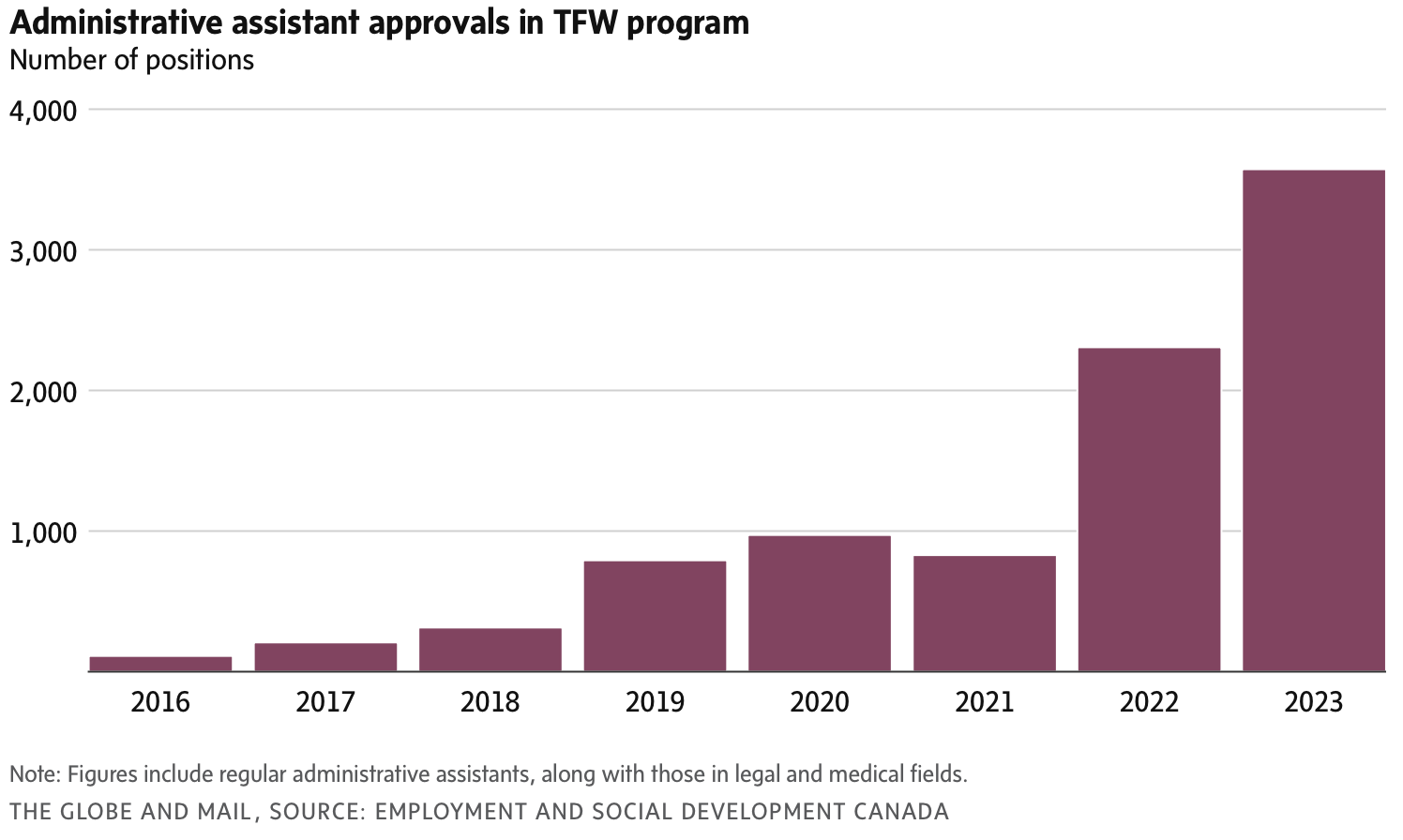
Last year, employers were approved to hire more than 3,500 administrative assistants via the Temporary Foreign Worker Program, up from just 112 of those roles approved in 2016, according to figures published by the federal government. In addition, companies were authorized to hire nearly 2,000 administrative officers in 2023. (The TFW program accounts for a small share of foreign labour in Canada, so it’s likely that other pathways are being tapped for admin workers, too.)

The TFW program has soared in use over the past few years, including more recruitment of low-wage workers in hospitality, construction and other fields. But this trend has brought greater scrutiny to the program, particularly as the unemployment rate has risen and some groups — notably young people and recent immigrants — have struggled to find jobs.

The federal government has said it’s trying to scale back the TFW program, and earlier this week, it announced a pause in using it to hire certain low-wage workers in the Montreal region.

Source: The sudden rise of temporary foreign workers in entry-level office jobs