Weil répugne à abaisser l’exigence du français pour satisfaire le patronat | Le Devoir

The debate over French language competency required for immigrants in Québec continues, with employers arguing for greater flexibility with respect to those with wanted skills:

La ministre de l’Immigration, de la Diversité et de l’Inclusion, Kathleen Weil, a voulu, mardi, prendre ses distances du patronat, qui voit dans la réforme de la Loi sur l’immigration une chance de réduire les exigences linguistiques pour les immigrants dont les qualifications sont recherchées.

« Je n’ai jamais confirmé cette orientation, bien au contraire », a lancé Kathleen Weil à la présidente de la CSQ, Louise Chabot, qui prenait part aux consultations en commission parlementaire sur le projet 77 qui propose une refonte de la Loi sur l’immigration.

« Je n’ai jamais évoqué que je partageais l’opinion de ceux qui disent qu’on viendrait réduire les critères de sélection, d’une part, pour ensuite augmenter le niveau de francisation en milieu de travail », a indiqué la ministre. Elle doit déposer sous peu une nouvelle politique d’immigration qui devrait révéler les véritables intentions du gouvernement Couillard en la matière.

La semaine dernière, Michel Leblanc, de la Chambre de commerce du Montréal métropolitain, ainsi qu’Éric Tétrault, des Manufacturiers et exportateurs du Québec, sont venus réclamer au gouvernement qu’il permette aux employeurs d’embaucher des travailleurs immigrants qui ne parlent pas français pour combler des postes spécialisés qui font l’objet de pénuries, quitte à ce qu’ils apprennent le français sur les lieux de travail.

La ministre a soutenu au Devoir qu’il était possible de recruter des candidats à l’immigration qui connaissent le français tout en répondant aux besoins précis du marché du travail. « On est capable de faire les deux », a-t-elle dit.

Louise Chabot s’est inquiétée de « l’obsession » de l’adéquation entre la formation des immigrants et le marché du travail. Selon la chef syndicale, la politique d’immigration ne peut pas seulement être axée sur les besoins ponctuels des entreprises en main-d’oeuvre. « Par les témoignages qu’on entend du patronat, jusqu’à maintenant, le français semble être un “nice to have” et non pas une condition importante dans l’ensemble des critères », a-t-elle dit aux journalistes.

Source: Weil répugne à abaisser l’exigence du français pour satisfaire le patronat | Le Devoir

ICYMI: Caribbean Investment for Citizenship programmes: David Jessop

Good overview of the trend among many Caribbean countries to offer citizenship for investors, and the risks and consequences of that approach:

Since then, most Caribbean citizenship programmes have put in place, usually with external support, mechanisms to address these issues, but there remain clear variations in the way programmes operate.

While officials in North America and Europe make clear they have no objection to well run citizenship-by-investment schemes given they have ones of their own, they say they remain concerned, suggesting the possibility of sanctions against any nation unable to ensure their programmes meet international requirements.

Notwithstanding, other conceptual and practical problems remain.

At a purely economic level, it is hard to understand why such schemes are not designed to be sustainable in ways that bring continuing income to the country concerned. Without any residency requirement there is no long-term gain in the form of other taxes or fees. Moreover, in the absence in some cases of the equivalent of an independently controlled sovereign fund able to receive fees from citizenship, one-off income remains unrelated to long-term infrastructural, education or public health care needs.

Secondly, the willingness of some countries to grant citizenship to future generations as well as the applicant means that not only is there no long-term benefit from the passport holder’s descendants, but the issuing nation concerned has little or no idea about the identity or nature of growing numbers of future citizens.

Thirdly, the real danger remains that should it be discovered that a passport has been issued to someone who is on a criminal or terrorism watch list, ordinary citizens may face blanket requirements for visas where none previously existed.

There are also other problems requiring resolution. There is a lack of clarity in some nations about what donations – the preferred route for most applicants – are applied to; there is a plethora of sales agents globally and a need for the regulation of their activities; some countries do not have the capacity to deal adequately with the number of requests being made; few governments join up their promotional efforts with developers to try to encourage investments into productive real estate or tourism projects; high risk investment vehicles are being approved; in some nations opposition parties allege impropriety in relation to who benefits; and most schemes still lack real transparency.

As international views on monitoring money laundering and transparency evolve, and concerns grow about global security, it is likely that countries offering economic citizenship without greater transparency could become the subject of more intense international scrutiny.

It would be wise for the region as a whole to consider carefully how best to balance the understandable desire to create new sources of government revenue, with the wider implications and reputational risk inherent in citizenship-by investment- programmes.

Source: Commentary: The View from Europe: Citizenship programmes – more work to be done | Caribbean News Now

ICYMI: Ten Theses on Immigration – Douthat, The New York Times

Buried in Ross Douthat’s concerns regarding immigration and integration, is an endorsement of Canadian and Australian approaches:

As someone who is (obviously) skeptical of the elite-level consensus on immigration’s benefits, I’m glad to see the G.O.P. and conservatism tilting away from George W. Bush/Rubio-Schumer “comprehensivism” on immigration policy. But I also think that the stampede to Trumpism is being unduly influenced by a conflation of the American and European situations. Europe faces a real, potentially deep and epoch-defining crisis — a refugee problem that could threaten the very foundations of the continent’s post-Cold War order. America faces a much more normal sort of policy quandary, to which the ideal political response could reach the destination that Salam proposes in his essay — sharper limits on low-skilled migration and a more Canadian or Australian approach to immigration as, effectively, recruitment  — without huge and wrenching shifts, mass deportations, religion-specific entry bans, and all the rest of the Trumpian bill of goods.

So while we should be guided, no less than Europe, by a greater prudence than our leadership has shown to date, we should also recognize that what is (for Germany especially) now a crisis Over There remains as yet an opportunity for us.

Source: Ten Theses on Immigration – The New York Times

Liberal MPs put heat on McCallum to address immigration processing ‘mess,’ say lengthy delays ‘unacceptable’

Not surprising, the range and nature of complaints (which may have been a factor among visible minority voters during the recent election) but turning this around takes time:

Minister of Immigration, Refugees and Citizenship John McCallum has been under intense pressure at recent national caucus meetings from Liberal MPs who want him to address the “mess” in the processing times of immigration applications, which in some cases is taking more than six years for family class applications.

“This is not acceptable. We have to do something about it,” Liberal MP Sukh Dhaliwal (Surrey-Newton, B.C.) told The Hill Times.

In the last two national caucus meetings—Sunday, Jan. 24 and Wednesday, Jan. 27—about 20 MPs spoke up, in total, in both meetings, Liberal sources told The Hill Times. Liberal MPs told Mr. McCallum (Markham-Thornhill, Ont.) that, up until the last election, Conservatives were to be blamed for the slow processing of applications because they were in power. But Canadians now want to know what the Liberals have done to speed up the processing times in the last three months, according to Liberal sources. During the Jan. 24 caucus meeting, Mr. McCallum and his departmental officials conducted a briefing for MPs about the causes of the delay and introduced them to some departmental resources that can help MPs in serving their constituents on immigration files.

Sources told The Hill Times that Liberal MPs recognize that Mr. McCallum and the Immigration Department is focused on the politically sensitive Syrian refugees file, but they also want swift action on Immigration applications in the regular streams.

During the last election campaign, the Liberals had promised to bring in 25,000 Syrian refugees to Canada by the end of last year, but they missed the deadline and are now aiming to achieve this goal by the end of February. As of last week, about 14,000 have arrived in Canada. Because of the high-profile domestic and international implications of the Syrian refugee file, Mr. McCallum and the Immigration Department have been in the media spotlight for months. The Syrian refugee crisis is considered the biggest refugee crisis since the end of World War II and it’s estimated 12 million have been displaced as a result of the civil war in Syria.

Meanwhile, the Immigration application processing times are different for different categories including family class, economic class, refugee and humanitarian and compassionate classes.

In the case of parents and grand parents sponsorship applications, the department is currently processing the ones that were filed on or before Nov. 4, 2011, according to the departmental website. The processing time for spouses or common-law partners living inside Canada is 26 months and for the ones outside of Canada is 17 months.

In the economic class, if an application was filed between 2008 and 2010, the processing time is 67 months while for the ones filed between 2010 and 2014, is 13 months.

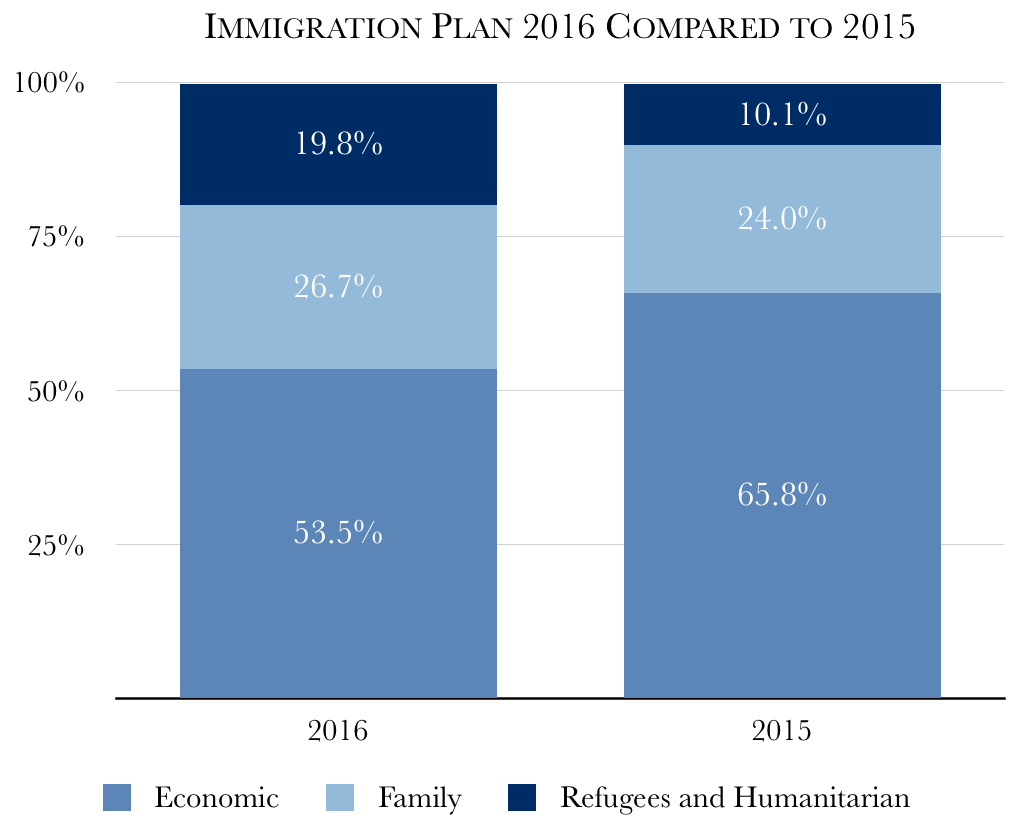
Canada takes in about 260,000 immigrants each year in all categories, combined. The statistics were not available for last year, but in 2014, 66,661 received Canadian immigration in the ‘family class’ category, 165,089 in the ‘economic class’ category and 23,286 in the ‘refugee class’ category, according to the departmental website. In 2013, Canada took in a total of 259,023 immigrants including 81,843 in family class, 148,155 in economic immigrant class and 23,831 in refugees class.

In interviews last week, Liberal MPs told The Hill Times that about 60-70 per cent of their constituency work is immigration related and specifically for family class applications.

Mr. Dhaliwal said that Mr. McCallum, who also served in former the Cabinets of prime ministers Jean Chrétien and Paul Martin, has assured MPs that he understands and recognizes the processing of applications and will take steps to speed things up.

“He [Mr. McCallum] has publicly said and he has privately said that he’s going to fix and fix [this issue] once for all. The pressure is on and this is one of the toughest ministries and tasks to handle and John McCallum comes up with a lot of experience behind him. He’s a thoughtful individual and working on this file. We are trying to help him by giving our input and he’s consulting people,” said Mr. Dhaliwal.

Source: Liberal MPs put heat on McCallum to address immigration processing ‘mess,’ say lengthy delays ‘unacceptable’ | hilltimes.com

Le français, non merci – Language of Immigrants in Quebec

Interesting study on the degree to which Quebec immigrants integrate to French or English-speaking environments (the vast majority of immigrants settle in Montreal where this is an option).

Not totally surprisingly, Latin American and Arab immigrants tend to integrate into francophone environnement, those from China, South Asia and the Philippines remain more anglophone in orientation:

Plus de 200 000 Néo-Québécois, soit 20 % de la population immigrée au Québec, ne parlent pas français. La plupart de ces immigrants, soit 160 000, parlent anglais. En dépit de la sélection prioritaire de candidats connaissant le français — 60 % du total —, l’immigration continue de contribuer au déclin du français, surtout dans la région de Montréal.

C’est ce que signale un portrait des efforts du Québec en matière de francisation et d’intégration intitulé Le Québec rate sa cible. Commandité par la CSN, le Mouvement national des Québécois, la Société Saint-Jean-Baptiste de Montréal et le Mouvement Québec français, le document exhaustif de 130 pages, rédigé par le chercheur Jean Ferretti de l’Institut de recherche en économie contemporaine (IREC), s’appuie sur des données du ministère de l’Immigration, de la Diversité et de l’Inclusion (MIDI) et de Statistique Canada ainsi que sur diverses études de chercheurs comme Marc Termotte, Paul Béland, Michel Pagé, Brahim Boudarbat, Gilles Grenier, Patrick Sabourin et Guillaume Marois.

« On dirait que par négligence, le gouvernement du Québec refuse de voir l’impact de l’immigration sur le français à Montréal », a affirmé Jean Ferretti au Devoir.

« La politique migratoire menée depuis 1991 ne permet pas d’atteindre l’objectif du [ministère] de pérenniser le français. Les efforts de sélection ont permis de hausser la part d’immigrants connaissant le français, mais ne sont pas suffisants pour endiguer le déclin du français », écrit Jean Ferretti.

Concurrence linguistique

Le Québec est dans une situation particulière par rapport à d’autres sociétés, note-t-il. « L’adoption de la langue de la majorité par les immigrants ne va pas de soi. À Montréal, la possibilité de vivre dans la langue de son choix et la forte présence des anglophones du Québec créent une situation de concurrence linguistique qui limite les transferts linguistiques vers le français. »

Jean Ferretti cite Paul Béland, qui a démontré que les immigrants de langue maternelle latine ou originaires de la Francophonie, quelle que soit leur langue maternelle, sont enclins à adopter le français, alors que c’est l’inverse pour les immigrants de langue maternelle non latine. Depuis 1971, la proportion des immigrants de langue latine qui adoptent le français a augmenté à 87 %, tandis que le transfert vers le français des immigrants de langue non latine est resté le même en 30 ans, à 15 %.

Ainsi 88 % des Latino-Américains et 90 % des Arabes installés au Québec connaissent le français, alors que plus de 40 % des Chinois et des Sud-Asiatiques ne connaissent pas le français. Dans le cas des Philippins, 58 % d’entre eux ne parlent pas français.

Pour préserver le caractère français du Québec, il importe non seulement de recruter une forte proportion d’immigrants qui connaissent le français, mais il faut choisir parmi les immigrants qui ne connaissent pas le français ceux qui sont les plus aptes à adopter la langue commune, estime l’auteur.

Si le gouvernement du Québec poursuit la même politique en matière d’immigration qu’à l’heure actuelle, le poids démographique des francophones continuera de diminuer. Reprenant les projections des démographes Guillaume Marois et Marc Termotte, les francophones ne représenteraient plus que 75 % de la population du Québec dans 40 ans, contre 82 % en 2006. Si le seuil d’immigration de 50 000 à l’heure actuelle était porté à 65 000 — Philippe Couillard a déjà indiqué son intention d’augmenter le nombre d’immigrants reçus au Québec —, le poids des francophones s’élèverait à 73 %.

De son côté, Marc Termotte évalue qu’avec un seuil de 60 000 immigrants par an, la proportion de francophones sur l’île de Montréal passerait de 52,4 % [donnée de 2011] à 42,3 % en 2056. Ces projections, qui montrent un accroissement de la présence des allophones (de 23 % à 34 %) ne tiennent pas compte des transferts linguistiques au terme de la deuxième génération d’immigrants.

Source: Le français, non merci | Le Devoir

Quebec: Les cours de français boudés par les immigrants

Not a good development but the article offers few reasons to explain the drop from 60 to 40 percent of those taking language training. I have not seen any articles or studies on comparative take-up rates in English Canada (readers please correct or advise):

Environ 60 % des immigrants adultes qui ne connaissent pas le français en arrivant au Québec refusent de suivre les cours de français qui leur sont offerts gratuitement par l’État, une proportion en nette progression ces dernières années.

Selon le rapport annuel de gestion 2014-2015 du ministère de l’Immigration, de la Diversité et de l’Inclusion (MIDI), des 13 455 immigrants reçus qui déclaraient ne pas connaître le français en 2012, seulement 3689 s’étaient inscrits à un cours de français dans les deux ans qui ont suivi, soit un pourcentage de 27,4 %. Mais comme les cours offerts par le MIDI ne représentent que les deux tiers des cours de français offerts aux nouveaux arrivants, a-t-on précisé au ministère — l’autre tiers est le fait du ministère du Travail, de l’Emploi et de la Solidarité sociale (MTESS) —, il s’agit d’un peu plus de 40 % des immigrants anglophones ou allophones qui jugent bon d’apprendre formellement le français dans les deux ans qui suivent leur arrivée.

Or en 2008, la proportion était inversée : 60 % des nouveaux arrivants ne connaissant pas le français assistaient aux cours offerts par l’État, évaluait-on au ministère. On s’inquiétait toutefois du fait que 40 % d’entre eux choisissaient de bouder les cours.

Délais et budgets en baisse

On montrait du doigt les longs délais que les immigrants devaient subir avant de pouvoir participer à un cours de français. Ces délais n’ont plus cours aujourd’hui. « En matière de francisation, le Ministère répond à la demande et les budgets sont ajustés en conséquence », a soutenu dans un courriel la porte-parole du MIDI, Karine Baribeau.

Et les budgets sont revus à la baisse : réduction de 1,45 million en 2012-2013, de 809 000 $ en 2013-2014 et de 3,4 millions en 2014-2015, pour un total de 5,7 millions, soit près de 10 % du budget consacré à la francisation des immigrants par le MIDI. Selon la porte-parole, la diminution de l’an dernier est due à une baisse de fréquentation des cours à temps complet alors que le nombre d’immigrants qui suivent des cours à temps partiel s’est maintenu. Près de 10 800 immigrants se sont inscrits au cours à temps complet, soit 15 % de moins qu’il y a deux ans, contre 15 350 à des cours à temps partiel et 3000 à des cours en ligne, pour un total d’un peu plus de 29 000 étudiants de tous les niveaux de connaissance du français.

Source: Les cours de français boudés par les immigrants | Le Devoir

Les Iraniens les plus nombreux à avoir choisi le Québec

Good illustration of how immigrants adapt to revised regulations (changing federal skills preferences leading those rejected to apply to Quebec):

Quel pays a fourni le plus d’immigrants au Québec en 2014, dernière année complète pour laquelle on a la statistique? La France? La Chine? Le Maroc? Haïti? Vous avez tout faux.

La bonne réponse est l’Iran, révèle le plus récent bilan démographique du Québec. Un résultat étonnant puisque ce pays n’apparaît habituellement pas au sommet de ceux de provenance des nouveaux arrivants.

Hormis le cas de la Chine, les immigrants qui entrent au Québec proviennent habituellement de pays francophones, latins à la limite. Or, même si le français a eu un certain rayonnement en Iran, notamment à l’époque du shah, chassé du pouvoir au moment de la révolution islamique de 1979, la place du français au sein des élites s’est amenuisée depuis.

Cette donnée a pris de court les experts en immigration du Centre Urbanisation Culture Société de l’Institut national de la recherche scientifique (INRS) et de l’Institut de la statistique du Québec (ISQ).

«J’ai été surprise, reconnaît Chantal Girard, démographe de l’ISQ. On a fait des vérifications auprès de l’Immigration et il y aurait comme un effet de concentration», dit-elle, en nous invitant à communiquer directement avec Immigration Québec pour les détails.

Changements à Ottawa

Il semble que les Iraniens qui se font refuser l’entrée au Canada aient décidé de passer par le Québec, quitte à déménager au Canada anglais par la suite.

«Cette variation pourrait être due à des changements apportés par le gouvernement fédéral en 2009», explique Karine Baribeau, porte-parole du ministère de l’Immigration. En effet, c’est à ce moment-là que le Ministère a modifié les domaines de formation recherchés, ce qui a causé le refus de nombreux candidats iraniens, qui n’avaient plus les diplômes privilégiés par le gouvernement fédéral. À ce moment, de nombreux candidats iraniens se seraient tournés vers le Québec et auraient présenté une demande.

«Nous avons donc reçu un nombre élevé de demandes de candidats iraniens de 2009 à 2013. En 2014, on a remarqué que le nombre de demandes reçues revenait tranquillement à la normale. Comme il s’écoule un certain délai entre la sélection par le Québec et l’admission, ça concorderait avec les fluctuations remarquées dans les admissions.»

Près de 6000 Iraniens sont entrés au Québec en 2014, comparativement à environ 3500 Français et 3500 Algériens. Après neuf mois en 2015, le Québec avait accueilli 3084 Iraniens, au deuxième rang des pays de provenance derrière la France.

Source: Les Iraniens les plus nombreux à avoir choisi le Québec | André Dubuc | National

Action Canada Report: Barriers to Belonging – Paving a Smoother Path to Immigrant Inclusion

For those interested in Ottawa, presentation of a report February 5 by a group of young Canadian leaders on immigrant integration (Barriers to Belonging session – disclosure I was one of the people interviewed for the report):

Fellows Presentation Invite EN (Feb '16)There are currently 1.6 million permanent residents in Canada. These newcomers are central to the economic, social and political fabric of the country. Yet these recent immigrants continue to face considerable challenges to participating in the full spectrum of Canadian life.

Join us for the release of our report: Barriers to Belonging – Paving a Smoother Path to Immigrant Inclusion, and participate in a public dialogue around recommendations concerning the design of smarter services, building bridges to employment and strengthening the political engagement of recent immigrants.

What:              Action Canada Presentation of Final Report

When:             Friday February 5, 2016

Time:              8:45am – 9:45am (light refreshments and welcome beginning at 8:00am)

Where:           Sheraton Ottawa Hotel, Rideau Room, 150 Albert Street 


Millionaire immigrant investor program lures only 7 instead of 60

No surprise. Immigrant investor programs always have a ‘cash for citizenship’ aspect to them, with investors making rate-of-return calculations. And while the previous government may have talked up the ‘value’ of citizenship, clearly investors found the cost far greater than the benefits.

Lesson from the pilot – cancel the program:

The Immigrant Investor Venture Capital program, a revamped version of a program critics once denounced as “cash for citizenship,” was launched under the former Conservative government.

It was meant to attract rich immigrants willing to make a non-guaranteed investment of $2 million up front, which would be held for 15 years in a fund managed principally by BDC Capital, the investment arm of the Business Development Bank of Canada, in return for permanent residency. They also had to prove they had even more money in the bank.

But a year after it was launched, the pilot program has yielded just seven applications from potential international investors and no permanent resident visas.

“The demand for this pilot program has been low,” said Nancy Caron a spokeswoman with the Department of Immigration, Refugees and Citizenship Canada in an email to CBC News this week.

High-hopes dashed

The previous Conservative government thought it would result in hundreds of applications from rich immigrant investors.

“The program will be open for applications from Jan. 28 to Feb. 11, 2015, or until a maximum of 500 applications are received,” the previous government announced around this time last year.

A year later, Canada is still waiting to welcome it’s first new millionaire immigrant investor.

“A total of seven applications are in process,” said the departmental spokeswoman this week, adding that as of Dec. 30, 2015, four applications had passed a first-stage review and three had passed a second-stage review and were “in process.”

Only when an application reaches the second-stage is it then given a “pass or fail,” Caron explained.

With all seven applications still in process, “No permanent resident visas have yet been issued under this program,” she said.

‘A blank cheque’

The previous Conservative government tightened up the rules under the new pilot after acknowledging that immigrant investors under the old program were not likely to stay in Canada over the long term and contributed “relatively little” to the Canadian economy.

While the Conservatives were hoping to have better luck with this program than they did under the former Immigrant Investor Program, Richard Kurland, an immigration lawyer and policy analyst based in Vancouver, said the pilot was “broken” from the get-go.

“Canada was asking prospective immigrants to write a blank cheque and hope that 15 years down the road they would see any return on that investment,” Kurland said in a phone interview with CBC News.

“It’s no surprise to see that the wealthy immigrant investor crowd would look at other immigration possibilities to come to this country in order to grow our economy, create jobs and find a secure place for their own families.”

Source: Millionaire immigrant investor program lures only 7 instead of 60 – Politics – CBC News

Foreign caregivers wait years to call Canada home

The human impact on lengthy processing:

Immigration Refugees and Citizenship Canada’s website says it currently takes an average of 47 months to process the permanent resident applications of those caregivers in the backlog. The New Delhi office is currently finalizing 80 per cent of its overseas dependant cases in about 40 months, the department said.

Immigration spokesperson Nancy Chan said officials have been “aggressively” trying to bring down the backlog by admitting record numbers of permanent residents.

“At the start of 2014, the backlog of applicants for permanent residence through the LCP stood at about 58,000 people, including principal applicants, as well as their spouses, common-law partners and dependants,” said Chan in an email.

“As of Dec. 3, 2015, the backlog of applicants for permanent residence through the LCP has been reduced to about 38,000 people.”

Under the old program, foreign caregivers were required to complete 24 months, or 3,900 hours, of authorized full-time live-in employment within four years to qualify for permanent resident status.

In Chhabra’s case, Chan said, although she applied for permanent residence in February 2011, the department did not receive all the required paperwork until June 2013.

Ranjit Kaur Grewal, 30, said her application has just passed the 47-month mark, and counting. The fashion design graduate took a six-month course as a personal support worker and came to Canada in 2008 under the caregiver program.

“We come because we believe we can have a better future here,” said Grewal, who applied for permanent residency in December 2011 and married her engineer husband, Shivek Dhillon, the next year through an arranged marriage.

Grewal became pregnant after a trip to visit her husband and gave birth to their daughter, Savreen, in Canada. However, to work and support herself, the young mother, a warehouse packer in Malton, had to take the little girl back to India when she was only seven months old.

“We do miss our family,” Grewal said. “The wait is just so hard on us.”

Many of the caregivers, while waiting for their permanent status and family reunification, don’t really have a life, said Sukhdip Kaur, who has been in the queue for 49 months to get her status and reunite with her husband, Gurpiar Sran, a plumber in Punjab.

The 33-year-old Ottawa woman was recently caught in a late-night robbery while closing the Tim Hortons restaurant where she works as a manager.

“You just get up, go to work, go home, go to bed and start the next day,” said Kaur, who has a master’s degree in history from India and was a teacher. “You are alone and don’t have a life here.”

Source: Foreign caregivers wait years to call Canada home | Toronto Star