Is Canada A Nation Of Immigrants? | Jack Jedwab

Jack and I have a disagreement here, with significant policy implications.

The issue is not, in a labelling sense, of creating multiple classes of Canadians. We are now back in the world of “a Canadian is a Canadian is a Canadian,” whether born here, born abroad or children of immigrants.

In contrast to earlier waves of mainly white and Christian immigrants, with many similar integration challenges, today’s immigrants are largely visible and religious minorities.

Without looking a the different experiences between first and subsequent generations of immigrants, we overlook the very real differences in outcomes for different groups of the second-generation compared to non-visible minority Canadians (or “old-stock” Canadians).
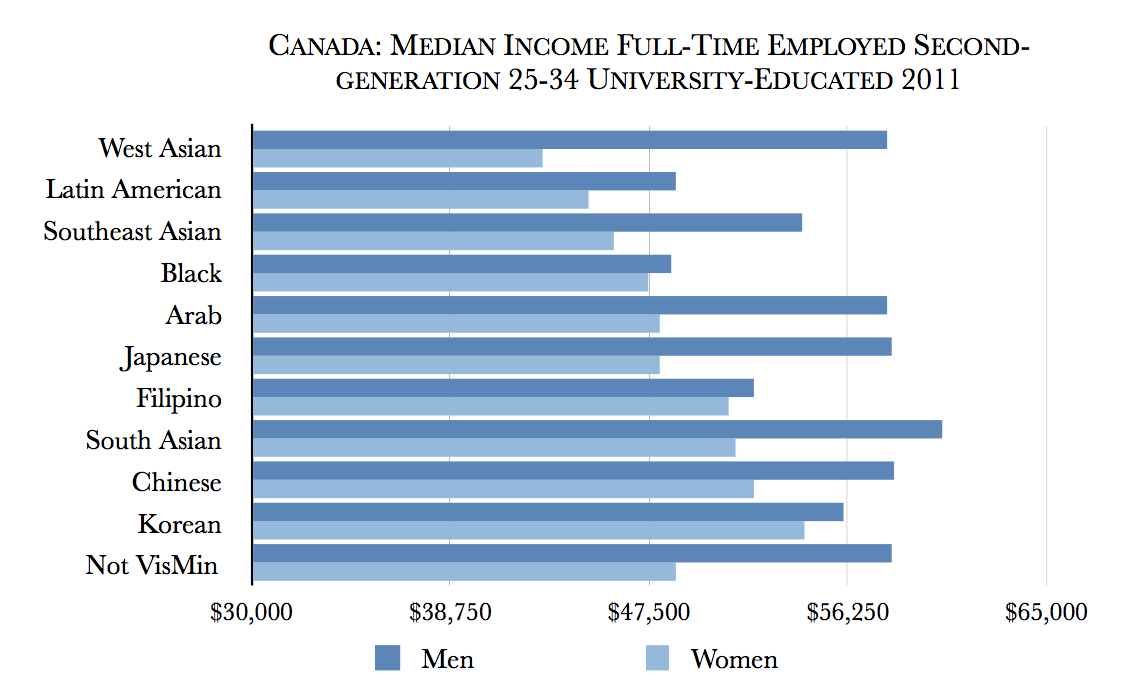
2G_University_Educated_25-34In some cases (i.e., percentage university-educated), the second-generation does significantly better than non-visible minority Canadians. And those that find employment have comparable median salaries.

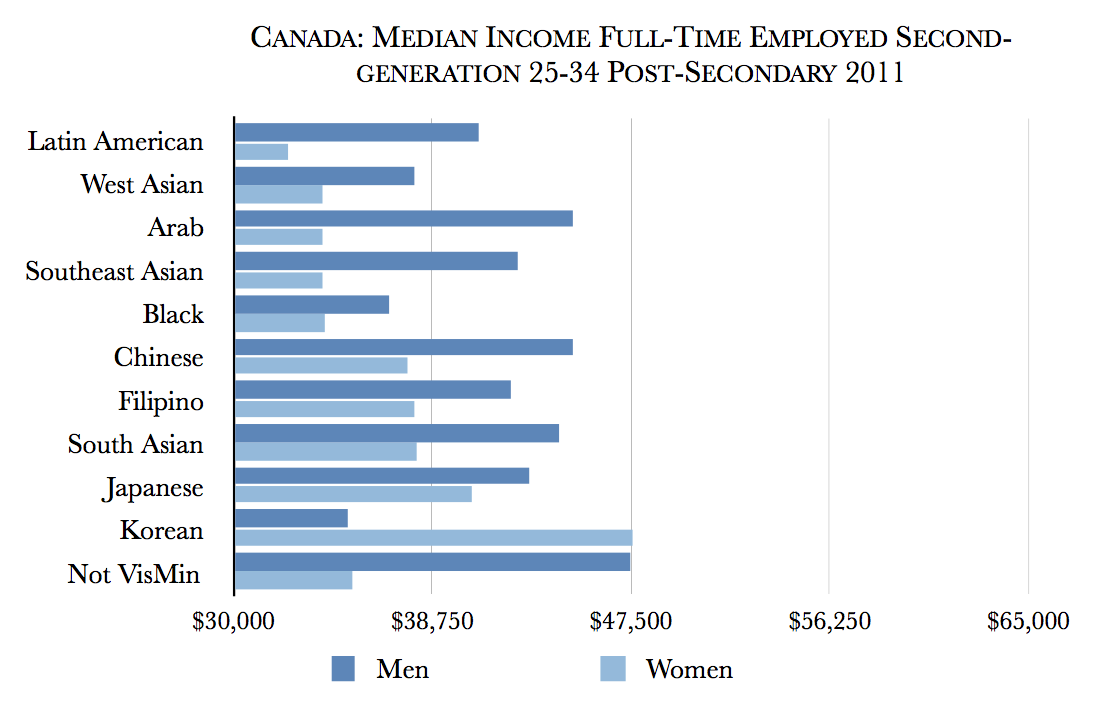
However, the second generation has higher unemployment rates than non-visible minority Canadians. Those that are not university educated have lower median incomes, as shown in the chart below:
2G_Non-Univ_Educated_25-34This is not to mentioned the well-documented instances of discrimination in hiring, police carding and other areas that show significant differences between visible minorities and others.

So while as a ‘value statement,’ one may prefer to refer second-generation immigrants as non-immigrants, this effectively masks some of the ongoing integration challenges that some elements face.

And while I fully agree with Jack that comparisons with Europe are often inappropriate given our differences in history, geography and identities, we do, like other ‘new world’ countries, view ourselves as countries of immigrants, unlike Europe. And this, with the exception of the USA, both reflects and influences how we deal with integration.

Measuring and contrasting the outcomes of both first and second generation outcomes provides useful international and internal benchmarks allow us to identify ongoing integration challenges with a view to overcoming them. Not making the distinction obscures them:

But there a significant segment of the Canadian-born population that sometimes wrongly gets labeled as immigrants. I refer specifically to persons born in Canada of foreign-born parents (a group to which I belong). Much social science literature in Europe refers to these children of immigrants as “second generation immigrants”. To many North American observers the term must seem like an oxymoron. It nonetheless gets employed by a number of Canadian scholars.

There are statistical breakdowns in the census of Canada on the basis of generational status. Immigrants are generally designated as the first generation, their children as second generation and there is a category for third generation or more. It’s inaccurate to refer to second generation Canadians as something other than non-immigrants with whom they are grouped in the census question on immigrant status.

The confusion that is created by designating them as “second generation immigrants” is sometimes influenced by European analysis with the practice in several EU countries of not automatically conferring citizenship on persons born in the country. For example, children born in France of foreign-born parents do not become citizens until reaching the age of the majority. Switzerland does not automatically extend citizenship to a child that is born in the country. Rather, a person is automatically Swiss if at least one of the child’s parents is Swiss.

Relatively few Canadian scholars that use the term second generation immigrants necessarily think of such individuals as immigrants. Rather most simply echo terminology that is used in some of the Canadian literature on immigration and citizenship and/or seek to engage with European policy-makers or scholars by employing a common vocabulary. But the Canadian-European comparisons can be problematic and regrettably they sometimes don’t make for good scholarly work.

Is Canada a nation of immigrants? It is certainly a nation with many immigrants who have played a critical role in the process of nation-building. But it is simply too limiting a concept when “the nation of immigrants” conveys the idea that immigration is the country’s principal defining characteristic.

Source: Is Canada A Nation Of Immigrants? | Jack Jedwab

Rights groups call for oversight of Canada border agency

Another due process pressure point on the Government:

Civil society groups proposed a model Thursday for independent oversight of the Canada Border Services Agency, following the deaths of two immigration detainees in March.

Recent revelations that the CBSA had fully implemented just one of the 19 recommendations from a coroner’s inquest examining the 2013 death of Lucia Vega Jimenez at the Vancouver airport are another indication that the border agency is in need of oversight, said Josh Paterson of the B.C. Civil Liberties Association.

The CBSA is the only law enforcement agency in Canada that has no independent oversight body, noted Canadian Association of Refugee Lawyers president Mitch Goldberg, even though officers generally have more power and less training than police.

An oversight body for the CBSA would need to be independent of political influence and have legal power to both investigate and monitor CBSA activities, said Canadian Council for Refugees president Loly Rico. The council has proposed a model for a CBSA oversight body, recommending that it have the ability to receive and review complaints from citizens and non-citizens about their interactions with the CBSA, compel CBSA to share information, and make recommendations to the Public Safety Minister.

Canada has been criticized by three United Nations agencies in the last four years over its treatment of immigration detainees, said Alex Neve, secretary-general of Amnesty International Canada. Some of the practices criticized by the United Nations included the practice of keeping children in detention, the lack of a limit under Canadian law on the amount of time an individual can be detained, and the country’s extensive use of immigration detention, when it should be a last resort, Neve said.

“That is a very strong signal that Canada’s immigration detention system is broken,” he said, adding that it is “unconscionable” that there is no independent oversight of CBSA.

Source: Rights groups call for oversight of Canada border agency

International-student work program needs overhaul, report says

Great example of some of the in-depth research and analysis that IRCC/CIC do, and the importance this work can and should have in ongoing policy development and program design.

However, highly disturbing that the release of such research took a nine-month battle between the Globe and IRCC/CIC. It is one thing to apply ATIP liberally with respect to advice to a Minister (decision or information memo), quite another to research. Questionable ethics for all involved, and hopefully the current Government will deliver on its commitment to greater openness:

A program that allows international students to work in Canada after graduation is creating a low-wage work force, encouraging low-quality postsecondary programs, and needs to be redesigned, says an internal report from Citizenship and Immigration Canada.

Under the Post-Graduation Work Permit Program international students with degrees from Canadian colleges and universities can work here for up to three years after their programs end. Between 50 per cent and 60 per cent of eligible international students applied for a work permit, the report says, with more than 70,000 people holding permits in 2014.

The program is designed to make Canadian postsecondary institutions an attractive destination and to give international students work experience, making it easier to apply for permanent residence.

But the 35-page report found that the majority of those employed through a work permit are in low-skilled jobs in the service sector, and have median earnings that are less than half of other recent university and college graduates.

“Facilitating this large pool of temporary labour, largely in low-paid positions, may be in conflict with the objectives of the Putting Canadians First strategy,” the report states.

That strategy was initiated by the former Conservative government to prioritize employment for Canadians after abuses of the temporary-foreign-worker program came to light. The Post-Graduation Work Permit (PGWP) report was commissioned as part of a larger review of temporary-foreign-worker policies.

The Globe and Mail obtained the report after a nine-month battle. The government initially refused the request. After an appeal to the Information Commissioner of Canada and discussions between the commissioner, Citizenship and Immigration Canada and the newspaper, the government provided a partly redacted version of the report.

Marked “secret,” the report reviews six years of the work-permit program, from 2008 to 2014. It raises many questions about how Canada attracts international students and how they transition to citizenship.

Its findings are likely to complicate the recently announced review of how the new Express Entry immigration system is treating international students who want to become permanent residents. Express Entry, introduced in January, 2015, does not award applicants any extra points for studying in Canada, as had been the case under a prior immigration program for international students. As a result, it has been heavily criticized for making it much harder for international students to become permanent residents.

Earlier this month, John McCallum, Minister of Citizenship and Immigration, said the government is launching a federal-provincial task force to look at how Express Entry can better serve this group.

“International students have been shortchanged by the Express Entry system,” he said at the time. “They are the cream of the crop in terms of potential future Canadians …”

The PGWP report, however, suggests that most international students’ investment in a Canadian education is not being rewarded by the labour market.

International students with a work permit had median earnings of $19,291 in 2010, compared with about $41,600 for 2013 domestic college graduates and $53,000 for Canadian university grads, according to the review.

Source: International-student work program needs overhaul, report says – The Globe and Mail

Canada’s tech startup sector wants easier access to hire top foreign talent

Yet some more expected tweaks to Express Entry:

After winning a big concession in the budget on taxing stock options, Canada’s tech startup sector is braced for its next battle: urging Ottawa to fix immigration rules that limit its ability to hire top foreign talent.

The Express Entry system brought in by the last government in 2015 “is fundamentally too rigid” and leaves employers waiting up to six months to discover if they can bring skilled foreign talent to Canada, said Tobi Lutke, CEO of Ottawa-based software firm Shopify Inc. “That puts us at a huge disadvantage for recruiting internationally.”

Under policy changes enacted by the Conservatives, employers now must validate a job offer by getting government approval for a “Labour Market Impact Assessment” – showing it couldn’t find Canadians to do the job. While that approach targeted abusers of the temporary foreign worker program, it meant fast-growing tech firms searching for the best employees globally had to submit to the same drawn-out process, only to be told in many cases by Ottawa that they should just hire a Canadian.

“It was a misguided approach,” said Sarah Anson-Cartwright, director of skills and immigration policy for the Canadian Chamber of Commerce.

Immigration Minister John McCallum wasn’t available to comment. But a department spokesman said the government plans to review the Express Entry program “to see how it can be improved for potential immigrants such as top-level foreign executives. The review will include, likely among other things, the LMIA requirement.”

Tech startup leaders say the rules not only add delays but that the process lacks transparency and consistency, imposes needless bureaucracy and lacks an appeals process. In many cases, would-be recruits choose other offers rather than waiting. Foreign students awaiting government approval for their job offers sometimes must leave Canada when their study visas expire.

Six out of 10 employers surveyed by the Canadian Employee Relocation Council (CERC) last year said the immigration changes under the Tories had hindered their strategy planning and recruiting. One out of six opted to create the jobs abroad instead.

Curious to know the relative competitiveness of Canada vis-a-vis the US, given my understanding of the problems Silicon Valley has in hiring global talent.

Source: Canada’s tech startup sector wants easier access to hire top foreign talent – The Globe and Mail

ICYMI: Deportations to Jamaica, Honduras could hurt Canada

The possible longer-term impact of the populist policy to deport criminals:

Experts in Canada and Jamaica told the researchers that the ability of deportees to obtain jobs, housing, education and health care heavily influenced their ability to reintegrate and whether criminals would continue to take part in illicit activity upon their return.

“The great difficulty with properly reintegrating criminal deportees has ultimately contributed to deportee-related problems with unemployment, homelessness, inadequate housing, property crime, mental health and addiction,” one study says.

Jamaica has returned to prominence as a major shipment point for cocaine originating in South America, posing concerns for Canadian police, the researchers add. The organized-crime landscape has also expanded beyond drugs to lucrative lottery scams that directly target Canadians.

It’s one thing to deport someone with no real connection to Canada, but quite another to return a person who has grown up in Canada, said Toronto immigration lawyer Lorne Waldman.

“It’s completely unacceptable that we’re dumping our social problems back in Jamaica,” Waldman said.

“I think the time has come for our government to really reassess this policy.”

Deportees to Honduras return to a country that is facing urgent humanitarian problems, a proliferation of street gangs and organized groups involved in the hemispheric drug trade, the other study says. The extremely challenging economic conditions, social stigma and threat of violence make it difficult to build a new life.

A number of Honduran organizations offer social services to deportees, but they lack resources and cannot keep up with the massive flow of returnees, particularly from the United States, the study says. “Canada can play an important role in international efforts to support deportees and the Honduran authorities, while pushing for broader security and justice reform in Honduras.”

The studies also point out that privacy law limits the information about returnees the Canada Border Services Agency can share with officials in other countries, potentially hampering reintegration. However, they add the RCMP may be better placed to pass along information through its international channels.

Source: Deportations to Jamaica, Honduras could hurt Canada – The Globe and Mail

Plenty of blame to go round in real estate crisis: Mason

The (valid) criticism of governments continues.

But at least, the planned StatsCan study will illustrate the extent to which (mainly Chinese) immigration has contributed to increased housing prices:

The B.C. government recently vowed to crack down on real estate agents involved in nefarious practices such as shadow flipping that help to drive up prices. But this is a small measure that will do absolutely nothing to improve affordability. Its primary purpose is to improve optics: Look, everyone, Premier Christy Clark is finally doing something about this mess. The Premier also asked B.C. Housing to look at the impact of foreign investment in the market.

In this week’s federal budget, meanwhile, $500,000 was set aside to help Statistics Canada determine the best way to collect data on international buyers.

It would be comical if it weren’t so sad.

Others, meanwhile, aren’t waiting. This week, two economists from the National Bank produced a study showing as many as one-third of house purchasers in Metro Vancouver last year were from China. But perhaps the most interesting numbers to be revealed lately concern the impact that the immigrant-investor program – both the one run for years by Ottawa (and terminated in 2014) and another that still exists in Quebec – has had on the real estate madness we are witnessing.

Under the program, immigrants can come to Canada in exchange for $800,000, up front, that serves as a five-year loan to the government. The report, brought to light by Ian Young of the South China Morning Post, reveals how completely porous and unaccountable the immigrant-investor system has been. Truly awful might be another way to describe it.

For example, after 10 years the average annual income tax paid by these millionaire migrant investors is $1,400. That compares with $7,500 for the average Canadian. The report notes that after five years, many of these investors have secured Canadian citizenship and returned to their home country.

Quebec accepts about 1,750 such applications annually. After handing over their $800,000, most move to Vancouver and buy real estate. The vast majority of all who have taken advantage of these programs over the years have ended up in British Columbia (by one estimate, nearly 200,000).

Those who have come to Canada acknowledged to federal researchers that their primary motivation for obtaining citizenship was as a hedge against political or economic upheaval occurring in their home country.

The federal government has known about the impact the investor pipeline was having on things such as real estate and didn’t care. It was more than pleased to sell Canadian citizenship to the wealthy. The B.C. government, meanwhile, is only too happy to take rich immigrants through the investor back door that continues to be provided by Quebec. It doesn’t care that it isn’t seeing any of the loan money that immigrant investors have to pay; it is making tens of millions from the insane escalation in real estate prices these immigrants have set off.

Canadians should be furious that their governments allowed this to happen. Now all that these same governments can do is introduce lame measures that will have no meaningful impact on housing prices, but rather are designed to show that government is on the problem!

Except they’re not. And never have been. And hopefully history will judge them harshly for that.

Source: Plenty of blame to go round in real estate crisis – The Globe and Mail

Study likely to fuel debate on foreign home buyers

One of the small, low-cost, but important initiatives in the budget, along with some estimates from economists regarding the extent of the issue. Better data means better decisions:

New funding from Ottawa to help remedy what economists call an “astonishing lack of data” about international investment in Canadian real estate amounts to less than the down payment on an average detached house in Vancouver, despite signs the country’s most expensive housing markets are witnessing a significant influx of foreign buyers.

Responding to Tuesday’s federal budget, National Bank of Canada economists Peter Routledge, Parham Fini and Paul Poon estimate that the Liberal government’s promise of $500,000 for Statistics Canada to study the issue of foreign investment in the housing market amounts to just 27.5 per cent of the average $1.8-million price of a detached home in the Greater Vancouver Area. (It equates to just 18 per cent of the $2.87-million average price of a detached house in the City of Vancouver, or less than the required minimum 20-per-cent down payment.)

Still, they say the funding, enough for Statscan to spend one year examining ways to collect data on international buyers, is a welcome change to help address what has become a “politically delicate” issue in a country that prides itself on having an open economy and immigration system.

In an analysis that is likely to add fuel to that political debate, the economists conducted their own research showing that as many as one-third of all home purchases in the Vancouver region last year and 14 per cent in Toronto came from buyers in China.

Without any Canadian-specific data on foreign investors to go on, the economists came up with their estimates by extrapolating from two international surveys of realtors and buyers.

One is an annual report on the level of foreign home-buyer investment by the National Association of Realtors, based on surveys of real estate agents in the United States. It estimates that Chinese investors bought $28.6-billion (U.S.) of real estate in the U.S. housing market between March, 2014, and March, 2015, a seven-fold increase from the $4.1-billion they spent in 2009.

The second is a multiple-choice survey by the Financial Times of 77 wealthy Chinese investors who had bought real estate outside of China. Of those, 33.5 per cent said they bought homes in United States, while 11.7 per cent invested in Vancouver and 8.3 per cent in Toronto.

Combining the two surveys, the economists estimate that Chinese investors spent roughly $9-billion (Canadian) on home sales in the Greater Toronto Area last year, or 14 per cent of all total sales volume in the region.

In the Greater Vancouver Area, they estimate Chinese investors spent $12.7-billion – or 33 per cent of total sales. That figure, they say, lines up with research from B.C. urban planner Andy Yan, who found that 66 per cent of all sales of 172 detached homes in three west-side Vancouver neighbourhoods within a six-month period were to buyers with non-Anglicized Chinese names.

The economists admit their survey is somewhat unscientific, but say such attempts highlight the importance of collecting better data on the influence of foreign investment, and even immigration, on housing market affordability.

Source: Study likely to fuel debate on foreign home buyers – The Globe and Mail

Study reveals awfulness of Canadian investor immigration; income tax averages C$1,400 per millionaire | South China Morning Post

More on Vancouver real estate and investor immigration:

Yet other resultant economic activity is scant – in fact, investor migrants’ favourite “business” is real estate ownership.

Average annual income tax paid by millionaire migrants was C$1,400. No, that isn’t missing a zero

That’s just one finding of a Federal government evaluation of the Chinese-dominated investor schemes, quietly published in October 2014. I can find no reference to the 103-page report in any media; two leading academics who have studied the schemes for years were unaware of it before I forwarded it to them this week.

A skinny internal report on immigrant employment earnings, dating from 2012, gave a hint of what many suspected about the investor schemes, whose only real requirement of applicants was a willingness to hand over a pile of cash (latterly, C$800,000) as a five-year loan to Canada. But the latest data is depressingly comprehensive.

Among other things it reveals that 10 years after admission, the average annual income tax paid by millionaire migrants’ primary breadwinners was C$1,400. No, that isn’t missing a zero. The true average is even lower – since one-third did not file tax returns.

Compare that to the C$10,900 paid by skilled worker immigrants, or the C$7,500 paid by Canadians on average.

 Millionaire migrants’ average taxable income from all sources peaks at C$19,500 three years after arrival, but then defies the trend of other immigrant classes by falling sharply, to C$15,800 after 10 years. The report notes “increasing rates of out-migration after five years (especially among investors) may indicate a relationship with obtaining citizenship … a share of these immigrants wait to obtain Canadian citizenship to move out of the country.”

The Quebec backdoor: still open, still ripping off BC

Why does this matter? Wasn’t the federal IIP shut down? Yes, but the QIIP continues to operate and has always been the biggest component of investor migration to Canada. In fact, with 1,750 applications accepted annually, and a hefty backlog, Quebec’s immigration department is on track to funnel about 1,400 new millionaire households to Vancouver per year; that’s down from the 2011 peak, but is about the same average level the city received under both the federal and Quebec schemes in the past decade.

Source: Study reveals awfulness of Canadian investor immigration; income tax averages C$1,400 per millionaire | South China Morning Post

The Daily — Study: Immigration, business ownership and employment in Canada, 2001 to 2010

Another interesting and useful study (see the earlier Immigrants took the brunt of recession-year turn toward self-employment):

Immigrants who have been in Canada for more than 10 years have higher rates of private incorporated business ownership than individuals born in Canada. However, the types of businesses owned by immigrants tend to employ fewer paid workers than those owned by individuals born in Canada, according to a new study.

Rates of business ownership are relatively low among immigrants during their initial years in Canada, but, over time, these rates surpass those for individuals born in Canada.

Among immigrant taxfilers who had been in Canada for 10 to 30 years in 2010, about 6% were owners of private incorporated businesses that employed paid workers. This compares with about 5% of Canadian-born taxfilers. But, while immigrant-owned private incorporated businesses employed, on average, about four paid workers, those owned by Canadian-born individuals had about seven paid workers.

Of all immigrant-owned private incorporated businesses, 45% were located in four industries: professional, scientific and technical services; retail trade; accommodation and food services; and transportation and warehousing. One-third of private incorporated businesses owned by Canadian-born individuals were in these four industries.

The rate of unincorporated self-employment was also higher among longer-term immigrants (22%) than among individuals born in Canada (16%). When restricted to individuals who received at least one-half of their total earnings from unincorporated self-employment—defined as primary unincorporated self-employment—these rates were 12% for the longer-term immigrants and 8% for individuals born in Canada.

Immigrants who were principal applicants in the business class had the highest incidence of incorporated business ownership or primary unincorporated self-employment, with a combined rate of 40%. Among principal applicants in the economic class, the combined rate was 17%, while among both family-class immigrants and refugees, it was 15%.

Source: The Daily — Study: Immigration, business ownership and employment in Canada, 2001 to 2010

McCallum n’est pas surpris de l’accueil réservé à Le Pen

Reinforcing the message:

Le ministre fédéral de l’Immigration, John McCallum, croit qu’en refusant de rencontrer Marine Le Pen lors de son passage au Canada, les politiciens ont fait comprendre à la chef du Front national « qu’au Canada, on n’est pas d’accord avec elle ». Concernant l’accueil des 25 000 réfugiés syriens au pays — « de la folie », selon Mme Le Pen —, le ministre McCallum estime que le message est tout aussi clair. « Il y a un bon consensus parmi la classe politique au Québec et au Canada en faveur de ces réfugiés. Donc le fait que les politiciens ne veulent pas lui parler ne me surprend pas », a-t-il affirmé lundi.

De passage à Saguenay, le premier ministre Philippe Couillard a pour sa part rappelé que Mme Le Pen n’occupe aucune fonction au sein du gouvernement français et qu’il n’a pas l’intention d’entamer un débat avec elle.

Source: McCallum n’est pas surpris de l’accueil réservé à Le Pen | Le Devoir