ICYMI – Enquête: le Montréal des sans-papiers

One of the relatively rare articles that I have seen regarding sans-papiers. And being undocumented, we have no good data on how many there are:

Nous les croisons sans les voir dans les rues de Montréal. Ils font le tri de nos rebuts, récurent les toilettes de nos cliniques médicales, passent l’aspirateur, la nuit, dans les couloirs de nos bureaux. Ils sont des dizaines de milliers, mais ils sont invisibles. Sans eux, l’économie de la ville subirait un dur coup, puisque ces travailleurs de l’ombre occupent les emplois dont personne ne veut. Sans le moindre filet de sécurité. Bienvenue dans le monde occulte des sans-papiers de Montréal.

Les travailleurs invisibles

Alors qu’un flot de demandeurs d’asile, apeurés par le national-populisme de Donald Trump, déferle à la frontière canado-américaine, alors que Denis Coderre déclare Montréal «ville sanctuaire», nous avons voulu mettre en lumière le quotidien des sans-papiers. Nous avons découvert que Montréal est encore loin d’être la terre d’asile proclamée par le maire. À bien des égards, elle est moins hospitalière que des métropoles américaines comme Los Angeles et New York, qui ont depuis longtemps adopté des politiques concrètes pour soutenir les sans-papiers sur leur territoire.

Montréal suivra bientôt les traces de ces villes américaines en offrant divers services et, surtout, en limitant au maximum la collaboration de ses policiers avec les agents d’immigration, a assuré le maire Coderre.

Mais ce n’est encore qu’un projet. Pour le moment, 70% des sans-papiers de la métropole n’arrivent peu ou pas à satisfaire leurs besoins personnels ou ceux de leur famille, révèlent les données préliminaires d’une étude menée par l’Institut de recherche en santé publique de Montréal. Près de la moitié d’entre eux manque carrément de nourriture. Et 40% craignent d’être déportés s’ils tentent d’obtenir des services publics.

Cette crainte pesante, omniprésente, les pousse à tolérer les abus de ceux qui profitent de leur vulnérabilité, en sachant parfaitement qu’ils n’ont pas le loisir de se plaindre.

Source: Enquête: le Montréal des sans-papiers | Isabelle Hachey | Enquêtes

Canada supports a ‘values’ test. But not the values of the far right. – Terry Glavin

Glavin’s take on the Macleans’ poll and what it says about Canadian values:

It is a delicious paradox and it’s wholly counterintuitive. What’s one of the strongest feelings expressed by the otherwise liberal, laid-back and largely contented people revealed by our poll? It’s in the survey respondents’ support for a proposition most closely associated, fairly or not, with Canada’s disgruntled, anti-immigrant, Islamophobic fringe.

A whopping 84 per cent of respondents agreed with the statement, “New immigrants to Canada should be screened to ensure they share Canadian values.” Almost 50 per cent “strongly” agreed. That’s a higher register of strong feeling than the survey elicited in any other policy-related question.

Peculiar to the far-right edges of the Conservative party, the specific proposal to subject prospective immigrants to a “Canadian values” assessment in face-to-face interviews was a major plank in party leadership candidate Kellie Leitch’s campaign. Opposed by several other candidates and derided by Liberals and New Democrats as a dog whistle to bigots, Canadians, it would seem, are for it, with gusto. Only five per cent of survey respondents “strongly” disagreed with the proposition. That’s a slam dunk.

But here’s the paradox: It turns out that the “Canadian values” revealed in our poll are dramatically at odds with the values espoused by the loudest proponents of an immigrant “values” test. In other words, Canada’s rednecks should be careful what they wish for.

Almost all of the 17 primary values questions put to poll respondents elicited enthusiasm in varying degrees for “progressive” values and ambivalence about almost everything else. If it’s “Canadian values” you want embraced by the roughly 300,000 people who emigrate to Canada every year, you’ll have to screen out almost everybody except for liberals.

Source: Canada supports a ‘values’ test. But not the values of the far right. – Macleans.ca

Indian officer’s denial at Canadian border a mistake, federal government says

Mistakes happen. Recognition and correction depends in part about level of person affected and nature of representation:

The federal government is admitting border officials made a mistake when a retired anti-insurgency officer from India was deemed inadmissible to Canada and denied entry.

Days later, after an outcry from Indian officials, the officer was suddenly reissued a visa and flown back to Toronto.

In a statement in May, Canada’s High Commissioner to India, Nadir Patel, expressed “regret” about the incident but would not reveal the rejected visitor’s identity citing privacy protection. Immigration officials subsequently confirmed the person as Tejinder Singh Dhillon.

Dhillon, a retired senior officer with the Central Reserve Police Force (CRPF), India’s largest paramilitary force under the home affairs ministry, was refused admission in May at the Vancouver airport on the way to his niece’s wedding in Toronto.

Canada border officials explained the refusal by indicating on a form letter that the 67-year-old had served a government that engages or has engaged in terrorism, human rights violations, crime against humanity or genocide.

The incident immediately caused diplomatic ripples between New Delhi and Ottawa, prompting Canadian officials to issue not just a new multiple-entry visa to Dhillon but a plane ticket for his return.

“Such a characterization of a reputed force like the CRPF is completely unacceptable.  We have taken up the matter with the Government of Canada,” a foreign ministry official told Indian media.

Patel said the refusal was a mistake on Ottawa’s part.

“Over the past year, over 300,000 Indian nationals have applied to visit Canada. From time to time, with such a large number of applications, oversights on visa applications can happen which is regrettable,” Patel wrote in a statement.

“Form letters in use by the Government of Canada include generic language taken from Canada’s legislation. In this case, the language does not reflect the Government of Canada’s policy toward India or any particular organization. . . The Central Reserve Police Force plays an important role in upholding law and order in India.”

Anirudh Bhattacharyya, who interviewed Dhillon and reported the story from Toronto for the Hindustan Times, said Dhillon complained Canadian officials treated him in an “unreasonable and indecent manner, accusing him of having either participated or having knowledge of CRPF’s human rights violations.

“It is very upsetting. I have seen many crises, but this is very difficult to bear,” Dhillon told Bhattacharyya in an interview.

Source: Indian officer’s denial at Canadian border a mistake, federal government says | Toronto Star

Liberals face pressure to crack down on crooked immigration consultants

More on the problems of immigration consultants (see earlier Agency that oversees immigration consultants appears to be in turmoil):

The government is facing pressure from MPs of all political stripes to crack down on bogus immigration consultants who prey on people who are desperate to work or live in Canada.

The Commons immigration committee has just wrapped up weeks of hearings on unregistered representatives called “ghost consultants.” MPs are now considering recommendations ranging from overhauling or even scrapping the independent oversight body, to imposing heavier penalties for perpetrators.

Members heard harrowing stories from duped clients who testified behind closed doors. Some were ripped off for thousands of dollars, or brought over with the promise of work only to be dumped at the side of the road or left in a warehouse. In all, they heard from 50 witnesses and read 24 written submissions.

Liberal MP and committee chair Borys Wrzesnewskyj said testimony about crooked and ghost consultants made it clear the status quo can’t continue.

“There is an appetite to fix this. It’s just not acceptable that the present set of circumstances continue,” he told CBC. “It won’t be an easy job. The fact that it’s been studied a number of times and we’re still having to listen to circumstances and their very poignant stories speaks to that.”

Wrzesnewskyj hopes the committee can table its report, which is expected to include recommendations for sweeping reforms, before the House rises for the summer.

Conservative immigration critic Michelle Rempel believes there is broad consensus that the current system is broken and needs an urgent fix. The “hair-curling” stories heard underscore the need for major reforms.

Blacklist for bad actors

While there are many above-board immigration consultants, their reputation has been stained by reports of unethical representatives preying on vulnerable people.

Along with suggesting a possible blacklist for bad practitioners, Rempel said the government must work to modernize and simplify the complex system so people can navigate it themselves instead of turning to third parties.

“More broadly, the fact that there even needs to be an industry suggests there are a lot of improvements that could be had within the actual department in terms of ease, efficacy of approaching the Canadian immigration system,” she said.

Rempel said testimony about significant governance problems with the Immigration Consultants of Canada Regulatory Council (ICCRC), which was established in 2011 to oversee registered consultants, raised questions about its ability to fulfil its mandate.

Source: Liberals face pressure to crack down on crooked immigration consultants – Politics – CBC News

Newcomers grabbing at Canada’s brass ring: Canada Project findings

Some of the interesting points regarding newcomers:

One of the key findings from a Canada Project poll is that 44 per cent of immigrants have access to over $10,000 in savings. That far exceeds the 27 per cent of multi-generationals who say they do—and that didn’t surprise the two women. “The anxiety and instability is always there for immigrants,” says Maramba. “So, having access to a chunk of funds that’s easy to access is a priority for us. It’s a ‘protection-from-instability fund’, a ‘just-in-case fund’ if we have to go home on short notice to see mom and dad, or help the family in other ways back home.”

Another key finding from the poll, a partnership led by Maclean’s and includes MoneySense, came when it asked the question: ‘For most transactions, how do you prefer to pay?’ In this case, 67 per cent of those who identified as immigrant respondents replied ‘credit’ whereas only 55 per cent of first generation Canadians did. “This can be explained by the immigrant’s desire to build a strong credit history,” notes Yap. “It’s almost as if we need to catch up with the local-born Canadians who have had their credit cards from the start.”

Many immigrants come from countries where the banking system is quite different from Canada’s. The importance placed on property ownership, both as a hold of value and as a status symbol, is amplified by Asian immigrants who are more likely to own their own home and have property investments—a key reason why as many as 81 per cent of immigrant poll respondents say they feel happily middle class.

Bernice Cheung, a Vice President of Cultural markets and Financial Services at Environics Research in Canada notes another reason for the financial success of immigrants. “Established immigrants, meaning those who have been here 11 years or more—often fare better than native born Canadians,” says Cheung.

“I’d say it’s likely because education and the strong work ethic are strongly valued, and better incomes often come with better educations and hard work.” Cheung, who conducts the 2017 Financial Services Among New Canadians Study, also mentions the Tiger Mom phenomenon, defined as a very strict, very disciplined, high-expectations family upbringing. “Especially for those coming from Asian countries, the desire to achieve is very highly placed,” she says.

…Certified financial planner Heather Franklin has seen the same disciplined approach to getting ahead amongst her own immigrant clients. “It’s important to them to do well, whereas for Canadians born here, it’s more about keeping up appearances and ‘keeping up with the Jones.’ Immigrants value hard work, a home and security—not all the bells and whistles.”

These days, immigrants have a lot of help getting them started in building wealth and financial success in their new country and most Canadian banks have newcomer packages. “Set up a chequing account in the first few weeks of your arrival,” advises Cheung to immigrant newcomers. “After all, before you can apply for a credit card, mortgage or personal loan, and before you can start building up your Canadian credit history, you need an account.” Often these newcomer banking packages mean they won’t charge monthly account fees for the first six-to-12 months and they’ll give immigrants discounts on other financial products like safety deposit boxes or auto insurance.

….As well, Newcomers should consider attending seminars hosted by banks on taxation, credit cards, Tax-Free Savings Accounts (TFSAs), Registered Retirement Savings Plans (RRSPs) as well as other tax deferring vehicles. “It’s also helpful to have a financial advisor set up a financial plan, starting with learning to use a TFSA,” says Cheung. Maramba agrees, adding that she found it beneficial to visit a fee-for-service financial advisor who gave good financial advice and didn’t simply take her money for selling her investments.

The Canada Project

In the bigger economic picture, Canadians should be very happy with social policy issues that see Canada welcoming about 300,000 immigrants a year. “Without immigration there is no growth,” says Cheung. “Without immigrants, Canadians will become a rapidly aging country, and the economy will decline. A healthy immigration policy is key to a healthy economy and more prosperity for everyone.”

Source: Newcomers grabbing at Canada’s brass ring – Macleans.ca

A Bargain Price on American Citizenship – Diplomatic Courier

Another good analysis of the US EB-5 immigrant investor program:

Of all the innovations and new products that have breached the competitive global market, U.S. citizenship is now one of them. As part of a sales pitch presented at an investment conference in Beijing, Nicole Kushner Meyer (sister of Jared Kushner, President Trump’s son-in-law and a top White House adviser) offered American citizenship in return for a $500,000 investment.

The only scandal about this is that the offer is completely legal. How? Through the EB-5 visa program. According to U.S. Citizenship and Immigration Services website, this 25-year-old EB-5 Immigrant Investor Program grants immigrants a path to a green card if they invest $1 million into a project that creates 10 or more U.S. full-time jobs. However, the minimum investment price drops to $500,000 if the development is “within a high-unemployment area or rural area in the United States.”

After two years, a foreign investor with an EB-5 visa can prove he or she put $500,000 into a developing or high unemployment area and created ten American jobs. Once that proof is confirmed, the investor is finally issued a Green Card, meaning permanent residency status that transforms into citizenship after five years. Fast and easy, if you have the money.

While Nicole Kushner Meyer’s dropping of her brother’s name and political ties have stirred up an ethical debate, the United States is not the only nation to advertise residency via an EB-5-esque immigration program. So you want to be a citizen of the Netherlands? That’ll $1.4 million, please. What about France? $10 million and a two-month wait. According to a studyby Allison Christians, citizenship by investment around the world range from $5.4 million in Russia to as low as $5,000 in Paraguay. On average, the price of citizenship is approximately $1 million internationally. However, the program has been accused of being susceptible to fraud and abuse with little oversight. Developers, such as the Kushner Company, can get investments offering very low rates of return because the investors are getting something they care about even more: U.S. citizenship.

While the EB-5 offers a simplified and expedited route to citizenship, the unfortunate truth is that for many entering the United States, $1 million is not exactly petty pocket cash that can be thrown into an ambiguous investment. It seems that the path to citizenship is different for those bringing economic capital and jobs into the country. Their stimulation of the domestic economy is so valued that the government rewards their investment in America’s continued growth with U.S. citizenship. A Department of Commerce review of EB-5 shows that in calendar years 2012 and 2013, more than 11,000 immigrant investors provided $5.8 billion in capital, roughly 35% of the total investment ($16.7 billion), for 562 EB-5 related projects, creating an estimate total of 174,039 jobs. In essence, the government is financing private real estate developers.

Although the EB-5 visa program received bipartisan support for its termination at the end of April, President Trump recently signed a bill to extend that program through the end of September. While attracting foreign investment and generating jobs in the U.S. is undoubtedly supported, advocates for the end of EB-5’s exploitation propose better options, like thoughtful tax and regulatory policies that open the U.S. for more pro-business opportunities rather than through the sale of something quite invaluable: the right—and privilege—to be an American citizen.

Source: A Bargain Price on American Citizenship – Diplomatic Courier

Half of the most highly valued tech companies in the U.S. were founded by immigrants – Recode

Speaks for itself:

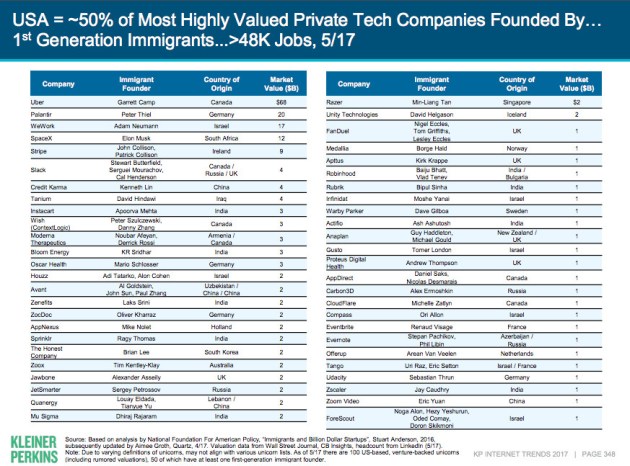
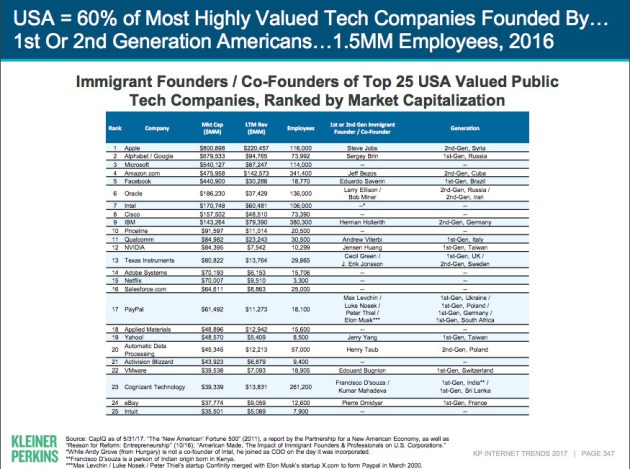
It turns out immigration is a boon for innovation in the United States. Sixty percent of the highest-valued tech companies were co-founded by first- or second-generation immigrants, according to Kleiner Perkins Caufield & Byers partner Mary Meeker’s annual internet trends report, which she presented at the Code Conference at Terranea Resort today.

Mary Meeker internet trends report

That number is still pretty high even if you count just first-generation Americans. Half of all of the most valuable private tech companies in the United Sates were co-founded by immigrants — including Uber, SpaceX, Instacart, AppNexus and FanDuel.

Mary Meeker internet trends report

Source: Half of the most highly valued tech companies in the U.S. were founded by immigrants – Recode

Immigrants in Canada, and the secrets some of us keep [servants]: Gelek Badheytsang

Interesting reflections if a bit over wrought:

“My Family’s Slave” came to me at a time when I was already thinking about immigrants and the intimate, complicated relationships many of us have with this notion of worthiness in our new homes—the entrapping idea of the “model immigrant”. The narratives that colour and contour our identities in Canada—of being resilient, enterprising, marginalized, inspiring, vilified, grateful, and so on—are underpinned by the subtle and not-so-subtle understanding that we have to constantly prove why we belong here. Our Canadian passports may feel solid to the touch, but they can also feel conditional and notional—even if you were born here.

And so, of course, it makes sense then that we are always trying to scrub clean the parts of us that we deem unsightly, and buff up our exceptionalism as much as we can. This is reflected early on in Tizon’s essay:

“To our American neighbours, we were model immigrants, a poster family. They told us so. My father had a law degree, my mother was on her way to becoming a doctor, and my siblings and I got good grades and always said ‘please’ and ‘thank you.’ We never talked about Lola. Our secret went to the core of who we were and, at least for us kids, who we wanted to be.”

That sheen only goes so far though. And as Tizon’s essay and the reactions it provoked have shown, there is an important, necessary conversation to be had about the lives of those who work for us, whose names we barely remember now even if we only called them by their nicknames, who raised us, and who continue to raise us. By confronting these secrets we think we’ve left behind—or in Tizon’s case, actually living with him and serving his family in various parts of the United States—we can participate even more firmly in discussions around poverty, class, racism, justice, and dignity. These are issues that arise and intersect as we talk about immigrants in Canada. Many of us, whether a skilled immigrant or a refugee, can come from privileged perches. But once here in Canada, we usually situate ourselves on the oppressed end.

We, after all, are the ones who made it. We process the traumas of displacement and cope with survivor’s guilt by various means, and one them may be to pretend that we don’t have demons of our own to reckon with when it comes to our connections with those who worked beneath us.

To a Canadian born here, the ethical dilemma about being a part of inhumane labour practices may start with fussing (momentarily) over buying a pair of sneakers made by sweatshop workers. For some us though, those sweatshop kids were a stark, pulsating presence in our lives back home. Some of them even lived with us.

Ultimately, the act of speaking honestly and compassionately about people like Eudocia Tomas Pulido humanizes the immigrant experience and narrative. We are complex. We have secrets. Just like anyone else.

The uncomfortable realities of domestic servants don’t just operate within the purview of recent immigrants, nor is it only subsumed by the distant hum of cities in faraway home countries. Pulido’s compatriots, from the Philippines and beyond, continue to be abused here in Canada, by Canadians, under the legal sanction of the federal government’s temporary foreign worker program. It was only eight years ago that Ruby Dhalla, then a Liberal MP from Brampton and herself a child of immigrants from India, was embroiled in a national scandal after the nannies that she hired to take care of her mother accused her family of mistreatment. The caregivers were hired under the temporary foreign worker program. They were from the Philippines.

In writing this piece, I’m aware of the fact that most of the voices that I came across, critical or not, were from those who were a class above or removed from the servants. It is important, then, to acknowledge the privileges I represent and exercise, and the ways in which I am complicit in perpetuating this imbalance of power—even if only written in this case, even if only temporarily when I visit my family back home or when I travel to places where it’s normal to see underage boys serving you tea.

I hear the voices that try to normalize these realities—of the dirt-poor conditions that the servants come from, and the indignities they have to accept as a consequence of colonialism, capitalism, traditional hierarchies, and the arbitrary distribution of dumb luck that allows some of us to hire drivers to drop our kids off to their tennis lessons and some of us to drive a car so that we can feed our kids.

In spite of that yawning chasm, the lives of the servants and their masters become enmeshed with each others’, no matter how hard we try to ignore or dismiss these tenuous threads that hold whole houses and communities together.

I am reminded, above all, of the poem by Waharu Sonawane, a Bhil Adivasi activist and poet from India:

We didn’t go to the stage,
nor were we called.
With a wave of the hand
we were shown our place.
There we sat
and were congratulated,
and “they”, standing on the stage,
kept on telling us of our sorrows.
Our sorrows remained ours,
they never became theirs. […]

With “My Family’s Slave”, Tizon has attempted to own this part of his immigrant story, and share his relationship with a woman who raised him and who he ultimately considered enslaved for much of her life. In doing so, the two of them have invited confessions, revelations, and reflections from those who are connected to worlds spanning diasporas, continents, and generations.

Stories like Pulido’s show us that dignity is a delicate matter. But its reserve is surprisingly deep.

Source: Immigrants in Canada, and the secrets some of us keep – Macleans.ca

The real housing boom: The suburbs are where we want to be – Yakabuski

Not just want: affordability. Yakabuski on the demographic trends towards the suburbs, particularly the 905 and BC’s Lower Mainland:

The raw numbers are even more revealing. More than two-thirds of Canadians already live in some form of suburb, according to research by Queen’s University’s David Gordon, who divides Canada’s urban population between those who live in the “active core” of cities, in “transit suburbs” with ready access to public transport, and in the “auto suburbs” where the car rules.

Between 2006 and 2011, the active cores added 89,000 souls; the transit suburbs grew by 70,000. The auto suburbs added 1.3 million people, with 380,000 more in suburban Toronto alone. “We’re a suburban nation,” says Prof. Gordon. “That trend is not soon going to change.”

Luckily, Canada has not seen the kind of “sorting” of its population that has made the political divide between U.S. suburbs (largely white, middle-class and Republican) and inner cities (ethnically and socio-economically diverse and overwhelmingly Democratic) so unbridgeable. In Canada, it’s in the suburbs where elections are the most competitive.

The reason, Prof. Gordon notes, is that our suburbs are far more diverse.

Though we have “ethnic enclaves” such as Brampton, Ont., and Surrey, B.C., they are neither exclusive nor cut off from the surrounding community or society. This helps explains why suburban politics is so fluid here.

“There’s hope in Canada; we’re not as dug in as the Americans on the blue-red thing,” Prof. Gordon says. “It’s possible for any centrist politician to craft a platform to win in the suburbs.”

Source: The real housing boom: The suburbs are where we want to be – The Globe and Mail

Almost 7 in 10 Metro residents will be non-white in two decades: Todd

From the Statistics Canada 2036 projections:

Canada is experiencing the fastest rate of ethnic change of any country in the Western world, say international demographers.

Almost seven of 10 Metro Vancouver residents will be visible minorities, or non-whites, in less than two decades, says Eric Kaufmann, a professor at University of London, Birkbeck, citing Statistics Canada projections.

In addition, Kaufmann said, University of Laval professor Patrice Dion has worked with Statistics Canada officials to develop projections that suggest Canada as a whole, at the current rate of immigration, will be almost 80 per cent non-white in less than a century.

While the rapid pace of change likely will not  hurt Canada’s economy, Kaufmann said, it will continue to have great effect on the ethnic make-up of cities such as Greater Toronto and Metro Vancouver.

These two Canadian cities and others will, in just a few years, become “majority minority,” a term describing places in which one or more ethnic minority (relative to the country’s population) make up a majority of the local population.

 A 2017 Statistics Canada report, titled Immigration and Diversity: Population Projections, forecasts the number of Canadians with visible minority status will “increase more rapidly than the rest of the population” and “could more than double by 2036 to between 12.8 million and 16.3 million.”

The cities that will have the highest levels of visible minorities by 2036 will be Greater Toronto, Metro Vancouver, Calgary, Abbotsford-Mission, Edmonton and Winnipeg.

Non-whites already make up almost half the residents of Greater Toronto and Metro Vancouver.

…Meanwhile, Canada is undergoing “the fastest rate of ethnic change of any country in the Western world,” Kaufmann said, describing how 300,000 immigrants are arriving each year in a country of 35 million people, with four in five of those immigrants being visible minorities.

“The United States’ per capita immigration rate is only one-third to one-half as fast as Canada’s. … At the same time (U.S. President Donald) Trump has promised to reduce America’s inflows by half,” Kaufmann said.

“Europe is also generally tightening inflows and only 300,000 non-Europeans enter the European Union, population 510 million, each year. Most immigrant-receiving Western European states will be at least three-quarters European origin in 2050.”

In Canada, whites currently make up about 80 per cent of the population.

Kaufmann, however, drew attention to a study led by the University of Laval’s Patrice Dion and Statistics Canada official Eric Caron-Malenfant that projects that by 2106, the vast majority of Canada’s population will be descendants of immigrants who arrived after 2006.

Assuming that four in five immigrants during that time period will continue to be non-white, Kaufmann projected that by 2106 whites will account for between 12 to 38 per cent of the population.

“I think a reasonable middle conclusion is that Canada will be 20 per cent white, 65 per cent non-white and 15 per cent mixed race by 2106,” he said.

“Canada will probably become a ‘majority-minority’ country around 2060.”

Source: Almost 7 in 10 Metro residents will be non-white in two decades | Vancouver Sun

StatCan report: Immigration and Diversity: Population Projections for Canada and its Regions, 2011 to 2036 (91-551-X2017001)