Josh Dehaas: Government should provide information on fate of failed asylum seekers

Valid points raised by Dehaas and Richard Kurland:

So what’s the truth? Are fake refugees really being encouraged to cross into Canada where they can sign up for welfare or a work permit, knowing they can ride off the backs of Canadian taxpayers for months or years? Or, as the Liberals make it sound, will they be put on a plane and sent packing?

The government is failing to provide basic answers

The truth is, we don’t know. It’s difficult to answer these types of questions because the government won’t provide basic answers about what’s happened to failed asylum seekers. Their failure to provide this data leaves Canadians to fill in the blanks. That’s dangerous, because it could lead to irrational public demands to close the door.

Right now, what little the government does report about failed asylum seekers doesn’t instil confidence. The Canada Border Services Agency’s goal in the 2015-16 fiscal year was to remove 80 per cent of failed asylum seekers within a year of a rejection of their claim, including appeals. In fact, they managed to remove just 47 per cent. In 2016-17 (year ended March 31), CBSA claims they did better, at 63 per cent. Either way, these figures suggest a large number of failed asylum seekers have decided to stick around indefinitely.

One would assume CBSA knows where they are and is trying to track them down. But neither Public Safety Minister Ralph Goodale nor the the CBSA’s Jacques Cloutier would answer that question when it was put to them in a parliamentary committee in October by Conservative MP Larry Maguire.

The CBSA will not say how many warrants have been issued

One might also assume there are warrants out for their arrests; they’re supposed to be issued whenever removal orders come into effect. But the CBSA won’t say how many warrants there are. They did tell the Toronto Sun in March that there were 44,773 outstanding warrants for individuals who are supposed to be deported, but claimed they couldn’t say how many were failed refugees.

Richard Kurland, a veteran immigration lawyer, says he has been asking the CBSA for years to release data showing how many people have been removed, which countries they’re from, and how many warrants are active. Last year, he used the Access to Information Act to try to get details out of the CBSA, but the response arrived approximately nine months later and incomplete. It showed that there were 9,724 failed refugee claimants in the “removals working inventory” in September 2016, but didn’t really answer his questions.

“CBSA is just not providing basic reporting information, even though it’s instantly accessible literally at the push of a button,” Kurland says. Without such details, he adds, “it’s hard for us to have an intelligent, evidence-based discussion on policy.”

How are we supposed to get ahead of new challenges without basic information?

Kurland, for the record, says he believes most asylum seekers are coming here “in good faith” and that, even if they’re rejected, most are willing to self-deport. He also believes that the refugee system is working well compared to a decade ago when he says there were large numbers of illegitimate asylum seekers from eastern Europe coming to Canada to take advantage of our generous social assistance. Back then, he says, the wait for a refugee hearing was as long as four years, with another two or three for appeals. The Conservative fixed that problem, in part by speeding up the process for people from countries that don’t normally produce legitimate refugees.

But how are we supposed to get ahead of new challenges with the system, if we can’t even access the numbers needed to assess how well the CBSA is doing its job?

The government shouldn’t be leaving Canadians to fill in the blanks, because it will only generate suspicion. The people who will suffer most if Canadians lose faith in our immigration system are legitimate refugees.

via Josh Dehaas: Government should provide information on fate of failed asylum seekers | National Post
ICYMI – New immigration quotas: Too low and no long-range plan: Saunders

Saunders critiques the modest increase in levels against the perspective of his Maximum Canada:

Two shocking facts about the Liberals’ new immigration targets: First, they’re not high. Not by any measure. And second, they’re not well-planned.

Immigration Minister Ahmed Hussen’s announcement of a gradual increase in immigration numbers drew the usual mix of alarmist and exultant headlines: More than a million newcomers by 2020! Saved from the devastation of an aging population! But Mr. Hussen was proceeding with the sort of tiptoe-step caution that has come to characterize his government. His plan is to raise skilled and family immigration by far less than 1950s, 1980s or 2000s increases, while letting refugee numbers fall back to their usual tiny slice of the immigration pie (after a 2016 peak caused by the Syrian emergency). It’s not out of line with the immigration and population-growth thinking of every Tory and Liberal government of the past half century.

Indeed, the initial response from the Conservatives, via immigration critic Michelle Rempel, was not to criticize the numbers as too high but to predict that the Liberals will be incapable of meeting their economic-immigrant targets and filling the labour shortages that both parties complain about. The NDP response, also reasonable, was that more of those immigrants need to be less-skilled, because that’s also where our economy needs people.

Both Mr. Hussen’s proposal and the opposition responses are based on the most short-term vision of immigration: filling jobs now and meeting demographic challenges a decade from now. What is missing is the longer view of a larger, more sustainably populated Canada – one that concentrates rather than sprawls, one that uses population growth for ecological efficiency rather than waste. (This also happens to be the subject of my new book, Maximum Canada). We can hope that some such plan is in the works.

In the meantime, it’s best to think of Mr. Hussen’s targets as a temporary holding pattern. Since the late 1980s, Canadian immigration rates have remained fairly consistent, hovering around 0.8 per cent of the population each year (that is, around eight immigrants per 1,000 people). Rates declined somewhat in the 1990s – not out of policy desire (Prime Minister Jean Chrétien wanted that rate to increase to 1 per cent annually), but because the economy was poor, and when that happens, immigrants don’t come. Then they rose again at the turn of the century, and have held at around 0.8.

Canada’s new level of 300,000 makes for an immigration rate of 8.3 per thousand. Mr. Hussen’s gradual increase, to 340,000 per year by 2020, would be a far smaller increase than we saw in one year alone under Brian Mulroney (who raised it by 50,000 in 1986-7) and identical to the one-year rise we experienced in 2000. It would give Canada a rate of 9 immigrants per 1,000 citizens.

That’s not high by Canadian standards, and it sure isn’t by world standards: It’s less than the 2015 immigration rates in Britain (9.7), the Netherlands (9.9), Sweden (13.7) or Switzerland (18.5). This is not mass immigration by any stretch. We tried that a century ago: If we were to have the immigration rate of 1913, we’d have to take in 1.75 million immigrants a year. Nobody is returning to those times.

But we’re stuck with a way of thinking about immigrants that’s often rooted in the previous century.

Canadians, and often their government, still think of immigrants as units of labour to be plugged into factories and labs. But the typical immigrant to Canada today is not an employee; she’s someone setting out to employ people, or at least manage them.

Six out of 10 male immigrants and five out of 10 female immigrants today arrive with university degrees – twice the rate of Canadian-born people. More than half of them own a house within four years of arriving – despite the very high costs of housing in the big cities and their suburbs where immigrants settle.

In other words, we should no longer think of immigrants as sources of (or competition for) jobs, but as primary sources of new economic activity.

On the other hand, we remain mired in another legacy of 20th-century thought: that immigrants will find their way into the middle class on their own.

Children of immigrants do succeed, to an enormous degree. But the first generation tends to get lost, its members often unable to realize their potential as creators of employment. A generation ago, immigrants saw their incomes converge with Canadian averages within 15 years. Today, immigrants are 1.5 times more likely than average Canadians to live in poverty, and twice as likely to earn less than $30,000 a year, after 15 years. Only 24 per cent of immigrants with professional degrees ever get work in that field. We waste talented people.

We need to invest ahead of population growth, so it delivers benefits rather than trapping people in isolation and low incomes. We should not talk about population growth without a significant new cross-government, cross-jurisdiction program to plan and invest for it.

via New immigration quotas: Too low and no long-range plan – The Globe and Mail

In the era of extreme immigration vetting, Canada remains a noble outlier: John Ivison

Ivison’s take on my MPI article Building a Mosaic: The Evolution of Canada’s Approach to Immigrant Integration):

While Donald Trump used Tuesday’s deadly attack in New York to promote immigration restrictions, a remarkable consensus continues to hold in Canada, evident in the response to the government’s announcement that nearly 1 million newcomers will be welcomed over the next three years.

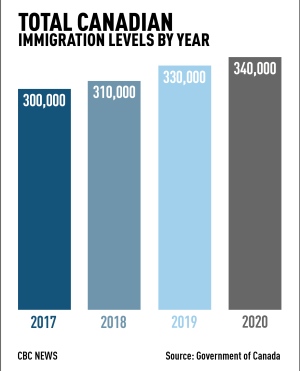
Immigration minister Ahmed Hussen said late Wednesday 310,000 new entrants will arrive next year, 330,000 in 2019 and 340,000 in 2020.

In response, Conservative immigration critic Michelle Rempel complained about the Liberals over-promising and under-delivering on the immigration file, pointing to a backlog at the Immigration and Refugee Board, a lack of mental health services for Yazidi women, wait times for permanent residency for caregivers, and an uneven spread of immigrants across the country. But crucially, those complaints were about management of the system by the Liberals, not the significant uptick in numbers.

In a world where the U.S. president is pushing to step up “extreme vetting,” where even countries like Germany and Denmark with a reputation for being havens are turning against immigrants, Canada is a notable, noble outlier.

As Andrew Griffith, a former senior bureaucrat at the department of Citizenship and Immigration, notes in a new paper for the Washington-based Migration Policy Institute, Canada’s successful immigration policy has its roots in the country’s history and geography.

“The ongoing creative tension between groups (English, French and Indigenous peoples) produced a culture of accommodation central to Canada’s ability to absorb and integrate newcomers. Further, the widely held perception among Canadians that immigrants are an economic boon and cultural asset to the country has made public opinion on the subject generally resilient, even as sharp backlashes have unfolded in the United States and Europe,” he wrote.

The polling bears that out. In fact, fewer people are concerned about immigrants not adopting “Canadian values” than at any time in the past 20 years, according to a major study carried out last year by the Environics Institute.

The study said 58 per cent of Canadians disagree with the statement that immigration levels are too high, compared with 37 per cent who agree. Views on the issue in Quebec reflected the national average.

It said 80 per cent believe the economic impact of immigration is positive, compared to just 16 per cent who disagree.

And it found 65 per cent think immigration controls are effective in keeping out criminals, up from just 39 per cent in 2008.

Since the major liberalization of immigration in the 1960s, when Canada abandoned race-based selection criteria and paved the way for the country’s current diversity, there has been a consistency about the broad parameters of immigration policy, regardless of which party has been in power.

Since 1995, immigrants admitted under economic preferences have consistently accounted for half or more of newly arrived immigrants.

The OECD’s migration outlook survey suggests the Canadian system is successful at attracting some of the world’s best and brightest. In 2014, 260,400 permanent residents were admitted, and more than half of the 25-to-64 year olds in that group had completed post-secondary degrees. The employment rate for foreign-born men was higher than for native-born men.

None of that is to suggest that the system is not used as a source of electoral fodder — particularly by the Liberal Party.

While the Conservatives reduced family-class immigration and increased economic immigration when they were in power, new programs introduced by the Liberals threaten to reverse some of that progress.

In the last election, the Liberals campaigned on prioritizing family reunification, granting points under the Express Entry system to applicants with siblings in Canada and doubling the number of applications allowed for parents and grandparents.

There was plenty more political pandering — watering down language requirements, lifting Mexican visa requirements and reducing the residency requirement for citizenship from four years to three.

The Trudeau Liberals’ emphasis on rights over the responsibilities promoted by the Harper government — and the prioritization of diversity over Harper’s insistence on shared Canadian values and history — paid electoral dividends, shifting the allegiance of a number of visible minority communities toward the Liberals.

Yet the changes were at the margins.

Both governments adhered to the distinctly Canadian model of integration, based on broad agreement about the way immigrants are selected, settled and melded into society.

The demographics defy partisanship and both Conservatives and Liberals have tried to offset the effect of an ageing population, where the working age to retired ratio is set to fall from 6.6:1 in 1971 to 2:1 by 2036.

Beyond the economics, there is a common approach to integration.

Griffiths notes that as far back as 1959 in Statistics Canada’s Canada Year Book, integration was defined as being clearly distinct from assimilation — it provided for the retention of cultural identity.

The niqab ban in Quebec suggests the debate on accommodation is not resolved.

But it is easy to lose sight of the fact that Canadians are broadly at ease with mass immigration to this country, even as it has resulted in a country with one of the largest foreign-born populations in the world.

Source: John Ivison: In the era of extreme immigration vetting, Canada remains a noble outlier | National Post

Building a Mosaic: The Evolution of Canada’s Approach to Immigrant Integration | migrationpolicy.org

My overview piece for the Washington-based Migration Policy Institute on how the Canadian approach to immigration, settlement, citizenship and multiculturalism works to further integration.

I am working with the Canadian Immigration Historical Society on a more comprehensive version, scheduled for next year.

Source: Building a Mosaic: The Evolution of Canada’s Approach to Immigrant Integration | migrationpolicy.org

2018 Immigration Plan: Higher Levels and a Multi-Year Plan Will Benefit Canada’s Economy

Conference Board reaction to the Government announcement with a good summary. :

On the heels of the Government of Canada’s announcement that it will welcome some 310,000 immigrants in 2018 and is introducing a multi-year levels plan for just the second time in history, the Conference Board’s Craig Alexander offers the following insights:

“Canada’s decision to increase immigration will help sustain long-term economic growth in light of its rapidly aging population and low birth rate. Introducing a multi-year levels plan will improve the ability of governments, employers, immigrant-serving organizations, and other important stakeholders to successfully integrate newcomers into Canada’s economy and society.”
—Craig Alexander, Senior Vice-President and Chief Economist, The Conference Board of Canada.

Insights

  • Canada’s 2018 immigration target of 310,000 represents a 19 per cent increase compared with its newcomer intake between 2006-2015.
  • The immigration target will be 330,000 in 2019, and 340,000 in 2020.
  • Canada’s intake is the highest since 1913 and will represent about 0.90 per cent of the population by 2020 which is also high by historical standards. Unlike the past, however, Canada can no longer count on natural increase (births minus deaths) to grow its labour force.
  • Population aging is one of the biggest economic and fiscal challenges facing Canada.
  • An October 2017 report by the Conference Board shows that immigration is a strong driver of Canada’s economy. Today, 75 per cent of population growth is due to immigration. Canada’s population growth will come entirely from immigration as the number of deaths is forecast to outpace births by the early 2030s.
  • In the absence of immigration, economic growth and government revenues would slow, and Canada would struggle to fund vital social programs. Health care, for example, will only become more expensive to deliver as an older population requires more services.
  • Canada is introducing a multi-year levels plan for just the second time in its history. The plan will allow stakeholders to make informed decisions as they seek to integrate newcomers into the economy and society. For instance, city planners can more accurately project how many newcomers will be arriving over multiple years and what sorts of infrastructure investments are required to successfully absorb a larger population.
  • Canada first introduced a multi-year levels plan for the period between 1982-1984 but the onset of a recession effected the federal government’s ability to continue with the plan.
  • Opinion polls show that public support for immigration remains high. To maintain this support, it is essential that newcomers are equipped with the tools that they need to benefit the Canadian economy and complement domestic workers.

Source: 2018 Immigration Plan: Higher Levels and a Multi-Year Plan Will Benefit Canada’s Economy

Canada to admit nearly 1 million immigrants over next 3 years

Good overview with some of the preliminary political reaction. Will be interesting to see how this plays out, but the Conservative focus on integration issues and border controls suggests that the increase itself is not a concern:

Canada will welcome nearly one million immigrants over the next three years, according to the multi-year strategy tabled by the Liberal government today in what it calls “the most ambitious immigration levels in recent history.”

Canadian immigration levels by year

The number of economic migrants, family reunifications and refugees will climb to 310,000 in 2018, up from 300,000 this year. That number will rise to 330,000 in 2019 then 340,000 in 2020.

The targets for economic migrants, refugees and family members was tabled in the House of Commons Wednesday afternoon.

Hussen said the new targets will bring Canada’s immigration to nearly one per cent of the population by 2020, which will help offset an aging demographic. He called it a historic and responsible plan and “the most ambitious” in recent history.

“Our government believes that newcomers play a vital role in our society,” Hussen said. “Five million Canadians are set to retire by 2035 and we have fewer people working to support seniors and retirees.”

In 1971 there were 6.6 people of working age for each senior, Hussen said, but by 2012 that ratio had gone to 4.2 to 1 and projections show it will be at 2 to 1 by 2036, when almost 100 per cent of population growth will be a result of immigration; it stands at about 75 per cent today.

Hussen said immigration drives innovation and strengthens the economy, rejecting some claims that newcomers drain Canada’s resources and become a burden on society.

He said the government is also working to reduce backlogs and speed up the processing of applications in order to reunite families and speed up citizenship applications.

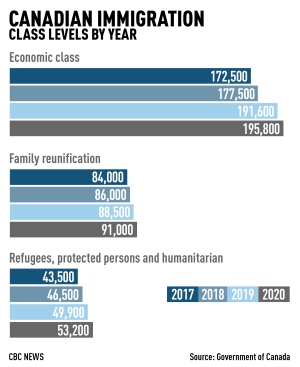
Canadian immigration class levels by year

The federal government’s own Advisory Council on Economic Growth had recommended upping levels to reach 450,000 newcomers annually by 2021. Hussen said the government is taking a more gradual approach to ensure successful integration.

“At arriving at these numbers we listened very carefully to all stakeholders who told us they want to see an increase but they also want to make sure that each and every newcomer that we bring to Canada — bringing a newcomer to Canada is half of the job. We have to make sure that people are able to be given the tools that they need to succeed once they get here,” he said.

Focus on integration: Rempel

Conservative immigration critic Michelle Rempel was critical of the plan, suggesting the government needs to do a better job of integrating newcomers.

“It is not enough for this government to table the number of people that they are bringing to this country. Frankly the Liberals need to stop using numbers of refugees, amount of money spent, feel-good tweets and photo ops for metrics of success in Canada’s immigration system.”

She said the Liberals need to bring Canada’s immigration system “back to order” by closing the loophole in the Safe Third Country Agreement that has seen migrants cross into Canada at unofficial border crossings only to claim refugee status.

She also said the immigration system should focus on helping immigrants integrate through language efficiency and through mental health support plans for people who are victims of trauma.

Dory Jade, the CEO of the Canadian Association of Professional Immigration Consultants, welcomed the news although he suggested the numbers should be higher.

“Canada will greatly prosper and grow once the 350,000 threshold has been crossed,” he said. “Nevertheless, we are witnessing a very positive trend.”

The Canadian Council of Refugees also welcomed the news, but wanted more, saying the share for refugees was only increased slightly from 13 per cent this year to 14 per cent in each of the next three years.

Calls for longer-range forecast

In past, there has been a one-year figure for how many immigrants will be permitted into the country, but provinces and stakeholders have called for longer-range forecasts.

A statement from Ontario’s Immigration Minister Laura Albanese, before the announcement, said the province supports the introduction of multi-year levels plans “to provide more predictability to the immigration system and inform program planning.”

“Significant variation in year-to-year immigration levels can dramatically impact the requirement for provincial year-to-year resources. A longer term outlook would help in planning for appropriate service levels and use of resources.”

The statement said Ontario supports growth in immigration levels, particularly in economic immigration categories to support the growing economy.

Diversity drives innovation

During the government’s consultation period, the Canadian Immigrant Settlement Sector Alliance presented “Vision 2020,” what it called a “bold” three-year plan to address growing demographic shifts underway in the country, calling for increased numbers in the economic, family and refugee categories.

It recommended a target of 350,000 people in 2018, which climbs to 400,000 in 2019 and 450,000 by 2020.

Chris Friesen, the organization’s director of settlement services, said it’s time for a white paper or royal commission on immigration to develop a comprehensive approach to future immigration.

“Nothing is going to impact this country [more] besides increased automation and technology than immigration will and this impact will grow in response to [the] declining birth rate, aging population and accelerated retirements,” he told CBC News.

Source: Canada to admit nearly 1 million immigrants over next 3 years – Politics – CBC News

Justin Trudeau rolls the dice on immigration

Cam Clark’s take on the multiculturalism-year immigration levels planned increases:

Justin Trudeau’s Liberal government is doing something no Canadian government has done for decades: It is gambling on a lot more immigration.

There should be no doubt that it is a gamble. On the day that U.S. President Donald Trump was responding to a terrorist attack in New York by blaming the immigration system, exploiting resentment there, the Liberals were saying Canada needs more immigrants. And don’t think that’s because it’s a slam-dunk political winner with new Canadians: Polls show first-generation immigrants are not much keener on expanded immigration than those born here.

Mr. Trudeau’s government is making a statement that it is going in a different direction. In fact, that’s the statement that Immigration Minister Ahmed Hussen made. “We are emphatically and unapologetically taking the opposite approach,” he said at a press conference in Toronto.

The numbers that the Liberals are shooting for are nowhere near the massive, 450,000-a-year level proposed by the Liberal-appointed Advisory Council on Economic Growth headed by McKinsey and Co. guru Dominic Barton and backed by some big-business voices and the Conference Board of Canada. Mr. Barton had suggested more newcomers could foster economic growth and mitigate the aging of Canadian society. But that would be a huge expansion, and for politicians, that’s not just a gamble but going all in.

Yet Mr. Hussen’s numbers are still large increases. Under Stephen Harper’s Conservatives, there were typically about 260,000 immigrants each year. The Liberals have increased the target to 300,000 this year, and will keep increasing to 340,000 by 2020 – that’s a 30-per-cent increase over a typical Conservative year, and a 21-per-cent increase over the Conservative 2010 high mark. When compared with the size of the population, the Liberals are planning a rate of immigration not seen since Brian Mulroney was in power.

Immigration levels dropped substantially for two years under Jean Chrétien, and levels have fluctuated from year to year, but no government since Mr. Mulroney’s has made any sustained, substantive change to immigration rates – the number of immigrants as a percentage of the population. The Liberals plan to move the rate upward significantly.

It’s a plan to keep increasing immigration steadily. Mr. Hussen even revived the Liberal target of increasing immigration to 1 per cent of the Canadian population – a promise made by Mr. Chrétien in 1993 but ignored once he was in power.

Politically, it’s not the specific number that matters. The government has done polls that show that most Canadians don’t have the foggiest notion how many immigrants come to Canada. But Canadians still have opinions on whether there are too many immigrants, or too few.

A survey commissioned in March by the Association for Canadian Studies found that 38.4 per cent of Canadians think there are too many immigrants, while just 10.4 per cent said there are too few. But a lot, 41.1 per cent, said that the number’s about right. Perhaps that’s one reason recent governments haven’t risked changing things much.

Jack Jedwab, the association’s president, said the number of people who think there are too many immigrants is generally pretty stable, between 30 per cent and 40 per cent; it’s near the high end of the range now. (The March survey was conducted by web panel that used a sample of 2,559 people.)

People born outside of Canada are a little less likely to think there’s too much immigration, but not much. There is a substantial political divide: People who consider themselves on the right are far more likely to think there are too many immigrants than people on the left.

That may be one reason Mr. Trudeau’s Liberals are willing to take a political gamble on immigration. It emphasizes a difference that plays better with left-leaning voters. And it represents a contrast with Mr. Trump. But it’s still a gamble.

Even Mr. Trump is calling for a “merit-based” immigration system, which sounds similar to Canada’s “high-skilled” class, rather than the United States’s current visa lotteries. He won’t end immigration; the Trump culture war is mostly about Mexicans and Muslims, and he has portrayed both as dangerous.

In Canada, Mr. Jedwab said, the resentment of immigration was once driven by economics – the sentiment that immigrants take Canadian jobs or cost the treasury – but now, it is clearly driven by perceived security concerns and fears immigrants are changing Canadian culture and values.

No wonder then, that Mr. Hussen emphasized the economic reasons for expanding immigration, noting, for example, that there will be fewer workers to support retirees in coming years. His plan also includes more family reunification, asylum-seekers and resettled refugees. People like the notion of hard-working economic immigrants, but not everyone is as positive about the rest. That’s probably a very big reason why governments have not signalled a sustained change in immigration levels for a quarter century. Until now, they didn’t want to take a risk.

Source: Justin Trudeau rolls the dice on immigration – The Globe and Mail

Link to government background info: Backgrounder2018-2020 Immigration Levels Plan

Minister says 300,000 new immigrants a year is Canada’s ‘new normal’ – Home | The House | CBC Radio

Setting the stage for the 2018 levels announcement. Not much suspense in that the number will be higher; some suspense as to whether the government will announce a multi-year plan as long talked about. Some political risks in doing so as steady increase may provoke some reaction, and possible political benefits to the government’s brand.:

Canada’s immigration minister says Canada will welcome at least as many immigrants next year as it is in 2017.

The government’s plan for annual immigration levels, which was set at 300,000 for this year, is expected to be tabled in the House of Commons next week.

Immigration minister Ahmed Hussen told The House that the government will not go below that level next year.

“Three hundred thousand is now our new normal,” he said, while not closing the door to a higher number for 2018.

“As a government we went from 260,000 to 300,000 because of the need to meet the demands of Canadian families who wanted to reunite with their loved ones,” Hussen continued. “But also employers who are asking us to allow them to continue to use immigration more and more as a way to meet their growth needs.”

Hussen added that he’s been in the process of consultations since April to put together the immigration outlook that’s coming soon, and that those consultations focused on the numbers Canada should bring in and what the right mix immigration, in terms of the different classes, should be.

He said the “vast majority” of immigrants coming in will be from the economic class because that’s where the greatest need is.

This will be followed closely by family class immigrants and then refugees, Hussen said.

Statistics Canada census numbers released Wednesday revealed the number of immigrants in Canada has reached its highest rate in a century.

Source: Minister says 300,000 new immigrants a year is Canada’s ‘new normal’ – Home | The House | CBC Radio

Income gap persists for recent immigrants, visible minorities and Indigenous Canadians

The Stars’s highlighting of the recent Census release:

As the face of Canada grows more diverse, the income gap between residents who identify as visible minorities, Indigenous or recent immigrants and the rest of Canadians remains a yawning chasm, data from the 2016 Census shows.

The income gap for these groups barely budged between 2006 and 2016, narrowing by just two percentage points for Indigenous Canadians and recent immigrants and widening by one percentage point for visible minorities, according to census data released Wednesday.

Total income was 26 per cent lower for visible minorities than non-visible minorities and 25 per cent lower for Indigenous Canadians than non-Indigenous Canadians.

But recent immigrants — many of whom are also visible minorities — face the toughest economic challenge with total incomes that fall 37 per cent below total incomes for Canadians born here, the data shows.

It means for every dollar in the pocket of someone born in Canada, a recent immigrant has just 63 cents.

More than 22 per cent of Canadians — including 51.5 per cent of Torontonians — reported being from a visible minority community in 2016, up from 16.3 per cent nationally in 2006.

In Toronto, more than 55 per cent of visible minority residents were living on less than $30,000 in 2016 compared to fewer than 40 per cent of the rest of the city’s population, according to census data provided to the Star.

While almost 14 per cent of non-visible minorities in Toronto reported total incomes of $100,000 or more, just 4 per cent of people from visible minority communities had access to that amount of cash in 2016.

“The latest census data simply confirms the reality that racialized people, recent immigrants, and Indigenous people continue to face discrimination and that income inequality doesn’t just magically reverse itself,” said Sheila Block senior economist for the left-leaning Canadian Centre for Policy Alternatives.

“That takes political leadership,” added Block who crunched the national income gap from the latest census data on immigration, ethnocultural diversity and aboriginal peoples.

“As these populations increase and continue to lag behind, it becomes a bigger issue for everybody,” she said.

“We know this kind of inequality doesn’t only have a negative impact on the population that’s affected, but it has a negative impact on us overall as a society.”

Increases to income support programs such as social assistance, employment insurance and pensions are part of the solution, she said. But labour reform, including more access to unionization and a higher minimum wage are also key.

Nadira Begum, who has a master’s degree in social work from her native Bangladesh, juggles three part-time jobs and numerous volunteer positions in the non-profit sector but still hasn’t been able to land full-time work.

“I have been looking for a full-time job in my field for more than 10 years,” said the Regent Park mother of three. “I have the skills, the experience and the knowledge, but if they don’t hire me, how can I show them? It is a common story in our community.”

Begum’s part-time jobs have often involved substantially similar work as full-time employees, and yet she has been paid a lower wage. Friends with part-time jobs as grocery store clerks who were hired the same time as full-time clerks are paid less and enjoy fewer benefits, Begum added.

“We are not equally paid, even though we do the same work,” she said. “And we can’t complain because we can’t afford to lose our jobs.”

Deena Ladd of the Workers’ Action Centre says Ontario’s planned $15 minimum wage by 2019 will be a huge boost for visible minorities, recent immigrants and Indigenous workers, who are more likely than the rest of Canadians to be toiling for minimum wage.

But changes to the province’s proposed Fair Workplaces, Better Jobs Act are needed to ensure these workers, who like Begum are often stuck in temporary, part-time and contract positions, are paid the same as permanent and full-time staff, Ladd said.

Wording in the proposed minimum-wage legislation currently mandates equal pay for equal work if the job is “substantially the same,” Ladd said. But that allows employers to change one aspect of the job and still be allowed to pay temp, contract and part-time workers less.

Instead, the proposed legislation should be reworded to say these workers are entitled to equal pay if the job is “substantially similar” to work performed by a full-time employee, she said.

Another problem with the proposed law is the definition of seniority. Unlike all other provisions of the Employment Standards Act which measure seniority by the date an employee was hired, the equal pay amendments include a definition of seniority as “hours worked.” If this is not changed, workers from economically disadvantaged groups who are more likely to work part-time, will never achieve equal pay for equal work, Ladd said.

“The new legislation has the potential to address the kinds of inequities highlighted by the census,” she said. “But if we don’t strengthen the language so workers can use the equal-pay protections in their workplaces in a strong way, then it will be just words on paper.”

The legislation, which just passed second reading, is expected to become law later this year.

Ryerson University professor Myer Siemiatycki, who teaches immigration and settlement studies, says the census findings are a wake-up call and a reminder of why the census is important.

“These are worrying statistics,” he said. “They reflect the adverse living conditions of huge numbers of Canadians who fall into these three categories of population . . . It’s an alarm bell and we need to respond.”

Source: Income gap persists for recent immigrants, visible minorities and Indigenous Canadians | Toronto Star

New figures show just how big Canada’s immigrant wage gap is

One of the first deeper looks at Census data, looking at immigrant status, language and income by Arvind Magesan of U of Calgary. The November release of language at work, education etc will further enrich this analysis:

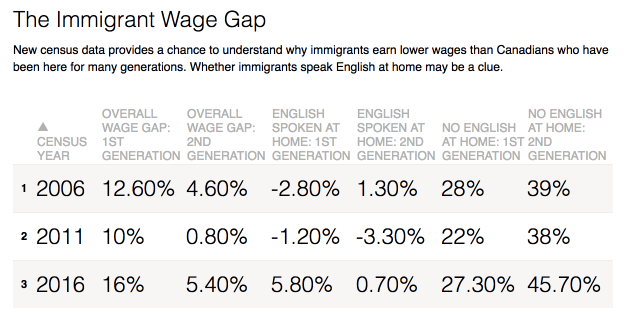
The first thing that surprised me is the gap has not changed much over the past 10 years. Census data from 2006 showed, at a national level, first-generation immigrants earned wages 12.6 per cent less than the average wage of native Canadians. In 2011, the gap dropped slightly to 10 per cent, but the new census data shows it’s climbed significantly to 16 per cent.

wagegap1

Importantly, the gap is a countrywide phenomenon. Looking at the three of the most popular destinations for immigrants in the past decade — Toronto, Vancouver and Calgary — the gap in 2016 sits at 25, 17 and 23 per cent respectively.

Interestingly, the gap doesn’t only exist for first-generation immigrants, but also for the children of immigrants (second generation, i.e. Canadians born to immigrant parents). The new data shows at the national level, second-generation immigrants earn 5.4 per cent less than natives.

Understanding the wage gap

The obvious question that follows then is: What is the source of these gaps?

Canada is an especially interesting case given the “points” system used to screen potential immigrants, where language, education and job skills are key determinants. And for the first time, the census has reported that about six out 10 new immigrants came here under the so-called economic admission category, meaning they have the skills “to enhance and promote economic development.”

Given the way immigrants are screened before entry, one would expect relatively quick integration into the Canadian economy and a convergence in wages. But this is clearly not the case.

The reasons put forward to explain the wage gap range from employer difficulty in assessing immigrant education credentials to outright discrimination. Economists refer to two types of “discrimination” in the labour market context, “statistical discrimination” and “taste-based discrimination.”

In the former, employers use observable traits (such as race) to make inferences about something like productivity. For example, an employer sees a job applicant with brown skin. The employer isn’t prejudiced towards brown people, but is worried (stereotypically) the employee is going to want to take trips “home” to Sri Lanka and would need a lot of vacation time. So the employer hires someone else equally qualified. Taste-based discrimination is more what we think of as prejudice — not wanting to hire someone purely because of skin colour.

Identifying causal factors that explain the wage gap is a difficult task – individuals who immigrate to Canada do so by choice. These choices are a function of a host of factors that could potentially jointly explain the decision to immigrate and labour market outcomes, including personal characteristics, job experience and education, to name just a few. Identifying discrimination in the labour market, and separating between taste-based and statistical discrimination, is even harder.

However, a 2011 study by University of Toronto economist Phil Oreopolous takes an important step in this direction.

In the study, thousands of computer-generated resumes were mailed out to companies that had posted ads searching for employees. The resumes were randomly assigned either a foreign or a “white” sounding last name, and were otherwise identical. The result: The resumes where the applicant had a foreign-sounding last name were less likely to receive a call back than identical looking resumes with a “white” last name.

When the author followed up with some of the recruiters, the overwhelming reason given for overlooking resumes with a foreign-sounding name was that they anticipated difficulty with language. Specifically, recruiters expected a lack of fluency in English, problems with communicating at work and difficulty for customers and co-workers in understanding a foreign accent. In other words, recruiters were statistically discriminating between job candidates based on their names.

Can language proficiency close the gap?

The census presents an opportunity to study the importance of English proficiency for the gap in labour market earnings between immigrants and native Canadians in 2016. The census provides information on wages, immigrant (and generation) status, as well as the language most commonly spoken at home.

Specifically, guided by the findings in Oreopolous’s study, I looked at how the gap in average wages changes when English is spoken at home. (For the purpose of this study, I looked at communities outside of Quebec, where French is the dominant language.) In 2016, 63 per cent of new immigrants living outside of Quebec most often spoke a language other than English or French while at home.

The latest census data says the native-first generation immigrant wage gap is 16 per cent at the national level. Once we examine whether immigrants speak English at home, things change — the wage difference is just 5.8 per cent. But for first-generation immigrants who don’t speak English at home, the gap jumps to 27.3 per cent.

For second-generation immigrants, there is barely any gap for those who speak English at home (0.7 per cent) but it’s still a significant gap for those who don’t speak English at home (a whopping 45.7 per cent).

This pattern also holds in the major metropolitan centres in the English-speaking parts of the country, which attract the most immigrants.

Interestingly, at almost 25 per cent, Toronto has one of the largest city level wage gaps in the country, explained at least in part by the fact that new immigrants tend to land in Toronto first and are more likely to be unemployed for a period of time. The three largest cities in English-speaking Canada, which also attract the most immigrants, also have gaps larger than the national average.

In Ottawa, immigrants of either generation who speak English at home actually earn more than natives on average. While it may be tempting to attribute the major differences across the cities to differences in culture, they are more likely due to regional differences in industrial composition and attendant labour demand.

The wage gap for immigrants who don’t speak English at home is very large. In Toronto and Calgary, first-generation immigrants who don’t speak English at home can expect to earn 37 per cent less than natives. Perhaps even more interesting is the fact that the gap across all cities for is larger for second generation immigrants who don’t speak English at home.

wagegap2

Though these patterns are striking, they should not be interpreted as causal – immigrants can’t necessarily start speaking English at home and expect to see their future earnings increase. There are unobserved qualities of individuals that may correlate both with the tendency to speak English at home as well as with labour market earnings potential. Without holding these fixed in some way, we can’t say whether there is a causal relationship between English skills and the gap in labour market outcomes.

But supposing that the findings here are suggestive of a causal relationship, why does speaking English at home matter so much?

One obvious answer is that individuals who speak English at home speak better English in general — and this would mean better communication at work. This would be consistent with the worries that the recruiters in Oreopolous’s study had when deciding who to call back. Or perhaps individuals of foreign descent that speak English at home tend to have other important skills on average.

The ConversationBut another possibility is the labour market discriminates against individuals with weaker English skills even when English is not important for productivity. Sorting between these different explanations (and others) will require more data and a deeper look.

Source: New figures show just how big Canada’s immigrant wage gap is – Macleans.ca