Why China and Hong Kong must heed America’s immigration debate

Interesting commentary on the demographic challenges facing some Asian countries and the consequent need for more thought regarding their immigration policies.

Noticing that there seems to be more interest among some Asian countries in talking to countries like Canada (and likely Australia) as part of their policy makers efforts to develop or update their immigration-related policies:

…The main reason is demographic. The World Bank says East Asia is ageing faster than any other region.

China is growing older faster than almost any other country, and its low birth rate and longer lifespans means that by 2050, a quarter of the population will be over 65, with fewer and fewer young people working to support them.

Japan’s demographic crisis is well known; the population is likely to drop below 100 million before 2050, and soon after some 40 per cent of its people will be senior citizens. And Hong Kong, with its low fertility rate, has its own demographic time bomb, with its over-65 population expected to hit 24 per cent in just seven years, and a third over-65 by 2041.

They are trying to solve the problem with band-aids. China scrapped its Mao-era “one child policy” in favour of a two-child policy – and is likely to soon scrap centralised family planning altogether. Japan’s Prime Minister Shinzo Abe wants to put more women and elderly into the workforce to deal with the manpower shortage.

The real answer to the demographic challenge is immigration. New immigrants could fill the pending labour shortages, replenish the dwindling birth rates and also provide health care and home care for the growing elderly populations. But Asian countries in general, and China and Japan in particular, are not known to be hospitable to immigrants.

Accepting more immigrants would mean a cultural sea change for China, Japan and even Hong Kong, a city of immigrants. The notion of “nationhood” could no longer be predicated solely on sharing the same history, heritage and mother tongue.

In other words, Asians may have to start having the same debate currently roiling the United States – what their counties are, and what they should look like in the future.

The debate in Asia, without a history of immigration, is likely to be even more wrenching and more rancorous than the one underway in the US. But it is no less vital, if the future crisis is going to be averted.

Source: Why China and Hong Kong must heed America’s immigration debate

Immigrants are largely behind Canada’s status as one of the best-educated countries

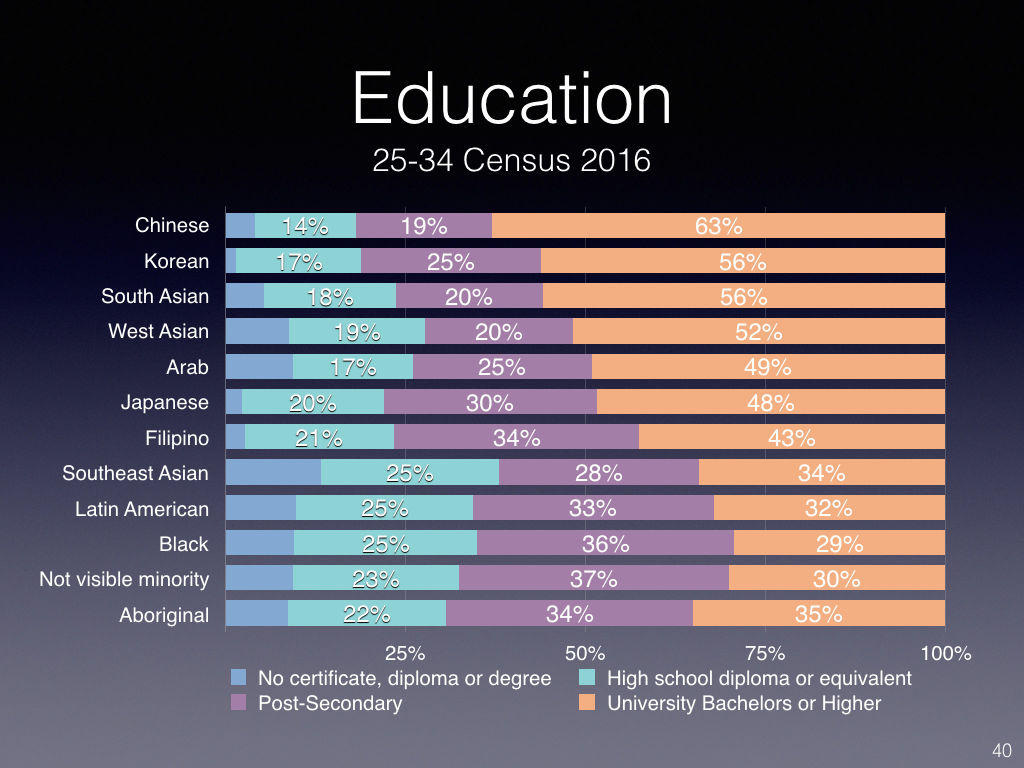
The difference among visible minority groups, including gender, is one of the more interesting aspects of this study:

Canada can credit immigrants for making it one of the best-educated countries in the world.

Not only do many newcomers arrive with university degrees, their high expectations for their children’s academic achievements also appear to lead to the pursuit of higher education among their children, according to a new internal government analysis.

The Immigration Department report, obtained through an access to information request, found 36 per cent of the children of immigrants aged 25 to 35 held university degrees, compared to 24 per cent of their peers with Canadian-born parents.

Among the top immigration source countries, more than 50 per cent of the children of immigrants from China and India graduated from university, while one-third of those born to Filipino immigrant parents finished their degrees.

By comparison, between 30 and 37 per cent of children to immigrants from Western Europe completed university, followed by those from Latin America and the Caribbean at a rate ranging from 23 to 28 per cent — about par with children with Canadian-born parents, the report said.

“The educational attainment of the parents matters; children with highly educated parents are more likely to be highly educated themselves. And immigrant parents in Canada tend to have higher levels of educational attainment than Canadian-born parents,” said the report by researcher Garnett Picot for the department’s research and evaluation unit.

“Parents’ expectations regarding education matters, and immigrant families, particularly Asian families, tend to have higher educational expectations for their children, on average, than families with Canadian-born parents.”

Picot, who declined the Star’s interview request, said family income did not seem to play a role in the gaps in educational attainment.

“This is important because many immigrant families struggle economically,” he wrote in his article, titled The Educational and Labour market Outcomes of the Children of Immigrants: A Success to be Preserved.

The Organization for Economic Co-operation and Development (OECD) ranked Canada second only to Korea as the highest educated nation in the world in 2016, with over 60 per cent of Canadians with a post-secondary education.

An Immigration Canada spokesperson said Picot’s study was part of the government’s attempt to monitor the long-term performance of immigration policies and programs by looking at how the children of immigrants are doing in terms of their educational and economic outcomes.

via Immigrants are largely behind Canada’s status as one of the best-educated countries | Toronto Star

Israel’s Immigration Crisis Is a Lesson for Trump – Bloomberg

Interesting take on Israel’s experience with walls:

In his first State of the Union message on Tuesday, President Donald Trump again made his controversial case for building a wall along the southern border of the U.S. Back in 2016, his opponents scoffed at the feasibility of such a grandiose project, he had. But when asked about it by Mexican President Enrique Pena Nieto he was ready for the question. “Look at Israel,” was his response, “Bibi Netanyahu told me the wall works.”

It does. In 2006, thousands of penniless, undocumented Sudanese and Eritreans, most of them young men, began crossing Israel’s border with Egypt. Bedouin coyotes led them on a harrowing journey through the Sinai desert and dropped them off. The migrants made their way to the working class neighborhoods of Tel Aviv, where they found cheap housing and off-the-books jobs.
Work was plentiful. Word spread. Soon Israel found itself facing what looked like an unstoppable flow of undocumented migrants. Employers were happy to hire cheap manual workers. Slumlords made a killing from renting overcrowded apartments. But most citizens, especially in Tel Aviv’s working-class neighborhoods, were unhappy with the influx of rootless foreign migrants.

Bringing the Jewish diaspora back to the Holy Land is the essence of Zionism. In Israel’s 70 years of independence it has welcomed Holocaust refugees, embattled Jewish communities from the Muslim Middle East and, more recently, over a million immigrants from the former Soviet Union and Ethiopia.

But these latest newcomers from Sudan and Eritrea were different. They were, to put it simply, not Jews. They fell outside Israel’s mission statement. Increasingly, the public came to see them as a problem.

Israel is a problem-solving country. In the fall of 2010, it began building a wall along its 152-mile border with Egypt. It was completed within four years. Built mostly of steel, the wall reaches a height of 25 feet in some places, and is equipped with state-of-the-art electronic sensors, cameras and detection technologies. The whole project came in at less than half a billion dollars. The border is now virtually impassable to undocumented workers as well as smugglers and drug traffickers.

But, once you have sealed off the border, Israelis learned, you are still left with the illegal immigrants who are already on your side of it. This is an issue the U.S. will have to contend with if and when it builds its wall. Israel is dealing with it now.

There are an estimated 35,000 to 40,000 Sudanese and Eritreans in the country, mostly in the Tel Aviv area. Until now they have been allowed to stay on renewable two-month visas. But they are now being notified that these permits will not be renewed. On April 1, they will face three choices: They can return to their countries of origin. They can go to prison. Or they can accept resettlement in a third country.

Those who take option number three will receive a $3,500 stipend and a one-way ticket. In the past, most voluntary deportees have been gone to Ghana or Rwanda. So far those countries — which are paid $5,000 per capita by Israel — have not publicly agreed to take more migrants. Still, some Israeli officials are confident that Rwanda, at least, is on board.

Not everyone will be deported. About 10,000 children and their parents will be exempt. They are the Israeli version of the U.S. Dreamers, although their future status is unclear. Some 2,000 bona fide humanitarian refugees from Darfur are also staying. But single men of working age who are presumed to be economic migrants — an estimated 65 percent to 70 percent of the Sudanese and Eritrean community — have two months to decide their next destination.

Those two months promise to be turbulent. Left-wing political parties and activists — with the moral and financial support of “progressive” American Jewish organizations — have been mobilizing. Demonstrations are already taking place. Some of the protestors have deployed the “hands-up-don’t-shoot” gesture, an American import. Others have been clad in chains. This is a campaign designed for television.

The pictures won’t look good, especially if the police use force to disperse angry crowds. Israel — which has long been accused of apartheid by Palestinian propagandists — is sensitive to charges of racism. In their defense, officials cite the fact that in recent years, Israel has deported more illegals from the former Soviet Union than from Eritrea and Sudan. They argue that Rwanda is a safe destination where the United Nations is active in overseeing refugees.  And they contend that the $3,500 stipend the deportees receive is generous enough to cover two years of living expenses.

This rebuttal may be true, but it doesn’t change the likelihood that Israel’s image will take a hit. Prime Minister Netanyahu is highly attuned to foreign public relations, but his first concern is the opinion of voters, who strongly support Israel’s right to control its own borders and to remove illegals. This sentiment is not limited to members of his Likud party or religious nationalists. Last month, Tel Aviv University released the results of a two-year survey on the willingness of Europeans to give asylum to foreign refugees. Israel (counted as a European country in the survey) placed second-to-last, above only the Czech Republic.

American opinion seems to be hardening as well. In Tuesday’s speech, Trump proposed allowing Dreamers to remain in the US, but insisted on ending the visa lottery and closing down so-called chain immigration — positions that have strong public support according to a Harvard-Harris pollpublished in late January (That poll also revealed a majority want to decrease legal immigration and give preference to those with qualifications that can contribute to the economy.) Significantly, the president did not tell Congress what he proposes to do with the many millions of undocumented non-Dreamers in the U.S.

Some will be deported, as they have been all along. In 2017, federal immigration officers removed 226,000 people in the country illegally, down slightly from the last year of the Barack Obama administration. Israel’s planned operation pales in comparison, but it will provide a real-life example of a post-wall removal policy. The scale, sensitivities and complexities are completely different, of course, but Trump has proven to be a close student of all things Bibi. Presumably he will be watching.

via Israel’s Immigration Crisis Is a Lesson for Trump – Bloomberg

Refugees crossing into B.C. on the rise, immigrant group says

Numbers small compared to Quebec but likely to increase:

On Nov. 18, 2017, Ribwar Omar, a 38-year-old Iraqi Kurd, arrived in Blaine, Wash., by bus. He stopped at a coffee shop, bought a hot chocolate and then, using the GPS on his phone, he made his way through a forest near the Peace Arch and crossed the border into Canada.

Omar is awaiting a refugee hearing, one of 1,277 new refugee claimants that made their way on foot from Washington state to B.C. in 2017. New numbers released by the Immigrant Services Society of B.C. (ISS) show their group has tracked a 76-per-cent increase in individuals accessing their services that have applied for refugee status, and 90 per cent of those arrive the same way Omar did: by walking across the U.S./Canada border between Blaine and Surrey through Peace Arch Park.

Chris Friesen of the ISS calls it “the underground railroad.”

“We have seen single men, families of 12, 13, people in wheelchairs, pregnant women,” said Friesen, with the majority originating from Afghanistan, Iraq, Mexico, Iran and Colombia.

Friesen and other advocates are concerned that the spike in the number of asylum seekers could increase as the weather warms-up. Last summer, over 7,000 asylum seekers entered Quebec through irregular border crossings.

The reason many asylum seekers are using irregular border crossings — through farmers fields or border parks — is because of the Safe Third Country agreement between Canada and the U.S.

Under the deal, signed during the Harper government regime, refugee claimants are required to request refugee protection in the first safe country they arrive in, unless they qualify for an exception.

“This means that a refugee claimant who came from the United States to Canada through an official border crossing could be detained and deported, or kept in the United States, forcibly impinging their ability to seek asylum in this country,” said Friesen.

Many of the refugee claimants are well-informed about their rights, and will phone the RCMP to be picked up once they arrive in Canada. “The RCMP will drive them to Hornby Street to file their refugee claim,” said Friesen.

“With the numbers that are coming in it is pushing us to the breaking point,” said Friesen, who called the situation “a bloody mess.”

Friesen said ISS is tracking two clear waves of refugee claimants. The first includes those, like Omar, who are able to obtain a legal visitor’s visa to the U.S., and use the United States as a transit point into Canada.

“This is quite new,” said Friesen.

The second stream of new asylum seekers is comprised of individuals who may have been in the U.S. for years, but are vulnerable to the Trump administration’s new policies, including accelerated deportations, the suspension of temporary protection agreements for Haitian and El Salvadoran immigrants, as well as Dreamers.

Friesen said he has been in contact with provincial officials who are planning consultations next month on contingency plans to deal with the continued influx of asylum seekers.

via Refugees crossing into B.C. on the rise, immigrant group says | Vancouver Sun

In immigration debate, what constitutes ‘merit’? – CSMonitor.com

Not a bad overview regarding definitions of merit (Canada uses its points, frequently tweaked, for its definition for economic immigrants), and a reminder, given the different interests at play, that different definitions are needed:

When President Trump talks about immigration in his first State of The Union speech tonight, people are likely to hear him use one phrase in particular: “merit-based immigration.”

As part of his offer to put 1.8 million young, unauthorized immigrant “Dreamers” on a path to citizenship, Mr. Trump also wants to shift legal immigration away from prioritizing family reunification to a system based on individual qualifications. It would be a significant change – if lawmakers could agree on what constitutes “merit.”

The president and his supporters in Congress appear to be defining merit as highly skilled, well-educated immigrants who speak English and can support themselves. But what about strawberry pickers or hotel workers? Those jobs are commonly performed by low-skilled immigrants. And then there’s the brother or sister of a legal resident who comes to America and starts a business, whose family helps him or her adjust to a new culture.

“Nobody has a set definition of ‘merit.’ Everyone uses it for his own purpose,” says Theresa Cardinal Brown, the director of immigration policy at the Bipartisan Policy Center in Washington. The term sounds positive, she says, while a phrase like “chain migration” – or family-based immigration, which the president wants to stop – sounds negative, like a weight.

These terms – and their political shadings – are meant to sway public opinion, Ms. Brown says. And they hide a legitimate question: “When you are talking about a merit-based system in the US context, are you looking to decrease the overall number of immigrants, or are you looking to adjust the criteria of who comes in?”

Today, America’s legal immigration is demand-oriented – it relies on the demand of families in the US to sponsor relatives and American employers to sponsor foreign workers. It also includes a relatively small visa diversity program to allot slots to underrepresented countries (the “visa lottery,” which the president wants to end) and a humanitarian component for refugees and asylum seekers, which the administration is radically scaling back.

The system heavily favors families, which advocates describe as consistent with American values. About two-thirds of the slightly more than 1 million people granted legal status (known as green cards) in 2015 were family-based, according to the Department of Homeland Security (DHS). Only 14 percent were employer-sponsored.

This is a problem, the administration and many Republicans in Congress maintain. Low-skilled immigrants are low taxpayers – a burden on public services, oversaturating the job market, and stagnating wages, in their view. And family-based immigration poses a security threat, says Attorney General Jeff Sessions. In an opinion piece published Jan. 21 in The Washington Times, he cites a report from the Department of Justice and DHS that since Sept. 11, 2001, Immigration and Customs Enforcement has removed more than 1,700 unauthorized immigrants with “national security concerns.”

“The American people have known for more than 30 years that our immigration system is broken. It’s intentionally designed to be blind to merit,” Mr. Sessions said in a speech Friday. “It doesn’t favor education or skills. It just favors anybody who has a relative in America – and not necessarily a close relative.”

Sessions and others in the administration point to countries such as Canada and Australia that have supply-oriented policies. These countries have long used point systems to qualify applicants, assigning them points for education, working age, employment, language, and other skills that determine their likelihood of assimilation and contribution to the economy.

As a result, these countries’ intake is the reverse of the US: About two-thirds of their legal immigrants are employment-based, rather than family-based, writes immigration expert Daniel Griswold in a recent op-ed in The Hill.

But these countries also have family components, and they adjusted their programs when they saw that their criteria did not automatically mean immigrants could easily adjust or work in their fields. Their systems are also more flexible to changing economies, while immigration policy in the US is heavily dependent on a gridlock-plagued Congress.

‘Green cards just for computer engineers’

“I don’t want green cards just for computer engineers,” Sen. Lindsey Graham (R) of South Carolina told reporters during the recent three-day government shutdown. Senator Graham has been in the thick of working on a bipartisan deal for Dreamers. “If you are out there working in the fields, if you are a construction worker, I want some of those people to have a way to stay here. If you are running a business, I want them to have a chance to get a green card.”

He blasted the president’s immigration policy expert, Stephen Miller, for wanting to restrict legal immigration at a time of a worker shortage. Demographers also point to an aging US population and warn about turning into a Russia or Japan without enough immigrants to support their seniors.

Indeed, the president’s immigration framework, released last week, echoes a bill by Sens. Tom Cotton (R) of Arkansas and David Perdue (R) of Georgia that would end “extended-family chain migration” and only sponsor spouses and minor children. The bill would cut in half the number of legal immigrants by eliminating many family-sponsored categories and significantly cutting the cap on such family-based visas.

Evelyn Huron, the director of Caritas Legal Services with Catholic Charities in San Antonio, Texas, says the president’s one-page immigration policy framework is vague. But the apparent emphasis on a merit-based system that rewards high-skilled and more affluent immigrants has her worried.

Even if the path to legal residency in the US narrows for poorer and less-skilled workers, Huron doubts that those workers will stop coming into the country looking for work.

“There are always going to be jobs for unskilled workers,” she says. “Are you going to have less people come? No. More people leave? No. You are just going to have less applying” for legal status.

Getting in the harvest

Take Dixondale Farms in Carrizo Springs, Texas, the largest and oldest onion plant farm in the country.

Bruce Frasier, the fourth-generation president of the family farm about 45 minutes from the US-Mexico border, has seen his workforce shrink by half in his time running the farm. He has been calling for the government to streamline the H-2A visa program – the main tool for foreign agricultural workers to gain seasonal access to the country – for years to supplement his dwindling workforce of legal residents.

“The number of [farm owner H-2A] applications are going up each year because more and more people are realizing they can’t get local [legal] workers, or even illegal workers, to do this,” says Mr. Frasier.

Last summer, with relatively little fanfare, the US Department of Homeland Security raised the cap on H-2B visas for foreign guest workers, a program favored by the hospitality industry, but not on H-2A and H-1B visas, programs favored by the agriculture and technology industries, respectively.

With fewer US residents looking for agricultural work, and an unreliable foreign guest worker program, many farmers – particularly in the interior of the country – turn to illegal workers to make sure they harvest their whole crop in time, Frasier continues.

The US food supply “is going to be harvested eventually by more foreign workers,” he says, because so few US residents want to do the work. “It’s whether you want to grow it in Mexico or want to grow it in the United States.”

Congress has grappled with the merit issue before. The bipartisan 2013 immigration reform bill that passed the Senate and wilted for lack of interest in the GOP-controlled House included a point-based merit system. It also eliminated the diversity visa lottery and restricted family-based immigration.

But that was part of a comprehensive immigration reform bill that not only had a path to citizenship for Dreamers, but also for millions of other unauthorized immigrants who arrived in the US before 2011. What Trump is offering is not this grand bargain, and has drawn many critics on the left – and on the right, including those who object to Dreamer “amnesty,” and his costly $25 billion trust fund for a border wall and other enhancements.

“I am forever looking for that thing that can break through the noise and make progress on a deal,” says Brown. At the end of the day, she says, everybody – but most especially the Dreamers – have to figure out how important it is to get their protections back.

“What is the price that everyone is willing to pay for them to feel safe? That debate is ongoing.”
via In immigration debate, what constitutes ‘merit’? – CSMonitor.com

America Is One of the Least “Generous” Countries on Immigration | Cato @ Liberty

Strange to compare US and other OECD countries with Gulf states which only have guest workers, with no or extremely limited pathway to permanent residency or citizenship. False comparison that undermines their arguments. A two-year time series is also misleading:

During his State of the Union speech, President Trump will tout his plan for draconian restrictions on legal immigrants. Supporters, like House Judiciary Committee Chairman Bob Goodlatte (R-VA), justify the plan by claiming that America is “by far the most generous nation in the world for legal immigration.” Not only is “by far” clearly false, but when you consider its wealth, America is already among the least generous to immigrants around the world.

The United States ranks in the bottom third of wealthy countries in terms of net new immigration as a share of total population from 2015 to 2017 as well as total foreign-born residents as a share of total population, according to figures  from the United Nations. Trump’s plan would make America even more closed than it already is.

The United Nations data contains information on the foreign-born populations in all countries (or semi-independent provinces) around the world.* U.S. immigration is decidedly unimpressive compared to all countries. Although America does have the highest total number of foreign-born residents in the world, a fair comparison requires controlling for the size of its current population. After all, a million new people entering India with a population of 1.3 billion would have very different effects than a million new people entering Estonia with a population of 1.3 million.

With this in mind, it is clear that America is nowhere near “the most generous country in the world” on immigration. Of the 232 jurisdictions that the UN includes, America ranks just 64th overall. Focusing on the rate of new immigrants as a share of total population, the United States had only the 49th highest net immigration rate from 2015 to 2017 (inflows minus outflows of foreign residents divided by total population). This places the United States rank in the 72nd and 79th percentiles in the world, respectively.

This assessment is still misleading, however, because it compares the United States to countries that very few immigrants would want to immigrate to. The United States’ ranking among more prosperous countries is even less inspiring. Of the 50 countries or provinces which had, according to the United Nations, a gross domestic product (GDP) of at least $20,000 per capita in 2015, the United States has the 34th highest share of foreign-born residents as well as the 34th highest net immigration rate (Table 1). This places the United States rank in the 32nd percentile on both measures.

The 50 most prosperous countries have double both the average foreign-born share and average immigration rate of the United States. Those countries at or above the 50th percentile have an average foreign-born share three times the U.S. share and an immigration rate four times as high as the U.S. rate. The United States is far from generous: it is downright stingy to immigrants. Figure 1 provides the net immigration rate from 2015 to 2017 for the United States and the 33 countries that rank higher than it.

Figure 1: Countries With Highest Net Per Capita Immigration From 2015 to 2017 and a Per Capita GDP Above $20,000 in 2015


Sources: United Nations (Foreign Populations); United Nations (Total Populations); United Nations (GDP Per Capita) 

This still considerably overstates America’s generosity because such a large share of America’s foreign-born population is here illegally: almost a quarter. This appears to be one of the highest shares in the world. Many of America’s immigrants are already defying America’s attitude toward them. In other words, U.S. law is not only hostile toward new immigrants. It is hostile toward its existing foreign-born residents.

By almost any reasonable standard, America is already one of the least generous countries in the world toward legal immigrants. If the United States does implement the White House’s immigration framework, it would be moving its nation’s immigration system in the opposite direction of the rest of the world. Other developed economies are opening their borders to more immigrants than ever, while the United States would have sent its immigration rate back to its lowest level since World War II.

America, however, doesn’t need to be “generous” toward immigrants at all. It is in the country’s self-interest not to prohibit foreigners from living and working in America. Allowing people to freely move and work where they want is not charity. It is an expansion of the free market and allows people to contribute to the economic prosperity of the country and expandthe pie for everyone. The president’s plan would make America both less generous and less prosperous.

Table 1: Immigration and Immigrant Population Ranking for Countries with Greater Than $20,000 Per Capita Gross Domestic Product

  Increase in Foreign-Born* From 2015-17 As a Share of Total Population Total Foreign-Born* Residents as a Share of Total Population
  Country Rate Country Share

1

Kuwait

6.5%

United Arab Emirates

90.8%

2

Turks and Caicos

5.3%

Kuwait

79.4%

3

Saudi Arabia

4.5%

Sint Maarten

72.9%

4

United Arab Emirates

3.5%

Turks and Caicos

71.4%

5

British Virgin Islands

2.7%

Qatar

69.4%

6

Sint Maarten

2.5%

British Virgin Islands

66.3%

7

Germany

2.4%

Liechtenstein

66.0%

8

Liechtenstein

2.4%

China, Macao SAR

58.8%

9

Austria

1.9%

Monaco

55.5%

10

Macao SAR

1.8%

Bahrain

52.7%

11

Sweden

1.5%

Andorra

52.6%

12

Singapore

1.4%

Singapore

47.4%

13

Brunei Darussalam

1.4%

Luxembourg

46.6%

14

Australia

1.4%

Cayman Islands

40.6%

15

Qatar

1.4%

Hong Kong SAR

39.8%

16

Bahrain

1.3%

Saudi Arabia

38.6%

17

Ireland

1.2%

Anguilla

38.2%

18

Switzerland

1.1%

Aruba

34.8%


Average

1.1%

Average

30.9%

19

Denmark

1.1%

Bermuda

30.6%

20

Cayman Islands

1.0%

Switzerland

30.1%

21

Norway

1.0%

Australia

29.6%

22

Iceland

0.8%

Brunei Darussalam

26.0%

23

Canada

0.8%

New Caledonia

24.5%

24

Anguilla

0.7%

Israel

24.3%

25

Malta

0.7%

Curaçao

24.3%

26

United Kingdom

0.7%

New Zealand

23.1%

27

Bahamas

0.6%

Canada

21.9%

28

New Caledonia

0.6%

Austria

19.1%

29

Luxembourg

0.6%

Sweden

17.9%

30

Hong Kong SAR

0.6%

Ireland

17.2%

31

New Zealand

0.6%

Cyprus

16.3%

32

Monaco

0.6%

Bahamas

16.0%

33

Finland

0.5%

San Marino

15.9%

34

United States

0.5%

United States

15.6%

35

Curaçao

0.5%

Norway

15.4%

36

Netherlands

0.4%

Germany

14.9%

37

Slovenia

0.3%

United Kingdom

13.5%

38

Aruba

0.2%

Spain

12.8%

39

San Marino

0.2%

Iceland

12.7%

40

Italy

0.2%

France

12.3%

41

Belgium

0.1%

Netherlands

12.1%

42

Spain

0.1%

Slovenia

11.8%

43

Japan

0.1%

Denmark

11.5%

44

Republic of Korea

0.0%

Belgium

11.2%

45

Greenland

0.0%

Greenland

10.7%

46

France

0.0%

Malta

10.6%

47

Cyprus

-0.3%

Italy

9.9%

48

Bermuda

-0.3%

Finland

6.3%

49

Israel

-0.6%

Republic of Korea

2.3%

50

Andorra

-1.3%

Japan

1.8%

Sources: United Nations (Foreign Populations); United Nations (Total Populations); United Nations (GDP Per Capita)

via America Is One of the Least “Generous” Countries on Immigration | Cato @ Liberty

USA: Here’s the economic impact of immigration in each state in 2018

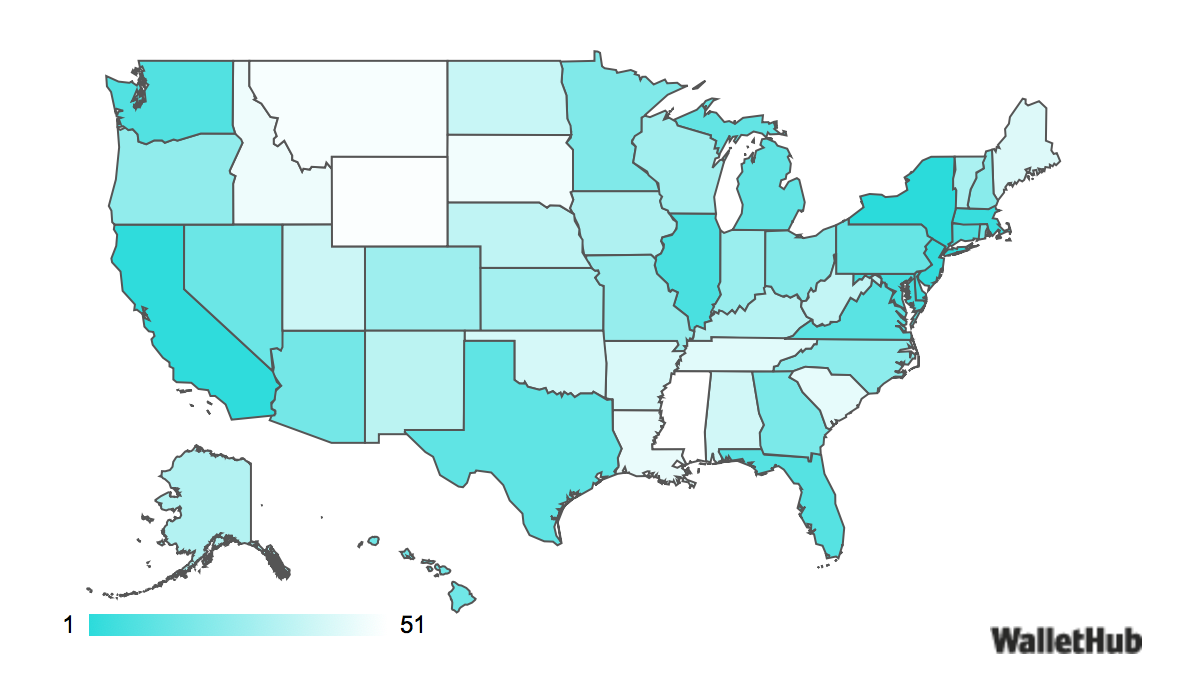
Nice map which has some overlaps with support for immigration (e.g West and East Coast) and opposition to immigration (e.g., Florida and Texas) in terms of states that voted for Trump:

As the national conversation about Dreamers, DACA, and Trump’s Wall continues, WalletHub decided to sit down and map out the economic impact of immigration on the United States. They looked at 19 metrics including median household income of foreign-born populations, immigrant-owned businesses, homeownership rates, and Fortune 500 companies founded by immigrants or their children.

The TL; DR of the report is that the states that traditionally have high levels of immigration (California, New York, New Jersey) also reap the greatest economic benefit.  In California, 27% of residents are foreign-born, which is 17.2 times higher than in West Virginia, the lowest at 1.57%. Unsurprisingly, immigrants make very little economic impact on West Virginia. Check out the full report here to start doling out facts and figures along with the many opinions about immigration.

Source: WalletHub

via Here’s the economic impact of immigration in each state in 2018

Worried about Trump-stoked exodus of immigrants, Canada discourages illegal crossings – LA Times

The government’s outreach in action in LA, and its key messages. Main takeaways from the article: overall message not different from hardliners but “delivered with a nicer Canadian soft sell” and “It’s unclear how effective he was:”

In a private dining room at Zov’s restaurant in Tustin, a Canadian envoy made his pitch to about a dozen immigration attorneys and immigrant rights leaders.
Pablo Rodriguez, a member of Parliament, leaned over from his seat in the middle of the table and asked everyone to spread the word: Please do not cross into Canada illegally.

“Get the facts and make a decision based on the right facts, before leaving your jobs and taking your children out of school and going up there hoping to stay there forever,” Rodriguez said. “Because if you don’t qualify … you will be returned and in this case not to the United States. You will have lost your status and would be returned to your country of origin.”

Worried that anti-immigrant rhetoric and decisions from the Trump administration could drive more people across its border, the Canadian government is trying to nip that in the bud.

Prime Minister Justin Trudeau dispatched Rodriguez to California. The whip for the majority Liberal Party in Parliament, Rodriguez arrived in the U.S. a few days after President Trump announced his decision to end temporary protected status of an estimated 200,000 Salvadorans in the country.

His message was not that different from immigration hardliners in the U.S. But it was delivered with a nicer Canadian soft sell.

Rodriguez was a young boy when he arrived in Canada as a political refugee from Argentina. He said he can empathize with those looking north.

He said that Canada is “an open country” and a nation of immigrants. But, he stressed, immigrating to the country needs to be done legally.

“You can’t just come to Canada and cross the border and stay there the rest of your life,” he said. “We want to avoid a humanitarian crisis along the border.”

The Canadian government, Rodriguez said, wants to avoid a repeat of what happened last summer when thousands of Haitians crossed Canada’s southern border “irregularly” after losing temporary protected status in the U.S.

The influx created a massive backlog of refugee claimants.

Last week was Rodriguez’s fourth outreach visit to the U.S. since the fall.

Rodriguez is one of several lawmakers and dignitaries Canada has sent in recent months to combat misinformation about gaining asylum in Canada. Recently, Canadian representatives traveled to Haitian communities in Miami and a Somalian enclave in Minneapolis.

During the meeting in Orange County, Rodriquez wore an infectious smile and an easygoing demeanor as he engaged in what he called a “friendly conversation” with immigration attorneys and immigrant community leaders.

It’s unclear how effective he was.

Some of those at the meeting said Canada seemed awfully hospitable compared to the countries some immigrants had left behind.

Countries such as Guatemala, El Salvador, Honduras and parts of Mexico are among the most dangerous places in the Western Hemisphere.

“If you are facing certain death in your country … Canada seems like a very excellent option,” said George W. Abbes, an immigration attorney.

Rodriguez said that so far there isn’t any indication that more Latin Americans are crossing the border from the U.S. to Canada.

But the Canadian government wants to be proactive, he said. Rodriguez said officials wanted to counter false reports in Latin American media that suggest migrating to Canada is an easy way to find immigration relief.

“We want to have an honest, transparent conversation,” Rodriguez said. “Canada is a very open country but there are rules.”

via Worried about Trump-stoked exodus of immigrants, Canada discourages illegal crossings

To Ross Douthat, white immigration is the only good immigration – Salon.com

While the most effective rebuttal to the Douthat piece can be seen in Noah Smith’s Twitter thread, https://twitter.com/NatalieBrender/status/958009393588486144, this article also is powerful:

President Donald Trump’s immigration policy is, increasingly, in the hands of his policy adviser, Stephen Miller. To most, Miller’s history and views should disqualify him from handling the sensitive topic. Even top Republicans have said that they had little faith in Miller’s bona fides.

But, to New York Times columnist Ross Douthat, Miller — the man who has displayed xenophobic and sexist traits since he was a high school student — is bringing to light something Americans should be debating: Do we really want immigrants?

Douthat suggested Sunday that Miller should be a point person on any immigration deal, saying that Miller can appeal to the “conservative” base that successfully blocked bipartisan immigration reform in 2013. And Douthat seemed to be in Miller’s camp, writing that Miller has some good points in not wanting immigrants:

>The foreign-born share of the U.S. population is near a record high, and increased diversity and the distrust it sows have clearly put stresses on our politics. There are questions about how fast the recent wave of low-skilled immigrants is assimilating, evidence that constant new immigration makes it harder for earlier arrivals to advance. . .

Douthat’s displeasure at immigration boils down to the fact that he may have to speak to someone who doesn’t speak English, even though his complaints don’t match the rhetoric of the guy at the end of the bar:

The present view of many liberals seems to be that restrictionists can eventually be steamrolled — that the same ethnic transformations that have made white anxiety acute will eventually bury white-identity politics with sheer multiethnic numbers.

The Stephen Miller wing of negotiations — that starts with the White House and goes down to the Freedom Caucus, with a long detour through the pages of Breitbart — is the dominant one. And that wing doesn’t want to “bury white-identity politics,” despite the fact that “America” has successfully absorbed other cultures for generations.

Remember that, at one time, the problem was that there were too many Irish immigrants coming into the country. At another time, it was Germans. And remember that those cultures gave Douthat the culture and the food that’s now interwoven in Americana — because even apple pie isn’t all that American.

But the fundamental problem is that in the United States, you can’t eliminate cultures that aren’t white. The U.S. wasn’t founded on an ethnic identity. Native to the country are the Native Americans. There’s a Mexican contingent that lived in the Southwest before it was part of American territory. Puerto Ricans, Samoans, Chamorro, Filipino and Haitians are all American citizens, by birth, because American territory is vast and doesn’t simply cover just White Settlement, Texas.

But Douthat’s claim overlooks one major error that completely blows up his entire argument. You can’t assume that America is built on a white identity — neither then nor now — without realizing that the country was built on the backs of black slavery and of land that once belonged to Native Americans. And Westward expansion was powered thanks to a Chinese-built transcontinental railroad.

Unfortunately for Douthat, white America hasn’t done as much as he may think it has.

via: To Ross Douthat, white immigration is the only good immigration – Salon.com

StatsCan Study: How temporary were Canada’s temporary foreign workers?

Spoiler alert – apart from Agricultural Workers program – is that the overall trend is temporary workers staying for longer periods with most temporary workers in Canada for 10 years or more transitioning from temporary to permanent residency status:

Temporary foreign workers are admitted to Canada through the Temporary Foreign Worker Program and the International Mobility Program (Government of Canada) with the objectives of addressing short-term labour shortages and advancing Canada’s broad economic and cultural interests. The number of temporary foreign workers present in Canada increased from 52,000 in 1996 to 310,000 in 2015. Given the growing presence of temporary foreign workers, their rate and length of stay in Canada are relevant to national immigration and labour market policies.

This Statistics Canada study documents the length of time that temporary foreign workers remain in Canada and the extent to which longer durations of stays are the result of extended use of temporary residence permits or transitions to permanent resident status.

In the study, temporary foreign workers are defined as individuals who were aged 18 to 64 at the time of their arrival in Canada, who received a work permit between 1990 and 2009, and whose first admission to Canada was primarily for work purposes. These individuals were followed for at least five years, and for up to 15 years, after their first admission to Canada. The study is based on the Temporary Residents File.

Durations of stay among temporary foreign workers became longer through the 2000s. Of the 264,000 temporary foreign workers first admitted to Canada from 1995 to 1999, 13% (or 35,000) were still in Canada five years after their initial arrival. This was the case for 37% (or 187,000) of the approximately 500,000 temporary foreign workers first admitted to Canada from 2005 to 2009. The same pattern was evident 10 years after arrival among earlier cohorts. Specifically, 11% of temporary foreign workers first admitted to Canada from 1995 to 1999 and 18% of those first admitted from 2000 to 2004 were still in Canada 10 years after their initial arrival in Canada.

Almost 90% of temporary foreign workers who were still in Canada after 10 years had obtained permanent resident status, having made the transition from temporary foreign worker to landed immigrant. This was the case among temporary foreign workers in virtually all ongoing programs, with the exception of the Seasonal Agricultural Workers Program. Temporary foreign workers in this program were unique in that almost one-quarter continued to receive work permits for seasonal employment 10 years after their initial arrival in Canada. Temporary foreign worker programs, such as the Seasonal Agricultural Workers Program, have been associated with different options for transitioning to permanent residence status.

via The Daily — Study: How temporary were Canada’s temporary foreign workers?