Toronto Sun Editorial: Immigration concerns about the process, not people

Ongoing conservative theme, one that has a certain resonance given the importance of perceptions of border management to public support of immigration (polling responses depend in part on how the question is formulated as illustrated by this famous Yes, Minister episode 1:38Survey (Yes, Prime Minister S1E2).

And while the “hectoring” of the PM is not helpful, neither is some of over-hyped rhetoric of the Conservatives, as both understand some of the complexities involved and the lack of simple solutions:

Canadians have largely been supportive of immigration for many years. How can they not be? So many Canadians are either immigrants themselves or have parents or grandparents who were born elsewhere.

So it’s concerning that public support for immigration has started to slip.

A new Ipsos Global Public Affairs poll shows that while Canadians back immigration more broadly, they’ve have significant concerns about how immigration is being managed.

The poll reveals 44% of people say that there are now too many immigrants coming to Canada. And a majority of respondents believe Canada is too welcoming to new arrivals.

Where is this coming from? What drives this perspective?

Brian Lilley explained in a Sun column that “a full 57% of Canadians agree with the statement that “immigration has placed too much pressure on public services in Canada.” That includes 77% of Conservative voters but also 51% of Liberal voters and 48% of NDP voters.”

In other words, at a time when people are anxious about issues, such as their economic future and the rising cost of living, they also worry about the economic costs and tax burdens that come with increased immigration.

Prime Minister Justin Trudeau has taken to hectoring those who express such concerns, last month divisively rejecting as immigration concerns as “fear-mongering” and anti-immigrant bias.

This is a naked, political smear tactic — aimed in an election year primarily at federal Conservatives — because the Trudeau Liberals have so utterly botched the care and settlement of refugees who are arriving daily at our borders.

But whether it’s the various measures the Liberals have taken to make it easier to get citizenship to Canada or their failure to take financial responsibility for migrants, Canadians increasingly are losing confidence in our immigration system.

We highly doubt frustrations with immigration are about the immigrants themselves. It’s about the way things are being done. It’s not about people but process.

One of the best ways we can enhance the popularity of immigration in Canada is being enhancing the integrity of the immigration system in Canada.

If the system has holes, if it looks like it’s easy to game, if the government acts like borders don’t matter, confidence will erode.

Let’s have a welcoming but well-managed immigration system that will make everyone proud.

Source: EDITORIAL: Immigration concerns about the process, not people

Douglas Todd: How Chinese, Filipino and other immigrants differ

I am a great fan of Dan Hiebert’s work and Todd’s article only whets my appetite to check out the interactive website:

Chinese and Filipino immigrants come to Canada with equally solid levels of education — but beyond that they’re remarkably different.

A revealing new “super-diversity” website created by a University of B.C. geographer, Daniel Hiebert, shows nine of 10 recent Chinese immigrants arrive in Metro Vancouver with enough money to immediately buy homes. But only half hold down jobs during their first five years in Canada, while four of 10 report they’re surviving on low incomes.

In sharp contrast, as Hiebert points out while showing his data-rich charts and maps on his interactive website, nine of 10 Filipino immigrants have jobs within five years of arriving in Metro Vancouver. Less than 10 per cent of Filipinos say they are on low incomes, and just four in 10 own their homes.

This is just a sample of the almost endless array of demographic insights about Canadian immigration, refugees, ethnicity, economic class and religion that can be readily discovered on the website, www.superdiv.mmg.mpg.de.

With a team of international scholars, Hiebert has been designing the site to help Canadian policy-makers, academics, journalists and the public “get a factual sense of how the world is changing. So that they can make their own interpretations.”

The website’s graphics quickly reveal nuggets about “super-diversity” in Canada, including that Metro Vancouver Muslims come from an astonishing 117 different ethnic backgrounds, and that initially disadvantaged refugees eventually do well in terms of education, income and housing after about two decades in Canada.

The super-diversity website democratizes immense pools of data from 1980 on, which have long been difficult or impossible for most Canadians to tap. The site provides the basis for an informed Canadian debate on immigration, which has so far been held back by exaggerated claims by both skeptics and advocates.

The website, created in collaboration with German and other scholars (thus the country code “.de” in the domain name), includes interactive maps that break Metro Vancouver down into 3,400 small chunks. Viewers can analyze each for such things as ethnicity, income, mobility, language and education levels.

This snapshot of a chart created by Prof. Daniel Hiebert shows the economic and housing outcomes of recent adult immigrants, those who arrived in Metro Vancouver between 2011 and 2016. It shows an amazing 90 per cent of new ethnic Chinese immigrants bring enough wealth to quickly buy a home in Metro Vancouver, in contrast to patterns in Sydney and Auckland. (Source: http://www.superdiv.mmg.mpg.de)

Since Hiebert’s Canadian research for the first time correlates 2016 census information with “landing data” provided by the federal immigration department, he was able to discover that immigrants in general, but ethnic Chinese in particular, move unusually quickly into Metro Vancouver’s housing market.

“The Chinese story is one of a great transfer of wealth” into Canada from offshore, he said. “Home ownership rates reflect that wealth transfer.”

The interactive online charts show the overall rate of home ownership by ethnicity — with nine in 10 ethnic Chinese owning their homes in Metro Vancouver, compared to eight in 10 South Asians, seven in 10 Caucasians and Koreans, six in 10 Filipinos and just four in 10 blacks, Arabs and Latin Americans.

The maps and charts created by Hiebert, Steven Vertovec, Alan Gamlen and Paul Spoonley also show the most “mobile” regions of Metro,the neighbourhoods in which people are more likely to move frequently. They tend to be in the north end of the City of Vancouver (from Kitsilano to Strathcona), New Westminster, parts of North Vancouver and around the City of Langley.

Hiebert’s maps also reveal which neighbourhoods come with the widest range of incomes, which he considers healthy. “You get more vibrancy in neighbourhoods in which you get to know people from other income levels. Gated communities are the worst. Nobody understands each other’s lives.”

While the west side of Vancouver tends to have a high ethnic mix, it has low diversity of incomes. In contrast, residents of the east side of Vancouver and south Burnaby have a range of incomes. “There’s a kind of upstairs-downstairs phenomenon” in the latter neighbourhoods, Hiebert said, with reasonably well-off homeowners serving as landlords to renters in basement suites.

Even though the amount of data on display in the “super-diversity” website is immense, Hiebert’s task in the next couple of months is to add more user-friendly statistics — this time on the often-ignored number of temporary residents and international students in Canada.

Their numbers have doubled in a decade to almost one million, with almost 200,000 in B.C., mostly Metro Vancouver. Hiebert, who is often asked to advise politicians and civil servants, acknowledged policy-makers rarely take into account this significant cohort of newcomers, who some say add to the intense pressure on the city’s rental market and transit system.

One of the aims of the super-diversity website is to compare migration issues in Canada with those in Australia and New Zealand. They are three of the five English-language countries (the others are Britain and the U.S.), that Hiebert says are magnets for “millions of millions of people around the world who want to learn English.”

Asked to compare migration to Sydney and Auckland with that to Metro Vancouver, Hiebert said each has large populations of Chinese immigrants.  But Metro Vancouver receives the most educated ethnic Chinese, he said, and far more who are ready to buy homes.

While the rate of home ownership among recent Chinese immigrants to Metro Vancouver is about 90 per cent, the rate is only about 50 per cent in Sydney and just 20 per cent in Auckland.

Source: Douglas Todd: How Chinese, Filipino and other immigrants differ

Fact-checking immigration: Boustan uses big data to explore myths about the past

Some interesting work here:

“When the horns started to blow and we saw the Statue of Liberty, I thought I was in heaven. Really. She’s up there and saying, ‘Come on in. From now on you are a free person.’”

These are the words of Turkish immigrant John Alabilikian, who came to the United States in 1922, collected by the Ellis Island Foundation in 1985 as part of its oral history library. In his interview, Alabilikian described escaping the Armenian genocide and journeying to America.

Personal anecdotes like these serve as a rich source of data for economist Leah Platt Boustan, who brings modern statistical analysis and big-data tools to the study of historical events and trends. With the recent digitization of first-person accounts and other documents, Boustan can uncover insights from people’s personal experiences in ways previously not possible. “It’s almost as if we can conduct surveys of people who lived in the past,” she said.

Statue of Liberty with quote from Leah Boustan, Professor of Economics; “Many people imagine that [19th-century] immigrants from Europe very quickly climbed the economic ladder and adopted U.S. behavior norms, and that immigrants today are slower to do so. That’s not the case.”

Boustan, who joined Princeton as a professor of economics in 2017, has an impressive record of proving and disproving ideas that people believe based on anecdotes or “gut feelings.” In the past, economists and historians had few data tools, but with today’s powerful computers and mathematical approaches, historical perspectives can be tested against hard numbers.

“Often what we think we know, we don’t really know,” Boustan said. “If you start to introspect, and ask, ‘Where do my beliefs come from?’ you might realize they come from your family’s experience or from relatively few anecdotes. We rarely test our beliefs with thousands of cases.” Boustan tries to rediscover that lost nuance, giving economists and historians a statistical footing for their research.

One of the questions Boustan has tackled is the issue of “white flight.” Between 1940 and 1970, white Americans left cities in large numbers, but historians have debated whether this exodus was motivated by the desire to pursue opportunities in suburbs or because of an influx of black Americans. Boustan’s analysis, published in the Quarterly Journal of Economics in 2010 when she was on the faculty at the University of California-Los Angeles, suggests that both were true.

Another of Boustan’s recent projects is on the age of mass migration, a period from around 1850 to about 1920, when more than 30 million Europeans moved to the United States. Working with longtime collaborators Ran Abramitzky at Stanford University and Katherine Eriksson at the University of California-Davis, and with support from the National Science Foundation, Boustan compared historical data to today’s records, asking: Are immigrants today assimilating more slowly than they did in the past?

“Many people imagine that immigrants from Europe very quickly climbed the economic ladder and adopted U.S. behavior norms, and that immigrants today are slower to do so,” Boustan said. “That’s not the case.”

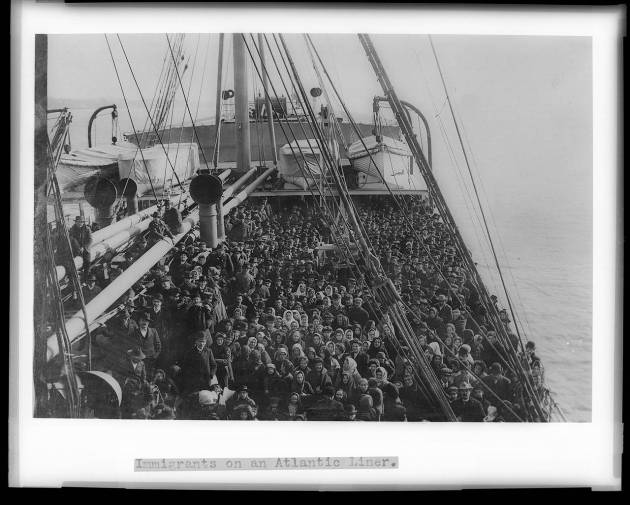
Crowds on 19th century immigrant ships

Leah Boustan, professor of economics, uses digitized historical records and other sources — like this 1906 photograph of immigrants on an Atlantic liner — to give researchers a statistical footing for studies on immigration, past and present.

Prior work suggested that European immigrants during the age of mass migration were paid less than native-born workers upon first arrival, but then quickly caught up. Boustan and her collaborators tracked the occupations of 21,000 natives and immigrants over two decades, and, in work published in 2014 in the Journal of Political Economy, showed that this common wisdom does not fit the facts in two different ways. Many recently arrived immigrant groups did not have lower earnings than natives and, overall, the income of immigrants and natives rose at close to the same rate.

Slow rates of economic assimilation are consistent with the experiences of recent immigrants, according to studies by other researchers, Boustan said. “There is nothing special — or necessarily alarming — about economic convergence that takes more than one generation,” Boustan said. “We have been there before.”

One measure of cultural assimilation that Boustan looked at was how immigrants named their children. Because selecting a child’s name costs nothing, and thus is independent of socio-economic status, Boustan argued that names indicate a family’s eagerness to adopt American culture. In work supported by a grant from the Russell Sage Foundation, she and her colleagues used millions of entries from recently digitized census records to calculate a “foreignness index” for each name in the early 1900s. She conducted a similar exercise using birth certificate records from California today. In both cases, she found that immigrants shift away from foreign-sounding names as they spend more time in their adopted nation, and at the same rate.

“What was striking about those two sets of analyses — the past and present — is that the speed of cultural assimilation, by this measure, is almost identical in the past and present,” Boustan said. The study is detailed in an NBER Working Paper posted in July 2016.

Boustan’s work is part of a growing trend in economics toward harnessing large data sets to explain historical observations, said her colleague and former mentor, Henry Farber, Princeton’s Hughes-Rogers Professor of Economics. Farber met Boustan when she was an undergraduate at Princeton in the late 1990s. Boustan later earned a Ph.D. at Harvard University in 2006 and then became a professor at the University of California-Los Angeles.

Today, Boustan’s office is only a few doors down from Farber, who is next door to his own dissertation adviser, Orley Ashenfelter, the Joseph Douglas Green 1895 Professor of Economics — three generations of empirical economics in one hallway. “Princeton is lucky to have her on the faculty,” Farber said.

Boustan is also part of the trend toward increasing female participation in a historically male-dominated discipline. When a leading journal recently asked her how the field might attract and train more women, she was caught off guard. “I realized that I didn’t know much about the overall situation of women in economics — I only knew anecdotes from my personal experiences,” Boustan said.

So she began investigating the problem with her characteristic big-data approach. “It is a very important question, and the best way to work on big questions is to take a look at the data,” she said.

She paired with graduate student Andrew Langan to collect data on the male-female graduate student ratios in economics departments at leading research universities and learn more about why some programs have more success than others in training women. Graduate programs in economics are on average 30 percent female across the nation, with some as low as 10 percent female and others achieving a 50-50 balance, Boustan and her team found.

“The average picture looks gloomy, but there are some bright rays,” Boustan said. For example, even departments with high numbers of male students and faculty can serve female students well if they provide opportunities for training and mentoring, they found.

Boustan keeps this in mind as she mentors and advises students in Princeton’s economics department. One advisee, Ji Won Choi, said, “I hope I can be an example, like Leah, for others in the future.”

Until recently, Princeton’s Department of Economics had few women in senior faculty positions, but the department has doubled its number of female faculty members over the past four years, said Janet Currie, the Henry Putnam Professor of Economics and Public Affairs at the Woodrow Wilson School, who was department chair until June 2018. “Nevertheless,” Currie said, “we are not where we would like to be, and we’ll need continuous effort not to lose the gains we have made and to diversify the faculty and student body in other dimensions.”

With so many charged topics facing society today, from the equitable treatment of women in the workplace to the role of immigrants in building the nation, Boustan’s data-driven approach to controversial issues is more relevant than ever. To explain the importance of this work, Boustan quotes her former mentor, the Harvard economic historian and labor economist Claudia Goldin: “The best historical questions are the ones that speak to the world we live in today.”

Source: Fact-checking immigration: Boustan uses big data to explore myths about the past

John Ivison: Trudeau sounds resigned to his inability to solve Canada’s border-crosser problem

Interesting and nuanced commentary, including recognition by the Prime Minister in terms of the limitations:

Justin Trudeau appears to have given up hope of reducing the flow of people crossing from the United States illegally to claim asylum, and is test-driving fresh rationalizations on why a migrant surge might not be such a bad thing. The new line from the Prime Minister is that the flow of asylum seekers may prove an economic boon for Canada.

“The fact that we have extremely low unemployment, we’re seeing labour shortages in certain parts of the country, (means) it is a good time to reflect that we are bringing in immigrants who are going to keep our economy growing,” Trudeau said in a pre-Christmas interview.

The statement came in response to a question about a contention by his predecessor, Stephen Harper, that an immigration system that is legal, secure and economically driven will have high levels of public acceptance, while the “irregular” migration phenomenon has made the system less secure and less economically driven.

It is clear there are labour shortages. A Business Development Bank of Canada study in September found four in 10 small- and medium-sized companies struggling to find new employees. But an orderly immigration system aims to match the skills of newcomers with the demands of employers. The free-for-all at the border is a triage situation. The only thing economically driven about it is the desire of the migrants crossing illegally to have a higher standard of living than they had in their country of origin.

Who can blame them? But it’s no way to run a country.

To claim this abuse of process will help the economy to grow is the latest attempt by the Trudeau government to justify its loss of control over the Canada-U.S. border. In November, Bill Blair, the border security minister, tried to sanitize the situation by pointing out that 40 per cent of migrants crossing illegally are children, suggesting that Canada is merely living up to its human rights obligations.

Neither argument can rationalize a situation where the integrity of the immigration system is being violated.

Trudeau pointed out that the Liberals have injected extra resources ($173 million in budget 2018) to ensure that everyone who arrives in Canada, even if they cross between official border crossings, is given a full security screening. “There are no loopholes or shortcuts, in that our immigration system continues to apply to everyone who arrives in this country,” he said.

This is true. The flow of migrants, mainly from Nigeria and Haiti, is costing the federal government a pretty penny — $340 million for the cohort of migrants who arrived in Canada in 2017, according to a November report by the Parliamentary Budget Office — not to mention straining provincial resources (the PBO estimated a cost of $200 million each for Ontario and Quebec). Such generous provision has attracted yet more asylum shoppers — year-over-year numbers suggest more people crossed illegally into Canada between January and September this year (15,726) than in the same period last year (15,102).

The endless appeals process means there is a massive backlog that is likely to require reform to reduce.

But at least the government has some control over the process once migrants have claimed asylum. When it comes to reducing the number flowing across the border, the Liberals appear accepting of their impotence.

Blair’s mandate letter gave him the lead role in talking to the Trump administration about “modernizing” the Safe Third Country Agreement, which states migrants claiming refugee status must make their claim in the first “safe” country they arrive in — Canada or the U.S.

A family from Haiti approach a tent in Saint-Bernard-de-Lacolle, Quebec, stationed by Royal Canadian Mounted Police, as they haul their luggage down Roxham Road in Champlain, N.Y., Monday, Aug. 7, 2017.

A loophole in the pact with the Americans means it does not apply between official points of entry.

But there appears to have been little progress on closing the loophole since public safety minister Ralph Goodale met then-homeland security secretary John Kelly in March, when they agreed to “monitor the situation” at the land border. Blair visited Washington in November to meet homeland security officials and his office says talks are “ongoing.”

They are likely to remain so.

No matter how much money the government spends trying to process asylum claims, a solution requires cooperation from the Trump administration — and that has not been forthcoming.

Even under Obama, there was no interest in extending the Safe Third Country Agreement to anyone crossing from the U.S. — a move that would increase the number of asylum claimants south of the border. There is likely to be a similar lack of concurrence about joint border enforcement patrols to stop people crossing in the first place.

But the agreement is currently as useless as a pulled tooth. There can be few issues of greater importance in the cross-border relationship and the point should be made forcefully in Washington whenever the Americans want something.

Canada’s consensus on immigration is in jeopardy, as economic migrants ignore this country’s laws and its borders.

Trudeau sounds resigned to being bound in an insoluble quandary. The upshot is that he is trying to promote an uncontrolled migration system as one that is not only orderly, but is of net benefit to Canada.

It is going to be a tough sell.

Source: John Ivison: Trudeau sounds resigned to his inability to solve Canada’s border-crosser problem

Canadian Immigration and Refugee Law: A Practitioner’s Handbook, 2nd Edition by Chantal Desloges and Cathryn Sawicki – Review

As one who looks at immigration from a data and policy perspective, reading Canadian Immigration and Refugee Law: A Practitioner’s Handbook deepened my understanding of legal perspectives and experience in supporting clients through the various immigration and refugee processes. Practitioners Chantal Desloges and Cathryn Sawicki (we follow each other on Twitter) have compiled a comprehensive and practical handbook that I found particularly useful in deepening my understanding of the intricacies of immigration policies.

The Handbook is impressive, close to 700 pages, broken into 16 chapters, with an extensive glossary, table of cases, and index. Each chapter starts with a helpful introduction explaining the relevant policies and programs. The table of contents is helpfully designed to allow readers to go directly to the topic of interest. 

The book features helpful graphics: organization charts, flow charts, and summary tables. The tables are particularly helpful and cover a range of areas: the roles and responsibilities of different actors, contrasting different programs (e.g., between the Temporary Foreign Worker Program and the International Mobility Program), occupational codes, the nature and steps in the processes, and the key provisions of the relevant legislation along with the relevant articles.

While the material is complex, and the intricacies appear almost infinite, the authors have made every attempt to write in as accessible language as possible. Yet this more accessible language does not “dumb down” the complexity of the content but rather makes the material easier to follow and, I expect, to explain to clients. This was further aided by selected media stories that highlight the practical impacts of the issues and decisions discussed (e.g., an article on what immigration officers look for with respect to applications for spousal sponsorship). The Handbook also includes some statistics (e.g., on the different waves of refugees) although in my view, too sparingly, as some sections such as permanent residency, would benefit from a data breakdown of the various programs to provide greater context.

The Handbook focuses on practical advice for counsel in representing clients. This is particularly extensive with respect to family class immigration, immigration appeals, the refugee determination process and judicial review, likely reflecting where most immigration law practice takes place. The recurring advice applying to all sections is that the responsibility lies with the applicant in making any application or request for consideration, the need for honesty and disclosure by the applicant  (and counsel’s professional responsibility to cease representation if the applicant is not being truthful) and that file prepared should be complete and well-organized to facilitate decision maker review. Implicitly, this essentially is a recommendation to use counsel in these areas of more complex immigration law.  

I do have, however, a few quibbles with some of the material: 

One nice touch, the Handbook uses she and her as much as he and him in referring to persons rather than just one gender.

As I was reading the Handbook, I kept on asking myself who might be the potential audience for such a comprehensive treatment beyond the obvious ones of current and future immigration lawyers and reputable immigration consultants? It is clearly a specialized publication, not designed for the general public, even if written in an accessible manner.

Policy practitioners generally rely on consultation with government lawyers to ensure their policy proposals are in conformity with law. However, reading the Handbook, I found that I benefitted from both the general and more specific treatment of the issues, and have already returned to the Handbook to answer some media enquiries. 

Certainly, policy practitioners new to immigration would benefit from reading the specific chapter relevant to their work. While it may be too much to expect (hope?) that political staffers and political commentators would read relevant sections to the issues of the day, they would clearly benefit from doing so, as some ill-informed debates regarding Canada’s international and domestic obligations regarding asylum seekers illustrate. Other potential audiences would include academics and think tank experts specialized in immigration.

Overall, the Handbook lives up to its billing as a practitioners handbook, but one relevant to anyone with a specialized professional interest in immigration issues.

Cato’s 2018 Immigration Research in Review | Cato @ Liberty

While I am far from being a libertarian, I do find that Cato’s analysis of immigration issues, and particularly of immigration-related data, impressive and worth following. Their round-up provides a good sense of the scope of their research and analysis, particularly with respect to some of the myths circulating or being propagated by the Trump administration:

Cato’s immigration policy team was very busy in 2018.  My colleagues David Bier and Andrew Forrester, in addition to some contributions by myself and numerous outside authors like the stupendous Michelangelo Landgrave, worked non-stop to produce almost 180 pieces this year in the form of blog posts, op-eds, Cato research papers, and peer-reviewed academic articles.  David Bier summarized many of these pieces in a twitter thread for those on Twitter.

Of those, I’m most proud of the pieces that discovered original facts and figures to illuminate the immigration issue.  With rare exceptions, the most valuable immigration policy research is that which produces original facts and figures, as too much of the debate over this topic is emotional and ungrounded.  We are trying to make the debate about the facts and contributing those that we have discovered on our own in the process. Below is a rundown of the original facts and figures that Cato scholars have calculated in 2018 by subtopic with links to our research.

Assimilation

The recent surge in immigrants along the border are low-skilled, poorly educated, and from Central America – but that doesn’t stop them and their descendants from learning English, converging to American wages, and joining the military at rates comparable to or higher than native-born Americans.

Border Security, the Wall, and Interior Immigration Enforcement

Much of the national immigration debate proceeds under the implicit and incorrect assumption that immigration enforcement only harms illegal immigrants. My colleague Matthew Feeney waded into the immigration debate with an excellent primer on how increased immigration enforcement, both at the border and in the interior of the United States, will infringe upon the civil liberties of American citizens and lawful permanent residents as well as an examination of legal protections that can help mitigate the lost rights.  Complementing Feeney’s paper is our finding, based on data from Travis County in Texas, that Immigration and Customs Enforcement (ICE) targeted at least 228 American citizens as illegal immigrants in that county over 12 years – or about 0.9 percent of all those detained.

Related to interior immigration reform is the E-Verify program, which is an electronic eligibility for employment verification system run by the federal government.  Congress created it in an attempt to turn off the magnet that attracts illegal immigrants to the United States in the first place: higher wages and low unemployment.  In theory, E-Verify would allow employers to check the identity information of new hires against government databases to see if they are legally eligible to work and to deny illegal immigrants.  For years, members of Congress have introduced bills to make E-Verify a national mandate to be used whenever a business hires somebody – including American citizens.

Four states have mandated E-Verify for all new hires, but only 56 percent of new hires in those states were run through E-Verify in the second quarter of 2017.  To be effective, a much higher percentage of new hires must be checked through E-Verify.  The four states that mandated E-Verify are Arizona, Alabama, Mississippi, and South Carolina.  Over time, the rate of new hires has barely budged in those states – even in South Carolina where the state conducts random audits of employers to supposedly guarantee compliance.  If those conservative states can’t effectively enforce an E-Verify mandate, there is no hope for doing so nationally.

Our next piece of original research confirmed that California’s TRUST Act, which limited state law enforcement cooperation with ICE, dramatically reduced deportations from that state.  Although deportations from California were falling prior to the TRUST Act going into effect in 2014, deportations from California that year dropped 39 percent relative to 2013.  In the rest of the country, the number of deportations only dropped 9 percent over the same period.

Much of the rest of our original research focused on border enforcement.  Republicans introduced a bill in 2018 to spend more on Border Patrol in the next five years than has been spent over the last 5 decades – in real terms.  A portion of that extra money would be spent on drones to patrol the border, an enforcement tool that has already been used on the border and is responsible for 0.5 percent of all border apprehensions at an astonishing cost of $32,000 per arrest.  Apprehended border crossers, whether discovered by drones or more traditional methods, spent an average of 39 hours in detention in late 2014 and 2015 or 12.8 million hours total.  Of course, all of this extra enforcement is unnecessary as the lesson of marijuana legalization on the state level shows that smuggling can more effectively be cut with better laws that allow cross-border flows rather than crackdowns.

Part of the justification for more spending and technology on the border is that Border Patrol agents face severe threats on the job.  While they certainly do, it’s not nearly as dangerous as many assume.  Thirty-three Border Patrol agents died on the job from 2003 through 2017 or about one death for every 7,968 agents per year.  Six of those agents were murdered on the job while the other 27 died in accidents or in unknown circumstances.  Their on-the-job murder rate is about 1 in 43,824 per year from 2003 onwards, much lower than the 1 in 19,431 annual murder rate for Americans during the same time period.  Every one of those murders or deaths is a tragedy, but those rates do not indicate an exceedingly dangerous job.

Crime

In 2016, illegal immigrants were 47 percent less likely to be incarcerated than native-born Americans and legal immigrants were 78 percent less likely to be incarcerated than natives.  By race and ethnicity, legal immigrants and illegal immigrants were less likely to be incarcerated than their native-born co-ethnics.  In the state of Texas, which actually counts criminal convictions by immigration status, the illegal immigrant criminal conviction rate is about half that of native-born Texans and the legal immigrant conviction rate was 66 percent below.  In Texas, that pattern also holds for crimes like homicide, larceny, and sex crimes.  Nationwide, only about 11 percent of “criminal aliens” actually committed a violent or property crime and 60 percent of those “criminal aliens” deported committed only a victimless crime. Related to these findings, DACA recipients were far less likely to be arrested than those who were not in DACA.

Illegal immigrants could commit more crimes and escape punishment for them by fleeing back to their home countries, but police clearance rates (the rate as which police solve crimes) are not correlated with the size of the illegal immigrant population even with numerous controls.  There is even some evidence that motor vehicle theft and burglary are solved as slightly higher rates in states with more illegal immigrants as a proportion of their population.  This is consistent with our finding that the interior immigration enforcement program had no effect on crime rates in North Carolina although it did increase assaults against police officers.  Interestingly, Arizona’s passage of an E-Verify mandate in 2007 drastically increased the flow of non-citizen offenders into Arizona state prisons – a serious potential side-effect of increased immigration enforcement that E-Verify supporters have yet to address.

Crime in Mexico along the U.S. border is a serious problem, but we found a negative correlation between homicide rates in Northern Mexico border states and homicide rates in American border states.  Expanding on the theme of crime flowing over the border, only about 0.2 percent of all border apprehensions in the first half of 2018 belonged to a gang.

DACA and Legalizing Unlawful Immigrants

President Trump’s slow-motion cancellation of the DACA program made for DACA-recipients and other Dreamers a big political issue in 2018 and several bills to do so in exchange for a border wall were proposed.  Many of those bills would have legalized only a small proportion of the Dreamer population, about half the number that President Trump claimed.  Another proposal would have denied a path to citizenship for 82 percent of Dreamers.

Economic Growth, Fiscal Effects, and Wages

Former visiting fellow Ike Brannon estimated that reversing DACA would cost the U.S. economy $351 billion from 2019 to 2028 in lost income and that the U.S. Treasury would lose $92.9 billion in tax revenue.  Under Trump’s proposal to halve legal immigration, we used a simple model to show that it would reduce the size of the U.S. economy by about $19 trillion in 2060 relative to what it would have been under the status quo, mainly by reducing the growth of the American population by 26 million.

Wage and economic assimilation of new immigrants is vitally important. Newly arrived immigrants have wages lower than otherwise identical natives, but those wage differences diminish greatly or disappear entirely after about two decades of working in the United States.  The immigrant wage gap has diminished in recent years.  Furthermore, illegal immigrants initially faced a hefty wage penalty of about 11.3 percent relative to legal immigrants due to their lack of legal work status.

Health

Many commentators expressed fear that immigrants, especially those in the migrant caravans, would spread disease once they arrive.  However, vaccination rates in Mexico  and Central America are generally higher than or about the same as those in the United States.

Immigration Affects the Fundamentals of Economic Growth

The best criticism of expanded legal immigration is that the new Americans and their descendants could vote for bad policies that diminish the prosperity of the United States.  On its face, this is plausible as immigrants generally come from countries with worse economic and political institutions than the United States.  Immigrants today are coming from more democratic countries than immigrants who came in the past.  Additionally, we published a working paper that examined a quasi-natural experiment in Jordan where a large and sudden exogenous shock of migrants permanently moved there.  We found that the migration significantly increased economic freedom.  That paper was accepted for publication in the World Bank Economic Review, the 28th best peer-reviewed academic economic journal in the world.  More impressively, that publication marks the first peer-reviewed publication for my talented colleague Andrew Forrester.

Unrelated to immigrant effects on public policy, we investigated whether immigrants could worsen U.S. economic growth by reducing the quality of firm management and found precisely nothing.

Immigration Policies in Foreign Countries

No analysis of American immigration policies is complete without a comparison to policies in other countries.  The United States ranks in the bottom third of wealthy countries in terms of net new immigrants as a share of total population from 2015 to 2017 as well as total foreign-born residents as a share of total population.  Singapore’s relatively open immigration policy provides a possible model for the United States.  About 47 percent of Singapore’s population is foreign-born, more than three-times greater than the United States as a whole and larger than any American urban area, but with fantastic economic effects compared to its neighbors.

Legal Immigration

One of President Trump’s immigration reform frameworks would have cut 22 million legal immigrants over the next 50 years and, if it was in place since 1965, it would have reduced legal immigration by about 23 million.  That latter figure doesn’t include the tens of millions of our fellow citizens born here since 1965 who would not be Americans if that framework was applied retroactively.  Consistent with the President’s plans to cut legal immigration, his administration has increased the denial rate for visas by 37 percent.

President Trump and those who want to cut legal immigrants have frequently said that they want to reduce low-skilled immigration and boost the number of highly-skilled immigrants so that our immigration system looks more like the Canadian system.  This is unnecessary as our immigration system, on its own, is already admitting far more skilled immigrants than it used to.  On paper, the proportion of skilled new immigrants admitted to the United States from 2012-2016 is about the same as in Canada during that time:  49 percent with a bachelors or above education admitted to the United States compared to 52 percent in Canada.  Even immigrants who arrive via family-reunification and on the diversity visa are more educated than native-born Americans.

Although our legal immigration system is admitting more skilled immigrants on its own, serious problems remain.  For instance, Indian immigrants with advanced degrees face a 150-year wait for employment-based green cards.  That is shockingly unfair and economically destructive, even for a government bureaucracy.  Small tweaks to our immigration system could reduce that problem significantly.  More importantly, a small administrative change that is consistent with current law could increase legal immigration by 27 percent across the board and allow in far more skilled immigrants.

Refugees and Asylum Seekers

President Trump’s so-called Muslim ban has cut Muslim refugees, immigrants, and travelers by 91 percent, 26 percent, and 60 percent, respectively.  Related to that, Trump’s refugee policy has also cut the number of Christian refugees by 64 percent.  Additionally, signing a Free Trade Agreement with the United States does not boost the number of refugees or asylum-seekers who come from those countries.  The Syrian Civil War is winding down, but a persistent criticism over recent years is that rich Gulf States have not sponsored any Syrian refugees.  While legally true, that analysis ignores the fact that the Gulf States have allowed over 1.2 million Syrians to enter and remain on their territory on non-refugee visas over that time in response to the humanitarian crisis.

Terrorism

President Trump favored “extreme vetting” for new immigrants and travelers to prevent future terrorist attacks. But since the 9/11 attacks, the U.S government has done an admirable job screening out terrorists.  From 2002-2016, the government issued one visa to a radicalized terrorist for every 29 million non-terrorists and issued 379 million visas for each deadly terrorist.  The government undertakes many more counterterrorism activities than just visa vetting.  Since 9/11, they have spent $2.8 trillion on counterterrorism.  Assuming the statistical value of life is $15 million, that spending would have to have prevented about 188,740 murders in terrorist attacks during that time to break even – or over 1,000 times as many people as were actually murdered in terror attacks on U.S. soil since 9/11.  That is extremely unlikely.

About 3,518 Americans have been murdered in terrorist attacks on U.S. soil from 1975 through the end of 2017.  That’s about a one in 3.3 million chance per year of being murdered in a terrorist attack here committed by any terrorist.  By comparison, 7,548 people have been murdered by animals during that time – a death rate about double that caused by terrorists.  The annual chance of dying in a terrorist attack in the United Kingdom during that time is higher at about 1 in 1.1 million per year.  Since 9/11, the chance of being murdered in a terror attack in France has been about 7-times higher than in the United States.  Terrorism is obviously a threat to Americans that the government should seek to keep low, but its deadliness should not be exaggerated.

The migrant caravan dominated headlines in 2018, but the terrorist threat from asylum-seekers and illegal immigrants has been very low since 1975 and not a single terrorist from Mexico or Central America has entered during that time.  The last year that illegal border crossers who were eventually convicted of planning a terrorist attack on U.S. soil entered the United States was in 1984.  They came as children and were arrested in 2007 before they killed or injured anybody.  Furthermore, those apprehended along the border from Muslim countries haven’t committed any attacks on U.S. soil and none of the examples given meet that criteria.

Welfare

On the basis of monetary value, immigrants individually consume about 39 percent fewer welfare benefits than native-born Americans.  Immigrants and their native-born children consume about 33 percent less welfare individually than native-born Americans whose ancestors have been here for at least two generations.

Conclusion

Immigration has been one of the top policy issues since 2015.  Cato scholars have been at the forefront of publishing new facts and figures to illuminate this debate.  This post does not include our other activities such as our work with Rep. Grothman (R-WI) to reduce immigrant welfare consumption, our numerous public debates, summations of outside research, and weekly analysis of immigration-related events.  We hope to continue this pace of original research in 2019 and beyond.

Source: Cato’s 2018 Immigration Research in Review | Cato @ Liberty

UK and German immigration: a tale of two very different laws

One of the better articles on planned changes to immigration policy in both countries:

Two European countries announced radical overhauls of their immigration rules on Wednesday, but there the similarity ended.

Britain, where concerns about long-term impacts of immigration helped drive the 2016 vote to leave the European Union, billed its stricter regime as “a route to strengthened border security and an end to free movement”.

Germany, however, facing such a shortage of workers that is threatening economic growth, said it was easing immigration rules to attract more foreign job-seekers.

In an interview on BBC Radio 4’s Today programme, the British home secretary, Sajid Javid, stressed that the Conservatives’ 2017 election manifesto had made clear the party’s “commitment to bring net migration down”.

His counterpart in Germany, Horst Seehofer, said: “We need manpower from third countries to safeguard our prosperity and fill our job vacancies.” The economy minister, Peter Altmaier, hailed the new law – keenly awaited by business – as historic.

Britain’s priority appears primarily to be establishing a system of tough controls capable of keeping certain people out. Business has accused the government of putting a political imperative for restriction before the needs of the economy.

In contrast, by introducing looser visa procedures and reducing red tape Germany’s emphasis appears to be on making it easier for certain people to enter and to stay. Some in Angela Merkel’s conservative alliance and in the far-right Alternative für Deutschland (AfD) have said such a move ignores public concerns about immigration.

The UK’s system does not put a cap on numbers but aims to reduce annual net migration to “sustainable levels”. It requires skilled workers to earn a minimum salary, to be decided next year. After Brexit there would be no more special treatment for EU citizens; a transitional temporary worker scheme would allow them, and workers of any skill level from other “low risk” countries, to enter Britain without a job offer for up to 12 months.

Business leaders have warned that the system will leave the UK poorer, depriving industry of a migrant workforce on which it has depended. The proposed £30,000 salary threshold for skilled workers would leave hospitals, the contstruction and hospitality sectors, manufacturing, agriculture and logistics desperately short of labour, they said.

Germany’s Fachkräftezuwanderungsgesetz, or skilled labour immigration law, will allow skilled workers such as cooks, metallurgy workers and IT technicians to enter the country for six months to try to find a job, provided they can support themselves financially.

More controversially, the law will offer the prospect of permanent residency to asylum seekers who have a job and speak good German but currently face deportation if their asylum applications are turned down.

Immigration has been a key political issue in Germany since Europe’s 2015 migration crisis, when the country absorbed more than 1 million mostly Muslim refugees and migrants, sparking a xenophobic backlash and surge of support for the anti-immigration AfD in federal and regional elections.

Ministers stressed the new rules were a “pragmatic solution” to a pressing economic problem. The AfD said they would fuel immigration, providing “a fresh incentive for people from around the world to come”. In Germany, however, those politics have not, so far, prevailed.

Source: UK and German immigration: a tale of two very different laws

Trump Is Making Americans More Immigrant-Friendly

The irony:

President Donald Trump may ultimately be a unifying force on one of the most divisive issues in U.S. politics: immigration.

That’s not Trump’s intent, of course. Having launched his presidential campaign in 2015 with a demagogic assault on immigrants, Trump has been a reliable fount of calumny ever since. His policies, from brutalizing children at the border — a 7-year-old girl died in U.S. custody last week — to terminating Temporary Protected Status for refugees, appear designed to convince his MAGAnauts that he can, and somehow will, forestall the further browning of America.

In public opinion, immigration is an imperfect substitute for “race.” However, Trump has succeeded in making it a more meaningful one. As numerous political science analyseshave determined, Trump’s racial animus is the sticky goo that binds him to his most enthusiastic followers. That goo may be a potent political force, but it’s not a boundless one. Trump appears to have found its limits.

The NBC/Wall Street Journal poll has been asking survey respondents since 2005 whether “immigration helps the United States more than it hurts it.” In December 2005, 37 percent said immigration helps more, while 53 percent said it hurts.

That anti-immigrant sentiment, regularly measured by the poll, largely prevailed until 2012, when opinions started gradually to shift. In the most recent poll, taken in September, the pro-immigration “helps” line reached a peak of 61 while the anti-immigration “hurts” side hit a new low at 28. Measured from December 2005 until September 2018, there is a 49-point swing in favor of immigration “helps.”

Likewise, in June this year, Gallup recorded a new high of 75 percent of Americans saying they believe immigration is a “good thing.”

In the 2018 midterm elections, Democratic pollster Stanley Greenberg wrote, Democrats ran as a “self-confident multicultural party” against a GOP running as an “anti-immigrant party.” The results were not good for the anti-immigrant side.

The greatest risk for Republicans is that Trump’s racial malice will energize nonwhite voters to be more politically engaged while also alienating them, long-term, from the GOP.

That’s what may have happened in California after the state GOP’s anti-immigrant turn under Republican Governor Pete Wilson, who won election in 1994 with a sharp anti-immigrant campaign. “The California GOP went from virtually splitting the Hispanic vote in 1990 to only capturing 17 percent of it in 1998,” wrote Alex Nowrasteh, an immigration expert at the Cato Institute, in an analysis of the electoral consequences. By contrast, during the same period Republicans in Texas continued to be competitive with Hispanic voters and in Florida, then-Governor Jeb Bush claimed to have won 60 percent of the Hispanic vote in his 2002 re-election.

I asked veteran Democratic consultant Bill Carrick, adviser to California Senator Dianne Feinstein, whether he sees Trump cultivating a California-style backlash. “Trump is doing for immigration nationwide what Pete Wilson did in 1994,” Carrick emailed. “The more we debate the immigration issue, the more supportive voters become of immigration reform.”

Political scientist Dan Hopkins of the University of Pennsylvania wrote in 2017 that “Americans became more liberal on immigration at exactly the time that Trump and the Republicans turned more hard-line.”

However, in an email last week, Hopkins said that his research, using a survey group that has been stable over several years, suggests that the pro-immigrant drift in the electorate has slowed. “The big-picture summary from my data,” he wrote, “is one of remarkable stability since Trump took office.”

That’s largely what Republican pollster David Winston sees as well. In a detailed report on the 2018 midterms, Winston concluded that the immigration debate did hurt Republican candidates. “The focus on the immigration/caravan issue instead of the positive jobs report in the last days of the campaign had a net result of late deciders breaking for Democrats by 12 points,” Winston wrote.

But Winston doesn’t think Democrats are necessarily gaining ground. The basic values debate between the parties, Winston said in a telephone interview, is that the U.S. is a “country of laws” (Republican) versus a “country of immigrants” (Democratic). “The public believes in both of these values,” Winston said. The job of politicians, he said, is to figure out how to make those values work together.

Making things work is not Trump’s strong suit. Consequently, there is a high probability that the immigration issue will fester until a new president is sworn in. But even if Trump doesn’t drive still more Americans into the pro-immigrant camp, the next president appears poised to have a stronger pro-immigrant constituency than Barack Obama had at any point during his presidency.

“There is a Trump effect,” said immigration advocate Frank Sharry, via email. “When it comes to the public’s view of immigrants and pro-immigration policies, Trump has made them more popular than ever.”

Source: Trump Is Making Americans More Immigrant-Friendly

Trump’s battle against H-4 visa holders

Spousal employment, another Canadian immigration advantage compared to the USA:

When Molika Gupta immigrated to the U.S. in 2013, after marrying her husband who was already working in the states, she had no idea she would be unable to work. In India, she had earned bachelor’s and master’s degrees and worked in patent licensing—but once she came to the U.S., she found she could not work on the H-4 visa, which is given to immediate family members of an H-1B worker. (The H-1B is a temporary visa awarded to highly skilled foreign workers, to fill specialized jobs for which there aren’t enough qualified American workers. An H-4 visa allows immediate family members to legally accompany H-1B holders to the U.S. and study here, but it does not authorize them to work.) She decided to get a second master’s degree, which put her on a student visa, but two years later, she was forced to switch back to the H-4 after striking out with the H-1B lottery. (There’s a cap of 85,000 H-1B visas per year—a lottery system is now used to determine which petitions will be approved.)

“That’s when the darkness and depression and loneliness started,” she says. “I was not expecting something like this would happen to me.” When her H-4 work authorization was finally granted in 2017, employers were wary of hiring someone with a gap in their employment history. “Hiring managers couldn’t understand what happened because they’re not really aware of the immigration process,” she says. Now, she works as a freelancer—and advocates for other H-1B spouses in her situation.

“IT’S JUST FUNDAMENTALLY WRONG”

Gupta is one of about 100,000 women who could lose the ability to work if the Trump administration follows through on yet another anti-immigration measure, which would revoke work permits for H-1B spouses—more formally known as the employment authorization document (EAD). Since 2015, when President Obama introduced EAD, H-4 visa holders have had the ability to work without a green card. At the moment, the green card wait time for highly skilled Indian immigrants—who account for more than 75% of H-1B holders—is decades long, which means that without being granted work authorization, their spouses could be barred from working for the foreseeable future.

An overwhelming majority of those spouses are women, for whom the ability to work secures their economic independence—and helps bolster the U.S. economy. In a survey of 2,411 H-4 holders, the advocacy group Gupta works with (which started as a Facebook page, “Save H4EAD“) found that 94% of respondents were women. Nearly 60% of the people surveyed have postgraduate or professional degrees, and about 57% have lived in the U.S. for more than five years and have U.S.-born children. The women who could be affected don’t just work in the tech industry; they are teachers and nurses and architects.

“These are people who are on a path to becoming permanent citizens,” says Todd Schulte, the president of immigration advocacy group FWD.us. “It’s just fundamentally wrong.”

The Trump administration already cracked down on the H-1B visa last year, when he issued an executive order that led to a more stringent review of H-1B petitions as well as increased scrutiny of compensation and why the job in question requires a foreign worker. Immigration lawyers have reported a higher rate of denials and delays issuing visas. But the decision on H-4 work authorization—which was first proposed over a year ago—has been delayed for months, leaving H-4 holders in a state of fearful anticipation. The EAD work authorization was initially introduced through an executive order by Obama, and Trump could similarly revoke it by executive order, although it could potentially be challenged in court.

According to Schulte, the White House has not made a move to revoke H-4 work permits in part because they don’t have a good reason to do so. “Take a step back and think about how unprecedented this move is,” he says. “This is a successful program. There is nobody saying this is somehow bad for the economy and country who can back it up with economic stats. They don’t actually have economic justification for it.”

WHAT IT MEANS FOR U.S. TECH JOBS

For tech companies, which have historically employed tens of thousands of H-1B workers, a decision to revoke work permits for spouses could compromise their ability to attract talent from countries like India and China. (Microsoft president Brad Smith has cautioned that the decision could force them to move jobs out of the U.S.) In Congress, there is bipartisan support for H-4 work authorization: Earlier this year, Pramila Jayapal (D-WA) and Mia Love (R-UT) penned a letter with the support of 130 bipartisan members of Congress, imploring Department of Homeland Security Secretary Kirstjen Nielsen to preserve the current regulation. Jayapal also has legislation drafted that can be introduced in the event of a decision.

“I think it’s absolutely ridiculous to welcome one person to contribute their considerable skills to our economy, but tell their spouse that they have to stay home,” she says. “Everyone—regardless of gender—deserves to be able to use and enhance their skills, be financially self-sufficient, thrive mentally and physically, and pursue their dreams. Moreover, it hurts our ability to attract and retain workers. Many of our peers, like Canada and Australia, provide work authorization for accompanying spouses. It’s simply the right thing to do.”

Congressman Ro Khanna, whose district falls within Silicon Valley, says that while people in his town halls sometimes express concerns over the H-1B visa, nobody ever speaks out against the H-4 work permit. “I’ve never had a single constituent in my two years of Congress say that the spouses of H-1B visa holders should not be able to work,” he says. “I think people view that as inhumane or cruel.” That economic independence is particularly important, he says, given there is higher incidence of domestic abuse or violence when a spouse can’t work. And in places with a high cost of living—such as the Bay Area—Khanna says the loss of a second income could significantly impact the livelihood of many families.

The one upside of Trump’s rhetoric is that it has raised awareness and shed light on the plight of H-1B spouses, many of whom only realize they can’t work without the EAD aftercoming to the U.S. And some people have a “distorted” image of the women who carry the H-4 visa, according to Gupta. “It’s not like I was waiting for someone to appear as a knight in shining armor and take me to the U.S.,” Gupta says. “That’s not the case for many women out there.”

Gupta and other advocates—the Save H4-EAD group is led by a group of about 20 people—have drawn more attention to their cause by meeting with lawmakers to share their stories. Raising awareness in the U.S. has also enlightened many women in India who may have to move to the U.S. (Though Gupta adds, “Nobody should be forced to choose between their freedom to work and marriage.”) The group is also preparing for a commenting period if and when the Trump administration makes a decision on work permits.

But Gupta says there is little she can do to brace herself for what could be her new reality. “Nobody can prepare for a situation that they don’t deserve to be in,” Gupta says. “Fighting for your work rights in a country that is the most developed in the world is ironic. I don’t know what should be my next action.”

Source: Trump’s battle against H-4 visa holders

The Colossal Price of Theresa May’s Immigration Obsession

The continuing saga of what appears to be a disaster in slow motion:

Cracking down on immigration is how Theresa May has chosen to interpret the Brexit campaign’s promise to “take back control.” As a result, the U.K. prime minister has ruled out one of the more plausible alternatives to her own EU withdrawal deal: The so-called “Norway-Plus” idea, which would keep Britain in the European single market and force it to accept freedom of movement from other countries in the bloc.

Indeed, control of British borders is probably the most indelible of May’s red lines in the Brexit negotiations. Even though she voted remain, she was always the fiercest champion of the Conservative Party’s promise to cut yearly net migration to the “tens of thousands” during her previous incarnation as home secretary. Ivan Rogers, the former U.K. ambassador to the EU, said last week: “The entire EU knows that where we have now reached derives from her putting the ending of free movement of people well above all other objectives.”

But while May was right about immigration being one of the driving forces of the leave vote, she should note that British public opinion on the matter seems to be softening. As Rogers suggests, May’s withdrawal deal can be seen as trying to end freedom of movement from the EU at almost any cost, including a weaker economy, being a rule-taker from Brussels and swallowing demands for guarantees on the Irish border. She may no longer be totally in tune with her electorate.

Brits increasingly think that Britain should prioritize staying in the single market over ending freedom of movement, according to the pollsters Opinium. That fits with other surveys which put worries about the economy and public services above immigration. The numbers are still close, but the trend is clear. In early 2017, the split was 40-30 in favor of prioritizing an end to free movement. Recently it has flipped to 40-35 the other way.

None of this is to say that Brits have become sanguine about controlling immigration. But there does seem to be rising concern about whether it’s worth the price of leaving the single market. And the cost of Brexit is already apparent. UBS economists reckon the British economy is 2.1 percent lower than where it would have been without the leave vote, equating to about 40 billion pounds ($50.4 billion) of lost GDP.

At the same time, we’ve also seen a drop in net migration since the vote as EU workers avoid Britain. The yearly number has fallen from about 336,000 at the end of June 2016 to about 273,000 at the end of June this year: a reduction of 63,000.

If you take UBS’s 40 billion pounds of lost output over the past two years and divide it by the number of fewer migrants, you get to 635,000 pounds. Now, no one is suggesting that this is the direct cost of losing each of those migrants. Most of the lost output since the Brexit vote comes from factors such as consumer fear, curtailed investment and the weak pound. But it still begs the question of whether this is all a price worth paying for “taking back control” of the borders?

Looking further forward, the Bank of England’s forecasts suggest that May’s Brexit plan would cut yearly net migration to about 100,000 by 2021, while the long-term GDP cost relative to pre-2016 trends would be between 1 to 3 percent in the most optimistic scenarios. These figures suggest a cost of about 40 billion pounds over a six-to-seven-year-period, for a policy that delivers 236,000 fewer net annual migrants. That’s 169,500 pounds per non-arriving migrant. A smaller figure than the previous one, but still one that asks a question.

May is essentially telling the U.K. that you can control EU migration, or you can have the economic benefits of the single market. You cannot have both. She’s right; there’s no Boris Johnson fantasy of having cake and eating it here. But if her deal has become all about killing freedom of movement at any cost, Brits need to know what that price is.

Source: The Colossal Price of Theresa May’s Immigration Obsession