New Immigrants Spending $620,000 More on Vancouver Houses

Interesting differences between Vancouver and Toronto:

Vancouver homes purchased by recent immigrants are worth a third more on average than those owned by Canadians, a government study found.

People who moved to the Pacific coast city between 2009 and 2016 own 5 percent of the detached properties, which are worth C$2.34 million ($1.76 million) on average, or C$824,000 more than those owned by people born in Canada, Statistics Canada reported Tuesday. The gap in Vancouver prices is much larger than for immigrants who arrived earlier, and the same pattern doesn’t hold for Toronto, the agency said.

The report is one of the most detailed yet on immigration and housing in Vancouver and Toronto, the nation’s two most-expensive real estate markets. Policy makers are seeking to get a handle on the decade-long housing boom that drove prices to unprecedented levels, creating record household debt burdens and an affordability crisis.

Tuesday’s report said the role newcomers play in the Vancouver and Toronto real estate markets reflects the large share of the population they represent in each city. Immigrants own 37 percent of homes in Vancouver and made up 41 percent of the population in 2016, while in Toronto they own 43 percent of homes and were 46 percent of the population.

Toronto’s recent immigrants own 4.7 percent of single-detached homes worth an average of C$892,600, or just C$43,300 higher than other Canadian-born owners, the study found. It didn’t give a detailed explanation of why the shift to expensive homes in Vancouver by recent immigrants wasn’t mirrored in Toronto, saying a more detailed study would require many more years of data.

The Vancouver price gap was even larger under an immigration program that targeted new investors in Canada. Recent arrivals to the city under that federal program bought single-detached properties worth an average of C$3.11 million. Across several immigration categories, recent immigrants to Vancouver from China spent more on housing than people from nations such as India or the U.K.

Immigrants may spend more on housing because they have fewer savings in traditional retirement accounts or because of different cultural attitudes, the report said. “Home ownership might be an important milestone for immigrants in the path towards social and economic integration,” it said. “Investments in housing may also be a more important retirement asset and source of wealth creation for immigrants.”

Source: New Immigrants Spending $620,000 More on Vancouver Houses

The Case for an Immigration Tariff

While I don’t see how this approach would work better than the points-based systems in Canada and Australia, and how simple and transparent it would be to implement.

And other studies have shown that the high percentage of family class immigrants, including Asian, does not appear to be resulting in poor economic outcomes (see: One Face of Immigration in America Is a Family Tree Rooted in Asia):

The current U.S. immigration system favors non-economic immigrants. About 81 percent of new immigrants are family members of American citizens or green card holders, whereas only 5 percent earn green cards for employment or investment purposes. Our rapidly changing economy requires a more dynamic immigration system that allows in types of economic immigrants who are barred under the current system. Congress should create an additional visa category that would allow foreigners to work and live legally in the United States after paying a tariff. Immigrants who pay the immigration tariff would receive a “gold card” that does not directly lead to citizenship, but allows the immigrant to live and work legally in the United States. Congress could adjust the tariff rate on the basis of the immigrant’s estimated fiscal impact, as determined by the individual’s level of education or other relevant demographic factors. Several other countries charge high fees for visas or sell the right to immigrate, which offer excellent lessons in how to design a well-functioning immigration tariff for the United States. An American immigration tariff would create a dynamic, market-based, merit-based, relatively more economically efficient, and self-regulating system that would serve the ever-changing American economy.

Source: The Case for an Immigration Tariff

The Hidden Automation Agenda of the Davos Elite

Clarity and likely greater impact on the labour force needed and immigration levels:

They’ll never admit it in public, but many of your bosses want machines to replace you as soon as possible.

I know this because, for the past week, I’ve been mingling with corporate executives at the World Economic Forum’s annual meeting in Davos. And I’ve noticed that their answers to questions about automation depend very much on who is listening.

In public, many executives wring their hands over the negative consequences that artificial intelligence and automation could have for workers. They take part in panel discussions about building “human-centered A.I.” for the “Fourth Industrial Revolution” — Davos-speak for the corporate adoption of machine learning and other advanced technology — and talk about the need to provide a safety net for people who lose their jobs as a result of automation.

But in private settings, including meetings with the leaders of the many consulting and technology firms whose pop-up storefronts line the Davos Promenade, these executives tell a different story: They are racing to automate their own work forces to stay ahead of the competition, with little regard for the impact on workers.

All over the world, executives are spending billions of dollars to transform their businesses into lean, digitized, highly automated operations. They crave the fat profit margins automation can deliver, and they see A.I. as a golden ticket to savings, perhaps by letting them whittle departments with thousands of workers down to just a few dozen.

“People are looking to achieve very big numbers,” said Mohit Joshi, the president of Infosys, a technology and consulting firm that helps other businesses automate their operations. “Earlier they had incremental, 5 to 10 percent goals in reducing their work force. Now they’re saying, ‘Why can’t we do it with 1 percent of the people we have?’”

Few American executives will admit wanting to get rid of human workers, a taboo in today’s age of inequality. So they’ve come up with a long list of buzzwords and euphemisms to disguise their intent. Workers aren’t being replaced by machines, they’re being “released” from onerous, repetitive tasks. Companies aren’t laying off workers, they’re “undergoing digital transformation.”

A 2017 survey by Deloitte found that 53 percent of companies had already started to use machines to perform tasks previously done by humans. The figure is expected to climb to 72 percent by next year.

The corporate elite’s A.I. obsession has been lucrative for firms that specialize in “robotic process automation,” or R.P.A. Infosys, which is based in India, reported a 33 percent increase in year-over-year revenue in its digital division. IBM’s “cognitive solutions” unit, which uses A.I. to help businesses increase efficiency, has become the company’s second-largest division, posting $5.5 billion in revenue last quarter. The investment bank UBS projects that the artificial intelligence industry could be worth as much as $180 billion by next year.

Kai-Fu Lee, the author of “AI Superpowers” and a longtime technology executive, predicts that artificial intelligence will eliminate 40 percent of the world’s jobs within 15 years. In an interview, he said that chief executives were under enormous pressure from shareholders and boards to maximize short-term profits, and that the rapid shift toward automation was the inevitable result.

The Milwaukee offices of the Taiwanese electronics maker Foxconn, whose chairman has said he plans to replace 80 percent of the company’s workers with robots in five to 10 years.CreditLauren Justice for The New York Times

“They always say it’s more than the stock price,” he said. “But in the end, if you screw up, you get fired.”

Other experts have predicted that A.I. will create more new jobs than it destroys, and that job losses caused by automation will probably not be catastrophic. They point out that some automation helps workers by improving productivity and freeing them to focus on creative tasks over routine ones.

But at a time of political unrest and anti-elite movements on the progressive left and the nationalist right, it’s probably not surprising that all of this automation is happening quietly, out of public view. In Davos this week, several executives declined to say how much money they had saved by automating jobs previously done by humans. And none were willing to say publicly that replacing human workers is their ultimate goal.

“That’s the great dichotomy,” said Ben Pring, the director of the Center for the Future of Work at Cognizant, a technology services firm. “On one hand,” he said, profit-minded executives “absolutely want to automate as much as they can.”

“On the other hand,” he added, “they’re facing a backlash in civic society.”

For an unvarnished view of how some American leaders talk about automation in private, you have to listen to their counterparts in Asia, who often make no attempt to hide their aims. Terry Gou, the chairman of the Taiwanese electronics manufacturer Foxconn, has said the company plans to replace 80 percent of its workers with robots in the next five to 10 years. Richard Liu, the founder of the Chinese e-commerce company JD.com, said at a business conferencelast year that “I hope my company would be 100 percent automation someday.”

One common argument made by executives is that workers whose jobs are eliminated by automation can be “reskilled” to perform other jobs in an organization. They offer examples like Accenture, which claimed in 2017 to have replaced 17,000 back-office processing jobs without layoffs, by training employees to work elsewhere in the company. In a letter to shareholders last year, Jeff Bezos, Amazon’s chief executive, said that more than 16,000 Amazon warehouse workers had received training in high-demand fields like nursing and aircraft mechanics, with the company covering 95 percent of their expenses.

But these programs may be the exception that proves the rule. There are plenty of stories of successful reskilling — optimists often cite a program in Kentucky that trained a small group of former coal miners to become computer programmers — but there is little evidence that it works at scale. A report by the World Economic Forum this month estimated that of the 1.37 million workers who are projected to be fully displaced by automation in the next decade, only one in four can be profitably reskilled by private-sector programs. The rest, presumably, will need to fend for themselves or rely on government assistance.

In Davos, executives tend to speak about automation as a natural phenomenon over which they have no control, like hurricanes or heat waves. They claim that if they don’t automate jobs as quickly as possible, their competitors will.

“They will be disrupted if they don’t,” said Katy George, a senior partner at the consulting firm McKinsey & Company.

Automating work is a choice, of course, one made harder by the demands of shareholders, but it is still a choice. And even if some degree of unemployment caused by automation is inevitable, these executives can choose how the gains from automation and A.I. are distributed, and whether to give the excess profits they reap as a result to workers, or hoard it for themselves and their shareholders.

The choices made by the Davos elite — and the pressure applied on them to act in workers’ interests rather than their own — will determine whether A.I. is used as a tool for increasing productivity or for inflicting pain.

“The choice isn’t between automation and non-automation,” said Erik Brynjolfsson, the director of M.I.T.’s Initiative on the Digital Economy. “It’s between whether you use the technology in a way that creates shared prosperity, or more concentration of wealth.”

Mexican Asylum Claims Skyrocket Since the Trudeau Government Eliminated Visa for Mexican Nationals

The numbers have increased dramatically although without the IRCC background documents, we do not know whether this extent was predicted or not. But there was a clear trade-off between economic and political considerations and maintaining the visa requirement.

The previous Conservative government faced similar pressures from the EU with respect to the visa requirements then in place for Bulgaria and Romania but were defeated before they had to make a similar decision (EU visa standoff strains allies Canada needs to pass trade deal. The Conservative government did drop the visa requirement for Czech nationals facing this pressure. The Liberal government dropped the visa requirement for Bulgaria and Romania (only Romania figures in the top 25 asylum claimant countries):

After the Trudeau government changed Canada’s visa rules, the number of Mexican refugee claimants in Canada skyrocketed.

2,445 Mexican visitors to Canada failed to leave and instead applied for refugee status in Canada during the first ten months of 2018, according to new data from Immigration Refugee Citizenship Canada (IRCC) .

The number of Mexican asylum claimants to Canada in on track to rise almost 75% above the previous year’s total, or an 840% increase from 2016’s total.

In July 2016, the Trudeau government removed the visitor visa for Mexicans travelling to Canada —  a visa imposed by the Harper government back in 2009 to end a surge of Mexicans claiming refugee status — despite the fact that the visa significantly reduced the number of asylum claims.

In 2016, the number of Mexican asylum seekers jumped to 260 from 111 the previous year, then surged to 1,515 in 2017, and continued to climb dramatically in 2018, rising to 2,445 claims in the first 10 months.

Number of Annual Asylum Claims from Mexican Nationals

2007 2008 2009 2010 2011 2012 2013 2014 2015 2016 2017 2018
7,153 9,454 7,581 1,197 649 321 84 80 111 260 1,515 2,445

Source: Department of Citizenship and Immigration Canada

“Our Government took a pivotal step towards rebuilding and strengthening our relationship with Mexico, which was damaged considerably under the previous government,” said Immigration Minister Ahmed Hussen’s spokesperson Mathieu Genest in an email.

“The visa lift has helped expand trade and business opportunities, increase investment and tourism, and strengthen people-to-people ties that benefit both countries. In 2017 alone, the increase in business travellers and tourists generated more than $600 million in economic benefits for Canada.”

Not everyone shares the Trudeau government’s optimism.

Toronto Immigration lawyer Guidy Mamann pointed out that, “the decision was definitely not consistent with traditional immigration policy.”

“This was completely anticipated by anyone who knows anything about it. It was done for purely political reasons. Mexico is a full participant in NAFTA and didn’t want to feel like the poor cousin of the trio. The cost was anticipated and was undertaken as the ‘cost of doing (international) business,’” said Mamann in an email.

“I would bet that any report by the CBSA (Canadian Border Services Agency) or CIC (the Department of Citizenship and Immigration Canada, now know as Immigration Refugee Citizenship Canada or IRCC) that was requested by the government at that time would have warned of a significant increase in refugees claims,” he said.

Prior to the Harper government’s policy that made it mandatory for Mexicans travelling to Canada to get a travel visa, only a small fraction of the thousands of Mexicans asking for refugee status were deemed by the Immigration and Refugee Board of Canada to be legitimate claimants. In 2008, for instance, Mexico comprised 26% of all asylum claims in Canada.

About 90% of those claims were eventually either rejected or abandoned.

“It would be inappropriate to speculate on asylum claims before the IRB,” said Genest about the low success rate of past Mexican refugee claimants being a concern with the latest spike in claims.

“The IRB is an independent, quasi-judicial tribunal that operates at arms-length from the government to assess and make decisions on all refugee claims. Each case is evaluated on its own merits, and those with a well-founded fear of persecution are permitted to stay and those who are found to not have a legitimate claim are removed.”

Canada’s asylum system costs taxpayers billions of dollars every year.

High-skilled immigration remains popular in anti-immigrant nations

Not much new but reinforces the point that the benefits of higher skilled immigrants are better understood than lower skilled:
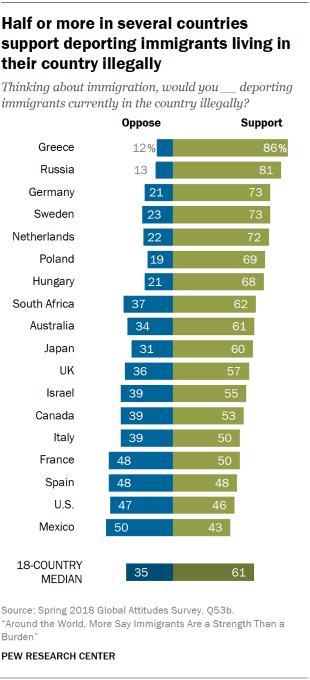
Most of those calling for less immigration overall actually support high-skilled immigration, according to an international survey released this week — a counterpoint to the immigration backlash that has upended politics in the U.S. and other countries.

Why it matters: A majority of people who want to cut immigration levels do not necessarily see all immigrants as threats to their job security, but support bringing in foreign workers for highly technical jobs. As fights over asylum, the border and unauthorized immigration rage, the survey is a reminder that the opposition to immigration isn’t across the board.

The big picture: More than half of respondents from 10 of the 12 nations surveyed by the Pew Research Center said they support high-skilled immigration (Israel and Italy were the exceptions). In the U.S., 78% said they supported high-skilled immigrants.

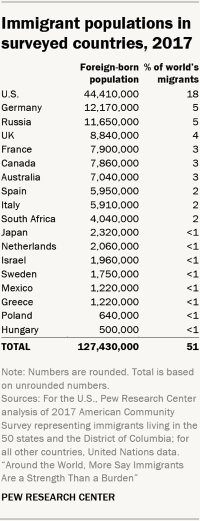
  • But only two countries had immigrant populations where more than half had attained a college degree — Canada and Australia.
  • The U.S. has the highest number of college-educated immigrants, but they only make up around a third of the total U.S. immigrant population.

Between the lines: Immigrants — high-skilled, low-skilled and even unauthorized — play a crucial role in the American labor force beyond high-skilled jobs. The industries that most depend on unauthorized immigrant workers in the U.S., for example, include agriculture, construction and leisure/hospitality, according to an earlier study by Pew.

  • Immigrant workers could be key in maintaining high economic growth as the U.S. population ages and fertility rates drop.
  • “The Pew study shows the public clearly recognizes the great value high-skilled foreigners bring to America, and the critical role they play in our industries and communities nationwide,” Jeff Lande of the Lande Group, which represents India-based IT companies, told Axios.

Source: High-skilled immigration remains popular in anti-immigrant nations

François Legault veut davantage d’immigrants français

I wonder whether he realizes that some of these may well be of other ethnicities than French (e.g., from Magreb, where issues around laicité could emerge):

Alors qu’il amorçait sa première visite officielle en France, le premier ministre du Québec a déclaré que, même s’il avait l’intention de réduire les quotas d’immigration, il souhaitait attirer encore plus d’immigrants français au Québec. François Legault a fait cette déclaration au Devoir au premier jour de sa visite en France à l’occasion de laquelle il rencontrera lundi le président, Emmanuel Macron, et le premier ministre, Édouard Philippe.

Pour le premier ministre, il est clair que la réduction des quotas d’immigration ne doit pas nuire à l’immigration en provenance de la France. Au contraire, dit-il. « Actuellement, il y a beaucoup trop d’immigrants au Québec qui ne sont pas qualifiés ou qui ne parlent pas français, dit le premier ministre. Donc, des Français, on en prendrait plus. De même que des Européens. »

François Legault rappelle son « inquiétude » de constater que, l’an dernier, 53 % des immigrants accueillis au Québec ne parlaient pas français. Avec l’immigration française, dit-il, il n’y a généralement ni problème de qualification ni problème de langue. C’est aussi pour recruter du personnel qualifié que l’Union des municipalités du Québec participait la semaine dernière au grand Salon du travail et de la mobilité professionnelle à la grande halle de La Villette à Paris.

On l’aura compris, c’est une visite surtout économique qu’entend mener le premier ministre québécois en France, durant laquelle il doit d’ailleurs rencontrer une douzaine de dirigeants de grandes entreprises françaises afin de les convaincre d’accroître leurs investissements au Québec. Le premier ministre est d’ailleurs accompagné du ministre de l’Économie et de l’Innovation, Pierre Fitzgibbon, ainsi que de la ministre des Relations internationales Nadine Girault.

« Ma priorité est économique, dit-il. Je ne veux rien soustraire [dans la relation France-Québec]. Mais je pense qu’on peut en faire plus en économie en augmentant les exportations. […] Je veux aussi augmenter les investissements des entreprises françaises au Québec, même si je comprends que M. Macron veut le contraire. »

François Legault n’hésite pas à qualifier de « ridicule » le chiffre des exportations québécoises en France, qui ne représente que « trois jours sur une année » comparativement aux exportations en direction des États-Unis. Il dit vouloir « doubler » les échanges économiques. « Il est plus que temps que l’on diversifie nos exportations, dit-il. Nos entreprises n’ont pas le réflexe d’exporter en Europe. Il va falloir changer ça. » Le premier ministre entend notamment augmenter le nombre d’agents commerciaux de la Délégation générale du Québec à Paris. Il compte aussi, en réorganisant Investissement Québec, mieux arrimer le travail de cette agence à celui de la Caisse de dépôt et des délégations à l’étranger.

Entre Matignon et l’Élysée, François Legault se rendra au siège de L’Oréal rencontrer son p.-d.g., Jean-Paul Agon. La multinationale des produits de beauté compte déjà 1474 employés au Québec et une usine à Saint-Laurent. Immédiatement après, il s’entretiendra avec le p.-d.g. du groupe agroalimentaire Fleury Michon, Régis Lebrun, qui emploie 350 personnes à Rigaud. Lundi soir, il mangera avec une demi-douzaine de dirigeants d’entreprises inscrites à la Bourse de Paris, dont David Layani, fondateur du groupe Onepoint, spécialiste de la transformation numérique des entreprises, et Jean-Laurent Bonnafé, directeur général de la grande banque BNP-Paribas.

Le volet politique de cette première visite à l’étranger sera pour sa part plus classique. Lundi midi, François Legault aura un repas privé avec le président Emmanuel Macron. Pour le reste, il rencontrera le premier ministre, Édouard Philippe, et les présidents du Sénat, Gérard Larcher, et de l’Assemblée nationale, Richard Ferrand. Il n’y aura ni conférence de presse commune avec le premier ministre français, ni signature d’ententes, ni non plus de rencontre avec les leaders des partis politiques, comme avaient l’habitude de le faire certains de ses prédécesseurs. « C’est déjà beau que, dans le contexte des gilets jaunes, on nous accorde tout ce temps », dit-on dans l’entourage du premier ministre.

MALCOLM: The latest Liberal fearmongering – Conservatives will ‘militarize the border’?!

Fear-mongering, like virtue signalling, is all too common, whether it be from the right or left. And Malcolm, whose writings are consistent in condemning Liberal actions (and inactions), and arguably fear-mongering herself, rarely addresses some of the inconvenient truths of her critiques.

In this case, if Canada were to declare the whole border official entry points for purposes of the Safe Third Country Agreement, the implication would be that we would need to have more staff at the border to enforce it, not to mention US agreement (unlikely) to take back any person attempting to cross the border.

And should we declare Roxham Road an official point of entry (and if the US would agree), many would simply look for other places to slip across the border?

One could argue that in fact allowing Roxham Road as a loophole makes it easier for the government to know who is arriving and perform the needed security and related checks and go through the IRB process rather than being completely unmanaged:

But While accusing the opposition of fear-mongering about illegal immigration, top Trudeau government officials have stepped up their own fear-mongering campaign against the opposition.

The 2019 federal election may be nine months away, but the campaign has already begun. The latest comes from Trudeau’s immigration minister Ahmed Hussen, who accused the Conservative Party of wanting to “militarize the border.”

Last week, Conservative MP and immigration critic Michelle Rempel held a news conference where she called on the government to study the issue of how Canada screens and vets migrants who illegally cross into Canada. Rempel’s proposal was mild, and well within reason.

Canada is experiencing an unprecedented and ongoing surge in illegal border crossings, which has been accompanied by stories of alleged terrorists and migrants with national security red flags slipping into Canada.

Rempel noted in her news conference that the Conservatives have been asking for a review of Canada’s immigration screening policy since the border crisis escalated in 2017.

Responding to Rempel’s proposal, Hussen dismissed the Tory position on immigration and bizarrely seemed to invent a new position for them.

“I haven’t seen anything from the Conservatives. They don’t have a plan,” said Hussen, before quickly changing his tune. “Do you know what their plan is? To militarize the border and place a CBSA official or RCMP official every 100 metres,” said Hussen.

In the same breath, Hussen claimed both that the Conservatives didn’t have a plan and that their plan includes militarizing the border.

Of course, there is no evidence that the Conservatives — or any sane person for that matter — has ever called for officials to be stationed every hundred meters along the border.

The shared Canada-U.S. border, after all, spans 8,891 kilometres. With border officials ever 100 metres — ten per kilometer — that would mean staffing the border with about 90,000 border stations, and asking our American neighbours to do the same.

If the mainstream media bothered to fact-check Liberal politicians like they do the opposition, Hussen’s wild allegation would surely fail the test.

In reality, the problem is mostly contained to one small section of the border.

In 2018, 19,419 migrants illegally entered Canada in between official ports of entry, 18,518 of them crossed into Quebec. This is in line with the Trudeau government’s claim that 95% of all illegal crossings occur along Roxham Road.

The problem does not span Canada’s nearly 9,000-kilometre border. It’s isolated to a very small location — making it much easier to tackle.

Canada could drastically reduce the flow of illegal migration by taking a simple step: closing the border at Roxham Road and stopping migrants from crossing there. Instead, the Trudeau government has done the opposite.

First, they built a land bridge so migrants wouldn’t have to walk through a ditch.

Second, they permanently stationed RCMP officers at this unofficial crossing point (which is less than five kilometres from the official crossing at Champlain, NY) to register incoming migrants.

Third, they set up makeshift refugee camps so that asylum seekers could start their paperwork and quickly become eligible for government handouts.

Finally, they began shuttling migrants to Montreal or Toronto — their choice — and setting them up in government-funded housing.

Not only has the Liberal government helped to facilitate illegal immigration, they’re normalizing it and thereby encouraging more of it.

Perhaps that is where Minister Hussen is coming from. When you believe in open borders, everything else begins to look like “militarization.”

Source: MALCOLM: The latest Liberal fearmongering – Conservatives will ‘militarize the border’?!

Tory leader Andrew Scheer promises more autonomy for Quebec on immigration, Coyne comments

As Coyne notes (Andrew Coyne: Shameless bidding war for Quebec votes is only going to get worse), the bidding war begins:

Quebec will be given more autonomy over immigration if the federal Conservatives win October’s election, party leader Andrew Scheer promised Monday. But he wouldn’t say whether he agrees that Quebec alone should determine how many immigrants it receives.

Premier Francois Legault campaigned on a promise to temporarily reduce annual immigration to Quebec, beginning this year. But almost one month into the new year, Prime Minister Justin Trudeau — an advocate of increased immigration to Canada — hasn’t said whether his Liberal government will help Quebec reach its goal.

Trudeau has said he is willing to continue discussions with Legault over his immigration demands, but he stresses his priority is to ensure Quebec has enough workers to fill widespread labour shortages across the province.

Speaking in Montreal at the end of a months-long consultation aimed at courting Quebec voters, Scheer promised “to ensure that Quebec has more autonomy” over immigration.

“Trudeau has had months to do something about (immigration), and what I’m saying is that come October, when I sit down with Mr. Legault, we will actually have actions and not just words, and not just meetings for the sake of meetings,” Scheer told reporters.

Legault says he’s concerned too many immigrants fail to learn French or leave the province soon after arriving. The premier, elected Oct. 1, wants to reduce immigration to address those issues.

Immigration has become a particularly sensitive topic in Quebec since 2017, when an influx of asylum seekers entering the province illegally from the United States began. Last year alone, 18,518 out of 19,419 — or 95 per cent — of RCMP interceptions of migrants crossing between official ports of entry occurred in Quebec.

Scheer said Canadians’ concerns over immigration “stem from the fact this government has completely lost control of the immigration file. We see a situation in Quebec where over 30,000 people have entered Canada illegally and the government — Justin Trudeau — has literally done nothing to stop that.”

Quebec controls roughly 70 per cent of immigrants who settle in the province every year, all in the economic migrant category. The remaining 30 per cent arrive through the family re-unification system or as refugees, two categories controlled by the federal government. Legault has stated he wants to reduce by 20 per cent the number of immigrants in all three categories.

Scheer on Monday declined to say whether he thinks Quebec should control all three categories of immigrants to the province. “I think if you have the right approach … you don’t need to have one party and one level dictating to the other. You work together in collaboration, understanding that Quebec has specific challenges, specific needs.”

Federal Intergovernmental Affairs Minister Dominic LeBlanc said last week he and other federal ministers will soon be meeting with their Quebec counterparts to discuss Legault’s plan to reduce immigration. But LeBlanc said that discussion will have to be “in the context of a broader discussion around labour shortages and … around asylum seekers and the appropriate compensation that the government of Quebec requires.”

The Conservatives sense an opening in the province due to turmoil inside the Bloc Quebecois. The sovereigntist party that once dominated federal politics in the province has been reduced to 10 MPs and last week elected a new leader, Yves-Francois Blanchet, by acclamation.

Last March, Scheer wrote an open letter to Quebecers in La Presse inviting people upset with the “incompetence” of Trudeau and tired of the “existential crises” of the Bloc to come over to his party. An aide said Monday Scheer is taking French lessons, and the Tory leader’s increased ease with the language was noticeable at the news conference.

Aside from promising more autonomy over immigration, Scheer said a Tory government would agree to Legault’s demand that Quebecers file a single tax return to be overseen by the Quebec government.

The Tory leader also promised to “offer incentives” to retirees who want to re-enter the work force, in order to help alleviate labour shortages. And he said a Conservative government would invest in infrastructure to prevent wastewater discharges into the St. Lawrence River and appoint a federal minister from Quebec to oversee economic development in the province.

Later on Monday Scheer was scheduled to attend an event at the campaign office for his candidate, Jasmine Louras, who is vying to replace former NDP leader Tom Mulcair in a Feb. 25 byelection in the Montreal riding of Outremont.

Yes, you can buy your way into U.S. citizenship

Not sure how this program is being affected by the Trump administration (85 percent of applications are from China and, like other investment immigration programs, has been dogged by questions of fraud and questionable value):

Yes, you can buy your way into U.S. citizenship The Globe and Mail It’s known as the ‘million dollar

It’s known as the “million dollar green card,” a visa program that gives wealthy people the ability to move to the United States by creating economic opportunities and employment there.

The EB-5 investor visa offers permanent U.S. residency and eventually citizenship when a person invests between US$500,000 and US$1-million in a new commercial enterprise that produces at least 10 full-time jobs.

The program is becoming popular among Canadians with financial means, experts say, from retirees who want to live for extended periods south of the border to families that eventually want their children to be able to study and work there.

But it’s important to understand the program’s rules, costs and timing, they warn, as well as to seek qualified advice about issues such as health care, estate and tax planning as well as payments associated with the Canadian exit and U.S. entry.

“You need to ask questions,” says Joe Kirkwood, a dual Canadian-U.S. citizen who is an immigration attorney and partner at Leibl & Kirkwood, a private law firm in San Diego that specializes in U.S. immigration law. Three-quarters of the firm’s clients are Canadian, he says, and about 10 per cent are getting EB-5 visas, an overall number that is “increasing for sure,” especially as retiring baby boomers often don’t have other ways to become U.S. residents. “You’re buying green card status.”

The U.S. Congress created the EB-5 Immigrant Investor Program in 1990 to help stimulate the country’s economy by attracting new business investment from abroad. It is administered by U.S. Citizenship and Immigration Services, a division of the Department of Homeland Security.

Up to 10,000 EB-5 visas are issued each year. Chinese nationals typically account for three-quarters of them, but Canada consistently ranks among the top 20 source countries. In 2017, according to U.S. State Department statistics, 55 EB-5 visas were issued to Canadian investors and family members.

Applicants can “fly solo,” Mr. Kirkwood says, making a direct investment of US$1-million in an eligible small business that creates at least 10 jobs and then actively managing it. Or they can passively invest US$500,000 in one of about 900 EB-5 regional centres, approved organizations designed to manage EB-5 investor funds and the immigration approval process. These centres finance or buy equity in job-creating capital projects in certain areas, typically smaller communities with high jobless rates.

For the first two years, EB-5 visa holders are granted conditional permanent-resident status in the United States. After 24 months of compliance with the program, they can apply to have the conditions removed. Dependent children under 21 and spouses get the same visa status as the primary EB-5 investor and receive their own green cards. All are eligible for U.S. citizenship five years after initial approval.

EB-5 funds have been used to build office towers, shopping malls, ski resorts, hospitals and film studios.

One of the bigger downsides for participants in the program is that their cash is locked up for perhaps five years, says Terry Ritchie, director of cross-border wealth services for Cardinal Point Capital Management Inc., a firm with offices in Canada and the United States that specializes in wealth management for people in both countries.

Mr. Ritchie says it’s critical for would-be EB-5 investors to look at their tax and estate planning structures, their other investments and the tax implications of leaving Canada.

He cautions that the program comes with a “a nuisance factor because you’re dealing with government.” For example there’s a lot of poking and prodding through your personal information and tax returns. “You’re laying bare your financials,” he says.

The visa applicant must also show evidence that the investment is being made with capital acquired lawfully, for example earnings from employment, private businesses, real estate, stocks and bonds, an inheritance or a gift.

It typically takes 18 to 20 months for applications to be processed, and the filing fee is US$3,675. Plans to update the program and increase the minimum investments required have been reported but not implemented. There have also been warnings that the program might be cancelled altogether.

Mr. Kirkwood suggests that Canadians exhaust other options for U.S. residency, such as family sponsorship or sponsorship by an employer, as it can take a significant amount of time and money to go the EB-5 route. Administrative fees for the EB-5 program can range from $30,000 to $50,000, with legal costs of around $25,000, he says, plus the cost of other professional and financial planning advice.

Entrepreneurs looking to live full-time in the United States, he notes, have other options, such as the E-2 investor visa, which requires a smaller investment in a business – say an outlay of US$150,000 to start a yogurt shop in Florida, for instance – but does not come with a green card and must be renewed periodically.

The principal residence of EB-5 visa holders must be in the United States, Mr. Kirkwood notes. Direct investors are expected to live in the same area as their project, in order to develop and manage the business, while passive investors can live anywhere in the country.

Another motivation for EB-5 investors is attendance at elite universities. For example, it may be easier for the children of EB-5 visa holders to ultimately get into an Ivy League school as a green card holder or dual citizen rather than an international student, and they might qualify for in-state tuition at universities. But Mr. Kirkwood warns that dependent children must be younger than 21 upon the initial program approval to qualify for green cards.

Source: Yes, you can buy your way into U.S. citizenship

USA: New Immigrants Are More Culturally Different than They Used to Be

Some interesting analysis using World Values Survey data. Largely reflects country of origin:

Native-born American concerns about immigration are primarily about how immigration will affect the culture of the country as a whole and, to a lesser extent, how the newcomers will affect the economy.  One’s personal economic situation is not a major factor.  It’s reasonable to assume that the degree of cultural difference between native-born Americans and new immigrants affects the degree of cultural concern.  Thus, Americans would likely be less concerned over immigrants from Canada or Singapore than they would be over immigrants from Egypt or Azerbaijan.

A large team of psychologists recently created an index of the cultural distance of people from numerous countries around the world relative to the United States.  The index is constructed from responses to the World Values Survey as well as linguistic and geographical distances.  Their index includes numerous different psychological facts such as individualism, power distance, masculinity, uncertainty avoidance, long term orientation, indulgence, harmony, mastery, embeddedness, hierarchy, egalitarian, autonomy, tolerance for deviant behavior, norm enforcement, openness, conscientiousness, extraversion, agreeableness, neuroticism, creativity, altruism, and obedience.  These are all explained in more detail in the paper.

Their paper has an index where lower numbers indicate a culture more similar to that of the United States while a higher number indicates a culture more distant from that of the United States.  As some extreme examples, Canada’s cultural distance score is 0.025 and Egypt’s is 0.24.

Using the cultural distance index, I calculated the cultural distance of the stock of immigrants in the United States in 2015 from native-born Americans.  I then compared the cultural distance of the stock to the cultural distance of the flow of immigrants who arrived in 2012-2015.  The immigration figures come from the Annual Social and Economic Supplement of the U.S. Census Bureau.  If the stock of immigrants in 2015 was more culturally similar to native-born Americans than the flow, then the recent flow is more culturally distinct.  If the stock of immigrants in 2015 was more culturally different from native-born Americans than the flow, then the recent flow is less culturally distinct.

Table 1 shows the results.  The immigrant flow in 2012-2015 is more culturally different from native-born Americans than the stock of immigrants was in 2015.  In other words, today’s newest immigrants are more different than those from the relatively recent past.  Relative to the stock, the cultural distinctiveness of the flow in 2012-2015 was greater by about one-fourth of a standard deviation.  In other words, the stock of American immigrants in 2015 was very culturally similar to people from Trinidad and Tobago (0.099) while the flow of new immigrants who arrived from 2012-2015 more similar to Romanians (0.11).

Table 1

Cultural Distance of Immigrants Relative to Native-Born Americans

Cultural Distance
Immigrant Stock 0.10
Immigrant Flow 0.11

Sources: WEIRD Index, ASEC, and author’s calculations.

There are a few problems with my above calculations.  First, those who choose to move here are likely more similar to Americans than those who do not.  There is obviously some difference in cultural values inside of a country as the average person does not choose to emigrate to the United States.  Second, American immigration laws likely select immigrants with similar cultural values through various means such as favoring the family members of Americans and those hired by American firms.  It’s reasonable to assume that foreigners who marry Americans and who are hired by American firms are more culturally similar than the average person from those countries.  Third, the cultural distance index only covers about two-thirds of the immigrant population in the United States.  It is possible that countries not on the list could shift the score significantly in either direction.

New immigrants to the United States are more culturally different than those of the past, but not by much.  This increase in the cultural difference of new immigrants could have had an outsized impact on Trump voters in 2016, but immigration overall is more popular with Americans than it used to be.

Source: New Immigrants Are More Culturally Different than They Used to Be