Douglas Todd: Would-be immigrants to Canada being sold ‘false dreams’

Yet another story on immigration fraud with some examples of more reputable consultants:

The migration agents confronted Vancouver’s Laleh Sahba as she walked on the sidewalk last month near the Canadian embassy in Ankara, Turkey.

The street hawkers told her that, for $25,000 or more, they would get her to an immigration professional who would be sure to hand her a visitor or student visa so she could be well on her way to obtaining a Canada passport.

The sidewalk agents mistook Sahba for another near-desperate Middle Eastern person who would spend almost everything she had for the dream of becoming a permanent resident in Canada, land of promise.

But Sahba — an Iranian-Canadian and a regulated Canadian immigration consultant — says her encounter with Turkey’s street agents was just another reminder how easy it is for people abroad and in Canada to claim to be immigration experts to take vulnerable people for a nasty ride.

“They are selling wrong information. They are making up false dreams,” Sahba said at her downtown Vancouver office. “This is a huge business. And what disturbs me is that many are in it for the money in Canada. They’re playing with people’s lives.”

Sahba, who works with professional immigration partners in the Middle East, is among a small number of Canadian immigration consultants and lawyers who are coming forward to describe the wide range of misinformation, misdeeds and scams being foisted on would-be immigrants.

Some of those posing as immigration specialists are telling anxious people they will eventually get a Canadian passport if they pay large sums, in the tens of thousands of dollars, just to obtain a study or visitor’s visa, which have limited use. Some are also falsely telling clients they can finagle them status as a refugee.

The immigration fantasies of foreign nationals often end in tatters, says Sahba, 40, who came to Canada from Iran two decades ago and has been a consultant for 15 years. Many immigration specialists are making promises they can’t deliver on. By the time most would-be immigrants come to her to find a way out of their migration problems “they are absolutely screwed. We can’t help them.”

Much more must be done, Sahba says, to clean up the fast-growing immigration-advice industry, which in Canada includes 5,400 regulated immigration consultants and 1,000 immigration lawyers, but also an untold number of unlicensed agents.

Marina Sedai, a Surrey immigration lawyer, tends to agree. She told a Conference Board of Canada workshop in Vancouver last month that there is “rampant immigration fraud” being perpetrated by some consultants and agents.

Sedai said she is constantly hearing from troubled clients about how they’ve being misled or defrauded by self-professed experts who demand large fees to guide foreign nationals through Canada’s intricate immigration system.

As national chair of the Canadian Bar Association’s immigration section, Sedai highlighted how her organization has told federal Immigration Minister Ahmed Hussen the system Ottawa has set up to regulate immigration consultants, who have less formal training than lawyers, is not working.  “There are good reasons,” the society said in 2017, “to limit the practice of immigration law to lawyers and Quebec notaries,” with immigration consultants working under the supervision of lawyers.

Many wives are being advised by immigration specialists to get a study visa so their husbands can come to Canada and work and their children can attend school, says Laleh Sahba. The trouble is many wives “don’t really want to study” and end up failing. It leads to big problems for the family.

Sahba, however, believes the majority of regulated immigration consultants do excellent work. Still, she hears at least five times a month from foreign nationals who have become embroiled in shady agreements that involve both Canadian immigration advisers and lawyers.

While Sahba generally supports Ottawa’s aim to make it simpler for some of the more than 500,000 foreign students in Canada to become permanent residents, for instance, she said some advisers are increasingly misrepresenting the study visa program as the backdoor immigration ticket for entire families.

Many wives in their 40s and 50s are being advised, she said, to apply for a study visa so that their husband can come to Canada on a spousal work visa and their children can attend schools in Toronto, Metro Vancouver and elsewhere.

The trouble, Sahba said, is many of the wives are unable to pass English-language exams and “don’t really want to study in the first place.” They begin failing courses and can’t get into postgraduate school, which means they and their husbands and children are expected to return home.

“It’s all over for them. They’ve wasted their time and huge amounts of money. And their kids have in the meantime become used to Canadian society. This is where my heart bleeds.”

In addition to describing scams in which so-called immigration specialists have charged clients many thousands of dollars just for a visitor’s visa, Sahba said other illicit schemes involve provincial immigrant entrepreneur programs, including those operated by Quebec, B.C. and Manitoba.

Since a large number of so-called immigration specialists also have real-estate licences, Sahba says, some become embroiled in housing deals with rich prospective newcomers.

Other advisers direct so-called entrepreneurs to make “passive investments” in Canadian properties or businesses, which often involve nothing more than appearing to transfer money between relatives’ bank accounts.

In one extreme case, Sahba worked with two sisters from Pakistan who transferred more than $170,000 to immigration agents in Canada who said they were arranging the purchases of a gift shop and pet store in Vancouver. The entire process, which involved transferring photos and signatures via Skype, was fake. The culprits couldn’t be tracked.

The Canadian Bar Association, in its attempts to target “incompetent and unscrupulous” immigration advisers, told Canada’s immigration minister in 2017 there had been an “astonishing” 1,470 complaints against the regulated members of the Immigration Consultants of Canada Regulatory Council (ICCRC) since it began in 2011, plus 1,115 more against non-members.

That regulatory council posts some of the online allegations against its licensed Canadian immigration consultants, with one ICCRC page describing disciplinary investigations against almost 50 named members, who regularly charged clients $10,000 to $30,000 for relatively small tasks. Many of the consultants are accused of misdeeds such as: “Deceiving client,” “misleading client,” “falsely advising client,” “failing to notify client,” “charging client exorbitant fee” and of “misrepresenting” themselves in a variety of ways, including as border officials.

Sedai said some immigration advisers have even become involved in presenting false job offers to would-be immigrants — an activity she says she has run into in Surrey. Burnaby immigration lawyer George Lee is among those who has tried to expose the widespread jobs deception.  

Although the clients of people who make a living in the immigration industry continue to take part in illicit schemes based on bad advice, Sabha wants to make clear some clients have not been innocent in the process. “They’ve got dirty hands, too.”

And the chances for all concerned of getting caught are increasing.

“The immigration officers are also not stupid anymore, not like in the old days,” Sahba says, chuckling. “They’re smart. And they’re looking at all aspects of every immigration application.”

Source: Douglas Todd: Would-be immigrants to Canada being sold ‘false dreams’
‘He was supposed to help us’: Chinese immigrants out thousands after immigration agent disappears

It would be a lot simpler just to ban consultants and only advise applicants to use lawyers. And hard to understand why people would trust a 24-year-old with that kind of money (no, lawyers have a few bad apples too, but there are meaningful codes of conduct and enforcement):

A Winnipeg immigration agent has allegedly skipped town, leaving a group of Chinese immigrants in the lurch and out thousands of dollars.

Jiatoo Immigration Consulting Inc., run by 24-year-old Zhihao Jia, quietly shut the doors at its Pembina Highway office in early March, clearing out furniture in a seemingly overnight move with no notice given to its landlord or clients.

“He was supposed to help us — but he didn’t help, but hurt us,” said Julie, a client of Jia’s, who the CBC has agreed not to identify.

Julie said she gave Jia $10,000 on March 1, 2019, to help her apply for a post-graduate work permit and eventually help her get permanent residency in Canada.

Instead, less than two weeks later, she was left scrambling to find Jia after he stopped returning her calls or texts.

‘No people, no furniture, nothing’

When Julie went to Jia’s office on March 11, she knew there was a problem.

“We found his office was totally vacant. Nobody was there. They were all gone. No people, no furniture, nothing,” she said.

The CBC has agreed not to name the woman we are calling Julie, as she is afraid that speaking out could impact her future immigration applications.

She is one of at least 13 Chinese immigrants who claim they were affected by Jia’s disappearance, according to licensed immigration consultant Yu Xiang, who is working with Julie and a few other clients left in the lurch.

One person gave Jia over $20,000 and only received partial services before the immigration agent packed up and left, Xiang said.

“The severity of harm done to them [varies],” person to person, he said.

Some clients paid and got nothing, he said, while others got partial help and some received full service. But Xiang questions the legitimacy of their applications, because Jia was not licensed to fill them out.

CBC has not been able to speak with Xiang’s clients to independently verify this claim.

Julie said she felt she could trust Jia after seeing online advertisements for his company, and a website saying it was nominated for a 2017 “new emerging Chinese company” award at the Manitoba Chinese Business Gala.

When she went to the company, Julie had just graduated college and needed to get a job in order to obtain a work permit and stay in Canada.

She agreed to pay Jiatoo Immigration Consulting $15,000 for help to find a job and eventually receive assistance with her application for permanent residency in Canada, according to the retainer agreement signed by the client and the company.

Julie paid Jia $10,000 up front, and was to pay the remaining $5,000 at a later date.

“We are newcomers. We are not familiar with the immigration service or the working environment here in Canada,” she said when asked why people pay for immigration services.

“We need help. We need guidance and instruction. We need to consult people who know how to help us.”

Jiatoo owed 2 months’ rent

The landlord at 675 Pembina Highway got a call from an employee of Jiatoo Immigration on March 5, saying the office was empty.

“She said the place was cleaned out,” said property manager Eileen Gaynor.

CBC has not been able to reach Jia for comment. Texts and phone calls to the cellphone number he provided to clients, and which is listed on Jiatoo’s website, went unanswered.

CBC reporters also visited two properties associated with Jia through land titles. Both were abandoned. Stacks of newspapers were piled up outside the front door of one of the properties.

Gaynor said Jia still owed rent for February when he vanished. He had given her a cheque but it bounced. By March, he had closed his bank account so she could no longer collect on his debt.

Jia moved into the strip mall in April 2018, according to Gaynor. Company records show he is the director of Jiatoo Education Service Inc and also the president of Club Royale Immigration Inc.

Winnipeg police investigating

Julie said despite paying Jia, she got nothing in return. At first she wasn’t sure what to think, but after telling police what happened, the woman is confident she’s been duped.

“It’s official now, so we aren’t suspicious anymore. We are pretty sure that he’s a fraud,” she said.

For weeks, the woman kept trying to get ahold of Jia. He eventually phoned her husband, telling the couple to stop looking for him — or else.

“He said he knew us. He has got our information, and he [said] if we called police, it will have a bad influence on our immigration process,” Julie said.

After reporting Jia to police, Julie called the Canada Border Services Agency and Winnipeg-based immigration consultant Yu Wang — the licensed immigration consultant Jia worked under as an agent. Company records show that Wang is the director of Internationalized View Investments Consulting Ld.

In Canada, under the Immigration and Refugee Protection Act, advice or representation for immigration applications can only be provided by either a person licensed through the Immigration Consultants of Canada Regulatory Council (ICCRC) — the regulatory body for immigration consultants — or a lawyer in good standing (or in Quebec, a member in good standing with the Chambredesnotaires du Québec).

Winnipeg police confirmed that they received a report from the client and are investigating. The CBSA said it is not their practice to confirm or deny whether they have launched an investigation.

At this time no charges have been laid.

Not allowed to give immigration advice: ICCRC

Jia was not licensed to do immigration work, but had been hired to recruit clients for Wang.

Jia is not a member of the ICCRC, but was registered as an agent of Wang’s.

Agents are not allowed to provide any advice for immigration under the current ICCRC regulations, but those rules are frequently skirted, explained Xiang, who is a licensed consultant under the regulatory council.

Wang told CBC News he had no idea Jia was taking money from clients until a woman called him mid-March to allege the agent stole her money.

“He’s supposed to [be] recruiting clients for me,” Wang said. “I prepare the application to Citizenship and Immigration Canada.”

Wang said Jia informed him earlier this month he was moving to Vancouver, so Wang cancelled his agency agreement with him. The ICCRC confirmed the agreement was cancelled on March 15.

He says he has no idea where any money Jia collected would be and he does not have access to a client list. He said repeated messages to Jia about the money have gone unanswered.

“I didn’t see the money at all,” he told CBC.

Xiang said the likely reason more people have not reached out to Wang is because they do not understand that he is the consultant Jia worked under.

Julie said at first, she was afraid to speak out, but decided she couldn’t stay quiet and allow other people to be victimized.

“We trusted him,” she said.

“We want people [to know] what kind of a company Jiatoo is, and we want people to know what kind of person Zhihao Jia is — and to me personally, I want my money back.”

Julie said Jia came to Canada as a student in 2012, and took the same path as she did which makes his actions even more egregious.

“He studied here and graduated and [worked] here. So I think he should know what we think. He should know what we feel — what we feel as a newcomer here.”

200 cases reported each year: CBSA

The Immigration Consultants of Canada Regulatory Council cannot legally prosecute or investigate allegations of fraud. It can discipline a consultant if an agent of a member acts unethically.

On first offence, the council member receives a written warning.

On second offence, the member is fined $100.

The CBC requested an interview with the ICCRC, which could not be accommodated in the time frame requested.

In a prepared statement, the regulatory council said it could not disclose information on any investigations that are currently underway.

But Xiang says he’s heard stories like Julie’s too many times.

“It has a very huge impact on the reputation of Canada’s immigration system,” he said.

“And there’s lack of trust between these newcomers and the various service providers in Canada.”

Almost 180 cases of suspected immigration-consultant offences are brought to the attention of the Canada Border Services Agency each year, according to data provided by the agency.

About 120 of those complaints involve unlicensed consultants.

Xiang says those cases aren’t just about money. A late application form or forms with missing errors can mean the applicant is denied a work permit or permanent residency, and the consequences can be deportation.

“We’re talking about people’s lives here,” he said.

Source: ‘He was supposed to help us’: Chinese immigrants out thousands after immigration agent disappears

Canada, U.S. move to redraft border treaty to cut flow of asylum seekers

More movement than I would have thought possible with a possible clever fix of taking seekers to a regular border crossing where they could be deported under the STCA.

Should the USA agree (far from certain), will be interesting to see how it would work in practice (a regular shuttle from Roxham Road until the flow decreases?).

And hanging over all of this is the court challenge to the STCA:

Canada and the United States are a step closer to redrawing the Safe Third Country Agreement covering asylum seekers, as Ottawa looks to stem the flow of refugee claimants crossing between authorized points of entry.

The U.S. Department of Homeland Security (DHS) has sent a formal request to the State Department – which handles international treaties – to renegotiate the STCA with Canada, a source in the U.S. administration said. The source was granted anonymity because they are not authorized to speak publicly on the matter.

Ottawa wants the pact changed to close a loophole, which would allow Canada to immediately deport most asylum seekers coming from the United States.

Canadian officials would take such asylum seekers to an official crossing, where they would be denied immediate entry. But that plan would have to clear legal hurdles articulated by the Supreme Court that guarantee a hearing to any refugee claimant setting foot in Canada.

More than 40,000 asylum seekers have entered Canada at unauthorized points of entry since U.S. President Donald Trump launched his crackdown on illegal immigration two years ago. The flood of claimants is bogging down the refugee protection system in Canada.

Under the current pact, most refugee claimants who come to Canada from the United States at official points of entry – such as border stations – are immediately sent back to the United States. But the pact does not apply between such points of entry, so those who cross between border stations have the right to make a refugee claim. Canada wants this changed so most people coming from the United States – at any point along the border – can be immediately deported. The idea behind the treaty is that refugees do not face a risk of persecution in the United States, so it is safe for them to apply for asylum there – no need to continue on to Canada.

The U.S. government source said DHS officials are working with their counterparts at the State Department on the request to start negotiations – formally called a C-175. Under that process, a high-ranking State Department official, usually an assistant secretary, must approve the request. An approval would allow talks to begin, but would not determine the outcome.

The State Department would not comment on the development. “We do not discuss internal and inter-agency deliberations, nor do we discuss specific documents or communications that are involved in such deliberations,” spokesman Noel Clay wrote in an e-mail.

Border Security Minister Bill Blair wrote to DHS Secretary Kirstjen Nielsen last September to ask her to start talks on changing the border agreement. Mr. Blair’s office said the letter mentioned his mandate from Prime Minister Justin Trudeau to manage the surge in asylum seekers at the border.

In a statement this week, Mr. Blair’s spokesman said Canada and the United States have not yet entered into formal negotiations on the STCA.

“However, since his appointment, Minister Blair has met with numerous stakeholders including U.S. members of Congress, Customs and Border Protection and Department of Homeland Security officials to discuss modernizing the STCA as soon as possible,” Ryan Cotter said.

Mr. Blair visited Washington this month to press his case. He met with three Republican legislators active on border-control matters – senators John Cornyn and Ron Johnson, and Representative Mike Rogers – as well as Matthew Reynolds, the U.S. representative for the United Nations High Commissioner for Refugees, and Kirsten Hillman, Canada’s deputy ambassador to the United States.

Mr. Rogers, the top Republican on the House Homeland Security Committee, would not discuss Canada’s requested change to the treaty.

“I don’t have a comment right now,” he said outside his Capitol Hill office Wednesday.

One Canadian official, who was granted anonymity because they are not authorized to speak publicly, said between 60 and 70 per cent of the asylum seekers crossing the border between points of entry appear to have gone to the United States specifically for that purpose: They arrive in the United States on a visitor’s visa, with no intention of seeking asylum there, then immediately head to the border.

Speaking to The Globe and Mail this month, Mr. Blair said Canada is proposing a change to the STCA that would allow Canadian officials to escort asylum seekers who enter at unauthorized entry points to a designated crossing area. There, the border agreement could be applied, allowing Canadian officials to refuse entry to the asylum seekers. The change would apply to the entire border.

Mr. Blair explained how it would work in Saint-Bernard-de-Lacolle, Que., the unauthorized point of entry at the end of Roxham Road in New York State, where most irregular asylum seekers have entered Canada.

“If, for example, there was an agreement of the United States to accept back those people that are crossing at the end of Roxham Road, then Canadian officials who are already there dealing with those people as they come across could theoretically take them back to a regular point of entry … and give effect to those regulations at that place,” Mr. Blair said on March 15.

The legal community is divided over whether the proposal would violate the Supreme Court’s landmark 1985 Singh decision, which found that all refugee claimants on Canadian soil are entitled to an oral hearing.

Errol Mendes, a constitutional law professor at the University of Ottawa, says the Singh decision would apply to asylum claimants who cross into Canada between official points of entry and express fear of persecution.

“The only way you can get around it is if they don’t claim that they’re seeking asylum, but once they do, the Singh case covers it,” Prof. Mendes said. “This is really tricky.”

However, refugee lawyer Lorne Waldman has a different interpretation of how the Singh decision would apply to Mr. Blair’s proposal.

“There doesn’t have to be a hearing … [because it’s assumed] the U.S. is going to give them a fair hearing,” Mr. Waldman said.

He added that while it may be legal to send refugee claimants back to the United States at the moment, a continuing Federal Court challenge may change that. In 2017, the Canadian Council for Refugees, Amnesty International and the Canadian Council of Churches launched a legal challenge to change the designation of the United States as a safe country for refugees. The groups argue that the rights of refugees have been stripped under the Trump administration. The Federal Court will take at least another year to issue a decision, Mr. Waldman said.

Craig Damian Smith, an immigration expert at the University of Toronto, said the political calculus for Mr. Trudeau is clear: He wants to shore up Liberal support in Quebec and in the 905 suburbs around Toronto, where anti-refugee sentiment boiled over into protests against asylum seekers arriving from the United States last summer. While tightening the STCA will cause some advocates for refugees to sour on the Prime Minister, there are not enough of them to matter electorally.

Still, the government’s proposed changes to the deal would clash with Canada’s image as a country that welcomes asylum seekers.

“The optics of that – pushing people back across the border, when right now we see friendly RCMP greeting people – what are they going to look like when they start chasing people down? That’s not good,” said Mr. Smith, associate director of the Global Migration Lab at the Munk School of Global Affairs and Public Policy.

It’s not clear exactly when Canadian officials first reached out to their U.S. counterparts to discuss reopening talks on the STCA. Mike MacDonald, an associate assistant deputy minister at the Immigration Department, told a parliamentary committee in May, 2018, that Canada had been in talks with the United States for “several months.”

Immigration Minister Ahmed Hussen and Public Safety Minister Ralph Goodale met with Ms. Nielsen last year to talk about the matter. Mr. Blair was the first minister to write to Ms. Nielsen last September, shortly after he was appointed the government’s first Minister of Border Security and took over the irregular asylum seekers file from Mr. Hussen.

Source: Canada, U.S. move to redraft border treaty to cut flow of asylum seekers

Europe’s south and east worry more about emigration than immigration – poll

Interesting results but understandable given the demographics:

Southern and eastern European countries are more concerned about emigration than immigration, according to a wide-ranging survey of attitudes in 14 EU countries.

In Spain, Italy, Greece, Poland, Hungary and Romania, six countries where population levels are either flatlining or falling sharply, more citizens said emigration was a worry than immigration, according to the poll by the European Council on Foreign Relations (ECFR).

The steepest falls are in Romania, where the population has decreased by almost 10% over the past decade as an exodus of mostly young people move to work in western Europe.

https://interactive.guim.co.uk/uploader/embed/2019/03/popuation-change-zip/giv-3902leY08K5RYnIs/

However, in northern and western nations, concerns over immigration far outstripped those over emigration.

The survey was conducted to establish the principal issues of concern ahead of the European parliamentary elections in May. The 14 nations polled will occupy 80% of the seats in the new parliament.

The poll discovered that Europeans are concerned about far more than migration, even though it has dominated EU politics and discourse over the five year term of the outgoing parliament. Corruption, nationalism, terrorism and climate change are also uppermost in minds.

In the survey as a whole, 20% were worried about emigration and 32% about immigration. The poll was conducted by YouGov and questioned almost 50,000 people.

https://interactive.guim.co.uk/charts/embed/mar/2019-03-25T13:41:59/embed.html

In some countries, the fear of emigration was so great that large numbers of people believed compatriots should not be allowed to leave their country for long periods of time.

https://interactive.guim.co.uk/charts/embed/mar/2019-03-25T15:48:16/embed.html

“The EU elections have been sold as a battleground over the heart of Europe,” said Mark Leonard, the director of the ECFR, adding that nationalists were trying to turn the vote into a referendum on migration.

“The findings from this poll should give heart to pro-Europeans, and show that there are still votes to be won on major issues such as climate change, healthcare, housing, and living standards,” Leonard said. “They will be making a strategic blunder if they accept the framing of the anti-European parties that this election will be won or lost on migration alone.”

Populist leaders like Hungary’s Viktor Orbán and Italy’s Matteo Salvini are seeking to put migration front and centre of the 23-26 May polls, in which 374 million people are eligible to vote in a new parliament for a five-year term. The Orbán government recently deployed a scare poster warning about migration policy in Brussels.

Hungary has refused to take refugees under an EU quota system and continues to block an EU law that proposes a permanent redistribution system for asylum seekers. The poster referred to this theme, stating: “They want to introduce compulsory relocation quotas.”

Orbán, who is under pressure to quit the main centre-right European parliament group, has called for migration policy to be “withdrawn from the commission and returned to the member states”. EU member states already play the decisive role in migration policy.

While Orbán has scaled back his media attacks, following pressure from allies in the European People’s party, he has indicated that he could resume his anti-EU campaign. “Our job now is to continually inform the people about what Brussels is up to.”

But immigration numbers have fallen sharply over the past two years: in 2018, the number who crossed the Mediterranean was put at just over 116,000 by UNHCR, down almost 90% from those who made the journey in 2015.

The survey found that Islamic radicalism was the top area of concern, worrying about one in five Europeans, though fears were much higher in countries like Belgium, France and the Netherlands than in eastern Europe.

In almost all countries, a majority of people agreed that the environment should be made a priority even if it damaged economic growth.

https://interactive.guim.co.uk/charts/embed/mar/2019-03-25T15:47:08/embed.html

But the data also showed a wide range of concerns cropping up in different countries, meaning that the election will be fought on different issues across the continent.

The economy was the single biggest concern in Italy, Romania and Greece. In seven countries – Hungary, Italy, Poland, Romania, Spain, Greece and Slovakia – more than 50% of people surveyed said corruption was a major issue.

Some experts have warned centrist and traditional parties against accepting a pro-EU versus anti-EU narrative, fearing it will only bolster populists by setting up straw-man arguments.

The European elections are the second-largest electoral contest in the world, behind the Indian elections. Voters in 27 countries are due to elect 705 MEPs, who will take office on 2 July. The UK is not scheduled to take part in the vote and will have to inform the EU by 12 April if it wishes to elect MEPs, meaning a long Brexit delay.

Source: Europe’s south and east worry more about emigration than immigration – poll

Pope Francis on immigration: Political leaders ‘risk becoming prisoners of the walls they build’

Well said:

Pope Francis said on Sunday that political leaders who want walls and other barriers to keep migrants out “will end up becoming prisoners of the walls they build.”

The pope made his comments to reporters aboard the plane returning from Morocco in response to a question about migration in general and about U.S. President Donald Trump’s threat to shut down the southern border with Mexico.

“Builders of walls, be they made of razor wire or bricks, will end up becoming prisoners of the walls they build,” he said.

Francis, who did not mention Trump in his response, has sparred with the U.S. president before over migration, which was a theme of several questions on the plane as well as during the trip to Morocco.

Trump has declared a national emergency to justify redirecting money earmarked for the military to pay for his promised U.S.-Mexico border wall.

“I realize that with this problem (of migration), a government has a hot potato in its hands, but it must be resolved differently, humanely, not with razor wire,” the Argentine-born pope said on the plane.

Addressing Moroccan leaders on Saturday, Francis said that problems of migration would never be resolved by physical barriers but instead required social justice and correcting the world’s economic imbalances.

“With fear, we will not move forward, with walls, we will remain closed within these walls,” he said on Sunday.

Besides the United States, migration has again risen to the fore of national political debates in a number of North African and European countries.

On the plane, Francis repeated some of the key points of his views on migration.

He said wealthy countries should help eliminate the root causes of migration such as poverty, war and political instability.

Migrants should be accepted, protected and integrated and if a country cannot handle the numbers, the migrants should be distributed among other countries, he said.

Metropolis 2019 Halifax Conference notes

For the diversityvotes.ca, see our blog entry: https://www.diversityvotes.ca/whats-new/metropolis-conference-doing-immigration-differently

—–

Overall, the 2019 Metropolis conference had a stronger line-up of plenary speakers than previous years, with substantive discussion of immigration and integration issues in Atlantic Canada. 

The different context of Atlantic Canada, where demographic pressures are sharpest and consequently the need for increased immigration greatest, has parallels elsewhere in rural and northern Canada, as seen in the recently announced Rural and Northern Immigration Pilot and the Alberta UCP’s party platform aiming at increasing immigration to rural Alberta.

The Nova Scotia Minister of Immigration and the mayors of Halifax and Moncton reinforced this need and outlined their respective initiatives to attract and retain immigrants. 

The Atlantic Immigration Pilot, where 800 designated employers have access to Nova Scotia’s share of the Provincial Nominee Program spots, allowed Nova Scotia to introduce new streams: a physician stream and labour market priority (early childhood education, financial professionals, francophone). About 40 percent of employers were located outside Halifax.

Both mayors talked about their focus on retaining international students and events such as receptions to welcome students to the community. Halifax provides free transit and recreation policies to refugees for their first year. Moncton provides a “concierge” service to help newcomers navigate the “system” and holds job fairs to assist them find a job. Both mayors wanted to have a more formal consultative role in immigration along with the provincial and federal government. Additional resources for francophone immigrants were flagged by Moncton and permanent resident municipal voting rights by Halifax.

Michael Hahn of Western noted the vastly improved quantity and quality of data compared to when he did his thesis, particularly the linking of administrative and census data. Immigration was moving outside the major cities, reflecting in part the Provincial Nominee Program and Express Entry (expression of interest by employers). He echoed the call for a greater role for municipalities and suggested that more could be done to assist students to transition from temporary to permanent residency status. He noted, however, that municipalities with a university would benefit compared to those without.

The presentation by the international affairs advisor of Montreal focussed on their international activities in relation to the Global Compact on Migration. Dubious value compared to the practical on the ground initiatives outlined by the mayors. She also mentioned the need for more data regarding indicators of how welcoming a community was at the municipal level.

The plenary on refugees and asylum seekers in North America was a welcome change from last year’s infomercial on the North American Migration Policy forum with substantive presentations and discussion. 

Agustin Escobar Latapi, Director General, Centro de Investigaciones y Estudios Superiores en Antropología Social, Mexico gave a detailed presentation on how Mexico had changed from an emigration to an immigration country over the past 10-15 years given Mexican returnees and immigrants from Central America and Venezuela (mainly refugees, 30,000 in 2018). Given US immigration and refugee restrictions, most of them will become de facto residents of Mexico.

Julia Gelatt, Senior Policy Analyst, Migration Policy Institute, outlined the impact of staffing and funding constraints at USCIS on processing asylum applications. The decline of refugees from the Middle East and consequent relative increase in the share of refugees from Africa and East Asia reflect Trump administration changes. At the southern border, there was a shift from Mexican asylum seekers to those from Central American and Venezuela, with more being families rather than individuals.

Anne Richard, former Assistant Secretary of State for Population, Refugees and Migration in the Obama Administration (2012-2017) noted the 180 degree change in policy under the Trump administration. From the goal in the last year of the Obama administration of 110,000 to 45,000 in the Trump administration, with only 21,000 admitted in 2018. Prejudice against Muslims meant fewer Somalia and Syrian refugees. While stressing the importance of security screening, she animated that the more cumbersome processes were not necessarily more effective. The reduced numbers have had a corresponding impact on organizations that support refugees. On a more positive note, resistance to some of the changes by Congress, the courts, mayors and mainstream press, including the separation of children from their parents, was having an impact.

François Crépeau, Director, Centre for Human Rights and Legal Pluralism, McGill University, focussed on the Global Compact on Migration and systematically reviewed the myths regarding the Compact.

One of the strongest plenaries was Shaping the Story of Refugees and Immigrants in the News, covering the changing media landscape and suggestions on how best to get stories out.

Kelly Toughill, University of King’s College and former journalist noted that there were only three full-time immigration reporters in Canada: Doug Saunders (Globe), Nicholas Keung (Star) and Doug Todd (Vancouver Sun). There were many more free lancers on blogs and other media than reporters. Moreover, Communications staff, whether government or private, vastly outnumbered reporters. Reliance on communications officers to respond to reporters, rather than experts, further diminished the ability of reporters to report and analyze policy and program changes. Social media had a further impact: Michelle Rempel, Conservative immigration critic has 84,000 followers, twice as much as Minister Hussen, both dwarfing Saunders and Keung at about 5,000 followers each. Toughil noted that, unlike reporters, other sources all had an explicit agenda: #ImmigrationMatters is perceived as pre-election government propaganda, ISANS (Immigrant Services Association of Nova Scotia) can be perceived as advocating for more resources, CIC News is designed to attract high value clients to an immigration lawyer. Toughill ended with a plea for academics and service providers to develop relations and share their knowledge with reporters.

Michael Tutton, The Canadian Press, Halifax, noted that immigration-specific news can be easily lost in a “torrent” of other important news on the economy, healthcare etc. It is important to relate immigration to other aspects and stories rather than just stand-alone stories. Reporters have an important role to play in helping to “unpack the black box,” making the contrast between the Harper government not providing access to stowaways, and the arrival of Syrian refugees, where reporters were able to talk to sponsors, service organizations and many of the refugees themselves. Tutton noted that the discussion around the importance of immigration in economic terms — as in input — meant less understanding of immigrants as people. He cited the example of the Prince Edward Island investor immigrant program where most did not remain in the province as an example where people lost faith in immigration. However, that being said, reporters should cover the imperfections and problems of immigration. But the goal should be to tell all stories with knowledge, understanding and empathy.

Madeline Ziniak, Senior Broadcast Executive, Chair, Canadian Ethnic Media Association, noted the importance of ethnic media for marginalized voices. Ethnic media had a long history in Canada dating form a German newspaper in 1777. Ethnic media provides a platform for community building and sense of belonging in the context of the larger Canadian society and the lens of Canadian standards and values. These expressions and reflections of Canada’s diversity are part of the settlement and integration process. For seniors, who generally tend to revert to their mother tongue as they age, ethic media helps them to remain connected. Voices silenced in immigrant countries of origin can find a voice in Canadian ethnic media and thus perhaps influencing events in those countries. Ziniak noted the need for greater public support to ethnic media, citing CBC and TVO as examples, given that their business models were struggling as well, with less private sector interest.

Louisa Taylor, Director, Refugee 613, Ottawa, Ontario, after outlining the activities of her organization, noted the current context where the anti-immigration far right were organized and becoming more active. The challenge of getting the facts out in a “post-fact” world made it harder. She suggested that messaging should mobilize hope, know and focus on goals not means. In terms of engaging with those with immigration-related concerns, she recommended listening without judgment and find a space where values overlap in order to engage in discussion.

Some of the questions focussed around the “bubbles” between those with different views. Panelists noted the dangers of separate “facts,” the contrast between mainstream media’s use of the CP style guide compared to other media, and how to find ways to reach people. The example of Colin Colin Kaepernick’s kneeling during the US national anthems and Nike’s subsequent ad were cited as successful examples, recognizing that these approaches will inevitably annoy some people. Digging deeper into “happy” stories to include some of the problems would be more authentic and credible as well as finding ways to connect a story to the wider community.

The last plenary,  Immigration on the Margins, provided some good examples of how settlement organizations and governments were helping smaller communities welcome immigrants.

Ken Walsh, Association for New Canadians, Newfoundland talked about the range of services provided and how immigration was essential given that Newfoundland and Labrador had the most rapidly aging population in the country. Their approach has a number of satellite offices across the province with considerable focus on direct outreach with employers. Challenges to immigrant retention include lack of ethnocultural groups and social isolation of spouses which the organization which a variety of orientation programs and activities try to address. 

Cathy Woodbeck, Executive Director, Thunder Bay Multicultural Association, noted the work they do with Peel and Windsor to find placement for newcomers from those areas looking for opportunities, given that Thunder Bay has a labour shortage and low unemployment. They are learning from the best practices of the Atlantic Immigration Pilot and work with the community to improve service availability. Pre and post arrival services are available. Note:

Lara Dyer, IRCC and Shelley Bent, Nova Scotia Office of Immigration talked about the Atlantic Immigration Pilot’s experience in Nova Scotia. The AIP is employer driven, with an employer role in settlement services orientation, including a settlement plan for the entire family. Nova Scotia’s experience indicates the need for individual conversations with employers, with dedicated staff to help employers navigate through the system. The major lessons learned to date include: the need for increased support to employers tailored to the needs of the employee and his/her family, and the ongoing partnership with IRCC which has a dedicated team to support provincial staff in answering their questions. While people have fears about immigrants taking jobs, once immigrants are hired, more positive stories start.

Workshops

As has become  my regular practice, I organized a workshop on “how to debate immigration: Atlantic edition” with Kelly Toughill (moderator), Howard Ramos, Dalhousie University, Tony Fang, Memorial University and Alex LeBlanc, New Brunswick Multicultural Council. Although I was unable to locate a reasonable immigration critic for the panel, we did engage in a good discussion on how to engage those with concerns regarding immigration, with the key points a willingness to listen openly, find concrete examples where immigration was beneficial (ranging from the general labour needs to who will buy your house!).

My annual citizenship workshop focussed on birth tourism with my presenting this deck and Audrey Macklin of UofT providing a frank and engaging critiqueI of the substance and magnitude of the issues. Governments also “gamed the system” the deportation of long-term permanent residents who had unwittingly not become citizens (e.g., Abdi, Revell, Moretto, Budlakoti) or imposing a first generation limit on transmitting citizenship. “Meaningfulness” was an elusive concept and there were citizens who had as little connections as the children of birth tourists. Fundamentally, she argued that citizenship laws are a highly imperfect proxy for meaningfulness and connection.  

The most interesting workshop for me focussed on improved data through integration of administrative data (e.g., IRCC’s Longitudinal Immigration Database – IMDB, health data from CIHI) and census data. Improvements to the IMDB include citizenship, children, preliminary 2017 wages and settlement services. External linkages being developed include health, education, and non-immigrant data. For example, with respect to birth tourism, the linkage with CIHI’s DAD will allow separating out temporary residents such as international students from the “non-resident self pay” coding to have a more accurate number of birth tourists along with countries of origin.


Why it’s time to restart the federal immigrant-investor program

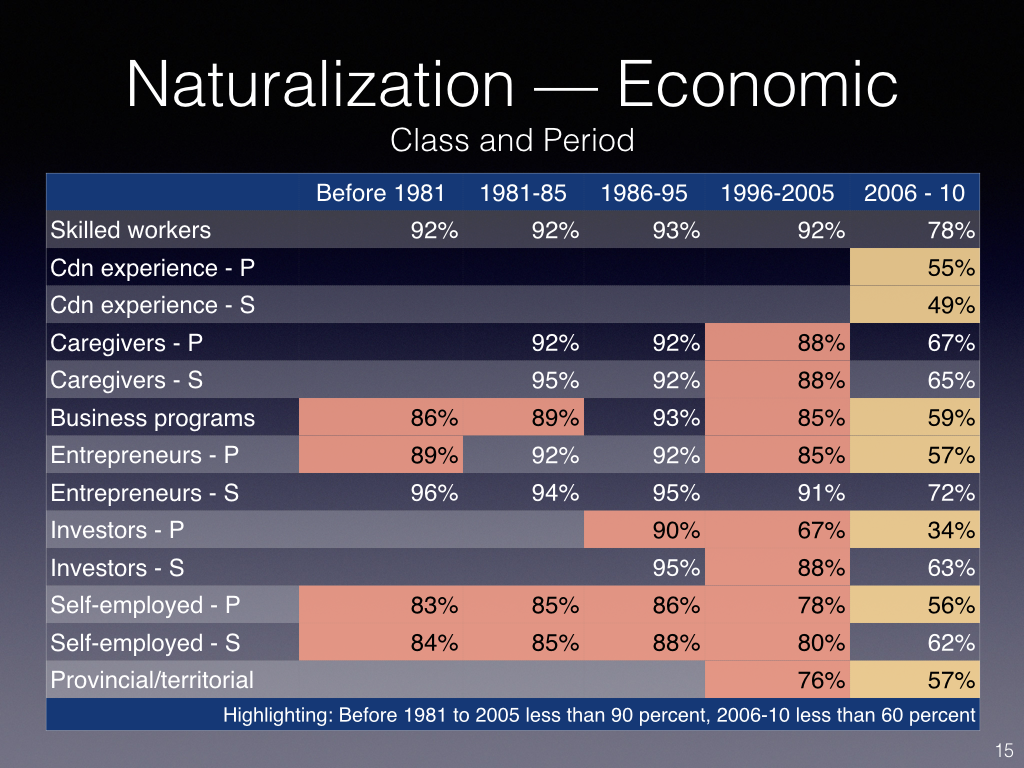
No, it’s not (apart from creating business for immigration lawyers, some increased pressures on the housing market and some increased consumer spending. It is striking when looking at Canadian immigration data, that the incomes of primary applicants under the previous investment programs, based on tax data, are less than refugees since 1996.

I have not been able to find a Quebec government evaluation of its investor immigrant program on their website so it is hard to substantiate or refute Silverstone’s claim that it has pumped “billions” into the Quebec economy. We do know, however, that most of these immigrants end up elsewhere and pay little to know tax (Opinion | Study reveals awfulness of Canadian investor immigration):

These are exhilarating times for Canadian immigration. Ottawa announced last December that it would be accepting more than one million immigrants over the next three years, with an increase in 2018 to 310,000 from the previous 300,000 annually, followed by a further increase to 330,000 in 2019 then to 340,000 in 2020.The Province of Quebec, which essentially runs its own immigrant selection process, is, however, reducing its intake by some 20 per cent.

The large majority of these new entrants to Canada will be in various economic categories. In particular, the federal government’s new global talent stream, with its quick-processing turnaround time, and enhancement of the startup visa program, are becoming very useful mechanisms for recruiting and retaining international high-tech talent.The express entry stream, which brings skilled workers to Canada, broke a record in 2018, with almost 90,000 invitations to apply issued. This represents an increase of nearly 4,000 over the previous record set in 2017. Immigration authorities are also promising to clear some of the backlog in the family-reunification class, including the families of the much-needed live-in caregivers. The rules for obtaining Canadian citizenship have also been significantly relaxed.

With the national unemployment rate at a 40-year low 5.6 per cent, immigration is on its way to being an ever-more significant factor satisfying the Canadian labour market. It’s the major factor in Canada’s population growth, which rose by about 1.4 per cent last year. About 71 per cent of this growth is as a result of immigration.

However, processing immigration applications as well as refugee claims does not come cheap. The 2018 federal budget supports increased immigration levels to the tune of $440-million, with an additional $173-million for asylum seekers. The government’s pre-election budget earmarked $1.18-billion over five years to “accelerate” the claims process and to “facilitate the removal of failed asylum claimants.”

Quebec’s immigrant investor program 

Since its inception in 1986, the Quebec immigrant investor program has pumped billions of dollars into the Quebec economy. Quebec’s is a passive investment program. This means that potential immigrants must ante up $1.2-million for a period of five years, after which the money is returned in full but without interest. The prospective investor must establish a minimum personal net worth of $2-million and be able to demonstrate the legal provenance of the funds. They also have to be able to show at least two years of business management experience. The vast majority of the thousands of immigrant investors come from China and elsewhere in Asia, with some from the Middle East. Quebec charges a substantial application fee. The program is well run and has proved to be an economic winner.

Although the program is administered by the province, investors and their families must satisfy federal security and medical standards. One of the criticisms is that the bulk of successful applicants do not maintain their residence in Quebec, but rather flow to other parts of Canada, primarily southern Ontario and British Columbia. Quebec has responded to this by adding an intent to reside in the province proviso, but, in practice, inter-provincial mobility will really not be restricted.

Restarting the federal investor program 

Canada’s federal immigrant investor program was terminated in 2014. It is time for it to be restarted. An immigrant investor program geared toward job creation in economically challenged areas of the country should be implemented now. Such a program could require an active investment of $1-million, with perhaps a lower amount geared toward areas of higher unemployment. This money would be risk capital directed toward private-sector enterprises with job creation as an essential component. The Canadian stream should, of course, include all necessary checks to ensure the legitimate source of the funds as well as to determine the net worth of the applicant.

Borrowing from the EB-5 conditional-visa system in the United States, the Canadian plan should provide for the creation of regional centres, which would enable the private sector in any given area to participate constructively in the allocation of the investment by the foreign applicant. Regional centres in the U.S. bring together investors and local and regional entrepreneurs and economic development officials to ensure the best use of funds. Studies have found that, in the U.S., immigrant investor capital has played a key role in financing several large projects in areas as diverse as New York and Las Vegas.

In the Canadian context, the regional centre would always have as its focus the creation of at least two permanent jobs per investor. Substantial application fees and a security deposit, along with strict monitoring of the investment, will keep away tire kickers and fraudsters, and the regional centre must be prepared to provide complete transparency with regard to the investment process and allocation of resources. In addition, it should be tasked with assisting the immigrant investor as well as other classes of immigration, including refugees, by providing integration and employment services in order to ensure that newcomers build successful lives in this country. Refugees could be major beneficiaries of the job-creation component of a rejuvenated immigration investor program.

Alternatively, the government could just reinstate the discontinued federal immigrant investor program as it was, basically mimicking Quebec’s passive investment initiative. Either way, an essential element that would maximize chances for success would be a firm undertaking by the federal government that applications would be handled in a timely fashion. Serious overseas investors are not going to wait four and five years to have their applications processed.

A typical immigrant investor arriving with a family in a struggling area of the country will be serious and motivated. The investor, having paid perhaps $30,00 in application fees, along with a risk capital investment of a million dollars—and spending perhaps nearly that amount again in dwelling costs, clothing, schooling, vehicles, and many other needed expenditures—will surely be an asset rooted in his or her chosen community. This, combined with the establishment of a viable commercial enterprise and the creation of employment opportunities, produces a winning situation that could economically and socially boost many Canadian locales, especially those outside Montreal, Toronto, and Vancouver—that attract the bulk of new immigrants.

Ramping up to receiving 10,000 families annually could generate billions and create 20,000 jobs. Now is the time to act and get new money into our system before we lose more highly desirable investor immigrants to other jurisdictions.

Source: Why it’s time to restart the federal immigrant-investor program

Buying citizenship vs. deportation: The contrasting world of immigration in Tampa Bay

Sharp contrast:

On a Friday morning, many people who traveled far and wide wait inside the Tampa Immigration office, are hoping for a better life.

“I’m from the Netherlands,” said Marjoke.

“To live in Tampa Bay, it’s really pretty awesome!” she told us with a smile, minutes after she was officially sworn in as a U.S. citizen.

Ahmad from Palestine told us, ”I’ve been waiting for this moment for a long time in my life.”

Their stories are stories of personal success.

Stories of defeat

But for Army Veteran Elliot Martinez, the Road to the American Dream for his Honduran wife, has taken a heartbreaking detour.

“How can I… ahh… it’s a hard thing to explain,” said Martinez as he takes a deep breath.

“I want my wife back. I need her… I find myself being very lonely. And I’m not a man who cries, but I find myself crying every once in a while because I miss her,” he said.

Like many immigrants from Central America, Martinez’s wife Consuelo, came to the U.S. illegally 18 years ago.

She was allowed to stay as long as she didn’t commit any crimes and she checked in with immigration officials once a year.

But, that all changed two months ago, while she was working on becoming a citizen.

“On the way to the lawyer’s office, we got here, got outside the door, and they called her on the phone and told her she had to leave the next day,” Martinez recalled.

Tampa Immigration Attorney Samson Koyonda is seeing a surge in cases like Elliot’s.

“After the election in 2016… there was a fever pitch atmosphere. The emphasis was no longer on deporting criminal aliens, the emphasis was on deporting everybody,” said Koyonda.

But, there is another path to the American dream.

A path paved with money

It’s called EB-5, a federal program giving rich immigrants the chance to get a green card if they invest at least $500,000 into a local project that creates at least 10 jobs.

Supporters say it creates jobs for people in Tampa Bay and if you need proof that EB-5 money is being pumped into Florida, look no farther than the Tampa skyline.

According to the website of Atlantic American Partners — one of the premiere EB-5 investment firms in Tampa — they raised $4.5 million to build the Aloft Tampa Downtown hotel, $12 million to re-develop The Le Meridian Hotel, which used to be a Federal Courthouse, $19 million to build the 500 Harbour Island high rise, and $23 million for Nine15 apartment building.

And beyond downtown, the new Current Hotel now under construction at Rocky Pointe, fetched $9 million in foreign funds.

Even your non-descript neighborhood strip malls like the Horizon Park Shopping Center on Hillsborough Avenue, got a boost from overseas investors trying to come to America, $3.5 million dollars worth.

It all adds up to thousands of local jobs in the Tampa Bay area and hundreds of rich immigrants and their families now living in the U.S. and on their way to becoming U.S. Citizens.

Statewide, the EB-5 numbers are far greater, especially in South Florida.

“They’re providing things. That money provides jobs,” said Mike Xenick, the CEO of Invest America, which is an EB-5 recruiting firm that seeks foreign investors to fund job creating projects in Tampa Bay.

“That is a huge benefit to the United States, huge benefit to the communities these projects are being built in. They are adding to society here in a positive way,” said Xenick.

Critics of EB-5 point to a contrasting world of immigration in America: those who have money and are able to get in and those who do not, and are facing increased enforcement.

Xenick says that is a very simplistic argument because, ”They (the EB-5 Immigrants) are putting hard money at risk, for a very long period of time.

“They may never see that money back,” he said.

EB-5 Program & Reported Fraud

That kind of money risk has led to allegations of fraud, which are spelled out in a Federal lawsuit against a South Florida Development company that used EB-5 money from Chinese and Russian immigrants. They sued claiming their money was misspent.

The Federal case was dismissed last December, after the company filed Chapter 11 Bankruptcy, but another lawsuit has just been filled in state court in Florida.

Alison Jimenez is a Tampa economist who specializes in money laundering cases.

“The SEC has filed over 32 different enforcement actions since 2013. Specifically over EB-5 programs,” she said.

She said the problem with EB-5 is there is no central regulator who’s looking over the program, and many times the investment documents are in Chinese, making it hard for banks to know if the money is legitimate.

Jimenez said some EB-5 projects have even risen to the level of being a ponzi scheme.

“They have in fact been ponzi schemes, and some have been plain old fraud,” she said.

Mike Xenick, who’s never been sued, admits the industry could use more regulations, but he says the EB-5 program has been a win, win for Tampa Bay.

“The United States provides opportunities for a lot of people, from a lot of different walks of life,” he said.

Dreams and Reality

Elliot Martinez dreams of a day when his wife will be back in his arms.

“I served in the forces to guard our way of life, I was prepared to give my life for their defense, but I will fight for my wife,” he said.

Meanwhile, Martinez’s lawyer, Samson Koyonda, estimates it will probably take two and a half years for his wife to come back to the United States.

Source: Buying citizenship vs. deportation: The contrasting world of immigration in Tampa Bay

H-1B: U.S. employers say Canada’s immigration policies better, as tech booms north of border

These articles keep on coming:

About two-thirds of U.S. employers see Canada’s immigration policies as more favorable than those at home, while a single Canadian city has seen more tech job growth than the Bay Area, Seattle and Washington, D.C. combined, according to a new report.

“Canada has been using friendly immigration policies as one of its key tools to aggressively attract tech companies,” said the 2019 Immigration Trends Report from Envoy, a firm selling immigration services to companies.

Of the 405 HR professionals and hiring managers who participated in Envoy’s survey late last year, 38 percent said their companies were thinking about expanding to Canada, and about a fifth said they already had one or more offices there, according to the report.

Toronto in 2017 added more tech jobs than the Bay Area, Seattle and Washington, D.C. together, and the nation’s capital, Ottawa, boasts more than 1,700 tech companies, the report said.

The firm’s findings come amid a fierce national debate over immigration, with significant controversy over the H-1B visa. The immigration trends report highlights heightened scrutiny of H-1B applications by federal authorities carrying out President Donald Trump’s “Buy American and Hire American” executive order.

San Francisco immigration lawyer Pavan Dhillon, who specializes in helping people obtain work permits and residency in Canada, pointed in a tweet to “Green card backlogs & attacks on legal immigration” as reasons why it appears from Silicon Valley that the American Dream is being replaced by the Canadian Dream.

A Quartz magazine article Tuesday argued that Canada is in fact eating our American Dream. Tech founder Vartika Manasvi told Quartz she chose Calgary over Silicon Valley as the location for StackRaft, a startup making a jobs platform.

“People don’t want to risk long-term careers and live with uncertainty in the U.S.,” Manasvi said. “Finding another visa or transferring the H-1B can be stressful. The Canadian immigration system is gradually moving towards becoming more and more skill-based.”

Among the benefits of immigrating to Canada instead of the U.S., Quartz reported, are faster visa processing times and cheaper fees; a more predictable visa-allocation system than America’s H-1B lottery; employment for visa holders’ spouses at a time when the Trump Administration is moving to ban H-1B holders’ wives and husbands from jobs; and permanent residency in two years or citizenship in three, compared to a green card wait that can last many years in America.

Source: H-1B: U.S. employers say Canada’s immigration policies better, as tech booms north of border

Poland Bashes Immigrants, but Quietly Takes Christian Ones

Telling:

The far-right Law and Justice party came to power in 2015, at the height of Europe’s migrant crisis, after running a campaign that inspired choruses of “Poland for Poles.” With national elections due in October, the governing party is once again promoting its vision of “Poland First.”

The party’s loud, anti-immigrant rhetoric has created special headaches for the European Union, which has largely failed to distribute quotas of migrants from North Africa, the Balkans and the Middle East around the Continent because of resistance from Poland and other hard-line member states.

So it may come as a surprise that the Polish government has, very quietly, presided over the largest influx of migrant workers in the country’s modern history — though they are mostly Christians from neighboring Ukraine.

Prime Minister Mateusz Morawiecki has not been shy about promoting the government’s agenda. “We want to reshape Europe and re-Christianize it,” he said in 2017 in an interview with a Catholic television station. The government recently ordered all new passports include the phrase, “God, Honor, Motherland.”

But immigration is Poland’s paradox. It has benefited greatly from the European Union’s open borders, earning billions of dollars in remittances from the hundreds of thousands of Polish workers who have migrated to other countries in the bloc, especially to Britain. Yet with Poland now facing labor shortages, the government is failing to lure back the diaspora — and is restricted by its political stance against migrants.

If government officials rarely speak about needing migrant workers, the infusion of Ukrainians is apparent in many Polish cities. According to Eurostat, more than 683,000 foreigners received their first residence permits in Poland in 2017, the highest number for any country in the European Union. There are now over two million Ukrainians working in Poland, most flocking to cities that are the engines driving the Polish economy.

The question is whether they will stay. Last year, the European Union began allowing visa-free travel for Ukrainians, and Germany is easing work requirements for skilled workers, targeting Ukrainians. A recent newspaper survey in Poland found that 59 percent of Ukrainians in the country said they would leave for Germany if the labor market opened up.

“There is no ownership of the issue by the government,” said Anna Wicha, a director at the Adecco Group, one of the largest employment agencies in Poland. “You ask how many Ukrainians are working here and they will say 500,000. But it is more than two million. And many may be going to Germany.”

For now, the government lacks a long-term strategy to expand the labor pool. Many experts and some opposition politicians in Poland say the situation will only be resolved if political leaders soften their resistance to migrants and embrace plurality. But at the national level, even talking about immigration can be politically lethal.

When Pawel Chorazy, the deputy minister of investments and development, said during a televised debate before the October local elections that “the inflow of immigrants to Poland needs to be increased to sustain economic growth,” he was met with scorn.

Joachim Brudzinski, the interior minister, said that Mr. Chorazy’s comments were “not a position of the government.” The prime minister, Mr. Morawiecki, said that Mr. Chorazy “got seriously ahead of himself.”

Then he fired him.

“Politicians are dancing on the line, well aware that you can wake up demons,” said Irena Kotowska, head of the center for demography at the Warsaw School of Economics. “It is easy to play into nationalist feeling with anti-immigrant rhetoric. But the reality of the need in the labor market is more and more clear every day.”

“This is a defining moment for the country,” she added. “Some decisions simply have to be made.”

Here in the central city of Lodz, the contradictions of Poland’s migration dilemma are evident. Unlike national leaders, however, the local mayor, Hanna Zdanowska, has embraced immigrants. When she ran last October, she called for an inclusive Poland that welcomed newcomers.

The governing party campaigned hard against her, but she won with 70 percent of the vote, which she credited in part to the city’s history of tolerance. It was once a manufacturing center of hundreds of red brick factories, with a diverse population of Dutch, English and German residents, and a strong Jewish contingent.

Henryk Panusz, 89, whose family were leaders in the knitwear industry and part of a boomtown that was an eclectic mix of ethnicities and cultures, said Lodz “was the promised land.”

“Until the Second World War, there were so many cultures and ethnicities and nationalities,” he added.

After the war, Lodz struggled under Communist rule before the Iron Curtain started disintegrating in Poland in 1989. After the country joined the European Union, providing a chance for people to leave more easily, Lodz saw its population decline to under 690,000, from more than 850,000. That was part of an exodus since 2004 of about 2.5 million people from a nation of around 38 million.

But Poland has also benefited from billions in European Union subsidies that have helped turn the country into one of the Continent’s fastest-growing economies. Lodz has attracted international companies, while reinventing many old factories as cultural spaces to attract a new creative class.

Even as the economy thrives, however, the Polish government has had little success in luring home many of those who went abroad in search of better pay and greater opportunity, despite spending millions on a publicity campaign.

Aleksandra Modrzejewska left Lodz in 2014 and found a job as a waitress when she first arrived in Britain. She now lives in Chelmsford, England, and works as an insurance broker. She says she believes the assurances of the government in London that no matter what happens when Britain leaves the European Union, a process known as Brexit, she will be able to stay.

“No one I know is thinking of leaving,” she said. “Brexit may have an impact on new people coming but, as far as I can tell, for people who have built their lives here, it is not going to change anything.”

“It was just a different quality of life,” she added, explaining her decision to leave Poland. “People are much more open and inviting of different cultures and nationalities.”

For officials in Lodz, and elsewhere in Poland, the labor shortage is a problem that could curb economic growth. More than half of the companies in Poland reported having trouble finding workers, according to a survey by Work Service, Poland’s largest employment agency.

Antonina Marushko, 30, came to Lodz from Ukraine three years ago with her husband and two children. She says the move has been difficult. But, she adds, she does not want to leave. She worked and saved and recently was able to open her own beauty salon.

“Our life is here now,” she said.

To reconcile the new arrivals with the government’s anti-immigrant, Christian identity, Poland’s leaders have gone to great lengths to create narrow policies that almost completely limit the influx to Christians. That goal was all but stated in proposed legislation that would make it easier for people from former Soviet satellite countries that are “culturally similar” to Poland to become permanent residents.

Polish immigration officials declined to be interviewed for this article. But the government has worked so hard for so long to build a narrative that bolsters suspicion of all outsiders that even an immigration policy built on proximity and cultural affinity is fraught.

The influx of Ukrainians has come at the same time as a straining in the relationship between the Polish and Ukrainian governments over the politicization of history and the difficult pasts of the two nations, which share a border that has shifted multiple times over the decades.

For Ukrainians migrating to Poland, those tensions can ripple into daily life. Ms. Marushko, the beauty parlor owner, said that her son was the only Ukrainian in his class and that some of the other children — presumably repeating talk they heard at home — had told him that Poland was for the Poles.

Ms. Marushko said that one of her older Polish clients routinely mocked Ukrainians, calling them radioactive because of Chernobyl, a bitter reference to the nuclear disaster in 1986.

“Things are better now,” Ms. Marushko said, referring to her experiences of prejudice.

Perhaps the biggest problem for Poland is that another generation, despite growing up in an era of economic growth, also seems eager to leave.

“There is still the perception here that you ‘make it’ outside of Poland,” said Ms. Wicha of the Adecco Group.

Ms. Modrzejewska, the insurance broker in Britain, agreed. “Even if you have the worst job, it is a better life,” she said.

She talks frequently with her family and her 14-year-old sister, Magda, who seems to have taken the message to heart.

“I want to be a doctor or a medical engineer,” Magda said. “We also have family in Florida. I am too young to know what I will do, but I think about it and going to Florida is my dream.”