China relaxes rules to attract more skilled overseas talent

Interesting shift:

China’s Ministry of Public Security is to relax its immigration rules, opening the door to more highly skilled overseas workers and allowing a greater number of foreigners the opportunity to become permanent residents.

The rule changes, which will take effect from August, will also allow top talents from abroad to apply for long-term visas and make it easier for budding overseas entrepreneurs to start a business in China, the ministry announced on Wednesday.

Previously, only foreign talents who made “major and extraordinary contributions” while in China or who filled a skills gap were allowed to apply for permanent residence. From next month, those with in-demand skills and those whose annual income or taxes reached a specified threshold can apply for permanent residence, as can their spouses and underage children.

Those who have held a job in China for four years in a row and have been resident for at least six months each year, whose annual income is higher than six times the annual average worker’s wage in their city of residence, and who pay at least 20 per cent of their income in taxes, are eligible for permanent residence under the new rules.

In Beijing, the average salary last year was 94,258 yuan (US$13,706), setting the threshold for overseas candidates at 565,548 yuan (US$82,236) per annum.

The revised policy will also make it easier for people of Chinese ethnicity from overseas to apply for permanent residence. Those with a doctoral degree, or who have worked in what the ministry called “key development areas” for four years with a stay of at least six months each year are also eligible for permanent residence.

Source: China relaxes rules to attract more skilled overseas talent

Trump’s ‘blatantly illegal’ immigration rules end asylum protections

One of the better summaries:

The Trump administration has announced new immigration rules ending asylum protections for almost all migrants who arrive at the US-Mexico border, in violation of both US and international law.

According to the new rules, any asylum seekers who pass through another country before arriving at the southern border – including children traveling on their own – will not be eligible for asylum if they failed to apply first in their country of transit. They would only be eligible for US asylum if their application was turned down elsewhere.

The change would affect the vast majority of migrants arriving through Mexico. Most of those currently come from Guatemala, Honduras and El Salvador, but an increasing number are from Haiti, Cuba and countries further afield in Africa and Asia.

The new rules were placed on the federal register on Monday and due to take effect on Tuesday, though they will be immediately challenged in court for contraventions of the US refugee act and the UN refugee convention guaranteeing the right to seek asylum to those fleeing persecution from around the world.

Source: Trump’s ‘blatantly illegal’ immigration rules end asylum protections

Worried UK employers call for changes to proposed immigration reform

Echoes earlier concerns by the business community:

A coalition of British industry groups and education bodies, worried by the prospect of Brexit worsening skills and labour shortages, has called for the next prime minister to relax proposed reforms of the immigration system.

The #FullStrength campaign said on Wednesday it had written to both Boris Johnson, frontrunner to be the next leader of the Conservative Party and prime minister, and his rival, foreign minister Jeremy Hunt, calling for the government they would lead to lower the salary threshold proposed in draft immigration legislation from 30,000 pounds to 20,000.

In December, Britain set out in a policy paper the biggest overhaul of its immigration policy in decades, ending special treatment for European Union nationals.

Concern about the social and economic impact of immigration helped drive Britain’s 2016 referendum vote to leave the EU.

#FullStrength brings together bodies including London First, techUK, the British Retail Consortium, the Recruitment & Employment Confederation, UKHospitality, the Federation of Master Builders and Universities UK. Collectively they represent tens of thousands of businesses and employ millions of workers across all sectors and regions of Britain.

Their joint letter said more than 60% of all jobs in the UK currently fall under the proposed 30,000-pound salary threshold, highlighting the risk in setting the future level too high for vital services such as health and social care.

The coalition also wants the government to extend the temporary work route for overseas workers from one year to two years, revise the sponsorship model to make it easier for firms of all sizes to bring in the overseas talent they need, and reinstate the two-year, post-study visa for international students to work in Britain post-graduation.

“Without the ability to access international talent, many of our world-class sectors are at significant risk,” the joint letter said.

“As the UK prepares to leave the EU in the near future, it is imperative that the government puts in place measures that will avoid employers facing a cliff-edge in recruitment, and works towards building a successful economy that is open and attractive.”

Johnson has pledged that Britain will leave the EU with or without a transition deal on Oct. 31 if he becomes prime minister, while Hunt has said that he would, if absolutely necessary, go for a no-deal Brexit.

Source: Worried UK employers call for changes to proposed immigration reform

Critics question why Canada’s border officers need bulletproof vests to work with migrants

I would have more confidence in CBSA’s policy rationale and justification had they not earlier made officers within Canadian airports wear bullet proof vests within the arrivals area security envelope (i.e. people who have already passed departure security and flown to Canada):

Canada’s border-security agency will soon require all border-security officers working with detained migrants to wear defensive gear that includes batons, pepper spray and bulletproof vests — a policy that is drawing concern over a perceived “criminalization” of asylum seekers.

A new national policy on uniforms was adopted internally last year after the Canada Border Services Agency (CBSA) began moving what it deems “higher-risk immigration detainees” from provincial jails, where they were being held for security purposes, into one of the agency’s three “immigration holding centres.”

The agency decided all officers working in these centres must be outfitted in protective and defensive equipment to ensure a “common operational approach” in light of the fact that these migrants previously were held in jails, according to a briefing note obtained by The Canadian Press through access-to-information law.

“This will require greater CBSA officer presence in managing detainee populations at the IHCs, including the ability to de-escalate and intervene physically if necessary,” the briefing note says.

“Ensuring that IEOs [inland enforcement officers] wear their defensive equipment will enable officers to protect/defend themselves and others if necessary in the IHC.”

The defensive gear they are to wear includes steel-toed boots, “soft body armour,” a defensive baton, pepper spray and handcuffs. They will not carry firearms.

The changes have sparked concern this will create an environment within immigration detention centres akin to jail conditions and encourage the perception that detained migrants in Canada, including some children, are criminals worthy of punishment.

Same tools as maximum-security facilities

A group of doctors, lawyers, legal scholars and human rights organizations wrote two letters last year to Public Safety Minister Ralph Goodale urging him to cancel the policy — calls they say have been ignored.

“We applaud your efforts to reduce the number of immigration detainees held in provincial jails. But raising security measures in an administrative detention centre to mirror those of a criminal institution defeats the purpose of transferring immigration detainees from jails to IHCs,” says one letter, dated June 22, 2018.

“The proposed policy would arm CBSA officers with some of the same tools as correctional officers in maximum-security facilities … [which] is clearly disproportionate to any potential risk and is not warranted.”

Concerns have also been raised internally by the union that represents the security officers themselves, who are worried about the increased risks of having weapons in the mix if a high-risk situation or confrontation does arise.

Anthony Navaneelan, a lawyer with Legal Aid Ontario who also works with the Canadian Association of Refugee Lawyers, said it’s not every day the border-security union and migrant-advocacy groups agree.

Wearing defensive gear when dealing with refugees is “inappropriate and unnecessary,” Navaneelan said.

He pointed to a 2012 report by the UN special rapporteur on the human rights of migrants, François Crépeau, that said detention of migrants on the grounds of their irregular status should “under no circumstance be of a punitive nature” and should never involve prison-like conditions or environments.

“The idea of getting them out of jails is to recognize the fact that it can re-traumatize refugee claimants to be putting them in detention to begin with when they’ve committed no crime,” Navaneelan said.

“Also in terms of necessity, CBSA hasn’t identified for us any incidents that have happened at the immigration holding centres that would warrant these types of measures. Certainly I’d, at best, call this a proactive measure in anticipation of some future concern … but we certainly think escalating or creating an environment where officers are equipped with these types of measures is almost a solution in search of a problem.”

‘Balance’ between safety of officers and detainees

In a statement, CBSA spokeswoman Rebecca Purdy said the agency’s operating procedures say officers “must” wear the protective and defensive equipment issued to them while on duty.

The decision to equip officers working in migrant detention centres with uniforms and defensive gear was made “to ensure national alignment of CBSA standards for its operations and is consistent with practices implemented domestically and internationally as it relates to detention,” Purdy said.

As for the concerns raised by the lawyers, doctors, human-rights groups and the officers’ union, CBSA “ensured that there is a balance reflected between the safety and security of officers and other detainees,” Purdy added.

Asylum seekers in Canada can be detained for a number of reasons, including if CBSA officers have reason to believe they would be deemed inadmissible on grounds of security, criminality or records of violating human or international rights themselves.

A migrant also can be detained simply if a CBSA officer believes the person might be a no-show for his or her refugee-determination hearing. The vast majority of migrants detained by Canada are held for this reason, according to government statistics posted online. Last year, 81 per cent of detained migrants were held because they were deemed unlikely to appear for their hearings, including 40 children, most of whom were travelling with adults.

Janet Dench, executive director of the Canadian Council for Refugees, said her organization was assured that migrants detained for administrative reasons such as this would be separated from those suspected of criminality when held in Canadian detention centres.

She questioned why CBSA officers will be required to wear defensive gear in all areas of these centres, rather than only in wings where migrants suspected of being security or criminal threats are being held.

She also echoed concerns that wearing this gear is akin to treating refugees like criminals

“The CBSA should very much reduce the criminalization of those people who are detained,” Dench said.

Source: Critics question why Canada’s border officers need bulletproof vests to work with migrants

Home Office outsourcing immigration operations ‘on the cheap’ due to funding shortages and lack of ministerial interest, says chief inspector

Pretty damning indictment of poor political and bureaucratic management:

The Home Office has been outsourcing immigration operations “on the cheap” because of funding shortages and a lack of interest from ministers, the government’s own chief inspector of borders has admitted.

David Bolt, who provides independent scrutiny of the UK’s border and immigration management, told The Independent that in order to “manage its capacity”, the Home Office had made subcontracting part of its “modus operandi” – and as a consequence had reduced control over its own operations.

He questioned whether there was “sufficient visibility” around the way the department had increasingly placed the onus on external agencies, such as landlords and doctors, to carry out immigration checks, and around the manner in which immigration detention, visa processing and other provisions had been outsourced to private firms.

The department has come under fire over the past year for wrongly treating those with a right to live in the UK as illegal immigrants under its hostile environment policies – an issue encapsulated by the Windrush scandal – and has been accused of creating barriers to applying for UK status through its decision to privatise the visa system.

The chief inspector said that while Home Office processes that had adequate funding and “enthusiasm” from ministers were working well, such as the EU settlement scheme, other operations were not being so effectively executed.

“The EU settlement is working better as a process,” he said. “You’ve got senior ministerial interest; you’ve got funding; the Home Office was essentially able to design the system to suit itself; you’ve got enthusiasm around delivery; you’ve got a clear target – all of those are ingredients that will make something work.

“Much of the rest of the business doesn’t feel like that. It doesn’t have clear targets; it doesn’t have the same ministerial interest; it doesn’t have the funding; and it’s not prioritised so it doesn’t necessarily have the resources, so I think that’s the department’s challenge.

“That’s why outsourcing is part of its modus operandi. That’s one way in which it can try and manage all this capacity – to give the task to somebody else.”

Mr Bolt raised concerns about difficulties for visa applicants and for other immigrants to access the services of private firms who have commercial contracts with the Home Office, such as Sopra Steria, a French firm that took over in-country visa processing in November.

The Independent revealed last month that the company had raked in millions for providing what lawyers branded a “substandard” service, which had forced some applicants to pay high fees and travel hundreds of miles to submit applications on time.

MPs and lawyers subsequently called for an independent investigationinto the outsourced system, raising “extreme concerns” about Sopra Steria’s “capacity and ability” to run the service.

Speaking after an event organised by the All-Party Parliamentary Group for Visas and Immigration on Thursday, Mr Bolt said: “When you hear that people have difficulty accessing Sopra Steria or any of the other outsourced commercial contracts, what is the Home Office doing to ensure that what they’re providing is actually meeting the terms of the contract?

“In earlier contracts, one of the challenges was whether the contract had been properly funded, so there’s been an attempt to try and do things slightly on the cheap. And then it always feels rather reluctant to press the provider, because they realised they’ve got the provider over a barrel.

“The question is, does it retain sufficient visibility of what’s going on and sufficient control over it? And to what extent is it accountable for what’s delivered?”

He also said that when the department placed requirements on agencies such as the NHS, schools and landlords to carry out immigration checks as part of its hostile environment measures, he was “not sure that it [took] enough responsibility for what then happens”.

A report published by Mr Bolt in 2016, which aimed to understand how the Home Office was going to assess the effectiveness of the hostile environment policies, found there were “no real measurements in place to collect, analyse and evaluate” the measures.

But the chief inspector questioned whether the department had “the capacity to do anything about it” because they were “short of resource generally, meaning everything is under pressure” – likening the situation to “changing a tyre as you’re driving down the motorway”.

Why is the Home Office getting so many immigration decisions wrong?

“Across all of the Home Office, its business is bigger than its capacity to manage. It’s constantly having to make decisions about priorities, and getting dragged off to do things. That for me is one of the key issues – whether it’s got the bandwidth to cope with everything,” he added.

A Home Office spokesperson said: “We welcome the independent scrutiny of the chief inspector and take his comments, criticism and recommendations very seriously.

“We are committed to delivering an immigration system that is fair and delivers value for money for the taxpayer and the inspector is a crucial part of that work. It is only right that the department and ministers give full consideration to the recommendations made in ICIBI (independent chief inspector of borders and immigration) reports, which can be complex and wide-ranging.”

Source: Home Office outsourcing immigration operations ‘on the cheap’ due to funding shortages and lack of ministerial interest, says chief inspector

Kelly Toughill: The corrosive power of “Where are you from?”

Part of the challenges in encouraging and retaining immigration to Atlantic Canada. Not unique to Atlantic Canada: my Russian-born mother always bristled when she was asked the question in Toronto in the 50s and 60s:
Opinion: If Atlantic Canadians are serious about boosting immigration and making newcomers feel welcome, writes Kelly Toughill, we need to find a way to have real conversations about regional culture and the come-from-away phenomenon.

“Do you feel like a Nova Scotian?” I asked the woman.

We had stumbled into the topic by mistake. It is not something we talk about here: not those of us who chose Nova Scotia nor those who are tethered to the province by ancestral DNA. We were cautious, hesitant, both aware of the danger surrounding the taboo.

She is a person of significant influence with a broad social and professional network who has lived here more than 20 years. No, she said, she does not feel like a Nova Scotian and knows she never will.

Neither do I.

“I moved to Nova Scotia 21 years ago and expect to live here until I die, but I have come to terms with the fact that I will always be treated like a guest.”

There is a stereotype about the “come from away” phenomenon in Atlantic Canada, but little deep, respectful discussion of how the tendency to divide people by origin affects the region and its future. If we hope to use immigration to bolster the flagging population, we must figure out how to have that conversation right now.

Where you are from means something very different here than in the other places I have lived. In San Francisco, Rio de Janeiro, Washington, D.C. or Toronto, when asked where I was from, the question really meant, “Where do you live? Where do you choose to make your home? Where can you best relax and let down your guard?”

Here, it means something else entirely. I have never seen a place so connected to its roots. That is a joyful thing. It is one reason this province has such a strong sense of identity, a distinct culture and a tradition of caring for its own. But traditions can be exclusionary.

“When I first moved to Nova Scotia, I travelled the Atlantic region extensively for work. In other regions, an opening social line might be, “What do you do?” But here it was always, “Where are you from?””

I would answer, “Halifax,” because that’s where I live or, if asked in Halifax, would say, “Here.”

And people treated me as if I were lying.

It took me a while to realize they were asking me to name a spot of earth that defines my identity. Where are my ancestors buried? Where do people remember my malevolent uncle, my grandmother’s affection for mathematics, my mother’s brilliant, eclectic career?

There is no place like that for me. There is no place like that for hundreds of millions of people around the world. And that is incomprehensible to many of my neighbours and, now, closest friends.

It was a union activist who helped me figure out how to answer that essential East Coast question. We were sitting on a wharf in Saint Anthony, Newfoundland, when he asked where I was from. I explained that I had no idea how to answer in a way that honoured the real intent of his question. After a long talk, he suggested I name the place that I was born.

Now, when people ask, I say “Washington, D.C.” My parents were newly arrived in Washington when I was born. I left when I was eight years old and I do not have a single relative or friend in that city. It feels a little bit like a lie every time I say it, but it is the closest answer to their truth that I can offer.

A recent article in the academic journal Ethnicities describes how that specific question can be part of a system of welcoming that leaves racialized newcomers as perpetual outsiders. Speaking welcome: A discursive analysis of an immigrant mentorship event in Atlantic Canada, by Kristi A. Allain, Rory Crath and Gül Çaliskan, examined an event in Fredericton designed to welcome newly arrived economic immigrants. They considered the language and structure of the event through the lens of Jacques Derrida’s theory of conditional hospitality. They found that the event designed to welcome newcomers actually reinforced their status as foreign and other. And it all started with, “Where are you from?”

This is not just a matter of manners and personal feelings. Atlantic Canada will need tens of thousands of new immigrants to maintain its population, tax base and public services over the next few decades. There is much public debate about how to structure immigration pathways, how to improve economic outcomes and how immigrants can best be supported for long term success. But there is little discussion of local culture and how that can work for – and against – the retention of newcomers.

The woman and I were hesitant because we both know that this topic relies exclusively on personal experience as evidence, and that can very easily be misunderstood as a blanket criticism of the region. It takes trust even to talk about the phenomenon.

I sent her a draft of this column and asked if she was comfortable being named. She thought about it for a day and then declined. She said was afraid of discouraging other newcomers and also afraid of hurting the feelings of her Nova Scotian colleagues.

I know what she means. My Nova Scotian friends have been hurt or angry when I tried to describe my experience, so now I just don’t. After all, the Atlantic region is known for its tremendous hospitality. There is even a hit Broadway musical about how Newfoundland welcomed strangers stranded on 9-11. But being treated well as a guest is not the same as being included, for guests are expected to leave.

I asked the woman if she feels Canadian. The answer was instant and affirmative: of course, absolutely.

Me too. I am Canadian through-and-through. My inclusion in the body Canada does not feel conditional in any way, unlike my status in Nova Scotia.

I still wince every time I hear someone ask, “Where are you from?” It reminds me that I will always be a stranger in my own home province. I’ve come to accept my outsider status as the price of living in this magnificent place, but it is sad. If we want to draw people here, not everyone will make the same choice that I have.

So, here’s a suggestion: No matter how much it might feel right, no matter whether your intention is to welcome, or simple curiosity, don’t ask a stranger, “Where are you from?” Wait until you get to know them to probe that specific identity marker. Wait until you have forged a bond. Wait until that question will not be seen as a signal that your new friend will never really belong.

Source: The corrosive power of where are you from

Will Your Job Still Exist In 2030?

More on the expected impact of automation and AI:

Automation is already here. Robots helped build your car and pack your latest online shopping order. A chatbot might help you figure out your credit card balance. A computer program might scan and process your résumé when you apply for work.

What will work in America look like a decade from now? A team of economists at the McKinsey Global Institute set out to figure it out in a new report out Thursday.

The research finds automation widening the gap between urban and rural areas and dramatically affecting people who didn’t go to college or didn’t finish high school. It also projects some occupations poised for massive growth or growing enough to offset displaced jobs.

Below are some of the key takeaways from McKinsey’s forecast.

Most jobs will change; some will decline“Intelligent machines are going to become more prevalent in every business. All of our jobs are going to change,” said Susan Lund, co-author of the report. Almost 40% of U.S. jobs are in occupations that are likely to shrink — though not necessarily disappear — by 2030, the researchers found.

Employing almost 21 million Americans, office support is by far the most common U.S. occupation that’s most at risk of losing jobs to digital services, according to McKinsey. Food service is another heavily affected category, as hotel, fast-food and other kitchens automate the work of cooks, dishwashers and others.

At the same time, “the economy is adding jobs that make use of new technologies,” McKinsey economists wrote. Those jobs include software developers and information security specialists — who are constantly in short supply — but also solar panel installers and wind turbine technicians.

Health care jobs, including hearing aid specialists and home health aides, will stay in high demand for the next decade, as baby boomers age. McKinsey also forecast growth for jobs that tap into human creativity or “socioemotional skills” or provide personal service for the wealthy, like interior designers, psychologists, massage therapists, dietitians and landscape architects.

In some occupations, even as jobs disappear, new ones might offset the losses. For example, digital assistants might replace counter attendants and clerks who help with rentals, but more workers might be needed to help shoppers in stores or staff distribution centers, McKinsey economists wrote.

Similarly, enough new jobs will be created in transportation or customer service and sales to offset ones lost by 2030.

Employers and communities could do more to match workers in waning fields to other compatible jobs with less risk of automation. For instance, 900,000 bookkeepers, accountants and auditing clerks nationwide might see their jobs phased out but could be retrained to become loan officers, claims adjusters or insurance underwriters, the McKinsey report said.

Automation is likely to continue widening the gap between job growth in urban and rural areas

By 2030, the majority of job growth may be concentrated in just 25 megacities and their peripheries, while large swaths of the country see slower job creation and even lose jobs, the researchers found. This gap has already widened in the past decade, as Federal Reserve Chairman Jerome Powell noted in his remarks on Wednesday.

Source: Will Your Job Still Exist In 2030?

Douglas Todd: What would happen to Canadian housing if immigration stopped?

Good range of perspectives covered in this thought experiment:

What would happen to Canada’s housing market if immigration to Canada was substantially reduced or even cut to zero? It’s a crucial question for the public, and for real-estate developers who start new construction projects on the basis of predictions of future sales.

Surprisingly, however, the answers are all over the map.

Some specialists suggest virtually nothing would happen to Canadian housing prices if immigration slowed or ended. Others say the impact would be lower prices and hard times for the powerful real-estate industry.

While there are no immediate signs immigration levels will be reduced — Prime Minister Justin Trudeau has increased the immigration rate by more than 30 per cent, to almost 350,000 newcomers a year — the issue is central to the dreams and anxieties of Canadian residents who either own homes or want to imagine the possibility.

Two Ontario real-estate specialists recently wrote in the Financial Post that, based on studies, the “overall impact of immigration on housing markets is modest at best in most cases.”

The most startling research spotlighted by Murtaza Haider, of Ryerson University, and Stephen Moranis, a Toronto real-estate insider, maintained that immigration has virtually no impact on overall Canadian housing prices.

The authors of that contentious study, Ahter Akbari and Yigit Aydede of Saint Mary’s University in Halifax, claimed immigration adds an insignificant $1 to every $1,000 people in Canada spend on housing.

Could that be true?

UBC geography professor emeritus David Ley, whose findings differ from the 2012 paper by the Saint Mary’s profs, said in an interview their study looks at the period from 1996 to 2006 and doesn’t focus on urban regions, which his analyses do. Ley has consistently found a close correlation between strong immigration and high housing prices in global cities.

In that way the Saint Mary’s paper sidesteps an increasingly plain-to-see phenomenon: Housing prices vary according to where immigrants choose to live. And for the most part they stream into major cities, especially sky-high Toronto and Vancouver.

Indeed, the authors of the Financial Post article that cites the Saint Mary’s study apparently contradict themselves at the end of their piece, after repeating the impact of immigration is “modest at best” on housing.

“The more important realization,” Haider and Moranis say in their last sentence, “is that an absence of immigration would result in a declining population and aging of the workforce, which could have a much larger negative impact on Canadian housing markets.”

So, which is it? Immigration has almost no influence on housing? Or the population growth it brings has a tremendous impact?

Simon Fraser University’s Josh Gordon, a specialist in public policy, says it’s crucial to follow through on the “counter-factual” question, to imagine a scenario not currently in the cards: What would happen to housing prices if immigration levels reduced to zero?

The real-estate industry, Gordon said, repeatedly says it must build more housing faster because the Canadian population is growing rapidly, predominantly because of immigration.

The development industry’s repeated warnings, Gordon said, that Metro Vancouver and Toronto property must be rezoned at higher density and that rents will continue to rise would be thrown into disarray with the ending of immigration.

“What’s revealing is that when certain members of the real-estate industry try to generate a fear-of-missing-out mentality (FOMO), as well as the expectation that prices will rise over time, their typical move is to emphasize how many people will be arriving on a yearly basis and how large the population will eventually be,” Gordon said.

“The actions of those organizations belie the idea that immigration is not likely to have much impact on prices.”

There is evidence housing prices would dramatically adjust if immigration stopped.

After all, the populations of Metro Vancouver and Toronto experience net growth of about one per cent a year, almost entirely from foreign-born newcomers, who need places to live. That does not include the  high portion the two cities take in of the roughly one million international students and temporary visa workers who are now in Canada at any one time.

And a recent study by Statistics Canada researchers found the detached houses bought by recent immigrants to Metro Vancouver are, on average, valued $824,000 higher than such homes owned by people born in Canada. In Toronto the cost of recent immigrants’ homes was about $50,000 higher than that of the domestic born.

UBC geographer Daniel Hiebert, in addition, showed in a peer-reviewed study that recent immigrants, especially those from China, show statistically greater determination than Canadian-born citizens to buy housing in Canada’s three major cities. “First and foremost,” Hiebert says, “immigration policy is, essentially, also a form of housing policy.”

The Urban Development Institute, which represents property developers, makes no bones about how housing supply must be expanded to support immigration.

“Over the next 25 years, our province is expected to grow by more than 1.4 million people, partly as a result of the federal government’s plan to raise immigration 13 per cent by 2020,” UDI president Anne McMullin recently wrote. “That means we must work together to create new homes if we want our children and grandchildren to have a future in B.C.”

A related June study by Gordon found a near-perfect correlation between housing unaffordability and foreign ownership in certain Metro Vancouver municipalities. Gordon discovered, for instance, that Vancouver, Richmond and West Vancouver are not only the most unaffordable municipalities, they are the one most attracting millionaire migrants and their wealth.

There is a complicating factor, however, as there often is when trying to understand the mass global movement of people and money.

Gordon emphasizes that immigration levels and foreign ownership, which he defines as “housing owned primarily on the basis of foreign income or wealth,” are related. But they’re different, too.

“There is some overlap to the extent that immigration, as it happens in Canada, involves many people arriving with significant amounts of wealth,” Gordon said. “But debates about immigration are largely distinct, though not entirely, from debates around foreign ownership, even while certain people have tried to conflate the two.“

How do the foreign-buyers taxes in B.C. and Ontario, as well as B.C.’s speculation tax, fit into the discussion of housing prices? Those measures are focused on foreign ownership, not immigration levels, Gordon said.

“The point of the measures in relationship to foreign ownership is to discourage the de-coupling of the housing market from the labour market, to discourage the use of large amounts of foreign capital to purchase property in Canada,” said Gordon.

“Measures around foreign ownership are about levelling the playing field for local working people. Measures around immigration are different. The irony is that measures to limit or curtail foreign ownership may in fact be beneficial for many new immigrants, because new immigrants who do not arrive with vast amounts of wealth are doubly disadvantaged in the housing market.”

It can take a while to get one’s head around the global forces running through Canadian housing.

But no matter which way you look at the impact of large-scale immigration, and foreign capital, on key sectors of Canada’s vigorous housing market, it’s undeniable they’re profoundly connected — and that decisions made about immigration will indeed always be a form of housing policy.

Source: Douglas Todd: What would happen to Canadian housing if immigration stopped?

Immigrants are moving to smaller U.S. cities

Also happening in Canada to a certain extent:

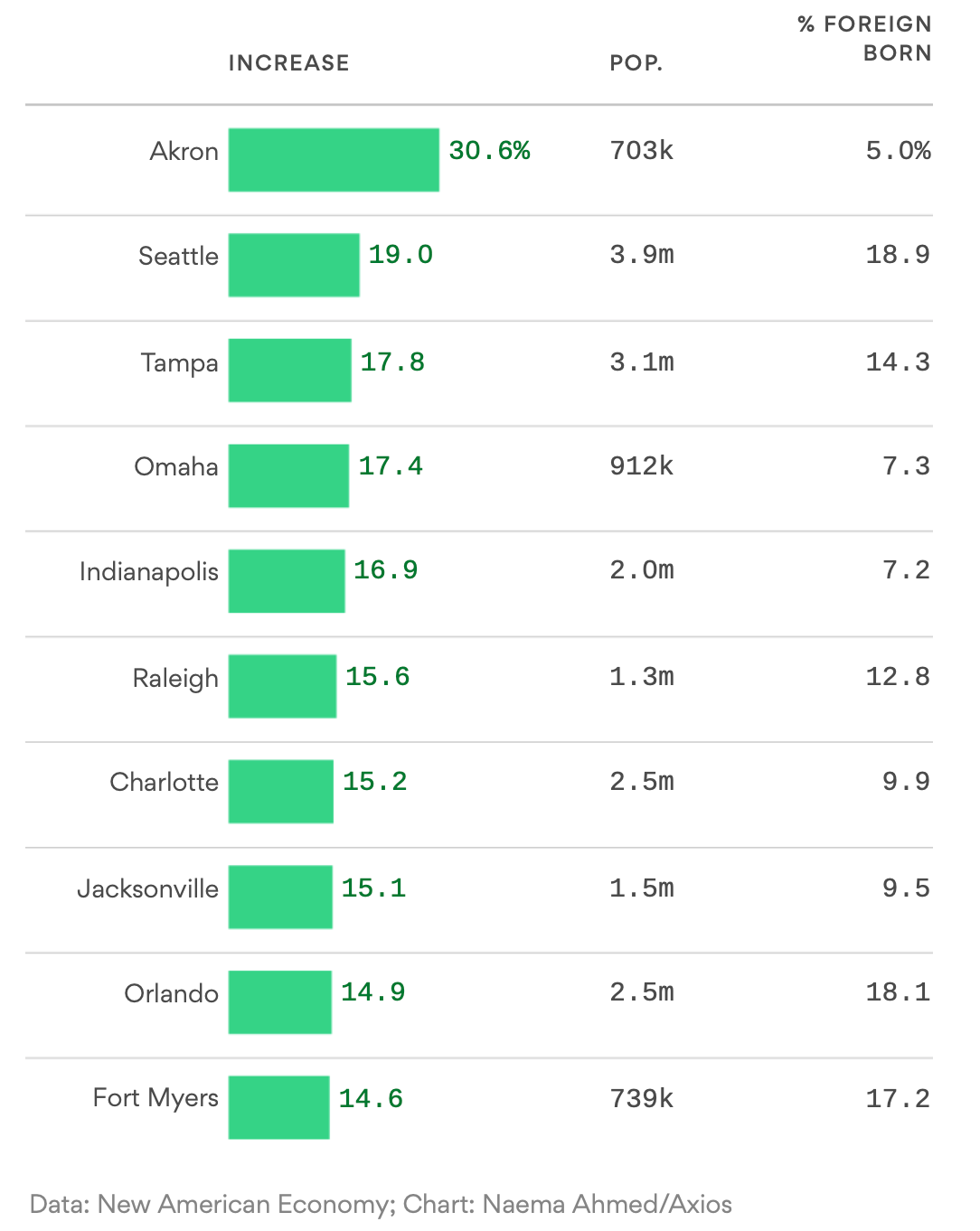
As young Americans stream to coastal cities, immigrants are seizing opportunities in the midwest and south where mid-sized cities are struggling to maintain a younger, working-age population.

Why it matters: From 2014-2017, immigrants contributed nearly 33% of the total population growth in the top 100 U.S. metro areas — and they’re settling in smaller cities that aren’t typically considered immigration hubs, according to new research from New American Economy.

“Immigrants — very similar to other Americans — are looking for less crowded, more affordable cities that have dynamic job markets,” said Andrew Lim, research director at the bipartisan research and advocacy organization.

Details: Foreign-born migration helped reverse population decline in several metros, such as Detroit, Memphis, Dayton and St. Louis.

  • In 2017, immigrants were responsible for 98% of the population growth in metro Cincinnati, 88% of the growth in metro Birmingham, and 87% of growth in metro Miami.
  • Four of the top 10 cities seeing the most population growth from immigrants are in Florida — a state seeing a disproportionate growth of aging residents.

What’s happening: Many of the top destinations are grappling with a demographic double whammy: a growing aging population on one hand, and a dwindling young population on the other.

  • Immigrants to the U.S. are more likely to be of working age — between 25 and 64 — than the native-born population. Meanwhile, 98 of the top 100 metros saw an increase in population above the age of 65 between 2014 and 2017.
  • Healthcare is a popular job area as demands grow in caring for aging residents. In El Paso, for example, immigrants made up a third of healthcare workers in 2017. In the Minneapolis-St. Paul area, that number was 20%.

The big picture: Immigration is a national flashpoint right now, with controversies around poor conditions in detention centers along the Mexico border and political fights over whether the 2020 Census will include a citizenship question.

The research highlights the economic upsides of immigration.

  • Immigrant entrepreneurs grew by 7.7% in the top 100 metro areas between 2014 and 2017. The number more than doubled in Baton Rouge, and grew by more than 60% in Tulsa.
  • Immigrant homeownership increased by 9.5%, with Nashville, Oklahoma City and Charlotte seeing the fastest growth.
  • Despite growth in smaller cities, the more traditional metros (New York, Los Angeles, San Francisco) still saw the highest levels of spending power and taxes paid by immigrants.

Go deeper:

Source: Immigrants are moving to smaller U.S. cities

Immigration: les étudiants étrangers diplômés au Québec expulsés de la voie rapide

Not a great way to communicate the change, nor explain it:

Sans faire de bruit, le gouvernement de François Legault vient de suspendre un programme qui permettait aux étudiants étrangers diplômés d’une université québécoise d’immigrer par la voie rapide.

L’annonce a été faite par le truchement de la Gazette officielle du Québec, publiée hier. On apprend dans ce document hautement technique la suspension temporaire immédiate du programme qui permet depuis 2010 aux nouveaux diplômés d’obtenir en quelques semaines seulement un certificat de sélection du Québec, premier pas vers l’obtention de la résidence permanente au pays.

Interrogée par La Presse, l’attachée du ministre de l’Immigration, de la Diversité et de l’Inclusion a expliqué que la suspension se terminera le 1er novembre et fait partie de la refonte du système d’immigration par le gouvernement de la Coalition avenir Québec.

Un autre volet du Programme de l’expérience québécoise (PEQ) – nom donné au processus d’immigration accéléré -, qui vise les travailleurs étrangers occupant un emploi au Québec depuis plus d’un an, est maintenu.

« Étant donné la pénurie de main-d’oeuvre, le gouvernement a décidé de donner la priorité aux travailleurs qui occupent déjà un emploi au Québec. Ils répondent rapidement à nos besoins », affirme Élisabeth Gosselin.

Lorsque La Presse a demandé comment des travailleurs déjà embauchés pouvaient avoir un plus grand impact sur les 120 000 postes à pourvoir au Québec que des étudiants fraîchement diplômés, l’attachée de presse de Simon Jolin-Barrette a affirmé que la pénurie de main-d’oeuvre serait « pire si ces travailleurs [déjà en poste] quittent » le Québec.

Mme Gosselin ajoute que malgré la suspension, ceux qui ont obtenu un diplôme récemment n’ont pas nécessairement à déménager hors du Québec. Ces derniers peuvent demander un permis de travail temporaire, fait-elle valoir.

« En catimini »

L’annonce de la suspension du programme a fait bondir l’opposition officielle à Québec. « Le gouvernement a fait ça en catimini. Il y a eu des annonces la semaine dernière sur l’immigration : pourquoi ne pas avoir parlé de la suspension d’une partie du Programme de l’expérience québécoise, un programme qui fonctionne très bien ? », tonnait hier Dominique Anglade, députée de Saint-Henri-Sainte-Anne et candidate à la direction du Parti libéral. « C’est un gouvernement qui pense à court terme, sans vision. Cette annonce va être dommageable pour l’image du Québec à l’international à long terme », dit celle qui a été présidente et directrice générale de Montréal international avant de faire le saut en politique.

Président de l’Association québécoise des avocats et avocates en droit de l’immigration (AQAADI), Guillaume Cliche-Rivard était incrédule hier. « Tout ça est une conséquence des seuils d’immigration revus à la baisse par le gouvernement. Couper dans le programme destiné aux étudiants étrangers avec un diplôme du Québec et qui parlent français n’a aucun sens, se désolait hier l’avocat. Toutes les sociétés occidentales veulent que les étudiants formés chez eux restent. On envoie vraiment le mauvais message à ceux qui veulent venir étudier au Québec. »

Selon lui, la suspension du programme rendra les universités québécoises – qui recherchent sans cesse de nouveaux étudiants étrangers – moins attrayantes.

À Montréal international, l’une des organisations mises à profit par le gouvernement précédent pour convaincre un plus grand nombre d’étudiants étrangers de rester et de travailler au Québec après leurs études, on disait ne pas s’inquiéter de l’annonce gouvernementale. « Ce qui a été annoncé nous réjouit. Les étudiants étrangers peuvent toujours obtenir un visa de travail. Ce qui est important pour nous, c’est que les travailleurs et les étudiants étrangers qui viennent au Québec ne soient pas freinés lorsqu’il est temps d’obtenir un permis temporaire », a dit hier Christian Bernard, vice-président aux affaires économiques et aux communications.

Un programme populaire

C’est le gouvernement de Jean Charest qui avait mis sur pied le Programme de l’expérience québécoise en 2010 afin de donner rapidement un statut d’immigration permanent aux travailleurs qualifiés temporaires et aux étudiants étrangers qui ont terminé leurs études dans la province. Pour y être admissibles, les demandeurs doivent avoir une bonne connaissance du français.

Depuis 2015, le gouvernement du Québec a déployé des programmes spéciaux pour convaincre davantage d’étudiants étrangers de s’installer au Québec après leurs études, notant un retard important sur la rétention des diplômés par rapport à d’autres provinces, dont l’Ontario, ou encore en se comparant à d’autres pays d’immigration, dont l’Australie et les États-Unis.

En 2018, 10 711 personnes ont été sélectionnées pour l’immigration par le Québec grâce au PEQ, soit près du cinquième des 55 000 immigrants reçus dans la province l’an dernier. De ce nombre, la moitié – soit 5146 – était composée de récents diplômés. En 2019, 8052 personnes ont déjà reçu le feu vert du Québec par le truchement du PEQ, dont 3226 diplômés. Or, le gouvernement de la CAQ a abaissé à 40 000 le seuil d’immigration du Québec pour 2019.

***

Deux fois plus d’étudiants étrangers

De 2009 à 2018, le nombre de permis d’études délivrés à des étrangers a doublé au Québec. En 2018, ils étaient 70 060. De ce nombre, 5146 ont fait une demande d’immigration auprès du gouvernement du Québec. En général, le Québec retient environ 20 % des étudiants étrangers après l’obtention d’un diplôme. Le gouvernement libéral voulait doubler ce pourcentage.

« Par leur expérience préalable au Québec, [les diplômés et les travailleurs qualifiés temporaires] ont déjà amorcé leur processus d’intégration au marché du travail et à la société québécoise, ce qui en fait des candidats de choix à l’immigration permanente. »

– Extrait du document Planification de l’immigration au Québec pour la période 2020-2022 produit en 2019 par le ministère de l’Immigration, de la Diversité et de l’Inclusion