Canada’s work force needs to take hold of its immigration advantage

Another business perspective on elements of the “Canadian advantage” for highly skilled immigrants:

The global economy is going through a profound transformation.

Game-changing technology is driving the digital era, causing many industries to reshape and reform. Real-world applications of artificial intelligence, AR/VR and machine learning are disrupting everything from how we shop, how we manufacture, even to how we mine.

It is also radically redefining how we work and what skills are needed – and these new and increasingly specialized skill sets are in chronic short supply.

While our colleges and universities are doing a good job producing much needed graduates in fields such as robotics, data and analytics, blockchain and AI, they simply can’t keep up with the growth in demand.

This growing skill gap is a drag on business and a drag on economic growth. Organizations around the world are being forced to look beyond their borders to attract workers to propel their businesses forward. But at a time when many countries are turning inward and tightening their borders, it is getting increasingly difficult to do so.

On this front, Canada’s approach to attracting workers with these in-demand skills stands out.

Our current immigration system was built on the belief that improving the entry of in-demand foreign workers would help employers scale up, boost revenues and ultimately create new jobs for Canadians.

This model has worked well and, as we saw recently, the OECD called Canada’s system the benchmark for other countries, noting we lead the OECD with the highest share of highly educated foreign-born entrants. In particular, it praised Canada’s immigration system for the way it chooses which workers to admit as well as its pre- and post-arrival supports.

But Canada could do even more to protect and leverage our advantage in attracting the world’s brightest and best workers. In addition to the strength of our immigration processes, we also have a global reputation for being a welcome place for newcomers.

Business leaders need to stand up for and embrace the continued importance of immigration to the Canadian economy and society.

Canada’s strength as a country – present, past and future – is directly tied to attracting and embracing newcomers. Immigration powers our economy and makes our society one of the most desired in the world. With a rapidly aging population, immigration is more important than ever.

As the child of immigrants myself, I know the journey can be rocky at times – change always is – but I also understand what Canada means to immigrants, and what immigrants mean to this country. Like most newcomers, my parents were extremely grateful for the opportunities Canada provided and worked hard to ensure I understood how lucky I was to have this chance.

We need to be clear with businesses that are searching for much needed high-skill workers that the answer is Canada.

We already have many of the key components needed to attract high-tech businesses, such as high quality of life, solid infrastructure, low corporate tax rates and significant tax benefits for research and development activities.

Our tech super clusters also provide opportunities to partner with Canadian academic and research institutions to develop ideas and talent.

KPMG has been working with a number of organizations, particularly in the technology industry, that are looking to expand their operations and are beginning to recognize that Canada’s progressive immigration system can help address their talent challenges.

The key questions we ask each organization include:

  • Is your organization able to access foreign talent fast enough and with certainty to meet your current business needs and growth objectives?
  • Do foreign nationals working at your operations feel confident that they can obtain permanent residence status in a reasonable period of time for themselves and their families to remain long term?
  • Does the foreign talent pool that you are seeking to recruit feel comfortable that they will be welcomed as foreign workers and future immigrants in the countries you are based?

For many, the answer to all these questions is “no” when looking anywhere else but Canada.

With our reputation for openness and building on our history, Canada has an immense opportunity to expand our digital economy by building on our talent advantage – to attract the world’s best people and companies.

Doing so will drive innovation, create more high-quality jobs and reverse the brain drain.

Source: Canada’s work force needs to take hold of its immigration advantage

Changing U.S. Policy and Safe-Third Country “Loophole” Drive Irregular Migration to Canada

Good in-depth study:

Nearly 50,000 asylum seekers entered Canada irregularly via land crossing from the United States over a two-year period beginning in spring 2017—contributing to a doubling in the overall number of asylum requests seen in 2016. Most make their way into Canada via Roxham Road, an unofficial crossing at an otherwise unremarkable country road along the New York-Quebec border.

The surge in asylum filings is the result of a few factors, perhaps most notably U.S. policy changes that have made the United States less hospitable and growing recognition of a “loophole” in the 2004 Canada-U.S. Safe Third Country Agreement (STCA). While the treaty was designed to manage asylum-seeker processing by requiring individuals to apply for protection in the first of the two countries entered, it allows those who reside in or transit through the United States to claim asylum in Canada if they enter between official ports of entry.

Box 1. Methodology

This article presents findings from semi-structured interviews with 290 asylum seekers from more than 50 countries, with a representative sample by country of origin. They had been in Canada from a period of only a few days up to two years. Interviews were conducted from December 2018 to October 2019. They took roughly one hour, and were conducted in the respondent’s language of choice at shelters and community organizations in Toronto, Hamilton, Ottawa, and Montreal.

Recruitment took place using posters and communication through social workers and volunteers. Respondents were identified by their first name only, and offered the choice to use a pseudonym. No identifying or contact information was collected.

Interviews were also conducted with two dozen lawyers, social workers, civil servants, and personnel from government and law enforcement in Canada and the United States.

The majority doing so, according to research undertaken by the author and his research team, only briefly transited the United States before crossing into Canada. Around 60 percent of the 290 asylum claimants interviewed—from a diverse mix of countries including Haiti, Nigeria, Colombia, and the Democratic Republic of the Congo (DRC)—had spent an average of five days before moving on to Canada. The remainder had lived in the United States for an average of six years.

The increase in asylum seekers has proven a politically and morally fraught issue for the Trudeau government in the lead-up to the October 21 federal election, offering opposition parties and civil-society groups on the right and left alike reason to criticize the centrist Liberals in power. It also has placed new scrutiny in Canada on the Safe Third County Agreement, criticized by conservatives for its role in fostering more asylum claims and on the other side of the spectrum by lawyers and refugee-rights advocates who question whether the United States remains a “safe” country.

This article, which draws from the first year of the “Understanding Emergent Irregular Migration Systems to Canada” research project, presents findings from interviews to explore asylum claimants’ motivations for claiming asylum, information sources, and experiences along their journey and after arrival. It also analyzes the effects of the recent arrivals on Canada, especially regarding the political implications. The goal is to fill a research gap by providing empirical evidence for the drivers of irregular migration to Canada.

U.S. Policy Change as a Driver of Migration to Canada

Increasing irregular arrivals to Canada may be attributed to many factors, including (mis)information spread about the STCA “loophole” through social networks and international media. Insights from interviews with asylum claimants suggest that U.S. policies are a major driver of irregular migration to Canada—though the relationship is not always linear. An increase in arrivals after change in U.S. policy is not unprecedented: discrepancies between U.S. and Canadian refugee determinations in the 1980s led to a “border rush” of predominantly Central and South American asylum seekers. The ensuing backlog in Canada’s asylum system led to the creation of the country’s Immigration and Refugee Board (IRB) and motivated Canada to seek an STCA in the first place.

Causes of the Recent Uptick in Asylum Seekers

The Trump administration’s decision not to extend a long-standing Temporary Protected Status (TPS) designation for some 46,000 Haitians was the catalyst for the drastic increase in asylum claims in Canada in 2017. In April 2017, just 140 Haitians crossed into Canada at Roxham Road. The following month, the number increased to 1,355, and to 3,505 that June. Roughly half of the 6,500 Haitians who arrived during the April 2017 – June 2019 period examined, were U.S. residents, with the rest arriving from Haiti and third countries, particularly Brazil. Thus an announced U.S. policy change resulted in roughly 7.5 percent of all Haitians in the United States with TPS choosing Canada rather than risking deportation, moving to a third country, or remaining unauthorized in the United States.

Figure 1. Number of Asylum Seeker Claims on Roxham Road, April 2017-June 2019

Source: Data provided to the author by Immigration, Refugees, and Citizenship Canada (IRCC) under a memorandum of understanding.

A commensurate number of TPS recipients from countries other than Haiti have not sought asylum in Canada, even as the Trump administration has also moved to end designations for Salvadorans, Hondurans, Nicaraguans, and others. The lack of similar movement may owe to a number of factors, including the fact that U.S. courts have at least temporarily blocked the upcoming terminations. Obama-era Department of Homeland Security (DHS) officials, advocates, and asylum seekers interviewed also noted that Latino immigrants are more politically organized and committed to resisting Trump administration policies.

Still, more than 300,000 people risk losing TPS in early 2020, and in an environment of hostility toward asylum seekers and unauthorized immigrants, more may aim to cross irregularly into Canada, particularly if it appears the courts will not continue being a brake on Trump administration immigration actions.

Table 1. Temporary Protected Status (TPS) Populations in the United States and Expiry Dates

Note: A grant of Temporary Protected Status (TPS) provides recipients protection from removal from the United States, as well as work authorization.
Source: D’Vera Cohn, Jeffrey S. Passel, and Kristen Bialik, “Many Immigrants with Temporary Protected Status Face Uncertain Future in U.S.” Pew Research Center FactTank blog, March 8, 2019, available online.

Beyond the initial rush of Haitians in mid-2017, many others have made the journey after being in the United States for only a short period of time. Roughly 60 percent of respondents used the United States only as a transit state, spending an average of five days. They learned of the crossing from a range of sources, often through social media, YouTube, or word of mouth. Some early respondents, mostly from Nigeria, were reticent to admit that they had planned to come to Canada, and said they had no knowledge of Roxham Road before arriving in the United States. These respondents also offered similar, almost verbatim reasons for asylum. The researchers thus revised their interview structure to focus on the source of information for the Roxham Road route. Several described purchasing asylum narratives from “story sellers” or “travel agents,” typically based on persecution for gender and sexual orientation. While these types of claims are long-standing, narratives also included Donald Trump’s anti-migrant pronouncements and the specter of family separation as the reason for spontaneous transit to Canada. Thus, decisionmakers in Canada must now contend with U.S. policy in assessing claims.

However, most respondents planned to use Roxham Road from the outset. “My husband had Canada in mind for years. He wanted to do it legally, like fill out the forms online. But once he heard about Roxham Road he decided to send us,” said Hadiza, a 39-year-old woman from Niger. “It was a difficult decision. It was me and three kids. My husband had to stay behind. He sent us first and maybe he can come later.”

For these migrants, the unlikelihood of protection contributed to their choice not to remain in the United States. Roughly 20 percent had been denied visitor or skilled immigrant visas to Canada but were able to obtain or already had U.S. visitor visas. Several, predominantly from the DRC, Angola, and Pakistan, said they obtained visas by bribing U.S. consular officials. Restrictive U.S. asylum procedures, more open visa regimes, and corruption thus impact asylum claims in Canada.

Roughly 40 percent of respondents had resided in the United States for a period of years, mostly unauthorized residents who had overstayed a visa or received a negative asylum decision. Unlike many who transited through the United States in days, this group explicitly stated that their reasons were directly tied to U.S. policies.

“This word ‘illegal’ is weird to me, even if I use it about myself,” said Derrick, a 22-year-old from Gabon. “Every day people tell you to go back to your country, that if you’re struggling you should just go. That’s not a life. I’m not a criminal, I don’t hurt people. I just want to work and study.”

Among respondents’ fears were the threat of workplace immigration enforcement operations or law enforcement status checks. The most common catalysts for the decision to use Roxham Road were that a relative or community member had been incarcerated or deported, or that they were running out of funds or appeals in lengthy U.S. asylum procedures. Several said they abandoned claims because of a 2018 policy to schedule new cases in immigration court before older ones, a “last in, first out” policy DHS implemented to deal with the rapidly rising Central American caseload. Regardless, most reported a growing fear from the Trump administration’s anti-immigrant discourse, more frequent discrimination, and anxiety about the fate of their children should they be apprehended. Finally, around 3,500 U.S. citizens had crossed the border during the April 2017-June 2019 period, according to Immigration, Refugees, and Citizenship Canada (IRCC), signaling the displacement of mixed-status households with unauthorized immigrant parents and U.S.-citizen children.

Many who arrived in late 2018 or in 2019 had actively researched Roxham Road, which had garnered significant media attention in 2017, often through online searches and conversations with community members, but considered it a last resort. Interview questions asked respondents who resided long term in the United States where Canada ranked among options including return to their country of origin, relocation to a third country, or move elsewhere in the United States, particularly a sanctuary jurisdiction. Most were incredulous about the notion of returning to their country of origin, but would have preferred to remain in the United States were it not for the Trump administration. Canada offered the simplest and safest option.

Transnational Border Crossers

Irregular migration to Canada rapidly became more transnational after receiving attention from mainstream and social media. By late 2017, Nigeria overtook Haiti as the top country of origin, and the number of nationalities diversified significantly.

Table 2. Top 20 Countries of Origin of Roxham Road Asylum Claimants, April 2017- June 2019

Source: IRCC data provided to the author under a memorandum of understanding.

For most who transited the United States over a short period of days, the decision to seek asylum in Canada has less to do with U.S. policy and more to do with finding a solution for a precarious situation. To take one example, many claimants who are considered Yemeni, Palestinian, or Sudanese in official data were born and lived in Saudi Arabia. “Saudi-ization” policies—aimed at increasing the share of native-born Saudis in the workforce—resulted in the termination of these workers’ residence permits. For Yemenis, this means risk of deportation to a country with which they have no connection and one experiencing a humanitarian emergency. Many Palestinians would be rendered stateless. Respondents coming from these types of situations relayed how their social networks were abuzz about the U.S. route to Canada as early as May 2017, offering a new means to fulfill pre-existing desires for mobility.

While those with financial means often fly to the United States, an increasing number, predominantly from Africa, undertook multimonth and even multiyear overland journeys from Brazil, through Central America, to the United States. This comports with global findings that the first people in irregular migration systems are often those with the capital to move quickly, while those with fewer resources take more precarious routes.

The less well-heeled or those unable to secure U.S. visitor visas recounted harrowing danger, including violence and extortion by state security services, criminals, and smugglers; capsized boats on the coast of Colombia; horrific experiences in the Darien Gap jungle in Panama; predation from gangs in Mexico; and waiting in dangerous conditions at the U.S. border. “The jungle in Panama was very, very hard. You’re walking past dead bodies. You spend ten days or two weeks. You have to walk through rivers, over mountains. There are snakes and bandits… You walk for days, from the time the sun comes up until it goes down, and you sleep wherever you lay,” said Naomi, a 22-year-old from Angola. “If a child dies, the parent leaves it behind. If your husband dies, you leave them behind. Because if not, it’s you who will be left behind. It was the most difficult thing I’ve ever done.”

(Mis)Information and Social Networks 

Social networks play a strong role in would-be migrants’ decision-making. In the case of Nigerian claimants, for example, Pentecostal churches play a key role planning travel and social connections once in Canada. Refugee claimants from Yemen, Colombia, and a range of African states receive detailed instructions from community members who have already arrived. Some respondents said U.S. aid organizations encourage people to move on to Canada after release from detention.

As in other irregular migration corridors, misinformation and rumors seem to have a strong influence. Whispers of impending enforcement actions in the United States served as a catalyst for several respondents. More often, rumors are spurred by minority-language media and are amplified and distorted through social media. These often have some basis in fact. Recent arrivals reported rumors that the Canadian border will be closed if the Conservatives win the October election, spurring people to hurry on their journeys.

When Trump announced a ban on refugees from certain Muslim-majority countries within days of taking office Prime Minister Justin Trudeau tweeted: “To those fleeing persecution, terror & war, Canadians will welcome you, regardless of your faith. Diversity is our strength #WelcomeToCanada.” A number of respondents cited this juxtaposition as a prominent example that Canada was “saving” refugees from the United States. “I was hearing a lot of things about the Prime Minister of Canada. My friend told me they’re welcoming people there. And I thought ‘this is the place I’m supposed to go’,” said Bilal, 25, from Yemen.

It would be disingenuous, however, to claim a tweet was the direct catalyst for migration. The irregular movements to Canada instead owed in a broader sense to the erosion of protection and retreat from norms of asylum in the United States, against which people measured their chances in Canada.

Interviews illustrate that claimants had accurate information about the route, yet little knowledge of the asylum process in Canada. Respondents were surprised by the scale of the flow, wait times for hearings, not immediately receiving housing, and the difficulties in finding child care and work. And while only a few respondents said they would have made a different decision, interviews and DHS data suggest that over the past two years dozens or hundreds of asylum seekers had either returned to their country of origin or used smugglers to re-enter the United States.

A Surprising Lack of Criminality at the Border

In comparison to other irregular migration corridors—and indeed on other legs of the journey—there is remarkably little criminality at the U.S.-Canada border. The route existed long before Roxham Road made headlines. It generally consists of transit by bus or private car to Plattsburgh, New York, and taxi companies transporting people to the border. Individuals with large families or health issues, or those who fear interactions with U.S. immigration enforcement, use a network of private drivers. None of this activity amounts to smuggling under U.S. or Canadian law, and there is very little evidence of abuse while people move within the United States.

A small number reported intimidation by taxi drivers in Plattsburgh. In the early days, taxi companies overcharged for the 25-mile drive to Roxham Road. In May 2019, the New York attorney general convicted the owner of one company of systematically overcharging. This trend has abated, and most respondents relayed either no meaningful interactions or acts of kindness from drivers, who calm agitated people and explain the process at the border.

The most significant exploitation is in Canada, particularly by immigration consultants and lawyers. In several cases—in collaboration with agents in the United States—consultants from migrants’ national or linguistic community convinced individuals to come to Canada. Such consultants offer a “full-service” fee, including transportation to the border, access to a safe house in Canada (which is unnecessary), and promises to circumvent Immigration and Refugee Board (IRB) wait times (which is not possible). They then extract as much money as possible before abandoning claimants. Other respondents, primarily from Latin America, have reported lawyers charging exorbitant rates for paperwork that could be covered by legal aid organizations. As Nadya, a 35-year-old woman from Colombia, explained: “The agent charged us $1,500, and put us in touch with a lawyer in Canada, [who] said it was $6,000, then $1,500 each to get a work permit. He said could get us work and we could pay him back. Once we got to Montreal there was a group of Latino lawyers, [who] explained we would get free legal aid. We asked, ‘How much do we have to pay [for] a work permit?’ It’s then we realized he was trying to take advantage of us.” Finally, there is some evidence that Mexican and Nigerian claimants arrive owing debts for passage and are immediately recruited to work under the table for temporary labor agencies.

These types of exploitation pale in comparison to the abuse and danger reported along irregular migration routes elsewhere around the globe. Most interviewees reported positive experiences with Canadian officials and consider the system fair despite long wait times. Understood in a global context, claiming asylum in Canada remains a safe process.

Impacts on Canada

The backlog at Canada’s IRB, a tribunal that hears refugee claims, had grown to more than 79,000 cases as of August 2019, with average wait time of two years for first hearings. A 2019 auditor general’s report found that wait times could increase to five years by 2024 if the number of claims remains constant. The increase has strained shelter capacity in major cities, particularly Montreal and Toronto. Polling by the Angus Reid Institute suggests that while most Canadians remain in favor of welcoming refugees and asylum seekers, they overestimate the number of refugees present, see irregular migration as a crisis, and those entering at Roxham Road as “queue jumpers” or “bogus refugees.” Attacks on shelters and demonstrations against housing asylum seekers in Toronto, and far-right protests at shelters in Montreal and on the border in Lacolle, Quebec have occurred.

The opposition Conservative Party of Canada has accused the government of losing control of the border. In late 2018, the party took a page from the playbook of Europe’s far-right populists, claiming the Global Compact for Safe, Orderly, and Regular Migration would mean ceding sovereignty to the United Nations. The Ontario Progressive Conservative Party refused to cooperate with the federal government over shelters and housing for asylum seekers, and made the unprecedented move of canceling legal aid for refugee claimants, which is a crucial part of the asylum process. The goal was to foster chaos in the lead-up to the election and shift the burden to Quebec, a crucial electoral battleground.

It has also been expensive. After lobbying from the legal and advocacy community, the federal government announced CAD $26.8 million in funding to address the legal aid shortfall. The 2018 budget allocated $72 million for capacity-building at IRB, and the 2019 budget an additional $1.2 billion over five years. Providing shelter space for asylum seekers has cost cities somewhere in the range of $150 million. The political challenge is that effective policy requires administrative solutions, while critics can mobilize narratives of economic migrants gaming the asylum system as a result of uncontrolled borders.

The government has sought to balance capacity building with restrictive policies. In 2018 it created a new Minister of Border Security and Organized Crime Reduction, appointing a tough-on-crime ex-police chief from Toronto. It also changed the Immigration and Refugee Protection Act to prevent asylum shopping by denying access for people who previously sought protection in the United States, Australia, New Zealand, or the United Kingdom. The change was roundly criticized by refugee-rights advocates and has caused significant uncertainty for both asylum seekers and the legal community. Officials interviewed on the condition of anonymity confirmed it is a pre-emptive measure in case of U.S. policies that might spur more migration, particularly in the lead-up to the 2020 U.S. presidential election.

Loophole or Safety Valve?

Much of the asylum debate in Canada has been about closing the STCA “loophole.” The left-leaning New Democratic Party and many academics, lawyers, and refugee advocates have called for Canada to suspend the accord, on grounds the United States is no longer a safe country for asylum seekers. Amnesty International and the Canadian Council for Refugees are challenging its constitutionality. The Conservative Party has taken the opposite position, promising to extend the agreement to what has been long heralded as the “world’s longest undefended border.”

Applying the agreement between ports of entry would require vast new funding for federal police, who would be tasked with apprehending and detaining thousands of people. The result would create more criminalized smuggling markets, make migrants vulnerable to trafficking, create precarious undocumented populations, and push people to more dangerous routes. It would also fundamentally damage Canada’s global identity.

On the other hand, suspending the Safe Third Country Agreement would likely result in more asylum claimants, given peoples’ decisions have been significantly affected by ever-more hardline U.S. policies and rumors of more open Canadian ones.  Those arriving at regular ports of entry would still increase IRB backlogs. And the move would likely backfire politically, with voters potentially rewarding anti-refugee political platforms, as in Europe and the United States.

Restrictive policies are unlikely to stem the flow of people, and Canada has no leverage in negotiations with the White House over the STCA. Likewise, unilaterally suspending participation in the accord risks riling the U.S. government at a time when the Trump administration is limiting access to asylum and attempting to compel other states to take on the responsibility for hosting refugees.

While perhaps counterintuitive, the status quo with regards to the Safe Third County Agreement is a viable option. Roxham Road is well managed. The Royal Canadian Mounted Police (RCMP) and Canadian Border Services Agency (CBSA) conduct routinized security screening and first-line admissibility checks. The majority of interviewees took pains to mention they were treated humanely, in sharp contrast to experiences at other borders. Volunteers who monitor the crossing relayed that while there were instances of intimidating behavior by the RCMP in 2017, they are now rare because of the standardization of procedures, permanent infrastructure, and observation by volunteers. People arrive safely, and without criminal networks.

While politically fraught in the current context, Canada receives a small number of asylum seekers in comparison to other refugee-receiving countries. It has an established and well-funded settlement sector, and refugee-status determination procedures are largely fair. Staying the course until the 2020 U.S. elections would allow for capacity-building and long-term planning that bucks the global trend of reactionary policies in liberal democracies.

Acknowledgments

This article is part of a research project, “Understanding Emergent Irregular Migration Systems to Canada,” funded by the Social Sciences and Humanities Research Council and hosted by the Centre for Refugee Studies at York University and the Global Migration Lab at the Munk School of Global Affairs & Public Policy, University of Toronto.

Spanish government reduces irregular immigration by half

Through working with Morocco to reduce the “supply:”

The Spanish executive has reached its goal of reducing irregular immigration by half, a decision that was taken in January after arrivals in 2018 reached a record 64,298 people.

The latest official data shows 24,159 undocumented arrivals, marking the first time since 2010 that there has been such a steep drop in immigration by land and sea.

One out of every 100 migrants continues to die at sea

This decrease is largely owed to renewed efforts by Morocco to stop migrants from departing from its coastline.

“The preventive efforts by Moroccan authorities continue to be effective, and they are key to understanding the strong reduction in arrivals in Spain during 2019,” said the European Commission in an internal report to which EL PAÍS has had access. Those efforts include, among other things, preventing thousands of departures by land and the rescue of 10,700 migrants who were returned to Moroccan territory, adds the report.

Thanks to this assistance, in just a few months Spain has gone from being the main Mediterranean route for irregular immigration to showcasing itself as a role model in Europe. Spain and its European partners want to reinforce cooperation with Morocco, which has been rewarded diplomatically and financially with aid worth €180 million.

Immigrant deaths at sea have not dropped by as much. So far this year, 317 people have drowned or disappeared in the Strait of Gibraltar and the westernmost portion of the Mediterranean as they attempted to reach Spain, a 42% drop from 2018. One out of every 100 migrants continues to die at sea.

In 2018, record arrivals put irregular immigration at the top of the political agenda. Migratory pressure had been increasing since 2017, but the opposition claimed there was a push effect because of the Socialist (PSOE) administration’s decision to take in humanitarian vessels that had been rejected by Malta and Italy, such as the Aquarius NGO vessel.

Since then, the caretaker government of Socialist Party (PSOE) Prime Minister Pedro Sánchez has adopted tougher measures, including pushback policies at the border between Morocco and the Spanish exclave cities of Ceuta and Melilla, and preventing NGO-run humanitarian ships from sailing to the central Mediterranean.

While sea arrivals are more visible, a majority of immigrants arrive by air. Although it is impossible to know how many people on tourist visas extend their stay, asylum requests have ballooned to 82,000 so far this year, a figure that is largely due to Venezuelans and Colombians who make up 32% and 23% of asylum seekers, respectively.

Source: Spanish government reduces irregular immigration by half

The Crackdown On Illegal Immigration Is Hurting Oil Drillers

Interesting. Yet another sector feels the impact:

U.S. crude oil production growth may have slowed down this year, but the largest oil-producing counties in the Permian basin continue to feel a shortage of labor.

The predicament for small oil services business owners in New Mexico is aggravated by the surge in worksite audits, investigations, and arrests as part of U.S. President Donald Trump’s tougher stance on illegal immigration.

There are still oil field services business owners who continue to hire an illegal labor force.

Yet, those who want to play by the rules find themselves between a rock and a hard place. On the one hand, President Trump’s pro-oil policies clash with impact from the crackdown on immigration, which makes business owners idle drilling rigs and equipment not because they have drilled out all the shale wells in Lea County, but because they can’t find legal immigrant workers to do some of the dangerous difficult jobs on the oil field that some Americans shun.

Oil field business owners say that the lack of a system to get illegal oil workers documented or given working visas is impeding the oil industry from having enough labor force to take full advantage of the unprecedented—albeit slowing—oil boom in the United States.

“They’re demanding more rigs, more swabbing units, but you don’t have enough employees,” Johnny Vega, who runs Mico Services in New Mexico, told Reuters’ Hay.

Vega’s company generates some US$17 million in revenues per year. But right now, during the period of booming oil production in New Mexico, the firm has equipment idled, because there aren’t enough legal immigrant oil workers to operate it. That idled equipment could make Mico Services as much as US$700,000 per month. The lack of documented workers, however, has had Vega thinking about hiring out the company’s idled equipment.

Other oil field businesses also feel the labor shortage, especially as oil production in the U.S. and New Mexico continues to grow.

Lea County in New Mexico is the second biggest oil producing county in the United States, second only to McKenzie County in North Dakota.

“Our production has roughly tripled in the last five years,” Steve Vierck, former CEO and president of the Economic Development Corporation of Lea County, told Hobbs News-Sun in May this year.

“It really reflects not only how much oil production there is, but how much growth there has been in oil production to move up the chart as fast as Lea County has,” Vierck added.

New Mexico, as a whole, is the third-largest oil producing state in the U.S. after Texas and North Dakota. In 2018, New Mexico’s oil production accounted for 6.3 percent of total American production, EIA data shows.

But at the same time, the U.S. Immigration and Customs Enforcement (ICE) has significantly stepped up criminal investigations, business audits, and arrests. In the fiscal year 2018, Homeland Security Investigations (HSI) opened 6,848 worksite investigations, initiated 5,981 I-9 audits, and made 779 criminal and 1,525 administrative worksite-related arrests—all of these categories surged by 300 to 750 percent over the previous fiscal year, ICE said.

In New Mexico’s oil industry, business owners playing by the rules feel the labor shortage, while those who turn a blind eye to oil workers’ documents (or lack of thereof) fear the immigrant clampdown.

Source: The Crackdown On Illegal Immigration Is Hurting Oil Drillers

British Family Detained By ICE After Unlawfully Entering U.S. From Canada

Bureaucratic ineptitude and cruelty, that may help some understand what those caught on the Southern border are facing:

A British couple and their 3-month-old son are being detained in a federal immigration facility in Pennsylvania after they say they accidentally strayed across the U.S.-Canada border.

U.S. Customs and Border Protection agents arrested the family for unlawfully entering the country while on vacation in British Columbia. The family said that while driving, they swerved down an unmarked road to avoid an animal.

“This is how the scariest experience of our entire lives started,” wrote Eileen Connors, 24, in a sworn statement shared by immigration attorneys with Aldea — The People’s Justice Center, a pro bono legal clinic in Reading, Pa.

The Connors family was taken into federal immigration custody in Washington state on Oct. 3 and slept on what they describe as “a dirty floor” in a border patrol station. Connors said the family was asked about family members in the United States they could be released to, but instead of being freed they were transferred to the Berks Family Residential Center, outside Reading, on Oct. 5.

There, they say treatment worsened. Connors said that the Berks County-run facility was not equipped to care for such a young child and that normal caretaking items — such as a container of formula and teething powder — have been confiscated. At one point, her baby had no clothes while staff washed the clothes he arrived with.

“This facility is frigid,” said Connors. “The staff here first told us they cannot turn on the heat in the building until the end of next month,” even though temperatures are in the 50s at night.

As a result, her son’s health is suffering, she says.

A few days ago, “[he] woke up with his left eye swollen and teary … also his skin is rough and blotchy,” Connor wrote.

In an echo of events at the U.S. southern border, where parents were separated from their children through a “zero tolerance” policy, the family wrote that in response to complaints about conditions, an ICE employee offered to remove their baby.

“If we wanted, we could sign papers to allow him to be separated from us and taken to some other facility,” Connors said. “We were shocked and disgusted.”

Few safeguards

An ICE spokesman confirmed that the family is in custody at the Berks Family Residential Center but denied any mistreatment.

“BFRC provides a safe and humane environment for families as they go through the immigration process. BFRC supports all sanctioned local, state, and federal investigations into the safety and welfare of our residents,” he said in a statement, adding that reports of abuse or inhumane conditions “are unequivocally false.”

In addition to the couple and their son, the Connorses’ extended family, which includes two other young children, was also taken into custody.

As British citizens, the family was entitled to visit the U.S. without a visa.

“They could just come to the United States with a passport,” said attorney Bridget Cambria, who worked on the civil rights complaint that has been filed on behalf of the family with the Department of Homeland Security. “The reason it sounds silly is because it is silly.”

Instead, Eileen and her husband, David, 30, are locked into an immigration process with few safeguards. People in federal immigration custody are not entitled to legal counsel and even the wrongful arrest of U.S. citizens can take weeks to sort out, as they struggle to prove their identities while in detention.

Other foreign tourists have also found themselves in dire straights. Last June, a French citizen visiting her mother in British Columbia was arrested by U.S. Customs and Border Patrol after jogging on the beach near the border of Vancouver and Blaine, Wash. She was held in federal immigration detention for two weeks.

Unlawful border crossings in the north are also on the rise, with 4,316 people apprehended at the Canadian border in 2018, up from 3,027 the previous year.

CBP has not yet responded to questions about why the Connors family was taken into custody.

Attorneys familiar with the case say they hope the family will be released later in the week, based on communication with the British Embassy.

In her statement, Connors said conditions at the facility slowly improved after she was able to speak to someone from the British Embassy on Oct. 8. Still, she wrote that the experience will haunt them.

“We have been treated like criminals here, stripped of our rights, and lied to,” she said. “We will be traumatized for the rest of our lives.”

Source: British Family Detained By ICE After Unlawfully Entering U.S. From Canada

A Perfect Scorecard: Canada’s immigrants are faring much better in the labour market

Nice data analysis and overall good news:

Immigrant underemployment has been a longstanding challenge in Canada, but recent evidence runs in contrast to the negativity that often surrounds this subject. 

While it is true that many immigrants are working below their paygrade, which according to a recent report by the Royal Bank of Canada costs the economy an estimated $50 billion in annual GDP, Statistic Canada data shows considerable progress is being made on this front.

A Perfect Scorecard

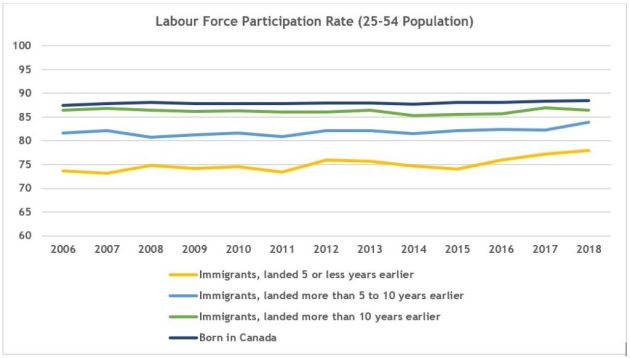
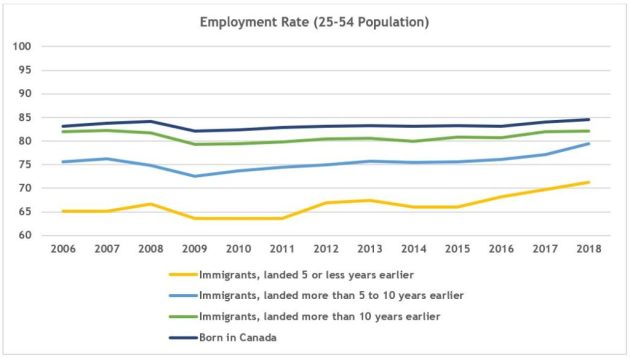
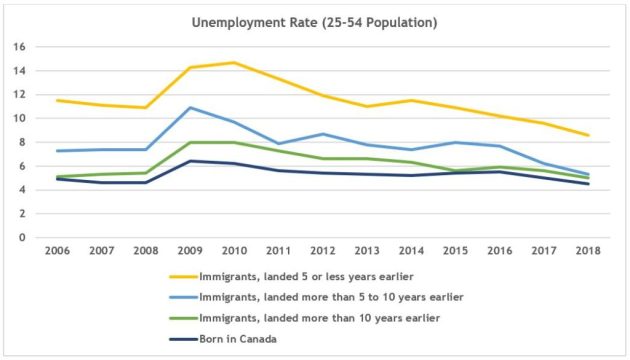
When assessing various immigrant labour force metrics, everything that we want to be happening is actually occurring: More immigrants are in the labour market and are employed, fewer of them are underemployed, and their wages are on the rise.

Among core-aged workers (those between the ages of 25-54), the participation rate of Canada’s newcomers (those in Canada for five years or less) stood at 78 per cent in 2018 compared with 74 per cent in 2006.

This is a positive finding because it suggests that newcomers today are integrating into the labour market more quickly than their predecessors (the participation rate represents the percentage of people within a specific cohort that are working or are looking for a job).

The newcomer employment rate (the share of a worker cohort with a job) has also improved — it was 71.3 per cent in 2018 compared with 65.2 per cent in 2006.

Similarly, immigrants who have been in Canada between 5 and 10 years have seen their employment rates rise significantly to 79.5 per cent in 2018 compared with 75.6 per cent in 2006.

The unemployment rate (the share of a worker cohort looking for a job) has declined. Among newcomers, it stood at 8.6 per cent in 2018, which may seem high, but is a marked improvement compared with what it stood at after the 2008-09 recession (14.7 per cent) and back in 2006 (11.5 per cent). It has also dropped among other immigrant cohorts—it stood at just 5.3 per cent in 2018 for immigrants that have been in Canada between 5 and 10 years compared with 7.3 per cent in 2006.

Immigrant wages are also rising. A 2018 Statistics Canada report noted that “immigrants admitted to Canada in 2015 earned the highest entry wages of any cohort admitted since 1981.”

Moreover, core-aged immigrants with a university degree saw their wages increase by 3.5 per cent in 2017 compared with the previous year (the Canadian-born cohort saw a 0.9 per cent increase).

Two Factors at Play

The first major factor that can explain the better performance of immigrants is Canada’s tightening labour market.

With more baby boomers retiring, Canadian employers are increasingly counting on immigrants to fill the void. According to a Conference Board of Canada study, all 9.2 million baby boomers will retire over the next decade, which means that employers will need to become even more reliant on immigrants.

Reforms to Canada’s immigration policy are the second factor. These include reforms to selection policies as well as expanded efforts to support newcomer settlement and integration.

Expression of interest systems launched by the federal government (Express Entry) and provinces across Canada are likely contributing to improved immigrant outcomes. By ranking applicants against one another based on human capital factors such as age, work experience, education, and language ability, the federal government and provinces are now giving preference to the highest-scoring immigrants.

This marks a departure from Canada’s previous system where immigrants were selected so long as they met a certain points threshold, even if there were other candidates waiting behind them who had higher scores.

Canada’s Provincial Nominee Program (PNP) is also likely contributing to the improvements. An evaluation by Immigration, Refugee, and Citizenship Canada (IRCC) noted that the vast majority of PNP arrivals become established economically, with high employment rates, and earnings that increase over time.

More temporary residents are now transitioning to permanent residents under Express Entry and the PNP (“two-step migration”). This is sound policy as Statistics Canada research has shown that immigrants who previously worked or studied in Canada initially have a large earnings advantage over those without prior experience living in Canada.

Settlement Services

The federal government and provinces and territories fund settlement supports for immigrants such as language training, employment services, among others. IRCC is the largest funder of such services and has increased its annual settlement budget fivefold over the past two decades to $1.5 billion today.

It is likely that this increased investment is contributing to the labour market improvements immigrants have recently enjoyed.

Room for improvement and reasons to be optimistic

As noted by a recent CIC News article, immigrants continue to face labour market barriers that undermine their ability to make even more significant contributions to Canada’s economy.

At the same time, they are doing better in the labour market, which is probably due to baby boomer retirements and refinements to immigration policy.

These two factors will continue, which should leave us feeling optimistic that immigrants will continue to enjoy stronger labour market outcomes.

Source: A Perfect Scorecard: Canada’s immigrants are faring much better in the labour market

The U.S. might be about to send us these two immigration and refugee problems

Good insight on the next series of headaches:

Of the many files landing on the next government’s desk following this month’s election, at least two may give it an immigration headache. Both come from decisions made by our neighbour to the south: President Donald Trump’s reversal of his country’s post-Reagan refugee policy and his rewriting of “safe third country” rules. Addressing each will involve a difficult balance of humanitarian principles, foreign policy interests and our relationship with the U.S.

The first headache has to do with Canada’s unexpected surpassing of the United States in resettling the world’s greatest number of refugees. Resettlement is the organized transfer of refugees to countries like Canada, relocating them away from countries like Turkey and Lebanon that often host millions of refugees inside their borders. Canada’s newfound leadership has less to do with our natural benevolence, however, than with an unprecedented reduction in American refugee admissions under the Trump administration. In both Canada and the U.S., resettlement has generally enjoyed support from both conservatives and liberals. Since 1980, America has led the world both in resettling refugees and also in successfully encouraging other countries to increase their refugee intake, trends that continued until 2018. In that year, Canada resettled 28,000 refugees, up from an average of 11,000 annually in the years prior to 2015. By contrast, U.S. admissions dropped to a record low of just 23,000 in 2018, down from a 20-year average of 66,000 and a one-year record high of 96,000 in 2016.

Our Canadian moment, even if it is a moment by default, has global implications as the U.S. announces further cuts to refugee admissions in the coming year. Resettlement has acted as a fiscal and social pressure valve for countries hosting millions of refugees, some of them Canadian friends or allies, like Bangladesh and Turkey. It is also a foreign policy and national security instrument, facilitating the recruitment of translators in war zones and embarrassing strategic foes via the admission of citizens fleeing their countries. Canada must weigh these considerations, as well as humanitarian ones, against rising pressure on Canadian funds and a recent drop in public confidence in Canada’s overall immigration system. Nor do we have the same clout as the Americans in helping redistribute the refugee load more fairly throughout the world, especially now that, following the U.S. lead, more countries are reducing their resettlement programs than are expanding them.

In addition to formal resettlement, Canada faces a growing number of asylum claims. Over 170,000 asylum-seekers have sought protection here since the past federal election, 50,000 of whom crossed the border to do so — either “illegally” or “irregularly” depending on who you talk to. Both the Liberals and Conservatives have promised to staunch the flow of border crossings by renegotiating the Canada-U.S. Safe Third Country Agreement and to return asylum-seekers walking across our southern border to the U.S. for processing. The current agreement applies only to official border crossings, however. A strengthened agreement could apply this arrangement to claimants crossing the border elsewhere, as well. Unfortunately, a strengthened agreement may not be in the cards. In fact, recent changes in U.S. asylum policy may hand the next prime minister a completely suspended agreement, rather than a renegotiated one, which will be bad news both for relations with the U.S. and for an already backed-up Canadian asylum system.

Under a new policy, the Americans will deport asylum-seekers if they passed through another country on their way to the U.S., even if they face a demonstrated risk of torture or persecution in their home country. This violates one of the founding principles of the Safe Third Country Agreement — namely, that countries not return asylum-seekers with credible fears to their home country. It also strengthens the possibility of a successful challenge of the agreement in a current case before the Federal Court of Canada. If the case were to result in the agreement’s suspension, asylum-seekers could make their claims directly at official border crossings without the risk of being turned back to the U.S. This would eliminate the incentive to cross the border to claim protection but it might also invite a correspondingly greater number of claims than before, as prospective claimants would have a more direct route into Canada from the U.S. Canada would not be obligated to approve their claims, but we would have to assess them, further impacting an already backlogged and beleaguered process. It would also risk offending the U.S. by in effect labelling it an unsafe country for refugees. That is not an outcome we want in a time of already tense trade relations.

The potential impact of these changes is hard to overstate. Canada has a proven track record when it comes to processing and integrating refugees. The next federal government may want to leverage our new position as the world’s number one resettlement destination to introduce its own model sponsorship program among like-minded partners on the international stage. It should also consider investing in a more rapid and flexible claim assessment system, one able to respond to large and sometimes unpredictable flows of claimants whatever agreements we do or don’t have with other countries and whatever choice they do or don’t make about re-electing mercurial leaders.

Source: The U.S. might be about to send us these two immigration and refugee problems

On immigration, Liberals and Conservatives agree on targets but not on how to get there

Another analysis of party positions on immigration-related issues;

In the months leading up to the federal election, many political observers in Ottawa thought immigration issues would figure prominently in the campaign.

The Conservative opposition had spent months between 2017 and 2019 hammering the Liberal government on their handling of a spike in asylum claimants crossing into Canada, mostly at a single point on Quebec’s southern border.

The Liberals, for their part, continued to trumpet Canada’s openness to immigrants and refugees — something Justin Trudeau had highlighted since the 2015 campaign with his party’s commitment to take in more refugees fleeing war-torn Syria.

But over the course of the campaign, including the two official leaders’ debates last week, immigration has taken a back seat to issues like climate change, or how the various leaders would save you a buck if they formed government.

That might be because, in spite of the rhetoric and the politicking, Canada’s mainstream political parties have a broad consensus on immigration being key to the country’s continued economic and social well-being.

But there are important differences in both tone and policy between the Liberals and the Conservatives — the two parties which have the most realistic shot of governing. How would the first six months of a Conservative or a Liberal government differ?

The Star looks ahead at what this election could mean for Canada’s immigration policies — and for people hoping to make it to Canadian shores.

Liberal majority

Naturally, a Liberal majority would represent the least change from Canada’s current immigration levels. The Liberals have been steadily increasing planned immigration levels since taking office in 2015, and would continue to do so if they were re-elected.

According to the federal government’s immigration levels plan, Canada would aim to grow the number of immigrants from 330,800 in 2019, to 350,000 in 2021. Most of these, around 60 per cent, come through Canada’s economic stream for immigration — skilled workers to fill needs in the economy.

The Liberal party says it will enact “modest and responsible” increases in immigration, with a focus on attracting “highly skilled workers.”

A Liberal government would introduce a municipal nominee program that would allow local communities to directly sponsor permanent immigrants and it would make permanent a separate program to encourage immigration to Atlantic Canada. A minimum of 5,000 spaces would be earmarked for each program. The Liberals say they would also waive citizenship fees for permanent residents.

The number of refugees admitted into Canada fluctuates year-to-year, although irregular migration at the Canada-U.S. border — where asylum claimants have been crossing outside recognized ports of entry in hopes of securing refugee status — decreased in 2019 compared to previous years.

Conservative majority

Conservative Leader Andrew Scheer largely agrees with the Liberal government’s proposed immigration targets of 350,000 newcomers in 2021. Scheer told the CBC this month that immigration levels should not be “politicized.”

“This should be a number that Statistics Canada and experts in various fields say ‘we need this many people to come’ to fill the gaps in the workplace, or to ensure we have a growing population, combined with a humanitarian component for family reunification and refugees,” Scheer said.

So don’t expect a new Conservative government to drastically change course on the top-level numbers. The Conservatives main point of difference with the Liberals is the situation at Roxham Road in Quebec.

Since 2017, more than 50,000 people have crossed the Canada-U.S. border outside of a border services checkpoint. Once they reach Canadian soil, Canada has an obligation — under both domestic and international law — to give their asylum claims a fair hearing.

While the numbers have decreased year-over-year since 2017, when U.S. President Donald Trump’s administration started threatening specific groups with deportation, the Conservatives have continued to heap criticism on the Liberals’ handling of the file.

Last week, Scheer announced that a Conservative government would attempt to “renegotiate” the Safe Third Country Agreement with the Trump administration. The bilateral agreement requires those seeking asylum to make their claim in either the U.S. or Canada, whichever they arrive in first. But convincing the hardline Trump administration to take in more refugees would be an uphill battle — particularly as Trump seeks re-election.

Scheer said there are “other options” if the U.S. is unwilling to renegotiate the agreement — although declined in his news conference to say what those options were. A Scheer government would also hire an additional 250 officers for the Canada Border Services Agency, a significant increase in the agency’s inland enforcement workforce.

The Conservatives would also prioritize funding to immigration services like language training and credential recognition, in addition to emphasizing services to vulnerable newcomers.

Minority government

All the parties recognize the importance of immigration to Canada’s economy at a time when the country’s workforce is aging and concerns mount about labour shortages. This could open the door to more economic immigration as well as increased efforts to recognize the credentials of professionals trained abroad. And three parties want changes to Canada’s Safe Third Country Agreement with the United States — although in very different ways.

The Green party wants it terminated, the NDP says suspend it and the Conservatives want changes, to prevent asylum seekers from the U.S. from making claims when they arrive at unofficial border crossings. The Liberals said only that it would work with the U.S. to “modernize” the agreement.

But a Liberal minority government could come under opposition pressure for more drastic changes.

The NDP say that Canada has an important role to play taking in refugees. New Democrats and Green party members want to speed family reunification. Both want to crack down on “unscrupulous” immigration consultants.

The Green party wants the accreditation of foreign professionals expedited to speed their entry into the workforce. It would eliminate the temporary foreign workers program by increasing immigration levels and working with employers to assist with permanent residency. And it says that Canada must be ready to take in “environmental” refugees, those who have been displaced by the impacts of climate change.

Source: On immigration, Liberals and Conservatives agree on targets but not on how to get there

Election 2019: Party Platform Immigration Comparison

With all party platforms out, it is now possible to compare the written policy commitments of each party. 

While each party leader has made additional commitments on the campaign trail (e.g., Conservative Party of Canada leader Scheer on maintaining current Liberal immigration levels, New Democratic Party leader Singh pledging additional funding for Quebec integration and settlement services), this analysis looks only at the official party platforms, as these will form the basis of any future government “report card.”

In general, differences among the four main parties are a matter of nuance as all accept ongoing large numbers of immigrants, programs to facilitate integration, straight forward  pathways to citizenship  and the multicultural reality of Canada. 

The only major dissent from that overall consensus is from the People’s’ Party of Canada. The Bloc québecois’ narrow focus on Quebec issues is reflected in virtue signalling its intent to table private members’ bills that assert or seek to expand Quebec’s jurisdiction in immigration.

Party platforms reflect commitments, which are both concrete and “virtue signalling” to their respective bases and voters that they wish to attract.

The Conservative platform on immigration is sparse, with commitments that reflect their main focus on management of immigration, particularly the irregular arrivals at Roxham Road. This is balanced by their commitment to remove the cap on privately sponsored refugees while clarifying priorities for refugee selection (implicitly downplaying the UN Refugee Agency role). Commitments that reflect more strongly concerns of their base include banning values tests for Grant and Contribution programs (Canada Summer Jobs program) and re-opening the Office for Religious Freedom. 

The platform is silent on high profile issues previously raised in opposition such as M-103 on Islamophobia and other forms of racism and discrimination and their opposition to the UN’s Global Compact for Migration.

The lack of meaningful commitments on immigration levels and mix, citizenship and multiculturalism would provide a Conservative government considerable policy and program latitude should it form the government. The PPC picks up on some of issues the Conservatives dropped, along with prohibiting birth tourism and an overall hard-tone on immigration.

The Liberal platform is stay the course on immigration levels and most other policy areas. Apart from the major announcement of eliminating citizenship application fees, the platform places greatest emphasis on multiculturalism-related issues, whether it be with respect to diversity of appointments, anti-racism and anti-hate strategies, and resources to counter international far-right networks, including additional funding. The platform is silent on family reunification, the Temporary Foreign Worker Program, refugees, and integration.

The NDP and Green platforms are to the left of the Conservative and Liberal platforms. Of the two, the NDP platform is the more coherent. In the event of a minority government, the almost “laundry list” approach in both platforms would provide some areas of agreement, but not their call to abolish the Safe Third Country Agreement with the USA.

Neither major party has chosen to make immigration the big issue that was predicted at the start of the campaign, reflecting that both parties need to win a substantial part of the immigrant and visible minority vote to win the election. So while there are differences in tone and substance,  these have been relatively downplayed in their respective platforms, campaign language notwithstanding.

This table (Election Platforms 2019 Comparison) highlights party positions on immigration (levels, mix, Temporary Foreign Workers, refugees, irregular asylum seekers), integration, citizenship and multiculturalism.

Immigration levels: The Conservative platform is silent on immigration levels. The Liberal platform continues the current trajectory of “modest and reasonable” annual increases along with making the Atlantic Immigration Pilot permanent and establishing a Municipal Immigration Pilot. The NDP platform states that levels should reflect labour market needs.

The Green platform commits to regularize the status of illegal (non-regularized status immigrants) and improve the pathway to permanent residency for international students and Temporary Foreign Workers.

The PPC platform proposes a cut of between 50 and 70 percent of current immigration levels, along with the addition of in person interviews to assess the “extent to which they align with Canadian values and societal norms.” The PPC also proposes increased resources to Canadian Security Intelligence Service (CSIS), Royal Canadian Mounted Police (RCMP) and Immigration, Refugees and Citizenship Canada (IRCC) for the interviews and more thorough background checks.

Immigration mix:  While the Conservative, NDP and Green platforms all promise to speed up family reunification, particularly for parents and grand-parents for the Conservatives and NDP and children for the Greens, the PPC platform calls for abolishing family reunification for parents and grand-parents. The Liberal and Bloc platforms are silent.

The NDP platform calls for faster reunification of caregivers with their families. The Green platform calls for a “robust system” to assess the education and training credentials against Canadian standards prior to arrival along with clear explanations for professionals and an improved pathway to permanent residency for international students and Temporary Foreign Workers.

The PPC proposes to adjust the point system to increase the percentage of economic class immigrants.

Temporary Foreign Workers:  While the Conservative platform commits to match employment backgrounds to employment needs of companies that rely on TFWP, the Green platform calls for the replacement of Temporary Foreign Workers by increased immigration. The PPC platform calls for limiting numbers and ensuring they are only temporary. Both the NDP and Green platforms call for increased regulation of immigration consultants. 

The Liberal and Bloc platforms are silent.

Refugees: While the Conservative platform commits to the elimination of the cap for privately sponsored refugees, the PPC calls for relying solely on private sponsorship, accepting fewer refugees, no longer “relying” on the UN for refugee selection, and taking Canada out of the UN Global Compact for Migration.

The Conservative platform places priority on genocide survivors, LGBTQ+ refugees, and internally-displaced persons while the PPC platform places priority on persecuted religious minorities (e.g.,  Christians, Yazidis) in majority Muslim countries.

The NDP program calls for increased support for refugee integration. The Bloc calls for a moratorium on deportations to countries in conflict or where the life of a refugee would be in danger. The Liberal platform is silent.

Asylum seekers (Safe Third Country Agreement): While the Conservative platform calls for closing the loophole in the STCA that allows irregular arrivals between official border crossings, the Liberal platform states that it will work with the USA to “modernize” the Agreement. The NDP, Greens and Bloc call for its termination. 

The PPC would declare the whole border an official port of entry , deport irregular arrivals,  and fence frequently used border crossings like Roxham Road.

The Conservative platform commits to speed up refugee processing by deploying Immigration and Refugee Board judges to common arrival points and speed up deportations by hiring an addition 250 CBSA agents. The Green platform calls for the establishment of a Civilian Complaints and Review Commission for CBSA. The Bloc platform calls for the hiring of additional IRB members in Quebec to adjudicate claims.

Integration (settlement services): The Conservative platform commits to continue supporting settlement services while the Green platform calls for increased funding for language training through earmarked transfers to the provinces. The platform also calls for increased funding to multicultural organizations to provide language and other services. No other party makes integration commitments.

Citizenship: The Liberal platform commits to eliminate citizenship fees (currently $630 for adult applications). The Green platform commits to address the remaining cases of “lost Canadians” while the PPC platform commits to change the Citizenship Act to make birth tourism illegal.

Multiculturalism: The Conservative platform commits to end values tests for government G&C programs (e.g., the Summer Jobs program) and to reopen the Office of Religious Freedom.

The Liberal platform promises to continue improving the diversity of GiC appointments and senior levels of the public service. The Anti-Racism Strategy will be strengthened through doubling funding, along with increased G&C funding. The platform commits to improve the quality and amount of data collection regarding hate crimes. An additional $6 million over three years will be provided to the Centre for Community Engagement and Prevention of Violence along with resources to counter the rise of international far-right networks and terrorist organizations.

Both the Liberal and NDP platforms commit to hold social media companies accountable for hate speech.

The NDP platform has the longest list of commitments including: ensuring all major cities have dedicated hate crime units; the convening of a national working group to counter online hate; funding for anti-gang projects to deter at-risk youth from joining gangs or becoming radicalized; a ban on carding by federal law enforcement and working to end carding in all jurisdictions; and a national task force to develop a roadmap to end over-representation of Indigenous and visible minorities in prison populations, along with an African Canadian Justice Strategy.

The Green platform commits to improving the integration into the multicultural fabric, assisting cultural organizations to obtain charitable status, amending the Anti-Terrorism Act and Public Safety Act to require that formal charges be brought against all those detained and lastly, investigating allegations that Canadian officials cooperated with foreign agencies known to use torture.

The PPC platform commits to repealing the Multiculturalism Act and eliminating funding that promotes multiculturalism.

The Bloc platform focusses exclusively on Quebec jurisdiction questions: opposing any federal intervention in Bill 21 and laïcité; strengthening relations with immigrant communities;  private member bill “virtue signalling” with respect to exempting Quebec from the Multiculturalism Act; banning offering or receiving public services with face covered; having citizenship applicants living in Quebec demonstrate knowledge of French; and making federally regulated sectors (banks, transport, communications) located in Quebec subject to Bill 101.

Exposé of immigration scheme in Canadian trucking prompts warning from feds

The Globe’s excellent exposé on practices in the trucking industry (Canada Ottawa to probe possible abuse of foreign workers as B.C. reviews trucking rules)gets noted in the North American trucking press:

The Canadian government said any employer found to break the rules of a temporary worker program would face “serious consequences” after an investigation by The Globe and Mailexposed a scheme that saw trucking companies with poor safety records luring inexperienced foreign workers into driver careers.

Canada’s second-largest newspaper found that some trucking companies and immigration consultants were exploiting job-seekers through Canada’s Temporary Foreign Worker Program, which allows companies to temporarily fill vacancies from outside the country when the jobs can’t be filled. The investigation revealed an array of allegations such as payments for jobs.

“Any employer found to have violated the rules of the Temporary Foreign Worker Program will face serious consequences,”  Isabelle Maheu, a spokesperson for the program’s administrator, Employment and Social Development Canada, wrote in an email on October 8.

Maheu would not say whether Employment and Social Development Canada was investigating any employers mentioned in The Globe and Mail’s report. But she wrote that allegations of misuse are being investigated.

“The Government of Canada takes very seriously its responsibility to protect the integrity of the Temporary Foreign Worker Program, as well as the safety and welfare of temporary foreign workers, and does not tolerate any abuse or misuse of workers,” Maheu wrote.

But within the industry, there is growing anger about employers who cut corners to fill trucks and improve their operating margins.

“The article put the final piece of the puzzle together,” said Wendell Erb, CEO of Erb Group, an Ontario-based trucking company that specializes in refrigerated transport.

The Canadian Trucking Alliance responded to the Globe’s report, saying it was “embarrassed by the actions of a small element of our sector.”

The organization, which represents carriers across Canada,  called on improved oversight by federal and provincial authorities and also singled out a practice known as “Driver Inc.” where drivers are intentionally misclassified as independent contractors to avoid tax withholding.

The organization also stressed the importance of immigration programs that help fill trucks and other positions in the industry.

Source: Exposé of immigration scheme in Canadian trucking prompts warning from feds