In Australia, a New Look at Immigration: ‘It’s About Our Friends’

Another example of how the personal trumps the official narratives by highlighting inhumanity (as was the case with Alan Kurdi or the Kamloops residential school deaths):

The 3-year-old girl was born in Australia, in a tiny town called Biloela, far from the big cities of Sydney and Melbourne. But her parents were asylum seekers from Sri Lanka and living in a country that heavily discourages illegal migration, so the government sent them to a faraway island while deciding their fate.

This week the girl, Tharnicaa Murugappan, returned to mainland Australia, but not for the reason her family had hoped — she was medically evacuated to Perth, where she is now battling a blood infection in a hospital after a lengthy illness. Supporters of the family say she was given only painkillers for nearly two weeks at the remote government detention facility while her fever rose, and she now suffers from pneumonia, which led to her blood infection.

Tharnicaa and her family, often called the “Biloela family” among Australians, are the most high-profile asylum seekers in Australia. In a country that is inured to criticism from international human rights organizations over its “draconian” immigration policy, the detentions of Tharnicaa and her older sister have drawn outrage.

Tharnicaa’s illness has renewed calls for the family to be released from detention and prompted candlelight vigils and protests across Australia. Over half a million people have signed a petition demanding the family be returned to Biloela, a town of about 5,800 that is 260 miles northwest of Brisbane. Politicians from both sides have called for the family to be released from detention while maintaining support for the hard-line immigration policies that put them there. Karen Andrews, the home affairs minister, has been so inundated with calls about the case that her voicemail specifies that anyone wanting to speak to her about it should do so in writing.

The Murugappan family — mother Kokilapathmapriya Nadesalingam, father Nadesalingam Murugappan, Tharnicaa and her 6-year-old sister, Kopika — are the only people held in the Christmas Island detention center, which is 1,000 miles north of the Australian mainland. The two sisters, who both were born in Australia, are the only two children currently being held in immigration detention in Australia. Unlike the United States, Australia does not automatically grant citizenship to children born in the country, and the two girls are ineligible as the children of “unlawful maritime arrivals.”

The case is unusual in that the small rural town of Biloela, which has been leading the fight to get the family back, is a politically conservative place. But when the family was whisked away by immigration officials in 2018 after their claims for asylum were rejected and their temporary visas expired, locals weren’t thinking about politics. This case “wasn’t about politics or asylum seekers, it was about our friends,” said Simone Cameron, a Biloela local and friend of the family.

The family has been held on Christmas Island since 2019, as they fight government efforts to deport them to Sri Lanka.

Late last month, supporters of the family said, Ms. Nadesalingam and Mr. Murugappan started raising concerns with International Health and Medical Services, the private company that provides health care for the Christmas Island detention center, after Tharnicaa developed a fever on May 24. Requests for antibiotics were ignored, and the family was only given over-the-counter painkillers and a fact sheet about common flu symptoms, even as her fever increased and she started vomiting.

Tharnicaa was hospitalized on Christmas Island on June 6, according to the supporters. The next day, she was evacuated, along with her mother, to a hospital in the mainland city of Perth. She is recovering, but doctors are still trying to find the cause of the infection.

“It was the pure negligence of them not actually giving Tharnicaa antibiotics that led to her developing pneumonia,” a family friend, Angela Fredericks, said in a phone interview on Thursday. She added that the family had to “beg and fight” for Tharnicaa to be evacuated to the mainland.

In previous statements, Home Affairs Minister Karen Andrews has defended Tharnicaa’s treatment, saying she was evacuated to Perth as soon as it was recommended. International Health and Medical Services did not respond to requests for comment.

Canada needs more immigrants — and not only for the economy

Good nuanced commentary and the need for a broader lens than just demographic and economic:

There’s a problem in persistently defining immigrants as economic drivers that will take Canada to a more prosperous place.

It’s not that the pitch is wrong.

It’s that it is myopic, and it’s pushing Canada to evaluate the movement of people as a pure dollars-and-cents exercise. And that’s short-sighted at a time when we need all the compassion we can get.

Canadians’ impressions of their country as an open and tolerant nation that thrives on diversity have been deeply challenged over the past two weeks — first with the discovery of the remains of 215 children in unmarked graves at the site of a former residential school in Kamloops, B.C., and then by what police say was an intentional attack on a Muslim family in London, Ont. that left four people dead.

“There’s a growing feeling that we aren’t holding together as best we should,” says Sen. Ratna Omidvar, a vocal proponent of ramping up immigration — and in a way that is not just about economics.

“We need to be more intentional about social cohesion,” she says.

Repeatedly making the case for increasing diversity almost solely on an economic basis doesn’t help — as the federal Liberals themselves used to sense.

In 2016, a group of influential economic advisers led by Dominic Barton, now Canada’s ambassador to China, came up with a list of strategies to ensure Canada’s prosperity over the long term — a list that carries weight to this day. Barton told the federal Liberals that among other things, they should dramatically ramp up immigration as a way to propel Canada’s economy forward

A few cabinet ministers thought it was a great concept at first, but even as the Liberals embraced most of Barton’s other growth recommendations, they eventually balked at the idea, unsure of their ability to sell the public on a complex argument.

Five years later, however, not only are they making the argument, it’s almost to the exclusion of anything else when it comes to immigration. And yes, it’s complex.

Canada’s economy isn’t growing fast enough to maintain our standard of living and fund all the social safety nets we have come to expect, it goes. Plus, labour shortages are all around us, and if they’re not here now, they soon will be.

Since Canadians are retiring faster than they can reproduce, we need to replenish the workforce and bolster the financial foundation of our social safety net by adding many, many more immigrants.

The pandemic set us back in our immigration plans because of closed borders, but the federal government is now actively making up for lost time and then some — a key plank in the recovery strategy. The economic messaging is central — everywhere in Immigration Minister Marco Mendicino’s comments in the House and speeches to the public, the policy documents issued through the immigration department and the pitches Liberal MPs make to their constituents. 

Immigrants create small businesses, fill job vacancies, make our health-care system work, spend money, and support their children to make more money than they did, the message goes.

While Omidvar makes those arguments herself, she says there’s a danger in thinking narrowly.

“You make it about one thing only,” she says. “We have turned immigration into too much of a transactional experience.”

She talks about her own experience moving to Canada from Iran in 1981 and finding her way by joining a local gardening club and planting daffodils with her neighbours.

While she appreciates all the politicians’ speeches about diversity and inclusion in the wake of the London attack, she warns that social cohesion — an essential for quality of life, economic and beyond — comes from a community-based, proactive approach and not the reactive approach she has seen on display over the past couple of weeks. And that means a focus on immigrants as whole people who are valuable members of our communities.

Economist Mikal Skuterud, a professor at the University of Waterloo, doesn’t buy many of the economic arguments around immigration that the federal government is making these days. “It’s hyperbolic, it’s completely exaggerated, and it’s not honest in a lot of cases,” he says.

He argues that immigration could bolster Canada’s prosperity if newcomers are more productive than existing workers, but that’s not always the case. He also points out that if immigrants have the same age distribution as the existing workforce, they won’t do much to change the way the labour force pays for a growing contingent of retirees.

But he does agree with Omidvar that it’s important to evaluate immigration on factors that go well beyond labour and economics, especially if we want to enrich our culture and not just our wallets.

Public opinion polling suggests that Canadians generally view immigration as beneficial to Canada, but the top reasons people give for being pro-immigration are around diversity and multiculturalism. Contributions to the economy come second, says Andrew Parkin, executive director of the Environics Institute for Survey Research. 

For the sake of social peace, perhaps our political rhetoric should take its cue from the public in this case.

Source: https://www.thestar.com/politics/political-opinion/2021/06/10/canada-needs-more-immigrants-and-not-only-for-the-economy.html

The United States Should Welcome Immigrants from China

Interesting counter-intuitive take by Cato Institute. Not sure whether parallel with Cold War refugees fleeing communism but worth thinking about given Canadian concerns:

Competition with China is dominating America’s foreign policy discourse in a way reminiscent of Cold War hysteria. Our politics haven’t descended into McCarthyite crusades to purge federal departments of alleged communist infiltrators, but there are already examples of making policy out of paranoia.

In addition to fueling wasteful defense spending, fear of China has led policymakers to push for cuts to Chinese immigration. Senator Tom Cotton (R-AR) believes dramatically reducing immigration from China is necessary to protect against Chinese spies stealing American secrets. Senator Ted Cruz (R-TX) went so far as to block a bill allowing for Hong Kongers to get work permits and become refugees because he’s afraid of spies. President Biden has maintained the anti-Chinese immigration policies adopted by the Trump administration.

To the extent that China poses a serious threat to the United States, policymakers should be clamoring to liberalize immigration with China rather than restrict it. At the beginning of the Cold War with the Soviet Union, American politicians ignored the Know-Nothings of their time and encouraged refugees from communist countries.

Starting with President Truman, who ordered the admission of 80,000 refugees from Soviet-occupied Poland, the Baltic countries, and from areas of Southern Europe where communist insurgencies were active in 1945, and ending with the Lautenberg Amendment of 1990, the U.S. government consistently liberalized refugee and asylum policy for those fleeing communism. They let in millions of refugees and asylum seekers from countries as varied as Hungary, China, Greece, the Soviet Union, and Cuba – the birthplace of Senator Cruz’s father.

Welcoming immigrants from communist countries produced important economic, political, moral, and propaganda victories during the Cold War that showcased the superiority of individual liberty and capitalism over communism. But modern policy makers are ignoring those victories today.

U.S. policymakers are worried about Chinese technology. One obvious response is to channel the most productive and educated Chinese citizens to our shores. Why don’t today’s policymakers learn from the past and liberalize Chinese immigration? Espionage is the main excuse, but immigration restrictions would do little to mitigate this threat and would produce negative unintended consequences down the road for America’s competition with China.

From 1990 to 2019, there were 1,485 people convicted of espionage or espionage-related crimes spying on U.S. soil. Of those, 184 were from China. Chinese-born spies stole economic secrets or intellectual property from private firms two-thirds of the time. Of the 46 firms that were the victims of economic espionage committed by Chinese spies on U.S. soil, 16 were the victims more than once – meaning that they decided that their expected espionage-related costs of hiring Chinese workers were lower than the benefits of hiring them.

Rarely were the stolen secrets related to national security. Chinese immigrant Xiaorong You was indicted for stealing a formula for a coating for the inside of Coke cans. Last year, Xin Wang, a Chinese-born visiting researcher at the University of California San Francisco (UCSF) was arrested for the espionage-related crime of visa fraud because he did not inform U.S. immigration officials that he was still a medical technician in the Chinese People’s Liberation Army.

Assistant Attorney General for National Security John C. Demers said that Wang’s case “is another part of the Chinese Communist Party’s plan to take advantage of our open society and exploit academic institutions.” At UCSF, Wang was researching obesity and metabolism, not weapons.

Some instances of espionage are serious, but many don’t have a connection to Chinese immigrants. American-born John Reece Roth, for instance, exported data on specialized plasma technology for use in drones that he had developed under a U.S. Air Force contract. We shouldn’t let the occasional case of Chinese espionage blind the government to the benefits of liberalizing immigration for those fleeing Communist China.

In contrast, Chinese immigrants are making huge contributions to research and development that will unlock economic and technological innovation going forward. In all STEM fields, there are around 46,000 Chinese undergraduates, about 41,000 master’s students, and an estimated 36,000 PhD students at U.S. universities. Immigration restrictions to deal with the manageable threat of espionage guarantees that many of them will return to China and that fewer will come in the future.

The federal government should use the Cold War immigration playbook to liberalize immigration with China. Congress should update the Jackson-Vanik amendment to the Trade Act of 1974, which liberalized trade with non-market economies if they allowed emigration. That would end the Trump-era trade restrictions on China in exchange for the Chinese allowing the free emigration of Uighurs, other persecuted ethnic and religious minorities like Christians and Tibetans, and Hong Kongers. For the long term, expanded asylum options, green cards for all Chinese graduates of American universities, and allowing all educated Chinese immigrants to come here without restriction should all be on the table.

Liberalizing immigration with China is a net benefit for the United States and may even give America an edge in its competition with Beijing. Moreover, providing a safe haven for those fleeing totalitarian communism in China will be a tremendous moral victory for the United States.

Americans understood this during the Cold War. It’s time their children applied that lesson today.

Source: The United States Should Welcome Immigrants from China

Increased Immigration is Not A Simple Solution for US Population Woes

I do not normally agree with the Center for Immigration Studies, with its general anti-immigration work, but this analysis largely mirrors my own concerns regarding the arguments of Canadian advocates for increased immigration:

Conventional wisdom has developed that the United States desperately needs more immigration to address the supposed twin evils of population aging and slowing population growth. The 2020 Census showing the U.S. grew by “only” 22.7 million over the last decade has prompted a new round of calls to expand immigration.

In fact, immigration does not make the population substantially younger unless the level is truly enormous and ever-increasing. Moreover, there is no body of research showing that higher rates of population growth necessarily make a country richer on a per-person basis. Advocates of mass immigration also ignore the downsides of larger populations, as well as the more effective and less extreme alternatives that exist for dealing with an aging society.

Despite this reality, Jay Evensen of Salt Lake City’s Deseret News argues that the slowdown in population growth revealed by the Census “portends a population disaster.” Bloomberg News’ Noah Smith thinks lower population growth creates a “grim economic future.”

Many commentators argue for increasing immigration above the more than one million already allowed in each year to spur population growth and “rebuild the demographic pyramid,” as former Florida Governor Jeb Bush famously put it in 2013. But as the former director of Princeton’s graduate program in population studies, Thomas Espenshade, observed a number of years ago, “the effect of alternative immigration levels on population age structure is small, unless we are willing to entertain a volume of U.S. immigration of historic proportion.”

To illustrate, the Census Bureau’s “low-immigration” scenario produces a U.S. population of 376 million in 2060, compared to 447 million under its “high-immigration” scenario — a 71 million difference. Under its low-immigration scenario, 56 percent of the population will be working-age (18-64) in 2060, compared to 57 percent under its high-immigration scenario. Thus, the addition of 71 million people raises the working-age share by just one percentage point.

One reason the impact is so modest is that immigrants are not uniformly young when they arrive — many now come in their 50s and 60s — and they grow old over time just like everyone else. Moreover, immigrant fertility now only slightly exceeds native-born fertility, and their children add to the dependent population — those too young or too old to work. Of course, these children eventually grow up and become workers, but by then many of their immigrant parents will be at or near retirement age.

Given the inefficiency of immigration as a tool to address population aging, immigration advocate Justin Gest at George Mason University is forced to propose unprecedented levels of future immigration to accelerate population growth and slow population aging. In a piece for CNN and a report for the immigration advocacy group fwd.us, he argues for doubling immigration to the United States to make the country “younger, more productive, and richer.”

Gest’s own projections show that the current level of immigration will make the U.S. population 74 million larger in 2050 than if there was no immigration, while doubling immigration would add another 92 million people by 2050.

Gest emphasizes that making the population 166 million larger increases the aggregate size of the economy significantly. More workers, more consumers, and more government spending does make for a larger GDP. But a larger population means the larger GDP is spread out over more people, so each individual is not necessarily better off. If all that mattered was the overall size of the economy, Bangladesh would be considered a richer country than New Zealand. Of course, what really determines the standard of living in a country is its per capita GDP.

Gest claims that the 74 million additional people that the current level of immigration would add will raise per capita income by 4 percent in 2050, relative to no immigration. He further asserts that doubling immigration would, along with an additional 92 million people, increase average income by another 3 percent. The idea behind this calculation is that if there are more workers — or more specifically, if a larger share of the population is of working-age — the average income of the entire population will be higher.

What is so striking about these numbers is that even if everything Gest argues is true, adding a total of 166 million people to the country — more than the combined populations of France and Germany — in just three decades only modestly improves per capita economic growth. But even this small increase is an overestimate if the new immigrants crowd out some existing workers from the labor force. There is certainly evidence that this happens with teenagers and Black Americans.

In the real world, it is hard to find evidence that population growth actually increases per capita economic growth. For example, if population growth were such an economic boon, then countries like Canada and Australia, which have among the highest rates of immigration and resulting population growth in the developed world, would dramatically outpace a country like Japan, which has relatively little immigration and a declining population. And yet, between 2010 and 2019, Japan’s per capita GDP growth was slightly higher than Canada’s and Australia’s. Among all developed countries, the correlation between population growth and per capita economic growth was actually negative between 2010 and 2019.

One of the reasons population growth is not associated with economic growth is that increasing the supply of workers reduces incentives to improve productivity. Looking across countries, a 2017 study by Ronald Lee and Andrew Mason found that “low fertility is not a serious economic challenge.” Instead, they find that “The effect of low fertility on the number of workers and taxpayers has been offset by greater human capital investment, enhancing the productivity of workers.” There is simply no reason to assume that a larger population will necessarily be richer.

Putting aside economics, making the population 166 million larger or even 74 million larger than it would otherwise be has important environmental implications. While population is not the only factor that determines human impact on the environment, it does have a direct bearing on everything from preventing further habitat loss to cleaning up the Chesapeake Bay.

One can debate the severity of climate change and how best to address it. But mathematically, if the total population is 166 million (50 percent) larger in 2050 than it would otherwise be, then each person would have to reduce their greenhouse gases admission by roughly one-third just to maintain the current level of emissions, to say nothing of lowering levels. As Joseph Chamie, the former director of the United Nations Population Division, pointed out in The Hill recently, stabilizing America’s population is necessary “to deal effectively with climate change and many other critical environmental concerns.”

In addition to the environment, making the population dramatically larger must also have profound implications for the quality of life. Most Americans aspire to live in areas with a fair amount of open space. A 2018 Gallup poll found, by a two-to-one margin, that Americans want to live in rural areas or suburbs. The rapid suburbanization of immigrants shows that they share this desire. Significantly increasing the nation’s population density is likely to make it more difficult for many Americans to live the way they want to.

There is also the issue of traffic. As a Brookings Institution analysis a number of years ago concluded, “The most obvious reason traffic congestion has increased everywhere is population growth.” Traffic congestion alone has been estimated to cost the American economy $120 billion annually. Both the American Society of Civil Engineers and the Department of Transportation have reported that the nation’s roads are in a state of disrepair and need significant upgrades. It is hard to imagine that adding tens of millions more people in just 30 years would not create even more congestion.

If we are concerned about population aging, there are far less radical ways to address it. Projections by Karen Zeigler and myself show that raising the retirement age by just one year increases the share of the population that is working-age (16-64) about as much as all of the immigration expected by the Census Bureau through 2050. Increasing it by three years improves it more than does doubling immigration. We also found that increasing the share of working-age people who have a job from the pre-Covid rate of 70 percent to 75 percent would do more to improve the overall share of the population who are actually workers in 2050 than would the current level of immigration.

Population boosters assume a larger population would be a boon to the economy, even though there is no clear evidence that this is the case. They also ignore the negative impact on the environment, congestion, traffic, and other qualify of life issues. There are more effective, less radical, and more environmentally sustainable ways to deal with the challenges associated with population aging than using an ever-increasing level of immigration to dramatically increase the population.

Dr. Steven Camarota is director of research at the Center for Immigration Studies.

Source: Increased Immigration is Not A Simple Solution for US Population Woes

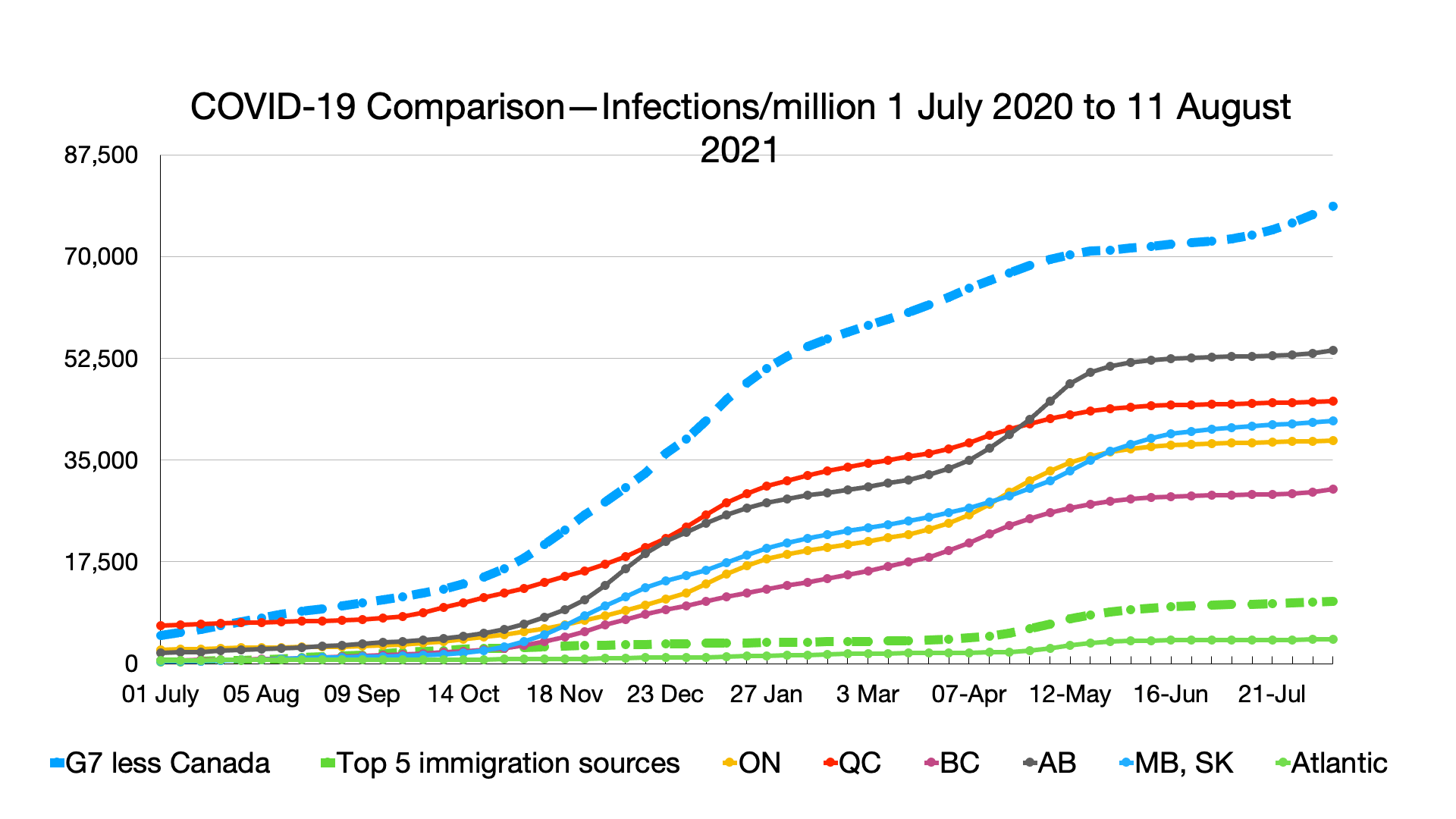
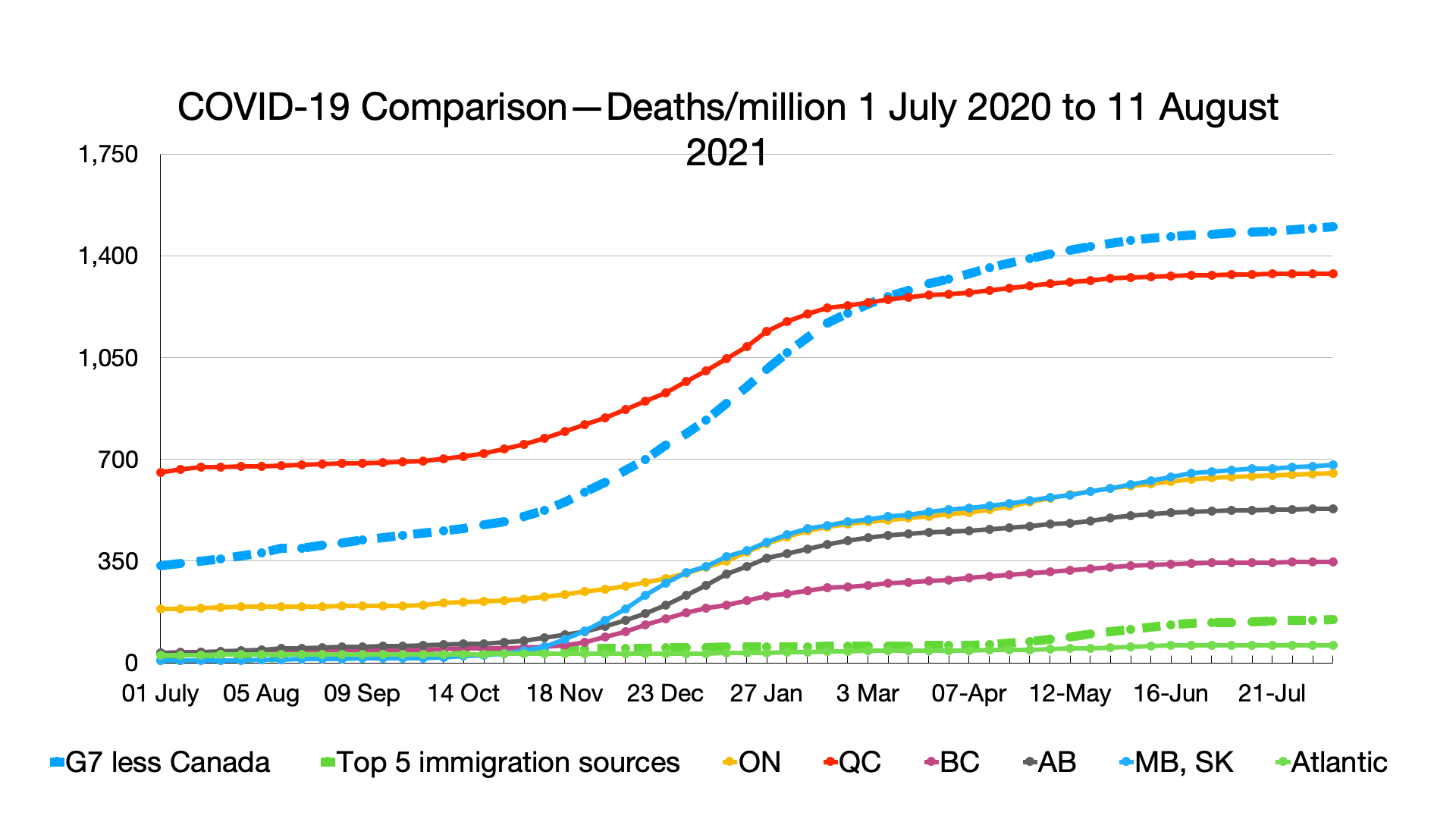
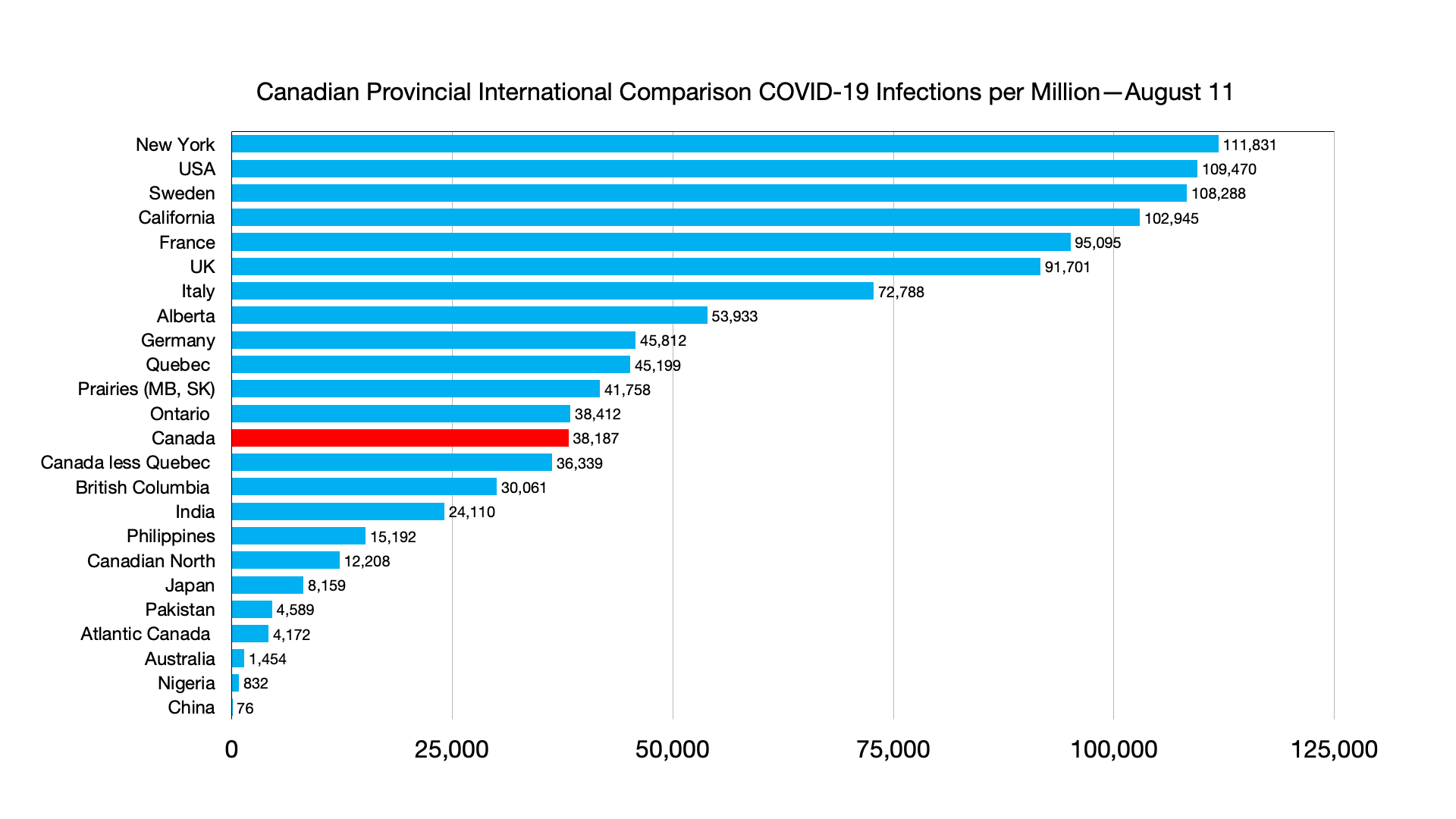
#COVID-19: Comparing provinces with other countries 9 June Update

The latest charts, compiled 9 June as overall rates in Canada continue to decline along with increased vaccinations (still largely first dose, fully vaccinated less than 10 percent).

Vaccinations: Minor relative changes, Canadian provinces all ahead of EU countries save Germany.

Trendline charts

Infections per million: No major relative changes and recent surges appear to be levelling off save for the Prairies (mainly Manitoba).

Deaths per million: No significant change, Prairies slightly ahead of Ontario.

Vaccinations per million: Canadian vaccination rates now exceed G7 less Canada with Quebec. US vaccination rates continue to stall. Vaccination rate increase in immigration source countries driven mainly by China and India to a lessor extent.

Weekly

Infections per million: No relative change.

Deaths per million: Prairies ahead of Ontario, driven by Manitoba.

Federal government opening immigration options for Hong Kongers to come to Canada

Good:

The federal government is opening up new immigration options for Hong Kongers to make Canada their home as Beijing continues its unprecedented crackdown on the former British colony.

Immigration Minister Marco Mendicino said two new immigration streams will now begin taking applications from Hong Kongers working in Canada or recent university graduates from Hong Kong now living in Canada. They will be offered a quicker and more efficient pathway to permanent residence.

“At this difficult moment, Canada continues to stand shoulder to shoulder with the people of Hong Kong. We are deeply concerned about China’s imposition of the National Security Law, and more broadly the deteriorating human rights situation in Hong Kong,” the Immigration, Refugees and Citizenship department said in a statement.

This is on top of a program announced in February targeted at people living in Hong Kong who had graduated from a Canadian or foreign university. It offers them a three-year open work permit that would help pave the way for applying for permanent residency.

The work permit program opened in February and has so far attracted 3,481 applications, the department said on Monday.

An exodus from Hong Kong has been expected since the Chinese government imposed the national security law on Hong Kong in June, 2020, saying it was to target secession, subversion and terrorism. But it includes vaguely defined offences that critics say effectively criminalize dissent and opposition to the Chinese Communist Party’s rule.

“With young Hong Kongers casting their eyes abroad, we want them to choose Canada,” Mr. Mendicino said in a statement.

“Skilled Hong Kongers will have a unique opportunity to both develop their careers and help accelerate our recovery. This landmark initiative will strengthen our economy and deepen the strong ties between Canada and the people of Hong Kong.”

Canada and Western allies have called China’s clampdown a violation of the international treaty it signed pledging to allow local autonomy and civil rights to continue for 50 years after the 1997 handover.

Records show Hong Kongers have already moved billions of dollars to Canada. Last year, capital flows out of Hong Kong banks and into Canada reached the highest level on record, with about $43.6-billion in electronic funds transfers recorded by FINTRAC, Canada’s anti-money-laundering agency.

A crackdown on civil rights in Hong Kong that accelerated in 2020 amid the global pandemic has steadily eroded the territory’s political and social freedoms that were unique in China, a legacy of the territory’s years under British control. Earlier this year, Chinese lawmakers approved changes to Hong Kong’s electoral system, further reducing democratic representation in the city’s institutions and introducing a mechanism to vet and screen politicians for loyalty to Beijing.

Source: https://www.theglobeandmail.com/politics/article-federal-government-opening-immigration-options-for-hong-kongers-to/

Canada trumpeted its special, one-time immigration program for international grads and essential workers. But did it work in the end?

Some lessons here more broadly, both with respect to policy and service delivery:

Has Ottawa’s latest immigration pathway for international graduates and essential migrant workers been a success or a missed opportunity?

After much fanfare in April to announce the first-come, first-served program to grant permanent residence to temporary migrants in Canada, officials released details about the process and requirements less than 24 hours before applications opened a month ago on May 6.

The cap of 40,000 applications for international graduates here on postgraduate work permits was filled within a day, while intake for the two migrant worker streams in health and non-health sectors — with a cap of 50,000 applications — has been slow.

As of Friday, only 1,700 applications had been received under the stream for health workers out of a quota of 20,000, and just 11,900 of the 30,000 vacancies for those in non-health related jobs were filled.

That shortfall has prompted some critics to question whether the special pathway only favours those with Canadian education credentials and in higher-skilled jobs, but excludes the essential workers who don’t meet the strict language and job criteria and who really need the help.

“It’s a missed opportunity to provide a pathway to permanent residence for other ‘low-skilled’ workers who don’t qualify. … They had an opportunity to finally give all low-skilled foreign nationals pathway for permanent residence that they’d been talking about for years,” says Vancouver-based immigration lawyer Steven Meurrens.

“There are so many people here in low-skilled jobs for such a long time. It’s not clear to me why they didn’t just expand it to all low-skilled workers who are here but don’t have an (eligible) immigration program.”

International graduates who lost their jobs during the pandemic and had their postgraduate work permits expire are already eligible to renew their permits for up to 18 months due to the pandemic, said Meurrens.

“The government sold the pathway as a COVID program. They could’ve sold it that ‘these people have been working during the pandemic and we’re going to let them stay permanently,’” said Meurrens. “They could have the political will to do that. I don’t think any opposition party would attack the government for it.”

Excitement — followed by disappointment, for some

In April, Ottawa’s announcement of the new pathway made for a good news story and the pathway was well received. It came as Canada was struggling during the peak of the third wave of COVID-19 pandemic, with daily new infections averaging more than 8,500 cases.

“This new pathway to permanent residence recognizes Canada’s need for educated and experienced workers as we work toward our economic recovery,” the immigration department said in a news release.

“It also acknowledges the extraordinary service of so many essential workers during the pandemic, many of whom are newcomers to our country and have played critical roles as we fight COVID-19.”

The pathway created a frenzy among many temporary migrants with precarious status in Canada, who were faced with the uncertainty over the impact and disruption of the pandemic toward their pursuit for permanent residence here.

Jose, a failed refugee claimant from Mexico with diabetes, has braved the exposure to COVID-19 while working in a restaurant and house cleaning through the pandemic. He said he was excited when he first heard about the program, but that excitement quickly turned to disappointment when he learned the pathway wasn’t opened to all essential workers.

“I felt sad when I found out more about the new program. We have been working to support Canadians who are staying at home during the pandemic,” said Jose, who asked his last name be withheld because he has been undocumented in Canada since his asylum claim based on sexual orientation was refused in 2009.

“Many of us have no other options to stay. We have worked hard during the pandemic and we are the ones who need a special program for permanent residence,” added the 41-year-old Montreal man.

The new pathway stipulates that all applicants must be legally employed with valid work permits in Canada at the time of their application and when they are granted permanent residence. Some applicants may end up being disqualified if they fail to keep their jobs or work permit while waiting out the process.

There are also minimum English proficiency requirements based on language test results. The migrant worker streams are limited to 40 health-care occupations and 95 other essential jobs across a range of fields, such as caregiving and food production and distribution.

Communication around program falls under criticism

Ottawa lawyer Betsy Kane said immigration officials did a poor job in communicating about the specifics of the program as they rushed to roll it out.

“The execution was very poor because people didn’t even know what the requirements were. People had to prepare in real time as they were changing what actually had to be submitted. Their guide came out the day before the application was due to open,” she pointed out.

“For somebody who is unable to appreciate what the requirements are, one of the challenges is using a portal. Expecting all documents to be scanned in a beautiful fashion and uploaded in a timely basis under the gun of a quota for low-skilled workers is not realistic.”

Although the new government portal did not crash as many observers expected it to, the immigration department’s system was so overwhelmed by the number of applicants trying to pay the $1,050 application fee that it stopped working for hours on May 6.

The pathway for international graduates would have been a godsend for Sunshine Pardinan, who was laid off as a technical assistant at a dental office and unemployed for seven months at the onset of the pandemic.

The 41-year-old Filipina missed the cap for that stream because she was unable to secure the birth certificates of her four children back home as required in the application.

Fortunately, she still qualified for the nonhealth essential worker stream.

“I was blessed that I had another chance to apply or my family’s immigration dream would be crushed,” said Pardinan, who has a degree in education from Cebu and graduated from Centennial College’s one-year business foundation program in April 2020.

“I was lucky that my former employer called me back in October so I have a job and can still qualify as an essential worker. We all have been helping the economy and I hope the government can give all temporary residents a chance.”

Kane, the lawyer, said she was not surprised the cap for the international graduate stream was filled quickly, as there’s a huge demand to keep attracting international students here and the 40,000 quota accounts for less than 10 per cent of the international student population already here.

While health workers are in huge demand, many of those are tied up helping to fight the pandemic and are not in a rush to apply because they are likely going to qualify or may have already applied through a regular immigration program.

‘A mad rush’

Daniel Lantin, who just completed a two-year program in business marketing from Centennial College this spring, was already preparing to apply for permanent residence under the skilled immigration class before Ottawa announced the new pathway.

With his work experience in social media marketing for a software company, the 30-year-old from the Philippines was able to obtain all the documentation he needed, such as proof of completing his school program and police clearances. He even managed to register and take the mandatory English test before application opened.

“This pathway is a bonus. It’s a once-in-a-lifetime opportunity that they’re taking in international students who basically just graduated and have full-time work,” said Lantin, who already had an undergraduate degree and worked in marketing in the Philippines.

“We weren’t sure whether this was going to open up again. This is an opportunity that’s not given to everyone. It’s a blessing.”

However, Lantin couldn’t get his application photos professionally done because studios were closed. Instead, he included in his file a note to explain why he didn’t have a photo and hopes immigration officials will accept the reasoning.

His lawyer, Lou Janssen Dangzalan, said people were bound to miss documents and make mistakes in their submissions as they were rushed to complete applications online, sometimes without even looking at their eligibility.

“Based out of my consultation that I’ve had, a lot of people are saying that ‘I’m going to take my chances and maybe they will adjust the policy.’ They were planning to apply anyway,” said Dangzalan, who was approached by a couple of dozen applicants for help and only 14 had valid language test results.

“The 40,000 international graduates that they’ve got. They’re not going to get all of that,” he added. “It’s such a mad rush and mistakes will be made.”

‘There will be opportunities above and beyond this pathway’

Experts said it all comes down to how forgiving and flexible immigration officials are in handling that and if they would just refuse those applications outright.

During a parliamentary immigration committee meeting, officials appeared to have moved the goalpost of the new pathway when they were asked what they would do if many ended up not being qualified.

“One single application can allow two or three people (family members) to ultimately come to Canada. We can therefore hit the target of 90,000,” said Daniel Mills, assistant deputy immigration minister in operations. “It does not necessarily depend on the number of applications, but the number of people involved.”

And for those who don’t meet this program’s criteria, Marian Campbell Jarvis, assistant deputy immigration minister in policy, said, other “pathways still exist alongside this special temporary public policy that was put in place, so there will be opportunities above and beyond this pathway.”

Jarvis expects the uptake for the essential worker streams will ultimately pick up as in the case in most new immigration programs.

In an interview Friday, Immigration Minister Marco Mendicino praised the new pathway as the “broadest and most inclusive” pathway to permanent residence for essential workers in the history of the immigration system.

He said the details of the program were clearly communicated before it opened to applications and that the feedback to the pathway has been overwhelmingly positive.

“By publishing the guideline before the program even opened, we began to inform, educate and give access to clear transparent guidance, so that as people began to prepare to submit, they have the benefit of clear instructions,” Mendicino told the Star.

“The doors are still open to this program. There are spaces. There is still time.”

Mendicino also did not rule out the possibility of another, similar pathway as the pandemic continues to wreak havoc to global migration.

“We are going to make the greatest success out of this program. Once this program has concluded and we have a really clear understanding of how it has landed, we’ll be in a better position to decide. There may be other similar pathways that we should create,” he said.

A system that needs ‘overhaul’

Karen Cocq of the Migrant Workers Alliance for Change said the problem with the new pathway is that it was designed for the people who don’t need a special program to get permanent residence.

It’s evident, she said, the program privileged those who were already the most well placed to access permanent residency with the money to pay for lawyers and fees, or may already be preparing their applications with documentations handy.

“The immigration minister trotted out these highly qualified hardworking workers in health care as examples of front-line heroes the program was built to thank. But the vast majority of people the minister called out don’t need this program,” said Cocq.

“And we know so many people who work in health care in other job classifications who do need access to permanent residency simply can’t get it through the program because so many of them are working undocumented.”

She said these are just symptoms of the fundamental tenet of Canada’s current approach to immigration that’s based on transitioning temporary residents such as international students and migrant workers to become permanent residents.

“Until the immigration system stops producing temporariness, we will continue to require partial, piecemeal and inadequate solutions. This is a historic opportunity that the government has where there’s public awareness in how the system puts people in vulnerable positions,” Cocq explained.

“I think there’s public support and public appetite to see fundamental change coming out of the pandemic to see the reorganizing of the economy and of the immigration system. The government is missing an opportunity to do the overhaul of the system that’s required.”

Source: Canada trumpeted its special, one-time immigration program for international grads and essential workers. But did it work in the end?

Pandemic likely to drive a surge in immigration fraud, border agency warns

Not all that surprising:

The COVID-19 pandemic is likely to drive an increase in immigration fraud and human smuggling as desperate migrants try to get into Canada, says a strategic intelligence report prepared by the Canada Border Service Agency.

The report warns that economic downturns and increased poverty abroad caused by the pandemic will prompt more people to resort to irregular methods to come to Canada.

“With more people looking to immigrate, there is likely to be an increase in fraud in all immigration streams via the use of fraudulent supporting documentation to bolster visa or permanent resident applications, fraudulently acquired travel documents to be able to board flights to Canada and misrepresentation,” says the report, dated June 2020.

Source: Pandemic likely to drive a surge in immigration fraud, border agency warns

Why The US Is Losing Immigrant Entrepreneurs To Other Nations

Interesting longish read on how USA is becoming less attractive given immigration restrictions, and how other countries, including Canada, are benefitting:

John S. Kim, cofounder of Sendbird, which offers real-time chat and messaging for mobile apps and websites, relocated from his native South Korea to San Francisco five years ago.

He wanted to be close to his U.S. customers like Yahoo, Reddit and Headspace,have access to Silicon Valley venture capital, hire American engineers and expand his company here. He easily obtained an L-1 nonimmigrant visa for foreign executives, given that he’d first started the business in South Korea, but by 2019, he had only one extension left. He applied for a green card to get legal permanent residency—and received a letter that he’d likely be denied. “Notice of intent to deny is, ‘We’re going to kick you out; change our mind,’ ” he says. “We had raised $100 million–plus in financing, we had real revenue in the tens of millions of dollars, we were creating jobs. It was a slap in the face, for sure.”

Source: Why The US Is Losing Immigrant Entrepreneurs To Other Nations

IRCC’s ‘arbitrary’ automatic extensions on information requests created ‘unfair playing field,’ say immigration agents

Understand the policy rationale given the volume of requests and limited capacity, but underlines the need in IRCC modernization to reduce the need for ATIP requests on the status of individual files:

Some immigration agents filing numerous access to information requests on behalf of their clients are feeling burned by a recently phased-out Immigration, Refugees, and Citizenship Canada practice that they say was “arbitrary” and akin to institutional targeting, harming their companies’ reputations and the confidence clients placed in them.

Five unnamed people were highlighted in a recent special report by Information Commissioner Caroline Maynard, who were identified by the department to be subject to automatic delays in requests they made through Canada’s access to information laws. The report, tabled in Parliament on May 25, found the IRCC was out of step with access to information rules. While the Office of the Information Commissioner’s (OIC) probe was triggered by an influx of requests to the department between 2017 to 2020, it learned that five individuals—consultants, agents, or lawyers specializing in immigration—were identified as frequent requesters by the department, which then “automatically” decided an extension was needed on their files.

Under the act, federal institutions have to respond to access requests within 30 calendar days or otherwise request an extension of 60 or 90 days as required. Rules dictate the head of an institution should help facilitate complete, timely, and accurate responses to requesters “without regard to the identity of a person making the request.” In place since 2019, the IRCC policy was scrapped in March 2021, shortly after the commissioner ruled it against the act and recommended it be ended.

The Hill Times spoke with several people who participated in Ms. Maynard’s investigation and said they faced challenges in getting information from the department over those years, some of whom said they filed thousands of requests for information from the IRCC.

Ms. Maynard’s office fields complaints from organizations, businesses, reporters, Parliamentarians, and individuals who encounter difficulties in their access to government records under the Access to Information Act. Complaints are typically related to delays or outright refusals from some institutions.

The Hill Times obtained documents that show IRCC identified the five people in a Sept. 19, 2019, email between IRCC and departmental ATIP workers and, the following day, officials suggested that “by looking at the numbers the first three” should be subject to a 90-day extension while the last two should receive a 60-day extension. The names were redacted, but The Hill Times has seen two names mentioned separately in two sets of documents.

Manmeet Rai, founder of getgcms.com, a website that helps clients request their immigration case files from the department, was listed in one of these emails as among the five. His requests appeared to be flagged to automatically have a 90-day extension added to them, effective Sept. 23, 2019, according to an internal email.

Mr. Rai said he received a “blanket” extension on all requests filed under his name since September 2019, and that development led him to be “concerned about what is going on inside the government.” He learned his name appeared on that IRCC list when he filed an access-to-information request on his own name.

Mr. Rai declined to delve into specific business information, like how many requests he filed each year, but said he submitted more than 7,000 requests in 2019 alone.

He said IRCC’s policy, also revealed in Ms. Maynard’s investigation, was “arbitrary.” Its application, he said, was “a targeted exercise toward a specific group of people who were filing requests to help immigrant applicants who were not otherwise entitled to obtain their information” under the act. His requests were “clumped together” when they should have been treated as independent files.

“Everyone wants the information as soon as possible, because if the information is available to them, they can take some corrective action if their application is in progress,” said Mr. Rai. “But if they are to wait for 120 days from the date they filed the request, that is just absolutely dreadful for anyone.” (As of publication, the department had not yet responded to requests for comment from The Hill Times.)

While Immigration Minister Marco Mendicino (Eglinton-Lawrence, Ont.) accepted and agreed with Ms. Maynard’s findings, he noted in his response to the report, that “bulk requesters take a significant amount of IRCC resources due to their sheer volume.” In 2019-20, an average of 6,157 pages of records per business day had to be pulled for the top five requesters, the minister said, amounting to more than 30,000 pages per week.

“These top five requestors alone made over 10,000 requests last year. Paired with the extraordinary growth in requests … it became apparent that IRCC needed to take steps to support broader access rights in an equitable manner.” He said “nevertheless,” the department would no longer be relying on its policy.

Mr. Rai, who took part in the OIC’s investigation, commended the office for being “co-operative and upfront.” That the policy no longer exists is a testament to it living up to its task as a watchdog, he said, but he still feels the policy damaged his business. Mr. Rai noted over the last several years, there have been a swath of websites offering similar services that have popped up, but which promised deadlines he could not meet given the automatic extension applied to his information requests.

“You don’t have to be licensed to do that, you just have to be in Canada,” he said, noting that may have been why the department saw an “influx of so many requests” in recent years.

According to the OIC’s report, IRCC received a total of 116,928 access requests in 2019-20, a figure 42 per cent greater than the year before. All other government institutions combined received a fraction of that figure, equalling 39,294 requests during the same fiscal year. Out of this figure, 98 per cent were related to immigration case files, coming from foreign nationals or immigration lawyers hoping to get more details on their clients’ files.

Typically, Mr. Rai said his organization serves two types of clients: people filing permanent residency applications, and those looking for temporary residence, like students or visitors.

“The outcome was that instead of the people who were already doing it, there were new websites which came out and said, ‘See, we are doing it better than others because these guys are being targeted and they get an extension, whereas we can provide you the same information within 30 days,’ ” he said.

IRCC should be ‘transparent’ with rejected applicants

IRCC should be more “transparent” with rejected applicants, who are often keen to know why (and file access-to-information requests) so they could course correct moving forward, added Mr. Rai.

“If IRCC is more transparent in giving out information to each individual … people would be happy and would get some solace out of it that something is happening, rather than just keeping quiet after the application is filed,” he said.

It’s a reality the OIC appeared to be aware of. In its report, the office noted the department’s MyAccount portal “provides little information on the status of the processing of an application,” with template letters used to let applicants know if they have been accepted or rejected. IRCC is now looking to do a “comprehensive review of various refusal letters,” with a new temporary resident refusal letter that could be used for the 2021-22 year, according to its response to Ms. Maynard’s report.

But according to the OIC’s report, the department still does not plan to offer excerpts of notes made by the immigration officers assigned to a person’s file, which is a “frequent” request in complaints it receives.

Prateek Sharma, founder of gcmsbuddy.com, also took part in the OIC’s investigation and said he suspected he’s one of the top five identified by IRCC for automatic extensions. Since starting the website in 2017, he said he has filed between 7,000 and 8,000 complaints against IRCC with the OIC.

The bulk of his clients hired him in 2018, and shortly after, the “majority” of his company’s requests started getting 90-day extensions. He agreed with Mr. Rai that the time period coincided with a steady rise in websites claiming they had faster turnaround times.

“Word spreads easily among a small community. There are forums and WhatsApp groups around, and people started complaining that this website is getting all the extensions and another website has just started that’s not getting [them],” he said. “It contributed to an unfair playing field for us, because it was not my fault. People wanted to know about their status, and it was not like I was requesting the same information for the same person again and again.”

Ms. Maynard noted in a May 25 interview that requesters were filing multiple requests for multiple clients; Mr. Sharma said as a result, he felt services like his were singled out and he took a reputational hit. (Citing privacy concerns and the nature of its investigations, the OIC declined to name the five identified requesters and how many each filed.)

“[Clients] are worried about their future because they have a lot of things to plan; moving to Canada and starting a new life,” he noted.

“If some business is doing good, you’re kind of targeting them. The more requests we are sending, that means we are a popular website and we are offering a good service.” According to Mr. Sharma, there were about three or four major websites offering a similar service before 2019, a figure he predicted has since grown to 10 or more. “That prompted people to start new websites and now they are on par with us. All our hard work and everything—our reputation was ruined because of this.” While “thankful” the policy is now phased out, he wasn’t sure “if there’s a way to measure those losses.”

Because of the repeated extensions, Mr. Sharma said his group was subject to “angry customers” who noted other websites were offering a quicker turnaround. “It was a hard time, because the number of emails we used to get asking for status updates increased a lot,” he said.

Think about applicants, not just workers, urges agent 

The Hill Times spoke to another requester who took part in the OIC’s investigation, an associate with gcmsnotes.com who also rancaipsnotes.com. They asked not to be identified by name, but their name was listed in a Sept. 20, 2019, document obtained by The Hill Times. The email named the associate as somebody whose files would be subject to a 60-day extension, effective Sept. 23, 2019, per an internal IRCC email.

The associate said from their clients’ perspective, it was “quite frustrating” not to know why their application may have been refused, especially if those applying are students. Because intake periods for colleges and universities can range from January, May, or September, the associate said many clients wanted to know how to tweak their applications so they could apply in time for the next period, while others may have punted their timelines to start classes to a later semester.

“People are falling behind in their careers, or in starting a career, because of this arbitrary decision on their file,” the associate said. “It had a pretty big impact. … For some of them, they had to make life-altering decisions about whether to postpone their intake. They were disappointed with that.”

The associate supported the OIC recommendation to beef up IRCC’s staff so there are more workers tasked with handling the volume of requests. Ms. Maynard earlier said there are some 200-plus analysts helping the IRCC, which ranks among the bigger units. Her office, which itself is subject to the act, has about three full-time workers.

Mr. Mendicino told her office he agreed with the recommendation, according to the report, though his written response fell short of committing to a number of workers or funding. The department is working to secure more resources “in conjunction with the departmental action plan, while implementing permanent technological solutions,” he wrote in his response to the OIC.

Asked for more information about the IRCC’s policy, IRCC spokesperson Peter Liang did not elaborate in a May 27 email. Thanking the OIC for its “thorough and thoughtful investigation,” Mr. Liang said the department has developed a management action plan in response to the report, though the link he referred to only mentioned that the policy no longer exists. The department did not respond in time for publication to follow up questions about Mr. Rai, the associate who said they were among the five targeted, or how the policy came to be.

“They are concerned about the well-being of the IRCC employees. … Who’s concerned about the well-being of the students and the families who are affected by this?” the associate asked.

Concerns about unlicensed immigration consultants have long persisted in the field, with legislation to set up a new College of Immigration and Citizenship Consultants passing in 2019.

In her report, Ms. Maynard noted the department flagged “dishonest actors who are taking advantage of vulnerable” people by, among other things, charging clients high fees for access requests, though regulation of the industry is an issue beyond the office’s “legal jurisdiction” and is not addressed in the report.

When one requester asked for departmental communication “directing ATIP staff to seek time extensions for ATIP requests” between September and December 2019—when the phased-out policy was in effect—they were told there were no records but “all instructions were given verbally,” according to documents obtained by The Hill Times.

The associate questioned whether verbal instructions were appropriate.

“If you’re a large organization handling over 100,000 requests a year, and you are going to get instructions verbally, how are you going to make sure your employees in the department are consistent in their actions? How are you going to hold your people accountable?” the associate wondered. “Somebody has to write them down to make sure they’re consistently applied across the board.”

IRCC defended its practice to Ms. Maynard’s office, her report noted, arguing the Treasury Board Secretariat’s (TBS) policy on access to information, “endorse[s]” the practice they employed. But in her ruling, Ms. Maynard said while the TBS offers “guidance” to institutions on what is considered a large volume of records, “it in no way suggests that a series of unrelated access to information requests can be lumped together.” According to that guidance, a large number of records is generally considered such if it requires more than 500 pages to be pulled and if their production interferes with the institution’s operations.

Citing privacy concerns and the nature of its investigations, OIC spokesperson James Ellard said in an email the office does not identify requesters by name, nor can it offer a breakdown of requests made by each individual. Asked if it was aware of any other government institutions that have identified top requesters in this way, he said the circumstances were “unique” to the department.

“This type of dramatic increase [in access requests] has not been observed elsewhere, nor is the commissioner aware of any other department adopting the practice of grouping requests by individual and automatically claiming time extensions to all requests made by these individuals,” he said, adding Ms. Maynard is “pleased” to see the practice is no longer in effect.

The Hill Times has asked the IRCC who was responsible for the practice’s creation, implementation, and authorization, along with its justification, but did not hear back by publication. The paper also presented some of the sentiments expressed by the requesters to the department for comment.

Source: IRCC’s ‘arbitrary’ automatic extensions on information requests created ‘unfair playing field,’ say immigration agents