Alboim and Kohl: A post-election to-do list for the Afghan crisis

Good practical recommendations:

Now that the federal election is over, it’s time to make urgent policy decisions in response to the Afghan crisis. People remain in peril there and Canada needs to play its part domestically and on the international front.

Canadians worked side-by-side with Afghan nationals to improve security, democracy, human rights, women’s rights, girls’ education and a free press in Afghanistan. Canada has a moral obligation to help people who are now at risk. Even if there is no direct link to Canada, coming to the aid of people in danger is the humanitarian thing to do, the right thing to do. It’s what Canada does and has done well in other refugee crises.

Here’s our suggested to-do list of what government should tackle on an urgent basis.

Get people out
Canada should intensify its work with allies on the diplomatic front to encourage the Taliban to allow safe passage out of the country. Afghans with travel authorization to Canada can then leave the country. We should also continue to encourage and support neighbouring countries to keep their borders open to fleeing Afghans and allow Canadian immigration processing to take place in these countries of first asylum.

Increase government assisted refugees 
Prior to calling the election, the Liberals committed to the resettlement of up to 20,000 vulnerable Afghan nationals through two new programs. They have now doubled their commitment to 40,000. At least half of these should consist of government-assisted refugees. This will expedite arrivals and send a strong message to private sponsors that they are complementing, rather than replacing, government efforts.

Keep extended families together
Every effort should be made to keep extended families together when selecting refugees for resettlement to Canada. Where families have become separated, it is also important to enable and expedite mechanisms to reunite them. Many people living in dire circumstances, whether in Afghanistan or other countries, are ineligible under existing rules to be reunited with family members in Canada.

People in Canada can sponsor certain close family members, but they cannot sponsor others such as adult children or siblings. This creates an untenable situation. Afghans in Canada will have a hard time adapting to their new life when fraught with worry over relatives who are in peril abroad. Both groups will suffer without the mutual support that they can provide.

Pave the way for private sponsorship
Canadians are willing to pitch in but there are obstacles to private sponsorship. First, the lengthy processing times and backlogs must be reduced. Organizations that have sponsorship agreements with government are further hampered by caps on the number of refugees they can sponsor each year.

During the Syrian refugee crisis, the government allowed sponsors to exceed those caps. The same approach should be taken for Afghan refugees. Additionally, as Canada did with the Syrian crisis, privately sponsored Afghans should be deemed “prima facie” refugees without requiring a formal assessment by the United Nations Human Commissioner for Refugees or another state. This will allow groups that are not affiliated with agreement holders to play a strong role in private sponsorship.

Clarify the new humanitarian program 
The government has announced a promising new program to resettle vulnerable Afghan nationals who have managed to leave the country. This includes women leaders, human rights advocates, persecuted religious minorities, LGBTI individuals and journalists. The government needs to communicate how eligible people will be identified and what processes will be used for this program. Lists prepared by Canadian organizations, family members and others will be instrumental in identifying candidates.

Speed things up 
Afghan refugee claimants in Canada should be fast-tracked at the Immigration and Refugee Board, as has been done for groups from certain other world areas. We also need to expedite the transition to permanent residence for Afghans who entered the country on a temporary permit because they didn’t have the opportunity to complete their immigration processing overseas. Individuals on a temporary permit are not eligible for federal programs available to permanent residents, including income support and the sponsorship of family members.

Strengthen international aid 
We cannot forget that most vulnerable Afghans are unable to leave and that millions of Afghan refugees are hosted by neighbouring countries. This reality has existed for decades, exacerbated by the most recent crisis. Perhaps the most important task on the government’s to-do list is to increase humanitarian aid for organizations working on the ground in Afghanistan and neighbouring or nearby countries such as Pakistan and Turkey.

Achieving the items on this to-do list will require sustained government commitment, funding and staffing in Canada and abroad. If Canada can check off all of the boxes, we can be confident that we are doing our part in response to this international crisis.

Source: https://policyoptions.irpp.org/magazines/october-2021/a-post-election-to-do-list-for-the-afghan-crisis/

Americans Conflate Border Chaos and Legal Immigration | Cato at Liberty Blog

Of note (irregular crossings at Roxham Road in Canada provoke similar reactions):

A new poll released by Quinnipiac shows strong disapproval of President Biden’s immigration and border policies. According to the poll, 25 percent of respondents approve and 67 percent disapprove of Biden’s handling of immigration issues. Similarly, 23 percent approve and 67 percent disapprove of his handling of the situation on the Mexican border. This poll offers deep insights into how Americans think about immigration and ways for the Biden administration to get out of its chaotic immigration and border mess.

First, the similarity between the polling numbers suggests that Americans conflate what happens on the border with all of immigration policy. Of course, immigration policy is more than just border security. Legal immigration, such as allowing immigrants and migrants to legally come here from abroad, is the most important portion of immigration policy. Second, Americans are deeply concerned about border security issues. Apprehensions of immigrants along the border are up substantially over earlier years. The recent debacle over Haitian arrivals, the government’s heavy‐​handed response, and the certainty of future border arrivals from around the world feed the justified public perception of chaos along the border.

Border chaos makes Americans more opposed to immigration, both legal and illegal. As I’ve written before, there is a convincing academic literature on how public perceptions of chaos and illegal immigration reduce support for legal immigration around the world. When people feel like their government has lost control of immigration, voters are more likely to oppose legal immigration. That’s why the public’s opinion of immigration and the Mexican border are virtually identical in the Quinnipiac poll.

Smart commentators have noticed that the Quinnipiac questions do not indicate precisely what people disapprove of in Biden’s immigration policies. They’ve pointed out that Biden has pursued Trump’s immigration policies with some minor changes, many of which are more restrictive than Trump’s. There is evidence for this in other polls where a trend has emerged that those who are dissatisfied with immigration levels are increasingly dissatisfied because the numbers are too low – although more who are dissatisfied still want less immigration. Perhaps, these commentators claim, people are upset at Biden’s restrictive policies and harsh enforcement along the border? Unfortunately, that interpretation is too clever by half.

The Quinnipiac poll breaks down responses by political party. Democrats, who are more pro‐​immigration, support Biden’s policies while more immigration‐​skeptical Republicans oppose it. We’d see the opposite if the disapproval registered in the Quinnipiac poll were about Biden’s anti‐​immigration policies. The only confounding poll result is that 51 percent of respondents disapproved of deporting some Haitians without allowing them to apply for asylum, with 49 percent of Republicans and 30 percent of Democrats approving. This result is evidence that people are more supportive of immigration when people know how the immigration and enforcement systems actually operate.

Decoupling the immigration issue from the U.S.-Mexico border is key to liberalizing immigration. Candidate Biden ran on the most pro‐​immigration platform since Lincoln’s platform in 1864. If he wants to pursue those policies, his administration will have to reduce perceptions of chaos along the border.

How can he do that?

The first step is to recognize that more enforcement won’t reduce the perceptions of chaos. Even if 100 percent of illegal border crossers are returned or removed from the United States, the images of people crossing will continue to fuel the perceptions of chaos. With more enforcement, we’d even have more images and stories of chaos. The second step is realizing that few people are animated by opposition to legal immigration numbers. Sure, there are some organizations run by population control radicals like NumbersUSA that wants to reduce legal immigration, but they are not the norm. The third step is finding ways for these border crossers to enter legally and in an orderly fashion through ports of entry. By doing so, the scary images appearing in the media will disappear and the public will correctly perceive a vast reduction in chaos. Border Patrol agents can then focus their limited resources on intercepting actual security threats rather than asylum seekers and otherwise law‐​abiding illegal border crossers.

A streamlined parole process run at U.S. embassies and consulates far away from the border, expanded guest worker visa programs, and more green cards would channel many of the would‐​be border crossers into the legal immigration system and away from crossing between ports of entry. More importantly, such systems would allow vetting of migrants.

Opposition to immigration and the border chaos is mostly not a reflexive nativist reaction to immigrants. Americans like immigrants and are generally very welcoming, but Americans are rightly alarmed by chaos. For libertarians and many others, chaos is a sign of government failure and an indication that liberalization will reduce illegal immigration and chaos as it has in the past. For most Americans, their reaction to chaos is to be opposed to anything related to the cause of that chaos. This is the immigration Catch‐​22: Liberalization is required to get control over the border but border chaos politically prevents liberalization. The Biden administration can break that Catch‐​22 only by liberalizing first and incurring that political cost upfront. The political benefits for the Biden administration as well as the economic, social, and security benefits to U.S. society of a bold pro‐​immigration policy would be delayed but also much larger. As the Quinnipiac numbers show, Biden doesn’t have much to lose by following this approach.

Source: Americans Conflate Border Chaos and Legal Immigration | Cato at Liberty Blog

Getting a Canadian study permit should take 13 weeks. So why are these Iranians waiting as long as two years?

Unclear but possibly security clearance-related:

Few graduate students have the experience and know-how in radiation and computer engineering that University of Saskatchewan professor Li Chen needs for his research.

In January 2020, through a network of academics in his field, he recruited Peiman Pour Momen, who had a master’s degree and appeared to be a perfect fit.

Momen was in Iran.

Now, almost two years after Chen offered the position on his team, the prospective PhD student is still waiting for a study permit to come to Canada.

And, after three deferrals for admission, the university has withdrawn his offer.

“I am devastated,” says Momen, 31, who has a master’s degree in computer engineering from the Amirkabir University of Technology in Tehran.

“I’ve wasted 18 months of my life and still there is no end to this nightmare.”

The Canadian immigration department says on its website that the processing of study permits takes an average 13 weeks even now, in the midst of the pandemic. Some Iranian students say they have been waiting as long as two years, and that the delay is costing them career opportunities.

“We want Canadian authorities to expedite this process and stop discriminating against Iranian students,” Momen said. “We are losing our funded positions and universities may stop taking us for future projects because our study permits may not be issued on time.”

Chen, an electrical and computer engineering professor, says Momen would have been “a great asset to my research project.”

“He has a strong CV and the experience,” said Chen, whose research focuses on radiation effects in microelectronics and radiation-tolerant digital and analog circuits and systems.

“We’ve received funding ($350,000) for this project. Having strong students like him is key for our research.”

The number of study permit applications to Canada from Iran has been on the rise — from 7,336 in 2017 to 19,594 in 2019, before it dipped to 15,817 last year, due to the global pandemic. In the first seven months of this year, the immigration department received 12,843 Iranian applications.

The majority of the applicants planned to attend post-secondary education programs. Last year, for instance, almost 83 per cent of the 15,817 applicants were accepted by a college or university, including 5,356 in a master’s and 2,106 in a doctorate program in universities.

There were about 3,200 Iranian study permit applications in the system pending a decision as of the end of September, and more than half of those applications were for a post-graduate program.

It’s not just the lengthy processing time frustrating Iranian applicants, but also the increasing refusal rate.

The latest immigration data shows the refusal rates of study permit applications from Iran has doubled from 22 per cent in 2017 to 46 per cent so far this year.

So far in 2021, 53 per cent of the applicants accepted for a master’s program in university were refused, up from 10 per cent four years ago.

Arian Soltani, who has a master’s degree in software engineering in Iran, was accepted by the Université de Sherbrooke in May 2019 and was supposed to start in the fall of 2020.

He says he thought 16 months would be enough time to obtain a study permit; today his application is still pending “a routine background check,” the immigration department told the Star.

“Who, in their right mind, would believe a simple study permit application could take more than two years?” asked the 29-year-old, who decided to start remotely last year, hoping his study permit would come through eventually.

Soltani said it’s hard to concentrate on his PhD studies and research, with his mind preoccupied with his study permit situation and facing financial struggles to stay afloat without getting paid.

“I don’t have any access to my (research) funding since I reside outside of Canada. So I made a deal with my supervisor that I’d live off my savings until I get the visa,” he said.

“Those savings are long gone and now I am basically living off a mortgage.”

The immigration department said there are many reasons for the processing delays, including security screening, the “complexity” of a case, missing documents and problems in establishing identity — and disruption caused by the COVID-19 pandemic.

“It’s frustrating for anyone hoping to begin their studies in Canada when their application takes longer than expected, which has been the case for too many in the Iranian community,” said department spokesperson Rémi Larivière.

“Every application is handled on a case-by-case basis, and there’s no one simple explanation for how long it takes.”

He suggested that in some countries such as Iran, it can be more challenging for immigration officials and the applicant to obtain documentation, leading to longer processing times than average.

Maryam Sattari, who applied for her study permit in September 2019 and is still waiting, said she checks her application on the immigration department website religiously and there has been literally no update to her file from day one, other than a confirmation acknowledging the receipt of her application.

“My profile still shows that the application is under a background check,” said the 31-year-old, who has a master’s degree in photonics and was to start her PhD program in science energy and material at the National Institute of Scientific Research in Quebec last year.

“Unfortunately, they are not able to determine when my application will be finalized.”

Source: Getting a Canadian study permit should take 13 weeks. So why are these Iranians waiting as long as two years?

#COVID-19: Comparing provinces with other countries 6 October Update

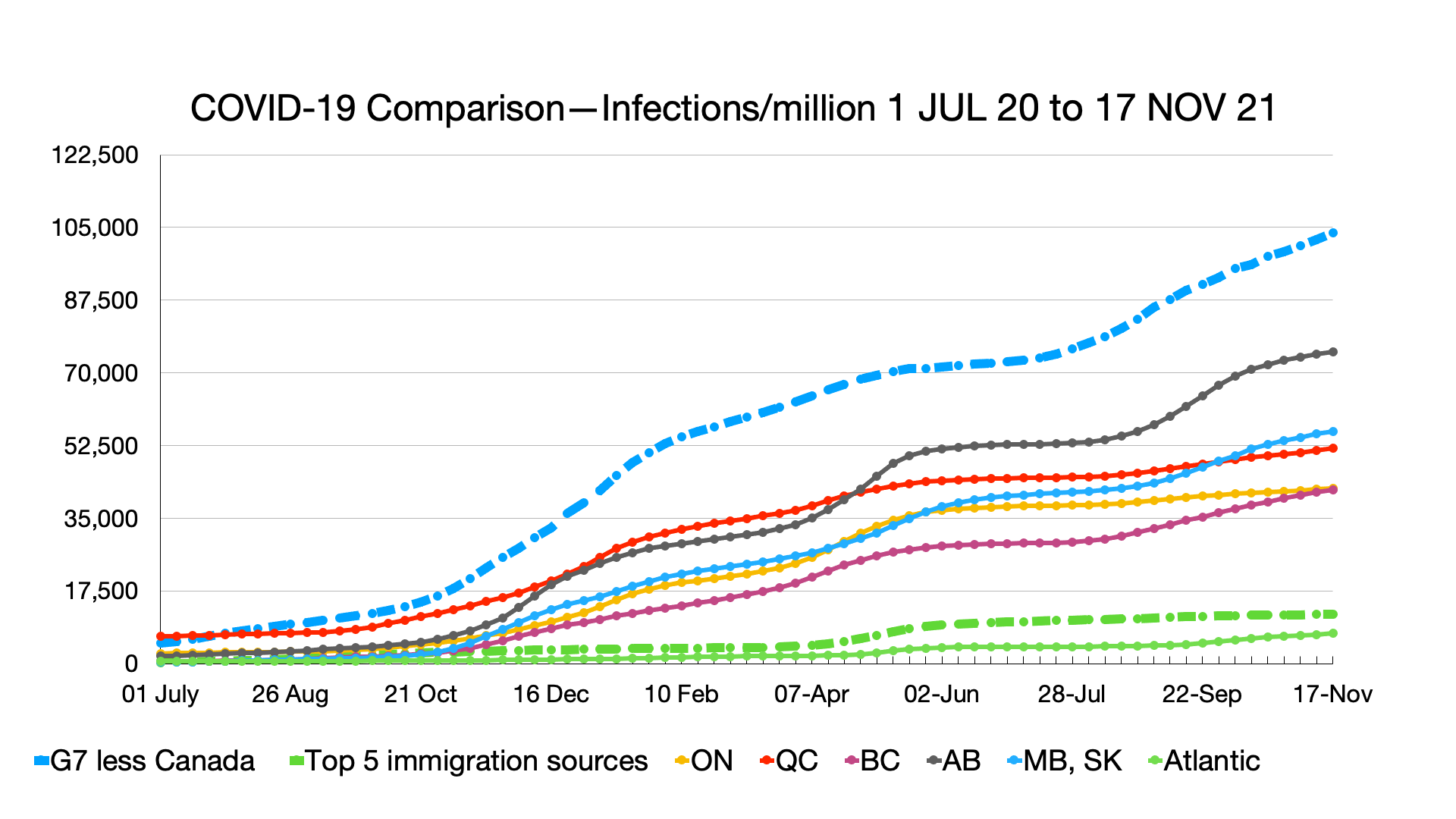
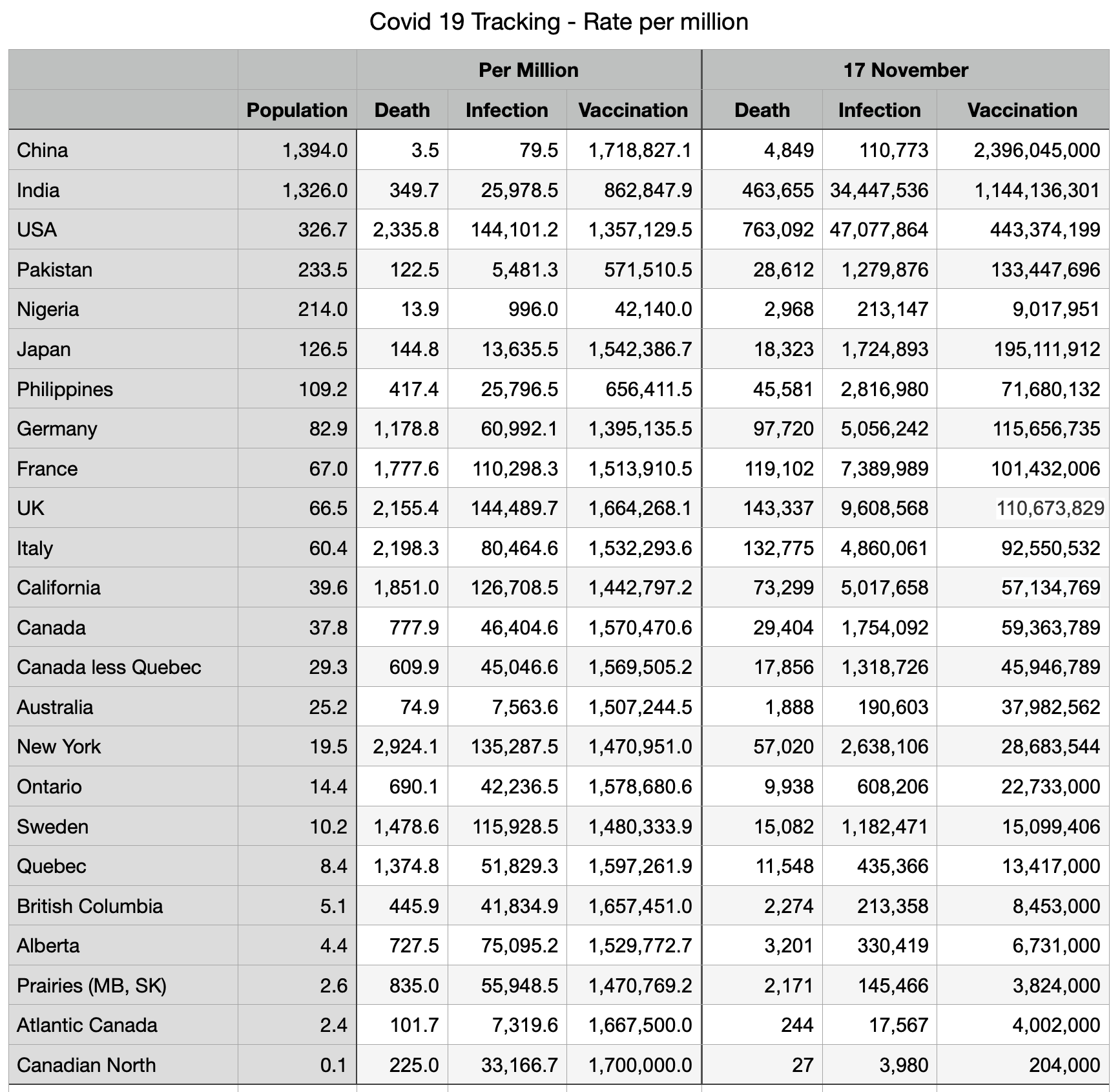
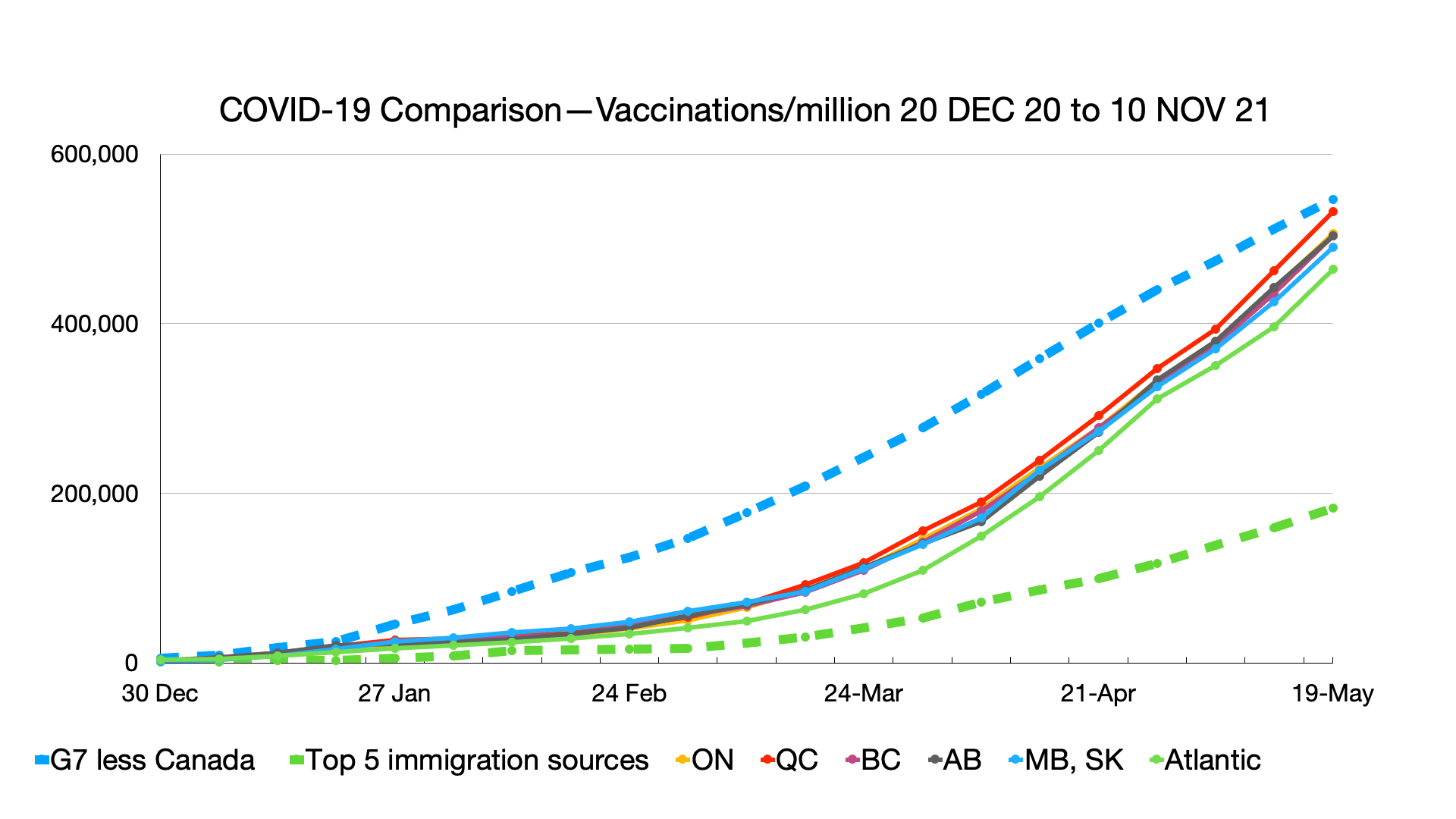
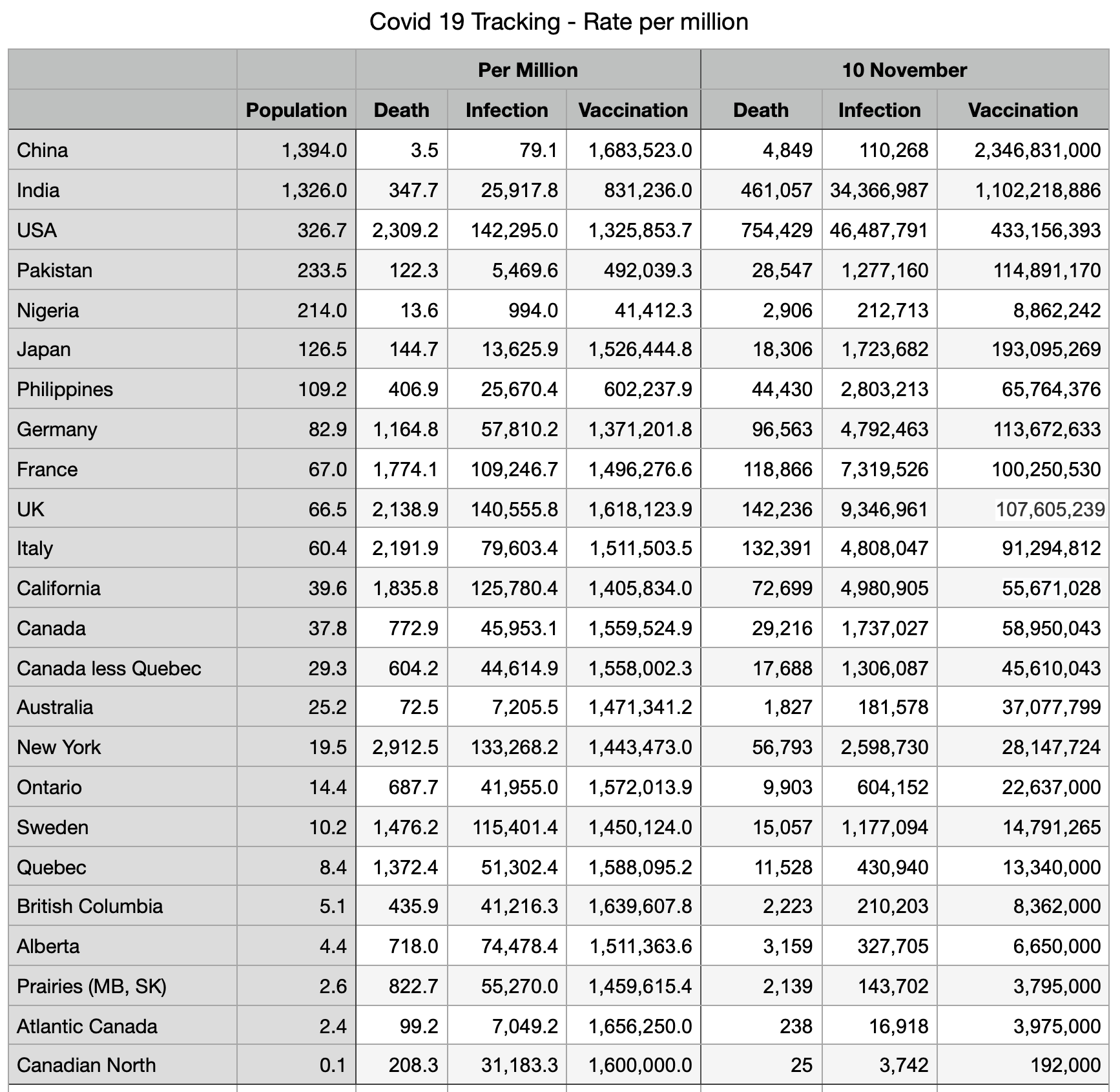
The latest charts, compiled 6 Octoober as overall rates in Canada increase slightly due to the variant. Canadians fully vaccinated 72.4 percent, higher than USA 56.7 percent and the UK 67.4 percent).

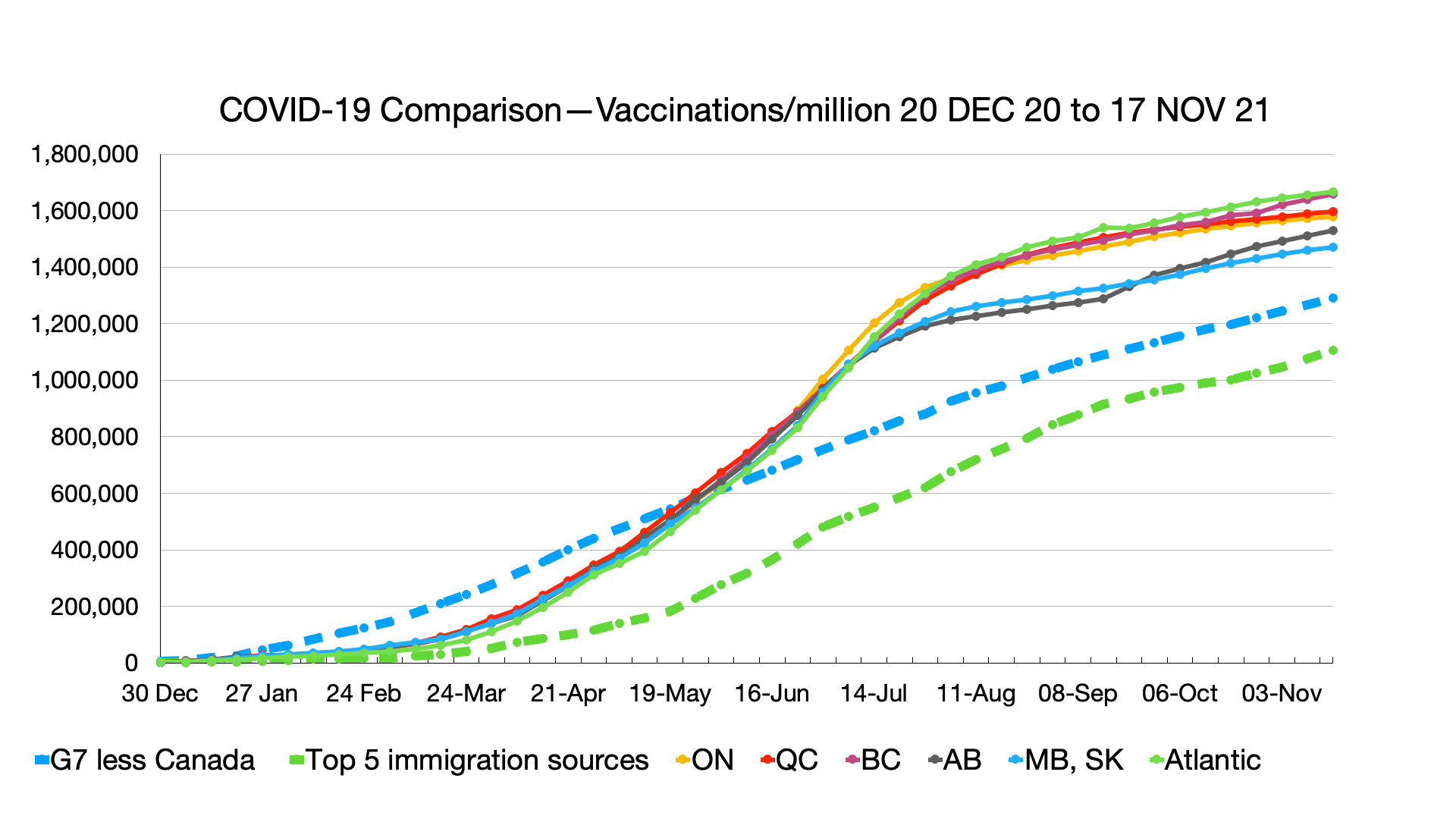
Vaccinations: Minor changes in Canada, Japan now ahead of New York and Germany. China fully vaccinated 75 percent (unchanged), India 18.4 percent.

Trendline Charts:

Infections: Continued trend of pronounced uptick in G7 less Canada (driven largely by USA). Continued sharp rise in Alberta particularly notable as has been extensively covered in the media. British Columbia has overtaken Quebec.

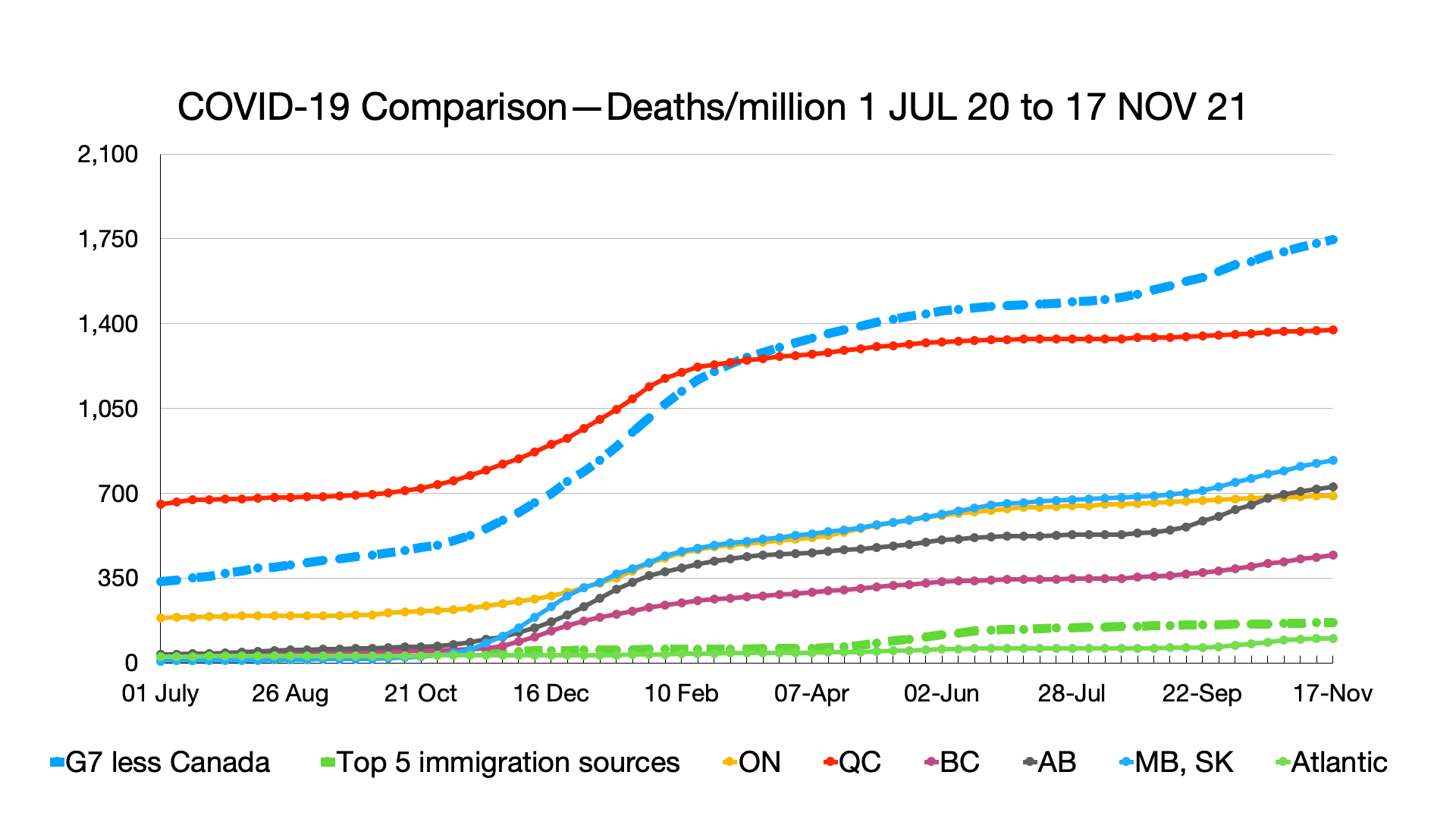
Deaths: Canadian North ahead of Japan, Alberta approaching Ontario deaths.

Vaccinations: No significant change from last week. New Brunswick recent increase less apparent in Atlantic as a whole.

Weekly

Infections: Canada ahead of Canada less Quebec, Atlantic Canada ahead of Pakistan:

Deaths per million: Prairies ahead of Canada, Philippines ahead of India, Canadian North ahead of Japan:

‘Earth-shattering’: Why applicants to Canada’s special, one-time immigration program fear a computer glitch may have dashed their dreams

Not good if correct:

Parthkumar Patel graduated from a two-year program in computer science from the University of Regina in January but was having a tough time finding a job in his field in Canada.

For months, the international graduate from India worked jobs in restaurants before he was hired by a car-rental company as a customer-service representative. With no end to the pandemic in sight, he says, he wondered if he’d ever land a job that would qualify him for permanent residence here.

Then in April, the federal government announced it would roll out a one-time pathway for temporary residents such as international graduates and essential migrant workers already in Canada to become permanent residents, in part to recognize their contributions to Canada during the pandemic.

Like other enthused applicants, Patel scrambled to compile all the documentation he needed for the online application process. He drove eight hours from Regina to Edmonton to sit for an English language test, because it was the closest centre with an available spot.

On May 6, before the application process opened at noon, he sat with two other friends also applying to the program so they could do it together and make sure there were no mistakes and that they had all the i’s dotted and crossed all the t’s for the application. At 12:22 p.m., he completed his application.

Patel says he was shocked last month when he received a refusal of his application, for failing to submit his French language test result. The problem? He said he’d applied to the English international graduate stream — not the French one. He already submitted his English test result and shouldn’t have needed a French test result.

He said he’s certain he selected the right stream from the drop-down menu in the intake portal.

“I’m 100 per cent sure,” said the 21-year-old. “It’s my best chance to become a permanent resident in Canada. This was so important to me that I double-, triple-checked everything before I submitted my file to make sure I got everything right.”

The so-called TR-to-PR pathway has six streams, three each for English-speaking and French-speaking applicants, under international graduates, health and non-health essential worker categories. All three English-speaking streams had caps and were removed from the portal once they were filled.

As the applications are being processing, a growing number of applicants for the English-speaking streams are claiming that a glitch in the immigration application portal has wrongfully bumped them into the French streams. While some have already received refusal letters, others are just starting to spot the problem in their application record.

Toronto immigration lawyer Mario Bellissimo has filed a challenge against the immigration department for refusing another applicant’s case, claiming that his client was misplaced and processed in the wrong stream.

“We have also reached out to the Department of Justice early on, because we want to make sure that it’s not a client error and we want to know what’s happening, because the implications are huge,” said Bellissimo, who said he’s had several similar inquiries.

“Let’s assume there is a glitch. If, in fact, there’s no client error, then is there still a manual review? I really hope that when we drill down on these cases, it was a glitch that somehow can be remedied.”

The immigration department said applicants to the pathway are assessed against the requirements of the stream they selected in the drop-down menu.

“It is possible that the applicant selected the French-speaking stream because the general stream was already filled and the general stream was not present in the drop-down menu,” department spokesperson Jeffrey MacDonald said in an email.

But Patel insists that’s an impossible scenario in his case, as he was among the first to submit the application, a day before the English international graduate stream was filled.

He pointed out there is a precedent of a glitch in the pathway’s application portal. It had continued to accept new applications under the English international graduate stream even after all the 40,000 spots had been taken within 24 hours. That forced officials to issue a special public policy in late June to ensure the 7,300 additional applicants wouldn’t be penalized due to the system error.

“I am heartbroken by this unfair rejection of my application,” said Patel, who hopes officials will investigate and provide remedies to him and others.

Wenjing Xie, a former international student from China, has worked in customer service at a bank in Ottawa on a postgraduate work permit since she graduated with a degree in finance from the University of Ottawa in 2019.

The 25-year-old said she applied under the non-health essential worker stream on May 6 with three other friends with their immigration consultant watching every step on Zoom.

She submitted the complete application at 12:33 p.m. and received a refusal on Sept. 14 under the French non-health essential worker stream for failing the language requirement.

“I just cried. I was so depressed that I had to take a day off from work when I got the rejection letter,” said Xie, whose work permit expires in May 2022.

“I met all the requirements and I did everything on time. Unfortunately, I didn’t take any screen images and I don’t have proof. Who would have?”

Bellissimo said he hopes the actual uploading and the technology of the system can reveal the truth through his litigation, which is now before the court.

“If you haven’t kept your screenshots, you haven’t had the benefit of doing all of that. How are you going to prove your case? What’s actually kept by the department? We don’t know,” he explained.

“It just seems like there would have to be multiple breakdowns for this to occur. I’m having a difficult time understanding how you get to this point. That’s why we felt it was important to move forward with this (legal) challenge and see how it gets resolved.”

Nishith Vagjani, who came here from Nigeria and finished two postgraduate programs last December at Fanshawe College in London, Ont., applied to the English non-health essential worker stream on July 16 hours before the application closed.

He went to his immigration application account in early September after hearing from people on social media about applicants being processed in the wrong stream. To his surprise, his application was placed in the French non-health essential worker stream.

“That was an earth-shattering moment for me. I put in so much hard work into the process,” said the 26-year-old, who scrambled to collect all the documents required — including from India, where he received his undergraduate degree — to complete the application.

The only proof he said he has is the mandatory form, the IMM0130, that all applicants were required to put a check mark on the stream they selected, plus an acknowledgment of receipt of his application.

Vagjani said he contacted the immigration department to fix the problem but was told nothing could be done.

Immigration officials said anyone who has an issue with their applications under the pathway can contact them directly through their web form.

Source: ‘Earth-shattering’: Why applicants to Canada’s special, one-time immigration program fear a computer glitch may have dashed their dreams

IRCC’s immigrant settlement funding by province/territory for 2021-22

Not much new but useful to have this overview, which again highlights the disproportionate share allocated to Quebec:

…IRCC settlement funding by province and territory

The memo shows that Mendicino approved the following 2021-22 allocation by province and territory (except Quebec). Note that all figures are rounded and also include spending projections obtained from IRCC’s publicly available 2021-2022 departmental plan:

  • Ontario: $407.2 million
  • Alberta: $124.1 million
  • British Columbia: $119 million
  • Manitoba: $46.6 million
  • Saskatchewan: $41.3 million
  • Nova Scotia: $17.2 million
  • New Brunswick: $14.6 million
  • Prince Edward Island: $6.2 million
  • Newfoundland and Labrador: $5.2 million
  • Yukon: $1.3 million
  • Northwest Territories: $1.1 million
  • Nunavut: $608,000
  • Sub total: $784.4 million
  • Other allocations: $46 million
  • Dedicated IRCC Initiatives: $46.2 million
  • Quebec (Not included in the memo): $650.3 million via the separate annual grant it receives from IRCC
  • Resettlement services (Not included in the memo): $145.7 million
  • Grand total (Not included in the memo): $1,672.6 billion

Sources: IRCC memo and IRCC’s Departmental Plan 2021-22.

Screenshot 1: Settlement Funding Allocation (Click on image to enlarge):

ircc settlement funding allocation 2021-2022
Source: IRCC

IRCC’s settlement funding formula

One possible reason IRCC has stopped sharing this information publicly is due to the controversy it garners among provinces, territories, and the service provider organizations. These stakeholders are in constant negotiations with IRCC on identifying the most appropriate funding levels for their respective jurisdictions. IRCC acknowledges the controversial nature of this process in the memo.

The memo outlines that the allocation of funding by province and territory is based on a federal Cabinet approved National Settlement Funding Formula. The formula allocates funding for each jurisdiction based on the three-year average proportion of immigrant landings by jurisdiction. It also gives additional weight to refugees to account for their unique settlement needs (refugees tend to require more settlement services than economic and family class immigrants). Quebec is not subject to this formula since its grant is calculated based on the formula outlined in the Canada-Quebec Accord relating to Immigration and Temporary Admission of Aliens signed in 1991. Due to Quebec’s special status as Canada’s only French-speaking province, it has more authority than any other jurisdiction to select immigrants. It also receives more IRCC settlement funding than any jurisdiction and has more flexibility to use the funding.

Screenshot 2: The National Settlement Funding Formula (Click on image to enlarge):

ircc settlement funding formula

Source: IRCC.

Settlement funding per capita

As indicated in Screenshot 2, IRCC determined the 2021-22 allocations based on immigrant landings in each province and territory in 2017, 2018, and 2019. This results in the following settlement funding amounts per capita:

  • Nunavut: $16,432
  • Quebec: $13,541
  • Northwest Territories: $4,622
  • Yukon: $4,194
  • Newfoundland and Labrador: $3,428
  • New Brunswick: $3,072
  • Ontario: $3,033
  • Alberta: $2,913
  • Manitoba: $2,862
  • Nova Scotia: $2,857
  • Saskatchewan: $2,691
  • Prince Edward Island: $2,684
  • British Columbia: $2,671

Sources: IRCC; Author’s calculations. The methodology is: Allocations for each province and territory divided by annual average of each province/territory’s immigrant intake between 2017-2019.

IRCC’s memo states that smaller jurisdictions receive capacity building funding to allow them to increase the scale of their services. This may explain why jurisdictions with low newcomer intakes including Nunavut, the Northwest Territories, Yukon, Newfoundland and Labrador, and New Brunswick are at the top of the list. Ontario gets more than the provinces west of it due to it having the highest refugee intake in the country.

Quebec leads all provinces due to the generous settlement formula identified in the Canada-Quebec Accord. Among its provisions, the formula dictates the grant amount can only increase over time.

What does this all mean?

IRCC goes to great lengths to help immigrants succeed. This is demonstrated by its settlement program accounting for nearly half of the department’s annual $3.6 billion budget. Canada is the largest funder of immigrant settlement services in the world.

At the same time, IRCC has the difficult task of identifying how to distribute its settlement funding across the country in a manner that takes into consideration the needs of each jurisdiction. This results in an imperfect process that is subject to intense scrutiny and debate among Canada’s governments, settlement provider organizations, researchers, and the media.

Quebec enjoys the most funding in absolute terms as well as the second most per capita even though its provincial government was elected in 2018 on a mandate to reduce immigration. The province’s settlement funding formula was agreed to in 1991 based on the expectation that Quebec’s immigration levels would increase over time to help compensate for its aging population and low birth rate. However the election of the Coalition Avenir Quebec (CAQ) party in 2018 highlighted a flaw in the formula, as Quebec has since seen its annual grant from IRCC continue to rise as its newcomer intake declined by 22 per cent in 2019 compared to 2018.

Conversely, Alberta, New Brunswick, Prince Edward Island (PEI) and the Northwest Territories have each seen their settlement allocations decline this federal fiscal year due to recent declines in their newcomer arrivals. Decreasing allocations to jurisdictions when their newcomer levels decline may seem fair, but it also creates operational challenges. Namely, lower IRCC funding to a province or territory could come at a time when that jurisdiction sees an increase in their newcomers (and hence, strains their ability to deliver settlement supports to newcomers). In addition, decreased funding means that service provider organizations may need to scale back their operations which sometimes entails laying off staff.

IRCC recognizes such challenges, which is why the memo notes that IRCC will make a one-time transfer to their Western Canada operations to top-up the funding provided to Alberta. The purpose of the top up is to ensure that Alberta can continue to provide high quality settlement supports to its newcomers.

Finally, IRCC recognizes that further investments will be needed to support future newcomers. The memo states the department anticipates more settlement funding to become available as it looks to welcome more newcomers through its Immigration Levels Plan. The 2021-2023 levels plan is the most ambitious in Canadian history as it seeks to welcome over 400,000 new immigrants per year. Since its founding in 1867, Canada has welcomed 400,000 immigrants in a year just once, in 1913. As such, the memo indicates an expectation the allocation for all provinces and territories (excluding Quebec) will increase by another $100 million for the 2023-24 federal fiscal year. This suggests the department’s total settlement spending will reach some $2 billion annually within the next few years.

Source: IRCC’s immigrant settlement funding by province/territory for 2021-22

COVID-19 Immigration Effects: July update

This update is somewhat delayed given IRCC only released the operational processing series of data (applications, citizenship, and visa) on October 4. August Permanent Residents admissions just under 38,000, slightly lower than July.


General observations:

  • IRCC’s 2021 strategy to meet the target of 400,000 new immigrants through transitioning temporary residents (students and workers) to permanent residency continues.
  • Of note, applications from Afghans increased more than sixfold in July, from 337 to 2,078
  • Temporary Residents IMP remained stable whereas Temporary Residents TFWP declined (reduced number of agriculture workers)
  • The number of study permit applications and study permits both increased significantly
  • Asylum claimants remained stable at the sharply reduced level due to travel and border restrictions
  • Settlement service web interest has yet to recover from pre-pandemic levels
  • The number of new citizens remain at about half of pre-pandemic levels
  • There was a doubling of visitor visas issued reflecting summer travel, with visas from Indian nationals increasing more than seven times, compared to Chinese nationals only doubling.

No more immigration: PM says Britain is in period of adjustment

Will see whether this holds up, or ongoing shortages force a change (see Doug Saunders Bare shelves, empty pumps: Britain’s self-inflicted Brexit wound):

British Prime Minister Boris Johnson said on Sunday he would not return to “uncontrolled immigration” to solve fuel, gas and Christmas food crises, suggesting such strains were part of a period of post-Brexit adjustment.

At the start of his Conservative Party’s conference, Johnson was again forced to defend his government against complaints from those unable to get petrol for their cars, retailers warning of Christmas shortages, and gas companies struggling with a spike in wholesale prices.

The British leader had wanted to use the conference to turn the page on more than 18 months of COVID-19 and to refocus on his 2019 election pledges to tackle regional inequality, crime and social care.

Instead, the prime minister finds himself on the back foot nine months after Britain completed its exit from the European Union – a departure he said would give the country the freedom to better shape its economy.

“The way forward for our country is not to just pull the big lever marked uncontrolled immigration, and allow in huge numbers of people to do work … So what I won’t do is go back to the old failed model of low wages, low skills supported by uncontrolled immigration,” he told the BBC’s Andrew Marr Show.

“When people voted for change in 2016 and … again in 2019 as they did, they voted for the end of a broken model of the UK economy that relied on low wages and low skill and chronic low productivity, and we are moving away from that.”

It was the closest the prime minister has come to admitting that Britain’s exit from the EU had contributed to strains in supply chains and the labour force, stretching everything from fuel deliveries to potential shortages of turkeys for Christmas.

“There will be a period of adjustment, but that is I think what we need to see,” he said.

But while the government plans to issue thousands of temporary visas for foreign truck drivers and poultry workers, Johnson was clear he would not open the taps of immigration, again shifting the responsibility to businesses to lift wages and attract more workers.

Shortages of workers after Brexit and the COVID-19 pandemic have sown disarray in some sectors of the economy, disrupting deliveries of fuel and medicines and leaving more than 100,000 pigs facing a cull due to a lack of abattoir workers.

Conservative Party chair, Oliver Dowden, said that the government was taking measures to hire more truck drivers in general and that the government had started training military tanker personnel to start fuel deliveries on Monday.

“We will make sure that people have their turkey for Christmas, and I know that for the Environment Secretary George Eustice this is absolutely top of his list,” he told Sky News.

But the overwhelming message from the government was that businesses must step up to solve supply chain issues and to entice more British workers with higher wages.

“I don’t believe in a command and control economy so I don’t believe the prime minister is responsible for what is in the shops. This is why we have a free enterprise economy,” foreign minister Liz Truss told an event at the conference.

“I’m sure that the goods will be delivered into our shops.”

But rather than the reset Johnson hoped to preside over in the northern English city of Manchester, the conference looks set to be overshadowed by the crises and criticism of the government’s withdrawal of a top-up to a state benefit for low-income households.

The main opposition Labour Party is set to focus on the removal of the uplift, hoping to undermine those Conservative lawmakers who won over its traditional supporters in northern and central England.

Johnson may also come under fire for breaking with the Conservatives’ traditional stance as the party of low taxes after increasing some of them to help the health and social care sectors.

“We don’t want to raise taxes, of course, but what we will not do is be irresponsible with the public finances,” he said. “If I can possibly avoid it, I do not want to raise taxes again, of course not.”

Source: No more immigration: PM says Britain is in period of adjustment

Immigration adds 1.4 to 1.5 years to U.S. life expectancy, study says

Interesting study for both first and second generation immigrants, and the factors influencing shorter lifespans of non-immigrants:

If immigrants to the United States formed their own country, their pre-COVID-19 life expectancies would exceed or match those of the world’s leaders in longevity -; Swiss men and Japanese women. A new study by USC and Princeton researchers estimates that immigration adds 1.4 to 1.5 years to U.S. life expectancy at birth. In 2017, foreign-born life expectancy reached 81.4 and 85.7 years for men and women, respectively. That’s about 7 and 6.2 years longer than the average lifespan of their U.S.-born counterparts.

Demographers knew that immigrants lived longer. The main question that we set out to answer was, How much is this really contributing to national life expectancy trends? Our results show that they’re making an outsized contribution to national life expectancy.”

Arun Hendi, the lead author of the study and assistant professor of sociology and public affairs at Princeton University

The study was published in the September 2021 issue of SSM Population Health, by Hendi and Jessica Ho, an assistant professor of gerontology and sociology at the USC Leonard Davis School of Gerontology. Their work provides new insights on how immigrants contributed to national life expectancy trends over nearly three decades, from 1990 to 2017.

The research suggests that immigrants are responsible for approximately half of the recent U.S. gains in life expectancy. Moreover, the gap in life expectancy between foreign-born and native-born residents is widening.

In fact, the researchers say, Americans’ life expectancy would steeply decline if it weren’t for immigrants and their children. Under that scenario, U.S. life expectancy in 2017 would have reverted to levels last seen in 2003 -; 74.4 years for men and 79.5 years for women -; more closely resembling the average lifespans of Tunisia and Ecuador.

Study shows diverging trends during the last decade

Prior research has shown that between 2010 and 2017, overall U.S. life expectancies saw an unprecedented stagnation. The plateau has been largely attributed to drug overdose deaths among adults in their prime working ages and slowdowns in the rate of improvement in cardiovascular disease mortality. But this new study shows that immigrants experienced life expectancy gains during this period, while the U.S.-born population experienced declines.

“If it weren’t for immigrants, our national life expectancy stagnation that we experienced since 2010 would instead be a national decline in life expectancy,” Ho said. “For them to have that large an impact is unexpected because they represent a relatively small proportion of the U.S. population.”

In addition, while the immigrant advantage was already present in 1990, the research shows that the difference between immigrants and the U.S.-born has widened substantially over time, with the ratio of American-born to foreign-born mortality rates nearly doubling by 2017.

“When compared to immigrants’ life expectancy, the U.S.-born are doing poorly. Much of this is related to their very high mortality at the prime adult ages,” said Ho, an expert in the social determinants of health and mortality. “Low mortality among prime-aged immigrants doesn’t just help the foreign-born -; it helps the U.S.-born too. Prime-aged adults are likely to be in the labor force and raising children. This means that they contribute to higher tax revenues and slower population aging.”

Hendi says this is particularly relevant today because those prime adult ages are where the country is losing years of life due to drug overdose mortality and other preventable causes of death.

“The fact that immigrants are doing well suggests that there is a capacity to thrive in the U.S., but the U.S.-born aren’t fulfilling that potential,” he said.

Immigrants are a small but influential share of the U.S. population

Immigrants make up under 15% of the U.S. population, up from around 8% in 1990 but still a small percentage of the total. Hendi and Ho cite healthy behaviors and the changing selectivity of the immigrant population as factors that may contribute to their influence on total life expectancy.

“Immigrants tend to be healthier in part due to the selective migration of those who have the health, resources and stamina to migrate to the U.S., and this selectivity may have grown stronger,” Ho said.

The researchers highlight the role of increases in high-skilled immigration, which is partly reflected in changes in countries of origin as immigrant streams shift from Mexico to places like India and China. They also note that there may be pro-longevity characteristics of immigrant populations, regardless of country of origin, including a lower propensity to drink, smoke and use drugs than U.S.-born residents.

“Many of America’s immigrants come from lower-income, less-developed nations, leading some to worry that these immigrants bring their home countries’ high-mortality conditions with them and thus drag down America’s national average longevity,” Hendi said. “But the results say just the opposite. Far from dragging down the national average, immigrants are bolstering American life expectancy. A big part of the story appears to be that immigrants take fewer risks when it comes to their health.”

The study additionally found that the children of foreign-born residents retain some life expectancy advantage but do not fare as well as their parents.

Hendi and Ho used data from the National Vital Statistics System and the U.S. Census Bureau to estimate life expectancy levels among foreign-born, U.S.-born and total populations between 1990 and 2017.

The team plans to examine COVID-19’s impact on immigrant life expectancies. A January 2021 study by USC and Princeton researchers found the COVID-19 pandemic had significantly affected life expectancy, with stark declines in life expectancy among Black and Latino populations. A separate USC study last July of a large diverse group of Medicaid enrollees found Latino patients had starkly higher odds than whites of testing positive for COVID-19 as well as higher odds of hospitalization and death.

Source: Immigration adds 1.4 to 1.5 years to U.S. life expectancy, study says

Le Pen Joins French Conservatives Seeking Immigration Referendum

Here we go again, with a race to the bottom:

After trying to moderate her image for months, far-right leader Marine Le Pen went back to basics by casting a national conversation about immigration as a battle for the soul of France and renewing a pledge to hold a referendum on the issue if she defeats Emmanuel Macron next year.

“The April 2022 election will be about our civilization,” Le Pen said during a press conference on Tuesday. “Will France remain France, or be brushed aside by the uncontrolled torrent of massive migration flows that will wipe out our culture, our values, our way of life.”

Le Pen said she’d consult the French about changing the constitution to “drastically” reduce immigration. She pledged to introduce a law that will prevail over international treaties and allow her to breach European Union legislation if a majority of citizens backs the idea.

“What we are offering is a ready-for-use solution,” she said.

Several presidential hopefuls on the traditional right are seeking tougher rules on who is allowed to live in the country, including Michel Barnier and Xavier Bertrand.

And though Macron ran as a centrist in 2017, he has since become more conservative and his government has also talked about the need to control immigration. On Tuesday, it said it will reduce the number of visas granted to Algerians, Moroccans and Tunisians to protest their countries’ refusal to facilitate the return of nationals in “an irregular situation” in France.

But Le Pen’s harsher tone may be more the result of the threat posed by ultra-right media personality Eric Zemmour, who has been publicly toying with a run. He has previously demanded a referendum to overhaul immigration law as well as a short-term moratorium on entries. He links immigration to terrorism.

Le Pen is placing second in surveys of voting intentions, after Macron, though polls show support for Zemmour rising and cutting into her voter base. If Zemmour joins the crowded contest, he’d likely increase the chances Le Pen would be knocked out of the second round and throw the race wide open.

During the press conference, Le Pen said she wants to make it illegal for people from different countries to live in closed communities as a way of preserving their traditions and ban undocumented people from regularizing their situation. The Schengen accord, which allows free circulation for people in Europe, would need to be renegotiated, she said.

Source: Le Pen Joins French Conservatives Seeking Immigration Referendum