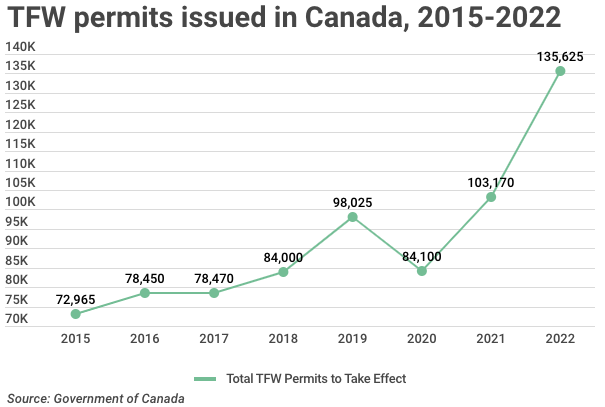
Ottawa to refine way it counts non-permanent residents, to factor in visa processing delays 

Of note. An improvement, even if likely incomplete:

Ottawa will revise the way it counts non-permanent residents this month and take into account delays by the immigration authorities in processing the paperwork of international students, foreign workers and others who want to extend their stay in Canada.

Rather than presuming they have left the country 30 days after their permits and visas expire, Statistics Canada will stretch the hiatus period, counting them as still in the country for around four months while their paperwork is being processed.

The changes to its methodology follow warnings from economists that there may be around one million more non-permanent residents living in Canada than official figures suggest.

Benjamin Tal, deputy chief economist at CIBC Capital Markets, said Statscan’s system assumes that temporary resident visa holders leave the country 30 days after the expiration of their visas, even though many of them remain longer and apply to extend their stays.

Mr. Tal estimates that about 750,000 of the non-permanent residents absent from the official numbers were missed this way. Another 250,000 – mostly international students – were missed by the census, he says.

Statscan said on Thursday it has been counting non-permanent residents as having left the country 30 days after their visas expired but it believed Mr. Tal’s estimate of those missed from the figures was too high.

But it said later this month it would revise its methodology, and count non-permanent residents as having left the country at around 120 days after their visas expired. This would take into account the amount of time it is actually taking Immigration, Refugees and Citizenship Canada to process visas.

Laurent Martel, director, demography, at Statistics Canada, said because there is no exit data on the number of non-permanent residents leaving the country, it has to rely on the date at which permits to stay in Canada expire as an indication of when non-permanent residents are no longer here.

He said the processing times for people wanting to renew or extend their visas and permits fluctuate. But he said Statscan has been in close contact with IRCC and had adjusted its assumptions to accurately reflect the time it is taking officials to process the paperwork.

“For those who are in the process of renewing their permits, we have to rely on assumptions. Up to now the assumption, designed in partnership with the IRCC … it was 30 days,” he said in an interview. “What we have done recently is that we have adjusted the processing time so now we’re changing that assumption.

“It will go from 30 days to 120 days because right now it’s a better reflection of the reality currently with IRCC in terms of processing times.”

He said Statistics Canada would continue to monitor the situation and may revise its assumptions again if IRCC’s processing times change. He said the publication of the revised figures was timely and came against a backdrop of a very large increase in the number of non-permanent residents in Canada.

Mr. Tal welcomed the revised methodology, which Statistics Canada described in background briefings on Thursday.

The federal government has boosted its immigration targets in recent years, and is now aiming to admit about 500,000 new permanent residents a year by 2025. But that doesn’t include foreign students on visas or people on temporary work permits.

Statscan said it believed its figures were robust and revised figures to be produced later this month would not show an enormous difference. Mr. Martel said because it was working closely with IRCC, “we truly believe that our assumptions do make sense actually.”

He said non-permanent residents whose visas and permits had expired but had not applied to renew or extend them, and were still in Canada, were not counted in the official statistics.

A former federal economist, Henry Lotin, who is the founder of the consulting firm Integrative Trade and Economics, said he began telling Statistics Canada six years ago that its population forecasts for non-permanent residents fall short.

Like Mr. Tal, Mr. Lotin has estimated that at least one million more non-permanent residents are living in Canada than are captured in official numbers.

“They know they had to change and I appreciate they have responded to re-examine how they count non-permanent residents,” Mr. Lotin said.

But he said that there were still huge backlogs at IRCC and many non-permanent residents have waited far longer than four months to have their papers extended or renewed.

He said if 120 days is the average time non-permanent residents have to wait for the paperwork to extend their stays to be processed, many waiting far longer would still not be counted as in the country.

Mr. Lotin added that non-permanent residents waiting for extensions after the expiration of their visas and permits were legally in Canada.

Source: Ottawa to refine way it counts non-permanent residents, to factor in visa processing delays

Here’s just how high immigration has gotten

A reminder by the National Post:

A majority of Canadians now seem to think that immigration is too high, according to a recent Nanos poll. Of respondents, 53 per cent said that the government’s plan to accept 465,000 new permanent residents was too high. It’s a sharp turnaround from just a few months prior, when a similar Nanos poll in March found that only 34 per cent of Canadians thought immigration was too high.

Canada has long been one of the most pro-immigration countries on earth, and since at least the 1990s the mainstream Canadian position on immigration levels was that they were just fine. On the eve of Justin Trudeau’s election as prime minister in 2015, an Environics poll found that a decisive 57 per cent of Canadians disagreed with any notion that there is “too much immigration in Canada.”

But if this sentiment is changing, it might be because Ottawa has recently dialled up immigration to the highest levels ever seen in Canadian history. Below, a quick guide to just how many people are entering Canada these days.

Immigration is nearly double what it was at the beginning of the Trudeau government (and way more when you count “non-permanent” immigrants)

In 2014 — the last full year before the election of Justin Trudeau — Canada brought in 260,404 new permanent residents. This was actually rather high for the time, with Statistics Canada noting it was “one of the highest levels in more than 100 years.”

But last year, immigration hit 437,180, and that’s not even accounting for the massive spike in “non-permanent” immigration. When the estimated 607,782 people in that category are accounted for, the Canadian population surged by more than one million people in a single calendar year. Representing a 2.7 per cent annual rise in population, it was more than enough to cancel out any per-capita benefits from Canada’s GDP rise for that year.

It’s about on par with the United States (a country which is eight to 10 times larger)

Proportionally, Canada has long maintained higher immigration than the United States. But in recent months immigration has gotten so high that Canada is even starting to rival the Americans in terms of the raw number of newcomers.

Last year, while Canada marked one million newcomers, the U.S. announced that its net international migration was about the same. Given the size of the U.S. (331 million vs. 40 million in Canada), this means that Canada is absorbing migrants at a rate more than eight times that of the Americans.

When these trends first began showing themselves in early 2022, CIBC deputy chief economist Benjamin Tal credited it with driving down Canadian wage growth. “The last time I checked, the U.S. is 10 times larger than we are,” he said.

Housing construction isn’t even close to keeping up with the influx

In the last few weeks, the Trudeau government seemed to acknowledge for one of the first times that their aggressive immigration policy was helping to worsen the country’s housing shortage, and thus drive up real estate unaffordability.

“We want to better align our immigration policies with the absorptive capacity of communities that includes housing,” was how housing minister Sean Fraser put it to CTV on Sunday. Notably, Fraser was immigration minister before being shifted to the housing file in July.

According to one Scotiabank estimate, Canada would need to build 1.8. million homes to return the housing market to any semblance of affordability. But right now the rate of new homes isn’t even keeping up with the population increase, much less addressing the existing deficit.

In 2022 there were just 219,942 housing completions across Canada. It’s about as many homes as Canada was building in the mid-1970s, a decade when Canada was bringing in fewer than 100,000 new immigrants each year. But with current immigration rates, Canada is now bringing in about five new people for every new apartment or townhouse getting built.

It’s like repopulating all three northern territories every month

In a routine update on employment numbers last week, Statistics Canada announced the good news that the country had added 40,000 new jobs in August — before noting that all this new employment had been immediately cancelled out by immigration. That same month saw the arrival of 103,000 temporary and permanent newcomers into Canada, with the result that the country’s net employment rate actually went down. “Given this pace of population growth, employment growth of approximately 50,000 per month is required for the employment rate to remain constant,” reported Stats Canada.

The rate of 103,000 is a bit higher than normal, and was driven in part by the arrival of international students. But since the beginning of 2023, the influx of newcomers has averaged about 81,000.

For context, the entire population of the Canadian North is about 118,000. Comprising three territories — the Northwest Territories, the Yukon and Nunavut — and dozens of communities, the North has daily newspapers, several dedicated airlines, power plants and even a skyscraper. And on average, Canada is absorbing enough new people every 43 days to completely fill its North.

There are worrying signs that rising numbers of immigrants are dropping almost immediately into poverty

In the 2021 census, the trend seemed to be that poverty rates among newcomers to Canada were going down, in part due to “higher government transfers.” While there’s been no new data to contradict this trend, Canada has seen a smattering of incidents that seem to point towards an immigrant community that isn’t finding opportunity the way they used to.

A report last month found that Toronto-area food banks were experiencing a massive spike in usage among recent immigrants. Feed Scarborough, for one, released a survey finding that three quarters of their users have been in the country for less than a year. “Immigrants are struggling to meet their most basic needs,” it read.

Shelters across Ontario and Quebec have reported being overwhelmed by recent migrants, many of whom entered the country via the longstanding Roxham Road illegal border crossing. A Toronto international student found homeless and living under a bridge recently became the subject of a viral TikTok video. And in July, the Toronto-area community of Brampton was shocked by videos showing a job fair at a local supermarket being attended by massive queues containing hundreds of applicants, many of whom were international students.

Source: Here’s just how high immigration has gotten

This program aims to attract startups to Canada. Critics say it’s being used as ‘a backdoor way into the country’

Another questionable immigration program and pathway it appears, on substantive, due diligence and processing time grounds:

They come from every corner of the world with big dreams and ideas, looking for a base and investment capital to plant the seeds of their startup enterprises — and potential permanent residence in Canada.

So much is at stake for their success — and for Canada’s Start-Up Visa (SUV) immigration program, which gives these entrepreneurs a pathway for permanent residence by harnessing their business innovations and brilliance.

Amid a current economic slowdown, the federal government has vastly scaled up its annual SUV intake from 1,000 spots (including the entrepreneurs’ family and those in the self-employed stream) in 2022 to 3,500 this year, 5,000 in 2024 and 6,000 in 2025.

Yet, it is also one of the economic immigration programs that has received the least public attention — and scrutiny — despite the significant role it plays in Canada’s job creation and global competitiveness.

While no one disputes the need to expand the initiative, critics fear its rapid growth feeds a wild-west-type landscape amid the program’s already lengthy processing time and concerns over its potential misuse for immigration to Canada.

“What the program has done is created an enormous number of applications from people who want to move to Canada and are ready to pay money to find a backdoor way into the country,” said Sunil Sharma, managing director of Toronto’s Techstars, whose workshops are meant to connect budding entrepreneurs with capital, mentors and networking.

Launched in 2013, the SUV program has no minimum requirements on education, net worth or business experience, in contrast to Canada’s typical economic immigration process, which favours those who are younger and have Canadian education credentials and work experience.

The most crucial qualifying element is the letter of support by an organization designated by the Immigration Department to vet applicants’ business proposals based on their worthiness and readiness. Notably, successful applicants are not obliged to carry through their business plans upon becoming permanent residents.

The SUV replaced the archaic Entrepreneur Program, which offered a three-year conditional residency for people with a minimum net worth of $300,000 and required that they open mall kiosks, corner stores, restaurants and other small businesses before they obtained permanent status. Today, Canada is looking to attract innovative business startups that will give the country a cutting edge on the global stage.

The new SUV pilot program got off to a slow start. It fell short of its initial target of 2,750 applications a year. In the first three years, it only attracted 113 principal applicants, whose business plans, until June 2016, were subject to mandatory industry peer reviews as a quality control mechanism.

“There were minimal levels of fraud and misuse associated with the SUV pilot and the integrity mechanisms employed were successful in identifying issues,” said an Immigration Department evaluation report in late 2016.

“However, there is a potential program integrity gap regarding the monitoring of designated entities’ SUV activities.”

The report also pointed to the small size of the applicants, which allowed immigration officials to watch the designated organizations and applicants’ activities closely.

In 2018, Ottawa made the pilot a permanent program. Since then, the total number of applications received has shot up to a total of 2,035 in the past five years, up from just 291 between 2013 and 2017.

And so has the program’s average processing time, which has crept up from an initial 158 days to 16 months in 2019, and now sits at 32 months. As of last September, there were 1,368 permanent residence applications in the queue for the SUV business program.

Critics attribute the exponential growth of interest in the program to the rogue promotion by unscrupulous recruiting agents, sometimes lawyers and consultants, who pitch it as an easy pathway for immigration with minimal requirements.

These agents, say critics, offer to enrol prospective candidates with business plans and ideas in incubation and accelerator programs — some of them provided by government designated SUV assessment organizations — at a hefty fee, to get the coveted letter of support.

“They’re making millions of dollars in fees and they’re flooding the program with applications,” said Sharma, whose accelerator is a federal government-designated organization under the SUV program.

“For those of us who are using the startup visa for its true intention, we’re having a very, very difficult time getting those visas through.”

Immigration consultant Phil Mooney said unscrupulous agents and middlemen often target prospective immigrants who otherwise have a tough time qualifying for the restrictive economic immigration programs that favour young people with Canadian education and work credentials in the Express Entry points selection system.

A contract to a prospective SUV applicant he recently perused from a Lagos-based investment company in Nigeria asked for a $165,500 (U.S.) payment that included eligibility assessment, business validation and a month-long incubation training in business strategy preparation and market analysis.

It also claimed that two designated SUV entities in Canada agreed to offer consultancy services.

“It became pretty clear that anybody over 35 could never get here through Express Entry. Anybody with less than perfect English or anybody with no Canadian work experience or no degree in Canada, nobody can come anymore,” said Mooney.

“But there’s still a whole lot of people out there with a lot of money.”

Their motivation, he said, is Canadian permanent residence, and not about starting a business. (Immigration data shows those aged 40 and over made up more than half of the SUV applicants since its inception, though almost 86 per cent had at least a bachelor’s degree.)

SUV applicants can get their letter of support from three tiers of designated organizations recommended by two investment industry groups and sanctioned by the Immigration Department:

Business incubators that support a startup or early stage company to grow by providing them office space, mentorship, management support;

Angel investor groups made up of wealthy individuals who provide financial backing for small startups, usually asking for ownership equity in these companies; or

Venture capital funds consisting of a group of investors which pools money to place it in startups which show promise of growth.

Under the program, designated angel investors and venture capitalists have to commit $75,000 and $200,000, respectively, to the business proposals they have chosen to support.

Between 2014 and 2022, 881 SUV business applications were approved for permanent residence but an overwhelming 78.4 per cent of them were supported by business incubators, according to government data obtained by immigration lawyer Siavash Shekarian.

Startups endorsed by angel investors made up 18 per cent of the successful SUV applications and less than three per cent were put forward by the high-return venture capitalists.

When the SUV program was launched in 2013, there were only 28 designated organizations, including 25 venture capital funds and three angel investor groups.

By 2018, when it became a permanent program, the number of entities almost doubled, with 21 ventures, eight angels and 24 business incubators.

Today, there are 88 groups — 28 ventures, eight angels and 52 incubators — that have the authority to issue the letter of support to SUV applicants.

To be designated, these organizations must be vetted and recommended to the Immigration Department by the National Angel Capital Organization (NACO) and the Canadian Venture Capital and Private Equity Association (CVCA).

The industry organizations are also responsible for convening peer review panels, at the request of immigration, to independently assess and ensure due diligence is given by the designated entity that issues the letter of support.

The Immigration Department prohibits designated entities from charging fees for the assessment of business proposals or for the issuance of the support letter. However, there are no specific rules on other fees.

National Angel Capital Organization’s (NACO) website says the designated entities under its watch cannot charge applicants fees for the use of physical space, services and programs “above industry standard rates” without references to what the industry standards are.

With willing patrons looking for a shot at permanent residence to Canada and loose regulations over designated organizations, critics say the SUV program is open to abuse.

“The designated entities are the gatekeepers to the whole thing,” said immigration consultant Ramin Mirzadegan, who focuses on economic immigration and has assisted in dozens of SUV applications from Iran, the top source country of applicants.

“The clients feel like if they do this, they get the LOS (letter of support) and everything will be done. That’s how it’s sold and that’s how people are taken advantage of.”

Under the traditional business immigration programs, immigration officials are responsible for assessing the merits of the business plan, but that task in the SUV program has been entrusted to the third-party designated groups based on their business and investment expertise.

“The program by design is outsourcing innovation to the designated organizations,” said immigration lawyer Shekarian, whose practice focuses on business immigration.

“And here’s the problem. The way I define innovation can be very loose and very easy. But how do I as immigration (department) ensure that those incubators pick good people with good ideas as opposed to those organizations that are in it just for the money?”

Shekarian said immigration officials and designated organizations should raise the bar to qualify only SUV applicants whose business ideas are already in “post-ideation” stage rather than just accept a business proposal on paper.

“If you say, ‘I need more than just ideation now. I need validation. I need traction now. I need tech readiness. I need to see something,’ ” he explained, “it attracts genuine entrepreneurs and makes it harder for bad actors to just bring new people who just want to buy a passport.”

The Star reviewed more than a dozen Federal Court judgments over the past five years involving SUV applicants who were refused under the SUV program and challenged the immigration decisions.

Although the designated entities that issued their letter of support were not a party or the subject of the judicial reviews, the court rulings often cited the immigration officials’ concerns over the lack of “due diligence” in the assessment process that were concurred by independent peer review panels.

One court decision in 2020 cited an immigration officer’s claim that a Vietnamese woman was pursuing her proposed business venture for the primary purpose of acquiring status in Canada despite a commitment from Empowered Startups Ltd., a designated organization in B.C., to “incubate” her business venture.

The officer, according to Justice Patrick Gleeson, raised concerns that Empowered provided the applicant the business idea to develop and market a wearable sensor technology.

In another case in 2019, the court said an immigration officer referred another Vietnamese applicant’s business proposal to a peer review panel to assess whether due diligence was completed by Empowered when accepting it for incubation. The panel, according to Justice Rene Leblanc’s ruling, concluded that there had been an insufficient level of due diligence by the designated organization.

In yet another court decision in 2019, now retired Justice Robert Barnes referenced a peer panel review ordered by the immigration department with “concerns about possible (Empowered) involvement in assisting applicants in acquiring status or privilege.”

The review panel’s report, said the court decision, stated that the female applicant from Hong Kong “has committed to paying $300,000 for a year of incubation services,” saying that was “not normal for an incubator in Canada.”

A court case in 2022 involved two applicants in China who received a letter of support from Spark Commercialization and Innovation Centre in Oshawa for a joint partnership with an existing client of the organization.

The peer review panel, cited Justice Shirzad Ahmed’s decision, found a lack of due diligence on Spark’s part in its assessment of the Chinese applicants’ business proposal.

All the four judicial review applications were dismissed by the court.

Christopher Lennon, president and general counsel of Empowered, declined to comment on the specific cases but pointed out that the company was not a party to those proceedings and anything stated in these cases is not necessarily correct and in some cases, might be incorrect.

“Our role as designated entities is to recruit, vet and find high potential entrepreneurs to start new businesses in Canada. And part of our role is also to help them start those new businesses in Canada. So we’re advisers and mentors. So we definitely have involvement in crafting and helping them launch the new business,” Lennon said.

“Are we involved in the conceptualization of the business in many cases? Absolutely. Do we give them business ideas off the shelf? No, never.”

While Empowered is a big supporter of the SUV program, Lennon said the peer review is one area that is structurally flawed by design because it sets up some serious conflict-of-interest issues when a business proposal approved by a designated organization is reviewed by a peer panel made up of direct competitors.

The SUV program, he said, does not prescribe the due diligence process and allows each organization to have their own, as long as they can demonstrate a thorough process to assess business proposals, he said.

“You need that flexibility,” said Lennon, and immigration officials already have the leverage to remove an entity’s designation “if they’re ever concerned an entity is routinely or flagrantly not complying with their process.”

With the cost of recruiting entrepreneurs for Canada being downloaded to private entities like his, Lennon said they have to be reimbursed to cover marketing, travelling and staff to vet and support these foreign entrepreneurs.

“We need to be able to run a business ourselves. There are enough designated entities and there’s enough competition that people can shop around for different designated entities and different prices,” said Lennon.

“This is where this whole price thing that I hear comes up from time to time.”

Sherry Colbourne, president and CEO of the Spark Centre, said it was approved as a designated entity in 2018, at a time when NACO came in and took over the administration of the program from another now defunct group.

She said Spark, one of 17 not-for-profit innovation centres in Ontario, ran into a problem with “due diligence” with some of the early clients because the SUV program lacked clear guidance, said Colbourne.

“So in that particular (court) case, I really chalk it up to us not fully understanding the rule because there was no onboarding or training or any guidance,” she said.

Colbourne said it is challenging to come up with industry standards in fee structure because the costs in delivering these incubator and accelerator programs differ by regions, though she agrees on the need to improve the vetting of the designated entities because the administration of the SUV program relies on a “trusted network.”

“I absolutely believe that increasing the number (of SUV spots) is the right thing to do,” said Colbourne, who has heard “a lot of stories” about people being exploited and about people trying to exploit the program.

Claudio Rojas, NACO’s CEO, was unavailable for an interview and referred the Star’s questions about the backlogs and alleged misuse of the SUV program, as well as queries about the issues of due diligence and peer review panels, to the Immigration Department.

In a statement, Rojas said business incubators in Canada offer a wide variety of programming and thus fees will also vary. NACO now has about 100 organizational members, who pay between $750 and $2,500 a year to join the group.

Since 2020 and through the pandemic, he said NACO recommended an average of four organizations to immigration for designation (4 in 2020, 7 in 2021 and 2 in 2022), said his statement.

Kim Furlong, CVCA’s CEO, said her members’ approach is very different from the accelerators and incubators and groups applying to CVCA for designation are independently and individually vetted by KPMG before they are recommended to the Immigration Department.

The process is very selective and the bar is high, said Furlong, hence the number of SUV applications supported by its designated entity is very limited.

“These are serious investors and they’re willing to make a commitment in investing in a company,” said Furlong. “Our members have skin in the game.”

The Immigration Department touted the SUV business program as a success, having welcomed 900 entrepreneurs as permanent residents and bringing in more than 300 startups, including ApplyBoard, Litmus, ProteinQure, Clik.ai, Virtro and AGADA Biosciences.

Designated organizations have committed over $7 million to approved startups through the program, and some of the businesses have been acquired by larger companies.

The department said it has internal mechanisms for reporting suspected fraud and the means to investigate or refer cases to the Canada Border Services Agency or law enforcement agencies, as warranted.

Officials can “inspect” an organization for compliance and suspend a designated entity or revoke its designation if there’s a reason to suspect it submitted false, misleading or inaccurate information, said Immigration Department spokesperson Remi Lariviere.

However, between 2013 until March 2021, only one designated entity had been inspected; one had been suspended and 25 had been de-designated. The department said most de-designated organizations requested to be de-designated.

Currently, SUV applicants are eligible for a one-year closed work permit, which allows them to work on their business project inside Canada while waiting for the processing of their permanent residence.

Under the changes announced by the immigration minister in June, these applicants will be able to apply for an open work permit that lasts for three years in duration and allows them to work in Canada for any employer. Some critics worry the prospect of an extended open work permit would give unscrupulous agents another tool to market and abuse the SUV program.

“SUV applications will be prioritized for processing if they are supported by designated entities that have committed capital to the startup proposal,” said Lariviere. “The amount of capital required for the prioritization of these applications will be announced shortly.”

Meanwhile, talented entrepreneurs are not going to wait for Canada to open its doors to them.

Andrew Airelobhegbe, a serial startup entrepreneur from Nigeria, and three partners started Lenco, a multinational online business banking platform, in 2021, which now employs 49 in Zambia and Nigeria. The company processes $600 million (U.S.) in transactions per month and have over 36,000 businesses as customers.

{{tncms-asset alignment=”right” app=”editorial” id=”b3c1a382-2fe1-51ba-b287-aa3ab7cdc350″ width=”one-third”}}

He and three of his co-founders applied for permanent residence under the SUV program in March 2021 and are still waiting for a decision. Meanwhile, he received his O-1 visas to the U.S. and Exceptional Talent visa to the U.K. last year — both within weeks — to take his operations there.

Airelobhegbe said he would’ve loved to base Lenco’s North American operations in Canada with its huge immigrant market, and the company’s four jobs in software engineering and data science in San Francisco could have been Canada’s.

“At the end of the day, it’s not even about permanent residence. We just want to build a successful business and have access to the market,” said the 30-year-old, who applied for a work permit in December 2021 to work on his project in Canada. It was refused in January because Canadian immigration didn’t believe he would leave.

“You stay where your work is. If you need to spend more time in one market, you need more access to it.”

Source: This program aims to attract startups to Canada. Critics say it’s being used as ‘a backdoor way into the country’

BC Business Council: Canadians face 40 years of stagnant incomes – government’s economic strategy is failing, vs Coyne’s supply side immigration approach

Good hard hitting look at the government’s economic and related immigration policies. Money quote: “… like believing Christmas dinner will be made easier if you invite more people because they can help with the washing up.”

Sharp contrast to the Andrew Coyne piece below “hallelujah for all those extra people, and let’s have lots more,” which reminds me of voodoo supply side economics and the Laffer curve:

The House of Commons resumes sitting Sept. 18. One of its first orders of business should be to debate the government’s economic growth strategy, which is failing and needs a rethink.

In the five years to 2019, Canada’s real GDP per capita growth was an anemic 0.5 per cent per annum. Since 2019, it has been the fifth-weakest of 38 OECD countries – and per capita GDP growth has even turned negative over the past year.

For the second quarter of 2023, year-over-year GDP growth was 1.1 per cent. But population growth was 3.1 per cent, the highest since 1957-58, after the Hungarian Revolution and the Suez Crisis. Thus, in per capita terms the Canadian economy is shrinking by 2 per cent year-over-year.

Canada is one of the few advanced countries where real incomes are lower than before the pandemic. Real GDP per person is $55,170, compared with $56,379 in 2019, meaning the economy is generating $1,200 less income per person, or $2,830 less income per household, than it was four years ago.

We estimate Canada will not recover its 2019 income per capita until at least 2027, based on the federal budget’s projections for GDP growth and likely population growth. The OECD forecasts that Canada will be the worst-performing advanced economy over both 2020-30 and 2030-60, with the lowest growth in real GDP per capita. The principal reason is that Canada is expected to rank dead last among OECD countries in productivity growth over most of 2020-60.

Young and aspirational Canadians face 40 years of stagnant average real incomes. The only way to feel confident about future living standards is to avoid looking at the data.

Several of the government’s core policy beliefs are misguided. The first is that freewheeling government spending, untethered by the defined limits of a credible fiscal anchor, is not “consumption” but rather “investment” that raises real incomes. The data say otherwise.

A related belief is that government programs are what entice companies to become more innovative and productive, rather than signals from well-functioning, competitive product markets and discerning customers. The government has relied on households and business taxpayers to fund subsidies for preferred recipients and has massively expanded the bureaucracy without much to show for it other than shrinking the relative size of the private sector. That is a recipe for a low-productivity, low-wage economy.

A third belief is that “ever-increasing” immigration is an economic panacea. The academic literature overwhelmingly finds that the level of immigration has a negligible or neutral overall impact on indicators that determine a country’s living standards: labour productivity, real wages, the employment rate, the population’s age structure and, crucially, GDP per capita.

Ramping up immigration to fill low-wage jobs instantly increases demand for things that take years to build, such as housing (especially rentals), roads, schools and hospitals. We have no idea how provinces and municipalities can be expected to quickly address the needs of 800,000 extra temporary residents arriving in the past two years – people they did not know were coming – along with 920,000 additional permanent residents. Our concern is compounded by the revelation that Statistics Canada has undercounted – by one million – the number of temporary residents already here. The federal government’s immigration strategy is like believing Christmas dinner will be made easier if you invite more people because they can help with the washing up.

“It ain’t what you don’t know that gets you into trouble, it’s what you know for sure that just ain’t so,” wrote Mark Twain. Demonstrably, federal policies are yielding “prosperity-free” economic growth.

We believe Canada needs an economic policy agenda focused on raising average living standards. The country would benefit from modest (and co-ordinated) fiscal and monetary policy restraint to dampen inflation, alongside a productivity-focused agenda to expand the economy’s supply-side capacity, expedite business investment and innovation, scale domestic firms and ensure Canada can supply the world with responsibly produced natural resources and manufactured goods.

This will require overdue reforms to our inefficient tax and regulatory systems. Such a policy agenda would aim to cool demand and enhance supply, bringing them into balance. Critically, this would lift rather than reduce or stagnate average real incomes, as is happening under the federal government’s current approach.

David Williams, DPhil, is vice-president of policy at the Business Council of British Columbia. Jock Finlayson is the council’s senior policy adviser.

Source: Canadians face 40 years of stagnant incomes – government’s economic strategy is failing

Coyne:

By now the consensus has more or less become set in stone. Why are housing prices in Canada so high – fifth highest, relative to income, in the OECD? Well, it’s obvious, isn’t it? It’s because we’re taking in too many people. Supply and demand and all that. Common sense, really.

The same goes for our stagnating standard of living. Canada’s GDP per capita is no higher than it was in 2017; labour productivity, having fallen for five consecutive quarters, is back to where it was in 2014. That, too, we are told, is on account of there being too many people about. Again, simple math, right? More labour relative to capital equals less investment per worker equals lower productivity. QED.

Or health care. Wait times are now three times what they were 30 years ago. Must be because of all of those immigrants.

It’s true that Canada’s population has been growing over the past year or two at rates that exceed recent experience: a million more people last year, probably at least as many this year.

Of course, that’s coming off a relatively slow year in 2021, when the population grew by only 200,000 and change, but still: We’re looking at an average population growth rate, over the past three years, of nearly 2 per cent annually. And yes, most of that has been the result of immigration.

Of course, 2-per-cent population growth isn’t especially high by historical standards. From 1946 through 1982, that was the average growth rate; throughout the 1950s, indeed, it was well in excess of that mark. I do not believe the 1950s are commonly associated with either sluggish growth rates or housing shortages.

For that matter, soaring house prices and lagging productivity growth – and health care wait times – have been issues in Canada for many years, long before population growth began to take off. As they are in other advanced countries, with stable or even falling population numbers.

So perhaps the case that Canada, of all places, suffers from Too Many People may not be quite so self-evident as it may have first appeared. If GDP per capita is straggling, is it because of the denominator (population) or the numerator (GDP)? If housing prices are soaring, is that because of the demand, or the supply? Is the problem too many people, or too little of the investment and housing needed to support them?

It would be one thing if the supply of either were running flat out – if investment or output or housing starts were at record or even unusually high levels, but still could not keep up with the torrid growth in population. But such is not the case.

I suppose it’s possible to connect the relative stagnation of per capita GDP over the past several years to the surge in population over the last two. But it’s surely at least as significant that GDP growth itself has slowed markedly throughout. At roughly 1.5 per cent a year, after inflation, GDP growth since 2014 has averaged less than a third of what it was in the 1950s.

The same with housing. Maybe you can put the current level of house prices down to the number of people living here. Or maybe we should look at the number of houses. At 424 housing units per 1,000 residents, economists at Scotiabank have observed, Canada has the lowest supply of housingof any G7 country.

Why? Because the supply of housing in recent decades has slowed to a trickle. Housing starts, at roughly 260,000 annually, are lower now, in absolute terms, than they were in the early 1970s, when our population was barely half what it is today. Adjusting for population, the rate of housing starts is a third less than it was in the 1960s and 1970s (600 per 100,000 population versus 900).

If we were still building as many houses, proportionately, as we did then, we’d be adding more than400,000 units a year, and no one would be talking about a housing shortage. We’re not overpopulated, we’re underhoused.

It’s just too simple, in other words, to look at the number of people, or the growth rate, as our neo-Malthusians would have it. It’s certainly true that an increase in population, given a fixed quantity of investment or housing, will lead to increased pressure on these resources. But these quantities aren’t fixed, or certainly needn’t be. If they are, it’s worth asking why – notably, what contribution ill-considered policy might be making to this.

As, in fact, we now are. What can be said about population growth is that it makes the costs of bad policy more apparent. If it means we are now beginning, at long last, to have a serious conversation about the barriers to investment and housing construction that have bedevilled this country for decades, then hallelujah for all those extra people, and let’s have lots more.

Source: It’s not that we have too many people. It’s that we have too few houses

Breguet: It’s time to reduce immigration

But will they? Despite all the signals on possible changes, any pivot may be too hard a political reversal for the government and its NDP partner to make.

But Breguet makes a convincing case, as it is the only short-term measure that can show seriousness on housing and other related files.

And I continue to believe that given these issues affect immigrants and non-immigrants alike, this may be less of a third rail then appears:

How could the Trudeau government interject new political life into itself? It could switch its position on immigration. I’m not talking about going PPC or [Quebec Premier Francois] Legault, but a significant pivot from ongoing increase to the country’s immigration in-take target and its general “century initiative” rhetoric.

This isn’t such a far-fetched idea. We’ve seen recent glimpses when government raised the prospect of a possible cap on the number of international students, a group that has ballooned massively in recent years to reach 900k recently, and is believed, at least by some, to put significant pressure on rents and housing prices. 

While the Liberals have, at times, given the impression that they don’t take the housing crisis seriously and are inclined to double down on satisfying their increasingly mortgage-free boomer base, we must also recognize that the Liberal Party of Canada has historically been remarkably good at adapting and pivoting when needed. They read the room much better than the Conservatives and New Democrats. 

So, if they decide to get more serious on the housing file, they’ll need to confront the fact they can’t build enough (or, more precisely, incentivize provinces and cities to build) to make a meaningful difference on prices before 2025. They could however pivot on immigration and have results quickly. 

It might start with reducing the number of international students. But the government’s track record on immigration and built-in strengths could enable it to go further by reducing the number of permanent residents (including points-based immigrants and refugees) without the risk of people questioning its commitment to immigration and diversity. 

It’s hard to know how much such a policy pivot would affect housing demand and in turn prices but it may not matter per se. Politics, of course, is ultimately about optics. The government would look like it’s trying to get to the root of the housing crisis. The Conservatives, by contrast, appear afraid of their own shadows with anything related to immigration. 

The prime minister might therefore gamble that his name and decades of good-faith support for immigration and multiculturalism would allow him to pivot without alienating voters from cultural and visible minorities—something that the Conservatives likely cannot afford, especially after the 2015 election. The Liberals in short may have the political maneuverability to counterintuitively run to the right of the Conservatives on immigration. 

Polls have shown people are ready to support a reduction in immigration levels. A well-crafted message centered on helping the housing market could succeed and take this topic away from Poilievre who currently enjoyed a de facto monopoly on it in the past couple of years. 

Bryan Breguet, Too Close to Call founder and pollster

Source: It’s time to reduce immigration

Poll finds more than half of Canadians want fewer immigrants than … – The Globe and Mail

Worrisome but not surprising given all the articles and commentary regarding the impacts on housing, healthcare and infrastructure. All reflecting policy and political failings:

More than half of Canadians want the federal government to accept fewer immigrants than it is planning for in 2023, a new poll shows – a rise from one in three in March.

…

Source: Poll finds more than half of Canadians want fewer immigrants than … – The Globe and Mail

Que veulent dire les cibles proposées par Québec dans ses consultations sur l’immigration?

A noter:

Il faudrait beaucoup plus que 60 000 immigrants au Québec chaque année pour freiner le déclin du poids démographique au sein du Canada, souligne d’emblée le démographe Marc Termote. Il est toutefois « assez d’accord » avec la hausse des seuils, l’un des deux scénarios proposés par le gouvernement de François Legault, puisqu’elle permettrait au moins de maintenir la population de la Belle Province.

L’une des options de l’exercice actuel propose en effet de faire grimper les seuils d’au moins 10 000 immigrants permanents d’ici 2027.

Le professeur associé de démographie à l’Université de Montréal avait lui-même suggéré l’an dernier de passer peu à peu à une cible de 58 000 immigrants au Québec, dans un rapport commandé par le ministère de l’Immigration, de la Francisation et de l’Intégration (MIFI).

Son raisonnement pour en arriver à ce chiffre différait cependant de celui du gouvernement, qui le justifie notamment par la possibilité d’une « contribution accrue aux besoins de main-d’oeuvre dans certains secteurs d’activité prioritaires », dans son cahier préparatoire aux consultations.

C’est plutôt une question de maintien démographique : « On dépend à 100 % de l’immigration rien que pour garder constant à long terme le nombre d’habitants au Québec », explique-t-il. Comme ailleurs dans les pays industrialisés, la province est en voie de connaître un accroissement naturel près de zéro, alors que les naissances ne compenseront bientôt plus les décès. Pour garder même « la faible croissance démographique actuelle du Québec », il serait nécessaire d’arriver à au moins 58 000 immigrants, dit M. Termote.

Un seuil à 58 000 — ou à 60 000, comme ce que propose le gouvernement — dépasserait le maximum enregistré au cours des cinquante dernières années, note-t-il.

La cible annuelle de 50 000 immigrants représente quant à elle à peu près la quantité de résidences permanentes permises par Québec chaque année depuis 2009. Pendant la même période, la population du Québec a grossi de 13 %. C’est donc le « taux d’immigration » qui a diminué, c’est-à-dire la proportion de nouveaux arrivants par rapport à la population totale.

« Le taux d’immigration est l’une des manières de raisonner, mais il faut considérer d’autres facteurs », dit le démographe, comme la volonté ou non d’un État de faire grossir sa population. Le Québec a, par exemple, eu des taux d’immigration beaucoup plus élevés lors de grandes crises humanitaires, comme en 1957 après l’invasion soviétique de la Hongrie ou au tournant des années 1980 avec l’arrivée de réfugiés vietnamiens.

Pas de remède au déclin relatif

Quant au poids démographique de la province dans le pays, le verdict de M. Termote est sans appel : « On est condamnés à être marginalisés au sein du Canada. »

Même si le nombre de résidents permanents a varié 14 000 et 55 000 par année depuis 1951, une constante demeure : le Québec a toujours reçu une proportion d’immigrants moins grande que son poids démographique dans le Canada. Un phénomène qui sous-tend l’érosion du poids démographique dans la Fédération.

En 1951, par exemple, une année d’immigration pourtant importante, Québec a accueilli 24 % de tous les immigrants au Canada, mais la population de la province représentait 29 % de celle du pays.

Cet écart a aussi été particulièrement grand récemment. En 2019, première année où la Coalition avenir Québec a déployé son programme d’immigration, la province a reçu 12 % de toute l’immigration du Canada avec 40 000 résidents permanents. Le Québec représentait près de 23 % de la population totale. Même un seuil de 60 000 immigrants ne continuera de représenter qu’environ 12 % du total canadien attendu de 485 000 en 2024.

Est-ce le Canada qui va trop vite ? Ou le Québec qui va trop lentement ? « C’est une tendance de longue durée qui n’est pas près de s’arrêter », répond avec tact le professeur à cette question de plus en plus polarisante. En extrapolant, « même si c’est un exercice dangereux », à la fin du siècle, le poids du Québec ne sera plus que 15 % au sein du Canada, a-t-il calculé.

Aucune des façons de remédier au déclin du poids démographique du Québec ne lui semble envisageable. Il faudrait remonter la fécondité à des niveaux supérieurs à ceux des cinquante dernières années, ce qui est « injustifié du point de vue éthique pour les femmes », croit-il. Ou encore, recevoir plus de 100 000 immigrants, ce qui lui semble « irréaliste » et en « rupture complète avec les objectifs de la politique linguistique poursuivis depuis des décennies », écrivait-il en 2022.

Source: Que veulent dire les cibles proposées par Québec dans ses consultations sur l’immigration?

Should international students be capped? Here’s what Canada’s provinces say

Highlighting just how difficult any change will be, no matter how needed, given provincial and education institution opposition. Unclear whether the federal government will have the political courage to impose some form of cap or restrictions.

HESA has a good post on the difficulties (Caps on Student Visas) particularly for the federal government should it try to assess different education institutions etc. A possible way around this would be to manage the granting of study permits like Provincial Nominee Program, with provincial-level caps, declining over time, with provincial responsibility to review DLIs to reduce the visa mills of private colleges and the public colleges that subcontract to them:

As Canada continues to grapple with a housing crisis, the conversation is increasingly turning to international students coming into the country.

But multiple provinces are pushing back on federal suggestions that an international student cap could help solve the problem, and say they haven’t been consulted.

Immigration Minister Marc Miller, Housing Minister Sean Fraser and Public Safety Minister Dominic LeBlanc have all indicated that Ottawa is considering a cap on student intake.

Following their comments over the past two weeks, Global News reached out to provincial and territorial governments about how it would impact them and whether they would support any caps.

Three provinces, British Columbia, New Brunswick, and Newfoundland and Labrador, told Global News they had not been consulted on any proposed cap. Only the government of the Northwest Territories said it had been in contact with Ottawa about a proposed student cap.

“The GNWT has been in discussions with the federal government regarding potential changes around international students and, while not the main focus, a proposed cap has been mentioned,” a spokesperson for the N.W.T. government said.

A B.C. government official on background said, “At this time, Provincial officials responsible for international education have not been contacted by IRCC or any other department with a proposal to cap international student enrolment. We will await and review any international student enrolment policy.”

Angela Picco, a spokesperson for the Newfoundland and Labrador Department of Education, said international students were a crucial part of the province’s strategy to address its demographic challenges.

“We are hopeful that we will have the opportunity for consultation before any cap is implemented to ensure that it does not disadvantage our province, given the demographic challenges facing our province and the role of post-secondary education in attracting newcomers to this province,” she said.

Picco added that the provincial government would support post-secondary institutions increasing their international student numbers.

New Brunswick similarly said international students have been integral to the “province’s economy for a number of years and the attraction and retention of them is critical to our current and future workforce.”

“We have seen the number of international students increase over the past few years and we hope this trend will continue,” Judy Désalliers, a spokesperson for the Post-Secondary Education, Training and Labour Ministry, said.

“The federal government, through Immigration, Refugees and Citizenship Canada, regularly meets with the provinces and territories but has not consulted with New Brunswick about a proposed cap on international students,” the statement added.

The government of Saskatchewan told Global News it thinks the province and its institutions are in the best position to determine the appropriate number of international students since education is an area of provincial jurisdiction.

“As such, we find no justification for implementing such a restriction in our province thanks to the hard work of our institutions ensuring housing and other needs of students are being met,” Sam Sasse, a spokesperson for the Ministry of Advanced Education, said.

“Our government has confidence in the ability of Saskatchewan’s designated learning institutions to manage recruitment and support for both domestic and international students.”

What about Quebec and Ontario?

Quebec, too, said it is working to attract international students, particularly francophone students and those in “priority sectors.”

The Quebec Ministry of Education also indicated it was concerned about the income of higher educational institutions.

“The ministry will closely follow federal government decisions that could have an impact on the income of higher education establishments in Quebec,” a spokesperson said, writing in French.

Ontario, which is home to nearly half of all international students in Canada, said in a statement that while the federal government was responsible for immigration policy, “all levels of government have a role to play in supporting the welcoming of international students.”

The Ontario government did not clearly state whether it would support any kind of a cap.

A Nova Scotia government spokesperson said while it would be premature to comment right now, “Nova Scotia would want to be given the opportunity to be consulted because international students make a positive impact on our province. We want to help them build a life and career here when they graduate.”

The role of international students in provincial labour markets was also raised by provinces and territories. The N.W.T. was among those, saying the region already caps international students at 30 per cent of an institution’s total population.

“It is important that any federal adjustments to the classes of immigrants which may be allowed into Canada each year, including international students, not negatively impact the NWT’s ability to attract and retain international students and talent, which are important to the territory’s labour market and economic development,” a spokesperson said.

Alberta currently has 90,000 job vacancies across sectors, with many employers looking to international students to fill those labour gaps. A spokesperson for the ministry of advanced education told Global News their labour forecasts show “international students will play a key role in complimenting our efforts in broadening and deepening Alberta’s talent pool.”

A spokesperson for P.E.I. said the province was looking forward to hearing the details of any proposed cap on international students, so it can better understand the implications for P.E.I.

A spokesperson for the Yukon said this was an “issue for some of the other jurisdictions in Canada,” since the territory only has Yukon University and three registered private training institutions.

Manitoba and Nunavut did not respond to a request for comment by deadline.

The growing focus on federal immigration and whether targets need to be reviewed comes as the country struggles to cope with a housing crisis.

NDP Leader Jagmeet Singh told reporters on Monday that it would be unfair to blame students.

“I want to be really clear on this. International students are not to be blamed for the housing crisis we’re in. Over the past decades, both Liberals and Conservatives have not built enough homes,” Singh said.

Singh said the NDP, if elected in the next federal election, would require colleges and universities that have international student enrolment to prove that they can provide them housing.

“If you’re welcoming students in, you should be able to house them,” he said.

Singh said that while provinces had a “role to play” in easing the housing crisis for students, he was “not interested in playing a blame game.”

The NDP leader said student housing needed to be a part of any national housing strategy.

Conservative Leader Pierre Poilievre last month called Canada’s immigration system “broken” and said, “I’ll make sure we have housing and health care so that when people come here they have a roof overhead and care when they need it.”

After last month’s cabinet retreat, Prime Minister Justin Trudeau said Canadians should be “very careful” about blaming international students for the housing crisis.

“We have to be very careful. Over the past years, we’ve seen a lot of different people and a lot of different groups blamed for the housing crisis. At one point it was foreign homebuyers. At another point it was developers being super aggressive. Another point, it was under-investments by various orders of government. Now it’s people saying, ‘Oh, it’s international students,’” Trudeau said.

Many of the provinces told Global News they were investing significantly in building student residences. At the same time, Fay Faraday, a law professor at Osgoode Hall Law School and immigration law expert, said Canadian universities depend on international students for a large chunk of their revenue.

She said this is because of declining provincial support for post-secondary education over the last few years.

“The international student population is critical to the functioning of the university because the fees that they pay, which are significantly above domestic fees, fill the gap in the underfunding for the public education system and secondary public education system,” Faraday said.

Last month, Universities Canada also pushed back against a potential cap on international student intake.

“Recent comments conflating international students and the housing crisis are deeply concerning to Universities Canada and our members,” Lisa Wallace, a spokesperson for Universities Canada, said in a statement.

“International students bring important knowledge, diversity and skills to our campuses, communities and workforce. We must continue to welcome them to study at Canadian universities.”

According to a recent survey by the Daily Bread food bank, which was released on Wednesday, Immigration, Refugees and Citizenship Canada’s estimated living expense used during the application process is nearly half of what a student in Toronto typically spends.

Source: Should international students be capped? Here’s what Canada’s provinces say

Canada’s rules on Islamic adoptions prevent families from bringing their children home – CBC.ca

Of interest given different adoption regimes:

Every year for the last four years, Maha Al-Zu’bi, a former Calgary professor, her husband Tahseen Kharaisat, a former local restaurant owner, and their five-year-old son Furat have dressed in red and white to celebrate Canada Day from the apartment they’re renting in the northwest suburbs of Amman, Jordan.

Maha says, while it’s always a celebratory day, it’s a hard one — because sometimes even the thought of looking at pictures from home brings her to tears.

“We strongly believe we’ll be back in Canada someday. But we don’t know when,” Maha told CBC News. “We love Canada, but sometimes when you love someone you close your eyes to their mistakes because you love them.”

The “mistake” Maha refers to is a federal policy with roots stretching back through the last decade. Families, their lawyers and advocates say it effectively blocks Canadians from adopting children from many Muslim-majority countries. The sticking point is a difference in terminology between how those countries, and Canada, view adoption.

CBC News spoke with two families who say their lives are on hold while they’re left waiting for the government to recognize their adoptions as legal.

‘The way I was being treated never felt like I was Canadian’

Al-Zu’bi and Kharaisat are Canadian citizens. When they moved to Calgary in 2011, Al-Zu’bi quickly got a job at the University of Calgary, where she completed a PhD in environmental design, while Kharaisat opened a shawarma restaurant.

But their family didn’t feel complete — the couple had always hoped to have a child.

After years of exhausting and expensive fertility treatments, and with Al-Zu’bi in her early 40s and Kharaisat about to enter his 50s, time felt like it was running out.

The waitlist to adopt a child in Canada was at least five years, so the couple turned to their country of origin, Jordan, to find a child in need of a home. That’s where they met Furat. The three-month-old boy was born with a cleft hand — a congenital condition where the centre of the hand is missing fingers. He was abandoned by his birth mother due to his disability.

“The first moment the lady gave him to me, I was staring into his eyes and he gave a big smile — it was a great sign that he’s as happy as we are,” Al-Zu’bi said.

They decided to welcome Furat into their family and completed the Jordanian adoption process, under a law called kafala. It never occurred to them to consult a lawyer to investigate whether Canada would treat some international adoptions as different than others — and there was nothing clearly visible on the Canadian government’s website that would indicate that adopting from an Islamic country would be prohibited.

One week after Furat was adopted, the family applied to the Canadian embassy for his visitor visa. It was promptly rejected.

“It was a surprise. And, to be honest, it was very disappointing,” Maha says. “I file taxes every year. We’ve always been good citizens. I love Canada … but [once I started being interviewed] the way I was being treated never felt like I was Canadian. It wasn’t welcoming.”

The family’s lawyer wrote to Alberta Adoption Services to request a review of the department’s policy. Alberta’s justice department instead responded, stating the federal government would need to amend its immigration regulations for the adoption to proceed.

A picture of an official U.S. visitor visa, with a child's photo on it.
The U.S. issued Furat a visitor visa, despite Canada’s reluctance. The CBC has blurred the photo to hide any personal information. Supplied by Maha Al-Zu’bi (Supplied by Maha Al-Zu’bi)

While adoption is provincially regulated in Canada, few provinces allow for exemptions to the policy, and advocates say the federal restriction means it’s difficult, if not impossible, for families to adopt children under a certain type of Islamic legislation.

That’s because in many Islamic countries, like Jordan, guardianship is established under kafala law, by which adoptive parents become the sponsors or guardians of a child, but not their official adoptive parents. It’s based on an interpretation of the Qur’an that encourages fostering children in need, without severing the possibility of ties to the child’s biological family.

The official reason Furat is barred from entering Canada is that Canada, as a signatory of the Hague Convention on intercountry adoption, does not recognize parent-child guardianships established in countries under Islamic law. Yet the United States, Britain and Australia, all signatories to the same convention, allow adoptions from Islamic countries.

Countries affected by the legislation include Jordan, Somalia, Pakistan, and Morocco. It’s a policy the current federal government promised to review five years ago — but questions from CBC News to the government about the status of that review went unanswered.

Immigration, Refugees and Citizenship Canada maintains these countries’ policies don’t meet Canada’s legal definition of adoption. However, critics say Canada’s policy is based on a misinterpretation of Islamic adoption law that unfairly discriminates against Muslim families.

The IRCC says that while the government is “sensitive to the emotional stress that can be caused when there are issues with cases involving children” it must take precautions to ensure international adoptions comply with laws in Canada, the Hague Convention, and the child’s country of origin.

“Once the adoption process has been completed in accordance with the laws of both countries, then the immigration or citizenship process to bring the child to Canada can proceed,” the IRCC said in an emailed statement.

The family has submitted all requested legal documents, including a letter of support and verification of legal guardianship from Jordan’s foreign affairs ministry and the minister of social development. The IRCC says, as Furat’s case is before the courts, it’s unable to comment further.

Policy’s origins date back to counter-terrorism memo

In British Columbia, unlike Alberta, provincial legislation allows an adoption agency to sign off on non-Hague-recognized adoptions in advance, before a family adopts from overseas, which has allowed some adoptions to be completed in countries like Morocco.

Delia Ramsbotham, managing director of B.C.’s Sunrise Family Services Society, says her agency has received calls from families across the country asking how to adopt from nations that don’t have an established adoption process with Canada — and that sometimes she has to break the news the adoption might not be possible, due to the country they’re trying to adopt from or where they live.

She says that one of the reasons Hague adoption rules are so restrictive is because they’re meant to ensure children are legally available for adoption, and that they’re able to legally immigrate into their adoptive parents’ country.

“It’s an attempt to try to put safeguards in place for everyone involved,” she said. “The powers that be don’t want people who live in Canada flying overseas and doing an adoption and bringing those kids back if we don’t know if those kids were trafficked, if those kids were actually in need of a family or if their parents were paid off … it’s not just protecting the children, it’s protecting the birth parents, and adoptive parents.”

She suggests that anyone preparing to adopt first contact their province or territory’s adoption agency, to get guidance on navigating the complex patchwork of laws between Canada and whichever country they’re interested in adopting from.

When asked by CBC News why Alberta doesn’t recognize guardianship adoptions, like B.C., a spokesperson for Alberta’s minister of children and family services said its legislation doesn’t “recognize guardianship orders as equivalent to adoption orders.”

They added that it’s outside the province’s legislated authority to be involved in international adoptions that only grant guardianship orders.

While Canada ratified the Hague Convention in 1995, adoptions from Islamic countries still appear to have been accepted across Canada until about 2013. That year, Canada abruptly issued a notice that it had banned all adoptions from Pakistan, stating “Pakistani law allows for guardianship of children but does not recognize our [Canada’s] concept of adoption.”

The CBC’s Fifth Estate released an investigation into the policy in 2018, where it found that the restriction had quietly been extended to virtually all Islamic countries, and that emails from federal officials to provinces and territories were attempting to drum up support for the change.

It found that just days before the Pakistan adoption ban, a heavily redacted memo addressed to former foreign affairs minister John Baird, titled “Canadian programming to counter the terrorist threat from Pakistan,” raised questions of whether the decision was motivated by a national security agenda.

CBC News has filed requests under the Access to Information Act with the hope of clarifying the origins of the policy and determining whether the current federal government has endeavoured to change the policy, but has yet to receive the results of those inquiries.

The office of then-federal immigration minister Ahmed Hussen said in 2018 that it would undertake a review of the policy and determine a path forward to recognize Muslim adoptions. But the results of that review, if complete, do not appear to have been made public.

CBC News asked Immigration Minister Sean Fraser’s office for comment on the status of that review and was told that the office does not have an update to share. Any further comment was referred to the IRCC.

The federal government’s website states it can provide humanitarian exemptions to the policy. And legal decisions, like one by an Edmonton Court of Queen’s Bench Justice in 2015, have declared that kafala law does create “a permanent parent-child relationship.”

And yet, five years later, the government policy remains the same, with no clarity. And more families are left in legal limbo.

‘I was so hurt’

Farhan Abdi Omer, a Canadian citizen from Somalia who works as a security officer at the Calgary Courts Centre, is another parent confounded and, in his words, “heartbroken” by the government’s denial of his application to bring his two sons to Canada.

For three-and-a-half years, Omer, like the Al-Zu’bi family, has applied, been denied, and is now in the process of appealing Canada’s immigration system.

Fifteen years ago, Omer was working as a police officer in Somalia. One evening, while inspecting an area of Mogadishu that had seen intense violence and targeting of Somali Christians, he happened across two boys, Ayanle and Khader, on an abandoned street.

They were approximately three and five years old. Omer and his late wife took the boys in, and searched for their birth parents for over a year before deciding to formally adopt them via a secular, United Nations-recognized court in Somalia in 2009.

Later, the family fled Somalia, and became refugees in neighbouring Djibouti. Omer and his wife decided he should immigrate to Canada first, to save money and prepare for the entire family’s arrival down the line.

While in Djibouti, Omer’s wife was diagnosed with cancer, delaying their immigration process as his earnings in Canada went toward her chemotherapy treatments. She passed away in 2017, leaving the boys in the care of Omer’s mother before he began the process to bring them to Canada.

By this point, Omer’s two sons had become Christians, which he says makes them more vulnerable to discrimination in Djibouti.

In 2019, the same year Maha Al-Zu’bi and Tahseen Kharaisat applied for Furat’s temporary visa, Omer applied to sponsor his boys to come to Canada. The application was referred to the Canadian High Commission to Kenya in Nairobi. The visa office twice expressed concern that the Somali adoptions were not legally valid because Somalia is predominantly Islamic.

“I am concerned that there is no official law or legal structure that allows full adoption in Somalia,” reads one of the letters from the high commission, dated May 17, 2021, which Omer provided to CBC News.

“While issues and obligations related to guardianship, custody and care of children left without biological parents may be addressed in Islamic Sharia law as understood in Somalia, Islamic Sharia law and other bodies of law in Somalia do not allow for full adoption of a child, as generally understood in Canada.”

The letter also says the immigration program manager was concerned the arrangement may not be in the best interests of the child because there is “no competent recognized central government adoption authority or child welfare agency in Somalia” with the capacity to approve adoptions, verify the origins of the child or verify adoption documents.

In response, Omer explained, with supporting documentation, that the Somali adoption order was issued by a secular, UN-recognized court.

Further, Omer obtained an order from an Alberta Court of Queen’s Bench (now King’s Bench) justice that establishes that Omer’s Somali adoption order has the legal effect of an adoption order under Alberta law.

Despite these responses, Omer says the visa office refused the applications on the basis that adoptions are not available in Somalia as it is a majority Islamic jurisdiction.

“I was so hurt … Because I’m a Muslim?” Omer said. “I’m a citizen, a Canadian. I respect everyone, all religions. I am integrated. I mean, I can’t hear that from Canada. If I heard that from Somalia, I would say, ‘OK,’ but from Canada? I can’t hear that. It’s not acceptable.”

Last summer, Omer’s application was officially denied, with the family being told by the immigration program manager that he was not satisfied that a legal adoption had taken place.

Ramsbotham, the B.C. agency adoption director, says even if Omer had moved to B.C. and not Alberta, B.C. law likely still wouldn’t allow for him to bring his children to Canada — because it only allows for adoptions approved in advance, and Omer had taken guardianship of his children long before he immigrated.

She said she’d like to see more targeted humanitarian exemptions to the law.

“I do wish that the government would create a provision for valid placements of kids in different circumstances,” Ramsbotham said. “The human experience is too complicated to fit nicely into all the laws that are drawn out.”

A legal fight

Omer is currently in the process of appealing the decision with the support of pro bono legal counsel. In the meantime, he has been working seven shifts a week at the courthouse, sending money to the boys, who are now 18 and 20, and his mother.

Omer’s immigration agent, Tewolde Yohannes, says he has been approached by about half a dozen other Somali families in Calgary struggling to bring their adopted children into Canada, but that after his experience with Omer’s case, he will no longer take on their cases.

“It just drains you,” he says, “knowing the outcome will most likely be negative.”

Omer’s current pro bono counsel is Nick Ettinger. He says the immigration appeal process “can be virtually unnavigable without legal counsel, which may be financially out of reach for many newcomers to Canada.”

In their appeal, Omer’s counsel raised concerns that a ban on adoptions from Islamic countries is discriminatory. An appeal earlier this year argued that the denying visa officer’s blanket statement that Islamic law doesn’t allow for full adoption “lacks transparency … and constitutes an unfounded generalization.”

Omer says his sons face risks to their safety back in East Africa, due to their identity, and he is anxious to bring them to Canada as soon as possible. In the Alberta court’s endorsement of Omer’s adoption order, the presiding judge noted the particular vulnerability of the boys and the urgency with which their application should be processed.

“They need somebody to guide them to success in their life. They need somebody to help them. I need them because I need, you know, to be happy with them — because I was happy,” Omer said. “They’re really smart kids and I want them to have a better life.”

Impossible choices

Al-Zu’bi and Kharaisat are also fighting the government’s decision in Federal Court.

After four years of waiting to return to Canada, they’ve incurred enormous costs — Tahseen was forced to sell his restaurant, the couple depleted their savings, and they sold off all their furniture to pay for their legal expenses.

In one letter from the immigration office in Jordan, an immigration officer told the family that since the Canadian couple chose to adopt their child in Jordan, they might as well just stay there.

“I have considered the emotional and financial hardship to the guardians who have chosen to leave Canada … I do not find that the hardship of the situation they have chosen to pursue is undue,” the officer wrote.

Maha Al-Zu’bi says that since adopting Furat, she hasn’t spent a day away from his side. They could stay in Jordan, but it would mean selling their home in Canada, declaring non-residency, losing their careers, and starting over. Back in Canada, more than 100 friends have written letters of support on their behalf to the government.

Michael Greene, the couple’s lawyer, calls the denial “unfair, [and] grossly unjust.”

Greene says the decision to interpret the Hague Convention to exclude kafala adoption is an entirely political one — no court was involved in the change. He points to a number of changes to immigration legislation either made or considered at the time of the decision, during former federal immigration minister Jason Kenney’s tenure, such as the examination of a plan to cut off refugees with health issues and the passage of a law that allows the immigration minister to decide who can and can’t enter the country on the basis of national security concerns.

Meanwhile, Omer is still preparing to bring his sons to Canada. He talks to the boys and their grandmother daily, before work. He tells them the process has been delayed, but does not share the reason their applications have been rejected.

“They think Canada is very open, and there is freedom of religion here. I don’t want them to lose hope,” he says.


When asked to clarify its policy on adoptions under kafala law, the IRCC sent the following statement:

The Government of Canada’s first priority is to protect the safety and well-being of the child/children involved in international adoptions.

Immigration, Refugees and Citizenship Canada (IRCC) is sensitive to the emotional stress that can be caused when there are issues with cases involving children. Nonetheless, IRCC must take all necessary precautions to ensure that all international adoption cases involving children comply with Canadian laws, international laws, as well as the statutes and regulations of the child’s country of origin.

The Hague Convention on Protection of Children and Co-operation in Respect of Intercountry Adoption (“Hague Convention”), to which Canada is a party, covers only international adoptions that create a permanent legal parent-child relationship between the adoptive parents and the adopted child. Some countries have other systems in place, such as guardianship or Kafala, which does not sever the legal relationship between the biological parents and the child and does not create a new permanent legal parent-child relationship.

These types of systems do not meet Canada’s legal definition of adoption (see s. 3(2) of the Immigration and Refugee Protection Regulations). The Hague Convention, as well as federal, provincial and territorial legislation in Canada, state that the laws of both the country of origin and the receiving country must be complied with for all international adoptions. A key consideration under the Hague Convention is that the child’s availability for adoption must be determined by the child’s state of origin. 

For all international adoptions, two separate processes must be completed:

1. The adoption process, and

2. The immigration or citizenship process.

The adoption process involves the adoption authorities in the province or territory of residence of the prospective adoptive parents and the State from which the child is being adopted. Once the adoption process has been completed in accordance with the laws of both countries, then the immigration or citizenship process to bring the child to Canada can proceed.

In Canada, adoption is the responsibility of the provinces and territories, and they all have their own legislation implementing the Hague Convention. IRCC’s role as the competent authority for immigration and citizenship is to make a determination on the right of the child to enter and reside permanently in Canada.

Source: Canada’s rules on Islamic adoptions prevent families from bringing their children home – CBC.ca

Canadian government won’t rule out changing immigration targets to address housing challenges, Fraser says

Odd that former minister of immigration is signalling possible changes rather than the current immigration minister. Whether deliberate strategy for the minister who was responsible for increases to take some of the possible heat over high immigration levels, or simply that he now understands (better late than never) the linkages between immigration levels and housing pressures.

Will only know whether this is just a series of trial balloons or a significant pivot with the release of the immigration levels plan later this fall:

Canada’s housing minister says the federal government isn’t ruling out changes to its ambitious immigration targets, but maintains the country should also focus on what it can do to increase housing supply when it comes to addressing current housing challenges.

“When we look to the future of immigration levels planning, we want to maintain ambition and immigration, but we want to better align our immigration policies with the absorptive capacity of communities that includes housing, that includes health care, that includes infrastructure,” Sean Fraser said in an interview on CTV’s Question Period with Vassy Kapelos on Sunday.

Fraser said he believes the federal government has “some work to do” with its temporary immigration programs, which currently operate on the basis of demand in an “uncapped way,” but doesn’t “necessarily” need to reduce the number of newcomers who become permanent residents each year. It’s common for almost half of those individuals to already be in Canada as temporary residents, he noted.

Before making any changes, however, Fraser said the federal government would have to consult with other levels of government — since deciding which institutions take in international students is within the purview of provincial governments — as well as institutions that have “a duty to play part of a role in housing the people who come here.”

He also stressed that conversations around addressing the country’s housing crisis should not solely revolve around immigration.

“It’s important that when we’re looking at the answer to our housing challenges, we also focus on what we can do to increase the supply,” the minister said.

“I think it’s essential that we remember that immigration remains one of Canada’s strongest competitive advantages in the global economy.”

Fraser introduced Canada’s ambitious immigration targets in November 2022 when he was the federal immigration minister, with a goal of bringing in 465,000 permanent residents in 2023, 485,000 in 2024 and 500,000 in 2025.

At the time, he said the move was necessary to ensure Canada’s economic prosperity, by helping businesses find workers to fill in labour gaps and to attract the skills required in key sectors including health care, skilled trades, manufacturing and technology.

Academics, commercial banks, opposition politicians and policy thinkers, however, have been warning the federal government the country’s high-growth immigration strategy is exacerbating Canada’s housing crisis.

In a July report, economists from TD estimated that if the current immigration strategy continues, Canada’s housing shortfall could widen by about half a million units in just two years’ time.

The Canadian Mortgage and Housing Corporation has estimated the country needs to build 3.5 million more homes by 2030 than it is currently on track for, to help achieve some semblance of housing affordability.

Fraser previously said putting a cap on the number of international students permitted to study in this country is one of the solutions the federal government is discussing when it comes to addressing housing affordability and rental availability.

But when speaking with Kapelos on Sunday, he said his preference is to continue to welcome “significant numbers” of international students “because the program is good for Canada, both in the short term and the long term when you create a pipeline of potential new citizens.”

Fraser said the federal government, along with its provincial and institutional partners, have to ensure that international students — many of whom have reported struggles to find affordable and adequate housing in Canada — are supported and communities have the capacity to “absorb them” when they arrive here.

“If we were going to shift the way that we operate, to set a target or to align the numbers with the housing capacity, it’s a monumental change in the way that Canada does immigration,” Fraser said.

“That doesn’t mean we shouldn’t do it. But it does mean if we’re seeking to make a permanent change to the way that Canada’s immigration laws operate, we have to do it right.”

Welcoming people to Canada who are making a productive contribution to the country’s economy is “essential,” Fraser said, adding he doesn’t “want to lose that.”

Source: Canadian government won’t rule out changing immigration targets to … – CTV News