Better late than never as these changes should curb some of the abuse and exploitation, particularly by private colleges. Refreshing clear language on “puppy mills,” “back-door” entry points, “enough is enough.”
Will be interesting to see what push back from institutions and provinces with his threat to limit visas starting next fall, a year out from the election:
Learning institutions that areprofit-making “back-door” entry points to Canada should be “effectively shut down,” he said.
He added that if provinces do not take action by the beginning of the next academic year, his department may start refusing visas for students applying to enroll at this type of institution.
“Enough is enough,” he said. “If provinces and territories cannot do this we will do it for them, and they will not like the bluntness of the instruments that we use.”
Indeed. While I understand his fear of being labelled xenophobic by the Liberals and others, this may be less of an issue that immigrants are also suffering from high housing costs and availability issues and Focus Canada indicated that immigrants have higher levels of cancer over immigration levels than non-immigrants:
Which brings me back to the elephant in the room, which Housing hell never mentions: immigration.
In the long run, over decades and centuries, Canada can match housing supply to housing demand, regardless of whether the national population is 40 million or 400 million. But in the here and now, a surge in new arrivals, particularly since the pandemic – with one million new residents in 2022, and likely more this year – has introduced housing demand at a far faster pace than supply can be built.
It’s simple math. There’s no getting around it. And both the Prime Minister and the man after his job would rather not talk about it.
Additional polling on souring of public mood on current high levels, related commentary on links to housing availability and affordability among other issues:
‘There’s going to be friction’: Two-thirds of Canadians say immigration target is too high, poll says
Worrisome trend but understandable:
Two-thirds of Canadians say this country’s immigration target is too high, suggests a new poll that points to how opinions on the issue are taking shape along political lines — a shift that could turn immigration into a wedge issue in the next federal election.
A poll by Abacus Data has found the percentage of people who say they oppose the country’s current immigration level has increased six points since July, with 67 per cent of Canadians now saying that taking in 500,000 permanent residents a year is too much.
“The public opinion has shifted in Canada to a point where if a political leader wanted to make this an issue, they could,” said Abacus chair and CEO David Coletto.
“We’re headed into a period where there’s going to be friction.”
Affordability crisis putting Canadian dream at risk: poll
Yet another poll, focussed on immigrants:
The Leger-OMNI poll, one of the largest polling samples of immigrants in recent years, surveyed 1,522 immigrants across Canada between Oct. 18 and 25. It is one of the few polls specifically surveying immigrants.
The research finds the cost-of-living crisis is hitting immigrants hard. Eighty-three per cent polled feel affordability has made settling more difficult. While financial or career opportunities were the motivating factor for 55 per cent of immigrants’ journey to Canada, just under half surveyed think there are enough jobs to support those coming in.
A quarter (24 per cent) feel their experience in Canada has fallen short of expectations.
Kalil: We simply don’t have enough money to solve Canada’s housing crisis
Reality:
Housing does not magically appear when there is demand for it. It takes time, infrastructure needs to be built to support it, the construction industry needs to have the capacity to deliver it, and our housing economy needs to hold enough money to fund it – which it does not.
Burney on immigration and his take on the public service:
A rapid increase in immigration numbers was touted until it was seen simply as a numbers game, lacking analyses of social consequences, notably inadequate housing, and unwelcome pressures on our crumbling health system. Meritocracy is not really part of the equation, so we are not attracting people with needed skills. Instead, we risk intensifying ethnic, religious and cultural enclaves in Canada that will contribute more division than unity to the country.
The policy on immigration needs a complete rethink. But do not expect constructive reform to come from the public service, 40 per cent larger now than it was in 2015 and generously paid, many of whom only show up for office work one or two days per week. Suggestions that they are more productive or creative at home are absurd.
Keller: The Trudeau government has a cure for your housing depression
Here’s what Stéfane Marion, chief economist with National Bank, wrote on Tuesday. It’s worth quoting at length.
“Canada’s record housing supply imbalance, caused by an unprecedented increase in the working-age population (874,000 people over the past twelve months), means that there is currently only one housing start for every 4.2 people entering the working-age population … Under these circumstances, people have no choice but to bid up the price of a dwindling inventory of rental units. The current divergence between rental inflation (8.2 per cent) and CPI inflation (3.1 per cent) is the highest in over 60 years … There is no precedent for the peak in rental inflation to exceed the peak in headline inflation. Unless Ottawa revises its immigration quotas downward, we don’t expect much relief for the 37 per cent of Canadian households that rent.”
What are the odds of the Trudeau government taking that advice?
Conference Board: Don’t blame immigration for inflation and high interest rates – Financial Post
Weak argumentation and overall discounting of the externalities and wishful thinking for the long-term:
Of course, immigration has also added to demand. Strong hiring supported income growth, and immigrants coming to Canada need places to live and spend money on all the necessities of life. This adds to demand pressures and is especially concerning for rental housing affordability. Such strength in underlying demographic demand is inflationary when there is so little slack in the economy. Taking in so many in such a short period of time has stretched our ability to provide settlement services, affordable housing and other necessities. But there is also no doubt that the surge in migrants has alleviated massive labour market pressure and is thus deflationary. Without immigration, Canada’s labour force would be in decline, especially over the next five years as Canada’s baby boomers retire in growing numbers. Steady immigration adds to our productive capacity, our GDP and our tax take — enough to offset public-sector costs and modestly improve government finances.
One thing is certain, if immigration is aligned with our capacity to welcome those who are arriving, it will continue to drive economic growth and enrich our society through diversity, as it has through most of our history.
Mike Burt is vice president of The Conference Board of Canada and Pedro Antunes is the organization’s chief economist.
More international students are seeking asylum in Canada, numbers reveal
Another signal that our selection criteria and vetting have gaps:
The number of international students who seek asylum in Canada has more than doubled in the past five years, according to government data obtained under an access-to-information request.
The number of refugee claims made by study permit holders has gone up about 2.7 times to 4,880 cases last year from 1,835 in 2018, as the international student population also surged by approximately 1.4 times to 807,750 from 567,065 in the same period.
Over the five years, a total of 15,935 international students filed refugee claims in the country.
While less than one per cent of international students ended up seeking protection in Canada, the annual rate of study permit holders seeking asylum doubled from 0.3 per cent to 0.6 per cent between 2018 and 2022.
‘It’s unfair’: Haitians in Quebec upset province has opted out of federal family reunification program
Well, Quebec has the right to opt-out and face any resulting political pressure:
The federal program, announced in October by Canadian Immigration Minister Marc Miller, will open the door to 11,000 people from Colombia, Haiti and Venezuela who have immediate family members living in Canada either as citizens or permanent residents.
But when it launched on Nov. 17, it made clear that only those who “reside in Canada, outside the province of Quebec,” would be eligible to sponsor relatives.
The province of Quebec had opted out of the program.
“What really surprised them in California was the sharp decoupling there is in Metro Vancouver between incomes and housing prices,” said Andy Yan, an associate professor of professional practice at Simon Fraser University who also heads its City Program.
It’s relevant that Yan was invited to speak to about 75 urban design specialists in the San Francisco Bay area, since it also has prices in the same range (adjusted to Canadian dollars) as super-expensive Metro Vancouver.
But there is a big difference. Unlike Metro Vancouver, the San Francisco region also has the fourth-highest median household incomes in North America.
Indeed, median wages in the California city come in at the equivalent of about $145,000 Cdn., 61 per cent higher than $90,000 in Vancouver.
In other words, while things are rough for would-be homeowners in the San Francisco area, they are horrible for those squeezed out of the Metro Vancouver market.
Why is that? In his California presentation, Yan talked, quite sensibly, about the three big factors that normally determine housing costs: supply, demand and finance.
Glavin: Is there a triumphant Geert Wilders in Canada’s future? Not yet, but …
The risk exists but overstated:
….To object to this state of affairs doesn’t make Canada a racist country, and state-sanctioned rejection of the very idea of mainstream Canadian values, coupled with the catastrophic mismatch between immigration levels and Canada’s capacity to accommodate them all, doesn’t mean there’s some hard-right turn just around the corner with a Geert Wilders figure coming out of nowhere.
But it does mean that Canada is barrelling towards a brick wall, and we should stop and turn around.
Antiquated U.S. Immigration System Ambles into the Digital World
Similar challenges as Canada:
Notorious for its reliance on antiquated paper files and persistent backlogs, the U.S. immigration system has made some under-the-radar tweaks to crawl into the 21st century, with the COVID-19 pandemic serving as a catalyst. Increased high-tech and streamlined operations—including allowing more applications to be completed online, holding remote hearings, issuing documents with longer validity periods, and waiving interview requirements—have resulted in faster approvals of temporary and permanent visas, easier access to work permits, and record numbers of cases completed in immigration courts.
While backlogs have stubbornly persisted and even grown, the steps toward modernization at U.S. Citizenship and Immigration Services (USCIS) and the State Department have nonetheless led to a better experience for many applicants seeking immigration benefits and helped legal immigration rebound after the drop-off during the COVID-19 pandemic. Swifter processes in the immigration courts have provided faster protection to asylum seekers and others who are eligible for it, while also resulting in issuance of more removal orders to those who are not.
Yet some of these gains may be short-lived. Some short-term policy changes that were implemented during the pandemic have ended and others are about to expire, raising the prospect of longer wait times for countless would-be migrants and loss of employment authorization for tens of thousands of immigrant workers. Millions of temporary visa applications may once again require interviews starting in December, making the process slower and more laborious for would-be visitors. This reversion to prior operations could lead to major disruptions in tourism, harm U.S. companies’ ability to retain workers and immigrants’ ability to support themselves, and create barriers for asylum seekers with limited proficiency in English.
Thousands of Canada’s permanent residents are afraid to leave the country. Here’s why
Another policy and service delivery fail:
According to an email from Immigration, Refugees, and Citizenship Canada (IRCC), there are over 70,000 Ahmad Omars out there, waiting on their first PR cards. This situation has left them trapped in a travel limbo, unable to leave the country or make future plans.
“Initially, the estimated waiting time for the PR card was 30 days. However, 30 days later, it extended to 45 days, and then, 45 days after that, it became 61 days. Now, I find myself significantly beyond the expected waiting time,” Omar said.
“It doesn’t feel like I am actually a permanent resident until I get the card.”
Saunders: How the push for border security created an illegal-immigration surge
Agree, but likelihood low:
If we wanted to reduce legal immigration numbers, as Mr. de Haas argues, we’d need to change the underlying economy: fund universities and colleges so they don’t rely on overseas student fees; incentivize farms to rely on technology rather than cheap labour (at the cost of higher food prices); make domestic housecleaners and child-minders a strictly upper-class thing again; and settle for lower levels of competitiveness and economic growth.
What doesn’t work is the entire false economy of border security – as years of expensive, dangerous experiments show, it actually amplifies the problem it’s meant to solve.
Rise in net migration threatens to undermine Rishi Sunak’s tough talk – The Guardian
Leaving others to clean up the mess:
Of Boris Johnson’s many broken promises, his failure to “take back control” of post-Brexit immigration is the one that Tory MPs believe matters most to their voters.
Johnson has long fled the scene – Rishi Sunak is instead getting the blame from his New Conservative backbenchers who predict they will be punished at the ballot box in the “red wall” of the north and Midlands.
The former prime minister’s battlecry of “getting Brexit done” at the 2019 election went hand-in-hand with a manifesto promise to reduce levels of net migration from what was about 245,000 a year.
A tough “points-based immigration system” was going to be brought in by the then home secretary, Priti Patel, and supposedly allow the UK rather than Brussels to have control of the numbers.
And yet the latest net migration figures of almost 750,000 for 2022 show that far from decreasing, net migration has gone up threefold. Many economists believe this level of migration is necessary and the natural consequence of a country facing staff shortages and high domestic wages.
The Provincial Nominee Program: Retention in province of landing
Good analysis of retention rates by province:
“The Provincial Nominee Program (PNP) is designed to contribute to the more equitable distribution of new immigrants across Canada. A related objective is the retention and integration of provincial nominees in the nominating province or territory. This article examines the retention of PNP immigrants at both the national and provincial or territorial levels. The analysis uses data from the Immigrant Landing File and tax records, along with three indicators of retention, to measure the propensity of a province or territory to retain immigrants. Results showed that the retention of PNP immigrants in the province or territory of landing was generally high. Overall, 89% of the provincial nominees who landed in 2019 had stayed in their intended province or territory at the end of the landing year. However, there was large variation by province or territory, ranging from 69% to 97%. Of those nominees located in a province at the end of the landing year, a large proportion (in the mid-80% range) remained in that province five years later. Again, there was significant variation by province, ranging from 39% to 94%. At the national level, both short- and longer-term provincial and territorial retention rates were lower among provincial nominees than among other economic immigrants. However, after adjusting for differences in the province of residence, sociodemographic characteristics and economic conditions, the provincial nominee retention rate was marginally higher than that among federal skilled workers during the first three years in Canada, and there was little difference after five years. Ontario, Alberta and British Columbia had the highest PNP retention rates, and Newfoundland and Labrador, Prince Edward Island, and New Brunswick, the lowest. This gap among provinces tended to increase significantly with years since immigration. Accounting for the provincial unemployment rate explained some of the differences in retention rates between the Atlantic provinces and Ontario, Alberta and British Columbia. However, even after adjusting for a rich set of control variables, a significant retention rate difference among provinces persisted. Provinces and territories can benefit from the PNP not only through the nominees retained in the province or territory, but also from those migrating from other provinces or territories. Ontario was a magnet for the secondary migration of provincial nominees. After accounting for both outflows and inflows of provincial nominees, Ontario was the only province or territory that had a large net gain from this process, with significant inflows of provincial nominees from other provinces. Overall, long-term retention of provincial nominees tended to be quite high in Ontario, Alberta and British Columbia, particularly when considering inflows, as well as outflows. Manitoba, Saskatchewan and Nova Scotia tended to have an intermediate level, but still relatively high longer-term retention rates. Prince Edward Island, New Brunswick, and Newfoundland and Labrador had the lowest retention.”
Keller: Why are our schools addicted to foreign student tuition? Because government was the pusher
Unfortunately, a large part of the visa system has been diverted to other purposes. We’re basically selling citizenship on the cheap, with the funds backfilling for provincial governments’ underfunding of higher education.
International students, advocates say Canada should permanently lift 20-hour work cap
Advocates underline point that international students have become a back-door immigration worker stream:
Advocacy group Migrant Workers Alliance for Change has been calling for this change since 2017 and has been fielding increasing calls from concerned students.
“This is a question about whether we want to live in a society where everybody has equal rights and protections, or if we’re going to allow a system that sections off a group of people on the basis of their immigration status and denies them the same rights,” she said.
“There are six weeks left until the end of this temporary policy. Every day matters and the clock is ticking. We’re calling on Prime Minister Trudeau and Immigration Minister Mark Miller to do the right thing and permanently remove the 20-hour work limit.”
‘Canadian experience’ requirements are not just discriminatory – they harm the economy
Change happening but too often Canadian experience applied unevenly. That being said, during my experience during cancer treatment, there were some cultural differences in patient care, reminding me that immigrants would encounter also encounter differences:
In 2021, immigrants made up nearly a quarter of the Canadian population, a historic high. As Canada ages, immigration is projected to fuel the country’s entire population growth by 2032.
It is often said that immigrants help drive Canada’s prosperity. But if “Canadian experience” remains a stumbling block for newcomers to enter the job market, that vision will be nothing but a pipe dream.
Fortunately, I am now employed, working in a field where my past skills are highly relevant and respected. In hindsight, I would have answered that recruiter’s question differently.
There is nothing alien about my “foreign experience,” I would have emphasized. What I learned in China – skills like collaboration, research, empathy and writing – still applies. And I say this as a writer and communicator: a skill is a skill, regardless of where I call home.
Owen Guo is a freelance writer in Toronto. He is a former reporter for the New York Times in Beijing and a graduate of the University of Toronto.
Australia’s political opportunists have stoked hysteria and robbed refugees of their humanity – The Guardian
By former Minister of Immigration 1079-82:
There was a time in Australia when refugees were heroes. In the late 1970s, when thousands of Vietnamese refugees settled in Australia, the then Fraser government publicised their “stories of hardship and courage”. They were presented as individuals with names and faces, possessing great resilience and ordinary human needs. Giving these brave people – nurses, teachers, engineers among them – and their children sanctuary made sense. When we are humane and welcome refugees, we assist them and ourselves.
Much has changed since then. As Fraser’s former minister for immigration and ethnic affairs, I have watched with dismay the shift in Australian public attitudes to refugees over the past two decades, since the Howard government began to pedal hard on the issue, depicting people seeking asylum as a threat to the Australian way of life. The humanity and individuality of refugees has been lost in political opportunism, as dog-whistling slogans stoked the hysterical, sometimes racist elements of public discourse. Yet this politics proved a winner and over the past two decades both major parties came to share the same dehumanising asylum policies. This is evident in the recent ugly, bitter parliamentary debate following the high court’s decision that it is unlawful for the Australian government to indefinitely detain people in immigration detention and the hasty legislative response.
Ian Macphee AO was minister for immigration and ethnic affairs in the Fraser government (1979-1982)
With the Conservatives leading the polls, it is worth speculating what changes a Conservative government might bring to immigration, citizenship, multiculturalism, and employment equity policies, and the degree to which Tories would be constrained in their policy and program ambitions. Despite talking about change and “common sense,” they will still be constrained by provincial responsibilities and interests, the needs and lobbying of the business community, and an overall limitation of not wanting to appear to be anti-immigration.
Constraints
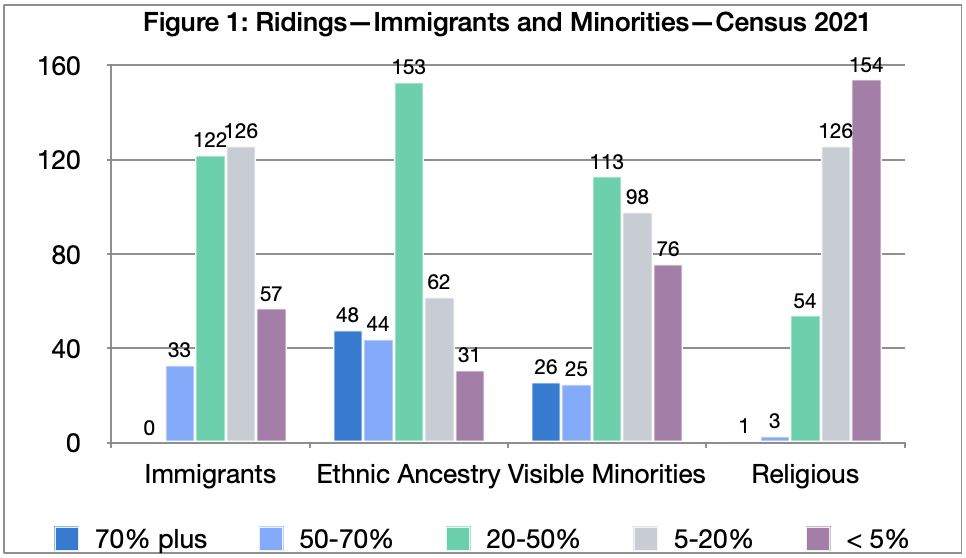
One fundamental political constraint is that elections are won and lost in ridings with large numbers of visible minorities and immigrants, like in the Greater Toronto and Hamilton Area, British Columbia’s Lower Mainland, and other urban areas as shown in Figure 1. Arguably, the Conservatives learned this lesson in the 2015 election, where citizenship revocation provisions and the Barbaric Cultural Practices Act signalled to many new Canadians they were not welcome.
The demographic of immigrants and minorities across Canadian electoral ridings. Graph courtesy of Andrew Griffith
Given that immigration is a shared jurisdiction with the provinces, any move to restrict the numbers of permanent residents, temporary workers, and foreign students will likely be met with provincial opposition. All provinces—save Quebec—largely buy into the “more is merrier” demographic arguments. Provincial governments and education institutions rely on large numbers of international students to fund higher education, and thus have already signalled concerns with the current government’s trial balloon about capping students from abroad.
Stakeholder pressures are a further constraint. Business groups, large and small, want a larger population to address labour market needs, and that includes international students for low-value-added service jobs. A larger population also means more consumers. Immigration lawyers and consultants, both in Canada and abroad, benefit from more clients. Settlement and refugee groups can continue to press for increased resources even if evaluations question their effectiveness with respect to economic immigrants. Most academics focus on barriers to immigrants and visible minorities rather than questioning their assumptions. Lobby groups like the Century Initiative and others continue to push the narrative that a larger population is needed to address an aging population, a narrative that is supported by all these stakeholders, and federal and provincial governments (except for Quebec).
Few of these stakeholders seriously address the impact of immigration on housing availability and affordability, health care, and infrastructure, despite all the recent attention to the links between housing and immigration. Most stakeholders are either in denial, claim that ramping up housing can be done quickly as many recent op-eds indicate, or argue that raising these issues is inherently xenophobic if not racist.
Global trends that also could shape a possible Conservative government include increased refugee and economic migrant flows, greater global competition for the same highly skilled talent pool and, over time, expanded use of AI and automation as a growing component of the labour market.
Immigration
Given these constraints and the fear of being labelled xenophobic, Conservatives have focused more on service delivery failures than questioning immigration levels, whether it’s permanent resident targets or the rapid increase in uncapped temporary workers and international students. Poilievre has stated that the Conservative focus will be on the “needs of private-sector employers, the degree to which charities plan to support refugees, and the desire for family reunification,” suggesting greater priority on economic and family immigration categories, as was largely the case for the Harper government. The Conservatives’ recent policy convention was largely silent on immigration. They are engaging in considerable outreach to visible minority and immigrant communities, adopting the approach of former Conservative minister Jason Kenney, “the minister for curry in a hurry.”
That being said, it is likely that a Conservative government would likely freeze or decrease slightly the number of permanent residents rather than continuing with the planned increases (the Liberal government recently indicated that it is not “ruling out changes to its ambitious immigration targets.)”
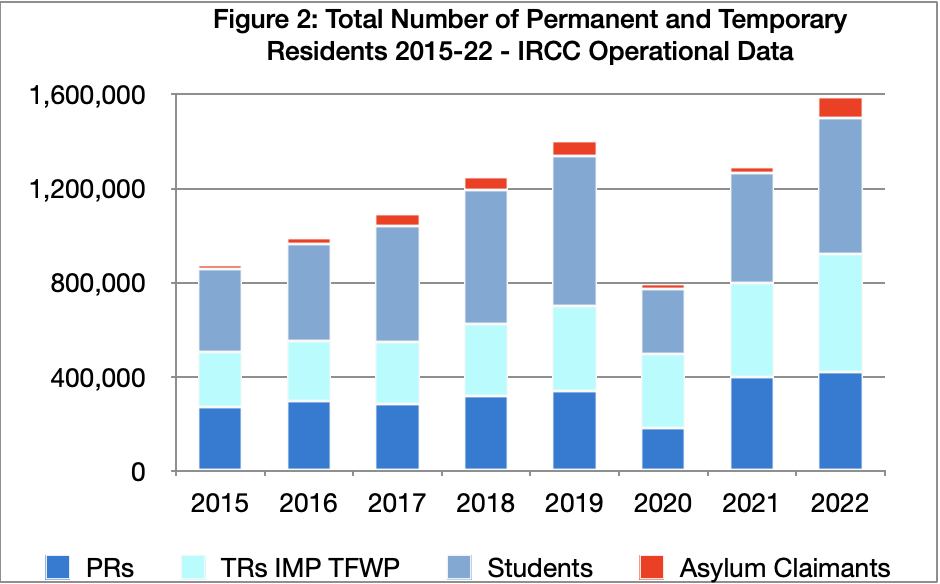
Figure two highlights the growth in permanent and temporary residents since 2015. The extent of public debate on the impact of immigration on housing provides latitude for a freeze at 2023 levels, or a small decrease given that immigrants and non-immigrants alike are affected. Graph courtesy of Andrew Griffith
It is less clear whether a Conservative government would have the courage to impose caps on temporary workers given pressure from employers, including small businesses. However, the previous Conservative government did have the political courage to impose restrictions following considerable abuse of the temporary work program, ironically exposed by the Liberals and NDP. Similarly, imposing caps on international students would run into strong resistance from provincial governments given their dependence on students from abroad to support higher education. Even placing caps on public colleges that subcontract to private colleges—which are more for low-skilled employment than education—would be challenging given employer interest in lower-wage employees. They may, however, reverse the Liberal government’s elimination of working-hour caps for foreign students.
Whether a Conservative government would go beyond the usual federal-provincial-territorial process and provide financial support for foreign credential recognition, or be more ambitious and transfer immigrant selection of public sector regulated professions (e.g., health care) to the provinces is unclear. However, given that regulatory bodies are provincial and, for health care, provinces set the budgets, they may explore this option.
While the simplification and streamlining of over 100 immigration pathways is long overdue, given the complexity for applicants to navigate the system, and for governments to manage and automate it, such longer-term “fixing the plumbing” initiatives are less politically rewarding than addressing various stakeholder pressures.
Given the increased number of asylum claimants, a Conservative government would be likely to restore requirements for claimants to have sufficient funds and an intent to leave, and may consider reimposing a visa requirement on Mexican nationals.
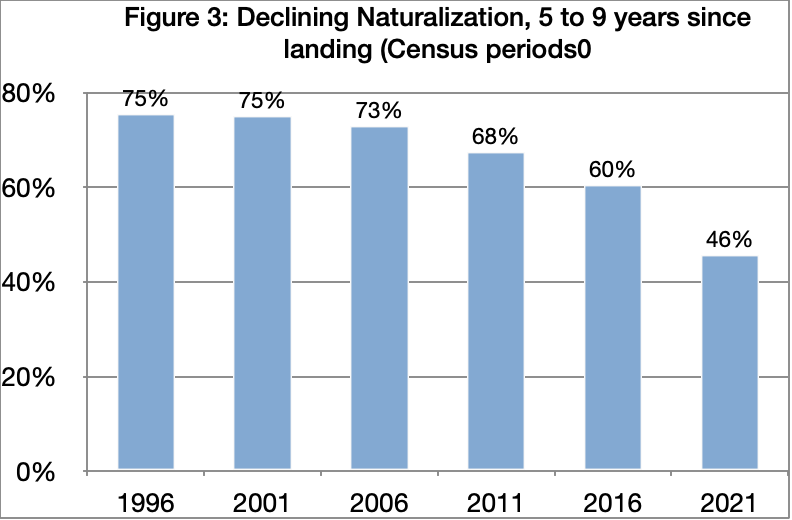
Citizenship is arguably the end point of the immigration journey as it represents full integration into society with all the political rights and responsibilities that entails. This assumption is being challenged by a combination of Canadian economic opportunities being relatively less attractive for source countries such as China and India, along with greater mobility of highly educated and skilled immigrants. As a result, the naturalization rate is declining as shown in figure three.
Figure three depicting naturalization rates between 1996 and 2021. Graph courtesy of Andrew Griffith
The previous Conservative government was more active on citizenship than other recent governments. In 2009, it released a new citizenship study guide, Discover Canada, with a greater focus on history, values and the military. It also required a higher passing score on the citizenship test—up to 75 per cent compared to 60 per cent—and different versions were circulated to reduce cheating. Language requirements were administered more strongly, and adult fees were increased from $100 to $530. A first generation cut-off for transmission of citizenship was implemented as part of addressing “lost Canadians” due to earlier Citizenship Act gaps. C-24 amended the Citizenship Act to increase residency requirements from three to four years, increased testing and language assessment to 18-64 years from 18-54 years, and a revocation provision for citizens convicted of treason or terror.
It is unclear the degree to which the Conservatives will consider citizenship a priority in relation to other immigration-related issues. From an administrative perspective, changing residency requirements again would simply complicate program management, make it harder to reduce processing times, and would not provide any substantive benefit. Re-opening citizenship revocation would simply draw attention to the risks that countries would offload their responsibilities, as the example of former U.K. citizen and Canadian citizen by descent Jack Letts illustrates.
Given that the Liberal government to date has not issued a revised citizenship guide, the Conservatives would likely stick with Discover Canada, issued in 2009. Similar, the existing citizenship test and pass rates, and proof of meeting language requirements would not need to be changed. As the Liberal government never implemented 2019 and 2021 campaign commitments to eliminate citizenship fees, one should not expect any change from the fee increase of 2014.
The Conservatives may wish to revisit the issue of birth tourism. In 2012, they pushed hard, but ultimately the small numbers known at the time and provincial opposition to operational and cost considerations made them drop their proposal. Since then, however, health-care data indicated pre-pandemic numbers of birth tourists to be around 2,000, although these dropped dramatically during the pandemic given visa and travel restrictions.
In contrast to immigration and citizenship, a Conservative government would face fewer constraints with respect to multiculturalism and employment equity. Their public criticism of wokeism, their policy resolutions stressing merit over “personal immutable characteristics“, their criticism of diversity, equity and inclusion training, and their criticism of Liberal government judicial, Governor in Council, and Senate appointments all point to a likely shift in substance and tone.
It is highly likely that resources would be cut sharply under a Conservative government given their overall approach to government expenditures, their general approach to limit government intervention and their scepticism regarding critical race theory, systemic racism, and diversity, equity, and inclusion training. There would likely also be a return to a more general integration focus between and among all groups. They would, of course, be unlikely to curb any of the recognition months or days, given the importance to communities (and their political outreach).
A Conservative government might reduce the amount and quality of data available regarding visible minority, Indigenous Peoples, persons with disabilities represented in public service, and other government appointments.
The Liberal government expanded public service data to include disaggregated data by sub-group, allowing for more detailed understanding and analysis of differences within each of the employment equity groups since 2017, along with data on LGBTQ+ people. Previous government reports only covered the overall categories of women, visible minorities, Indigenous Peoples and persons with disabilities. It is uncertain whether these reports under a future Conservative government would revert back to only reporting on overall group representation, hirings, promotions and separations. Given that this concerns public service management, it may well decide to continue current practice or the more sceptical elements may press for change.
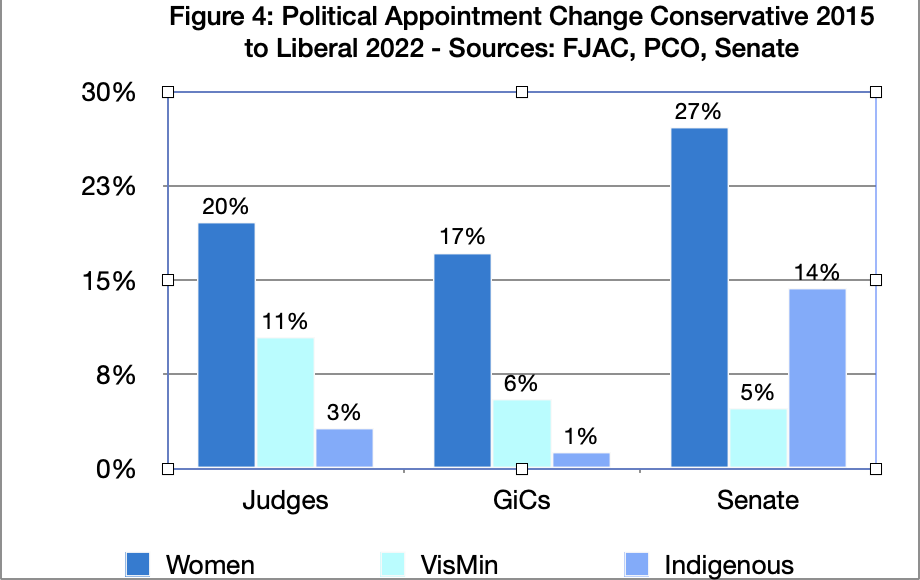
On the other hand, political appointments—judges, Governor-in-Council, Senate—are another matter. Appointment processes are likely to be revised given concerns that the processes introduced by the Liberal government unduly favoured candidates more on the centre-left than centre-right. Figure 4 highlights the increased representation of women, visible minorities and Indigenous Peoples in political appointments.
Figure four highlights the increased representation of women, visible minorities and Indigenous Peoples in political appointments. Graph courtesy of Andrew Griffith
Similarly, at the end of the last Conservative government, Governor-in-Council appointments to commissions, boards, Crown corporations, agencies, and tribunals were 34.2 per cent women, 6.1 per cent visible minorities, and 2.9 per cent Indigenous. Under the Liberal government, the number of women increased to 51.4 per cent, visible minorities to 11.6 per cent, and 4.2 per cent Indigenous by January 2023.
Senate appointments present a more nuanced picture. Conservative appointment of visible minorities was at 15.8 per cent, representing a conscious effort to address under-represented groups, but women, at 31.6 per cent of appointments, and Indigenous Peoples at 1.8 per cent, were significantly under-represented. The Liberal introduction of a formally independent and non-partisan advisory board resulted in a sharp increase in diversity: 58.8 per cent women, 20.6 per cent visible minorities, and 16.2 per cent Indigenous Peoples.
Along with these process changes, the Liberal government expanded annual reporting to include visible minorities, Indigenous Peoples, persons with disabilities, and judicial appointment reporting also included LGBTQ and ethnic/cultural groups. Should a Conservative government decide to stop these annual breakdowns, it will be harder to track any shifts in representation.
The current review of the Employment Equity Act, launched in 2021, has not yet resulted in any public report on consultations and recommendations from the Task Force. Given limited parliamentary time and higher priorities during the current mandate, it is unlikely that any revisions to the Act will be approved. However, should any legislation come to pass, it is likely that a future Conservative government might wish to revisit some of the provisions.
Concluding observations
To date, two overarching themes have driven Conservative discourse: Canada is broken, and the need to “remove the gatekeepers.” The Yeates report confirms that the immigration department is broken, reflecting long neglect of organization weaknesses, a lack of client focus, and, I would argue, an excessive multiplicity of programs that make it harder for clients to navigate, and more difficult for IRCC to manage.
One of the ironies of assessing likely Conservative policies is immigration, citizenship, and related areas all pertain to government being “gatekeepers.” It’s easier to shrink the gate for some policies and programs than others (e.g., government political appointments). Others, such as reducing levels of permanent and temporary residents, are much more challenging given the strength of provincial, business, and other stakeholders opposition. The degree to which a Conservative government is prepared to expend political capital will obviously reflect whether or not it has a majority in Parliament.
The sharp decrease in public support for immigration, given the impact on housing, health care, and infrastructure, likely provides greater flexibility for any future Conservative government. While there is greater flexibility with respect to multiculturalism and employment equity, a Conservative government could also be ambitious with needed immigration reforms for permanent and temporary immigration.
While some have argued that immigration and related issues have become a third rail in Canadian politics, this need not be the case. The concerns being raised are regarding the impact of large and increasing numbers of permanent and temporary migration on housing, health care, and infrastructure, not the racial, religious or ethnic composition of immigrants. These issues affect immigrants and non-immigrants alike and focus on commonalities, not differences.
Picking up on earlier CBC reporting and advocating for ending the visa exemption for Mexico:
….
The Americans don’t realize that Ottawa’s immigration system needs a complete overhaul. Toronto and Vancouver are being flooded with newcomers who are overwhelming hospitals and homeless shelters, and driving up real estate prices. Visa-free travel for Mexicans is a loophole that must be closed. And Canada’s loose student visa rules must be tightened immediately.
From October 2022 to this September, the 2023 fiscal year, there were 96,917 Indians encountered — apprehended, expelled or denied entry — having entered the U.S. without papers. It marks a fivefold increase from the same period from 2019 to 2020, when there were just 19,883.
Immigration experts say several factors are at play, including an overall growth in global migration since the pandemic, oppression of minority communities in India, smugglers’ use of increasingly sophisticated and in-demand methods of getting people to America, and extreme visa backlogs.
The number of undocumented Indians in the U.S. has been climbing since borders opened post-Covid, with 30,662 encountered in the 2021 fiscal year and 63,927 in the 2022 fiscal year.
Out of the nearly 97,000 encounters this year, 30,010 were at the Canadian border and 41,770 at the Southern border.
“The Southern border has just become a staging ground for migrants from all parts of the world to come to the U.S. most quickly,” said Muzaffar Chishti, a lawyer and the director of non-partisan research group Migration Policy Institute’s New York office. “Why would you wait for a visitor visa in Delhi if you can make it faster to the Southern border?”
The Canadian border, on the other hand, has large stretches that are virtually unguarded at times, said Gaurav Khanna, an assistant professor of economics at the University of California at San Diego, whose research concentrates on immigration.
While not all routes look the same, a journey from India to the U.S. might take migrants on several legs, all while being passed among various facilitators.
“People will get you to, let’s say, the Middle East, or people will get you to Europe,” Chishti said. “The next journey from there would be to Africa. If not Africa, maybe then to South America. Then the next person will get you from South America to the south of Mexico. Then from the south of Mexico to the northern cities of Mexico, and then the next person will get you over to the U.S.”
Long, treacherous journeys often land migrants in limbo, facing overwhelmed immigration systems, he said. CBP told NBC News that families coming to the U.S. illegally will face removal.
“No one should believe the lies of smugglers through these travel agencies. The fact is that individuals and families without a legal basis to remain in the United States will be removed,” a CBP spokesperson said.
But when those migrants are coming from across an ocean, experts say, the reality is far more complicated.
“You can easily turn people back to Mexico — that’s their country, ‘make a U-turn,’” Chishti said. “But you can’t deport people to faraway places that easily. Mexico won’t take them. Why would Mexico take an Indian?”
Of particular note this month is the drastic drop in the number of temporary residents transitioning to permanent residency and a an equally sharp decrease in the number admitted under IMP.
Canada has long been an outlier in the Western world for having the rare dynamic of both high levels of immigration and high levels of public support for immigration. Paired with cross-partisan support on the topic, the issue has not been a major driving factor of the country’s politics. But that consensus may be changing. New data from the Canadian Century Initiative finds that there has been a significant increase in Canadians who believe that Canada has too much immigration.
Mikal Skuterud, a labour economist at the University of Waterloo and director of the Canadian Labour Economics Forum, offers his expertise on the topic in an exclusive exchange with The Hub’s editor-at-large, Sean Speer. He breaks down the numbers and highlights the ways Canada can reform its system to reverse these trends and better serve the country as a whole.
SEAN SPEER: As you know, the Canadian Century Initiative, a non-profit organization dedicated to the goal of raising Canada’s population to 100 million by 2100 through large-scale immigration, recently released new polling in conjunction with the Environics Institute for Survey Research. I want to start by asking for your reaction to the survey’s top-line finding. There has been a significant increase—indeed, the largest year-over-year increase since Environics started asking this question in 1977—in the percentage of respondents who believe that Canada has too much immigration. What do you think about this result? Are you surprised? And what do you think is behind it?
MIKAL SKUTERUD: While Canadians have always been, and continue to be, overwhelmingly open to immigration, opinion polls have long shown that a significant majority of Canadians believe the number of immigrants Canada accepts should be limited. I think this reflects a widespread belief that while immigration has the potential to boost average economic well-being in the population, there is a limit to that potential. The vast majority of Canadians understand that the economy has an absorptive capacity. When the population grows faster than the housing stock, public infrastructure, and business capital, there is less capital per person, and this tends to lower labour productivity and average economic living standards in the population. My best guess is that the shifting sentiments that Environics is seeing in their polling reflect concerns that the government’s ambitious immigration agenda is pushing up against the economy’s absorptive capacity.
SEAN SPEER: The biggest explanation for the increase in the public’s misgivings about immigration is the perceived effect on housing prices. This ought to have been a predictable concern among policymakers and the Canadian Century Initiative itself. Why do you think we failed to account for housing demand and the need for greater supply in conjunction with raising immigration levels? What can be done to improve jurisdictional coordination and coherence on these issues?
MIKAL SKUTERUD: In 2015, an economic narrative surfaced in this country that claimed heightened immigration rates, from what were already high rates when compared to other OECD countries, would be a tonic for economic growth. Canadians were told that higher population growth would not only make Canada more prosperous but that higher immigration was necessary for economic growth. For economists like me, who have been studying the economics of Canadian immigration for decades, these hyperbolic claims did not line up with the predictions of standard economic models of economic growth or with the Canadian empirical evidence.
In March 2016, then Minister of Immigration, John McCallum, invited a group of us to share our views. In retrospect, it’s clear that our concerns fell on deaf ears. The immigration narrative was a feel-good story, and nobody likes a cold shower. The appeal of the narrative that immigration—“Canada’s secret sauce”—could be the solution to our dismal economic growth and labour productivity performance is understandable. But, of course, sometimes political narratives are so appealing that well-intentioned people get caught up in the warm feelings of what we’d like to be true and lose sight of the more important question of what is true.
If we know nothing else about the economics of immigration, we know that immigration has distributional effects. In general, the folks who are on the opposite side of consumer and producer markets of immigrants stand to benefit, while folks on the same side are likely to experience adverse economic effects. While recent immigrants who live in the same communities as newcomers face heightened competition for housing and jobs, the competitive pressures facing sellers in mortgage markets (banks) and buyers in labour markets (employers) are alleviated.
An interesting result from the recent Environics poll which I haven’t heard any media report on is that the biggest shift in dissatisfaction with recent immigration levels is among first-generation immigrants. This is consistent with the proposition that population growing pains are likely felt most by immigrants already here. To the extent that we care about the consequences of heightened immigration on economic inequality and social cohesion, these distributional effects should be of first-order concern to policymakers.
SEAN SPEER: One of the issues that, according to the polling, is the subject of declining public confidence is the notion that we need or want a larger population itself. A lot of the immigration debate is implicitly motivated by the idea that we should aspire to a fast-growing and larger population. What is your view on this question? What does the scholarship tell us about the benefits of bigness? Should we have an explicit goal for Canada’s population to become larger?
MIKAL SKUTERUD: The economic case for bigness is most often made with reference to what economists call “agglomeration effects.” The general idea is that bigger cities with higher population densities are more successful in generating the flows of knowledge and ideas that result in innovation, and in turn, technological advances, and growth in total factor productivity. This mechanism could, in theory, be a source of increasing returns to scale, such that a two percent increase in the inputs that go into producing aggregate output, most importantly the labour input, result in a more than two percent increase in aggregate output. In this way, an increase in the immigration rate can produce an increase in GDP per capita.
Unfortunately, I’m unaware of any credible evidence that this mechanism has been important in recent Canadian history. Certainly, the current push to settle more immigrants in remote communities works against this mechanism. In work with my colleague Joel Blit and recent Ph.D. student Jue Zhang, we examined the relationship between inflows of university-educated immigrants into Canadian cities to the number of new patents created in those cities and found no evidence consistent with the proposition that agglomeration effects have been quantitively important for Canada historically, in contrast to the results of a similar analysis using U.S. data.
Perhaps a more compelling argument for why population size is, in itself, a sound economic objective is that bigger countries have more geopolitical influence on the world stage and that this advantage somehow benefits economic growth through more advantageous free trade deals, for example. However, if this mechanism was quantitatively important, we’d expect countries with larger populations to be on average richer, but the opposite is true. World Bank data from 187 countries in 2019 shows that the correlation between national population and GDP per capita is unambiguously negative. Many big countries are poor, and many small countries are rich.
SEAN SPEER: One of the most interesting results is that 77 percent of respondents said that government policy should prioritize high-skilled immigration. Only one-third said that it should prioritize low-skilled workers and students. Yet as your work has shown, government policy has tilted away from high-skilled immigration to the latter two categories in recent years. How does one explain that dissonance and what should be done to rebalance the composition of Canada’s different immigration streams?
MIKAL SKUTERUD: The repair to the permanent immigration system is simple: return to a single pathway for economic-class immigration with a single selection criterion. This is what we had in Canada before 2021. All economic-class immigrants (outside Quebec) received permanent residency status by entering the Express Entry pool where they were assigned a Comprehensive Ranking System (CRS) score, which is essentially a prediction of the applicants’ future earnings in Canada. Every two weeks, IRCC announced a CRS cutoff score and candidates with scores above the cutoff were invited to apply for PR status.
However, since 2021 IRCC has introduced a series of ad-hoc TR-to-PR pathway programs intended to provide PR pathways for applicants with low CRS scores. For example, in April 2021, they announced a new PR pathway for 90,000 temporary workers employed in a list of “essential occupations” that included cashiers, cleaners, truck drivers, construction and farm labourers, and security guards. More recently, the Category-Based Selection System has been introduced allowing the minister of the day to bypass the CRS criterion to prioritize any occupation in the applicant pool. This flexibility enables the Minister to respond to business lobbying pressure for more low-skilled labour. This politicization of immigrant selection isn’t good for wage growth in Canada’s low-skilled workforce and undermines business incentives to invest in training and technologies to improve labour productivity.
The question of whether immigration should be focused on raising the average human capital stock of the population or plugging holes in current labour markets is longstanding. Economists have overwhelmingly argued for the former approach. Their logic is simply that we don’t believe planned economies work well. There is overwhelming evidence that aggregate production in modern economies doesn’t require some fixed ratio of labour types. In 1921, one-third of Canada’s workers were employed in agriculture. After more than 100 years of innovation in farming equipment, less than two percent are. Trying to predict where job vacancies will be in five or ten years is futile because labour demand is endogenous to labour supply. Where a particular labour type is plentiful, wages will be low, incentivizing employment of those types, and where a labour type is scarce, wages will increase, incentivizing substitution to other types of labour or capital investments. If we want a low-wage low-skill economy, we should target low-skill immigrants; but if we want a high-skill high-wage economy, we should prioritize high-skill immigrants.
SEAN SPEER: More generally, if you were advising government policymakers on their policy response to these findings, what might change? Should we lower our permanent resident target? Should we prioritize addressing the growth in non-PR streams? Should we do both? What is the Skuterud plan to restore public support for high levels of immigration?
MIKAL SKUTERUD: A positive outcome of the growth in Canada’s foreign student and temporary foreign worker populations is it has justified a call for better data. Statistics Canada now publishes a quarterly data series on the overall size of Canada’s non-permanent (NPR) population. This population is exceptionally difficult to measure but they have taken a good shot at it. What the data show is that Canada’s NPR population increased from 1.5 million to 2.2 million—a nearly 50 percent increase—between July 2022 and July 2023.
As the NPR population grows faster than the number of new PR entries, an increasing number of temporary residents who came to Canada with dreams of settling permanently will find their permits expiring before they’ve made the transition. This inevitably means that Canada’s undocumented population will grow. A growing undocumented population is undesirable for many reasons, so rebalancing growth in Canada’s NPR population with the growth in Canada’s PR targets should be, in my view, a first-order priority for IRCC.
At the core of the challenge here are two realities. First, Canadian permanent residency status holds enormous economic value to huge populations of individuals around the world. Second, Canadian immigration policy has over the past decade shifted in a significant way to “two-step immigration” in which the pathway to PR status is to study or work in Canada as a temporary resident and then clear the hurdles of the PR admission system. Together these realities mean that a key factor in migrants’ private cost-benefit decisions to come to Canada is their perception of the likelihood of making a successful TR-to-PR transition while in Canada.
While increasing TR-to-PR pathways for migrants may be well-intentioned, an unintended consequence of these programs is they increase the odds that lower-skilled migrants will get lucky and obtain PR status. In this regard, they serve to lure migrants who are willing to pay exorbitant tuition fees to postsecondary institutions that offer little educational value and or accept jobs offering substandard wages and working conditions. There’s little doubt in my mind that an important cause of the tremendous growth in the NPR population is a supply-driven response to migrants’ perceptions that their chances of winning the PR lottery have increased in recent years. Fixing this problem requires returning to a single PR pathway that is transparent and predictable and that prioritizes applicants with the highest CRS scores.
As Ottawa unveils its immigration plan for 2024-26 this week, immigration experts say more resources are needed to help new permanent residents settle into life in Canada:
Immigration Minister Marc Miller announced Wednesday that Canada will not cut immigration levels and plans to hold its target of annual newcomers steady at 500,00 people starting in 2026.
“I was a little bit surprised that they didn’t reduce the numbers given the discourse that’s been going on in the public about too many immigrants coming, but I think it also speaks to the need that we have for newcomers to come here for all kinds of reasons,” Lori Wilkinson, a professor in the department of sociology and criminology at the University of Manitoba, told Global News.
Yet another voice questioning the government’s immigration strategy and policies given lack of business investment:
Immigration is driving a historic surge in Canada’s population. At the same time, Canadian wages and living standards are stagnant. That is a bad combination – and, worse, it is not a coincidence. And here’s the link: Business investment isso weak that the stock of productive capital per worker in Canada – the buildings, tools and software they use – is falling. More workers and less capital are putting Canada on a path to a low-productivity, low-wage economy.
…
William Robson is chief executive of the C.D. Howe Institute. He recently co-authored a report on business investment in Canada.