Canada’s voluntary census is worthless. Here’s why – The Globe and Mail
2013/10/05 Leave a comment
Another illustration of the effects of the move to a voluntary census.
Canada’s voluntary census is worthless. Here’s why – The Globe and Mail.
Working site on citizenship and multiculturalism issues.
2013/10/05 Leave a comment
Another illustration of the effects of the move to a voluntary census.
Canada’s voluntary census is worthless. Here’s why – The Globe and Mail.
2013/10/03 Leave a comment
Good commentary by Jonathan Kay on the campaign (Restore Our Anthem) to make our national anthem gender neutral, given the reality of today’s military and society. The government clumsily floated this idea a few years ago, but perhaps this time can manage the pressure from the traditionalists (who forget that the “sons” reference dates from WW 1) was in fact an addition deemed appropriate to the times.
A way for the government to reinforce its attachment to all things military while showing a more contemporary perspective on gender.
Jonathan Kay: ‘In all thy sons command’ has had its day | National Post.
2013/10/01 Leave a comment
Interesting debate between David Mitchell, President of the Public Policy Forum, and Donald Savoie, of Université de Moncton, on the policy skills of the current crop of deputies, and whether the emphasis is on policy development or management skills.
I think context matters. While deputies generally have a rounded skill and competency set, there is less appetite for longer-term policy development under the current government than previous governments, as the Conservative government has its own strong policy agenda and the public service has focused more on short-term program policy in implementing that agenda.
It is the more open-ended and longer-term policy development that has been weakened, and my understanding is that policy capacity in a number of departments has been cut back through successive rounds of expenditure reductions. Not to say there was not capacity to be trimmed, or that this does not reflect legitimate political and bureaucratic decisions. We need to start by acknowledging the changes and likely longer-term impact of the capacity of the public service.
Savoie’s comments strike me as ignoring the current context. Just as he has argued against parliamentary officers at a time when Parliament is not performing its job of scrutinizing government spending (Do we need a PBO?), he does not acknowledge the degree to which policy advice and direction comes more from the political level. In addition, he does not acknowledge the degree to which official-level advice has been discounted or ignored, or limited to program policy and implementation issues.
Given the paywall, full text below:
The newer generation of federal deputy ministers have top-notch management skills, but lack sufficient expertise in policy development which could prove to be detrimental for the current and future governments in dealing with unforeseen crises situations such as terrorism, climate change, or military conflicts, says David Mitchell, president of the Public Policy Forum, one of the country’s leading think tanks, but other experts disagree.
“The newer deputy ministers who are emerging or senior public servants who are emerging have very, very solid managerial skills and expertise, but probably less experience in terms of policy development because there hasn’t been such a great demand for it in recent years,” said Mr. Mitchell in an interview with The Hill Times, adding that that the outgoing deputy ministers have more policy development experience than the ones replacing them.
“Most of the work of the public service has been around service delivery, management [and] accountability because that’s been the order of the day, but there’s been less of a demand on the public service for policy development and policy skills and many of the senior public servants who are moving into retirement are taking those skills with them and the newer generation of leaders likely has not had as much experience with that. That could be a challenge in the future when a government may require policy options and policy development skills, especially if they are not there in abundance in the future.”
Mr. Mitchell, a political historian who also served as MLA in the British Columbia legislature from 1991-1996, said that the process of shifting of focus away from policy development to effective management, service delivery, and accountability in the federal public service has been in progress over the last generation and now most of the policy development takes place in thinks tanks, industry associations and universities. This, he said, has made the top bureaucrats unprepared to deal with crisis situations.
“An aging population, increasing responses to natural disasters, international dimensions to public policy in terms of terrorism, climate change, or military conflicts, or unanticipated areas that we really don’t know about. If the public service isn’t actively thinking through scenarios and coming up with potential policy options for future governments, we could be in a position where we could be less prepared as a country to deal with emerging realities that the Canadian public can’t easily anticipate now. But it used to be the job of the public service to be thinking about this and to be prepared to not only advise the government of the day, but also to present policy options in order to deal with unanticipated circumstances. Today, that capacity has atrophied within government,” said Mr. Mitchell who in the past served as vice-president of Queen’s University, the University of Ottawa, and Simon Fraser University.
Mr. Mitchell said that with the departure of outgoing deputy ministers, the federal public service not only is losing individuals with significant policy development experience but also the institutional memory.
Prime Minister Stephen Harper (Calgary Southwest, Alta.) shuffled the senior ranks of the public service in late July. In the shuffle, George Da Pont, who was then president of Canadian Food Inspection Agency (CFIA), was appointed as the deputy minister of Health; Bruce Archibald, then president of the Federal Economic Development Agency for Southern Ontario was named president of the CFIA; Karen Ellis, former associate deputy minister of Natural Resources was named the president of Federal Economic Development Agency for Southern Ontario; Anita Biguzs, former associate deputy minister of Citizenship and Immigration was promoted to the position of deputy minister in the same department; Wilma Vreeswijk, former deputy secretary to the Cabinet (Business Transformation and Renewal) was named associate deputy minister of Citizenship and Immigration; Colleen Volk, former deputy secretary to the Cabinet (senior personnel), Privy Council Office, was named deputy secretary to Cabinet (senior personnel, Business Transformation and Renewal) Privy Council Office; and Helena Borges, former assistant deputy minister, programs group at Transport Canada was named associate deputy minister of Transport. At the time of the shuffle, Prime Minister Harper also announced the retirement plans of Glenda Yeates, former deputy minister of health, and Neil Yeates, former deputy minister of Citizenship and Immigration.
Meanwhile, Donald Savoie, who holds a Canada Research Chair in public administration and governance at the Universitè de Moncton, N.B., and is also a leading expert on the machinery of government, disagreed with Mr. Mitchell’s opinion that senior federal public servants have insufficient experience in policy development.
“I don’t necessarily agree with that. I think deputy ministers today have to have a number of skills. One is policy, second is political skills, not partisan, I want to make that important distinction. They have to have political antennas, not partisan antennas, a big difference. They have to have policy skills, they have to know how to work with other departments because policy now transcends departments and they do hopefully know how to manage and it’s a very difficult environment,” said Mr. Savoie, who is the author of numerous books and articles on public administration and public policy, in an interview with The Hill Times.
“There’s a series of skills that someone who makes into a deputy minister rank has had to prove in the past and policy skills happens to be one of them,” Mr. Savoie said. “The deputies who are recently appointed over the past several years, a lot of them come from central agencies: the bulk of deputies from the PCO, Finance, Treasury Board and so on. That’s not where you hone your management skills, that’s where you hone your policy and political skills.”
Mr. Savoie, who also has extensive experience in both government and academia, said that the process of policy development has changed over the years with more players offering their input but the senior civil servants are still the ones that are the decision makers in the formation of policies.
“There’s different forces that come into play, different contributions. But, ultimately, at the end of the day, people who present policy packages are those who are in government. Deputy minister is the final funnel before policies arrive on a minister’s desk, or the Prime Minister’s desk, or the Privy Council Clerk’s desk. Various forces shape it, but deputy minister is the guy or the gal who has the gate to the policy process. The policy process gate is still inside government. It hasn’t moved outside. Different people try to make it to the gate, but deputies still control that gate,” said Mr. Savoie.
Mr. Savoie said that the loss of institutional memory is not something new in the public service as it has been going on dating back to 1867. He, however, suggested that the government should come up with some arrangement by which the institutional memory could be preserved.
“You can’t [pull] the hand of a deputy minister to stay in government till the age of 75 to protect institutional memory. It is part of the process. Should there be a process to capture better institutional memory and to value it inside government, yes. There’s all kinds of things you could do: There’s a need for more case studies on policy management [and] development inside federal government. I don’t see many case studies that have been produced. They are relatively simple to produce. And exit interviews, inviting the [outgoing] deputy to a series of round tables, there’s a way to capture that institutional memory and I think government should work on it a bit more.”
Mike Joyce, former assistant secretary at the Treasury Board Secretariat who retired about five years ago, in an interview with The Hill Times, also disagreed with Mr. Mitchell that the new crop of top civil servants have insufficient policy development expertise.
“The previous criticism of deputy ministers has, of course, been the reverse that they’re good at policy and they are rotated so quickly that they are not very good at management. If you are looking at the current crop of senior appointments as being good at management, I would say that’s a good thing if that’s true, but I wouldn’t suggest that they are any weaker on policy,” said Mr. Joyce who is now an adjunct professor at Queen’s University School of Policy Studies.
2013/09/30 Leave a comment
While the front part is typical Conrad Black over the top, his conclusion is interesting:
There are limits to what a country of 35-million can do, but it wouldn’t kill Canadians to develop their own brand of exceptionalism. Canada is exceptionally racially tolerant, has been exceptionally careful never to engage in an unjust or unsuccessful war. It has been exceptionally successful at joining forces between the private and public sectors, and should do so again in the field of medical care, and in ownership of the automobile industry and the aerospace industry (so we can finally recover from the disaster of the Avro Arrow cancellation in 1959).
More broadly, Canada is exceptional as the only trans-continental, officially bicultural, parliamentary confederation in history. Canada has also been an exceptionally successful liberal state, and we should build on this to abolish prison for (all but a few) non-violent people; to legalize drugs but require treatment for hard drug users; to honour the treaties with the native peoples fully; to use the tax system to reduce poverty by incentivizing poverty reduction schemes as a way of reducing a wealth surcharge; and to lead the reform of international institutions.
The Canadian answer to the problems in the United States must not be sniggering; it must be to do better here.
Conrad Black: Toward a theory of Canadian exceptionalism | National Post.
2013/09/30 Leave a comment
An interesting contrary view to the conventional view in favour of interprovincial migration, arguing the need to shift towards more active labour market training that allows the provinces to create more opportunities within, rather than depopulation. From a Conservative senator, Diane Bellemare, no less, in her book, Créer et partager la prospérité (Creating and Sharing Prosperity).
Migration isn’t the answer to unemployment – The Globe and Mail.
2013/09/27 Leave a comment
More on just how broken Canada’s Access to Information system is. So much for government accountability.
Canada’s info czar warns against federal government’s new obstructive tactics – The Globe and Mail.
2013/09/26 Leave a comment
An opinion piece by Matthew Mendelsohn of the Mowat Centre, arguing that we should benefit more from the diaspora networks created by immigration. Not too much new here but bears repeating:
Diasporas provide linkages. They help information circulate. They provide cultural knowledge where it didn’t exist before. They can help establish trust and deepen social capital.
Their knowledge can lower transaction costs and reduce the time it takes to enter new markets and form new partnerships. They connect people, ideas and understanding….
We are failing immigrants and Canada when we fail to recognize the cultural knowledge, international experience and global networks of our people. We can do better.
The private sector could deepen its connections with ethnocultural chambers of commerce, professional immigrant networks, alumni networks and immigrant resource groups within firms. All these networks can help businesses better understand opportunities in emerging markets. Successful firms are already doing this.
But capitalizing on our potential requires more than the private sector. It requires governments to ensure that rules and regulations from a half century ago are not undermining our capacity to fulfil our potential as a diaspora nation.
Canada needs to take advantage of being ‘Diaspora Nation’ | Toronto Star.
2013/09/24 Leave a comment
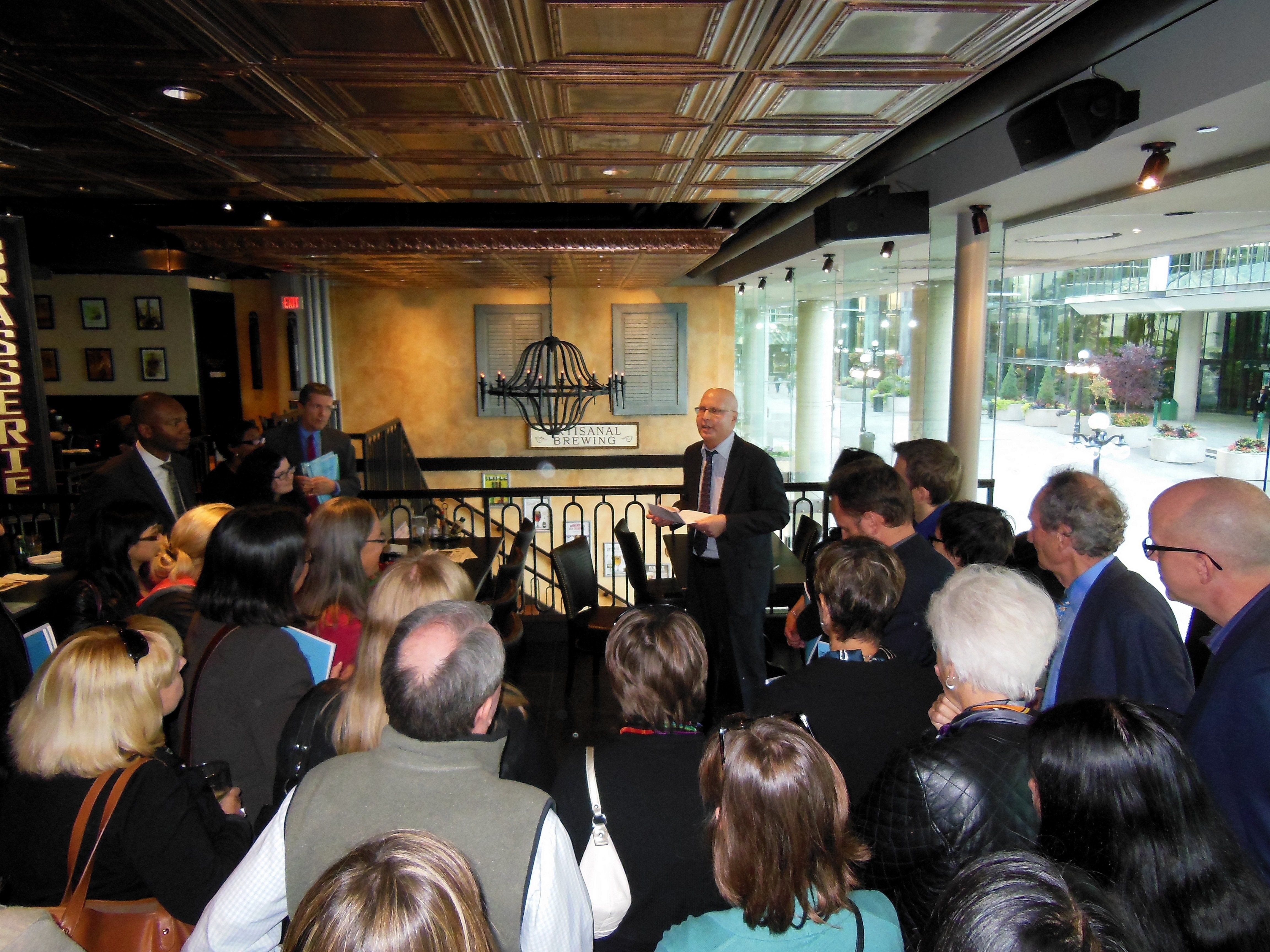 Book launch went well, with about 50 people attending, and nice mix of family, neighbours, friends and former colleagues. Not much media that I saw, but given press to date, no complaints. And reasonable book sales.
A fun event to reconnect with so many.
For those interested, I have posted:
And some other photos for the feel of the launch:

Group Shot
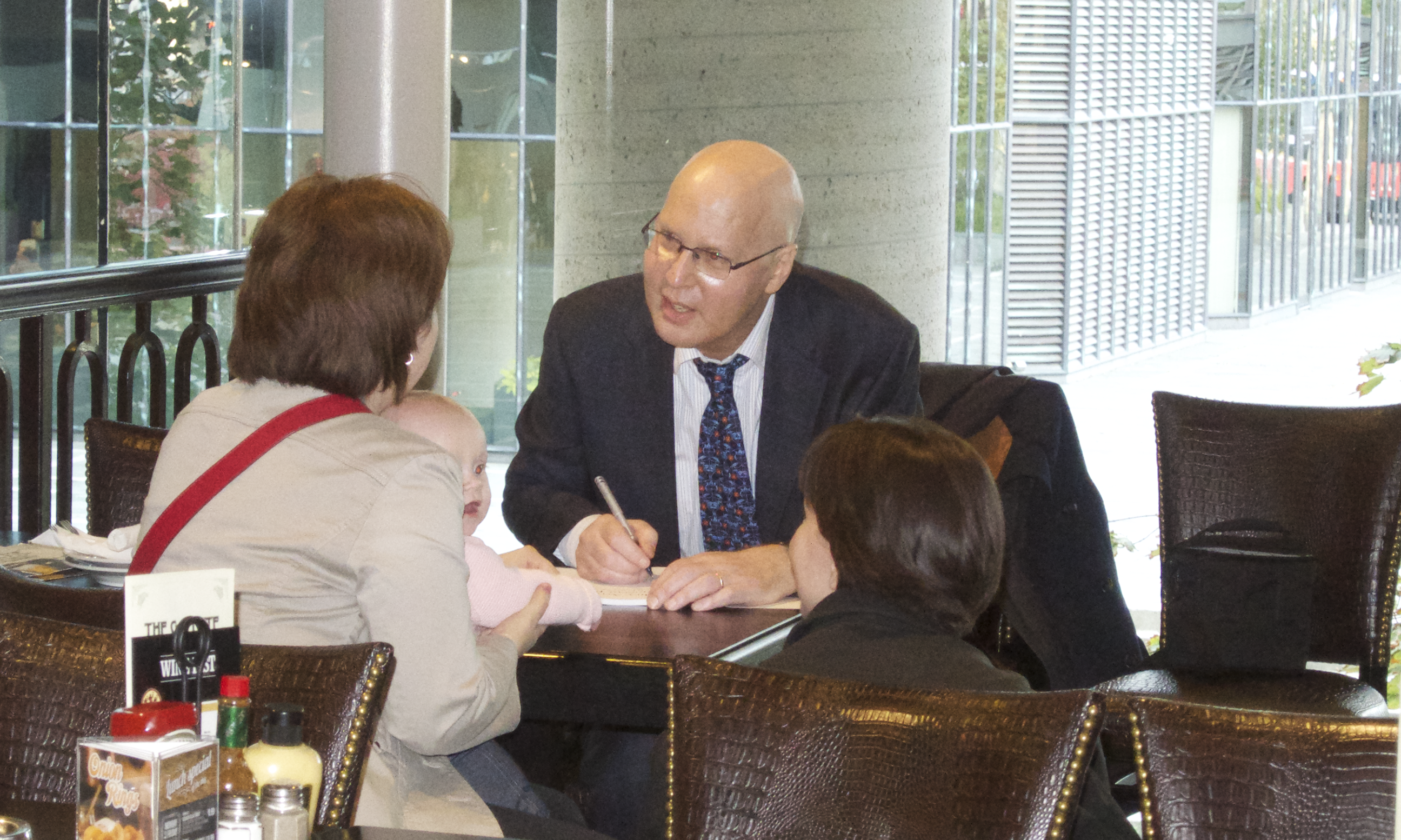
Book Signing
2013/09/24 Leave a comment
Correct assessment, although even isolated incidents can be deadly. Interestingly, no mention of the ongoing research towards better understanding of some of the possible factors involved that are part of the federally funded Kanishka Project:
…. invest in research on pressing questions for Canada on terrorism and counter-terrorism, such as preventing and countering violent extremism.
The Project is about better understanding what terrorism means in the Canadian context, how that is changing over time, and what we can do to support effective policies and programs to counter terrorism and violent extremism in Canada.
No ‘mass phenomenon’ of homegrown radicalization in Canada, says Harper – Winnipeg Free Press.
2013/09/23 1 Comment
Article from Hill Times today on the occasion of my book launch. Open event, The 3 Brewers, Bank and Sparks, today between 5 and 7 pm. Look forward to seeing many Ottawa-based people there. Best price for paper version of book ($15, HST and shipping included).
Andrew Griffith offers an insider’s account about the major cultural shift in the public service when the Conservatives formed government back in 2006.
When the Conservatives won government in 2006, the federal public service was not prepared for the ideological change to public policy-making, says a former top mandarin and author of the new book Policy Arrogance or Innocent Bias: Resetting Citizenship and Multiculturalism.
“One of the funny things about the relationship between the political level and official level is that we’re both equally certain in our own truth,” said Andrew Griffith, a former 30-year veteran of the public service, in an interview with The Hill Times. “A party comes in, they’ve developed a platform, they’re absolutely convinced they’re right and that they have the truth and they were elected on that platform and, similarly, we in the public service are convinced that we’re absolutely right, we have the studies, the research, the evidence—how can anybody disagree with us?”
Mr. Griffith, a former director general at the Canadian Heritage Department who worked on multiculturalism policy, is launching his new book in Ottawa on Sept. 23 at The Three Brewers, 240 Sparks St., from 5 to 7 p.m.
He moved over to the Citizenship and Immigration department when Jason Kenney (Calgary Southeast, Alta.) was named the minister in 2008 and took the multiculturalism files with him. Using his experience with implementing multiculturalism and citizenship policy, Mr. Griffith wrote an insider’s account about the major cultural shift in the public service when the Conservatives formed government.
“In this particular transition, the perspective, or worldview, of both sides was so different. We had the Calgary crowd—by and large the Conservative Party wanted smaller government, less government intervention and was more skeptical of the power of government to actually do good,” Mr. Griffith told The Hill Times in a phone interview last week. “We live in the Ottawa bubble, Central Canada, and, by and large, civil servants are small ‘l’ liberals. You know, you don’t join government because you want to shrink it generally, maybe the people in Finance do, but, generally speaking, the people who join government have a belief in the power of government to do good. It doesn’t mean they’re big government people, it’s just a different world view.”
Mr. Griffith said the differing worldviews “sharpened tensions” between the public service and the new government.
“Previous transitions hadn’t had, I don’t think, such a sharp tension. I don’t recall that during the Mulroney government, because, again, it was more of a Central Canadian government,” he said. “They came with strong ideas and knew what they didn’t like.”
In the case of multiculturalism and citizenship policy, he said, the Conservative government’s worldview was a complete departure from that of former prime ministers Pierre Trudeau, Brian Mulroney, and Jean Chrétien.
“They didn’t like much of the traditional approach in multiculturalism and everything like that, sort of the old-style focusing on visible minority issues. On citizenship, it was very clear they wanted a stronger reference to Canadian history, military, Crown, etc., and so the way they would come at the issues is we’d have a meeting, and they’d say, ‘Here’s what we want,’ and we’d initially figure it out. In many cases, it appeared very foreign to us in terms of what we knew about Canada, so it took us time to absorb it and react to it and find a way to say, ‘Now we understand it so we can actually work with you,’ ” he said.
Mr. Griffith said several of the policies generated were based on anecdotes that the minister or his staff would bring back and attempt to fix.
For example, in Policy Arrogance, he outlined that in the case of making changes to citizenship rules around “birth tourism”—or dealing with people who planned trips to Canada so that their baby would be born on Canadian soil and be granted automatic citizenship—anecdotes “trumped” evidence he said, because there was very little data to begin with.
“The minister admitted that he did not know the extent of the problem even as he made the case to crack down on birth tourism,” Mr. Griffith wrote. “Officials struggled with this lack of hard numbers as stories emerged in the Quebec and B.C. media.”
Mr. Griffith wrote that the CIC later engaged with medical associations and hospitals to “ascertain the extent of the issue,” but did not consult with provincial health systems that would have allowed them to see how many births were paid or not paid through the public system for which citizens and permanent residents are eligible.
“Such analysis would help quantify the extent of the issue, and help inform cost-benefit analysis of any change to citizenship legislation to align Canadian policy with other jurisdictions that no longer allow automatic citizenship upon birth,” Mr. Griffith wrote. “In developing policy and program advice, the paucity of data and analysis made it hard to provide advice on the likely impact of any policy changes. More, the minister’s wishes for early implementation meant there were limits to appropriate due diligence.”
Mr. Griffith told The Hill Times that public servants couldn’t discount Mr. Kenney’s anecdotes, however, because he went to at least 20 community events three weekends out of four.
“His anecdotes had a reasonable amount of weight,” he said, noting that officials did not take the anecdotes wholly; as the people Mr. Kenney was seeing was not entirely representative of the Canadian population.
“He was more in touch with the communities than we were. Our evidence tended to be large-scale research and surveys, which are very valid, and his evidence tended to be anecdotal, but it was such a large base of anecdotes that it was something that we actually had to take into account.”
When it came time to rewrite the citizenship guide, Discover Canada, the public servants working on it “didn’t get it right at all,” so the ministerial and political staff “actually wrote it for us” and the department went from there, Mr. Griffith said.
“Normally that isn’t done,” he said, adding that later, the minister’s office would have “a challenge session” going through each page one by one. “We were able to understand why they wanted it and the why is actually more important than the what because if you understand the why, then you can figure out a way to make it work. It would be difficult at the beginning … and then as you got through those discussions, you could get to more pragmatic ‘okay, now that we understand what you want, we can move in this direction.’ It served as a bit of a dance.”
Mr. Griffith said that while he was “never afraid” to give advice under these circumstances, his four years at Citizen and Immigration Canada was a “real learning experience.”
Writing that experience down “was actually satisfying and cathartic,” he said.
“My intent was actually to provoke a bit of a discussion initially within the public service about the relationship issue between the government and the public service because my sense was that we didn’t manage the relationship very well at the beginning,” Mr. Griffith said about writing the book.
“We weren’t responsive enough to the change in direction of the government so we appeared obstructive at best or resisting or even disloyal perhaps to the incoming government so I think there were some lessons learned for the public service in terms of how we manage that transition that hopefully by having a more open discussion about how we actually deal with a situation where we have an incoming government that has a very different worldview from our worldview in a way that actually doesn’t exacerbate tensions, but actually sort of helps develop a more normal working relationship.”
There was a difficult line between the public servants giving “fearless advice” and putting into practice the “loyal implementation” role, he said.
In the end, Mr. Griffith said, he felt at CIC that public servants were able to balance both, despite going through the “Kübler-Ross stages of grief and loss—denial, anger, bargaining, depression, and acceptance—in dealing with the traumatic challenge to their role, as well as to the long-standing consensus between previous Liberal and Conservative parties on citizenship and multiculturalism issues.”
Mr. Griffith told The Hill Times that, for the most part, Mr. Kenney was “actually quite good” at listening to advice, although “he wouldn’t necessarily accept it.”
While he couldn’t say whether this was widespread in other departments, Mr. Griffith said politicians are likely more drawn to anecdotes than scientific evidence and statistics because they are people’s people.
“This government is more ideological than previous governments. This government does tend to discount evidence. This government does actually tend to cut things that do provide evidence, like the census. All that’s on the public record,” Mr. Griffith said.
“How it works in individual departments, I’m not close enough to know that. I do know from some people that yes, some ministers are more receptive to listening to advice but again that always gets run by ‘The Centre’ [the PMO]. In the end, whether the minister listens or not is almost less important than whether ‘The Centre,’ i.e. the PMO, listens to it,” Mr. Griffith said.
As for whether things will change if and when a new government is elected, Mr. Griffith said it would likely be easier under a non-Conservative government.“My sense is that this Conservative government situation with the public service is probably fairly unique,” he said, noting that if the Liberals or NDP formed a government, they would likely have more confidence in the public service. “But either way, the public service has to be prepared to respond to whatever decision Canadians make at the polls. That’s always the bottom line in terms of the loyal implementation part.”
Bea Vongdouangchanh, The Hill Times, 23 September 2013
Former CIC mandarin says several public policies came from minister’s anecdotes | hilltimes.com.

Click image for book purchase

