Our health needs a healthy civil service: Picard

André Picard on the importance of a strong regulatory capacity and public service. His comment on Blueprint 2020 (highlighted) is unfortunately all too true:

Among other things, we need drug regulators who can regulate rigorously, free of political and corporate pressures. More broadly, we need a public service that works, and is free to work, in the public interest.

It’s not enough to have laws – let’s not forget that drug regulations were similar in Canada and the U.S. at the time thalidomide came along – we need people who can give those laws life, to embrace the spirit and not just the letter of the law, especially when it comes to ensuring public safety.

In short, we need to foster a new generation of Dr. Kelseys.

Sadly, we are doing exactly the opposite.

We have a public service that is muzzled, emasculated, derided and decimated.

There are about a quarter-million federal public servants in Canada, a considerably lower figure than from a decade ago. They serve a broad variety of functions from, overseeing national parks to ensuring aviation safety, and everything in between.

It is in our best interest, economically as well as socially, that every one of those workers serves a useful function.

Yet consultations with the public servants show that they feel mired in red tape and frustrated by cumbersome processes that leave them unable to do their jobs. That’s why the Privy Council has undertaken an initiative to transform the public service, dubbed Blueprint 2020.

The plan features some lovely rhetoric, such as Conservative Leader Stephen Harper saying in the introduction: “An agile, efficient and effective Public Service is essential to the well-being of Canadians.” And it is chock-full of good intentions.

But Blueprint 2020 lacks of a clear philosophical bent and strong political commitment to an independent, empowered public service.

What is required, especially in these difficult economic times, is a scientific, non-partisan approach to drafting and implementing policy.

While it is fashionable to bad-mouth the bureaucracy and sing the praises of free market, public regulation plays an essential role as a ballast to corporate excesses driven by self-interest.

The role of government, duly elected, is to formulate legislation and other policies in what it believes is the best interests of citizens. But its role is not to micromanage and bark orders down the line. Rather, elected officials should depend on civil servants for thoughtful, independent advice, especially on scientific matters.

What we need today is evidence-based policy-making if, for no other reason than it produces better policy.

Public servants should not be toadies, singing the praises of ill-conceived or partisan initiatives. Nor should they be muzzled. They should be offering constructive criticism to ensure policies are workable and fair, and analysis and insight that helps avoid unintended consequences.

For this, we need to create an atmosphere where public servants can innovate, take risks, and, as Dr. Kelsey did, call B.S. when necessary.

If we want better government and more sensible public policies, we need to give public-sector employees autonomy, authority and responsibility.

That, rather than a celebration of individual heroics, should be Frances Kelsey’s legacy.

Our health needs a healthy civil service – The Globe and Mail.
NCC had ‘no choice’ but to approve victims of communism site, Mills email asserts

More email disclosures that are embarrassing to the Government, this time with respect to the Victims of Communism Memorial:

“There was really no choice but to approve what had already been announced,” Mills says in the email to Kristmanson.

“If the NCC board had voted against the site, we would not only have been straying onto the turf of the Public Works department, we would have embarrassed the government in a significant way,” his email says.

While the National Capital Act says the NCC must approve changes to the use of public lands and new “buildings or other work” erected on them, it also gives the federal cabinet the power to give approval if the NCC balks.

Another email from Mills to Kristmanson, dated March 30, 2015, strongly suggests the NCC chair privately opposes the chosen memorial site.

Referring to a letter opposing the memorial’s location he received in March of this year, Mills told Kristmanson the letter writer “is someone whose opinion I respect,” adding: “This likely reflects the view of most thinking people in our community.”

In the letter to Mills, the writer, whose name has been withheld, says he is “deeply disturbed” by the plan to build the memorial near the Supreme Court and asks Mills to use his influence to reverse the decision.

“I know you well enough to know that you probably think this is a bad idea by any definition,” the letter writer tells Mills.

“It is the view of many that the prime minister has seized on this idea, not only to please his political base, but also to make a statement to the court with which he is in an adversarial relationship,” the writer continues.

Allowing the decision to stand, he says, “will lead to the conclusion that the NCC — intended to be a non-partisan agency — has become a willing agent of the governing party.”

Though Mills has not spoken out publicly against the memorial’s location, he was one of only three NCC board members in June to vote against allowing soil decontamination work to start on the site.

NCC had ‘no choice’ but to approve victims of communism site, Mills email asserts | Ottawa Citizen.

Canada’s democratic institutions are on trial: Savoie

Donald Savoie on the broader implications of centralization and the ever-growing role of PMO as highlighted in the release of PMO emails during the Duffy trial:

Governing from the centre first took shape under Pierre Trudeau. It has only grown in scope and intensity since. We have reached the point where our national political and bureaucratic institutions have lost their way. We see evidence of this everywhere – voter participation has been drifting down for the past 40 years or so and our national public service suffers from a worrisome morale problem. Why bother voting if what matters is decided by economic and political elites talking to one another or through lobbyists, and why bother generating well-thought and evidence-based policy advice, knowing that there is no political market for it? Why bother trying to manage operations as competently as your private sector counterparts when you are told to avoid all risks in the interest of managing the blame game?

Canadians are paying a high price for this state of affairs. Governing from the centre tosses aside not only Parliament but the voice of the regions as well. Governing Canada as it were a unitary state in a country as geographically and economically diverse as Canada is fraught with danger. Not only are regional ministers now a relic of Canadian political history, provincial premiers are left on the sideline, talking to one another with little influence on national policy.

The state of Canadian democracy and the health of our political institutions require the attention of Canadians and our political leaders. They cannot be relegated to a segment of the leaders debate. Sound public policies and the ability of Canada’s regions to work toward a common purpose are tied to our political institutions.

What the 450+ pages of e-mails reveal is the sorry state of our institutions. An upstairs-downstairs to governing and treating our political institutions as an appendage of the PMO is fraught with danger for democracy, for national unity and sound public policy and for the pursuit of the public interest.

Canada’s democratic institutions are on trial – The Globe and Mail.

Reevely: Sticking up for the public service a tricky line for Ottawa politicians

On the public service and political level relationship, picking up some of the themes of my book, Policy Arrogance or Innocent Bias: Resetting Citizenship and Multiculturalism:

They [the Conservatives] fired the head of the Canadian Nuclear Safety Commission for being too meticulous about nuclear safety, forced the head of Statistics Canada to resign on principle, went to war with Parliamentary budget officer Kevin Page and Elections Canada boss Marc Mayrand. Ombudsmen for veterans and victims of crime lost faith in the Tories and said so publicly, then got frozen out.

That the Conservatives would be suspicious of the public service is understandable: A small-government party isn’t naturally friends with people who work in the government, who’ll tend toward statist solutions to public problems. And there’s a real divide between public-sector workers with stable employment and private-sector ones in Canada’s growing precariat (some of whom actually work for the government as temps, creating a shadow public service that began under the Liberals).

The Tories’ approach to the genuine challenges they have with the public service has, in the main, been to dump on public servants generally and get rid of specific senior ones who get too uppity. That might be satisfying for certain elements of the Conservative base but does not actually get Canada a better government. After nine years in power, they’ve likely effected about as much genuine reform as we can hope for.

But it says a great deal about how low the relationship between the politicians and the public service has gotten that “we would listen to the advice of professionals even if we don’t always take it” counts as a meaningful change from the way the Canadian government works now.

Reevely: Sticking up for the public service a tricky line for Ottawa politicians | Ottawa Citizen.

Québec désapprouve l’abolition de la banque de données des statistiques officielles

Quebec’s cancellation of the census moment?

La décision a été vivement dénoncée mercredi, notamment par des chercheurs qui y avaient recours. « La banque de données fait partie de ces coupes dont on s’évertue à faire croire qu’elles n’auront pas d’impacts sur les usagers. Mais elles en auront », s’est indigné André Lemelin. Ce professeur d’économie à l’Institut national de recherche scientifique (INRS) s’intéresse de près aux statistiques régionales et utilise régulièrement les données de l’ISQ, dont celles de la BDSO.

« Les chercheurs devront dorénavant courir à droite et à gauche, trouver quel ministère et qui est responsable de quoi pour pouvoir obtenir des données. C’est décidément une perte déplorable », décrit-il. L’ISQ effectuait en effet un travail de sélection, de préparation et de mise en forme des données pour les rendre « intelligibles, conviviales et accessibles », mentionne Patricia Caris, directrice générale adjointe aux statistiques et à l’analyse sociales. Des compilations statistiques sur mesure, un service déjà offert moyennant plusieurs centaines de dollars, pourront être obtenues. M. Lemelin doute toutefois que les chercheurs soient prêts à assumer ce fardeau supplémentaire pour leurs fonds de recherche qui fondent aussi.

Le président du Syndicat de professionnelles et professionnels du gouvernement du Québec, Robert Perron, s’inquiète aussi vivement : « C’est une “ harpérisation ” de l’État qui rendra plus difficile la dénonciation de ce qui se passe », croit-il.

« La transparence est l’un des outils de la démocratie, l’information nous permet de comprendre la société dans laquelle on vit », renchérit Lise Millette, présidente de la Fédération professionnelle des journalistes du Québec. Elle déplore le fait que les journalistes devront « reprendre le bâton du pèlerin et cogner à la porte de chacun des ministères quand notre coffre à outils n’est déjà pas très garni ».

Québec désapprouve l’abolition de la banque de données des statistiques officielles | Le Devoir.

Back to the beginning: the Conservatives burst a hiring bubble of their own making

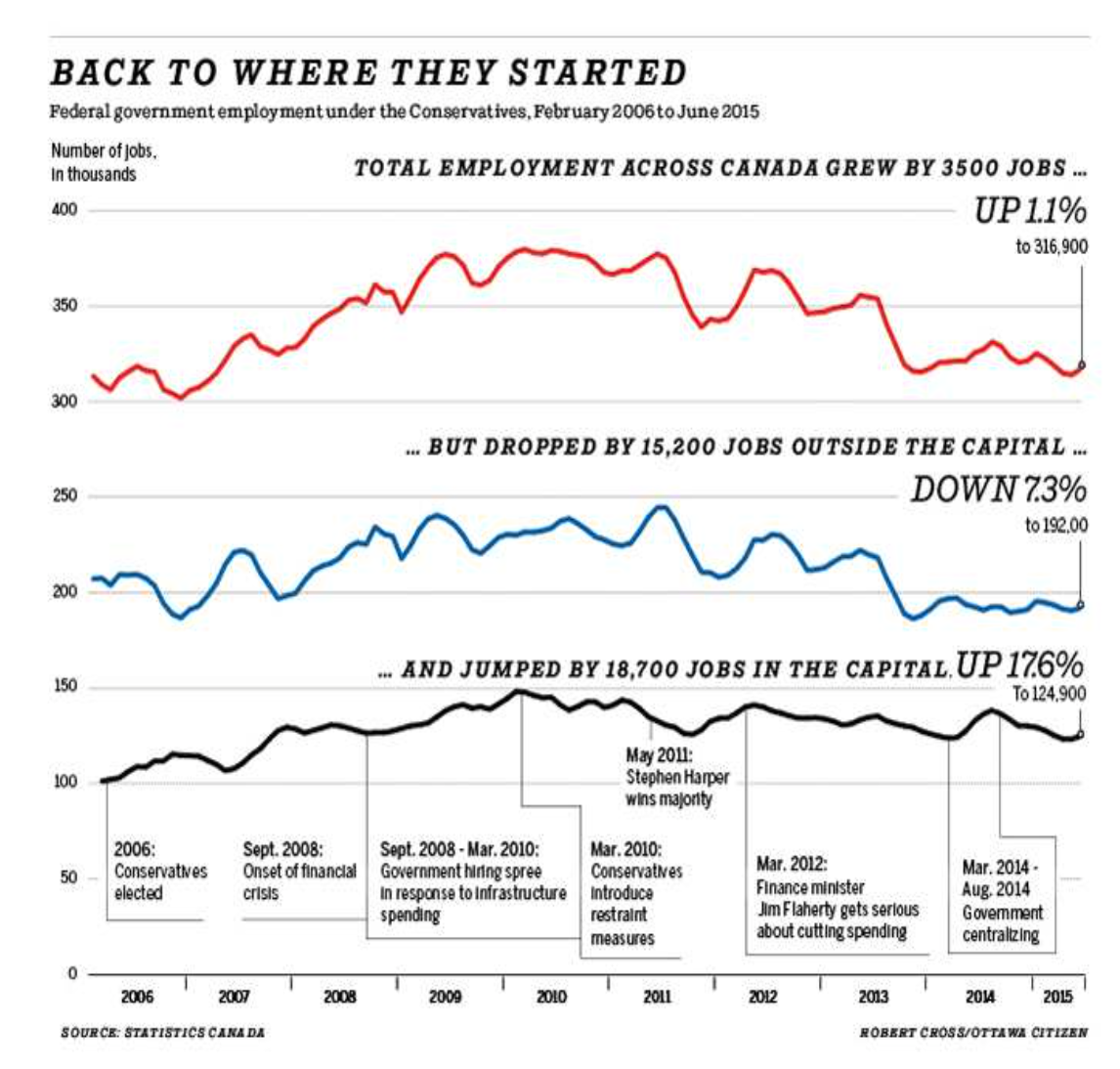
Back_to_the_beginning__the_Conservatives_burst_a_hiring_bubble_of_their_own_making___Ottawa_CitizenGood analysis by James Bagnall on public service employee number swings. Most interesting figure for me was shift from the regions to Ottawa/Gatineau (from 33.9 to 39.4 percent), reflecting in part that the decisions are made in the capital, not the regions, and likely disproportionate cuts to service delivery. The controversy over the closing of Veterans Affairs example being the most public example, with cuts to CIC’s regional network being partly responsible for the dramatic decline in the number of new citizens in 2012 and 2013 :

The initial rapid rise in the size of the federal workforce was a response to the onset of the 2008 financial crisis. The thinking was that if the private sector stopped spending, government had to pick up the slack to prevent economic collapse.

When it became apparent a couple of years later that the world hadn’t ended, the Conservatives reasserted a party imperative: the budget must balance. The late finance minister Jim Flaherty began signalling restraint in 2010, then accelerated things with his March 2012 budget. An important catalyst was the introduction of executive bonus programs that rewarded managers who trimmed their budgets.

Huge swings in government employment aren’t unique to Conservatives. The Liberals under prime minister Jean Chrétien implemented equally drastic cuts in percentage terms during the mid- to late-1990s. Chrétien and his finance minister, Paul Martin, had little choice. Interest payments on the federal government’s debt consumed 31 per cent of total revenues and were growing.

Even after adding more than $150 billion to taxpayers’ debt burden, the Conservatives budget is still much healthier. Last year, debt interest represented little more than 10 per cent of revenues, thanks in large part to substantially lower interest rates than were faced by Chrétien.

An unexpected result of the Conservative government’s recent retrenchment has been a sharp rise in the percentage of public sector employees based in the National Capital Region. According to data compiled by Statistics Canada, 39.4 per cent of the federal government’s workforce in June lived in Ottawa or Gatineau – compared to just 33.9 per cent when the Conservatives were sworn in almost nine-and-a-half years ago.

Indeed, had it not been for this centralization, the economy of the National Capital Region might have dipped perilously close to recession. Another way to look at it: From early 2006 to mid-2015, the Conservatives added 18,700 government jobs in Ottawa and Gatineau – and took away 15,200 from the rest of the country. Among the federal departments disproportionately hurt by the job losses were Veterans Affairs, Agriculture, Defence, Employment and Environment – organizations with a strong presence nationally.

Whoever wins the federal election will find much within the government’s workforce in need of repair – and many employees who would like to see an end to the wild swings of the past 20 years.

Back to the beginning: the Conservatives burst a hiring bubble of their own making | Ottawa Citizen.

Cohen: Canada’s ambition deficit

Andrew Cohen captures it (building on his earlier book, The Unfinished Canadian):

This costs money, and we are cheap. Our new ethic is low taxes, in which a cloying federal government returns money to Canadians, as it did last week in child benefits, rather than make hard decisions for the public good. Or, governments ask Canadians to approve tax increases in referendums, as in British Columbia, evading responsibility for governing.

Today’s deficit is no longer about money. It’s about ambition.

Cohen: Canada’s ambition deficit | Ottawa Citizen.

Mel Cappe on ideology over evidence

Well worth reading the entire issue of Policy Magazine (I previously highlighted Kevin Lynch’s more general commentary Canada’s public service and the new global normal of change).

I particularly liked former Clerk Mel Cappe’s commentary:

However, that requires Ministers to ask policy questions before they find policy solutions. It requires prime ministers to be open to evidence convincing them of the importance of the issue at hand, an analysis of the effects of the problem on Canadians, and the development of policy options and approaches that could be elaborated to deal with the problem.

This model presumes ministers and PMs asking questions before they have answers: has violent crime increased or decreased in Canada and why? It presumes that we would invest in data collection with quality assurance to ensure that we know who we are, the problems we face and possible policy avenues to address them: for instance, a long form census instead of a voluntary national household survey.

In this model, the demand curve of ideas in the market for public policy is robustly shifted out and to the right. It still slopes downwards, but it values ideas. The marginal value of the last idea is significantly positive. Unfortunately, now that ministers ask fewer questions and demand less of their public servants, the marginal value of the last idea is very large. But it is not actually leading to increased use. Curiosity is a prerequisite for vigorous public debate.

The more that ideology plays into the picture, the more that answers are provided before the questions are posed. If you have ideology you don’t need evidence.

…Quality public policy requires a fine understanding of the nature of the problems that afflict us, of the impacts of alternative policies and an analytic basis for informing public policy. This requires a robust evidentiary basis for the market in ideas. It requires a vigorous, analytic and highly educated public service to do the analysis. And most importantly, it requires ministers who will ask tough questions, be open to the evidence and be prepared to make their decisions informed by that evidence and analysis.

Public Service in the Digital Age

Planning guru Larry Beasley on a monumental controversy

Good and interesting interview on how the Government’s political politicization of the memorial differed from the normal practice, fuelling the controversy:

Q: So what changed? What went wrong in the case of the victims of communism memorial?

Two things happened. One is that, several years ago, the responsibility for managing the conceptualization, as well as the implementation of monuments, moved away from the National Capital Commission, which is one step removed from government, and shifted over to [the Department of Canadian Heritage].

Second, in more recent times, the governments of the day have been more interested in using monuments and memorials to communicate themes. In the past, memorialization was not so much a part of the government’s communications strategy. Some of the more recent memorials have been sponsored by the government and have been communication vehicles for government.

Q: Such as?

The 1812 memorial on Parliament Hill, for example, is a good indication. That was a part of a whole communications program the government has. I’m not trying to interpret the politics of why that was the case, but it was the case.

Q: The process was less political in the past?

In the past, what tended to happen is that organizations would come to the NCC. The NCC has a very well-articulated policy on the location of monuments according to their stature, saving certain sites for the primary monuments of the country, identifying sites where monuments were appropriate. That was managed through the NCC, at arm’s length from government, working with the sponsoring organizations.

In recent years, there have always been competitions, truly independent panels, the advice of our committee, and other kinds of advice. The projects then move forward.

Q: And that didn’t happen in the case of the victims of communism memorial?

As I understand it, the monument is basically sponsored by the government and has been implemented through a department of the government. The NCC is put in the position of an approval authority, but it’s much more constrained than if it was managing the project from the beginning.

Planning guru Larry Beasley on a monumental controversy.

Canadians deserve stronger response on assisted death

More on the lack of balance on the assisted death advisory panel (see earlier Federal government appoints panel to review assisted dying but critics fear bias):

Just as importantly, to improve end-of-life care there needs to be a commitment and investment in palliative care – but that is a complement, not a substitute, for right-to-die legislation.

A panel of experts could be helpful in making recommendations. But the threesome chosen by the government features Harvey Max Chochinov, the Canada research chair in palliative care at the University of Manitoba; and Catherine Frazee, former co-director of the Ryerson-RBC Institute for Disability Studies Research and Education, both of whom are opponents of assisted death; and Benoît Pelletier, a constitutional law professor at the University of Ottawa and proponent of asymmetrical federalism (meaning he’s not a big believer in federal legislation).

The three are top-flight academics but they come to the table with clear biases – or a perception of bias – that strips the exercise of any real credibility. There is little doubt the government wants them to recommend the most restrictive rules imaginable.

This is an issue that cries out for rules that are consensual and compassionate, not restrictive and partisan. The nitty-gritty of right-to-die legislation should be determined by an all-party committee of elected representatives.

Let’s not forget the most important admonition of the Supreme Court, that denying the choice of a hastened death to those who are suffering “intolerably and permanently” amounts to cruel and unusual punishment. Delaying a correction to this injustice is doubly and unnecessarily cruel.

Canadians deserve stronger response on assisted death – The Globe and Mail.