StatsCan to unveil new ‘efficient’ long-form census for 2016

Good example of the public service doing its job and preparing for a possible change:

When the Liberals were sworn into office in November, one of their first orders of business was to announce the reinstatement of the long-form census.

The timeline seemed very tight — the first forms are to go out to residents in the North in February.

But Marc Hamel, the census program director general, says the agency had planned for risks associated with the 2016 census. One of those risks was if a new government decided to bring back the long questionnaire.

“It had already been in the public sphere that opposition parties last year were saying, if they were elected, they would bring back the mandatory long-form census, so we had started to look at how that would be possible,” Hamel said in an interview.

The agency decided to design the questionnaire in a more adaptable format.

Rather than sending selected households separate pieces of mail with the short form and then the National Household Survey, the questionnaires were integrated into one document.

“That design was going to be efficient and it was going to work for both approaches,” said Hamel. “From that perspective, no redesign was required. We were simply able to move ahead with the same questionnaires that we had already designed for 2016.”

Also, because most Canadians fill out the census online — 64 per cent in 2011 — changing details in a computer system was not a major overhaul.

The letter that accompanies the questionnaires will allow the agency to underline that the long part is mandatory again. Census staff will also drive home the message.

Fewer people will have to fill out the long form than last time, one in four households rather than one in three with the NHS. Statistics Canada has had to print more short-form questionnaires as a result of the change.

The agency doesn’t think it will save money with fewer people getting the bigger package. It expects it will have more responses to process because of the return to the mandatory format.

The main challenge will come from adjusting to the data logistics of bringing back the long-form census. Bar codes help the agency keep track of where they drop off which forms and some of that work will have to be rejigged.

There will also be a public awareness campaign to make sure that people realize they need to fill out the forms. Hamel says the agency never really emphasizes the penalties associated with not filling out the forms — a $500 fine or up to three months in jail, or both.

“Census information is really important, and that’s where we put the focus,” said Hamel.

“What do we use the census information for, why is it important for communities, and why is it important for people to participate.”

Source: StatsCan to unveil new ‘efficient’ long-form census for 2016 – The Globe and Mail

And one of the new challenges:

Quinn Nelson wants to be counted in the 2016 long-form census, but when it comes to the question of gender identity there’s a problem: Nelson is transgender and identifies as neither male nor female.

“As a non-binary person, often when I fill out forms there’s only two options given to me and that’s not enough for me,” Nelson said in an interview on CBC’s Power & Politics.

In November, Nelson wrote an email to Navdeep Bains, the minister responsible for Statistics Canada and the census. Nelson didn’t want to violate the law by not filling out the questionnaire.

The University of Calgary sociology student also wanted to make sure Statistics Canada was going to provide an accurate reflection of the country.

The census assumes that 100 per cent of the respondents can answer that they are either male or female, “and that’s not accurate,” Nelson said.

“The census is used by a lot of policy makers, sociologists and government officials to make decisions. They really need to know what their population is. That’s the point of the census.”

….Bains hasn’t responded to Nelson, but Statistics Canada did. Deputy chief statistician Connie Graziadei said the 2016 census questionnaire had already been approved and published, but there is an option for Nelson.

“I was told to answer neither, to leave the question blank; also to answer in the comments why I found the question inadequate.”

Transgender student says some Canadians need 3rd option for gender on census
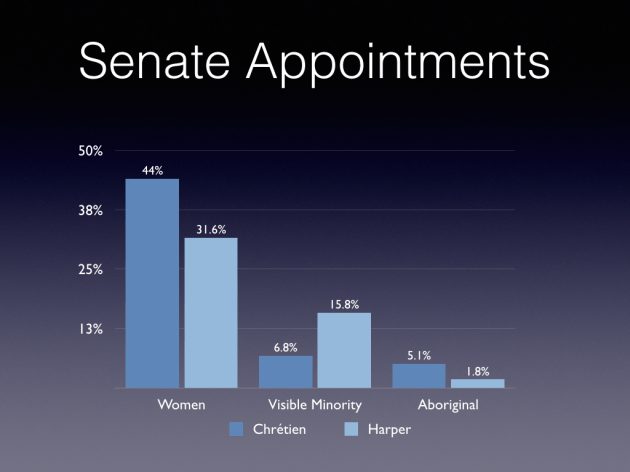
Diversity of Senate Appointments – Comparing Chrétien and Harper

Senate Appointments.001Given the push for gender parity and greater diversity in upcoming Senate appointments (see Trudeau urged to create gender-balanced Senate), I thought it might be interesting to compare the Chrétien and Harper records with respect to diversity.

Chrétien, with his 75 appointments, achieved close to parity for women, with aboriginal peoples slightly over-represented. Visible minorities were under-represented, however.

Harper with his 57 appointments, in contrast, slightly over-represented visible minorities while under-representing women and aboriginal peoples (the fewer number of appointments over a comparable time period reflects his decision to stop appointing senators in response to the Duffy and other scandals).

Will see what PM Trudeau and the advisory body come up with.

John Ibbitson’s take on how gender parity would result in a more ‘progressive’ Senate:

 The other reason Trudeau would want gender parity in the Senate 

Justin Trudeau Urged By Advisers To Be Innovative In Era Of Big Change

Not easy challenges:

Justin Trudeau’s advisers are warning that the federal government needs to do a better job of connecting with Canadians — especially online — in order to keep pace with ever-evolving public expectations.

The new landscape is being shaped by policy complexity, rapid technological change, limited finances and increasing demands for citizen involvement, say internal briefing memos prepared for the prime minister.

More and more, people expect the government to include them early and often in the design of policy and programming choices that affect them, say the notes, obtained by The Canadian Press under the Access to Information Act.
“There is a gap in Canada between how citizens communicate with each other and with private sector service providers (e.g. banks) and their experience with the federal government,” says one memo.

In order to remain relevant to Canadians, the government needs to focus on delivering high-quality, factual digital content.

However, government is often bogged down by red tape, the need for signoffs from various layers of management and barriers to effectively spending money and assigning people to tasks, the notes say.

The memos point out other problems and hurdles:

  • the access-to-information system that allows people to make formal requests for government files is “time-consuming and expensive to administer”;
  • Canadians are “broadly concerned and uncertain” of how the government uses their personal information, whether it be for law enforcement, national security or other purposes;
  • the government is grappling with cyberthreats to its information holdings from so-called ‘hacktivists,’ criminals and others.

The notes suggest updating the outmoded 2006 federal communications policy to reflect the “voracious demand” from Canadians for online information and the rising use of mobile devices.

Information published on the prime minister’s website and social media accounts must be factually accurate and non-partisan — tenets that should be enshrined in a new communications policy, the advisers say.

Government advertising is seen to be “partisan in nature” at times, another shortcoming that must be addressed in the revised policy, the notes stress.

The Conservative government was pilloried by critics for lavish multimillion-dollar ad campaigns that seemed to convey little useful information.

The Privy Council Office is already working with Treasury Board officials to ensure potential amendments to the policy include “clear accountabilities for non-partisanship” when it comes to ads.

Source: Justin Trudeau Urged By Advisers To Be Innovative In Era Of Big Change

ICYMI: How the federal government centralized under the Tories

Potential reasons for the increased centralization:

Several months before then-prime minister Stephen Harper called the 2015 federal election, the size of the federal workforce dipped below 314,000 — practically the same level as during the earliest months of his nearly decade-long reign.

But there was nothing remotely stable about what happened in between, when federal departments and agencies swiftly added more than 65,000 workers, then just as quickly cut the positions that had been created.

The topsy-turvy environment did little for efficiency, morale or clear thinking. But one unexpected result was a pronounced centralization of government in the National Capital Region.

It was a surprise because the Conservatives are strongest in the regions and outside the urban core, and might have been expected to shift some government operations away from the capital.

Yet the percentage of federal government employees working in Ottawa-Gatineau jumped to 39.3 per cent of the total last May from 33 per cent in May 2006, according to data supplied by Statistics Canada. The numbers are unadjusted for seasonal influences, but they are compiled using three-month moving averages to smooth out fluctuations.

Since May, the centralizing trend has reversed somewhat, but this reflects the one-time impact of the Oct. 19 federal election — which featured a mini-hiring boom of election helpers, mostly outside the capital region. Even so, the number of federal government workers in Ottawa-Gatineau — 131,500 in November — was 38.4 per cent of the total.

The question is: Why did the concentration here rise? It’s unlikely top bureaucrats deliberately set out to achieve this result.

….This is in sharp contrast with the situation in the late 1990s, when the federal government last embarked on a major downsizing. At the peak of the tech boom, the percentage of the federal government workforce based in Ottawa-Gatineau slipped to just 30 per cent of the total, as many former government employees jumped to fast-growing firms in the private sector.

Another factor that might have supported the recent centralizing pattern has to do with the internal politics of federal departments. Employees close to the head office are likely better able to safeguard positions here — or to identify other positions in the capital that might soon come open.

Whatever the reasons for the move to the government core, it presents the new Liberal administration with an interesting choice. The government’s spending plans suggest more hiring is in store for federal workers. Liberal cabinet ministers might find it difficult to resist the urge to steer new hiring to where the economy is weakest.

I would not underestimate the internal politics or dynamics which tend to guard headquarters more than regions.

Source: How the federal government centralized under the Tories | Ottawa Citizen

ICYMI: Trudeau must clarify ‘unwritten’ PS rules: expert panel

Always interesting, the views of Kevin Lynch and others on the panel. Personally, not sure about the proposed solutions but report is raising  the right questions:

For the public service, the first thing to do is clarify the “conventions” or unwritten rules underpinning its role on policy advice, as well as carrying out programs and delivering services, says the panel.

Lynch said that clarity should come in a statement from the prime minister. He said the statement should be made in Parliament, with all-party support, and would be the benchmark for future behaviour.

After the sponsorship scandal of the Chrétien era, the Conservative government under Stephen Harper passed legislation that beefed up the role and responsibilities of deputy ministers, making them “accounting officers” responsible for the management of their departments.

The panel wants deputy ministers to also annually attest to measures that ensure regular meetings between the minister and deputy ministers, as well as working relationships between the minister, minister’s office and departmental officials.

Deputies would also have to attest to the “highest levels of integrity and impartiality” in the department on policy advice, program delivery, regulatory administration and departmental communications. They would have to confirm departments have the policy capacity to deliver the government’s agenda and handle the study of long-term issues.

The department would also be expected to consult Canadians and use digital technology to stay abreast of the public’s views when developing policies and programs.

Many argue the existing legislation for “accounting officers” covers much of this territory because deputy ministers are responsible for following all Treasury Board policies and the code of conduct.

Lynch said the panel was intent that its report, published by the Public Policy Forum, not be shelved without debate so it is taking the discussion on the road. He and other members are touring the public policy and management schools at universities across the country to discuss the proposals.

Academics and public management experts have sounded the alarm for years on the deterioration of Canada’s democratic institutions as more power was centralized in the Prime Minister’s Office. Many argue the problems got worse under the Conservative government.

Lynch said the panel is proposing “practical” fixes that could be done quickly without changing the constitution and new legislation.

A big problem for the public service is the mushrooming army of political staffers led by the PMO, the “political service” that has taken over some of the work of the public service.

Politicians began to rely on staffers for ideas and advice, sidelining the public service. As a result, the public service didn’t use, and thus lost, some of its policy capacity, and deputy ministers ended up more connected to the PMO than their ministers.

The panel recommended a new code of conduct for political staff that would clearly spell out the roles and duties of public servants and what political staff can do. It also urged more training and an oversight body for political staff.

Trudeau introduced a new code of conduct for staffers in his updated Guide to Ministers.

But Lynch said “short-termism” and political parties being in “permanent campaign” mode have changed the nature of the work of the public service and its relationship with politicians.

“This is not about going back to the good old days,” said Lynch. “These broad trends are happening regardless and what we have to do is figure out — given that reality — the checks and balances that will ensure (our institutions) work they way they are intended.”

Politicians are racing to keep up with today’s rapid, “technology-driven round-the-clock news cycle.” Parties are seen to be always in campaign mode and focus on short-term issues for political gain rather than long-term policies and strategies. Public servants, however, are supposed to be neutral and have no role in campaigns.

“We have drifted into a period of permanent campaigning, which is an American phenomenon …. which is not a good thing for the role of the public service because it doesn’t have a role in a campaign, said Lynch.

“Political parties operate less as a government and more as a party for re-election so the more we get into permanent campaign modes, it changes the relationships and not necessarily in good ways.”

Lynch argued that once the governance issue is fixed, the next challenge for the public service will be changing the way it does policy in a world driven by big data and analytics. Public servants must learn to manage risk; they will have to become innovative and use more open communications and using social media.

Source: Trudeau must clarify ‘unwritten’ PS rules: expert panel | Ottawa Citizen

Implementing diversity and inclusion in Parliament: A more complete picture | My piece in the hilltimes.com

With the appointment of parliamentary secretaries and opposition critics, we now have a more comprehensive picture of gender and visible minority diversity in Parliament’s leadership positions. How well has the Liberal government implemented its overall diversity and inclusion commitments, and how have the other parties responded to the “because it’s 2015” challenge?

Although Prime Minister Justin Trudeau appointed a Cabinet with gender parity (15 each of men and women) and almost 17 per cent visible minority ministers (four Sikh and one Afghan Canadian), gender parity was not attained for parliamentary secretaries (12 positions out of 35 or 34 per cent). Visible minority parliamentary secretaries are over-represented (nine positions or 24 per cent) in relation to their share of the voting population (15 per cent).

Moreover, the government addressed some of the criticism regarding Cabinet over-representation of Sikhs by appointing three African Canadians, one Chinese, one Arab, one Latin American and three South Asians (two Sikhs, one Ismaili Muslim). Three of the nine visible minority parliamentary secretaries are women, including Celina Caesar-Chavannes, a parliamentary secretary to the Prime Minister.

In total, of the 68 leadership positions (ministers, parliamentary secretaries, whips, and House leaders), 59 per cent are men, and 21 per cent are visible minority men or women. The detailed breakdown is shown in the chart below:

In terms of percentage of caucus, there are 27 women in leadership positions out of 50 elected, or 54 per cent. For visible minorities, there are 14 out of 39 elected, or 36 per cent. In contrast, 30 non-visible minority men are in leadership positions out of 134 elected, or 20 per cent.

No matter how one looks at the data, this marks a major shift in government parliamentary leadership appointments, towards more women and visible minorities.

The Conservative official opposition compensated for their relatively low number of women MPs (17 per cent of caucus), making 35 per cent of critics women (the Harper government’s last Cabinet similarly appointed more women to Cabinet—31 per cent—compared to the 17 per cent in caucus).

However, with a small number of visible minority MPs (six or six per cent of caucus), critic visible minority representation is only slightly compensated at nine per cent, although visible minority MPs form 13 per cent of the smaller number of deputy critics. But in relation to caucus membership, 50 per cent of visible minority Conservative MPs are critics, reflecting again the same drive to present a more inclusive face to Canadians.

The NDP opposition has the largest proportionate female caucus representation: 41 per cent. It is no surprise that women MPs form 45 per cent of critics. With only two visible minority MPs to choose from, only one (three per cent) is a critic (but again, this is 50 per cent of those elected).

So what does all this mean in terms of diversity and inclusion?

The Liberal government, given the large number of women (50) and visible minority (39) MPs elected had little difficulty in meeting its stated goals of Cabinet gender parity (but slipped in other leadership positions). It also was able to significantly exceed visible minority representation in relation to the number of visible minority voters.

This ‘over-representation’ reflects a conscious decision to demonstrate diversity and inclusion, one that started with having the highest percentage of visible minority candidates (17 per cent) compared to the other major parties (13 per cent).

For both opposition parties, the weakness in visible minority representation reflects the small number of visible minority MPs elected. With respect to women, the Conservatives responded to the ‘because its 2015’ challenge, compensating for their small number of women MPs, and applying the same approach to visible minorities. The NDP made the most effort in recruiting female candidates, many of whom were successful, and thus close to gender parity was not a challenge.

All in all, taken together, the Liberal leadership positions reflect a significant implementation of the diversity, inclusion and multiculturalism agenda, one that, given the horizontal ministerial comment for parity and diversity in all government appointments, holds significant promise in ensuring greater representation in government.

Moreover, to the extent that the opposition parties could, their choices recognize the need to respond to this agenda and ensure that their leadership reflects Canadian diversity.

Source: Implementing diversity and inclusion in Parliament: A more complete picture | hilltimes.com

Improving public access to information will make government better, Trudeau says

Something to watch:

During the election campaign, the Liberals said government data and information should be open by default, in formats that are modern and easy to use.

Trudeau has asked Treasury Board President Scott Brison to work with Justice Minister Jody Wilson-Raybould on a review of the access law to ensure the information commissioner is empowered to order government files to be released — something she cannot do now.

He also wants Canadians to have easier access to their own personal information and says the law should be extended to ministerial offices — including his own — as well as to the administrative institutions that support Parliament and the courts.

In addition, Trudeau has directed Brison to accelerate and expand open-data initiatives and make government data available digitally.

In the interview, the prime minister made it clear he was not wedded to those changes alone.

“Access to information is about better governance, and it’s about ensuring that the decisions we take are thoroughly justifiable on a broad level,” he said. “And that’s not always easy, but it is certainly what’s going to lead to better outcomes.”

In a broad sense, the federal government must dispense with the notion that secrecy is necessary for decision-making behind the doors of cabinet, caucus and the bureaucracy, said Sean Holman, an assistant professor of journalism at Mount Royal University in Calgary.

“That’s really the test of openness for any kind of access-to-information reform in this country.”

Certain classes of records, such as audits and ministerial calendars, should be released as a matter of course so “we get used to the idea that government should be operating in the sunlight, not in these darkened, private spaces,” he said.

Legault tabled a report earlier this year recommending dozens of changes to the access law — the latest in a long line of calls for reform. She welcomes the prospect of a federal review, but hopes it happens “in a timely manner.”

Holman said history suggests the Trudeau government’s planned study will lead nowhere.

“The fact that this isn’t something the government appears to be doing immediately is concerning in and of itself,” he said.

“The longer governments stay in power the more seductive secrecy becomes.”

Source: Improving public access to information will make government better, Trudeau says

Tories call for probe of public servants who aided report on tax agency

Valid concerns regarding the breach of the impartiality of the public service, not just leaking of documents (which also is problematic):

The Conservatives are calling for an investigation into claims that Canada Revenue Agency employees teamed up with an advocacy group for a report that alleges mismanagement and political interference in tax investigations that cost billions in uncollected revenue.

Conservative MP Ziad Aboultaif, the party’s national revenue critic, said the involvement of public servants in such a report during an election is “disturbing” and shouldn’t be ignored just because a new government was elected.

“I would hope that the Minister of National Revenue realizes the seriousness of this and is investigating the supposed wrongdoing, not ignoring it because the incident took place under the previous government,” said Aboultaif.

“There is a principle involved here; it is not about party politics. Canadians expect their public service to be both professional and neutral.”

The report, by Canadians for Tax Fairness, was based on 28 interviews with former and current auditors and other tax specialists. They alleged the agency is mismanaged, undermined by major budget cuts, and that it targets ordinary taxpayers over the “big-time tax cheats” hiding money offshore.

Public servants are supposed to be non-partisan and loyal to the elected government. They face even stricter limits on their behaviour during an election.

Aboultaif argued neutrality is part of the job and that public servants give up the right to criticize government policies when they join the public service.

“Public servants take an oath of office and agree to abide by a code of ethics while employed in the civil service,” he said.

….So far, the Canada Revenue Agency has rejected the report’s allegations as unfounded. It said it was unable to determine if the ethics code was breached because it didn’t know who the employees were.

Donald Savoie, Canada Research Chair in public administration and governance at the University of Moncton, has written books on how the traditional “bargain” or relationship between public servants and politicians is broken. He says this case is one of the most blatant violations yet.

“If public servants become political actors, which is what is happening here, that is just not how the Westminster system was conceived. We are reshaping fundamental tenets of the system on the fly without any reflection or debate.”

Savoie argued this is an issue that warrants the attention of Prime Minister Justin Trudeau to clarify what is expected of public servants today.

“This is a government issue, not a CRA issue. It should be raising alarm bells in the Privy Council Office and Treasury Board because it goes to the heart of the fundamental role of the public service.

“I think the prime minister, cabinet and head of the public service should be responding.”

Source: Tories call for probe of public servants who aided report on tax agency | Ottawa Citizen

The earlier article ICYMI:

Source: Public Servants ‘blow the whistle’ on tax system shortfalls | Ottawa Citizen

Inside Justin Trudeau’s ‘turbo-Zen’ army: Wells

My favourite quote from this good overview of the Liberal government’s ambitious agenda and working methods. Well worth reading in its entirety:

(Muscle memory is turning out to be a constant challenge for the Trudeau crew as they work with the federal public service to implement their stacked agenda, after Stephen Harper spent a decade trying to dampen bureaucratic enthusiasm. In meetings on refugee resettlement, the Trudeau adviser said, “It became clear early on that [bureaucrats’] overriding objective was not to get yelled at. We had to say, ‘Guys, that’s not how we’re going to work.’ ”)

And this quote on tone:

But much of the tone comes from the Prime Minister himself. In early group conversations in the Langevin Block where the government’s top political staffers and bureaucratic advisers work, Trudeau has often been the one who cuts conversations about the day’s worries short and reminds others to consider the long-term goal, people familiar with those meetings said.

“He’s got 320 campaign promises, and four years to deliver them, and he really wants to ensure they don’t get off track,” the longtime observer said. And so participants describe a peculiar characteristic of the Trudeau government in its early days: despite the rush to deliver on commitments and the early hiccups of botched plans or unforeseen catastrophe, the general atmosphere has been one of eerie calm. Turbo schedule, Zen attitude.

“Totally Zen about headlines,” the Trudeau adviser said. “How do you think we survived the last six months?”

The longtime observer confirmed the self-diagnosis. “If the nanny thing had happened to Harper, his PMO’s reaction would have been, ‘Who do we shoot?’ ”

And on implementation of the longer-term view:

But the long-range focus is not merely a matter of Trudeau’s personal style. It is baked into the design of his government. “Right from the get-go there was a keen desire to make sure we focused on results and pacing of delivery,” Peter Harder, a former deputy minister who ran Trudeau’s transition team, said in an interview. The most visible sign of this is the most important cabinet committee. Under previous governments it would have been called “priorities and planning.” Under Trudeau it’s called “agenda and results.” Its goal is to relentlessly track progress against targets to make sure the government delivers on its agenda items. “It’s never been done before,” Harder said. “Our cabinet committees [in previous governments] have always been focused on incoming events, not on stocks of results.” The agenda and results membership list includes three ministers who are often named among Trudeau’s closest personal confidants: House leader Dominic LeBlanc, Heritage Minister Mélanie Joly and Economic Development Minister Navdeep Bains.

Source: Inside Justin Trudeau’s ‘turbo-Zen’ army – Macleans.ca

Liberals Urge 33 Of Harper’s Political Appointees To Resign Voluntarily

Interesting that of the 39 letters, 1 is to a citizenship judge (Roy Wong) and four to appointees to the IRB:

Liberal MPs urged dozens of Conservative political appointees Monday to follow the federal government’s request and voluntarily resign from positions to which they were appointed in the dying days of Stephen Harper‘s government.

Last summer, Harper’s cabinet approved the appointment or term extensions for 49 people, whose positions took effect only after the Oct. 19 election.

The Prime Minister’s Office is particularly incensed over the unusual, and extraordinarily high, $1-million-plus severance packages that some appointees negotiated with the Conservative government. In total, taxpayers could be on the hook for $18.5 million to break the contracts.

Thirty-eight people were appointed to terms that took effect between Oct. 20, 2015, and Dec. 30, 2015. Ten people were appointed to terms starting in 2016 and one extreme case was to start in 2019. But John Badowski, the chairperson of the Transportation Appeal Tribunal of Canada, resigned his future appointment last week before being formally asked. 

Given that the Government has expressed its lack of confidence in these appointees, it would be wise for them to voluntarily resign.

Source: Liberals Urge 33 Of Harper’s Political Appointees To Resign Voluntarily