How the parties collect your personal info — and why Trudeau doesn’t seem to mind: Delacourt

Great piece by Delacourt:

Numbers are definitely in fashion in the new Liberal government at the moment — and not just because the budget is landing next week.

A first-ever session on “behavioural economics” for public servants was filled to capacity last week, according to a Hill Times report. “Combining economics with behavioural psychology,” said PCO spokesperson Raymond Rivet, “this new tool can help governments make services more client-focused, increase uptake of programs, and improve regulatory compliance.

Better government through behavioural economics — the idea was popularized by the 2009 book Nudge and almost immediately adopted through the establishment of a “nudge unit” by the British government in 2010. Justin Trudeau’s government is already borrowing the concept of “deliverology” from the Brits, so the ‘nudge’ was never going to be far behind. President Barack Obama, Trudeau’s new best friend, also has taken steps to introduce nudge theory to the U.S. government in recent years.

But the real motivation for data-based governance in the Trudeau government may have come from a source much closer to home — the recent election, specifically the Liberals’ extensive use of big data to win 184 seats last fall. Make no mistake: Trudeau’s Liberals may have won the election by promising intangibles like ‘hope’ and ‘change’, but they sealed the deal with a sophisticated data campaign and ground war.

So now that the Liberals have seen how mastery of the numbers can help win elections, we probably shouldn’t be too surprised that they see those same skills as useful for governing as well. Big-data politics is here to stay.

What’s missing from that equation, however — at least on the political side — is privacy protection. Late last week, while everyone’s attention was fixated on Washington, federal Privacy Commissioner Daniel Therrien reminded a Commons committee that all the political parties are amassing data on voters without any laws to guard citizens’ privacy.

“While the Privacy Act is probably not the best instrument to do this, Parliament should also consider regulating the collection, use and disclosure of personal information by political parties,” Therrien told the Commons committee on access to information and privacy.
A little more than a year ago, it seemed that a new Liberal government could be expected to agree with the privacy commissioner.
Recall last year’s conference on “digital governance” in Ottawa; on stage for one panel discussion were key strategists for the three main parties — Tim Powers for the Conservatives, Brad Lavigne for the New Democrats and Gerald Butts for the Liberals. Mr. Butts is, of course, now Trudeau’s principal secretary.

Fielding questions from the audience, the three were asked whether political databases should be subject to Canadian privacy laws. Powers and Lavigne demurred; only Butts seemed to be saying ‘yes’.

Here’s his lengthy quote, which appeared a few weeks later in an iPolitics column by Chris Waddell:

“Let’s not kid ourselves, political parties are public institutions of a sort. They are granted within national or sub-national legislation special status on a whole variety of fronts, whether they be the charitable deduction, the exemption from access to information — all those sorts of things,” Butts told the conference.

“We have created a whole body of law … or maybe we haven’t. Maybe we have just created a hole in our two bodies of law that allow political parties to exist out there in the ether. I think that is increasingly a problem and it is difficult for me to envision a future where it exists for much longer.”

That was a year ago. And unless I missed it, there’s nothing in any of Trudeau’s mandate letters to ministers about new privacy laws for political parties. And without giving away too much about the new chapters of my soon-to-be-re-released book on political marketing, I didn’t get the impression during our recent interview that Prime Minister Trudeau was greatly troubled by the collision between privacy protection and political databases.

It seems odd to me that citizens can get (often appropriately) worked up about “intrusive” government measures, whether it’s the census or the C-51 anti-terrorism law, and yet be mostly indifferent to what the chief electoral officer has called the “Wild West” of political data collection.

Even Conservatives who resented the gun registry didn’t seem to mind that their own party was keeping track of gun owners in its database, so that it could send them specially targeted fundraising messages from time to time. That’s just behavioural economics, applied to the political arena.

So far, British Columbia is the only province to take steps to put political databases in line with privacy protection. The provincial chief of elections in B.C., Keith Archer, notified political parties that they would not get access to the voters’ list — the raw material of any political database — if they failed to comply with privacy laws.

That step could — and should — be implemented in Ottawa, too. We’re in the era of big-data politics and behavioural-insight governance, and Canadians are entitled to some accountability about the data the governing party is collecting and using on them.

Not so long ago, one of Trudeau’s most senior advisers agreed with that idea. Maybe all it takes is a little nudge.

Source: How the parties collect your personal info — and why Trudeau doesn’t seem to mind – iPolitics

Charities push back against Liberals on political audits

Interesting given that the mandate letter of National Revenue Minister Diane Lebouthillier includes the following commitment:

Allow charities to do their work on behalf of Canadians free from political harassment, and modernize the rules governing the charitable and not-for-profit sectors, working with the Minister of Finance.  This will include clarifying the rules governing “political activity,” with an understanding that charities make an important contribution to public debate and public policy.  A new legislative framework to strengthen the sector will emerge from this process. –

Apparently, this will only be on a go-forward basis:

Some Canadian charities are reviving a campaign to get tax auditors off their backs after the Liberal government delivered what the charities say is a half-measure in ending “political harassment,” a promise from the 2015 election campaign.

At least 14 charities, including the Sierra Club Foundation and the World Wildlife Fund, launched a letter-writing campaign and petition this week calling on the Liberal government to stop all political-activity audits started by the Harper Conservatives in 2012.

“Charities under audit for political activities from the previous government are still under audit,” says a statement on a website, created by a charities coalition last year.

“These audits need to end immediately. Reform of the rules that allowed these audits must begin.”

Some 54 charities were caught by CRA’s political-activities audits, and five were given notice they would lose their charitable registrations, meaning they could not offer tax receipts to donors.

Critics have said the rules restricting political activities are unclear, and that the audits effectively gagged some groups, a phenomenon dubbed “advocacy chill.”

Optimism dampened

The charities sector had been heartened by the Liberals’ platform, which promised to “allow charities to do their work on behalf of Canadians free from political harassment.”

But the optimism was soon dampened. On Jan. 20, National Revenue Minister Diane Lebouthillier said 24 political-activity audits currently underway will continue their course, and the five groups under notice of deregistration will not be spared, though they can appeal.

The only change was that auditors would be stood down in six cases of charities scheduled for political-activity audits that had not yet begun, and the $13.4-million program would eventually be wound up.

Tim Gray, executive director of Environmental Defence, which is facing deregistration, said in an interview: “Let’s recognize what actually happened with the previous government and put an end to this.

“We are trying to escalate the importance of action on this issue. So we’re going to relaunch and encourage people to contact the minister and the prime minister to get them to act on their commitments.”

Source: Charities push back against Liberals on political audits – Politics – CBC News

Public servants flock to PCO’s first-ever behavioural economics briefing

I am a fan of nudges and Kirkman captures the reality that current politics already incorporate nudges, and so the question is more what kind of nudge is more effective as part of policy and program design, rather than more existential questioning.

As readers already know, I am also a fan of behavioural economics, and found the insights in Kahneman’s Thinking Fast and Slow particularly relevant to policy makers who may not be as aware of their thinking processes as needed:

Elspeth Kirkman, North American head of the Behavioural Insights Team’s head of North American operations, was asked during a presentation how she responds to criticism that she’s involved in “social engineering.” She said governments cannot get away from the fact they have to encourage certain kinds of behaviour from people, so it might as well be done effectively.

“Departments and governments are already nudging people in terms of how they present information to them, how they ask them to do things, how they structure their defaults, and all we’re doing really is being mindful about that,” she said. “We’re saying, actually, let’s just understand what the implication in the way that we’re structuring that choice is.”

Eldar Shafir, a professor of psychology and public affairs at Princeton University, told the audience that sometimes more than a “nudge” is needed when it comes to public policy.

“I’m a big fan of nudges … but nudges are a very modest attempt to interfere minimally, often at a very low cost, when you’re politically somewhat helpless, in ways that that help people,” he said.

“But there’s a lot more than that. And if you think about what policy does throughout, whether it’s the design of emergency rooms or what it takes to make a nation healthy and happy, there are profound psychological questions that lie at the core of what we do.”

When asked to elaborate in what qualifies as a nudge and what’s seen as more, Mr. Shafir noted how buildings are often designed—in terms of where stairs, elevators, and parking lots are placed—to promote physical activity, and he feels buildings that are constructed in ways to encourage certain behaviours represent the kind of policy that goes beyond nudges.

Ms. Kirkman talked about an EAST model—which stands for easy, attractive, social, and timely—for creating conditions for public compliance with government policies.

She talked about using plain language and less “legalese” to make it easier for people to understand government communications. She used an example of a U.S. city that had an unfortunate practice of sending out very technically worded letters to homeowners whose properties did not meet municipal standards.

“The letter actually starts with: ‘According to Chapter 156 and/or Chapter 155 and/or Chapter 37 in the [municipal] ordinances process, we have found your property to be in violation of inspection.’ And it kind of just goes on and on and on like this, and it doesn’t actually say, ‘Hey, you need to fix your property and here’s what’s wrong with it.’ ”

In terms of making things attractive, Ms. Kirkman used an example how different styles of texting unemployed people from a job centre in the Britain to inform them about a new supermarket that was holding a job fair. She said 10 per cent of the people notified would typically attend such a non-mandatory event. However, when people’s individual names were used in the message, that increased to 15 per cent. When the message appeared to come from the unemployed people’s employment advisers, it increased to 17 per cent. Finally, that rate increased to 26 per cent when the individuals were told their advisers had booked them a time-slot at this event.

The social aspect of encouraging certain actions is shown by Mr. Treusch’s example of publicizing how most people pay their taxes, Ms. Kirkman said.

Another factor is who conveys the message, she said. She recalled how the British government once sent letters signed by the chief medical officer that advised certain physicians to prescribe antibiotics less often, and the campaign was a success. She said the message would have been less effective with this particular audience if it came from the health minister. These physicians were also told how the majority of their peers were prescribing fewer antibiotics, she added.

An example of timeliness focused on a police force Britain that was found to be much less ethnically diverse than the community it serves. Research ultimately uncovered that most applicants of minority ethnicities were failing an online test in which they were asked how they would react, as a police officer, to certain situations.

Ms. Kirkman said it’s believed the effect of “stereotype threat” was at work, where people who are part of groups that have negative stereotypes tend to perform worse in certain instances if reminded of those stereotypes just before the task.

She said when the wording of the email asking applicants to take this test was changed to be “warmer” and contain a preamble asking them to think about what it would mean to their community if they became a police officer, the gap in success in the test between white applicants and others was closed.

Source: Public servants flock to PCO’s first-ever behavioural economics briefing |

Brand Command: Canadian Politics and Democracy in the Age of Message Control

Alex Marland’s book on branding and message control under the Harper government is now out (Marland also edited the wonderful Canadian Election Analysis 2015 – Ubcpress.ca, issued just a few weeks after the election).

Now that the ‘brand’ has changed, interesting to reflect on the Liberal government’s equally – if not stronger – branding, evident at both the PM, Ministerial and other levels:

A brand-centric approach to power involves the strategic unification of words and visuals. At the most basic level, a branding philosophy holds that communicating disjointed messages in a haphazard style is less likely to resonate with intended audiences. Conversely, core information repeatedly communicated in an uncomplicated, consistent, and efficient way to targeted subgroups is more likely to secure support for the sender’s agenda. Branding strategy positions the sender as unique, reassures audiences, and communicates aspirational, value-based, and credible messages. Repetitiveness and symmetry are crafted to pierce the clamour. A “less is more” approach to communication reinforces information and messages and does so in a resource-efficient manner that accentuates visual imagery.

Branding balances the information demands of the impassioned and the uninterested. It communicates cues and signals to distracted audiences while stoking emotional connections with those who are most loyal. It involves marketers maximizing their communications investments by promoting messages designed to differentiate the brand and to resonate on an emotional level with target audiences. It understates or ignores the brand’s flaws. It turns a humdrum interaction into a memorable experience. The resulting brand loyalty felt by the most ardent supporters is such that they can be impervious to missteps and to courting by competitors. An organization requires tenacious leadership to assert branding objectives over the demands and criticisms of other actors. The more fractured that media become, the more that party strategists and senior public servants seek to standardize and centralize their messages. The more that message cohesion, discipline, and centralization are practised, the more that society makes political choices based on images of politicians rather than on policy details. In politics, the brand unites everything.Th e rest of us need to look at political leaders, party politics, the media, and public administration through a branding lens to understand this.

…This book … is concerned with establishing that changes in communications technology are enabling the centre to enforce communications control and to implement branding strategy. This examination will provide both believers and disbelievers of the Savoie thesis with a basis for further assessment of whether the centre has too much power – and in particular a better understanding of the institutional conditions and processes related to political communications and elite behaviour. Brand Command argues that the causes of centralization are systemic, not individualistic. In this light, Trudeau’s pledge to empower cabinet and buck the forces of centralization seems idealistic. Branding strategy seeks to influence public impressions and to set and advance agendas. It is accompanied by an organizational willingness to exploit opportunities to penetrate a communications cyclone and a motivation to achieve resource efficiencies. In interviews conducted for this book, many respondents pontificated, unaided, along the following lines: “Disseminating a message in the clutter or bombardment of information that you get today is a huge challenge … One of the solutions to that is consistency of messaging, which probably explains to a large degree the centralized approach that government has taken to its communications.”

Brand Command UBC Press

Canadian woman will be on next series of bank notes, Trudeau announces

One has to admire the choreography of this announcement on International Women’s Day with other related elements: the PM’s op-ed in the Globe ( Gender equality is an opportunity, not a threat) and the announcement of DM changes, which included four women (one of whom is visible minority) and one man – because its 2016?:

The image of an iconic Canadian woman will appear on the next issue of bank notes, Prime Minister Trudeau announced today.

“A Canadian woman will be featured on the very first of the next series of bills expected in 2018,” Trudeau said.

“Today, on International Women’s Day, the Bank of Canada is taking the first step by launching public consultations to select an iconic Canadian woman to be featured on this new bill.”

The government and the Bank of Canada did not indicate which denomination would showcase the iconic female Canadian.

Finance Minister Bill Morneau, who stood alongside the prime minister with other members of the Liberal caucus and former Mississauga, Ont., mayor Hazel McCallion during the announcement, noted that it is “high time to change.”

“One of the very first things I had the honour of doing as the new finance minister was asking the governor of the Bank of Canada, Stephen Poloz, and his colleagues at the bank whether it’s in fact possible to put a woman on the bank note,” said Morneau.

The finance minister said he was told the central bank had been looking into the possibility for some time and was keen to support the initiative.

Source: Canadian woman will be on next series of bank notes, Trudeau announces – Politics – CBC News

Perception of politicization of the public service is a problem for Liberals | Ottawa Citizen

Not unexpected to hear this kind of criticism from the opposition, as well as the more-balance assessments from others:

The appointment of Matthew Mendelsohn, who helped write the Liberal election platform, as a senior-ranking bureaucrat is a “clear, unprecedented and blunt” politicization of Canada’s non-partisan public service, says former Conservative cabinet minister Jason Kenney.

Kenney said the previous Conservative government — which had a rocky and sometimes hostile relationship with the bureaucracy — would have been vilified if it “plunked” such a key election player into the top ranks of the Privy Council Office (PCO).

“The real shocker here is his appointment to a No. 2 position in the PCO, the summit of the entire public service,” said Kenney in an interview. “A fellow who worked as a partisan political Liberal on the election campaign … I don’t think there is any precedent for this.”

That perception has dogged the Liberals since Mendelsohn was appointed in December as a deputy secretary in the PCO to head a new “results and delivery” secretariat to ensure election promises are tracked and met.

Results and delivery are big priorities for the Liberals and the public service has a lousy track record at both. By all accounts, Mendelsohn is working hard to get buy-in from ministers, deputy ministers and departments on creating a “delivery culture” in government.

And there seems little debate Mendelsohn is qualified. He is an academic, founding director of the Mowat Centre, an Ontario think-tank, a former deputy minister of several provincial portfolios; an associate cabinet secretary in Ontario and a one-time public servant.

But his bona fides include a leave from the Mowat Centre to work on the Liberal platform and help pen Prime Minister Justin Trudeau’s mandate letters for ministers.

He is also part of the Dalton McGuinty-Kathleen Wynne brain trust that has joined the Trudeau government.

He worked with Queen’s Park veterans Katie Telford, now Trudeau’s chief of staff, and Gerald Butts, his principal secretary. (Mendelsohn’s wife, Kirsten Mercer, was Wynne’s justice policy adviser who moved to Ottawa to become chief of staff for Justice Minister Jody Wilson-Raybould but has since been replaced.)

“The closer you fly to the action the bigger the risk of being branded,” said David Zussman, who holds the Jarislowsky Chair in Public Sector Management at the University of Ottawa. He was recruited into PCO to help lead the Jean Chrétien government’s massive program review.

Zussman also cautions the government has to be careful about the perception that it is too Ontario-centric when staffing ministers’ offices.

“They need a national perspective in ministers’ offices and they have to be careful about that. They could all be meritorious appointments but if they all come from the same place they are not as valuable to ministers as people who come from across the country,” he said.

Ralph Heintzman, a research professor at University of Ottawa, was a harsh critic of the Tory government for politicizing the public service particularly for using government communications to promote party interests.

Heintzman, a key player in writing the public service’s ethics code, feels Mendelsohn’s appointment is within bounds. He was tapped as a policy expert for the platform but wasn’t a candidate or campaign worker.

But perception is reality in politics and Heintzman said Mendelsohn had “sufficient involvement” with the Liberals that the government will now have to be sensitive to all future appointments.

“The very fact the appointment created a perception, fair or not, creates a new situation for the Liberals in the future because it will have to be very sensitive about any future appointments from outside the public service to make sure those impressions aren’t reinforced,” said Heintzman.

That could pose a problem for a government that is anxious to renew the public service and bring in new talent and skills to fill many policy and operational gaps.

The public service has long been criticized for monastic and a “closed shop.” In fact, former PCO Clerk Janice Charette made recruitment, including bringing in mid-career and senior executives, one of her top three priorities.

Source: Perception of politicization of the public service is a problem for Liberals | Ottawa Citizen

From a different angle, Geoff Norquay, a former staffer to former PM Mulroney, argues for greater movement between the two spheres:

We learned this week that a significant number of public servants have been joining ministerial offices in the new Liberal government.

The knee-jerk reactions of some Conservative commentators were predictable enough: “It absolutely feeds into the perception that the civil service favours the Liberals, and that the public service is becoming more political,” said Michele Austin, a former chief of staff to two Harper government ministers.

I believe these reactions are wrong, for several reasons.

Canada has a non-partisan public service, but people have been crossing back and forth between the public service and political offices for many years. It used to be a normal process and it’s not necessarily a bad thing. Actually, it’s a good thing.

Until the Harper era, these movements were openly acknowledged and positively sanctioned, because people from ministers’ offices wishing to cross over to the public service were given a priority for hiring in the bureaucracy.

As part of his effort to close “revolving doors,” Stephen Harper put a stop to the priority system. That was a mistake. Once it has worked through its top priorities, I hope the new government considers bringing the priority system back.

Ministers’ offices are the nexus where the public service and politics meet. They are the place where political judgments are applied to bureaucratic recommendations, where political desires meet practical realities, and where executive decision-making confronts the art of practical execution.

Far too often, these two sides operate as non-communicating solitudes. When relationships between ministers’ offices and the public service become strained, it’s usually because they don’t understand each other’s motivations, priorities, imperatives and constraints.

Many of these tensions and frustrations can be made more manageable if public service recommendations to ministers are more politically sensitive, and if requests and instructions from the political level are tempered by respect for bureaucratic considerations.

open quote 761b1bCreativity comes from your ability to see the different and conflicting sides of complex issues, and apply what you’ve learned from one field to the challenges of another.

The odds of this happening are much better if at least some people making these calls, and negotiating the interface, have experience on both sides. That’s certainly been my experience through more than forty years of working in and around provincial and federal governments.

Trudeau’s blurring the line between ministries and the public service. Good for him.

Trudeau on Trump: Not ‘smug’, Mr. Kenney — just sensibly alarmed: Kheiriddin

Tasha Kheiriddin on Trudeau’s comments and Jason Kenney’s reaction:

Some criticized Trudeau’s remarks as ungracious. “Regrettably smug comment by PM Trudeau,” sniffed Jason Kenney on Twitter, “re our American friends, who help to defend Canada & our interests globally.” The American Spectator’s Aaron Goldstein called Justin Trudeau “smug and condescending just like Obama.”

But Trudeau wasn’t being smug. He was speaking truth to power, or power-in-waiting — at a time when many in the U.S. would do well to listen. Like his father, Trudeau pointed out something about Americans that Americans are seldom going to notice themselves — that they are all too often oblivious of the interests and experiences of the people with whom they share the planet. The elephant won’t crush the mouse out of malice — but he might do it out of ignorance.

In Trump’s case, the ignorance is wilful — even celebrated by those who profess it. Anti-elitism has combined with racism to fuel Trump’s rise. Malicious verbal — or physical — attacks are visited on those who disagree with him. The ends aren’t justifying the means this time, because the ends have nothing to do with protecting American values or interests. They’re all about Donald Trump — what he wants, the lies he’s willing to tell to get what he wants.

Trump’s campaign carries all the hallmarks of tyranny — towards other nations, towards the American people themselves. And it won’t help Americans defend themselves … or us.

Trudeau on Trump: Not ‘smug’, Mr. Kenney — just sensibly alarmed

Nine new MPs came to Canada as refugees or from current or past war zones |

Good profile of the backgrounds of this group of MPs:

Nine newly-elected MPs in the 42nd Parliament, which is considered the most diverse crop of MPs in Parliament’s history, came to Canada either as refugees or fled from war-torn countries.

Out of the nine, according to research conducted by John Chenier, former editor of <em>The Lobby Monitor</em> and now editor of ARC Publications, four came to Canada as refugees from war zones or suffered persecution and five immigrated to Canada from current and past troubled zones such as the Middle East or Pakistan.

The four MPs who came to Canada as refugees are: Liberals Arif Virani (Parkdale-High Park, Ont.) from Uganda; Gary Anandasangaree (Scarborough-Rouge Park, Ont.) from Sri Lanka; Maryam Monsef (Peterborough-Kawartha, Ont.) from Afghanistan and Ahmed Hussen (York South-Weston, Ont.) from Somalia.

The five first-generation immigrants from current and past danger zones include: Liberal MP Faycal El-Khoury (Laval-Les Iles, Que.) from Lebanon; Liberal MP Iqra Khalid (Mississauga-Erin Mills, Ont.) from Pakistan; Liberal MP Salma Zahid (Scarborough Centre, Ont.) from Pakistan; Liberal MP Eva Nassif (Vimy, Que.) from Lebanon, and Conservative MP Ziad Aboultaif (Edmonton Manning, Alta.) from Lebanon.

In total, there are 40 MPs from all parties who were born outside of Canada, according to Parliament of Canada website and research conducted by <em>The Hill Times</em>. Of these, 29 are Liberal, eight are Conservatives, two are NDP, and one from the Green Party.

Source: Nine new MPs came to Canada as refugees or from current or past war zones |

Canadian Heritage shows how public service seeks to foster innovation

Good initiative and equally good debate about its utility (I had tried equally to institute the Google 20 percent time set-aside – without much success):

As part of a push in the bureaucracy to find new ways to work, Canadian Heritage is one of a dozen departments taking a page from Google and letting employees spend up to 20 per cent of their time working on temporary projects outside their usual job descriptions and the usual procedures.

Deputy minister Graham Flack said the initiative – called “micro-missions” – was developed to bring some flexibility to the rigid organization of departments.

“The theory behind micro-missions is, in government, it’s actually very difficult with our traditional HR systems to move people around,” Mr. Flack said.

Mr. Flack also chairs a committee of top bureaucrats who work on new ideas, and the group invites junior employees to join their discussions to get fresh ideas and a better view on the ground.

“We operate in a very hierarchical organization, and sometimes [we have] to give them a reality check,” said Francis Nolan-Poupart, a 27-year-old policy analyst at Employment and Social Development Canada, who sits on the committee.

But just because an idea worked for Google does not mean it will work for the government – or even for other tech companies. Konval Matin, the director of culture at Shopify in Ottawa, and Anna Lambert, the director of talent acquisition, said their company – a rising star in Canada’s tech world – tried giving employees time every week for special projects, but it just did not work.

“We realized you would get so enthralled in your day-to-day that you wouldn’t actually set aside the 20-per-cent time,” Ms. Matin said.

Marianne Hladun, an executive who leads the Public Service Alliance of Canada’s young-worker file, said the union has some concerns that projects might just add work for already stressed employees.

“In a lot of cases, people are just trying to keep their heads above water,” Ms. Hladun said. “In some departments, which I believe Canadian Heritage falls into, … people are doing special assignments but they’re not being compensated at appropriate levels. That’s a bit of a concern to us.”

Leaders at both the political and bureaucratic level have warned that many areas of the federal public service are suffering from poor workplace environments that are hampering service delivery and the mental health of the work force. In her final annual report last year as the top bureaucrat in Ottawa, Janice Charette said there was an urgent need to create a “healthy, respectful and supportive work environment.”

Donald Savoie, a professor at the Université de Moncton and a leading expert on public administration, said he thinks some of the innovative projects are just “band aids” that do not fix deeper problems affecting morale in the public service. “For a government to say, we’re going to have hackathons, or collaborative events, or spaces, that, my friend, is the easy part. The much more difficult part is redefining the role of the public service so that it would resonate.”

Shopify holds townhalls on Fridays where employees are encouraged to share what they are working on, and talk about what is going well and what is more challenging than expected – just as Canadian Heritage tried to do with its pizza lunch.

Ms. Matin of Shopify said even the executive team takes part occasionally – and the exercises have been good not just for morale, but also for productivity as workers from different teams pick up tips from each other.

“The stuff that’s really easier said than done is the trust and the autonomy,” Ms. Matin said. “Not being afraid of letting people experiment and try new things and potentially fail. But the cool thing is, let them fail, let them talk about it.”

Traditionally, the public service is not known for taking risks. Mr. Brison acknowledges the potential for failure as more public institutions and individuals are empowered to try new things and make more decisions on their own. As a political leader, he could be held responsible if something goes wrong. But he says that is part of pushing the public service to do better.

“The only way to avoid ever making any mistakes is to do nothing,” he said.

Source: Canadian Heritage shows how public service seeks to foster innovation – The Globe and Mail

Diversity in political backrooms still lacking

My piece in The Hill Times:

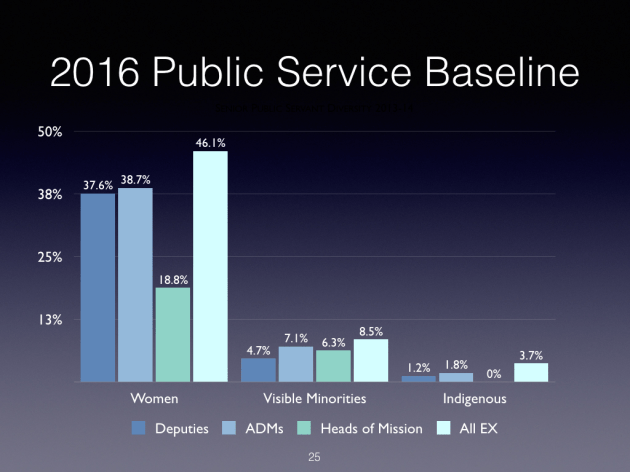
The Liberal government included in its mandate letters to all ministers a “commitment to transparent, merit-based appointments, to help ensure gender parity and that indigenous Canadians and minority groups are better reflected in positions of leadership.”To recall, the Prime Minister appointed a Cabinet with gender parity (15 each of men and women) and almost 17 per cent visible minority ministers (four Sikh and one Afghan Canadian).

Gender parity was not attained for parliamentary secretaries (12 positions out of 35 or 34 per cent) or other leadership positions such as whips and House leaders, visible minority parliamentary secretaries are over-represented (nine positions or 24 per cent) in relation to their share of the voting population (15 per cent).

Given this commitment and action, is the Liberal government also applying diversity and inclusion to its hiring of political staff? What about the official opposition?

To assess this, I looked at the Prime Minister’s Office (59 total positions and 12 senior staffers), the Leader of the Official Opposition’s office (OLO, 23 positions), and ministerial offices (senior staff defined as chief of staff, directors of communications, policy, issues and parliamentary affairs, along with press Secretaries, total number of 101 positions filled at time of writing).

Sources for the data include the regular ‘Hill Climbers’ updates in The Hill Times, other relevant press articles, and the imperfect Government Electronic Directory Services (GEDS). Gender and visible minority status were identified through names, LinkedIn profiles, biographies and photos where available.

From a gender perspective, women are under-represented at the senior level in PMO (one-third), but close to 40 per cent for all 59 PMO staffers. OLO has slightly lower representation of women (30 per cent). For minister’s offices, the percentage of chiefs of staff is slightly less than the overall per cent of close to 40 per cent who are women.

Visible minorities are consistently under-represented, save for the overall numbers in PMO (15 per cent). OLO and senior ministerial office staff all range between four to seven per cent, less than half of the percentage of visible minority Canadian citizens, with chief of staff visible minority representation slightly higher at 10 per cent.

While I have focused on gender and visible minority status, diversity includes of course other dimensions such as regional diversity (many, if not most Liberal staffers come from, or have worked in, Ontario and Toronto), sexual orientation, religion, education etc. R. Paul Wilson’s A Profile of Ministerial Policy Staff in the Government of Canada provides the best most recent analysis of the different aspects of diversity among staffers under the Conservative government October 2012 to June 2013.

Does this matter? In many ways, it does not. Gender parity in Cabinet and relatively strong Parliamentary Secretary representation set the tone for the government and Parliament.

Being a political staffer may not necessarily lead to a direct path to becoming a future MP. Staffer experience is not necessarily perceived as an asset in local riding associations or to the broader public. Staffers may be asked by the party to be its flag-bearer in unwinnable ridings. The most famous example of a staffer becoming an MP is, of course, former Prime Minister Harper, who was a staffer to Reform Party leader Preston Manning among other positions.

All three major parties were able to recruit an impressive number of visible minority candidates (women less so).

However, staffers play an important role in government (and opposition) decision-making. Having a diversity of backgrounds and experience generally helps inform decision-making.

The Liberal government’s commitment to diversity and inclusion, so well executed at the public level for both women and visible minorities, is lacking in the backrooms, particularly for visible minorities. Given the role that staffers play in preparing ministers for debates and discussions, this may impact on the degree to which the overall diversity and inclusion agenda is implemented.

http://www.hilltimes.com/opinion-piece/2016/03/02/diversity-in-political-backrooms-still-lacking/45495&nbsp;