Privy Council Office’s new delivery unit increases capacity for centralized control, say experts

Will be interesting to assess in a few years but it is designed to deliver on the government’s agenda:

The Privy Council Office’s Results and Delivery Unit, created by the new Trudeau Liberal government, has increased the capacity for more centralized control over government, say experts.

But while there are early positive signs it will be used to strengthen cabinet, it remains to be seen what the effect will be in practice in the years ahead.

“We don’t really know [yet] whether it will result in centralized control, but what it does mean is that we’ve now increased capacity at the centre,” Anna Esselment, an assistant professor of politics at the University of Waterloo, said in an interview last week. “There’s always suspicion when greater capacity occurs in the centre that this will ultimately mean greater power for the prime minister.”

In a recent interview with The Hill Times, Alex Marland, an associate politics professor at Memorial University and author of Brand Command, said “central control is deepening far more than people know or seem to care about.

“The creation of delivery units in the centre of the Liberal government are an excellent example of PMO control. It is not lost on me that if the Harper administration had created those we’d be hearing howls that Canada is becoming an authoritarian state,” he said. “It is the role of academics to see beyond public personas of political leaders, especially when everyone else is distracted by them.”

The Liberal government announced the appointment of former Ontario deputy minister Matthew Mendelsohn to the new role of deputy secretary to cabinet on results and delivery on Dec. 23, putting him in charge of the PCO’s new Results and Delivery Unit (RDU).

The RDU has been created within the PCO and “will support efforts to monitor delivery, address implementation obstacles on key priorities, and report on progress to the prime minister,” as well as facilitating “the work of government by developing tools, guidance, and learning activities on implementing an outcome-focused approach,” explained PCO spokesperson Raymond Rivet in an email response to questions from The Hill Times. It’s “designed to help ministers deliver on commitments and help the prime minister track progress on the delivery of top priorities,” he said.

…As for Canada’s federal delivery unit, there are a dozen staff listed as working in the office of the deputy secretary to cabinet on results and delivery: Francis Bilodeau, assistant secretary; Valerie Anglehart, executive assistant; Christina Norris, director of operations; Craig Kuntz, director of data; Mélanie Lavictoire, cabinet committee coordinator; Bruce Wang, senior analyst; Yanic Allain, administrative assistant; and analysts Kevin Dobbie, Sophie Hashem, Karim Moussaly, and Melissa Tan.

Source: Privy Council Office’s new delivery unit increases capacity for centralized control, say experts |

A new mental health plan could be ‘turning point’ in PS renewal

Quite the list:

Wilkerson said executives and managers will be the key players in leading a change to rid the workplace of the management and organization practices and policies that contribute to stress and depression of employees:

1. The bureaucracy ‘treadmill. Public servants jumping from job to job with no ‘overall picture” of why and what it means.

2.  Giving employees lots of responsibility, but little discretion.

3. Too much work and not enough resources to do it.

4. Heavy and ‘destructive’ reliance on emails and texting to the exclusion of personal conversations.

5.  A workplace where ‘everything is a priority.’

6. Unclear expectations among employees of what they are responsible for and ambiguity around who is charge.

7.  Employees skills and the jobs people they are asked to do are not well-matched.

8 Employees are discouraged from and feel they have “no voice to question workload or priority-setting”

9. The loss of capacity to execute projects.

10. A pervasive sense of erratic management and perpetual delegation from the top down to the rank and file, which diffuses accountability and erodes faith in managers.

The plan comes as the public service faces a massive generational turnover with the departure of the baby boomers and Wilkerson estimates 85 per cent of new jobs demand “cerebral” not manual skills.

As the country’s largest employer, Wilkerson said the public service is a microcosm of the Canadian workforce and tackling the stresses there will give policy-makers a blueprint for preventing mental illness among all Canadians.

He said the Canada’s health care system has failed all Canadians, including public servants, facing mental illness with 75 per cent unable to get access to the services or care they need.

“Understanding the experience of their own employees –  senior government officials will escape the blinders of budgetary policy-making to see just how devastating the under-funding of mental health care in this country really is,” said Wilkerson. With that, Wilkerson argue Canada could be international model and press to make  mental health a “global development priority’ when it hosts the G7 meetings in 2018

Source: A new mental health plan could be ‘turning point’ in PS renewal

Bureaucrats played up TPP advantages in Freeland welcome briefing

Seems like history repeats itself. Many transition notes in the 2006 transition reflected implicit bias towards exiting policies and it appears the same may be true for the 2015 transition:

Federal public servants played up the benefits of the Trans-Pacific Partnership trade deal to incoming Trade Minister Chrystia Freeland last fall, according to a briefing document prepared shortly after the federal election. Ms. Freeland, however, decided to take a neutral stance on the deal.

Global Affairs Canada also suggested Ms. Freeland (University-Rosedale, Ont.) move “quickly” on the TPP consultations promised by her party during the election campaign, according to the lengthy transition briefing book prepared for the new trade minister, which noted that department staff could help sell the deal to Canadians.

“Engaging Canadians quickly around the recently concluded Trans-Pacific Partnership (TPP) Agreement and bringing into force the Canada-EU Comprehensive Economic and Trade Agreement (CETA) will also be important in this regard, as these agreements will improve Canada’s access to U.S. and EU markets,” the briefing document said.

“Departmental officials play a critical role in informing and engaging Canadians on the benefits of these new agreements,” said the briefing, which also suggested that Ms. Freeland reach out to several of her provincial counterparts “to speak to the benefits” of the TPP.

Media attention around the TPP makes it “an opportunity for proactive communications,” the briefing said.

Liberal Party president Anna Gainey had pledged during the election campaign last October that her party supported trade agreements “like” the TPP for their job-creating potential. Ms. Freeland, however, made it clear in the months after the election that she would not use her position to promote the TPP—which was negotiated by the previous Conservative government—famously telling the audience at a panel discussion in Ottawa on Dec. 2 that “It’s not my job to persuade anybody that TPP is good.”

Source: Bureaucrats played up TPP advantages in Freeland welcome briefing |

Federal ‘unmuzzling’ has gone beyond government scientists with scrapping of Harper-era system

The real test will come when someone ‘screws-up’.

There will still be need for coordination and heads-up. But most public servants have the sense of what is appropriate and what it not:

The Liberal government has scrapped the elaborate system Conservatives were using to organize central message control within the government, replacing it with… nothing, according to the Privy Council Office.

It’s not just the scientists who’ve been unmuzzled. Anyone in the government who wants to organize a public event, or speak at one — and anyone who wants to talk to journalists — is affected by this change in policy.

The PCO, which acts as a support to Prime Minister Justin Trudeau and his cabinet, confirmed the shift this week.

Under this government, it is no longer using documents called “Message Event Proposals,” which came into practice under Stephen Harper’s Conservatives, to vet events and media requests across the federal government. The documents “have not been replaced with something new,” said spokesperson Raymond Rivet.

“The PCO’s new communications process looks like another positive step,” said Debi Daviau, president of the Professional Institute of the Public Service of Canada.

The union represents about 57,000 government scientists and other professionals, mainly at the federal level of government. It has been one of the most vocal advocates for the government “unmuzzling” its scientists.

Though she said there’s clear support for science from the Liberal government, Daviau warned that policies and directives are always at the whim of the government of the day, noting a “chill” under Harper.

“A lot of work needs to happen so that science is never silenced again by a federal government. What we need now is to safeguard it from future attacks and ensure we are consistent across government departments,” Daviau said.

Despite the shift at PCO, Rivet noted some departments might still use Message Event Proposals or similar products internally.

“Departments and ministers are responsible for their own communications, though co-ordination remains important,” said Olivier Duchesneau, a spokesperson for Trudeau. Some inquiries are still flagged to the PCO when more than one agency or department is involved, Rivet added.

Duchesneau said the government is basing its communications on the concept of “government by cabinet,” though he didn’t comment specifically on the scrapped Harper-era system.

Source: Federal ‘unmuzzling’ has gone beyond government scientists with scrapping of Harper-era system | National Post

Because it’s 2015 … Implementing Diversity and Inclusion – My latest ebook

because-its-2015_pdf__page_1_of_59_Over the past months, as many of you know, I have been doing a series of articles on the 2015 election, Cabinet and other senior appointments, along with baseline data for the public service, Governor in Council and judicial appointments by which to measure the government’s implementation of its diversity and inclusion commitments.

I have integrated and updated these in mini-book form, available as a free download from:

iPad/Mac version (iBooks)

Windows version (PDF)

I hope you find this compilation and the reference data it provides of interest and use.

The description is below.


——————-

Because it’s 2015 … Implementing Diversity and Inclusion

Canada’s 2015 election provided a sharp contrast between the social cohesion focus of the Conservative party and its use of identity politics, and the Liberal party’s emphasis on diversity and inclusion. This was not only reflected in policy and language but in candidate recruitment, with the Liberals having the largest number of visible minority candidates, although Conservative and NDP numbers also increased.

The overall voting shift to the Liberals was particularly strong among new Canadian voters, reflecting a mix of the overall shift to the Liberals in this election, perceived anti-immigrant bias and identity politics, and lack of support for Conservative restrictive citizenship and immigration policies.

In power, the Liberals implemented their diversity and inclusion commitment through the establishment of a Cabinet Committee on Diversity and Inclusion, Cabinet and Parliamentary Secretary appointments, Ministerial mandate letters and initial Senate appointments. They also set expectations for other senior appointments.

This short book provides data and related analysis with respect to the election results, political representation and leadership positions, and establishes the 2016 baseline for senior public servants, Governor in Council and judicial appointments by which to judge the Government’s implementation.

With over 40 charts and tables, Because it’s 2015 … is an invaluable reference for those interested in Canadian politics and diversity. iPad optimized.

Table of Contents

  1. Introduction
  2. Political Institutions
  3. Public Service Impact
  4. Governor in Council Appointments
  5. Judicial Diversity
  6. Concluding Observations

The complicated task of getting more women involved in politics

The debate over how to get more women involved in politics, contrasting the NDP’s Kennedy Stewart’s private members bill linking election expense reimbursement with female candidate share with Michelle Rempel’s encouragement and education approach:

Mr. Stewart’s academic research has shown that the party selection processes are biased, and that men are five times more likely to win nominations just because the selectors are biased against women.

So, the problem is with the political parties, and their old-boy networks and structures.

Equal Voice, a non-partisan group that advocates for more elected women, notes that only 32 per cent of candidates in last year’s federal election were women.

Based on the formula in his bill, Mr. Stewart says $1.25-million would be deducted from the Conservatives’ reimbursement for the 2015 election, because 20 per cent of their candidates were female; the Liberals, with 31 per cent female candidates, would lose about $900,000, and the NDP, which ran 43 per cent female candidates, would have lost about $200,000.

Mr. Stewart’s bill was debated earlier this month in the Commons; it comes back for a vote in September.

Some note that, even if it passes, the desired change might not come. Equal Voice says that in France, for example, the major parties will simply take the financial hit.

For Ms. Rempel, the bill would not make “real change.” She says women need to be educated on how to win nominations – raising money, dealing with the media, and building networks – to prepare them for the “fiery furnace” of a federal election. She believes going through rigorous internal party vetting is a positive exercise for women.

“The propensity is – and frankly you see it in all political parties in Canada – I don’t want to see women that are thrown into non-winnable ridings just to be a token so that [the party] is not financially penalized,” she says. “I think that actually takes women a step back.”

She fears a bill such as Mr. Stewart’s will change the calibre of women in the Commons: “There are women in our House of Commons across party lines that have really strong CVs or really strong life experiences. All of the women that are in the House of Commons are there because they won elections, full stop. They are not there because of tokenism.”

The NDP has the strongest female representation in caucus (41 percent), the Conservatives the weakest (17 percent, identical to 2011 election), the Liberals 27 percent.

Source: The complicated task of getting more women involved in politics – The Globe and Mail

Contrasting Liberal and Conservative Themes for 150th Anniversary of Confederation in 2017

Quite a change – close to 180 degrees –  from the previous government:

Canadians throughout the country, as well as those living abroad, will proudly take part in the celebrations marking the 150th anniversary of Confederation. This is a wonderful opportunity to celebrate all that it means to be Canadian. The Government of Canada is proud to be part of this anniversary of national and historic importance. It plans to:

  • promote and celebrate our Canadian identity; our ethnic, linguistic, cultural and regional diversity; and our rich history and heritage;
  • encourage Canadians to invest in our country’s future by bringing about significant changes and leaving a lasting legacy for coming generations;
  • create opportunities for Canadians to participate and celebrate together our shared values, our Canadian identity, our achievements, our majestic environment and our place in the world; and
  • maximize government investments and generate economic benefits for the country’s communities.

The main themes of the Government of Canada’s vision for the 150th anniversary of Confederation are:

Diversity and inclusion – We want to continue building a welcoming Canada where there is a place for everyone, a Canada where everyone can reach his or her full potential.


Reconciliation with Indigenous peoples – We want to support the vital work of reconciliation ‎with Indigenous peoples as outlined in the recommendations of the Truth and Reconciliation Commission. Reconciliation is a journey for all Canadians as we move forward into Canada’s next 150 years.


Youth – We want to continue to engage young people and give them the means to contribute to our society, because they are the ones who will shape tomorrow’s Canada.


Environment – We want to be the custodians of our environment, because it is a source of our country’s wealth and pride. We want to bring Canadians closer to nature in order to strengthen their environmental awareness.

The previous Conservative government’s theme and vision

The Government of Canada will bring Canadians together with a common purpose. The Canada 150 overarching theme is “Strong. Proud. Free.”—words that define and characterize present-day Canada. A Canada that is a strong leader in the world, with one of the most robust economies. A Canada that is proud of its identity and achievements, as well as its natural beauty and resources. A Canada that is free with an open, diverse and pluralistic society. This theme connects us with our past, embraces the present, and builds towards the future.

The Canada 150 vision includes three elements:

Giving Back to Canada: Canadians will be challenged to dream about what the future holds for the next 150 years, and to give back to our country, providing meaningful change and lasting legacies for future generations.

Honouring the Exceptional: Exceptional Canadian people, places, achievements and events will be showcased to help shape Canada’s leaders of tomorrow.

Celebrating and Bringing Canadians Together: Canadians and their communities will have opportunities to celebrate together and build a deeper understanding of Canada, its people and what it means to be Canadian.

Canada 150 programming will support and promote activities that align with this vision.

Source: Backgrounder: The 150th Anniversary of Confederation in 2017 – Canada News Centre

Archived – Backgrounder – Strong. Proud. Free.: Get Ready to Celebrate Canada 150! – 2015

Trudeau chooses two women to fill top diplomatic positions – and broader diversity emphasis

Telling and consistent with overall diversity and inclusion agenda:

The Prime Minister has told Global Affairs that its list of career candidates has too many white males and promised better representation in terms of gender and ethnicity.

Overall numbers for all Global Affairs employees: 54.8 percent women, 14.4 percent visible minorities (TBS EE report 2014-15).

Source: Trudeau chooses two women to fill top diplomatic positions – The Globe and Mail

With civil service shakeup, Trudeau brings youth, diversity to top jobs

Election 2015 and Beyond- Implementation Diversity and Inclusion.001Simon Doyle on changes to Deputy ranks but more anecdotal than evidence-based.

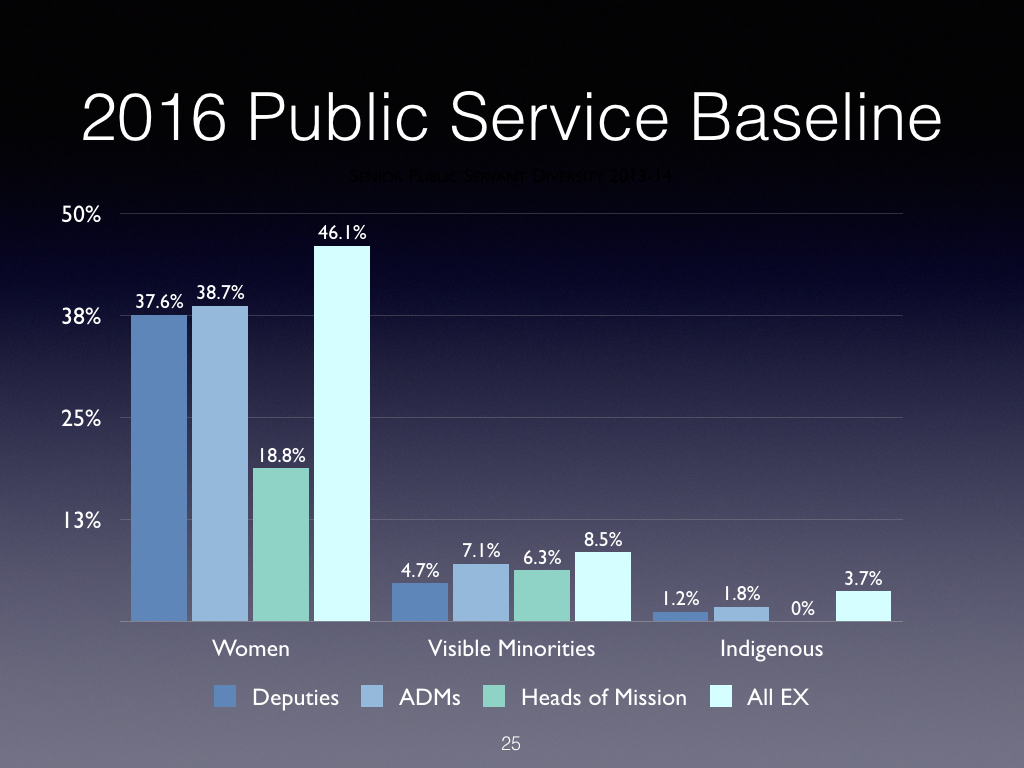
My count of the 19 Deputy appointments to date by PM Trudeau: 10 men, 9 women, 1 visible minority, no Indigenous people. Gender parity but weak visible minority and Indigenous peoples representation, reflecting in part weaknesses in ADM diversity as shown in the above chart:

Retirements of Ottawa’s highest-ranked bureaucrats have accelerated under the Justin Trudeau government as the Liberals shuffle the leadership of the public service after years of management under Stephen Harper.

The government has made a series of moves with its highest-ranked bureaucrats since coming into office last fall, most recently promoting senior officials who had worked on the Environment and Foreign Affairs portfolios.

…..David Zussman, a former senior government official and a professor of public-sector management at the University of Ottawa, said the number of appointments are high, with more than 20 changes in the senior ranks of the public service since late December, including retirements.

“I’m sure word would have gone out that: ‘We’re in a process of renewal, and any of you guys thinking of leaving, do me a favour and tell me now,’ ” Dr. Zussman said.

“A lot of them are really long-standing public servants who I think hung around for the election to help out [former clerk] Janice Charette, and now, six months into it, they decided to trigger their retirements. They’ve all got their 35 years,” he said, indicating they can collect pensions.

…“Some ministers may want a new deputy, and it’s their prerogative to say they would like someone new. The clerk may decide that he feels someone should move, or sometimes deputies will go and say they would like to move,” said C. Scott Clark, former deputy minister of finance and a senior adviser to the prime minister under the Jean Chrétien government.

“It takes time for a minister and a deputy to form what I would call a good relationship, a professional, working relationship. Sometimes they do, sometimes they don’t,” Mr. Clark said.

…The new deputies also reflect efforts by Mr. Trudeau and the clerk to renew the public service and, as with the makeup of the Prime Minister’s cabinet, introduce some youth and diversity into the government’s leadership.

“He’s been very clear about the importance he attaches to having a professional, non-partisan, responsive, agile, creative public service,” Mr. Wernick told The Globe and Mail in an interview earlier this year. “It’s the only way he’s going to accomplish the goals he put in front of Canadians.”

One senior government official said Mr. Trudeau, in late January, made a rare appearance at the Deputy Ministers’ Breakfast, a gathering of all the public service’s most senior mandarins who meet in Langevin Block. Prime ministers typically address the breakfast once or twice per year.

While it’s unclear what was said, the PM has been emphasizing with senior officials a program for getting results and revitalizing the public service. Mr. Trudeau attended the meeting shortly after he appointed Mr. Wernick as Clerk.

….Mr. Scott expects more changes in the fall after the government takes the summer to regroup. “I would expect there will probably be more moves coming,” he said. As Mr. Wernick said in a recent letter to the PM: “It is clear to me that we are entering a period of dramatic generational change in the Public Service.”

Source: With civil service shakeup, Trudeau brings youth, diversity to top jobs – The Globe and Mail

PMO ‘central control deepening far more than people know or seem to care about’

Good interview with Alex Marland, author of Brand Command: Canadian Politics and Democracy in the Age of Message Control;

Your book also examines political communications under the Harper Conservatives. Has political communications changed under the Trudeau Liberals? 

“The Trudeau brand is refreshing and engaging. Even those who cringe at the selfies and the blatant photo-ops should acknowledge that the change in tone is a welcome relief after the intense negativity that permeated Canadian politics dating to the early 2000s. Hopefully the showmanship will fall away, because a shameless desire for publicity and public adulation can turn many citizens off politics too. For someone like me, the issue is that the more that the media’s glare is on the prime minister, the more power that individual has. I believe that central control is deepening far more than people know or seem to care about. The creation of delivery units in the centre of the Liberal government are an excellent example of PMO control. It is not lost on me that if the Harper administration had created those we’d be hearing howls that Canada is becoming an authoritarian state. It is the role of academics to see beyond the public personas of political leaders, especially when everyone else is distracted by them.”

Why do you say the pursuit of political power is strategic as never before? What do you mean?

“The competition for power involves a level of strategic manoeuvering and tactical execution in ways that are exceedingly complex. Sure, there’s a lot of gut instinct involved—there just isn’t enough money in Canadian politics to enable the kind of data analytics found in the U.S.A. In any event, you cannot form government on the basis of marketing alone. It was sometimes said that Harper was playing chess while everyone else was playing checkers. I would suggest that everyone is forced to play chess now. Even the smallest political parties have supporter databases, are using social media, are familiar with market segmentation to bundle coalitions, and so on. Everything is quick, quick, quick—not only do you need to be sharp-minded, but you need to operate in a media cycle that churns multiple times per day. This is where branding comes in: if you have a core set of messages and values the brand mantra acts as a guide for spinning a message no matter what the circumstance.”

How has branding influenced democracy?

“Branding’s supporters, including in the government, will tell you that it saves money and makes things more efficient. Navigating webpages with a common look and feel is an example; cutting down on the number of sub-brands and logos throughout government is another. Templates for campaign signs, brochures and websites have done wonders for local campaigns, while simultaneously imprinting a central command ethos. Branding also simplifies things for electors—the same messages are repeated, we see the same visuals over and over. Only the most rabid politicos read campaign platforms, or care about policy discussions at party conventions. Most Canadians are busy with their daily lives and pay surface attention to politics. Branding connects with them. It also limits the potential for a brand ambassador to commit a gaffe or so-called “bozo interruption” that undermines the leadership team. So as a strategy it helps to move an agenda forward. The downside, of course, is that candidates and MPs, and even some ministers, become regional sales reps of a message set by people at the top. It becomes a serious problem when all messages align, bordering on state propaganda.”

Where is Canadian politics headed? 

“I am a cautious optimist. The proliferation of digital media means that traditional elite power structures are under stress to change and evolve. This is generally good. What is not good is that the online sphere has become a powerful interest group for the hyper-sensitive forces of political correctness. A healthy democracy is strongest when open-minded citizens carefully deliberate a variety of opinions. As a society, we need leaders who encourage thoughtful constructive debate, who are willing to challenge the wisdom of crowds, who question attachments to party labels, and who aren’t afraid to sometimes take a public punch from their own brand ambassadors.”

Source: PMO ‘central control deepening far more than people know or seem to care about’ |