John Ivison: Uber is unlovable, but the federal Liberals were wrong to bash them with a tax

I don’t understand the logic behind Uber being exempt from the HST. The HST is paid by taxis, Uber’s closest competitor, and innovation should not mean an exemption from paying for government services. Uber drivers access medicare and other public services and thus should not be undermining funding for these same services.

Paying HST would not change the fundamentals behind technological disruption, just ensure a more level playing field.

Personally, I was insulted by Uber’s request that I email my MP in support of their position. Instead, I emailed her stating my opposition to Uber’s position:

Travis Kalanick, Uber’s co-founder, has spoken about his desire to eventually move to self-driving cars for Uber vehicles.

Children born in 2017 might never need to learn to drive. As a discussion paper authored by the University of California’s Adam Stocker and Sura Shaheen pointed out recently, automated vehicles and shared mobility applications will have become accepted technology by 2030 and may come to dominate ground transportation by 2050, revolutionizing the car industry in the same way that mobile phones have transformed the telecom industry. This will take millions and millions of cars off the road.

Instead of penalizing Uber drivers and customers, a more sensible way of levelling the playing field with the taxi industry would have been to remove the exceptional circumstance under which all drivers are obliged to pay sales tax if they earn less than $30,000.

If the Liberal government is as keen to innovate as it claims to be, it should reverse the direction of public policy and encourage private transportation companies like Uber and its competitor, Lyft.

Uber has some maturing to do when it comes to the way it treats its employees, its customers and its competitors. But its dynamic pricing, ride-sharing technology is here to stay and it will change global transportation systems for the better. Ottawa should be onside.

Source: John Ivison: Uber is unlovable, but the federal Liberals were wrong to bash them with a tax | National Post

Trudeau government’s vacant appointments backlog up 80%

Good follow-up story and valid concern regarding the large number of vacancies.

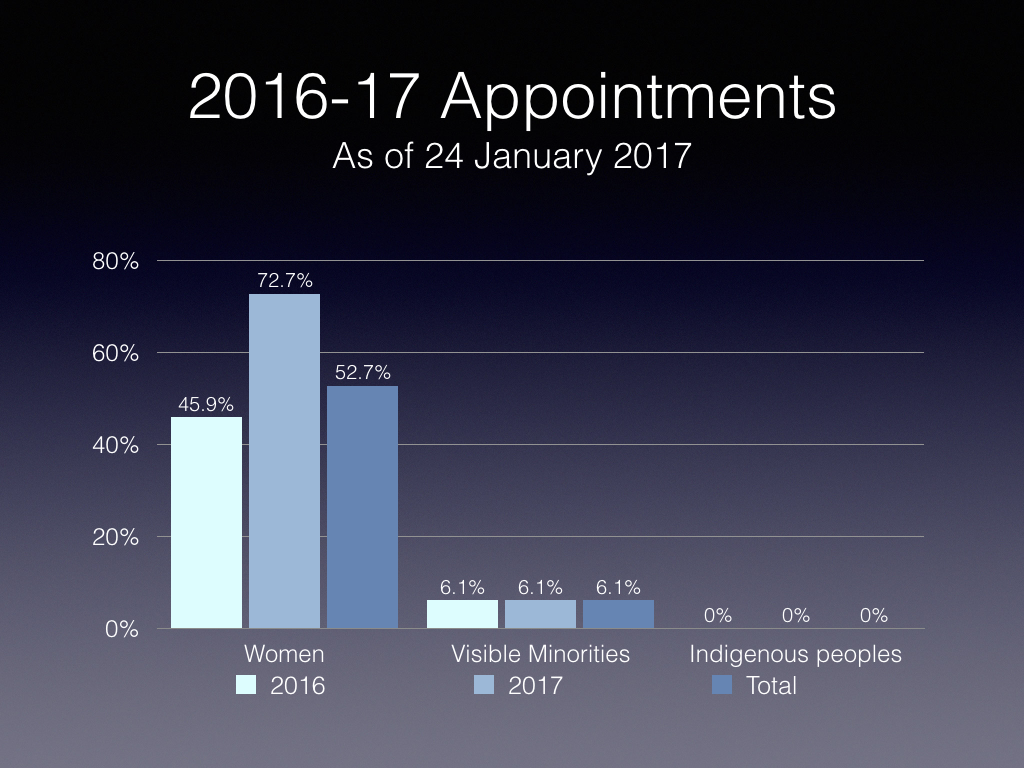
But nice to see that PCO is now tracking more systematically the diversity of appointments and improving representation (of the more than 100 appointments to date, 62 per cent women, 15 per cent visible minorities, 10 per cent Indigenous Canadians):

Five months after Prime Minister Justin Trudeau’s government assured Canadians that its new system would soon fix the backlog of appointments that need to be filled, the problem has gotten much worse.

An analysis by CBC News reveals that one in three governor in council positions — ranging from directors of government agencies to members of tribunals that hear appeals of employment insurance or pension disputes — is currently vacant or occupied by an appointee whose term is past its expiry date.

When CBC first looked at the question in October 2016, 19.6 per cent of the governor in council positions were vacant or past their expiry date.

That number is currently at 35 per cent, although it will drop slightly next week when several appointments to the Immigration and Refugee Board made by cabinet earlier this month take effect.

The backlog in October of more than 300 appointments has now swelled to 572. Of the 515 positions, 354 are vacant. Another 161 are occupied by an appointee, often one named by the previous Conservative government, whose appointment is past its expiry date. However, they are allowed to remain until they are replaced or renewed.

The positions range from lucrative full-time jobs with six-figure salaries to part-time positions that pay per diems and expenses.

There are also 57 vacancies for federally appointed judges, down slightly from the 61 vacancies in October 2016 that prompted concerns about growing backlogs in criminal trials.

In several cases, positions are being filled on a temporary basis because the government was not able to fill them before the incumbent’s term was set to expire. Among them are half of the officers of Parliament — the conflict of interest and ethics commissioner, the commissioner of lobbying and the official languages commissioner, while the chief electoral officer’s position is listed as vacant.

Former prime minister Stephen Harper’s government went on an appointment spree in the weeks leading up to the 2015 election, filling not only most of the positions that were vacant but also making 49 “future appointments” of individuals whose terms weren’t due to be renewed until well after the election.

In October, the government said that the initial backlog was caused in part by the decision to overhaul the appointments process and bring in a more open and balanced merit-based system.

It said that system was up and running, Canadians were applying for the positions and vacancies were being filled.

Five months later, the government said it has received more than 11,000 applications for vacant appointments and more than 100 selection processes are currently underway.

“The more rigorous approach to conducting selection processes represents a significant volume of work,” said Raymond Rivet, spokesman for the Privy Council Office.

Rivet said that since the government launched its new appointments process it has made more than 100 appointments.

“Of this number, 62 per cent have been women, 15 per cent visible minorities, 10 per cent Indigenous Canadians and 50 per cent identify as fully or functionally bilingual.”

However, Conservative MP Tony Clement, former president of the Treasury Board, said the growing backlog of vacant appointments is affecting service to Canadians.

“This clearly a case where these appointments, which are necessary for the proper functioning of government — there could be issues involving people getting their appropriate EI, for instance, or their appropriate pension — are not being processed because of the lack of these appointments.”

Clement blamed the backlog on Trudeau’s director of appointments, Mary Ng, who announced Feb. 15 that she was taking a leave from her job to seek the Liberal nomination in the Toronto-area riding of Markham-Thornhill. The riding became vacant after Trudeau appointed former immigration minister John McCallum as Canada’s ambassador to China.

“It’s very disappointing,” said Clement. “The person in charge of this process is now the Liberal candidate in Markham, and obviously she was spending too much time campaigning for herself and not enough time making recommendations to the prime minister on appointments.”

Judge shortage causing unnecessary legal trauma: MacKay

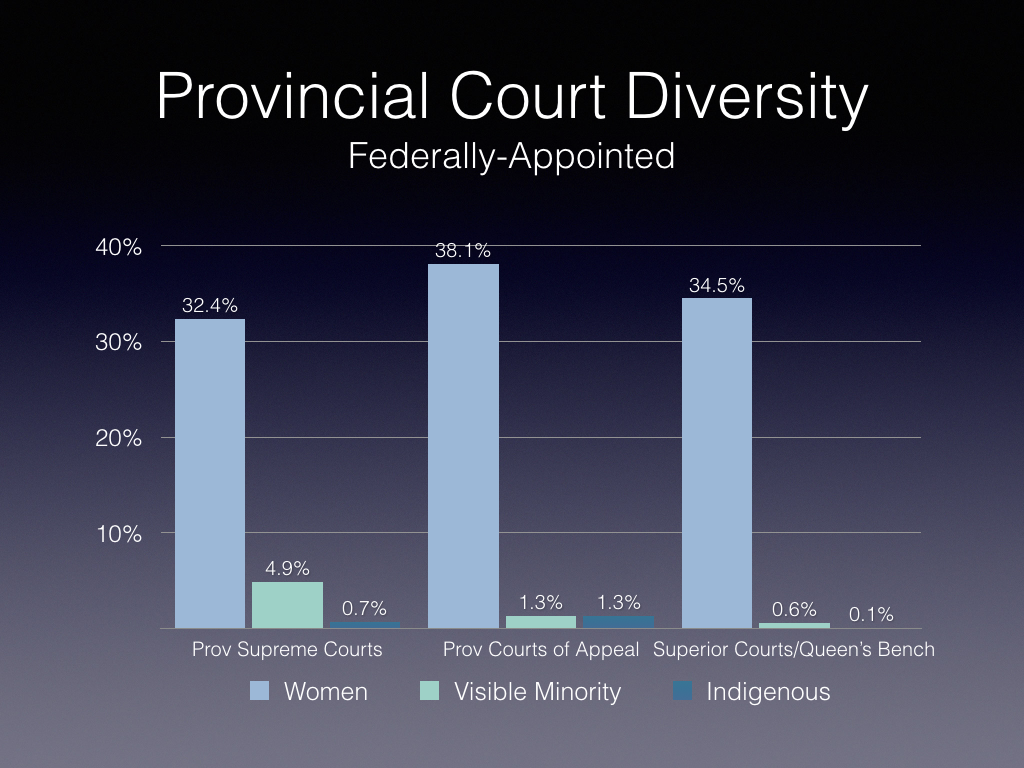
While MacKay is right to criticize the government for its delay in appointing judges, his assertion that under the Conservative government ‘s, “We appointed a judiciary that represented “the face of Canada,” a diverse bench predicated and built on inclusion of all races, creeds, and genders in the legal community across Canada” is false as shown in my 2016 analysis: Diversity among federal and provincial judges – Policy Options).

In contrast, appointments to date of the current government show a marked increase: 57.4 percent women, 6.4 percent for each of visible minorities and Indigenous peoples.

The federal government has a fundamental responsibility to appoint a sufficient complement of judges such that our courts can function properly. Its failure in that regard creates a constitutional crisis that goes to the very rule of law that underpins our justice system.

A lack of judicial appointments in the context of increasing pressure to conduct timely trials equals a systemic miscarriage of justice. With caseloads where they are, the system is at its breaking point.

Add to this difficult dynamic the recent Supreme Court of Canada ruling in the R v Jordan decision, which mandates criminal trials must be heard within 18 months for the so-called lower courts, and 30 months for the Superior ones. Absent compelling circumstances, “delinquent” prosecution equals administrative dismissal.

Due to this artificial prescription dozens of cases have been tossed, including murder and sex assault cases. No trial. No verdict. Worse still, the victims and their families are left without recourse or remediation and no one is accountable. Not fully appreciated as yet, this jarring situation stands to worsen due to the arbitrary deadline, which provides no consideration for the seriousness of the offence.

Against this backdrop we note inertia from the federal government on the appointment of judges to hear these languishing cases. Canadians face an alarming scenario of serious violent charges being vacated due to the acute shortage of judges. “Justice delayed is justice denied” is a maxim never more appropriately invoked than now.

As minister of justice (2013-15) I oversaw the appointment of more than 230 judges; prior to that my government prioritized hundreds more. We appointed a judiciary that represented “the face of Canada,” a diverse bench predicated and built on inclusion of all races, creeds, and genders in the legal community across Canada.

Vacancies on the federally appointed bench is at an all-time high. Sixty-two empty seats of the 840 federally appointed judges, against 14 (the lowest in decades) when my government left office. In June 2015, we appointed a record 22 women: over 60 per cent of the judges appointed on that occasion. We appointed more judges on one day (43) than the current government has in 16 months in office.

Source: Judge shortage causing unnecessary legal trauma: MacKay | Toronto Star

Liberals urged to scrap 19th century rule that requires laws be printed in books

Although I, like most people, never consult these hard copies, I think it these are important to have as an official and archival record.

As for the specifications, these can and should be updated, but again any new specifications should be archival quality:

An obscure statute dating from Confederation has Parliament frozen in time, forcing the government to print every new law on old-fashioned paper.

Bureaucrats want to ditch those rules, end the costly printing and make digital versions the new standard — but the Liberal government has yet to decide whether to break with tradition.

At issue is the Publication of Statutes Act, conceived in the 19th century, which requires the Queen’s Printer to publish new laws passed by Parliament in an annual compendium that must be printed on quality paper.

The legislation has never been overhauled. Although Justice Canada publishes the laws online as well, the digital versions aren’t considered official.

Each year, the Queen’s Printer — now part of Public Services and Procurement Canada (PSPC) — must print and distribute about 250 hardcover copies of the annual statutes, destined for a select group of judges, legal libraries and other locations.

The total cost is estimated at about $100,000, including $40,000 worth of printing and distribution through a private firm.

The format is meticulously spelled out in a regulation that helps keep printing costs high:

“The annual Statutes of Canada shall be printed on Number 1 Opaque Litho Book according to Canadian Government Specifications Board Standard 9-GP-29, Grade 2, Type 1, (except moisture content) or equivalent in white colour, English finish, and the basic weight shall be 100 pounds per 1,000 sheets 25 inches by 38 inches.”

The detailed specifications continue for three more paragraphs.

Deputy minister makes the case

Last May, a senior official at PSPC pressed the new minister, Judy Foote, to fix the problem, according to a briefing note obtained by CBC News.

“The requirement to print the Annual Statutes predates modern electronic communications (some provisions have not been amended since the 19th century) and does not foster the timely and efficient access to federal legislation for Canadians,” deputy minister Marie Lemay said.

Lemay called for the repeal of the regulation, and amendments to the Publication of Statutes Act and other laws to haul Parliament into the digital era. The process would require formal notices, legal drafting and the backing of Parliament, and would take months.

But Foote’s spokesperson said rookie members of Parliament need to be updated on the issue before the government decides whether to scrap the printing requirement.

Regulations governing the printing of Statutes of Canada

A regulation spells out in minute detail just how the annual Statutes of Canada are to appear in book form. (CBC)

“As the Annual Statutes contain important information for elected members and many MPs are in their first term, Minister Foote, in consultation with the deputy minister, has determined that the department will formally consult with MPs and senators before making any changes to the delivery format,” press secretary Jessica Turner said in an email.

But Lemay had specifically cautioned against delay in her briefing note last spring.

“It is important to proceed … as soon as possible,” she wrote. “On January 1, 2016, Justice Canada changed the layout of its laws and regulations. They are now incompatible with the format of the Annual Statutes as required.”

“Consequently, it will be impossible to print the 2016 Statutes.”

Source: Liberals urged to scrap 19th century rule that requires laws be printed in books – Politics – CBC News

Statscan can’t afford for data access to play favourites

Former Chief Statistician Wayne Smith’s critique of Shared Services Canada may have some merit as this example illustrates:

There were some curious and intriguing details behind the headlines of Statistics Canada’s monthly employment report, as there always are. It’s a serious shame – and a serious problem – that almost no one could see them.

Again.

The national statistical agency’s website was out of commission since early Friday morning, before the 8:30 a.m. ET release of the February labour force survey. As of late afternoon, Statscan’s website remained dark; the details of one of the most important economic indicators of its monthly calendar were invisible to the Canadian public all day.

(By the way, the report showed that the Canadian economy added an estimated 15,000 net new jobs in February, a bit better than economists had expected, and the unemployment rate dropped to 6.6 per cent, matching an eight-year low.)

You might recall that something like this happened before, about eight months ago, when Statscan’s systems were down for more than seven hours on another jobs-report Friday. Not to mention the many, many occasions that Statscan’s website has fizzled out for much briefer periods shortly after the release of major economic indicators, during moments of peak traffic scrambling for the fresh data.

At the time of this writing, we don’t know what the problem was with Friday’s system failure. Neither Statscan nor Shared Services Canada, the agency that oversees e-mail, data and network services across the vast breadth of the federal public service, got back to us with an explanation. Certainly past snafus have been placed at the feet of Shared Services, the $1.9-billion brainchild of the previous Conservative government that was supposed to streamline Ottawa’s complex tangle of information technology, but has instead been blamed for everything from AWOL paycheques to RCMP systems failures.

The previous head of Statscan, Wayne Smith, resigned last September over Shared Services’ handling of Statscan’s information systems, which he said had not only become “disruptive, ineffective, slow and unaffordable,” but compromised the independence and confidentiality of the statistical agency’s data.

Now, I’m not here to point fingers. But the point is that these Statscan failures, while maybe not the same risk to public safety as the RCMP’s problems, are more than just a nuisance to the economists and journalists who wallow in these economic numbers.

The system problems, when they arise, create inequitable distribution of information that is relied on, and more to the point traded on, by financial markets. That’s a serious problem.

In the case of Friday’s jobs data, instead of every market participant being able to see the same data at the same time on the same website, each was left to his or her own devices (literally and figuratively). The lucky ones had access to Bloomberg data and news terminals, the expensive yet indispensable toys of professional trading operations, where at least the basic highlights of the report would have been fairly quickly disseminated. Others could have turned to media reports from the smattering of news organizations that attended Statscan’s pre-release lockup (in which reporters were given the release in advance but kept sequestered in a room, unable to communicate the information until the moment of the release time).

But if you were in need of the deeper statistical details below the surface of these quick-hit reports, good luck. Even the research departments of the big banks were scrambling, relying on friendly contacts at Statscan to e-mail to them whatever data they could.

All of which not only delayed the dissemination of this key economic data to the public and to financial markets, but also resulted in some very uneven distribution – in terms of both the timeliness and the amount of information that reached different sets of ears and eyes with an interest in the data.

And the employment data are very significant indeed to the bond and currency markets, especially now. It has become increasingly evident that the direction the Bank of Canada will take on interest rates hinges substantially on the evolution of the labour market. In its rate decision earlier this month, the central bank pointed specifically to “subdued growth in wages and hours” as key evidence of “persistent economic slack” in Canada.

And indeed, the February jobs report showed that despite the improvements in hiring and the unemployment rate, growth in wages and hours worked remained disappointing. Knowledge of this spoke volumes to any bond or currency trader placing bets on the timing of future Bank of Canada rate moves. And some traders had access to this information long before others.

That’s simply unacceptable.

As long as these technology problems persist, they undermine the integrity of an independent, impartial national statistics provider. Access to critical data can’t play favourites, even if it’s by accident.

Source: Statscan can’t afford for data access to play favourites – The Globe and Mail

Supreme Court judge [Justice Wagner] says Canadians shouldn’t worry about arrival of refugees, migrants 

Thoughtful and pertinent comments, particularly interesting his comments on identity:

Wagner said the notions of identity, human dignity and democratic values permeate the Charter and “lay the foundations for looking beyond our own borders.

“We can welcome refugees and migrants with the confidence that our society is able not only to manage our differences, but to thrive on them,” said Wagner.

Speaking to reporters later, Wagner acknowledged that, while his speech was delivered to a legal and academic audience, there was a message for Canadians concerned about the influx of refugees and migrants.

“We should, I think, welcome all those people and we should be willing to accommodate them and not change them,” he said.

“People should not be afraid of having migrants and refugees in their own countries. I think we’re strong enough and . . . we have strong moral values, and one of those values is the respect for human dignity. And, if we take our role seriously, we’ll look, we’ll adopt the perspective of the other, and it could only, I think, as far as I’m concerned, grow society much better in the future.”

Asked if that means there should be room for face veils and other individual expressions of religious identity, Wagner declined to answer, saying: “I don’t know if those cases will come before the court, so I don’t want to comment.”

Wagner holds one of the three high court seats reserved for Quebec. Quebec’s legislature is now studying a bill to require “religious neutrality” of those who deliver or receive public services, amid calls to ditch the bill in the wake of the slaying of six Muslims at a Quebec City mosque.

Wagner said judges have an “obligation” to try to understand the perspective of a person who says their equality rights are breached, but he added “that doesn’t mean that the claimant is right . . . that doesn’t mean that I would adopt his way, or his reasoning, or his opinion, or his end result.”

In his speech, Wagner admitted early approaches to how judges analyzed discrimination did not stand up to the task. He said Charter interpretation is still “a work in progress,” but, he added, over the past 150 years “the constitution has enabled us to navigate difficult questions of identity.

“Personal and group characteristics are the starting point of Charter equality jurisprudence, but identity is not about labels; it is a shorthand for how people see themselves, how others see them, and how those two things interact in people’s lives.”

Wagner said the Supreme Court looks to the context and experiences of a person claiming discrimination, and seeks to understand the person’s perspective, which is an especially important consideration in cases of aboriginal law or where there are overlapping characteristics of a person’s identity that influence how they experience discrimination.

Wagner said the experience of a woman who is part of a visible minority can be totally different from that of a young man who has the same characteristics. “If one of the two is not a citizen, or has a different sexual orientation, their experience could be even more different.”

“When the court eventually faces a question touching on trans-gender identity, these two propositions will provide essential frames of reference: that identity is not fixed, but changing, and that identity is not innate, but contextual,” he said.

Wagner predicted that, although the principle of “dignity” fell out of favour in judicial analyses of equality claims, it would find new traction in future Charter litigation. It is a crucial consideration when judges weigh whether a rights violation is reasonable and justified. “Equality infringements ought to be increasingly difficult to justify to the extent that it strikes at the heart of someone’s individual or group identity and, with it, their recognition as full participants in Canada’s ongoing democratic dialogue,” he said.

University of Ottawa law professor Errol Mendes said Wagner’s speech would please equality-seeking groups on the one hand, but he said Wagner also emphasized “democratic values” and “substantive” equality over any superficial concept of equality.

To Mendes, it was a signal from a judge who some suggest could one day become the chief justice of Canada, that the balance won’t always tip in favour of those who feel their rights are breached.

C-33 – Canada’s former chief electoral officers eager for successor, laud proposed electoral legislative changes

Interesting that the provision to extent non-resident voting rights not raised as an issue, again suggesting lesser priority:

Canada’s former chief electoral officers Marc Mayrand and Jean-Pierre Kingsley are lauding changes proposed in new legislation, including moving the elections commissioner back under the authority of Elections Canada and removing restrictions on who can apply for the job of commissioner.

But they also say there are other issues to be addressed, and with only an acting chief electoral officer in place since Mr. Mayrand stepped down at the end of December, both say they’re eager to see a new permanent chief electoral officer of Canada named.

“I don’t think it’s desirable to have too long of an interim in those positions [officers of Parliament]. I think these positions require people who have a firm ground and can make the difficult decision that they have to make from time to time,” Mr. Mayrand told The Hill Times in an interview last week. “There are other bills that I understand are coming forward and it’s important to have somebody in the position [of chief electoral officer] who can steer the organization.”

Having given notice of his plans to retire in June, Mr. Mayrand, who officially exited the role on Dec. 28, said, “It seems to be a long process, to say the least.”

The Liberal government will select its nominee to become the next chief electoral officer “in a manner consistent with the merit-based appointments process,” which the government has put in place, John O’Leary, communications director to Democratic Institutions Minister Karina Gould (Burlington, Ont.), said in an email.

That process involves advertising for open positions on a government appointments website, among other things.

“I haven’t seen any advertisement for the position,” said Mr. Mayrand in a telephone interview last week with The Hill Times. He said from his experience, once a candidate has been identified, the process “unfolds very quickly.” However, finding the right candidate can be “hard to do,” he noted, given the knowledge and skills required for the job.

Since Mr. Mayrand retired on Dec. 28, deputy chief electoral officer Stéphane Perrault has been the acting chief electoral officer.

Former chief electoral officer Jean-Pierre Kingsley held the job for 17 years until Feb. 17, 2007 and was succeeded by Mr. Mayrand days later on Feb. 21 after the House of Commons unanimously approved his appointment.

“I am disappointed because there is no reason why the government did not initiate staffing action immediately when Mr. Mayrand announced that he was retiring [in June]. … At that very time, they should have set the ball in motion, and we would have a chief electoral officer as I speak. Acting appointments in the officers of Parliament positions is a very bad process,” said Mr. Kingsley.

The Liberal government is currently faced with a backlog of hundreds of unfilled appointments.

Mr. O’Leary said finding a new chief electoral officer “is a priority for Minister Gould, and we will have more to say about this in due course.”

Paul Thomas, a professor emeritus of political science at the University of Manitoba, said he thinks there’s a “very small community of professionals” in Canada with the expertise needed for the job of chief electoral officer.

“Election law is not the simple, straightforward thing of the past,” he said.

Prof. Thomas noted the next federal election in 2019 is “not that far away now, and it would be better if we had a permanent CEO with all the status and authority and confidence of the government and Parliament presiding over the administration of that election.”

Source: Canada’s former chief electoral officers eager for successor, laud proposed electoral legislative changes – The Hill Times – The Hill Times

Diversity in GiC appointments – 2016 Update

My latest in IRPP Policy Options:

election-2015-and-beyond-implementation-diversity-and-inclusion-062Following my 2016 baseline study of the diversity of Governor in Council (GiC) appointments (Governor in Council Appointments – 2016 Baseline), I have analyzed 2016 and early 2017 appointments using the GiC appointments index. There has been a strong push towards gender parity but no clear trend with respect to visible minorities and Indigenous peoples.

Baseline data below:

GiC Baseline 2016.010

Source: Diversity in GiC appointments

Someone should take the fall for Ottawa’s botched Phoenix pay system

Hard to disagree with Barrie McKenna: the lack of accountability at both the political and bureaucratic level, the inability of government to manage large-scale IT projects and the miss match between those who “sold” the project and those responsible for delivery are of broad concern, not just in the case of Phoenix.

IT in government is complex given the myriad of requirements and groups involved.

My experience with IT in government is a mixed bag. My most successful project, done with a small group of PCO policy types, was the creation of an Access database to manage the then Chrétien government annual priority setting exercise. Delivered on time, it worked  and ensured consistent tracking rather than the previous time-consuming and error prone Word-based process.

My second experience, also at PCO, but on a larger scale (more data, more users) and thus involving IT folks, was replacing the previous Cabinet meeting planning system with a more up-to-date platform with more flexibility. The IT folks and the consultant never got it to work during my time there.

Lastly, at Service Canada, we partnered with Service New Brunswick to deliver, on Transport Canada’s behalf, a system for pleasure craft licensing. When it went live, it crashed but we were able to identify and fix the problem within a few days (the data link capacity was too small, something missed in all the preparations, by all involved). After that it worked well (Service Canada eventually decided to end its involvement and focus on core services to ESDC):

The mess that is Phoenix is a story of misguided political objectives, bungled management of a major technology project and a complete failure by anyone in charge to take responsibility for mistakes.

The fiasco raises troubling questions about the government’s ability to perform one of its most basic functions – paying its bills and taking care of employees. The Phoenix system is just one of the major information-technology projects, totalling billions of dollars, now under way in the government.

Centralizing the multitude of separate payroll systems was the brainchild of Stephen Harper’s Conservative government, which was convinced it could wring huge savings out of the bureaucracy. In charge were then-public works minister Rona Ambrose (now interim Conservative leader) and Tony Clement, former president of the treasury board. Neither has expressed any remorse for the fiasco.

The Conservatives eliminated 700 payroll jobs in dozens of departments, mainly in Ottawa, and created a new centralized pay centre in Miramichi, N.B. – political compensation for the shuttered gun registry. Most of those offered positions there refused to move, leaving the running of Phoenix in the hands of hundreds of untrained new hires.

The problem now belongs to the Liberal government, which could have delayed deployment of the system to work out the inevitable bugs. To his credit, Prime Minister Justin Trudeau has acknowledged his government initially didn’t take the problem seriously.

“I’ll admit it,” Mr. Trudeau told a frustrated civil servant at a town hall in Kingston, Ont., earlier this year. “This government … didn’t pay enough attention to the challenges and the warning signs on the transition we were overseeing.”

But the mea culpa came three months after the government had promised to resolve the payroll mess. Now, it’s not even offering a target.

Just as troubling is the lack of accountability within the upper ranks of civil servants. Many of those responsible have retired or moved to other jobs in the government. No one has been fired.

Nor has there been a thorough investigation by Parliament of what went wrong. Deputy Minister of Public Works Marie Lemay, who inherited the payroll problem, appeared before the House of Commons government operations committee last year. But none of the original architects of the system have had to answer for their roles.

And then there is IBM Canada, which Ottawa hired to design and implement the system. It appears the government, not IBM, is on the hook for fixing the problems. So why, one wonders, would the government sign a contract that left it so dangerously exposed to financial and technical risk?

Phoenix was supposed to save Ottawa $70-million a year. Instead, the government has spent $50-million fixing the problem, including an extra $6-million paid to IBM, and there is no end in sight.

This isn’t just a story of a botched payroll system. It’s about the chronic inability of governments to manage major purchases, including technology projects.

Unless Ottawa gets to the bottom of what went wrong on Phoenix, it will keep making the same mistakes elsewhere in the government.

That should worry all taxpayers, not just government workers.

Source: Someone should take the fall for Ottawa’s botched Phoenix pay system – The Globe and Mail

Shared Services Canada, already having resulted in the resignation of the Chief Statistician (INSERT), now comes under fire from the RCMP:

CBC News has obtained a blistering Jan. 20, 2017, memo to Public Safety Minister Ralph Goodale in which Commissioner Bob Paulson details how critical IT failures have increased by 129 per cent since the beleaguered department took over tech support for the entire government five years ago.

Not only that, the memo says, the duration of each outage has increased by 98 per cent.

“Its ‘one size fits all’ IT shared services model has negatively impacted police operations, public and officer safety and the integrity of the criminal justice system,” reads the memo.

The document appears to respond to a request for more information after a series of CBC News reports on the RCMP’s long-standing dissatisfaction with Shared Services Canada (SSC).

Despite the agency’s creation of special teams and committees to address shoddy service and repeated computer outages, Paulson said minimal progress has been made.

The commissioner bolstered his arguments by enclosing an appendix of recent critical incidents to show just how little appreciation or understanding there is for operational law enforcement requirements.

RCMP commissioner warns continued IT failures will have ‘catastrophic’ consequences
ICYMI: Conservative MPs laugh at Amarjeet Sohi’s past as city bus driver

So ironic, if not hypocritical, as the Conservatives, in government or opposition, always take aim at “elites.”

(My recent analysis of Senate appointments confirmed that senators appointed by PM Trudeau have more “elite” backgrounds than those by former PM Harper – Diversity in the Senate – Policy Options):

A federal cabinet minister who learned to deal with the public while driving an Edmonton transit bus was laughed at this week in the House of Commons, apparently for that very reason.

Amarjeet Sohi, the minister of infrastructure and Liberal MP for Edmonton Mill Woods, rose in the house Tuesday to speak about transportation.

He began his remarks by acknowledging that as a former transit driver he was especially shocked to learn that a bus driver in Winnipeg had been stabbed to death earlier in the day.

“Mr. Speaker, as a former bus driver, I want to convey our thoughts and prayers,” Sohi said.

On the video recording of the proceedings of the House of Commons, loud laughter could be heard coming from the opposition benches.

Sohi’s colleagues on the Liberal side could be seen shaking their heads in disbelief.

“What I heard was laughter,” Sohi said Wednesday during an interview from Ottawa.

The former transit bus driver went on to serve two terms on Edmonton city council, before winning a seat as a Liberal member of Parliament in the 2015 federal election.

“I take pride in my background,” Sohi said.

“I think it does demonstrate a streak of elitist attitude in the Conservative party, where maybe they don’t appreciate we have working-class people in Parliament in the Liberal government who are making a difference in the lives of Canadians.”

Adam Vaughan, a Liberal MP from Toronto, raised a point of order in the House on Wednesday and asked that the laughter be “withdrawn,” which would strike it from the record.

“This is offensive to the values of this House, to the values of Canadians and the diversity of all of us,” Vaughan said.

But Conservative House leader Candice Bergen refused.

“There’s all kinds of laughter that occurs here,” Bergen responded in the House. “So we absolutely respect and honour all of the jobs that we’ve done, and the experience we bring to this house.”

Sohi said he wasn’t personally upset by the laughter, but he thought Bergen’s statement fell short of what was required.