Liberals reshape judicial bench with appointments of women

The Globe finally catches up to the story of the increased diversity of the government’s judicial appointments, almost exclusively focussing on gender with only cursory reference to the increased number of visible minority (8.5 percent) and indigenous (5.1 percent) judicial appointments (after Thursday’s latest batch of appointments).

The Globe also misses another key aspect: the increased diversity in the Judicial Appointments Advisory Councils named to date: 62.9 percent women, 11.4 percent visible minorities, and 10.0 percent Indigenous peoples:

The Liberal government is reshaping the bench, appointing a substantial majority of women, even though they make up a minority of applicants. The approach is winning praise from some in the legal community, while sparking concern about “quotas” from others.

A year and a half after taking office, the government has appointed 56 judges, of whom 33 are women – 59 per cent. Yet women make up only 42 per cent of the 795 people who have applied to be judges since the Liberals put in place a new appointment process in October.

Making federal institutions more reflective of Canadian diversity has been a theme of the Liberal government. Its cabinet has an equal number of men and women, and it announced a plan last week to ensure more women and minorities are named to federally funded research chair positions at universities.

Justice Minister Jody Wilson-Raybould says a more diverse bench will build the public’s confidence in the judiciary. “We are beginning to demonstrate how it is possible to have a bench that truly reflects the country we live in,” she said in an e-mail to The Globe and Mail.

But some in the legal community question the government’s commitment to the merit principle in appointing judges to federally appointed courts, which includes the superior courts of provinces, the Federal Court and Tax Court.

“I’m not really in favour of a quota system – those are alarming discrepancies,” Brenda Noble, a veteran family lawyer in Saint John, said in an interview, referring to the gap between female appointees and applicants. “You want to have the best people in the job.”

Ian Holloway, the University of Calgary’s law dean, said it is hard to fault the government for increasing the proportion of women judges. Even so, he said he worries the government is putting too much emphasis on gender.

“In the old days, it was offensive that people got judgeships just because they were Liberals or Tories. That helped breed contempt for the judiciary. What we don’t want to do is replicate that in a different form.”

But others say the government is doing the right thing.

Brenda Hildebrandt, a Saskatoon lawyer and governing member of the Saskatchewan Law Society, was pleased. “Do I think it’s a good thing women are more represented on the bench? Yes, I do, and I would hope that those are qualified candidates and that the fact that they’re women is just one consideration, albeit important.”

Rosemary Cairns Way, a University of Ottawa law professor who has studied diversity on federally appointed courts, supports the government’s move as a way of achieving gender parity. “When there is no shortage of meritorious candidates, it seems to me the government can legitimately choose judges who, in addition to being independently qualified, will fulfill other institutional goals such as a more diverse and gender-balanced bench.”

When the Liberals took office, 35 per cent of the federal judiciary (full-time and semi-retired) were women, according to the Office of the Commissioner for Federal Judicial Affairs. Given a similar time frame to the Conservatives – a decade in office – the Liberals would ultimately put women in the majority among the full-time federal judiciary if they maintain the current ratio of appointments. The previous government appointed more than 600 full-time federal judges, 30 per cent of them women; women also made up 30 per cent of applicants during the Conservatives’ years in office.

The government’s emphasis on creating a bench more reflective of Canada’s diversity does not extend quite as much to racial minorities as it does to women. However, there are at least seven visible minorities among the new appointees – two of Indigenous ancestry, three of South Asian background, one Japanese-Canadian and one Chinese-Canadian.

The Liberals have authorized the judicial-affairs commissioner to collect, for the first time, data on race, Indigenous status, gender identity, sexual orientation and physical disability of applicants and appointees. But the office would not release those numbers to The Globe and Mail for this story, saying it is still preparing the data and it intends to publish them soon.

The Globe asked Ms. Wilson-Raybould whether she has a numerical target for the appointment of women to the federal judiciary. She replied that the government appoints judges based on merit and the needs of the court. “In assessing merit, I do not discriminate against applicants based on their gender, ethnic or cultural background,” she said in an e-mail.

She acknowledged that the pace of racial-minority appointments is lagging and suggested the problem is a lack of minorities in the legal profession.

“We know that more needs to be done to increase the number of visible minorities in our law schools. As that happens, the face of the profession will change and evolve to better reflect the rest of the population.”

Rob Nicholson, a former Conservative justice minister, and the party’s current justice critic, said his chief concern is that qualified people be appointed. “If it’s 55-per-cent women and 45-per-cent men, as long as we get qualified people for this,” he said.

Source: Liberals reshape judicial bench with appointments of women – The Globe and Mail

Political activity audits of charities suspended by Liberals

A significant roll-back of the previous government’s approach:

The Liberal government is suspending the few remaining political activity audits of charities after an expert panel report recommended removing a political gag order imposed on them by the Conservatives five years ago.

As an immediate first step to respond to the panel’s recommendations, National Revenue Minister Diane Lebouthillier “has asked the CRA to suspend all action in relation to the remaining audits and objections that were part of the Political Activities Audit Program, initiated in 2012,” a release Thursday said.

The panel report, also released Thursday, and the suspension together appear to end a long chill for charities that began in 2012, when the Conservative government launched 60 political activity audits, starting with environmental groups that had criticized federal energy and pipeline policies.

A spokesperson for the minister, Chloe Luciani-Girouard, said Thursday’s suspension affects 12 audits, of which seven have resulted in an intention to revoke charitable status.

The program cost environmental, anti-poverty, human-rights and religious charities significant staff resources and legal fees, and brought an “advocacy chill” to the sector, with many groups self-censoring lest they be caught in the Canada Revenue Agency’s net or annoy their auditors.

The Liberal Party campaigned in the 2015 election to end the “political harassment” of charities, but once elected did not quite end the program. Instead, the new government cancelled six of the political activity audits that were yet to be launched, but allowed audits already underway to continue.

That left groups such as Environmental Defence and Canada Without Poverty, which were deemed too political by CRA, still under immediate threat of losing their charitable status. Thursday’s announcement lifts that threat, at least until the government responds to the panel recommendations.

The five-member panel, chaired by Marlene Deboisbriand on the board of Imagine Canada, says Canada’s charity law and regulations are too restrictive and vague. It calls for changes to the Income Tax Act to delete any reference to “political activities” with regard to charities.

Would change enforcement

The change would be “to explicitly allow charities to fully engage, without limitation, in non-partisan public policy dialogue and development, provided that it is subordinate to and furthers their charitable purposes.” The CRA would also dramatically change its enforcement activities.

The panel report, based on wide consultations last fall, also said there was broad consensus in the charity sector that partisan activities — endorsing particular candidates or parties — should remain forbidden.

The panel recommended that a charity’s political activities, whether pressing for a change in government policy or buttonholing a politician, be judged on whether they further the group’s charitable purpose.

The proposed changes would eliminate current rules that restrict a charity’s political activities to 10 per cent of their resources. Critics have argued the rules are unclear on definitions of what constitutes a political act.

Source: Political activity audits of charities suspended by Liberals – Politics – CBC News

The Collapse of American Identity – The New York Times

Good summary of the increased divide in America and the ongoing political implications:

But recent survey data provides troubling evidence that a shared sense of national identity is unraveling, with two mutually exclusive narratives emerging along party lines. At the heart of this divide are opposing reactions to changing demographics and culture. The shock waves from these transformations — harnessed effectively by Donald Trump’s campaign — are reorienting the political parties from the more familiar liberal-versus-conservative alignment to new poles of cultural pluralism and monism.

An Associated Press-NORC poll found nearly mirror-opposite partisan reactions to the question of what kind of culture is important for American identity. Sixty-six percent of Democrats, compared with only 35 percent of Republicans, said the mixing of cultures and values from around the world was extremely or very important to American identity. Similarly, 64 percent of Republicans, compared with 32 percent of Democrats, saw a culture grounded in Christian religious beliefs as extremely or very important.

These divergent orientations can also be seen in a recent poll by P.R.R.I. that explored partisan perceptions of which groups are facing discrimination in the country. Like Americans overall, large majorities of Democrats believe minority groups such as African-Americans, immigrants, Muslims and gay and transgender people face a lot of discrimination in the country. Only about one in five Democrats say that majority groups such as Christians or whites face a lot of discrimination.

Republicans, on the other hand, are much less likely than Democrats to believe any minority group faces a lot of discrimination, and they believe Christians and whites face roughly as much discrimination as immigrants, Muslims and gay and transgender people. Moreover, only 27 percent of Republicans say blacks experience a lot of discrimination, while 43 percent say whites do and 48 percent say the same of Christians.

Taken as a whole, these partisan portraits highlight contrasting responses to the country’s changing demographics and culture, especially over the past decade as the country has ceased to be a majority white Christian nation — from 54 percent in 2008 to 43 percent today. Democrats — only 29 percent of whom are white and Christian — are embracing these changes as central to their vision of an evolving American identity that is strengthened and renewed by diversity. By contrast, Republicans — nearly three-quarters of whom identify as white and Christian — see these changes eroding a core white Christian American identity and perceive themselves to be under siege as the country changes around them.

These responses are shifting the political magnetic field that defines the parties. Republican leaders are finding strong support among their base for the Trump administration’s executive order barring travel to the United States from particular Muslim-majority countries. But their plan to repeal and replace the Affordable Care Act was dramatically derailed by factions within their own party.

Democrats, on the other hand, are enjoying energetic backing from their base for pro-immigration and pro-L.G.B.T. stances, but they are experiencing increasing opposition to their support for free trade.

There have been other times in our history when the fabric of American identity was stretched in similar ways — the Civil War, heightened levels of immigration at the turn of the 20th century and the cultural upheavals of the 1960s.

But during these eras, white Christians were still secure as a demographic and cultural majority in the nation. The question at stake was whether they were going to make room for new groups at a table they still owned. Typically, a group would gain its seat in exchange for assimilation to the majority culture. But as white Christians have slipped from the majority over the past decade, this familiar strategy is no longer viable.

White Christians are today struggling to face a new reality: the inevitable surrender of table ownership in exchange for an equal seat. And it’s this new higher-stakes challenge that is fueling the great partisan reorientation we are witnessing today.

The temptation for the Republican Party, especially with Donald Trump in the White House, is to double down on a form of white Christian nationalism, which treats racial and religious identity as tribal markers and defends a shrinking demographic with increasingly autocratic assertions of power.

For its part, the Democratic Party is contending with the difficulties of organizing its more diverse coalition while facing its own tribal temptations to embrace an identity politics that has room to celebrate every group except whites who strongly identify as Christian. If this realignment continues, left out of this opposition will be a significant number of whites who are both wary of white Christian nationalism and weary of feeling discounted in the context of identity politics.

This end is not inevitable, but if we are to continue to make one out of many, leaders of both parties will have to step back from the reactivity of the present and take up the more arduous task of weaving a new national narrative in which all Americans can see themselves.

True test of Trudeau’s expensive data devotion will be whether he follows the numbers – Politics – CBC New

Better data may not guarantee better policy and outcomes, but at least it can ensure more informed discussion and debate:

Justin Trudeau’s Liberals are a group that enthuses about “evidence-based policy” and “smarter decisions” and has concerned itself with “deliverology.”

And they are apparently hungry for more data.

“The challenge that we’re facing is one of — and we saw this more acutely a year ago in Vancouver — a dearth of data,” the prime minister said recently when asked about what his government might do about Toronto’s heated real estate market.

Adam Vaughan, a parliamentary secretary and Liberal MP in downtown Toronto, says there are theories about what’s happening within the city’s real estate market, but not enough is known about what’s actually going on.

“We’ve got to … get the data,” he told CBC’s Power & Politics. “We have to manage the data so that we can understand where the problems are emerging and deal with them quickly.”

Such concerns follow a spring budget that, between the promises of jobs and roads and social assistance, included new commitments to data: tens of millions of dollars to be spent collecting new numbers on health care, housing, transportation and other concerns.

More money for more data

The Liberals have promised $39.9 million for the creation of a new “Housing Statistics Framework,” while another $241 million will go to the Canada Mortgage and Housing Corporation to, in part, “improve data collection and analytics.”

The Canadian Institute for Health Information will receive $53 million to address “health data gaps” and strengthen “reporting on health system performance,” while $13.6 million will go to Statistics Canada to “broaden tourism data collection.”

Developing a “Clean Technology Data Strategy” will cost $14.5 million and Transport Canada will receive $50 million to establish a new “Canadian Centre on Transportation Data.”

Meanwhile, the new infrastructure bank will be committed to working with other levels of government and Statistics Canada to “undertake an ambitious data initiative on Canadian infrastructure.”

A week after the budget’s release, the government announced $95 million would be spent gathering data on the availability of child care.

So what might all these numbers add up to?

It might simply give government a better understanding of what’s happening across the country. As one senior Liberal official notes, more data can also lead to the discovery of previously unrecognised problems.

Such data would then, in theory, inform and guide government decisions.

That’s an ideal of evidence-based policy, an aspiration for more rational politics that has arisen in recent years and might now be viewed as a technocratic rival to the emotional, anti-establishment populism that brought Donald Trump to the White House. Witness this month’s marches for science across the United States, which echoed a similar protest on Parliament Hill in 2012.

EARTH-DAY/USA-MARCH

Marchers advance toward city hall during the March for Science Los Angeles on April 22. (Kyle Grillot/Reuters)

“Data allows you to know what is the scope of the problem you’re trying to solve, or is there a problem that actually needs solving, and to measure how you’re doing and if [your policy] is working,” said the senior Liberal official.

If all that data is made public, it could also foster a better policy debate.

Incomplete record on evidence

The signature first act of Trudeau’s government was to restore the mandatory long-form census, the cancellation of which galvanized concerns about the former Conservative government’s approach to evidence and policy.

The rest of their agenda in this regard remains a work in progress. A chief science adviser has not yet been appointed. Still pending are improvements to the annual reporting on the performance of government programs and reform of the estimates process, through which Parliament approves the government’s spending plans. New legislation for the parliamentary budget officer has been panned as too weak and restrictive.

‘Will they use the data? Will they listen to it? Even if it shows that some of their policies aren’t working? That will be the true test.’– Katie Gibbs, Evidence for Democracy

Liberals nonetheless express interest in focusing on outcomes, not inputs: on what is accomplished with public money, not just what is spent. More information about what’s happening in and around the areas touched by public policy would help with that.

“Collecting the data is the first step in making policies that are informed by evidence and, even more importantly, actually evaluating public policies to see if they are doing what we hoped they would,” said Katie Gibbs, executive director of the group Evidence for Democracy.

“So it’s certainly important, but it’s still just the first step. Will they use the data? Will they listen to it? Even if it shows that some of their policies aren’t working? That will be the true test.”

Source: True test of Trudeau’s expensive data devotion will be whether he follows the numbers – Politics – CBC News

How disruptive technologies are eroding our trust in government – The Globe and Mail

Always worth reading, anything by Kevin Lynch. This piece is much stronger on the diagnostic side than policy proscriptions, reflecting the nature of the challenges:

We are in the midst of a fourth industrial revolution, driven by disruptive technological change. These technologies, such as big data, machine learning, artificial intelligence, quantum computing and blockchain are intersecting and combining in extraordinary ways to create a “technology 4.0 world.” Few revolutions unfold without upheaval, uncertainty and swaths of winners and losers, however, and this one is no different. Its impact will be felt well beyond commerce – in how we communicate, interact, date, learn, gather news and govern ourselves.

An autonomous-driving truck carrying a load of beer on an interstate highway; self-driving cars; drones delivering parcels; robots reading X-rays and offering diagnoses; algorithms providing investment advice; artificial intelligence allowing computers to learn, infer and predict – the essence of many middle-class jobs. All are disruptive technologies producing gains in productivity and growth, to be sure, but also the inevitable displacement of jobs – and a looming quandary for policymakers.

Part of this quandary is the growing gap between the scale, scope and speed of these transformations and the capacity of government to implement timely and effective policy changes. Put simply, in today’s dynamic world, last-generation governance and policy processes are a poor match for next-generation disruptive trends, and trust in government is an early casualty.

Let’s drill down on the causes of this governance gap.

First, there is the ever-increasing pace of technical change versus the pace of policymaking, which is static at best. The game Angry Birds went from launch to 50-million customers within 35 days; Reliance Jio Infocomm Ltd., the new Indian wireless firm, acquired 100-million customers within six months; Facebook, Snapchat and Google roll out new platform services at astounding speed. Government is simply not wired today to respond at this pace.

Second, the scope of technological change is vast and shifting compared with the scope of government policymaking, which is typically compartmentalized into silos. Few technological innovations mirror departmental boundaries and regulatory powers, and few government departments were designed for the hyper-connected world of technology 4.0.

Third, disruptive innovation by its intrinsic nature is risk-taking, unlike governments, which are typically risk-averse. This clash of risk cultures exacerbates the gap between changing technology and policy making, with both needing to move more to risk-management models and behaviours.

Fourth, disruptive innovations know few borders, unlike governments, whose borders define their sovereignty and within which they are typically loath to share. The global financial crisis amply demonstrated the gap between “new” financial products traded globally and a patchwork quilt of national regulations and regulators with little cross-border co-operation.

Fifth, many of today’s transformative technologies are platform-based, with non-linear scalability and near-zero marginal costs, compared with policy changes in government, which have a bias toward incrementality because it is easier to garner political and public support for tweaking the status quo than embarking on bold new policies.

Sixth, disruptive innovations evolve through trial and error, unlike governments, whose policy ability to respond is hampered by uncertainty – the known unknowns and unknown unknowns are significant in an era of disruption. Too early, policy reactions can impede innovation and competition; too late can allow systemic risks to accumulate.

And seventh, the disruption of traditional media by interactive social-media platforms with enormous scale has allowed the creation of virtual communities of interest and vast arrays of unfiltered commentary, unlike with governments, where governing and considered policy analysis are too often the casualties of the immediacy of Twitter and Facebook.

What can governments do to respond to this growing gap?

In an era of disruption, policy thinking has to move from hindsight to foresight. Governmental structures require more flexibility and fluidity. They need to use social media better, to crowd-source public insights. Policy making must become more risk-tolerant and innovative. Communications should eschew excessive short-termism, and offer a longer-term focus. To regain trust, start today to tackle the big issues that will dominate tomorrow. How do economies and societies handle disruption on this scale? What are the new jobs technological change will create and the skills they will require? What are the models to reskill and retrain the work force? How are the benefits of this technological change and costs of its adjustment going to be shared? All questions the public instinctively gets.

This governance gap poses a broader political problem as well. Workers made redundant by robots and global supply chains, aware of increasing income inequality and decreasing equality of opportunity, are embracing populist tenets ranging from nationalism to protectionism, from distrust of institutions to anger. As history teaches us, bouts of fervent populism seldom end well. So, to respond to the dual challenge of rebuilding growth through innovation and of facilitating adjustment to technological change, we have to get ahead of the disruption curve in our policy analysis and thinking.

Source: How disruptive technologies are eroding our trust in government – The Globe and Mail

Ottawa pilots ‘name-blind’ recruitment to reduce ‘unconscious bias’ in hiring

This pilot will provide some real world data to the existing blind cv studies that have been conducted by Oreopoulos and Reitz.

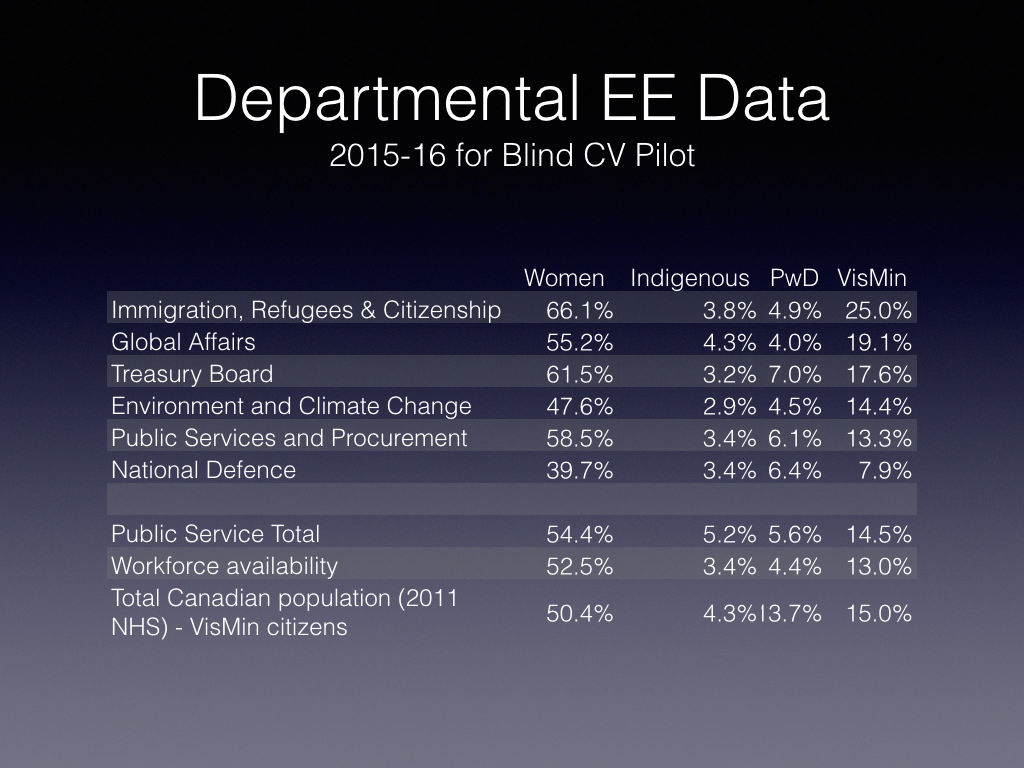
Wisely, the government has chosen to pilot this in a number of departments with different representation challenges, as shown in the table below:

As the government has largely met the goal of being representative of the population it serves, implicit bias may be less of a factor in the government sector. Representation is somewhat less at more senior levels, where implicit bias is likely less of an issue given that candidates are known.

It would be ironic indeed if the pilot, intended to test for bias against visible minorities, would show a bias for visible minorities, given some of the “over-representation” in some departments. In any case, a valuable exercise.

Ottawa has launched a pilot project to reduce biases in the hiring of federal civil services through what is billed “name-blind” recruitment, a practice long urged by employment equity advocates.

The Liberal government’s move came on the heels of a joint study by University of Toronto and Ryerson University earlier this year that found job candidates with Asian names and Canadian qualifications are less likely to be called for interviews than counterparts with Anglo-Canadian names even if they have a better education.

“It’s not just an issue of concern for me but for a lot of people. A number of people have conducted research in Canada, the U.K., Australia and the U.S. that showed there is a subliminal bias in people reading too much into names,” said Immigration Minister Ahmed Hussen, who first delivered the idea to Parliament last year as a rookie MP from Toronto.

“Name-blind recruitment could help ensure the public service reflects the people it serves by helping to reduce unconscious bias in the hiring process.”

Some companies in the private sector, including banks and accounting firms, have already adopted the practice, which removes names from application forms in order to stop “unconscious bias” against potential recruits from minority backgrounds.

In the United Kingdom, the government now requires name-blind applications for university admissions service and other applications for organizations such as the civil service, British Broadcasting Company and local government.

U of T sociology professor Jeffrey Reitz said the initiative is an important step forward but cautioned officials they must consult independent experts in developing the process and reviewing the results to make sure it is done correctly.

To conduct name-blind screening, he said, recruiters must remove any information on a resumé that would reveal the ethnicity of the person, such as name, birth place and membership in an association before coding the candidates in the talent pool.

“If the government is serious about it, they need to make the process transparent and allow researchers to look at the new procedures and the results,” said Reitz, a co-author of the Canadian study on name discrimination against Asians.

Debbie Douglas of the Ontario Council of Agencies Serving Immigrants said she hopes the pilot could benefit other minority groups, given studies have shown that white English- and French-speaking able-bodied women have been the primary beneficiaries of current employment equity programs.

“We hope as the government moves proactively to ensure diversity in hiring it will review the existing program and strengthen it to ensure the intentional inclusion of racialized and indigenous job seekers,” said Douglas.

Treasury Board President Scott Brison, who championed Hussen’s initial idea, said he welcomed the opportunity to explore new ways of recruiting talent for the public service.

“A person’s name should never be a barrier to employment. Diversity and inclusion in the workplace is critical to building an energized, innovative and effective public service that is better able to meet the demands of an ever-changing world,” said Brison at the launch of the pilot at Ryerson Thursday.

The six departments participating in the pilot include Department of National Defence; Global Affairs Canada; Immigration, Refugees and Citizenship Canada; Public Services and Procurement Canada; Environment and Climate Change Canada; and the Treasury Board Secretariat. A report on the pilot is expected in October.

Using data from a recent large-scale Canadian employment study that examined interview callback rates for resumés with Asian and Anglo names, U of T and Ryerson researchers found Asian-named applicants consistently received fewer calls regardless of the size of the companies involved.

Although a master’s degree can improve Asian candidates’ chances of being called, it does not close the gap and their prospects don’t even measure up to those of Anglo applicants with undergraduate qualifications.

Compared to applicants with Anglos names, Asian-named applicants with all-Canadian qualifications had 20.1 per cent fewer calls from organizations with 500 or more employees, and 39.4 per cent and 37.1 per cent fewer calls, respectively, from medium-sized and small employers.

Source: Ottawa pilots ‘name-blind’ recruitment to reduce ‘unconscious bias’ in hiring | Toronto Star

This is the Jeff Bezos playbook for preventing Amazon’s demise – Recode

Lots of interesting insights into Bezos’ thinking.

The one I found the most interesting, given my government background, was on the need for quick decision-making and related implications (impossible in government context given risk concerns but nevertheless helpful as a prompt to think more deeply about government processes):

High-Velocity Decision Making

Day 2 companies make high-quality decisions, but they make high-quality decisions slowly. To keep the energy and dynamism of Day 1, you have to somehow make high-quality, high-velocity decisions. Easy for start-ups and very challenging for large organizations. The senior team at Amazon is determined to keep our decision-making velocity high. Speed matters in business – plus a high-velocity decision-making environment is more fun too. We don’t know all the answers, but here are some thoughts.

First, never use a one-size-fits-all decision-making process. Many decisions are reversible, two-way doors. Those decisions can use a light-weight process. For those, so what if you’re wrong? I wrote about this in more detail in last year’s letter.

Second, most decisions should probably be made with somewhere around 70% of the information you wish you had. If you wait for 90%, in most cases, you’re probably being slow. Plus, either way, you need to be good at quickly recognizing and correcting bad decisions. If you’re good at course correcting, being wrong may be less costly than you think, whereas being slow is going to be expensive for sure.

Third, use the phrase “disagree and commit.” This phrase will save a lot of time. If you have conviction on a particular direction even though there’s no consensus, it’s helpful to say, “Look, I know we disagree on this but will you gamble with me on it? Disagree and commit?” By the time you’re at this point, no one can know the answer for sure, and you’ll probably get a quick yes.

This isn’t one way. If you’re the boss, you should do this too. I disagree and commit all the time. We recently greenlit a particular Amazon Studios original. I told the team my view: debatable whether it would be interesting enough, complicated to produce, the business terms aren’t that good, and we have lots of other opportunities. They had a completely different opinion and wanted to go ahead. I wrote back right away with “I disagree and commit and hope it becomes the most watched thing we’ve ever made.” Consider how much slower this decision cycle would have been if the team had actually had to convince me rather than simply get my commitment.

Note what this example is not: it’s not me thinking to myself “well, these guys are wrong and missing the point, but this isn’t worth me chasing.” It’s a genuine disagreement of opinion, a candid expression of my view, a chance for the team to weigh my view, and a quick, sincere commitment to go their way. And given that this team has already brought home 11 Emmys, 6 Golden Globes, and 3 Oscars, I’m just glad they let me in the room at all!

Fourth, recognize true misalignment issues early and escalate them immediately. Sometimes teams have different objectives and fundamentally different views. They are not aligned. No amount of discussion, no number of meetings will resolve that deep misalignment. Without escalation, the default dispute resolution mechanism for this scenario is exhaustion. Whoever has more stamina carries the decision.

I’ve seen many examples of sincere misalignment at Amazon over the years. When we decided to invite third-party sellers to compete directly against us on our own product detail pages – that was a big one. Many smart, well-intentioned Amazonians were simply not at all aligned with the direction. The big decision set up hundreds of smaller decisions, many of which needed to be escalated to the senior team.

“You’ve worn me down” is an awful decision-making process. It’s slow and de-energizing. Go for quick escalation instead – it’s better.

So, have you settled only for decision quality, or are you mindful of decision velocity too? Are the world’s trends tailwinds for you? Are you falling prey to proxies, or do they serve you? And most important of all, are you delighting customers? We can have the scope and capabilities of a large company and the spirit and heart of a small one. But we have to choose it.

Source: This is the Jeff Bezos playbook for preventing Amazon’s demise – Recode

Liberal bill would automatically increase user fees for federal services by rate of inflation

This kind of fundamental legislation should not be part of an omnibus bill but needs to be debated separately. As I have written before (The impact of citizenship fees on naturalization – Policy Options), CIC/IRCC obtained an exemption from the User Fees Act for citizenship fees in Budget 2013.

This allowed the department to raise fees twice in one year with minimal consultation and arguably misleading Parliament both with respect to the impact of the exemption (i.e., fee increases would not lead to a decline in applications) and that the second increase (from $300 to $530) was not mentioned during the C-24 hearings in either the House or Senate:

The Liberal government has introduced a bill that would significantly increase the fees that Canadians pay for a variety of federal services, such as campsites, fishing licences and passports.

In an omnibus budget bill brought forward Tuesday, the government proposes a new Service Fees Act that would automatically hike hundreds of fees by the level of inflation each year.

The move would also make it much easier for departments to apply for fee increases to better match the cost of providing services to individual Canadians and businesses. The proposed law is slated to come into effect April 1 next year.

The federal government collected about $2 billion in various fees in 2014-15, the latest year for which figures are available, but estimates it cost $3.4 billion to provide those services — resulting in a massive shortfall of $1.4 billion.

FedBudget 20170322

Finance Minister Bill Morneau’s last budget only hinted at the significant changes in user fees being contemplated. Over the four years, starting April 1, 2018, the government expects to collect $364 million in additional fees. (Justin Tang/Canadian Press)

The measure was briefly mentioned in last month’s budget document, which estimated aggregate fee revenues would increase by $36 million in 2018-2019, and by $147 million in extra revenues by 2021-2022.

The measure does not target specific fees. Rather, it replaces 13-year-old legislation that effectively froze fees by making it too onerous for departments to apply for increases as costs rose.

Federal officials estimate only about 20 per cent of all federal fees are captured by the User Fees Act of 2004. But the new legislation would capture almost all fees, and would require government to report in detail to Parliament each year on the amounts collected versus the cost of providing services.

Opposition critics have called the measure a tax grab, which can especially hurt low-income Canadians.

But a spokesman for Treasury Board President Scott Brison, who is shepherding the new user-fee regime, says the bill would relieve taxpayers of the unfair burden of paying for services enjoyed by individuals and corporations, while it also increases transparency.

Exempts some fees

“The government is always looking for ways to minimize costs for taxpayers and making the fee system transparent,” said Bruce Cheadle.

“We want to give everyone equal access to high-quality government services and we’re going to ensure middle-class Canadians aren’t disproportionately footing the bill for this.”

The new bill exempts some fees from the new regime, including fees under the Food and Drugs Act and some fees considered too small to be material.

The government also suggests that some costs, such as those related to food safety, will not always be fully charged back to users because there is a public good also attached to some government services.

CBC News first reported on the government’s plans in February, citing an internal briefing note for Brison that argued fees have been largely frozen since 2004 as departments shied away from the complex regulatory process of arguing for increases.

The briefing note from August 2016 said 84 per cent of existing user fees have not changed in 13 years, and cover a diminishing fraction of the actual cost of delivering the services.

Despite the fresh measures to increase fees, Brison last year eliminated all retrieval, processing and reproduction fees under the Access to Information Act. And this year, Parks Canada is waiving entry fees for its national parks and historic site to celebrate Canada’s 150th anniversary.

Source: Liberal bill would automatically increase user fees for federal services by rate of inflation – Politics – CBC News

Samara’s 2017 Democracy 360 Second Report Card on How Canadians Communicate, Participate and Lead in Politics – Visible Minority Methodology Issues

While I have great respect for the work Samara does and continues to do, as exemplified in their latest report, I would be remiss in not pointing out some serious methodological mistakes made with respect to visible minority representation.

Their diversity numbers:

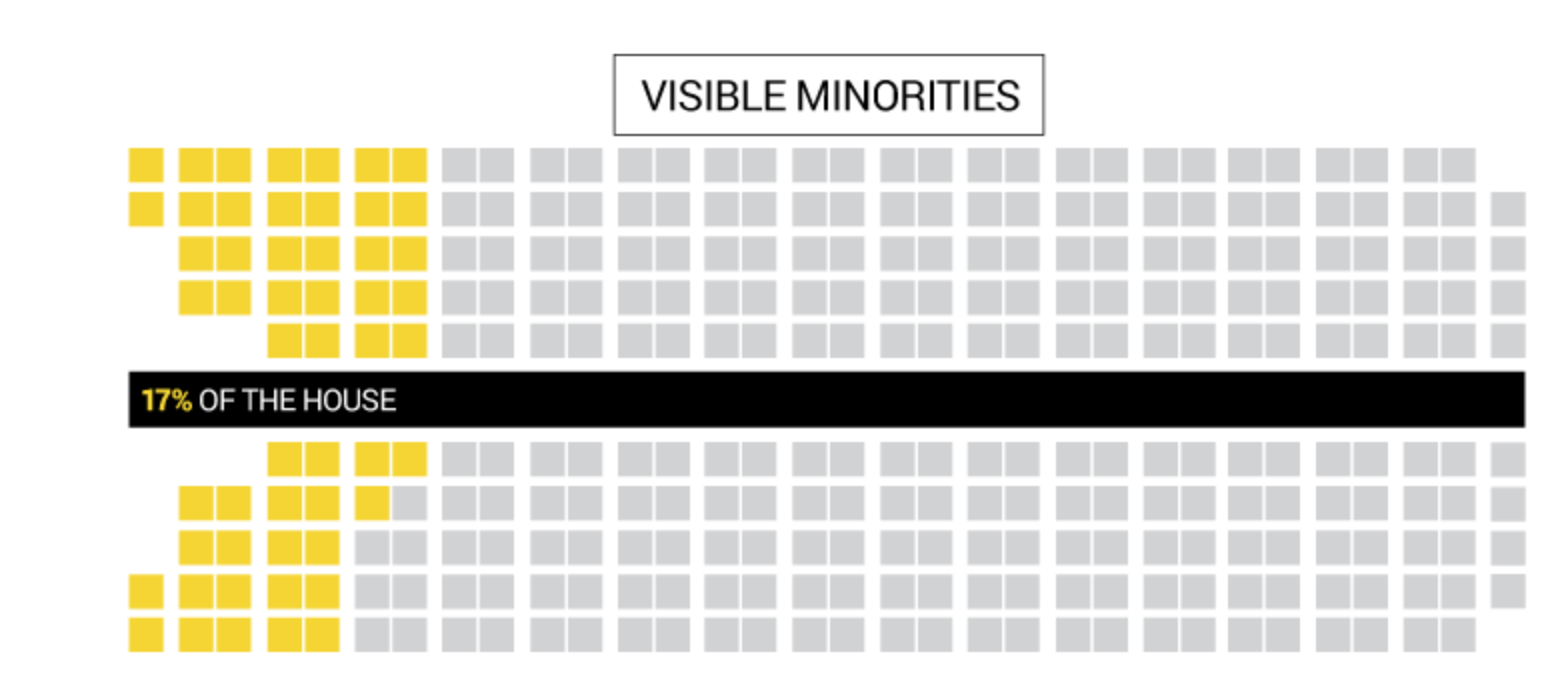
While our current Cabinet was selected to be more reflective of the Canadian population, Parliament generally, with 74% men, still has a long way to go. Women represent half of Canada’s population, but they are only 26% of its MPs. Visible minorities are better represented—they make up 17% of MPs and 19% of the population. Indigenous MPs make up 3% of the House and 4% of the population. In terms of representation of the youngest cohort of voters Canadians, representation has lost ground since 2015. Only 4% of MPs in the 41st Parliament are aged 18 to 30, a cohort that comprises 17% of the Canadian population.

The two mistakes are:

  • Using the wrong baseline for visible minority representation. Samara uses the overall population of visible minorities (19 percent) rather than the correct baseline of 15 percent, those visible minorities who are also Canadian citizens and thus able to vote. This is the second time that this incorrect baseline has been used and should be corrected for future reports; and,
  • Their count of the number of visible minority MPs is wrong. The correct count is 47, not the 53 indicated in the chart below.

The corrected numbers show visible minorities forming 14 percent of the House of Commons (2015 election), compared to 15 percent of the visible minority voting population. A good result.

Samara and I have shared our respective data sets and discussed these concerns and they have been forthcoming on the reasons for the discrepancies. Their count of visible minorities included some Indigenous MPs and Alexandra Mendès (but not Pablo Rodriguez) and they used the overall visible minority population to be consistent with their earlier report.

For future reports, my main recommendations:

  • for women, foreign-born and Indigenous MPs, use the authoritative parlinfo biographical information which would avoid mis-categorization of Indigenous as visible minority MPs;
  • use existing analysis rather than re-inventing the wheel. Erin Tolley, Kai Chan and I all came up with the 47 number (Erin and I compared notes to ensure that neither of us missed anything, Kai did his work independently; and,
  • use the population of visible minorities who are also Canadian citizens as the baseline, not the total visible minority population.

Their numbers for foreign-born, women and Indigenous MPs are correct, taken from the parl.gc.ca site (however the graphics are not – 40 versus the correct figure of 41 foreign-born, 81 versus 88 women, 9 versus 11 Indigenous peoples).

Source: 2017 Democracy 360

Byelection results: Tories hold Calgary seats, Liberals keep Ottawa, Montreal, Markham: Increase in diversity

These results further increase diversity: four women elected, all replacing men, one visible minority elected, replacing a non-visible minority man.

Overall totals: 92 (up from 88) women or 27 percent, 48 visible minorities (up from 47) or 14 percent.

Source: Byelection results: Tories hold Calgary seats, Liberals keep Ottawa, Montreal, Markham – Politics – CBC News