Inside the progressive think tank that really runs Canada [Canada2020]

Good long read by Anne Kingston:

To study Canada 2020, it’s useful to have some grid paper to better map its myriad interconnections, many which reveal the two degrees of separation that define Canadian politics. Three of its co-founders—Smith, Tim Barber and Eugene Lang, all well-connected Liberals—were also principals in the Ottawa-based Bluesky Strategy Group, a firm whose services include lobbying and media relations (Lang left Bluesky and Canada 2020 in 2013). Pitfield, the fourth named co-founder, has impeccable Liberal bona fides: the son of Senator Michael Pitfield, clerk of the Privy Council when Pierre Trudeau was PM; a lifelong friend of Justin Trudeau, helping him write the stirring 2000 eulogy to his father that paved his way to political office. Pitfield, who also worked for the Canada China Business Council founded by billionaire Paul ­Desmarais, is married to Anna Gainey, elected president of the Liberal Party of Canada in 2014; he ran digital strategy for Trudeau’s leadership bid and also for the 2015 federal Liberal campaign.

Connections between Canada 2020, the Liberal Party and Bluesky can look like a Venn diagram on steroids. Bluesky and Canada 2020 are based at 35 O’Connor St., where the party rented space for a temporary “volunteer hub” during the election. Pitfield intersects with the Liberals professionally via his company Data Sciences Inc., which has an exclusive agreement to manage the party’s digital engagement; two Data Sciences staffers sit on the Liberal Party’s board of directors.

Where there is Liberal news, there’s often a Canada 2020 connection. Take the recent controversy over Rana Sarkar, named Canada’s consul general to San Francisco at a salary twice the listed compensation. Media focused on his friendship with Gerald Butts, Trudeau’s senior adviser. But Sarkar has deep Canada 2020 links, too: he was named to its advisory board in 2015, is the author of a chapter in one of its “policy road maps,” and has participated in its speaker series. The bottom line: to understand this big-L Liberal moment in Canadian politics, you have to understand Canada 2020.

When asked about the organization’s genesis, co-founder Tim Barber points to an Oct. 2003 New York Times Magazine story, “Notion Building,” about the Center for American Progress (CAP), which had recently been founded by John Podesta. Bill Clinton’s former White House chief of staff (and later an Obama adviser) wanted to take on the right with an enterprise that could book liberal thinkers on cable TV, create an “edgy’’ website, and recruit scholars to research and promote new progressive policy ideas. CAP wasn’t an organ of the Democratic Party, Podesta insisted, though history points to it being just that.

Podesta hates the term “think tank,” Barber says. “I do too. It’s way too passive and conjures days gone by. His view was that there’s an opportunity for organizations to put as much time into marketing and communicating big ideas as coming up with those big ideas.”

Source: Inside the progressive think tank that really runs Canada – Macleans.ca

Fonctionnaires autochtones: insatisfaction, discrimination et harcèlement | Maxime Bergeron | Politique canadienne

Haven’t seen this covered in English media. Worrisome (although it would be useful to have some comparative data for other groups):

Alors qu’Ottawa multiplie les appels à la «réconciliation» avec les peuples issus des Premières Nations, une enquête menée auprès de 2189 fonctionnaires fédéraux autochtones révèle un pourcentage élevé d’insatisfaction, de même que de nombreux cas de «discrimination» et de «harcèlement» au travail.

L’enquête menée par le groupe-conseil Quorus au profit du ministère de la Sécurité publique, obtenue par La Presse, indique aussi que 40% des employés autochtones songent à quitter leur poste d’ici deux à trois ans. Des conclusions qui ne surprennent pas du tout Magali Picard, vice-présidente exécutive à l’Alliance canadienne de la fonction publique (AFCP) pour le Québec et porte-parole du Cercle national des peuples autochtones.

«Je ne vous ferai pas croire qu’il n’y a pas de discrimination au gouvernement du Canada, ce n’est pas vrai. Ce que ça fait, souvent, c’est que les gens ne restent pas en poste.»

Mme Picard, membre de la nation huronne-wendate, dit avoir elle-même vécu plusieurs situations troublantes alors qu’elle était employée du gouvernement fédéral. Elle entend encore régulièrement les problèmes de fonctionnaires autochtones pendant des «cercles fermés» de discussion, où ils ne craignent pas les représailles.

«Pas plus tard qu’en mai dernier, j’ai entendu des histoires d’horreur, où des gestionnaires venaient juger les us et coutumes qui sont pratiqués dans les réserves ou les familles, en disant que c’était dépassé ou du folklore, que les gens devraient être gênés, raconte la dirigeante syndicale. On entend aussi tous les stéréotypes : vous ne payez pas vos taxes, votre électricité. C’est aberrant.»

«Sentiment de discrimination»

Parmi les conclusions du sondage de Quorus, remis en mai dernier au gouvernement, on apprend que 42% des autochtones jugent l’accès à des possibilités d’apprentissage et de perfectionnement «inégal». Questionnés sur les plus grandes difficultés rencontrées dans leur emploi, 18% ont mentionné un «manque de respect pour la culture autochtone» et 17%, un «sentiment de discrimination».

«Ceux qui ont une expérience négative à l’égard de leur environnement de travail ont abordé les aspects suivants : la discrimination, le harcèlement, l’intimidation et le manque de respect en milieu de travail», peut-on lire dans le rapport de 123 pages.

«Dans certains cas, on a rapporté des attaques insidieuses, et dans d’autres, des situations de discrimination directe.»

Le sondage souligne que 56% des fonctionnaires issus des Premières Nations sont «satisfaits ou très satisfaits» de leur emploi. Mais 40% pensent à quitter leur poste d’ici deux ou trois ans, une proportion plus élevée que pour l’ensemble des employés de la fonction publique fédérale (26%), d’après des données citées dans l’étude.

Amélioration

Selon la syndicaliste Magali Picard, la situation des autochtones se serait dégradée dans la fonction publique pendant la décennie du règne des conservateurs, entre 2006 et 2015. «Oui, on a vu une recrudescence des comportements de harcèlement, d’intimidation, d’abus de pouvoir, de commentaires qui sont vraiment très difficiles à croire dans les années auxquelles nous sommes rendues, et ce, de la part de l’employeur le plus important au pays.»

Les choses auraient toutefois commencé à s’améliorer depuis la passation des pouvoirs à Ottawa, soutient Mme Picard. «Même si ça ne va pas à la vitesse qu’on voudrait, l’attitude est différente, le respect est là, et la volonté de rétablir des liens, on la sent. Ça, ça ne peut que nous aider à améliorer les conditions des employés de la fonction publique.»

Réponse d’Ottawa

Au cabinet de Scott Brison, président du Conseil du Trésor qui chapeaute la fonction publique canadienne, on a souligné hier avoir pris un « engagement fondamental » en vue de « renouveler la relation avec les peuples autochtones ».

«Il nous reste bien du travail en matière de recrutement et de rétention des employés autochtones», affirme Jean-Luc Ferland, attaché de presse du président du Conseil du Trésor Scott Brison.

Pour tenter d’attirer davantage de jeunes autochtones, Ottawa a lancé en 2016 un programme de stages d’été destiné aux étudiants, considéré comme «un pas significatif dans la bonne direction». Le nombre de participants a triplé entre la première et la deuxième année, avance le Conseil du Trésor.

Selon des chiffres de mars 2016, quelque 5,2% des 259 000 employés du gouvernement fédéral sont issus des peuples autochtones. Il s’agit d’une surreprésentation par rapport au taux de disponibilité des autochtones au sein de la population active, qui s’élève à 3,4%, indique une autre étude d’Ottawa.

Source: Fonctionnaires autochtones: insatisfaction, discrimination et harcèlement | Maxime Bergeron | Politique canadienne

Feds underestimated complexity, ignored concerns about Phoenix pay system, review finds

Pretty damning account of senior management failures:

An independent report on the problem-plagued Phoenix pay system rollout released Thursday says the government underestimated its complexity.

Public Services and Procurement Minister Carla Qualtrough (Delta, B.C.) apologized to affected public servants in an Oct. 5 press conference, and said the review confirmed many of the thoughts she already had. She noted fixing the pay system is the first priority in her mandate letter from the prime minister, given to her after he moved her into the job in August.

“The implementation of such a complex business transformation across the entire government of Canada was a massive undertaking that I believe history will record was set up to fail,” she said, noting there was poor planning on almost every key aspect. “There’s no easy or quick fix for the problems in the pay system.”

The report’s “lessons learned” included: assigning accountability and authority to a single office, properly defining the scope of the project, fully testing the software before launch, and not expecting savings until well after implementation.

Overall, the independent consultants hired to do the review found the officials working on the project were most concerned with being on time and on budget. Briefings were usually positive and the culture of the department responsible prevented people from speaking negatively about the project. The report said bad news was usually buried, with concerns mostly ignored. Even at the pay system’s launch in February 2016, testing was incomplete, with no planned fix date and no contingency plan.

Other lessons included making sure to have sufficient employee knowledge capacity, and communicating effectively. The report noted workplace culture was also important, and that the 17 lessons it outlined “are yet to be learned” by the government.

Though work on the new pay system began under the previous Conservative government, the Liberals launched it in February 2016. It was supposed to consolidate the payroll of over 300,000 public service employees, but instead it has left many of them overpaid, underpaid, or not paid at all. Radio-Canada recently reported that as of Aug. 8 nearly half of the 313,734 federal public servants paid through Phoenix had been waiting at least a month to have their complaints dealt with. The government contracted IBM to configure the software for the government payroll system.

The program was supposed to save the government $70-million per year, but so far the Liberals have sunk in about $400-million to fix it.

Source: Feds underestimated complexity, ignored concerns about Phoenix pay system, review finds – The Hill Times – The Hill Times

And good background to some of the potential conflicts of interest with some of companies doing background studies and recommendations, and working on implementation:

Two companies that were awarded tens of millions of dollars in contracts to help create the new federal pay system played a part in recommending the Phoenix project in the first place, CBC News has learned.

This appearance of a conflict of interest in the very early days of the project is raising flags for those who monitor federal procurement and accountability.

The internal government report that recommended a new pay system in 2009 relied heavily on two studies — one from IBM and another from PricewaterhouseCoopers. These were two of the companies that went on to help develop Phoenix for a combined price tag of more than $200 million — and counting.

“That’s a cause for concern,” said Christopher Stoney, who follows procurement and accountability issues as a professor at the School of Public Policy and Administration at Carleton University. “[It’s] clearly getting into areas here of conflict of interest.”

The recommendation

In May 2009, top government bureaucrats delivered a document called Initiative to Fix the Pay System Business Plan, which convinced decision makers to bring in a new, modern pay system. That system would later be called Phoenix.

A year earlier, international professional services firm PricewaterhouseCoopers published a report called Analysis of Industry and Government of Canada Pay Administration Services Delivery Model Options. The PricewaterhouseCooper’s study has not been made public, but it is quoted liberally throughout the Phoenix business plan.

The PwC study suggested the most cost effective choice for the Government of Canada would be to create a consolidated pay centre and use customized off-the-shelf pay software. It was advice the government embraced.

PricewaterhouseCoopers also reviewed the business case as, in the government’s words, “an independent Third Party to ensure unbiased and accurate content.”

The company has earned $17.4 million through its work on the Phoenix system since 2009, according to the federal government database Buyandsell.gc.ca.

“I think anybody looking at this would be concerned that there was this possible undermining of independence,” said Stoney, who co-edits the annual publication How Ottawa Spends. “At some point it seems as though that independence was eroded and [PwC] became increasingly key players in this.”

IBM’s role

The government’s Initiative to Fix the Pay System Business Case also depended on research provided by IBM in a February 2007 report called Pay Benchmarking Study for the Government of Canada.

In September, CBC reported details about IBM Canada’s extensive responsibilities to design, implement, operate and fix the Phoenix system, for a price tag that has so far reached $185 million.

The 2007 IBM study pointed out that custom, off-the-shelf software systems are “consistently more cost effective and enable higher quality and efficiency, when implemented and sustained properly.”

This was exactly the kind of system that IBM was hired to implement for Phoenix.

IBM also noted the government’s old system was at risk of failure. Its report warned that these “payroll errors can have significant consequences for both the financial picture of the organization and talent retention.”

‘Brought into the tent’

“It’s clear that two of the contractors that played a role on the build and operations played a role in the business case,” said Kevin Page, president of the Institute of Fiscal Studies and Democracy at the University of Ottawa.

“So we literally brought them into the tent, asked them to see whether or not the business case was strong, asked them to do benchmarking, which is critical to performance of a business case.”

Page was appointed Canada’s first Parliamentary Budget Officer in 2008 and was in that role when this business plan was developed. But he had never seen the business case until CBC sent it to him recently.

Handling the public policy hot potatoes

Rachel Curran, former director of policy to former PM Harper, argues correctly for governments to “embrace debate.” While some, of course, will dispute the record of the Harper government with respect to its receptivity to debate, it nevertheless is sound advice to all governments and public servants.

Her point about diversity of political views, apart from her reflexive reference to elites (of which she is one), is particularly important, as well as, of course, not automatically labelling as, for example, “elitist” or xenophobic:

The most important lesson from our summer of discontent, however, is this: we should not shy away from the necessary and inevitable debates around policy-making in sensitive areas. Too often in Canada, governments avoid so-called “third rail” policy issues because they are afraid of the political consequences. That doesn’t serve our country or its citizens well.

The Harper government never returned to the problems it was attempting to address in Bill C-30, and our police forces still don’t have the tools they need to fight online crime effectively. Our employment insurance system continues to perpetuate a widespread system of part-time employment in some regions, while leaving full-time workers without needed coverage in others. Jurisdictions elsewhere in the world with mixed public/private healthcare systems achieve notably better outcomes, spending less money per capita, than we do. But we are not talking — really talking — about any of these issues. In that sense, it is a blessing when internal and external events coincide to force a public conversation on an issue like immigration or our refugee system.

Government aside, as a society we should not be afraid of public debate, or differences in outlook. Elite Canadian opinion, whether represented in the media, academia, think tanks, or even the business world, is often reluctant to tolerate and accommodate dissent, or to provide space for alternate views. Suppressing freedom of thought and speech does not suppress or eliminate opinions we find uncomfortable or unpleasant; in fact, the opposite is true. Shutting down the expression of alternate views simply encourages individuals to seek out less productive outlets, because there is no space or voice for them in mainstream discussion.

We need to actively embrace difference. Diversity does not just encompass ethnicity or gender or sexual orientation; it also includes political and cultural views. This does not mean tolerating hate speech or exhortations to violence, but it does mean accommodating opinions and concerns without painting them as de facto racist, for example. Vigorous disagreements on matters of policy and politics are not cause for hand-wringing, but are indicative of a dynamic and thriving democracy. Only when our public discussion is fully open and honest will we also have public policy that is truly representative and informed.

Source: Handling the public policy hot potatoes

Erick Erickson: How to Find Common Ground @NYTOpinion

Health crisis and mindfulness of mortality provoke reflection on all sides of the political spectrum. Unfortunately, all too often, this awareness does not occur before:

The truth, though, is that our Facebook friends are probably not going to water our flowers while we are on vacation and our Twitter followers will not bring us a meal if we are sick. But the actual human being next door might do both if we meet him.

This is what I want my children to know if I should die before they wake. The kitchen table is the most important tool they have to reshape their community. Preparing a home-cooked meal and inviting people over, both those we know and those we want to know, forces us to find common ground.

Not everything should be political, and we can only make everything political when we decide the other side is evil just because they disagree with us. We can see the world only in this polarized way if we never take the time to know anyone on the other side, if we never find ways to build friendship despite our differences.

Every person has an interesting story to tell. I want my children to know my story. But I also want them to know that the stranger next door has one, too, and that even if they disagree on much, they can still be friends.

We may also never find that common ground with people whose politics or faith conflicts with ours. But we owe it to one another to disagree agreeably, without anger or intimidation, whether on a front porch or a Facebook page. A little more grace among us all would go a long way toward healing the nation.

Why Canada’s political pipeline leaves little room for anyone but white men

Good study by Erin Tolley (disclosure: know Erin from our time together at CIC/IRCC and we remain in contact):

For women, the toughest hurdle is at the nomination level, the first checkpoint into the political realm.

Racialized minorities come up against barriers further along, beginning at the candidate selection stage.

That’s according to Erin Tolley, who teaches political science at the University of Toronto.

Tolley is among the first to map the race and gender of more than 800 people vying for a political party’s nomination ahead of the 2015 vote in 136 of the country’s most diverse ridings, where racialized minorities make up at least 15 per cent of the population, half of which are in Ontario. (Her tally uses Statistics Canada’s definition of “visible minority” and therefore does not include Indigenous nomination contestants or candidates.)

Wannabe politicians must first successfully compete for their choice party’s nomination in order to become the candidate in an election.

Though Tolley’s project is still in the works, early findings suggest political parties aren’t doing enough to diversify the pool of candidates.

“The dynamics for women and racialized minorities are different,” she said. “That’s important for parties to know because they therefore need to have different strategies if they want to attract and want to run women or racialized minority candidates.”

Women make up 52 per cent of the population, but only accounted for 33 per cent of nomination contestants across those 136 ridings. The proportion of female election candidates ticked up slightly, to 36 per cent, and 31 per cent of elected MPs in those districts were women.

That suggests women are less likely to throw their hat in the ring, but once they do, they fare well.

“Maybe women don’t want to run, they don’t want to be called ‘Barbies,’ for example,” Tolley said, citing veteran MP Gerry Ritz’s now-deleted and apologized-for recent tweet that referred to Environment Minister Catherine McKenna as “climate Barbie.”

Tolley put the onus on political parties.

“Political parties don’t do sufficient work to identify women candidates and encourage them to run,” she said. “Frankly, not enough fingers are pointed at political parties. We don’t need to change the electoral system to get women into politics. All parties need to do is nominate more women. It’s actually pretty simple.”

Racialized minorities don’t experience the same obstacle.

According to the data, minorities declare their candidacy in proportions that match their presence in the population. However, by the time Canadians go to the polls the share of MPs of colour is far below that.

“They want to be nomination contestants, but then the party is less likely to select them, and voters are even less likely to select them,” Tolley said.

Across the 136 ridings, racialized minorities comprised 38 per cent of the population and 37 per cent of nomination contestants. That dwindled to 33 per cent of election candidates, and to 29 per cent of MPs — an eight-point gap between the number of hopeful nominees and those who won a seat on the Hill.

A contributing factor is one Tolley has previously explored — that minority candidates tend to compete against each other in battleground districts.

That’s because racialized minorities are more likely to run, and win, in more diverse ridings, Tolley said. For instance, three candidates of colour may vie for their party’s nomination in an ethnically-rich district, and split the ballot.

“So, you have this big pool of people who are interested, but they’re competing against each other, essentially cancelling each other out — and that’s happening at each level,” she explained.

As for white men, their political possibilities widen.

Thirty-nine per cent of nomination contestants in those diverse ridings were white men, and they comprised 40 per cent of candidates on the ticket. Nearly half, 48.5 per cent, of those who won a seat were white males.

Source: Why Canada’s political pipeline leaves little room for anyone but white men | Toronto Star

Canada’s access-to-information system has worsened under Trudeau government: report

Hopefully, this report will provoke some attention:

Canada’s access-to-information system has only gotten worse under Prime Minister Justin Trudeau’s government, and a new Liberal bill intended to fix the problems has “worrisome” elements, a new report has found.

A freedom-of-information audit from News Media Canada, a national association representing the Canadian news media industry, gives the federal government a failing grade for timely disclosure of information. It also said its performance in this year’s audit “was even worse than in the latter years of the former Stephen Harper government.”

“The results are not encouraging and show a system that seems as broken as ever,” said a report on the audit by journalist and professor Fred Vallance-Jones and Emily Kitagawa, a freelance journalist and social worker.

Nathan Cullen, the NDP democratic reform critic, called the findings “shameful.”

“It’s got to be a bad day for Liberals when Stephen Harper was more open to the Canadian public than they are,” he said.

The report came the same day the federal information watchdog said she is “generally very disappointed” with the Liberal bill that would revise the Access to Information Act, which is intended to let Canadians see federal files.

Information commissioner Suzanne Legault said on Tuesday she will outline her concerns about the planned changes in a special report to Parliament this week.

The act, which took effect in 1983, allows people who pay $5 to request everything from correspondence and studies to expense reports and meeting minutes.

Agencies must answer requests within 30 days or provide a good reason for taking more time.

Source: Canada’s access-to-information system has worsened under Trudeau government: report – The Globe and Mail

Germany’s election and the educational polarisation of voters | Times Higher Education (THE)

Interesting analysis:

Germany has voted. Angela Merkel is weakened, but she remains chancellor and is now seeking new coalition partners for government.

Instead of focusing on what the election means for German higher education and research policy – which probably won’t become clear until months of coalition negotiations have concluded – I want to highlight some interesting voting patterns among German graduates.

In the United States and the UK, it’s now a commonplace observation that voters seem increasingly divided by levels of education rather than traditional cleavages like levels of income. In the ballots of 2016 and 2017, graduates tended to take the side of more open, pro-cosmopolitan parties and politicians (Jeremy Corbyn’s Labour, Hillary Clinton, Remain in the UK’s EU referendum) against more closed, nationalistic forces (Theresa May’s Conservatives, Leave, Donald Trump).

You can certainly quibble with these groupings, but the overall trend is unmistakable.

For example, in this year’s UK general election, graduates were 10 percentage points less likely to back the Conservatives, and nine percentage points more likely to vote for Labour, than the broader voting public.

The divide was even starker last year during the EU referendum, when 68 per cent of graduates voted to remain.

Meanwhile, in the US election, Clinton won college graduates by a nine percentage point margin, while Trump won everyone else by eight points. “This is by far the widest gap in support among college graduates and non-college graduates in exit polls dating back to 1980,” according to the Pew Research Center.

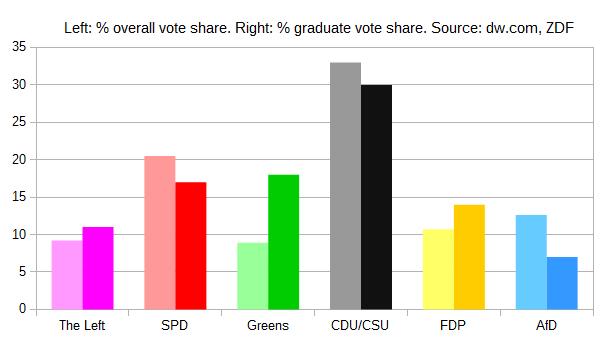
Is the same thing happening in Germany? Ostensibly not – German graduates seem more in line with their fellow citizens than in the UK or the US. This is most clearly visible when you look at the graduate vote share for Germany’s political parties arranged on the left to right political spectrum:

In terms of the bigger parties, graduates were a little less likely than other voters to vote for Merkel’s conservatives (CDU/CSU) – but exactly the same was true of the social democrats (SPD).German graduates voting patterns

Graduates were both more likely to opt for the radically left-wing Die Linke – and the almost diametrically opposed (at least on economic matters) Free Democratic Party (FDP). This feels very different from the US and UK, where graduates have come down heavily on one side or the other in the votes of the past two years.

Why might this be? A couple of potential reasons spring to mind. Germany is famed for the quality of its vocational education, which, although under pressure, still offers the hope of a well respected and remunerated life course that does not require university. Non-graduates are perhaps less likely to be economically “left behind” than in other countries.

There is also still no real equivalent of the Ivy League, Oxbridge or the grandes écoles in Germany, meaning that attending (a certain type of) university is arguably less of a prerequisite for power and influence.

But have a look at the chart again – there are nonetheless signs that educational polarisation is beginning to take root in Germany.

Graduates heavily backed the Greens, who, aside from their environmental policies, are known as supporters of multiculturalism, and have several high-profile leaders with a Turkish family background. The AfD on the other hand are emphatically against multiculturalism and have leaders who have made a series of brazenly racist statements; they were largely shunned by voters who have been to university.

As the AfD’s entry into parliament shows, Germany is not immune from the divisions afflicting the UK, the US and many other European countries. It will be interesting to see if the country becomes just as polarised on educational grounds as well.

Source: Germany’s election and the educational polarisation of voters | Times Higher Education (THE)

New passport processing system $75M over budget

Yet another failing project, once again pointing out political and public servant accountability and management issues:

Another government IT project is going off the rails, this one intended to issue Canadian passports faster and cheaper than the current system.

The so-called Passport Program Modernization Initiative, launched in 2014, is at least $75 million over budget and well behind schedule.

“From its outset, the complexity … was underestimated,” says an internal document, explaining a series of setbacks to the ambitious plan.

“The project management capacity and expertise was insufficient for the complexity and scale of the initiative.”

The January 2017 document, obtained by CBC News under the Access to Information Act, says that in initial tests the new system actually increased processing times, rather than decreased them as planned, and allowed breaches to Canadians’ confidential information.

The passport mess joins the botched Phoenix payroll system, the struggling email transformation initiative and the Canada.ca project as IT schemes inherited by the Liberal government that have bogged down in delays and cost over-runs.

That’s because passport fees are much higher than the actual cost of producing the document, and surpluses can be used for improvements in passport processing, including the modernization project and its budget overruns.

Online renewals

The passport project was first approved in December 2013 with a five-year, $101.2-million budget, and was intended among other things to let Canadians apply online for renewals. The project was to be complete by June next year.

But Immigration, Refugees and Citizenship Canada — which has run the passport office since July 2013 — now says modernization will cost at least $176 million, a 75 per cent increase so far, and will not meet next year’s deadline because of delays.

“The project schedule is under review and planned activities are being resequenced to occur at a later date,” says a report on the project.

CBC News has previously reported on the first flubbed test of the new system, starting on May 9, 2015, in which at least 1,500 passports were produced that were vulnerable to fraud and tampering.

But unlike the other three, the fees Canadians pay directly for their passports are going to bail out the modernization project rather than general tax revenues.

‘The reporting did not track project spending … against budgeted activities.’– Internal report on passport modernizaton project

The test was carried out despite warnings of some officials that it posed significant security risks. In the summer of 2015 the department suspended its use of the new system, which was plagued with hundreds of glitches. Officials said none of the 1,500 problematic passports was issued to any citizen.

An internal audit of the initiative’s first stages found a raft of problems, including lack of cost control.

“The reporting did not track project spending against budgeted activities,” says the February 2016 audit report, adding the project “did not include a plan for security requirements.”

In 2013, the new fee for a five-year passport was set at $120 compared with $87 previously, and the department introduced a new 10-year passport for a $160 fee.

Revenues currently far exceed expenses; the passport program generated a surplus of $253 million for 2015-2016, the most recent year reported.

Revenue to drop

But because more Canadians are holding 10-year passports, the department expects revenues to drop significantly starting next year as fewer people need renewals.

The program will start drawing on its accumulated surpluses after next year to avoid deficits — but the modernization program’s cost overruns will add to the fiscal pressures.

That’s the opposite of the original plan, which was for the passport modernization project to dramatically cut the cost of issuing passports, and help IRCC get through the lean years from 2018 to 2023 as revenues decline because of the effect of 10-year passports issued in 2013 and after.

Source: New passport processing system $75M over budget – Politics – CBC News

ICYMI: Rewriting history? That’s how history is written in the first place – Macleans.ca

Worth reading – the counterpoint to some earlier commentary:

If you’ve been following the debate over whether Sir John A. Macdonald—prime minister, lawyer, architect of Confederation, corrupt politician, and functional alcoholic—should have his name removed from schools and buildings in Ontario, you’ve likely encountered histrionic reactions from those who decry such efforts as erasing history or re-writing our past or genetically engineering political correctness into Canadians.

The “history is under attack!” responses are predictable, but that’s not their critical deficiency. No, the greatest weakness in that argument is that it fetishizes a particular account of history, ignoring what history is, what it represents, and what it does. Many of the quickest takes about the “problem with re-writing history” are sops for old-school culture, mopping up buckets of indignation from those whose historical experiences and values seem rather well-represented in our official accounts of our past, as well as our acknowledgements and celebrations of events and figures.

This all started last week when the Elementary Teachers’ Federation of Ontario (ETFO) cracked open Pandora’s box by passing a motion to “examine and rename schools and buildings named after Sir John A. Macdonald.” The impetus for dropping the sometimes-beloved whiskey-soaked codger? “[H]is central role as the architect of genocide against Indigenous peoples.” I’d say the punishment fits the crime here, except it doesn’t; being structurally complicit in the deaths of many peoples and their culture while initiating an ongoing history of violence against the descendants of those peoples seems to warrant a rather more severe reprimand. But let’s set that aside.

This debate has been a long time coming. We should have had it in earnest a long time ago, given changes to the makeup of Canadian society and the longstanding injustices that remain woefully and shamefully under-addressed or unaddressed entirely, especially our relationship with Indigenous peoples. But the debate thus far hasn’t sufficiently acknowledged one crucial consideration: revisiting our history—reassessing it and how we think about it—is central not only to correcting the record in some cases, but also to moving forward as a country. History is not a static moment or series of moments; history is an ongoing project that connects past generations to the present, and it is built by human beings who make choices about what we admit to, what we ignore, what we celebrate, and what we condemn.

The preferences, norms, and values of a society change over time; the present is a reflection of what we want to represent us, right now—and so it is perfectly reasonable, and often necessary, for a country to revisit what in its history it chooses to emphasize and celebrate. This is, after all, how history is written in the first place.

Now, no one is suggesting that we completely strike Macdonald and other historical figures who are implicated in practices or actions we now find unacceptable or abhorrent from the history books. No one is arguing that we should forget Macdonald’s legacy as a critical part of Confederation. We’re not turning the porch light off and pretending we’re not home should he pop by.

All the ETFO and others are suggesting is that in some instances, we should choose not to celebrate and honour Macdonald by naming schools and buildings after him, which seems rather reasonable given that he was complicit in the abusive and murderous residential schools system as well as other (what we would now call) crimes against Indigenous peoples. If a democratic society chooses to live its history by shifting who and what it emphasizes and celebrates, then bully for it—especially if a shift in focus is used to foreground and address historical and contemporary injustices and to renew efforts at healing persistent wounds. This reassessment of the past and how we live in the present is only controversial if your understanding of history is static and your commitment to your country is monolithic.

Historian Sean Carleton captured this line of argument well, reminding us that history is always political and never objective, and that while facts are objective, history is not. “We need to remember that both naming and renaming are political things that need debate,” Carleton said in a piece that ran in the Calgary Herald. “Names are not neutral and that’s what I think is somewhat frustrating about the claim that changing the name is erasing history.” Precisely.

Cherie Dimaline, a Métis woman, wrote in Today’s Parent that history is indeed political, as well as ongoing and alive in the present, especially the Canadian history of violence against Indigenous peoples. “It strikes me as particularly ironic that they’re worried about history being lost. After all, the very fact that we send our children to schools named after the architect of Indigenous genocide through the residential schools attempts to remove our story, negate our well-being and ignore our continued survival,” she writes. “It is, in fact, a push to actively lose history….I hear all the time that colonization happened 400 years ago, that it’s so far gone that we shouldn’t be so sensitive…. Colonization didn’t happen 400 years ago; it began 400 years ago and continues today. Right now.”

Carleton and Dimaline remind us that history is ongoing and disputed; as we live, and make choices about how we remember and view our own histories, we create history anew, whether we care to acknowledge that or not. Those who oppose dropping Macdonald’s name from schools and buildings smuggle in a comfort with a broad conceit of history that isn’t universally shared, one that carries water for some but not for others; one person’s “re-writing of history” may be another’s rectification of history. A sophisticated understanding of where we come from takes this understanding of history for granted as a starting point and accepts that the past is more than a series of fixed written records, and our conception of it certainly isn’t objective.

As long as we humans have had history, we’ve been re-writing it. In fact, our history is the history of “erasing”—that is, revisiting and revising—our past. Canada is no exception to this practice, and nor should we be. Indeed, it may be the case that the best way to continue as a country is through an ongoing and vigorous debate about who we are, where we come from, what we value, and what we choose to celebrate, emphasize, and honour in our public spaces.
Source: Rewriting history? That’s how history is written in the first place – Macleans.ca