Cabinet ministers asked to find ‘ambitious’ spending cuts as Carney government prepares first budget

To watch, significant targets:

Federal cabinet ministers are being asked to find “ambitious” internal savings this summer ahead of the 2025 budget as Prime Minister Mark Carney’s government decides how it will pay for the billions of dollars in new spending that it recently announced.

Specifically, ministers must find ways to reduce program spending by 7.5 per cent in the fiscal year that begins April 1, 2026, followed by 10 per cent in savings the next year and 15 per cent in the 2028-29 fiscal year.

Program spending refers to the costs related to services provided directly by Ottawa. It excludes large categories such as federal transfers to the provinces and territories for health and social services, debt payments, and direct transfers to individuals such as seniors benefits. 

Finance Minister François-Philippe Champagne sent two letters to all cabinet ministers Monday informing them of plans for a “Comprehensive Expenditure Review” as well as a new pre-budget process related to minister requests for new funding.

“You will be expected to bring forward ambitious savings proposals to spend less on the day-to-day running of government, and invest more in building a strong, united Canadian economy,” Mr. Champagne wrote in one of the letters.

Source: Cabinet ministers asked to find ‘ambitious’ spending cuts as Carney government prepares first budget

The Functionary: New clerk expectations

More notes of caution but I wish them well:

But are they too alike? That’s the worry. Both bring a Goldman Sachs-style mindset with big ambition that prizes speed and outcomes, which could drive them to barrel ahead — not listening, not slowing down, ignoring red flags.

Would deputies raising alarms about a Phoenix-style pay disaster get heard? Or would they be dismissed as risk-averse and stuck in public-service inertia?

As one long-time deputy minister said:

“Neither Carney nor Sabia has worked in the parts of government that actually deliver services. Finance manages crises — it doesn’t build systems. Fixing immigration or modernizing service delivery isn’t about reacting fast. It’s about designing complex programs, managing risk, and building IT that actually works. That’s not their wheelhouse.”

Goldman pace, Ottawa reality. The kind of style that works at Goldman Sachs — where there’s a deep bench of talent ready to step in — doesn’t translate easily to the public service, where replacements aren’t so easy to find or groom. Burnout here carries real risks, and losing top talent isn’t as simple as hiring the next in line.

Tellier and Sabia also came up in a different era. Barking orders and command-and-control leadership were the norm in the 1990s. But that style is now widely seen as outdated.

These days clerks prioritize wellness and mental health. And many public servants are tired. They haven’t a breather since the pandemic. There’s been Trump’s trade war, the federal election, two government transitions, and new crises keep coming – wars, fires.

Can the public service handle a hard-driving, two-year push for massive changes – with the chaos of layoffs? And can Carney stay focused to get his big things done?

The new guard is, well, older. Carney and his lieutenants — Sabia, chief-of-staff Marc-André Blanchard, and principal secretary David Lametti — are all white, male Boomers or Gen Xers leading a millennial-dominated public service that’s 58-per-cent women. 

Many public servants have only ever worked under the Trudeau government, where wellness, DEI, values and ethics, and work-life balance were top priorities. Money flowed and the public service grew. Gears are now shifting to high performance, speed, outcomes, spending and job cuts. That’s a culture shift.

The real leadership test may be less about what gets done — and more about how.

Source: New clerk expectations

Gearey: In the federal public service, simple gender parity isn’t enough

Remarkably limited in scope. It’s not just gender parity but representation of visible minorities and Indigenous peoples, along with the intersectionality with gender.

The overall public service record has become much more representative over the years, as any cursory reading of employment equity reports and related data tables demonstrates.

Women visible minorities are slightly greater than the overall percentage of women: 57.8 percent, while Indigenous peoples women are much more strongly represented, 63.4 percent compared to 56.9 percent.

To put departmental diversity variation in context, out of the 31 departments with over 1,000 employees, only 6 do not have gender parity:

Partnership is collective; it doesn’t “give” women anything but rather frees everyone. True gender partnership is architectural — it’s not just paint on the walls. Partnerships must create space for trans women too, whose representation is even more marginal. Broadening partnerships in this way, even beyond binary gender lines, creates more durable and valuable culture change.

This kind of partnership culture-building is especially needed in portfolios such as National Defence, Innovation, Science and Economic Development, and STEM-related departments such as Natural Resources — areas where women remain under-represented and influence is unevenly distributed.

Departments that prioritize inclusion will not only improve productivity and retention, but also align more closely with the values of younger generations entering the workforce.

Still, not all mechanisms for achieving equity have kept pace with the progress they helped achieve. Some public service job postings continue to include criteria restricted to equity groups that include women. If true equity had been realized, women wouldn’t need to tick a box to be counted.

Not all equity groups have progressed at the same pace, so we’re not at a one-size-fits-all approach. Equity must begin with presence before it can refine process.

Tying this up, the risk card — “Diminished Male Relevance” — wasn’t just hypothetical. It captured a fear that progress must come at someone’s expense. Real partnership, however, isn’t subtraction, it’s about choosing to evolve together. If that feels uncomfortable, it likely means we’re getting somewhere.

Source: Gearey: In the federal public service, simple gender parity isn’t enough

Treasury Board reports gains on diversity and equity in public service, but will cuts hamper progress?

Good question:

The federal public service continued to increase the number of women, Indigenous people, visible minorities, and people with disabilities in its ranks between 2023 and 2024, according to the latest report on employment equity. But as the federal public service now begins to shrink for the first time in over 10 years, some have raised concerns that job cuts will hamper progress for equity-seeking groups….

Source: Treasury Board reports gains on diversity and equity in public service, but will cuts hamper progress?

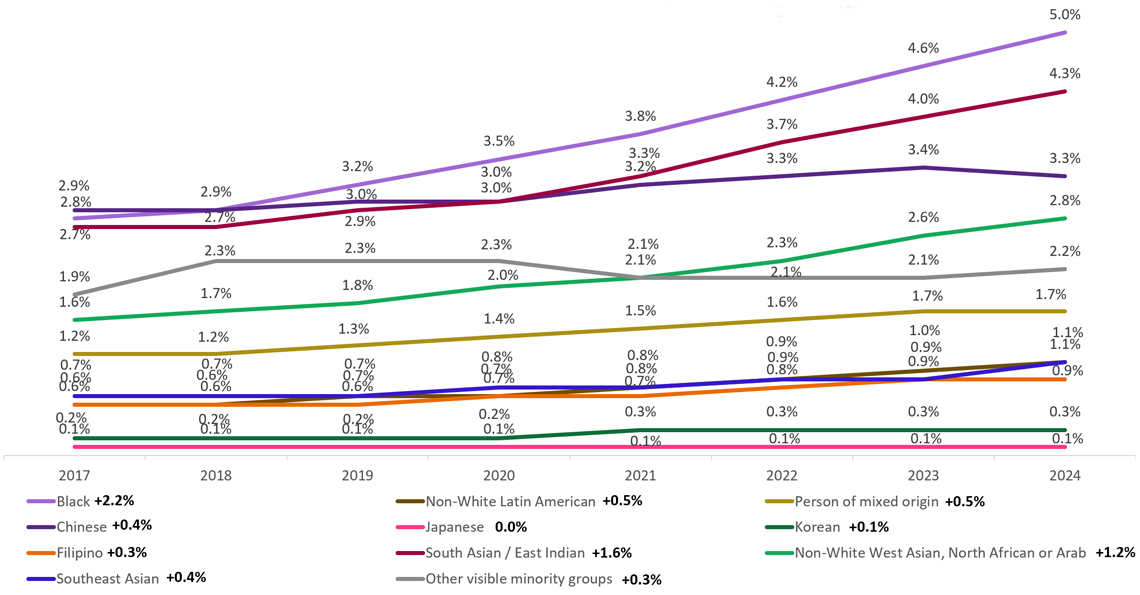
TBS publishes some rich infographics and infographics: Employment Equity Demographic Snapshot 2023–2024

Figure 33: Representation trends for members of visible minorities by subgroup – percentage

Text version below:


Public service shrinks by nearly 10,000, with tax, immigration hit the hardest

Interestingly, core public administration, the basis for employment equity reports, only shrank by some 3,000 (CRA not included in core public administration, meaning that IRCC had the vast majority of cuts). The 2023-24 EE report shows an increase, but as I go through hiring, promotion, and separation data, hiring has started to decrease. Real issues, as others have flagged, with cuts disproportionately affecting younger workers. More to come:

The federal public service shed almost 10,000 people last year, with the Canada Revenue Agency and Immigration, Refugees and Citizenship Canada losing the most employees.

The last time the public service contracted was in 2015, when the number of people employed dropped just slightly from 257,138 to 257,034.

The number of public servants employed by the federal government fell from 367,772 to 357,965 over the last year.

The CRA lost 6,656 employees between 2024 and 2025, dropping from 59,155 to 52,499. The size of the Immigration, Refugees and Citizenship Canada workforce fell from 13,092 to 11,148, a loss of 1,944 employees.

The Public Health Agency of Canada lost 879 employees, Shared Services Canada dropped 608 employees, Health Canada lost 559 and the Canadian Food Inspection Agency lost 453.

Some departments and agencies saw their workforces expand over the past year. The RCMP hired another 911 public servants, Elections Canada hired another 479, National Defence hired an extra 381 and Global Affairs Canada took on another 218.

The data does not include employees on leave without pay, locals employed outside of Canada, RCMP regular force and civilian members, Canadian Armed Forces members, employees of the National Capital Commission and those who work for the Canadian Security Intelligence Service.

Most of those who lost their jobs were “term” employees — people hired for a limited period of time. Between 2024 and 2025, the public service lost almost 8,000 term employees.

The government also dropped almost 3,000 casual employees — people who can’t be employed by any one government department or agency for more than 90 days — and 1,750 students.

The number of permanent federal public service employees increased by about 2,700 last year.

More than three-quarters of the people who left the federal public service last year were under the age of 35.

Of those who lost their jobs, 4,413 were between the ages of 25 and 29, another 3,354 were between the ages of 20 and 24, 563 were aged 30 to 34 and 246 were under 20.

Lori Turnbull, a professor of political science at Dalhousie University, said it’s not surprising that most of the positions eliminated were term positions — short-term positions that don’t have to be renewed.

“These contract positions are often vehicles for entry into the public service,” Turnbull said.

David McLaughlin, executive editor of Canadian Government Executive Media and former president and CEO of the Institute on Governance, said term employees and younger staffers are the easiest people for governments to cut.

“If you’re paying people out, they don’t require big packages, so they are the easiest, cheapest employees to let go,” he said.

But by dropping younger employees whose careers are just beginning, he said, the government risks missing out on the kind of cultural change and innovation the public service badly needs.

“You run the longer-term risk by letting go younger people who may be dedicating their careers and to public service,” he said. “You are simply reinforcing the older sub-performers that may exist in the public service.

“I would not recommend this as an approach to resolving public service spending.”

The government spent $43.3 billion on public servants’ salaries in 2023-24, according to the parliamentary budget officer. It spent a $65.3 billion on all employee compensation, including pensions, overtime and bonuses.

PBO data also indicates that, in 2023, the average salary for a full-time public servant was $98,153.

The Treasury Board of Canada Secretariat said it could not provide an average salary for public servants for 2024 or 2025.

Public service employees have been braced for layoffs since the previous Liberal government launched efforts to refocus federal spending in 2023.

In the 2024 budget, ­the previous government said it expected the public service population to decline by around 5,000 full-time positions over the subsequent four years.

It also said that, starting on April 1, 2025, departments and agencies would be required to cover a portion of increased operating costs with existing resources.

Prime Minister Mark Carney has vowed to cap, not cut, the federal public service, though his government has given little indication of what that might entail. The prime minister also has promised to launch a “comprehensive” review of government spending with the aim of increasing its productivity.

Hundreds of workers in the Canada Revenue Agency, Employment and Social Development Canada and Immigration, Refugees and Citizenship Canada have been laid off recently.

Those organizations also saw their numbers increase during the pandemic years.

Turnbull said that, with the pandemic over and immigration numbers being scaled down, the federal government sees this downsizing as “logical.”

McLaughlin, meanwhile, warned that downsizing only offers “episodic savings” and wondered whether service delivery can keep up with demand.

Source: Public service shrinks by nearly 10,000, with tax, immigration hit the hardest

Nicolas: De Los Angeles à Kananaskis

Discomforting possible parallel. We will see this upcoming weekend:

….Ce qui se passe à Los Angeles représente un tournant, sur deux principaux aspects.

Premièrement, sur le fond, soit la violence politique envers les personnes immigrantes. Les agents de contrôle de l’immigration (ICE) arrêtent des parents sur leurs lieux de travail pendant que leurs enfants sont à l’école et tentent de se déployer dans des écoles primaires pour y interroger des enfants. On a vu d’autres enfants être privés de leur droit à être représentés par un avocat et être interrogés seuls par les autorités. On a déjà vu aussi, un peu partout au pays, des gens être « déportés » vers des prisons du Salvador et à Guantánamo. J’utilise le mot « déportés » entre guillemets, puisqu’il n’est pas question de retourner les gens vers leur pays d’origine : il s’agit plus de kidnappings. Dans une ville comme Los Angeles, s’en prendre à la population immigrante au statut irrégulier, c’est s’en prendre au tissu social, économique et communautaire de la métropole. La population résiste, parce que les personnes qui sont ciblées par ICE sont indissociables de la population même.

Si l’on considère que les personnes qui ne possèdent pas la citoyenneté d’un pays n’ont pas de droits fondamentaux, la démocratie est déjà mise à mal.

Deuxièmement, sur la résistance politique qui se déploie face à ICE. Lorsque des citoyens décident de dénoncer le fait que des parents soient séparés brutalement de leurs enfants, ou que des enfants soient séparés brutalement de leurs parents, ils exercent leur liberté de conscience politique, leur liberté d’expression et leurs droits civiques. En déployant des agents militaires sans le consentement du gouverneur de l’État, et sans que la situation le justifie, Trump franchit encore une autre ligne. La question grave qui se pose désormais, c’est : existe-t-il dorénavant une possibilité que les élections de mi-mandat ne soient pas des élections libres ? Parce que lorsqu’on commence à gérer le débat politique par l’intimidation armée, où et quand s’arrête-t-on, et pourquoi ?

Revenons au Canada, et à la tentation, qui remonte par soubresauts, de « normaliser » nos relations avec États-Unis. Bien sûr, vu que notre économie est en jeu, ça se comprend tout à fait. Mais il existe un risque sérieux, vu le rythme où Washington s’enfonce, que nos liens avec nos voisins nous entraînent aussi vers l’abysse avec eux. Et par abysse, j’entends ici une forme d’abysse morale. Si la démocratie est précieuse pour les Canadiens, on ne peut s’attacher aussi intimement à un régime déterminé à la fragiliser, chez nous comme chez eux.

Alors que le G7 s’ouvre à Kananaskis, en Alberta, j’ai certaines appréhensions. L’Histoire ne se répète jamais, mais je crois que l’on peut tout de même tirer certaines leçons de l’échec monumental des Accords de Munich de 1938. J’espère que les chefs d’État seront plus rapides, cette fois-ci, à reconnaître en leur sein l’acteur qui affiche un mépris ouvert pour la règle de droit.

Source: De Los Angeles à Kananaskis

…. What is happening in Los Angeles represents a turning point, on two main aspects.

First, on the substance, either political violence against immigrants. Immigration Control Officers (ICE) arrest parents at their workplaces while their children are in school and try to deploy to primary schools to interview children. Other children have been deprived of their right to be represented by a lawyer and questioned alone by the authorities. We have also seen, all over the country, people being “deported” to prisons in El Salvador and Guantánamo. I use the word “deported” in quotation marks, since there is no question of returning people to their country of origin: it is more about kidnappings. In a city like Los Angeles, attacking the irregular immigrant population is attacking the social, economic and community fabric of the metropolis. The population resists, because the people who are targeted by ICE are inseparable from the population itself.

If we consider that people who do not have the citizenship of a country do not have fundamental rights, democracy is already being damaged.

Secondly, on the political resistance that is unfolding against ICE. When citizens decide to denounce the fact that parents are abruptly separated from their children, or that children are abruptly separated from their parents, they exercise their freedom of political conscience, their freedom of expression and their civil rights. By deploying military agents without the consent of the governor of the state, and without the situation justifying it, Trump crosses yet another line. The serious question that now arises is: is there now a possibility that midterm elections are not free elections? Because when we begin to manage the political debate through armed intimidation, where and when do we stop, and why?

Let’s go back to Canada, and to the temptation, which is rising by ups, to “normalize” our relations with the United States. Of course, since our economy is at stake, it is quite understandable. But there is a serious risk, given the pace at which Washington is sinking, that our links with our neighbors also lead us to the abyss with them. And by abyss, I mean here a form of moral abyss. If democracy is valuable to Canadians, we cannot be so intimately attached to a regime determined to weaken it, both at home and at home.

As the G7 opens in Kananaskis, Alberta, I have some apprehensions. History never repeats itself, but I believe that we can still learn some lessons from the monumental failure of the 1938 Munich Agreements. I hope that the Heads of State will be quicker, this time, to recognize within them the actor who displays an open contempt for the rule of law.

The Functionary On PM Carney’s Work Style

Another interesting assessment of Carney’s management style:

“For too long, when federal agencies have examined a new project, their immediate question has been ‘why?’ With this bill, we will instead ask ourselves ‘how?’” he said.

That’s a signal.

He expects the public service to change how it works: less process, more results. Less caution, more action. Fewer barriers, more execution.

The bill also creates a Major Projects Office — a single federal point of contact to help priority projects through assessment and permitting.

It’s a tall order: a major cultural shift from administration to execution. From gatekeepers to doers. Public servants managed to do it during the pandemic, when rules loosened and they were galvanized by the mission to protect the health of Canadians.

But this time around it won’t be easy. As one long-time deputy minister put it, this is about a “client-focused approach to delivery” for a system built on managing risk and compliance.

“This legislation is a test for us to prove we can deliver. People are excited, but we’ll have to work really hard to do it,” said a senior bureaucrat not authorized to speak publicly.

“How do we streamline our processes to be more efficient? How do we actually think about the national interests of the country while recognizing environmental and Indigenous rights? That culture shift is a different way of thinking and focuses on execution.”….

Ready or not, Carney demands answers
Word has spread fast that Carney doesn’t suffer weak briefings. He’s known to cut them short when officials can’t answer his questions — and to call people out when they’re unprepared.

The stories get retold, maybe reshaped — it is Ottawa, after all — but the message has landed: come ready or don’t come at all.

Everyone’s heard a version: Carney meets with a senior bureaucrat who can’t answer a question. He stops the briefing cold and in so many words tells them to come back when they know their file. Ouch.

The risk in that kind of exchange? Officials might start pulling their punches — and stop speaking truth to power.

Carney brings a “toughness,” as one senior bureaucrat told me. He expects the clerk and deputy ministers to know their files cold. No vague answers. No promises to follow up. He wants clear answers in the room. “He digs and digs,” said one official. “People will just have to adjust and be ready for that.”

Source: The Functionary On PM Carney’s Work Style

How DOGE’s push to amass data could hurt the reliability of future U.S. statistics

Part of the destruction of government institutions under the Trump administration:

Falling public participation in surveys and trust in government have plagued the U.S. Census Bureau for decades.

And some of the agency’s current and former workers say there’s a new complication to gathering enough survey responses to produce key statistics for the country.

The Trump administration’s murky handling of data, which has sparked investigations and lawsuits alleging privacy violations, has become one of the reasons people cite when declining to share their information for the federal government’s ongoing surveys, these workers say.

“I got more people asking me how I know information isn’t going to be sold or given away,” says a former field representative, who says they were met with “a lot of suspicion” and specific mentions of Elon Musk, President Trump’s billionaire adviser who set up the DOGE team, from some households they tried to interview earlier this year. The former bureau employee, who was let go as part of the Trump administration’s downsizing of the federal government, asked not to be named because they fear retaliation.

A current field representative says they don’t “feel as comfortable” in their role as they felt asking questions for surveys last year — and neither do some people who had previously shared their information. One person specifically mentioned DOGE when declining a follow-up interview, says the current representative, who asked NPR not to name them because they are not authorized to speak publicly.

“It’s a system that runs on trust, and the trust, I would say, has been declining,” the current field representative says. “It makes me sad as an American that distrust is at that level. But I do understand it. I fear for the data I’m collecting. Is it going to be misused? And the privacy guarantees that I describe to people — are those going to be respected?”

These questions don’t surprise Nancy Bates, a former senior researcher for survey methodology at the bureau. Bates has tracked declining public participation in the census going back to the 1990 tally.

Federal law prohibits the bureau from releasing information that would identify a person or business to anyone, including other federal agencies and law enforcement. But a report Bates helped prepare during the first Trump administration found 28% of people surveyed in 2018 said they were very or extremely concerned the bureau would not keep their 2020 census answers confidential.

“Even prior to DOGE, the Census Bureau was always dealing with a level of mistrust about privacy and confidentiality,” says Bates, who, after retiring from the agency in 2020, helped lead its 2030 census advisory committee before the Trump administration disbanded it. “I absolutely can see why the public concern would be increased following these unauthorized and illegal access to data.”…

Source: How DOGE’s push to amass data could hurt the reliability of future U.S. statistics

Savoie: Public service reform is only possible if the Prime Minister champions the project

Yep:

…The government’s agenda can be developed by asking a series of questions. What government structure is needed to promote a unified, single Canadian economy? How can we best redirect resources to high-priority areas such as trade and national defence? How can Ottawa pull back from more areas of provincial jurisdiction? The federal government has nearly 300 organizations, and it’s time to weed out those that are past their best-before dates; the same can be said about some federal government programs. 

But unless the Prime Minister ensures that these questions are answered and action is taken, the government will be like the proverbial goldfish, going around and around in its bowl repeating nice castle, nice castle

Source: Public service reform is only possible if the Prime Minister champions the project

ICYMI: Former top bureaucrat Jocelyne Bourgon calls for bold public service reform to match Carney’s economic plan

As always, the challenge lies in the doing, but a good list:

…Among areas to start with:

Previous promises: Governments should take a hard look at pre-election and election commitments. If they no longer fit the fiscal or policy needs, restructure, postpone – or drop them. Finding cheaper ways to deliver them should also be on the table, too.

Review temporary funding: Governments have long relied on “temporary funding” for short-term initiatives, which can be up to 30 per cent of some departments’ budgets. This distorts the true deficit picture, encourages governments to focus on “announceables,” and leaves others to manage expiring funds. Review them to ensure these initiatives align with government priorities, such as reducing dependency on the U.S., or to phase them out altogether.

Tax Expenditures: Canada’s tax system hasn’t been reassessed since the 1960s, and most tax credits and exemptions haven’t been reviewed since the ’80s. Bourgon says revisiting them could yield more savings than any program review could.

Simplify, simplify, simplify: A key step is to simplify – everythingFrom regulations, legislation, to forms to internal processes, simplification is its own type of reform, and one that could make government more effective and less costly.

Agencies and Structures: When Bourgon was clerk, there were 109 departments, agencies, and Crown corporations. Today, there may be 250 – or more. That growth has brought over 2,000 senior executives, each with internal supports. Has it improved results? She suggests full portfolio-level reviews to cut, consolidate, or integrate agencies.

Central agencies: Since 2000, the budgets of the Privy Council Office, Treasury Board, and Finance have soared — up 250 per cent, 540 per cent and 220 per cent respectively. Bourgon says it’s time to review them. When central agencies get too operational, she warns, they lose the big picture. Bogged down in transactions, they stop thinking strategically – and when excellence slips, the public service falls behind its global peers.

Start at the top: Look at political staff. Their ranks have swelled to 765, up 60 per cent since 2011 and six times more than the U.K., a country with nearly double our population. Shrink the number and refocus their roles on building political alliances, maintaining party unity, and managing Parliament. The savings might be small, but the message is powerful.

And, she notes, a smaller cabinet also performs better – and costs less.

Source: Former top bureaucrat Jocelyne Bourgon calls for bold public service reform to match Carney’s economic plan